

IEC 60721-3-2:1997
(Main)Classification of environmental conditions - Part 3: Classification of groups of environmental parameters and their severities - Section 2: Transportation
General Information
- Abstract
IEC 60721-3-2:1997 Defines the environmental conditions to which a product is subjected while being transported from one place to another after being made ready for dispatch from the manufacturing factory.
- Status
- Published
- Publication Date
- 05-Mar-1997
- Technical Committee
- TC 104 - Environmental conditions, classification and methods of test
- Drafting Committee
- MT 19 - TC 104/MT 19
- Current Stage
- DELPUB - Deleted Publication
- Start Date
- 23-Feb-2018
- Completion Date
- 28-Aug-2026
Buy Documents
IEC 60721-3-2:1997 - Classification of environmental conditions - Part 3: Classification of groups of environmental parameters and their severities - Section 2: Transportation Released:3/6/1997
Overview
IEC 60721-3-2:1997 is an international standard developed by the International Electrotechnical Commission (IEC) that focuses on the classification of environmental conditions during transportation of products. This part of IEC 60721 specifically classifies groups of environmental parameters and their severities that products encounter from the moment they leave the manufacturing factory to their destination, covering various transportation modes such as road, rail, water, air, and vertical transport systems.
This standard is essential for manufacturers, transporters, and quality assurance professionals to ensure the reliable handling and delivery of products under defined environmental conditions. It helps in designing packaging, transport methods, and product robustness suitable for transportation environments.
Key Topics
Scope of Environmental Conditions during Transportation
IEC 60721-3-2 applies to the environmental parameters a product is subjected to in transit after factory dispatch. This includes climatic, mechanical, biological, chemical, and other physical stressors experienced during transport.Classification of Environmental Parameter Groups and Severities
The standard defines and classifies environmental agents such as temperature extremes, humidity, vibration, shock, contamination by chemically or mechanically active substances, and biological impacts, specifying their severity levels.Modes of Transport Covered
The classification includes:- Road transportation (cars, trucks, conveyors, animals)
- Rail transportation (trains, trams, conveyors)
- Waterways (ships, hovercraft, conveyors)
- Air transportation (airplanes, conveyors)
- Vertical transport (cranes, lifts, cable cars)
Environmental Conditions Focused on Transportation
The emphasis is on conditions potentially harmful to products or packaging during loading, unloading, and transit.Reference to Related IEC and ISO Standards
The standard refers to related normative documents and IEC standards such as IEC 60721-1 (environmental parameters and severities) and IEC 60721-2 (environmental conditions in nature) for comprehensive environmental condition classification.
Applications
Product Design & Packaging
Manufacturers can use IEC 60721-3-2 classifications to design products and packaging systems capable of withstanding specific transportation environmental stresses, reducing damage and ensuring safety.Logistics and Supply Chain Management
Logistics professionals can plan transportation modes and routes considering environmental risks, selecting proper packaging, storage, and handling strategies accordingly.Quality Assurance in Transport
The standard helps establish criteria for product acceptance or rejection based on environmental exposure during transport, supporting inspection and testing protocols.Risk Assessment and Mitigation
By understanding the defined environmental parameters and their severities, companies can identify potential risks during shipment and implement mitigation techniques such as cushioning, insulation, or protective coatings.
Related Standards
IEC 60721-1: Environmental Parameters and Their Severities
Provides terminology and classification of individual environmental parameters relevant to products.IEC 60721-2: Environmental Conditions Present in Nature
Describes natural environmental conditions to which products might be exposed during operation or storage.IEC 27, IEC 417, IEC 617
Relevant for graphical and letter symbols used within IEC standards documentation.ISO Standards
Collaborative work with ISO ensures harmonized classification of environmental conditions relevant to product design and transportation.
Keywords
- IEC 60721-3-2
- Environmental conditions classification
- Transportation environment standards
- Product packaging environment
- Transport environmental parameters
- Transportation modes environmental impact
- Environmental severity classification
- IEC standards for transportation
- Product transportation durability
- Climatic and mechanical transport conditions
IEC 60721-3-2:1997 serves as a fundamental reference for industries aiming to certify product resilience against the challenges faced during transportation, thus enhancing product reliability, reducing losses, and improving customer satisfaction globally.
Relations
- Effective Date
- 05-Sep-2023
Buy Documents
IEC 60721-3-2:1997 - Classification of environmental conditions - Part 3: Classification of groups of environmental parameters and their severities - Section 2: Transportation Released:3/6/1997
Get Certified
Connect with accredited certification bodies for this standard

IMP NDT d.o.o.
Non-destructive testing services. Radiography, ultrasonic, magnetic particle, penetrant, visual inspection.
Inštitut za kovinske materiale in tehnologije
Institute of Metals and Technology. Materials testing, metallurgical analysis, NDT.
Q Techna d.o.o.
NDT and quality assurance specialist. 30+ years experience. NDT personnel certification per ISO 9712, nuclear and thermal power plant inspections, QA/
Sponsored listings
Frequently Asked Questions
IEC 60721-3-2:1997 is a standard published by the International Electrotechnical Commission (IEC). Its full title is "Classification of environmental conditions - Part 3: Classification of groups of environmental parameters and their severities - Section 2: Transportation". This standard covers: IEC 60721-3-2:1997 Defines the environmental conditions to which a product is subjected while being transported from one place to another after being made ready for dispatch from the manufacturing factory.
IEC 60721-3-2:1997 Defines the environmental conditions to which a product is subjected while being transported from one place to another after being made ready for dispatch from the manufacturing factory.
IEC 60721-3-2:1997 is classified under the following ICS (International Classification for Standards) categories: 19.040 - Environmental testing. The ICS classification helps identify the subject area and facilitates finding related standards.
IEC 60721-3-2:1997 has the following relationships with other standards: It is inter standard links to IEC 60721-3-2:2018. Understanding these relationships helps ensure you are using the most current and applicable version of the standard.
IEC 60721-3-2:1997 is available in PDF format for immediate download after purchase. The document can be added to your cart and obtained through the secure checkout process. Digital delivery ensures instant access to the complete standard document.
Standards Content (Sample)
NORME CEI
INTERNATIONALE
IEC
60721-3-2
INTERNATIONAL
Deuxième édition
STANDARD
Second edition
1997-03
Classification des conditions d’environnement –
Partie 3:
Classification des groupements des agents
d’environnement et de leurs sévérités –
Section 2: Transport
Classification of environmental conditions –
Part 3:
Classification of groups of environmental parameters
and their severities –
Section 2: Transportation
Numéro de référence
Reference number
CEI/IEC 60721-3-2: 1997
Validité de la présente publication Validity of this publication
Le contenu technique des publications de la CEI est cons- The technical content of IEC publications is kept under
tamment revu par la CEI afin qu'il reflète l'état actuel de constant review by the IEC, thus ensuring that the content
la technique. reflects current technology.
Des renseignements relatifs à la date de reconfirmation de Information relating to the date of the reconfirmation of the
la publication sont disponibles auprès du Bureau Central de publication is available from the IEC Central Office.
la CEI.
Les renseignements relatifs à ces révisions, à l'établis- Information on the revision work, the issue of revised
sement des éditions révisées et aux amendements peuvent editions and amendments may be obtained from IEC
être obtenus auprès des Comités nationaux de la CEI et National Committees and from the following IEC
dans les documents ci-dessous: sources:
• Bulletin de la CEI • IEC Bulletin
• Annuaire de la CEI • IEC Yearbook
Publié annuellement Published yearly
• Catalogue des publications de la CEI • Catalogue of IEC publications
Publié annuellement et mis à jour régulièrement Published yearly with regular updates
Terminologie Terminology
En ce qui concerne la terminologie générale, le lecteur se For general terminology, readers are referred to IEC 50:
reportera à la CEI 50: Vocabulaire Electrotechnique Inter- International Electrotechnical Vocabulary (IEV), which is
national (VEI), qui se présente sous forme de chapitres issued in the form of separate chapters each dealing
séparés traitant chacun d'un sujet défini. Des détails with a specific field. Full details of the IEV will be
complets sur le VEI peuvent être obtenus sur demande. supplied on request. See also the IEC Multilingual
Voir également le dictionnaire multilingue de la CEI. Dictionary.
Les termes et définitions figurant dans la présente publi- The terms and definitions contained in the present publi-
cation ont été soit tirés du VEI, soit spécifiquement cation have either been taken from the IEV or have been
approuvés aux fins de cette publication. specifically approved for the purpose of this publication.
Symboles graphiques et littéraux Graphical and letter symbols
Pour les symboles graphiques, les symboles littéraux et les For graphical symbols, and letter symbols and signs
signes d'usage général approuvés par la CEI, le lecteur approved by the IEC for general use, readers are referred to
consultera: publications:
– la CEI 27: Symboles littéraux à utiliser en – IEC 27: Letter symbols to be used in electrical
électrotechnique; technology;
– la CEI 417: Symboles graphiques utilisables – IEC 417: Graphical symbols for use on
sur le matériel. Index, relevé et compilation des equipment. Index, survey and compilation of the
feuilles individuelles; single sheets;
– la CEI 617: Symboles graphiques pour schémas; – IEC 617: Graphical symbols for diagrams;
et pour les appareils électromédicaux, and for medical electrical equipment,
– la CEI 878: Symboles graphiques pour – IEC 878: Graphical symbols for electromedical
équipements électriques en pratique médicale. equipment in medical practice.
Les symboles et signes contenus dans la présente publi- The symbols and signs contained in the present publication
cation ont été soit tirés de la CEI 27, de la CEI 417, de la have either been taken from IEC 27, IEC 417, IEC 617
CEI 617 et/ou de la CEI 878, soit spécifiquement approuvés and/or IEC 878, or have been specifically approved for the
aux fins de cette publication. purpose of this publication.
Publications de la CEI établies par le IEC publications prepared by the same
même comité d'études technical committee
L'attention du lecteur est attirée sur les listes figurant à la fin The attention of readers is drawn to the end pages of this
de cette publication, qui énumèrent les publications de la publication which list the IEC publications issued by the
CEI préparées par le comité d'études qui a établi la technical committee which has prepared the present
présente publication. publication.
NORME
CEI
INTERNATIONALE
IEC
60721-3-2
INTERNATIONAL
Deuxième édition
STANDARD
Second edition
1997-03
Classification des conditions d’environnement –
Partie 3:
Classification des groupements des agents
d’environnement et de leurs sévérités –
Section 2: Transport
Classification of environmental conditions –
Part 3:
Classification of groups of environmental parameters
and their severities –
Section 2: Transportation
IEC 1997 Droits de reproduction réservés Copyright - all rights reserved
Aucune partie de cette publication ne peut être reproduite ni utilisée No part of this publication may be reproduced or utilized in
sous quelque forme que ce soit et par aucun procédé, électronique any form or by any means, electronic or mechanical, including
ou mécanique, y compris la photocopie et les microfilms, sans photocopying and microfilm, without permission in writing from
l'accord écrit de l'éditeur. the publisher.
International Electrotechnical Commission 3, rue de Varembé Geneva, Switzerland
Telefax: +41 22 919 0300 e-mail: inmail@iec.ch IEC web site http: //www.iec.ch
CODE PRIX
Commission Electrotechnique Internationale
PRICE CODE T
International Electrotechnical Commission
Pour prix, voir catalogue en vigueur
For price, see current catalogue
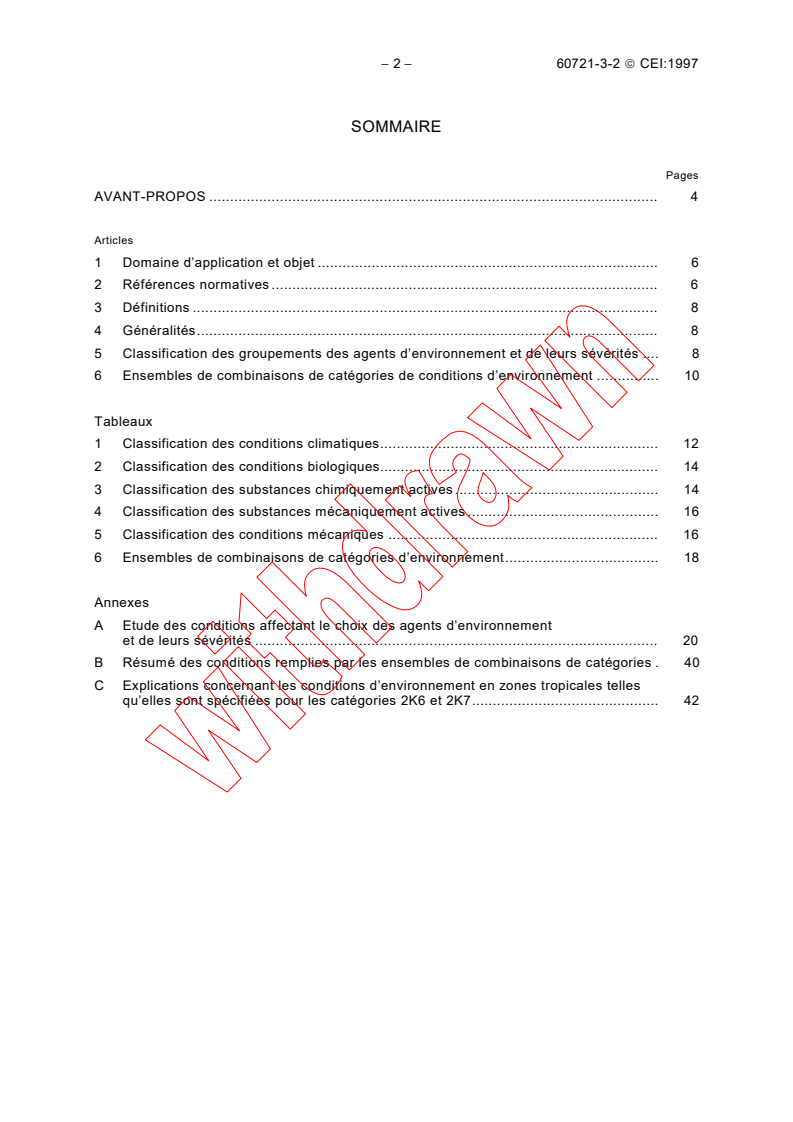
− 2 − 60721-3-2 CEI:1997
SOMMAIRE
Pages
AVANT-PROPOS . 4
Articles
1 Domaine d’application et objet . 6
2 Références normatives . 6
3 Définitions . 8
4 Généralités. 8
5 Classification des groupements des agents d’environnement et de leurs sévérités . 8
6 Ensembles de combinaisons de catégories de conditions d’environnement . 10
Tableaux
1 Classification des conditions climatiques. 12
2 Classification des conditions biologiques. 14
3 Classification des substances chimiquement actives . 14
4 Classification des substances mécaniquement actives . 16
5 Classification des conditions mécaniques . 16
6 Ensembles de combinaisons de catégories d’environnement. 18
Annexes
A Etude des conditions affectant le choix des agents d’environnement
et de leurs sévérités . 20
B Résumé des conditions remplies par les ensembles de combinaisons de catégories . 40
C Explications concernant les conditions d’environnement en zones tropicales telles
qu’elles sont spécifiées pour les catégories 2K6 et 2K7. 42
60721-3-2 IEC:1997 − 3 −
CONTENTS
Page
FOREWORD . 5
Clause
1 Scope and object. 7
2 Normative references . 7
3 Definitions . 9
4 General . 9
5 Classification of groups of environmental parameters and their severities. 9
6 Sets of environmental condition class combinations . 11
Tables
1 Classification of climatic conditions. 13
2 Classification of biological conditions . 15
3 Classification of chemically active substances. 15
4 Classification of mechanically active substances. 17
5 Classification of mechanical conditions . 17
6 Sets of environmental class combinations. 19
Annexes
A Survey of conditions affecting the choice of environmental parameters and their
severities. 21
B Summary of conditions covered by the sets of class combinations. 41
C Explanation of the environmental conditions in tropical areas as specified
in classes 2K6 and 2K7 . 43
− 4 − 60721-3-2 CEI:1997
COMMISSION ÉLECTROTECHNIQUE INTERNATIONALE
_________
CLASSIFICATION DES CONDITIONS D’ENVIRONNEMENT –
Partie 3: Classification des groupements des agents
d’environnement et de leurs sévérités –
Section 2: Transport
AVANT-PROPOS
1) La CEI (Commission Electrotechnique Internationale) est une organisation mondiale de normalisation
composée de l'ensemble des comités électrotechniques nationaux (Comités nationaux de la CEI). La CEI a
pour objet de favoriser la coopération internationale pour toutes les questions de normalisation dans les
domaines de l'électricité et de l'électronique. A cet effet, la CEI, entre autres activités, publie des Normes
Internationales. Leur élaboration est confiée à des comités d'études, aux travaux desquels tout Comité
national intéressé par le sujet traité peut participer. Les organisations internationales, gouvernementales et
non gouvernementales, en liaison avec la CEI, participent également aux travaux. La CEI collabore
étroitement avec l'Organisation Internationale de Normalisation (ISO), selon des conditions fixées par accord
entre les deux organisations.
2) Les décisions ou accords officiels de la CEI concernant les questions techniques, représentent, dans la
mesure du possible un accord international sur les sujets étudiés, étant donné que les Comités nationaux
intéressés sont représentés dans chaque comité d’études.
3) Les documents produits se présentent sous la forme de recommandations internationales. Ils sont publiés
comme normes, rapports techniques ou guides et agréés comme tels par les Comités nationaux.
4) Dans le but d'encourager l'unification internationale, les Comités nationaux de la CEI s'engagent à appliquer
de façon transparente, dans toute la mesure possible, les Normes internationales de la CEI dans leurs normes
nationales et régionales. Toute divergence entre la norme de la CEI et la norme nationale ou régionale
correspondante doit être indiquée en termes clairs dans cette dernière.
5) La CEI n’a fixé aucune procédure concernant le marquage comme indication d’approbation et sa respon-
sabilité n’est pas engagée quand un matériel est déclaré conforme à l’une de ses normes.
6) L’attention est attirée sur le fait que certains des éléments de la présente Norme internationale peuvent faire
l’objet de droits de propriété intellectuelle ou de droits analogues. La CEI ne saurait être tenue pour respon-
sable de ne pas avoir identifié de tels droits de propriété et de ne pas avoir signalé leur existence.
La Norme internationale CEI 60721-3-2 a été établie par le comité d’études 75 de la CEI:
Classification des conditions d’environnement.
Cette deuxième édition annule et remplace la première édition parue en 1985, l’amendement 1
(1991) et l’amendement 2 (1993). Le troisième amendement a conduit à la publication de cette
édition consolidée.
Le texte de cette norme est issu des documents suivants:
FDIS Rapport de vote
75/278/FDIS 75/293/RVD
Le rapport de vote indiqué dans le tableau ci-dessus donne toute information sur le vote ayant
abouti à l'approbation de cette norme.
La CEI 721 comprend les parties suivantes, présentées sous le titre général Classification des
conditions d’environnement:
− Partie 1: 1990, Agents d’environnement et leurs sévérités
− Partie 2: Conditions d’environnement présentes dans la nature
− Partie 3: Classification des groupements des agents d’environnement et de leurs
sévérités.
Les annexes A, B et C sont données uniquement à titre d’information.
60721-3-2 IEC:1997 − 5 −
INTERNATIONAL ELECTROTECHNICAL COMMISSION
_________
CLASSIFICATION OF ENVIRONMENTAL CONDITIONS –
Part 3: Classification of groups of environmental parameters
and their severities –
Section 2: Transportation
FOREWORD
1) The IEC (International Electrotechnical Commission) is a worldwide organization for standardization
comprising all national electrotechnical committees (IEC National Committees). The object of the IEC is to
promote international co-operation on all questions concerning standardization in the electrical and electronic
fields. To this end and in addition to other activities, the IEC publishes International Standards. Their
preparation is entrusted to technical committees; any IEC National Committee interested in the subject dealt
with may participate in this preparatory work. International, governmental and non-governmental organizations
liaising with the IEC also participate in this preparation. The IEC collaborates closely with the International
Organization for Standardization (ISO) in accordance with conditions determined by agreement between the
two organizations.
2) The formal decisions or agreements of the IEC on technical matters express, as nearly as possible, an
international consensus of opinion on the relevant subjects since each technical committee has representation
from all interested National Committees.
3) The documents produced have the form of recommendations for international use and are published in the
form of standards, technical reports or guides and they are accepted by the National Committees in that
sense.
4) In order to promote international unification, IEC National Committees undertake to apply IEC International
Standards transparently to the maximum extent possible in their national and regional standards. Any
divergence between the IEC Standard and the corresponding national or regional standard shall be clearly
indicated in the latter.
5) The IEC provides no marking procedure to indicate its approval and cannot be rendered responsible for any
equipment declared to be in conformity with one of its standards.
6) Attention is drawn to the possibility that some of the elements of this International Standard may be the
subject of patent rights. The IEC shall not be held responsible for identifying any or all such patent rights.
International Standard IEC 60721-3-2 has been prepared by IEC technical committee 75:
Classification of environmental conditions.
This second edition cancels and replaces the first edition published in 1985, amendment 1
(1991) and amendment 2 (1993). The third amendment led to the publication of this
consolidated edition.
The text of this standard is based on the following documents:
FDIS Report on voting
75/278/FDIS 75/293/RVD
Full information on the voting for the approval of this standard can be found in the report on
voting indicated in the above table.
IEC 721 consists of the following parts, under the general title Classification of environmental
conditions:
− Part 1: 1990, Environmental parameters and their severities
− Part 2: Environmental conditions appearing in nature
− Part 3: Classification of groups of environmental parameters and their severities.
Annexes A, B and C are for information only.
− 6 − 60721-3-2 CEI:1997
CLASSIFICATION DES CONDITIONS D’ENVIRONNEMENT –
Partie 3: Classification des groupements des agents
d’environnement et de leurs sévérités –
Section 2: Transport
1 Domaine d’application et objet
La présente section de la CEI 60721-3 classifie les groupements d’agents d’environnement et
de leurs sévérités auxquelles un produit est soumis alors qu’il est transporté d’un lieu à un
autre, passé le stade où il est prêt à l’expédition hors de l’usine de production.
Il a été tenu compte des moyens de transport les plus couramment employés, y compris les
moyens suivants:
− transports routiers: voitures, fourgonnettes, camions, animaux, courroies transporteuses;
− transports ferroviaires: trains, tramways, courroies transporteuses;
− transport par voies navigables, fluviales et maritimes: navires, aéroglisseurs, courroies
transporteuses;
− transports aériens: avions, courroies transporteuses;
− transports à la verticale: grues, monte-charges, téléphériques.
Les conditions d’environnement spécifiées dans la présente section sont celles auxquelles est
exposé le produit que l’on transporte. Si le produit est empaqueté, les conditions
d’environnement s’appliquent à l’emballage contenant le produit. On indique seulement les
conditions susceptibles d’être préjudiciables aux produits.
Les conditions applicables au stockage et à l’utilisation sont données dans d’autres sections de
la CEI 721-3.
La présente norme a pour objet de définir les agents d’environnement, et leurs degrés de
sévérité, auxquels un produit sera exposé lorsqu’il se trouve transporté sur terre, sur eau et
par air, y compris le chargement et le déchargement.
Un nombre limité de catégories de conditions d’environnement est donné, couvrant un vaste
domaine d’application. L’utilisateur de cette norme choisira les catégories les plus basses
exigées pour couvrir chacune des conditions du transport en question. Un guide est donné à
l’annexe A à ce sujet.
2 Références normatives
Les documents normatifs suivants contiennent des dispositions qui, par suite de la référence
qui y est faite, constituent des dispositions valables pour la présente section de la CEI 721-3.
Au moment de la publication, les éditions indiquées étaient en vigueur. Tout document normatif
est sujet à révision et les parties prenantes aux accords fondés sur la présente section de la
CEI 721-3 sont invitées à rechercher la possibilité d’appliquer les éditions les plus récentes des
documents normatifs indiqués ci-après. Les membres de la CEI et de l’ISO possèdent le
registre des Normes internationales en vigueur.
60721-3-2 IEC:1997 − 7 −
CLASSIFICATION OF ENVIRONMENTAL CONDITIONS –
Part 3: Classification of groups of environmental parameters
and their severities –
Section 2: Transportation
1 Scope and object
This section of IEC 60721-3 classifies the groups of environmental parameters and their
severities to which a product is subjected while being transported from one place to another
after being made ready for dispatch from the manufacturing factory.
The most commonly used methods of transportation have been taken into account, including
the following:
− road transport: cars, lorries, trucks, animals, conveyors;
− rail transport: trains, trams, conveyors;
− water transport, inland and maritime: ships, hovercraft, conveyors;
− air transport: aircraft, conveyors;
− vertical transport: cranes, transport lifts, cableways.
The environmental conditions specified in this section are those met by the product being
transported. If the product is packed, the environmental conditions apply to the package
containing the product. Only severe conditions, which may be harmful to products, are
included.
Conditions for storage and use are given in other sections of IEC 721-3.
The object of this standard is to classify groups of environmental parameters and their
severities to which a product will be exposed when being transported on ground, water and in
air, including loading and unloading.
A limited number of classes of environmental conditions are given, covering a broad field
of application. The user of this standard should select the lowest classes necessary covering
each of the conditions of the intended transportation. Some guidance for this is given in
annex A.
2 Normative references
The following normative documents contain provisions which, through reference in this text,
constitute provisions of this section of IEC 721-3. At the time of publication, the editions
indicated were valid. All normative documents are subject to revision, and parties to
agreements based on this section of IEC 721-3 are encouraged to investigate the possibility of
applying the most recent editions of the normative documents indicated below. Members of IEC
and ISO maintain registers of currently valid International Standards.
− 8 − 60721-3-2 CEI:1997
CEI 721-1: 1990, Classification des conditions d’environnement − Partie 1: Agents
d’environnement et leurs sévérités
Amendement 1 (1992)
Amendement 2 (1995)
CEI 721-2-1: 1982, Classification des conditions d’environnement − Partie 2: Conditions
d’environnement présentes dans la nature − Température et humidité
Modification 1 (1987)
CEI 721-3-0: 1984, Classification des conditions d’environnement − Partie 3: Classification des
groupements des agents d’environnement et de leurs sévérités − Introduction
Modification 1 (1987)
3 Définitions
Pour les besoins de la présente section de la CEI 721-3, les définitions suivantes sont
applicables, en plus des définitions figurant à l’article 3 de la CEI 721-1.
3.1 protégé contre les intempéries: Le produit, empaqueté ou non empaqueté, est contenu
dans un compartiment assurant un certain degré de protection contre l’environnement, qui peut
aller d’un conteneur à régulation thermique à une bâche étanche placée sur le produit. La
ventilation peut aller du débit d’air contrôlé au repli d’une partie d’une bâche étanche pour
permettre à l’air de circuler normalement.
3.2 non protégé contre les intempéries: Le produit, empaqueté ou non empaqueté, n’est
protégé en aucune façon contre l’environnement.
4 Généralités
Il est instamment recommandé de se reporter à la CEI 721-3-0 afin d’éviter une mauvaise
utilisation des catégories définies dans d’autres sections de la CEI 721-3.
Les sévérités spécifiées sont celles qui ont une faible probabilité d’être dépassées. Toutes les
valeurs spécifiées sont des valeurs maximales ou des valeurs limites. Ces valeurs peuvent être
atteintes mais ne se maintiennent pas de façon permanente. Selon la situation, différentes
fréquences de survenance liées à un certain laps de temps peuvent apparaître. De telles
fréquences de survenance n’ont pas encore été introduites dans la présente norme, mais il
convient de les considérer au sujet de tout agent d’environnement. Il convient de les spécifier
complémentairement, le cas échéant.
Des indications concernant la durée et la fréquence de survenance sont données dans la
modification 1 à la CEI 721-3-0, en tant qu’article 6.
L’attention est attirée sur le fait que des combinaisons des agents d’environnement indiqués
peuvent augmenter leurs effets sur un produit. Cela est particulièrement valable lorsqu’il s’agit
d’une humidité relative élevée, à laquelle s’ajoutent des conditions biologiques, ou des condi-
tions applicables à des substances actives sur le plan chimique ou mécanique.
5 Classification des groupements des agents d’environnement et de leurs sévérités
Les tableaux 1, 2, 3, 4 et 5 donnent un nombre limité de catégories pur les conditions
climatiques (K), les conditions biologiques (B), les substances chimiquement actives (C),
les substances mécaniquement actives (S) et les conditions mécaniques (M). Pour un produit
donné, il convient de se référer à la série complète de catégories, par exemple
2K2/2B1/2C2/2S2/2M3.
60721-3-2 IEC:1997 − 9 −
IEC 721-1: 1990, Classification of environmental conditions − Part 1: Environmental
parameters and their severities
Amendment 1 (1992)
Amendment 2 (1995)
IEC 721-2-1: 1982, Classification of environmental conditions − Part 2: Environmental
conditions appearing in nature − Temperature and humidity
Amendment 1 (1987)
IEC 721-3-0: 1984, Classification of environmental conditions − Part 3: Classification of groups
of environmental parameters and their severities − Introduction
Amendment 1 (1987)
3 Definitions
For the purpose of the present section of IEC 721-3, the following definitions apply, in addition
to the definitions in clause 3 of IEC 721-1.
3.1 weatherprotected: The product, packed or unpacked, is contained within an enclosure
which affords some protection from the environment, ranging from a temperature controlled
container to a waterproof cover placed over the product. Ventilation ranges from controlled air
flow to the raising of part of a waterproof cover to allow for natural air flow.
3.2 non-weatherprotected: The product, packed or unpacked, is not protected in any way
from the environment.
4 General
Reference to IEC 721-3-0 is strongly recommended in order to avoid misuse of the classes
defined in other sections of IEC 721-3.
The severities specified are those which will have a low probability of being exceeded. All
specified values are maximum or limit values. These values may be reached, but do not occur
permanently. Depending on the situation, there may be different frequencies of occurrence
related to a certain period of time. Such frequencies of occurrence have not yet been included
in this standard, but should be considered for any environmental parameter. They should
additionally be specified, if applicable.
Information on the duration and frequency of occurrence is given, as clause 6, in amendment 1
to IEC 721-3-0.
Attention is drawn to the fact that combinations of the environmental parameters given may
increase the effect on a product. This applies especially to the presence of high relative
humidity in addition to biological conditions, or to conditions of chemically or mechanically
active substances.
5 Classification of groups of environmental parameters and their severities
A limited number of classes for climatic conditions (K), biological conditions (B), chemically
active substances (C), mechanically active substances (S) and mechanical conditions (M) are
given in tables 1, 2, 3, 4 and 5. For a given product, reference should be made to the total set
of classes, for example 2K2/2B1/2C2/2S2/2M3.
− 10 − 60721-3-2 CEI:1997
Voir aussi l’article 6.
L’article A.2 de l'annexe A explique sur quoi sont fondées ces catégories.
Les conditions climatiques en zones tropicales, telles qu’elles sont spécifiées dans les caté-
gories 2K6 et 2K7 sont expliquées à l’annexe C.
Lorsque les catégories les plus basses, c’est-à-dire celles comportant le chiffre le plus bas
2K1/2B1/2C1/2S1/2M1, se trouvent combinées, cela représente les conditions auxquelles un
produit est exposé lorsqu’il est transporté dans des conditions très limitées. Lorsque les
catégories les plus élevées, c’est-à-dire celles comportant le chiffre le plus élevé 2K5/2B3/
2C3/2S3/2M3, se trouvent combinées, cela couvre le transport dans des conditions
extrêmement variées, y compris des conditions très sévères.
Toute catégorie couvrant les conditions représentées par un chiffre élevé comprend normale-
ment toutes les catégories représentées par des chiffres inférieurs.
Pour certains agents, il n’a pas encore été possible de quantifier les différents degrés de
sévérité.
L’article A.3 de l'annexe A résume les conditions couvertes par les différentes catégories.
6 Ensembles de combinaisons de catégories de conditions d’environnement
Comme cela a été indiqué à l’article 5, la classification permet un certain nombre de combi-
naisons possibles de conditions d’environnement qui influent sur les produits, quel que soit
l’endroit où ils sont utilisés. Le nombre de possibilités et, dès lors, la flexibilité sont de ce fait
très grands. Cependant, en pratique, cette flexibilité n’est pas toujours un avantage quand, par
exemple, les spécifications sur les conditions d’environnement pour certains endroits sont
rédigées par des parties différentes, produisant de ce fait invariablement des divergences,
certes mineures mais néanmoins gênantes.
Afin de limiter les possibilités à des cas généraux, des ensembles normalisés de combinaisons
de catégories peuvent être choisis dans le tableau 6. Pour un endroit ou un produit donné, on
fait alors référence à cette norme, par exemple IE22. C’est uniquement dans le cas où les
conditions semblent ne pas être remplies par cette spécification que l’on fait référence à
chaque catégorie comme cela est précisé à l’article 5. Par ailleurs, si quelques sévérités des
agents s’écartent de celle(s) des combinaisons de catégories, il convient de l’exprimer en
ajoutant la phrase suivante à la désignation de l’ensemble «mais pour le . (agent) . (sévérité
et unité)», par exemple IE22 mais pour le sable 10 g/m
.
L’annexe B donne un résumé des conditions remplies par les ensembles de combinaisons de
catégories.
60721-3-2 IEC:1997 − 11 −
See also clause 6.
The basis of these classes is explained in clause A.2 of annex A.
Climatic conditions in tropical areas as specified in classes 2K6 and 2K7 are explained in
annex C.
The combination of the lowest classes 2K1/2B1/2C1/2S1/2M1 forms the conditions to which a
product will be subjected when being transported under very restricted conditions. The
combination of the highest classes 2K5/2B3/2C3/2S3/2M3 covers transportation under a very
wide variety of conditions including very severe conditions.
A class with higher digit conditions normally includes all classes with lower digits.
For certain parameters it has not yet been possible to give quantitative values of severities.
A summary of the conditions covered by the classes is given in clause A.3 of annex A.
6 Sets of environmental condition class combinations
As indicated in clause 5, the classification allows a number of possible combinations of
environmental conditions bearing on products wherever used. The number of possibilities, and
thus the flexibility, is therefore very great. In practice, however, this flexibility is not always an
advantage when, for instance, environmental condition specifications for a certain location are
drawn up by different parties, invariably producing small but disturbing divergencies.
In order to limit the possibilities to general cases, standard sets of class combinations may be
selected from table 6. For a given location or product, reference may then be made to this
standard, for example IE22. Only when conditions are not considered to be covered by this
specification, is reference made to each class as indicated in clause 5. Alternatively, if some
severities of parameters deviate from that or those of the class combination, this should be
expressed by the addition to the set designation of the following phrase: “but . (parameter) .
(severity and unit)”, for example IE22 but sand 10 g/m .
Annex B gives a summary of conditions covered by the sets of class combinations.
− 12 − 60721-3-2 CEI:1997
Tableau 1 − Classification des conditions climatiques
Agent d’environnement Unité Catégorie
6) 6)
2K1 2K2 2K3 2K4 2K5 2K5H 2K5L
2K6 2K7
a) Basse température de °C +5 +5
−25 −25 −40 −65 −25 −65 −20
l’air
b) Haute température de °C Non +60 +70 +70 +85 +85 +70 +70 +85
l’air, dans des compar-
1)
timents non ventilés
c) Haute température de °C +40 +40 +40 +40 +55 +55 +40 +40 +55
l’air, dans des comparti-
ments ventilés, ou de
2)
l’air du dehors
°C Non +5/+30
d) Variation de tempé- −25/+25 −25/+30 −40/+30 −65/+30 −25/+30 −65/+30 −20/+30
3)
rature, air/air
e) Variation de tempé- °C Non Non +40/+5 +40/+5 +55/+5 +55/+5 +40/+5 +40/+5 +55/+5
3)
rature air/eau
f) Humidité relative, non % 75 75 95 95 95 95 95 95 95
associée à des varia-
tions de température
°C +30 +30 +40 +45 +50 +50 +45 +45 +50
rapide
g) Humidité relative, % Non Non 95 95 95 95 95 95 95
associée à des varia-
tions rapides de tempé-
°C +5/+30
−25/+30 −40/+30 −65/+30 −25/+30 −65/+30 −20/+30
rature: air/air à humidité
3)
relative élevée
h) Humidité absolue, Non Non 60 60 80 80 60 60 80
g/m
associée à des varia-
tions rapides de tempé-
+70/+15 +70/+15 +85/+15 +85/+15 +70/+15 +70/+15 +85/+15
rature:air/air à teneur en °C
4)
eau élevée
kPa 70 70 70 70 30 30 30 30 30
i) Basse pression
atmosphérique
kPa/min Non Non Non Non 6 6 6 6 6
j) Variation de la
pression atmosphérique
k) Mouvement du milieu m/s Non Non 20 20 30 30 30 30 30
environnant, air
l) Précipitations, pluie mm/min Non Non 6 6 15 15 6 15 15
700 700 1120 1120 1120 1120 1120 1120 1120
m) Rayonnement, solaire
W/m
n) Rayonnement, chaleur Non Non 600 600 600 600 600 600 600
W/m
o) Eau provenant m/s Non Non 11333 33
d’autres sources que
5)
la pluie
p) Mouillure Rien Non Non Conditions de surfaces mouillées
1) La haute température de la surface d’un produit peut être influencée à la fois par la température de l’air
environnant, indiquée ici, et par le rayonnement solaire à travers une fenêtre ou d’autres ouvertures.
2) La haute température de la surface d’un produit est influencée par la température de l’air environnant,
indiquée ici, et par le rayonnement solaire défini ci-après.
3) On suppose un transfert direct du produit entre les deux températures indiquées.
4) On suppose que le produit est soumis seulement à une baisse rapide de la température (pas d’augmentation
rapide). Les chiffres donnés pour la teneur en eau s’appliquent aux températures allant jusqu’au point de rosée;
aux températures plus basses on suppose que l’humidité relative est d’approximativement 100 %.
5) Le chiffre indique la vitesse de l’eau et non la hauteur d’eau accumulée.
6) D’autres informations sur les catégories 2K6 (tropical humide) et 2K7 (tropical sec) sont données à
l’annexe C.
60721-3-2 IEC:1997 − 13 −
Table 1 − Classification of climatic conditions
Environmental Unit Class
6) 6)
parameter 2K1 2K2 2K3 2K4 2K5 2K5H 2K5L
2K6 2K7
a) Low air temperature °C +5 +5
−25 −25 −40 −65 −25 −65 −20
b) High air temperature, °C No +60 +70 +70 +85 +85 +70 +70 +85
air in unventilated
1)
enclosures
c) High air temperature, °C +40 +40 +40 +40 +55 +55 +40 +40 +55
air in ventilated
enclosures or outdoor
2)
air
d) Change of °C No +5/+30
−25/+25 −25/+30 −40/+30 −65/+30 −25/+30 −65/+30 −20/+30
3)
temperature, air/air
e) Change of °C No No +40/+5 +40/+5 +55/+5 +55/+5 +40/+5 +40/+5 +55/+5
3)
temperature, air/water
f) Relative humidity, not % 75 75 95 95 95 95 95 95 95
combined with rapid
°C +30 +30 +40 +45 +50 +50 +45 +45 +50
temperature changes
g) Relative humidity, % No No 95 95 95 95 95 95 95
combined with rapid
temperture changes:
°C
−25/+30 −40/+30 −65/+30 −25/+30 −65/+30 +5/+30 −20/+30
air/air at high relative
3)
humidity
h) Absolute humidity, No No 60 60 80 80 60 60 80
g/m
combined with rapid
temperature changes:
+70/+15 +70/+15 +85/+15 +85/+15 +70/+15 +70/+15 +85/+15
air/air at high water °C
4)
content
i) Low air pressure kPa 70 707070303030 3030
kPa/min No No No No 6 6 6 6 6
j) Change of air pressure
k) Movement of m/s No No 2020303030 3030
surrounding medium, air
mm/min No No 6 6 15 15 6 15 15
l) Precipitation, rain
m) Radiation, solar 700 700 1120 1120 1120 1120 1120 1120 1120
W/m
No No 600 600 600 600 600 600 600
n) Radiation, heat
W/m
o) Water from sources m/s No No 11333 33
5)
other than rain
p) Wetness None No No Conditions of wet surfaces
1) The high temperature of the surface of a product may be influenced by both the surrounding air temperature
given here and the solar radiation through a window or other opening.
2) The high temperature of the surface of a product is influenced by the surrounding air temperature given here
and the solar radiation defined below.
3) A direct transfer of the product between the two temperatures given is presumed.
4) The product is assumed to be subjected to a rapid decrease of temperature only (no rapid increase). The
figures of water content apply to temperatures down to the dew-point; at lower temperatures the relative humidity
is assumed to be approximately 100 %.
5) The figure indicates the velocity of water and not the height of water accumulated.
6) Further information on classes 2K6 (tropical damp) and 2K7 (tropical dry) is given in annex C.
− 14 − 60721-3-2 CEI:1997
Tableau 2 − Classification des conditions biologiques
Agent d’environnement Unité Catégorie
2B1 2B2 2B3
a) Flore Rien Non Présence de moisissures, excroissances
fongueuses, etc.
b) Faune Rien Non Présence de rongeurs et autres animaux nuisibles
aux produits:
excepté les termites y compris les termites
Tableau 3 − Classification des substances chimiquement actives
Agent d’environnement Unité Catégorie
2C1 2C2 2C3
a) Sels marins Rien Non Conditions du brouillard Conditions de l’eau
salin de mer
0,1 1,0 (0,3) 10 (5,0)
b) Dioxyde de soufre
mg/m
3 3 0,037 0,37 (0,11) 3,7 (1,85)
cm /m
c) Hydrogène sulfuré 0,01 0,5 (0,1) 10 (3,0)
mg/m
3 3
0,0071 0,36 (0,071) 7,1 (2,1)
cm /m
d) Oxydes d’azote 0,1 1,0 (0,5) 10 (3,0)
mg/m
(exprimés sous forme de
3 3 0,052 0,52 (0,26) 5,2 (1,56)
valeurs équivalentes de cm /m
dioxydes d’azote)
e) Ozone 0,01 0,1 (0,05) 0,3 (0,1)
mg/m
3 3 0,005 0,05 (0,025) 0,15 (0,05)
cm /m
f) Chlorure d’hydrogène 0,1 0,5 (0,1) 5,0 (1,0)
mg/m
3 3
0,066 0,33 (0,066) 3,3 (0,66)
cm /m
g) Fluorure d’hydrogène 0,003 0,03 (0,01) 2,0 (0,1)
mg/m
3 3 0,0036 0,036 (0,012) 2,4 (0,12)
cm /m
0,3 3,0 (1,0) 35 (10)
h) Ammoniac
mg/m
3 3 0,42 4,2 (1,4) 49 (14)
cm /m
NOTES
1 Les chiffres indiqués sont des valeurs maximales se produisant au cours d’une période de 30 min par jour.
2 Les chiffres donnés entre parenthèses sont les valeurs moyennes d’une longue durée prévue.
3 3 3
3 Les chiffres indiqués en cm /m ont été calculés sur la base des valeurs indiquées en mg/m et se réfèrent
à 20 °C et 101,3 kPa.
4 Les valeurs du tableau sont arrondies.
60721-3-2 IEC:1997 − 15 −
Table 2 − Classification of biological conditions
Environmental Unit Class
parameter
2B1 2B2 2B3
a) Flora None No Presence of mould, fungus, etc.
b) Fauna None No Presence of rodents or other animals harmful to
products:
excluding termites including termites
Table 3 − Classification of chemically active substances
Environmental Unit Class
parameter
2C1 2C2 2C3
a) Sea salts None No Conditions of salt mist Conditions of salt water
b) Sulphur dioxide 0,1 1,0 (0,3) 10 (5,0)
mg/m
3 3
0,037 0,37 (0,11) 3,7 (1,85)
cm /m
c) Hydrogen sulphide 0,01 0,5 (0,1) 10 (3,0)
mg/m
3 3
0,0071 0,36 (0,071) 7,1 (2,1)
cm /m
d) Nitrogen oxides 0,1 1,0 (0,5) 10 (3,0)
mg/m
(expressed in the
3 3 0,052 0,52 (0,26) 5,2 (1,56)
cm /m
equivalent values of
nitrogen dioxides)
e) Ozone 0,01 0,1 (0,05) 0,3 (0,1)
mg/m
3 3
0,005 0,05 (0,025) 0,15 (0,05)
cm /m
f) Hydrogen chloride 0,1 0,5 (0,1) 5,0 (1,0)
mg/m
3 3
0,066 0,33 (0,066) 3,3 (0,66)
cm /m
g) Hydrogen fluoride 0,003 0,03 (0,01) 2,0 (0,1)
mg/m
3 3 0,0036 0,036 (0,012) 2,4 (0,12)
cm /m
h) Ammonia 0,3 3,0 (1,0) 35 (10)
mg/m
3 3
0,42 4,2 (1,4) 49 (14)
cm /m
NOTES
1 The figures given are maximum values, occurring over a 30 min period per day.
2 The figures within brackets are the expected long-term mean values.
3 3 3
3 The values given in cm /m have been calculated from the values given in mg/m and refer to 20 °C and
101,3 kPa.
4 The table uses rounded values.
− 16 − 60721-3-2 CEI:1997
Tableau 4 − Classification des substances mécaniquement actives
Agent d’environnement Unité Catégorie
2S1 2S2 2S3
a) Sable dans l’air Non 0,1 10
g/m
b) Sédimentation de Non 3,0 3,0
mg/(m ⋅h)
poussière
Tableau 5 − Classification des conditions mécaniques
Les conditions mécaniques indiquées s’appliquent aux articles placés sur le plancher du
compartiment de transport.
Agent d’environnement Unité Catégorie
2M1 2M2 2M3
a) Vibrations stationnaires
1)
sinusoïdales :
amplitude du déplacement mm 3,5 3,5 7,5
amplitude de l’accélération 10 15 10 15 20 40
m/s
gamme de fréquences Hz 2-9 9-200 200-500 2-9 9-200 200-500 2-8 8-200 200-500
b) Vibrations stationnaires,
1)
aléatoires :
2 3
densité spectrale 1 0,3 1 0,3 3 1
m /s
d’accélération
gamme de fréquences Hz 10-200 200-2000 10-200 200-2000 10-200 200-2000
c) Vibrations non station-
2)
naires, y compris choc :
Spectre de réponse au choc
type I,
100 100 300
m/s
crête de l’accélération â
Spectre de réponse au choc
type II, crête
Non 300 1000
m/s
de l’accélération â
d) Chute libre:
masse inférieure à 20 kg m 0,25 1,2 1,5
masse de 20 kg à 100 kg m 0,25 1,0 1,2
masse supérieure à 100 kg m 0,1 0,25 0,5
e) Culbute:
masse inférieure à 20 kg Rien Culbute à partir de n’importe quel bord
masse de 20 kg à 100 kg Rien Non Culbute à partir de n’importe quel bord
masse supérieure à 100 kg Rien Non Non Culbute à partir de
n’importe quel bord
f) Roulis, tangage
3)
degré Non
angle ±35 ±35
s Non
période 8 8
g) Accélération constante 20 20 20
m/s
kPa 5 10 10
h) Charge statique
1) La gamme de fréquences peut être limitée à 200 Hz pour le transport sur les parties du véhicule à haut
amortissement interne.
2) Voir la figure 1.
3) Un angle de 35° se produit temporairement, mais des angles jusqu’à 22,5° peuvent être atteints pendant de
longues périodes.
60721-3-2 IEC:1997 − 17 −
Table 4 − Classification of mechanically active substances
Environmental Unit Class
parameter
2S1 2S2 2S3
a) Sand in air No 0,1 10
g/m
b) Dust sedimentation No 3,0 3,0
mg/(m ⋅h)
Table 5 − Classification of mechanical conditions
The mechanical conditions given apply to items placed on the floor of the transport
compartment.
Unit Class
Environmental
parameter
2M1 2M2 2M3
a) Stationary vibration
1)
sinusoidal :
displacement amplitude mm 3,5 3,5 7,5
acceleration amplitude 10 15 10 15 20 40
m/s
frequency range Hz 2-9 9-200 200-500 2-9 9-200 200-500 2-8 8-200 200-500
b) Stationary vibration,
1)
random :
2 3
acceleration spectral 1 0,3 1 0,3 3 1
m /s
density
frequency range Hz 10-200 200-2000 10-200 200-2000 10-200 200-2000
c) Non-stationary vibration
2)
including shock :
Shock response spectrum
type I,
100 100 300
m/s
peak acceleration â
Shock response spectrum
type II,
No 300 1000
m/s
peak acceleration â
d) Free fall:
mass less than 20 kg m 0,25 1,2 1,5
mass 20 kg to 100 kg m 0,25 1,0 1,2
mass more than 100 kg m 0,1 0,25 0,5
e) Toppling:
mass less than 20 kg None Toppling around any of the edges
mass 20 kg to 100 kg None No Toppling around any of the edges
mass more than 100 kg None No No Toppling around any of
the edges
f) Rolling, pitching:
3)
degree No
±35 ±35
angle
s No
period 8 8
g) Steady-state acceleration 20 20 20
m/s
h) Static load kPa 5 10 10
1)
The frequency range may be limited to 200 Hz for transportation on parts of the vehicle with high internal
damping.
2)
See figure 1.
3)
An angle of 35° only oc
...