

IEC 61804-2:2006
(Main)Function blocks (FB) for process control - Part 2: Specification of FB concept
General Information
- Abstract
IEC 61804-2:2006 Specifies FB (Function Bloks) by using the result of harmonization work as regards several elements:
- the device model which defines the components of an IEC 61804-2 conformant device;
- conceptual specifications of FBs for measurement, actuation and processing. This includes general rules for the essential features to support control, whilst avoiding details which stop innovation as well as specialization for different industrial sectors. It defines a subset of the requirements of IEC 61804-1 (hereafter referred to as Part 1) only, while Part 1 describes requirements for a distributed system.
- Status
- Published
- Publication Date
- 11-Sep-2006
- Technical Committee
- SC 65E - Devices and integration in enterprise systems
- Drafting Committee
- WG 7 - TC 65/SC 65E/WG 7
- Current Stage
- DELPUB - Deleted Publication
- Start Date
- 10-Jan-2018
- Completion Date
- 28-Aug-2026
Buy Documents
IEC 61804-2:2006 - Function blocks (FB) for process control - Part 2: Specification of FB concept Released:9/12/2006
IEC 61804-2:2006 - Function blocks (FB) for process control - Part 2: Specification of FB concept Released:9/12/2006
Overview
IEC 61804-2:2006 - "Function blocks (FB) for process control - Part 2: Specification of FB concept" is a conceptual specification for Function Blocks used in process automation. It harmonizes existing technologies to define a device model and a set of FB concepts for measurement, actuation and processing while deliberately avoiding low‑level implementation constraints. The standard defines a subset of requirements from IEC 61804‑1 (system aspects) and is intended to be mapped to specific communication systems and product implementations.
Key topics
- Device model: Defines the components and structure of an IEC 61804‑2 conformant device (see Clause 4.1).
- Function Block types: Conceptual FB definitions for analog and discrete I/O, calculation/control FBs, technology blocks (e.g., temperature, pressure), device/resource blocks and application FBs (Clauses 4–5).
- Block composition and signal flows: Guidance on combining FBs for measurement, actuation and application-level processing.
- Common algorithms and FB behavior: Generic algorithmic behavior and state models shared across FBs (Clause 5.6 and state charts).
- Mapping and interoperability: Mechanisms to map the conceptual FBs to communication systems, system management and APOs/fieldbus profiles (Clauses 7–8, figures on mapping).
- Conformance and declarations: Conformance statement and declaration format (Annex B) focusing on Part 2 requirements only.
- Tool and product bridging: EDDL and other companion specifications bridge Part 2 conceptual models to concrete device and tool implementations.
Applications and practical value
Who uses IEC 61804‑2 and why:
- Device manufacturers - design device models and FB libraries that are interoperable across control systems.
- Control-system and fieldbus vendors - map conceptual FBs to communication profiles (e.g., fieldbus/APO mappings).
- System integrators and control engineers - build reusable, modular control logic using standardized FB concepts for measurement, actuation and processing.
- Software tool developers - implement engineering tools that support FB definitions, parameter descriptions and conformance declarations.
Practical outcomes:
- Enables consistent device descriptions and modular function block reuse.
- Simplifies integration of sensors, actuators and controllers across heterogeneous systems.
- Supports interoperability while allowing innovation and sector-specific specialization.
Related standards
- IEC 61804‑1 (overview / system aspects)
- IEC 61804‑3 (EDDL mapping and device description language)
- IEC 61499‑1 (function block architecture)
- IEC 61131‑3 (programming languages)
- IEC 61158 (fieldbus communications)
- ISO 15745‑1 (asset management mapping)
IEC 61804‑2 is a conceptual foundation for function block based process control, intended to be mapped to concrete technologies to achieve interoperable, modular automation solutions.
Relations
- Effective Date
- 05-Sep-2023
- Effective Date
- 05-Sep-2023
Buy Documents
IEC 61804-2:2006 - Function blocks (FB) for process control - Part 2: Specification of FB concept Released:9/12/2006
IEC 61804-2:2006 - Function blocks (FB) for process control - Part 2: Specification of FB concept Released:9/12/2006
Get Certified
Connect with accredited certification bodies for this standard

BSI Group
BSI (British Standards Institution) is the business standards company that helps organizations make excellence a habit.

DVS-ZERT GmbH
German welding certification society.
CARES (UK Certification Authority for Reinforcing Steels)
UK certification for reinforcing steels and construction.
Sponsored listings
Frequently Asked Questions
IEC 61804-2:2006 is a standard published by the International Electrotechnical Commission (IEC). Its full title is "Function blocks (FB) for process control - Part 2: Specification of FB concept". This standard covers: IEC 61804-2:2006 Specifies FB (Function Bloks) by using the result of harmonization work as regards several elements: - the device model which defines the components of an IEC 61804-2 conformant device; - conceptual specifications of FBs for measurement, actuation and processing. This includes general rules for the essential features to support control, whilst avoiding details which stop innovation as well as specialization for different industrial sectors. It defines a subset of the requirements of IEC 61804-1 (hereafter referred to as Part 1) only, while Part 1 describes requirements for a distributed system.
IEC 61804-2:2006 Specifies FB (Function Bloks) by using the result of harmonization work as regards several elements: - the device model which defines the components of an IEC 61804-2 conformant device; - conceptual specifications of FBs for measurement, actuation and processing. This includes general rules for the essential features to support control, whilst avoiding details which stop innovation as well as specialization for different industrial sectors. It defines a subset of the requirements of IEC 61804-1 (hereafter referred to as Part 1) only, while Part 1 describes requirements for a distributed system.
IEC 61804-2:2006 is classified under the following ICS (International Classification for Standards) categories: 25.040.40 - Industrial process measurement and control; 35.240.50 - IT applications in industry. The ICS classification helps identify the subject area and facilitates finding related standards.
IEC 61804-2:2006 has the following relationships with other standards: It is inter standard links to IEC 61804-2:2018, IEC 61804-2:2004. Understanding these relationships helps ensure you are using the most current and applicable version of the standard.
IEC 61804-2:2006 is available in PDF format for immediate download after purchase. The document can be added to your cart and obtained through the secure checkout process. Digital delivery ensures instant access to the complete standard document.
Standards Content (Sample)
INTERNATIONAL IEC
STANDARD 61804-2
Second edition
2006-09
Function blocks (FB) for process control –
Part 2:
Specification of FB concept
Reference number
Publication numbering
As from 1 January 1997 all IEC publications are issued with a designation in the
60000 series. For example, IEC 34-1 is now referred to as IEC 60034-1.
Consolidated editions
The IEC is now publishing consolidated versions of its publications. For example,
edition numbers 1.0, 1.1 and 1.2 refer, respectively, to the base publication, the
base publication incorporating amendment 1 and the base publication incorporating
amendments 1 and 2.
Further information on IEC publications
The technical content of IEC publications is kept under constant review by the IEC,
thus ensuring that the content reflects current technology. Information relating to
this publication, including its validity, is available in the IEC Catalogue of
publications (see below) in addition to new editions, amendments and corrigenda.
Information on the subjects under consideration and work in progress undertaken
by the technical committee which has prepared this publication, as well as the list
of publications issued, is also available from the following:
• IEC Web Site (www.iec.ch)
• Catalogue of IEC publications
The on-line catalogue on the IEC web site (www.iec.ch/searchpub) enables you to
search by a variety of criteria including text searches, technical committees
and date of publication. On-line information is also available on recently issued
publications, withdrawn and replaced publications, as well as corrigenda.
• IEC Just Published
This summary of recently issued publications (www.iec.ch/online_news/ justpub)
is also available by email. Please contact the Customer Service Centre (see
below) for further information.
• Customer Service Centre
If you have any questions regarding this publication or need further assistance,
please contact the Customer Service Centre:
Email: custserv@iec.ch
Tel: +41 22 919 02 11
Fax: +41 22 919 03 00
INTERNATIONAL IEC
STANDARD 61804-2
Second edition
2006-09
Function blocks (FB) for process control –
Part 2:
Specification of FB concept
IEC 2006 Copyright - all rights reserved
No part of this publication may be reproduced or utilized in any form or by any means, electronic or
mechanical, including photocopying and microfilm, without permission in writing from the publisher.
International Electrotechnical Commission, 3, rue de Varembé, PO Box 131, CH-1211 Geneva 20, Switzerland
Telephone: +41 22 919 02 11 Telefax: +41 22 919 03 00 E-mail: inmail@iec.ch Web: www.iec.ch
PRICE CODE
Commission Electrotechnique Internationale XA
International Electrotechnical Commission
МеждународнаяЭлектротехническаяКомиссия
For price, see current catalogue
– 2 – 61804-2 IEC:2006(E)
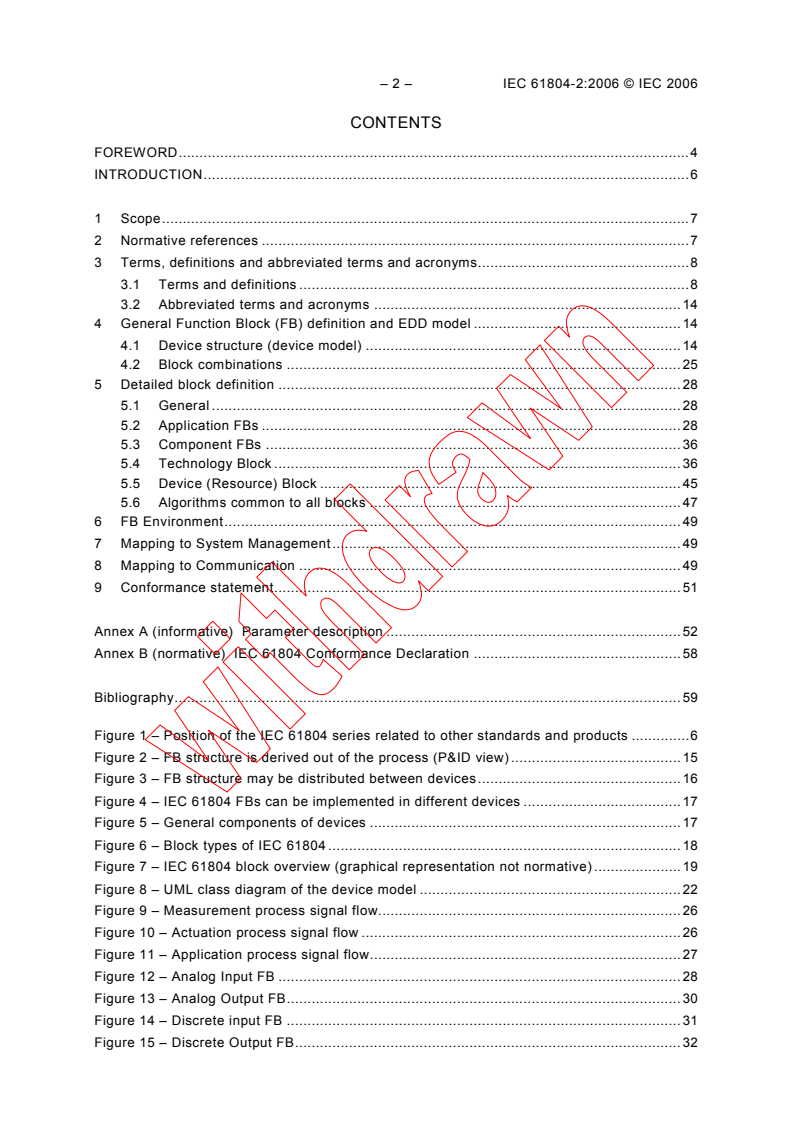
CONTENTS
FOREWORD.4
INTRODUCTION.6
1 Scope.7
2 Normative references .7
3 Terms, definitions and abbreviated terms and acronyms.8
3.1 Terms and definitions .8
3.2 Abbreviated terms and acronyms .14
4 General Function Block (FB) definition and EDD model .14
4.1 Device structure (device model) .14
4.2 Block combinations .25
5 Detailed block definition .28
5.1 General .28
5.2 Application FBs .28
5.3 Component FBs .36
5.4 Technology Block .36
5.5 Device (Resource) Block .45
5.6 Algorithms common to all blocks .47
6 FB Environment.49
7 Mapping to System Management.49
8 Mapping to Communication .49
9 Conformance statement.51
Annex A (informative) Parameter description .52
Annex B (normative) IEC 61804 Conformance Declaration .58
Bibliography.59
Figure 1 – Position of the IEC 61804 series related to other standards and products .6
Figure 2 – FB structure is derived out of the process (P&ID view) .15
Figure 3 – FB structure may be distributed between devices.16
Figure 4 – IEC 61804 FBs can be implemented in different devices .17
Figure 5 – General components of devices .17
Figure 6 – Block types of IEC 61804 .18
Figure 7 – IEC 61804 block overview (graphical representation not normative) .19
Figure 8 – UML class diagram of the device model .22
Figure 9 – Measurement process signal flow.26
Figure 10 – Actuation process signal flow .26
Figure 11 – Application process signal flow.27
Figure 12 – Analog Input FB .28
Figure 13 – Analog Output FB.30
Figure 14 – Discrete input FB .31
Figure 15 – Discrete Output FB.32
61804-2 IEC:2006(E) – 3 –
Figure 16 – Calculation FB.34
Figure 17 – Control FB.35
Figure 18 – Temperature Technology Block .36
Figure 19 – Pressure Technology Block .39
Figure 20 – Modulating actuation technology block .41
Figure 21 – On/Off Actuation Technology Block .43
Figure 22 – Harel state chart .46
Figure 23 – Application structure of ISO OSI Reference Model .49
Figure 24 – Client/Server relationship in terms of OSI Reference Model .50
Figure 25 – Mapping of IEC 61804 FBs to APOs.50
Table 1 – References of model elements .21
Table 2 – Variables and parameter description template .24
Table 3 – Example of temperature sensors of Sensor_Type.37
Table 4 – Device status state table .45
Table 5 – Device status transition table .46
Table A.1 – Parameter description .52
Table B.1 – Conformance (sub)clause selection table.58
Table B.2 – Contents of (sub)clause selection tables .58
– 4 – 61804-2 IEC:2006(E)
INTERNATIONAL ELECTROTECHNICAL COMMISSION
___________
FUNCTION BLOCKS (FB) FOR PROCESS CONTROL –
Part 2: Specification of FB concept
FOREWORD
1) The International Electrotechnical Commission (IEC) is a worldwide organization for standardization comprising
all national electrotechnical committees (IEC National Committees). The object of IEC is to promote
international co-operation on all questions concerning standardization in the electrical and electronic fields. To
this end and in addition to other activities, IEC publishes International Standards, Technical Specifications,
Technical Reports, Publicly Available Specifications (PAS) and Guides (hereafter referred to as “IEC
Publication(s)”). Their preparation is entrusted to technical committees; any IEC National Committee interested
in the subject dealt with may participate in this preparatory work. International, governmental and non-
governmental organizations liaising with the IEC also participate in this preparation. IEC collaborates closely
with the International Organization for Standardization (ISO) in accordance with conditions determined by
agreement between the two organizations.
2) The formal decisions or agreements of IEC on technical matters express, as nearly as possible, an international
consensus of opinion on the relevant subjects since each technical committee has representation from all
interested IEC National Committees.
3) IEC Publications have the form of recommendations for international use and are accepted by IEC National
Committees in that sense. While all reasonable efforts are made to ensure that the technical content of IEC
Publications is accurate, IEC cannot be held responsible for the way in which they are used or for any
misinterpretation by any end user.
4) In order to promote international uniformity, IEC National Committees undertake to apply IEC Publications
transparently to the maximum extent possible in their national and regional publications. Any divergence
between any IEC Publication and the corresponding national or regional publication shall be clearly indicated in
the latter.
5) IEC provides no marking procedure to indicate its approval and cannot be rendered responsible for any
equipment declared to be in conformity with an IEC Publication.
6) All users should ensure that they have the latest edition of this publication.
7) No liability shall attach to IEC or its directors, employees, servants or agents including individual experts and
members of its technical committees and IEC National Committees for any personal injury, property damage or
other damage of any nature whatsoever, whether direct or indirect, or for costs (including legal fees) and
expenses arising out of the publication, use of, or reliance upon, this IEC Publication or any other IEC
Publications.
8) Attention is drawn to the Normative references cited in this publication. Use of the referenced publications is
indispensable for the correct application of this publication.
The International Electrotechnical Commission (IEC) draws attention to the fact that it is claimed that compliance
with this document may involve the use of patents
U.S. Patent No. 5,333,114
U.S. Patent No. 5,485,400
U.S. Patent No. 5,825,664
U.S. Patent No. 5,909,368
U.S. Patent Pending No. 08/916,178
Australian Patent No. 638507
Canadian Patent No. 2,066,743
European Patent No. 0495001
Validated in:
UK – Patent No. 0495001
France – Patent No. 0495001
Germany – Patent No. 69032954.7
Netherlands – Patent No. 0495001
Japan Patent No. 3137643
61804-2 IEC:2006(E) – 5 –
IEC take no position concerning the evidence, validity and scope of this patent right. The holder of this patent right
has assured the IEC that he is willing to negotiate licenses under reasonable and non-discriminatory terms and
conditions with applicants throughout the world. In this respect, the statement of the holder of this patent right is
registered with IEC. Information may be obtained from:
Fieldbus Foundation,
9390 Research Boulevard, Suite II-250,
Austin, Texas, USA 78759,
Attention: President.
Attention is drawn to the possibility that some of the elements of this document may be the subject of patent rights
other than those identified above. IEC shall not be held responsible for identifying any or all such patent rights.
This International Standard has been prepared by subcommittee 65C: Digital communications,
of IEC technical committee 65: Industrial-process measurement and control.
This second edition, together with the first edition of IEC 61804-3, cancels and replaces the
first edition of IEC 61804-2 published in 2004. This edition constitutes a technical revision.
This edition includes the following significant technical changes with respect to the previous
edition:
a) transfer of the EDDL-specific clauses to IEC 61804-3;
b) the FB-specific subclauses 4.1 and 4.2 as well as Clauses 5, 6, 7 and 8 are unchanged.
The text of this standard is based on the following documents:
CDV Report on voting
65C/405/CDV 65C/420/RVC
Full information on the voting for the approval of this standard can be found in the report on
voting indicated in the above table.
This publication has been drafted in accordance with ISO/IEC Directives, Part 2.
The list of all parts of the IEC 61804 series, under the general title Function Blocks (FB) for
process control, can be found on the IEC website.
The committee has decided that the contents of this publication will remain unchanged until
the maintenance result date indicated on the IEC web site under "http://webstore.iec.ch" in
the data related to the specific publication. At this date, the publication will be
• reconfirmed;
• withdrawn;
• replaced by a revised edition, or
• amended.
A bilingual version of this publication may be issued at a later date.
– 6 – 61804-2 IEC:2006(E)
INTRODUCTION
This part of IEC 61804 provides conceptual Function Block specifications, which can be
mapped to specific communication systems, and their accompanying definitions by industrial
groups.
The EDDL fills the gap between the conceptual FB specification of IEC 61804-2 and a product
implementation. Figure 1 shows these aspects.
Abstract models IEC 61499-1 ISO 15745-1
Conceptual FB
IEC
-
IEC 61804 2
specification for
61804 - 3
FB concept
the process
EDDL
sector
IEC/TR
FIP
Controlnet
Solutions FF PROFI-
companion
FB BUS 61804 - 4
(technology)
standards
...
application PA profile
Interoperability
profiles
Guideline
Implementation
Products
IEC 1507/06
Figure 1 – Position of the IEC 61804 series related to other standards and products
61804-2 IEC:2006(E) – 7 –
FUNCTION BLOCKS (FB) FOR PROCESS CONTROL –
Part 2: Specification of FB concept
1 Scope
This part of IEC 61804 is applicable to Function Blocks (FB) for process control.
This standard specifies FB by using the result of harmonization work as regards several
elements:
c) the device model which defines the components of an IEC 61804-2 conformant device;
d) conceptual specifications of FBs for measurement, actuation and processing. This
includes general rules for the essential features to support control, whilst avoiding details
which stop innovation as well as specialization for different industrial sectors.
This standard defines a subset of the requirements of IEC 61804-1 (hereafter referred to as
Part 1) only, while Part 1 describes requirements for a distributed system.
The conformance statement in Annex B, which covers the conformance declaration, is related
to this standard only. Requirements of Part 1 are not part of these conformance declarations.
The standardization work for FB was carried out by harmonizing the description of concepts of
existing technologies. It results in an abstract level that allowed the definition of the common
features in a unique way. This abstract vision is called here the conceptual FB specification
and mapped to specific communication systems and their accompanying definitions by the
industrial groups. This standard is also based on the abstract definitions of IEC 61499-1.
NOTE This standard can be mapped to ISO 15745-1.
There are solutions on the market today, which fulfil the requirements of this standard and
show how the conceptual specification is implemented in a given technology. New
technologies will need to find equivalent solutions (see Figure 4).
2 Normative references
The following referenced documents are indispensable for the application of this document.
For dated references, only the edition cited applies. For undated references, the latest edition
of the referenced document (including any amendments) applies.
IEC 60050-351:1998, International Electrotechnical Vocabulary (IEV) – Part 351: Automatic
control
IEC 60584-1, Thermocouples – Part 1: Reference tables
IEC 61131-3:2003, Programmable controllers – Part 3: Programming languages
IEC 61158 (all parts), Digital data communications for measurement and control – Fieldbus for
use in industrial control systems
IEC 61499-1:2005, Function blocks – Part 1: Architecture
IEC 61499-2:2005, Function blocks – Part 2: Software tools requirements
– 8 – 61804-2 IEC:2006(E)
IEC 61804-1:2003, Function blocks (FB) for process control − Part 1: Overview of system
aspects
ISO/IEC 7498-1:1994, Information technology – Open Systems Interconnection – Basic
Reference Model: The Basic Model
ISO/IEC 9899, Programming languages − C
ISO/IEC 10646-1, Information technology – Universal Multiple-Octet Coded Character Set
(UCS) – Part 1: Architecture and Basic Multilingual Plane
3 Terms, definitions, and abbreviated terms and acronyms
3.1 Terms and definitions
For the purposes of this document, the following terms and definitions, some of which have
been compiled from the referenced documents, apply.
3.1.1
algorithm
finite set of well-defined rules for the solution of a problem in a finite number of operations
3.1.2
application
software functional unit that is specific to the solution of a problem in industrial-process
measurement and control
NOTE An application may be distributed among resources and may communicate with other applications.
3.1.3
application function block
FB which has no input or output to the process
3.1.4
attribute
property or characteristic of an entity, for instance, the version identifier of an FB type
specification
[IEC 61499-1]
NOTE The formal description of attributes is part of the solution profiles to achieve domain-specific
interoperability. IEC 61804 defines the general rules to define the attributes and specifies the EDDL to describe
attributes, which may be described in solution profiles.
3.1.5
component function block
FB instance which is used in the specification of an algorithm of a composite FB type
NOTE A component FB can be an FB or a composite FB type.
3.1.6
composite FB type
FB type whose algorithm is expressed entirely in terms of interconnected component FBs and
variables
[IEC 61499-1]
61804-2 IEC:2006(E) – 9 –
3.1.7
configuration (of a system or device)
step in system design: selecting functional units, assigning their locations and defining their
interconnections
[IEC 61499-1]
3.1.8
data
representation of facts, concepts or instructions in a formalized manner suitable for
communication, interpretation or processing by human beings or by automatic means
[ISO/AFNOR Dictionary of Computer Science]
3.1.9
data connection
association established between functional units for conveyance of data
[IEC 61499-1]
3.1.10
data input
interface of an FB which receives data from a data connection
[IEC 61499-1]
3.1.11
data output
interface of an FB, which supplies data to a data connection
[IEC 61499-1]
3.1.12
data type
set of values together with a set of permitted operations
[ISO 2382 series]
3.1.13
device
independent physical entity capable of performing one or more specified functions in a
particular context and delimited by its interfaces
[IEC 61499-1]
3.1.14
device block
FB which has no input and no output
3.1.15
device management application
application whose primary function is the management of a multiple resources within a device
[IEC 61499-1]
3.1.16
Electronic Device Description Language (EDDL)
methodology for describing parameter(s) of an automation system component
– 10 – 61804-2 IEC:2006(E)
3.1.17
Electronic Device Description (EDD)
data collection containing the device parameter(s), their dependencies, their graphical
representation and a description of the data sets which are transferred.
NOTE The Electronic Device Description is created using the Electronic Device Description Language (EDDL).
3.1.18
entity
particular thing, such as a person, place, process, object, concept, association, or event
[IEC 61499-1]
3.1.19
event
instantaneous occurrence that is significant to scheduling the execution of an algorithm
[IEC 61499-1]
NOTE The execution of an algorithm may make use of variables associated with an event.
3.1.20
exception
event that causes suspension of normal execution
[IEC 61499-1]
3.1.21
function
specific purpose of an entity or its characteristic action
[IEC 61499-1]
3.1.22
functional unit
entity of hardware or software, or both, capable of accomplishing a specified purpose
[ISO/AFNOR Dictionary of Computer Science]
3.1.23
function block (function block instance)
software functional unit comprising an individual, named copy of a data structure and
associated operations specified by a corresponding FB type
[IEC 61499-1]
NOTE Typical operations of an FB include modification of the values of the data in its associated data structure.
3.1.24
function block diagram
network in which the nodes are function block instances, variables, literals, and events
NOTE This is not the same as the function block diagram defined in IEC 61131-3.
[IEC 61499-1]
3.1.25
hardware
physical equipment, as opposed to programs, procedures, rules and associated
documentation
[ISO/AFNOR Dictionary of Computer Science]
61804-2 IEC:2006(E) – 11 –
3.1.26
implementation
development phase in which the hardware and software of a system become operational
[IEC 61499-1]
3.1.27
input variable
variable whose value is supplied by a data input, and which may be used in one or more
operations of an FB
NOTE An input parameter of an FB, as defined in IEC 61131-3, is an input variable.
[IEC 61499-1]
3.1.28
instance
functional unit comprising an individual, named entity with the attributes of a defined type
[IEC 61499-1]
3.1.29
instance name
identifier associated with, and designating, an instance
[IEC 61499-1]
3.1.30
instantiation
creation of an instance of a specified type
[IEC 61499-1]
3.1.31
interface
shared boundary between two functional units, defined by functional characteristics, signal
characteristics, or other characteristics as appropriate
[IEV 351-11-19:1998]
3.1.32
internal variable
variable whose value is used or modified by one or more operations of an FB but is not
supplied by a data input or to a data output
[IEC 61499-1]
3.1.33
invocation
process of initiating the execution of the sequence of operations specified in an algorithm
[IEC 61499-1]
3.1.34
management function block
FB whose primary function is the management of applications within a resource
[IEC 61499-1]
– 12 – 61804-2 IEC:2006(E)
3.1.35
mapping
set of values having defined correspondence with the quantities or values of another set
[ISO/AFNOR Dictionary of Computer Science]
3.1.36
model
representation of a real world process, device, or concept
[IEC 61499-1]
3.1.37
operation
well-defined action that, when applied to any permissible combination of known entities,
produces a new entity
[ISO/AFNOR Dictionary of Computer Science]
3.1.38
output variable
variable whose value is established by one or more operations of a FB and is supplied to a
data output
NOTE An output parameter of an FB, as defined in IEC 61131-3, is an output variable.
[IEC 61499-1]
3.1.39
parameter
variable that is given a constant value for a specified application and that may denote the
application
[ISO/AFNOR Dictionary of Computer Science]
3.1.40
resource
functional unit contained within a device which has independent control of its operation and
which provides various services to applications, including the scheduling and execution of
algorithms
NOTE 1 The RESOURCE defined in IEC 61131-3 is a programming language element corresponding to the
resource defined above.
NOTE 2 A device contains one or more resources.
3.1.41
resource management application
application whose primary function is the management of a single resource
[IEC 61499-1]
3.1.42
service
functional capability of a resource, which can be modelled by a sequence of service primitives
[IEC 61499-1]
61804-2 IEC:2006(E) – 13 –
3.1.43
software
intellectual creation comprising the programs, procedures, rules and any associated
documentation pertaining to the operation of a system
[IEC 61499-1]
3.1.44
system
set of interrelated elements considered in a defined context as a whole and separated from its
environment
[IEV 351-11-01:1998]
NOTE 1 Such elements may be both material objects and concepts as well as the results thereof (for example,
forms of organization, mathematical methods, and programming languages).
NOTE 2 The system is considered to be separated from the environment and other external systems by an
imaginary surface, which can cut the links between them and the considered system.
3.1.45
technology block
FB which has at least one input or one output to the process
3.1.46
text dictionary
collection of multilingual or other texts within the EDD
NOTE References within an EDD are used to select an appropriate text dictionary.
3.1.47
type
software element, which specifies the common attributes shared by all instances of the type
[IEC 61499-1]
3.1.48
type name
identifier associated with, and designating, a type
[IEC 61499-1]
3.1.49
variable
software entity that may take different values, one at a time
NOTE 1 The values of a variable are usually restricted to a certain data type.
NOTE 2 Variables are described as input variables, output variables, and internal variables.
[IEC 61499-1]
– 14 – 61804-2 IEC:2006(E)
3.2 Abbreviated terms and acronyms
The terms in IEC 60050-351:1998 apply partially.
ADU Analog Digital Unit
AFB Application Function Block
ANSI American National Standard Institut:
ANSI C American National Standard Institute for the programming language C
(see ISO/IEC 9899)
AP Application Process
ASCII American Standard Code for Information Interchange (see ISO/IEC 10646-1)
ASN.1 Abstract Lexical Structure Notation 1
BNF Backus Naur Format
CFB Component Function Block
DAU Digital Analog Unit
EDD Electronic Device Description
EDDL Electronic Device Description Language
FB Function Block
FBD Function Block Diagram
FMS Fieldbus Message Specification
HMI Human Machine Interface
HTML Hypertext Mark-up Language
I/O Input/Output
IAM Intelligent Actuation and Measurement
ID Identifier
mA Milliampere
NOAH Network Oriented Application Harmonization
OSI Open Systems Interconnection
P&ID Piping and Instrument Diagram
PDU Protocol Data Unit
SM System Management
TB Technology Block
UML Unified Modelling Language
wao Write as one
4 General Function Block (FB) definition and EDD model
4.1 Device structure (device model)
4.1.1 Device model description
FBs are encapsulations of variables and their processing algorithms. The variables and
algorithms are those required by the design of the process and its control system.
NOTE FBs can be derived from the diagram in
61804-2 IEC:2006(E) – 15 –
Figure 2.
FBs perform the application (measurement, actuation, control and monitoring) by connecting
their data inputs and data outputs.
Level Control
V3
L1
Controlled
Temperature Control
L2
process
T1 T2
F1
P1
V1 P2
Pump Control
V2
Analog
0-150 °C
Input
Analog Function
Control
Analog
Output Block
Input
0-150°C
Function
appli-
Function AI-T2
Block
Block
cation
AO-V1
PID_SP
AI-T1
PID
0-100 %
Function
Block
PID 1
IEC 353/04
Figure 2 – FB structure is derived out of the process (P&ID view)
The devices are connected via a communication network or a hierarchy of communication
networks.
NOTE The application may be distributed among several devices; see, for example, Figure 3. FB structure may
be distributed between devices according to IEC 61499-1.
– 16 – 61804-2 IEC:2006(E)
Communication network(s)
Device 1 Device 2 Device 3 Device 4
Application A
Application B
Appl. C
Controlled process
IEC 354/04
Figure 3 – FB structure may be distributed between devices
The FBs resulting from the design of the control system are abstract representations.
NOTE 1 These can be implemented in different ways in different device types (see Figure 4). FBs can be
implemented, for example, in field devices, programmable logic controller, visualization stations and device
descriptions.
Additionally, other applications such as system engineering and supervisory system have to
handle or interact with the FBs.
NOTE 2 Algorithms defined for a FB in the conceptual model are not necessarily mapped one-to-one to the
device; they can be mapped to the device, a proxy or a supervisory station if the current technology does not solve
it in the device.
61804-2 IEC:2006(E) – 17 –
Engineering system
Supervisory system
EDD n
EDD 3
IEC 61804 FB EDD 2
Visualization
Commissioning tool
EDD 1
FB faceplate
IEC 61804 EDD FB
for example,
Function Block AI_FB
Member
Programmable logic controller
{
Variable_1; .
Proxy
}
FB (IEC 61131-FB-Library)
FD 1 FD 2 FD 3 FD n
FD = Field device
EDD 1 EDD 2 EDD 3 EDD n
IEC 1508/06
Figure 4 – IEC 61804 FBs can be implemented in different devices
For the purposes of this standard, devices implement algorithms derived out of the design of
the controlled process in terms of FBs. The devices are hardware and software modular (see,
for example, Figure 5). The components of devices are Modules, Blocks, Variables and
Algorithms. There are defined relations between the components that are specified in the
UML class diagram below (see Figure 8).
Device
Module
Module
Block
Variable
Hardware-oriented components
Block
Function
- Device
Function - Module
Block
Software-oriented components
Function
- Block
- Function
Function
. . .
Block
- Variable
Function
Function
. . .
Variable . . .
... More modules/blocks
may be plugged in
IEC 356/04
Figure 5 – General components of devices
– 18 – 61804-2 IEC:2006(E)
For the purposes of this standard, there are different block types (see
Figure 6), which encapsulate specific functionality of devices performing an automation
application. The Technology Block represents the process attachment of a device. It contains
the measurement or actuation principles of a device. The technology block is composed of
acquisition or output and transformation parts. The application FB (hereafter called FB)
contains application-related signal processing, such as scaling, alarm detection or control and
calculation. Component FBs may perform mathematical and logical processing with specific
additional exception handling procedures such as not-allowed parameter values. They shall
be encapsulated within composite FBs.
The Device Block represents the resource of the device that contains information and function
about the device itself, the operation system of the device and the device hardware. The
device shall have an interface to the communication system and may have system
management functionalities.
Sensor/Actuator
Device
Technology
blocks
(process
System
attachment)
Device
management
(for example,
block
temperature,
pressure,
(for example,
measurement) (for example
device identification;
application
device status;
time
message)
synchronization)
Application
Function
Blocks
(for example,
measure input,
actuation output,
control,
calculation)
Device type specific
specification
Network interface management (e.g. communication loss)
Common specification
for all device types
Not mandatory for
all device types
IEC 1509/06
Figure 6 – Block types of IEC 61804
All devices within the scope of this standard shall have the same logical device structure (see
Figure 6). The number and types of blocks, which are instantiated in a device, are device- and
manufacturer-specific. At least, it shall have one Device Block, one application FB and one
network interface management.
There is a data flow chain from signal detection through the Technology Block and FBs and
vice versa. The signals between the parts of the chain are internal within the blocks or visible
61804-2 IEC:2006(E) – 19 –
as linkages between blocks. The logical chain of technology and FB is called a channel. This
concept is clarified in 4.2.1 and 4.2.2.
4.1.2 FB type
FBs are functional units in software, which encapsulate variables and algorithms. A FB type is
defined by its behaviour. One FB contains one or more than one algorithm. The description of
an FB is a list of algorithms, which are encapsulated in the FB together with the related data
inputs and data outputs and parameters. There are algorithms, which are related to the
process signal flow and those, which are related to other block specific algorithms. These
other algorithms are called management. Parameters are related to process signal flow and
management.
Graphical representation is not normative (see Figure 7). In other words, the data inputs and
data outputs represents the intention of the process signal flow (conceptual definition) not the
specific data that carry the according values.
The parameter table specifies all the necessary accessible data inputs, data outputs and
parameters of the FB.
Type name
Data input
Data output
Process
signal
Algorithms
flow
Algorithms
Manage-
ment
Parameter
Parameter_1 Description of parameter_1
Parameter_2 Description of parameter_2
... ...
IEC 358/04
Figure 7 – IEC 61804 block overview (graphical representation not normative)
The FB is summarized by the following components:
2 2
a) data Inputs which support status and are related to the process signal flow only;
2 2
b) data Outputs which support status and are related to the process signal flow only;
c) parameters related to the process signal flow and management;
d) maintain values to influence functions;
e) notify and make visible internal behaviour;
f) selection of functions in the signal flow;
– 20 – 61804-2 IEC:2006(E)
g) internal variables with memory for support of for example initialization;
h) mathematical/logical algorithm.
The influence of the FB behaviour is possible by data inputs and parameters only. The data
inputs and parameters are used in the following ways:
a) data, which are used as inputs or outputs of functions (for example, setpoint for scaling
functions);
b) data, which are used as parameter of functions (for example, limits for alarms and
warnings);
c) changes of parameter data are interpreted as events which switch transitions of state
automata (for example, start, stop, resume of operation modus of devices);
d) changes of parameter data are interpreted as events, which start transactions of
sequences of algorithms (for example, start of calibration procedures).
The data name and their description shall be checked to understand the purpose of the data.
4.1.3 FB execution
Execution control of FB algorithms is a feature of each device. Different execution policies are
allowed.
NOTE For example, combinations of the following execution control methods are possible and others may be
added:
a) free running;
b) device internal time schedule (time synchronization), for example, 2.7.2 of IEC 61131-3;
c) device internal event triggered;
d) parameter data changes are interpreted as events (see 4.1.2);
e) system wide time synchronization (time synchronization across the communication system);
f) communication service triggered;
g) system wide event triggered (for example, IEC 61499-1);
h) distributed execution control;
i) device internal time schedule (time synchronization).
The FB execution control within a device is only one aspect of the overall application execution control. The overall
execution control is determined, for example (see 3.10 of IEC/TR 61131-8), by:
a) Sequence order (sequential or parallel):
1) Execution order of blocks along the signal flow
2) Piping of data in parallel execution
3) Handling of loss of communication between devices
b) Synchronization:
1) Time synchronization between device
2) Use of time in scheduling
c) Time constraints; the following elements are covered:
1) Block execution time
2) Communication time delay
3) Scan rate of measurement
4) Actuation time
5) Choice of block algorithms
6) Time delay resulting from communication behaviour
d) Block execution time:
1) Communication time delay
2) Scan rate of measurement
3) Actuation time
4) Choice of block algorithms
61804-2 IEC:2006(E) – 21 –
e) Impact of exception handling:
1) Clock error
2) Device error
3) Communication error
The decision as to which technology fulfils the requirements should be based on a detailed check of at least all
these aspects. The choice of execution control method also depends on the technology level used to build the
devices. So the method of FB execution control is also constrained to those available in the fieldbus used by the
system.
4.1.4 Reference between IEC 61499-1, IEC 61499-2 and IEC 61804 models
The relations to IEC 61499-1 and IEC 61499-2 are given in Table 1.
Table 1 – References of model elements
IEC 61804 model element IEC 61499-1 model element
Reference of block types
Application FB Application FB
Technology Block Technology Block
Device (Resource) Block Device (Resource) Block
Reference of FB elements
Component Block Component Block
Type Name Type Name
a a
Data Input Data Input
a a
Data Output Data Output
Algorithms Algorithms
Parameter Parameter
Internal Variable Internal Variable
b
Principle relations between EDDL elements and IEC 61499-2 transfer syntax elements
BLOCK_A, BLOCK_B FUNCTION BLOCK
VARIABLE and CLASS INPUT VAR_INPUT, END_VAR
VARIABLE and CLASS OUTPUT VAR_OUTPUT, END_VAR
c
– ALGORITHM
VARIABLE and CLASS CONTAINED –
VARIABLE VAR, END_VAR
a
The data inputs and data outputs represent the source and sink points for the process signal flow (conceptual
definition) not the specific variables, which carry the according data.
b
This is not an exact syntax reference. It is intended to show the general relations.
c
Describing algorithms are not the intention of EDDL.
An IEC 61804 FB is an IEC 61499-1 FB without execution control and, therefore, has no event
inputs and event outputs. The execution control of the IEC 61804 FBs algorithms are hidden
(see 4.1.3).
4.1.5 UML specification of the device model
The device model definitions in 4.1.1, in Figure 5 and
Figure 6 are general. To solve the ambiguity, the model is described as a UML class diagram
(see Bibliography). The components are transformed to the UML language elements in Figure
8.
– 22 – 61804-2 IEC:2006(E)
CDevice
0.*0.*
1.1.**
0.0.**
00.*.* CModule
1.*1.*
CBlock
TypeName : String
0.0.**
algorithm_n()
algorithm_y()
CDeviceBlock
Device_Vendor : ParString
CFunctionBlock CTechnologyBlock
Device_Model : ParString
Device_Revision : ParString
0.0.11
Device_Ser_No : ParString
0.*0.*
CAcquistion
CComponentBlock
CTransformation
IEC 359/04
Figure 8 – UML class diagram of the device model
The following major steps are used to convert the device model into a UML class diagram:
a) the device becomes the class CDevice;
b) the module becomes the class CModule;
c) the Device Block, FB, Component FB and Technology Block become CDeviceBlock,
CFunctionBlock, CComponentFunctionBlock and CTechnologyBlock;
d) the block types are of the type Block which becomes CBlock;
e) a device contains a minimum of one block;
f) a device may contain modules;
g) a module contains a minimum of one block;
h) blocks can be composed out of other blocks, i.e. may be of composite FB type;
i) a block contains a minimum of zero or more parameters;
j) a block shall have algorithms which can be internal only or visible from the outside (i.e.
private or public);
k) a Device Block contains the attribute Device_Vendor, Device_Model, Device_Revision and
Device_Ser_No which are parameters;
l) the FB, Component FB and Technology Block contain the attribute TypeName.
NOTE The CBlock class can be referenced to the Basic FB Type Declaration of the IEC 61499-1 (see Figure
C.1.4). The IEC 61804 block type has no aggregation to the ECCDeclaration class.
61804-
...
IEC 61804-2 ®
Edition 2.0 2006-09
INTERNATIONAL
STANDARD
NORME
INTERNATIONALE
colour
inside
Function blocks (FB) for process control –
Part 2: Specification of FB concept
Blocs fonctionnels (FB) pour les procédés industriels –
Partie 2: Spécification du concept de FB
All rights reserved. Unless otherwise specified, no part of this publication may be reproduced or utilized in any form
or by any means, electronic or mechanical, including photocopying and microfilm, without permission in writing from
either IEC or IEC's member National Committee in the country of the requester. If you have any questions about IEC
copyright or have an enquiry about obtaining additional rights to this publication, please contact the address below or
your local IEC member National Committee for further information.
Droits de reproduction réservés. Sauf indication contraire, aucune partie de cette publication ne peut être reproduite
ni utilisée sous quelque forme que ce soit et par aucun procédé, électronique ou mécanique, y compris la photocopie
et les microfilms, sans l'accord écrit de l'IEC ou du Comité national de l'IEC du pays du demandeur. Si vous avez des
questions sur le copyright de l'IEC ou si vous désirez obtenir des droits supplémentaires sur cette publication, utilisez
les coordonnées ci-après ou contactez le Comité national de l'IEC de votre pays de résidence.
IEC Central Office Tel.: +41 22 919 02 11
3, rue de Varembé Fax: +41 22 919 03 00
CH-1211 Geneva 20 info@iec.ch
Switzerland www.iec.ch
About the IEC
The International Electrotechnical Commission (IEC) is the leading global organization that prepares and publishes
International Standards for all electrical, electronic and related technologies.
About IEC publications
The technical content of IEC publications is kept under constant review by the IEC. Please make sure that you have the
latest edition, a corrigenda or an amendment might have been published.
IEC Catalogue - webstore.iec.ch/catalogue Electropedia - www.electropedia.org
The stand-alone application for consulting the entire The world's leading online dictionary of electronic and
bibliographical information on IEC International Standards, electrical terms containing more than 30 000 terms and
Technical Specifications, Technical Reports and other definitions in English and French, with equivalent terms in 14
documents. Available for PC, Mac OS, Android Tablets and additional languages. Also known as the International
iPad. Electrotechnical Vocabulary (IEV) online.
IEC publications search - www.iec.ch/searchpub IEC Glossary - std.iec.ch/glossary
The advanced search enables to find IEC publications by a More than 55 000 electrotechnical terminology entries in
variety of criteria (reference number, text, technical English and French extracted from the Terms and Definitions
committee,…). It also gives information on projects, replaced clause of IEC publications issued since 2002. Some entries
and withdrawn publications. have been collected from earlier publications of IEC TC 37,
77, 86 and CISPR.
IEC Just Published - webstore.iec.ch/justpublished
Stay up to date on all new IEC publications. Just Published IEC Customer Service Centre - webstore.iec.ch/csc
details all new publications released. Available online and If you wish to give us your feedback on this publication or
also once a month by email. need further assistance, please contact the Customer Service
Centre: csc@iec.ch.
A propos de l'IEC
La Commission Electrotechnique Internationale (IEC) est la première organisation mondiale qui élabore et publie des
Normes internationales pour tout ce qui a trait à l'électricité, à l'électronique et aux technologies apparentées.
A propos des publications IEC
Le contenu technique des publications IEC est constamment revu. Veuillez vous assurer que vous possédez l’édition la
plus récente, un corrigendum ou amendement peut avoir été publié.
Catalogue IEC - webstore.iec.ch/catalogue Electropedia - www.electropedia.org
Application autonome pour consulter tous les renseignements
Le premier dictionnaire en ligne de termes électroniques et
bibliographiques sur les Normes internationales,
électriques. Il contient plus de 30 000 termes et définitions en
Spécifications techniques, Rapports techniques et autres
anglais et en français, ainsi que les termes équivalents dans
documents de l'IEC. Disponible pour PC, Mac OS, tablettes
14 langues additionnelles. Egalement appelé Vocabulaire
Android et iPad.
Electrotechnique International (IEV) en ligne.
Recherche de publications IEC - www.iec.ch/searchpub
Glossaire IEC - std.iec.ch/glossary
Plus de 55 000 entrées terminologiques électrotechniques, en
La recherche avancée permet de trouver des publications IEC
en utilisant différents critères (numéro de référence, texte, anglais et en français, extraites des articles Termes et
comité d’études,…). Elle donne aussi des informations sur les Définitions des publications IEC parues depuis 2002. Plus
projets et les publications remplacées ou retirées. certaines entrées antérieures extraites des publications des
CE 37, 77, 86 et CISPR de l'IEC.
IEC Just Published - webstore.iec.ch/justpublished
Service Clients - webstore.iec.ch/csc
Restez informé sur les nouvelles publications IEC. Just
Published détaille les nouvelles publications parues. Si vous désirez nous donner des commentaires sur cette
Disponible en ligne et aussi une fois par mois par email. publication ou si vous avez des questions contactez-nous:
csc@iec.ch.
IEC 61804-2 ®
Edition 2.0 2006-09
INTERNATIONAL
STANDARD
NORME
INTERNATIONALE
colour
inside
Function blocks (FB) for process control –
Part 2: Specification of FB concept
Blocs fonctionnels (FB) pour les procédés industriels –
Partie 2: Spécification du concept de FB
INTERNATIONAL
ELECTROTECHNICAL
COMMISSION
COMMISSION
ELECTROTECHNIQUE
PRICE CODE
INTERNATIONALE
CODE PRIX XA
ICS 25.040.40; 35.240.50 ISBN 978-2-8322-1459-6
– 2 – IEC 61804-2:2006 © IEC 2006
CONTENTS
FOREWORD . 4
INTRODUCTION . 6
1 Scope . 7
2 Normative references . 7
3 Terms, definitions and abbreviated terms and acronyms . 8
3.1 Terms and definitions . 8
3.2 Abbreviated terms and acronyms . 14
4 General Function Block (FB) definition and EDD model . 14
4.1 Device structure (device model) . 14
4.2 Block combinations . 25
5 Detailed block definition . 28
5.1 General . 28
5.2 Application FBs . 28
5.3 Component FBs . 36
5.4 Technology Block . 36
5.5 Device (Resource) Block . 45
5.6 Algorithms common to all blocks . 47
6 FB Environment . 49
7 Mapping to System Management . 49
8 Mapping to Communication . 49
9 Conformance statement . 51
Annex A (informative) Parameter description . 52
Annex B (normative) IEC 61804 Conformance Declaration . 58
Bibliography . 59
Figure 1 – Position of the IEC 61804 series related to other standards and products . 6
Figure 2 – FB structure is derived out of the process (P&ID view) . 15
Figure 3 – FB structure may be distributed between devices . 16
Figure 4 – IEC 61804 FBs can be implemented in different devices . 17
Figure 5 – General components of devices . 17
Figure 6 – Block types of IEC 61804 . 18
Figure 7 – IEC 61804 block overview (graphical representation not normative) . 19
Figure 8 – UML class diagram of the device model . 22
Figure 9 – Measurement process signal flow. 26
Figure 10 – Actuation process signal flow . 26
Figure 11 – Application process signal flow. 27
Figure 12 – Analog Input FB . 28
Figure 13 – Analog Output FB . 30
Figure 14 – Discrete input FB . 31
Figure 15 – Discrete Output FB . 32
Figure 16 – Calculation FB. 34
Figure 17 – Control FB . 35
Figure 18 – Temperature Technology Block . 36
Figure 19 – Pressure Technology Block . 39
Figure 20 – Modulating actuation technology block . 41
Figure 21 – On/Off Actuation Technology Block . 43
Figure 22 – Harel state chart . 46
Figure 23 – Application structure of ISO OSI Reference Model . 49
Figure 24 – Client/Server relationship in terms of OSI Reference Model . 50
Figure 25 – Mapping of IEC 61804 FBs to APOs . 50
Table 1 – References of model elements . 21
Table 2 – Variables and parameter description template . 24
Table 3 – Example of temperature sensors of Sensor_Type . 37
Table 4 – Device status state table . 45
Table 5 – Device status transition table . 46
Table A.1 – Parameter description . 52
Table B.1 – Conformance (sub)clause selection table . 58
Table B.2 – Contents of (sub)clause selection tables . 58
– 4 – IEC 61804-2:2006 © IEC 2006
INTERNATIONAL ELECTROTECHNICAL COMMISSION
___________
FUNCTION BLOCKS (FB) FOR PROCESS CONTROL –
Part 2: Specification of FB concept
FOREWORD
1) The International Electrotechnical Commission (IEC) is a worldwide organization for standardization comprising
all national electrotechnical committees (IEC National Committees). The object of IEC is to promote
international co-operation on all questions concerning standardization in the electrical and electronic fields. To
this end and in addition to other activities, IEC publishes International Standards, Technical Specifications,
Technical Reports, Publicly Available Specifications (PAS) and Guides (hereafter referred to as “IEC
Publication(s)”). Their preparation is entrusted to technical committees; any IEC National Committee interested
in the subject dealt with may participate in this preparatory work. International, governmental and non-
governmental organizations liaising with the IEC also participate in this preparation. IEC collaborates closely
with the International Organization for Standardization (ISO) in accordance with conditions determined by
agreement between the two organizations.
2) The formal decisions or agreements of IEC on technical matters express, as nearly as possible, an international
consensus of opinion on the relevant subjects since each technical committee has representation from all
interested IEC National Committees.
3) IEC Publications have the form of recommendations for international use and are accepted by IEC National
Committees in that sense. While all reasonable efforts are made to ensure that the technical content of IEC
Publications is accurate, IEC cannot be held responsible for the way in which they are used or for any
misinterpretation by any end user.
4) In order to promote international uniformity, IEC National Committees undertake to apply IEC Publications
transparently to the maximum extent possible in their national and regional publications. Any divergence
between any IEC Publication and the corresponding national or regional publication shall be clearly indicated in
the latter.
5) IEC provides no marking procedure to indicate its approval and cannot be rendered responsible for any
equipment declared to be in conformity with an IEC Publication.
6) All users should ensure that they have the latest edition of this publication.
7) No liability shall attach to IEC or its directors, employees, servants or agents including individual experts and
members of its technical committees and IEC National Committees for any personal injury, property damage or
other damage of any nature whatsoever, whether direct or indirect, or for costs (including legal fees) and
expenses arising out of the publication, use of, or reliance upon, this IEC Publication or any other IEC
Publications.
8) Attention is drawn to the Normative references cited in this publication. Use of the referenced publications is
indispensable for the correct application of this publication.
The International Electrotechnical Commission (IEC) draws attention to the fact that it is claimed that compliance
with this document may involve the use of patents
U.S. Patent No. 5,333,114
U.S. Patent No. 5,485,400
U.S. Patent No. 5,825,664
U.S. Patent No. 5,909,368
U.S. Patent Pending No. 08/916,178
Australian Patent No. 638507
Canadian Patent No. 2,066,743
European Patent No. 0495001
Validated in:
UK – Patent No. 0495001
France – Patent No. 0495001
Germany – Patent No. 69032954.7
Netherlands – Patent No. 0495001
Japan Patent No. 3137643
IEC take no position concerning the evidence, validity and scope of this patent right. The holder of this patent right
has assured the IEC that he is willing to negotiate licenses under reasonable and non-discriminatory terms and
conditions with applicants throughout the world. In this respect, the statement of the holder of this patent right is
registered with IEC. Information may be obtained from:
Fieldbus Foundation,
9390 Research Boulevard, Suite II-250,
Austin, Texas, USA 78759,
Attention: President.
Attention is drawn to the possibility that some of the elements of this document may be the subject of patent rights
other than those identified above. IEC shall not be held responsible for identifying any or all such patent rights.
This International Standard has been prepared by subcommittee 65C: Digital communications,
of IEC technical committee 65: Industrial-process measurement and control.
This second edition, together with the first edition of IEC 61804-3, cancels and replaces the
first edition of IEC 61804-2 published in 2004. This edition constitutes a technical revision.
This edition includes the following significant technical changes with respect to the previous
edition:
a) transfer of the EDDL-specific clauses to IEC 61804-3;
b) the FB-specific subclauses 4.1 and 4.2 as well as Clauses 5, 6, 7 and 8 are unchanged.
This bilingual version (2014-04) corresponds to the monolingual English version, published in
2006-09.
The text of this standard is based on the following documents:
CDV Report on voting
65C/405/CDV 65C/420/RVC
Full information on the voting for the approval of this standard can be found in the report on
voting indicated in the above table.
The French version of this standard has not been voted upon.
This publication has been drafted in accordance with ISO/IEC Directives, Part 2.
The list of all parts of the IEC 61804 series, under the general title Function Blocks (FB) for
process control, can be found on the IEC website.
The committee has decided that the contents of this publication will remain unchanged until
the maintenance result date indicated on the IEC web site under "http://webstore.iec.ch" in
the data related to the specific publication. At this date, the publication will be
• reconfirmed;
• withdrawn;
• replaced by a revised edition, or
• amended.
IMPORTANT – The 'colour inside' logo on the cover page of this publication indicates
that it contains colours which are considered to be useful for the correct
understanding of its contents. Users should therefore print this document using a
colour printer.
– 6 – IEC 61804-2:2006 © IEC 2006
INTRODUCTION
This part of IEC 61804 provides conceptual Function Block specifications, which can be
mapped to specific communication systems, and their accompanying definitions by industrial
groups.
The EDDL fills the gap between the conceptual FB specification of IEC 61804-2 and a product
implementation. Figure 1 shows these aspects.
Abstract models IEC 61499 - 1 ISO 15745 - 1
Conceptual FB
IEC
-
IEC 61804 2
specification for
61804 - 3
FB concept
the process
EDDL
sector
IEC/TR
FIP
Controlnet
Solutions FF PROFI -
companion
FB BUS 61804 - 4
(technology)
standards
...
application PA profile
Interoperability
profiles
Guideline
Implementation
Products
IEC 1507/06
Figure 1 – Position of the IEC 61804 series related to other standards and products
FUNCTION BLOCKS (FB) FOR PROCESS CONTROL –
Part 2: Specification of FB concept
1 Scope
This part of IEC 61804 is applicable to Function Blocks (FB) for process control.
This standard specifies FB by using the result of harmonization work as regards several
elements:
c) the device model which defines the components of an IEC 61804-2 conformant device;
d) conceptual specifications of FBs for measurement, actuation and processing. This
includes general rules for the essential features to support control, whilst avoiding details
which stop innovation as well as specialization for different industrial sectors.
This standard defines a subset of the requirements of IEC 61804-1 (hereafter referred to as
Part 1) only, while Part 1 describes requirements for a distributed system.
The conformance statement in Annex B, which covers the conformance declaration, is related
to this standard only. Requirements of Part 1 are not part of these conformance declarations.
The standardization work for FB was carried out by harmonizing the description of concepts of
existing technologies. It results in an abstract level that allowed the definition of the common
features in a unique way. This abstract vision is called here the conceptual FB specification
and mapped to specific communication systems and their accompanying definitions by the
industrial groups. This standard is also based on the abstract definitions of IEC 61499-1.
NOTE This standard can be mapped to ISO 15745-1.
There are solutions on the market today, which fulfil the requirements of this standard and
show how the conceptual specification is implemented in a given technology. New
technologies will need to find equivalent solutions (see Figure 4).
2 Normative references
The following referenced documents are indispensable for the application of this document.
For dated references, only the edition cited applies. For undated references, the latest edition
of the referenced document (including any amendments) applies.
IEC 60050-351:1998, International Electrotechnical Vocabulary (IEV) – Part 351: Automatic
control
IEC 60584-1, Thermocouples – Part 1: Reference tables
IEC 61131-3:2003, Programmable controllers – Part 3: Programming languages
IEC 61158 (all parts), Digital data communications for measurement and control – Fieldbus for
use in industrial control systems
IEC 61499-1:2005, Function blocks – Part 1: Architecture
IEC 61499-2:2005, Function blocks – Part 2: Software tools requirements
– 8 – IEC 61804-2:2006 © IEC 2006
IEC 61804-1:2003, Function blocks (FB) for process control − Part 1: Overview of system
aspects
ISO/IEC 7498-1:1994, Information technology – Open Systems Interconnection – Basic
Reference Model: The Basic Model
ISO/IEC 9899, Programming languages − C
ISO/IEC 10646-1, Information technology – Universal Multiple-Octet Coded Character Set
(UCS) – Part 1: Architecture and Basic Multilingual Plane
3 Terms, definitions, and abbreviated terms and acronyms
3.1 Terms and definitions
For the purposes of this document, the following terms and definitions, some of which have
been compiled from the referenced documents, apply.
3.1.1
algorithm
finite set of well-defined rules for the solution of a problem in a finite number of operations
3.1.2
application
software functional unit that is specific to the solution of a problem in industrial-process
measurement and control
NOTE An application may be distributed among resources and may communicate with other applications.
3.1.3
application function block
FB which has no input or output to the process
3.1.4
attribute
property or characteristic of an entity, for instance, the version identifier of an FB type
specification
[IEC 61499-1]
NOTE The formal description of attributes is part of the solution profiles to achieve domain-specific
interoperability. IEC 61804 defines the general rules to define the attributes and specifies the EDDL to describe
attributes, which may be described in solution profiles.
3.1.5
component function block
FB instance which is used in the specification of an algorithm of a composite FB type
NOTE A component FB can be an FB or a composite FB type.
3.1.6
composite FB type
FB type whose algorithm is expressed entirely in terms of interconnected component FBs and
variables
[IEC 61499-1]
3.1.7
configuration (of a system or device)
step in system design: selecting functional units, assigning their locations and defining their
interconnections
[IEC 61499-1]
3.1.8
data
representation of facts, concepts or instructions in a formalized manner suitable for
communication, interpretation or processing by human beings or by automatic means
[ISO/AFNOR Dictionary of Computer Science]
3.1.9
data connection
association established between functional units for conveyance of data
[IEC 61499-1]
3.1.10
data input
interface of an FB which receives data from a data connection
[IEC 61499-1]
3.1.11
data output
interface of an FB, which supplies data to a data connection
[IEC 61499-1]
3.1.12
data type
set of values together with a set of permitted operations
[ISO 2382 series]
3.1.13
device
independent physical entity capable of performing one or more specified functions in a
particular context and delimited by its interfaces
[IEC 61499-1]
3.1.14
device block
FB which has no input and no output
3.1.15
device management application
application whose primary function is the management of a multiple resources within a device
[IEC 61499-1]
3.1.16
Electronic Device Description Language (EDDL)
methodology for describing parameter(s) of an automation system component
– 10 – IEC 61804-2:2006 © IEC 2006
3.1.17
Electronic Device Description (EDD)
data collection containing the device parameter(s), their dependencies, their graphical
representation and a description of the data sets which are transferred.
NOTE The Electronic Device Description is created using the Electronic Device Description Language (EDDL).
3.1.18
entity
particular thing, such as a person, place, process, object, concept, association, or event
[IEC 61499-1]
3.1.19
event
instantaneous occurrence that is significant to scheduling the execution of an algorithm
[IEC 61499-1]
NOTE The execution of an algorithm may make use of variables associated with an event.
3.1.20
exception
event that causes suspension of normal execution
[IEC 61499-1]
3.1.21
function
specific purpose of an entity or its characteristic action
[IEC 61499-1]
3.1.22
functional unit
entity of hardware or software, or both, capable of accomplishing a specified purpose
[ISO/AFNOR Dictionary of Computer Science]
3.1.23
function block (function block instance)
software functional unit comprising an individual, named copy of a data structure and
associated operations specified by a corresponding FB type
[IEC 61499-1]
NOTE Typical operations of an FB include modification of the values of the data in its associated data structure.
3.1.24
function block diagram
network in which the nodes are function block instances, variables, literals, and events
NOTE This is not the same as the function block diagram defined in IEC 61131-3.
[IEC 61499-1]
3.1.25
hardware
physical equipment, as opposed to programs, procedures, rules and associated
documentation
[ISO/AFNOR Dictionary of Computer Science]
3.1.26
implementation
development phase in which the hardware and software of a system become operational
[IEC 61499-1]
3.1.27
input variable
variable whose value is supplied by a data input, and which may be used in one or more
operations of an FB
NOTE An input parameter of an FB, as defined in IEC 61131-3, is an input variable.
[IEC 61499-1]
3.1.28
instance
functional unit comprising an individual, named entity with the attributes of a defined type
[IEC 61499-1]
3.1.29
instance name
identifier associated with, and designating, an instance
[IEC 61499-1]
3.1.30
instantiation
creation of an instance of a specified type
[IEC 61499-1]
3.1.31
interface
shared boundary between two functional units, defined by functional characteristics, signal
characteristics, or other characteristics as appropriate
[IEV 351-11-19:1998]
3.1.32
internal variable
variable whose value is used or modified by one or more operations of an FB but is not
supplied by a data input or to a data output
[IEC 61499-1]
3.1.33
invocation
process of initiating the execution of the sequence of operations specified in an algorithm
[IEC 61499-1]
3.1.34
management function block
FB whose primary function is the management of applications within a resource
[IEC 61499-1]
– 12 – IEC 61804-2:2006 © IEC 2006
3.1.35
mapping
set of values having defined correspondence with the quantities or values of another set
[ISO/AFNOR Dictionary of Computer Science]
3.1.36
model
representation of a real world process, device, or concept
[IEC 61499-1]
3.1.37
operation
well-defined action that, when applied to any permissible combination of known entities,
produces a new entity
[ISO/AFNOR Dictionary of Computer Science]
3.1.38
output variable
variable whose value is established by one or more operations of a FB and is supplied to a
data output
NOTE An output parameter of an FB, as defined in IEC 61131-3, is an output variable.
[IEC 61499-1]
3.1.39
parameter
variable that is given a constant value for a specified application and that may denote the
application
[ISO/AFNOR Dictionary of Computer Science]
3.1.40
resource
functional unit contained within a device which has independent control of its operation and
which provides various services to applications, including the scheduling and execution of
algorithms
NOTE 1 The RESOURCE defined in IEC 61131-3 is a programming language element corresponding to the
resource defined above.
NOTE 2 A device contains one or more resources.
3.1.41
resource management application
application whose primary function is the management of a single resource
[IEC 61499-1]
3.1.42
service
functional capability of a resource, which can be modelled by a sequence of service primitives
[IEC 61499-1]
3.1.43
software
intellectual creation comprising the programs, procedures, rules and any associated
documentation pertaining to the operation of a system
[IEC 61499-1]
3.1.44
system
set of interrelated elements considered in a defined context as a whole and separated from its
environment
[IEV 351-11-01:1998]
NOTE 1 Such elements may be both material objects and concepts as well as the results thereof (for example,
forms of organization, mathematical methods, and programming languages).
NOTE 2 The system is considered to be separated from the environment and other external systems by an
imaginary surface, which can cut the links between them and the considered system.
3.1.45
technology block
FB which has at least one input or one output to the process
3.1.46
text dictionary
collection of multilingual or other texts within the EDD
NOTE References within an EDD are used to select an appropriate text dictionary.
3.1.47
type
software element, which specifies the common attributes shared by all instances of the type
[IEC 61499-1]
3.1.48
type name
identifier associated with, and designating, a type
[IEC 61499-1]
3.1.49
variable
software entity that may take different values, one at a time
NOTE 1 The values of a variable are usually restricted to a certain data type.
NOTE 2 Variables are described as input variables, output variables, and internal variables.
[IEC 61499-1]
– 14 – IEC 61804-2:2006 © IEC 2006
3.2 Abbreviated terms and acronyms
The terms in IEC 60050-351:1998 apply partially.
ADU Analog Digital Unit
AFB Application Function Block
ANSI American National Standard Institut:
ANSI C American National Standard Institute for the programming language C
(see ISO/IEC 9899)
AP Application Process
ASCII American Standard Code for Information Interchange (see ISO/IEC 10646-1)
ASN.1 Abstract Lexical Structure Notation 1
BNF Backus Naur Format
CFB Component Function Block
DAU Digital Analog Unit
EDD Electronic Device Description
EDDL Electronic Device Description Language
FB Function Block
FBD Function Block Diagram
FMS Fieldbus Message Specification
HMI Human Machine Interface
HTML Hypertext Mark-up Language
I/O Input/Output
IAM Intelligent Actuation and Measurement
ID Identifier
mA Milliampere
NOAH Network Oriented Application Harmonization
OSI Open Systems Interconnection
P&ID Piping and Instrument Diagram
PDU Protocol Data Unit
SM System Management
TB Technology Block
UML Unified Modelling Language
wao Write as one
4 General Function Block (FB) definition and EDD model
4.1 Device structure (device model)
4.1.1 Device model description
FBs are encapsulations of variables and their processing algorithms. The variables and
algorithms are those required by the design of the process and its control system.
NOTE FBs can be derived from the diagram in Figure 2.
FBs perform the application (measurement, actuation, control and monitoring) by connecting
their data inputs and data outputs.
Level Control
V3
L1
Controlled
Temperature Control
L2
process
T1 T2 F1
P1
P2
V1
Pump Control
V2
Analog
0-150 °C
Input
Analog Function
Control
Analog
Output Block
Input 0-150°C
Function
appli-
Function AI-T2
Block
Block
cation
AO-V1
PID_SP
AI-T1
PID
0-100 %
Function
Block
PID 1
IEC 353/04
Figure 2 – FB structure is derived out of the process (P&ID view)
The devices are connected via a communication network or a hierarchy of communication
networks.
NOTE The application may be distributed among several devices; see, for example, Figure 3. FB structure may
be distributed between devices according to IEC 61499-1.
– 16 – IEC 61804-2:2006 © IEC 2006
Communication network(s)
Device 1 Device 2 Device 3 Device 4
Application A
Application B
Appl. C
Controlled process
IEC 354/04
Figure 3 – FB structure may be distributed between devices
The FBs resulting from the design of the control system are abstract representations.
NOTE 1 These can be implemented in different ways in different device types (see Figure 4). FBs can be
implemented, for example, in field devices, programmable logic controller, visualization stations and device
descriptions.
Additionally, other applications such as system engineering and supervisory system have to
handle or interact with the FBs.
NOTE 2 Algorithms defined for a FB in the conceptual model are not necessarily mapped one-to-one to the
device; they can be mapped to the device, a proxy or a supervisory station if the current technology does not solve
it in the device.
Engineering system
Supervisory system
EDD n
EDD 3
IEC 61804 FB EDD 2
Visualization
Commissioning tool
EDD 1
FB faceplate
IEC 61804 EDD FB
for example,
Function Block AI_FB
Member
Programmable logic controller
{
Variable_1; .
Proxy
}
FB (IEC 61131-FB-Library)
FD 1 FD 2 FD 3 FD n
FD = Field device
EDD 1 EDD 2 EDD 3 EDD n
IEC 1508/06
Figure 4 – IEC 61804 FBs can be implemented in different devices
For the purposes of this standard, devices implement algorithms derived out of the design of
the controlled process in terms of FBs. The devices are hardware and software modular (see,
for example, Figure 5). The components of devices are Modules, Blocks, Variables and
Algorithms. There are defined relations between the components that are specified in the
UML class diagram below (see Figure 8).
Device
Module
Module
Block
Variable
Hardware-oriented components
Block
Function
- Device
Function - Module
Block
Software-oriented components
Function
- Block
- Function
Function
. . .
Block
- Variable
Function
Function
. . .
Variable . . .
... More modules/blocks
may be plugged in
IEC 356/04
Figure 5 – General components of devices
– 18 – IEC 61804-2:2006 © IEC 2006
For the purposes of this standard, there are different block types (see Figure 6), which
encapsulate specific functionality of devices performing an automation application. The
Technology Block represents the process attachment of a device. It contains the
measurement or actuation principles of a device. The technology block is composed of
acquisition or output and transformation parts. The application FB (hereafter called FB)
contains application-related signal processing, such as scaling, alarm detection or control and
calculation. Component FBs may perform mathematical and logical processing with specific
additional exception handling procedures such as not-allowed parameter values. They shall
be encapsulated within composite FBs.
The Device Block represents the resource of the device that contains information and function
about the device itself, the operation system of the device and the device hardware. The
device shall have an interface to the communication system and may have system
management functionalities.
Sensor/Actuator
Device
Technology
blocks
(process
System
attachment)
Device
management
(for example,
block
temperature,
pressure,
(for example,
measurement) (for example
device identification;
application
device status;
time
message)
synchronization)
Application
Function
Blocks
(for example,
measure input,
actuation output,
control,
calculation)
Device type specific
specification
Network interface management (e.g. communication loss)
Common specification
for all device types
Not mandatory for
all device types
IEC 1509/06
Figure 6 – Block types of IEC 61804
All devices within the scope of this standard shall have the same logical device structure (see
Figure 6). The number and types of blocks, which are instantiated in a device, are device- and
manufacturer-specific. At least, it shall have one Device Block, one application FB and one
network interface management.
There is a data flow chain from signal detection through the Technology Block and FBs and
vice versa. The signals between the parts of the chain are internal within the blocks or visible
as linkages between blocks. The logical chain of technology and FB is called a channel. This
concept is clarified in 4.2.1 and 4.2.2.
4.1.2 FB type
FBs are functional units in software, which encapsulate variables and algorithms. A FB type is
defined by its behaviour. One FB contains one or more than one algorithm. The description of
an FB is a list of algorithms, which are encapsulated in the FB together with the related data
inputs and data outputs and parameters. There are algorithms, which are related to the
process signal flow and those, which are related to other block specific algorithms. These
other algorithms are called management. Parameters are related to process signal flow and
management.
Graphical representation is not normative (see Figure 7). In other words, the data inputs and
data outputs represents the intention of the process signal flow (conceptual definition) not the
specific data that carry the according values.
The parameter table specifies all the necessary accessible data inputs, data outputs and
parameters of the FB.
Type name
Data input
Data output
Process
signal
Algorithms
flow
Algorithms
Manage-
ment
Parameter
Parameter_1 Description of parameter_1
Parameter_2 Description of parameter_2
... ...
IEC 358/04
Figure 7 – IEC 61804 block overview (graphical representation not normative)
The FB is summarized by the following components:
2 2
which support status and are related to the process signal flow only;
a) data Inputs
2 2
b) data Outputs which support status and are related to the process signal flow only;
related to the process signal flow and management;
c) parameters
d) maintain values to influence functions;
e) notify and make visible internal behaviour;
f) selection of functions in the signal flow;
– 20 – IEC 61804-2:2006 © IEC 2006
g) internal variables with memory for support of for example initialization;
h) mathematical/logical algorithm.
The influence of the FB behaviour is possible by data inputs and parameters only. The data
inputs and parameters are used in the following ways:
a) data, which are used as inputs or outputs of functions (for example, setpoint for scaling
functions);
b) data, which are used as parameter of functions (for example, limits for alarms and
warnings);
c) changes of parameter data are interpreted as events which switch transitions of state
automata (for example, start, stop, resume of operation modus of devices);
d) changes of parameter data are interpreted as events, which start transactions of
sequences of algorithms (for example, start of calibration procedures).
The data name and their description shall be checked to understand the purpose of the data.
4.1.3 FB execution
Execution control of FB algorithms is a feature of each device. Different execution policies are
allowed.
NOTE For example, combinations of the following execution control methods are possible and others may be
added:
a) free running;
b) device internal time schedule (time synchronization), for example, 2.7.2 of IEC 61131-3;
c) device internal event triggered;
d) parameter data changes are interpreted as events (see 4.1.2);
e) system wide time synchronization (time synchronization across the communication system);
f) communication service triggered;
g) system wide event triggered (for example, IEC 61499-1);
h) distributed execution control;
i) device internal time schedule (time synchronization).
The FB execution control within a device is only one aspect of the overall application execution control. The overall
execution control is determined, for example (see 3.10 of IEC/TR 61131-8), by:
a) Sequence order (sequential or parallel):
1) Execution order of blocks along the signal flow
2) Piping of data in parallel execution
3) Handling of loss of communication between devices
b) Synchronization:
1) Time synchronization between device
2) Use of time in scheduling
c) Time constraints; the following elements are co
...