

IEC 61804-2:2018
(Main)Function blocks (FB) for process control and electronic device description language (EDDL) - Part 2: Specification of FB concept
General Information
- Abstract
IEC 61804-2:2018 specifies FB (function blocks) by using the result of a harmonization work as regards several elements.
a) The device model which defines the components of an IEC 61804-2 conformant device.
b) Conceptual specifications of FBs for measurement, actuation and processing. This includes general rules for the essential features to support control, whilst avoiding details which stop innovation as well as specialization for different industrial sectors.
c) The electronic device description (EDD) technology, which enables the integration of real product details using the tools of the engineering life cycle.
This third edition cancels and replaces the second edition published in 2006 and integrates parts of IEC 61804-1 which was withdrawn in January 2013. This edition constitutes a technical revision.
This edition includes the following significant technical changes with respect to the previous edition:
a) added command communication mapping in Clause 8;
b) moved and reword compatibility level definition from IEC 62804-1 to new Annex B and terms and definitions;
c) added proxy concept in new Annex C.
- Status
- Published
- Publication Date
- 09-Jan-2018
- Technical Committee
- SC 65E - Devices and integration in enterprise systems
- Drafting Committee
- WG 7 - TC 65/SC 65E/WG 7
- Current Stage
- PPUB - Publication issued
- Start Date
- 10-Jan-2018
- Completion Date
- 05-Jan-2018
Overview
IEC 61804-2:2018 is an international standard developed by the International Electrotechnical Commission (IEC) that specifies the concept of Function Blocks (FB) for process control and Electronic Device Description Language (EDDL). This third edition supersedes the 2006 version and merges parts of the now-withdrawn IEC 61804-1 standard. It focuses on harmonizing essential elements related to device modeling, function block conceptual specifications, and integration technologies applicable in process automation industries.
The standard defines a structured device model composed of interoperable function blocks designed for measurement, actuation, and processing tasks. Its purpose is to enable robust, flexible, and innovation-friendly control solutions while accommodating sector-specific specialization. Moreover, IEC 61804-2 supports integration with EDDL, facilitating detailed electronic descriptions of real-world devices through engineering lifecycle tools.
Key Topics
Function Block (FB) Concept and Device Model
The standard clarifies the architecture of an IEC 61804-2 compliant device, outlining the hierarchical structure of FBs that represent functional components of automation equipment. This includes input/output functions, calculation and control blocks, and technology-specific blocks such as temperature or pressure controllers.Measurement, Actuation, and Processing Blocks
It encompasses general specifications for FBs related to sensor data acquisition (measurement channels), output commands (actuation channels), and various signal and control processing functionalities ensuring consistent behavior and integration.Electronic Device Description Language (EDDL) Integration
IEC 61804-2 describes how EDDL technology fits into the device model. EDDL enables precise electronic representation of device capabilities and parameters, supporting configuration, diagnostics, and system integration over the engineering lifecycle.Technical Enhancements in Edition 3
Notable updates include:- Introduction of command communication mapping to support enhanced device command interaction.
- Relocation and refinement of compatibility level definitions to improve clarity and usability.
- Addition of a proxy concept to facilitate indirect access and integration of function blocks in distributed control environments.
Applications
IEC 61804-2:2018 plays a critical role in process automation and industrial control systems by providing a standardized framework for device interoperability and control logic modularization. Key application areas include:
Process Control Systems
Enhances the design of distributed control systems (DCS) through reusable and interoperable function blocks, enabling efficient development, deployment, and maintenance of control strategies.Industrial Device Configuration and Integration
Facilitates seamless integration of sensors, actuators, and controllers across diverse industrial sectors, enhancing compatibility between devices from different manufacturers.Engineering Lifecycle Support
Supports device configuration, testing, commissioning, and diagnostics through standardized EDDL descriptions, extending device management capabilities throughout its operational life.Automation Innovation and Specialization
The framework avoids restricting innovation by providing generalized block definitions while enabling sector-specific customization, supporting evolving industrial automation needs.
Related Standards
IEC 61804-1 (withdrawn)
Earlier parts of the function block specification previously incorporated into IEC 61804-2.IEC 61499
Defines a reference model for distributed control based on function blocks; IEC 61804-2 relates to this by specifying mappings and interoperable architectures.IEC 61131
Covers programmable logic controller (PLC) programming languages and may be complementary for implementation of control logic.IEC 61784
Standardizes fieldbus communication protocols which are often used alongside function block-based devices.EDD and EDDL Standards
Related standards governing electronic device description languages that facilitate device configuration and lifecycle management.
IEC 61804-2:2018 is essential for engineers and system integrators aiming to implement advanced, interoperable process control solutions with standardized function blocks and device descriptions. Its emphasis on harmonization and modular design ensures improved compatibility, lifecycle management, and future-proof automation architectures.
Relations
- Revises
IEC 61804-2:2006 - Function blocks (FB) for process control - Part 2: Specification of FB concept - Effective Date
- 05-Sep-2023
Get Certified
Connect with accredited certification bodies for this standard

BSI Group
BSI (British Standards Institution) is the business standards company that helps organizations make excellence a habit.

DVS-ZERT GmbH
German welding certification society.
CARES (UK Certification Authority for Reinforcing Steels)
UK certification for reinforcing steels and construction.
Sponsored listings
Frequently Asked Questions
IEC 61804-2:2018 is a standard published by the International Electrotechnical Commission (IEC). Its full title is "Function blocks (FB) for process control and electronic device description language (EDDL) - Part 2: Specification of FB concept". This standard covers: IEC 61804-2:2018 specifies FB (function blocks) by using the result of a harmonization work as regards several elements. a) The device model which defines the components of an IEC 61804-2 conformant device. b) Conceptual specifications of FBs for measurement, actuation and processing. This includes general rules for the essential features to support control, whilst avoiding details which stop innovation as well as specialization for different industrial sectors. c) The electronic device description (EDD) technology, which enables the integration of real product details using the tools of the engineering life cycle. This third edition cancels and replaces the second edition published in 2006 and integrates parts of IEC 61804-1 which was withdrawn in January 2013. This edition constitutes a technical revision. This edition includes the following significant technical changes with respect to the previous edition: a) added command communication mapping in Clause 8; b) moved and reword compatibility level definition from IEC 62804-1 to new Annex B and terms and definitions; c) added proxy concept in new Annex C.
IEC 61804-2:2018 specifies FB (function blocks) by using the result of a harmonization work as regards several elements. a) The device model which defines the components of an IEC 61804-2 conformant device. b) Conceptual specifications of FBs for measurement, actuation and processing. This includes general rules for the essential features to support control, whilst avoiding details which stop innovation as well as specialization for different industrial sectors. c) The electronic device description (EDD) technology, which enables the integration of real product details using the tools of the engineering life cycle. This third edition cancels and replaces the second edition published in 2006 and integrates parts of IEC 61804-1 which was withdrawn in January 2013. This edition constitutes a technical revision. This edition includes the following significant technical changes with respect to the previous edition: a) added command communication mapping in Clause 8; b) moved and reword compatibility level definition from IEC 62804-1 to new Annex B and terms and definitions; c) added proxy concept in new Annex C.
IEC 61804-2:2018 is classified under the following ICS (International Classification for Standards) categories: 25.040.40 - Industrial process measurement and control; 35.240.50 - IT applications in industry. The ICS classification helps identify the subject area and facilitates finding related standards.
IEC 61804-2:2018 has the following relationships with other standards: It is inter standard links to IEC 61804-2:2006. Understanding these relationships helps ensure you are using the most current and applicable version of the standard.
IEC 61804-2:2018 is available in PDF format for immediate download after purchase. The document can be added to your cart and obtained through the secure checkout process. Digital delivery ensures instant access to the complete standard document.
Standards Content (Sample)
IEC 61804-2 ®
Edition 3.0 2018-01
INTERNATIONAL
STANDARD
NORME
INTERNATIONALE
colour
inside
Function blocks (FB) for process control and electronic device description
language (EDDL) –
Part 2: Specification of FB concept
Blocs fonctionnels (FB) pour les procédés industriels et langage de description
electronique de produit (EDDL) –
Partie 2: Spécification du concept de FB
All rights reserved. Unless otherwise specified, no part of this publication may be reproduced or utilized in any form
or by any means, electronic or mechanical, including photocopying and microfilm, without permission in writing from
either IEC or IEC's member National Committee in the country of the requester. If you have any questions about IEC
copyright or have an enquiry about obtaining additional rights to this publication, please contact the address below or
your local IEC member National Committee for further information.
Droits de reproduction réservés. Sauf indication contraire, aucune partie de cette publication ne peut être reproduite
ni utilisée sous quelque forme que ce soit et par aucun procédé, électronique ou mécanique, y compris la photocopie
et les microfilms, sans l'accord écrit de l'IEC ou du Comité national de l'IEC du pays du demandeur. Si vous avez des
questions sur le copyright de l'IEC ou si vous désirez obtenir des droits supplémentaires sur cette publication, utilisez
les coordonnées ci-après ou contactez le Comité national de l'IEC de votre pays de résidence.
IEC Central Office Tel.: +41 22 919 02 11
3, rue de Varembé info@iec.ch
CH-1211 Geneva 20 www.iec.ch
Switzerland
About the IEC
The International Electrotechnical Commission (IEC) is the leading global organization that prepares and publishes
International Standards for all electrical, electronic and related technologies.
About IEC publications
The technical content of IEC publications is kept under constant review by the IEC. Please make sure that you have the
latest edition, a corrigenda or an amendment might have been published.
IEC Catalogue - webstore.iec.ch/catalogue Electropedia - www.electropedia.org
The stand-alone application for consulting the entire The world's leading online dictionary of electronic and
bibliographical information on IEC International Standards, electrical terms containing 21 000 terms and definitions in
Technical Specifications, Technical Reports and other English and French, with equivalent terms in 16 additional
documents. Available for PC, Mac OS, Android Tablets and languages. Also known as the International Electrotechnical
iPad. Vocabulary (IEV) online.
IEC publications search - webstore.iec.ch/advsearchform IEC Glossary - std.iec.ch/glossary
The advanced search enables to find IEC publications by a 67 000 electrotechnical terminology entries in English and
variety of criteria (reference number, text, technical French extracted from the Terms and Definitions clause of
committee,…). It also gives information on projects, replaced IEC publications issued since 2002. Some entries have been
and withdrawn publications. collected from earlier publications of IEC TC 37, 77, 86 and
CISPR.
IEC Just Published - webstore.iec.ch/justpublished
Stay up to date on all new IEC publications. Just Published IEC Customer Service Centre - webstore.iec.ch/csc
details all new publications released. Available online and If you wish to give us your feedback on this publication or
also once a month by email. need further assistance, please contact the Customer Service
Centre: sales@iec.ch.
A propos de l'IEC
La Commission Electrotechnique Internationale (IEC) est la première organisation mondiale qui élabore et publie des
Normes internationales pour tout ce qui a trait à l'électricité, à l'électronique et aux technologies apparentées.
A propos des publications IEC
Le contenu technique des publications IEC est constamment revu. Veuillez vous assurer que vous possédez l’édition la
plus récente, un corrigendum ou amendement peut avoir été publié.
Catalogue IEC - webstore.iec.ch/catalogue Electropedia - www.electropedia.org
Application autonome pour consulter tous les renseignements
Le premier dictionnaire en ligne de termes électroniques et
bibliographiques sur les Normes internationales,
électriques. Il contient 21 000 termes et définitions en anglais
Spécifications techniques, Rapports techniques et autres
et en français, ainsi que les termes équivalents dans 16
documents de l'IEC. Disponible pour PC, Mac OS, tablettes
langues additionnelles. Egalement appelé Vocabulaire
Android et iPad.
Electrotechnique International (IEV) en ligne.
Recherche de publications IEC -
Glossaire IEC - std.iec.ch/glossary
webstore.iec.ch/advsearchform
67 000 entrées terminologiques électrotechniques, en anglais
La recherche avancée permet de trouver des publications IEC et en français, extraites des articles Termes et Définitions des
en utilisant différents critères (numéro de référence, texte, publications IEC parues depuis 2002. Plus certaines entrées
comité d’études,…). Elle donne aussi des informations sur les antérieures extraites des publications des CE 37, 77, 86 et
projets et les publications remplacées ou retirées. CISPR de l'IEC.
IEC Just Published - webstore.iec.ch/justpublished Service Clients - webstore.iec.ch/csc
Restez informé sur les nouvelles publications IEC. Just Si vous désirez nous donner des commentaires sur cette
Published détaille les nouvelles publications parues. publication ou si vous avez des questions contactez-nous:
Disponible en ligne et aussi une fois par mois par email. sales@iec.ch.
IEC 61804-2 ®
Edition 3.0 2018-01
INTERNATIONAL
STANDARD
NORME
INTERNATIONALE
colour
inside
Function blocks (FB) for process control and electronic device description
language (EDDL) –
Part 2: Specification of FB concept
Blocs fonctionnels (FB) pour les procédés industriels et langage de description
electronique de produit (EDDL) –
Partie 2: Spécification du concept de FB
INTERNATIONAL
ELECTROTECHNICAL
COMMISSION
COMMISSION
ELECTROTECHNIQUE
INTERNATIONALE
ICS 25.040.40; 35.240.50 ISBN 978-2-8322-5128-7
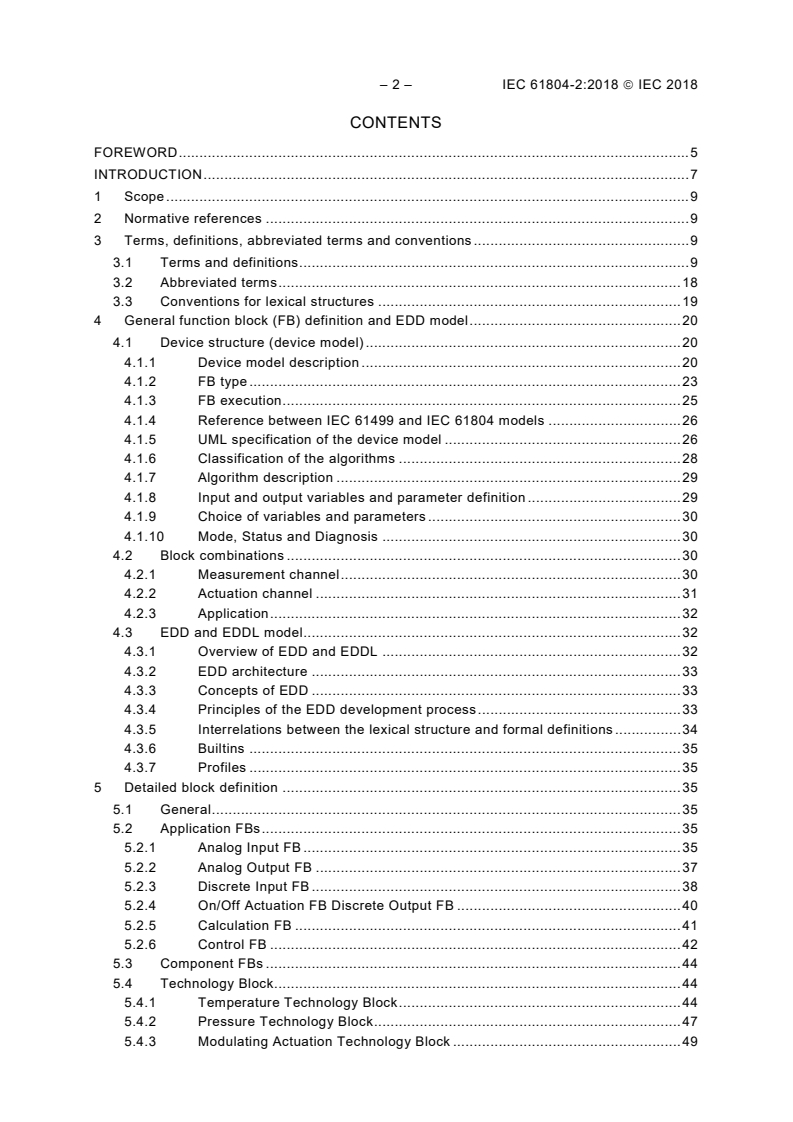
– 2 – IEC 61804-2:2018 IEC 2018
CONTENTS
FOREWORD . 5
INTRODUCTION . 7
1 Scope . 9
2 Normative references . 9
3 Terms, definitions, abbreviated terms and conventions . 9
3.1 Terms and definitions . 9
3.2 Abbreviated terms . 18
3.3 Conventions for lexical structures . 19
4 General function block (FB) definition and EDD model . 20
4.1 Device structure (device model) . 20
4.1.1 Device model description . 20
4.1.2 FB type . 23
4.1.3 FB execution . 25
4.1.4 Reference between IEC 61499 and IEC 61804 models . 26
4.1.5 UML specification of the device model . 26
4.1.6 Classification of the algorithms . 28
4.1.7 Algorithm description . 29
4.1.8 Input and output variables and parameter definition . 29
4.1.9 Choice of variables and parameters . 30
4.1.10 Mode, Status and Diagnosis . 30
4.2 Block combinations . 30
4.2.1 Measurement channel . 30
4.2.2 Actuation channel . 31
4.2.3 Application . 32
4.3 EDD and EDDL model. 32
4.3.1 Overview of EDD and EDDL . 32
4.3.2 EDD architecture . 33
4.3.3 Concepts of EDD . 33
4.3.4 Principles of the EDD development process . 33
4.3.5 Interrelations between the lexical structure and formal definitions . 34
4.3.6 Builtins . 35
4.3.7 Profiles . 35
5 Detailed block definition . 35
5.1 General . 35
5.2 Application FBs . 35
5.2.1 Analog Input FB . 35
5.2.2 Analog Output FB . 37
5.2.3 Discrete Input FB . 38
5.2.4 On/Off Actuation FB Discrete Output FB . 40
5.2.5 Calculation FB . 41
5.2.6 Control FB . 42
5.3 Component FBs . 44
5.4 Technology Block . 44
5.4.1 Temperature Technology Block . 44
5.4.2 Pressure Technology Block . 47
5.4.3 Modulating Actuation Technology Block . 49
5.4.4 On/Off Actuation Technology Block . 51
5.5 Device (Resource) Block . 54
5.5.1 Identification . 54
5.5.2 Device state . 54
5.5.3 Message . 56
5.5.4 Initialisation . 56
5.6 Algorithms common to all blocks . 56
5.6.1 Data Input/Data Output status . 56
5.6.2 Validity . 57
5.6.3 Restart Initialisation . 57
5.6.4 Fail-safe . 57
5.6.5 Remote Cascade Initialisation . 58
6 FB Environment . 58
7 Mapping to System Management . 58
8 Mapping to Communication . 59
Annex A (informative) Parameter description . 62
Annex B (informative) Compatibility levels . 68
B.1 General . 68
B.2 Compatibility . 69
B.3 Incompatibility . 69
B.4 Coexistence . 70
B.5 Interconnectability . 70
B.6 Interworkability . 70
B.7 Interoperability . 70
B.8 Interchangeability . 71
Annex C (informative) Proxy concept and its use in FB applications . 72
C.1 General proxy concept . 72
C.2 Use of the proxy concept in FB applications . 73
Bibliography . 75
Figure 1 – Position of IEC 61804-2 related to other standards and products . 7
Figure 2 – FB structure is derived out of the process (P&ID view) . 20
Figure 3 – FB structure may be distributed between devices (according to IEC 61499-
1) . 21
Figure 4 – IEC 61804 FBs can be implemented in different devices . 22
Figure 5 – General components of devices . 22
Figure 6 – Block types of IEC 61804 (all parts) . 23
Figure 7 – IEC 61804 block overview (graphical representation not normative) . 24
Figure 8 – UML class diagram of the device model . 27
Figure 9 – Measurement process signal flow . 31
Figure 10 – Actuation process signal flow . 31
Figure 11 – Application process signal flow . 32
Figure 12 – EDD generation process . 34
Figure 13 – Analog Input FB . 36
Figure 14 – Analog Output FB . 37
Figure 15 – Discrete input FB . 39
– 4 – IEC 61804-2:2018 IEC 2018
Figure 16 – Discrete Output FB . 40
Figure 17 – Calculation FB . 42
Figure 18 – Control FB . 43
Figure 19 – Temperature Technology Block . 44
Figure 20 – Pressure Technology Block . 48
Figure 21 – Modulating Actuation Technology Block . 50
Figure 22 – On/Off Actuation Technology Block . 52
Figure 23 – Harel state chart . 55
Figure 24 – Application structure of ISO OSI Reference Model . 59
Figure 25 – Client/Server relationship in terms of OSI Reference Model . 60
Figure 26 – Mapping of IEC 61804 FBs to APOs . 60
Figure B.1 – Levels of functional device compatibility . 68
Figure C.1 – Proxy model class diagram . 72
Figure C.2 – Proxy integration in DCS . 73
Table 1 – Field attribute descriptions . 19
Table 2 – Equivalences between IEC 61804 and IEC 61499 model elements . 26
Table 3 – Variables and parameter description template . 29
Table 4 – Example of temperature sensors of Sensor_Type . 46
Table 5 – Device status state table . 54
Table 6 – Device status transition table . 56
Table A.1 – Parameter description . 62
Table B.1 – Functionality features . 69
INTERNATIONAL ELECTROTECHNICAL COMMISSION
____________
FUNCTION BLOCKS (FB) FOR PROCESS CONTROL AND
ELECTRONIC DEVICE DESCRIPTION LANGUAGE (EDDL) –
Part 2: Specification of FB concept
FOREWORD
1) The International Electrotechnical Commission (IEC) is a worldwide organization for standardization comprising
all national electrotechnical committees (IEC National Committees). The object of IEC is to promote
international co-operation on all questions concerning standardization in the electrical and electronic fields. To
this end and in addition to other activities, IEC publishes International Standards, Technical Specifications,
Technical Reports, Publicly Available Specifications (PAS) and Guides (hereafter referred to as "IEC
Publication(s)"). Their preparation is entrusted to technical committees; any IEC National Committee interested
in the subject dealt with may participate in this preparatory work. International, governmental and non-
governmental organizations liaising with the IEC also participate in this preparation. IEC collaborates closely
with the International Organization for Standardization (ISO) in accordance with conditions determined by
agreement between the two organizations.
2) The formal decisions or agreements of IEC on technical matters express, as nearly as possible, an international
consensus of opinion on the relevant subjects since each technical committee has representation from all
interested IEC National Committees.
3) IEC Publications have the form of recommendations for international use and are accepted by IEC National
Committees in that sense. While all reasonable efforts are made to ensure that the technical content of IEC
Publications is accurate, IEC cannot be held responsible for the way in which they are used or for any
misinterpretation by any end user.
4) In order to promote international uniformity, IEC National Committees undertake to apply IEC Publications
transparently to the maximum extent possible in their national and regional publications. Any divergence
between any IEC Publication and the corresponding national or regional publication shall be clearly indicated in
the latter.
5) IEC itself does not provide any attestation of conformity. Independent certification bodies provide conformity
assessment services and, in some areas, access to IEC marks of conformity. IEC is not responsible for any
services carried out by independent certification bodies.
6) All users should ensure that they have the latest edition of this publication.
7) No liability shall attach to IEC or its directors, employees, servants or agents including individual experts and
members of its technical committees and IEC National Committees for any personal injury, property damage or
other damage of any nature whatsoever, whether direct or indirect, or for costs (including legal fees) and
expenses arising out of the publication, use of, or reliance upon, this IEC Publication or any other IEC
Publications.
8) Attention is drawn to the Normative references cited in this publication. Use of the referenced publications is
indispensable for the correct application of this publication.
9) Attention is drawn to the possibility that some of the elements of this IEC Publication may be the subject of
patent rights. IEC shall not be held responsible for identifying any or all such patent rights.
International Standard IEC 61804-2 has been prepared by subcommittee 65E: Devices and
integration in enterprice systems, of IEC technical committee 65: Industrial-process
measurement, control and automation.
This third edition cancels and replaces the second edition published in 2006 and integrates
parts of IEC 61804-1 which was withdrawn in January 2013. This edition constitutes a
technical revision.
This edition includes the following significant technical changes with respect to the previous
edition:
a) added command communication mapping in Clause 8;
b) moved and reword compatibility level definition from IEC 62804-1 to new Annex B and
terms and definitions;
– 6 – IEC 61804-2:2018 IEC 2018
c) added proxy concept in new Annex C.
The text of this standard is based on the following documents:
FDIS Report on voting
65E/567/FDIS 65E/576/RVD
Full information on the voting for the approval of this standard can be found in the report on
voting indicated in the above table.
This publication has been drafted in accordance with the ISO/IEC Directives, Part 2.
A list of all parts in the IEC 61804 series, published under the general title Function blocks
(FB) for process control and electronic device description language (EDDL), can be found on
the IEC website.
Future standards in this series will carry the new general title as cited above. Titles of existing
standards in this series will be updated at the time of the next edition.
The committee has decided that the contents of this publication will remain unchanged until
the stability date indicated on the IEC web site under "http://webstore.iec.ch" in the data
related to the specific publication. At this date, the publication will be
• reconfirmed,
• withdrawn,
• replaced by a revised edition, or
• amended.
IMPORTANT – The 'colour inside' logo on the cover page of this publication indicates
that it contains colours which are considered to be useful for the correct
understanding of its contents. Users should therefore print this document using a
colour printer.
INTRODUCTION
This part of IEC 61804 provides a conceptual function block (FB) specification, which can be
mapped to specific communication systems and their accompanying definitions by industrial
groups.
The EDDL fills the gap between the conceptual FB specification of this document and a
product implementation. Figure 1 shows these aspects.
Conceptual FB
IEC 61804 Electronic
specification for
IEC 61804 Function block concept
device description
the process
Part 2
sector
Solutions
Other
ControlNet
Foundation
PROFIBUS
(technology)
FB
PA profile
profile
application
BBB
specification
Implementation
EDD
Products
IEC
Figure 1 – Position of IEC 61804-2 related to other standards and products
The International Electrotechnical Commission (IEC) draws attention to the fact that it is
claimed that compliance with this document may involve the use of patents
U.S. Patent No. 5,333,114
U.S. Patent No. 5,485,400
U.S. Patent No. 5,825,664
U.S. Patent No. 5,909,368
U.S. Patent Pending No. 08/916,178
Australian Patent No. 638507
Canadian Patent No. 2,066,743
European Patent No. 0495001
Validated in:
UK – Patent No. 0495001
France – Patent No. 0495001
Germany – Patent No. 69032954.7
Netherlands – Patent No. 0495001
Japan – Patent No. 3137643
IEC take no position concerning the evidence, validity and scope of this patent right. The
holder of this patent right has assured the IEC that he is willing to negotiate licenses under
reasonable and non-discriminatory terms and conditions with applicants throughout the world.
In this respect, the statement of the holder of this patent right is registered with IEC.
Information may be obtained from:
Language
Part 3
Design rules
Part 4
Language builtins
Part 5
Requirements for
integrating fieldbus
devices - Part 6
– 8 – IEC 61804-2:2018 IEC 2018
FieldComm Group Inc.,
9430 Research Boulevard, Suite 1-120,
Austin, Texas, USA 78759,
Attention: President.
Attention is drawn to the possibility that some of the elements of this document may be the
subject of patent rights other than those identified above. IEC shall not be held responsible for
identifying any or all such patent rights.
ISO (www.iso.org/patents) and IEC (http://patents.iec.ch) maintain on-line data bases of
patents relevant to their standards. Users are encouraged to consult the data bases for the
most up to date information concerning patents.
The IEC 61804 series has the general title "Function blocks (FB) for process control and
electronic device description language (EDDL)" and consists of the following parts:
Part 2: FB concept
Part 3: Electronic device description language (EDDL)
Part 4: EDD design rules
Part 5: EDDL Builtin library
Part 6: Meeting the requirements for integrating fieldbus devices in engineering tools for field
devices
FUNCTION BLOCKS (FB) FOR PROCESS CONTROL AND
ELECTRONIC DEVICE DESCRIPTION LANGUAGE (EDDL) –
Part 2: Specification of FB concept
1 Scope
This part of IEC 61804 is applicable to function blocks (FB) for process control.
This document specifies FB by using the result of a harmonization work as regards several
elements.
a) The device model which defines the components of an IEC 61804-2 conformant device.
b) Conceptual specifications of FBs for measurement, actuation and processing. This
includes general rules for the essential features to support control, whilst avoiding details
which stop innovation as well as specialization for different industrial sectors.
c) The electronic device description (EDD) technology, which enables the integration of real
product details using the tools of the engineering life cycle.
The standardization work for FB was carried out by harmonizing the description of concepts of
existing technologies. It results in an abstract level that allowed the definition of the common
features in a unique way. This abstract vision is called here the "conceptual FB specification"
and is mapped to specific communication systems and their accompanying definitions by the
industrial groups.
NOTE This document can be mapped to ISO 15745-1.
There are solutions on the market today, which fulfil the requirements of this document and
show how the conceptual specification is implemented in a given technology. New
technologies will need to find equivalent solutions (see Figure 4).
2 Normative references
The following documents are referred to in the text in such a way that some or all of their
content constitutes requirements of this document. For dated references, only the edition
cited applies. For undated references, the latest edition of the referenced document (including
any amendments) applies.
IEC 61158 (all parts), Industrial communication networks – Fieldbus specifications
IEC 61499-1:2012, Function blocks – Part 1: Architecture
ISO/IEC 7498-1, Information technology – Open Systems Interconnection – Basic Reference
Model: The Basic Model
3 Terms, definitions, abbreviated terms and conventions
3.1 Terms and definitions
For the purposes of this document, the following terms and definitions apply.
ISO and IEC maintain terminological databases for use in standardization at the following
addresses:
– 10 – IEC 61804-2:2018 IEC 2018
• IEC Electropedia: available at http://www.electropedia.org/
• ISO Online browsing platform: available at http://www.iso.org/obp
3.1.1
performance
quantitative or qualitative level of a property at any point in time considered
[SOURCE: ISO 15686-1:2011, 3.15, modified – The second term "performance in use" has
been deleted. In the definition, the words "quantitative or" have been added and the word
"critical" has been deleted.]
3.1.2
semantics
relationships between the symbolic elements and their meanings, interpretation and use
[SOURCE: IEC 61131-3:2013, 3.85, modified – The words "of a programming language" have
been deleted.]
3.1.3
algorithm
finite set of well-defined rules for the solution of a problem in a finite number of operations
3.1.4
application
software functional unit that is specific to the solution of a problem in industrial-process
measurement and control
Note 1 to entry: An application may be distributed among resources, and may communicate with other
applications.
3.1.5
application function block
application FB
FB which has no input or output to the process
3.1.6
attribute
property or characteristic of an entity, for instance, the version identifier of an FB type
specification
Note 1 to entry: The formal description of attributes is part of the solution profiles to get domain specific
interoperability. IEC 61804 (all parts) defines the general rules to define the attributes and specifies the EDDL to
describe attributes, which may be described in solution profiles.
[SOURCE: IEC 61499-1:2012, 3.6, modified – A note to entry has been added.]
3.1.7
Builtin
predefined subroutine for communication and display executed by the EDD application
3.1.8
coexistence
ability of two or more devices to operate independently of one another in the same network
respecting the common rules for sharing the same medium
3.1.9
compatibility
ability of a device to provide the set of functions and data required by an application for a
specific role in the physical process
Note 1 to entry: Function comprises application and communication functions including the dynamic behavior.
Note 2 to entry: Data comprises communication frame format and order as well as data type definitions up to
semantical description of the functions.
3.1.10
component function block
component FB
FB instance which is used in the specification of an algorithm of a composite FB type
Note 1 to entry: A component FB can be an FB or composite FB type.
3.1.11
composite FB type
FB type whose algorithms are expressed entirely in terms of interconnected component FBs
and variables
[SOURCE: IEC 61499-1:2012, 3.16, modified – The words "and the control of their execution"
and "event" have been deleted. ]
3.1.12
configuration
selecting functional units, assigning their locations and defining their
interconnections
[SOURCE: IEC 61499-1:2012, 3.18]
3.1.13
data
representation of facts, concepts or instructions in a formalized manner suitable for
communication, interpretation or processing by human beings or by automatic means
[SOURCE: IEC 61499-1:2012, 3.23, modified – The definition has been rephrased.]
3.1.14
data connection
association established between functional units for conveyance of data
[SOURCE: IEC 61499-1:2012, 3.24, modified – The words "two function blocks" have been
replaced by "functional units".]
3.1.15
data input
interface of an FB which receives data from a data connection
[SOURCE: IEC 61499-1:2012, 3.25]
3.1.16
data output
interface of an FB which supplies data to a data connection
[SOURCE: IEC 61499-1:2012, 3.26]
3.1.17
data type
set of values together with a set of permitted operations
[SOURCE: IEC 61499-1:2012, 3.27]
– 12 – IEC 61804-2:2018 IEC 2018
3.1.18
device
independent physical entity capable of performing one or more specified functions in a
particular context and delimited by its interfaces
[SOURCE: IEC 61499-1:2012, 3.29, modified – The note to entry has been deleted.]
3.1.19
Device Block
FB, which has no input and no output
3.1.20
device management application
application whose primary function is the management of multiple resources within a device
[SOURCE: IEC 61499-1:2012, 3.30]
3.1.21
EDD application
program using the EDD, or any translated form, which offers functionality such as
communication representation, data representation, graphical representation, etc.
3.1.22
EDDL processor
processor or program, which translates the EDD into an executable form that can be
processed by an EDD application
3.1.23
EDDL profile
selection of the supported elements of the EDDL lexical structure including the syntax
definitions for a number of specific consortia
3.1.24
electronic device description language
EDDL
methodology for describing parameter(s) of a automation system component
3.1.25
electronic device description
EDD
data collection containing the device parameter(s), their dependencies, their graphical
representation and a description of the data sets which are transferred.
Note 1 to entry: The electronic device description is created using the electronic device description language
(EDDL).
3.1.26
electronic device description source
EDDS
ASCII file containing a specific device description
3.1.27
electronic device description technology
EDDT
technology which includes the EDD development process, the EDD usage and the involved
tool chain
3.1.28
electronic device description language compiler
tool which translates the EDD source in an internal format that is used by the EDD interpreter
3.1.29
electronic device description interpreter
EDDI
tool which uses the EDD source or an internal format that is given by the EDDL compiler to
provide the EDD information to the EDD user
3.1.30
entity
particular thing, such as a person, place, process, object, concept, association, or event
[SOURCE: IEC 61499-1:2012, 3.31]
3.1.31
event
instantaneous occurrence that is significant to scheduling the execution of an algorithm
Note 1 to entry: The execution of an algorithm may make use of variables associated with an event.
[SOURCE: IEC 61499-1:2012, 3.32]
3.1.32
exception
event that causes suspension of normal execution
[SOURCE: IEC 61499-1:2012, 3.36]
3.1.33
function
intended purpose of an entity or its characteristic action
[SOURCE: IEC 61499-1:2012, 3.44, modified – The word "specific" has been replaced by
"intended".]
3.1.34
functional unit
entity of hardware or software, or both, capable of accomplishing a specified purpose
[SOURCE: IEC 61499-1:2012, 3.48]
3.1.35
function block
function block instance
software functional unit comprising an individual, named copy of a data structure and
associated operations specified by a corresponding FB type
Note 1 to entry: Typical operations of an FB include modification of the values of the data in its associated data
structure.
[SOURCE: IEC 61499-1:2012, 3.45, modified – The definition has been rephrased and the
second note to entry has been deleted.]
– 14 – IEC 61804-2:2018 IEC 2018
3.1.36
function block diagram
FBD
network in which the nodes are function block instances, variables, literals, and events
Note 1 to entry: This is not the same as the function block diagram defined in IEC 61131-3.
3.1.37
hardware
physical equipment, as opposed to programs, procedures, rules and associated
documentation
[SOURCE: IEC 61499-1:2012, 3.49]
3.1.38
implementation
development phase in which the hardware and software of a system become operational
[SOURCE: IEC 61499-1:2012, 3.51]
3.1.39
incompatibility
inability of devices to provide the functions and performance required by their role in a
distributed application
3.1.40
input variable
variable whose value is supplied by a data input, and which may be used in one or more
operations of an FB
Note 1 to entry: An input parameter of an FB, as defined in IEC 61131-3, is an input variable.
[SOURCE: IEC 61499-1:2012, 3.54]
3.1.41
instance
functional unit comprising an individual, named entity with the attributes of a defined type
[SOURCE: IEC 61499-1:2012, 3.55]
3.1.42
instance name
identifier associated with and designating an instance
[SOURCE: IEC 61499-1:2012, 3.56]
3.1.43
instantiation
creation of an instance of a specified type
[SOURCE: IEC 61499-1:2012, 3.57]
3.1.44
interchangeability
ability of one device to fulfil exactly the same role of another device in the physical process
and distributed application as required by the process design
3.1.45
interconnectivity
ability of two or more devices to operate with one another using the same communications
protocols and communication interface
3.1.46
interface
shared boundary between two functional units, defined by functional characteristics, signal
characteristics, or other characteristics as appropriate
[SOURCE: IEC 60050-351:2013, 351-42-25, modified – The word "shared" has been added to
the definition, and the notes to entry have been deleted.]
3.1.47
internal variable
variable whose value is used or modified by one or more operations of a FB but is not
supplied by a data input or to a data output
[SOURCE: IEC 61499-1:2012, 3.60]
3.1.48
interoperability
ability of two or more devices to work together in one or more distributed applications with the
shared knowledge of the data types and the semantics of the data transmitted
3.1.49
interworkability
ability of two or more devices to support the transfer of data between devices with the shared
knowledge of the data types of the data transmitted
Note 1 to entry: The content of the data is unknown, e.g. a text string that can be displayed but not interpreted by
the receiver device itself, or the content is a value but the unit is unknown.
3.1.50
invocation
process of initiating the execution of the sequence of operations specified in an algorithm
[SOURCE: IEC 61499-1:2012, 3.61]
3.1.51
management function block
FB whose primary function is the management of applications within a resource
[SOURCE: IEC 61499-1:2012, 3.64]
3.1.52
management resource
resource whose primary function is the management of other resources
[SOURCE: IEC 61499-1:2012, 3.65]
3.1.53
mapping
set of values having defined correspondence with the quantities or values of another set
[SOURCE: IEC 61499-1:2012, 3.66, modified – The words "features or attributes" have been
replaced by "values", and "members" by quantities or values".]
– 16 – IEC 61804-2:2018 IEC 2018
3.1.54
model
representation of a real world process, device, or concept
3.1.55
operation
well-defined action that, when applied to any permissible combination of known entities,
produces a new entity
[SOURCE: IEC 61499-1:2012, 3.73]
3.1.56
output variable
variable whose value is established by one or more operations of a FB, and is supplied to a
data output
Note 1 to entry: An output parameter of an FB, as defined in IEC 1131-3, is an output variable.
[SOURCE: IEC 61499-1:2012, 3.74]
3.1.57
parameter
variable that is given a constant value for a specified application and that may denote the
application
[SOURCE: IEC 61499-1:2012, 3.75]
3.1.58
preprocessor
part of the runtime environment that transforms the information given in an EDD
3.1.59
preprocessor directive
description of conditions for filtering the EDD code before compilation or interpretation
Note 1 to entry: For example a preprocessor directive providing the facility to define names for constants or to
write macros to make code easier to read.
3.1.60
proxy
computer process that relays a protocol between client and server computer systems, by
appearing to the client to be the server and appearing to the server to be the client
[SOURCE: RFC 2828:2000]
3.1.61
resource
functional unit contained within a device which has independent control of its operation, and
which provides various services to applications, including the scheduling and execution of
algorithms
Note 1 to entry: The RESOURCE defined in IEC 61131-3 is a programming language element corresponding to
the resource defined above.
Note 2 to entry: A device contains one or more resources.
[SOURCE: IEC 61499-1:2012, 3.80, modified – The words "contained within a device" have
been added.]
3.1.62
resource management application
application whose primary function is the management of a single resource
[SOURCE: IEC 61499-1:20
...