


IEC 62676-3:2013
(Main)Video surveillance systems for use in security applications - Part 3: Analog and digital video interfaces
Video surveillance systems for use in security applications - Part 3: Analog and digital video interfaces
IEC 62676-3:2013 specifies physical, electrical and software interface (non-IP) specifications of analog and digital video interface in video surveillance systems (so far called CCTV) applications. Video interfaces are used both for connection and transmission of surveillance video, audio and control signals. This International Standard applies strictly to Video Surveillance Systems. This standard is based on broadcast television standards and other standards, and it defines the minimum requirements for analog and digital video interfaces to meet VSS's requirements, interoperability and de facto practice.
Systèmes de vidéosurveillance destinés à être utilisés dans les applications de sécurité - Partie 3: Interfaces vidéo analogiques et vidéo numériques
La CEI 62676-3:2013 spécifie les spécifications relatives aux interfaces physiques, électriques et logicielles (non-IP) de l'interface vidéo analogique et numérique dans les applications des systèmes de vidéosurveillance (auparavant appelés CCTV). Les interfaces vidéo sont utilisées la connexion et aussi la transmission des signaux de vidéo surveillance, des signaux audio et des signaux de commande. La présente Norme internationale s'applique strictement aux systèmes de vidéosurveillance. La présente norme est basée sur des normes de télévision par diffusion et d'autres normes. Elle définit également les exigences minimales pour les interfaces vidéo analogiques et numériques satisfassent aux exigences concernant les VSS, à l'interopérabilité et la pratique de facto.
General Information
- Status
- Published
- Publication Date
- 21-Jul-2013
- Technical Committee
- TC 79 - Alarm and electronic security systems
- Current Stage
- PPUB - Publication issued
- Start Date
- 22-Jul-2013
- Completion Date
- 15-Aug-2013
Overview
IEC 62676-3:2013 is an international standard that focuses on video surveillance systems used in security applications, specifically addressing the analog and digital video interfaces involved. This standard establishes stringent specifications for the physical, electrical, and software interfaces (excluding IP-based) used in the connection and transmission of video, audio, and control signals within video surveillance systems, also known as CCTV systems.
Rooted in existing broadcast television and related standards, IEC 62676-3:2013 defines the minimum requirements that analog and digital video interfaces must meet to ensure system interoperability, reliability, and adherence to industry best practices. By following this standard, manufacturers and users can ensure consistent quality and compatibility across various video surveillance products and components.
Key Topics
Scope and Application
IEC 62676-3:2013 applies exclusively to video surveillance systems used in security, laying out requirements for video interfaces that handle analog and digital video signals, audio, and control transmissions.Interface Types Covered
- Physical interfaces: Connection types for cameras, display units, video processing equipment, encoders/decoders, fiber optics, wireless transmission, and alarm interfaces.
- Electrical interfaces: Specifications for various video signal types including composite video, Y/C video, YPbPr and RGB analog component video, as well as digital video signals such as HDMI, DVI, DisplayPort, and SDI.
- Control signal interfaces: Standards for RS-232 and RS-485 communication protocols widely used for device control.
Analog Video Signal Requirements
The standard defines detailed performance parameters and testing methods for analog (composite) video signal transmission, focusing on:- Signal levels, input/output impedance, and return loss
- Signal-to-noise ratio and interference considerations
- Chrominance and luminance gain and delay characteristics
- Differential gain and phase precision
- Luminance non-linearity
Testing Procedures
Specific test setups, equipment, and procedures are provided for verifying compliance with the analog video transmission requirements, ensuring these quality benchmarks are measurable and reproducible.Software Interfaces
Although the standard excludes IP interfaces, it defines software-level interfaces pertinent to non-IP or network access layer video transmission elements.
Applications
IEC 62676-3:2013 is essential for stakeholders involved in the development, installation, and maintenance of video surveillance systems in security contexts such as:
- Building and Facility Security: Ensuring high-quality video transmission between cameras and monitoring equipment in commercial, residential, and public buildings.
- Public Safety Surveillance: Supporting the interface standards in city-wide CCTV networks, traffic monitoring, and law enforcement surveillance systems.
- Industrial Security: Applying robust analog/digital video interface standards in industrial plants, warehouses, and critical infrastructure.
- Security Equipment Manufacturing: Guiding manufacturers in producing compliant cameras, monitors, video processing devices, and transmission modules that seamlessly integrate and operate within standard VSS architectures.
Related Standards
This document integrates and builds upon foundational broadcast television standards and related interface specifications. Professionals working with IEC 62676-3:2013 may also reference:
- Broadcast and video transmission interface standards (e.g., SMPTE standards for digital video)
- IEC 62676 series parts addressing other aspects of video surveillance systems such as system architecture, data interfaces, and network video communications
- Communication protocols like RS-232 and RS-485 for control signals in video systems
- Standards on fiber optic and wireless video transmission for comprehensive surveillance system integration
By harmonizing video interface requirements with these standards, IEC 62676-3:2013 ensures interoperability, effective system design, and enhanced security performance.
Keywords: IEC 62676-3:2013, video surveillance systems, CCTV, analog video interface, digital video interface, security applications, video transmission standards, composite video, HDMI, RS-232, RS-485, video signal specifications, CCTV interoperability, video system testing, surveillance video quality



Get Certified
Connect with accredited certification bodies for this standard

NSF International
Global independent organization facilitating standards development and certification.

CIS Institut d.o.o.
Personal Protective Equipment (PPE) certification body. Notified Body NB-2890 for EU Regulation 2016/425 PPE.

Kiwa BDA Testing
Building and construction product certification.
Sponsored listings
Frequently Asked Questions
IEC 62676-3:2013 is a standard published by the International Electrotechnical Commission (IEC). Its full title is "Video surveillance systems for use in security applications - Part 3: Analog and digital video interfaces". This standard covers: IEC 62676-3:2013 specifies physical, electrical and software interface (non-IP) specifications of analog and digital video interface in video surveillance systems (so far called CCTV) applications. Video interfaces are used both for connection and transmission of surveillance video, audio and control signals. This International Standard applies strictly to Video Surveillance Systems. This standard is based on broadcast television standards and other standards, and it defines the minimum requirements for analog and digital video interfaces to meet VSS's requirements, interoperability and de facto practice.
IEC 62676-3:2013 specifies physical, electrical and software interface (non-IP) specifications of analog and digital video interface in video surveillance systems (so far called CCTV) applications. Video interfaces are used both for connection and transmission of surveillance video, audio and control signals. This International Standard applies strictly to Video Surveillance Systems. This standard is based on broadcast television standards and other standards, and it defines the minimum requirements for analog and digital video interfaces to meet VSS's requirements, interoperability and de facto practice.
IEC 62676-3:2013 is classified under the following ICS (International Classification for Standards) categories: 13.320 - Alarm and warning systems. The ICS classification helps identify the subject area and facilitates finding related standards.
IEC 62676-3:2013 is available in PDF format for immediate download after purchase. The document can be added to your cart and obtained through the secure checkout process. Digital delivery ensures instant access to the complete standard document.
Standards Content (Sample)
IEC 62676-3 ®
Edition 1.0 2013-07
INTERNATIONAL
STANDARD
NORME
INTERNATIONALE
Video surveillance systems for use in security applications –
Part 3: Analog and digital video interfaces
Systèmes de vidéosurveillance destinés à être utilisés dans les applications de
sécurité –
Partie 3: Interfaces vidéo analogiques et vidéo numériques
All rights reserved. Unless otherwise specified, no part of this publication may be reproduced or utilized in any form
or by any means, electronic or mechanical, including photocopying and microfilm, without permission in writing from
either IEC or IEC's member National Committee in the country of the requester.
If you have any questions about IEC copyright or have an enquiry about obtaining additional rights to this publication,
please contact the address below or your local IEC member National Committee for further information.
Droits de reproduction réservés. Sauf indication contraire, aucune partie de cette publication ne peut être reproduite ni
utilisée sous quelque forme que ce soit et par aucun procédé, électronique ou mécanique, y compris la photocopie et les
microfilms, sans l'accord écrit de la CEI ou du Comité national de la CEI du pays du demandeur.
Si vous avez des questions sur le copyright de la CEI ou si vous désirez obtenir des droits supplémentaires sur cette
publication, utilisez les coordonnées ci-après ou contactez le Comité national de la CEI de votre pays de résidence.
IEC Central Office Tel.: +41 22 919 02 11
3, rue de Varembé Fax: +41 22 919 03 00
CH-1211 Geneva 20 info@iec.ch
Switzerland www.iec.ch
About the IEC
The International Electrotechnical Commission (IEC) is the leading global organization that prepares and publishes
International Standards for all electrical, electronic and related technologies.
About IEC publications
The technical content of IEC publications is kept under constant review by the IEC. Please make sure that you have the
latest edition, a corrigenda or an amendment might have been published.
Useful links:
IEC publications search - www.iec.ch/searchpub Electropedia - www.electropedia.org
The advanced search enables you to find IEC publications The world's leading online dictionary of electronic and
by a variety of criteria (reference number, text, technical electrical terms containing more than 30 000 terms and
committee,…). definitions in English and French, with equivalent terms in
It also gives information on projects, replaced and additional languages. Also known as the International
withdrawn publications. Electrotechnical Vocabulary (IEV) on-line.
IEC Just Published - webstore.iec.ch/justpublished Customer Service Centre - webstore.iec.ch/csc
Stay up to date on all new IEC publications. Just Published If you wish to give us your feedback on this publication
details all new publications released. Available on-line and or need further assistance, please contact the
also once a month by email. Customer Service Centre: csc@iec.ch.
A propos de la CEI
La Commission Electrotechnique Internationale (CEI) est la première organisation mondiale qui élabore et publie des
Normes internationales pour tout ce qui a trait à l'électricité, à l'électronique et aux technologies apparentées.
A propos des publications CEI
Le contenu technique des publications de la CEI est constamment revu. Veuillez vous assurer que vous possédez
l’édition la plus récente, un corrigendum ou amendement peut avoir été publié.
Liens utiles:
Recherche de publications CEI - www.iec.ch/searchpub Electropedia - www.electropedia.org
La recherche avancée vous permet de trouver des Le premier dictionnaire en ligne au monde de termes
publications CEI en utilisant différents critères (numéro de électroniques et électriques. Il contient plus de 30 000
référence, texte, comité d’études,…). termes et définitions en anglais et en français, ainsi que
Elle donne aussi des informations sur les projets et les les termes équivalents dans les langues additionnelles.
publications remplacées ou retirées. Egalement appelé Vocabulaire Electrotechnique
International (VEI) en ligne.
Just Published CEI - webstore.iec.ch/justpublished
Service Clients - webstore.iec.ch/csc
Restez informé sur les nouvelles publications de la CEI.
Just Published détaille les nouvelles publications parues. Si vous désirez nous donner des commentaires sur
Disponible en ligne et aussi une fois par mois par email. cette publication ou si vous avez des questions
contactez-nous: csc@iec.ch.
IEC 62676-3 ®
Edition 1.0 2013-07
INTERNATIONAL
STANDARD
NORME
INTERNATIONALE
Video surveillance systems for use in security applications –
Part 3: Analog and digital video interfaces
Systèmes de vidéosurveillance destinés à être utilisés dans les applications de
sécurité –
Partie 3: Interfaces vidéo analogiques et vidéo numériques
INTERNATIONAL
ELECTROTECHNICAL
COMMISSION
COMMISSION
ELECTROTECHNIQUE
PRICE CODE
INTERNATIONALE
CODE PRIX W
ICS 13.320 ISBN 978-2-8322-0991-2
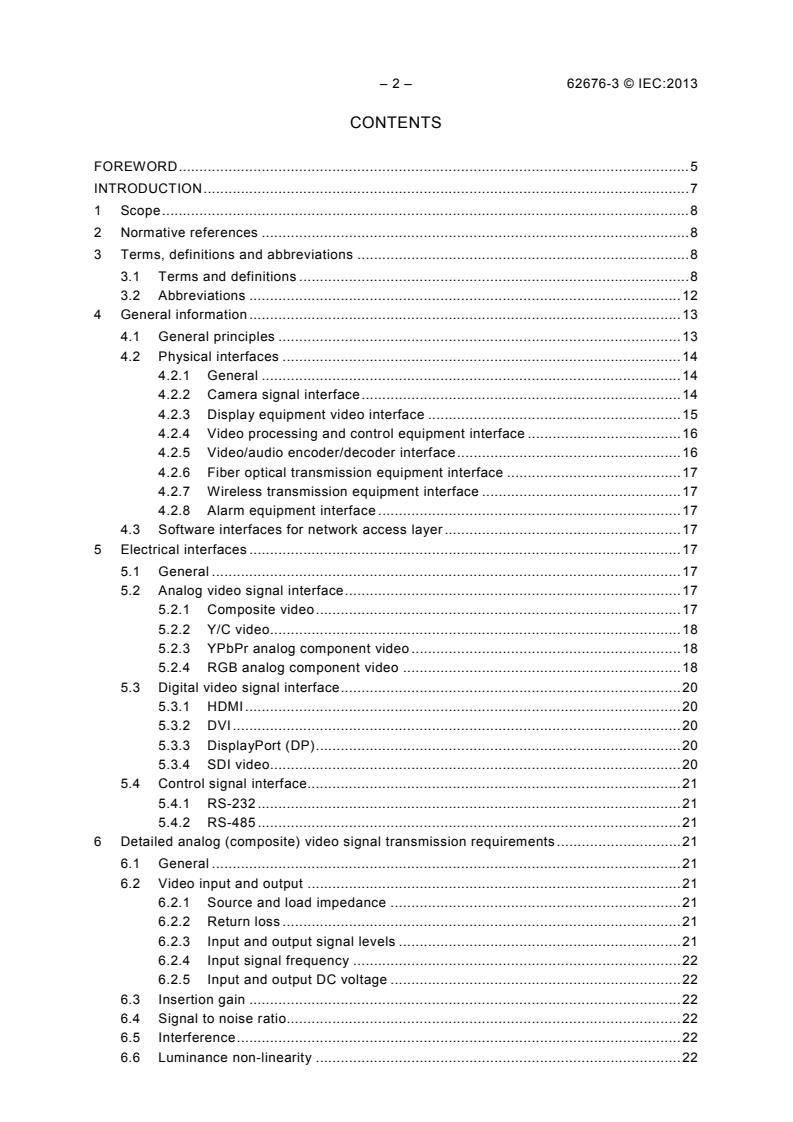
– 2 – 62676-3 © IEC:2013
CONTENTS
FOREWORD . 5
INTRODUCTION . 7
1 Scope . 8
2 Normative references . 8
3 Terms, definitions and abbreviations . 8
3.1 Terms and definitions . 8
3.2 Abbreviations . 12
4 General information . 13
4.1 General principles . 13
4.2 Physical interfaces . 14
4.2.1 General . 14
4.2.2 Camera signal interface . 14
4.2.3 Display equipment video interface . 15
4.2.4 Video processing and control equipment interface . 16
4.2.5 Video/audio encoder/decoder interface . 16
4.2.6 Fiber optical transmission equipment interface . 17
4.2.7 Wireless transmission equipment interface . 17
4.2.8 Alarm equipment interface . 17
4.3 Software interfaces for network access layer . 17
5 Electrical interfaces . 17
5.1 General . 17
5.2 Analog video signal interface . 17
5.2.1 Composite video . 17
5.2.2 Y/C video. 18
5.2.3 YPbPr analog component video . 18
5.2.4 RGB analog component video . 18
5.3 Digital video signal interface . 20
5.3.1 HDMI . 20
5.3.2 DVI . 20
5.3.3 DisplayPort (DP) . 20
5.3.4 SDI video. 20
5.4 Control signal interface. 21
5.4.1 RS-232 . 21
5.4.2 RS-485 . 21
6 Detailed analog (composite) video signal transmission requirements . 21
6.1 General . 21
6.2 Video input and output . 21
6.2.1 Source and load impedance . 21
6.2.2 Return loss . 21
6.2.3 Input and output signal levels . 21
6.2.4 Input signal frequency . 22
6.2.5 Input and output DC voltage . 22
6.3 Insertion gain . 22
6.4 Signal to noise ratio. 22
6.5 Interference . 22
6.6 Luminance non-linearity . 22
62676-3 © IEC:2013 – 3 –
6.7 Chrominance to luminance gain inequality . 22
6.8 Chrominance to luminance delay inequality . 23
6.9 Differential gain . 23
6.10 Differential phase . 23
7 Analog video signal transmission test conditions . 23
7.1 General . 23
7.2 Test equipment . 23
7.2.1 General . 23
7.2.2 Test equipment . 23
7.2.3 Test signals . 23
7.2.4 Equipment set-up . 24
7.3 Laboratory conditions . 24
8 Analog video signal transmission performance tests . 24
8.1 Input and output signal levels . 24
8.1.1 Principle . 24
8.1.2 Preparation of the test . 24
8.1.3 Test procedure . 24
8.1.4 Criterion for compliance . 24
8.2 Insertion gain . 24
8.2.1 Principle . 24
8.2.2 Preparation of the test . 24
8.2.3 Test procedure . 25
8.2.4 Criterion for compliance . 25
8.3 Input and output impedance . 25
8.3.1 Principle . 25
8.3.2 Preparation of the test . 25
8.3.3 Test procedure . 25
8.3.4 Criterion for compliance . 26
8.4 DC voltage at the output . 26
8.4.1 Principle . 26
8.4.2 Preparation of the test . 26
8.4.3 Test procedure . 26
8.4.4 Criterion for compliance . 26
8.5 Chrominance to luminance gain and delay inequality . 26
8.5.1 Principle . 26
8.5.2 Preparation of the test . 27
8.5.3 Test procedure . 27
8.5.4 Criterion for compliance . 27
8.6 Signal to noise ratio. 27
8.6.1 Principle . 27
8.6.2 Preparation of the test . 27
8.6.3 Test procedure . 27
8.6.4 Criterion for compliance . 27
8.7 Interference . 27
8.7.1 Principle . 27
8.7.2 Preparation of the test . 27
8.7.3 Test procedure . 28
8.7.4 Criterion for compliance . 28
8.8 Luminance non-linearity . 28
– 4 – 62676-3 © IEC:2013
8.8.1 Principle . 28
8.8.2 Preparation of the test . 28
8.8.3 Test procedure . 28
8.8.4 Criterion for compliance . 28
8.9 Differential gain . 28
8.9.1 Principle . 28
8.9.2 Preparation of the test . 28
8.9.3 Test procedure . 28
8.9.4 Criterion for compliance . 29
8.10 Differential phase . 29
8.10.1 Principle . 29
8.10.2 Preparation of the test . 29
8.10.3 Test procedure . 29
8.10.4 Criterion for compliance . 29
8.11 Documentation . 29
Annex A (normative) Test patterns . 30
Annex B (normative) Chrominance to luminance gain and delay charts . 33
Bibliography . 35
Figure 1 – Interface hierarchy of analog and digital video device . 13
Figure 2 – Connection scheme of VSS devices . 14
Figure 3 – Impedance measuring circuit . 25
Figure A.1 – Signal A . 30
Figure A.2 – Signal B . 30
Figure A.3 – Signal C . 31
Figure A.4 – Signal D1 . 31
Figure A.5 – Signal D2 . 32
Figure A.6 – Signal E . 32
Figure B.1 – Chrominance to luminance amplitude and delay errors . 33
Figure B.2 – The Rosman nomogram . 34
Table 1 – Summary of display monitor timings – Standards and guidelines . 19
62676-3 © IEC:2013 – 5 –
INTERNATIONAL ELECTROTECHNICAL COMMISSION
____________
VIDEO SURVEILLANCE SYSTEMS FOR USE
IN SECURITY APPLICATIONS –
Part 3: Analog and digital video interfaces
FOREWORD
1) The International Electrotechnical Commission (IEC) is a worldwide organization for standardization comprising
all national electrotechnical committees (IEC National Committees). The object of IEC is to promote
international co-operation on all questions concerning standardization in the electrical and electronic fields. To
this end and in addition to other activities, IEC publishes International Standards, Technical Specifications,
Technical Reports, Publicly Available Specifications (PAS) and Guides (hereafter referred to as “IEC
Publication(s)”). Their preparation is entrusted to technical committees; any IEC National Committee interested
in the subject dealt with may participate in this preparatory work. International, governmental and non-
governmental organizations liaising with the IEC also participate in this preparation. IEC collaborates closely
with the International Organization for Standardization (ISO) in accordance with conditions determined by
agreement between the two organizations.
2) The formal decisions or agreements of IEC on technical matters express, as nearly as possible, an international
consensus of opinion on the relevant subjects since each technical committee has representation from all
interested IEC National Committees.
3) IEC Publications have the form of recommendations for international use and are accepted by IEC National
Committees in that sense. While all reasonable efforts are made to ensure that the technical content of IEC
Publications is accurate, IEC cannot be held responsible for the way in which they are used or for any
misinterpretation by any end user.
4) In order to promote international uniformity, IEC National Committees undertake to apply IEC Publications
transparently to the maximum extent possible in their national and regional publications. Any divergence
between any IEC Publication and the corresponding national or regional publication shall be clearly indicated in
the latter.
5) IEC itself does not provide any attestation of conformity. Independent certification bodies provide conformity
assessment services and, in some areas, access to IEC marks of conformity. IEC is not responsible for any
services carried out by independent certification bodies.
6) All users should ensure that they have the latest edition of this publication.
7) No liability shall attach to IEC or its directors, employees, servants or agents including individual experts and
members of its technical committees and IEC National Committees for any personal injury, property damage or
other damage of any nature whatsoever, whether direct or indirect, or for costs (including legal fees) and
expenses arising out of the publication, use of, or reliance upon, this IEC Publication or any other IEC
Publications.
8) Attention is drawn to the Normative references cited in this publication. Use of the referenced publications is
indispensable for the correct application of this publication.
9) Attention is drawn to the possibility that some of the elements of this IEC Publication may be the subject of
patent rights. IEC shall not be held responsible for identifying any or all such patent rights.
International Standard IEC 62676-3 has been prepared by technical committee 79: Alarm and
electronic security systems.
The text of this standard is based on the following documents:
FDIS Report on voting
79/417/FDIS 79/429/RVD
Full information on the voting for the approval of this standard can be found in the report on
voting indicated in the above table.
This publication has been drafted in accordance with the ISO/IEC Directives, Part 2.
– 6 – 62676-3 © IEC:2013
A list of all parts in the IEC 62676 series, published under the general title Video surveillance
systems for use in security applications, can be found on the IEC website.
The committee has decided that the contents of this publication will remain unchanged until
the stability date indicated on the IEC web site under "http://webstore.iec.ch" in the data
related to the specific publication. At this date, the publication will be
• reconfirmed,
• withdrawn,
• replaced by a revised edition, or
• amended.
62676-3 © IEC:2013 – 7 –
INTRODUCTION
The IEC Technical Committee 79 in charge of alarm and electronic security systems together
with many governmental organizations, test houses and equipment manufacturers has defined
a common framework for video surveillance transmission in order to achieve interoperability
between products.
The IEC 62676 series of standards on video surveillance systems is divided into four
independent parts:
Part 1: System requirements
Part 2: Video transmission protocols
Part 3: Analog and digital video interfaces
Part 4: Application guidelines
Each part offers its own clauses on scope, references, definitions and requirements.
This IEC Standard Part 3 of IEC 62676 specifies physical, electrical interface and software
specifications of analog and digital video interfaces in Video Surveillance Systems (VSS), so
far called Closed Circuit Television (CCTV).
For analog video interfaces, analog video signal such as Composite Video is still the most
commonly used interface among Video Surveillance Systems equipment. Though broadcast
television industry has adopted composite video standards (e.g. NTSC, PAL), they have not
been consistently applied for Video Surveillance Systems applications and it is important to
standardize the interface to ensure interoperability between Video Surveillance Systems.
Also, as broadcast is moving towards digital, there are many possibilities to improve the
performance with these new Video Interfaces compared to conventional Analog Video
Interface, and thus it is important to standardize those new Analog Video interface and also
Digital Video Interface to ensure interoperability among Video Surveillance Systems using
these new interfaces.
For digital video interface, IEC 62676-1-2, IEC 62676-2-1, IEC 62676-2-2 and IEC 62676-2-3
focus on video transmission and compressed IP video transmissions by specifying internet (IP)
and higher layers. IEC 62676-3 completes the communication layer specification by
describing uncompressed digital video and two lowest layer protocols such as physical and
network access.
– 8 – 62676-3 © IEC:2013
VIDEO SURVEILLANCE SYSTEMS FOR USE
IN SECURITY APPLICATIONS –
Part 3: Analog and digital video interfaces
1 Scope
This Part of IEC 62676 specifies physical, electrical and software interface (non-IP)
specifications of analog and digital video interface in video surveillance systems (so far called
CCTV) applications. Video interfaces are used both for connection and transmission of
surveillance video, audio and control signals. Through video interfaces, video surveillance
systems can be put together by connecting various components such as image capturing
devices, image handling devices, etc. This International Standard ensures interoperability
among various video surveillance components.
This International Standard applies strictly to Video Surveillance Systems. This standard is
based on broadcast television standards and other standards, and it defines the minimum
requirements for analog and digital video interfaces to meet VSS’s requirements,
interoperability and de facto practice.
2 Normative references
The following documents, in whole or in part, are normatively referenced in this document and
are indispensable for its application. For dated references, only the edition cited applies. For
undated references, the latest edition of the referenced document (including any
amendments) applies.
IEC 60068-1:1988, Environmental testing – Part 1: General and guidance
IEC 62315-1:2003, DTV profiles for uncompressed digital video interfaces – Part 1: General
VESA Industry Standards & Guidelines for Computer Display Monitor Timing (DMT) Version 1
Revision 11
VESA Video Signal Standard (VSIS) Version 1, Rev. 2
3 Terms, definitions and abbreviations
3.1 Terms and definitions
For the purposes of this document, the following terms and definitions apply.
3.1.1
analog
a form of information that is represented by a continuous and smoothly varying amplitude or
frequency changes over a certain range
3.1.2
analog bandwidth
the difference between the upper and lower frequencies in a contiguous set of frequencies
Note 1 to entry: It is expressed in cycles per second, or Hertz (Hz).
62676-3 © IEC:2013 – 9 –
3.1.3
analog video
video signal made of a continuous electrical signal which contains the luminance (brightness)
and chrominance (color) of the image
Note 1 to entry: This video signal may be carried in separate channels, as in component video (YPbPr) and S-
Video, or combined in one channel, as in composite video and RF connector.
3.1.4
BNC jack
a type of connector used to input/output analog video signals, component video signals and
serial digital video signals, with the female electrical contact or socket, and is the “more fixed”
connector of a connector pair
Note 1 to entry: Relevant specifications can refer to IEC 61169-8.
3.1.5
channel
one or more streams of video, audio and/or metadata that together constitute a unique entity
for the purpose of surveillance
3.1.6
color depth
pixel depth
the number of bits used to represent the color of a single pixel in a bitmapped image or video
frame buffer
3.1.7
component
a software or hardware object, meant to interact with other components, encapsulating certain
functionality or a set of functionalities with clearly defined interfaces and conforming to a
prescribed behaviour common to all components within a standard
3.1.8
component video
a type of analog video information which is transmitted or stored as three separate signals
3.1.9
composite video
one format of analog video which contains all required video information in a single line-level
signal, including three source signals called Y, U and V with sync pulses
Note 1 to entry: It is usually in standard formats such as NTSC, PAL and SECAM.
3.1.10
composite video broadcast signal
one type of composite video signal which transfers data with analog waveform
3.1.11
DB9 connector
a common type of electrical connector used particularly in computers
3.1.12
DC voltage
the unidirectional flow of electric charge
3.1.13
differential gain
one kind of linearity distortion which affects the color saturation in TV broadcasting
– 10 – 62676-3 © IEC:2013
3.1.14
differential phase
one kind of linearity distortion which affects the color hue in TV broadcasting
3.1.15
digital
information coded in discrete, separate pulses or signal levels
3.1.16
digital video
video is presented as a sequence of digital data in binary format, rather than in a continuous
signal as analog information
3.1.17
displayPort
a digital display interface standard put forth by VESA which defines a digital audio/video
interconnect used primarily between a computer and its display, or a computer and a home-
theater system
3.1.18
equipment set-up
configuration and calibration of the equipment and operating software (if applicable)
3.1.19
fiber distributed data interface
one type of interface which provides a 100 Mbps optical standard for data transmission in a
local area network
3.1.20
frame
full frame of video as combination of two image fields interlaced together
3.1.21
interoperability
the ability of systems and units to provide services and to accept services from other systems
and units, in order to use the services for efficient operation.
Note 1 to entry: This term also refers to ability for information or services to be exchanged directly and smoothly
between providers and consumers.
3.1.22
internet protocol
basic connectionless network-layer protocol
3.1.23
NTSC
national television standards committee
standardized video signal format used in North America and other parts of the world,
delivering 29,97 frames per second and 525 scanlines
3.1.24
network interface
point of communication between a device and the network
3.1.25
open system interconnection
complete suite of network routing protocols developed by ISO including routing protocols
between the different layers of the system
62676-3 © IEC:2013 – 11 –
3.1.26
PAL
phase alternating line
analog color encoding system used in television systems in Europe and in many other parts of
the world, defining the video signal, using 625 TV lines per frame, at a refresh rate equal to
25 frames per second
3.1.27
physical transmission path
combination of the transmission medium, necessary amplifiers and other equipment to form a
transmission path with one or more transmission channels
3.1.28
picture aspect ratio
the aspect ratio of a picture is the ratio of the width of the image to its height
3.1.29
principle
fundamental rule applicable to a large number of situations and variations
3.1.30
RCA jack
a type of connector used to input/output analog audio/video signals, with the female electrical
contact or socket, and is the “more fixed” connector of a connector pair
3.1.31
RJ45 jack
one type of registered jack which specifies the physical male and female connectors as well
as the pin assignments of the wires in a network cable
3.1.32
serial digital interface
a family of video interfaces standardized by the Society of Motion Picture and Television
Engineers (SMPTE)
Note 1 to entry: For example, ITU-R.BT.656 and SMPTE 259M define digital video interfaces used for broadcast-
grade video.
3.1.33
transition of minimized differential signaling
one technology for transmitting high-speed serial data and is used by the DVI and HDMI video
interfaces, as well as other digital communication interfaces
3.1.34
transmission channel
combination of the transmission medium and necessary amplifiers and other equipment to
form a connection between video equipment in a VSS system
3.1.35
transmission system
combination of equipment and media that provide the transmission of video signals between
various VSS equipment
3.1.36
video graphic array
a video interface standard used for computer monitors, where ability to transmit a sharp,
detailed image is essential
– 12 – 62676-3 © IEC:2013
3.1.37
video matrix
a unit for connecting several input video signals to several outputs
3.1.38
video surveillance system
a system consisting of camera equipment, storage, monitoring and associated equipment for
transmission and controlling purposes
3.1.39
Y/C video
a type of analog video transmission scheme in which video information is encoded on two
channels: luma (luminance, "Y") and chroma (color, "C")
3.2 Abbreviations
For the purposes of this document, the following abbreviations apply.
3G-SDI 3-Gbps Serial digital interface
APL Average Peaks Level
BNC Bayonet Neill-Concelman
CAT5 Category 5 cable
CCIR Consultative Committee of International Radio
(International Consultative Committee for Radio)
CCTV Closed Circuit Television – In the rest of the series called VSS (Video
Surveillance Systems)
CRT Cathode Ray Tube
CVBS Composite Video Broadcast Signal
DC Direct Current
DCE Data Communications Equipment
DDC Display Data Channel
DDWG Digital Display Working Group
DIN Deutsche Industrie für Normen
DP DisplayPort
DMT Display Monitor Timing
DTE Data Terminal Equipment
DTV Digital TeleVision
DVI Digital Visual Interface
EDID Extended Display Identification Data
FCC Federal Communications Commission
FDDI Fiber Distributed Data Interface
HDcctv High Definition Closed Circuit Television
HD-SDI High Definition Serial Digital Interface
HDMI High-Definition Multimedia Interface
IP Internet Protocol
LCD Liquid Crystal Display
LED Light Emitting Diode
NTSC National Television Systems Committee
OSI Open Systems Interconnection
62676-3 © IEC:2013 – 13 –
PAL Phase Alternating Line
PC Personal Computer
PPP Point-to-Point Protocol
PTZ Pan/Tilt/Zoom
RCA Radio Corporation of America
RF Radio Frequency
RGB Red, Green, Blue
SDI Serial Digital Interface
SECAM Sequential Couleur A Memoire
SMPTE Society of Motion Picture and Television Engineers
S-Video Separate Video
TCP Transmission Control Protocol
TMDS Transition of Minimized Differential Signaling
VESA Video Electronics Standard Association
VGA Video Graphic Array
VSIS Video Signal Standard
VSS Video Surveillance System
VTD Video Transmission Device
Y/C Luma (luminance, "Y") / Chroma (color, "C")
4 General information
4.1 General principles
This clause consists of informative general information about analog and digital video
interfaces.
To achieve interoperability between analog and digital video devices connected to each other
as well as the necessary auxiliary devices in video surveillance system, it is necessary to
develop a basic standard of the analog/digital video interfaces based on existing correlative
standards. Thus this standard prescribes the physical interface, electric interface, as well as
the software/protocol interface among different devices. The scheme of interface hierarchy is
shown in Figure 1 below.
Physical interfaces
Analog or digital Analog or digital
video device video device
Electrical interfaces
Software interfaces
IEC 1752/13
Figure 1 – Interface hierarchy of analog and digital video device
Manufacturers of both hardware and software system in video surveillance field should ensure
that their products conform to the requirements specified in this standard.
Communication standards/protocols can be conceptually modelled by the ISO OSI reference
model of seven layers: physical, data link, network, transport, session, presentation, and
– 14 – 62676-3 © IEC:2013
application. They can also be more realistically modelled (as done by IEC 62676-2-1) by the
TCP/IP architecture model of five layers: physical, network access, internet, transport and
applications. IEC 62676-2-1 described communication standards concerning internet and
transport, especially at the IP level. IEC 62676-3 will describe physical and network access
layers. Physical and network access layers include physical, electrical and software interfaces.
Physical and electrical interfaces specify requirements on physical media (e.g. connectors
and cables) and electrical signals (e.g. composite, component). The interfaces address the
physical layer.
Moreover, video surveillance system is moving towards digital, networked and intelligence
based. So digital video interface in this standard addresses those digital video signals as well.
Finally, IEC 62676-1-2 describes the interfaces which are used to exchange data between the
VSS system and other systems. The interfaces between the systems can manage data
communication, mutual system control, common databases, common user interfaces or other
type of system integration. IEC 62676-3 describes those system level (analog and digital)
interfaces in detail.
4.2 Physical interfaces
4.2.1 General
The physical interfaces of video surveillance devices are used to connect devices through
fiber optic or video cables etc., as shown in Figure 2. It is the elementary interface to ensure
reliable transmission of the analog and digital signals as well as the related control signals.
This physical interface is usually one part in physical layer of the ISO OSI model. The
physical interface can include connectors (e.g. BNC, RCA, FC, ST, SC, LC, DIN, dB9) or
cables (e.g. coaxial, twisted-pair, fiber-optic) for wired transmission or air with a certain
electromagnetic spectrum (e.g. RF, microwave, infrared) for wireless transmission.
PC
Network
camera
Display
Matrix
Transmission
equipment
Analog/digital
equipment
camera
(cable/fiber/wireless)
Video/audio
encoder
Video/audio
encoder
Storage Video/audio
devices encoder
IEC 1753/13
Figure 2 – Connection scheme of VSS devices
4.2.2 Camera signal interface
4.2.2.1 Analog video camera signal interface
Analog video camera with composite video output should have the 75 Ω BNC jack connector
which also connects to 75 Ω coaxial cable (such as RG/59, RG/6, and RG/11) for
transmission.
Analog video camera may have an S-video min-DIN jack connector for outputting Y/C video
signal. The min-DIN jacks also connect to 75 Ω coaxial cable for transmission. Specifications
of Y/C video signal is described in 5.2.2.
62676-3 © IEC:2013 – 15 –
Analog video camera may have YPbPr analog component video RCA or BNC jacks for
outputting component video signals. The RCA or BNC jacks are connected to 75 Ω coaxial
cable for transmission.
If the camera has an embedded microphone, it may have the RCA jack or female 0,35 mm
jack for outputting audio signal.
4.2.2.2 Digital video camera signal interface
In the video surveillance field, digital video cameras should mainly include SDI, HD-SDI, 3G-
SDI camera and network camera, separately prescribed as below:
4.2.2.3 Serial camera signal interface
This kind of digital video camera should have the 75 Ω BNC jack for outputting the video
signals of serial digital interface (SDI, HD-SDI, 3G-SDI, HDcctv).
If the camera has an embedded microphone, it may have the female RCA or female 0,35 mm
jack for outputting audio signal.
In order to conveniently watching the live image via a portable monitor at the camera site
during the system installation, the digital camera may have another 75 Ω BNC jack for
outputting auxiliary composite video signal.
4.2.2.4 Parallel camera signal interface
This kind of digital video camera should have dB25 connectors for outputting video signals of
ITU-BT.601, ITU-BT.656, ITU-BT.1120 or SMPTE 125M.
4.2.2.5 Network camera interface
Network camera should have network interface for digital video transmission via network. The
physical interface of network camera should be the RJ45 jack which is connected to twisted
pair cables such as CAT3, CAT5, CAT5e or CAT6 cables.
In order to conveniently watch the video image over a portable monitor at the camera site
during the system installation, network camera may have a 75 Ω BNC jack for outputting
composite video signal.
If the camera has an embedded microphone, it may have the female RCA or female 0,35 mm
jack for outputting audio signal.
4.2.3 Display equipment video interface
4.2.3.1 General
Video display units (monitor) receive video from cameras or video processing/control
equipment. There are analog monitors such as CRT and digital monitors such as LCD, plasma
and organic LEDs. Regardless of monitor type, each monitor should have an analog video
interface and/or a digital video interface.
4.2.3.2 Analog video input interface
Composite (CVBS) video interface should use the same connectors and cables as cameras
with composite video output (see 4.2.2.1). The connector in the monitor should have female
type.
S-video interface should use the same connectors and cables as cameras with S-video output
(see 4.2.2.1). The connector in the monitor should have female type.
– 16 – 62676-3 © IEC:2013
YPbPr analog compon
...
Questions, Comments and Discussion
Ask us and Technical Secretary will try to provide an answer. You can facilitate discussion about the standard in here.
Loading comments...