

IEC 63376:2023
(Main)Industrial facility energy management system (FEMS) - Functions and information flows
General Information
- Abstract
IEC 63376:2023 specifies the functions and the information flows of industrial Facility Energy Management System (FEMS). Generic functions are defined for the FEMS, to enable upgrading traditional Energy Management System (EMS) from visualization of the status of energy consumption to automation of energy management defining a closer relation with other management and control systems. A generic method to classify the FEMS functions will be explained. The information exchange between the FEMS and other systems such as Manufacturing Operations Management (MOM), Manufacturing Execution System (MES) and Enterprise Resource Planning (ERP) will be outlined.
- Status
- Published
- Publication Date
- 15-Aug-2023
- Technical Committee
- TC 65 - Industrial-process measurement, control and automation
- Drafting Committee
- JWG 14 - TC 65/JWG 14
- Current Stage
- PPUB - Publication issued
- Start Date
- 16-Aug-2023
- Completion Date
- 07-Jul-2023
Overview
IEC 63376:2023 defines the functions and information flows of industrial Facility Energy Management Systems (FEMS). This standard provides a framework for upgrading traditional Energy Management Systems from basic energy consumption visualization to full automation and integration with other enterprise systems such as Manufacturing Operations Management (MOM), Manufacturing Execution System (MES), and Enterprise Resource Planning (ERP). By specifying generic FEMS functions and their interactions, IEC 63376 facilitates closer coordination between energy management and manufacturing processes, improving energy efficiency and operational optimization in industrial facilities.
As energy management evolves, implementing an advanced FEMS according to IEC 63376 helps industries reduce operational costs, enhance sustainability, and comply with international standards for energy usage and information security.
Key Topics
Generic FEMS Functions: IEC 63376 categorizes FEMS functions into monitoring, analysis, optimization, and instruction data flows. These functions enable data collection, performance analysis, operational strategy optimization, and dispatch of instructions for improved energy management.
Information Exchange: The standard defines protocols for information flows between FEMS and external systems such as MOM, MES, and ERP. It outlines how data confidentially and security (including adherence to IEC 62443 standards) are maintained within and outside the industrial facility.
Hierarchical Structure: FEMS operates within a hierarchical enterprise manufacturing system, coordinating with production processes and energy supply facilities to ensure seamless integration and optimal control.
Role Expansion: The document discusses extending FEMS roles beyond traditional energy monitoring, including integration with smart grids, demand response mechanisms, and renewable energy management.
Data Confidentiality and Security: IEC 63376 emphasizes protecting energy data through security measures and delineates system boundaries to safeguard sensitive information.
Applications
Industries deploying FEMS in compliance with IEC 63376 can expect benefits in various practical areas:
Energy Efficiency Improvement: Automating data collection and optimizing energy usage across manufacturing units leads to reduced waste and lowered energy costs.
Production-Integrated Energy Management: Tight integration of energy monitoring with manufacturing execution enables adaptive control based on real-time production needs.
Demand Response Support: FEMS can participate in grid-level demand response programs, assisting in peak load management and cost savings by responding to incentive-based or price-based signals.
Renewable Energy Integration: Applying the standard facilitates optimized usage of renewable energy sources and energy storage systems within industrial environments.
Operational Decision Support: Through advanced analysis and reporting, FEMS provides actionable insights to operators and energy managers for strategic energy interventions.
Enhanced Information Flow: Streamlined information exchange with MOM, MES, and ERP systems improves enterprise-wide energy data alignment and decision-making.
Related Standards
IEC 63376:2023 aligns with and complements several international standards to provide a comprehensive energy management framework:
IEC 62443 – Security for Industrial Automation and Control Systems: Provides guidelines for protecting control systems against cyber threats, crucial for safeguarding FEMS data and operations.
IEC 62264 (ISA-95) – Enterprise-Control System Integration: Defines models and terminology for integrating manufacturing and business systems, supporting interoperability with FEMS.
Other IEC Energy Management Standards: Covering various aspects of energy performance measurement, management systems, and smart grid interfaces.
Implementing IEC 63376 together with these related standards supports industries in establishing a robust, interoperable, and secure energy management infrastructure.
By adhering to IEC 63376:2023, industrial facilities can modernize their energy management approach, integrate with broader manufacturing systems, and leverage automation to achieve sustainable and cost-effective energy consumption aligned with global best practices.
Get Certified
Connect with accredited certification bodies for this standard

BSI Group
BSI (British Standards Institution) is the business standards company that helps organizations make excellence a habit.

Bureau Veritas
Bureau Veritas is a world leader in laboratory testing, inspection and certification services.

DNV
DNV is an independent assurance and risk management provider.
Sponsored listings
Frequently Asked Questions
IEC 63376:2023 is a standard published by the International Electrotechnical Commission (IEC). Its full title is "Industrial facility energy management system (FEMS) - Functions and information flows". This standard covers: IEC 63376:2023 specifies the functions and the information flows of industrial Facility Energy Management System (FEMS). Generic functions are defined for the FEMS, to enable upgrading traditional Energy Management System (EMS) from visualization of the status of energy consumption to automation of energy management defining a closer relation with other management and control systems. A generic method to classify the FEMS functions will be explained. The information exchange between the FEMS and other systems such as Manufacturing Operations Management (MOM), Manufacturing Execution System (MES) and Enterprise Resource Planning (ERP) will be outlined.
IEC 63376:2023 specifies the functions and the information flows of industrial Facility Energy Management System (FEMS). Generic functions are defined for the FEMS, to enable upgrading traditional Energy Management System (EMS) from visualization of the status of energy consumption to automation of energy management defining a closer relation with other management and control systems. A generic method to classify the FEMS functions will be explained. The information exchange between the FEMS and other systems such as Manufacturing Operations Management (MOM), Manufacturing Execution System (MES) and Enterprise Resource Planning (ERP) will be outlined.
IEC 63376:2023 is classified under the following ICS (International Classification for Standards) categories: 03.100.70 - Management systems. The ICS classification helps identify the subject area and facilitates finding related standards.
IEC 63376:2023 is available in PDF format for immediate download after purchase. The document can be added to your cart and obtained through the secure checkout process. Digital delivery ensures instant access to the complete standard document.
Standards Content (Sample)
IEC 63376 ®
Edition 1.0 2023-08
INTERNATIONAL
STANDARD
NORME
INTERNATIONALE
colour
inside
Industrial facility energy management system (FEMS) – Functions and
information flows
Système de gestion d'énergie des installations industrielles (FEMS) – Fonctions
et flux d’informations
All rights reserved. Unless otherwise specified, no part of this publication may be reproduced or utilized in any form
or by any means, electronic or mechanical, including photocopying and microfilm, without permission in writing from
either IEC or IEC's member National Committee in the country of the requester. If you have any questions about IEC
copyright or have an enquiry about obtaining additional rights to this publication, please contact the address below or
your local IEC member National Committee for further information.
Droits de reproduction réservés. Sauf indication contraire, aucune partie de cette publication ne peut être reproduite ni
utilisée sous quelque forme que ce soit et par aucun procédé, électronique ou mécanique, y compris la photocopie et
les microfilms, sans l'accord écrit de l'IEC ou du Comité national de l'IEC du pays du demandeur. Si vous avez des
questions sur le copyright de l'IEC ou si vous désirez obtenir des droits supplémentaires sur cette publication, utilisez
les coordonnées ci-après ou contactez le Comité national de l'IEC de votre pays de résidence.
IEC Secretariat Tel.: +41 22 919 02 11
3, rue de Varembé info@iec.ch
CH-1211 Geneva 20 www.iec.ch
Switzerland
About the IEC
The International Electrotechnical Commission (IEC) is the leading global organization that prepares and publishes
International Standards for all electrical, electronic and related technologies.
About IEC publications
The technical content of IEC publications is kept under constant review by the IEC. Please make sure that you have the
latest edition, a corrigendum or an amendment might have been published.
IEC publications search - webstore.iec.ch/advsearchform IEC Products & Services Portal - products.iec.ch
The advanced search enables to find IEC publications by a Discover our powerful search engine and read freely all the
variety of criteria (reference number, text, technical publications previews. With a subscription you will always have
committee, …). It also gives information on projects, replaced access to up to date content tailored to your needs.
and withdrawn publications.
Electropedia - www.electropedia.org
IEC Just Published - webstore.iec.ch/justpublished
The world's leading online dictionary on electrotechnology,
Stay up to date on all new IEC publications. Just Published
containing more than 22 300 terminological entries in English
details all new publications released. Available online and once
and French, with equivalent terms in 19 additional languages.
a month by email.
Also known as the International Electrotechnical Vocabulary
(IEV) online.
IEC Customer Service Centre - webstore.iec.ch/csc
If you wish to give us your feedback on this publication or need
further assistance, please contact the Customer Service
Centre: sales@iec.ch.
A propos de l'IEC
La Commission Electrotechnique Internationale (IEC) est la première organisation mondiale qui élabore et publie des
Normes internationales pour tout ce qui a trait à l'électricité, à l'électronique et aux technologies apparentées.
A propos des publications IEC
Le contenu technique des publications IEC est constamment revu. Veuillez vous assurer que vous possédez l’édition la
plus récente, un corrigendum ou amendement peut avoir été publié.
Recherche de publications IEC - IEC Products & Services Portal - products.iec.ch
webstore.iec.ch/advsearchform Découvrez notre puissant moteur de recherche et consultez
La recherche avancée permet de trouver des publications IEC gratuitement tous les aperçus des publications. Avec un
en utilisant différents critères (numéro de référence, texte, abonnement, vous aurez toujours accès à un contenu à jour
comité d’études, …). Elle donne aussi des informations sur les adapté à vos besoins.
projets et les publications remplacées ou retirées.
Electropedia - www.electropedia.org
IEC Just Published - webstore.iec.ch/justpublished
Le premier dictionnaire d'électrotechnologie en ligne au monde,
Restez informé sur les nouvelles publications IEC. Just
avec plus de 22 300 articles terminologiques en anglais et en
Published détaille les nouvelles publications parues.
français, ainsi que les termes équivalents dans 19 langues
Disponible en ligne et une fois par mois par email.
additionnelles. Egalement appelé Vocabulaire
Electrotechnique International (IEV) en ligne.
Service Clients - webstore.iec.ch/csc
Si vous désirez nous donner des commentaires sur cette
publication ou si vous avez des questions contactez-nous:
sales@iec.ch.
IEC 63376 ®
Edition 1.0 2023-08
INTERNATIONAL
STANDARD
NORME
INTERNATIONALE
colour
inside
Industrial facility energy management system (FEMS) – Functions and
information flows
Système de gestion d'énergie des installations industrielles (FEMS) – Fonctions
et flux d’informations
INTERNATIONAL
ELECTROTECHNICAL
COMMISSION
COMMISSION
ELECTROTECHNIQUE
INTERNATIONALE
ICS 03.100.70 ISBN 978-2-8322-7112-4
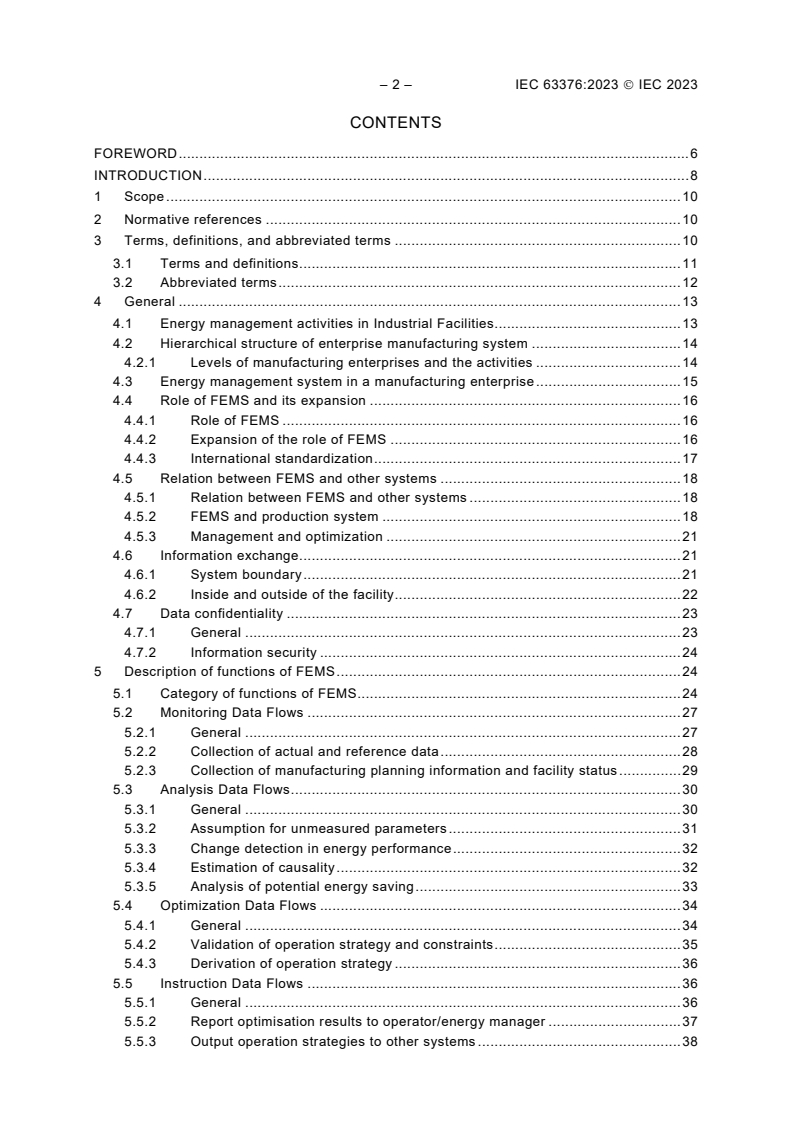
– 2 – IEC 63376:2023 IEC 2023
CONTENTS
FOREWORD . 6
INTRODUCTION . 8
1 Scope . 10
2 Normative references . 10
3 Terms, definitions, and abbreviated terms . 10
3.1 Terms and definitions . 11
3.2 Abbreviated terms . 12
4 General . 13
4.1 Energy management activities in Industrial Facilities. 13
4.2 Hierarchical structure of enterprise manufacturing system . 14
4.2.1 Levels of manufacturing enterprises and the activities . 14
4.3 Energy management system in a manufacturing enterprise . 15
4.4 Role of FEMS and its expansion . 16
4.4.1 Role of FEMS . 16
4.4.2 Expansion of the role of FEMS . 16
4.4.3 International standardization . 17
4.5 Relation between FEMS and other systems . 18
4.5.1 Relation between FEMS and other systems . 18
4.5.2 FEMS and production system . 18
4.5.3 Management and optimization . 21
4.6 Information exchange. 21
4.6.1 System boundary . 21
4.6.2 Inside and outside of the facility . 22
4.7 Data confidentiality . 23
4.7.1 General . 23
4.7.2 Information security . 24
5 Description of functions of FEMS . 24
5.1 Category of functions of FEMS. 24
5.2 Monitoring Data Flows . 27
5.2.1 General . 27
5.2.2 Collection of actual and reference data . 28
5.2.3 Collection of manufacturing planning information and facility status . 29
5.3 Analysis Data Flows . 30
5.3.1 General . 30
5.3.2 Assumption for unmeasured parameters . 31
5.3.3 Change detection in energy performance . 32
5.3.4 Estimation of causality . 32
5.3.5 Analysis of potential energy saving . 33
5.4 Optimization Data Flows . 34
5.4.1 General . 34
5.4.2 Validation of operation strategy and constraints . 35
5.4.3 Derivation of operation strategy . 36
5.5 Instruction Data Flows . 36
5.5.1 General . 36
5.5.2 Report optimisation results to operator/energy manager . 37
5.5.3 Output operation strategies to other systems . 38
6 Classification of FEMS . 38
7 FEMS Demand Response . 43
7.1 Demand Response . 43
7.2 FEMS and Incentive-based Demand Response . 44
7.3 FEMS and Price-based Demand Response . 44
Annex A (informative) FEMS Use Cases . 47
A.1 FEMS Actors . 47
A.2 Use cases of FEMS . 49
A.2.1 General . 49
A.2.2 Selection of Use cases . 49
A.2.3 Measurement and analysis of energy data (Visualization) . 50
A.2.4 Optimization of each unit . 51
A.2.5 Optimization of each facility . 53
A.2.6 Optimization of energy supply facility . 55
A.2.7 Overall optimization . 58
A.2.8 Energy Source optimization – Economics/renewables . 60
A.2.9 Energy Profile . 63
Annex B (informative) Interface to exchange information for FEMS . 66
B.1 Energy Storage System (ESS) . 66
B.2 Peak shift . 67
B.3 Peak shaving . 68
B.4 Other Functions . 69
B.4.1 General . 69
B.4.2 Battery operating time forecast . 69
B.4.3 Battery life monitoring . 69
B.4.4 Function update . 69
Bibliography . 70
Figure 1 – Characteristic feature of HEMS, BEMS, and FEMS . 13
Figure 2 – Functional hierarchy . 14
Figure 3 – Extension to the role-based equipment hierarchy model . 15
Figure 4 – System configuration of integration of multiple FEMS . 16
Figure 5 – Expansion of role of FEMS . 17
Figure 6 – Relationship between FEMS and other systems . 18
Figure 7 – Hierarchical model of production system . 20
Figure 8 – Multiple-input, Multiple-output controller . 20
Figure 9 – Hierarchical structure of integrated enterprise-production system . 22
Figure 10 – Example of Information exchange with inside and outside of the facility . 23
Figure 11 – IEC 62443 Security for industrial automation and control systems
standards . 24
Figure 12 – Categories of FEMS functions and improvement cycle of energy
performance . 25
Figure 13 – Relationship among functions of FEMS and other systems . 27
Figure 14 – Functions categorized under “Monitoring” and FEMS related data flow . 28
Figure 15 – Functions categorized under “Analysis” and FEMS related data flow . 31
Figure 16 – Functions categorized under “Optimization” and FEMS related data flow . 35
– 4 – IEC 63376:2023 IEC 2023
Figure 17 – Functions categorized under “Instruction” and FEMS related data flow . 37
Figure 18 – Three-dimensional map of FEMS . 40
Figure 19 – General approach common today for grid management of demand
response . 44
Figure 20 – Correspondence relationship among these seven FCs and FEMS functions . 45
Figure A.1 – Generic communication diagram between the smart grid and the FEMS . 47
Figure A.2 – Use Case representation on three-dimensional FEMS model . 49
Figure A.3 – Relationship between IEC 62264 (ISA 95) model and FEMS use-cases . 50
Figure A.4 – Measurement and analysis of energy data . 50
Figure A.5 – Sequence diagram of measurement and analysis of energy data . 51
Figure A.6 – Optimization of each unit (invertor control of compressor) . 52
Figure A.7 – Sequence diagram of Optimization of each unit (invertor control of
compressor) . 53
Figure A.8 – Optimization of each facility (quantity control of compressor) . 54
Figure A.9 – Sequence diagram of optimization of each facility (quantity control of
compressor) . 55
Figure A.10 – Optimization of energy supply facility (supply-side RENKEI) . 56
Figure A.11 – Sequence diagram of optimization of energy supply facility (supply-side
RENKEI) . 57
Figure A.12 – Overall optimization (demand and supply RENKEI) . 58
Figure A.13 – Sequence diagram of overall optimization (demand and supply RENKEI) . 59
Figure A.14 – Alternative energy sources . 61
Figure A.15 – Sequence diagram for energy source optimization . 62
Figure A.16 – Alternative energy profiles . 64
Figure A.17 – Sequence diagram for energy profile optimization . 65
Figure B.1 – Signal exchange diagram of the ESS and FEMS . 67
Figure B.2 – Energy flow during peak shift . 68
Figure B.3 – Peak shaving energy flow . 68
Table 1 – Description for FEMS function categories . 25
Table 2 – Data input and output of FEMS functions categorized into “Monitoring” . 27
Table 3 – Data input and output of FEMS functions categorized into “Analysis” . 30
Table 4 – Data input and output of FEMS functions categorized into “Optimization” . 34
Table 5 – Data input and output of FEMS functions categorized into “Instruction” . 36
Table 6 – Description of “Automation levels” . 39
Table 7 – Relation between the level of automation and function . 41
Table 8 – Relationship between the FCs in IEC 62872-2 [2] and the functions of FEMS . 46
Table A.1 – Actors and roles . 47
Table A.2 – Functions included in a Process (Measurement and analysis of energy
data) . 51
Table A.3 – Functions included in a Process (optimization of each unit (invertor
control of compressor) . 53
Table A.4 – Functions included in a process (optimization of each facility (quantity
control of compressor) . 55
Table A.5 – Functions included in a process (optimization of energy supply facility
(Supply-side RENKEI)) Function . 57
Table A.6 – Functions included in a process (overall optimization (demand and supply
RENKEI)) . 60
Table A.7 – Functions included in an energy optimization process . 62
Table A.8 – Functions included in an Energy Profiles Optimization Process . 65
– 6 – IEC 63376:2023 IEC 2023
INTERNATIONAL ELECTROTECHNICAL COMMISSION
____________
INDUSTRIAL FACILITY ENERGY MANAGEMENT SYSTEM (FEMS) –
FUNCTIONS AND INFORMATION FLOWS
FOREWORD
1) The International Electrotechnical Commission (IEC) is a worldwide organization for standardization comprising
all national electrotechnical committees (IEC National Committees). The object of IEC is to promote
international co-operation on all questions concerning standardization in the electrical and electronic fields. To
this end and in addition to other activities, IEC publishes International Standards, Technical Specifications,
Technical Reports, Publicly Available Specifications (PAS) and Guides (hereafter referred to as “IEC
Publication(s)”). Their preparation is entrusted to technical committees; any IEC National Committee interested
in the subject dealt with may participate in this preparatory work. International, governmental, and non-
governmental organizations liaising with the IEC also participate in this preparation. IEC collaborates closely
with the International Organization for Standardization (ISO) in accordance with conditions determined by
agreement between the two organizations.
2) The formal decisions or agreements of IEC on technical matters express, as nearly as possible, an international
consensus of opinion on the relevant subjects since each technical committee has representation from all
interested IEC National Committees.
3) IEC Publications have the form of recommendations for international use and are accepted by IEC National
Committees in that sense. While all reasonable efforts are made to ensure that the technical content of IEC
Publications is accurate, IEC cannot be held responsible for the way in which they are used or for any
misinterpretation by any end user.
4) In order to promote international uniformity, IEC National Committees undertake to apply IEC Publications
transparently to the maximum extent possible in their national and regional publications. Any divergence
between any IEC Publication and the corresponding national or regional publication shall be clearly indicated in
the latter.
5) IEC itself does not provide any attestation of conformity. Independent certification bodies provide conformity
assessment services and, in some areas, access to IEC marks of conformity. IEC is not responsible for any
services carried out by independent certification bodies.
6) All users should ensure that they have the latest edition of this publication.
7) No liability shall attach to IEC or its directors, employees, servants, or agents including individual experts and
members of its technical committees and IEC National Committees for any personal injury, property damage or
other damage of any nature whatsoever, whether direct or indirect, or for costs (including legal fees) and
expenses arising out of the publication, use of, or reliance upon, this IEC Publication or any other IEC
Publications.
8) Attention is drawn to the Normative references cited in this publication. Use of the referenced publications is
indispensable for the correct application of this publication.
9) Attention is drawn to the possibility that some of the elements of this IEC Publication may be the subject of
patent rights. IEC shall not be held responsible for identifying any or all such patent rights.
International Standard IEC 63376 has been prepared by IEC technical committee TC 65:
Industrial-process measurement, control and automation.
The text of this International Standard is based on the following documents:
Draft Report on voting
65/995/FDIS 65/1014/RVD
Full information on the voting for the approval of this International Standard can be found in
the report on voting indicated in the above table.
The language used for the development of this International Standard is English.
This document has been drafted in accordance with the ISO/IEC Directives, Part 2, and
developed in accordance with ISO/IEC Directives, Part 1 and ISO/IEC Directives, IEC
Supplement, available at www.iec.ch/members_experts/refdocs. The main document types
developed by IEC are described in greater detail at www.iec.ch/publications.
The committee has decided that the contents of this document will remain unchanged until the
stability date indicated on the IEC website under webstore.iec.ch in the data related to the
specific document. At this date, the document will be
• reconfirmed,
• withdrawn,
• replaced by a revised edition, or
• amended.
IMPORTANT – The "colour inside" logo on the cover page of this document indicates
that it contains colours which are considered to be useful for the correct
understanding of its contents. Users should therefore print this document using a
colour printer.
– 8 – IEC 63376:2023 IEC 2023
INTRODUCTION
The world's energy use has been increasing along with economic growth. Energy use by
Organization for Economic Co-operation and Development (OECD) countries is no longer
increasing. According to World Energy Outlook 2020 [3], energy demand in OECD countries
has been on a declining trend since 2007 with continued increase of their gross domestic
product. On the other hand, energy use in developing countries has been increasing in both
growth rate and value. Energy use by the industry sector is more than 50 % of the total
consumption and it is forecast to increase by about 10% between 2018 and 2030. Although
the rate of increasing energy demand is lower than the rate in the report published in 2012,
this increase causes serious concerns for environmental impact and presents opportunities for
energy management. To control global warming, the energy from renewable resources will be
increasing globally. It is expected that the share of renewable energy to total demand will
increase from about 30 % in 2019 to about 40 % in 2030. Outputs of renewable energy
resources such as solar photovoltaics and wind etc. require power regulation to manage
integration with the overall grid. Industrial facilities are major energy consumers and, also
major energy generators. Therefore, the industrial sector is expected to play a significant role
to satisfy the power regulations for the smart grid using renewable energy for decarbonization.
Consequently, it is quite urgent for the industrial sector to deploy energy management
systems to improve the energy efficiency to support the decarbonization of society.
Energy management in the manufacturing industries is linked to production and depending on
the industry it can have a very wide range of requirements. To date, energy management
systems have been custom developed for/by each company and then enhanced based on
practical experiences thus further customizing them. Therefore, there are many different EMS
for each organization. As coordination between related organizations becomes necessary for
the optimal operation of each facility, the functions of an industrial Facility Energy
Management System (FEMS) are required to be standardized to realize the benefits of making
better use of the available energy within and across enterprises and organizations.
Production systems have a hierarchical layered structure such as Enterprise Resource
Planning (ERP), Manufacturing Operations Management (MOM) / Manufacturing Execution
Systems (MES) and Control. FEMS may have been installed parallel to each layer of the
production system to communicate with them. As the production system is integrated for
overall optimization, expanding the boundary of FEMS for the horizontal and/or vertical
integration of FEMS is also required to have an input to that integrated production system
structure.
For overall optimization, the production system executes under the multiple constraints such
as safety, cost, quality of products, production schedule, market requirement, energy, and
others particular to the industry and application. These multiple constraints are prioritized
according to the business situation and used as the objective functions for optimization. Due
to the complexity and continuous variability of practical operation conditions, the objective
functions for optimization, in most cases, are set to the production system manually by an
experienced engineer or operator who has deep knowledge of the operation. FEMS have
been supporting those people by providing necessary information for their decision-making
processes during the operation.
As a FEMS needs to collect energy related information from many kinds of production
systems, MOM/MES and ERP, the volume of information has been increasing extensively. It is
necessary to clarify the necessary information and functions for energy management. It is
also necessary to automate the execution processes of functions of FEMS including the
decision-making processes for optimization as possible.
Automation technologies including modelling, simulation, Artificial Intelligence (AI), and others
enable automating the process for optimization thus reducing manual operation / intervention.
FEMS provide necessary functions and information for the above-mentioned optimization.
FEMS functions need to be defined as an international standard to improve interconnectivity
between the FEMS and other related systems. This document proposes to define the
functions, information flows and classification of FEMS based on the level of achievement of
FEMS capabilities. The level of automation of FEMS functions will be one factor to define the
classification. The level will provide management with a motivation and path for a stepwise
progression through the classification. The resulting FEMS standard increases the
sophistication of control in industrial complexes and processes so that improved optimization
of facility operations can be obtained. Furthermore, the information exchange among FEMS
and other systems such as MOM/MES and ERP will be defined for the integration.
International standardization will benefit both end users and suppliers of FEMS.
– 10 – IEC 63376:2023 IEC 2023
INDUSTRIAL FACILITY ENERGY MANAGEMENT SYSTEM (FEMS) –
FUNCTIONS AND INFORMATION FLOWS
1 Scope
This International Standard specifies the functions and the information flows of industrial
Facility Energy Management System (FEMS). Generic functions are defined for the FEMS, to
enable upgrading traditional Energy Management System (EMS) from visualization of the
status of energy consumption to automation of energy management defining a closer relation
with other management and control systems. A generic method to classify the FEMS functions
will be explained. The information exchange between the FEMS and other systems such as
Manufacturing Operations Management (MOM), Manufacturing Execution System (MES) and
Enterprise Resource Planning (ERP) will be outlined.
2 Normative references
The following documents are referred to in the text in such a way that some or all of their
content constitutes requirements of this document. For dated references, only the edition
cited applies. For undated references, the latest edition of the referenced document (including
any amendments) applies.
IEC 62264 (all parts), Enterprise-control system integration
IEC/TS 62872-1:2019, Industrial-process measurement, control and automation – Part 1:
System interface between industrial facilities and the smart grid
IEC/TR 62837:2013, Energy efficiency through automation systems
ISO 22400-1:2014, Automation systems and integration – Key performance indicators (KPIs)
for manufacturing operations management – Part 1: Overview, concepts and terminology
ISO 22400-2:2014/AMD1:2017, Automation systems and integration – Key performance
indicators (KPIs) for manufacturing operations management – Part 2: Definitions and
descriptions – Amendment 1: Key performance indicators for energy management
3 Terms, definitions, and abbreviated terms
For the purposes of this document, the following terms, definitions, and abbreviated terms
apply.
ISO and IEC maintain terminological databases for use in standardization at the following
addresses:
• IEC Electropedia: available at http://www.electropedia.org/
• ISO Online browsing platform: available at http://www.iso.org/obp
3.1 Terms and definitions
3.1.1
device
independent physical entity capable of performing one or more specified functions in a
particular context and delimited by its interfaces
Note 1 to entry: A device can form part of a larger device.
[SOURCE: IEC 61804-2:2017, 3.1.18, modified – addition of note from IEC 80004-9:2017,
3.1.1]
3.1.2
equipment
component or arrangement of components, built for specific function(s)
[SOURCE: ISO 19901-5:2016 (en), 3.17, modified – deletion of: Notes 1 & 2]
3.1.3
enterprise
one or more organizations sharing a definite mission, goals and objectives which provides an
output such as product or service
[SOURCE: IEC 62264-1:2013, 3.1.10]
3.1.4
facility
site, or area within a site, that includes the resources within the site or area and includes the
activities associated with the use of the resources
[SOURCE: IEC 62264-1:2013, 3.1.20]
3.1.5
operator
entity responsible for the minute-by-minute execution and safe functioning of a facility
3.1.6
organization
company, corporation, firm, authority or institution, or part or combination thereof, whether
incorporated or not, public, or private, that has its own functions and administration
Note 1 to entry: For organizations with more than one operating unit, a single operating unit may be defined as
an organization.
[SOURCE:ISO 14001:2004, 3.16, modified – reference to enterprise removed.]
3.1.7
plant
physical unit for a comprehensive process including the dedicated functional unit(s) for control
EXAMPLE: Heating plant, ventilating plant, air conditioning plant, chiller plant, sanitary installation, or electrical
installation.
Note 1 to entry: A plant can consist of several partial plants that are assembled from equipment, units, or
aggregates (e.g., boiler), devices, modules, components, and elements.
[SOURCE: ISO 16484-2:2004, 3.149, modified – Note 2 deleted, addition of (s) to "unit"]
– 12 – IEC 63376:2023 IEC 2023
3.1.8
site
identified physical, geographical, and/or logical component grouping of a manufacturing
enterprise under a single management
[SOURCE: IEC 62264-1:2013, 3.1.39, modified – addition of “under a single management”
after “enterprise”]
3.1.9
unit
lowest level of equipment typically scheduled by the Level 4 or Level 3 functions for
continuous manufacturing processes
3.2 Abbreviated terms
APO Advanced Planning and Optimization
BEMS Building Energy Management System
CMM Capability Maturity Model
DER Distributed Energy Resource
EMS Energy Management System
ERP Enterprise Resource Planning
FC Functional Component
FDREM Facility Demand Response Energy Management
FEMS Facility Energy Management System
HEMS Home Energy Management System
IP Intellectual Property
KPI Key Performance Indicator
LIMS Laboratory Information Management System
MES Manufacturing Execution System
MIMO Multiple Input Multiple Output
MOM Manufacturing Operations Management
MPC Model Predictive Control
OECD Organisation for Economic Co-operation and Development
MV Manipulated Variable
PV Process Variable
PCS Process Control System
PID Proportional Integral Derivative
SISO Single Input Single Output
SV Setpoint Value
WMS Warehouse Management System
4 General
4.1 Energy management activities in Industrial Facilities
In the customer domains of energy such as Home, Building/Commercial and Industry, energy
management systems: Home Energy Management System (HEMS), Building Energy
Management System (BEMS) and FEMS respectively have been deployed depending on the
characteristics of energy consumption. Figure 1 depicts the characteristic features of FEMS,
BEMS, and HEMS. Key factors are the energy usage and number of entities in each domain.
Arrows show energy distribution. Up-down-double arrows show energy trading between Home,
building and Industry through the energy distribution.
Figure 1 – Characteristic feature of HEMS, BEMS, and FEMS
The energy consumption of users of FEMS is generally larger than that of BEMS and HEMS,
the effect of a single industrial entity’s energy efficiency improvement is significant. The
profile of energy demand varies among entities as a function of the different types of energy
sources in a manufacturing facility. Typical energy sources are electricity, fuel, steam, hydro,
and distributed energy resources (DER) such as renewable energy, combined heating and
power stations, and storage systems to provide useful energy in the form of power, heat,
steam, heating or cooling water, compressed air and similar. FEMS is usually provided as a
made-to-order product. BEMS has a larger number of target entities and is readily available
as a ready-made product. HEMS, which deals with a larger number of smaller entities, is a
readily available mass product. Each system and associated complexity / degree of
customization has a corresponding price.
Energy management in a manufacturing enterprise is performed with consideration for
harmonizing many conflicting requirements such as productivity, quality, delivery, production
scheduling, manufacturing cost, profit, safety, environmental and related requirements. Those
requirements are prioritized depending on the corporate objectives and regulations at the time
the energy management decisions are made.
– 14 – IEC 63376:2023 IEC 2023
In industrial facilities, the energy supply facility supplies and manages energy by managing
electricity, heat, steam, hot or cooling water and compressed air to demand facilities such as
production lines. The energy supply facility may be designed independently to have the
capacity to meet the maximum energy demands. When the energy demand decreases, the
mismatch between energy supply and demand can cause significant energy loss and
decrease of energy efficiency. It is necessary to provide an optimum load balance between
equipment of an energy supply facility given the energy demand. Facility energy supply can
be controlled and operated based on the energy demand forecast incorporating factors such
as production schedule and ambient conditions such as changes in weather.
A FEMS collects data from each level of the production system for the optimization of energy
performance compared to the energy demands of the full production system. Collected data
are analysed for an optimum operation of the facility to improve energy performance. There
are many kinds of decision-making processes such as changing set points of equipment,
changing the operating conditions of devices, selecting a manufacturing process depending
on the operating situation, and others. Operating decisions are made automatically by the
system or manually by operators. Guidance systems are used to support manual operation. It
is expected that energy performance of an industrial facility will be improved further by making
FEMS processes highly automated.
4.2 Hierarchical structure of enterprise manufacturing system
4.2.1 Levels of manufacturing enterprises and the activities
Figure 2 – Functional hierarchy
As shown in Figure 2, IEC/ISO 62264-1 (ISA-95) defines the levels for the structure of
manufacturing enterprise.
FEMS is positioned on the level 3 as a part of MOM/MES. Manufacturing operations
management (MOM) is a term used in IEC 62264 to specify a portion of the functional
hierarchy model of a manufacturing enterprise.
FEMS exchanges information between MES, Laboratory Information Management System
(LIMS), Warehouse Management System (WMS), Capability Maturity Model (CMM) systems.
these level 3 systems exchange information with ERP, Advanced Planning and Optimization
(APO), logistic management system in level 4 and across facilities, controllers, and sensors
in level 2, 1 and 0. FEMS receives the information through MES. FEMS also exchanges
information between other energy management systems and smart grid gateways which
exchange information with the smart grid.
Figure 3 shows an extension to the role-based equipment hierarchy model for a variety of
processes. For manufacturing operations management there are specific terms for work
centres and work units that apply to continuous production, batch production, discrete or
repetitive production, and for storage.
Figure 3 – Extension to the role-based equipment hierarchy model
4.3 Energy management system in a manufacturing enterprise
Manufacturing enterprises have made continuing efforts to save energy. A better
understanding of how to improve the overall energy performance will lead to improving energy
efficiency, minimizing waste, reducing CO emissions, securing of supply and reducing overall
cost. The energy management system is becoming increasingly important for further
improvements of energy saving and the management of the enterprise.
In a manufacturing enterprise, an energy management system may have been installed for a
production facility every time it was needed. As an enterprise has multiple production facilities,
there could also exist multiple energy management systems in the enterprise. This form of
FEMS works for the individual optimization of energy performance of the single production
facility.
It is expected that EMS integration will improve the overall energy performance of an
enterprise to manage the operation of production systems for the changing business
environment. For that, it is necessary to clarify the functions and information that are
exchanged between implemented FEMS.
– 16 – IEC 63376:2023 IEC 2023
Figure 4 shows a general sys
...