

IEC TS 62564-1:2026
(Main)Process management for avionics - Aerospace qualified electronic components (AQEC) - Part 1: Integrated circuits and discrete semiconductors
General Information
- Abstract
IEC TS 62564-1:2026 defines the minimum requirements for integrated circuits and semiconductors which are designated as an "aerospace qualified electronic component (AQEC)".
This edition includes the following significant technical changes with respect to the previous edition:
a) addition of optional ADHP PPAP;
b) revision to Annex B; addition of Annex C and Annex D;
c) removal of STACK;
d) general update to referenced standards throughout.
- Status
- Published
- Publication Date
- 04-Jun-2026
- Technical Committee
- TC 107 - Process management for avionics
- Drafting Committee
- WG 2 - TC 107/WG 2
- Current Stage
- PPUB - Publication issued
- Start Date
- 05-Jun-2026
- Completion Date
- 05-Jun-2026
Buy Documents
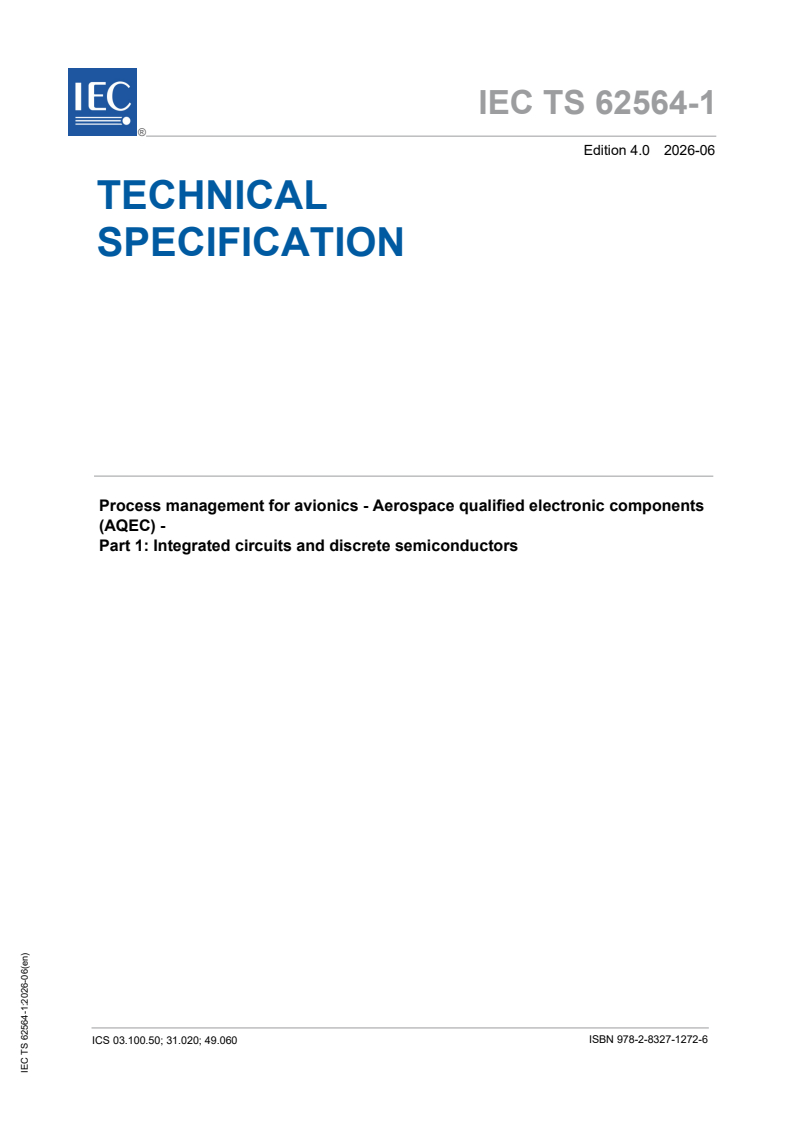
IEC TS 62564-1:2026 - Process management for avionics - Aerospace qualified electronic components (AQEC) - Part 1: Integrated circuits and discrete semiconductors
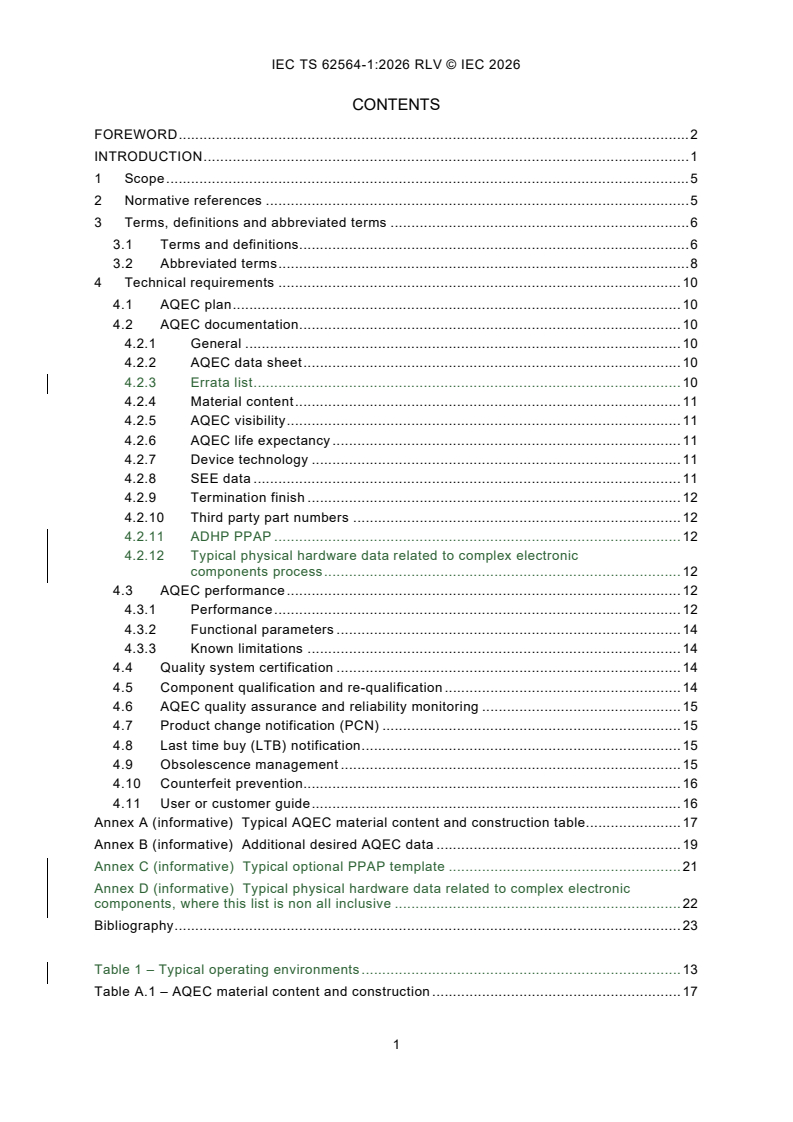
REDLINE IEC TS 62564-1:2026 RLV - Process management for avionics - Aerospace qualified electronic components (AQEC) - Part 1: Integrated circuits and discrete semiconductors
Overview
IEC TS 62564-1:2026 is a technical specification that sets out the minimum requirements for integrated circuits and discrete semiconductors designated as Aerospace Qualified Electronic Components (AQEC). Developed by the International Electrotechnical Commission (IEC), this document is crucial for any organization that manufactures or procures electronic components for use in avionics and other aerospace applications. It supports quality, reliability, and traceability in the selection and management of AQEC, ensuring compliance with requirements specific to the aerospace, defense, and high performance (ADHP) sectors.
This edition introduces key technical changes, including the optional Automotive, Defense, and High Performance (ADHP) Production Part Approval Process (PPAP), revisions to AQEC documentation, and updated references.
Key Topics
- AQEC Plan Requirements: Defines processes, documentation, and procedures for designating COTS (commercial off-the-shelf) semiconductors and integrated circuits as AQEC, addressing both physical hardware data and required enhancements for aerospace environments.
- AQEC Documentation: Specifies mandatory content for AQEC data sheets, including operational parameters, environmental and material data, known limitations, and performance characteristics. Emphasizes control of revisions and clear indication of AQEC qualification.
- Life Expectancy & Reliability: Calls for identification of limiting wear-out mechanisms and the use of vetted reliability models for both silicon-based devices and packaging. Ensures that life expectancy is calculated using recognized acceleration models and industry standards.
- Quality and Certification: Requires that manufacturers certify to accepted standards (e.g., ISO 9001, AS9100), and encourages further quality assurance, qualification, and requalification processes in line with IEC and industry practices.
- Obsolescence and Counterfeit Management: Mandates processes for product change notification (PCN), last-time-buy notification, and strong counterfeit prevention measures.
- Performance and Environmental Conditions: Ensures documentation of performance across a range of aviation-specific environmental conditions, including atmospheric radiation and extreme temperatures, with guidelines for exceeding standard industrial conditions.
- Optional ADHP PPAP: Introduces an optional, recommended process aligned with the automotive sector’s PPAP but tailored for ADHP users, supporting traceability and compliance in complex aerospace systems.
Applications
IEC TS 62564-1:2026 is applicable to:
- Component Manufacturers: To qualify, document, and supply AQEC-compliant integrated circuits and semiconductors for aerospace systems, supporting improved reliability and certification.
- Avionics and Aerospace OEMs: For procurement and systems engineering teams to ensure that key electronic components meet AQEC requirements, facilitating safer and more reliable operation in aircraft, satellites, and defense applications.
- Quality Assurance: Companies developing or integrating components into safety- or mission-critical systems use this standard to verify processes, certification, and traceability throughout the supply chain.
- Obsolescence and Counterfeit Management: Organizations benefit from proactive measures for product changes and end-of-life notifications, reducing risks related to continuing airworthiness and supply integrity.
Although primarily addressing avionics, the standard can be adopted by other industries with stringent reliability requirements, such as rail, marine, and some industrial sectors.
Related Standards
- IEC 62239-1: Preparation and maintenance of an electronic components management plan, referenced for user and customer ECMP compliance.
- J-STD-048: Notification Standard for Product Discontinuance, for robust obsolescence management.
- AEC-Q100 Series: Automotive IC qualification standards, relevant for AQEC candidacy when compliant with this document.
- JESD47 & JESD94: JEDEC standards for qualification and reliability assurance processes.
- IEC 62686-1: COTS electronic components in aerospace applications.
- SAE ARP 6379 and ARP 5890: Guidelines related to failure investigation and qualification.
- IEC 63287 series: Mission profile and reliability planning for semiconductor device qualification.
Summary:
IEC TS 62564-1:2026 is a cornerstone standard for process management and qualification of integrated circuits and discrete semiconductors in aerospace and high-reliability applications, supporting enhanced safety, traceability, and certification across the global supply chain.
Relations
- Effective Date
- 04-Oct-2024
Buy Documents
IEC TS 62564-1:2026 - Process management for avionics - Aerospace qualified electronic components (AQEC) - Part 1: Integrated circuits and discrete semiconductors
REDLINE IEC TS 62564-1:2026 RLV - Process management for avionics - Aerospace qualified electronic components (AQEC) - Part 1: Integrated circuits and discrete semiconductors
Get Certified
Connect with accredited certification bodies for this standard

BSI Group
BSI (British Standards Institution) is the business standards company that helps organizations make excellence a habit.

Bureau Veritas
Bureau Veritas is a world leader in laboratory testing, inspection and certification services.

DNV
DNV is an independent assurance and risk management provider.
Sponsored listings
Frequently Asked Questions
IEC TS 62564-1:2026 is a technical specification published by the International Electrotechnical Commission (IEC). Its full title is "Process management for avionics - Aerospace qualified electronic components (AQEC) - Part 1: Integrated circuits and discrete semiconductors". This standard covers: IEC TS 62564-1:2026 defines the minimum requirements for integrated circuits and semiconductors which are designated as an "aerospace qualified electronic component (AQEC)". This edition includes the following significant technical changes with respect to the previous edition: a) addition of optional ADHP PPAP; b) revision to Annex B; addition of Annex C and Annex D; c) removal of STACK; d) general update to referenced standards throughout.
IEC TS 62564-1:2026 defines the minimum requirements for integrated circuits and semiconductors which are designated as an "aerospace qualified electronic component (AQEC)". This edition includes the following significant technical changes with respect to the previous edition: a) addition of optional ADHP PPAP; b) revision to Annex B; addition of Annex C and Annex D; c) removal of STACK; d) general update to referenced standards throughout.
IEC TS 62564-1:2026 is classified under the following ICS (International Classification for Standards) categories: 03.100.50 - Production. Production management; 31.020 - Electronic components in general; 49.060 - Aerospace electric equipment and systems. The ICS classification helps identify the subject area and facilitates finding related standards.
IEC TS 62564-1:2026 has the following relationships with other standards: It is inter standard links to IEC TS 62564-1:2016. Understanding these relationships helps ensure you are using the most current and applicable version of the standard.
IEC TS 62564-1:2026 is available in PDF format for immediate download after purchase. The document can be added to your cart and obtained through the secure checkout process. Digital delivery ensures instant access to the complete standard document.
Standards Content (Sample)
IEC TS 62564-1 ®
Edition 4.0 2026-06
TECHNICAL
SPECIFICATION
Process management for avionics - Aerospace qualified electronic components
(AQEC) -
Part 1: Integrated circuits and discrete semiconductors
ICS 03.100.50; 31.020; 49.060 ISBN 978-2-8327-1272-6
All rights reserved. Unless otherwise specified, no part of this publication may be reproduced or utilized in any form or
by any means, electronic or mechanical, including photocopying and microfilm, without permission in writing from either
IEC or IEC's member National Committee in the country of the requester. If you have any questions about IEC copyright
or have an enquiry about obtaining additional rights to this publication, please contact the address below or your local
IEC member National Committee for further information.
IEC Secretariat Tel.: +41 22 919 02 11
3, rue de Varembé info@iec.ch
CH-1211 Geneva 20 www.iec.ch
Switzerland
About the IEC
The International Electrotechnical Commission (IEC) is the leading global organization that prepares and publishes
International Standards for all electrical, electronic and related technologies.
About IEC publications
The technical content of IEC publications is kept under constant review by the IEC. Please make sure that you have the
latest edition, a corrigendum or an amendment might have been published.
IEC publications search - IEC Products & Services Portal - products.iec.ch
webstore.iec.ch/advsearchform Discover our powerful search engine and read freely all the
The advanced search enables to find IEC publications by a publications previews, graphical symbols and the glossary.
variety of criteria (reference number, text, technical With a subscription you will always have access to up to date
committee, …). It also gives information on projects, content tailored to your needs.
replaced and withdrawn publications.
Electropedia - www.electropedia.org
The world's leading online dictionary on electrotechnology,
IEC Just Published - webstore.iec.ch/justpublished
Stay up to date on all new IEC publications. Just Published containing more than 22 500 terminological entries in English
details all new publications released. Available online and and French, with equivalent terms in 25 additional languages.
once a month by email. Also known as the International Electrotechnical Vocabulary
(IEV) online.
IEC Customer Service Centre - webstore.iec.ch/csc
If you wish to give us your feedback on this publication or
need further assistance, please contact the Customer
Service Centre: sales@iec.ch.
CONTENTS
FOREWORD . 2
INTRODUCTION . 4
1 Scope . 5
2 Normative references . 5
3 Terms, definitions and abbreviated terms . 6
3.1 Terms and definitions. 6
3.2 Abbreviated terms . 8
4 Technical requirements . 9
4.1 AQEC plan . 9
4.2 AQEC documentation . 10
4.2.1 General . 10
4.2.2 AQEC data sheet . 10
4.2.3 Errata list . 10
4.2.4 Material content . 10
4.2.5 AQEC visibility . 10
4.2.6 AQEC life expectancy . 11
4.2.7 Device technology . 11
4.2.8 SEE data . 11
4.2.9 Termination finish . 11
4.2.10 Third party part numbers . 12
4.2.11 ADHP PPAP . 12
4.2.12 Typical physical hardware data related to complex electronic
components process . 12
4.3 AQEC performance . 12
4.3.1 Performance . 12
4.3.2 Functional parameters . 13
4.3.3 Known limitations . 13
4.4 Quality system certification . 13
4.5 Component qualification and re-qualification . 13
4.6 AQEC quality assurance and reliability monitoring . 14
4.7 Product change notification (PCN) . 14
4.8 Last time buy (LTB) notification . 14
4.9 Obsolescence management . 14
4.10 Counterfeit prevention. 14
4.11 User or customer guide . 15
Annex A (informative) Typical AQEC material content and construction table. 16
Annex B (informative) Additional desired AQEC data . 18
Annex C (informative) Typical optional PPAP template . 20
Annex D (informative) Typical physical hardware data related to complex electronic
components, where this list is non all inclusive . 21
Bibliography . 22
Table 1 – Typical operating environments . 13
Table A.1 – AQEC material content and construction . 16
INTERNATIONAL ELECTROTECHNICAL COMMISSION
____________
Process management for avionics -
Aerospace qualified electronic components (AQEC) -
Part 1: Integrated circuits and discrete semiconductors
FOREWORD
1) The International Electrotechnical Commission (IEC) is a worldwide organization for standardization comprising
all national electrotechnical committees (IEC National Committees). The object of IEC is to promote international
co-operation on all questions concerning standardization in the electrical and electronic fields. To this end and
in addition to other activities, IEC publishes International Standards, Technical Specifications, Technical Reports,
Publicly Available Specifications (PAS) and Guides (hereafter referred to as "IEC Publication(s)"). Their
preparation is entrusted to technical committees; any IEC National Committee interested in the subject dealt with
may participate in this preparatory work. International, governmental and non-governmental organizations liaising
with the IEC also participate in this preparation. IEC collaborates closely with the International Organization for
Standardization (ISO) in accordance with conditions determined by agreement between the two organizations.
2) The formal decisions or agreements of IEC on technical matters express, as nearly as possible, an international
consensus of opinion on the relevant subjects since each technical committee has representation from all
interested IEC National Committees.
3) IEC Publications have the form of recommendations for international use and are accepted by IEC National
Committees in that sense. While all reasonable efforts are made to ensure that the technical content of IEC
Publications is accurate, IEC cannot be held responsible for the way in which they are used or for any
misinterpretation by any end user.
4) In order to promote international uniformity, IEC National Committees undertake to apply IEC Publications
transparently to the maximum extent possible in their national and regional publications. Any divergence between
any IEC Publication and the corresponding national or regional publication shall be clearly indicated in the latter.
5) IEC itself does not provide any attestation of conformity. Independent certification bodies provide conformity
assessment services and, in some areas, access to IEC marks of conformity. IEC is not responsible for any
services carried out by independent certification bodies.
6) All users should ensure that they have the latest edition of this publication.
7) No liability shall attach to IEC or its directors, employees, servants or agents including individual experts and
members of its technical committees and IEC National Committees for any personal injury, property damage or
other damage of any nature whatsoever, whether direct or indirect, or for costs (including legal fees) and
expenses arising out of the publication, use of, or reliance upon, this IEC Publication or any other IEC
Publications.
8) Attention is drawn to the Normative references cited in this publication. Use of the referenced publications is
indispensable for the correct application of this publication.
9) IEC draws attention to the possibility that the implementation of this document may involve the use of (a)
patent(s). IEC takes no position concerning the evidence, validity or applicability of any claimed patent rights in
respect thereof. As of the date of publication of this document, IEC had not received notice of (a) patent(s), which
may be required to implement this document. However, implementers are cautioned that this may not represent
the latest information, which may be obtained from the patent database available at https://patents.iec.ch. IEC
shall not be held responsible for identifying any or all such patent rights.
IEC TS 62564-1, which is a technical specification, has been prepared by IEC technical
committee 107: Process management for avionics. It is a Technical Specification.
This fourth edition cancels and replaces the third edition published in 2016. This edition
constitutes a technical revision.
This edition includes the following significant technical changes with respect to the previous
edition:
a) addition of optional ADHP PPAP;
b) revision to Annex B; addition of Annex C and Annex D;
c) removal of STACK;
d) general update to referenced standards throughout.
GEIA-STD-0002-001 (June 2006), Aerospace Qualified Electronic Component (AQEC)
Requirements, Volume 1 - Integrated Circuits and Semiconductors, has served as a basis for
the elaboration of the first edition (2009) of this technical specification.
The text of this Technical Specification is based on the following documents:
Draft Report on voting
107/442/DTS 107/443/RVDTS
Full information on the voting for its approval can be found in the report on voting indicated in
the above table.
The language used for the development of this Technical Specification is English.
This document was drafted in accordance with ISO/IEC Directives, Part 2, and developed in
accordance with ISO/IEC Directives, Part 1 and ISO/IEC Directives, IEC Supplement, available
at www.iec.ch/members_experts/refdocs. The main document types developed by IEC are
described in greater detail at www.iec.ch/publications.
A list of all parts in the IEC 62564 series, under the general title Process management for
avionics - Aerospace qualified electronic components (AQEC), can be found on the IEC website.
The committee has decided that the contents of this document will remain unchanged until the
stability date indicated on the IEC website under webstore.iec.ch in the data related to the
specific document. At this date, the document will be
– reconfirmed,
– withdrawn, or
– revised.
INTRODUCTION
Aerospace qualified electronic components (AQEC) plans are developed by manufacturers in
order to document compliance with AQEC requirements for aerospace, defence and high
performance (ADHP) users. For AQEC designated components, the intention is to
a) provide AQEC users access to information and data from the AQEC manufacturers that is
necessary for using commercial-off-the-shelf (COTS) products, particularly in the context of
aerospace certification process where complex electronic components are involved;
b) better enable AQEC users to assess whether these parts are capable of operating reliably
in their applications;
c) minimize deviations from the AQEC manufacturers' COTS electronic components;
d) have minimal impact on the AQEC manufacturers' standard operating or business
procedures;
e) promote communication between the AQEC manufacturers and users.
This document only addresses integrated circuits and discrete semiconductors manufactured
using silicon based technology and excludes silicon carbide and gallium nitride technologies.
1 Scope
This part of IEC 62564, which is a Technical Specification, defines the minimum requirements
for integrated circuits and semiconductors which are designated as an "aerospace qualified
electronic component (AQEC)". It applies to integrated circuits and semiconductors exhibiting
the following attributes:
a) a minimum set of responses to requirements, information and data including physical
hardware data, provided by the part manufacturer, which will allow a standard COTS
electronic component to be designated AQEC by the manufacturer;
b) as a minimum, each COTS electronic component (designated AQEC) will have been
designed, fabricated, assembled, and tested in accordance with the component
manufacturer's requirements for standard data book components with additional
enhancements as considered appropriate;
c) qualification of, and quality systems for, the COTS electronic components to be designated
as AQEC will include the manufacturer's standards, operating procedures, and technical
specifications. This information will be available when requested;
d) electronic components manufactured before the manufacturer has addressed AQEC
requirements, but utilizing the same processes, are also considered AQEC compliant,
providing sufficient data is made available;
e) additional desired attributes of a device designated AQEC (that will support AQEC users)
are found in Annex B of this document.
This document contributes by the above attributes to the aerospace certification process which
include particularly complex COTS electronic components.
NOTE 1 Parts qualified to military specifications such as JAN, JANTX, JANTXV transistors and diodes,
MIL-PRF-38535 or MIL-PRF-5962-XX microcircuits, CECC (CENELEC Electronics Component Committee) specified
components, etc. (except those identified as being for "logistic support" purposes only) are considered AQEC; the
remainder of this document only addresses non-military specification parts.
NOTE 2 Adding a TX to JAN prefix means that the part was not only made to MIL-PRF-19500 but it was also tested
to Mil spec. Adding a V to the TX means that the part was verified during testing before the package was completed.
NOTE 3 Electronic components classified by original component manufacturers (OCMs) as being 'enhanced'
components only become AQEC components when they meet the requirements of this document.
Parts qualified to AEC-Q100, grade 0, AEC-Q100 grade 1, and AEC-Q100 grade 2 according
to the standard qualification test plan according to Table 2 of AEC-Q100:2023 are considered
candidates for AQEC providing they meet the requirements of this document. Parts qualified to
AEC-Q100 for a specific mission profile require analysis to determine suitability for AQEC
selection. The users should document that the grade category used is compatible with the
application in accordance with their IEC 62239-1 electronic components management plan
(ECMP).
Although developed for the avionics industry, this document can be applied by other industrial
sectors at their discretion.
2 Normative references
The following documents are referred to in the text in such a way that some or all of their content
constitutes requirements of this document. For dated references, only the edition cited applies.
For undated references, the latest edition of the referenced document (including any
amendments) applies.
IEC 62239-1, Process management for avionics - Management plan - Part 1: Preparation and
maintenance of an electronic components management plan
J-STD-048, Notification Standard for Product Discontinuance
3 Terms, definitions and abbreviated terms
For the purposes of this document, the following terms and definitions apply.
ISO and IEC maintain terminology databases for use in standardization at the following
addresses:
– IEC Electropedia: available at https://www.electropedia.org/
– ISO Online browsing platform: available at https://www.iso.org/obp
3.1 Terms and definitions
3.1.1
AQEC specification
document prepared by or for the manufacturer to describe an AQEC product
Note 1 to entry: It includes a data sheet and can include other documents, such as material descriptions,
environmental test procedures, quality monitoring processes, etc. It can be a stand-alone document or a clearly
denoted item within a larger documentation system. There can be additional data associated with specific
applications which can be requested separately.
3.1.2
AQEC plan
instrument prepared by the plan owner (see 3.1.13) that clearly, concisely, and unambiguously
documents the processes used by the plan owner to satisfy the requirements of this document
Note 1 to entry: The plan contains auditable content.
3.1.3
assessment
evaluation of a plan owner's AQEC plan to determine if it is compliant with this document
Note 1 to entry: It can be conducted by IECQ, the customer, the customer's designee, or by a third party designated
by the customer community.
3.1.4
microcircuit
integrated circuit
microcircuit (device with a high circuit-element density) in which all or some of the circuit
elements are inseparably associated and electrically interconnected (on one or more
substrates, in a unique indivisible package) so that the microcircuit is considered to be
indivisible for the purpose of construction and commerce
3.1.5
semiconductor
discrete semiconductor device
semiconductor device that is specified to perform an elementary function and that is not divisible
into separate components functional in themselves (for example diodes, transistors,
optocouplers, LEDs and related products)
3.1.6
certification
process for validation of requirements by a higher authority
Note 1 to entry: Certification of complex components in the avionics industry typically refers to meeting the
requirements of AMC 20-152A formerly known as ED80. ED80 was identical to RTCA DO-254. The FAA will be
publishing a revision to AC-152 soon which will be identically worded to AMC 20-152A.
3.1.7
component
part
microcircuit, integrated circuit, semiconductor or discrete semiconductor for the purpose of this
document
3.1.8
customer
user
designer
original equipment manufacturer (OEM) that procures integrated circuits or semiconductor
devices, or both, compliant with this document and uses them to design, produce, and maintain
systems
3.1.9
customer community
body of customers that act together to address issues related to this document
3.1.10
data sheet
document prepared by the manufacturer that describes the electrical, mechanical, and
environmental characteristics of the component
3.1.11
enhanced
increased or improved, usually applied to a property or a characteristic value or a quality level
or a performance level of an item
Note 1 to entry: In the field of electronic components, enhanced properties for example result in additional
requirements which raise the long-term reliability of the item for an ADHP environment.
Note 2 to entry: An enhanced electronic component is a suitable candidate for becoming an AQEC component.
3.1.12
erratum
error or fault
Note 1 to entry: The plural of erratum is errata.
Note 2 to entry: An errata list is a compilation of errors or faults with their corrections and changes.
3.1.13
manufacturer
plan owner
producer of integrated circuits, microcircuits, or other semiconductor devices that can be
designated AQEC
Note 1 to entry: A manufacturer can produce the components directly or can oversee subcontracted manufacturing
according to their own processes. The manufacturer is also the plan owner.
3.1.14
supplier
distributor of components
Note 1 to entry: A plan for controlling AQEC inventory is in place in order to supply AQECs. A manufacturer can be
a supplier in the case where no distributor is involved.
3.1.15
third party
party designated to act on the behalf of the customer community
3.1.16
termination
element of a component that connects it electrically and mechanically to the next level of
assembly
Note 1 to entry: A termination includes base materials and coatings (including underplates).
3.1.17
form
shape, size, arrangement of parts, visible aspect, mode in which a part exists or manifests itself,
or the material an item is constructed from
3.1.18
fit
qualified and competent
3.1.19
function
work to a specification that an item is designed for without degrading reliability
3.2 Abbreviated terms
ADHP Aerospace, defence and high performance
AOQL Average outgoing quality limit
AQEC Aerospace qualified electronic component
BAG Bandwidth allocation gap
Bi-CMOS Bipolar CMOS
BOM Bill of material
BPSG Borophosphosilicate glass
CECC CENELEC Electronics Component Committee
CMOS Complementary metal oxide semiconductor
COTS Commercial off the shelf
DDR Double data rate
DFMEA Design failure mode and effects analysis
DLA Defence logistics agency (USA agency)
DPM Defects per million
DRAM Dynamic random access memory
DR&R Design review and report
DSIAC Defense systems information analysis center
DVP&R Design verification plan and report
ECMP Electronic component management plan
FFF Form, fit and function
FIT Failures in time
FMEA Failure mode and effects analysis which for purposes of this specification includes
DFMEA and PFMEA
FPGA Field programmable gate array
GIDEP Government industry data exchange program
HAST Highly accelerated stress test
HCI Hot carrier injection
HTOL High temperature operating life
IP Intellectual property
JAN Joint army navy
LED Light emitting diode
LTB Last time buy
MCU Multiple cell upset
MRAM Magnetoresistive random access memory
MSA Measurement systems analysis
NAND Negation AND
NBTI Negative bias temperature Instability
NOR Negation OR
PFMEA Process failure mode and effects analysis
PPAP Production part approval process
PBTI Positive bias temperature instability
PCN Product change notification
RoHS Restriction of hazardous substances in electrical and electronics equipment
SAE Society of automotive engineers
SDRAM Synchronous dynamic random access memory
SEE Single event effect
SEU Single event upset
SER Soft error rate
SEL Single event latch
SEFI Single event functional interrupt
SPC Statistical process control
SRAM Static random access memory
SOS Silicon on sapphire
TDDB Time dependant dielectric breakdown
THB Temperature humidity bias
VID Vendor item drawing (controlled and released by DLA)
4 Technical requirements
4.1 AQEC plan
The processes used to ensure compliance with the following requirements shall be documented
by the AQEC manufacturer and included in their AQEC plan. These requirements identify the
additional processes, documentation and procedures required to supply a manufacturer's COTS
part as an AQEC. Components classified by original component manufacturers (OCMs) as
being 'enhanced' components only become AQEC components when they meet the
requirements of this document. AQEC components can assist, with the physical hardware data,
the aerospace certification process which involves complex components. The plan includes, but
is not limited to, identifying data sheet parameters or conditions that are different for the AQEC
versus the COTS part. These differences shall be identified and the data made available upon
request.
4.2 AQEC documentation
4.2.1 General
For an ADHP customer, the information supplied by the AQEC manufacturer will be normally
utilised and retained in accordance with the customer electronic component management plan
(see IEC 62239-1).
4.2.2 AQEC data sheet
The AQEC manufacturer shall provide and maintain under revision control a data sheet that
includes operating characteristics, as well as physical characteristics. Any known environmental
limitations applicable to the application being addressed (see 4.3.1.2) shall be identified. This
documentation shall specify the form, fit and function for a given part number. This baseline
shall not be changed without proper notification (see 4.7). Use of a unique published or posted
AQEC data sheet is encouraged. As a minimum, the AQEC manufacturer shall document,
individually or by family,
a) the functional operating temperature range;
b) the defined performance (mechanical and electrical) at the operating temperature range;
c) the maximum storage temperature;
d) the maximum operating junction temperature or operating case temperature;
e) the defined lead material, underplate, and termination finish;
f) a package outline drawing;
g) the designation of applicable COTS data sheet (or AQEC unique data sheet, as applicable)
and reference to additional data, if applicable.
NOTE 1 For further guidance, see Annex B.
NOTE 2 A DLA VID drawing typically designated as part of V6/XXXXXX series can satisfy the AQEC data sheet
requirement.
4.2.3 Errata list
If errors or faults have been identified and corrected at the electronic component level, including
for example the component design and manufacturing or the associated documentation, an
errata list shall be made available and clearly identify:
– the data sheet revision or user handbook that it is being collected against;
– the date of publication;
– the component part numbers or families that it impacts.
4.2.4 Material content
For each AQEC covered by this document, the manufacturer shall make available, upon
request, information that describes the material content of the part. Annex A describes typical
material content for an AQEC. Materials that are considered proprietary by the AQEC
manufacturer and are not designated hazardous, can be excluded from public disclosure.
4.2.5 AQEC visibility
Each data sheet shall either state that the parts meet
...
IEC TS 62564-1 ®
Edition 4.0 2026-06
TECHNICAL
SPECIFICATION
REDLINE VERSION
Process management for avionics - Aerospace qualified electronic components
(AQEC) -
Part 1: Integrated circuits and discrete semiconductors
ICS 03.100.50; 31.020; 49.060 ISBN 978-2-8327-1312-9
All rights reserved. Unless otherwise specified, no part of this publication may be reproduced or utilized in any form or
by any means, electronic or mechanical, including photocopying and microfilm, without permission in writing from either
IEC or IEC's member National Committee in the country of the requester. If you have any questions about IEC copyright
or have an enquiry about obtaining additional rights to this publication, please contact the address below or your local
IEC member National Committee for further information.
IEC Secretariat Tel.: +41 22 919 02 11
3, rue de Varembé info@iec.ch
CH-1211 Geneva 20 www.iec.ch
Switzerland
About the IEC
The International Electrotechnical Commission (IEC) is the leading global organization that prepares and publishes
International Standards for all electrical, electronic and related technologies.
About IEC publications
The technical content of IEC publications is kept under constant review by the IEC. Please make sure that you have the
latest edition, a corrigendum or an amendment might have been published.
IEC publications search - IEC Products & Services Portal - products.iec.ch
webstore.iec.ch/advsearchform Discover our powerful search engine and read freely all the
The advanced search enables to find IEC publications by a publications previews, graphical symbols and the glossary.
variety of criteria (reference number, text, technical With a subscription you will always have access to up to date
committee, …). It also gives information on projects, content tailored to your needs.
replaced and withdrawn publications.
Electropedia - www.electropedia.org
The world's leading online dictionary on electrotechnology,
IEC Just Published - webstore.iec.ch/justpublished
Stay up to date on all new IEC publications. Just Published containing more than 22 500 terminological entries in English
details all new publications released. Available online and and French, with equivalent terms in 25 additional languages.
once a month by email. Also known as the International Electrotechnical Vocabulary
(IEV) online.
IEC Customer Service Centre - webstore.iec.ch/csc
If you wish to give us your feedback on this publication or
need further assistance, please contact the Customer
Service Centre: sales@iec.ch.
CONTENTS
FOREWORD . 2
INTRODUCTION . 1
1 Scope . 5
2 Normative references . 5
3 Terms, definitions and abbreviated terms . 6
3.1 Terms and definitions. 6
3.2 Abbreviated terms . 8
4 Technical requirements . 10
4.1 AQEC plan . 10
4.2 AQEC documentation . 10
4.2.1 General . 10
4.2.2 AQEC data sheet . 10
4.2.3 Errata list . 10
4.2.4 Material content . 11
4.2.5 AQEC visibility . 11
4.2.6 AQEC life expectancy . 11
4.2.7 Device technology . 11
4.2.8 SEE data . 11
4.2.9 Termination finish . 12
4.2.10 Third party part numbers . 12
4.2.11 ADHP PPAP . 12
4.2.12 Typical physical hardware data related to complex electronic
components process . 12
4.3 AQEC performance . 12
4.3.1 Performance . 12
4.3.2 Functional parameters . 14
4.3.3 Known limitations . 14
4.4 Quality system certification . 14
4.5 Component qualification and re-qualification . 14
4.6 AQEC quality assurance and reliability monitoring . 15
4.7 Product change notification (PCN) . 15
4.8 Last time buy (LTB) notification . 15
4.9 Obsolescence management . 15
4.10 Counterfeit prevention. 16
4.11 User or customer guide . 16
Annex A (informative) Typical AQEC material content and construction table. 17
Annex B (informative) Additional desired AQEC data . 19
Annex C (informative) Typical optional PPAP template . 21
Annex D (informative) Typical physical hardware data related to complex electronic
components, where this list is non all inclusive . 22
Bibliography . 23
Table 1 – Typical operating environments . 13
Table A.1 – AQEC material content and construction . 17
INTERNATIONAL ELECTROTECHNICAL COMMISSION
____________
Process management for avionics -
Aerospace qualified electronic components (AQEC) -
Part 1: Integrated circuits and discrete semiconductors
FOREWORD
1) The International Electrotechnical Commission (IEC) is a worldwide organization for standardization comprising
all national electrotechnical committees (IEC National Committees). The object of IEC is to promote international
co-operation on all questions concerning standardization in the electrical and electronic fields. To this end and
in addition to other activities, IEC publishes International Standards, Technical Specifications, Technical Reports,
Publicly Available Specifications (PAS) and Guides (hereafter referred to as "IEC Publication(s)"). Their
preparation is entrusted to technical committees; any IEC National Committee interested in the subject dealt with
may participate in this preparatory work. International, governmental and non-governmental organizations liaising
with the IEC also participate in this preparation. IEC collaborates closely with the International Organization for
Standardization (ISO) in accordance with conditions determined by agreement between the two organizations.
2) The formal decisions or agreements of IEC on technical matters express, as nearly as possible, an international
consensus of opinion on the relevant subjects since each technical committee has representation from all
interested IEC National Committees.
3) IEC Publications have the form of recommendations for international use and are accepted by IEC National
Committees in that sense. While all reasonable efforts are made to ensure that the technical content of IEC
Publications is accurate, IEC cannot be held responsible for the way in which they are used or for any
misinterpretation by any end user.
4) In order to promote international uniformity, IEC National Committees undertake to apply IEC Publications
transparently to the maximum extent possible in their national and regional publications. Any divergence between
any IEC Publication and the corresponding national or regional publication shall be clearly indicated in the latter.
5) IEC itself does not provide any attestation of conformity. Independent certification bodies provide conformity
assessment services and, in some areas, access to IEC marks of conformity. IEC is not responsible for any
services carried out by independent certification bodies.
6) All users should ensure that they have the latest edition of this publication.
7) No liability shall attach to IEC or its directors, employees, servants or agents including individual experts and
members of its technical committees and IEC National Committees for any personal injury, property damage or
other damage of any nature whatsoever, whether direct or indirect, or for costs (including legal fees) and
expenses arising out of the publication, use of, or reliance upon, this IEC Publication or any other IEC
Publications.
8) Attention is drawn to the Normative references cited in this publication. Use of the referenced publications is
indispensable for the correct application of this publication.
9) IEC draws attention to the possibility that the implementation of this document may involve the use of (a)
patent(s). IEC takes no position concerning the evidence, validity or applicability of any claimed patent rights in
respect thereof. As of the date of publication of this document, IEC had not received notice of (a) patent(s), which
may be required to implement this document. However, implementers are cautioned that this may not represent
the latest information, which may be obtained from the patent database available at https://patents.iec.ch. IEC
shall not be held responsible for identifying any or all such patent rights.
This redline version of the official IEC Standard allows the user to identify the changes made
to the previous edition IEC TS 62564-1:2016. A vertical bar appears in the margin wherever a
change has been made. Additions are in green text, deletions are in strikethrough red text.
IEC TS 62564-1, which is a technical specification, has been prepared by IEC technical
committee 107: Process management for avionics. It is a Technical Specification.
This fourth edition cancels and replaces the third edition published in 2016. This edition
constitutes a technical revision.
This edition includes the following significant technical changes with respect to the previous
edition:
a) addition of optional ADHP PPAP;
b) revision to Annex B; addition of Annex C and Annex D;
c) removal of STACK;
d) general update to referenced standards throughout.
GEIA-STD-0002-001 (June 2006), Aerospace Qualified Electronic Component (AQEC)
Requirements, Volume 1 - Integrated Circuits and Semiconductors, has served as a basis for
the elaboration of the first edition (2009) of this technical specification.
The text of this Technical Specification is based on the following documents:
Draft Report on voting
107/442/DTS 107/443/RVDTS
Full information on the voting for its approval can be found in the report on voting indicated in
the above table.
The language used for the development of this Technical Specification is English.
This document was drafted in accordance with ISO/IEC Directives, Part 2, and developed in
accordance with ISO/IEC Directives, Part 1 and ISO/IEC Directives, IEC Supplement, available
at www.iec.ch/members_experts/refdocs. The main document types developed by IEC are
described in greater detail at www.iec.ch/publications.
A list of all parts in the IEC 62564 series, under the general title Process management for
avionics - Aerospace qualified electronic components (AQEC), can be found on the IEC website.
The committee has decided that the contents of this document will remain unchanged until the
stability date indicated on the IEC website under webstore.iec.ch in the data related to the
specific document. At this date, the document will be
– reconfirmed,
– withdrawn, or
– revised.
INTRODUCTION
Aerospace qualified electronic components (AQEC) plans are developed by manufacturers in
order to document compliance with AQEC requirements for aerospace, defence and high
performance (ADHP) users. For AQEC designated components, the intention is to
a) provide AQEC users access to information and data from the AQEC manufacturers that is
necessary for using commercial-off-the-shelf (COTS) products, particularly in the context of
aerospace certification process where complex electronic components are involved;
b) better enable AQEC users to assess whether these parts are capable of operating reliably
in their applications;
c) minimize deviations from the AQEC manufacturers' COTS products electronic components;
d) have minimal impact on the AQEC manufacturers' standard operating or business
procedures;
e) promote communication between the AQEC manufacturers and users.
This document only addresses integrated circuits and discrete semiconductors manufactured
using silicon based technology and excludes silicon carbide and gallium nitride technologies.
1 Scope
This part of IEC 62564, which is a Technical Specification, defines the minimum requirements
for integrated circuits and semiconductors which are designated as an "aerospace qualified
electronic component (AQEC)". It applies to integrated circuits and semiconductors exhibiting
the following attributes:
a) a minimum set of responses to requirements, or information and data including physical
hardware data, provided by the part manufacturer, which will allow a standard COTS
electronic component to be designated AQEC by the manufacturer;
b) as a minimum, each COTS electronic component (designated AQEC) will have been
designed, fabricated, assembled, and tested in accordance with the component
manufacturer's requirements for standard data book components with additional
enhancements as considered appropriate;
c) qualification of, and quality systems for, the COTS electronic components to be designated
as AQEC should will include the manufacturer's standards, operating procedures, and
technical specifications. This information should will be available when requested;
d) electronic components manufactured before the manufacturer has addressed AQEC
requirements, but utilizing the same processes, are also considered AQEC compliant,
providing sufficient data is made available;
e) additional desired attributes of a device designated AQEC (that will support AQEC users)
are found in Annex B of this document.
This document contributes by the above attributes to the aerospace certification process which
include particularly complex COTS electronic components.
NOTE 1 Parts qualified to military specifications such as JAN, JANTX, JANTXV transistors and diodes,
MIL-PRF-38535 or MIL-PRF-5962-XX microcircuits, CECC (CENELEC Electronics Component Committee) specified
components, etc. (except those identified as being for "logistic support" purposes only) are considered AQEC; the
remainder of this document only addresses non-military specification parts.
NOTE 2 Adding a TX to JAN prefix means that the part was not only made to MIL-PRF-19500 but it was also tested
to Mil spec. Adding a V to the TX means that the part was verified during testing before the package was completed.
NOTE 3 Electronic components classified by original component manufacturers (OCMs) as being 'enhanced'
components only become AQEC components when they meet the requirements of this document.
Parts qualified to AEC-Q100, grade 0 through to grade 3 are considered AQEC. For those
applications where a 0 °C to +70 °C temperature range is appropriate, grade 4 is also
considered to be AQEC. Parts qualified to AEC-Q100, grade 0, AEC-Q100 grade 1, and AEC-
Q100 grade 2 according to the standard qualification test plan according to Table 2 of AEC-
Q100:2023 are considered candidates for AQEC providing they meet the requirements of this
document. Parts qualified to AEC-Q100 for a specific mission profile require analysis to
determine suitability for AQEC selection. The users should document that the grade category
used is compatible with the application in accordance with their IEC TS 62239-1 electronic
components management plan (ECMP).
Although developed for the avionics industry, this document can be applied by other industrial
sectors at their discretion.
2 Normative references
The following documents are referred to in the text in such a way that some or all of their content
constitutes requirements of this document. For dated references, only the edition cited applies.
For undated references, the latest edition of the referenced document (including any
amendments) applies.
IEC TS 62239-1, Process management for avionics - Management plan - Part 1: Preparation
and maintenance of an electronic components management plan
IEC 62396-1, Process management for avionics – Atmospheric radiation effects – Part 1:
Accommodation of atmospheric radiation effects via single event effects within avionics
electronic equipment
IEC TS 62668-1, Process management for avionics – Counterfeit prevention − Part 1: Avoiding
the use of counterfeit, fraudulent and recycled electronic components
ISO 9001, Quality management systems – Requirements
J-STD-048, Notification Standard for Product Discontinuance
3 Terms, definitions and abbreviated terms
For the purposes of this document, the following terms and definitions apply.
ISO and IEC maintain terminology databases for use in standardization at the following
addresses:
– IEC Electropedia: available at https://www.electropedia.org/
– ISO Online browsing platform: available at https://www.iso.org/obp
3.1 Terms and definitions
3.1.1
AQEC specification
document prepared by or for the manufacturer to describe an AQEC product
Note 1 to entry: It includes a data sheet and may can include other documents, such as material descriptions,
environmental test procedures, quality monitoring processes, etc. It may can be a stand-alone document or a clearly
denoted item within a larger documentation system. There may can be additional data associated with specific
applications which may can be requested separately.
3.1.2
AQEC plan
instrument prepared by the plan owner (see 3.1.13) that clearly, concisely, and unambiguously
documents the processes used by the plan owner to satisfy the requirements of this document
Note 1 to entry: The plan contains auditable content.
3.1.3
assessment
evaluation of a plan owner's AQEC plan to determine if it is compliant with this document
Note 1 to entry: It may can be conducted by IECQ, the customer, the customer's designee, or by a third party
designated by the customer community.
3.1.4
microcircuit
integrated circuit
microcircuit (device with a high circuit-element density) in which all or some of the circuit
elements are inseparably associated and electrically interconnected (on one or more
substrates, in a unique indivisible package) so that the microcircuit is considered to be
indivisible for the purpose of construction and commerce
3.1.5
semiconductor
discrete semiconductor device
semiconductor device that is specified to perform an elementary function and that is not divisible
into separate components functional in themselves (for example diodes, transistors,
optocouplers, LEDs and related products)
3.1.6
certification
process for validation of requirements by a higher authority
Note 1 to entry: Certification of complex components in the avionics industry typically refers to meeting the
requirements of AMC 20-152A formerly known as ED80. ED80 was identical to RTCA DO-254. The FAA will be
publishing a revision to AC-152 soon which will be identically worded to AMC 20-152A.
3.1.7
component
part
microcircuit, integrated circuit, semiconductor or discrete semiconductor for the purpose of this
document
3.1.8
customer
user
designer
original equipment manufacturer (OEM) that procures integrated circuits or semiconductor
devices, or both, compliant with this document and uses them to design, produce, and maintain
systems
3.1.9
customer community
body of customers that may act together to address issues related to this document
3.1.10
data sheet
document prepared by the manufacturer that describes the electrical, mechanical, and
environmental characteristics of the component
3.1.11
enhanced
increased or improved, usually applied to a property or a characteristic value or a quality level
or a performance level of an item
Note 1 to entry: In the field of electronic components, enhanced properties for example result in additional
requirements which raise the long-term reliability of the item for an ADHP environment.
Note 2 to entry: An enhanced electronic component is a suitable candidate for becoming an AQEC component.
3.1.12
erratum
error or fault
Note 1 to entry: The plural of erratum is errata.
Note 2 to entry: An errata list is a compilation of errors or faults with their corrections and changes.
3.1.13
manufacturer
plan owner
producer of integrated circuits, microcircuits, or other semiconductor devices that may can be
designated AQEC
Note 1 to entry: A manufacturer may can produce the components directly or may can oversee subcontracted
manufacturing according to their own processes. The manufacturer is also the plan owner.
3.1.14
supplier
distributor of components
Note 1 to entry: A plan for controlling AQEC inventory is in place in order to supply AQECs. A manufacturer can be
a supplier in the case where no distributor is involved.
3.1.15
third party
party designated to act on the behalf of the customer community
3.1.16
termination
element of a component that connects it electrically and mechanically to the next level of
assembly
Note 1 to entry: A termination includes base materials and coatings (including underplates).
3.1.17
form
shape, size, arrangement of parts, visible aspect, mode in which a part exists or manifests itself,
or the material an item is constructed from
3.1.18
fit
qualified and competent
3.1.19
function
work to a specification that an item is designed for without degrading reliability
3.2 Abbreviated terms
ADHP Aerospace, defence and high performance
AOQL Average outgoing quality limit
AQEC Aerospace qualified electronic component
BAG Bandwidth allocation gap
Bi-CMOS Bipolar CMOS
BOM Bill of material
BPSG Borophosphosilicate glass
COTS Commercial off the shelf
CECC CENELEC Electronics Component Committee
CMOS Complementary metal oxide semiconductor
COTS Commercial off the shelf
DDR Double data rate
DFMEA Design failure mode and effects analysis
DLA Defence logistics agency (USA agency)
DPM Defects per million
DRAM Dynamic random access memory
DSCC Defence supply centre Columbus (see http://www.dscc.dla.mil/)
DR&R Design review and report
DSIAC Defense systems information analysis center
DVP&R Design verification plan and report
ECMP Electronic component management plan
FFF Form, fit and function
FIT Failures in time
FMEA Failure mode and effects analysis which for purposes of this specification includes
DFMEA and PFMEA
FPGA Field programmable gate array
GIDEP Government industry data exchange program
HAST Highly accelerated stress test
HCI Hot carrier injection
HTOL High temperature operating life
IP Intellectual property
JAN Joint army navy
LED Light emitting diode
LTB Last time buy
MCU Multiple cell upset
MRAM Magnetoresistive random access memory
MSA Measurement systems analysis
NAND Negation AND
NBTI Negative bias temperature Instability
NOR Negation OR
PFMEA Process failure mode and effects analysis
PPAP Production part approval process
PBTI Positive bias temperature instability
PCN Product change notification
RoHS Restriction of hazardous substances in electrical and electronics equipment
SAE Society of automotive engineers
SDRAM Synchronous dynamic random access memory
SEE Single event effect
SEU Single event upset
SER Soft error rate
SEL Single event latch
SEFI Single event functional interrupt
SPC Statistical process control
SRAM Static random access memory
SOS Silicon on sapphire
TDDB Time dependant dielectric breakdown
THB Temperature humidity bias
VID Vendor item drawing (controlled and released by DSCC DLA)
4 Technical requirements
4.1 AQEC plan
The processes used to ensure compliance with the following requirements shall be documented
by the AQEC manufacturer and included in their AQEC plan. These requirements identify the
additional processes, documentation and procedures required to supply a manufacturer's COTS
part as an AQEC. Components classified by original component manufacturers (OCMs) as
being 'enhanced' components only become AQEC components when they meet the
requirements of this document. AQEC components can assist, with the physical hardware data,
the aerospace certification process which involves complex components. The plan includes, but
is not limited to, identifying data sheet parameters and/or conditions that are different for the
AQEC versus the COTS part. These differences shall be identified and the data made available
upon request.
4.2 AQEC documentation
4.2.1 General
For an avionics ADHP customer, the information supplied by the AQEC manufacturer will be
normally utilised and retained in accordance with the customer electronic component
management plan (see IEC TS 62239-1).
4.2.2 AQEC data sheet
The AQEC manufacturer shall provide and maintain under revision control a data sheet that
includes operating characteristics, as well as physical characteristics. Any known environmental
limitations applicable to the application being addressed (see 4.3.1.2) shall be identified. This
documentation shall specify the form, fit and function for a given part number. This baseline
shall not be changed without proper notification (see 4.7). Use of a unique published or posted
AQEC data sheet is encouraged. As a minimum, the AQEC manufacturer shall document,
individually or by family,
a) the functional operating temperature range;
b) the defined performance (mechanical and electrical) at the operating temperature range;
c) the maximum storage temperature;
d) the maximum operating junction temperature or operating case temperature;
e) the defined lead material, underplate, and termination finish;
f) a package outline drawing;
g) the designation of applicable COTS data sheet (or AQEC unique data sheet, as applicable)
and reference to additional data, if applicable.
NOTE 1 For further guidance, see Annex B.
NOTE 2 A DLA VID drawing typically designated as part of V6/XXXXXX series can satisfy the AQEC data sheet
requirement.
4.2.3 Errata list
If errors or faults have been identified and corrected at the electronic component level, including
for example the component design and manufacturing or the associated documentation, an
errata list shall be made available and clearly identify:
– the data sheet revision or user handbook that it is being collected against;
– the date of publication;
– the component part numbers or families that it impacts.
4.2.4 Material content
For each AQEC covered by this document, the manufacturer shall make available, upon
request, information that describes the material content of the part. Annex A describes typical
material content for an AQEC. Materials that are considered proprietary by the AQEC
manufacturer and are not designated hazardous, may can be excluded from public disclosure.
4.2.5 AQEC visibility
Each data sheet shall either state that the parts meet AQEC requirements (preferred) or
optionally, the component manufacturer may can list on its website all the part numbers that
are AQEC or include an AQEC reference in a description of another compliant class of parts.
4.2.6 AQEC life expectancy
The AQEC manufacturer shall identify the limiting wear-out failure mechanisms for a given
AQEC in a given application environment (see 4.3.1.2) for highly complex silicon based
technology components of feature size 90 nm and below including SRAMs, DRAMs (SDRAMSs,
DDR series), flash memories (NOR logic gate, NAND logic gate, MRAMS, microprocessors,
FPGAs). The AQEC manufacturer shall use acceleration models and failure rate estimating and
reporting methods vetted through peer reviewed publications or described in industry standards
and publications. This information shall be available on a website, data sheet, alternative
database, or provided on an as requested basis.
NOTE 1 Examples of die related reliability wear-out failure mechanisms include electromigration, gate oxide
breakdown (TDDB), positive (PBTI) and negative bias temperature instability (NBTI), hot carrier injection (HCI), etc.
NOTE 2 Examples of package reliability wear-out include mechanisms such as delamination, wire bond inter-
metallic formation, etc.
NOTE 3 Industry standards and publications which can assist include: IEC TR 62240-2, SAE ARP 6338,
SAE J1879, JESD94, JEP122, JP001, JESD47, JESD91, DSIAC (formerly RIAC) publication ("Physics of failure
based handbook of microelectronics systems").
The AQEC manufacturer should have reliability models for the lifetime limiting wear-out failure
modes that can predict the failure rate of that AQEC for a given end of lifetime frame and use
environment.
4.2.7 Device technology
Different technologies (for example bipolar and bi-CMOS; bulk CMOS and CMOS/SOS) shall
not be furnished under the same part number.
4.2.8 SEE data
Avionics equipment is subjected to ionising radiation that increases with altitude. At an altitude
of 40 000 feet (12,2 km) the radiation flux is approximately 300 times the atmospheric radiation
flux at sea level. The principal causes of atmospheric radiation single event effects (SEEs) on
devices with geometric feature sizes below a micron are high energy neutrons and thermal
neutrons (see IEC 62396-1).
The following information is required, where available, as part of the AQEC data or upon
request, for designers to assess the impact of component SEE when using small geometric
feature size devices, typically below 1 µm.
a) High energy neutron (> 10 MeV) measured single event upset (SEU) cross section or the
terrestrially measured soft error rate (SER).
b) High energy neutron (> 10 MeV) or terrestrially measured multiple cell upset (MCU) cross
section.
c) For memory devices, the way in which the bits in an individual word are stored within the
device, i.e. contiguously or non-contiguously.
d) The cross sections of any hard SEE, for example single event latch (SEL), single event
functional interrupt (SEFI) or stuck bits.
e) Thermal neutron sensitivity and the thermal neutron SEE cross sections. Where the
manufacturer uses Borophosphosilicate glass (BPSG) as a passivation and it contains
boron 10 or natural boron (20 % boron 10), this is to be declared.
4.2.9 Termination finish
Only one type of termination finish may should be furnished on an individual part number
supplied as part of the AQEC program. As a minimum, a change to a different single lead finish
or ball alloy requires a PCN that includes the date and lot code of implementation. A new
assigned part number is preferred.
4.2.10 Third party part numbers
Where applicable, the data sheet shall state the third party part number (for example DSCC
DLA VID) for the AQEC manufacturer's part number (preferred). Optionally, the AQEC
manufacturer may should list this data on their website or provide a link to the third party
information.
4.2.11 ADHP PPAP
The use of the ADHP PPAP is optional but highly recommended. The manufacturer should
consider making a version of the automotive PPAP process available for ADHP users, which
contains the data in 4.2 and Annex B.
A typical template for this ADHP version of a PPAP is included in Annex C.
4.2.12 Typical physical hardware data related to complex electronic components
process
Complex electronic components such as ASICs, microprocessors, microcontrollers, complex
interface microcircuits, FPGAs and large memories are typically involved in the aerospace
certification process. Additional data explaining how the functionality of these AQEC or
component family operates should be made available on request, see Annex D, to assist the
certification process.
4.3 AQEC performance
4.3.1 Performance
4.3.1.1 General
The manufacturer shall have documented processes to identify and verify the performance of
the given AQEC or component family in all environmental conditions identified in the
manufacturer's published data sheet.
4.3.1.2 Additional performance information
The environmental conditions encountered in commercial and military aircraft are sometimes
outside the conditions typically addressed by the semiconductor industry. At the same time, the
functional requirements of the applications mandate that increasingly high functional
performance components be compatible with the application.
NOTE Experience has shown that the part manufacturer often has sufficient information to determine if a specific
part being considered for an application has sufficient margin to operate successfully in a proposed application with
defined environment and reliability criteria.
To minimize the disruption to the manufacturer by continual requests for information, the AQEC
program has defined specific multiple operating environments to group AQEC applications into.
If a specific application does not comply with one of these categories, additional manufacturer
information is recommended.
Environment 1:
Temperature range: –40 °C to +85 °C case/ambient;
Failure rate versus time at temperature: 23 °C and 85 °C;
Atmospheric neutron SEE upset rate: upset rate and basis of information, see 4.2.7;
Wear-out life expectancy: 23 °C and 85 °C, conditions for which wear-out expectancy is
calculated.
Environment 2:
Temperature range: –40 °C to +100 °C case/ambient;
Failure rate versus time at temperature: 23 °C and 100 °C;
Atmospheric neutron SEE upset rate: upset rate and basis of information, see 4.2.7;
Wear-out life expectancy: 23 °C and 100 °C, conditions for which wear-out expectancy is
calculated.
Environment 3:
Temperature range: –55 °C to +125 °C case/ambient;
Failure rate versus time at temperature: 23 °C and 125 °C;
Atmospheric neutron SEE upset rate: upset rate and basis of information, see 4.2.7;
Wear-out life expectancy: 23 °C and 105 °C, conditions for which wear-out expectancy is
calculated.
Environment 4:
Temperature range: –40 °C to +125 °C case/ambient;
Failure rate versus time at temperature: 23 °C and 125 °C;
Atmospheric neutron SEE upset rate: upset rate and basis of information, see 4.2.7;
Wear-out life expectancy: 23 °C and 125 °C, conditions for which wear-out expectancy is
calculated.
To minimize the disruption to the parts manufacturer and to guide them to produce COTS parts
appropriate for AQEC selection, and thereby minimize requests for information, this document
defines specific multiple operating environments to category AQEC applications into, see
Table 1. If a specific application does not comply with one of these categories, additional
manufacturer information is recommended.
Table 1 – Typical operating environments
Environment Minimum and Temperatures where Atmospheric Wearout and
categories maximum failure rate versus time is neutron SEE lifetime
operating considered upset rate: see conditions for
temperature limits 4.2.7 for upset which lifetime
rate and basis of expectancy is
information if calculated
available, see
Note
1 -40 °C~+150 °C -40 °C, 23 °C and 150 °C X 23 °C and 150 °C
2 -40 °C~+125 °C -40 °C, 23 °C and 125 °C X 23 °C and 125 °C
3 -40 °C~+105 °C -40 °C, 23 °C and 105 °C X 23 °C and 105 °C
4 -40 °C~+85 °C -40 °C, 23 °C and 85 °C X 23 °C and 85 °C
5 -55 °C~+150 °C -55 °C, 23 °C and 105 °C X 23 °C and 105 °C
6 -55 °C~+125 °C -55 °C, 23 °C and 125 °C X 23 °C and 125 °C
7 -55 °C~+105 °C -55 °C, 23 °C~+105 °C X 23 °C~+105 °C
8 -55 °C~+85 °C -55 °C, 23 °C~+85 °C X 23 °C~+85 °C
NOTE X' means it is required.
4.3.2 Functional parameters
The manufacturer shall have documented processes for identifying the functional parameters
of the given AQEC within the published data sheet or the limits of 4.3.1.2, whichever is more
severe.
4.3.3 Known limitations
The manufacturer shall have documented processes to identify and publish any known
limitations of the AQEC within the published data sheet or the limits of 4.3.1.2 whichever is
more severe.
4.4 Quality system certification
As a minimum, the AQEC manufacturer (and its applicable subcontractors) shall be certified in
accordance with ISO 9001. Additional certifications to AS/EN/JISQ 9100, and/or ISO TS 16949
and/or IEC TS 62686-1 and/or STACK S/0001 are strongly encouraged, but not required.
As a minimum, the AQEC manufacturer (and its applicable subcontractors) shall declare the
certification of the part, for example to ISO 9001. Additional certifications to AS/EN/JISQ 9100,
or AITF 16949, or both, are strongly encouraged.
4.5 Component qualification and re-qualification
The manufacturer’s user's or customer's documented processes shall assure ensure in their
IEC 62239-1 ECMP that AQEC parts, if used, are qualified to meet the requirements of the data
sheet for the environment specified (according to 4.3.1.2). Examples of acceptable qualification
processes include: AEC-Q100, AEC-Q101, JESD47, IEC TS 62686-1 or STACK S/0001. Initial
product qualification tests shall include temperature cycling, moisture (HAST or THB), and life
test. Preconditioning is required for surface mount devices to simulate their assembly. Similar
parts (see AEC-Q100:2014, Appendix 1, or AEC-Q101) from the same family may can be tested
in lieu of the actual part.
The stresses applied during re-qualification of changes should be chosen in accordance with
recognized process change tables such as those in AEC-Q100:2014, Table 3, AEC-Q101 or
JESD47. The results of those re-qualification stress tests shall meet or exceed the original
qualification requirements for those stresses.
The AQEC manufacturer shall make available the initial qualification and any appropriate
requalification data upon request.
NOTE JEDEC has released alternate part qualification procedures (i.e. JESD94) to allow the
manufacturer to more closely match the qualification process for an individual part specifically
to a commercial customer's actual application. It is the responsibility of the customer for an
AQEC to determine that the qualification process is appropriate for the AQEC application, see
4.11.
NOTE 1 SAE ARP 6379 and SAE ARP 5890 provide guidelines for investigating component failure mechanisms
and deriving appropriate qualification plans.
NOTE 2 IEC 63287-2 introduces the concept of mission profile for developing reliability qualification test plans of
semiconductor devices and provides examples in the field of automotive applications. It can be used in conjunction
with IEC 63287-1 which provides guidelines for the preparation of detailed reliability test plans for device
qualification.
4.6 AQEC quality assurance and reliability monitoring
The AQEC manufacturer shall have documented controls in place to assure ensure the stability
of the specified AQEC device characteristics. The AQEC manufacturer shall also have
processes in place to ensure that the reliability of the product continues to meet or exceed the
initial reliability performance on an on-going basis.
This may can be accomplished through periodic (for example quarterly) reliability stress testing
of packaged units that includes temperature cycling, HAST, and HTOL (such as in
IEC TS 62686-1 and STACK S/0001). This may can also be accomplished through in-line
measurements collected in real time such as statistical process control charts, probe yield
monitoring, statistical bin limits, burn-in limits, etc. If in-line data is used, the AQEC
manufacturer shall have demonstrated and documented the relevance of that in-line data to
product reliability.
Data collected to ensure the ongoing reliability of the AQEC shall be made available.
4.7 Product change notification (PCN)
The manufacturer's AQEC plan shall document the PCN process. Guidance for PCN
requirements in support of the AQEC plan may can be found in JESD46 (to the revision in effect
at the time of the product change) and Annex A of JESD46:2011. AQEC manufacturers shall
include reference to external failure and change control databases (for example GIDEP) in the
PCN process where possible.
AQEC manufacturers shall include the relevant part number(s) on AQEC PCNs.
AQEC manufacturers shall include the relevant part number(s) on AQEC LTBs.
4.8 Last time buy (LTB) notification
Last time buy notification shall be provided under a PCN system with the terms of J-STD-048
as a minimum with a goal of at least 12 months from PCN notice date to LTB date. AQEC
manufacturers shall use relevant external obsolescence reporting databases (for example
GIDEP) in the PCN process.
AQEC manufacturers shall include the relevant part number(s) on AQEC LTBs.
4.9 Obsolescence management
The production life goal for an AQEC is a minimum of 5 years, with 1
...