

IEC 62056-6-1:2013
(Main)Electricity metering data exchange - The DLMS/COSEM suite - Part 6-1: Object Identification System (OBIS)
General Information
- Abstract
IEC 62056-6-1:2013 specifies the overall structure of the OBject Identification System (OBIS) and the mapping of all commonly used data items in metering equipment to their identification codes. OBIS provides a unique identifier for all data within the metering equipment, including not only measurement values, but also abstract values used for configuration or obtaining information about the behaviour of the metering equipment.
- Status
- Published
- Publication Date
- 29-May-2013
- Technical Committee
- TC 13 - Electrical energy measurement and control
- Current Stage
- DELPUB - Deleted Publication
- Start Date
- 19-Nov-2015
- Completion Date
- 28-Aug-2026
Overview
IEC 62056-6-1:2013, published by the International Electrotechnical Commission (IEC), is part of the DLMS/COSEM suite and defines the OBject Identification System (OBIS) for electricity metering data exchange. OBIS is a standardized system that uniquely identifies all types of data in electricity metering equipment-ranging from actual measurement values to configuration, status, and behavioral information. This standard establishes the overall structure of OBIS and maps commonly used data items to their corresponding identification codes, ensuring interoperability and consistency across metering equipment from various manufacturers.
Key Topics
- OBIS Code Structure: OBIS uses a hierarchical 6-value identifier (A to F groups) to systematically categorize and locate meter data, supporting a wide range of application scenarios.
- Value Group A: Identifies the energy type or abstract object (e.g., electricity, gas, water).
- Value Group B: Denotes the measurement or communication channel.
- Value Group C: Specifies the type of data (e.g., current, voltage, temperature).
- Value Groups D, E, and F: Provide further classification (e.g., processing methods, tariff rates, billing periods).
- Manufacturer, Utility, Consortia, and Country Specificity: The standard assigns reserved ranges in various value groups to allow custom definitions for manufacturers, utilities, consortia, and countries without conflicts or ambiguity.
- Standardization and Interoperability: By defining a comprehensive mapping for all commonly used data items, OBIS enables uniform data exchange and integration for metering systems and management platforms globally.
Applications
IEC 62056-6-1:2013 is instrumental for:
- Electricity Metering Infrastructure: Used by manufacturers, utilities, and solution providers to enable standardized data identification-covering integrated meters, modular devices, data concentrators, and more.
- Smart Meter Data Exchange: Facilitates reliable and consistent communication between metering devices and management systems by defining unique identifiers for every data point.
- Billing and Tariff Management: Supports precise mapping of billing-related information, historical consumption, and tariff rates to OBIS codes, aiding in accurate customer invoicing and contract management.
- Multi-Energy Metering: Extends beyond electricity to allow the identification and integration of other energy types (gas, water, heat) within hybrid and multi-channel metering equipment.
- Utility Asset Management: Assists utilities in tracking meter configuration, status, error logs, and service entries using standardized identifiers.
- Regulatory Compliance and Auditing: Ensures metering data can be universally interpreted, streamlining reporting, validation, and regulatory adherence.
Related Standards
IEC 62056-6-1:2013 is part of a larger group of standards within the IEC 62056 DLMS/COSEM suite dedicated to electricity metering data exchange. Key related standards include:
- IEC 62056-6-2: Defines the COSEM interface classes for structured meter data representation.
- IEC 62056-21: Specifies direct local data exchange for meter reading, tariff, and load control.
- IEC 62053-23: Covers particular requirements for static meters for reactive energy.
- EN 13757-1: Addresses identifiers for metering equipment used for other types of utility measurements, such as gas and water.
- IEC/TR 62051 series: Provides glossaries and definitions relevant to electricity metering communication.
For ongoing updates and a list of all parts in the IEC 62056 series, users should consult the IEC webstore and the DLMS User Association.
Keywords: OBIS, IEC 62056-6-1, electricity metering, DLMS/COSEM, data exchange, metering standards, smart meter data, object identification system, utility compliance, billing integration.
Relations
- Effective Date
- 05-Sep-2023
- Effective Date
- 05-Sep-2023
Get Certified
Connect with accredited certification bodies for this standard

BSI Group
BSI (British Standards Institution) is the business standards company that helps organizations make excellence a habit.

DIBt (Deutsches Institut für Bautechnik)
German Institute for Building Technology.
DIN CERTCO
DIN Group product certification.
Sponsored listings
Frequently Asked Questions
IEC 62056-6-1:2013 is a standard published by the International Electrotechnical Commission (IEC). Its full title is "Electricity metering data exchange - The DLMS/COSEM suite - Part 6-1: Object Identification System (OBIS)". This standard covers: IEC 62056-6-1:2013 specifies the overall structure of the OBject Identification System (OBIS) and the mapping of all commonly used data items in metering equipment to their identification codes. OBIS provides a unique identifier for all data within the metering equipment, including not only measurement values, but also abstract values used for configuration or obtaining information about the behaviour of the metering equipment.
IEC 62056-6-1:2013 specifies the overall structure of the OBject Identification System (OBIS) and the mapping of all commonly used data items in metering equipment to their identification codes. OBIS provides a unique identifier for all data within the metering equipment, including not only measurement values, but also abstract values used for configuration or obtaining information about the behaviour of the metering equipment.
IEC 62056-6-1:2013 is classified under the following ICS (International Classification for Standards) categories: 17.220.20 - Measurement of electrical and magnetic quantities; 35.110 - Networking; 91.140.50 - Electricity supply systems. The ICS classification helps identify the subject area and facilitates finding related standards.
IEC 62056-6-1:2013 has the following relationships with other standards: It is inter standard links to IEC 62056-61:2006, IEC 62056-6-1:2015. Understanding these relationships helps ensure you are using the most current and applicable version of the standard.
IEC 62056-6-1:2013 is available in PDF format for immediate download after purchase. The document can be added to your cart and obtained through the secure checkout process. Digital delivery ensures instant access to the complete standard document.
Standards Content (Sample)
IEC 62056-6-1 ®
Edition 1.0 2013-05
INTERNATIONAL
STANDARD
NORME
INTERNATIONALE
Electricity metering data exchange – The DLMS/COSEM suite –
Part 6-1: Object Identification System (OBIS)
Échange des données de comptage de l'électricité – La suite DLMS/COSEM –
Partie 6-1: Système d’identification des objets (OBIS)
All rights reserved. Unless otherwise specified, no part of this publication may be reproduced or utilized in any form
or by any means, electronic or mechanical, including photocopying and microfilm, without permission in writing from
either IEC or IEC's member National Committee in the country of the requester.
If you have any questions about IEC copyright or have an enquiry about obtaining additional rights to this publication,
please contact the address below or your local IEC member National Committee for further information.
Droits de reproduction réservés. Sauf indication contraire, aucune partie de cette publication ne peut être reproduite ni
utilisée sous quelque forme que ce soit et par aucun procédé, électronique ou mécanique, y compris la photocopie et les
microfilms, sans l'accord écrit de la CEI ou du Comité national de la CEI du pays du demandeur.
Si vous avez des questions sur le copyright de la CEI ou si vous désirez obtenir des droits supplémentaires sur cette
publication, utilisez les coordonnées ci-après ou contactez le Comité national de la CEI de votre pays de résidence.
IEC Central Office Tel.: +41 22 919 02 11
3, rue de Varembé Fax: +41 22 919 03 00
CH-1211 Geneva 20 info@iec.ch
Switzerland www.iec.ch
About the IEC
The International Electrotechnical Commission (IEC) is the leading global organization that prepares and publishes
International Standards for all electrical, electronic and related technologies.
About IEC publications
The technical content of IEC publications is kept under constant review by the IEC. Please make sure that you have the
latest edition, a corrigenda or an amendment might have been published.
Useful links:
IEC publications search - www.iec.ch/searchpub Electropedia - www.electropedia.org
The advanced search enables you to find IEC publications The world's leading online dictionary of electronic and
by a variety of criteria (reference number, text, technical electrical terms containing more than 30 000 terms and
committee,…). definitions in English and French, with equivalent terms in
It also gives information on projects, replaced and additional languages. Also known as the International
withdrawn publications. Electrotechnical Vocabulary (IEV) on-line.
IEC Just Published - webstore.iec.ch/justpublished Customer Service Centre - webstore.iec.ch/csc
Stay up to date on all new IEC publications. Just Published If you wish to give us your feedback on this publication
details all new publications released. Available on-line and or need further assistance, please contact the
also once a month by email. Customer Service Centre: csc@iec.ch.
A propos de la CEI
La Commission Electrotechnique Internationale (CEI) est la première organisation mondiale qui élabore et publie des
Normes internationales pour tout ce qui a trait à l'électricité, à l'électronique et aux technologies apparentées.
A propos des publications CEI
Le contenu technique des publications de la CEI est constamment revu. Veuillez vous assurer que vous possédez
l’édition la plus récente, un corrigendum ou amendement peut avoir été publié.
Liens utiles:
Recherche de publications CEI - www.iec.ch/searchpub Electropedia - www.electropedia.org
La recherche avancée vous permet de trouver des Le premier dictionnaire en ligne au monde de termes
publications CEI en utilisant différents critères (numéro de électroniques et électriques. Il contient plus de 30 000
référence, texte, comité d’études,…). termes et définitions en anglais et en français, ainsi que
Elle donne aussi des informations sur les projets et les les termes équivalents dans les langues additionnelles.
publications remplacées ou retirées. Egalement appelé Vocabulaire Electrotechnique
International (VEI) en ligne.
Just Published CEI - webstore.iec.ch/justpublished
Service Clients - webstore.iec.ch/csc
Restez informé sur les nouvelles publications de la CEI.
Just Published détaille les nouvelles publications parues. Si vous désirez nous donner des commentaires sur
Disponible en ligne et aussi une fois par mois par email. cette publication ou si vous avez des questions
contactez-nous: csc@iec.ch.
IEC 62056-6-1 ®
Edition 1.0 2013-05
INTERNATIONAL
STANDARD
NORME
INTERNATIONALE
Electricity metering data exchange – The DLMS/COSEM suite –
Part 6-1: Object Identification System (OBIS)
Échange des données de comptage de l'électricité – La suite DLMS/COSEM –
Partie 6-1: Système d’identification des objets (OBIS)
INTERNATIONAL
ELECTROTECHNICAL
COMMISSION
COMMISSION
ELECTROTECHNIQUE
PRICE CODE
INTERNATIONALE
CODE PRIX X
ICS 17.220; 35.110; 91.140.50 ISBN 978-2-83220-802-1
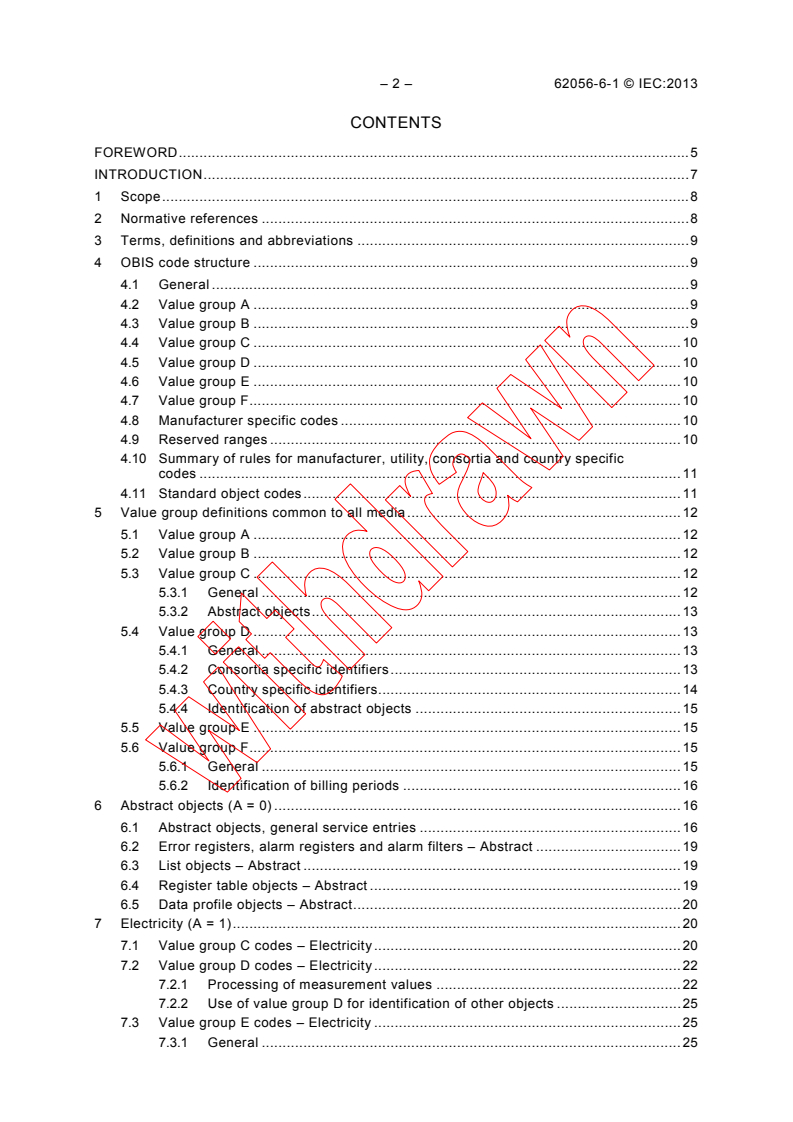
– 2 – 62056-6-1 © IEC:2013
CONTENTS
FOREWORD . 5
INTRODUCTION . 7
1 Scope . 8
2 Normative references . 8
3 Terms, definitions and abbreviations . 9
4 OBIS code structure . 9
4.1 General . 9
4.2 Value group A . 9
4.3 Value group B . 9
4.4 Value group C . 10
4.5 Value group D . 10
4.6 Value group E . 10
4.7 Value group F. 10
4.8 Manufacturer specific codes . 10
4.9 Reserved ranges . 10
4.10 Summary of rules for manufacturer, utility, consortia and country specific
codes . 11
4.11 Standard object codes . 11
5 Value group definitions common to all media . 12
5.1 Value group A . 12
5.2 Value group B . 12
5.3 Value group C . 12
5.3.1 General . 12
5.3.2 Abstract objects . 13
5.4 Value group D . 13
5.4.1 General . 13
5.4.2 Consortia specific identifiers . 13
5.4.3 Country specific identifiers. 14
5.4.4 Identification of abstract objects . 15
5.5 Value group E . 15
5.6 Value group F. 15
5.6.1 General . 15
5.6.2 Identification of billing periods . 16
6 Abstract objects (A = 0) . 16
6.1 Abstract objects, general service entries . 16
6.2 Error registers, alarm registers and alarm filters – Abstract . 19
6.3 List objects – Abstract . 19
6.4 Register table objects – Abstract . 19
6.5 Data profile objects – Abstract . 20
7 Electricity (A = 1) . 20
7.1 Value group C codes – Electricity . 20
7.2 Value group D codes – Electricity . 22
7.2.1 Processing of measurement values . 22
7.2.2 Use of value group D for identification of other objects . 25
7.3 Value group E codes – Electricity . 25
7.3.1 General . 25
62056-6-1 © IEC:2013 – 3 –
7.3.2 Tariff rates . 25
7.3.3 Harmonics . 25
7.3.4 Phase angles . 26
7.3.5 Transformer and line loss quantities . 26
7.3.6 UNIPEDE voltage dips . 29
7.3.7 Use of value group E for the identification of other objects . 30
7.4 Value group F codes – Electricity . 30
7.4.1 Billing periods . 30
7.4.2 Multiple thresholds . 30
7.5 OBIS codes – Electricity . 30
7.5.1 General purpose objects – Electricity . 30
7.5.2 Error register objects – Electricity . 33
7.5.3 List objects – Electricity . 34
7.5.4 Data profile objects – Electricity . 34
7.5.5 Register table objects – Electricity . 34
Annex A (normative) Code presentation . 36
Annex B (informative) Significant technical changes with respect to IEC 62056-61 . 39
Bibliography . 41
Index . 42
Figure 1 – OBIS code structure . 9
Figure 2 – Quadrant definitions for active and reactive power . 22
Figure 3 – Model of the line and the transformer for calculation of loss quantities . 27
Figure A.1 – Reduced ID code presentation . 36
Table 1 – Rules for manufacturer, utility, consortia and country specific codes . 11
Table 2 – Value group A codes . 12
Table 3 – Value group B codes . 12
Table 4 – Value group C codes – Abstract objects . 13
Table 5 – Value group D codes – Consortia specific identifiers . 13
Table 6 – Value group D codes – Country specific identifiers . 14
Table 7 – OBIS codes for abstract objects, general service entries . 16
Table 8 – OBIS codes for error registers, alarm registers and alarm filters – Abstract . 19
Table 9 – OBIS codes for list objects – Abstract . 19
Table 10 – OBIS codes for Register table objects – Abstract . 19
Table 11 – OBIS codes for data profile objects – Abstract . 20
Table 12 – Value group C codes – Electricity . 20
Table 13 – Value group D codes – Electricity . 22
Table 14 – Value group E codes – Electricity – Tariff rates . 25
Table 15 – Value group E codes – Electricity – Harmonics . 25
Table 16 – Value group E codes – Electricity – Extended phase angle measurement . 26
Table 17 – Value group E codes – Electricity – Transformer and line losses . 27
Table 18 – Value group E codes – Electricity – UNIPEDE voltage dips . 29
Table 19 – OBIS codes for general purpose objects – Electricity . 30
Table 20 – OBIS codes for error register objects – Electricity . 34
– 4 – 62056-6-1 © IEC:2013
Table 21 – OBIS codes for list objects – Electricity . 34
Table 22 – OBIS codes for data profile objects – Electricity . 34
Table 23 – OBIS codes for Register table objects – Electricity . 35
Table A.1 – Example of display code replacement . 36
Table A.2 – Value group F – Billing periods . 37
62056-6-1 © IEC:2013 – 5 –
INTERNATIONAL ELECTROTECHNICAL COMMISSION
____________
ELECTRICITY METERING DATA EXCHANGE –
THE DLMS/COSEM SUITE –
Part 6-1: Object Identification System (OBIS)
FOREWORD
1) The International Electrotechnical Commission (IEC) is a worldwide organization for standardization comprising
all national electrotechnical committees (IEC National Committees). The object of IEC is to promote
international co-operation on all questions concerning standardization in the electrical and electronic fields. To
this end and in addition to other activities, IEC publishes International Standards, Technical Specifications,
Technical Reports, Publicly Available Specifications (PAS) and Guides (hereafter referred to as “IEC
Publication(s)”). Their preparation is entrusted to technical committees; any IEC National Committee interested
in the subject dealt with may participate in this preparatory work. International, governmental and non-
governmental organizations liaising with the IEC also participate in this preparation. IEC collaborates closely
with the International Organization for Standardization (ISO) in accordance with conditions determined by
agreement between the two organizations.
2) The formal decisions or agreements of IEC on technical matters express, as nearly as possible, an international
consensus of opinion on the relevant subjects since each technical committee has representation from all
interested IEC National Committees.
3) IEC Publications have the form of recommendations for international use and are accepted by IEC National
Committees in that sense. While all reasonable efforts are made to ensure that the technical content of IEC
Publications is accurate, IEC cannot be held responsible for the way in which they are used or for any
misinterpretation by any end user.
4) In order to promote international uniformity, IEC National Committees undertake to apply IEC Publications
transparently to the maximum extent possible in their national and regional publications. Any divergence
between any IEC Publication and the corresponding national or regional publication shall be clearly indicated in
the latter.
5) IEC itself does not provide any attestation of conformity. Independent certification bodies provide conformity
assessment services and, in some areas, access to IEC marks of conformity. IEC is not responsible for any
services carried out by independent certification bodies.
6) All users should ensure that they have the latest edition of this publication.
7) No liability shall attach to IEC or its directors, employees, servants or agents including individual experts and
members of its technical committees and IEC National Committees for any personal injury, property damage or
other damage of any nature whatsoever, whether direct or indirect, or for costs (including legal fees) and
expenses arising out of the publication, use of, or reliance upon, this IEC Publication or any other IEC
Publications.
8) Attention is drawn to the Normative references cited in this publication. Use of the referenced publications is
indispensable for the correct application of this publication.
9) Attention is drawn to the possibility that some of the elements of this IEC Publication may be the subject of
patent rights. IEC shall not be held responsible for identifying any or all such patent rights.
The International Electrotechnical Commission (IEC) draws attention to the fact that it is claimed that compliance
with this International Standard may involve the use of a maintenance service concerning the stack of protocols on
which the present standard IEC 62056-6-1 is based.
The IEC takes no position concerning the evidence, validity and scope of this maintenance service.
The provider of the maintenance service has assured the IEC that he is willing to provide services under
reasonable and non-discriminatory terms and conditions for applicants throughout the world. In this respect, the
statement of the provider of the maintenance service is registered with the IEC. Information may be obtained from:
DLMS User Association
Zug/Switzerland
www.dlms.ch
International Standard IEC 62056-6-1 has been prepared by IEC technical committee 13:
Electrical energy measurement, tariff- and load control.
___________
Device Language Message Specification.
– 6 – 62056-6-1 © IEC:2013
This edition cancels and replaces IEC 62056-61 published in 2006. It constitutes a technical
revision.
The significant technical changes with respect to IEC 62056-61 are listed in Annex B.
The text of this standard is based on the following documents:
FDIS Report on voting
13/1524/FDIS 13/1542/RVD
Full information on the voting for the approval of this standard can be found in the report on
voting indicated in the above table.
This publication has been drafted in accordance with the ISO/IEC Directives, Part 2.
A list of all the parts in the IEC 62056 series, published under the general title Electricity
metering data exchange – The DLMS/COSEM suite, can be found on the IEC website.
Future standards in this series will carry the new general title as cited above. Titles of existing
standards in this series will be updated at the time of the next edition.
The numbering scheme has changed from IEC 62056-XY to IEC 62056-X-Y. For example
IEC 62056-61 becomes IEC 62056-6-1.
The committee has decided that the contents of this publication will remain unchanged until
the stability date indicated on the IEC web site under "http://webstore.iec.ch" in the data
related to the specific publication. At this date, the publication will be
• reconfirmed,
• withdrawn,
• replaced by a revised edition, or
• amended.
62056-6-1 © IEC:2013 – 7 –
INTRODUCTION
The competitive electricity market requires an ever-increasing amount of timely information
concerning the usage of electrical energy. Recent technology developments enable to build
intelligent static metering equipment, which is capable of capturing, processing and
communicating this information to all parties involved.
To facilitate the analysis of metering information, for the purposes of billing, load-, customer-
and contract management, it is necessary to uniquely identify data items, whether collected
manually or automatically, via local or remote data exchange, in a manufacturer-independent
way. The definition of identification codes to achieve this – the OBIS codes – is based on
DIN 43863-3:1997, Electricity meters – Part 3: Tariff metering device as additional equipment
for electricity meters – EDIS – Energy Data Identification System.
– 8 – 62056-6-1 © IEC:2013
ELECTRICITY METERING DATA EXCHANGE –
THE DLMS/COSEM SUITE –
Part 6-1: Object Identification System (OBIS)
1 Scope
This part of IEC 62056 specifies the overall structure of the OBject Identification System
(OBIS) and the mapping of all commonly used data items in metering equipment to their
identification codes.
OBIS provides a unique identifier for all data within the metering equipment, including not only
measurement values, but also abstract values used for configuration or obtaining information
about the behaviour of the metering equipment. The ID codes defined in this standard are
used for the identification of:
• logical names of the various instances of the ICs, or objects, as defined in
IEC 62056-6-2 ;
• data transmitted through communication lines,
• data displayed on the metering equipment, see A.2.
This standard applies to all types of metering equipment, such as fully integrated meters,
modular meters, tariff attachments, data concentrators etc.
To cover metering equipment measuring energy types other than electricity, combined
metering equipment measuring more than one type of energy or metering equipment with
several physical measurement channels, the concepts of medium and channels are
introduced. This allows meter data originating from different sources to be identified. While
this standard fully defines the structure of the identification system for other media, the
mapping of non-electrical energy related data items to ID codes needs to be completed
separately.
NOTE EN 13757-1 defines identifiers for metering equipment other than electricity: heat cost allocators, cooling,
heating, gas, cold water and hot water.
2 Normative references
The following documents, in whole or in part, are normatively referenced in this document and
are indispensable for its application. For dated references, only the edition cited applies. For
undated references, the latest edition of the referenced document (including any
amendments) applies.
IEC/TR 62051:1999, Electricity metering – Glossary of terms
IEC/TR 62051-1:2004, Electricity metering – Data exchange for meter reading, tariff and load
control – Glossary of terms – Part 1: Terms related to data exchange with metering equipment
using DLMS/COSEM
IEC 62053-23:2003, Electricity metering equipment (a.c.) – Particular requirements – Part 23:
Static meters for reactive energy (classes 2 and 3)
___________
To be published simultaneously with this part of IEC 62056.
62056-6-1 © IEC:2013 – 9 –
IEC 62056-21:2002, Electricity metering – Data exchange for meter reading, tariff and load
control – Part 21: Direct local data exchange
IEC 62056-6-2:—, Electricity metering data exchange – The DLMS/COSEM suite – Part 6-2:
COSEM interface classes
NOTE See also the Bibliography.
3 Terms, definitions and abbreviations
For the purposes of this document, the terms and definitions given in IEC/TR 62051 and
IEC/TR 62051-1 and the following apply.
COSEM Companion Specification for Energy Metering
COSEM object An instance of a COSEM interface class
DLMS Device Language Message Specification
DLMS UA DLMS User Association
GSM Global System for Mobile Communications
IC Interface Class
IEC International Electrotechnical Commission
ISO International Organization for Standardization
OBIS OBject Identification System
VZ Billing period counter
4 OBIS code structure
4.1 General
OBIS codes identify data items used in energy metering equipment, in a hierarchical structure
using six value groups A to F, see Figure 1.
A B C D E F
IEC 1091/13
Figure 1 – OBIS code structure
4.2 Value group A
Value group A is used to identify the media (energy type) to which the metering is related.
Non-media related information is handled as abstract data.
4.3 Value group B
Value group B is generally used to identify the measurement channel number, i.e. the number
of the input of a metering equipment having several inputs for the measurement of energy of
the same or different types (for example in data concentrators, registration units). Data from
different sources can thus be identified.
Value group B may also be used to identify the communication channel, and in some cases
for other purposes.
The definitions for this value group are independent from the value group A.
– 10 – 62056-6-1 © IEC:2013
4.4 Value group C
Value group C is used to identify the abstract or physical data items related to the information
source concerned, for example current, voltage, power, volume, temperature. The definitions
depend on the value in the value group A.
Further processing, classification and storage methods are defined by value groups D, E
and F.
For abstract data, value groups D to F provide further classification of data identified by value
groups A to C.
4.5 Value group D
Value group D is used to identify types, or the result of the processing of physical quantities
identified by values in value groups A and C, according to various specific algorithms. The
algorithms can deliver energy and demand quantities as well as other physical quantities.
4.6 Value group E
Value group E is used to identify further processing or classification of quantities identified by
values in value groups A to D.
4.7 Value group F
Value group F is used to identify historical data, identified by values in value groups A to E,
according to different billing periods. Where this is not relevant, this value group can be used
for further classification.
4.8 Manufacturer specific codes
In value groups B, C, D, E and F, the following ranges are available for manufacturer-specific
purposes:
• group B: 128…199;
• group C: 128…199, 240;
• group D: 128…254;
• group E: 128…254;
• group F: 128…254.
If any of these value groups contain a value in the manufacturer specific range, then the
whole OBIS code shall be considered as manufacturer specific, and the value of the other
groups does not necessarily carry a meaning defined in this standard or in IEC 62056-6-2.
In addition, manufacturer specific ranges are defined in Table 7 with A = 0, C = 96, in
Table 19 with A = 1, C = 96.
4.9 Reserved ranges
By default, all codes not allocated are reserved.
___________
Reservation process administered by the DLMS User Association (see Foreword).
62056-6-1 © IEC:2013 – 11 –
4.10 Summary of rules for manufacturer, utility, consortia and country specific codes
Table 1 summarizes the rules for handling manufacturer specific codes specified in 4.8, utility
specific codes specified in 5.2, consortia specific codes specified in 5.4.2 and country specific
codes specified in 0.
Table 1 – Rules for manufacturer, utility, consortia and country specific codes
Code type Value group
A B C D E F
128…199 c d e f
128…
b d e f
199, 240
Manufacturer specific 0, 1, 4.9
b c 128…254 e f
b c d 128…254 f
b c d e 128…254
Manufacturer specific
2 0 0…64 96 50…99 0…255 0…255
abstract
Manufacturer specific,
media related general 1, 4…9 0…64 96 50…99 0…255 0…255
purpose
Utility specific 65…127
Consortia specific 1…64 93 See Table 5
0, 1, 4.9
Country specific 1…64 94 See Table 6
“b”, “c”, “d”, “e”, “f” means any value in the relevant value group.
The range D = 50…99 is available for identifying objects, which are not represented by another defined code,
but need representation on the display as well. If this is not required, the range D = 128…254 should be used.
If the value in value group B is 65…127, the whole OBIS code should be considered as utility specific and the
value of other groups does not necessarily carry a meaning defined neither in Clause 4 nor 5.
The usage of value group E and F is defined in consortia specific documents.
The usage of value group E and F is defined in country specific documents.
Objects for which this standard defines standard identifiers shall not be re-identified by
manufacturer, utility, consortia or country specific identifiers.
On the other hand, an object previously identified by a manufacturer-, utility-, consortia- or
country- specific identifier may receive a standard identifier in the future, if its use is of
common interest for the users of this standard.
4.11 Standard object codes
Standard object codes are meaningful combinations of defined values of the six value groups.
Notation: In the following tables, in the various value groups, “b”, “c”, ”d”, “e”, “f” signifies any
value in the respective value group. If only one object is instantiated, the value shall be 0. If a
value group is shaded, then this value group is not used.
NOTE The DLMS UA maintains a list of standard COSEM object definitions at www.dlms.com. The validity of the
combination of OBIS codes and class_id-s as well as the data types of the attributes are tested during
conformance testing.
– 12 – 62056-6-1 © IEC:2013
5 Value group definitions common to all media
5.1 Value group A
The range for value group A is 0 to 15, see Table 2.
Table 2 – Value group A codes
Value group A
0 Abstract objects
1 Electricity related objects
4 Heat cost allocator related objects
5 Cooling related objects
6 Heat related objects
7 Gas related objects
8 Cold water related objects
9 Hot water related objects
All other
Reserved
The following subclauses contain value group definitions B to F common for all values of
value group A.
5.2 Value group B
The range for value group B is 0 to 255, see Table 3.
Table 3 – Value group B codes
Value group B
No channel specified
1…64 Channel 1.64
65…127
Utility specific codes
128…199 Manufacturer specific codes
200…255 Reserved
If channel information is not essential, the value 0 shall be assigned.
The range 65…127 is available for utility specific use. If the value of value group B is in this
range, the whole OBIS code shall be considered as utility specific and the value of other
groups does not necessarily carry a meaning defined neither in this standard nor in
IEC 62056-6-2.
5.3 Value group C
5.3.1 General
The range for value group C is 0 to 255. The definitions depend on the value in value group A.
The codes for abstract objects are specified in 5.3.2. Electricity related codes are specified in
7.1.
62056-6-1 © IEC:2013 – 13 –
5.3.2 Abstract objects
Abstract objects are data items, which are not related to a certain type of physical quantity.
See Table 4.
Table 4 – Value group C codes – Abstract objects
Value group C
Abstract objects (A = 0)
a
0…89 Context specific identifiers
93 Consortia specific identifiers (See 5.4.2).
94 Country specific identifiers (See 0)
96 General service entries (See 6.1)
General Error registers (See 0)
98 General list objects (See 6.3)
99 Abstract data profiles (See 6.5)
b
127 Inactive objects
128…199, 240 Manufacturer specific codes
All other Reserved
a
Context specific identifiers identify objects specific to a certain protocol and/or
application. For the COSEM context, the identifiers are defined in IEC 62056-6-2:—,
6.2.
b
An inactive object is an object, which is defined and present in a meter, but which has
no assigned functionality.
5.4 Value group D
5.4.1 General
The range for value group D is 0 to 255.
5.4.2 Consortia specific identifiers
Table 5 specifies the use of value group D for consortia specific applications. In this table,
there are no reserved ranges for manufacturer specific codes. The usage of value group E
and F is defined in consortia specific documents.
Table 5 – Value group D codes – Consortia specific identifiers
Value group D
Consortia specific identifiers (A = any, C = 93)
01 SELMA Consortium
All other Reserved
Objects that are already identified in this standard shall not be re-identified
by consortia specific identifiers.
NOTE The SELMA Consortium is an associated member of the DLMS UA.
– 14 – 62056-6-1 © IEC:2013
5.4.3 Country specific identifiers
Table 6 specifies the use of value group D for country specific applications. Wherever
possible, the country phone calling codes are used. In this table, there are no reserved
ranges for manufacturer specific codes. The usage of value group E and F is defined in
country specific documents.
Table 6 – Value group D codes – Country specific identifiers
Value group D
a
Country specific identifiers (A = any, C = 94)
00 Identifiers for Finland
01 Identifiers for the USA
02 Identifiers for Canada
Identifiers for Serbia
07 Identifiers for Russia
10 Identifiers for Czech
Identifiers for Bulgaria
12 Identifiers for Croatia
13 Identifiers for Ireland
Identifiers for Israel
15 Identifiers for Ukraine
16 Identifiers for Yugoslavia
NOTE With the dissolution of the former Yugoslavia into separate
nations, country code 16 was decommissioned.
20 Identifiers for Egypt
27 Identifiers for South Africa
Identifiers for Greece
31 Identifiers for the Netherlands
32 Identifiers for Belgium
Identifiers for France
34 Identifiers for Spain
35 Identifiers for Portugal
36 Identifiers for Hungary
37 Identifiers for Lithuania
38 Identifiers for Slovenia
39 Identifiers for Italy
Identifiers for Romania
41 Identifiers for Switzerland
42 Identifiers for Slovakia
43 Identifiers for Austria
44 Identifiers for the United Kingdom
45 Identifiers for Denmark
46 Identifiers for Sweden
47 Identifiers for Norway
48 Identifiers for Poland
49 Identifiers for Germany
52 Identifiers for South Korea
62056-6-1 © IEC:2013 – 15 –
Value group D
a
Country specific identifiers (A = any, C = 94)
54 Identifiers for Argentina
55 Identifiers for Brazil
57 Identifiers for Colombia
61 Identifiers for Australia
62 Identifiers for Indonesia
63 Identifiers for the Philippines
Identifiers for New Zealand
65 Identifiers for Singapore
73 Identifiers for Moldova
75 Identifiers for Belarus
81 Identifiers for Japan
85 Identifiers for Hong Kong
86 Identifiers for China
87 Identifiers for Bosnia and Herzegovina
90 Identifiers for Turkey
91 Identifiers for India
Identifiers for Pakistan
96 Identifiers for Saudi Arabia
97 Identifiers for the United Arab Emirates
Identifiers for Iran
All other Reserved
Objects that are already identified in this standard shall not be re-identified by country
specific identifiers.
5.4.4 Identification of abstract objects
For the use of value group D to identify abstract objects, see Clause 6.
For identifiers of electricity related general-purpose objects, see Table 19.
5.5 Value group E
The range for value group E is 0 to 255. It can be used for identifying further classification or
processing of values defined by values in value groups A to D. The various classifications and
processing methods are exclusive.
For the use of value group E to identify abstract objects, see Clause 6.
For identifiers of electricity related general-purpose objects, see Table 19.
5.6 Value group F
5.6.1 General
The range for value group F is 0 to 255. In all cases, if value group F is not used, it is set to
255.
– 16 – 62056-6-1 © IEC:2013
5.6.2 Identification of billing periods
Value group F specifies the allocation to different billing periods (sets of historical values) for
the objects defined by value groups A to E, where storage of historical values is relevant. A
billing period scheme is identified with its billing period counter, number of available billing
periods, time stamp of the billing period and billing period length. Several billing period
schemes may be possible. See also 7.4.1, A.3 and IEC 62056-6-2:—, 6.2.2.
6 Abstract objects (A = 0)
6.1 Abstract objects, general service entries
Table 7 below specifies object codes for abstract objects. See also IEC 62056-6-2:—,
Table 12.
Table 7 – OBIS codes for abstract objects, general service entries
OBIS code
Abstract objects, general service entries
A B C D E F
Billing period values/reset counter entries
(First billing period scheme if there are two)
Billing period counter (1) 0 b 0 1 0 VZ
or
Number of available billing periods (1) 0 b 0 1 1
Time stamp of the most recent billing period (1) 0 b 0 1 2
Time stamp of the billing period (1) VZ (last reset) 0 b 0 1 2 VZ
Time stamp of the billing period (1) VZ 0 b 0 1 2 VZ
-1 -1
… … … … … … .
Time stamp of the billing period (1) VZ 0 b 0 1 2 VZ
-n -n
Billing period values/reset counter entries
(Second billing period scheme)
Billing period counter (2) 0 b 0 1 3 VZ
or
Number of available billing periods (2) 0 b 0 1 4
Time stamp of the most recent billing period (2) 0 b 0 1 5
Time stamp of the billing period (2) VZ (last reset) 0 b 0 1 5 VZ
Time stamp of the billing period (2) VZ 0 b 0 1 5 VZ
-1 -1
... … … … … … ...
Time stamp of the billing period (2) VZ 0 b 0 1 5 VZ
-n -n
Device ID numbers (non-energy/channel related)
Complete device ID 0 0 96 1
Device ID 1 (manufacturing number) 0 0 96 1 0
… … … …
Device ID 10 0 0 96 1 9
Metering point ID (abstract) 0 0 96 1 10
Parameter changes, calibration and access
Number of configuration program changes 0 b 96 2 0
a
Date of last configuration program change 0 b 96 2 1
a
Date of last time switch program change 0 b 96 2 2
a
Date of last ripple control receiver program change 0 b 96 2 3
Status of security switches 0 b 96 2 4
a
Date of last calibration 0 b 96 2 5
a
Date of next configuration program change 0 b 96 2 6
62056-6-1 © IEC:2013 – 17 –
OBIS code
Abstract objects, general service entries
A B C D E F
a
Date of activation of the passive calendar 0 b 96 2 7
b
Number of protected configuration program changes 0 b 96 2 10
a b
Date of last protected configuration program change 0 b 96 2 11
a
Date (corrected) of last clock synchronization/setting 0 b 96 2 12
Date of last firmware activation 0 b 96 2 13
Input/output control signals
c
State of input/output control signals, global 0 b 96 3 0
State of input control signals (status word 1) 0 b 96 3 1
State of output control signals (status word 2) 0 b 96 3 2
State of input/output control signals (status word 3) 0 b 96 3 3
State of input/output control signals (status word 4) 0 b 96 3 4
Disconnect control 0 b 96 3 10
Internal control signals
c
Internal control signals, global 0 b 96 4 0
Internal control signals (status word 1) 0 b 96 4 1
Internal control signals (status word 2) 0 b 96 4 2
Internal control signals (status word 3) 0 b 96 4 3
Internal control signals (status word 4) 0 b 96 4 4
Internal operating status signals
c
Internal operating status, global 0 b 96 5 0
Internal operating status (status word 1) 0 b 96 5 1
Internal operating status (status word 2) 0 b 96 5 2
Internal operating status (status word 3) 0 b 96 5 3
Internal operating status (status word 4) 0 b 96 5 4
Battery entries
Battery use time counter 0 b 96 6 0
Battery charge display 0 b 96 6 1
Date of next battery change 0 b 96 6 2
Battery voltage 0 b 96 6 3
Battery initial capacity 0 b 96 6 4
Battery installation date and time 0 b 96 6 5
Battery estimated remaining use time 0 b 96 6 6
Aux. supply use time counter 0 b 96 6 10
Aux. voltage (measured) 0 b 96 6 11
Power failure monitoring
Number of power failures
In all three phases 0 0 96 7 0
In phase L1 0 0 96 7 1
In phase L2 0 0 96 7 2
In phase L3 0 0 96 7 3
In any phase [sic] 0 0 96 7 21
Auxiliary supply 0 0 96 7 4
Number of long power failures
In all three phases 0 0 96 7 5
In phase L1 0 0 96 7 6
In phase L2 0 0 96 7 7
In phase L3 0 0 96 7 8
In any phase 0 0 96 7 9
d
Time of power failure
– 18 – 62056-6-1 © IEC:2013
OBIS code
Abstract objects, general service entries
A B C D E F
In all three phases 0 0 96 7 10
In phase L1 0 0 96 7 11
In phase L2 0 0 96 7 12
In phase L3 0 0 96 7 13
In any phase 0 0 96 7 14
e
Duration of long power failure
In all three phases 0 0 96 7 15
In phase L1 0 0 96 7 16
In phase L2 0 0 96 7 17
In phase L3 0 0 96 7 18
In any phase 0 0 96 7 19
Time threshold for long power failure
Time threshold for long power failure 0 0 96 7 20
NOTE 1 See Number of power failures in any phase, 0.b.96.7.21.255
above in the Number of power failur
...