

IEC 62056-1-0:2014
(Main)Electricity metering data exchange - The DLMS/COSEM suite - Part 1-0: Smart metering standardisation framework
- Abstract
IEC 62056-1-0:2014 provides information on the smart metering use cases and on architectures supported by the IEC 62056 DLMS/COSEM series of standards specifying electricity meter data exchange. It describes the standardization framework including:
- the principles on which the standards shall be developed;
- the ways the existing standards shall be extended to support new use cases and to accommodate new communication technologies, while maintaining coherency;
- the aspects of interoperability and information security. It also provides guidance for selecting the suitable standards for a specific interface within the smart metering system.
- Status
- Published
- Publication Date
- 03-Jun-2014
- Technical Committee
- TC 13 - Electrical energy measurement and control
- Drafting Committee
- WG 14 - TC 13/WG 14
- Current Stage
- PPUB - Publication issued
- Start Date
- 04-Jun-2014
- Completion Date
- 30-Jun-2014
Overview
IEC 62056-1-0:2014 titled Electricity Metering Data Exchange - The DLMS/COSEM Suite - Part 1-0: Smart Metering Standardisation Framework is an international standard published by the International Electrotechnical Commission (IEC). It provides a comprehensive framework for smart metering systems focusing on electricity meter data exchange using the DLMS/COSEM suite of standards. This document outlines use cases, system architecture, and fundamental principles for standardization, interoperability, and security in smart metering communication.
The standard addresses the growing demand for reliable, interoperable, and secure data exchange across smart meters and related systems in smart grids and smart homes. As smart metering adoption rises worldwide, IEC 62056-1-0:2014 ensures consistency and extensibility in standard development, adapting to new communication technologies and evolving use cases.
Key Topics
Smart Metering Use Cases & Architecture
The standard provides detailed use cases to illustrate various smart metering scenarios and prescribes a reference architecture to support efficient electricity data exchange. It defines interfaces to external systems such as home automation, distribution management, and substation automation.Standardization Principles
IEC 62056-1-0 establishes the core principles guiding the development and extension of the DLMS/COSEM standards suite to ensure:- Coherency across all related standards
- Flexibility to incorporate new communication technologies
- Consistent expansion to cover emerging smart grid applications
Interoperability and Security
Interoperability is a key aspect, ensuring diverse devices and systems can communicate seamlessly. The standard emphasizes layered security mechanisms, including:- Access control and authentication
- Communication channel security
- End-to-end data protection
These security features safeguard the integrity, confidentiality, and availability of metering data.
Data Model and Communication Profiles
The object-oriented COSEM data model supports a wide range of metering data types and smart grid functionalities. Communication profiles link the data model to various transmission protocols, enabling flexible deployment over different communication technologies.Guidance for Interface Selection
The framework helps stakeholders select appropriate IEC 62056 standards and interfaces matching specific smart metering system elements, ensuring interoperable and scalable system designs.
Applications
IEC 62056-1-0:2014 plays a critical role in:
Smart Grid Integration
Enabling effective data exchange between electricity meters and grid management systems to support advanced grid operations, demand response, and energy efficiency initiatives.Billing and Customer Management
Providing accurate and secure data for supplier-consumer contracts, advanced billing, and consumer energy usage insights.Home and Building Automation
Allowing seamless interaction between smart meters and home automation devices for energy management and automation.Utility Distribution Automation
Supporting communication between meters and distribution automation systems for improved grid reliability and performance.Technology Evolution Adaptation
Ensuring future-proofing of meter data exchange standards to incorporate new communication technologies without losing compatibility or security.
Related Standards
IEC 62056-1-0:2014 belongs to the broader IEC 62056 DLMS/COSEM suite, which includes detailed specifications for:
- COSEM object models used for metering data representation
- Communication profiles tailored for different transmission media
- Security protocols for data protection
- Interface standards to external systems and networks
Additionally, related IEC standards referenced include line carrier communication protocols IEC 61334-4-32 and IEC 61334-5-1, which support certain communication layers utilized in smart metering.
Keywords: IEC 62056-1-0, DLMS/COSEM, smart metering standards, electricity metering data exchange, smart grid interoperability, metering communication protocols, smart meter security, IEC smart metering framework, smart metering architecture, metering data model, meter data security, utility data exchange.
Get Certified
Connect with accredited certification bodies for this standard

BSI Group
BSI (British Standards Institution) is the business standards company that helps organizations make excellence a habit.

DIBt (Deutsches Institut für Bautechnik)
German Institute for Building Technology.
DIN CERTCO
DIN Group product certification.
Sponsored listings
Frequently Asked Questions
IEC 62056-1-0:2014 is a standard published by the International Electrotechnical Commission (IEC). Its full title is "Electricity metering data exchange - The DLMS/COSEM suite - Part 1-0: Smart metering standardisation framework". This standard covers: IEC 62056-1-0:2014 provides information on the smart metering use cases and on architectures supported by the IEC 62056 DLMS/COSEM series of standards specifying electricity meter data exchange. It describes the standardization framework including: - the principles on which the standards shall be developed; - the ways the existing standards shall be extended to support new use cases and to accommodate new communication technologies, while maintaining coherency; - the aspects of interoperability and information security. It also provides guidance for selecting the suitable standards for a specific interface within the smart metering system.
IEC 62056-1-0:2014 provides information on the smart metering use cases and on architectures supported by the IEC 62056 DLMS/COSEM series of standards specifying electricity meter data exchange. It describes the standardization framework including: - the principles on which the standards shall be developed; - the ways the existing standards shall be extended to support new use cases and to accommodate new communication technologies, while maintaining coherency; - the aspects of interoperability and information security. It also provides guidance for selecting the suitable standards for a specific interface within the smart metering system.
IEC 62056-1-0:2014 is classified under the following ICS (International Classification for Standards) categories: 17.220.20 - Measurement of electrical and magnetic quantities; 35.110 - Networking; 91.140.50 - Electricity supply systems. The ICS classification helps identify the subject area and facilitates finding related standards.
IEC 62056-1-0:2014 is available in PDF format for immediate download after purchase. The document can be added to your cart and obtained through the secure checkout process. Digital delivery ensures instant access to the complete standard document.
Standards Content (Sample)
IEC 62056-1-0 ®
Edition 1.0 2014-06
INTERNATIONAL
STANDARD
NORME
INTERNATIONALE
colour
inside
Electricity metering data exchange – The DLMS/COSEM suite –
Part 1-0: Smart metering standardisation framework
Échange des données de comptage de l'électricité – La suite DLMS/COSEM –
Partie 1-0: Cadre de normalisation du comptage intelligent
All rights reserved. Unless otherwise specified, no part of this publication may be reproduced or utilized in any form
or by any means, electronic or mechanical, including photocopying and microfilm, without permission in writing from
either IEC or IEC's member National Committee in the country of the requester. If you have any questions about IEC
copyright or have an enquiry about obtaining additional rights to this publication, please contact the address below or
your local IEC member National Committee for further information.
Droits de reproduction réservés. Sauf indication contraire, aucune partie de cette publication ne peut être reproduite
ni utilisée sous quelque forme que ce soit et par aucun procédé, électronique ou mécanique, y compris la photocopie
et les microfilms, sans l'accord écrit de l'IEC ou du Comité national de l'IEC du pays du demandeur. Si vous avez des
questions sur le copyright de l'IEC ou si vous désirez obtenir des droits supplémentaires sur cette publication, utilisez
les coordonnées ci-après ou contactez le Comité national de l'IEC de votre pays de résidence.
IEC Central Office Tel.: +41 22 919 02 11
3, rue de Varembé Fax: +41 22 919 03 00
CH-1211 Geneva 20 info@iec.ch
Switzerland www.iec.ch
About the IEC
The International Electrotechnical Commission (IEC) is the leading global organization that prepares and publishes
International Standards for all electrical, electronic and related technologies.
About IEC publications
The technical content of IEC publications is kept under constant review by the IEC. Please make sure that you have the
latest edition, a corrigenda or an amendment might have been published.
IEC Catalogue - webstore.iec.ch/catalogue Electropedia - www.electropedia.org
The stand-alone application for consulting the entire The world's leading online dictionary of electronic and
bibliographical information on IEC International Standards, electrical terms containing more than 30 000 terms and
Technical Specifications, Technical Reports and other definitions in English and French, with equivalent terms in 14
documents. Available for PC, Mac OS, Android Tablets and additional languages. Also known as the International
iPad. Electrotechnical Vocabulary (IEV) online.
IEC publications search - www.iec.ch/searchpub IEC Glossary - std.iec.ch/glossary
The advanced search enables to find IEC publications by a More than 55 000 electrotechnical terminology entries in
variety of criteria (reference number, text, technical English and French extracted from the Terms and Definitions
committee,…). It also gives information on projects, replaced clause of IEC publications issued since 2002. Some entries
and withdrawn publications. have been collected from earlier publications of IEC TC 37,
77, 86 and CISPR.
IEC Just Published - webstore.iec.ch/justpublished
Stay up to date on all new IEC publications. Just Published IEC Customer Service Centre - webstore.iec.ch/csc
details all new publications released. Available online and If you wish to give us your feedback on this publication or
also once a month by email. need further assistance, please contact the Customer Service
Centre: csc@iec.ch.
A propos de l'IEC
La Commission Electrotechnique Internationale (IEC) est la première organisation mondiale qui élabore et publie des
Normes internationales pour tout ce qui a trait à l'électricité, à l'électronique et aux technologies apparentées.
A propos des publications IEC
Le contenu technique des publications IEC est constamment revu. Veuillez vous assurer que vous possédez l’édition la
plus récente, un corrigendum ou amendement peut avoir été publié.
Catalogue IEC - webstore.iec.ch/catalogue Electropedia - www.electropedia.org
Application autonome pour consulter tous les renseignements
Le premier dictionnaire en ligne de termes électroniques et
bibliographiques sur les Normes internationales,
électriques. Il contient plus de 30 000 termes et définitions en
Spécifications techniques, Rapports techniques et autres
anglais et en français, ainsi que les termes équivalents dans
documents de l'IEC. Disponible pour PC, Mac OS, tablettes
14 langues additionnelles. Egalement appelé Vocabulaire
Android et iPad.
Electrotechnique International (IEV) en ligne.
Recherche de publications IEC - www.iec.ch/searchpub
Glossaire IEC - std.iec.ch/glossary
Plus de 55 000 entrées terminologiques électrotechniques, en
La recherche avancée permet de trouver des publications IEC
en utilisant différents critères (numéro de référence, texte, anglais et en français, extraites des articles Termes et
comité d’études,…). Elle donne aussi des informations sur les Définitions des publications IEC parues depuis 2002. Plus
projets et les publications remplacées ou retirées. certaines entrées antérieures extraites des publications des
CE 37, 77, 86 et CISPR de l'IEC.
IEC Just Published - webstore.iec.ch/justpublished
Service Clients - webstore.iec.ch/csc
Restez informé sur les nouvelles publications IEC. Just
Published détaille les nouvelles publications parues. Si vous désirez nous donner des commentaires sur cette
Disponible en ligne et aussi une fois par mois par email. publication ou si vous avez des questions contactez-nous:
csc@iec.ch.
IEC 62056-1-0 ®
Edition 1.0 2014-06
INTERNATIONAL
STANDARD
NORME
INTERNATIONALE
colour
inside
Electricity metering data exchange – The DLMS/COSEM suite –
Part 1-0: Smart metering standardisation framework
Échange des données de comptage de l'électricité – La suite DLMS/COSEM –
Partie 1-0: Cadre de normalisation du comptage intelligent
INTERNATIONAL
ELECTROTECHNICAL
COMMISSION
COMMISSION
ELECTROTECHNIQUE
PRICE CODE
INTERNATIONALE
CODE PRIX Q
ICS 17.220; 35.110; 91.140.50 ISBN 978-2-8322-1617-0
– 2 – IEC 62056-1-0:2014 © IEC 2014
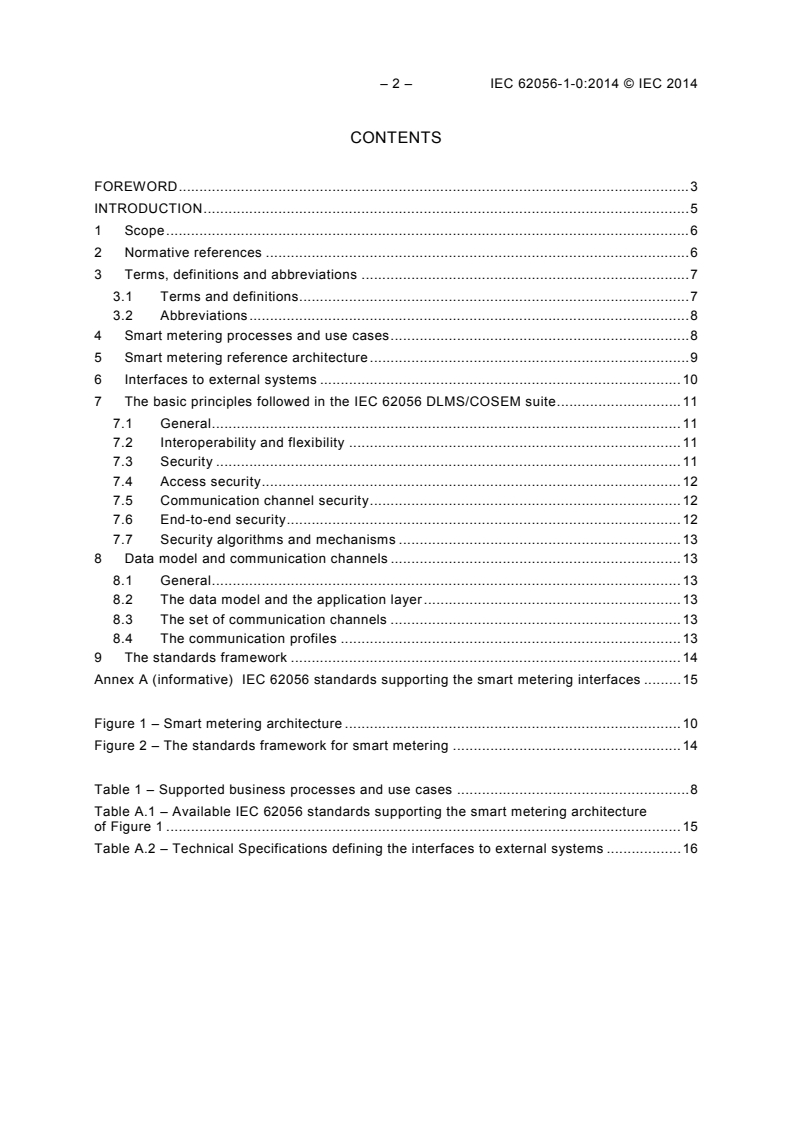
CONTENTS
FOREWORD . 3
INTRODUCTION . 5
1 Scope . 6
2 Normative references . 6
3 Terms, definitions and abbreviations . 7
3.1 Terms and definitions. 7
3.2 Abbreviations . 8
4 Smart metering processes and use cases . 8
5 Smart metering reference architecture . 9
6 Interfaces to external systems . 10
7 The basic principles followed in the IEC 62056 DLMS/COSEM suite . 11
7.1 General . 11
7.2 Interoperability and flexibility . 11
7.3 Security . 11
7.4 Access security . 12
7.5 Communication channel security . 12
7.6 End-to-end security . 12
7.7 Security algorithms and mechanisms . 13
8 Data model and communication channels . 13
8.1 General . 13
8.2 The data model and the application layer . 13
8.3 The set of communication channels . 13
8.4 The communication profiles . 13
9 The standards framework . 14
Annex A (informative) IEC 62056 standards supporting the smart metering interfaces . 15
Figure 1 – Smart metering architecture . 10
Figure 2 – The standards framework for smart metering . 14
Table 1 – Supported business processes and use cases . 8
Table A.1 – Available IEC 62056 standards supporting the smart metering architecture
of Figure 1 . 15
Table A.2 – Technical Specifications defining the interfaces to external systems . 16
INTERNATIONAL ELECTROTECHNICAL COMMISSION
____________
ELECTRICITY METERING DATA EXCHANGE –
THE DLMS/COSEM SUITE –
Part 1-0: Smart metering standardisation framework
FOREWORD
1) The International Electrotechnical Commission (IEC) is a worldwide organization for standardization comprising
all national electrotechnical committees (IEC National Committees). The object of IEC is to promote
international co-operation on all questions concerning standardization in the electrical and electronic fields. To
this end and in addition to other activities, IEC publishes International Standards, Technical Specifications,
Technical Reports, Publicly Available Specifications (PAS) and Guides (hereafter referred to as “IEC
Publication(s)”). Their preparation is entrusted to technical committees; any IEC National Committee interested
in the subject dealt with may participate in this preparatory work. International, governmental and non-
governmental organizations liaising with the IEC also participate in this preparation. IEC collaborates closely
with the International Organization for Standardization (ISO) in accordance with conditions determined by
agreement between the two organizations.
2) The formal decisions or agreements of IEC on technical matters express, as nearly as possible, an international
consensus of opinion on the relevant subjects since each technical committee has representation from all
interested IEC National Committees.
3) IEC Publications have the form of recommendations for international use and are accepted by IEC National
Committees in that sense. While all reasonable efforts are made to ensure that the technical content of IEC
Publications is accurate, IEC cannot be held responsible for the way in which they are used or for any
misinterpretation by any end user.
4) In order to promote international uniformity, IEC National Committees undertake to apply IEC Publications
transparently to the maximum extent possible in their national and regional publications. Any divergence
between any IEC Publication and the corresponding national or regional publication shall be clearly indicated in
the latter.
5) IEC itself does not provide any attestation of conformity. Independent certification bodies provide conformity
assessment services and, in some areas, access to IEC marks of conformity. IEC is not responsible for any
services carried out by independent certification bodies.
6) All users should ensure that they have the latest edition of this publication.
7) No liability shall attach to IEC or its directors, employees, servants or agents including individual experts and
members of its technical committees and IEC National Committees for any personal injury, property damage or
other damage of any nature whatsoever, whether direct or indirect, or for costs (including legal fees) and
expenses arising out of the publication, use of, or reliance upon, this IEC Publication or any other IEC
Publications.
8) Attention is drawn to the Normative references cited in this publication. Use of the referenced publications is
indispensable for the correct application of this publication.
9) Attention is drawn to the possibility that some of the elements of this IEC Publication may be the subject of
patent rights. IEC shall not be held responsible for identifying any or all such patent rights.
International Standard IEC 62056-1-0 has been prepared by IEC technical committee 13:
Electrical energy measurement and control.
The text of this standard is based on the following documents:
FDIS Report on voting
13/1574/FDIS 13/1580/RVD
Full information on the voting for the approval of this standard can be found in the report on
voting indicated in the above table.
This publication has been drafted in accordance with the ISO/IEC Directives, Part 2.
– 4 – IEC 62056-1-0:2014 © IEC 2014
A list of all parts in the IEC 62056 series, published under the general title Electricity metering
data exchange – The DLMS/COSEM suite, can be found on the IEC website.
The committee has decided that the contents of this publication will remain unchanged until
the stability date indicated on the IEC web site under "http://webstore.iec.ch" in the data
related to the specific publication. At this date, the publication will be
• reconfirmed,
• withdrawn,
• replaced by a revised edition, or
• amended.
IMPORTANT – The 'colour inside' logo on the cover page of this publication indicates
that it contains colours which are considered to be useful for the correct
understanding of its contents. Users should therefore print this document using a
colour printer.
INTRODUCTION
With the growing number of smart metering deployments, secure and interoperable data
exchange between the different system components becomes essential. Besides supporting
the execution of the supplier-consumer contract and providing the necessary billing data the
smart meter becomes also the source of valuable information for the efficient operation of the
smart grid.
The increasing range of applications that depend on metering data leads to a growing amount
of data to be exchanged within the smart metering system and via the interfaces to other
systems. Smart metering systems must be adaptable to different communication channels
without creating any data incompatibilities for the supported applications.
The standards in the IEC 62056 DLMS/COSEM suite have been constantly improved and
extended considering the growing requirements of the smart metering and smart grid
applications. In particular, the object oriented COSEM data model has been extended with
new interface classes supporting new smart metering and smart grid use cases. The
application layer has been “fortified” with state-of-the art security features offering scalable
security for the entire range of applications via a large range of communication channels. With
the introduction of the concept of “communication profiles” the IEC 62056 DLMS/COSEM suite
provides the means to link different communication channels standards with the consistent
data model of DLMS/COSEM.
This International Standard summarises the principles the IEC 62056 standards are built on
and sets the rules for future extensions to guarantee consistency.
Smart metering forms an important part of smart grids and smart homes. In order to ensure
the efficient and secure flow of information between the different applications and actors in
the energy market, harmonisation of the standards worked out by the corresponding
standardisation committees becomes necessary. In particular, a smart metering system offers
interfaces to electricity and non-electricity meters, to home automation, to substation
automation and to electricity distribution management systems. The standardisation concepts
described in this standard ensure consistency within the scope of smart metering as a
prerequisite to define harmonised interfaces to smart grid and smart home systems.
The standards of the IEC 62056 DLMS/COSEM suite have been developed by IEC TC13 for
the purposes of electricity metering. Some of the standards – in particular the COSEM data
model – are also used by other Technical Committees responsible for non-electricity metering.
– 6 – IEC 62056-1-0:2014 © IEC 2014
ELECTRICITY METERING DATA EXCHANGE –
THE DLMS/COSEM SUITE –
Part 1-0: Smart metering standardisation framework
1 Scope
This part of IEC 62056 provides information on the smart metering use cases and on
architectures supported by the IEC 62056 DLMS/COSEM series of standards specifying
electricity meter data exchange. It describes the standardization framework including:
• the principles on which the standards shall be developed;
• the ways the existing standards shall be extended to support new use cases and to
accommodate new communication technologies, while maintaining coherency;
• the aspects of interoperability and information security.
It also provides guidance for selecting the suitable standards for a specific interface within the
smart metering system.
Other aspects of metering covered by TC13, like metrological requirements, testing, safety
and dependability are out of the scope of this Standard.
2 Normative references
The following documents, in whole or in part, are normatively referenced in this document and
are indispensable for its application. For dated references, only the edition cited applies. For
undated references, the latest edition of the referenced document (including any
amendments) applies.
IEC 61334-4-32, Distribution automation using distribution line carrier systems – Part 4: Data
communication protocols – Section 32: Data link layer – Logical link control (LLC)
IEC 61334-5-1, Distribution automation using distribution line carrier systems – Part 5-1:
Lower layer profiles – The spread frequency shift keying (S-FSK) profile
IEC 62056 (all parts), Electricity metering data exchange – The DLMS/COSEM suite
IEC 62056-3-1, Electricity metering data exchange – The DLMS/COSEM suite – Part 3-1: Use
of local area networks on twisted pair with carrier signalling
IEC 62056-4-7, Electricity metering – Data exchange for meter reading, tariff and load control
– Part 4-7: COSEM transport layers for IPv4 networks (to be published)
IEC 62056-5-3:2013, Electricity metering data exchange – The DLMS/COSEM suite –
Part 5-3: DLMS/COSEM application layer
IEC 62056-6-1:2013, Electricity metering data exchange – The DLMS/COSEM suite –
Part 6-1: Object Identification System (OBIS)
IEC 62056-6-2:2013, Electricity metering data exchange – The DLMS/COSEM suite –
Part 6-2: COSEM interface classes
IEC 62056-7-6, Electricity metering data exchange – The DLMS/COSEM suite – Part 7-6: The
3-layer, connection-oriented HDLC based communication profile
IEC 62056-8-3, Electricity metering data exchange – The DLMS/COSEM suite – Part 8-3:
Communication profile for PLC S-FSK neighbourhood networks
IEC 62056-9-7, Electricity metering data exchange – The DLMS/COSEM suite – Part 9-7:
Communication profile for TCP-UDP/IP networks
IEC 62056-42, Electricity metering – Data exchange for meter reading, tariff and load control
– Part 42: Physical layer services and procedures for connection-oriented asynchronous data
exchange
IEC 62056-46, Electricity metering – Data exchange for meter reading, tariff and load control
– Part 46: Data link layer using HDLC protocol
3 Terms, definitions and abbreviations
3.1 Terms and definitions
For the purposes of this document, the terms and definitions given in the standards of the
IEC 62056 series apply as well as the following:
3.1.1
communication channel
physical or logical channel to transport data over single or multiple communication media
3.1.2
communication medium
physical medium to transmit signals carrying information
3.1.3
exchangeability
ability of a specific system component to replace a specific component in an existing system
without any need for configuration neither on the component’s side nor of the system’s side.
Interoperability is a necessary but not a sufficient condition to achieve exchangeability. For
hardware components the expression “plug-and-play” is also used to describe their
exchangeability
3.1.4
external systems
systems supporting use cases beyond the scope of smart metering but exchanging
information with the smart metering system
3.1.5
interoperability
ability of two or more system components to exchange information and to use the information
that has been exchanged for the purpose the component is designed for
3.1.6
open standard
standard made available to the general public and being developed (or approved) and
maintained via a collaborative and consensus driven process
– 8 – IEC 62056-1-0:2014 © IEC 2014
3.2 Abbreviations
The following abbreviations are used in this standard:
APDU Application Protocol Data Unit
CIM Common Information Model of TC57
COSEM Companion Specification for Energy Metering
DLMS Device Language Message Specification
ERP Enterprise Resource Planning
HES Head End System
LN Local Network
LNAP Local Network Access Point
NN Neighbourhood Network
NNAP Neighbourhood Network Access Point
PLC Power Line Carrier
WAN Wide Area Network
4 Smart metering processes and use cases
Table 1 gives an overview on the use cases that shall be supported by the smart metering
standards. The use cases are clustered into business processes. This clustering serves just
illustration purposes; it may vary from utility to utility.
Table 1 – Supported business processes and use cases
Business process Use case
Obtain meter readings on demand
Obtain scheduled meter reading
Contracting and billing Set and maintain contractual parameters in the meter (see NOTE 2)
Execute supply control
Execute load control
Customer support Provide information to the energy consumer
Meter commissioning and registration
Meter supervision
Maintenance of the security system
Manage events and alarms
Infrastructure maintenance
Firmware update
Clock synchronisation
Disconnection and re-connection of the consumer’s premises
Quality of supply supervision
NOTE 1 There are no commonly agreed names for the smart metering use cases within the standardisation
community yet. In order to consider the universal scope of the IEC standards generic and self-explanatory
names are used here.
NOTE 2 The contractual parameters consider the credit mode or the debit mode (pre-payment) operation of the
meter.
The detailed requirements of the various use cases depend on the market and on the legal
environment the smart metering system is operating in. The supporting standards shall be
designed to offer enough flexibility to meet the different market needs and the different legal
environments.
In order to facilitate achieving interoperability, security and efficiency, the standards shall
consider all aspects of data exchange in a smart metering system, including the functions to
be supported, the data models (semantics), the data presentation (syntax), and the
communication protocols for transporting the data over the interfaces using various
communication technologies.
5 Smart metering reference architecture
Figure 1 shows the smart metering reference architecture enabling the data exchange
necessary to support the use cases of Table 1. The different system components and their
interfaces are identified. The partitioning between the different components is based purely on
communication aspects; i.e. components and interfaces are specified wherever a transition
from one communication medium to another may be considered.
A comprehensive set of smart metering standards shall support all interfaces identified in
Figure 1. All specifications of communication protocols, data access methods or data
structures shall describe only the “outside view”; i.e. how the data and the communication
protocols behave on the interfaces. The behaviour within the components (“inside view”) is
implementation specific and is therefore out of the scope of the standards in the IEC 62056
series.
A practical realisation of a smart metering system will typically contain a subset of the
components and interfaces shown in Figure 1. Components and interfaces which are not
exposed and are therefore not accessible do not need to fulfil any standards.
– 10 – IEC 62056-1-0:2014 © IEC 2014
IEC 1717/14
Figure 1 – Smart metering architecture
EXAMPLE 1 “PLC system”:
A PLC system typically uses the C interface between the Metering device and the NNAP (Data Concentrator). The
communication between the NNAP and the HES uses the G2 interface.
EXAMPLE 2 “IP communication via GPRS”
Typically uses the G1 interface between the meter and the HES.
EXAMPLE 3 “Hand Held Unit for local meter access”
This typically uses the M interface.
6 Interfaces to external systems
Smart metering systems exchange data with external systems on several levels using
different interfaces. On LNAP level interfaces to Home Automation and to non-electricity
meters may be provided, on NNAP level typically interfaces to substation automation
equipment may be required, whereas on HES level typically interfaces to billing and ERP
(Enterprise Resource Planning) systems are provided.
The interfaces between the smart metering system and these external systems shall use the
standards of the IEC 62056 DLMS/COSEM suite or shall use the existing standards of the
external system. Interoperability shall be achieved on data model level by mapping the data
models of IEC 62056-6-2 and IEC 62056-6-1 to the data model of the external system.
NOTE 1 The specification of the mapping between the COSEM data model and the data model of CIM
(IEC 61968-9) supporting the interface between a smart metering system and an ERP system is undertaken by
TC13. See Table A.2.
_______________
This architecture has been developed under the smart metering standardisation mandate M/441 of the
European Commission.
NOTE 2 The specification of the mapping between the COSEM data model and the data model of IEC 61850
supporting the interface between a smart meter and a substation automation system is undertaken by TC57. See
Table A.2.
7 The basic principles followed in the IEC 62056 DLMS/COSEM suite
7.1 General
To meet the requirements of Clauses 4 and 5, the standards in the IEC 62056 DLMS/COSEM
suite shall follow the principles laid out in the following subclauses.
7.2 Interoperability and flexibility
Standardised interfaces shall enable different manufacturers to offer smart metering
components which can be integrated into a common smart metering infrastructure in an
interoperable way.
NOTE 1 The standards in the IEC 62056 DLMS/COSEM suite provide semantic and syntactic interoperability on
the data model and application layer level. Lower layers may depend on the specific communication channels.
Therefore on “lower layer” level interoperability between different media may not be achieved. Electrical and
mechanical aspects of the interfaces are out of scope.
IEC standards are applicable on a global scope. The specifications shall therefore be general
enough to support a wide range of partly diverging and even conflicting requirements. On the
other hand they shall be precise enough to support interoperability and exchangeability on all
component levels.
The following techniques are widely used in the IEC 62056 DLMS/COSEM suite to achieve
the combination of flexibility (to cover different market needs) and precision of the
specification (to enable interoperable implementations):
• specification of standardised options allowing the functionality of a specific implementation
to be optimised to specific market needs;
• information on the options implemented can be retrieved from the component itself (self-
description);
NOTE 2 E.g. IEC 62056-6-2 offers a standardised data object containing a “table of contents” of the
functionality and data available in the meter.
• standardised negotiation of the specific rules (contexts) applied for the data exchange
(e.g. services to be used, security applied);
• flexibility on the data formats by encoding the data type information with the application
data.
It is left to the freedom of the manufacturer to decide what range of options a system
component should support. However, in order to provide exchangeability the system designer
shall make sure that all components support a common minimal set of options. The
specification of the minimal set of options is part of a companion specification for a specific
smart metering system. Companion specifications are typically issued and maintained by
large utilities or by industry interest groups. Interoperability tests are typically based on the
companion specifications.
7.3 Security
The use cases supported by the smart metering system require the protection of the system
components, the interfaces and the information exchanged to maintain system integrity and to
protect the privacy of the energy users.
The security measures shall be scalable to meet the specific requirements of the use cases,
taking into account the criticality of the information, the properties of the communication
channels and the resources of the system components.
– 12 – IEC 62056-1-0:2014 © IEC 2014
The IEC 62056 DLMS/COSEM suite shall provide scalable security tools:
• to protect the integrity of system components;
• to protect data and messages exchanged between system components from source to
destination.
7.4 Access security
Data exchange between smart metering system components shall follow the Client-Server
model. Data exchange shall only be possible following appropriate identification and
authentication of the communicating partners.
For each data element and for each function of the server, appropriate access rights (read,
write, execute, with appropriate cryptographic protection) shall be defined for different clients.
The mechanism to authenticate the communication partners, the access rights to data and the
cryptographic protection to be applied shall be scalable so that it can be adapted to meet
project specific requirements.
The identification and authentication mechanisms and the access rights are supported by the
Application layer specified in IEC 62056-5-3, the data model specified in IEC 62056-6-2
(COSEM interface classes), and the identifiers specified in IEC 62056-6-1 (OBIS interface
object identification system).
7.5 Communication channel security
Cryptographic protection to ensure privacy and authenticity of information exchange with
smart meters shall be provided on application layer level according to IEC 62056-5-3. The
requested protection level shall be configurable, depending on the type of client and on the
communication channel used. In particular, the application layer messages (APDUs) and the
data carried by them may be sent in clear, or may be protected by any combination of
encryption, authentication and digital signature using cryptographic algorithms of proven
security.
NOTE Different client types may be: meter operator, retailer, end user etc.
By applying cryptographic protection on the application layer level, the information can be
securely exchanged in a uniform way independently of the communication channels and
protocols used.
Configuration of the security system and the management of the keys shall be supported by
the appropriate interface objects specified in IEC 62056-6-2.
7.6 End-to-end security
The communication channel security measures described in 7.5 protect the data and services
on application layer level. Once the data leaves the application layer of the communication
stack (e.g. for further processing or for storing in a smart metering system component) the
protection is repealed. Should the data be further transmitted it may be protected again using
the security context and material of the new communication partners.
Some of the use cases of a smart metering system may require “source to destination”
protection as illustrated by the following examples:
EXAMPLE 1: “Authenticated billing data”:
In order to avoid any dispute between the consumer and the electricity supplier the billing data is authenticated by
the metering device (e.g. by means of a digital signature) following the rules of legal metrology. The authentication
of the billing data stays with the data during the entire lifetime of the data independent of the actual transport route
the data has followed between the source (meter) and the destination (energy supplier’s data base). In order to
consider the privacy of the consumption data the data may even be encrypted to be only readable by the energy
supplier.
EXAMPLE 2: “Changing tariffication parameters”
The energy provider remotely changes the tariffication parameters in one of his customer’s meters. The change is
executed by the corresponding service acting on the tariffication parameters in the meter. The service and the new
tariffication parameters are authenticated by the energy provider and the meter checks the authentication before
accepting the new parameters. The authentication is independent of the communication path used between the
energy provider and the meter.
End-to-end data security shall protect data and the related services from the source to the
final destination, independently of the communication protocols used on the different
communication networks between the source and the destination.
7.7 Security algorithms and mechanisms
The security algorithms and mechanisms used in the IEC 62056 DLMS/COSEM suite shall be
selected from the standards approved by NIST (or by similar internationally recognised
organisations). In particular, algorithms specified in NSA Suite B shall be used.
8 Data model and communication channels
8.1 General
The IEC 62056 DLMS/COSEM suite shall follow the principle of one common data model and
application layer supporting different communication channels and protocols.
This principle considers the fact that the communication standards are driven by the evolution
of communication technology and shall therefore permanently be updated. On the other hand,
the data model standards depend on the use cases which are rather independent of the
developments in communication technology.
8.2 The data model and the application layer
The data model defined in IEC 62056-6-1 and IEC 62056-6-2 shall comprise a comprehensive
set of interface classes supporting the smart metering use cases shown in Clause 4. Any
implementation based on this data model may be optimised to the specific market needs by
choosing the appropriate set of instances of the interface classes (interface objects) defined
in IEC 62056-6-2. Services to access to the data model and the security measures shall be
defined in the underlying application layer IEC 62056-5-3 which shall be common to all
communication layer standards.
8.3 The set of communication channels
The communication standards provided by the IEC 62056 DLMS/COSEM suite shall describe
the lower layers (below the application layer) for communication media and channels relevant
for smart metering. The set of communication channel standards shall be comprehensive
enough to cover all interfaces listed in the smart metering architecture of Figure 1 (see
Annex A). If open communication standards are available from other IEC technical
committees or from other international standardisation organisations they shall be used by
reference.
8.4 The communication profiles
The communication profile standards shall specify how the COSEM data model and the
DLMS/COSEM application layer can be used over the lower, communication media-specific
protocol layers. The IEC 62056 DLMS/COSEM suite shall provide a specific communication
_______________
http://www.nsa.gov/ia/programs/suiteb_cryptography/index.shtml
– 14 – IEC 62056-1-0:2014 © IEC 2014
profile standard for each communication medium relevant for smart metering. Communication
profile standards shall refer to communication standards that are part of the IEC 62056
DLMS/COSEM suite or to any other open communication standard.
9 The standards framework
The structuring of IEC 62056 standards shown in Figure 2 reflects the principles described in
Clause 8.
IEC 1718/14
Figure 2 – The standards framework for smart metering
The standards IEC 62056-6-1, IEC 62056-6-2 and IEC 62056-5-3 shall specify all aspects to
model and manage the functionality of the metering devices supporting the smart metering
use cases. These standards shall be independent of the communication channels and the
methods used to transport the data. To support new use cases, the set of the COSEM
interface classes, the interface object identifiers (OBIS codes) or the application layer
services may be extended as needed, in line with the principles and requirements laid out.
The communication specific aspects shall be specified by different “communication
standards”. The set of available “communication standards” shall cover all interfaces relevant
for smart metering as shown in Figure 1. New communication media or new methods to
transport data shall be considered by adding new “communication standards”. Whenever
possible, existing communication standards shall be used and they shall be linked into the
standardisation framework via the corresponding “profile” standard.
A communication profile standard shall define the link between a specific “communication
standard” and the set of IEC 62056-6-1, IEC 62056-6-2 and IEC 62056-5-3 standards. In
particular, the configuration aspects shall be defined to enable the efficient, interoperable use
of the communication protocols via the given medium.
Annex A
(informative)
IEC 62056 standards supporting the smart metering interfaces
Table A.1 shows the standards available to cover the interfaces of the smart metering
reference architecture. The list reflects the status of May 2013; it is permanently extended
considering the availability of new communication channels and data exchange methods
suitable for smart metering.
Table A.1 – Available IEC 62056 standards supporting
the smart metering architecture of Figure 1
Interface Communication standard Profile standard Data model and application
network layer standard
IEC 62056-3-1: Use of local IEC 62056-3-1: Use of local
area networks on twisted pair area networks on twisted pair
IEC 62056-6-1: COSEM Object
with carrier signalling with carrier signalling
Identification System (OBIS)
IEC 62056-46: Data link layer
IEC 62056-6-2: COSEM
using HDLC protocol
M Interface classes
IEC 62056-42: Physical layer IEC 62056-7-6: The 3-layer,
LN IEC 62056-5-3: DLMS/COSEM
services and procedures for connection-oriented HDLC
application layer
connection-oriented based communication profile
asynchronous data exchange
IEC 62056-21: Direct local
not planned not planned
data exchange
(IEC 61334-5-1: Lower layer
profiles – The spread
frequency shift keying (S-FSK)
profile)
IEC 62056-6-1: COSEM Object
Identification System (OBIS)
(IEC 61334-4-32: Data link
IEC 62056-8-3: PLC S-FSK
C
layer – Logical link control
IEC 62056-6-2: COSEM
profile for neighbourhood
(LLC))
Interface classes
NN
networks
See NOTE.
IEC 62056-5-3: DLMS/COSEM
application layer
IEC 62056-46: Data link layer
using HDLC protocol
IEC 62056-6-1: COSEM Object
Identification System (OBIS)
IEC 62056-4-7: COSEM IEC 62056-9-7:
G1
IEC 62056-6-2: COSEM
transport layers for IPv4/v6 Communication profile for
Interface classes
WAN
networks TCP-UDP/IP networks
IEC 62056-5-3: DLMS/COSEM
application layer
IEC 62056-4-7: COSEM
G2
transport layers for IPv4/v6 in preparation in preparation
WAN
networks
IEC 62056-6-1: COSEM Object
IEC 62056-46: Data link layer
Identification System (OBIS)
using HDLC protocol
IEC 62056-6-2: COSEM
H1 in preparation
IEC 62056-3-1: Use of local
Interface classes
area networks on twisted pair
IEC 62056-5-3: DLMS/COSEM
with carrier signalling
application layer
– 16 – IEC 62056-1-0:2014 © IEC 2014
Interface Communication standard Profile standard Data model and application
network layer standard
IEC 62056-6-1: COSEM Object
Identification System (OBIS)
IEC 62056-46: Data link layer IEC 62056-6-2: COSEM
H2 not in the Scope of TC13
using HDLC protocol Interface classes
IEC 62056-5-3: DLMS/COSEM
application layer
H3 not in the Scope of TC13 not in the Scope of TC13 not in the Scope of TC13
NOTE The IEC 61334 suite has been developed by IEC TC57. These standards, covering power line carrier
(PLC) communication, are strongly linked to the smart metering standards framework.
Table A.2 shows the projects to develop Technical Specifications that specify interfaces
between smart metering systems and external systems.
Table A.2 – Technical Specifications defining the interfaces to external systems
External system External system Meter data exchange Responsible IEC TC
standard standard
Electricity distribution IEC 61968-9 IEC 62056-6-1 IEC TC13
management, billing, ERP
IEC 62056-6-2
Substation automation IEC 61850 IEC 62056-6-1 IEC TC57
IEC 62056-6-2
_____________
– 18 – IEC 62056-1-0:2014 © IEC 2014
SOMMAIRE
AVANT-PROPOS . 19
INTRODUCTION . 21
1 Domaine d’application . 22
2 Références normatives . 22
3 Termes, définitions et abréviations . 23
3.1 Te
...