

IEC TS 62647-21:2013
(Main)Process management for avionics - Aerospace and defence electronic systems containing lead-free solder - Part 21: Program management - Systems engineering guidelines for managing the transition to lead-free electronics
General Information
- Abstract
IEC/TS 62647-21:2013(E) is designed to assist program management and/or systems engineering management in managing the transition to lead-free electronics to assure product reliability and performance. The basic principles delineated in this document can be used for program management and/or systems engineering management of any aerospace and/or high performance program. The annexes in the document describe tools that can be used in conjunction with this document. This document is designed to assist a program in assuring the performance, reliability, airworthiness, safety, and certifiability of product(s), in accordance with IEC/TS 62647-1.
- Status
- Published
- Publication Date
- 25-Jul-2013
- Technical Committee
- TC 107 - Process management for avionics
- Drafting Committee
- WG 1 - TC 107/WG 1
- Current Stage
- PPUB - Publication issued
- Start Date
- 26-Jul-2013
- Completion Date
- 30-Nov-2013
Buy Documents
IEC TS 62647-21:2013 - Process management for avionics - Aerospace and defence electronic systems containing lead-free solder - Part 21: Program management - Systems engineering guidelines for managing the transition to lead-free electronics Released:7/26/2013
Overview
IEC TS 62647-21:2013 - "Process management for avionics - Part 21: Program management" - provides systems engineering and program-management guidelines for managing the transition to lead-free electronics in aerospace and defence (avionics) systems. Its purpose is to help programs assure product reliability, performance, airworthiness, safety and certifiability while migrating from leaded to lead‑free solders, aligned with the broader IEC/TS 62647 series.
Key topics and requirements
The technical specification addresses program-level concerns and deliverables relevant to lead‑free transitions:
- Program decision criteria for adopting Pb‑free technologies and compliance to IEC/TS 62647-1.
- Requirements definition including customer, regulatory (e.g., RoHS/WEEE), and prime‑contractor expectations.
- Supplier lead‑free control plans: procurement controls, sub‑contractor oversight, producibility and schedule of Pb‑free implementation.
- Requalification and test planning: delta qualification, requalification, and acceptance methods (analysis, test, similarity).
- Rework/repair and maintenance guidelines and documentation/training needs for Pb‑free products.
- Risk management: identification, program‑level risk analyses and mitigation strategies specific to Pb‑free manufacturing and materials.
- Cost and schedule considerations associated with transition.
- Annex tools and templates (informative): tier‑risk matrix, links to EU directives and Executive Order 13148, program manager and manufacturing checklists, recommended contractual language, and supplier assessment checklists.
Practical applications and users
This specification is practical for organizations and roles responsible for managing lead‑free transitions in high‑reliability electronics:
- Program managers and systems engineering managers planning or overseeing Pb‑free adoption.
- Prime contractors and integrators in aerospace and defence evaluating supplier readiness and contractual language.
- Quality, procurement and supply‑chain engineers implementing supplier control plans and audits.
- Test and reliability engineers developing requalification and acceptance strategies.
- Regulatory and certification teams ensuring products remain airworthy, safe and certifiable during/material changes.
Use cases include program planning for phased Pb‑free implementation, supplier assessments, creation of requalification/test plans, and updating maintenance procedures and contractual requirements.
Related standards
- IEC/TS 62647-1 (framework and definitions for lead‑free avionics process management) - compliance reference within TS 62647-21.
- References and background: EU RoHS/WEEE directives and Executive Order 13148 are cited for regulatory context.
- Basis documents noted: IEC/PAS 62647-21 and GEIA-HB-0005-1.
Keywords: IEC TS 62647-21, lead-free electronics, avionics, aerospace, defence, program management, systems engineering, RoHS, WEEE, reliability, supplier control.
Relations
- Effective Date
- 05-Sep-2023
Buy Documents
IEC TS 62647-21:2013 - Process management for avionics - Aerospace and defence electronic systems containing lead-free solder - Part 21: Program management - Systems engineering guidelines for managing the transition to lead-free electronics Released:7/26/2013
Get Certified
Connect with accredited certification bodies for this standard

BSI Group
BSI (British Standards Institution) is the business standards company that helps organizations make excellence a habit.

Bureau Veritas
Bureau Veritas is a world leader in laboratory testing, inspection and certification services.

DNV
DNV is an independent assurance and risk management provider.
Sponsored listings
Frequently Asked Questions
IEC TS 62647-21:2013 is a technical specification published by the International Electrotechnical Commission (IEC). Its full title is "Process management for avionics - Aerospace and defence electronic systems containing lead-free solder - Part 21: Program management - Systems engineering guidelines for managing the transition to lead-free electronics". This standard covers: IEC/TS 62647-21:2013(E) is designed to assist program management and/or systems engineering management in managing the transition to lead-free electronics to assure product reliability and performance. The basic principles delineated in this document can be used for program management and/or systems engineering management of any aerospace and/or high performance program. The annexes in the document describe tools that can be used in conjunction with this document. This document is designed to assist a program in assuring the performance, reliability, airworthiness, safety, and certifiability of product(s), in accordance with IEC/TS 62647-1.
IEC/TS 62647-21:2013(E) is designed to assist program management and/or systems engineering management in managing the transition to lead-free electronics to assure product reliability and performance. The basic principles delineated in this document can be used for program management and/or systems engineering management of any aerospace and/or high performance program. The annexes in the document describe tools that can be used in conjunction with this document. This document is designed to assist a program in assuring the performance, reliability, airworthiness, safety, and certifiability of product(s), in accordance with IEC/TS 62647-1.
IEC TS 62647-21:2013 is classified under the following ICS (International Classification for Standards) categories: 03.100.50 - Production. Production management; 31.020 - Electronic components in general; 49.060 - Aerospace electric equipment and systems. The ICS classification helps identify the subject area and facilitates finding related standards.
IEC TS 62647-21:2013 has the following relationships with other standards: It is inter standard links to IEC PAS 62647-21:2011. Understanding these relationships helps ensure you are using the most current and applicable version of the standard.
IEC TS 62647-21:2013 is available in PDF format for immediate download after purchase. The document can be added to your cart and obtained through the secure checkout process. Digital delivery ensures instant access to the complete standard document.
Standards Content (Sample)
IEC/TS 62647-21 ®
Edition 1.0 2013-07
TECHNICAL
SPECIFICATION
Process management for avionics – Aerospace and defence electronic systems
containing lead-free solder –
Part 21: Program management – Systems engineering guidelines for managing
the transition to lead-free electronics
IEC/TS 62647-21:2013(E)
All rights reserved. Unless otherwise specified, no part of this publication may be reproduced or utilized in any form
or by any means, electronic or mechanical, including photocopying and microfilm, without permission in writing from
either IEC or IEC's member National Committee in the country of the requester.
If you have any questions about IEC copyright or have an enquiry about obtaining additional rights to this publication,
please contact the address below or your local IEC member National Committee for further information.
IEC Central Office Tel.: +41 22 919 02 11
3, rue de Varembé Fax: +41 22 919 03 00
CH-1211 Geneva 20 info@iec.ch
Switzerland www.iec.ch
About the IEC
The International Electrotechnical Commission (IEC) is the leading global organization that prepares and publishes
International Standards for all electrical, electronic and related technologies.
About IEC publications
The technical content of IEC publications is kept under constant review by the IEC. Please make sure that you have the
latest edition, a corrigenda or an amendment might have been published.
Useful links:
IEC publications search - www.iec.ch/searchpub Electropedia - www.electropedia.org
The advanced search enables you to find IEC publications The world's leading online dictionary of electronic and
by a variety of criteria (reference number, text, technical electrical terms containing more than 30 000 terms and
committee,…). definitions in English and French, with equivalent terms in
It also gives information on projects, replaced and additional languages. Also known as the International
withdrawn publications. Electrotechnical Vocabulary (IEV) on-line.
IEC Just Published - webstore.iec.ch/justpublished Customer Service Centre - webstore.iec.ch/csc
Stay up to date on all new IEC publications. Just Published If you wish to give us your feedback on this publication
details all new publications released. Available on-line and or need further assistance, please contact the
also once a month by email. Customer Service Centre: csc@iec.ch.
IEC/TS 62647-21 ®
Edition 1.0 2013-07
TECHNICAL
SPECIFICATION
Process management for avionics – Aerospace and defence electronic systems
containing lead-free solder –
Part 21: Program management – Systems engineering guidelines for managing
the transition to lead-free electronics
INTERNATIONAL
ELECTROTECHNICAL
COMMISSION
PRICE CODE
V
ICS 03.100.50; 31.020; 49.060 ISBN 978-2-8322-1019-2
– 2 – TS 62647-21 © IEC:2013(E)
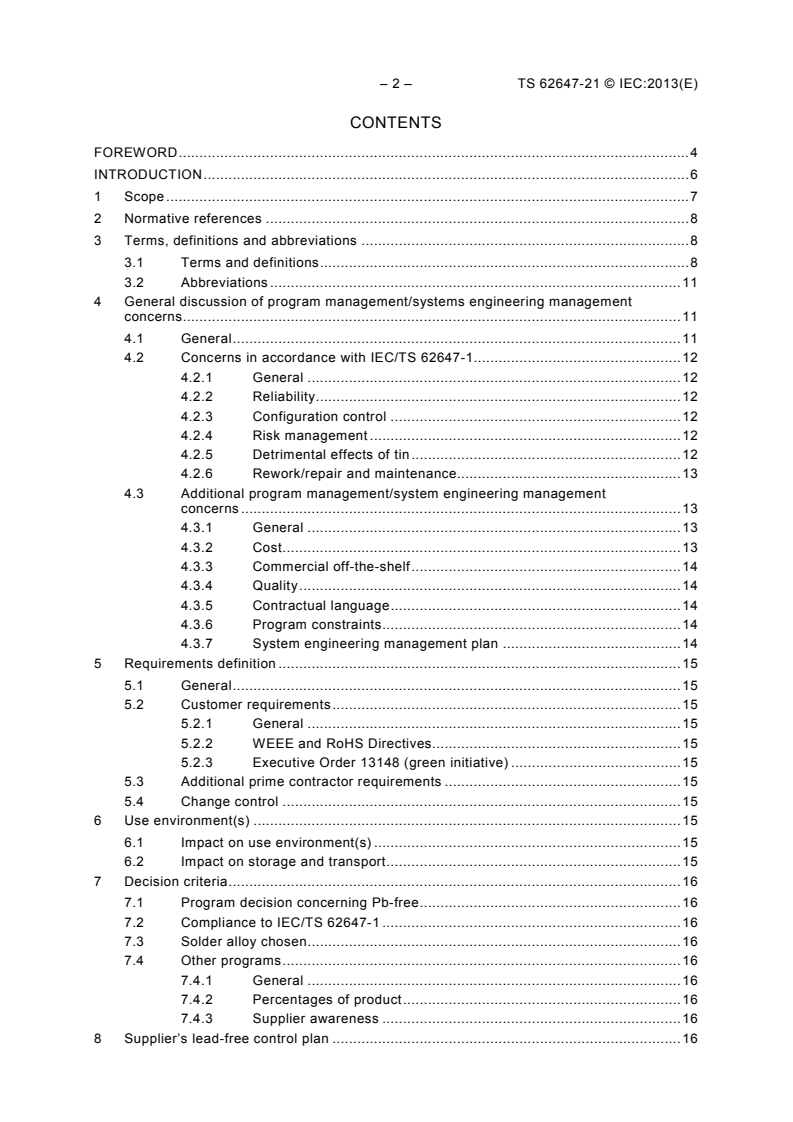
CONTENTS
FOREWORD . 4
INTRODUCTION . 6
1 Scope . 7
2 Normative references . 8
3 Terms, definitions and abbreviations . 8
3.1 Terms and definitions . 8
3.2 Abbreviations . 11
4 General discussion of program management/systems engineering management
concerns. 11
4.1 General . 11
4.2 Concerns in accordance with IEC/TS 62647-1. 12
4.2.1 General . 12
4.2.2 Reliability . 12
4.2.3 Configuration control . 12
4.2.4 Risk management . 12
4.2.5 Detrimental effects of tin . 12
4.2.6 Rework/repair and maintenance. 13
4.3 Additional program management/system engineering management
concerns . 13
4.3.1 General . 13
4.3.2 Cost . 13
4.3.3 Commercial off-the-shelf . 14
4.3.4 Quality . 14
4.3.5 Contractual language . 14
4.3.6 Program constraints . 14
4.3.7 System engineering management plan . 14
5 Requirements definition . 15
5.1 General . 15
5.2 Customer requirements . 15
5.2.1 General . 15
5.2.2 WEEE and RoHS Directives. 15
5.2.3 Executive Order 13148 (green initiative) . 15
5.3 Additional prime contractor requirements . 15
5.4 Change control . 15
6 Use environment(s) . 15
6.1 Impact on use environment(s) . 15
6.2 Impact on storage and transport . 15
7 Decision criteria . 16
7.1 Program decision concerning Pb-free . 16
7.2 Compliance to IEC/TS 62647-1 . 16
7.3 Solder alloy chosen. 16
7.4 Other programs . 16
7.4.1 General . 16
7.4.2 Percentages of product . 16
7.4.3 Supplier awareness . 16
8 Supplier’s lead-free control plan . 16
TS 62647-21 © IEC:2013(E) – 3 –
8.1 General . 16
8.2 Supplier procurement and sub-contractor control . 17
8.2.1 General . 17
8.2.2 Supplier procurement . 17
8.2.3 Supplier sub-contractor control plan . 17
8.3 Productibility plan . 18
8.4 Manufacturing changes . 18
8.5 Manufacturing risk management . 18
8.6 Supplier schedule of Pb-free implementation . 18
9 Requalification/test plan . 18
9.1 General . 18
9.2 Delta qualification or requalification . 18
9.3 Acceptance by analysis/test . 18
9.4 Acceptance by similarity . 19
10 Rework/repair and maintenance . 19
10.1 General . 19
10.2 Supplier recommendations for rework/repair of Pb-free products . 19
10.3 Maintenance and training documentation . 19
11 Risk management . 19
11.1 General . 19
11.2 Program-level identification of program-level risks . 19
11.3 Risk analyses. 19
11.4 Risk mitigation . 19
12 Cost . 19
13 Presentation to customer . 20
13.1 General . 20
13.2 Compliance to IEC/TS 62647-1 . 20
13.3 System engineering management plan . 20
13.4 Other deliverables to the customer . 20
Annex A (informative) Matrix of tier level versus associated risk . 21
Annex B (informative) Links to the European Union Directives and Executive Order
13148 . 23
Annex C (informative) General program manager checklist for dealing with Pb-free
issues . 24
Annex D (informative) General manufacturing process assessment checklist for
assessing supplier compliance to IEC/TS 62647-1 . 26
Annex E (informative) Recommended program language (subject to contractual
agreements) . 33
Bibliography . 34
– 4 – TS 62647-21 © IEC:2013(E)
INTERNATIONAL ELECTROTECHNICAL COMMISSION
____________
PROCESS MANAGEMENT FOR AVIONICS –
AEROSPACE AND DEFENCE ELECTRONIC
SYSTEMS CONTAINING LEAD-FREE SOLDER –
Part 21: Program management –
Systems engineering guidelines for managing
the transition to lead-free electronics
FOREWORD
1) The International Electrotechnical Commission (IEC) is a worldwide organization for standardization comprising
all national electrotechnical committees (IEC National Committees). The object of IEC is to promote
international co-operation on all questions concerning standardization in the electrical and electronic fields. To
this end and in addition to other activities, IEC publishes International Standards, Technical Specifications,
Technical Reports, Publicly Available Specifications (PAS) and Guides (hereafter referred to as “IEC
Publication(s)”). Their preparation is entrusted to technical committees; any IEC National Committee interested
in the subject dealt with may participate in this preparatory work. International, governmental and non-
governmental organizations liaising with the IEC also participate in this preparation. IEC collaborates closely
with the International Organization for Standardization (ISO) in accordance with conditions determined by
agreement between the two organizations.
2) The formal decisions or agreements of IEC on technical matters express, as nearly as possible, an international
consensus of opinion on the relevant subjects since each technical committee has representation from all
interested IEC National Committees.
3) IEC Publications have the form of recommendations for international use and are accepted by IEC National
Committees in that sense. While all reasonable efforts are made to ensure that the technical content of IEC
Publications is accurate, IEC cannot be held responsible for the way in which they are used or for any
misinterpretation by any end user.
4) In order to promote international uniformity, IEC National Committees undertake to apply IEC Publications
transparently to the maximum extent possible in their national and regional publications. Any divergence
between any IEC Publication and the corresponding national or regional publication shall be clearly indicated in
the latter.
5) IEC itself does not provide any attestation of conformity. Independent certification bodies provide conformity
assessment services and, in some areas, access to IEC marks of conformity. IEC is not responsible for any
services carried out by independent certification bodies.
6) All users should ensure that they have the latest edition of this publication.
7) No liability shall attach to IEC or its directors, employees, servants or agents including individual experts and
members of its technical committees and IEC National Committees for any personal injury, property damage or
other damage of any nature whatsoever, whether direct or indirect, or for costs (including legal fees) and
expenses arising out of the publication, use of, or reliance upon, this IEC Publication or any other IEC
Publications.
8) Attention is drawn to the Normative references cited in this publication. Use of the referenced publications is
indispensable for the correct application of this publication.
9) Attention is drawn to the possibility that some of the elements of this IEC Publication may be the subject of
patent rights. IEC shall not be held responsible for identifying any or all such patent rights.
The main task of IEC technical committees is to prepare International Standards. In
exceptional circumstances, a technical committee may propose the publication of a technical
specification when
• the required support cannot be obtained for the publication of an International Standard,
despite repeated efforts, or
• the subject is still under technical development or where, for any other reason, there is the
future but no immediate possibility of an agreement on an International Standard.
Technical specifications are subject to review within three years of publication to decide
whether they can be transformed into International Standards.
TS 62647-21 © IEC:2013(E) – 5 –
IEC/TS 62647-21, which is a technical specification, has been prepared by IEC technical
committee 107: Process management for avionics.
The text of this technical specification is based on the following documents: IEC/PAS 62647-
21 and GEIA-HB-0005-1.
This technical specification cancels and replaces IEC/PAS 62647-21, published in 2011. This
edition constitutes a technical revision.
This edition includes the following significant technical changes with respect to the previous
edition:
a) Coherence with IEC/TS 62647-1 definitions.
b) Reference to IEC 62647 documents when already published.
The text of this technical specification is based on the following documents:
Enquiry draft Report on voting
107/204/DTS 107/215/RVC
Full information on the voting for the approval of this technical specification can be found in
the report on voting indicated in the above table.
This publication has been drafted in accordance with the ISO/IEC Directives, Part 2.
A list of all the parts in the IEC 62647 series, published under the general title Process
management for avionics – Aerospace and defence electronic systems containing lead-free
solder, can be found on the IEC website.
The committee has decided that the contents of this publication will remain unchanged until
the stability date indicated on the IEC web site under "http://webstore.iec.ch" in the data
related to the specific publication. At this date, the publication will be
• transformed into an International standard,
• reconfirmed,
• withdrawn,
• replaced by a revised edition, or
• amended.
A bilingual version of this publication may be issued at a later date.
– 6 – TS 62647-21 © IEC:2013(E)
INTRODUCTION
Due to a variety of real and potential health issues, many constituent materials used in the
production of electronic products have come under scrutiny. The European Union (EU) has
started a process with two directives: 2002/95/EC Restriction of Hazardous Substances
(RoHS) and 2002/96/EC Waste Electrical and Electronic Equipment (WEEE) that restrict or
eliminate the use of various substances in a variety of products that are produced after July
2006. Directive 2011/65/EU on the restriction of the use of certain hazardous substances in
electrical and electronic equipment is an updated / recast version of the Directive 2002/95/EC.
One of the key materials restricted is lead (Pb), which is widely used in electronic solder and
electronic piece part terminations. While these regulations may appear to only affect products
for sale in the EU, due to the reduced market share of the Aerospace, Defence and High
Performance (ADHP) electronics industry, many of the lower tier suppliers have changed their
products because their primary market is consumer electronics. Additionally, several U.S.
states have enacted similar “green” laws and many Asian electronics manufacturers have
recently announced completely green product lines.
Since the ADHP electronics industry is one of the few major industrial sectors that still repair
circuit card assemblies (CCAs) and since Pb-free materials and processes are relatively
immature and poorly understood, an aerospace-wide approach to the transition was deemed
to be highly valuable.
TS 62647-21 © IEC:2013(E) – 7 –
PROCESS MANAGEMENT FOR AVIONICS –
AEROSPACE AND DEFENCE ELECTRONIC
SYSTEMS CONTAINING LEAD-FREE SOLDER –
Part 21: Program management –
Systems engineering guidelines for managing
the transition to lead-free electronics
1 Scope
This part of IEC 62647 is designed to assist program management and/or systems
engineering management in managing the transition to lead-free (Pb-free) electronics to
assure product reliability and performance.
Manufacturers of Aerospace, Defence and High Performance (ADHP) electronics may
inadvertently introduce Pb-free elements (including piece part finish, printed wiring board
(PWB) or printed circuit board (PCB) finish, or assembly solder) if careful coordination
between buyer and supplier is not exercised. For example, piece part manufacturers may not
always change part numbers to identify Pb-free finishes, especially if the previous tin-lead
(Sn-Pb) finished piece part has been discontinued. Detailed examination of piece parts and
documents at receiving inspection, while crucial, may not be sufficient to identify Pb-free
piece parts.
NOTE 1 Pb-free technology can impact any program regardless of whether the program itself is exempt or bound
by environmental regulations. The industry conversion to Pb-free solder technology may affect an ADHP program
in one or both of the following ways:
1) if the program is required to implement Pb-free technology (contract requirement, environmental regulation,
etc), then the program manager/lead systems engineer will need to assess the impact of in-house transition
with respect to design (performance of products using Pb-free) and process (processes to build Pb-free
products);
2) if the program purchases COTS (commercial-off-the-shelf) items for its products/systems, then there is a very
good chance that these items will contain Pb-free solder or Pb-free finishes on parts, printed wiring boards
(PWBs), printed circuit boards (PCB), or circuit cards assemblies (CCA).
The basic principles delineated in this document can be used for program management and/or
systems engineering management of any aerospace and/or high performance program. The
annexes in the document describe tools that can be used in conjunction with this document.
1) Annex A describes a matrix of product tier level versus associated risks with respect to a
Pb-free transition.
2) Annex B contains links to the European Union Directives and Executive Order 13148.
3) Annex C contains a general program manager checklist for dealing with Pb-free issues
that summarizes the content of this document.
4) Annex D contains a general manufacturing process assessment checklist to assess
supplier compliance to IEC/TS 62647-1.
5) Annex E describes a recommended program language to assure performance, reliability,
airworthiness, safety, and certifiability of Pb-free product(s).
This document is designed to assist a program in assuring the performance, reliability,
airworthiness, safety, and certifiability of product(s), in accordance with IEC/TS 62647-1.
Please note that the program manager and systems engineer (along with their respective
organizations), and the appropriate enterprise authority work together in ensuring that all
impacts of Pb-free technology insertion are understood and risks mitigated accordingly.
– 8 – TS 62647-21 © IEC:2013(E)
For the purposes of this document, “program management (or manager) and/or systems
engineering management (or manager) and/or the appropriate enterprise authority” are
defined as “program manager”.
NOTE 2 The implications are that the program manager and systems engineering manager (along with their
respective organizations) and the appropriate enterprise authority work together in ensuring that all impacts of Pb-
free technology insertion are understood and risks mitigated accordingly.
This document may be used by other high performance and high reliability industries at their
discretion.
2 Normative references
The following documents, in whole or in part, are normatively referenced in this document and
are indispensable for its application. For dated references, only the edition cited applies. For
undated references, the latest edition of the referenced document (including any
amendments) applies.
IEC/TS 62647-1:2012, Process management for avionics – Aerospace and defence electronic
systems containing lead free solder – Part 1: Preparation for a lead-free control plan
IEC/TS 62647-2, Process management for avionics – Aerospace and defence electronic
systems containing lead-free solder – Part 2: Mitigation of deleterious effects of tin
3 Terms, definitions and abbreviations
For the purposes of this document, the following terms, definitions and abbreviations apply.
3.1 Terms and definitions
3.1.1
assemblies
electronic items that require electrical attachments, including soldering of wires or component
terminations
EXAMPLE Circuit cards and wire harnesses.
[SOURCE: IEC/TS 62647-1:2012, 3.1]
3.1.2
COTS
commercial-off-the-shelf
item whose design and configuration is controlled by the manufacturer and on which the user
has no control as to design and configuration
Note 1 to entry: An item may be a component, a subassembly, an assembly, a system.
[SOURCE: IEC/TS 62647-1:2012, 3.3]
3.1.3
critical
state of an item or function, which if defective, will result in the system’s inability to retain
operational capability, meet primary objective, or affect safety
[SOURCE: IEC/TS 62647-1:2012, 3.2]
TS 62647-21 © IEC:2013(E) – 9 –
3.1.4
customer
entity or organization that (a) integrates a piece part, soldered assembly, unit, or system into
a higher control level system, (b) operates the higher control level system, or (c) certifies the
system for use
EXAMPLE This may include end item users, integrators, regulatory agencies, operators, original equipment
manufacturers (OEMs), and sub-contractors.
[SOURCE: IEC/TS 62647-1:2012, 3.5]
3.1.5
high performance
continued performance or performance on demand where an application (product, equipment,
electronics, system, program) down time cannot be tolerated in an end-use environment
which can be uncommonly harsh, and the application must function when required
EXAMPLE: Examples of high performance applications are life support or other critical systems.
[SOURCE: IEC/TS 62647-1:2012, 3.7]
3.1.6
lead-free
Pb-free
less than 0,1 % by weight of lead (Pb) in accordance with reduction of hazardous substances
(RoHS) guidelines
[SOURCE: IEC/TS 62647-1:2012, 3.8]
3.1.7
Lead-free control plan
LFCP
aerospace or military system supplier’s document that defines the processes that assure the
Plan owners, their customers and all other stakeholders that aerospace, defence and high
performance high-reliability electronics systems containing Pb-free solder and Pb-free piece
part and PWB finishes will continue to be reliable, safe, producible, affordable, and
supportable
[SOURCE: IEC/TS 62647-1:2012, 3.9]
3.1.8
Pb-free tin
pure tin or any tin alloy with < 3 % lead (Pb) content by weight
Note 1 to entry: Some Pb-free finishes other than pure tin, such as tin-bismuth and tin-copper are considered to
be “tin” for the purposes of this specification. Many of these alloys have not been assessed for whiskering
behaviour.
[SOURCE: IEC/TS 62647-1:2012, 3.11]
3.1.9
Pb-free tin finish
final finishes or underplates either external or internal to a device, board or other hardware,
including all leads and surfaces, even those coated, encapsulated, or otherwise not exposed
Note 1 to entry: It may include finishes on electrical piece parts, mechanical piece parts, and boards. It does not
include Pb-free bulk solders, assembly materials, solder balls, or those devices where the Pb-free tin finish has
been completely replaced (consistent with GEIA-STD-0006).
[SOURCE: IEC/TS 62647-1:2012, 3.12]
– 10 – TS 62647-21 © IEC:2013(E)
3.1.10
PCB
printed circuit board
PWB
printed wiring board
substrate using conductive pathways, tracks or signal traces etched from copper sheets
laminated, and allowing to connect electrically a set of electronic components to realize a
circuit card
3.1.11
piece part
electronic component that is not normally disassembled without destruction and is normally
attached to a printed wiring board to perform an electrical function
[SOURCE: IEC/TS 62647-1:2012, 3.14]
3.1.12
repair
act of restoring the functional capability of a defective article in a manner that precludes
compliance of the article with applicable drawings or specifications
[SOURCE: IEC/TS 62647-1:2012, 3.17]
3.1.13
rework
action taken to return a unit (SRU/LRU/system) to a state meeting all requirements of the
engineering drawing, including both functionality and physical configuration by making repairs
Note 1 to entry: Also used to define the act of reprocessing non-complying articles, through the use of original or
equivalent processing in a manner that assures full compliance of the article with applicable drawings or
specifications.
[SOURCE: IEC/TS 62647-1:2012, 3.16]
3.1.14
sub-contractor
organization, within the given high-reliability industry, that supplies, maintains, repairs, or
supports electronic systems, and is not the direct supplier to the customer or user of those
systems
[SOURCE: IEC/TS 62647-1:2012, 3.22]
3.1.15
supplier
entity or organization that designs, manufactures, repairs, or maintains a piece part, unit, or
system
Note 1 to entry: This includes original equipment manufacturers (OEMs), repair facilities, sub-contractors, and
piece part manufacturers.
[SOURCE: IEC/TS 62647-1:2012, 3.23]
3.1.16
system
one or more units that perform electrical function(s)
[SOURCE: IEC/TS 62647-1:2012, 3.24]
TS 62647-21 © IEC:2013(E) – 11 –
3.1.17
tin whisker
spontaneous crystal growth that emanates from a tin (Sn) surface and which may be
cylindrical, kinked, or twisted
Note 1 to entry: Typically tin whiskers have an aspect ratio (length/width) greater than two, with shorter growths
referred to as nodules or odd-shaped eruptions (OSEs).
[SOURCE: IEC/TS 62647-1:2012, 3.26]
3.1.18
unit
one or more assemblies within a chassis or higher level system to perform electrical
function(s)
[SOURCE: IEC/TS 62647-1:2012, 3.27]
3.2 Abbreviations
ADHP Aerospace, defence and high performance
ATP Acceptance test procedure
CCA Circuit card assembly
COTS Commercial off-the-shelf
ENIG Electroless nickel/gold
EU European Union
FMECA Failure mode effects and criticality analysis
GEIA Government Electronics and Information Technology Association
IR Infra-red
LFCP Lead-free control plan
OEM Original equipment manufacturer
OSP Organic solderability preservative
Pb-free Lead-free
PMP Parts, materials, and processes
PWB Printed wiring board
PCB Printed circuit board
SEMP System engineering management plan
Sn-Pb Tin/lead (e.g. 63 % tin/37 % lead)
4 General discussion of program management/systems engineering
management concerns
4.1 General
A program manager’s role is to be aware of how changes will affect the program, whether the
program is on the system level, unit level, assembly level, or piece part level. The change
from Sn-Pb solder to Pb-free solder will affect all electronics programs, regardless of level or
size. The program manager also needs to understand where Pb-free is being introduced in
the program (piece part finishes only, assembly soldering, etc.). Annex A differentiates the
various tier levels and the associated risk to consider. The concerns described in 4.2 and 4.3
need to be considered for a successful transition.
– 12 – TS 62647-21 © IEC:2013(E)
4.2 Concerns in accordance with IEC/TS 62647-1
4.2.1 General
In accordance with IEC/TS 62647-1, program concerns include reliability, configuration
control, risk management, effects of tin in the system, and rework/repair and maintenance.
4.2.2 Reliability
The program manager should understand how the transition to Pb-free may affect the
reliability of the program. The program manager or a designee should understand the effects
of mixing Sn-Pb and Pb-free solder, the effects on package types/geometry, how Pb-free may
react to the program’s use environment, if units and/or systems will include Sn-Pb and Pb-free
assemblies, piece parts, etc. In addition, the program manager should consider a common
reliability data collection during all phases of the program to facilitate systems performance
improvement.
4.2.3 Configuration control
The need for configuration control is paramount to the Pb-free transition. Studies have shown
that mixing Sn-Pb and Pb-free solders or the mixing of Pb-free solders of different alloys
and/or piece parts (solders or finishes of different alloys) may have detrimental impact on the
long-term reliability under high stress (e.g., defence, commercial aerospace, or space)
environments. The program manager should understand the appropriate configuration
controls (e.g., traceability) that are necessary for the program’s environment. Note that the
program manager shall decide the configuration control measures that shall be taken for the
various levels (i.e., piece part, assembly, unit, system).
The material content of the terminations (component leads) is critical in assuring adequate
reliability and performance of the finished product. The program manager should ensure that
appropriate and demonstrated processes are in place at the suppliers’ that will accurately
identify the material content of piece parts used in soldered assemblies and that the material
content is compatible with the supplier’s soldering processes.
The program manager may require a parts, materials, and processes plan to be in place at
the supplier’s which reflects appropriate quality control procedures. The plan should include
sub-contractor controls that affect the reliability of the end product.
4.2.4 Risk management
Risk identification and risk assessment need to be performed for the Pb-free transition for the
particular environmental conditions of the program. Risks need to be identified early and a
mitigation strategy engaged. The program manager has a responsibility to conduct a complete
risk management plan.
4.2.5 Detrimental effects of tin
Pb-free tin finishes in an avionics or high performance system can have detrimental effects on
functionality of the system as tin whiskers can spontaneously grow from the surfaces. Piece
parts with Pb-free tin finishes have already been introduced into ADHP systems with minimal
understanding of the effects that they will have. Program managers need to have a plan for
either eliminating the use of Pb-free tin in their product, through life-time buys or re-finishing
piece parts, or a plan for addressing and mitigating the risks.
IEC/TS 62647-2 provides standard methods for controlling and mitigating the use of Pb-free
tin finished piece parts. It defines three basic levels, with additional sublevels, for controlling
and mitigating the use of Pb-free tin finishes with accurate regard to tin whiskers. These
levels can be summarized as follows.
Level 1: No restrictions on Pb-free tin finish use.
TS 62647-21 © IEC:2013(E) – 13 –
Level 2: Pb-free tin finish is allowed under some circumstances.
– Level 2A. Use of Pb-free tin finish without explicit controls is acceptable under
most circumstances but the likelihood of whiskers and the methods used to
estimate their impact and mitigation strategies will be documented. Pb-free tin
finish may be prohibited in some specific circumstances called out in
contractual documents.
– Level 2B. Pb-free tin finishes may be used but only with customer approved and
specified control measures. These Pb-free tin finish approvals may be blanket
approvals for multiple piece parts and applications within the system. Pb-free
tin finish may be prohibited in some specific circumstances called out in
contractual documents.
– Level 2C. Restricted use of Pb-free tin finish. Pb-free tin finish is prohibited
unless an exception with customer approval is made. Specific instruction on use
of Pb-free tin finish and required control measures are to be provided and
reviewed on a case-by-case basis.
Level 3: Use of Pb-free tin finish is prohibited and measures shall be taken to verify
compliance.
These levels are designed to be used in requests for proposals and control documents. The
customers should determine the appropriate control level or levels for their product, based on
criticality, their comfort with the risk, and other mitigating features of their program, such as
redundancy and repairability. For many larger programs, different subsystems or units may
need different control levels that can be based on customer and supplier discussions and
agreement regarding both application and supplier mitigation solution knowledge.
In most cases, it would be appropriate for OEMs to have general policies that aid in the
selection of the appropriate control level. Program managers should work with their
companies to develop the policy to aid in consistent requirements across programs.
Program managers also need to be prepared for handling errors in finish determination or
mitigation application. This may simply be a variation in the program's normal process waiver
process or may require a more in-depth risk assessment, depending on the criticality level.
4.2.6 Rework/repair and maintenance
Rework/repair and maintenance becomes a concern if Sn-Pb and Pb-free solders and/or piece
parts are used on the same assemblies. As stated before, studies have shown that reliability
of the joints/junctions of mixed lead and Pb-free solder may decrease in high stress
environments. A program manager should make the customer aware of the higher risks
associated with field rework/repair and maintenance when standard solder materials (i.e.
60 % tin/40 % lead or 63 % tin/37 % lead) are used on Pb-free assemblies and/or piece parts.
4.3 Additional program management/system engineering management concerns
4.3.1 General
The program manager also has additional concerns from a programmatic point of view. These
include cost, parts obsolescence, COTS, quality, contract language, other existing program
constraints, and updating of the program system engineering management plan (SEMP).
Other concerns can be addressed based on specific program needs.
4.3.2 Cost
The costs of the Pb-free transition need to be quantified and decisions need to be made as to
who will assume the costs. The program manager should be aware that the situation is likely
to be dynamic over the next several years. Added costs may come from additional risk
management determination, configuration controls, rework/repair and maintenance changes,
drawing changes, possible redesign, requalifying/delta qualifying, etc.
– 14 – TS 62647-21 © IEC:2013(E)
4.3.3 Commercial off-the-shelf
4.3.3.1 General
Commercial-off-the-shelf (COTS) is always a critical concern for a program manager. The
very nature of COTS may allow Pb-free substitution irrespective of program requirements.
4.3.3.2 COTS piece parts and parts obsolescence or COTS piece parts
The supplier may request substitution of Pb-free finished piece parts on a program. This
occurs not only because of the piece part supplier obsolescing standard Sn-Pb-finishes, but
also due to a COTS piece part substitution. The program manager or a designee should have
controls in place and understand IEC/TS 62647-2, to mitigate the risks associated with Pb-
free finished piece parts and COTS. The program manager needs to ensure that the parts,
materials, and processes (PMP) control plan for the program is updated and addresses how
lead-free piece parts will be identified and tracked. If a PMP control plan is not available for
the program, the program manager should ensure that the PMP functional group is aware of
each parts substitution and is adequately addressing the issue of lead-free piece parts.
4.3.3.3 COTS assemblies
The product may contain COTS assemblies, as well. The program manager should be aware
of the possible risks due to COTS assemblies containing either Pb-free piece parts and/or Pb-
free soldered assemblies. The program manager needs to ensure that the parts, materials,
and processes (PMP) control plan for the program is updated and addresses how lead-free
assemblies will be identified and tracked. If a PMP control plan is not available for the
program, the program manager should ensure that the PMP functional group is aware of each
parts substitution and is adequately addressing the issue of lead-free assemblies.
4.3.4 Quality
Quality is a critical consideration in the transition to Pb-free and the program manager needs
to be assured that the final product meets the technical and operational requirements with the
specified reliability at all levels. This includes the flow of requirements, implementation and
documentation through and to sub-contractors.
4.3.5 Contractual language
Appropriate contractual language needs to be included in new contracts that describe the
customer requirements regarding Pb-free parts. An example contractual language is included
in Annex E.
4.3.6 Program constraints
The program manager needs to be proactive in understanding all of the impacts to the
program schedule (including all integrated master schedule line items). Consideration needs
to be particularly paid to changes in the delivery schedule due to requalification/delta
qualification of Pb-free parts and additional reliability testing. Also, if risk mitigation plans
include lifetime buys of long-lead Sn-Pb-finish parts (due to obsolescence), the updated
schedule needs to reflect the changes appropriately.
4.3.7 System engineering management plan
The program manager should reassess the program’s system engineering management plan,
if one exists, and update to include the Pb-free transition controls for the program.
TS 62647-21 © IEC:2013(E) – 15 –
5 Requirements definition
5.1 General
A re-evaluation of the program requirements should be performed to determine the impact of
the Pb-free transition.
5.2 Customer requirements
5.2.1 General
The program manager should include all of the Pb-free transitions in a thorough risk
assessment/mitigation plan and present it to the customer. The purpose of the plan is to help
the customer understand the risks associated with the transition.
5.2.2 WEEE and RoHS Directives
The program manager should understand the implications of the WEEE and RoHS Directives
(Annex B).
5.2.3 Executive Order 13148 (green initiative)
Even though this generally applies only to facility operations issues, weapon system
maintenance by the customer may come under this category. The program manager should
be aware of the customer’s requirements in this area (Annex B).
5.3 Additional prime contractor requirements
Additional prime contractor requirements need to be re-assessed with regard to a possible
Pb-free transition.
5.4 Change control
The program manager should determine if any change from Sn-Pb to Pb-free constitutes a
change for which customer approval is needed. The purpose is to assure that configuration
control, traceability, and marking are properly controlled.
6 Use environment(s)
6.1 Impact on use environment(s)
The use environment(s) is(are) defined by the program requirements. The program manager
needs assurance from the supplier that the tr
...