

IEC 62087-6:2015
(Main)Audio, video, and related equipment - Determination of power consumption - Part 6: Audio equipment
General Information
- Abstract
IEC 62087-6:2015 specifies the determination of the power consumption of audio equipment for consumer use. The various modes of operation which are relevant for measuring power consumption are defined. This first edition of IEC 62087-6 cancels and replaces Clause 9 of IEC 62087:2011. This standard together with IEC 62087-1 to IEC 62087-5 cancels and replaces IEC 62087:2011. This International Standard constitutes a technical revision. This edition includes the following significant technical changes with respect to Clause 9 of IEC 62087:2011. The definition of the input signal is changed. The output power measurement of amplifiers is changed. The measurement method for compact audio systems including loudspeakers is added. Methods for measuring On-decoding, idle and auto power down functions are added. Portions of the document related to general measuring conditions and procedures are now contained in IEC 62087-1:2015. Portions of the document related to signals and media are now in IEC 62087-2:2015. The titles have changed in order to comply with the current directives and to accommodate the new multipart structure of IEC 62087.
- Status
- Published
- Publication Date
- 04-Jun-2015
- Drafting Committee
- MT 62087 - TC 100/TA 19/MT 62087
- Current Stage
- PPUB - Publication issued
- Start Date
- 05-Jun-2015
- Completion Date
- 15-Jun-2015
Buy Documents
IEC 62087-6:2015 - Audio, video, and related equipment - Determination of power consumption - Part 6: Audio equipment Released:6/5/2015
IEC 62087-6:2015 - Audio, video, and related equipment - Determination of power consumption - Part 6: Audio equipment Released:1/26/2021
Overview
IEC 62087-6:2015 - part of the IEC 62087 series - defines standardized methods for the determination of power consumption of audio equipment intended for mains connection. This first edition (Part 6) replaces Clause 9 of IEC 62087:2011 and focuses on consumer audio products, including separable components, integrated systems and compact audio systems including loudspeakers. The document specifies relevant operating modes (On, On-play, On-decoding, idle, Partial On, Off) and introduces test methods for auto power down behaviour, amplifier output power measurement and the updated input-signal definition. General measuring conditions and signal definitions are handled in IEC 62087-1 and IEC 62087-2 respectively.
Key Topics
- Scope: Measurement methods for mains-powered audio equipment; devices with non-removable main batteries are excluded.
- Operating modes: Clear definitions for On (with sub-modes On-play, On-decoding), Partial On, idle, Off and Auto power down - enabling consistent measurement across products.
- Measurement conditions: Requirements for power source, environmental and acoustical conditions, control adjustments, loading of terminals and required measurement accuracy.
- Signal & output level requirements: Updated input-signal definition and output-level criteria (examples include reference levels such as 1 W or fractions of rated power) for amplifier power measurements.
- Compact system method: New procedures for integrated amplifiers and sources within a single enclosure, including systems with attached/separable loudspeakers.
- Measurement procedure: Order of measurements, setup for separate and non-separable components, sound pressure testing locations, and handling of additional functions and auxiliary batteries.
- Auto power down and additional functions: Procedures to measure idle and auto-off performance to reflect real-world energy use.
Applications
- Manufacturers and design teams use IEC 62087-6:2015 to quantify and reduce power consumption during design validation and energy-optimization of audio products.
- Test laboratories and QA teams use the standard for repeatable power measurement and reporting for product datasheets.
- Regulators and energy-labeling programs rely on these methods to verify compliance with efficiency and standby-power limits.
- Product managers and compliance engineers use the standard to assess auto power down, idle behaviour and amplifier output characteristics that affect energy ratings and user experience.
Related Standards (if applicable)
- IEC 62087-1:2015 - General measuring conditions and procedures
- IEC 62087-2:2015 - Signals and media
- Other parts in the IEC 62087 series (Parts 3–5) covering TVs, video recorders and set-top boxes
- IEC 62301 - Measurement of standby power
- IEC 60268-5 - Loudspeaker measurement guidance
Using IEC 62087-6:2015 ensures consistent, internationally recognized measurement of audio equipment energy use - essential for product compliance, energy labeling and low-power design.
Buy Documents
IEC 62087-6:2015 - Audio, video, and related equipment - Determination of power consumption - Part 6: Audio equipment Released:6/5/2015
IEC 62087-6:2015 - Audio, video, and related equipment - Determination of power consumption - Part 6: Audio equipment Released:1/26/2021
Get Certified
Connect with accredited certification bodies for this standard

ANCE
Mexican certification and testing association.

Intertek Slovenia
Intertek testing, inspection, and certification services in Slovenia.

LNE (Laboratoire National de Métrologie et d'Essais)
French national laboratory for metrology and testing.
Sponsored listings
Frequently Asked Questions
IEC 62087-6:2015 is a standard published by the International Electrotechnical Commission (IEC). Its full title is "Audio, video, and related equipment - Determination of power consumption - Part 6: Audio equipment". This standard covers: IEC 62087-6:2015 specifies the determination of the power consumption of audio equipment for consumer use. The various modes of operation which are relevant for measuring power consumption are defined. This first edition of IEC 62087-6 cancels and replaces Clause 9 of IEC 62087:2011. This standard together with IEC 62087-1 to IEC 62087-5 cancels and replaces IEC 62087:2011. This International Standard constitutes a technical revision. This edition includes the following significant technical changes with respect to Clause 9 of IEC 62087:2011. The definition of the input signal is changed. The output power measurement of amplifiers is changed. The measurement method for compact audio systems including loudspeakers is added. Methods for measuring On-decoding, idle and auto power down functions are added. Portions of the document related to general measuring conditions and procedures are now contained in IEC 62087-1:2015. Portions of the document related to signals and media are now in IEC 62087-2:2015. The titles have changed in order to comply with the current directives and to accommodate the new multipart structure of IEC 62087.
IEC 62087-6:2015 specifies the determination of the power consumption of audio equipment for consumer use. The various modes of operation which are relevant for measuring power consumption are defined. This first edition of IEC 62087-6 cancels and replaces Clause 9 of IEC 62087:2011. This standard together with IEC 62087-1 to IEC 62087-5 cancels and replaces IEC 62087:2011. This International Standard constitutes a technical revision. This edition includes the following significant technical changes with respect to Clause 9 of IEC 62087:2011. The definition of the input signal is changed. The output power measurement of amplifiers is changed. The measurement method for compact audio systems including loudspeakers is added. Methods for measuring On-decoding, idle and auto power down functions are added. Portions of the document related to general measuring conditions and procedures are now contained in IEC 62087-1:2015. Portions of the document related to signals and media are now in IEC 62087-2:2015. The titles have changed in order to comply with the current directives and to accommodate the new multipart structure of IEC 62087.
IEC 62087-6:2015 is classified under the following ICS (International Classification for Standards) categories: 33.160.10 - Amplifiers. The ICS classification helps identify the subject area and facilitates finding related standards.
IEC 62087-6:2015 is available in PDF format for immediate download after purchase. The document can be added to your cart and obtained through the secure checkout process. Digital delivery ensures instant access to the complete standard document.
Standards Content (Sample)
IEC 62087-6 ®
Edition 1.0 2015-06
INTERNATIONAL
STANDARD
colour
inside
Audio, video and related equipment – Determination of power consumption –
Part 6: Audio equipment
All rights reserved. Unless otherwise specified, no part of this publication may be reproduced or utilized in any form
or by any means, electronic or mechanical, including photocopying and microfilm, without permission in writing from
either IEC or IEC's member National Committee in the country of the requester. If you have any questions about IEC
copyright or have an enquiry about obtaining additional rights to this publication, please contact the address below or
your local IEC member National Committee for further information.
IEC Central Office Tel.: +41 22 919 02 11
3, rue de Varembé Fax: +41 22 919 03 00
CH-1211 Geneva 20 info@iec.ch
Switzerland www.iec.ch
About the IEC
The International Electrotechnical Commission (IEC) is the leading global organization that prepares and publishes
International Standards for all electrical, electronic and related technologies.
About IEC publications
The technical content of IEC publications is kept under constant review by the IEC. Please make sure that you have the
latest edition, a corrigenda or an amendment might have been published.
IEC Catalogue - webstore.iec.ch/catalogue Electropedia - www.electropedia.org
The stand-alone application for consulting the entire The world's leading online dictionary of electronic and
bibliographical information on IEC International Standards, electrical terms containing more than 30 000 terms and
Technical Specifications, Technical Reports and other definitions in English and French, with equivalent terms in 15
documents. Available for PC, Mac OS, Android Tablets and additional languages. Also known as the International
iPad. Electrotechnical Vocabulary (IEV) online.
IEC publications search - www.iec.ch/searchpub IEC Glossary - std.iec.ch/glossary
The advanced search enables to find IEC publications by a More than 60 000 electrotechnical terminology entries in
variety of criteria (reference number, text, technical English and French extracted from the Terms and Definitions
committee,…). It also gives information on projects, replaced clause of IEC publications issued since 2002. Some entries
and withdrawn publications. have been collected from earlier publications of IEC TC 37,
77, 86 and CISPR.
IEC Just Published - webstore.iec.ch/justpublished
Stay up to date on all new IEC publications. Just Published IEC Customer Service Centre - webstore.iec.ch/csc
details all new publications released. Available online and If you wish to give us your feedback on this publication or
also once a month by email. need further assistance, please contact the Customer Service
Centre: csc@iec.ch.
IEC 62087-6 ®
Edition 1.0 2015-06
INTERNATIONAL
STANDARD
colour
inside
Audio, video and related equipment – Determination of power consumption –
Part 6: Audio equipment
INTERNATIONAL
ELECTROTECHNICAL
COMMISSION
ICS 33.160.10 ISBN 978-2-8322-2686-5
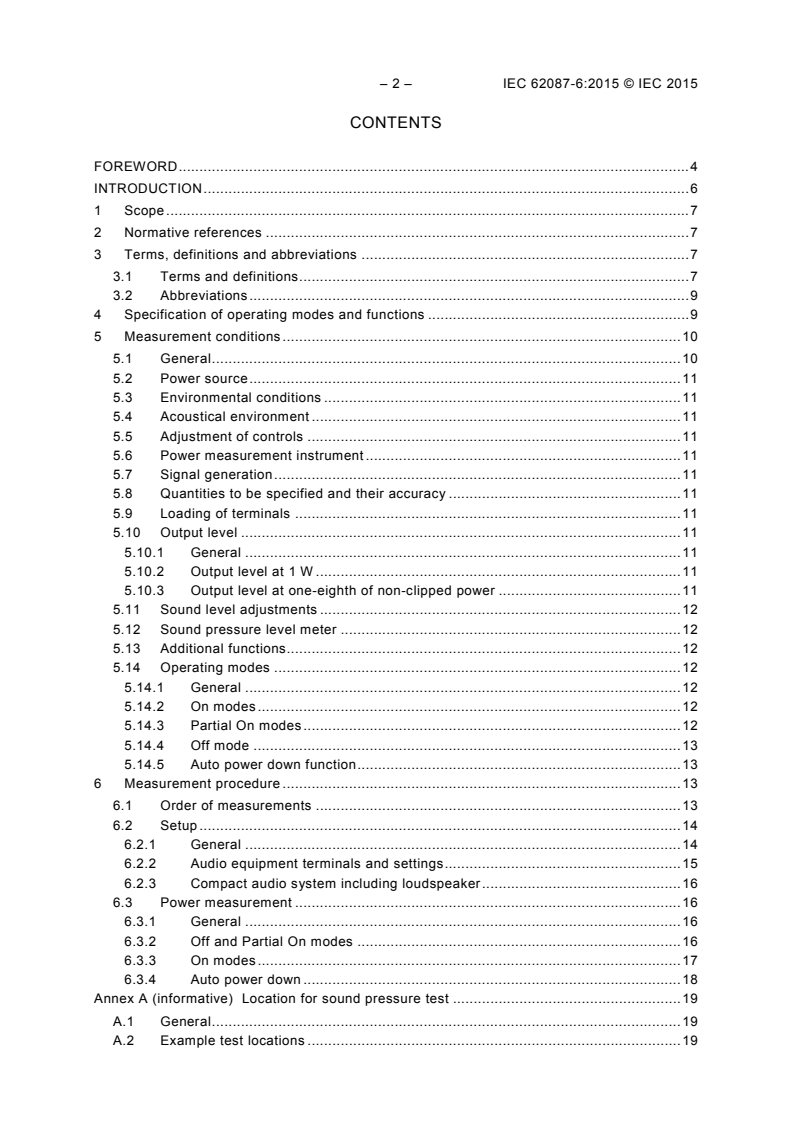
– 2 – IEC 62087-6:2015 © IEC 2015
CONTENTS
FOREWORD . 4
INTRODUCTION . 6
1 Scope . 7
2 Normative references . 7
3 Terms, definitions and abbreviations . 7
3.1 Terms and definitions . 7
3.2 Abbreviations . 9
4 Specification of operating modes and functions . 9
5 Measurement conditions . 10
5.1 General . 10
5.2 Power source . 11
5.3 Environmental conditions . 11
5.4 Acoustical environment . 11
5.5 Adjustment of controls . 11
5.6 Power measurement instrument . 11
5.7 Signal generation . 11
5.8 Quantities to be specified and their accuracy . 11
5.9 Loading of terminals . 11
5.10 Output level . 11
5.10.1 General . 11
5.10.2 Output level at 1 W . 11
5.10.3 Output level at one-eighth of non-clipped power . 11
5.11 Sound level adjustments . 12
5.12 Sound pressure level meter . 12
5.13 Additional functions . 12
5.14 Operating modes . 12
5.14.1 General . 12
5.14.2 On modes . 12
5.14.3 Partial On modes . 12
5.14.4 Off mode . 13
5.14.5 Auto power down function . 13
6 Measurement procedure . 13
6.1 Order of measurements . 13
6.2 Setup . 14
6.2.1 General . 14
6.2.2 Audio equipment terminals and settings . 15
6.2.3 Compact audio system including loudspeaker . 16
6.3 Power measurement . 16
6.3.1 General . 16
6.3.2 Off and Partial On modes . 16
6.3.3 On modes . 17
6.3.4 Auto power down . 18
Annex A (informative) Location for sound pressure test . 19
A.1 General . 19
A.2 Example test locations . 19
Bibliography . 21
Figure 1 – Order of measurements . 14
Figure 2 – Separate components . 14
Figure 3 – Audio systems (non separable components) . 15
Figure 4 – Audio systems (separable conponents) . 15
Figure 5 – Compact audio system including loudspeaker . 15
Figure 6 – Auto power down function . 18
Figure A.1 – Top view . 19
Figure A.2 – Top and front view . 20
Figure A.3 – Side view . 20
Table 1 – Operating modes and functions . 10
– 4 – IEC 62087-6:2015 © IEC 2015
INTERNATIONAL ELECTROTECHNICAL COMMISSION
____________
AUDIO, VIDEO AND RELATED EQUIPMENT –
DETERMINATION OF POWER CONSUMPTION –
Part 6: Audio equipment
FOREWORD
1) The International Electrotechnical Commission (IEC) is a worldwide organization for standardization comprising
all national electrotechnical committees (IEC National Committees). The object of IEC is to promote
international co-operation on all questions concerning standardization in the electrical and electronic fields. To
this end and in addition to other activities, IEC publishes International Standards, Technical Specifications,
Technical Reports, Publicly Available Specifications (PAS) and Guides (hereafter referred to as “IEC
Publication(s)”). Their preparation is entrusted to technical committees; any IEC National Committee interested
in the subject dealt with may participate in this preparatory work. International, governmental and non-
governmental organizations liaising with the IEC also participate in this preparation. IEC collaborates closely
with the International Organization for Standardization (ISO) in accordance with conditions determined by
agreement between the two organizations.
2) The formal decisions or agreements of IEC on technical matters express, as nearly as possible, an international
consensus of opinion on the relevant subjects since each technical committee has representation from all
interested IEC National Committees.
3) IEC Publications have the form of recommendations for international use and are accepted by IEC National
Committees in that sense. While all reasonable efforts are made to ensure that the technical content of IEC
Publications is accurate, IEC cannot be held responsible for the way in which they are used or for any
misinterpretation by any end user.
4) In order to promote international uniformity, IEC National Committees undertake to apply IEC Publications
transparently to the maximum extent possible in their national and regional publications. Any divergence
between any IEC Publication and the corresponding national or regional publication shall be clearly indicated in
the latter.
5) IEC itself does not provide any attestation of conformity. Independent certification bodies provide conformity
assessment services and, in some areas, access to IEC marks of conformity. IEC is not responsible for any
services carried out by independent certification bodies.
6) All users should ensure that they have the latest edition of this publication.
7) No liability shall attach to IEC or its directors, employees, servants or agents including individual experts and
members of its technical committees and IEC National Committees for any personal injury, property damage or
other damage of any nature whatsoever, whether direct or indirect, or for costs (including legal fees) and
expenses arising out of the publication, use of, or reliance upon, this IEC Publication or any other IEC
Publications.
8) Attention is drawn to the Normative references cited in this publication. Use of the referenced publications is
indispensable for the correct application of this publication.
9) Attention is drawn to the possibility that some of the elements of this IEC Publication may be the subject of
patent rights. IEC shall not be held responsible for identifying any or all such patent rights.
International Standard IEC 62087-6 has been prepared by technical area 12: AV energy
efficiency and smart grid applications, of IEC technical committee 100: Audio, video and
multimedia systems and equipment.
This first edition of IEC 62087-6 cancels and replaces Clause 9 of IEC 62087:2011. This
standard together with IEC 62087-1 to IEC 62087-5 cancels and replaces IEC 62087:2011.
This International Standard constitutes a technical revision.
This edition includes the following significant technical changes with respect to Clause 9 of
IEC 62087:2011.
– The definition of the input signal is changed.
– The output power measurement of amplifiers is changed.
– The measurement method for compact audio systems including loudspeakers is added.
– Methods for measuring On-decoding, idle and auto power down functions are added.
– Portions of the document related to general measuring conditions and procedures are now
contained in IEC 62087-1:2015.
– Portions of the document related to signals and media are now in IEC 62087-2:2015.
– The titles have changed in order to comply with the current directives and to accommodate
the new multipart structure of IEC 62087.
The text of this standard is based on the following documents:
FDIS Report on voting
100/2471/FDIS 100/2501/RVD
Full information on the voting for the approval of this standard can be found in the report on
voting indicated in the above table.
A list of all parts in the IEC 62087 series, published under the general title Audio, video, and
related equipment – Determination of power consumption, can be found on the IEC website.
This publication has been drafted in accordance with the ISO/IEC Directives, Part 2.
The committee has decided that the contents of this publication will remain unchanged until
the stability date indicated on the IEC website under "http://webstore.iec.ch" in the data
related to the specific publication. At this date, the publication will be
• reconfirmed,
• withdrawn,
• replaced by a revised edition, or
• amended.
A bilingual version of this publication may be issued at a later date.
– 6 – IEC 62087-6:2015 © IEC 2015
INTRODUCTION
This part of IEC 62087 specifies methods of measurements for the power consumption of
audio equipment for consumer use. It is used in conjunction with IEC 62087-2, which specifies
signals and media. This International Standard includes measurements in the On mode
(operation), which was previously identified as “On (average) mode” and adds methods for
measuring power consumption in the On-play, On-decoding, and idle sub-modes. These
methods consider the effects of the auto power down function. Additionally, this standard
includes determination of power consumption in the Partial On mode.
This standard has been divided into multiple parts. At the time of publication of this part, the
following parts are planned or published.
– Part 1: General
– Part 2: Signals and media
– Part 3: Television sets
– Part 4: Video recording equipment
– Part 5: Set-top boxes (STB)
– Part 6: Audio equipment
AUDIO, VIDEO AND RELATED EQUIPMENT –
DETERMINATION OF POWER CONSUMPTION –
Part 6: Audio equipment
1 Scope
This part of IEC 62087 specifies the determination of the power consumption of audio
equipment for consumer use.
The various modes of operation which are relevant for measuring power consumption are
defined.
This standard is limited to audio equipment which can be connected to the mains. Audio
equipment that includes a non-removable, main battery is not covered by this standard. Audio
equipment may include any number of auxiliary batteries.
The measuring conditions in this standard represent the normal use of the equipment and
may differ from other specific conditions, for example as specified in safety standards.
2 Normative references
The following documents, in whole or in part, are normatively referenced in this document and
are indispensable for its application. For dated references, only the edition cited applies. For
undated references, the latest edition of the referenced document (including any
amendments) applies.
IEC 60268-5:2003, Sound system equipment – Part 5: Loudspeakers
IEC 60268-5:2003/AMD1:2007
IEC 62087-1:2015, Audio, video, and related equipment – Determination of power
consumption – Part 1: General
IEC 62087-2:2015, Audio, video, and related equipment – Determination of power
consumption – Part 2: Signals and media
IEC 62301:2011, Household electrical appliances − Measurement of standby power
3 Terms, definitions and abbreviations
3.1 Terms and definitions
For the purposes of this document, the terms and definitions in IEC 62087-1:2015,
IEC 62087-2:2015, and the following apply.
3.1.1
additional functions
functions that are not required for the basic operation of the device
Note 1 to entry: Functions other than a main function.
– 8 – IEC 62087-6:2015 © IEC 2015
3.1.2
audio equipment
appliance which has the main function of reproducing analogue and/or digital audio signals
3.1.3
audio systems
audio equipment of separable or non-separable components for one or more audio functions
3.1.4
compact audio systems including loudspeakers
amplifier and one or more audio sources in a single enclosure, which might also contain the
loudspeakers
Note 1 to entry: The loudspeakers can be attached to, and separable from, the main enclosure.
3.1.5
free-field conditions
environment, such as an anechoic room, in which the sound pressure decreases by a factor of
2 with the doubling of the distance from a point source
3.1.6
main function
function, specified by the manufacturer, which produces sound from loudspeaker(s) and/or
output terminal(s)
3.1.7
mass storage device
non-removable, non-volatile storage for the recording of audio signals
3.1.8
multi-channel
two or more channels
3.1.9
non-clipped power
sine-wave power dissipated in the rated load impedance, measured at 1 000 Hz or the
frequency of the peak response, if the operation at 1 kHz is not intended, at the onset of
clipping at either one or both peaks
3.1.10
rated load impedance
impedance specified by the manufacturer and assumed to be a constant pure resistance
measured at the output terminals of an amplifier
3.1.11
separate components
standalone audio equipment that provides one or more audio functions
3.1.12
sound pressure level
SPL
logarithm of the ratio of a given sound pressure to the reference sound pressure
Note 1 to entry: Unless otherwise specified, the reference sound pressure is 20 µPа for airborne sound.
Note 2 to entry: Unless otherwise specified, the sound pressures are understood to be expressed in root-mean-
square values.
Note 3 to entry: Sound pressure level in decibels is 20 times the logarithm to the base ten of the ratio.
3.1.13
surround sound equipment
multi-channel audio equipment that includes front and rear channel capabilities
EXAMPLE Home theatre in a box, integrated surround sound amplifier.
3.2 Abbreviations
′ Prime
PS Power Supply unit
SPL Sound Pressure Level
SW Switch unit
UUT Unit Under Test
4 Specification of operating modes and functions
Table 1 describes the various operating modes and functions for audio equipment.
For all modes, main batteries, if any, shall be removed for the duration of the measurement
procedure. (See IEC 62087-1:2015, 5.1.1.1)
– 10 – IEC 62087-6:2015 © IEC 2015
Table 1 – Operating modes and functions
Power Mode Sub-mode Function(s) Description
0 W Disconnected Disconnected – Disconnected from The audio equipment is
the main power disconnected or galvanically
source isolated from all external power
sources.
≥0 W Off Off – Off The audio equipment is connected
to a
...
IEC 62087-6 ®
Edition 1.0 2015-06
INTERNATIONAL
STANDARD
NORME
INTERNATIONALE
Audio, video and related equipment – Determination of power consumption –
Part 6: Audio equipment
Appareils audio, vidéo et matériel connexe – Détermination de la consommation
de puissance –
Partie 6: Matériel audio
All rights reserved. Unless otherwise specified, no part of this publication may be reproduced or utilized in any form
or by any means, electronic or mechanical, including photocopying and microfilm, without permission in writing from
either IEC or IEC's member National Committee in the country of the requester. If you have any questions about IEC
copyright or have an enquiry about obtaining additional rights to this publication, please contact the address below or
your local IEC member National Committee for further information.
Droits de reproduction réservés. Sauf indication contraire, aucune partie de cette publication ne peut être reproduite
ni utilisée sous quelque forme que ce soit et par aucun procédé, électronique ou mécanique, y compris la photocopie
et les microfilms, sans l'accord écrit de l'IEC ou du Comité national de l'IEC du pays du demandeur. Si vous avez des
questions sur le copyright de l'IEC ou si vous désirez obtenir des droits supplémentaires sur cette publication, utilisez
les coordonnées ci-après ou contactez le Comité national de l'IEC de votre pays de résidence.
IEC Central Office Tel.: +41 22 919 02 11
3, rue de Varembé info@iec.ch
CH-1211 Geneva 20 www.iec.ch
Switzerland
About the IEC
The International Electrotechnical Commission (IEC) is the leading global organization that prepares and publishes
International Standards for all electrical, electronic and related technologies.
About IEC publications
The technical content of IEC publications is kept under constant review by the IEC. Please make sure that you have the
latest edition, a corrigendum or an amendment might have been published.
IEC publications search - webstore.iec.ch/advsearchform IEC online collection - oc.iec.ch
The advanced search enables to find IEC publications by a Discover our powerful search engine and read freely all the
variety of criteria (reference number, text, technical publications previews. With a subscription you will always
committee, …). It also gives information on projects, replaced have access to up to date content tailored to your needs.
and withdrawn publications.
Electropedia - www.electropedia.org
IEC Just Published - webstore.iec.ch/justpublished
The world's leading online dictionary on electrotechnology,
Stay up to date on all new IEC publications. Just Published
containing more than 22 000 terminological entries in English
details all new publications released. Available online and
and French, with equivalent terms in 18 additional languages.
once a month by email.
Also known as the International Electrotechnical Vocabulary
(IEV) online.
IEC Customer Service Centre - webstore.iec.ch/csc
If you wish to give us your feedback on this publication or
need further assistance, please contact the Customer Service
Centre: sales@iec.ch.
A propos de l'IEC
La Commission Electrotechnique Internationale (IEC) est la première organisation mondiale qui élabore et publie des
Normes internationales pour tout ce qui a trait à l'électricité, à l'électronique et aux technologies apparentées.
A propos des publications IEC
Le contenu technique des publications IEC est constamment revu. Veuillez vous assurer que vous possédez l’édition la
plus récente, un corrigendum ou amendement peut avoir été publié.
Recherche de publications IEC - IEC online collection - oc.iec.ch
webstore.iec.ch/advsearchform Découvrez notre puissant moteur de recherche et consultez
La recherche avancée permet de trouver des publications IEC gratuitement tous les aperçus des publications. Avec un
en utilisant différents critères (numéro de référence, texte, abonnement, vous aurez toujours accès à un contenu à jour
comité d’études, …). Elle donne aussi des informations sur adapté à vos besoins.
les projets et les publications remplacées ou retirées.
Electropedia - www.electropedia.org
IEC Just Published - webstore.iec.ch/justpublished
Le premier dictionnaire d'électrotechnologie en ligne au
Restez informé sur les nouvelles publications IEC. Just
monde, avec plus de 22 000 articles terminologiques en
Published détaille les nouvelles publications parues.
anglais et en français, ainsi que les termes équivalents dans
Disponible en ligne et une fois par mois par email.
16 langues additionnelles. Egalement appelé Vocabulaire
Electrotechnique International (IEV) en ligne.
Service Clients - webstore.iec.ch/csc
Si vous désirez nous donner des commentaires sur cette
publication ou si vous avez des questions contactez-nous:
sales@iec.ch.
IEC 62087-6 ®
Edition 1.0 2015-06
INTERNATIONAL
STANDARD
NORME
INTERNATIONALE
Audio, video and related equipment – Determination of power consumption –
Part 6: Audio equipment
Appareils audio, vidéo et matériel connexe – Détermination de la consommation
de puissance –
Partie 6: Matériel audio
INTERNATIONAL
ELECTROTECHNICAL
COMMISSION
COMMISSION
ELECTROTECHNIQUE
INTERNATIONALE
ICS 33.160.10 ISBN 978-2-8322-9332-4
– 2 – IEC 62087-6:2015 © IEC 2015
CONTENTS
FOREWORD . 4
INTRODUCTION . 6
1 Scope . 7
2 Normative references . 7
3 Terms, definitions and abbreviations . 7
3.1 Terms and definitions . 7
3.2 Abbreviations . 9
4 Specification of operating modes and functions . 9
5 Measurement conditions . 10
5.1 General . 10
5.2 Power source . 11
5.3 Environmental conditions . 11
5.4 Acoustical environment . 11
5.5 Adjustment of controls . 11
5.6 Power measurement instrument . 11
5.7 Signal generation . 11
5.8 Quantities to be specified and their accuracy . 11
5.9 Loading of terminals . 11
5.10 Output level . 11
5.10.1 General . 11
5.10.2 Output level at 1 W . 11
5.10.3 Output level at one-eighth of non-clipped power . 11
5.11 Sound level adjustments . 12
5.12 Sound pressure level meter . 12
5.13 Additional functions . 12
5.14 Operating modes . 12
5.14.1 General . 12
5.14.2 On modes . 12
5.14.3 Partial On modes . 12
5.14.4 Off mode . 13
5.14.5 Auto power down function . 13
6 Measurement procedure . 13
6.1 Order of measurements . 13
6.2 Setup . 14
6.2.1 General . 14
6.2.2 Audio equipment terminals and settings . 15
6.2.3 Compact audio system including loudspeaker . 16
6.3 Power measurement . 16
6.3.1 General . 16
6.3.2 Off and Partial On modes . 16
6.3.3 On modes . 17
6.3.4 Auto power down . 18
Annex A (informative) Location for sound pressure test . 19
A.1 General . 19
A.2 Example test locations . 19
Bibliography . 21
Figure 1 – Order of measurements . 14
Figure 2 – Separate components . 14
Figure 3 – Audio systems (non separable components) . 15
Figure 4 – Audio systems (separable conponents) . 15
Figure 5 – Compact audio system including loudspeaker . 15
Figure 6 – Auto power down function . 18
Figure A.1 – Top view . 19
Figure A.2 – Top and front view . 20
Figure A.3 – Side view . 20
Table 1 – Operating modes and functions . 10
– 4 – IEC 62087-6:2015 © IEC 2015
INTERNATIONAL ELECTROTECHNICAL COMMISSION
____________
AUDIO, VIDEO AND RELATED EQUIPMENT –
DETERMINATION OF POWER CONSUMPTION –
Part 6: Audio equipment
FOREWORD
1) The International Electrotechnical Commission (IEC) is a worldwide organization for standardization comprising
all national electrotechnical committees (IEC National Committees). The object of IEC is to promote international
co-operation on all questions concerning standardization in the electrical and electronic fields. To this end and
in addition to other activities, IEC publishes International Standards, Technical Specifications, Technical Reports,
Publicly Available Specifications (PAS) and Guides (hereafter referred to as “IEC Publication(s)”). Their
preparation is entrusted to technical committees; any IEC National Committee interested in the subject dealt with
may participate in this preparatory work. International, governmental and non-governmental organizations liaising
with the IEC also participate in this preparation. IEC collaborates closely with the International Organization for
Standardization (ISO) in accordance with conditions determined by agreement between the two organizations.
2) The formal decisions or agreements of IEC on technical matters express, as nearly as possible, an international
consensus of opinion on the relevant subjects since each technical committee has representation from all
interested IEC National Committees.
3) IEC Publications have the form of recommendations for international use and are accepted by IEC National
Committees in that sense. While all reasonable efforts are made to ensure that the technical content of IEC
Publications is accurate, IEC cannot be held responsible for the way in which they are used or for any
misinterpretation by any end user.
4) In order to promote international uniformity, IEC National Committees undertake to apply IEC Publications
transparently to the maximum extent possible in their national and regional publications. Any divergence between
any IEC Publication and the corresponding national or regional publication shall be clearly indicated in the latter.
5) IEC itself does not provide any attestation of conformity. Independent certification bodies provide conformity
assessment services and, in some areas, access to IEC marks of conformity. IEC is not responsible for any
services carried out by independent certification bodies.
6) All users should ensure that they have the latest edition of this publication.
7) No liability shall attach to IEC or its directors, employees, servants or agents including individual experts and
members of its technical committees and IEC National Committees for any personal injury, property damage or
other damage of any nature whatsoever, whether direct or indirect, or for costs (including legal fees) and
expenses arising out of the publication, use of, or reliance upon, this IEC Publication or any other IEC Publications.
8) Attention is drawn to the Normative references cited in this publication. Use of the referenced publications is
indispensable for the correct application of this publication.
9) Attention is drawn to the possibility that some of the elements of this IEC Publication may be the subject of patent
rights. IEC shall not be held responsible for identifying any or all such patent rights.
International Standard IEC 62087-6 has been prepared by technical area 12: AV energy
efficiency and smart grid applications, of IEC technical committee 100: Audio, video and
multimedia systems and equipment.
This first edition of IEC 62087-6 cancels and replaces Clause 9 of IEC 62087:2011. This
standard together with IEC 62087-1 to IEC 62087-5 cancels and replaces IEC 62087:2011. This
International Standard constitutes a technical revision.
This edition includes the following significant technical changes with respect to Clause 9 of
IEC 62087:2011.
– The definition of the input signal is changed.
– The output power measurement of amplifiers is changed.
– The measurement method for compact audio systems including loudspeakers is added.
– Methods for measuring On-decoding, idle and auto power down functions are added.
– Portions of the document related to general measuring conditions and procedures are now
contained in IEC 62087-1:2015.
– Portions of the document related to signals and media are now in IEC 62087-2:2015.
– The titles have changed in order to comply with the current directives and to accommodate
the new multipart structure of IEC 62087.
The text of this standard is based on the following documents:
FDIS Report on voting
100/2471/FDIS 100/2501/RVD
Full information on the voting for the approval of this standard can be found in the report on
voting indicated in the above table.
A list of all parts in the IEC 62087 series, published under the general title Audio, video, and
related equipment – Determination of power consumption, can be found on the IEC website.
This publication has been drafted in accordance with the ISO/IEC Directives, Part 2.
The committee has decided that the contents of this publication will remain unchanged until the
stability date indicated on the IEC website under "http://webstore.iec.ch" in the data related to
the specific publication. At this date, the publication will be
• reconfirmed,
• withdrawn,
• replaced by a revised edition, or
• amended.
– 6 – IEC 62087-6:2015 © IEC 2015
INTRODUCTION
This part of IEC 62087 specifies methods of measurements for the power consumption of audio
equipment for consumer use. It is used in conjunction with IEC 62087-2, which specifies signals
and media. This International Standard includes measurements in the On mode (operation),
which was previously identified as “On (average) mode” and adds methods for measuring power
consumption in the On-play, On-decoding, and idle sub-modes. These methods consider the
effects of the auto power down function. Additionally, this standard includes determination of
power consumption in the Partial On mode.
This standard has been divided into multiple parts. At the time of publication of this part, the
following parts are planned or published.
– Part 1: General
– Part 2: Signals and media
– Part 3: Television sets
– Part 4: Video recording equipment
– Part 5: Set-top boxes (STB)
– Part 6: Audio equipment
AUDIO, VIDEO AND RELATED EQUIPMENT –
DETERMINATION OF POWER CONSUMPTION –
Part 6: Audio equipment
1 Scope
This part of IEC 62087 specifies the determination of the power consumption of audio
equipment for consumer use.
The various modes of operation which are relevant for measuring power consumption are
defined.
This standard is limited to audio equipment which can be connected to the mains. Audio
equipment that includes a non-removable, main battery is not covered by this standard. Audio
equipment may include any number of auxiliary batteries.
The measuring conditions in this standard represent the normal use of the equipment and may
differ from other specific conditions, for example as specified in safety standards.
2 Normative references
The following documents, in whole or in part, are normatively referenced in this document and
are indispensable for its application. For dated references, only the edition cited applies. For
undated references, the latest edition of the referenced document (including any amendments)
applies.
IEC 60268-5:2003, Sound system equipment – Part 5: Loudspeakers
IEC 60268-5:2003/AMD1:2007
IEC 62087-1:2015, Audio, video, and related equipment – Determination of power consumption
– Part 1: General
IEC 62087-2:2015, Audio, video, and related equipment – Determination of power
consumption – Part 2: Signals and media
IEC 62301:2011, Household electrical appliances Measurement of standby power
3 Terms, definitions and abbreviations
3.1 Terms and definitions
For the purposes of this document, the terms and definitions in IEC 62087-1:2015,
IEC 62087-2:2015, and the following apply.
3.1.1
additional functions
functions that are not required for the basic operation of the device
Note 1 to entry: Functions other than a main function.
– 8 – IEC 62087-6:2015 © IEC 2015
3.1.2
audio equipment
appliance which has the main function of reproducing analogue and/or digital audio signals
3.1.3
audio systems
audio equipment of separable or non-separable components for one or more audio functions
3.1.4
compact audio systems including loudspeakers
amplifier and one or more audio sources in a single enclosure, which might also contain the
loudspeakers
Note 1 to entry: The loudspeakers can be attached to, and separable from, the main enclosure.
3.1.5
free-field conditions
environment, such as an anechoic room, in which the sound pressure decreases by a factor of
2 with the doubling of the distance from a point source
3.1.6
main function
function, specified by the manufacturer, which produces sound from loudspeaker(s) and/or
output terminal(s)
3.1.7
mass storage device
non-removable, non-volatile storage for the recording of audio signals
3.1.8
multi-channel
two or more channels
3.1.9
non-clipped power
sine-wave power dissipated in the rated load impedance, measured at 1 000 Hz or the
frequency of the peak response, if the operation at 1 kHz is not intended, at the onset of clipping
at either one or both peaks
3.1.10
rated load impedance
impedance specified by the manufacturer and assumed to be a constant pure resistance
measured at the output terminals of an amplifier
3.1.11
separate components
standalone audio equipment that provides one or more audio functions
3.1.12
sound pressure level
SPL
logarithm of the ratio of a given sound pressure to the reference sound pressure
Note 1 to entry: Unless otherwise specified, the reference sound pressure is 20 µPа for airborne sound.
Note 2 to entry: Unless otherwise specified, the sound pressures are understood to be expressed in root-mean-
square values.
Note 3 to entry: Sound pressure level in decibels is 20 times the logarithm to the base ten of the ratio.
3.1.13
surround sound equipment
multi-channel audio equipment that includes front and rear channel capabilities
EXAMPLE Home theatre in a box, integrated surround sound amplifier.
3.2 Abbreviations
′ Prime
PS Power Supply unit
SPL Sound Pressure Level
SW Switch unit
UUT Unit Under Test
4 Specification of operating modes and functions
Table 1 describes the various operating modes and functions for audio equipment.
For all modes, main batteries, if any, shall be removed for the duration of the measurement
procedure. (See IEC 62087-1:2015, 5.1.1.1)
– 10 – IEC 62087-6:2015 © IEC 2015
Table 1 – Operating modes and functions
Power Mode Sub-mode Function(s) Description
0 W Disconnected Disconnected – Disconnected from The audio equipment is
the main power disconnected or galvanically
source isolated from all external power
sources.
≥0 W Off Off – Off The audio equipment is connected
to an external power source and
provides no functions that depend
on an external power source. The
equipment cannot be switched into
any other mode with the remote
control unit, or an external or
internal signal. Note that some
power may be consumed if an EMC
filter or other components exist on
the source side of the power switch.
≥0 W Partial on Standby- – Wake on The audio equipment is connected
passive to an external power source and
• remote control
does not provide its main functions.
• internal signal
The equipment can be switched into
another mode with the remote
control unit or an internal signal, but
not with an external signal.
Standby- – Wake on The audio equipment is connected
active, low to an external power source and
• remote control
does not provide its main functions.
• internal signal
The equipment can be switched into
• external signal
another mode with the remote
control unit, an internal signal, or an
external signal.
Standby- – Wake on The audio equipment is connected
active, high to an external power source and
• remote control
does not provide its main functions.
• internal signal
The equipment can be switched into
• external signal another mode with the remote
control unit, an internal signal, or an
Data communications
external signal. Additionally, the
equipment is exchanging/receiving
data with/from an external source.
>0 W On Idle Idle Form of On mode during which the
equipment is capable of performing
its main function(s) but is not doing
so.
On-play Operation The audio equipment is performing
its main functions.
On-decoding Operation The audio equipment is decoding
compressed audio from a mass
storage device or external input.
The audio equipment is recording a
On-record Operation
single programme and may or may
not provide the audio outputs of the
programme being recorded.
The terms 'standby mode' or 'sleep mode' also describe the Partial On mode.
5 Measurement conditions
5.1 General
The measurement conditions clause specifies requirements that are independent of the
equipment to be measured. When setting up a test laboratory, these requirements shall be
taken into account.
The requirements in this clause apply to the measurement methods specified in Clause 6.
5.2 Power source
Defined in IEC 62087-1:2015, 5.1.1.
5.3 Environmental conditions
Defined in IEC 62087-1:2015, 5.1.2.
5.4 Acoustical environment
SPL measurements shall be made under the free-field conditions specified in IEC 60268-5:2003,
5.2.
5.5 Adjustment of controls
The controls not specifically mentioned in this standard shall be in the position adjusted by the
manufacturer for shipment to the end user. These controls shall remain in this state for the
duration of the test.
5.6 Power measurement instrument
Defined in IEC 62087-1:2015, 5.1.1.
5.7 Signal generation
Defined in IEC 62087-2:2015, Clause 6.
5.8 Quantities to be specified and their accuracy
Unless otherwise stated, the values of voltage, current, sound pressure, etc., mentioned in this
standard are assumed to be r.m.s. quantities. For most purposes, it is sufficient to measure
electrical quantities with an accuracy of ± 0,15 dB and acoustical quantities with an accuracy
of ± 1 dB. Unless otherwise stated, it is assumed that the distance between a measurement
point and its reference point is determined with an accuracy of ±0,01 m. The accuracy of
measurement required depends only on the purpose for which the results are to be used.
5.9 Loading of terminals
All loudspeaker terminals should be terminated with the minimum impedance as specified by
the manufacturer.
5.10 Output level
5.10.1 General
In the case of surround sound equipment, only the front left and front right speaker terminals
shall be loaded.
5.10.2 Output level at 1 W
The volume control shall be adjusted to obtain 1 W at the loudspeaker terminals.
5.10.3 Output level at one-eighth of non-clipped power
If the maximum non-clipped power is less than 8 W, the volume control shall be adjusted to
obtain one-eighth of non-clipped power at the loudspeaker terminals.
– 12 – IEC 62087-6:2015 © IEC 2015
Where the non-clipped power cannot be obtained using any audio test signal, the maximum
attainable output power is taken.
5.11 Sound level adjustments
The volume control shall be set to a level at which a SPL of 60 dB is measured 1 m from the
loudspeaker.
NOTE An SPL of 60 dB is not necessarily the same output level as 1 W at the loudspeaker terminals.
5.12 Sound pressure level meter
Measurements in free-field condition shall be made using a sound pressure level meter having
a known calibration.
NOTE Class 1 certified meter, specified in IEC 61672, with A-weighting, specified in IEC 60268-1.
5.13 Additional functions
Additional functions shall be turned off during the measurement process in the cases that those
functions can be turned on and off by the end user.
5.14 Operating modes
5.14.1 General
Audio equipment can operate in many modes.
5.14.2 On modes
5.14.2.1 On-play
The audio equipment is performing the main function.
5.14.2.2 On-decoding
The audio equipment is decoding compressed audio from a mass storage device or external
input.
5.14.2.3 Idle
A form of On mode during which the equipment is capable of performing its main function(s)
but is not doing so.
EXAMPLE 1 Audio equipment that is in “On-play” status, but does not currently provide an audio output sound
signal.
EXAMPLE 2 An optical disc player that is in “On-play” status, but is not currently playing a disc.
5.14.2.4 On-record
The audio equipment is recording a single programme and may or may not provide the audio
outputs of the programme being recorded.
5.14.3 Partial On modes
5.14.3.1 Standby-active, high
The audio equipment is placed in a mode where it
a) does not provide its main functions,
b) can be switched into another mode with the remote control unit, an internal signal, or an
external signal,
c) exchanges/receives data with/from an external source.
The data exchanged with an external source may provide information for functions such as:
• conditional access keys management,
• firmware upgrade.
This mode may not be available in all audio equipment.
5.14.3.2 Standby-active, low
The audio equipment is placed in a mode where it
a) does not provide its main functions,
b) can be switched into another mode with an internal or external signal, and
c) does not exchange/receive data with/from an external source.
This mode may not be available in all audio equipment.
5.14.3.3 Standby-passive
The audio equipment is placed in a mode where it
a) does not provide its main functions, and
b) can only be switched into another mode with the remote control unit or an internal signal.
The audio equipment is performing no useful function other than monitoring for a command to
switch to another mode. This command could come from a remote control or an internal signal.
This mode may not be available in all audio equipment.
5.14.4 Off mode
The audio equipment is connected to a power source, fulfills no function, and it cannot be
switched into any other mode with a remote control, an internal or an external signal.
This mode may not be available in all audio equipment.
5.14.5 Auto power down function
An auto power down feature may be implemented in audio equipment to power the equipment
down into a Partial On mode after a predetermined time. This feature is referred to as auto
power down.
6 Measurement procedure
6.1 Order of measurements
This document recommends the following order for the measurement procedure:
– Setup
a) Power consumption measurement, Off mode
b) Power consumption measurement, Partial On mode
c) Power consumption measurement, Idle mode
– 14 – IEC 62087-6:2015 © IEC 2015
d) Power consumption measurement, On mode
e) Power consumption measurement, auto power down
The above order is chosen to ensure proper stabilization prior to taking of each measurement.
The technician performing the test may vary the order as needed. However, the stabilization
prior to the taking of each measurement shall effectively be the same as if the recommended
order had been followed. (See Figure 1.)
Start
Setup
a) Power consumption
measurement,
Off mode
b) Power consumption
measurement,
Partial On mode
c) Power consumption
measurement,
Idle mode
d) Power consumption
measurement,
On mode
e) Power consumption
measurement,
auto power down
End
IEC
Figure 1 – Order of measurements
6.2 Setup
6.2.1 General
The UUT should be set up in a manner to simulate a normal operating environment. Optional
peripheral devices shall not be connected to the UUT for the duration of the measurement
procedure.
Main batteries, if any, shall be removed from UUT for the duration of the measurement
procedure.
Possible configurations of audio equipment connected to the mains are shown in Figure 2,
Figure 3, Figure 4 and Figure 5.
Mains
PS
IEC
Figure 2 – Separate components
Subunit (Player for optical discs)
AC/DC
Subunit (Broadcast radio receiver)
coupled
Main unit (Amplifier)
Mains
PS
IEC
Figure 3 – Audio systems (non separable components)
Subunit (Player for optical discs)
PS
AC coupled at the
Subunit (Broadcast radio receiver) rated mains voltage
PS
Main unit (Amplifier)
Mains
PS SW
SW: operated by the partial on control unit
Each unit may be assessed independently.
IEC
Figure 4 – Audio systems (separable components)
Player for optical discs
Loud- Broadcast radio receiver
Loud-
speaker speaker
Amplifier AC coupled at the
rated mains voltage
Mains
PS
IEC
Figure 5 – Compact audio system including loudspeaker
6.2.2 Audio equipment terminals and settings
The output terminals of the UUT, if any, shall be terminated with the rated load impedance.
The terminals which are not used during the measurement shall be terminated, if necessary, as
specified by the manufacturer. In the case of equipment with surround sound capabilities, only
the front L and front R speaker terminals shall be loaded.
The settings of the UUT shall be as follows.
a) The tone controls, if any, shall be set to the nominal or neutral position to provide the
frequency response as specified by the manufacturer.
NOTE 1 This is typically flat frequency response.
b) The balance control(s), if any, shall be set to the mechanical central position.
c) The surround sound function, if any, shall be set to a neutral setting that does not alter the
frequency response or add delay to the channels, if such a setting is available. If not
available, the default setting shall be used.
NOTE 2 The neutral setting is often labelled “stereo”.
d) If the UUT has video output(s), it shall be set to provide a video output signal.
A sine wave signal (IEC 62087-2: 2015, 4.3.1) shall be connected to the audio input terminals
of the UUT. If the UUT does not have any input terminals, the signal may be provided via an
RF audio signal input or reproduced from tape, disc or mass storage device.
– 16 – IEC 62087-6:2015 © IEC 2015
6.2.3 Compact audio system including loudspeaker
If the UUT is a compact audio system that includes an internal loudspeaker that cannot be
replaced by the rated load impedance, then the sound pressure level may be measured as
follows.
a) The UUT shall be set up in an anechoic environment.
b) The SPL is measured 1 m from the loudspeaker by a sound level meter.
EXAMPLE A possible UUT location is shown in Annex A.
c) The simulated programme signal according to IEC 62087-2:2015, 4.3.1.2 shall be used as
test signal.
d) The tone controls, if any, shall be set to the nominal or neutral position to provide the
frequency response as specified by the manufacturer.
NOTE 1 This is typically a flat frequency response.
e) The balance control(s), if any, shall be set to the mechanical central position.
f) The surround sound function, if any, shall be set to a neutral setting that does not alter the
frequency response or add delay to the channels, if such a setting is available. If not
available, the default setting shall be used.
NOTE 2 The neutral setting is often labelled “stereo”.
g) If the UUT has video output(s), it shall be set to provide a video output signal.
A sine wave signal (IEC 62087-2:2015, 4.3.1.1) shall be connected to the audio input terminals
of the UUT. If the UUT does not have any input terminals, the signal may be provided via an
RF audio signal input or reproduced from a tape, disc, or mass storage device.
The test report shall indicate which method was used for the power measurement.
6.3 Power measurement
6.3.1 General
The audio equipment under test shall be measured in each applicable mode as specified below.
6.3.2 Off and Partial On modes
6.3.2.1 General
Power consumption in the off and standby-passive sub-mode shall be measured as specified
in IEC 62301:2011. If the audio equipment supports the standby-active, low and standby-active,
high sub-modes, power consumption in those sub-modes may also be measured using
IEC 62301:2011.
6.3.2.2 Off
Power consumption in the Off mode (P ) shall be measured as specified in IEC 62087-1:2015.
OFF
6.3.2.3 Standby-active, high
If possible, activate a download mode from the primary service and measure the average power
consumed for at least 2 min. This measurement may require information from the manufacturer
and/or service provider to ensure the transport stream contains a suitable download and
instructions on how to set the audio equipment to receive the download. Report this value as
P . Report the time used to measure the average power.
SAH
NOTE It might not be possible to place the audio equipment into this mode. If this is the case and the value is still
required it could only be provided by manufacturer’s declaration.
6.3.2.4 Standby-active, low
To ensure that the audio equipment is in standby-active, low and is not performing any
downloading or recording functions, the following procedure should be used:
a) put the audio equipment into On mode;
b) after 5 min in On mode, press the standby or off button on the remote control;
c) stabilize the audio equipment for 30 min or until higher power mode maintenance activities
within the UUT have been completed.
. Report the time
Measure the average power consumed for at least 2 min. Report this as P
SAL
used to measure the average power. Report the time taken to switch to standby-active, low.
6.3.2.5 Standby-passive
To ensure that the audio equipment is in the standby-passive sub-mode, the following
procedure should be used:
a) put the audio equipment into the On mode;
b) after 5 min in this mode, press the standby or off button on the remote control;
c) stabilize the audio equipment for 30 min or until higher power mode maintenance activities
within the UUT activities have been completed.
Measure the average power consumed for at least 2 min. Report this as P . Report the time
SP
used to measure the average power. Report the time taken to switch to standby-passive.
6.3.3 On modes
6.3.3.1 On-play
6.3.3.1.1 Measurement of the power consumption during reproduction of the test
signal to the loudspeaker terminals
With the UUT providing the test signal to the loudspeaker terminals, measure the average power
consumed for at least 2 min. Report this as P . Report the time used to measure the average
ON
power.
6.3.3.1.2 Measurement for compact audio system including loudspeaker
With the UUT playing the simulated programme signal, measure the average power consumed
for at least 2 min. Report this as P . Report the time used to measure the average power.
SPL_ON
6.3.3.1.3 Measurement for audio equipment without amplifier
With the UUT playing back a previously recorded programme, measure the average power
consumed for at least 2 min. Report this as P . Report the time used to measure the average
PL
power.
6.3.3.2 On-decoding
With the UUT playing back a previously recorded programme from a compressed audio format,
measure the average power consumed for at least 2 min. Report this as P . Report the
AV_ON
time used to measure the decoding power.
6.3.3.3 Idle
The UUT shall be set in the On mode with its volume control adjusted to the minimum setting
such that the unit does not provide any audio output. The UUT shall be set in such a manner
– 18 – IEC 62087-6:2015 © IEC 2015
that it does not perform any other function. With the UUT in this condition, measure the average
power consumed for at least 2 min. Report this as P . Report the time used to measure the
IDLE
average power.
6.3.3.4 On-record
Start or schedule a recording. With the UUT recording the simulated programme signal
according to IEC 62087-2, measure the average power consumed for at least 2 min. Report this
as P . Report the time used to measure the average power.
REC_ON
6.3.4 Auto power down
If the UUT includes an auto power down feature, use the following procedure to determine the
auto power down interval and the power consumption after auto power down is completed. (See
Figure 6.)
a) Place the UUT in the On mode with the auto power down function enabled. The auto power
down interval is specified by the manufacturer. The auto power down interval should be
reported.
b) Stop any main functions of the UUT and start a timer to determine the auto power down
interval.
c) Allow the UUT to automatically power down.
d) Monitor the power consumption of the UUT until the power consumption stabilizes.
e) Stop the timer and report the auto power down interval.
f) Measure the average power consumed for a two minute period. Report this as P .
APD
Auto power down function
Auto power down interval
(determined by the manufacturer)
On mode
power consumption
Possible maintenance
functions in progress
Auto power down
power consumption
Stop any main Auto power Auto power
down starts down completed
functions
Elapsed time
IEC
Figure 6 – Auto power down function
Power consumption
Annex A
(informative)
Location for sound pressure test
A.1 General
Measurement location (sound meter placement): 1 m in front of the primary sound radiating
surface plane of unit under test.
A.2 Example test locations
Figure A.1 shows a possible test location for the loudspeaker of the UUT and the sound meter.
Top view: Product sitting on the ground reference
Determination of measurement
reference plane relative to primary
sound radiating surface for various
housing shapes
Sound meter
microphone
Centered
1 m
UUT shape
Convex front
Reference axis
Sound meter
microphone
Centered
1 m
UUT shape
Concave front
Reference axis
Sound meter
microphone
UUT shape Centered
1 m
Rectangular
Reference axis
shape
Example:
mini-component
system with
separable speakers
IEC
Figure A.1 – Top view
Figure A.2 and Figure A.3 show possible configurations and placements of the sound meter for
UUTs of various shapes.
– 20 – IEC 62087-6:2015 © IEC 2015
Top view Front view
UUT shape
Convex front
Target microphone of sound meter
‘dead center’ to primary sound
radiating surface
UUT shape
Concave front
UUT shape
Rectangular
shape
Example:
mini-component
Reference plane
system with
separable speakers
IEC
Figure A.2 – Top and front view
Side view
For a product where the primary sound radiating
surface is tilted.
Shim the UUT so it is square to the refere
...