

IEC 63093-13:2019
(Main)Ferrite cores - Guidelines on dimensions and the limits of surface irregularities - Part 13: PQ-cores
General Information
- Abstract
IEC 63093-13:2019 specifies the dimensions that are of importance for mechanical interchangeability for a preferred range of PQ-cores and low-profile PQI-cores made of ferrite, and the locations of their terminal pins on a 2,54 mm printed wiring grid in relation to the base outlines of the cores. It also gives guidance on allowable limits of surface irregularities applicable to PQ-cores in accordance with the relevant generic specification.
This first edition cancels and replaces the second edition of IEC 62317-13 published in 2015 and the first edition of IEC 60424-8 published in 2015. This edition constitutes a technical revision.
This edition includes the following significant technical changes with respect to the previous editions of IEC 62317-13 and IEC 60424-8:
a) IEC 63093-13 integrates IEC 62317-13 and IEC 60424-8;
b) IEC 60424-8:2015, Table 1, has been included in Annex B as Table B.1.
The contents of the corrigendum of May 2024 have been included in this copy.
- Status
- Published
- Publication Date
- 04-Feb-2019
- Technical Committee
- TC 51 - Magnetic components, ferrite and magnetic powder materials
- Drafting Committee
- WG 1 - TC 51/WG 1
- Current Stage
- PPUB - Publication issued
- Start Date
- 05-Feb-2019
- Completion Date
- 01-Mar-2019
Overview
IEC 63093-13:2019 is an international standard developed by the International Electrotechnical Commission (IEC) that provides comprehensive guidelines on the dimensions and surface irregularities limits of PQ-cores and low-profile PQI-cores made of ferrite. These guidelines ensure mechanical interchangeability of ferrite cores used in electronic components by specifying critical dimensional parameters and the permissible surface imperfections. By integrating earlier standards IEC 62317-13 and IEC 60424-8, this technical revision consolidates industry practices and enhances standardization efforts surrounding ferrite core components.
This standard facilitates compatibility by defining terminal pin locations on a 2.54 mm printed wiring grid relative to the base outlines of the cores, enabling consistent interfacing with coil formers and printed circuit boards. It also serves as a reference in manufacturer-customer negotiations regarding acceptable surface quality, thus improving product reliability and performance in various electrical and electronic applications.
Key Topics
Dimensional Specifications for PQ-Cores
IEC 63093-13 establishes principal dimensions critical for mechanical interchangeability of PQ-cores, including detailed measurements for both standard PQ-cores and low-profile PQI-cores. This ensures consistent fit and function across different manufacturing sources.Terminal Pin Location
The standard precisely defines the layout of terminal pins on a 2.54 mm printed wiring grid, facilitating accurate assembly and ensuring electrical connectivity compliance.Surface Irregularities and Quality Limits
Clear guidelines are provided on permissible surface defects such as chips, cracks, pull-outs, crystallites, flash, and pores. These limits help maintain core integrity and electromagnetic performance.Mounting and Coil Former Compatibility
Specifications cover dimensional limits for coil formers to guarantee compatibility with PQ-cores, supporting secure mounting and optimal coil winding.Technical Integration and Updates
The document integrates prior editions IEC 62317-13 and IEC 60424-8 into a unified framework and incorporates corrections up to May 2024, reflecting the latest industry consensus and technical advancements.
Applications
IEC 63093-13:2019 is highly relevant for manufacturers, designers, and quality control engineers in the electronics and electrical industries who work with magnetic components and ferrite cores. Its applications include:
Design and Manufacturing of Magnetic Components
Ensuring ferrite cores meet standardized dimensions and surface quality for consistent production and interchangeability.Power Electronics and Inductors
Supporting design of efficient transformers, inductors, and chokes by providing reliable core specifications that affect magnetic performance and assembly processes.Printed Circuit Board (PCB) Assembly
Facilitating the precise placement and securing of ferrite cores on PCBs through standardized pin layouts and mounting guidelines.Quality Assurance and Inspection
Guiding visual inspections and acceptance criteria for surface defects to improve product reliability in commercial and industrial electronics.Supply Chain Standardization
Enabling clear communication between core manufacturers and customers on acceptable dimensional and surface quality parameters, reducing potential disputes and improving procurement processes.
Related Standards
IEC 63093-13 references several essential standards and normative documents to ensure comprehensive applicability and consistency:
IEC 60205 – Calculation of the effective parameters of magnetic piece parts, critical for understanding core magnetic characteristics.
IEC 60401-1 – Terms and nomenclature for cores made of magnetically soft ferrites, establishing a common language for physical irregularities.
IEC 60424-1 – Ferrite cores – Guidelines on the limits of surface irregularities – General specification, providing generic surface quality requirements used in conjunction with IEC 63093-13.
Previous Editions IEC 62317-13 and IEC 60424-8 – Integrated and superseded by the current edition to unify dimensional and quality guidelines for PQ-cores.
With these related standards, IEC 63093-13:2019 serves as a critical reference for harmonizing ferrite core specifications globally, fostering innovation and reliability in magnetic component design and deployment.
Keywords: IEC 63093-13, ferrite cores, PQ-cores, PQI-cores, magnetic components, dimensions guidelines, surface irregularities, mechanical interchangeability, terminal pins, printed wiring grid, coil formers, magnetic core standards, electrical component design, surface quality limits, international standard, IEC technical committee.
Relations
- Effective Date
- 05-Sep-2023
- Effective Date
- 05-Sep-2023
- Effective Date
- 24-May-2024
Get Certified
Connect with accredited certification bodies for this standard

IMQ S.p.A. (Certification)
Italian electrical product certification.

SLG Prüf- und Zertifizierungs GmbH
German testing and certification body.

UL Solutions
Global safety science company with testing, inspection and certification.
Sponsored listings
Frequently Asked Questions
IEC 63093-13:2019 is a standard published by the International Electrotechnical Commission (IEC). Its full title is "Ferrite cores - Guidelines on dimensions and the limits of surface irregularities - Part 13: PQ-cores". This standard covers: IEC 63093-13:2019 specifies the dimensions that are of importance for mechanical interchangeability for a preferred range of PQ-cores and low-profile PQI-cores made of ferrite, and the locations of their terminal pins on a 2,54 mm printed wiring grid in relation to the base outlines of the cores. It also gives guidance on allowable limits of surface irregularities applicable to PQ-cores in accordance with the relevant generic specification. This first edition cancels and replaces the second edition of IEC 62317-13 published in 2015 and the first edition of IEC 60424-8 published in 2015. This edition constitutes a technical revision. This edition includes the following significant technical changes with respect to the previous editions of IEC 62317-13 and IEC 60424-8: a) IEC 63093-13 integrates IEC 62317-13 and IEC 60424-8; b) IEC 60424-8:2015, Table 1, has been included in Annex B as Table B.1. The contents of the corrigendum of May 2024 have been included in this copy.
IEC 63093-13:2019 specifies the dimensions that are of importance for mechanical interchangeability for a preferred range of PQ-cores and low-profile PQI-cores made of ferrite, and the locations of their terminal pins on a 2,54 mm printed wiring grid in relation to the base outlines of the cores. It also gives guidance on allowable limits of surface irregularities applicable to PQ-cores in accordance with the relevant generic specification. This first edition cancels and replaces the second edition of IEC 62317-13 published in 2015 and the first edition of IEC 60424-8 published in 2015. This edition constitutes a technical revision. This edition includes the following significant technical changes with respect to the previous editions of IEC 62317-13 and IEC 60424-8: a) IEC 63093-13 integrates IEC 62317-13 and IEC 60424-8; b) IEC 60424-8:2015, Table 1, has been included in Annex B as Table B.1. The contents of the corrigendum of May 2024 have been included in this copy.
IEC 63093-13:2019 is classified under the following ICS (International Classification for Standards) categories: 29.100.10 - Magnetic components. The ICS classification helps identify the subject area and facilitates finding related standards.
IEC 63093-13:2019 has the following relationships with other standards: It is inter standard links to IEC 60424-8:2015, IEC 62317-13:2015, IEC 63093-13:2019/COR1:2024. Understanding these relationships helps ensure you are using the most current and applicable version of the standard.
IEC 63093-13:2019 is available in PDF format for immediate download after purchase. The document can be added to your cart and obtained through the secure checkout process. Digital delivery ensures instant access to the complete standard document.
Standards Content (Sample)
IEC 63093-13 ®
Edition 1.0 2019-02
INTERNATIONAL
STANDARD
NORME
INTERNATIONALE
Ferrite cores – Guidelines on dimensions and the limits of surface irregularities –
Part 13: PQ-cores
Noyaux ferrites – Lignes directrices relatives aux dimensions et aux limites des
irrégularités de surface –
Partie 13: Noyaux PQ
All rights reserved. Unless otherwise specified, no part of this publication may be reproduced or utilized in any form
or by any means, electronic or mechanical, including photocopying and microfilm, without permission in writing from
either IEC or IEC's member National Committee in the country of the requester. If you have any questions about IEC
copyright or have an enquiry about obtaining additional rights to this publication, please contact the address below or
your local IEC member National Committee for further information.
Droits de reproduction réservés. Sauf indication contraire, aucune partie de cette publication ne peut être reproduite
ni utilisée sous quelque forme que ce soit et par aucun procédé, électronique ou mécanique, y compris la photocopie
et les microfilms, sans l'accord écrit de l'IEC ou du Comité national de l'IEC du pays du demandeur. Si vous avez des
questions sur le copyright de l'IEC ou si vous désirez obtenir des droits supplémentaires sur cette publication, utilisez
les coordonnées ci-après ou contactez le Comité national de l'IEC de votre pays de résidence.
IEC Central Office Tel.: +41 22 919 02 11
3, rue de Varembé info@iec.ch
CH-1211 Geneva 20 www.iec.ch
Switzerland
About the IEC
The International Electrotechnical Commission (IEC) is the leading global organization that prepares and publishes
International Standards for all electrical, electronic and related technologies.
About IEC publications
The technical content of IEC publications is kept under constant review by the IEC. Please make sure that you have the
latest edition, a corrigendum or an amendment might have been published.
IEC publications search - webstore.iec.ch/advsearchform Electropedia - www.electropedia.org
The advanced search enables to find IEC publications by a The world's leading online dictionary on electrotechnology,
variety of criteria (reference number, text, technical containing more than 22 000 terminological entries in English
committee,…). It also gives information on projects, replaced and French, with equivalent terms in 16 additional languages.
and withdrawn publications. Also known as the International Electrotechnical Vocabulary
(IEV) online.
IEC Just Published - webstore.iec.ch/justpublished
Stay up to date on all new IEC publications. Just Published IEC Glossary - std.iec.ch/glossary
details all new publications released. Available online and 67 000 electrotechnical terminology entries in English and
once a month by email. French extracted from the Terms and Definitions clause of
IEC publications issued since 2002. Some entries have been
IEC Customer Service Centre - webstore.iec.ch/csc collected from earlier publications of IEC TC 37, 77, 86 and
If you wish to give us your feedback on this publication or CISPR.
need further assistance, please contact the Customer Service
Centre: sales@iec.ch.
A propos de l'IEC
La Commission Electrotechnique Internationale (IEC) est la première organisation mondiale qui élabore et publie des
Normes internationales pour tout ce qui a trait à l'électricité, à l'électronique et aux technologies apparentées.
A propos des publications IEC
Le contenu technique des publications IEC est constamment revu. Veuillez vous assurer que vous possédez l’édition la
plus récente, un corrigendum ou amendement peut avoir été publié.
Recherche de publications IEC - Electropedia - www.electropedia.org
webstore.iec.ch/advsearchform Le premier dictionnaire d'électrotechnologie en ligne au
La recherche avancée permet de trouver des publications IEC monde, avec plus de 22 000 articles terminologiques en
en utilisant différents critères (numéro de référence, texte, anglais et en français, ainsi que les termes équivalents dans
comité d’études,…). Elle donne aussi des informations sur les 16 langues additionnelles. Egalement appelé Vocabulaire
projets et les publications remplacées ou retirées. Electrotechnique International (IEV) en ligne.
IEC Just Published - webstore.iec.ch/justpublished Glossaire IEC - std.iec.ch/glossary
Restez informé sur les nouvelles publications IEC. Just 67 000 entrées terminologiques électrotechniques, en anglais
Published détaille les nouvelles publications parues. et en français, extraites des articles Termes et Définitions des
Disponible en ligne et une fois par mois par email. publications IEC parues depuis 2002. Plus certaines entrées
antérieures extraites des publications des CE 37, 77, 86 et
Service Clients - webstore.iec.ch/csc CISPR de l'IEC.
Si vous désirez nous donner des commentaires sur cette
publication ou si vous avez des questions contactez-nous:
sales@iec.ch.
IEC 63093-13 ®
Edition 1.0 2019-02
INTERNATIONAL
STANDARD
NORME
INTERNATIONALE
Ferrite cores – Guidelines on dimensions and the limits of surface irregularities –
Part 13: PQ-cores
Noyaux ferrites – Lignes directrices relatives aux dimensions et aux limites des
irrégularités de surface –
Partie 13: Noyaux PQ
INTERNATIONAL
ELECTROTECHNICAL
COMMISSION
COMMISSION
ELECTROTECHNIQUE
INTERNATIONALE
ICS 29.100.10 ISBN 978-2-8322-6506-2
– 2 – IEC 63093-13:2019 © IEC 2019
CONTENTS
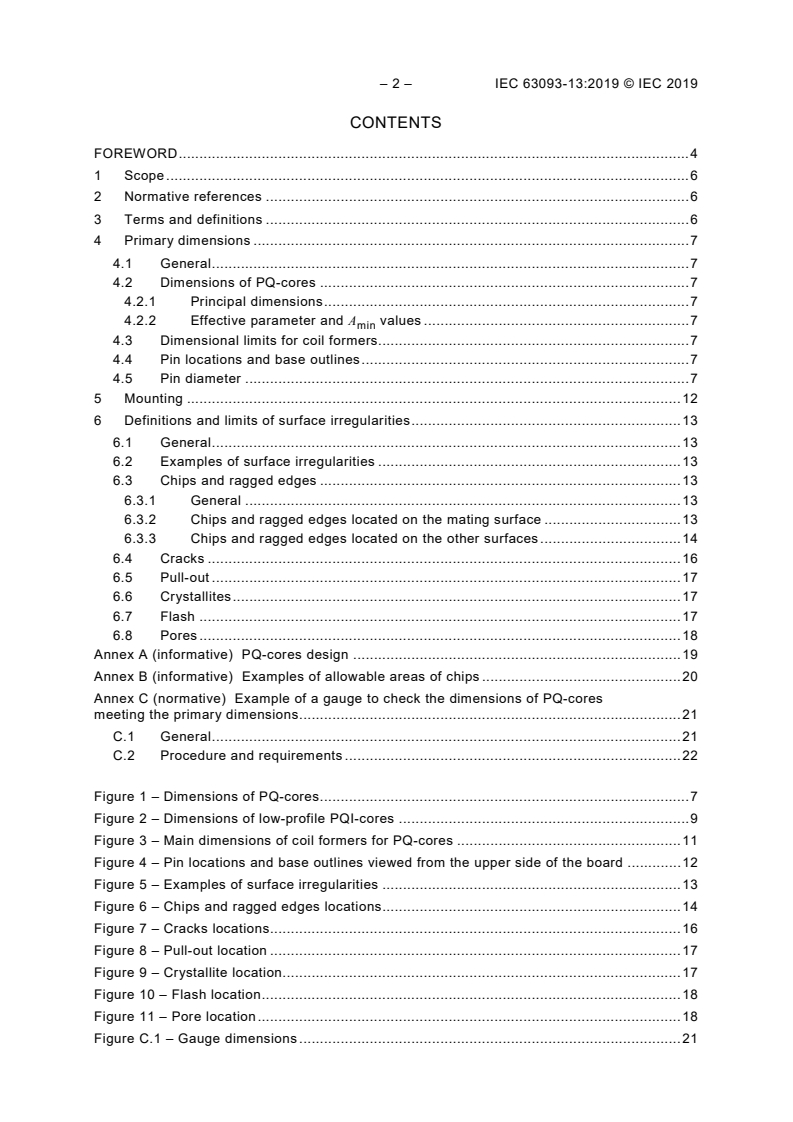
FOREWORD . 4
1 Scope . 6
2 Normative references . 6
3 Terms and definitions . 6
4 Primary dimensions . 7
4.1 General . 7
4.2 Dimensions of PQ-cores . 7
4.2.1 Principal dimensions . 7
4.2.2 Effective parameter and A values . 7
min
4.3 Dimensional limits for coil formers. 7
4.4 Pin locations and base outlines . 7
4.5 Pin diameter . 7
5 Mounting . 12
6 Definitions and limits of surface irregularities . 13
6.1 General . 13
6.2 Examples of surface irregularities . 13
6.3 Chips and ragged edges . 13
6.3.1 General . 13
6.3.2 Chips and ragged edges located on the mating surface . 13
6.3.3 Chips and ragged edges located on the other surfaces . 14
6.4 Cracks . 16
6.5 Pull-out . 17
6.6 Crystallites . 17
6.7 Flash . 17
6.8 Pores . 18
Annex A (informative) PQ-cores design . 19
Annex B (informative) Examples of allowable areas of chips . 20
Annex C (normative) Example of a gauge to check the dimensions of PQ-cores
meeting the primary dimensions . 21
C.1 General . 21
C.2 Procedure and requirements . 22
Figure 1 – Dimensions of PQ-cores . 7
Figure 2 – Dimensions of low-profile PQI-cores . 9
Figure 3 – Main dimensions of coil formers for PQ-cores . 11
Figure 4 – Pin locations and base outlines viewed from the upper side of the board . 12
Figure 5 – Examples of surface irregularities . 13
Figure 6 – Chips and ragged edges locations. 14
Figure 7 – Cracks locations. 16
Figure 8 – Pull-out location . 17
Figure 9 – Crystallite location. 17
Figure 10 – Flash location . 18
Figure 11 – Pore location . 18
Figure C.1 – Gauge dimensions . 21
Table 1 – Dimensions of PQ-cores . 8
Table 2 – Dimensions of low-profile PQI-cores . 9
Table 3 – Effective parameter and A values for PQ-cores . 10
min
Table 4 – Effective parameter and A values for low-profile PQI-cores . 10
min
Table 5 – Dimensional limits for coil formers for PQ-cores . 11
Table 6 – Area and length reference of irregularities for visual inspection . 15
Table 7 – Limits for cracks . 16
Table B.1 – Allowable areas of chips in mm . 20
Table C.1 – Gauge dimensions . 21
– 4 – IEC 63093-13:2019 © IEC 2019
INTERNATIONAL ELECTROTECHNICAL COMMISSION
____________
FERRITE CORES – GUIDELINES ON DIMENSIONS
AND THE LIMITS OF SURFACE IRREGULARITIES –
Part 13: PQ-cores
FOREWORD
1) The International Electrotechnical Commission (IEC) is a worldwide organization for standardization comprising
all national electrotechnical committees (IEC National Committees). The object of IEC is to promote
international co-operation on all questions concerning standardization in the electrical and electronic fields. To
this end and in addition to other activities, IEC publishes International Standards, Technical Specifications,
Publication(s)”). Their preparation is entrusted to technical committees; any IEC National Committee interested
in the subject dealt with may participate in this preparatory work. International, governmental and non-
governmental organizations liaising with the IEC also participate in this preparation. IEC collaborates closely
with the International Organization for Standardization (ISO) in accordance with conditions determined by
agreement between the two organizations.
2) The formal decisions or agreements of IEC on technical matters express, as nearly as possible, an international
consensus of opinion on the relevant subjects since each technical committee has representation from all
interested IEC National Committees.
3) IEC Publications have the form of recommendations for international use and are accepted by IEC National
Committees in that sense. While all reasonable efforts are made to ensure that the technical content of IEC
Publications is accurate, IEC cannot be held responsible for the way in which they are used or for any
misinterpretation by any end user.
4) In order to promote international uniformity, IEC National Committees undertake to apply IEC Publications
transparently to the maximum extent possible in their national and regional publications. Any divergence
between any IEC Publication and the corresponding national or regional publication shall be clearly indicated in
the latter.
5) IEC itself does not provide any attestation of conformity. Independent certification bodies provide conformity
assessment services and, in some areas, access to IEC marks of conformity. IEC is not responsible for any
services carried out by independent certification bodies.
6) All users should ensure that they have the latest edition of this publication.
7) No liability shall attach to IEC or its directors, employees, servants or agents including individual experts and
members of its technical committees and IEC National Committees for any personal injury, property damage or
other damage of any nature whatsoever, whether direct or indirect, or for costs (including legal fees) and
expenses arising out of the publication, use of, or reliance upon, this IEC Publication or any other IEC
Publications.
8) Attention is drawn to the Normative references cited in this publication. Use of the referenced publications is
indispensable for the correct application of this publication.
9) Attention is drawn to the possibility that some of the elements of this IEC Publication may be the subject of
patent rights. IEC shall not be held responsible for identifying any or all such patent rights.
International Standard IEC 63093-13 has been prepared by IEC technical committee 51:
Magnetic components, ferrite and magnetic powder materials.
This first edition cancels and replaces the second edition of IEC 62317-13 published in 2015
and the first edition of IEC 60424-8 published in 2015. This edition constitutes a technical
revision.
This edition includes the following significant technical changes with respect to the previous
editions of
IEC 62317-13 and IEC 60424-8:
a) IEC 63093-13 integrates IEC 62317-13 and IEC 60424-8;
b) IEC 60424-8:2015, Table 1, has been included in Annex B as Table B.1.
The text of this International Standard is based on the following documents:
FDIS Report on voting
51/1262/FDIS 51/1270/RVD
Full information on the voting for the approval of this International Standard can be found in
the report on voting indicated in the above table.
This document has been drafted in accordance with the ISO/IEC Directives, Part 2.
A list of all parts in the IEC 63093 series, published under the general title Ferrite cores –
Guidelines on dimensions and the limits of surface irregularities can be found on the IEC
website.
The committee has decided that the contents of this document will remain unchanged until the
stability date indicated on the IEC website under "http://webstore.iec.ch" in the data related to
the specific document. At this date, the document will be
• reconfirmed,
• withdrawn,
• replaced by a revised edition, or
• amended.
– 6 – IEC 63093-13:2019 © IEC 2019
FERRITE CORES – GUIDELINES ON DIMENSIONS
AND THE LIMITS OF SURFACE IRREGULARITIES –
Part 13: PQ-cores
1 Scope
This part of IEC 63093 specifies the dimensions that are of importance for mechanical
interchangeability for a preferred range of PQ-cores and low-profile PQI-cores made of ferrite,
and the locations of their terminal pins on a 2,54 mm printed wiring grid in relation to the base
outlines of the cores. It also gives guidance on allowable limits of surface irregularities
applicable to PQ-cores in accordance with the relevant generic specification.
The selection of core sizes for this document is based on the philosophy of including those
sizes which are industrial standards, either by inclusion in a national standard, or by
broad-based use in industry.
This document is a specification useful in the negotiations between ferrite core manufacturers
and customers about surface irregularities.
The general considerations that the design of this range of cores is based upon are given in
Annex A.
2 Normative references
The following documents are referred to in the text in such a way that some or all of their
content constitutes requirements of this document. For dated references, only the edition
cited applies. For undated references, the latest edition of the referenced document (including
any amendments) applies.
IEC 60205, Calculation of the effective parameters of magnetic piece parts
IEC 60401-1, Terms and nomenclature for cores made of magnetically soft ferrites – Part 1:
Terms used for physical irregularities
IEC 60424-1, Ferrite cores – Guidelines on the limits of surface irregularities – Part 1:
General specification
3 Terms and definitions
For the purposes of this document, the terms and definitions given in IEC 60401-1 and
IEC 60424-1 apply.
ISO and IEC maintain terminological databases for use in standardization at the following
addresses:
• IEC Electropedia: available at http://www.electropedia.org/
• ISO Online browsing platform: available at http://www.iso.org/obp
4 Primary dimensions
4.1 General
Compliance with the following requirements ensures mechanical interchangeability of
complete assemblies and wound coil formers.
4.2 Dimensions of PQ-cores
4.2.1 Principal dimensions
The principal dimensions of PQ-cores shall be as given in Table 1 and those of the low-profile
PQI-cores shall be as given in Table 2. See also Figure 1 and Figure 2. The dimensions of the
cores may be checked by means of gauges. By way of example, a possible standard for these
gauges is given in Annex C, although no relaxation of the requirements for the dimensions of
the cores given in Table 1 and in Table 2 is permitted.
4.2.2 Effective parameter and A values
min
The effective parameter values for cores having the dimensions given in 4.2 are as shown in
Table 3 and Table 4.
The definitions of effective parameters and their calculations shall be as given in IEC 60205.
4.3 Dimensional limits for coil formers
The main dimensions of coil formers suitable for use with a pair of PQ-cores shall be as given
in Table 5. See also Figure 3.
4.4 Pin locations and base outlines
These shall be as shown in Figure 4.
4.5 Pin diameter
Coil former terminations (pins) shall be accepted by a gauge having 1,2 mm holes on a true
position.
Figure 1 – Dimensions of PQ-cores
– 8 – IEC 63093-13:2019 © IEC 2019
Table 1 – Dimensions of PQ-cores
A B C D E F G J L
Size
mm mm mm mm mm mm mm mm mm
Min. 16,10 5,70 10,90 3,20 14,10 6,80 8,80
PQ 16/11,6 Nom. 3,1 8,5
Max. 16,70 5,90 11,50 3,50 14,70 7,20 10,40
Min. 20,10 8,00 13,60 5,00 17,60 8,60 12,00
PQ 20/16 Nom. 4,80 10,50
Max. 20,90 8,20 14,40 5,30 18,40 9,00 13,00
Min. 20,10 10,00 13,60 7,00 17,60 8,60 12,00
PQ 20/20 Nom. 4,80 10,50
Max. 20,90 10,20 14,40 7,30 18,40 9,00 13,00
Min. 26,05 9,95 18,55 5,60 22,05 11,80 15,50
PQ 26/20 Nom. 7,30 13,90
Max. 26,95 10,20 19,45 5,90 22,95 12,20 16,50
Min. 26,05 12,25 18,55 7,90 22,05 11,80 15,50
PQ 26/25 Nom 7,30 13,90
Max 26,95 12,50 19,45 8,20 22,95 12,20 16,50
Min. 31,50 10,15 21,50 5,60 27,00 13,20 19,00
PQ 32/20 Nom. 6,20 15,10
Max. 32,50 10,40 22,50 5,90 28,00 13,70 20,00
Min. 31,50 15,05 21,50 10,50 27,00 13,20 19,00
PQ 32/30 Nom. 6,20 15,10
Max. 32,50 15,30 22,50 10,80 28,00 13,70 20,00
Min. 34,50 17,25 25,50 12,35 31,50 14,10 23,50
PQ 35/35 Nom. 7,30 16,40
Max. 35,70 17,50 26,50 12,65 32,50 14,60 24,50
Min. 39,70 19,75 27,40 14,60 36,40 14,60 28,00
PQ 40/40 Nom. 7,75 16,80
Max. 41,30 20,00 28,60 14,90 37,60 15,20 29,00
Min. 49,00 24,85 31,50 17,90 43,30 19,65 31,50
PQ 50/50 Nom. 10,00 22,00
Max. 51,00 25,10 32,50 18,20 44,70 20,35 32,50
Min. 63,70 26,80 39,20 17,75 52,00 25,55 39,20
PQ 65/54 Nom. 12,00 27,50
Max. 66,30 27,20 40,80 18,25 54,00 26,45 40,80
Min. 77,00 19,45 41,20 12,60 69,10 25,00 60,10
PQ 78/39 Nom. 13,60 27,60
Max. 80,00 19,95 42,80 13,20 71,90 26,00 62,50
Min. 105,00 43,10 68,50 27,50 93,70 40,20 72,50
PQ 107/87 Nom. 22,80 43,70
Max. 109,00 43,90 71,50 28,50 97,30 41,80 75,30
Figure 2 – Dimensions of low-profile PQI-cores
Table 2 – Dimensions of low-profile PQI-cores
A B B C D E F G J L
1 2
Size
mm mm mm mm mm mm mm mm mm mm
Min. 16,10 5,30 2,25 10,90 2,90 14,10 6,80 9,60
PQI 16/7,8 No m . 3,90 8,40
Max. 16,70 5,50 2,45 11,50 3,20 14,70 7,20 10,40
Min. 20,10 5,90 2,85 13,60 2,90 17,60 8,60 12,00
PQI 20/9 Nom. 4,80 10,50
Max. 20,90 6,10 3,05 14,40 3,20 18,40 9,00 12,50
Min. 26,05 7,20 4,10 18,55 2,95 22,05 11,80 15,50
PQI 26/12 Nom. 7,30 13,90
Max. 26,95 7,40 4,30 19,45 3,25 22,95 12,20 16,50
– 10 – IEC 63093-13:2019 © IEC 2019
Table 3 – Effective parameter and A values for PQ-cores
min
a
C C A l V A
1 2 e e e min
Size
-1 -3 -3 2 3 2
mm × 10 mm mm mm mm mm
PQ16/11,6 0,633 82 14,958 42,4 26,9 1 140 38,5
PQ 20/16 0,580 53 9,034 6 64,3 37,3 2 400 59,3
PQ 20/20 0,709 95 11,129 63,8 45,3 2 890 59,3
PQ 26/20 0,361 41 2,932 5 123 44,5 5 490 113
PQ 26/25 0,437 83 3,569 9 123 53,7 6 590 113
PQ 32/20 0,313 14 2,001 2 156 49,0 7 670 142
PQ 32/30 0,440 40 2,833 3 155 68,5 10 600 142
PQ 35/35 0,465 38 2,718 8 171 79,7 13 600 161
PQ 40/40 0,491 97 2,602 7 189 93,0 17 600 174
PQ 50/50 0,342 34 1,032 6 332 113 37 600 314
PQ 65/54 0,209 36 0,355 40 589 123 72 700 531
PQ 78/39 0,256 49 0,577 90 444 114 50 500 386
PQ 107/87 0,14135 0,098 530 1 430 203 291 000 1 320
a
See IEC 60205.
Table 4 – Effective parameter and A values for low-profile PQI-cores
min
a
C C A l V A
1 2 e e e min
Size
-1 -3 -3 2 3 2
mm X 10 mm mm mm mm mm
PQI 16/7,8 0,466 78 11,185 41,7 19,5 814 37,4
PQI 20/9 0,345 95 5,238 7 66,0 22,8 1 510 59,3
PQI 26/12 0,224 03 1,814 3 123 27,7 3 420 110
a
See IEC 60205.
Figure 3 – Main dimensions of coil formers for PQ-cores
Table 5 – Dimensional limits for coil formers for PQ-cores
d d d h h a b h
1 2 3 1 2 3
Size mm mm mm mm mm mm mm mm
Min. Max. Min. Max. Min. Max. Min. Max. Min. Max. Max. Max. Min.
PQ16/11,6 13,55 13,95 8,87 9,07 7,07 7,27 6,00 6,35 4,95 5,60 19,15 20,45 6,1
PQ 20/16 17,05 17,45 10,85 11,05 9,05 9,25 9,60 9,95 8,55 9,20 23,35 23,35 6,1
PQ 20/20 17,05 17,45 10,85 11,05 9,05 9,25 13,60 13,95 12,55 13,20 23,35 23,35 6,1
PQ 26/20 21,35 21,85 14,15 14,45 12,25 12,55 10,80 11,15 9,75 10,40 26,95 29,65 6,1
PQ 26/25 21,35 21,85 14,15 14,45 12,25 12,55 15,40 15,75 14,35 15,00 26,95 29,65 6,1
PQ 32/20 26,35 26,85 15,85 16,15 13,85 14,15 10,80 11,15 9,65 10,30 32,35 34,35 6,6
PQ 32/30 26,35 26,85 15,85 16,15 13,85 14,15 20,35 20,95 19,20 20,10 32,35 34,35 6,6
PQ 35/35 30,85 31,35 16,65 17,05 14,75 15,05 24,05 24,60 22,90 23,95 35,55 39,45 7,1
PQ 40/40 35,75 36,25 17,35 17,65 15,45 15,75 28,55 29,05 27,40 28,20 41,30 42,45 6,1
PQ 50/50 42,65 43,15 22,95 23,45 20,55 21,05 34,75 35,25 33,50 34,30 51,00 51,25 9,6
PQ 65/54 51,35 51,85 29,05 29,55 26,65 27,15 34,45 34,95 33,20 34,00
PQ 78/39 68,45 68,95 28,60 29,10 26,20 26,70 24,15 24,65 22,90 23,70
PQ107/87 93,05 93,55 44,40 44,90 42,00 42,50 53,95 54,45 52,70 53,50
– 12 – IEC 63093-13:2019 © IEC 2019
Figure 4 – Pin locations and base outlines viewed from the upper side of the board
5 Mounting
Due to their sizes and respective weights, it is recommended that the cores above PQ 35/35
(including PQ 35/35) be fixed on the printed board with mounting assemblies at two opposite
sides of their coil formers.
Concerning low-profile PQI-cores, no mounting assemblies are defined. It is recommended
that the two cores be fixed by glue or adhesive tape.
6 Definitions and limits of surface irregularities
6.1 General
Surface irregularities are defined in IEC 60424-1.
6.2 Examples of surface irregularities
Figure 5 shows different examples of surface irregularities on a PQ-core.
Figure 5 – Examples of surface irregularities
6.3 Chips and ragged edges
6.3.1 General
The minimum chipping area is taken as 0,5 mm , to be distinguishable to the naked eye.
The maximum chipping area is taken as 50 mm , to be referenced to the design for the cores.
6.3.2 Chips and ragged edges located on the mating surface
The areas of the chips located on the mating surface (see C1 and C1’ irregularities in Figure 6)
shall not exceed the following limits:
– the cumulative area of the chips located on the mating surface shall be less than 4 % of
the total mating surface;
– the cumulative area of the chips located on the centre pole mating surface shall be less
than 2 % of the total mating surface;
– the cumulative area of the chips located on the mating surface of one outer leg shall be
less than 1 % of the total mating surface.
The total length of the ragged edges shall be less than 25 % of the perimeter of the relevant
mating surface.
– 14 – IEC 63093-13:2019 © IEC 2019
6.3.3 Chips and ragged edges located on the other surfaces
The areas of the chips located on the other surfaces (see C2, C2’, C3 and C3’ irregularities in
Figure 6) shall not exceed the following limits:
– the allowable chipping areas are doubled as compared to the limits for the whole mating
surfaces (see Table B.1);
– the rule for the ragged edges is the same as for the mating surfaces;
– chips and ragged edges are not acceptable on the inner edges of the wire slot area.
Figure 6 – Chips and ragged edges locations
The limits for allowable chipping areas of PQ-cores are given in Annex B.
The area and length reference of irregularities for visual inspection are given in Table 6.
Table 6 – Area and length reference of irregularities for visual inspection
– 16 – IEC 63093-13:2019 © IEC 2019
6.4 Cracks
Figure 7 shows examples of cracks locations on PQ-cores:
– a single crack which intersects the perimeter of the relevant surface at two points is not
acceptable (see S1 in Figure 7);
– the number of cracks located on the same surface shall not exceed three.
The limits of cracks at various locations shown in Figure 7 are given in Table 7.
NOTE S1 to S9: types of cracks (for limits for cracks, see Table 7).
Figure 7 – Cracks locations
Table 7 – Limits for cracks
Limits for multiple
a
Type Location Limits for single crack
cracks
S1 Any place Not acceptable Not acceptable
S2 Outer wall 20 % × W 40 % × W
S3 Mating surface of outer legs 20 % × W 40 % × W
S4 Mating surface of centre pole 20 % × F 40 % × F
S5 Bottom surface 25 % × T 50 % × T
S6 Back wall 25 % × T 50 % × T
S7 Centre pole wall 20 % × F 40 % × F
S8 Back surface 25 % × W 50 % × W
S9 Back surface 20 % × W 40 % × W
For, F, T, W, see Figure 7.
a
See Figure 7.
6.5 Pull-out
Figure 8 shows an example of a pull-out location on the PQ-core.
The cumulative area of the pull-out located on the bottom surface shall be less than 25 % of
the total respective surface area.
Figure 8 – Pull-out location
6.6 Crystallites
Figure 9 shows an example of crystallite location on the PQ-core:
– the single area of the crystallite located on any surface shall be less than 2 % of the
respective surface area;
– the cumulative area of the crystallites located on any surface shall be less than 4 % of the
respective surface area.
Figure 9 – Crystallite location
6.7 Flash
Figure 10 shows an example of flash location on the PQ-core:
– with chamfering around the back surface, the flash height shall not exceed the back
surface of the core;
– without chamfering around the back surface, the flash is not acceptable.
– 18 – IEC 63093-13:2019 © IEC 2019
Figure 10 – Flash location
6.8 Pores
Figure 11 shows an example of pore location on the PQ-core:
– the number of pores located on the same surface shall not exceed two; the total number of
pores located on all surfaces shall not exceed five;
– a hole with an area larger than 1 mm on any surface is not acceptable.
Figure 11 – Pore location
Annex A
(informative)
PQ-cores design
The design of PQ-cores standardized by the IEC is based on the following considerations:
a) Minimize design “q” (l /A × l /A ) with a uniform cross-section area of each magnetic
e e w w
path:
where
l is the average length of turns;
w
A is the available winding cross-section.
w
One useful way to consider ferrite core design is by evaluating the design factor “q”.
Minimize “q” results in the highest inductance and lowest copper losses in the transformer
or inductor. PQ-cores dimensions in this document are based on this type of design
philosophy.
b) Get more transmission power from the transformer assembly or real estate compared with
similar size cores.
c) Be able to take out the innermost wire without crossing other wires.
There are no base plates on the sides of the centre pole area. The innermost wire in the
coil can be taken out directly, making it easier to support the specified withstand voltage
of transformers.
d) The outside legs cover the coil former more than E-cores.
PQ-cores cover the coil former by more than 40 %, resulting in a good magnetic shielding
effect.
– 20 – IEC 63093-13:2019 © IEC 2019
Annex B
(informative)
Examples of allowable areas of chips
Information on allowable areas of chips for a given core is summarized in Table B.1.
NOTE Table B.1 is taken from IEC 60424-8:2015, Table 1, and is included in Annex B for ease of reference.
Table B.1 – Allowable areas of chips in mm
Chipping on Chipping on
Overall chipping Overall chipping
Core size mating surface of mating surface of
on mating surface on other surfaces
one outer leg centre pole
PQ16/11,6 < 1,0 < 2,0 < 3,5 < 6,5
PQ20/16 < 1,0 < 2,0 < 4,5 < 9,0
PQ20/20 < 1,0 < 2,0 < 4,5 < 9,0
PQ26/20 < 2,0 < 4,5 < 9,5 < 19,0
PQ26/25 < 2,0 < 4,5 < 9,5 < 19,0
PQ32/20 < 3,0 < 6,0 < 12,0 < 24,0
PQ32/30 < 3,0 < 6,0 < 12,0 < 24,0
PQ35/35 < 3,0 < 6,5 < 13,0 < 26,0
PQ40/40 < 3,5 < 7,0 < 14,0 < 28,0
PQ50/50 < 6,0 < 12,5 < 25,0 < 50,0
PQ65/54 < 12,5 < 24,5 < 49,0 < 50,0
PQ78/39 < 10,5 < 20,5 < 41,0 < 50,0
PQ107/87 < 27,5 < 50,0 < 50,0 < 50,0
Annex C
(normative)
Example of a gauge to check the dimensions of PQ-cores
meeting the primary dimensions
C.1 General
The gauges shall be in accordance with Figure C.1 and Table C.1.
Figure C.1 – Gauge dimensions
Table C.1 – Gauge dimensions
a b c d e f
mm mm mm mm mm mm
Size
Min. Max. Min. Max. Min. Max. Max. Min. Max. Min. Max.
PQ 16 16,705 16,715 7,50 7,60 11,505 11,515 2,90 14,085 14,095 7,205 7,215
PQ 20 20,905 20,915 12,20 12,30 14,405 14,415 2,90 17,585 17,595 9,005 9,015
PQ 26 26,955 26,965 14,50 14,60 19,455 19,465 2,95 22,035 22,045 12,205 12,215
PQ 32 32,505 32,515 17,30 17,40 22,505 22,515 5,60 26,985 26,995 13,705 13,715
PQ 35 35,705 35,715 19,50 19,60 26,505 26,515 12,35 31,485 31,495 14,605 14,615
PQ 40 41,305 41,315 22,00 22,10 28,605 28,615 14,60 36,385 36,395 15,205 15,215
PQ 50 51,005 51,015 27,10 27,20 32,505 32,515 17,90 43,285 43,295 20,355 20,365
PQ 65 66,305 66,315 29,20 29,30 40,805 40,815 17,75 51,985 51,995 26,455 26,465
PQ 78 80,005 80,015 21,95 22,05 42,805 42,815 12,60 69,085 69,095 26,005 26,015
PQ 107 109,005 109,015 45,90 46,00 71,505 71,515 27,50 93,685 93,695 41,805 41,815
– 22 – IEC 63093-13:2019 © IEC 2019
C.2 Procedure and requirements
To check the winding space, the gauge shall be fully inserted into the core without forcing;
when fully inserted, the gauge shall meet the mating surface of the outer legs of the core
under test.
___________
– 24 – IEC 63093-13:2019 © IEC 2019
SOMMAIRE
AVANT-PROPOS . 26
1 Domaine d'application . 28
2 Références normatives . 28
3 Termes et définitions . 28
4 Dimensions essentielles . 29
4.1 Généralités . 29
4.2 Dimensions des noyaux PQ . 29
4.2.1 Dimensions principales . 29
4.2.2 Valeurs des paramètres effectifs et de A . 29
min
4.3 Limites dimensionnelles des supports de bobine . 29
4.4 Emplacements des broches et encombrements de base . 29
4.5 Diamètre des broches . 29
5 Montage . 35
6 Définitions et limites des irrégularités de surface . 35
6.1 Généralités . 35
6.2 Exemples d'irrégularités de surface . 35
6.3 Eclats et bords ébréchés . 35
6.3.1 Généralités . 35
6.3.2 Eclats et bords ébréchés situés sur la surface de contact . 35
6.3.3 Eclats et bords ébréchés situés sur d'autres surfaces . 36
6.4 Fissures . 38
6.5 Collage . 39
6.6 Cristallites . 39
6.7 Bavures . 39
6.8 Pores . 40
Annexe A (informative) Conception des noyaux PQ . 41
Annexe B (informative) Exemples de surfaces où les éclats sont admissibles . 42
Annexe C (normative) Exemple de calibre pour vérifier les dimensions des noyaux PQ
satisfaisant aux dimensions essentielles . 43
C.1 Généralités . 43
C.2 Procédure et exigences . 44
Figure 1 – Dimensions des noyaux PQ . 30
Figure 2 – Dimensions des noyaux PQI extra plats . 31
Figure 3 – Dimensions principales des supports de bobine pour les noyaux PQ . 33
Figure 4 – Emplacements des broches et encombrements de base vus du dessus de la
carte . 34
Figure 5 – Exemples d'irrégularités de surface . 35
Figure 6 – Emplacements des éclats et des bords ébréchés . 36
Figure 7 – Emplacements des fissures . 38
Figure 8 – Emplacement d'un collage. 39
Figure 9 – Emplacement d'une cristallite . 39
Figure 10 – Emplacement d'une bavure . 40
Figure 11 – Emplacement d'un pore . 40
Figure C.1 – Dimensions des calibres . 43
Tableau 1 – Dimensions des noyaux PQ . 30
Tableau 2 – Dimensions des noyaux PQI extra plats . 32
Tableau 3 – Valeurs des paramètres effectifs et de A pour les noyaux PQ. 32
min
Tableau 4 – Valeurs des paramètres effectifs et de A pour les noyaux PQI extra
min
plats . 32
Tableau 5 – Limites dimensionnelles des supports de bobine pour les noyaux PQ . 33
Tableau 6 – Surfaces et longueurs de référence des irrégularités pour l'inspection
visuelle . 37
Tableau 7 – Limites des fissures . 38
Tableau B.1 – Surfaces admettant des éclats en mm . 42
Tableau C.1 – Dimensions des calibres . 43
– 26 – IEC 63093-13:2019 © IEC 2019
COMMISSION ÉLECTROTECHNIQUE INTERNATIONALE
____________
NOYAUX FERRITES – LIGNES DIRECTRICES RELATIVES AUX
DIMENSIONS ET AUX LIMITES DES IRRÉGULARITÉS DE SURFACE –
Partie 13: Noyaux PQ
AVANT-PROPOS
1) La Commission Electrotechnique Internationale (IEC) est une organisation mondiale de normalisation
composée de l'ensemble des comités électrotechniques nationaux (Comités nationaux de l'IEC). L'IEC a pour
objet de favoriser la coopération internationale pour toutes les questions de normalisation dans les domaines
de l'électricité et de l'électronique. A cet effet, l'IEC – entre autres activités – publie des Normes internationales,
des Spécifications techniques, des Rapports techniques, des Spécifications accessibles au public (PAS) et des
Guides (ci-après dénommés "Publication(s) de l'IEC"). Leur élaboration est confiée à des comités d'études, aux
travaux desquels tout Comité national intéressé par le sujet traité peut participer. Les organisations
internationales, gouvernementales et non gouvernementales, en liaison avec l'IEC, participent également aux
travaux. L'IEC collabore étroitement avec l'Organisation Internationale de Normalisation (ISO), selon des
conditions fixées par accord entre les deux organisations.
2) Les décisions ou accords officiels de l'IEC concernant les questions techniques représentent, dans la mesure
du possible, un accord international sur les sujets étudiés, étant donné que les Comités nationaux de l'IEC
intéressés sont représentés dans chaque comité d'études.
3) Les Publications de l'IEC se présentent sous la forme de recommandations internationales et sont agréées
comme telles par les Comités nationaux de l'IEC. Tous les efforts raisonnables sont entrepris afin que l'IEC
s'assure de l'exactitude du contenu technique de ses publications; l'IEC ne peut pas être tenue responsable de
l'éventuelle mauvaise utilisation ou interprétation qui en est faite par un quelconque utilisateur final.
4) Dans le but d'encourager l'uniformité internationale, les Comités nationaux de l'IEC s'engagent, dans toute la
mesure possible, à appliquer de façon transparente les Publications de l'IEC dans leurs publications nationales
et régionales. Toutes divergences entre toutes Publications de l'IEC et toutes publications nationales ou
régionales correspondantes doivent être indiquées en termes clairs dans ces dernières.
5) L'IEC elle-même ne fournit aucune attestation de conformité. Des organismes de certification indépendants
fournissent des services d'évaluation de conformit
...