

IEC 60601-2-43:2000
(Main)Medical electrical equipment - Part 2-43: Particular requirements for the safety of X-ray equipment for interventional procedures
General Information
- Abstract
Establishes safety requirements for the design and manufacture of X-ray equipment for prolonged radioscopically guided interventional procedures. Specifies information which is to be provided with such equipment for the assistance of the user and operator in managing the radiation risk arising from these procedures which could affect patients and staff.
- Status
- Published
- Publication Date
- 29-Jun-2000
- Technical Committee
- SC 62B - Medical imaging equipment, software, and systems
- Drafting Committee
- WG 24 - TC 62/SC 62B/WG 24
- Current Stage
- DELPUB - Deleted Publication
- Start Date
- 25-Mar-2010
- Completion Date
- 28-Aug-2026
Overview
IEC 60601-2-43:2000 - "Medical electrical equipment - Part 2-43: Particular requirements for the safety of X‑ray equipment for interventional procedures" - is a Particular Standard that supplements the General Standard IEC 60601-1. It establishes safety, information and design requirements for interventional X‑ray equipment declared by manufacturers as suitable for prolonged radioscopically guided interventional procedures. The standard focuses on managing radiation risk to patients and staff during prolonged fluoroscopic and image‑guided interventions.
Key topics and technical requirements
- Scope and intent: Requirements apply to X‑ray systems used for prolonged radioscopically guided interventional procedures (e.g., invasive cardiology, interventional radiology, neuroradiology) and exclude radiotherapy, CT, mammography and intracorporeal accessories.
- Radiation protection: Provisions addressing unwanted or excessive X‑radiation, including filtration, half‑value layers, correspondence between X‑ray field and image receptor, and designation of significant zones of occupancy.
- Dosimetry and mapping: Requirements and guidance on REFERENCE AIR KERMA (RATE) measurement procedures and isokerma maps for stray radiation distribution (annexes EE, FF).
- Information for users: Mandatory marking, instructions for use, technical descriptions and a statement of compliance to assist operators in managing radiation risk.
- Operator controls and data: Requirements for control features, operator information and protective measures to avoid hazardous outputs during prolonged procedures.
- Mechanical, electrical and environmental safety: Mechanical strength, moving parts, ingress of fluids (including footswitches), excessive temperature and constructional requirements (including CPR configuration and attachment of protective drapes).
- Terminology and annexes: Defined terms (annex AA), examples of procedures where deterministic effects are possible (annex BB), the interventional reference point (annex CC), cleaning/disinfection guidance (annex DD).
Practical applications
- Ensures design and manufacture of X‑ray systems minimize radiation injury and stochastic risk during long interventional procedures.
- Guides preparation of user manuals and labeling so clinicians and radiology staff can manage exposure and shielding.
- Supports procurement specifications for hospitals and imaging centers seeking interventional fluoroscopy suites and C‑arm systems.
- Informs clinical risk assessments, room layout (isokerma/stray radiation maps) and staff training on prolonged fluoroscopic use.
Who uses this standard
- Medical device manufacturers and design engineers of interventional X‑ray systems
- Clinical engineers and hospital procurement teams
- Radiologists, interventional cardiologists, and operating staff
- Health physicists, regulatory bodies and conformity assessment organizations
Related standards
- IEC 60601-1 (General requirements for medical electrical equipment) and its collateral standards
- IEC normative references for symbols and terminology (e.g., IEC 60050, IEC 60027, IEC 60417, IEC 60617)
- National radiological protection legislation and guidance (may supersede or complement provisions)
For implementation, consult the full IEC 60601-2-43:2000 text and applicable national regulations to ensure compliance and device safety in clinical practice.
Relations
- Effective Date
- 05-Sep-2023
Get Certified
Connect with accredited certification bodies for this standard

BSI Group
BSI (British Standards Institution) is the business standards company that helps organizations make excellence a habit.

TÜV Rheinland
TÜV Rheinland is a leading international provider of technical services.

TÜV SÜD
TÜV SÜD is a trusted partner of choice for safety, security and sustainability solutions.
Sponsored listings
Frequently Asked Questions
IEC 60601-2-43:2000 is a standard published by the International Electrotechnical Commission (IEC). Its full title is "Medical electrical equipment - Part 2-43: Particular requirements for the safety of X-ray equipment for interventional procedures". This standard covers: Establishes safety requirements for the design and manufacture of X-ray equipment for prolonged radioscopically guided interventional procedures. Specifies information which is to be provided with such equipment for the assistance of the user and operator in managing the radiation risk arising from these procedures which could affect patients and staff.
Establishes safety requirements for the design and manufacture of X-ray equipment for prolonged radioscopically guided interventional procedures. Specifies information which is to be provided with such equipment for the assistance of the user and operator in managing the radiation risk arising from these procedures which could affect patients and staff.
IEC 60601-2-43:2000 is classified under the following ICS (International Classification for Standards) categories: 11.040.50 - Radiographic equipment. The ICS classification helps identify the subject area and facilitates finding related standards.
IEC 60601-2-43:2000 has the following relationships with other standards: It is inter standard links to IEC 60601-2-43:2010. Understanding these relationships helps ensure you are using the most current and applicable version of the standard.
IEC 60601-2-43:2000 is available in PDF format for immediate download after purchase. The document can be added to your cart and obtained through the secure checkout process. Digital delivery ensures instant access to the complete standard document.
Standards Content (Sample)
INTERNATIONAL IEC
STANDARD
60601-2-43
First edition
2000-06
Medical electrical equipment –
Part 2-43:
Particular requirements for the safety
of X-ray equipment for interventional procedures
Appareils électromédicaux –
Partie 2-43:
Règles particulières de sécurité pour les appareils
radiologiques lors d'interventions
Reference number
Numbering
As from 1 January 1997 all IEC publications are issued with a designation in the
60000 series.
Consolidated publications
Consolidated versions of some IEC publications including amendments are
available. For example, edition numbers 1.0, 1.1 and 1.2 refer, respectively, to the
base publication, the base publication incorporating amendment 1 and the base
publication incorporating amendments 1 and 2.
Validity of this publication
The technical content of IEC publications is kept under constant review by the IEC,
thus ensuring that the content reflects current technology.
Information relating to the date of the reconfirmation of the publication is available
in the IEC catalogue.
Information on the subjects under consideration and work in progress undertaken
by the technical committee which has prepared this publication, as well as the list
of publications issued, is to be found at the following IEC sources:
• IEC web site*
•
Catalogue of IEC publications
Published yearly with regular updates
(On-line catalogue)*
• IEC Bulletin
Available both at the IEC web site* and as a printed periodical
Terminology, graphical and letter symbols
For general terminology, readers are referred to IEC 60050: International
Electrotechnical Vocabulary (IEV).
For graphical symbols, and letter symbols and signs approved by the IEC for
general use, readers are referred to publications IEC 60027: Letter symbols to be
used in electrical technology, IEC 60417: Graphical symbols for use on equipment.
Index, survey and compilation of the single sheets and IEC 60617: Graphical symbols
for diagrams.
* See web site address on title page.
INTERNATIONAL IEC
STANDARD
60601-2-43
First edition
2000-06
Medical electrical equipment –
Part 2-43:
Particular requirements for the safety
of X-ray equipment for interventional procedures
Appareils électromédicaux –
Partie 2-43:
Règles particulières de sécurité pour les appareils
radiologiques lors d'interventions
IEC 2000 Copyright - all rights reserved
No part of this publication may be reproduced or utilized in any form or by any means, electronic or
mechanical, including photocopying and microfilm, without permission in writing from the publisher.
International Electrotechnical Commission 3, rue de Varembé Geneva, Switzerland
Telefax: +41 22 919 0300 e-mail: inmail@iec.ch IEC web site http://www.iec.ch
Commission Electrotechnique Internationale
PRICE CODE
W
International Electrotechnical Commission
For price, see current catalogue
– 2 – 60601-2-43 © IEC:2000(E)
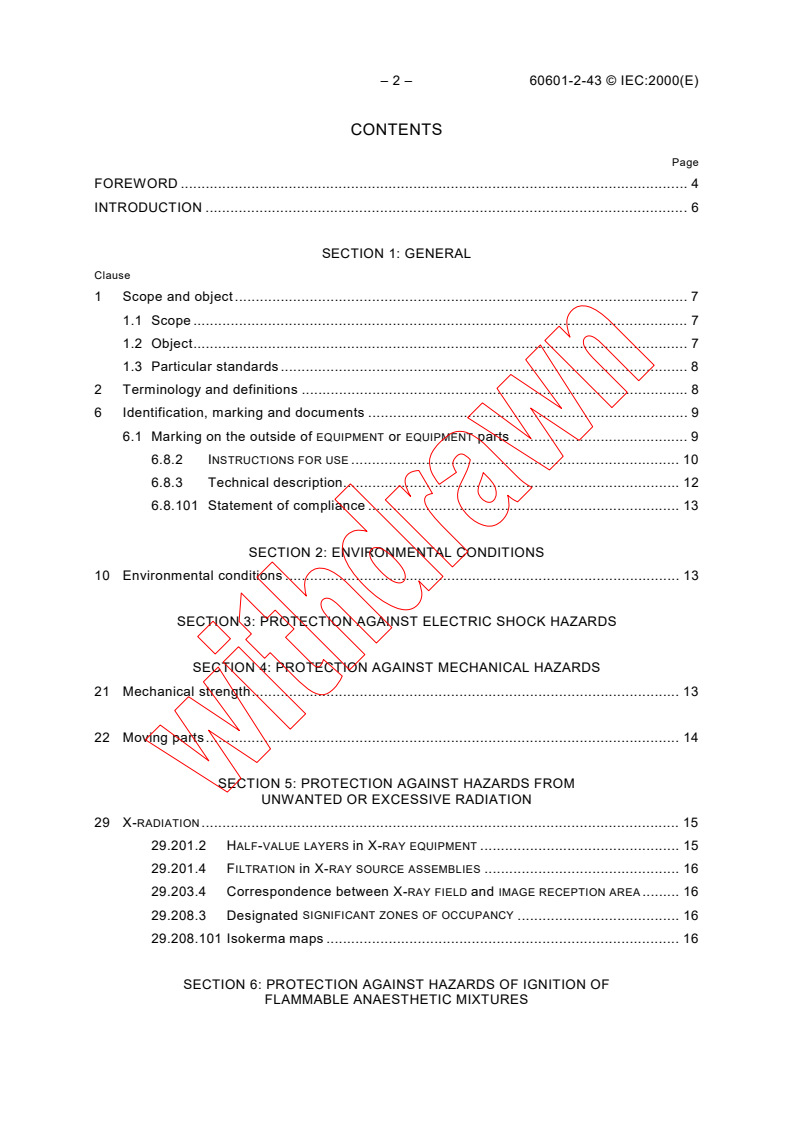
CONTENTS
Page
FOREWORD . 4
INTRODUCTION .6
SECTION 1: GENERAL
Clause
1 Scope and object . 7
1.1 Scope . 7
1.2 Object.7
1.3 Particular standards . 8
2 Terminology and definitions . 8
6 Identification, marking and documents . 9
6.1 Marking on the outside of EQUIPMENT or EQUIPMENT parts . 9
6.8.2 INSTRUCTIONS FOR USE . 10
6.8.3 Technical description. 12
6.8.101 Statement of compliance . 13
SECTION 2: ENVIRONMENTAL CONDITIONS
10 Environmental conditions . 13
SECTION 3: PROTECTION AGAINST ELECTRIC SHOCK HAZARDS
SECTION 4: PROTECTION AGAINST MECHANICAL HAZARDS
21 Mechanical strength. 13
22 Moving parts.14
SECTION 5: PROTECTION AGAINST HAZARDS FROM
UNWANTED OR EXCESSIVE RADIATION
29 X-RADIATION. 15
29.201.2 HALF-VALUE LAYERS in X-RAY EQUIPMENT . 15
29.201.4 FILTRATION in X-RAY SOURCE ASSEMBLIES . 16
29.203.4 Correspondence between X-RAY FIELD and IMAGE RECEPTION AREA . 16
29.208.3 Designated SIGNIFICANT ZONES OF OCCUPANCY . 16
29.208.101 Isokerma maps . 16
SECTION 6: PROTECTION AGAINST HAZARDS OF IGNITION OF
FLAMMABLE ANAESTHETIC MIXTURES
60601-2-43 © IEC:2000(E) – 3 –
SECTION 7: PROTECTION AGAINST EXCESSIVE TEMPERATURES
AND OTHER SAFETY HAZARDS
42 Excessive temperatures. 17
44 Overflow, spillage, leakage, humidity, ingress of liquids,
cleaning, sterilization and disinfection . 18
44.1 General. 18
44.6 Ingress of fluids . 18
44.6.101 Footswitches . 18
SECTION 8: ACCURACY OF OPERATING DATA AND PROTECTION
AGAINST HAZARDOUS OUTPUT
51 Protection against hazardous output . 18
51.101 Control features . 19
51.102 Information to the OPERATOR. 20
SECTION 9: ABNORMAL OPERATION AND FAULT CONDITIONS;
ENVIRONMENTAL TESTS
SECTION 10: CONSTRUCTIONAL REQUIREMENTS
59 Construction and layout . 22
59.101 Configuration for cardiopulmonary resuscitation (CPR) . 22
59.102 Attachment of protective drapes . 22
Annexes
L References - Publications mentioned in this standard. 23
AA Terminology – Index of defined terms. 24
BB Indications for the need to use EQUIPMENT complying with this standard. 26
CC The INTERVENTIONAL REFERENCE POINT. 28
DD Cleaning and disinfection . 29
EE Procedure for measuring REFERENCE AIR KERMA (RATE) . 30
FF Distribution maps of STRAY RADIATION. 33
Figures
101 Example of isokerma map at 100 cm height . 35
102 Example of isokerma map at 150 cm height . 36
Tables
101 Subclauses containing normative references to the ACCOMPANYING DOCUMENTS . 12
102 Addition to Table Xa in IEC 60601-1. 17
BB.1 Examples of prolonged RADIOSCOPICALLY GUIDED INTERVENTIONAL PROCEDURES for
which deterministic effects of IRRADIATION are possible. 26
BB.2 Examples of RADIOSCOPICALLY guided procedures for which deterministic effects
are unlikely. . 27
– 4 – 60601-2-43 © IEC:2000(E)
INTERNATIONAL ELECTROTECHNICAL COMMISSION
___________
MEDICAL ELECTRICAL EQUIPMENT –
Part 2-43: Particular requirements for the safety of
X-ray equipment for interventional procedures
FOREWORD
1) The IEC (International Electrotechnical Commission) is a worldwide organization for standardization comprising
all national electrotechnical committees (IEC National Committees). The object of the IEC is to promote
international co-operation on all questions concerning standardization in the electrical and electronic fields. To
this end and in addition to other activities, the IEC publishes International Standards. Their preparation is
entrusted to technical committees; any IEC National Committee interested in the subject dealt with may
participate in this preparatory work. International, governmental and non-governmental organizations liaising
with the IEC also participate in this preparation. The IEC collaborates closely with the International Organization
for Standardization (ISO) in accordance with conditions determined by agreement between the two
organizations.
2) The formal decisions or agreements of the IEC on technical matters express, as nearly as possible, an
international consensus of opinion on the relevant subjects since each technical committee has representation
from all interested National Committees.
3) The documents produced have the form of recommendations for international use and are published in the form
of standards, technical specifications, technical reports or guides and they are accepted by the National
Committees in that sense.
4) In order to promote international unification, IEC National Committees undertake to apply IEC International
Standards transparently to the maximum extent possible in their national and regional standards. Any
divergence between the IEC Standard and the corresponding national or regional standard shall be clearly
indicated in the latter.
5) The IEC provides no marking procedure to indicate its approval and cannot be rendered responsible for any
equipment declared to be in conformity with one of its standards.
6) Attention is drawn to the possibility that some of the elements of this International Standard may be the subject
of patent rights. The IEC shall not be held responsible for identifying any or all such patent rights.
International Standard IEC 60601-2-43 has been prepared by subcommittee 62B: Diagnostic
imaging equipment, of IEC technical committee 62: Electrical equipment in medical practice.
The text of this Particular Standard is based on the following documents:
FDIS Report of voting
62B/401/FDIS 62B/408/RVD
Full information on the voting for the approval of this Particular Standard can be found in the
report on voting indicated in the above table.
Annexes AA, EE and FF form an integral part of this standard.
Annexes BB, CC and DD are for information only.
In this Particular Standard, the following print types are used:
– requirements, compliance with which can be tested and definitions: roman type;
– notes, explanations, advice, introductions, general statements, exceptions and references: smaller type;
– test specifications: italic type;
– TERMS USED THROUGHOUT THIS PARTICULAR STANDARD WHICH HAVE BEEN DEFINED IN CLAUSE 2
OF THE GENERAL STANDARD, IN IEC 60788 OR IN THIS STANDARD: SMALL CAPITALS.
60601-2-43 © IEC:2000(E) – 5 –
This publication has been drafted in accordance with the ISO/IEC Directives, Part 3.
The committee has decided that the contents of this publication will remain unchanged until
2005. At this date, the publication will be
• reconfirmed;
• withdrawn;
• replaced by a revised edition, or
• amended.
A bilingual version of this standard may be issued at a later date.
– 6 – 60601-2-43 © IEC:2000(E)
INTRODUCTION
In recent years, there have been major developments in the use of X-RAY EQUIPMENT for
RADIOSCOPICALLY GUIDED INTERVENTIONAL PROCEDURES. These procedures may involve
prolonged IRRADIATIONS and may subject PATIENTS and OPERATORS to higher levels of risk than
those which normally prevail.
A consequence is the occurrence of deterministic injury when procedures involve the delivery
of substantial amounts of RADIATION to localized areas on the PATIENT. Another consequence is
the large contribution to the stochastic risk for the RADIATION induced cancers etc. collectively
to the PATIENT.
This Particular Standard deals with these additional risks and thereby complements the
General Standard with special provisions for this particular domain. Interventional procedures
of the type envisaged are well established in clinical fields such as:
– invasive cardiology;
– interventional RADIOLOGY;
– interventional neuroradiology.
These procedures also include many newly developing and emerging applications in a wide
range of medical and surgical specialities.
NOTE Attention is drawn to the existence of legislation in some countries concerning RADIOLOGICAL PROTECTION,
which may not align with the provisions of this standard.
60601-2-43 © IEC:2000(E) – 7 –
MEDICAL ELECTRICAL EQUIPMENT –
Part 2-43: Particular requirements for the safety of
X-ray equipment for interventional procedures
SECTION 1: GENERAL
The clauses and subclauses of this section of the General Standard apply, except as follows:
1 Scope and object
This clause of the General Standard applies, except as follows:
1.1 Scope
Addition:
This Particular Standard applies to X-RAY EQUIPMENT declared by the MANUFACTURER to be
suitable for prolonged RADIOSCOPICALLY GUIDED INTERVENTIONAL PROCEDURES. Its scope
excludes, in particular:
– equipment for RADIOTHERAPY;
– equipment for COMPUTED TOMOGRAPHY;
– ACCESSORIES intended to be introduced into the PATIENT;
– mammographic X-RAY EQUIPMENT.
NOTE 1 Examples of prolonged RADIOSCOPICALLY GUIDED INTERVENTIONAL PROCEDURES, for which the use of
EQUIPMENT complying with this standard is recommended, are given in annex BB.
NOTE 2 The particular requirements of this standard are not essential for EQUIPMENT used in all RADIOSCOPICALLY
GUIDED INTERVENTIONAL PROCEDURES. Examples of procedures, for which the use of EQUIPMENT complying with this
standard is considered not to be essential, are given in annex BB.
EQUIPMENT declared by the MANUFACTURER to be suitable for RADIOSCOPICALLY GUIDED
INTERVENTIONAL PROCEDURES, which does not include a PATIENT SUPPORT as part of the system,
is exempt from the PATIENT SUPPORT provisions of this standard.
1.2 Object
Replacement:
The object of this standard is:
– to establish safety requirements for the design and manufacture of X-RAY EQUIPMENT for
prolonged RADIOSCOPICALLY GUIDED INTERVENTIONAL PROCEDURES;
– to specify information which is to be provided with such EQUIPMENT for the assistance of the
USER and OPERATOR in managing the RADIATION risk arising from these procedures which
could affect PATIENTS and staff.
– 8 – 60601-2-43 © IEC:2000(E)
1.3 Particular standards
Addition:
This Particular Standard, hereinafter referred to as "this standard", amends and supplements a
set of IEC publications, hereinafter referred to as the "General Standard", consisting of
IEC 60601-1: 1988, Medical electrical equipment – Part 1: General requirements for safety, its
amendments 1 (1991) and 2 (1995), and all Collateral Standards.
The numbering of sections, clauses and subclauses of this standard corresponds to that of the
General Standard. The changes to the text of the General Standard are specified by the use of
the following words:
"Replacement" means that the clause or subclause of the General Standard is replaced
completely by the text of this standard.
"Addition" means that the text of this standard is additional to the requirements of the
General Standard.
"Amendment" means that the clause or subclause of the General Standard is amended as
indicated by the text of this standard.
Subclauses or figures which are additional to those of the General Standard are numbered
starting from 101, additional annexes are lettered AA, BB, etc., and additional items aa), bb),
etc.
Where there is no corresponding section, clause or subclause in this standard, the section,
clause or subclause of the General Standard applies without modification.
Where it is intended that any part of the General Standard, although possibly relevant, is not to
be applied, a statement to that effect is given in this standard.
A requirement of this standard replacing or modifying requirements of the General Standard
takes precedence over the original requirements concerned.
2 Terminology and definitions
This clause of the General Standard applies, except as follows:
Addition before 2.1:
An index of defined terms used in this standard is given in annex AA.
In this standard, terms printed in small capitals are used in accordance with their definitions in
the General Standard, in this standard, in IEC 60788 or in other IEC standards referenced in
annex AA.
NOTE Attention is drawn to the fact that where some terms, although listed in annex AA, are not printed in small
capitals, the concept addressed is not strictly confined to the formal definition.
In this standard, unless otherwise indicated:
– the values of X-RAY TUBE VOLTAGE refer to peak values, transients being disregarded;
– the values of X-RAY TUBE CURRENT refer to average values;
– qualifying conditions for certain defined terms, as listed in 2.202.1 to 2.202.5 of IEC 60601-1-3,
apply.
60601-2-43 © IEC:2000(E) – 9 –
Additional definitions:
2.101
RADIOSCOPICALLY GUIDED INVASIVE PROCEDURE
invasive procedure (involving the introduction of a device, such as a needle or a catheter into
PATIENT RADIOSCOPIC
the body of the ) using imaging as the principal means of guidance
2.102
RADIOSCOPICALLY GUIDED INTERVENTIONAL PROCEDURE
RADIOSCOPICALLY GUIDED INVASIVE PROCEDURE indented to effect treatment on the medical
condition of the PATIENT
2.103
INTERVENTIONAL X-RAY EQUIPMENT
X-RAY EQUIPMENT for RADIOSCOPICALLY GUIDED INTERVENTIONAL PROCEDURES
2.104
INTERVENTIONAL REFERENCE POINT
for INTERVENTIONAL X-RAY EQUIPMENT, specified point on the REFERENCE AXIS used as a
reference location for the indication of PATIENT-incident AIR KERMA and AIR KERMA RATE
2.105
DOSE AREA PRODUCT
product of the area of the cross-section of an X-RAY BEAM and the averaged AIR KERMA over
that cross-section. The unit is the Gray square metre (Gy⋅m ).
2 –1;
– DOSE AREA PRODUCT RATE, with the unit Gy⋅m ⋅s
– DOSE AREA PRODUCT (RATE), used for brevity where either DOSE AREA PRODUCT or DOSE AREA
PRODUCT RATE apply, according to the context.
2 2
NOTE The SI unit Gy⋅m may be expressed with a prefix e.g. as μGy⋅m to retain earlier used numeric dimensions
of values displayed to the OPERATOR.
2.106
REFERENCE AIR KERMA
AIR KERMA RAY BEAM
of the primary X- measured under specific conditions and expressed as an
equivalent value at the INTERVENTIONAL REFERENCE POINT
– REFERENCE AIR KERMA RATE, AIR KERMA RATE expressed as above
– REFERENCE AIR KERMA (RATE), used for brevity where either REFERENCE AIR KERMA or
REFERENCE AIR KERMA RATE apply, according to the context.
2.107
MODE OF OPERATION
for INTERVENTIONAL X-RAY EQUIPMENT, the technical state defined by a configuration of several
predetermined LOADING FACTORS, technique factors or other settings for RADIOSCOPY or
RADIOGRAPHY, selectable simultaneously by the operation of a single control
NOTE 1 Selection of a particular mode does not necessarily define the values of all the parameters affecting its use.
NOTE 2 Values defined by selection of a particular mode are not necessarily invariable during its use.
6 Identification, marking and documents
This clause of the General Standard applies, except as follows:
6.1 Marking on the outside of EQUIPMENT or EQUIPMENT parts
Additional items:
aa) PATIENT SUPPORT load
– 10 – 60601-2-43 © IEC:2000(E)
The PATIENT SUPPORT shall be marked with the maximum permissible mass (“load”) in
kilograms for NORMAL USE, other than use for cardiopulmonary resuscitation.
bb) Cardiopulmonary resuscitation (CPR)
The PATIENT SUPPORT shall be marked with abbreviated instructions on configuring the
EQUIPMENT for CPR.
cc) Marking of compliance
If, for INTERVENTIONAL X-RAY EQUIPMENT, compliance with this standard is to be marked on the
outside of the EQUIPMENT, the marking shall be made in combination with the MODEL OR TYPE
REFERENCE as follows:
INTERVENTIONAL X-RAY EQUIPMENT [model or type reference] IEC 60601-2-43:2000.
6.8.2 INSTRUCTIONS FOR USE
a) General information
Addition:
Add the following sentence to the first dash (as created in amendment 2 of the General
Standard):
The statement shall mention that the EQUIPMENT is intended for procedures in which skin dose
levels can be high enough in NORMAL USE to constitute a risk of deterministic effects.
d) Cleaning, disinfection and sterilization of parts in contact with the PATIENT
Amendment:
Replace "or, where necessary, identify suitable sterilization agents," with "shall identify suitable
agents for these purposes,".
Addition:
For INTERVENTIONAL X-RAY EQUIPMENT the scope of this information shall include details
concerning the cleaning and disinfection of all parts that, although not necessarily in direct
PATIENT
contact with the , can become soiled or contaminated, especially with body fluids, in
NORMAL USE.
NOTE 1 It is advisable for MANUFACTURERS to ensure that the information given is sufficient to exclude commonly
used but possibly corrosive substances, such as sodium hypochlorite, if the use of such substances would present
a risk of damage to the parts of the EQUIPMENT concerned.
NOTE 2 General information concerning the importance of cleaning and disinfection of INTERVENTIONAL X-RAY
EQUIPMENT is given in annex DD.
Additional items:
aa) Skin dose levels
The instructions shall draw attention to the need to manage the risk of skin dose levels
being high enough in NORMAL USE to cause deterministic effects and to the availability of
several selectable settings in both RADIOSCOPY and RADIOGRAPHY having a considerable
effect on the RADIATION QUALITY, the delivered AIR KERMA or AIR KERMA RATE and the image
quality.
bb) Available settings
Information shall be provided as delivered from the MANUFACTURER concerning available
configurations, MODES OF OPERATION, settings of LOADING FACTORS, technique factors and
60601-2-43 © IEC:2000(E) – 11 –
operating parameters that affect the RADIATION QUALITY or the prevailing value of
REFERENCE AIR KERMA (RATE) in NORMAL USE. This information shall include:
1) the values applying to the MODES OF OPERATION in RADIOSCOPY designated normal and
low in accordance with 51.101.4;
2) details of all other MODES OF OPERATION, giving the default values and the available
ranges of any factors that can be varied after the mode has been selected;
3) the values in RADIOSCOPY delivering the highest available REFERENCE AIR KERMA RATE;
4) the values in RADIOGRAPHY delivering the highest available REFERENCE AIR KERMA per
frame;
5) one set of values typical of RADIOGRAPHY for distinctive types of procedure for which the
EQUIPMENT is intended to be used.
NOTE This would, for example, include a typical vascular setting and a typical cardiac setting for EQUIPMENT
intended to be used for both applications.
Compliance is determined by inspection, functional tests and measurements of REFERENCE AIR
KERMA RATE
( ) as appropriate (see item cc) below).
cc) RADIATION data
For the MODES OF OPERATION and sets of values described in accordance with item bb)
above, values of REFERENCE AIR KERMA (RATE) shall be given, based on measurement by the
method described in annex EE.
In addition, for each of the available MODES OF OPERATION described in items bb) 1) and bb 2),
information shall be given, based on the use of the 20 cm PHANTOM, concerning the effect on
the REFERENCE AIR KERMA(rate) of changing the following factors, if these factors are variable
by the OPERATOR in the MODE OF OPERATION concerned:
– selectable ADDED FILTERS;
– ENTRANCE FIELD SIZE;
– pulse repetition frequency.
Particulars shall be given of the configurations of the EQUIPMENT and the test geometries that
can be used in the procedure described in annex EE to verify the values given.
Although it is required to provide details to enable verification by measurement in accordance
with annex EE, the stated values may be determined originally by other methods, including
calculation, leading to values that are in compliance, subject to the permitted tolerances, when
verified by the method given in annex EE.
Compliance is determined by inspection, functional tests and examination of the INSTRUCTIONS
FOR USE. The stated values of REFERENCE AIR KERMA (RATE) and statements concerning the
variation of these values are verified by the method described in annex EE, using validated
configurations and test geometries described in the INSTRUCTIONS FOR USE.
dd) PROTECTIVE DEVICES and ACCESSORIES
A list of PROTECTIVE DEVICES and ACCESSORIES for use when the EQUIPMENT is employed for
RADIOSCOPICALLY GUIDED INTERVENTIONAL PROCEDURES shall be provided. There may be
different lists for different types of procedures. The listing may include PROTECTIVE DEVICES
such as PROTECTIVE CLOTHING, recommended for use but not part of the EQUIPMENT.
ee) Provisions for CPR
Instructions shall be given for at least one method of configuring the EQUIPMENT for the
performance of CPR including the use of any necessary ACCESSORIES provided with the
EQUIPMENT. These instructions shall not call for the use of ACCESSORIES that are not provided
with the EQUIPMENT.
– 12 – 60601-2-43 © IEC:2000(E)
ff) INTERVENTIONAL REFERENCE POINT
The concept of the INTERVENTIONAL REFERENCE POINT shall be explained, and its location,
designated in accordance with 50.101.3, shall be described. Any statement required in
50.101.3 to justify the choice of location shall be included.
RRADIATION
gg) I disabling switch
The instructions shall recommend that the IRRADIATION disabling switch (see 50.101.6) be used
at all times, except when a procedure is in progress, to prevent the possibility of RADIATION
being emitted through the inadvertent actuation of an IRRADIATION SWITCH.
hh) Collision protection
The instructions shall describe the anti-collision features, including the operation of the
measures provided to prevent unnecessary interruption of a procedure arising from a collision.
jj) Dosimetry calibration
Instructions shall be given for maintaining the calibration of all dosimetric indications provided
on the EQUIPMENT.
Table 101 – Subclauses containing normative references to the ACCOMPANYING DOCUMENTS
Subclause Heading
21.3 Mechanical strength – untitled
29.208.101 Isokerma maps
44.1 Overflow, spillage, etc. – General
51.101.3 Position of the INTERVENTIONAL REFERENCE POINT
51.102.2 Management of image storage capacity
59.102 Attachment of protective drapes
6.8.3 Technical description
a) General
Addition:
The technical description shall state that the EQUIPMENT is intended for the performance of
prolonged RADIOSCOPICALLY GUIDED INTERVENTIONAL PROCEDURES including those in which there
is a risk of skin dose levels being high enough to cause deterministic effects.
Additional items:
aa) Installation
The technical description shall contain the following recommendations concerning the
installation of the EQUIPMENT:
– INTERLOCKS should not be provided on the doors of the room containing the EQUIPMENT. No
other measures, whether or not employed for RADIATION PROTECTION, should be able to
IRRADIATION
cause the interruption of or any other disturbance of a procedure in progress,
unless the OPERATOR has the means to prevent such action from occurring during the
procedure;
– all emergency stop controls in the system should be protected against accidental actuation;
– sufficient space should be provided around the PATIENT SUPPORT for the unimpeded conduct
of CPR;
60601-2-43 © IEC:2000(E) – 13 –
– one or more warning lights should be provided in order to indicate the LOADING STATE to
persons at all positions in the room containing the EQUIPMENT; see also requirement of
29.208.3.
NOTE Subclause 29.1.102 of IEC 60601-2-7 contains a requirement for HIGH-VOLTAGE GENERATORS to be provided
with means for the connection of external warning lights.
SUPPLY MAINS
bb) Failure of
The technical description shall describe the functional response and re-starting procedure for
the EQUIPMENT in the event of failure of the SUPPLY MAINS. Details shall be given of the
possibilities for provisions being made in the installation for emergency RADIOSCOPY and for the
preservation of stored images, so that the USER is able to decide on an appropriate level of
protection to be provided against such failures.
6.8.101 Statement of compliance
If, for INTERVENTIONAL X-RAY EQUIPMENT, compliance with this standard is to be stated, the
statement shall be made in the following form:
*) ***)
INTERVENTIONAL X-RAY EQUIPMENT . IEC 60601-2-43:2000 , or
**) *) ***)
.... .... IEC 60601-2-43:2000 .
*)
MODEL OR TYPE REFERENCE
**)
Name of the EQUIPMENT
***)
Year of publication of this standard
SECTION 2: ENVIRONMENTAL CONDITIONS
The clauses and subclauses of this section of the General Standard apply, except as follows:
10 Environmental conditions
This clause of the General Standard applies, except as follows:
10.2.1 Environment (see also 4.5)
Amendment:
The ambient temperature range in item a) is amended to +15 °C to +35 °C.
SECTION 3: PROTECTION AGAINST ELECTRIC SHOCK HAZARDS
The clauses and subclauses of this section of the General Standard apply.
SECTION 4: PROTECTION AGAINST MECHANICAL HAZARDS
The clauses and subclauses of this section of the General Standard apply, except as follows:
21 Mechanical strength
This clause of the General Standard applies, except as follows:
– 14 – 60601-2-43 © IEC:2000(E)
21.3
Addition:
Add the following paragraph after the third paragraph:
In INTERVENTIONAL X-RAY EQUIPMENT, the load for which the PATIENT SUPPORT is designed shall
be the normal load imposed by the PATIENT (as specified and marked, or otherwise as required
in this subclause), with the addition of a mass of not less than 50 kg to provide for additional
mass imposed in the performance of CPR. This additional load shall be assumed to be applied
uniformly over a length of 1 500 mm from the head-end of the PATIENT SUPPORT, or over the
whole length if it is less than 1 500 mm, when the EQUIPMENT is configured for CPR in
accordance with the INSTRUCTIONS FOR USE, including the fitting of any ACCESSORIES specified
for use in CPR.
Addition:
Add the following to the first paragraph of the description of the compliance test:
For INTERVENTIONAL X-RAY EQUIPMENT, the test shall be carried out in the least favourable
position other than when configured for CPR, and also in the least favourable position when
configured for CPR. When configured for CPR, the test shall include the application of
additional weight evenly over the portion of the PATIENT SUPPORT from the head-end up to a
length of 1 500 mm or the maximum available length if less than 1 500 mm. This additional
weight shall be applied after an interval of 1 min or more subsequent to the application of the
testing weight representing the normal load.
Amendment:
Delete the third paragraph of the description of the compliance test and substitute the
following:
The weight shall be equal to the required SAFETY FACTOR (see clause 28 of the General
Standard and also 21.101.1 and Table 102 in IEC 60601-2-32) times the specified normal load.
Where no normal load is specified, a weight that exerts a force of 1,35 kN shall be considered
the normal load. The full load shall act on the support system for a period of 1 min. The
additional weight applied subsequently for tests in the CPR configuration shall be 50 kg and
shall act on the support system for 1 min after its application.
Addition:
Add the following sentence to the fifth paragraph of the description of the compliance test:
INTERVENTIONAL RAY EQUIPMENT
For a test of X- in the CPR configuration, the system shall be
free from flexing or resonance effects that would impede the conduct of CPR.
22 Moving parts
This clause of the General Standard applies, except as follows:
60601-2-43 © IEC:2000(E) – 15 –
22.7
Addition:
Add a fifth dash, as follows:
– In order to prevent hazards arising from the unintended interruption of RADIOSCOPICALLY
GUIDED INTERVENTIONAL PROCEDURES, the operation of anti-collision devices in INTER-
VENTIONAL X-RAY EQUIPMENT shall not automatically switch off IRRADIATION and shall not
impair other functions of the EQUIPMENT, except movements connected with the potential
collision. Means shall be provided for any movement disabled by the actuation of an anti-
collision device to be caused to recover from collision within 5 s after a positive action
taken at the working position of the OPERATOR.
NOTE In INTERVENTIONAL X-RAY EQUIPMENT, hazards can arise if functionality is unnecessarily affected by the
operation of safety devices such as anti-collision devices.
SECTION 5: PROTECTION AGAINST HAZARDS FROM UNWANTED
OR EXCESSIVE RADIATION
The clauses and subclauses of this section of the General Standard apply, except as follows:
29 X-RADIATION
This clause of the Collateral Standard 60601-1-3 applies, except as follows:
29.201.2 HALF-VALUE LAYERS in X-RAY EQUIPMENT
Replacement:
The contents of table 204 are replaced by the following:
Table 204 – HALF-VALUE LAYERS in X-RAY EQUIPMENT
X-RAY TUBE VOLTAGE
Application Operating range for Selected value Minimum permissible
(see note 1)
NORMAL USE first HALF-VALUE LAYER
kV kV mm Al (see note 3)
INTERVENTIONAL X-RAY <50 See note 2
EQUIPMENT
50 1,8
60 2,2
70 2,5
80 2,9
90 3,2
100 3,6
110 3,9
120 4,3
>120 See note 2
ALF VALUE LAYERS
NOTE 1 H - for intermediate selected voltages are to be obtained by linear interpolation.
NOTE 2 Linear extrapolation is to be used here.
NOTE 3 These HALF-VALUE LAYER values correspond to a TOTAL FILTRATION of 2,5 mm Al for X-RAY EQUIPMENT
operating at constant potential.
– 16 – 60601-2-43 © IEC:2000(E)
29.201.4 FILTRATION in X-RAY SOURCE ASSEMBLIES
Amendment:
In the first line of the first dashed item in the list, replace "may" by "shall".
29.203.4 Correspondence between X-RAY FIELD and IMAGE RECEPTION AREA
Addition:
In perpendicular position of the X-RAY BEAM AXIS to the IMAGE RECEPTOR PLANE, the maximum
RAY FIELD
area of the X- shall conform to the following requirements:
a) at least 80 % of the area of the X-RAY FIELD shall overlie the effective IMAGE RECEPTION
AREA. Effective IMAGE RECEPTION AREAS smaller than 10 cm in diameter or on one side of
their shape are exempted;
b) the X-RAY FIELD measured along a diameter in the direction of greatest misalignment with
IMAGE RECEPTION AREA IMAGE
the shall not extend beyond the boundary of the effective
RECEPTION AREA by more than 2 cm.
RAY FIELD
NOTE 1 Attention is drawn to the qualifying conditions applying to the definitions of the terms X- and
effective IMAGE RECEPTION AREA in this addition, as stated in 2.202.1 and 2.202.3 of IEC 60601-1-3 respectively.
NOTE 2 This amendment requires higher precision for small X-RAY FIELDS in INTERVENTIONAL X-RAY EQUIPMENT as
compared with the original subclause in IEC 60601-1-3, reflecting the applicable working conditions for such
equipment and the current state of the technology.
Compliance is checked by inspection and test of the equipment, by measurement of the X-RAY
FIELDS. When automatic adjustment of the RADIATION APERTURE is provided, allow a period of at
least 5 s before measurements are made, for the automatic mechanism to complete any
adjustment occurring during the tests.
29.208.3 Designated SIGNIFICANT ZONES OF OCCUPANCY
Addition:
Add the following as the fourth dash in the list that follows the third paragraph:
INTERVENTIONAL RAY EQUIPMENT LOADING STATE
–for X- , means to switch into and out of the
shall be available for use by an OPERATOR located in the following positions:
a) in any of the designated SIGNIFICANT ZONES OF OCCUPANCY, with the EQUIPMENT
appropriately configured; a single footswitch with a sufficiently long cable may be used
for several SIGNIFICANT ZONES OF OCCUPANCY near the PATIENT;
b) at least 2 m from the irradiated region of the PATIENT, or within a PROTECTED AREA if
provided in the installation;
–for INTERVENTIONAL X-RAY EQUIPMENT, a signal indicating the LOADING STATE shall be
provided in such a way that it is perceptible to the OPERATOR in all the locations of items a)
and b) above. The presence of an image on the monitor shall not be considered as
satisfying this requirement.
Addition:
29.208.101 Isokerma maps
ACCOMPANYING DOCUMENTS
Isokerma maps shall be provided in the , describing the distribution
of STRAY RADIATION around the EQUIPMENT. These maps shall apply to typical configurations of
the EQUIPMENT when operated at the NOMINAL X-RAY TUBE VOLTAGE for RADIOSCOPY and shall
satisfy the following conditions:
60601-2-43 © IEC:2000(E) – 17 –
– information shall be given for at least one typical configuration with the X-RAY BEAM
horizontal and one with the X-RAY BEAM vertical;
– the isokerma maps shall be presented as isokerma curves normalised to a DOSE AREA
PRODUCT of 1 μGy⋅m ;
–
the isokerma maps shall be given for horizontal planes 1,0 m and 1,5 m height above the
floor and may be given additionally for other planes;
– the interval of value between adjacent curves shall not exceed a factor of 2;
– the measurement geometry on which the data are based shall be compatible with the
arrangements used for verification as described in annex FF;
– the data presented shall be accurate within ±50 % at all points more than 15 cm from the
EQUIPMENT or PHANTOM and within 3 m of the INTERVENTIONAL REFERENCE POINT or down to
0,001 μGy/(μGy⋅m ).
The information shall also include, for each configuration, a scaled schematic representation
of the arrangement of the EQUIPMENT showing the projection of the FOCAL SPOT on to the plane
of the drawing. Details shall also be given of the applicable measurement geometry, FOCAL
SPOT TO IMAGE RECEPTOR DISTANCE, X-RAY TUBE VOLTAGE and ENTRANCE FIELD SIZE.
NOTE Examples of the presentation of isokerma maps are given in Figures 101 and 102.
ACCOMPANYING DOCUMENTS
Compliance is determined by inspection of the . The isokerma maps
are checked by the procedure described in annex FF.
SECTION 6: PROTECTION AGAINST HAZARDS OF IGNITION OF
FLAMMABLE ANAESTHETIC MIXTURES
The clauses and subclauses of this section of the General Standard apply.
SECTION 7: PROTECTION AGAINST EXCESSIVE TEMPERATURES
AND OTHER SAFETY HAZARDS
The clauses and subclauses of this section of the General Standard apply, except as follows:
42 Excessive temperatures
42.1
Addition:
Add a row to Table Xa as shown in Table 102:
Table 102 – Addition to Table Xa in IEC 60601-1
Parts Maximum
temperature
°C
Parts of INTERVENTIONAL X-RAY EQUIPMENT which can, in NORMAL USE, have prolonged 41
contact with the PATIENT or the OPERATOR
Addition:
NOTE The addition to the maximum temperature in Table 102 is designed to take into account the added risks
arising from the possibility that long periods of contact may be involved, that the PATIENT is often sedated and that
the avoidance of contact during a procedure may not be possible without introducing other risks for the PATIENT.
Attention is drawn to the additions to clause 42 contained in IEC 60601-2-28.
– 18 – 60601-2-43 © IEC:2000(E)
44 Overflow, spillage, leakage, humidity, ingress of liquids, cleaning,
sterilization and disinfection
This clause of the General Standard applies, except as follows:
44.1 General
Addition:
RATIONALE – In RADIOSCOPICALLY GUIDED INTERVENTIONAL PROCEDURES, there can be relatively large quantities of
body and other fluids which may, directly or through deposits left behind, give rise to damage to the EQUIPMENT, or
to electrical, toxic or infectious hazards to PATIENTS, OPERATORS and service personnel.
All components which can come into contact with PATIENTS' secretions, excretions, other body
fluids, or fluids shall be constructed:
– so that covers or drapes can be employed to divert these fluids away from the EQUIPMENT,
or
– so that the EQUIPMENT surfaces over which the fluids can flow are suitable for cleaning and
disinfection.
Guidance shall be provided for the use of the cleaning and disinfecting agents listed in the
ACCOMPANYING DOCUMENTS.
EQUIPMENT casings likely to be exposed to specified cleaning and disinfecting agents shall be
designed so that they are protected from, or are otherwise tolerant, of the agents concerned.
NOTE Attention is drawn to the additional requirements in 6.8.2 d) concerning cleaning and disinfection
44.6 Ingress of liquids
Additional subclause:
44.6.101 Footswitches
The footswitches of INTERVENTIONAL X-RAY EQUIPMENT shall be operable even if the floor is
covered with 25 mm of water.
NOTE Attention is drawn to the limitation of operating voltage imposed by 56.11 in the General Standard.
Compliance is determined by mechanically actuating and releasing the footswitch (with no
electrical power source connected) 900 times in 25 mm depth of water over a period of 1 h;
then checking its functionality and electrical safety in accordance with the General Standard.
In addition there must be no evidence of water having reached mechanical parts that might
deteriorate if they remain wet indefinitely.
SECTION 8: ACCURACY OF OPERATING DATA AND PROTECTION
AGAINST HAZARDOUS OUTPUT
The clauses and subclauses of this section of the General Standard apply, except as follows:
51 Protection against hazardous output
Addition:
NOTE The provisions in the following subclauses recognize that protection against hazardous output from
INTERVENTIONAL X-RAY EQUIPMENT requires flexibility in the delivery of the intended RADIATION and the avoidance of
confusion in the presentation of image data to the OPERATOR during the course of a procedure.
60601-2-43 © IEC:2000(E) – 19 –
Additional subclauses:
51.101 Control features
51.101.1 AUTOMATIC INTENSITY CONTROL
AUTOMATIC INTENSITY CONTROL shall be provided.
Compliance is determined by inspection and functional tests.
51.101.2 Gri
...