

IEC 62499:2021
(Main)Railway applications - Current collection systems - Pantographs, testing methods for contact strips
General Information
- Abstract
IEC 62499:2021 gives rules for testing methods for newly manufactured pantographs contact strips. Not all tests may be relevant to some designs of contact strips. This document excludes tests using a particular pantograph. Additional supplementary tests, out of the scope of this document, may be necessary to determine suitability for a particular application and are by prior agreement between customer and manufacturer.
It is based on EN 50405:2015. This second edition cancels and replaces the first edition published in 2008. This edition includes the following significant technical changes with respect to the previous edition:
a. Title modified;
b. The scope of this standard is changed from carbon contact strips to contact strips;
c. Replacement of several reference standards;
d. Several terms and abbreviated terms are introduced;
- The definitions of metalized contact strip and metal contact strip are introduced according to the metal or carbon content by weight;
- The definitions of contact strip structures and types are introduced;
e. Requirements for data sheets are introduced;
f. Table 1: Schedule of tests and Table 2: Sequence of tests are introduced;
g. the requirements for certain test methods and test acceptance criteria are updated;
h. Test of metal content for metalized contact strip, test of the coefficient of friction, optional test of the impact resistance of the carbon material and optional test of wear properties are added;
- Annex A and Annex B are introduced.
- Status
- Published
- Publication Date
- 15-Dec-2021
- Technical Committee
- TC 9 - Electrical equipment and systems for railways
- Drafting Committee
- MT 62499 - TC 9/MT 62499
- Current Stage
- PPUB - Publication issued
- Start Date
- 16-Dec-2021
- Completion Date
- 07-Jan-2022
Overview
IEC 62499:2021 is an international standard developed by the International Electrotechnical Commission (IEC) that addresses testing methods for pantograph contact strips used in railway current collection systems. This second edition supersedes the 2008 edition, expanding the scope from purely carbon contact strips to a broader range of contact strips, including metalized and metal contact strips. The standard establishes uniform rules and test procedures for newly manufactured contact strips to ensure quality, safety, and performance in railway applications.
This standard is critical for manufacturers, railway operators, and testing laboratories engaged in the design, production, and evaluation of pantograph components. It ensures that contact strips meet appropriate mechanical, electrical, and thermal requirements before deployment, facilitating international compatibility and reliability of railway current collection systems.
Key Topics
IEC 62499:2021 covers comprehensive topics ensuring rigorous evaluation of pantograph contact strips:
Material Definitions and Types
Introduces specific definitions for metalized and metal contact strips based on metal or carbon content, along with various contact strip structures and types.Data Sheet Requirements
Specifies detailed data sheet information, including material composition, design drawings, and characteristic parameters necessary for manufacturing and testing transparency.Test Categories and Environmental Conditions
Categorizes tests into type tests and routine tests, with clear guidelines on environmental factors such as temperature, humidity, and air conditions during testing.Mechanical and Physical Tests
Includes methods to evaluate flexural characteristics, shear strength, mechanical fatigue resistance, and impact resistance to simulate real-life stresses.Electrical and Thermal Tests
Describes procedures for testing electrical resistance, current loading effects on temperature, and thermal fatigue to ensure stable electrical performance under operational loads.Friction and Wear Tests
Introduces methods for assessing coefficient of friction and optional wear properties, critical for maintaining effective contact and reducing maintenance needs.Auto-drop Detection Sensor Tests
Provides protocols for verifying the functionality and sealing integrity of auto-drop detection sensors integrated with contact strips, enhancing operational safety.Supplementary Appendices
Annex A outlines customer-specified parameters for automatic dropping devices, while Annex B details current loading test apparatus for consistency across test laboratories.
Applications
IEC 62499:2021 serves as a vital reference in the railway sector for:
Pantograph Manufacturing Quality Control
Ensures pantograph contact strips meet standardized safety and performance criteria before market release, reducing failure risks.Railway Vehicle Maintenance and Certification
Provides railway operators with tested assurance that replacement parts uphold system reliability and comply with international standards.Research and Development
Facilitates innovation in contact strip materials and designs by standardizing performance tests, allowing fair comparison and certification.Third-Party Testing and Certification Bodies
Establishes accepted test methods enhancing transparency and trust in evaluation results across global markets.Regulatory Compliance
Assists regulators and authorities in verifying that railway current collection systems maintain appropriate durability and safety under expected operating conditions.
Related Standards
For a comprehensive understanding and compliance framework in railway current collection and pantograph design, consider the following related IEC and EN standards:
EN 50405:2015
Basis standard for pantograph contact strip testing, which IEC 62499:2021 is based on and updates.IEC 61373
Specifies shock and vibration requirements for railway vehicle equipment, relevant for mechanical fatigue testing.IEC 60571
Covers electronic equipment used on rolling stock, complementing electrical testing of pantographs.IEC 62278
Railway applications – Specification and demonstration of reliability, availability, maintainability, and safety (RAMS).
By integrating IEC 62499:2021 with these standards, manufacturers and operators can ensure a holistic approach to pantograph current collection system design, testing, and maintenance.
Keywords: IEC 62499, pantograph contact strips, railway current collection, contact strip testing, railway pantograph standards, mechanical fatigue, electrical resistance testing, thermal fatigue, coefficient of friction, metalized contact strips, railway applications, pantograph testing methods, pantograph performance standards.
Relations
- Effective Date
- 05-Sep-2023
Get Certified
Connect with accredited certification bodies for this standard

IRIS Certification (UNIFE)
International Railway Industry Standard certification.

TÜV SÜD Rail GmbH
TÜV SÜD railway certification services.

Bureau Veritas Railway Certification
Railway and transportation certification.
Sponsored listings
Frequently Asked Questions
IEC 62499:2021 is a standard published by the International Electrotechnical Commission (IEC). Its full title is "Railway applications - Current collection systems - Pantographs, testing methods for contact strips". This standard covers: IEC 62499:2021 gives rules for testing methods for newly manufactured pantographs contact strips. Not all tests may be relevant to some designs of contact strips. This document excludes tests using a particular pantograph. Additional supplementary tests, out of the scope of this document, may be necessary to determine suitability for a particular application and are by prior agreement between customer and manufacturer. It is based on EN 50405:2015. This second edition cancels and replaces the first edition published in 2008. This edition includes the following significant technical changes with respect to the previous edition: a. Title modified; b. The scope of this standard is changed from carbon contact strips to contact strips; c. Replacement of several reference standards; d. Several terms and abbreviated terms are introduced; - The definitions of metalized contact strip and metal contact strip are introduced according to the metal or carbon content by weight; - The definitions of contact strip structures and types are introduced; e. Requirements for data sheets are introduced; f. Table 1: Schedule of tests and Table 2: Sequence of tests are introduced; g. the requirements for certain test methods and test acceptance criteria are updated; h. Test of metal content for metalized contact strip, test of the coefficient of friction, optional test of the impact resistance of the carbon material and optional test of wear properties are added; - Annex A and Annex B are introduced.
IEC 62499:2021 gives rules for testing methods for newly manufactured pantographs contact strips. Not all tests may be relevant to some designs of contact strips. This document excludes tests using a particular pantograph. Additional supplementary tests, out of the scope of this document, may be necessary to determine suitability for a particular application and are by prior agreement between customer and manufacturer. It is based on EN 50405:2015. This second edition cancels and replaces the first edition published in 2008. This edition includes the following significant technical changes with respect to the previous edition: a. Title modified; b. The scope of this standard is changed from carbon contact strips to contact strips; c. Replacement of several reference standards; d. Several terms and abbreviated terms are introduced; - The definitions of metalized contact strip and metal contact strip are introduced according to the metal or carbon content by weight; - The definitions of contact strip structures and types are introduced; e. Requirements for data sheets are introduced; f. Table 1: Schedule of tests and Table 2: Sequence of tests are introduced; g. the requirements for certain test methods and test acceptance criteria are updated; h. Test of metal content for metalized contact strip, test of the coefficient of friction, optional test of the impact resistance of the carbon material and optional test of wear properties are added; - Annex A and Annex B are introduced.
IEC 62499:2021 is classified under the following ICS (International Classification for Standards) categories: 45.060.01 - Railway rolling stock in general. The ICS classification helps identify the subject area and facilitates finding related standards.
IEC 62499:2021 has the following relationships with other standards: It is inter standard links to IEC 62499:2008. Understanding these relationships helps ensure you are using the most current and applicable version of the standard.
IEC 62499:2021 is available in PDF format for immediate download after purchase. The document can be added to your cart and obtained through the secure checkout process. Digital delivery ensures instant access to the complete standard document.
Standards Content (Sample)
IEC 62499 ®
Edition 2.0 2021-12
INTERNATIONAL
STANDARD
NORME
INTERNATIONALE
colour
inside
Railway applications – Current collection systems – Pantographs, testing
methods for contact strips
Applications ferroviaires – Systèmes de captage de courant – Méthodes d'essai
des bandes de frottement des pantographes
All rights reserved. Unless otherwise specified, no part of this publication may be reproduced or utilized in any form
or by any means, electronic or mechanical, including photocopying and microfilm, without permission in writing from
either IEC or IEC's member National Committee in the country of the requester. If you have any questions about IEC
copyright or have an enquiry about obtaining additional rights to this publication, please contact the address below or
your local IEC member National Committee for further information.
Droits de reproduction réservés. Sauf indication contraire, aucune partie de cette publication ne peut être reproduite
ni utilisée sous quelque forme que ce soit et par aucun procédé, électronique ou mécanique, y compris la photocopie
et les microfilms, sans l'accord écrit de l'IEC ou du Comité national de l'IEC du pays du demandeur. Si vous avez des
questions sur le copyright de l'IEC ou si vous désirez obtenir des droits supplémentaires sur cette publication, utilisez
les coordonnées ci-après ou contactez le Comité national de l'IEC de votre pays de résidence.
IEC Central Office Tel.: +41 22 919 02 11
3, rue de Varembé info@iec.ch
CH-1211 Geneva 20 www.iec.ch
Switzerland
About the IEC
The International Electrotechnical Commission (IEC) is the leading global organization that prepares and publishes
International Standards for all electrical, electronic and related technologies.
About IEC publications
The technical content of IEC publications is kept under constant review by the IEC. Please make sure that you have the
latest edition, a corrigendum or an amendment might have been published.
IEC publications search - webstore.iec.ch/advsearchform IEC online collection - oc.iec.ch
The advanced search enables to find IEC publications by a Discover our powerful search engine and read freely all the
variety of criteria (reference number, text, technical publications previews. With a subscription you will always
committee, …). It also gives information on projects, replaced have access to up to date content tailored to your needs.
and withdrawn publications.
Electropedia - www.electropedia.org
IEC Just Published - webstore.iec.ch/justpublished
The world's leading online dictionary on electrotechnology,
Stay up to date on all new IEC publications. Just Published
containing more than 22 000 terminological entries in English
details all new publications released. Available online and
and French, with equivalent terms in 18 additional languages.
once a month by email.
Also known as the International Electrotechnical Vocabulary
(IEV) online.
IEC Customer Service Centre - webstore.iec.ch/csc
If you wish to give us your feedback on this publication or
need further assistance, please contact the Customer Service
Centre: sales@iec.ch.
A propos de l'IEC
La Commission Electrotechnique Internationale (IEC) est la première organisation mondiale qui élabore et publie des
Normes internationales pour tout ce qui a trait à l'électricité, à l'électronique et aux technologies apparentées.
A propos des publications IEC
Le contenu technique des publications IEC est constamment revu. Veuillez vous assurer que vous possédez l’édition la
plus récente, un corrigendum ou amendement peut avoir été publié.
Recherche de publications IEC - IEC online collection - oc.iec.ch
webstore.iec.ch/advsearchform Découvrez notre puissant moteur de recherche et consultez
La recherche avancée permet de trouver des publications IEC gratuitement tous les aperçus des publications. Avec un
en utilisant différents critères (numéro de référence, texte, abonnement, vous aurez toujours accès à un contenu à jour
comité d’études, …). Elle donne aussi des informations sur adapté à vos besoins.
les projets et les publications remplacées ou retirées.
Electropedia - www.electropedia.org
IEC Just Published - webstore.iec.ch/justpublished
Le premier dictionnaire d'électrotechnologie en ligne au
Restez informé sur les nouvelles publications IEC. Just
monde, avec plus de 22 000 articles terminologiques en
Published détaille les nouvelles publications parues.
anglais et en français, ainsi que les termes équivalents dans
Disponible en ligne et une fois par mois par email.
16 langues additionnelles. Egalement appelé Vocabulaire
Electrotechnique International (IEV) en ligne.
Service Clients - webstore.iec.ch/csc
Si vous désirez nous donner des commentaires sur cette
publication ou si vous avez des questions contactez-nous:
sales@iec.ch.
IEC 62499 ®
Edition 2.0 2021-12
INTERNATIONAL
STANDARD
NORME
INTERNATIONALE
colour
inside
Railway applications – Current collection systems – Pantographs, testing
methods for contact strips
Applications ferroviaires – Systèmes de captage de courant – Méthodes d'essai
des bandes de frottement des pantographes
INTERNATIONAL
ELECTROTECHNICAL
COMMISSION
COMMISSION
ELECTROTECHNIQUE
INTERNATIONALE
ICS 45.060.01 ISBN 978-2-8322-1060-0
– 2 – IEC 62499:2021 © IEC 2021
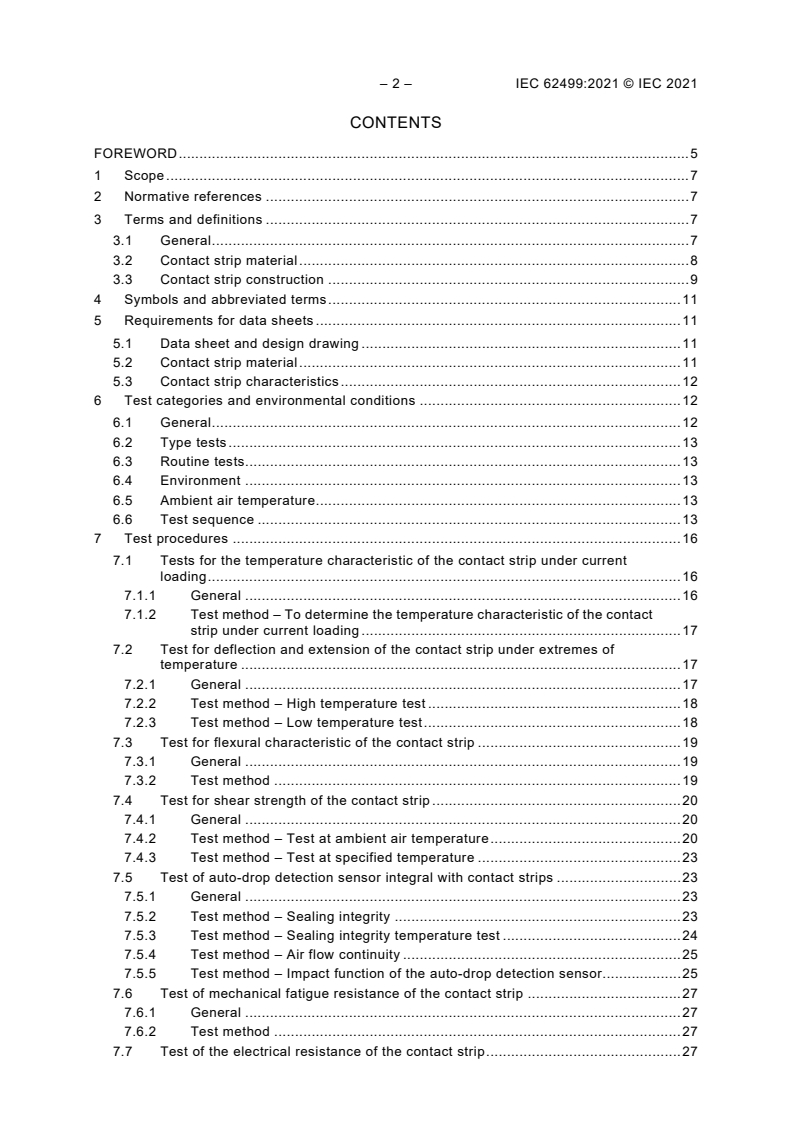
CONTENTS
FOREWORD . 5
1 Scope . 7
2 Normative references . 7
3 Terms and definitions . 7
3.1 General . 7
3.2 Contact strip material . 8
3.3 Contact strip construction . 9
4 Symbols and abbreviated terms . 11
5 Requirements for data sheets . 11
5.1 Data sheet and design drawing . 11
5.2 Contact strip material . 11
5.3 Contact strip characteristics . 12
6 Test categories and environmental conditions . 12
6.1 General . 12
6.2 Type tests . 13
6.3 Routine tests. 13
6.4 Environment . 13
6.5 Ambient air temperature . 13
6.6 Test sequence . 13
7 Test procedures . 16
7.1 Tests for the temperature characteristic of the contact strip under current
loading . 16
7.1.1 General . 16
7.1.2 Test method – To determine the temperature characteristic of the contact
strip under current loading . 17
7.2 Test for deflection and extension of the contact strip under extremes of
temperature . 17
7.2.1 General . 17
7.2.2 Test method – High temperature test . 18
7.2.3 Test method – Low temperature test . 18
7.3 Test for flexural characteristic of the contact strip . 19
7.3.1 General . 19
7.3.2 Test method . 19
7.4 Test for shear strength of the contact strip . 20
7.4.1 General . 20
7.4.2 Test method – Test at ambient air temperature . 20
7.4.3 Test method – Test at specified temperature . 23
7.5 Test of auto-drop detection sensor integral with contact strips . 23
7.5.1 General . 23
7.5.2 Test method – Sealing integrity . 23
7.5.3 Test method – Sealing integrity temperature test . 24
7.5.4 Test method – Air flow continuity . 25
7.5.5 Test method – Impact function of the auto-drop detection sensor. 25
7.6 Test of mechanical fatigue resistance of the contact strip . 27
7.6.1 General . 27
7.6.2 Test method . 27
7.7 Test of the electrical resistance of the contact strip . 27
7.7.1 General . 27
7.7.2 Test method . 28
7.8 Test of the metal content for metalized carbon contact strips and metal contact
strips . 28
7.8.1 General . 28
7.8.2 Method 1: Weighing a part before and after the impregnation . 29
7.8.3 Method 2: Determination of the apparent density of the material before
and after the impregnation . 29
7.8.4 Method 3: Weighing materials before sintering . 29
7.9 Test of the coefficient of friction . 29
7.9.1 General . 29
7.9.2 Test method . 30
7.10 Optional test of the impact resistance of the wearing material . 30
7.10.1 General . 30
7.10.2 Test method . 30
7.11 Test of the thermal fatigue properties of the contact strip . 30
7.11.1 General . 30
7.11.2 Test method – Thermal fatigue test . 31
7.12 Optional test of wear properties . 31
7.12.1 General . 31
7.12.2 Test method . 32
Annex A (informative) Parameters to be specified by the customer and graphical
representation of customer specified values for pantograph automatic dropping device
operation . 34
A.1 Parameters to be specified by the customer . 34
A.2 Graphical representation of customer specified values for pantograph
automatic dropping device operation . 35
Annex B (normative) Current loading test apparatus . 36
B.1 Current loading test apparatus – copper test electrode . 36
B.2 Current loading test apparatus . 37
Bibliography . 38
Figure 1 – Example of self-supported . 10
Figure 2 – Example of un-supported . 10
Figure 3 – High temperature test apparatus . 18
Figure 4 – Flexural characteristics test apparatus . 19
Figure 5 – Shear test sample preparation . 20
Figure 6 – Shear test fixture example. 21
Figure 7 – Shear test apparatus example . 22
Figure 8 – Force application tool example . 22
Figure 9 – Impact test device example . 26
Figure 10 – Air supply and monitoring apparatus example . 26
Figure 11 – Electrical resistance test apparatus example . 28
Figure 12 – Wear test rig example 1 . 32
Figure 13 – Wear test rig example 2 . 33
Figure A.1 – Graphical representation of customer specified values for pantograph
automatic dropping device operation . 35
Figure B.1 – Current loading test apparatus – copper test electrode . 36
– 4 – IEC 62499:2021 © IEC 2021
Figure B.2 – Current loading test apparatus . 37
Table 1 – Schedule of tests . 14
Table 2 – Sequence of tests . 16
Table 3 – Test current . 17
Table 4 – Test conditions – Test of mechanical fatigue resistance of the contact strip . 27
Table A.1 – Parameters to be specified by the customer . 34
INTERNATIONAL ELECTROTECHNICAL COMMISSION
____________
RAILWAY APPLICATIONS – CURRENT COLLECTION SYSTEMS –
PANTOGRAPHS, TESTING METHODS FOR CONTACT STRIPS
FOREWORD
1) The International Electrotechnical Commission (IEC) is a worldwide organization for standardization comprising
all national electrotechnical committees (IEC National Committees). The object of IEC is to promote international
co-operation on all questions concerning standardization in the electrical and electronic fields. To this end and in
addition to other activities, IEC publishes International Standards, Technical Specifications, Technical Reports,
Publicly Available Specifications (PAS) and Guides (hereafter referred to as “IEC Publication(s)”). Their
preparation is entrusted to technical committees; any IEC National Committee interested in the subject dealt with
may participate in this preparatory work. International, governmental and non-governmental organizations liaising
with the IEC also participate in this preparation. IEC collaborates closely with the International Organization for
Standardization (ISO) in accordance with conditions determined by agreement between the two organizations.
2) The formal decisions or agreements of IEC on technical matters express, as nearly as possible, an international
consensus of opinion on the relevant subjects since each technical committee has representation from all
interested IEC National Committees.
3) IEC Publications have the form of recommendations for international use and are accepted by IEC National
Committees in that sense. While all reasonable efforts are made to ensure that the technical content of IEC
Publications is accurate, IEC cannot be held responsible for the way in which they are used or for any
misinterpretation by any end user.
4) In order to promote international uniformity, IEC National Committees undertake to apply IEC Publications
transparently to the maximum extent possible in their national and regional publications. Any divergence between
any IEC Publication and the corresponding national or regional publication shall be clearly indicated in the latter.
5) IEC itself does not provide any attestation of conformity. Independent certification bodies provide conformity
assessment services and, in some areas, access to IEC marks of conformity. IEC is not responsible for any
services carried out by independent certification bodies.
6) All users should ensure that they have the latest edition of this publication.
7) No liability shall attach to IEC or its directors, employees, servants or agents including individual experts and
members of its technical committees and IEC National Committees for any personal injury, property damage or
other damage of any nature whatsoever, whether direct or indirect, or for costs (including legal fees) and expenses
arising out of the publication, use of, or reliance upon, this IEC Publication or any other IEC Publications.
8) Attention is drawn to the Normative references cited in this publication. Use of the referenced publications is
indispensable for the correct application of this publication.
9) Attention is drawn to the possibility that some of the elements of this IEC Publication may be the subject of patent
rights. IEC shall not be held responsible for identifying any or all such patent rights.
IEC 62499 has been prepared by IEC technical committee 9: Electrical equipment and systems
for railways. It is an International Standard.
It is based on EN 50405:2015.
This second edition cancels and replaces the first edition published in 2008. This edition
constitutes a technical revision.
This edition includes the following significant technical changes with respect to the previous
edition:
a) Title modified;
b) The scope of this standard is changed from carbon contact strips to contact strips;
c) Replacement of several reference standards;
d) Several terms and abbreviated terms are introduced;
• The definitions of metalized contact strip and metal contact strip are introduced
according to the metal or carbon content by weight;
• The definitions of contact strip structures and types are introduced;
– 6 – IEC 62499:2021 © IEC 2021
e) Requirements for data sheets are introduced;
f) Table 1: Schedule of tests and Table 2: Sequence of tests are introduced;
g) The requirements for certain test methods and test acceptance criteria are updated;
h) Test of metal content for metalized contact strip, test of the coefficient of friction, optional
test of the impact resistance of the carbon material and optional test of wear properties are
added;
i) Annex A and Annex B are introduced.
The text of this International Standard is based on the following documents:
Draft Report on voting
9/2762/FDIS 9/2773/RVD
Full information on the voting for its approval can be found in the report on voting indicated in the
above table.
The language used for the development of this International Standard is English.
This document was drafted in accordance with ISO/IEC Directives, Part 2, and developed in
accordance with ISO/IEC Directives, Part 1 and ISO/IEC Directives, IEC Supplement, available
at www.iec.ch/members_experts/refdocs. The main document types developed by IEC are
described in greater detail at www.iec.ch/standardsdev/publications.
The committee has decided that the contents of this document will remain unchanged until the
stability date indicated on the IEC website under webstore.iec.ch in the data related to the
specific document. At this date, the document will be
• reconfirmed,
• withdrawn,
• replaced by a revised edition, or
• amended.
IMPORTANT – The 'colour inside' logo on the cover page of this publication indicates
that it contains colours which are considered to be useful for the correct
understanding of its contents. Users should therefore print this document using a
colour printer.
RAILWAY APPLICATIONS – CURRENT COLLECTION SYSTEMS –
PANTOGRAPHS, TESTING METHODS FOR CONTACT STRIPS
1 Scope
This document gives rules for testing methods for newly manufactured pantographs contact
strips. Not all tests may be relevant to some designs of contact strips. This document excludes
tests using a particular pantograph. Additional supplementary tests, out of the scope of this
document, may be necessary to determine suitability for a particular application and are by prior
agreement between customer and manufacturer.
NOTE The customer can, among others, be the system integrator, the manufacturer, the purchaser, the operator of
the vehicle or the purchaser of the pantograph or a supervisory authority.
2 Normative references
The following documents are referred to in the text in such a way that some or all of their content
constitutes requirements of this document. For dated references, only the edition cited applies.
For undated references, the latest edition of the referenced document (including any
amendments) applies.
IEC 60413:1972, Test procedures for determining physical properties of brush materials for
electrical machines
IEC 60773:2021, Rotating electrical machines – Test methods and apparatus for the
measurement of the operational characteristics of brushes
ISO 148-1:2016, Metallic materials – Charpy pendulum impact test – Part 1: Test method
ISO 179-1:2010, Plastics – Determination of Charpy impact properties – Part 1:
Non-instrumented impact test
ISO 180:2019, Plastics – Determination of Izod impact strength
ISO 6508-1: Metallic materials – Rockwell hardness test – Part 1: Test method
3 Terms and definitions
For the purposes of this document, the following terms and definitions apply.
ISO and IEC maintain terminological databases for use in standardization at the following
addresses:
• IEC Electropedia: available at http://www.electropedia.org/
• ISO Online browsing platform: available at http://www.iso.org/obp
3.1 General
3.1.1
air flow continuity
uninterrupted flow of air
– 8 – IEC 62499:2021 © IEC 2021
3.1.2
air flow rate
flow rate, in standard litres per minute, based upon mass flow to be calculated at the standard
temperature and pressure (STP)
Note 1 to entry: Referenced at a temperature of 15 °C (288,15 K, 59℉) and an absolute pressure of 101,325 kPa
(1,013 25 bar, 1 standard atmosphere (atm)).
Note 2 to entry: Based upon the Standard Temperature and Pressure defined by ISO 13443.
3.1.3
auto-drop detection sensor
function incorporated in the contact strip which initiates the pantograph automatic dropping
device
Note 1 to entry: The tests specified in this document relate only to pantograph automatic dropping devices operated
by air.
3.1.4
pantograph automatic dropping device
ADD
device intended to lower the pantograph automatically if it is damaged
Note 1 to entry: The damage can include the contact strip and pantograph head, and other parts of the pantograph.
[SOURCE: IEC 60050-811:2017, 811-32-22]
3.1.5
rated current,
current value that the contact strip is designed to sustain in the expected lifetime of the contact
strip without degradation under the specified operating and environmental conditions
3.1.6
shear strength
force which can be withstood without failure of carbon material or the retention between the
wearing material and the integral carrier
3.2 Contact strip material
3.2.1
carbon contact strip
inclusive term for a metalized carbon or a plain carbon contact strip
3.2.2
plain carbon contact strip
hard carbon material, without added metal elements
Note 1 to entry: The material can contain additives, such as oil, wax or resin.
3.2.3
metalized carbon contact strip
strip composed of carbon and metal, which contains a metal content 65 % maximum by weight
Note 1 to entry: The material can contain additives and can be impregnated with oil, wax or resin.
3.2.4
metal contact strip
strip which is mainly composed of metal or metal alloy and the content of metal or metal alloy is
more than 65
3.3 Contact strip construction
NOTE The designs described in 3.3 may or may not include any of the following:
– Auto-drop detection sensor;
– Integrated end horns;
– Arc protection for integral carrier; either with additional components or coatings or with the carbon enshrouding
the supporting carrier.
3.3.1
bonded carbon contact strip
contact strip formed by a carbon contact strip permanently attached to an integral carrier by an
adhesive
3.3.2
carrier,
structure which supports the contact strip, but is not permanently attached to it, and is used as
an interface to the base plate of the pantograph head or the mounting point of the pantograph
3.3.3
copper clad contact strip
carbon contact strip housed in a formed copper sheath, with copper on the leading and trailing
faces extending from the base to the contact surface of the carbon
Note 1 to entry: Often referred to as a “Kasperowski” contact strip.
3.3.4
fitted carbon contact strip
contact strip formed by a carbon contact material permanently attached to an integral carrier
without the application of adhesive or solder
Note 1 to entry: This includes, but is not exclusive to, designs with carbon crimped, rolled or pressed into a carrier.
3.3.5
integral carrier
structure which supports the contact strip, and is permanently attached to it, without any
additional support between the contact strip and the base plate of the pantograph head or the
mounting points of the pantograph
3.3.6
metal and carbon composite contact strip
contact strip formed by vertical layers of metal mixed with layers of carbon permanently attached
to a carrier
3.3.7
self-supported
contact strip which does not need additional support between the mounting points used to
interface the contact strip and the pantograph (see Figure 1)
– 10 – IEC 62499:2021 © IEC 2021
Figure 1 – Example of self-supported
3.3.8
soldered carbon contact strip
contact strip formed by a carbon contact strip permanently attached to an integral carrier by
solder
3.3.9
un-supported
contact strip which requires mounting to an additional support structure (a carrier) before fitting
to the pantograph (see Figure 2)
Key
1 contact strip
2 carrier (for example)
Figure 2 – Example of un-supported
3.3.10
bolted carbon contact strip
carbon contact strip which can be directly bolted to a carrier
4 Symbols and abbreviated terms
A designed area of adhesion (mm )
F shear force (N)
s
R resistance (Ω)
Τ shear strength (N/mm )
s
T maximum temperature of the contact strip at the interface between the carrier and the
cs
“wearing material” determined by test (see 7.1) ( °C). The temperature is measured in
the “wearing material” immediately adjacent to the interface.
T the limit temperature at which the shear strength of the bond maintains a minimum
max
value determined by test (see 7.4.3) ( °C). (For bonded carbon contact trips). The
temperature is measured in the carbon immediately adjacent to the interface.
W weight of the part before impregnation
bi
W weight of the part after impregnation
ai
AD apparent density of the specimen before impregnation
b
AD apparent density of the specimen after impregnation
a
Δh vertical deflection in the middle of the contact strip (deflection upwards is positive)
Δl change in length of the contact strip assembly (increase in length is positive)
F test contact force (test 7.1.2)
A initial cross-sectional area of the contact wire (mm )
A cross-sectional area of contact wire after wear (mm )
h initial height of the contact strip sample (mm)
h height of the contact strip sample after wear (mm)
m initial mass of the contact strip sample (g)
m mass of contact strip sample after wear (g)
W running distance (10 km)
k
n the number of times pantograph passes through a contact wire (10 times)
tpp
W height wear ratio (mm/10 km)
h
W mass wear ratio (g/10 km)
m
2 4
W area wear ratio (mm /10 times)
a
W weight of the carbon powder
c
W weight of the metal powder
me
μ coefficient of friction
5 Requirements for data sheets
5.1 Data sheet and design drawing
The characteristics of the contact strip material should be provided in a data sheet and design
drawing.
5.2 Contact strip material
The following information is an example:
a) manufacturer's grade designation;
b) hardness according to IEC 60413 or ISO 6508-1;
– 12 – IEC 62499:2021 © IEC 2021
c) density according to IEC 60413;
d) flexural strength according to IEC 60413;
e) electric resistivity according to IEC 60413;
f) percentage of metal impregnation according to 7.8, with tolerance;
g) coefficient of friction according to 7.9;
h) material type e.g. plain carbon.
NOTE For metal contact strips information is provided according to alternative relevant standards.
5.3 Contact strip characteristics
The following information is an example:
a) contact strip construction as defined in 3.3 and Table 1;
b) data sheet and drawing reference numbers;
c) record of standard compliance and certification;
d) dimensions, tolerances and design drawings including specific requirements;
e) weight (new and fully worn) with tolerances;
NOTE 1 The worn weight, if provided, is an estimate based upon the service conditions.
f) designed rated current in operation;
NOTE 2 The designed rated current is defined by the manufacturer and customer, the manufacturer proves such
currents.
g) wear limit;
NOTE 3 The method and the basis for deciding the wear limit is shown by the manufacturer.
h) value of T determined by test 7.1;
cs
i) value of T determined by test 7.4.3;
max
j) maximum and minimum operating pressure for use with a pantograph automatic dropping
device;
k) air flow rate (in standard litres per minute) at minimum pressure for use with a pantograph
automatic dropping device;
l) minimum air leakage flow rate (in standard litres per minute) at specified pressure
corresponding to auto-drop operation;
NOTE 4 This parameter relates to IEC 60494-1:2013, 4.9. The value is given by the pantograph manufacturer to the
carbon contact strip manufacturer to use in the test of the auto-drop detection shock impact function test set out in
7.5.5.
m) minimum air flow rate (in standard litres per minute) at specified pressure, for operation of
auto-drop detection sensor.
NOTE 5 This parameter is defined to permit compliance with the time of 1 s mentioned in IEC 60494-1:2013, 6.2.5
for a specified pantograph. The value is given by the pantograph manufacturer to the carbon contact strip
manufacturer to use in the air flow continuity test set out in 7.5.4.
6 Test categories and environmental conditions
6.1 General
There are two categories of tests:
• type tests;
• routine tests.
The above tests are described in 6.2 to 6.3.
Supplementary tests may be required if they have been specified in the customer specification
and after agreement with the supplier.
6.2 Type tests
Type tests shall be performed on samples of a given design, in accordance with the schedule of
tests set out in Table 1 and Table 2.
Designs in current manufacture shall be considered to have satisfied the type tests if the
manufacturer can provide certified reports of type tests (complying with the test requirements
set out in this document) which have already been conducted successfully on identical
components.
NOTE IEC 60494-1:2013, 6.12.3 includes a combined test carried out by the customer during the running test of the
pantograph on the vehicle.
6.3 Routine tests
Routine tests shall be carried out in accordance with the schedule of tests set out in Table 1, to
verify that the properties of a product correspond to those determined during the type test.
Routine tests shall be performed on each item of equipment supplied, unless sampling is
specified by the customer.
6.4 Environment
The test shall be made indoors in an environment substantially free from air currents, except
those generated by heat from the sample being tested. In practice, this condition is reached
when the air velocity does not exceed 0,5 m/s.
6.5 Ambient air temperature
The ambient air temperature is the average temperature of the air surrounding the sample. It
shall be recorded during the tests.
The ambient air temperature during tests shall be more than +15 °C, but shall not exceed +30 °C.
No correction of the temperature-rise values shall be made for ambient air temperatures within
this range.
All tests shall be carried out at ambient air temperature unless otherwise specified.
6.6 Test sequence
Tests shall be performed in the sequence defined in Table 2 using the same sample for
successive tests as indicated in each column of the table.
NOTE The test sequence is set out in Table 2 to minimize the number of samples required for testing. Sample A is
subject to a comprehensive series of tests to demonstrate capability of withstanding stresses the contact strips
experience in service. A minimum of four sample contact strips plus material samples can be prepared to complete the
full series of tests.
– 14 – IEC 62499:2021 © IEC 2021
Table 1 – Schedule of tests
Routine
Type test
tests
Metal and carbon Metal
Bonded carbon Soldered carbon Fitted carbon Copper clad Bolted carbon
Design composite contact contact
g
contact strips contact strips contact strips contact strips contact strips
g g
strips strips
Test
7.1 Tests for the temperature
characteristic of the contact strip Yes Yes Yes Yes Yes Yes No Yes
under current loading
7.2 Test for deflection and
extension of the contact strip Yes Yes Yes Yes Yes Yes No Yes No
under extremes of temperature
7.3 Test for flexural characteristic
Yes No Yes No Yes No Yes No Yes No Yes No Yes No
of the contact strip
7.4 Test for shear strength of the Yes (if bonded or
e
Yes Yes No No No No
contact strip soldered)
7.5.2 Pantograph automatic
a a a a a a a a
Yes Yes Yes Yes Yes Yes Yes R
dropping device sealing integrity
7.5.3 Pantograph automatic
a a a a a a a
dropping device sealing integrity Yes Yes Yes Yes Yes Yes Yes
temperature test
7.5.4 Pantograph automatic
a a a a a a a a
dropping device air flow Yes Yes Yes Yes Yes Yes Yes R
continuity
7.5.5 Impact function of the
a a,c a a,c a a,c a,b,c a a,c a,b,c a a,c
Yes Yes Yes Yes Yes Yes No Yes Yes No Yes Yes
auto-drop detection sensor
7.6 Test of mechanical fatigue
Yes No Yes No Yes No Yes No Yes No Yes No Yes No
resistance of the contact strip
7.7 Test of the electrical Yes (type test Yes (type test Yes (if bonded or Yes (type test R (bonded
Yes Yes (type test only) No
resistance of the contact strip only) only) Soldered-type test only) only) only)
Self-
supported
Un-
supported
Self-
supported
Un-
supported
Self-
supported
Un-
supported
Self-
supported
Un-
supported
Self-
supported
Un-
supported
Self-
supported
Un-
supported
Self-
supported
Un-
supported
Routine
Type test
tests
Metal and carbon Metal
Bonded carbon Soldered carbon Fitted carbon Copper clad Bolted carbon
Design composite contact contact
g
contact strips contact strips contact strips contact strips contact strips
g g
strips strips
Test
7.8 Test of the metal content for
Yes (for carbon
metalized carbon contact strips Yes Yes Yes Yes (for carbon part) No Yes
part)
and metal contact strips
7.9 Test of the coefficient of Yes (for carbon
f
Yes Yes Yes Yes (for carbon part) No Yes
friction part)
7.10 Optional test of the impact
d d d d d d
No No No No No No No
resistance of the carbon material
7.11 Test of the thermal fatigue Yes(if bonded or
Yes Yes No No No No
properties of the contact strip soldered)
7.12 Optional test of wear
h h h h h h h
No No No No No No No
properties
a
Denote test that is only required if the strips are fitted with a pantograph auto-drop detection sensor.
b
The impact energy required to cause sufficient damage for activation of the pantograph auto-drop detection sensor with a copper clad strip or metal strip is extremely high when
compared to the energy with a bonded or soldered carbon. Manufacturer and customer to determine if this test is appropriate for this type of contact strip.
c
For unsupported contact strips, the performance of the pantograph automatic dropping device may be dependent upon the carrier mounted on the pantograph. The test is done on
the complete assembly. The customer is responsible for providing the additional supporting components necessary to undertake this test.
d
Optional test to be undertaken only if specifically requested by the customer.
e
If carrier is sufficiently large to clamp into test apparatus.
f
For metal contact strips information shall be provided according to alternative relevant standards.
g
Contact strips are allowed (if permitted in the infrastructure register) provided that:
– they are referenced in recognised standards, with mention of restrictions if any, or
– they have been subject to a test of suitability for use .
h
The test shall be carried out if a new material is adopted without the proven documents, such as field reference, for suitability to use.
Self-
supported
Un-
supported
Self-
supported
Un-
supported
Self-
supported
Un-
supported
Self-
supported
Un-
supported
Self-
supported
Un-
supported
Self-
supported
Un-
supported
Self-
supported
Un-
supported
– 16 – IEC 62499:2021 © IEC 2021
Table 2 – Sequence of tests
Design Sample A Sample B Sample C Sample D Individual
samples
Test Test Test Test Test
sequence sequence sequence sequence
7.1 Tests for the temperature
characteristic of the contact strip 4
under current loading
7.2 Test for deflection and extension
of the contact strip under extremes of 5
temperature
7.3 Test for flexural characteristic of 3
the contact strip (with 7.5.2)
14 (at
ambient air
7.4 Test for shear strength of the 1 (7.4.2)
temperature
contact strip and (7.4.3)
as specified
in 7.11)
7.5.2 Pantograph automatic dropping 2, 5 (at wear
2, 9 and 12 2
device sealing integrity limit)
7.5.3 Pantograph automatic dropping
device sealing integrity temperature 6
test
7.5.4 Pantograph automatic dropping
4 3
device air flow continuity
7.5.5 Impact function of the auto-drop
detection sensor
7.6 Test of mechanical fatigue
resistance of the contact strip
7.7 Test of the electrical resistance of
1, 8 and 11 1 1
the contact strip
7.8 Test of the metal content for
Material
metalized carbon contact strips and
a
sample
metal contact strips
Material
7.9 Test of the coefficient of friction
a
sample
7.10 Optional test of the impact Material
a
resistance of the carbon material sample
7.11 Test of the thermal fatigue
properties of the contact strip
7.12 Optional test of wear properties Test sample
a
Material samples need not be obtained from a finished contact strip.
7 Test procedures
7.1 Tests for the temperature characteristic of the contact strip under current loading
7.1.1 General
The test determines the temperature within the contact strip when carrying a defined current, T
cs
which is used as a reference temperature in subsequent tests. If the value of T measured in
cs
this test is less than 100 °C, then a value of 100 °C shall be used in the subsequent tests.
This test demonstrates that the strip design achieves dissipation of energy under current loading
so that the maximum design temperature limit is not exceeded when thermal equilibrium is
reached.
Continuous measurement (record interval shall be not more than 1 min) of the temperature shall
be used to determine the steady temperature reached at the defined current loading.
Recommended method to determine steady temperature is defined as follows: a steady
temperature is accepted when the recorded temperature fluctuation is less than
...