

IEC TS 62565-3-6:2026
(Main)Nanomanufacturing - Product specification - Part 3-6: Graphene-related products - Blank detail specification: graphene oxide in powders and dispersions
General Information
- Abstract
IEC TS 62565-3-6:2026 which is a Technical Specification, establishes the blank detail specification for graphene oxide in powders and aqueous dispersions.
This document defines a format for specifying key control characteristics (KCCs), including a list of these characteristics and their corresponding standardized measurement procedures, where available. Numeric values are left blank to be determined between the customer and supplier in the detail specification (DS).
In the DS, key control characteristics can be added or removed by mutual agreement.
If no standardized measurement procedures are available, guidelines in Annex A are presented, which can be used by the involved parties to assure consistent material quality.
For non-aqueous solvents, it is crucial to make modifications to address relevant characteristics such as appearance, pH, and viscosity.
- Status
- Published
- Publication Date
- 19-Feb-2026
- Technical Committee
- TC 113 - Nanotechnology for electrotechnical products and systems
- Drafting Committee
- WG 8 - TC 113/WG 8
- Current Stage
- PPUB - Publication issued
- Start Date
- 20-Feb-2026
- Completion Date
- 06-Mar-2026
Buy Documents
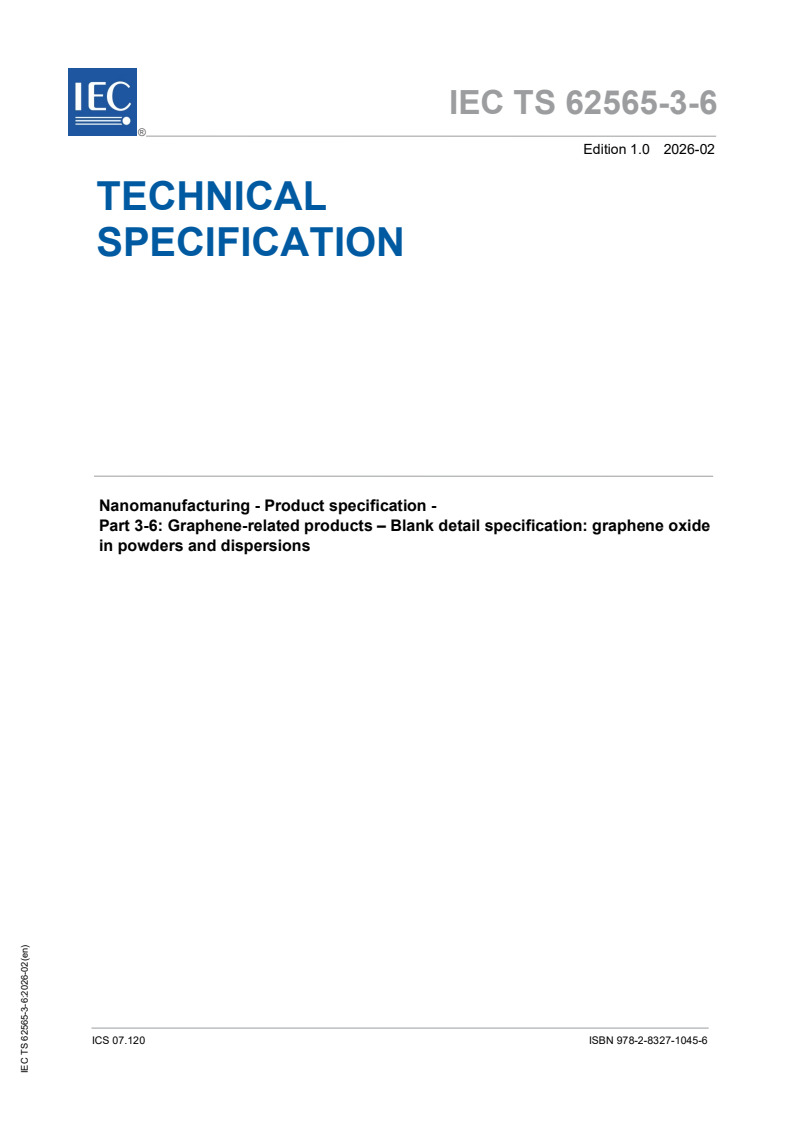

IEC TS 62565-3-6:2026 - Nanomanufacturing - Product specification - Part 3-6: Graphene-related products - Blank detail specification: graphene oxide in powders and dispersions
Overview
IEC TS 62565-3-6:2026 is a technical specification developed by the International Electrotechnical Commission (IEC) to standardize the blank detail specification (BDS) for graphene oxide in powders and aqueous dispersions. This document provides a clear structure for how to specify key control characteristics (KCCs) of graphene oxide products and outlines how suppliers and customers can agree on specific requirements for industrial and research applications. By offering a standardized template, it helps improve material comparison, procurement efficiency, and the consistency of graphene oxide quality across international markets.
Key Topics
- Blank Detail Specification (BDS): The standard presents a generic template for specifying the essential properties of graphene oxide, without setting fixed numerical values. These values are agreed upon between suppliers and customers in separate detail specifications (DS).
- Key Control Characteristics (KCCs): A comprehensive list of the crucial properties of graphene oxide, including suggested measurement procedures and references to standardized tests where available.
- Measurement Guidelines: Where no standardized measurement procedure exists, the specification offers guidance in Annex A to help maintain material quality and consistency.
- Product Forms and Solvent Considerations: The specification addresses both graphene oxide powders and aqueous dispersions. For non-aqueous solvents, key material characteristics such as appearance, pH, and viscosity should be specifically modified in the DS.
- Customization and Flexibility: The list of KCCs can be tailored by adding or removing items through mutual agreement, allowing adaptation to specific use cases.
- Quality Control: Emphasizes routine process checks and statistical process control, ensuring batch traceability and reporting of relevant technical and procurement information.
Applications
IEC TS 62565-3-6:2026 serves as a foundational tool in nanomanufacturing-especially for industries and research sectors that rely on consistent, high-quality graphene oxide materials. Applications span across:
- Coatings and Films: Enhancing barrier properties, strength, and conductivity.
- Filtration Materials: Used in membranes for water purification or gas separation.
- Life Sciences: As drug carriers, bio-sensors, and in functional fabrics for healthcare or smart textiles.
- Composites and Electronics: As components in conductive inks, batteries, supercapacitors, or other electronic devices.
Having a repeatable and transparent specification process helps buyers and sellers align on quality expectations, thereby enabling wider adoption and scale-up of graphene oxide technologies.
Related Standards
Several standards and references support the implementation of IEC TS 62565-3-6:2026:
- IEC TS 62565 Series: Covers product specifications for various nanomaterials and their industrial applications.
- ISO/TS 21356-1: Guidance for structural characterization of graphene from powders and dispersions.
- ISO 3954: Methods for sampling powders for metallurgical purposes.
- ISO/TS 80004-1: General terminology related to nanotechnologies.
- IEC TS 62607 Series: Test methods for key control characteristics of nanomaterials, including specific techniques for measuring graphene oxide properties.
Practical Value
- Facilitates Global Trade: By defining a common specification language, IEC TS 62565-3-6:2026 removes ambiguities during procurement and contract negotiations for graphene oxide materials.
- Supports Industrial Scale-Up: Ensures quality management and traceability, which are critical for manufacturers, suppliers, and end users seeking reliability in graphene-based products.
- Enables Innovation: Flexible adaptation of the specification template accelerates the introduction of new graphene oxide applications.
For organizations involved in nanomanufacturing, adopting this standard streamlines regulatory compliance, supports process optimization, and builds trust throughout the graphene oxide supply chain.
Buy Documents
IEC TS 62565-3-6:2026 - Nanomanufacturing - Product specification - Part 3-6: Graphene-related products - Blank detail specification: graphene oxide in powders and dispersions
Frequently Asked Questions
IEC TS 62565-3-6:2026 is a technical specification published by the International Electrotechnical Commission (IEC). Its full title is "Nanomanufacturing - Product specification - Part 3-6: Graphene-related products - Blank detail specification: graphene oxide in powders and dispersions". This standard covers: IEC TS 62565-3-6:2026 which is a Technical Specification, establishes the blank detail specification for graphene oxide in powders and aqueous dispersions. This document defines a format for specifying key control characteristics (KCCs), including a list of these characteristics and their corresponding standardized measurement procedures, where available. Numeric values are left blank to be determined between the customer and supplier in the detail specification (DS). In the DS, key control characteristics can be added or removed by mutual agreement. If no standardized measurement procedures are available, guidelines in Annex A are presented, which can be used by the involved parties to assure consistent material quality. For non-aqueous solvents, it is crucial to make modifications to address relevant characteristics such as appearance, pH, and viscosity.
IEC TS 62565-3-6:2026 which is a Technical Specification, establishes the blank detail specification for graphene oxide in powders and aqueous dispersions. This document defines a format for specifying key control characteristics (KCCs), including a list of these characteristics and their corresponding standardized measurement procedures, where available. Numeric values are left blank to be determined between the customer and supplier in the detail specification (DS). In the DS, key control characteristics can be added or removed by mutual agreement. If no standardized measurement procedures are available, guidelines in Annex A are presented, which can be used by the involved parties to assure consistent material quality. For non-aqueous solvents, it is crucial to make modifications to address relevant characteristics such as appearance, pH, and viscosity.
IEC TS 62565-3-6:2026 is classified under the following ICS (International Classification for Standards) categories: 07.120 - Nanotechnologies. The ICS classification helps identify the subject area and facilitates finding related standards.
IEC TS 62565-3-6:2026 is available in PDF format for immediate download after purchase. The document can be added to your cart and obtained through the secure checkout process. Digital delivery ensures instant access to the complete standard document.
Standards Content (Sample)
IEC TS 62565-3-6 ®
Edition 1.0 2026-02
TECHNICAL
SPECIFICATION
Nanomanufacturing - Product specification -
Part 3-6: Graphene-related products – Blank detail specification: graphene oxide
in powders and dispersions
ICS 07.120 ISBN 978-2-8327-1045-6
All rights reserved. Unless otherwise specified, no part of this publication may be reproduced or utilized in any form or
by any means, electronic or mechanical, including photocopying and microfilm, without permission in writing from either
IEC or IEC's member National Committee in the country of the requester. If you have any questions about IEC copyright
or have an enquiry about obtaining additional rights to this publication, please contact the address below or your local
IEC member National Committee for further information.
IEC Secretariat Tel.: +41 22 919 02 11
3, rue de Varembé info@iec.ch
CH-1211 Geneva 20 www.iec.ch
Switzerland
About the IEC
The International Electrotechnical Commission (IEC) is the leading global organization that prepares and publishes
International Standards for all electrical, electronic and related technologies.
About IEC publications
The technical content of IEC publications is kept under constant review by the IEC. Please make sure that you have the
latest edition, a corrigendum or an amendment might have been published.
IEC publications search - IEC Products & Services Portal - products.iec.ch
webstore.iec.ch/advsearchform Discover our powerful search engine and read freely all the
The advanced search enables to find IEC publications by a
publications previews, graphical symbols and the glossary.
variety of criteria (reference number, text, technical With a subscription you will always have access to up to date
committee, …). It also gives information on projects, content tailored to your needs.
replaced and withdrawn publications.
Electropedia - www.electropedia.org
IEC Just Published - webstore.iec.ch/justpublished The world's leading online dictionary on electrotechnology,
Stay up to date on all new IEC publications. Just Published containing more than 22 500 terminological entries in English
details all new publications released. Available online and and French, with equivalent terms in 25 additional languages.
once a month by email. Also known as the International Electrotechnical Vocabulary
(IEV) online.
IEC Customer Service Centre - webstore.iec.ch/csc
If you wish to give us your feedback on this publication or
need further assistance, please contact the Customer
Service Centre: sales@iec.ch.
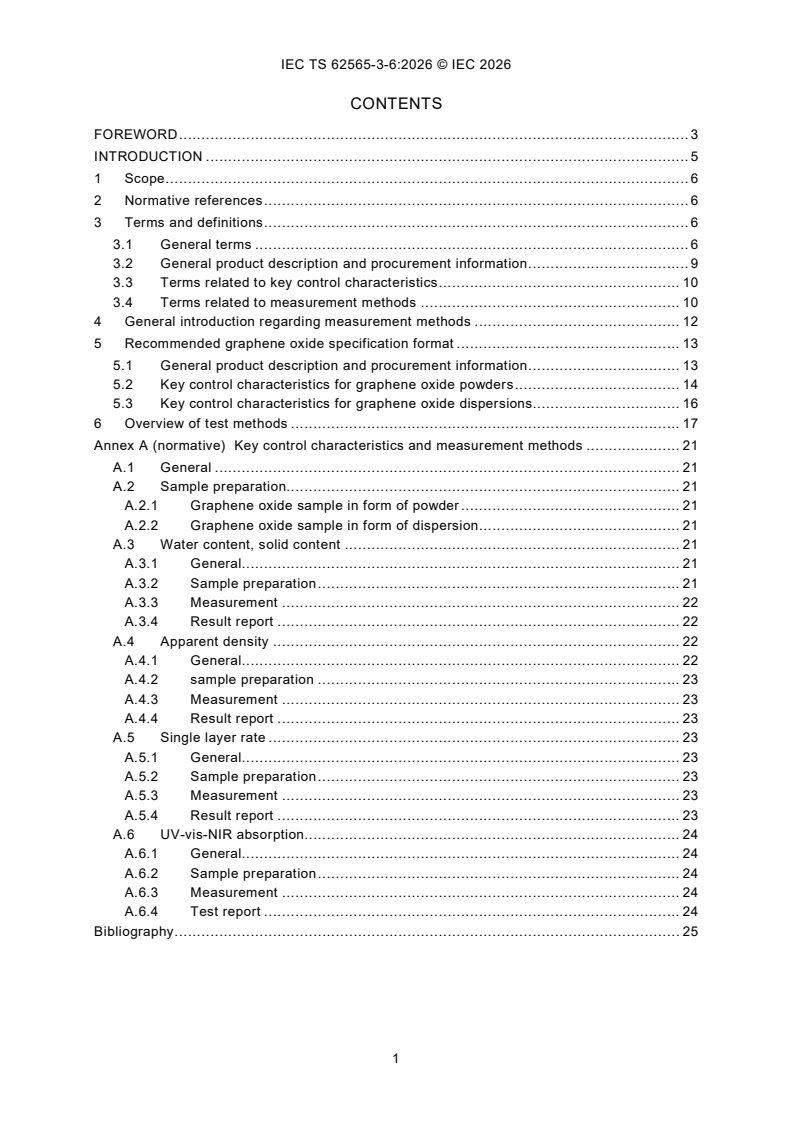
CONTENTS
FOREWORD . 3
INTRODUCTION . 5
1 Scope . 6
2 Normative references . 6
3 Terms and definitions . 6
3.1 General terms . 6
3.2 General product description and procurement information . 9
3.3 Terms related to key control characteristics . 10
3.4 Terms related to measurement methods . 10
4 General introduction regarding measurement methods . 12
5 Recommended graphene oxide specification format . 13
5.1 General product description and procurement information . 13
5.2 Key control characteristics for graphene oxide powders . 14
5.3 Key control characteristics for graphene oxide dispersions. 16
6 Overview of test methods . 17
Annex A (normative) Key control characteristics and measurement methods . 21
A.1 General . 21
A.2 Sample preparation. 21
A.2.1 Graphene oxide sample in form of powder . 21
A.2.2 Graphene oxide sample in form of dispersion . 21
A.3 Water content, solid content . 21
A.3.1 General. 21
A.3.2 Sample preparation . 21
A.3.3 Measurement . 22
A.3.4 Result report . 22
A.4 Apparent density . 22
A.4.1 General. 22
A.4.2 sample preparation . 23
A.4.3 Measurement . 23
A.4.4 Result report . 23
A.5 Single layer rate . 23
A.5.1 General. 23
A.5.2 Sample preparation . 23
A.5.3 Measurement . 23
A.5.4 Result report . 23
A.6 UV-vis-NIR absorption . 24
A.6.1 General. 24
A.6.2 Sample preparation . 24
A.6.3 Measurement . 24
A.6.4 Test report . 24
Bibliography . 25
Table 1 – General procurement information . 13
Table 2 – General material description . 14
Table 3 – Key control characteristics for graphene oxide powder . 15
Table 4 – Key control characteristics for graphene oxide dispersions . 16
Table 5 – Overview of measurement methods . 18
INTERNATIONAL ELECTROTECHNICAL COMMISSION
____________
Nanomanufacturing - Product specification -
Part 3-6: Graphene-related products -
Blank detail specification: graphene oxide in powders and dispersions
FOREWORD
1) The International Electrotechnical Commission (IEC) is a worldwide organization for standardization comprising
all national electrotechnical committees (IEC National Committees). The object of IEC is to promote international
co-operation on all questions concerning standardization in the electrical and electronic fields. To this end and
in addition to other activities, IEC publishes International Standards, Technical Specifications, Technical Reports,
Publicly Available Specifications (PAS) and Guides (hereafter referred to as “IEC Publication(s)”). Their
preparation is entrusted to technical committees; any IEC National Committee interested in the subject dealt with
may participate in this preparatory work. International, governmental and non-governmental organizations liaising
with the IEC also participate in this preparation. IEC collaborates closely with the International Organization for
Standardization (ISO) in accordance with conditions determined by agreement between the two organizations.
2) The formal decisions or agreements of IEC on technical matters express, as nearly as possible, an international
consensus of opinion on the relevant subjects since each technical committee has representation from all
interested IEC National Committees.
3) IEC Publications have the form of recommendations for international use and are accepted by IEC National
Committees in that sense. While all reasonable efforts are made to ensure that the technical content of IEC
Publications is accurate, IEC cannot be held responsible for the way in which they are used or for any
misinterpretation by any end user.
4) In order to promote international uniformity, IEC National Committees undertake to apply IEC Publications
transparently to the maximum extent possible in their national and regional publications. Any divergence between
any IEC Publication and the corresponding national or regional publication shall be clearly indicated in the latter.
5) IEC itself does not provide any attestation of conformity. Independent certification bodies provide conformity
assessment services and, in some areas, access to IEC marks of conformity. IEC is not responsible for any
services carried out by independent certification bodies.
6) All users should ensure that they have the latest edition of this publication.
7) No liability shall attach to IEC or its directors, employees, servants or agents including individual experts and
members of its technical committees and IEC National Committees for any personal injury, property damage or
other damage of any nature whatsoever, whether direct or indirect, or for costs (including legal fees) and
expenses arising out of the publication, use of, or reliance upon, this IEC Publication or any other IEC
Publications.
8) Attention is drawn to the Normative references cited in this publication. Use of the referenced publications is
indispensable for the correct application of this publication.
9) IEC draws attention to the possibility that the implementation of this document may involve the use of (a)
patent(s). IEC takes no position concerning the evidence, validity or applicability of any claimed patent rights in
respect thereof. As of the date of publication of this document, IEC had not received notice of (a) patent(s), which
may be required to implement this document. However, implementers are cautioned that this may not represent
the latest information, which may be obtained from the patent database available at https://patents.iec.ch. IEC
shall not be held responsible for identifying any or all such patent rights.
IEC TS 62565-3-6 has been prepared by IEC technical committee 113: Nanotechnology for
electrotechnical products and systems. It is a Technical Specification.
The text of this Technical Specification is based on the following documents:
Draft Report on voting
113/933/DTS 113/950/RVDTS
Full information on the voting for its approval can be found in the report on voting indicated in
the above table.
The language used for the development of this Technical Specification is English.
This document was drafted in accordance with ISO/IEC Directives, Part 2, and developed in
accordance with ISO/IEC Directives, Part 1 and ISO/IEC Directives, IEC Supplement, available
at www.iec.ch/members_experts/refdocs. The main document types developed by IEC are
described in greater detail at www.iec.ch/publications.
A list of all parts in the IEC 62565 series, published under the general title Nanomanufacturing -
Material specifications, can be found on the IEC website.
The committee has decided that the contents of this document will remain unchanged until the
stability date indicated on the IEC website under webstore.iec.ch in the data related to the
specific document. At this date, the document will be
– reconfirmed,
– withdrawn, or
– revised.
INTRODUCTION
This document establishes a standardized method to specify graphene-based materials of the
type of graphene oxide in form of powder and powders dispersed in liquids. Commercially
available graphene oxide differs in multiple ways from the perfect graphene oxide structure as
described in the correct academic definition as a monolayer of an oxidized honeycomb
arrangement of carbon atoms with a carbon-to-oxygen (C/O) ratio of 2,0.
Typical application areas of graphene oxide are coatings, filters, drug carriers, bio-sensors, and
functional fabrics.
A quite common way to synthesise graphene oxide is the processing of graphite in concentrated
acid in the presence of an oxidizing agent to exfoliate the graphene layers. Depending on the
application, graphene oxide is made available as dry powder and liquid dispersion, e.g. in water.
The structure of graphene oxide strongly depends on the method of synthesis. The graphene
oxide flakes have various types of small and large defects. Beside the oxygen bound to both
sides of the carbon monolayer, it is typically decorated with different types of oxygen containing
functional groups.
Subtle differences in the physical structure cause large differences in electrical, optical, and
chemical properties of graphene oxide. Therefore, it is important that vendors and users specify
the material as precisely as possible. A clear understanding and precise definition of these key
control characteristics (KCCs) as well as the availability of standardized measurement methods
to measure them is essential to guarantee consistent delivery of materials and intermediate
products into industrial processes.
According to the philosophy of the IEC Technical Committee 113 (IEC/TC 113), this is done by
the establishment of this document about graphene oxide which lists all technically relevant
KCCs of the material in a standardized template.
The referenced measurement standards are taken preferably from the 62607 series because
these standards are focused to provide exactly the information from the KCC table. If no 62607
standard exists, other standards can be referenced. As it is mandatory in those cases to provide
guidelines for the use of a given standard, these are given in Annex A.
Beside the specified KCCs listed in the BDS, there are always some hidden parameters which
are not completely under control. Therefore, general requirements like the method of the
production process as well as any kind of post processing (e.g. cleaning) is also part of the
document. Vendors and users are invited to add or remove listed KCCs if that is required by
the application, and to send their feedback to IEC/TC 113.
In summary, a standardized BDS is essential for the industrialization of graphene technologies
and crucial for the continued growth of applications incorporating graphene oxide. As significant
differences in both methodology and interpretation of measurement results at the current
Technical Readiness Level (TRL) continue to exist from one measurement laboratory to another,
it is important that this document as well as the referenced KCC measurement standards of the
62607 series be revised frequently to ensure that the standards represent the state of the art
of the technology.
1 Scope
This part of IEC 62565 establishes the blank detail specification for graphene oxide in powders
and aqueous dispersions.
This document defines a format for specifying key control characteristics (KCCs), including a
list of these characteristics and their corresponding standardized measurement procedures,
where available. Numeric values are left blank to be determined between the customer and
supplier in the detail specification (DS).
In the DS, key control characteristics can be added or removed by mutual agreement.
If no standardized measurement procedures are available, guidelines in Annex A are presented,
which can be used by the involved parties to assure consistent material quality.
For non-aqueous solvents, it is crucial to make modifications to address relevant characteristics
such as appearance, pH, and viscosity.
2 Normative references
The following documents are referred to in the text in such a way that some or all of their content
constitutes requirements of this document. For dated references, only the edition cited applies.
For undated references, the latest edition of the referenced document (including any
amendments) applies.
ISO 3954, Powders for powder metallurgical purposes - Sampling
ISO/TS 21356-1, Nanotechnologies - Structural characterization of graphene - Part 1: Graphene
from powders and dispersions
3 Terms and definitions
For the purposes of this document, the following terms and definitions apply.
ISO and IEC maintain terminology databases for use in standardization at the following
addresses:
– IEC Electropedia: available at https://www.electropedia.org/
– ISO Online browsing platform: available at https://www.iso.org/obp
3.1 General terms
3.1.1
nanomanufacturing
intentional synthesis, generation or control of nanomaterials, or fabrication step in the
nanoscale, for commercial purposes
[SOURCE: ISO/TS 80004-1:2015, 2.11]
3.1.2
key control characteristics
KCC
material property or intermediate product characteristic which can affect safety or compliance
with regulations, fit, function, performance, quality, reliability or subsequent processing of the
final product
Note 1 to entry: The measurement of a key control characteristic is described in a standardized measurement
procedure with known accuracy and precision.
Note 2 to entry: It is possible to define more than one measurement methods for a key control characteristic if the
correlation of the results is well-defined and known.
[SOURCE: IEC TS 62565-1:2023, 3.1]
3.1.3
product specification
structured document which describes all characteristics of a product known to be relevant for
applications of that product.
3.1.4
blank detail specification
BDS
structured generic specification of the set of key control characteristics which are necessary to
describe a specific nano-enabled product without assigning specific values or attributes
Note 1 to entry: Examples of nano-enabled products are: nanomaterials, nanocomposites and nano-subassemblies.
Note 2 to entry: Blank detail specifications are intended to be used by industrial users to prepare their detail
specifications used in bilateral procurement contracts. A blank detail specification facilitates the comparison and
benchmarking of different materials. Furthermore, a standardized format makes procurement more efficient and more
error robust.
3.1.5
detail specification
DS
specification based on a blank detail specification or sectional blank detail specification with
assigned values and attributes
Note 1 to entry: The properties listed in the detail specification are usually a subset of the key control characteristics
listed in the relevant blank detail specification or sectional blank detail specification. The industrial partners define
only those properties which are required for the intended application.
Note 2 to entry: Detail specifications are defined by the industrial partners. SDOs will be involved only if there is a
general need for a detail specification in an industrial sector.
Note 3 to entry: The industrial partners may define additional key control characteristics if they are not listed in the
blank detail specification or sectional blank detail specification.
3.1.6
measurand
quantity intended to be measured
Note 1 to entry: If the quantity is a key control characteristic, the measurement is an essential part of the quality
management system.
3.1.7
measurement method
process of experimentally obtaining one or more values that can reasonably be attributed to a
quantity
Note 1 to entry: If the quantity is a key control characteristic, the measurement is an essential part of the quality
management system.
3.1.8
measurement principle
phenomenon serving as a basis of a measurement
EXAMPLE 1 Thermoelectric effect applied to the measurement of temperature.
EXAMPLE 2 Energy absorption applied to the measurement of amount-of-substance concentration.
EXAMPLE 3 Hall effect applied to the measurement of magnetic flux density.
Note 1 to entry: The phenomenon can be of a physical, chemical, or biological nature.
[SOURCE: IEC 60050-112-04:2010, 112-04-03]
3.1.9
measurement procedure
detailed description of a measurement according to one or more measurement principles and
to a given measurement method, based on a measurement model, and including any calculation
to obtain a measurement result
Note 1 to entry: A measurement procedure is usually documented in sufficient detail to enable an operator to
perform a measurement.
Note 2 to entry: A measurement procedure can include a statement concerning a target measurement uncertainty.
Note 3 to entry: A measurement procedure is sometimes called a standard operating procedure, abbreviated SOP.
[SOURCE: JCGM 200:2012, 2.6]
3.1.10
standard operation procedure
SOP
authorized, documented procedure or set of procedures, work instructions and test instructions
for production and control
[SOURCE: ISO 15378:2017, 3.7.10]
3.1.11
measurement result
set of quantity values being attributed to a measurand together with any other available relevant
Information
Note 1 to entry: A measurement result is generally expressed as a single measured quantity value and a
measurement uncertainty. If the measurement uncertainty is considered to be negligible for some purpose, the
measurement result may be expressed as a single measured quantity value. In many fields, this is the common way
of expressing a measurement result.
[SOURCE: JCGM 200:2012, 2.9, modified – Note 1 and 3 to entry have been removed.]
3.1.12
measurement accuracy
closeness of agreement between a measured quantity value and a true quantity value of a
measurand
Note 1 to entry: The concept ‘measurement accuracy’ is not a quantity and is not given a numerical quantity value.
A measurement is said to be more accurate when it offers a smaller measurement error.
[SOURCE: JCGM 200:2012, 2.13, modified – Notes 2 and 3 to entry have been removed.]
3.1.13
measurement standard
standardized measurement procedure
normative document established by consensus and approved by a recognized body, that
provides a measurement procedure, for common and repeated use, aimed at the achievement
of the optimum degree of order in a given context
Note 1 to entry: Standards should be based on the consolidated results of science, technology and experience, and
aimed at the promotion of optimum community benefits.
3.1.14
good practice guide
GPG
informal document which is not necessarily peer reviewed but can be used as a working
document to establish a measurement procedure
Note 1 to entry: A GPG serves as the first document based on initial scientific research which is intended to be the
first step toward future standardization.
3.1.15
standard maturity level
SML
measure for estimating the maturity of a measurement procedure based on the consensus
achieved in the stakeholder community
Note 1 to entry: SML 1 - No documented measurement procedure available.
Note 2 to entry: SML 2 - Good practice guide publicly available based on a reasonable consensus achieved in the
stakeholder community, e.g. an industrial or academic consortia.
Note 3 to entry: SML 3 - IEC/ISO standard or technical specification available which can be applied with
modification and adaption to the intended application and use case of the BDS scope.
Note 4 to entry: SML 4 - IEC/ISO standard or technical specification available for the exact intended application
and use case of the BDS.
3.1.16
use case
specification of a generalized field of application, possibly entailing the following information
about the system: one or several scenarios, the functional range, the desired behaviour, and
the system boundaries
Note 1 to entry: The use case description typically does not include a detailed list of all relevant scenarios for this
use case. Instead, a more abstract description of these scenarios is used.
[SOURCE: ISO/PAS 21448:2019, 3.16]
3.2 General product description and procurement information
3.2.1
graphene
graphene layer
single-layer graphene
monolayer graphene
single layer of carbon atoms with each atom bound to three neighbours in a honeycomb
structure
Note 1 to entry: It is an important building block of many carbon nano-objects.
Note 2 to entry: As graphene is a single layer, it is also sometimes called monolayer graphene or single-layer
graphene and abbreviated as 1LG to distinguish it from bilayer graphene (2LG) and few-layered graphene (FLG).
Note 3 to entry: Graphene has edges and can have defects and grain boundaries where the bonding is disrupted.
[SOURCE: ISO/TS 80004‑3:2020, 3.1.13]
3.2.2
graphene oxide
GO
chemically modified single-layer graphene (3.1) prepared by extensive oxidative modification
of the basal planes
Note 1 to entry: Graphene oxide is a single-layer material with a high oxygen content (3.3.1), typically characterized
by C/O atomic ratios of approximately 2,0 depending on the method of synthesis.
[SOURCE: ISO/TS 80004-13:2024, 3.1.2.14, modified – Notes 2, 3 and 4 to entry have been
deleted.]
3.2.3
dispersion
microscopic multi-phase system in which discontinuities of any state (solid, liquid or gas:
discontinuous phase) are dispersed in a continuous phase of a different composition or state
Note 1 to entry: If solid particles are dispersed in a liquid, the dispersion is referred to as a suspension. If the
dispersion consists of two or more liquid phases, it is termed an emulsion. A suspoemulsion consists of both solid
and liquid phases dispersed in a continuous liquid phase.
[SOURCE: ISO/TR 13097:2013, 2.5]
3.2.4
aqueous dispersion
microscopic multi-phase system in which discontinuities are dispersed in a continuous phase
of water
3.3 Terms related to key control characteristics
3.3.1
oxygen content
amount of total oxygen in the graphene oxide (3.2.2)
3.4 Terms related to measurement methods
3.4.1
atomic force microscopy
AFM
method for imaging surfaces by mechanically scanning their surface contours, in which the
deflection of a sharp tip sensing the surface forces, mounted on a compliant cantilever, is
monitored
Note 1 to entry: AFM can provide a quantitative height image of both insulating and conducting surfaces.
Note 2 to entry: Some AFM instruments move the sample in the x-, y- and z-directions while keeping the tip position
constant and other move the tip while keeping the sample position constant.
Note 3 to entry: AFM can be conducted in vacuum, a liquid, a controlled atmosphere, or air. Atomic resolution may
be attainable with suitable samples, with sharp tips, and by using an appropriate imaging mode.
Note 4 to entry: Many types of force can be measured, such as the normal forces or the lateral, friction or shear
force. When the latter is measured, the technique is referred to as lateral, frictional or shear force microscopy. This
generic term encompasses all of these types of force microscopy.
Note 5 to entry: AFMs can be used to measure surface normal forces at individual points in the pixel array used for
imaging.
Note 6 to entry: For typical AFM tips with radii < 100 nm, the normal force should be less than about 0.1 mN,
depending on the sample material or irreversible surface deformation and excessive tip wear occurs.
[SOURCE: ISO/
...