

IEC 61557-1:2019
(Main)Electrical safety in low voltage distribution systems up to 1 000 V AC and 1 500 V DC - Equipment for testing, measuring or monitoring of protective measures - Part 1: General requirements
General Information
- Abstract
IEC 61557-1:2019 specifies the general requirements applicable to measuring and monitoring equipment for testing the electrical safety in low-voltage distribution systems with nominal voltages up to 1 000 V AC and 1 500 V DC. When measuring equipment or measuring installations involve measurement tasks of various measuring equipment covered by this series of standards, then the part of this series relevant to each of the measurement tasks is applicable. Other parts of IEC 61557 can specify additional requirements or deviations. This document does not cover functional safety or cybersecurity. IEC 61557-1:2019 cancels and replaces the second edition published in 2007. This edition constitutes a technical revision. This third edition includes the following significant technical changes with respect to the previous edition:
a) terms aligned with IEC 60050;
b) measurement of uncertainty revised according to the equations in 4.2 of ISO/IEC Guide 98-3:2008 (GUM);
c) updated references for safety and EMC requirements;
d) updated references for marking and operating instructions;
e) updated references for testing safety and EMC;
f) Annex A contains an explanation of GUM;
g) Annex B addresses environmental aspects.
- Status
- Published
- Publication Date
- 14-Oct-2024
- Technical Committee
- TC 85 - Measuring equipment for electrical and electromagnetic quantities
- Drafting Committee
- WG 8 - TC 85/WG 8
- Current Stage
- PPUB - Publication issued
- Start Date
- 26-Jul-2019
- Completion Date
- 09-Aug-2019
Buy Documents
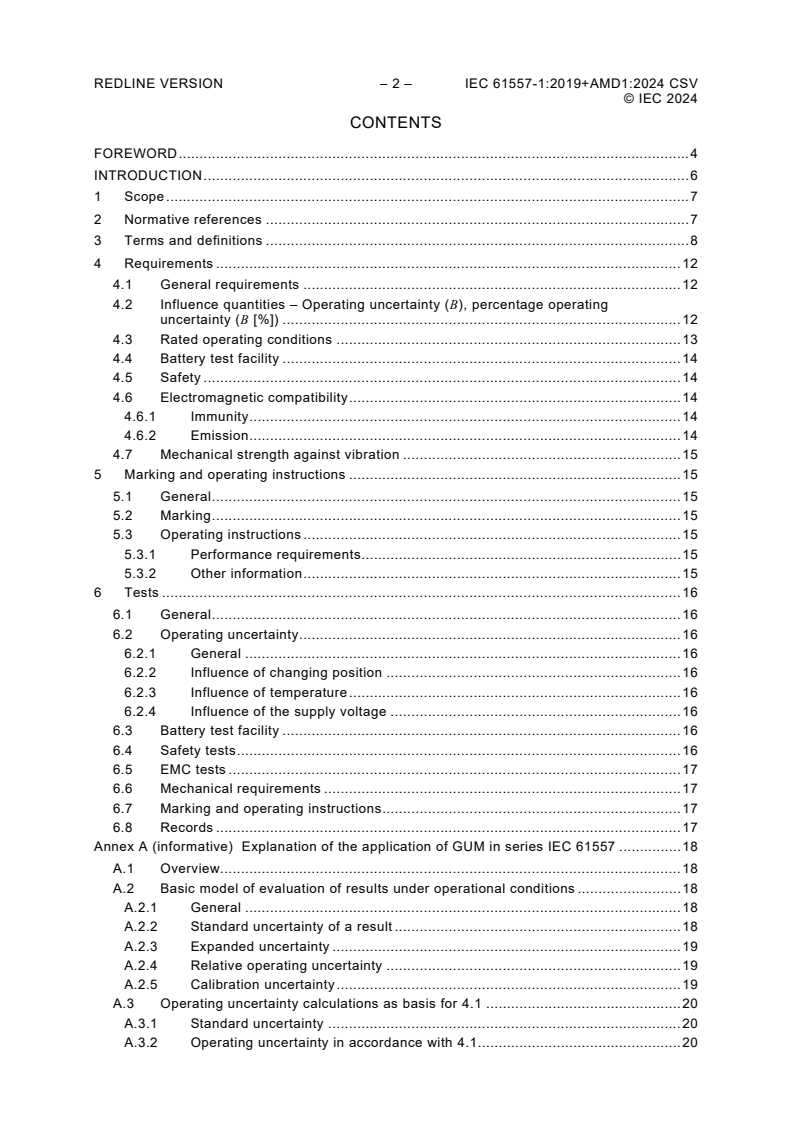
IEC 61557-1:2019+AMD1:2024 CSV - Electrical safety in low voltage distribution systems up to 1 000 V AC and 1 500 V DC - Equipment for testing, measuring or monitoring of protective measures - Part 1: General requirements Released:10/15/2024
IEC 61557-1:2019 RLV - Electrical safety in low voltage distribution systems up to 1 000 V AC and 1 500 V DC - Equipment for testing, measuring or monitoring of protective measures - Part 1: General requirements Released:7/26/2019
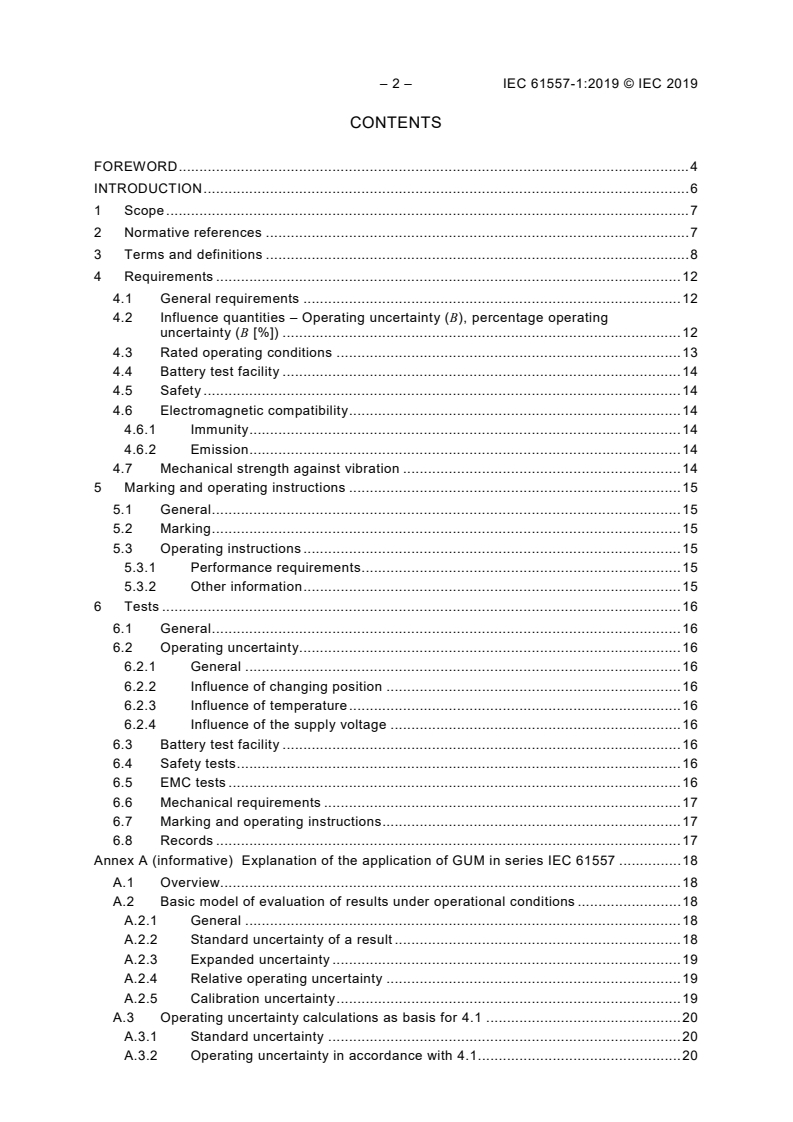
IEC 61557-1:2019 - Electrical safety in low voltage distribution systems up to 1 000 V AC and 1 500 V DC - Equipment for testing, measuring or monitoring of protective measures - Part 1: General requirements Released:7/26/2019
Overview
IEC 61557-1:2019 - "Electrical safety in low voltage distribution systems up to 1 000 V AC and 1 500 V DC - Equipment for testing, measuring or monitoring of protective measures - Part 1: General requirements" - defines the general requirements for measuring and monitoring equipment used to test electrical safety in low-voltage distribution systems. This Part 1 sets the baseline requirements that apply across the IEC 61557 series, covering devices used for verification, periodic testing and continuous monitoring of protective measures. It does not cover functional safety or cybersecurity.
Key updates in the 2019 (3rd) edition include alignment of terms with IEC 60050, adoption of measurement-of-uncertainty equations from the GUM (ISO/IEC Guide 98‑3:2008), updated safety and EMC references, and informative Annexes on GUM (Annex A) and environmental aspects (Annex B).
Key Topics
- Scope and definitions: standardized terms and classifications for low-voltage test equipment (up to 1 000 V AC / 1 500 V DC).
- Operating uncertainty: requirements and methods for evaluating measurement uncertainty according to the GUM, including influence quantities and expanded uncertainty.
- Rated operating conditions: specified supply and environmental conditions under which the equipment must meet performance criteria.
- Safety requirements: protective measures for users and third parties; integration with device safety standards.
- EMC: emission and immunity requirements to ensure reliable operation in real-world electrical environments.
- Mechanical tests: vibration and mechanical strength requirements for robustness in field use.
- Battery check and terminals: requirements for battery-powered instruments and secure terminals/connectors.
- Marking and operating instructions: mandatory markings, performance claims and user documentation to support safe and repeatable testing.
- Tests and records: mandatory test procedures (uncertainty, safety, EMC, mechanical) and documentation of results.
Applications
IEC 61557-1 is intended for:
- Manufacturers and designers of electrical test and monitoring instruments (insulation testers, loop/earth testers, RCD testers, insulation monitoring devices).
- Test laboratories and certification bodies assessing conformity with IEC 61557 series.
- Electrical contractors, installation testers and maintenance engineers specifying or using test equipment for compliance, commissioning and preventive maintenance.
- Procurement teams seeking standards-based specifications for low-voltage test equipment.
Practical benefits include improved safety, consistent measurement comparability between devices, and traceable uncertainty evaluation - essential for handover testing, warranty verification and continuous insulation monitoring.
Related Standards
- IEC 61557 series (other parts specify device‑specific requirements)
- IEC 60050 (electrotechnical vocabulary)
- ISO/IEC Guide 98‑3:2008 (GUM - uncertainty)
- IEC 61010‑1 (safety of measurement equipment)
- IEC 60364‑6 (installation testing requirements)
- IEC 62474 (material declaration guidance referenced in Annex B)
Keywords: IEC 61557-1, electrical safety, low voltage, test equipment, measurement uncertainty, GUM, EMC, insulation monitoring, protective measures.
Relations
- Effective Date
- 20-Oct-2023
- Effective Date
- 05-Sep-2023
Buy Documents
IEC 61557-1:2019+AMD1:2024 CSV - Electrical safety in low voltage distribution systems up to 1 000 V AC and 1 500 V DC - Equipment for testing, measuring or monitoring of protective measures - Part 1: General requirements Released:10/15/2024
IEC 61557-1:2019 RLV - Electrical safety in low voltage distribution systems up to 1 000 V AC and 1 500 V DC - Equipment for testing, measuring or monitoring of protective measures - Part 1: General requirements Released:7/26/2019
IEC 61557-1:2019 - Electrical safety in low voltage distribution systems up to 1 000 V AC and 1 500 V DC - Equipment for testing, measuring or monitoring of protective measures - Part 1: General requirements Released:7/26/2019
Get Certified
Connect with accredited certification bodies for this standard

IMQ S.p.A. (Certification)
Italian electrical product certification.

SLG Prüf- und Zertifizierungs GmbH
German testing and certification body.

UL Solutions
Global safety science company with testing, inspection and certification.
Sponsored listings
Frequently Asked Questions
IEC 61557-1:2019 is a standard published by the International Electrotechnical Commission (IEC). Its full title is "Electrical safety in low voltage distribution systems up to 1 000 V AC and 1 500 V DC - Equipment for testing, measuring or monitoring of protective measures - Part 1: General requirements". This standard covers: IEC 61557-1:2019 specifies the general requirements applicable to measuring and monitoring equipment for testing the electrical safety in low-voltage distribution systems with nominal voltages up to 1 000 V AC and 1 500 V DC. When measuring equipment or measuring installations involve measurement tasks of various measuring equipment covered by this series of standards, then the part of this series relevant to each of the measurement tasks is applicable. Other parts of IEC 61557 can specify additional requirements or deviations. This document does not cover functional safety or cybersecurity. IEC 61557-1:2019 cancels and replaces the second edition published in 2007. This edition constitutes a technical revision. This third edition includes the following significant technical changes with respect to the previous edition: a) terms aligned with IEC 60050; b) measurement of uncertainty revised according to the equations in 4.2 of ISO/IEC Guide 98-3:2008 (GUM); c) updated references for safety and EMC requirements; d) updated references for marking and operating instructions; e) updated references for testing safety and EMC; f) Annex A contains an explanation of GUM; g) Annex B addresses environmental aspects.
IEC 61557-1:2019 specifies the general requirements applicable to measuring and monitoring equipment for testing the electrical safety in low-voltage distribution systems with nominal voltages up to 1 000 V AC and 1 500 V DC. When measuring equipment or measuring installations involve measurement tasks of various measuring equipment covered by this series of standards, then the part of this series relevant to each of the measurement tasks is applicable. Other parts of IEC 61557 can specify additional requirements or deviations. This document does not cover functional safety or cybersecurity. IEC 61557-1:2019 cancels and replaces the second edition published in 2007. This edition constitutes a technical revision. This third edition includes the following significant technical changes with respect to the previous edition: a) terms aligned with IEC 60050; b) measurement of uncertainty revised according to the equations in 4.2 of ISO/IEC Guide 98-3:2008 (GUM); c) updated references for safety and EMC requirements; d) updated references for marking and operating instructions; e) updated references for testing safety and EMC; f) Annex A contains an explanation of GUM; g) Annex B addresses environmental aspects.
IEC 61557-1:2019 is classified under the following ICS (International Classification for Standards) categories: 17.220.20 - Measurement of electrical and magnetic quantities; 29.080.01 - Electrical insulation in general; 29.240.01 - Power transmission and distribution networks in general. The ICS classification helps identify the subject area and facilitates finding related standards.
IEC 61557-1:2019 has the following relationships with other standards: It is inter standard links to IEC 61557-1:2019/AMD1:2024, IEC 61557-1:2007. Understanding these relationships helps ensure you are using the most current and applicable version of the standard.
IEC 61557-1:2019 is available in PDF format for immediate download after purchase. The document can be added to your cart and obtained through the secure checkout process. Digital delivery ensures instant access to the complete standard document.
Standards Content (Sample)
IEC 61557-1 ®
Edition 3.1 2024-10
CONSOLIDATED VERSION
INTERNATIONAL
STANDARD
colour
inside
Electrical safety in low voltage distribution systems up to 1 000 V AC and 1 500 V
DC – Equipment for testing, measuring or monitoring of protective measures –
Part 1: General requirements
All rights reserved. Unless otherwise specified, no part of this publication may be reproduced or utilized in any form
or by any means, electronic or mechanical, including photocopying and microfilm, without permission in writing from
either IEC or IEC's member National Committee in the country of the requester. If you have any questions about IEC
copyright or have an enquiry about obtaining additional rights to this publication, please contact the address below or
your local IEC member National Committee for further information.
IEC Secretariat Tel.: +41 22 919 02 11
3, rue de Varembé info@iec.ch
CH-1211 Geneva 20 www.iec.ch
Switzerland
About the IEC
The International Electrotechnical Commission (IEC) is the leading global organization that prepares and publishes
International Standards for all electrical, electronic and related technologies.
About IEC publications
The technical content of IEC publications is kept under constant review by the IEC. Please make sure that you have the
latest edition, a corrigendum or an amendment might have been published.
IEC publications search - webstore.iec.ch/advsearchform IEC Products & Services Portal - products.iec.ch
The advanced search enables to find IEC publications by a Discover our powerful search engine and read freely all the
variety of criteria (reference number, text, technical publications previews, graphical symbols and the glossary.
committee, …). It also gives information on projects, replaced With a subscription you will always have access to up to date
and withdrawn publications. content tailored to your needs.
IEC Just Published - webstore.iec.ch/justpublished
Electropedia - www.electropedia.org
Stay up to date on all new IEC publications. Just Published
The world's leading online dictionary on electrotechnology,
details all new publications released. Available online and once
containing more than 22 500 terminological entries in English
a month by email.
and French, with equivalent terms in 25 additional languages.
Also known as the International Electrotechnical Vocabulary
IEC Customer Service Centre - webstore.iec.ch/csc
(IEV) online.
If you wish to give us your feedback on this publication or need
further assistance, please contact the Customer Service
Centre: sales@iec.ch.
IEC 61557-1 ®
Edition 3.1 2024-10
CONSOLIDATED VERSION
INTERNATIONAL
STANDARD
colour
inside
Electrical safety in low voltage distribution systems up to 1 000 V AC and 1 500 V
DC – Equipment for testing, measuring or monitoring of protective measures –
Part 1: General requirements
INTERNATIONAL
ELECTROTECHNICAL
COMMISSION
ICS 17.220.20, 29.080.01, 29.240.01 ISBN 978-2-8322-9879-4
REDLINE VERSION – 2 – IEC 61557-1:2019+AMD1:2024 CSV
© IEC 2024
CONTENTS
FOREWORD . 4
INTRODUCTION . 6
1 Scope . 7
2 Normative references . 7
3 Terms and definitions . 8
4 Requirements . 12
4.1 General requirements . 12
4.2 Influence quantities – Operating uncertainty (B), percentage operating
uncertainty (B [%]) . 12
4.3 Rated operating conditions . 13
4.4 Battery test facility . 14
4.5 Safety . 14
4.6 Electromagnetic compatibility . 14
4.6.1 Immunity . 14
4.6.2 Emission . 14
4.7 Mechanical strength against vibration . 15
5 Marking and operating instructions . 15
5.1 General . 15
5.2 Marking . 15
5.3 Operating instructions . 15
5.3.1 Performance requirements . 15
5.3.2 Other information . 15
6 Tests . 16
6.1 General . 16
6.2 Operating uncertainty . 16
6.2.1 General . 16
6.2.2 Influence of changing position . 16
6.2.3 Influence of temperature . 16
6.2.4 Influence of the supply voltage . 16
6.3 Battery test facility . 16
6.4 Safety tests . 16
6.5 EMC tests . 17
6.6 Mechanical requirements . 17
6.7 Marking and operating instructions . 17
6.8 Records . 17
Annex A (informative) Explanation of the application of GUM in series IEC 61557 . 18
A.1 Overview. 18
A.2 Basic model of evaluation of results under operational conditions . 18
A.2.1 General . 18
A.2.2 Standard uncertainty of a result . 18
A.2.3 Expanded uncertainty . 19
A.2.4 Relative operating uncertainty . 19
A.2.5 Calibration uncertainty . 19
A.3 Operating uncertainty calculations as basis for 4.1 . 20
A.3.1 Standard uncertainty . 20
A.3.2 Operating uncertainty in accordance with 4.1 . 20
© IEC 2024
Annex B (informative) Environmental aspects . 21
B.1 Overview. 21
B.2 Guidelines to establish a material declaration and end-of-life information . 21
B.2.1 General . 21
B.2.2 Guidelines for material declaration . 22
B.2.3 Guidelines for end-of-life (EoL) . 22
B.2.4 Example of a material declaration and end-of-life information . 22
Bibliography . 25
Figure B.1 – Components listed for EoL of a product . 24
Table B.1 – Material content according to IEC 62474 material classes . 23
REDLINE VERSION – 4 – IEC 61557-1:2019+AMD1:2024 CSV
© IEC 2024
INTERNATIONAL ELECTROTECHNICAL COMMISSION
____________
ELECTRICAL SAFETY IN LOW VOLTAGE DISTRIBUTION SYSTEMS
UP TO 1 000 V AC AND 1 500 V DC –
EQUIPMENT FOR TESTING, MEASURING OR MONITORING
OF PROTECTIVE MEASURES
Part 1: General requirements
FOREWORD
1) The International Electrotechnical Commission (IEC) is a worldwide organization for standardization comprising
all national electrotechnical committees (IEC National Committees). The object of IEC is to promote
international co-operation on all questions concerning standardization in the electrical and electronic fields. To
this end and in addition to other activities, IEC publishes International Standards, Technical Specifications,
Technical Reports, Publicly Available Specifications (PAS) and Guides (hereafter referred to as “IEC
Publication(s)”). Their preparation is entrusted to technical committees; any IEC National Committee interested
in the subject dealt with may participate in this preparatory work. International, governmental and non-
governmental organizations liaising with the IEC also participate in this preparation. IEC collaborates closely
with the International Organization for Standardization (ISO) in accordance with conditions determined by
agreement between the two organizations.
2) The formal decisions or agreements of IEC on technical matters express, as nearly as possible, an international
consensus of opinion on the relevant subjects since each technical committee has representation from all
interested IEC National Committees.
3) IEC Publications have the form of recommendations for international use and are accepted by IEC National
Committees in that sense. While all reasonable efforts are made to ensure that the technical content of IEC
Publications is accurate, IEC cannot be held responsible for the way in which they are used or for any
misinterpretation by any end user.
4) In order to promote international uniformity, IEC National Committees undertake to apply IEC Publications
transparently to the maximum extent possible in their national and regional publications. Any divergence
between any IEC Publication and the corresponding national or regional publication shall be clearly indicated in
the latter.
5) IEC itself does not provide any attestation of conformity. Independent certification bodies provide conformity
assessment services and, in some areas, access to IEC marks of conformity. IEC is not responsible for any
services carried out by independent certification bodies.
6) All users should ensure that they have the latest edition of this publication.
7) No liability shall attach to IEC or its directors, employees, servants or agents including individual experts and
members of its technical committees and IEC National Committees for any personal injury, property damage or
other damage of any nature whatsoever, whether direct or indirect, or for costs (including legal fees) and
expenses arising out of the publication, use of, or reliance upon, this IEC Publication or any other IEC
Publications.
8) Attention is drawn to the Normative references cited in this publication. Use of the referenced publications is
indispensable for the correct application of this publication.
9) IEC draws attention to the possibility that the implementation of this document may involve the use of (a)
patent(s). IEC takes no position concerning the evidence, validity or applicability of any claimed patent rights in
respect thereof. As of the date of publication of this document, IEC had not received notice of (a) patent(s),
which may be required to implement this document. However, implementers are cautioned that this may not
represent the latest information, which may be obtained from the patent database available at
https://patents.iec.ch. IEC shall not be held responsible for identifying any or all such patent rights.
This consolidated version of the official IEC Standard and its amendment has been
prepared for user convenience.
IEC 61557-1 edition 3.1 contains the third edition (2019-07) [documents 85/689/FDIS and
85/692/RVD] and its amendment 1 (2024-10) [documents 85/900/CDV and 85/926/RVC].
In this Redline version, a vertical line in the margin shows where the technical content
is modified by amendment 1. Additions are in green text, deletions are in strikethrough
red text. A separate Final version with all changes accepted is available in this
publication.
© IEC 2024
International Standard IEC 61557-1 has been prepared by technical committee 85: Measuring
equipment for electrical and electromagnetic quantities.
This third edition cancels and replaces the second edition published in 2007. This edition
constitutes a technical revision.
This third edition includes the following significant technical changes with respect to the
previous edition:
a) terms aligned with IEC 60050;
b) measurement of uncertainty revised according to the equations in 4.2 of
ISO/IEC Guide 98-3:2008 (GUM);
c) updated references for safety and EMC requirements;
d) updated references for marking and operating instructions;
e) updated references for testing safety and EMC;
f) Annex A contains an explanation of GUM;
g) Annex B addresses environmental aspects.
This document has been drafted in accordance with the ISO/IEC Directives, Part 2.
A list of all parts in the IEC 61557 series, published under the general title Electrical safety in
low voltage distribution systems up to 1 000 V AC and 1 500 V DC – Equipment for testing,
measuring or monitoring of protective measures, can be found on the IEC website.
The committee has decided that the contents of this document and its amendment will remain
unchanged until the stability date indicated on the IEC website under webstore.iec.ch in the
data related to the specific document. At this date, the document will be
• reconfirmed,
• withdrawn, or
• revised.
IMPORTANT – The 'colour inside' logo on the cover page of this publication indicates
that it contains colours which are considered to be useful for the correct
understanding of its contents. Users should therefore print this document using a
colour printer.
REDLINE VERSION – 6 – IEC 61557-1:2019+AMD1:2024 CSV
© IEC 2024
INTRODUCTION
IEC 60364-6 stipulates standardized conditions for the initial test of power installations
in TN, TT or IT systems for continuous monitoring and for testing these installations after
modifications. In addition to general references for the performance of the tests, IEC 60364-6
contains requirements that have to be verified by measurements. Only in a few instances, for
example when measuring the insulation resistance, does IEC 60364-6 contain details of the
characteristics of the measuring device to be used. Circuits which are given as examples in
IEC 60364-6, and referred to within the text of that document, are generally not suitable for
practical use.
The tests are carried out in installations where hazardous voltages can occur and where
careless use or a defect in the equipment can easily cause an accident. Therefore, the
technician has to rely on measuring devices which ensure safe test methods, in addition to
simplifying the measurements.
The application of the general safety regulations for electrical and electronic measuring
devices (IEC 61010-1) for testing the protective measures is not sufficient in itself. The
performance of measurements in the installation can cause hazards not only to the technician,
but also to third persons, depending on the measuring method used.
Likewise, reliable and comparable results of measurement with measuring devices from
different manufacturers are an important precondition in order to obtain an objective
assessment about the installation, for example when the installation is handed over for
periodic tests, for continuous insulation monitoring or in the case of performance warranty.
The IEC 61557 series has been established with the aim of stipulating common principles for
measuring and monitoring equipment for testing electrical safety and measuring performances
in systems with nominal voltages up to 1 000 V AC and 1 500 V DC which correspond to the
above-mentioned characteristics.
For that reason, the following common requirements have been stipulated in IEC 61557-1
(other parts of IEC 61557 can specify additional requirements or deviations):
– protection against extraneous voltages;
– class II protection (except insulation monitoring devices and insulation fault location
systems);
– requirements and safety precautions against hazardous touch voltages at the measuring
device;
– requirements for the assessment of connection configurations with respect to wiring errors
in the tested equipment;
– special mechanical requirements;
– measuring methods;
– measured quantity;
– specification of the maximum operating uncertainty;
– requirements for testing the influencing quantity and the calculation of the operating
uncertainty;
– uncertainties of the measuring device at the thresholds specified in the respective
standards;
– specification of the nature of type and routine tests and the required conditions for testing.
Contrary to the usual convention, terms and definitions that occur more than once in another
part of the series are listed in IEC 61557-1:2019, Clause 3. Only terms and definitions specific
to the respective part of IEC 61557 are listed in Clause 3 of that part.
© IEC 2024
ELECTRICAL SAFETY IN LOW VOLTAGE DISTRIBUTION SYSTEMS
UP TO 1 000 V AC AND 1 500 V DC –
EQUIPMENT FOR TESTING, MEASURING OR MONITORING
OF PROTECTIVE MEASURES
Part 1: General requirements
1 Scope
This part of IEC 61557 specifies the general requirements applicable to measuring and
monitoring equipment for testing the electrical safety in low-voltage distribution systems with
nominal voltages up to 1 000 V AC and 1 500 V DC.
When measuring equipment or measuring installations involve measurement tasks of various
measuring equipment covered by this series of standards, then the part of this series relevant
to each of the measurement tasks is applicable.
NOTE The term "measuring equipment" will hereafter be used to designate "testing, measuring and monitoring
equipment".
Other parts of IEC 61557 can specify additional requirements or deviations.
This document does not cover functional safety or cybersecurity.
2 Normative references
The following documents are referred to in the text in such a way that some or all of their
content constitutes requirements of this document. For dated references, only the edition
cited applies. For undated references, the latest edition of the referenced document (including
any amendments) applies.
IEC 60038:2009, IEC standard voltages
IEC 60529:1989, Degrees of protection provided by enclosures (IP code)
IEC 60529:1989/AMD1:1999
IEC 60529:1989/AMD2:2013
IEC 61010-1:2010, Safety requirements for electrical equipment for measurement, control and
laboratory use – Part 1: General requirements
IEC 61010-1:2010/AMD1:2016
IEC 61010-031, Safety requirements for electrical equipment for measurement, control and
laboratory use – Part 031: Safety requirements for hand-held and hand-manipulated
assemblies for electrical test and measurement
__________
A consolidated version of this publication exists, comprising IEC 60529:1989, IEC 60529:1989/AMD1:1999 and
IEC 60529:1989/AMD2:2013.
A consolidated version of this publication exists, comprising IEC 61010-1:2010 and
IEC 61010-1:2010/AMD 1:2016.
REDLINE VERSION – 8 – IEC 61557-1:2019+AMD1:2024 CSV
© IEC 2024
IEC 61010-2-030:2017, Safety requirements for electrical equipment for measurement, control,
and laboratory use – Part 2-030: Particular requirements for equipment having testing or
measuring circuits
IEC 61010-2-032, Safety requirements for electrical equipment for measurement, control, and
laboratory use – Part 2-032: Particular requirements for hand-held and hand-manipulated
current sensors for electrical test and measurement
IEC 61010-2-034:2017, Safety requirements for electrical equipment for measurement, control,
and laboratory use – Part 2-034: Particular requirements for measurement equipment for
insulation resistance and test equipment for electric strength
IEC 61326-1:2012, Electrical equipment for measurement, control and laboratory use – EMC
requirements – Part 1: General requirements
IEC 61326-2-4, Electrical equipment for measurement, control and laboratory use – EMC
requirements – Part 2-4: Particular requirements – Test configurations, operational conditions
and performance criteria for insulation monitoring devices according to IEC 61557-8 and for
equipment for insulation fault location according to IEC 61557-9
IEC 61557-8:2014, Electrical safety in low voltage distribution systems up to 1 000 V AC and
1 500 V DC – Equipment for testing, measuring or monitoring of protective measures – Part 8:
Insulation monitoring devices for IT systems
IEC 61557-9:2014, Electrical safety in low voltage distribution systems up to 1 000 V AC and
1 500 V DC – Equipment for testing, measuring or monitoring of protective measures – Part 9:
Equipment for insulation fault location in IT systems
3 Terms and definitions
For the purposes of this document, the following terms and definitions apply.
ISO and IEC maintain terminological databases for use in standardization at the following
addresses:
• IEC Electropedia: available at http://www.electropedia.org/
• ISO Online browsing platform: available at http://www.iso.org/obp
3.1
nominal system voltage
U
n
value of the voltage by which the distribution system is designated and to which certain
characteristics are assigned
3.2
voltage against earth
U
o
voltage between a phase conductor
and the earthed neutral point
3.3
voltage against earth
U
o
voltage present between the remaining phase conductors
and earth when one of the phase conductors is short-circuited to earth
© IEC 2024
3.4
fault voltage
U
f
voltage between a given point of fault and reference earth resulting from an insulation fault
[SOURCE: IEC 60050-826:2004, 826-11-02, modified – The symbol has been added.]
3.5
effective touch voltage
U
t
voltage between conductive parts when touched simultaneously by a person or an animal
Note 1 to entry: The value of the effective touch voltage may be appreciably influenced by the impedance of the
person or the animal in electric contact with these conductive parts.
[SOURCE: IEC 60050-195:1998, 195-05-11, modified – The symbol has been added.]
3.6
conventional touch voltage limit
U
L
maximum value of the touch voltage which is permitted to be maintained indefinitely in
specified conditions of external influences and is usually equal to 50 V AC, RMS or 120 V
ripple free DC
[SOURCE: IEC 60050-826:2004, 826-11-04, modified – "prospective" has been omitted from
the term and from the definition and values for the limit have been added to the definition; the
symbol has been added.]
3.7
supply voltage
voltage that is used to power the measurement equipment
Note 1 to entry: If a supply voltage is specified, for instance in the supply contract, then it is called "declared
supply voltage".
3.8
rated supply voltage
U
S
value of the supply voltage at a point where the measuring equipment does or can accept
electric energy as a supply
3.9
output voltage
U
a
voltage across the measuring equipment terminals where this equipment does or can output
electric energy
3.10
open-circuit voltage
U
q
voltage present across unloaded terminals on the measuring equipment
3.11
rated voltage
U
N
voltage value assigned by a manufacturer or other entity for a specified operating condition of
the measuring equipment
Note 1 to entry: The value for the rated voltage of low-voltage equipment is generally assigned from the list of
nominal voltages in IEC 60038:2009, Tables 1 and 6.
REDLINE VERSION – 10 – IEC 61557-1:2019+AMD1:2024 CSV
© IEC 2024
Note 2 to entry: Equipment may have more than one rated voltage value or may have a rated voltage range.
[SOURCE: IEC 60050-614:2016, 614-03-09, modified – The domain and
Note 1 have been omitted; the symbol has been added; the term specifically adapted for
measuring equipment.]
3.12
extraneous voltage
external voltage to which the measuring equipment can be subjected during measurement
3.13
rated current
I
N
current assigned by the manufacturer for the specified operating condition of the measuring
equipment
Note 1 to entry: The specified operating condition is a value (or values) within the rated operating conditions that
are designated by the manufacturer.
[SOURCE: IEC 60050-442:1998, 442-01-02, modified – "for accessories" has been deleted
from the term and Note 1 has been added; the definition has been adapted for application to
measuring equipment.]
3.14
short-circuit current
over-current resulting from a short circuit due to a fault on the terminals or within the
measuring equipment
3.15
rated frequency
f
N
frequency for which the measuring equipment is intended to be used and for which it has
been designed
3.16
uncertainty of measurement
parameter, associated with the result of a measurement, that characterizes the dispersion of
the values that could reasonably be attributed to the measurand
Note 1 to entry: This term is used in the "uncertainty" approach.
Note 2 to entry: The parameter can be, for example, a standard deviation (or a given multiple of it), or a half-width
of an interval having a stated level of confidence. Various ways of obtaining uncertainty are defined in the GUM.
Note 3 to entry: Uncertainty of measurement comprises, in general, many components. Some of these
components can be evaluated from the statistical distribution of the results of a series of measurements and can be
characterized by experimental standard deviations. The other components, which can also be characterized by
standard deviations, are evaluated from the assumed probability distributions based on experience or other
information.
[SOURCE: IEC 60050-311:2001, 311-01-02]
3.17
operating uncertainty
calculated uncertainty taking into account the intrinsic uncertainty and defined influence
quantities to mirror the worst case situation
3.18
fiducial uncertainty
uncertainty of measuring equipment expressed as a percentage of the fiducial value
© IEC 2024
3.19
fiducial value
clearly specified value to which reference is made in order to define the fiducial uncertainty
Note 1 to entry: This value can be, for example, the upper limit of the measuring range, the scale length or any
other value which is clearly stated.
[SOURCE: IEC 60050-311:2001, 311-01-16, modified – "error" has been replaced by
"uncertainty"; Note 1 has been omitted.]
3.20
percentage operating uncertainty
operating uncertainty of measuring equipment expressed as a percentage of the fiducial value
3.21
intrinsic uncertainty
uncertainty of a measuring instrument or supply instrument when used under reference
conditions
Note 1 to entry: The uncertainty caused by friction is part of the intrinsic uncertainty.
[SOURCE: IEC 60050-311:2001, 311-03-09, modified – "or supply instrument" has been
added to the definition; the Note has been deleted and Note 1 has been added.]
3.22
performance
characteristics defining the ability of a measuring instrument to achieve the intended functions
[SOURCE: IEC 60050-311:2001, 311-06-11]
3.23
influence quantity
quantity which is not the subject of the measurement and whose change affects the result of
the measurement
Note 1 to entry: This term is used in the "uncertainty" approach.
Note 2 to entry: Influence quantities can originate from the measured system, the measuring equipment or the
environment.
Note 3 to entry: As the calibration diagram depends on the influence quantities, in order to assign the result of a
measurement it is necessary to know whether the relevant influence quantities lie within the specified range.
Note 4 to entry: An influence quantity may be external or internal with reference to the equipment. When the
value of one of the influence quantities changes within its measuring range, it may affect the uncertainty due to
another quantity. The measured quantity, or a parameter of it, may itself act as an influence quantity. For example,
for a voltmeter, the value of the measured voltage may produce an additional uncertainty due to non-linearity or its
frequency may also cause an additional uncertainty.
[SOURCE: IEC 60050-311:2001, 311-06-01, modified – "the relationship between the
indication and" has been deleted from the definition; Note 4 has been added.]
3.24
variation
difference between the indicated values for the same value of
the measurand of an indicating measuring instrument, or the values of a material measure,
when an influence quantity assumes, successively, two different values
[SOURCE: IEC 60050-311:2001, 311-07-03]
REDLINE VERSION – 12 – IEC 61557-1:2019+AMD1:2024 CSV
© IEC 2024
3.25
reference conditions
set of specified values and/or ranges of values of influence quantities under which the
uncertainties, or limits of error, admissible for a measuring instrument are specified
[SOURCE: IEC 60050-311:2001, 311-06-02, modified – "are the smallest" has been
replaced with "are specified".]
3.26
operating condition
characteristic which may affect performance of a component, device or equipment
Note 1 to entry: Examples of operating conditions are ambient conditions, characteristics of the power supply,
duty cycle or duty type.
[SOURCE: IEC 60050-151:2001, 151-16-01]
3.27
rated operating conditions
specified set of conditions which may affect the performance of a measuring device and under
which the operating uncertainty is maintained
3.28
measuring voltage
U
m
voltage present at the measuring terminals during the measurement
3.29
uncertainty of measuring equipment
uncertainty of the result of a direct measurement of a measurand having negligible intrinsic
uncertainty
Note 1 to entry: Unless explicitly stated otherwise, the measuring equipment uncertainty is expressed as an
interval with coverage factor 2.
Note 2 to entry: In single-reading direct measurements of measurands having low intrinsic uncertainty with
respect to the measuring equipment uncertainty, the uncertainty of the measurement coincides, by definition, with
the measuring equipment uncertainty. Otherwise the measuring equipment uncertainty is to be treated as a
component of category B in evaluating the uncertainty of the measurement on the basis of the model connecting
the several direct measurements involved.
Note 3 to entry: The measuring equipment uncertainty automatically includes, by definition, the effects due to the
quantization of the reading values (minimum evaluable fraction of the scale interval in analogic outputs, unit of the
last stable digit in digital outputs).
Note 4 to entry: For material measures, the measuring equipment uncertainty is the uncertainty that should be
associated to the value of the quantity reproduced by the material measure in order to ensure the compatibility of
the results of its measurements.
4 Requirements
4.1 General requirements
Measuring equipment, when used for a designated purpose, shall not endanger persons,
livestock or property. Furthermore, measuring equipment with additional functions not forming
part of the application of the IEC 61557 series shall also not endanger persons, livestock or
property.
4.2 Influence quantities – Operating uncertainty (B), percentage operating uncertainty
(B [%])
The operating uncertainty shall be calculated by means of Equation 1:
© IEC 2024
2 2
BA=±+ E (1)
i
∑
i
where
A is the intrinsic uncertainty;
E is the variation;
i
i is the consecutive number of the variations.
The percentage operating uncertainty shall be calculated by means of Equation 2:
B
B %=±×100 % (2)
[ ]
F
where
F is the fiducial value.
The influencing variations used for calculating the operating uncertainty are denoted as
follows:
– variation due to changing the position E
– variation due to changing the supply voltage E
– variation due to changing the temperature E
– variation due to interference voltages E
– variation due to earth electrode resistance E
variation due to changing the phase angle of impedance of circuit under test E
– 6
• variation due to system phase angle 0° to 18° (use as applicable) E
6.1
• variation due to system phase angle 0° to 30° (use as applicable) E
6.2
– variation due to changing the system frequency E
– variation due to changing the system voltage E
– variation due to system harmonics E
variation due to system DC quantities E
– 10
– variation due to external low-frequency magnetic fields E
– variation due to load current E
– variation due to touch current caused by common mode voltage E
– variation due to frequency E
– variation due to repeatability E
The permissible percentage operating uncertainties are stated in other parts of IEC 61557.
Only one of the influence quantities is varied when calculating the operating uncertainty,
whilst the remaining influence quantities are kept under reference conditions. The larger of
the respective values of the variation (positive and negative variation) is inserted into the
equation for the calculation of the operating uncertainty.
4.3 Rated operating conditions
The following rated operating conditions shall apply, except for insulation monitoring devices
(IMD) in accordance with IEC 61557-8 and for insulation fault location systems (IFLS) in
accordance with IEC 61557-9:
REDLINE VERSION – 14 – IEC 61557-1:2019+AMD1:2024 CSV
© IEC 2024
– temperature range from 0 °C to 35 °C;
– a position of ±90° from the reference position for portable measuring equipment;
– 85 % to 110 % of the nominal supply voltage for supply from the distribution systems (if
applicable). The values in IEC 60038 shall be applied for a supply from the distribution
system;
– the charge condition in accordance with 4.4 shall apply to the battery or batteries/
accumulators for measuring equipment with a supply from batteries/accumulators;
– the range of revolutions per minute stated by the manufacturer for measuring equipment
with a supply from a hand-driven generator;
– frequency of the supply voltage ±5 % (if applicable).
NOTE Additional rated operating conditions are stated in other parts of the IEC 61557 series.
4.4 Battery test facility
Measuring equipment with power supplied from dry or rechargeable battery cells shall test
and indicate that the state of charge of these batteries will permit measurement within the
specification. This may be done automatically as part of the measurement cycle or as a
separate function. Where the battery test is a separate function, the test load shall be of the
same level as the one appearing during a measurement.
4.5 Safety
Measuring and monitoring equipment shall be in accordance with IEC 61010-1,
IEC 61010-2-030, IEC 61010-031, IEC 61010-2-034 and, if applicable, IEC 61010-2-032, and
with the following additional requirements.
Overvoltage categories and/or measurement categories are specified in the relevant parts of
IEC 61557.
Handheld measuring equipment shall fulfil the requirements for double or reinforced insulation.
The conductive parts of the terminals shall not be accessible and hazardous in connected,
partially connected or unconnected conditions.
The protective conductor if used for measuring purposes shall be treated as a live part,
except where a different requirement is specified in other parts of IEC 61557.
The terminals shall be designed so that the probe assembly can be connected to the
measuring equipment reliably.
4.6 Electromagnetic compatibility
4.6.1 Immunity
For immunity requirements, IEC 61326-1:2012, Table 2 shall apply. For testing, see 6.5 of this
document shall apply.
IEC 61326-2-2 shall apply for particular requirements for measuring equipment covered by
IEC 61557-2, IEC 61557-3, IEC 61557-4, IEC 61557-5, IEC 61557-6 and IEC 61557-7.
IEC 61326-2-4 shall apply for particular requirements for monitoring equipment covered by
IEC 61557-8 and IEC 61557-9.
4.6.2 Emission
For emissions, either class A or class B limits in accordance with IEC 61326-1:2012, 7.2 shall
apply.
© IEC 2024
4.7 Mechanical strength against vibration
In addition to the mechanical resistance tests in accordance with IEC 61010-1, measuring
equipment shall successfully pass the following vibration conditions (type test):
– direction: three mutually perpendicular axes;
– amplitude: 1 mm;
– frequency: 25 Hz;
– duration: 20 min.
5 Marking and operating instructions
5.1 General
Marking and operating instructions shall comply with IEC 61010-1, IEC 61010-2-032,
IEC 61010-2-030 and, in addition, these instructions shall comply with the requirements
specified in the relevant parts of IEC 61557.
5.2 Marking
The measuring equipment shall carry the following marking:
– type of equipment;
– type and current rating of the fuse in the case of exchangeable fuses;
– type of battery/accumulator and polarity of connection in the battery compartment;
– nominal system voltage and, if applicable, the symbol for double insulation in accordance
with IEC 61010-1:2010, Table 1, symbol 11;
– manufacturer’s name or registered trade mark;
– model number, name or other means to identify the equipment (inside or outside);
– reference to the operating instructions in accordance with IEC 61010-1:2010, Table 1,
symbol 14.
Units of the measured quantities and ranges of measurement shall be stated on the enclosure
or on the display.
5.3 Operating instructions
5.3.1 Performance requirements
The operating uncertainty, the intrinsic uncertainty and the variations E to E shall be
1 15
provided in the operating instructions (with the exception of measuring devices covered by
IEC 61557-8 and IEC 61557-9).
5.3.2 Other information
The operating instructions shall contain the following details:
– connection diagrams;
– instructions for measurements;
– brief description of the principle of measurement;
– diagrams or tables showing the maximum permissible indicated values taking into
consideration the tolerances stated by the manufacturer (if necessary);
– type of battery/rechargeable cells;
– information on the charging current, charging voltage and duration of charging for
rechargeable cells;
REDLINE VERSION – 16 – IEC 61557-1:2019+AMD1:2024 CSV
© IEC 2024
– operational lifetime/runtime of the battery/rechargeable cells or the possible number of
measurements;
– type of IP protection according to IEC 60529;
– any necessary special guidance notes.
6 Tests
6.1 General
Measuring equipment shall be tested in accordance with the safety standards IEC 61010-1,
IEC 61010-2-030, IEC 61010-031, IEC 61010-2-034 and, if applicable, IEC 61010-2-032, and
the EMC standards of IEC 61326 (all relevant parts).
All tests shall be carried out under reference conditions unless otherwise specified. The
reference conditions are stated in the relevant parts of IEC 61557.
Tolerances are added in the relevant parts of IEC 61557.
6.2 Operating uncertainty
6.2.1 General
The operating uncertainty shall be determined according to 6.2.2 to 6.2.4.
6.2.2 Influence of changing position
The variation E due to changing the position in accordance with 4.2 and 4.3, if applicable,
shall be determined for positions +90° or −90° from the reference position stated by the
manufacturer (routine test).
6.2.3 Influence of temperature
The variation E shall be determined from the reference temperature at 0 °C and 35 °C after
the device has reached a state of equilibrium (type test).
6.2.4 Influence of the supply voltage
The variation E due to changing the supply voltage shall be determined under the following
rated operating conditions (routine test):
– limits in accordance with 4.3 for measuring equipment supplied from distribution systems;
– limits in accordance with 4.4 and 6.3 for measuring equipment supplied from a
battery/accumulator;
– limits in accordance with 4.3 for measuring equipment supplied by a hand-driven
generator.
6.3 Battery test facility
The lower and upper limits for the battery voltage to which the battery test facility in
accordance with 4.4 is set, shall be determined by means of an external voltage source.
These values shall be used during the test in accordance with 6.2.4 as limits for variation E
by changing the supply voltage (routine test).
6.4 Safety tests
Compliance with 4.5 shall be tested (type test).
© IEC 2024
6.5 EMC tests
...
IEC 61557-1 ®
Edition 3.0 2019-07
REDLINE VERSION
INTERNATIONAL
STANDARD
colour
inside
Electrical safety in low voltage distribution systems up to 1 000 V a.c. and
1 500 V d.c. – Equipment for testing, measuring or monitoring of protective
measures –
Part 1: General requirements
All rights reserved. Unless otherwise specified, no part of this publication may be reproduced or utilized in any form
or by any means, electronic or mechanical, including photocopying and microfilm, without permission in writing from
either IEC or IEC's member National Committee in the country of the requester. If you have any questions about IEC
copyright or have an enquiry about obtaining additional rights to this publication, please contact the address below or
your local IEC member National Committee for further information.
IEC Central Office Tel.: +41 22 919 02 11
3, rue de Varembé info@iec.ch
CH-1211 Geneva 20 www.iec.ch
Switzerland
About the IEC
The International Electrotechnical Commission (IEC) is the leading global organization that prepares and publishes
International Standards for all electrical, electronic and related technologies.
About IEC publications
The technical content of IEC publications is kept under constant review by the IEC. Please make sure that you have the
latest edition, a corrigendum or an amendment might have been published.
IEC publications search - webstore.iec.ch/advsearchform Electropedia - www.electropedia.org
The advanced search enables to find IEC publications by a The world's leading online dictionary on electrotechnology,
variety of criteria (reference number, text, technical containing more than 22 000 terminological entries in English
committee,…). It also gives information on projects, replaced and French, with equivalent terms in 16 additional languages.
and withdrawn publications. Also known as the International Electrotechnical Vocabulary
(IEV) online.
IEC Just Published - webstore.iec.ch/justpublished
Stay up to date on all new IEC publications. Just Published IEC Glossary - std.iec.ch/glossary
details all new publications released. Available online and 67 000 electrotechnical terminology entries in English and
once a month by email. French extracted from the Terms and Definitions clause of
IEC publications issued since 2002. Some entries have been
IEC Customer Service Centre - webstore.iec.ch/csc collected from earlier publications of IEC TC 37, 77, 86 and
If you wish to give us your feedback on this publication or CISPR.
need further assistance, please contact the Customer Service
Centre: sales@iec.ch.
IEC 61557-1 ®
Edition 3.0 2019-07
REDLINE VERSION
INTERNATIONAL
STANDARD
colour
inside
Electrical safety in low voltage distribution systems up to 1 000 V a.c. and
1 500 V d.c. – Equipment for testing, measuring or monitoring of protective
measures –
Part 1: General requirements
INTERNATIONAL
ELECTROTECHNICAL
COMMISSION
ICS 17.220.20; 29.080.01; 29.240.01 ISBN 978-2-8322-7229-9
– 2 – IEC 61557-1:2019 RLV © IEC 2019
CONTENTS
FOREWORD . 4
INTRODUCTION . 6
1 Scope . 8
2 Normative references . 8
3 Terms and definitions . 10
4 Requirements . 16
4.1 General requirements . 16
4.2 Influence quantities – Operating uncertainty (B), percentage operating
uncertainty (B [%]) . 16
4.3 Rated operating conditions . 17
4.4 Battery check test facility . 18
Terminals .
Class of protection .
Class of pollution .
Overvoltage category .
Measuring category .
4.5 Safety . 18
4.6 Electromagnetic compatibility . 19
4.6.1 Immunity . 19
4.6.2 Emission . 19
4.7 Vibration test Mechanical strength against vibration . 19
5 Marking and operating instructions . 19
5.1 General . 19
5.2 Marking . 19
5.3 Operating instructions . 20
5.3.1 Performance requirements . 20
5.3.2 Other information . 20
6 Tests . 20
6.1 General . 20
6.2 Operating uncertainty . 20
6.2.1 General . 20
6.2.2 Influence of changing position . 21
6.2.3 Influence of temperature . 21
6.2.4 Influence of the supply voltage . 21
6.3 Battery check test facility . 21
Protection class .
Terminals .
6.4 Safety tests . 21
6.5 EMC tests . 21
6.6 Mechanical requirements . 21
6.7 Marking and operating instructions . 22
6.8 Records . 22
Annex A (informative) Explanation of the application of GUM in series IEC 61557 . 23
A.1 Overview. 23
A.2 Basic model of evaluation of results under operational conditions . 23
A.2.1 General . 23
A.2.2 Standard uncertainty of a result . 23
A.2.3 Expanded uncertainty . 24
A.2.4 Relative operating uncertainty . 24
A.2.5 Calibration uncertainty . 24
A.3 Operating uncertainty calculations as basis for 4.1 . 25
A.3.1 Standard uncertainty . 25
A.3.2 Operating uncertainty in accordance with 4.1 . 25
Annex B (informative) Environmental aspects . 26
B.1 Overview. 26
B.2 Guidelines to establish a material declaration and end-of-life information . 26
B.2.1 General . 26
B.2.2 Guidelines for material declaration . 27
B.2.3 Guidelines for end-of-life (EoL) . 27
B.2.4 Example of a material declaration and end-of-life information . 27
Bibliography . 30
Figure B.1 – Components listed for EoL of a product . 29
Table B.1 – Material content according to IEC 62474 material classes . 28
– 4 – IEC 61557-1:2019 RLV © IEC 2019
INTERNATIONAL ELECTROTECHNICAL COMMISSION
____________
ELECTRICAL SAFETY IN LOW VOLTAGE DISTRIBUTION SYSTEMS
UP TO 1 000 V AC AND 1 500 V DC –
EQUIPMENT FOR TESTING, MEASURING OR MONITORING
OF PROTECTIVE MEASURES
Part 1: General requirements
FOREWORD
1) The International Electrotechnical Commission (IEC) is a worldwide organization for standardization comprising
all national electrotechnical committees (IEC National Committees). The object of IEC is to promote
international co-operation on all questions concerning standardization in the electrical and electronic fields. To
this end and in addition to other activities, IEC publishes International Standards, Technical Specifications,
Technical Reports, Publicly Available Specifications (PAS) and Guides (hereafter referred to as "IEC
Publication(s)"). Their preparation is entrusted to technical committees; any IEC National Committee interested
in the subject dealt with may participate in this preparatory work. International, governmental and non-
governmental organizations liaising with the IEC also participate in this preparation. IEC collaborates closely
with the International Organization for Standardization (ISO) in accordance with conditions determined by
agreement between the two organizations.
2) The formal decisions or agreements of IEC on technical matters express, as nearly as possible, an international
consensus of opinion on the relevant subjects since each technical committee has representation from all
interested IEC National Committees.
3) IEC Publications have the form of recommendations for international use and are accepted by IEC National
Committees in that sense. While all reasonable efforts are made to ensure that the technical content of IEC
Publications is accurate, IEC cannot be held responsible for the way in which they are used or for any
misinterpretation by any end user.
4) In order to promote international uniformity, IEC National Committees undertake to apply IEC Publications
transparently to the maximum extent possible in their national and regional publications. Any divergence
between any IEC Publication and the corresponding national or regional publication shall be clearly indicated in
the latter.
5) IEC itself does not provide any attestation of conformity. Independent certification bodies provide conformity
assessment services and, in some areas, access to IEC marks of conformity. IEC is not responsible for any
services carried out by independent certification bodies.
6) All users should ensure that they have the latest edition of this publication.
7) No liability shall attach to IEC or its directors, employees, servants or agents including individual experts and
members of its technical committees and IEC National Committees for any personal injury, property damage or
other damage of any nature whatsoever, whether direct or indirect, or for costs (including legal fees) and
expenses arising out of the publication, use of, or reliance upon, this IEC Publication or any other IEC
Publications.
8) Attention is drawn to the Normative references cited in this publication. Use of the referenced publications is
indispensable for the correct application of this publication.
9) Attention is drawn to the possibility that some of the elements of this IEC Publication may be the subject of
patent rights. IEC shall not be held responsible for identifying any or all such patent rights.
This redline version of the official IEC Standard allows the user to identify the changes
made to the previous edition. A vertical bar appears in the margin wherever a change
has been made. Additions are in green text, deletions are in strikethrough red text.
International Standard IEC 61557-1 has been prepared by technical committee 85: Measuring
equipment for electrical and electromagnetic quantities.
This third edition cancels and replaces the second edition published in 2007. This edition
constitutes a technical revision.
This third edition includes the following significant technical changes with respect to the
previous edition:
a) terms aligned with IEC 60050;
b) measurement of uncertainty revised according to the equations in 4.2 of
ISO/IEC Guide 98-3:2008 (GUM);
c) updated references for safety and EMC requirements;
d) updated references for marking and operating instructions;
e) updated references for testing safety and EMC;
f) Annex A contains an explanation of GUM;
g) Annex B addresses environmental aspects.
The text of this International Standard is based on the following documents:
FDIS Report on voting
85/689/FDIS 85/692/RVD
Full information on the voting for the approval of this International Standard can be found in
the report on voting indicated in the above table.
This document has been drafted in accordance with the ISO/IEC Directives, Part 2.
A list of all parts in the IEC 61557 series, published under the general title Electrical safety in
low voltage distribution systems up to 1 000 V AC and 1 500 V DC – Equipment for testing,
measuring or monitoring of protective measures, can be found on the IEC website.
The committee has decided that the contents of this document will remain unchanged until the
stability date indicated on the IEC website under "http://webstore.iec.ch" in the data related to
the specific document. At this date, the document will be
• reconfirmed,
• withdrawn,
• replaced by a revised edition, or
• amended.
IMPORTANT – The “colour inside” logo on the cover page of this publication indicates
that it contains colours which are considered to be useful for the correct understanding
of its contents. Users should therefore print this document using a colour printer.
– 6 – IEC 61557-1:2019 RLV © IEC 2019
INTRODUCTION
IEC 60364-6:2006, stipulates standardized conditions for the initial test of power installations
in TN, TT or IT (IEC 60364) systems for continuous monitoring and for testing these
installations after modifications. In addition to general references for the execution
performance of the tests, IEC 60364-6 contains requirements that have to be verified by
measurements. Only in a few instances, for example when measuring the insulation
resistance, the standard contains does IEC 60364-6 contain details of the characteristics of
the measuring device to be used. Circuits which are given as examples in IEC 60364-6, and
referred to within the text of that document, are generally not suitable for practical use.
The tests are carried out in installations where hazardous voltages can occur and where
careless use or a defect in the equipment can easily cause an accident. Therefore, the
technician has to rely on measuring devices which ensure, apart from simplification of the
measurements, safe test methods, in addition to simplifying the measurements.
The application of the general safety regulations for electrical and electronic measuring
devices (IEC 61010-1) for testing the protective measures is not sufficient in itself. The
execution performance of measurements in the installation can cause hazards not only to the
technician, but also to third persons, depending on the measuring method, also to third
persons used.
Likewise, reliable and comparable results of measurement with measuring devices from
different manufacturers are an important precondition in order to obtain an objective
judgement assessment about the installation, for example when the installation is handed
over for periodic tests, for continuous insulation monitoring or in the case of performance
warranty.
The IEC 61557 series has been established with the aim of stipulating common principles for
measuring and monitoring equipment for testing electrical safety and measuring performances
in systems with nominal voltages up to 1 000 V AC and 1 500 V DC which correspond to the
above-mentioned characteristics.
For that reason, the following common specifications requirements have been stipulated in
Part 1 and other individual parts of the series of standards IEC 61557-1 (other parts of
IEC 61557 can specify additional requirements or deviations):
– protection against extraneous voltages;
– class II protection (except insulation monitoring devices and insulation fault location
systems);
– specifications requirements and safety precautions against hazardous touch voltages at
the measuring device;
– specifications requirements for the judgement assessment of connection configurations
with respect to wiring errors in the tested equipment;
– special mechanical requirements;
– measuring methods;
– measured quantity;
– specification of the maximum operating uncertainty;
– specifications requirements for testing the influencing quantity and the calculation of the
operational operating uncertainty;
– uncertainties of the measuring device at the thresholds specified in the respective
standards;
– specification of the nature of type and routine tests and the required conditions for testing.
Contrary to the usual convention, terms and definitions that occur more than once in another
part of the series are listed in IEC 61557-1:2019, Clause 3. Only terms and definitions specific
to the respective part of IEC 61557 are listed in Clause 3 of that part.
– 8 – IEC 61557-1:2019 RLV © IEC 2019
ELECTRICAL SAFETY IN LOW VOLTAGE DISTRIBUTION SYSTEMS
UP TO 1 000 V AC AND 1 500 V DC –
EQUIPMENT FOR TESTING, MEASURING OR MONITORING
OF PROTECTIVE MEASURES
Part 1: General requirements
1 Scope
This part of IEC 61557 specifies the general requirements for applicable to measuring and
monitoring equipment for testing the electrical safety in low-voltage distribution systems with
nominal voltages up to 1 000 V AC and 1 500 V DC.
When measuring equipment or measuring installations involve measurement tasks of various
measuring equipment covered by this series of standards, then the part of this series relevant
to each of the measurement tasks is applicable.
NOTE The term "measuring equipment" will hereafter be used to designate "testing, measuring and monitoring
equipment".
Other parts of IEC 61557 can specify additional requirements or deviations.
This document does not cover functional safety or cybersecurity.
2 Normative references
The following documents are referred to in the text in such a way that some or all of their
content constitutes requirements of this document. For dated references, only the edition
cited applies. For undated references, the latest edition of the referenced document (including
any amendments) applies.
1)
IEC 60038:1983 2009, IEC standard voltages
Amendment 1: 1994
Amendment 2: 1997
IEC 60364-6:2006, Electrical installations of buildings – Part 6: Verification
IEC 60664-1, Insulation coordination for equipment within low-voltage systems - Part 1:
Principles, requirements and tests
IEC 60529: 20011989, Degrees of protection provided by enclosures (IP code)
IEC 60529:1989/AMD1:1999
IEC 60529:1989/AMD2:2013
IEC 61010-1:20012010, Safety requirements for electrical equipment for measurement,
control and laboratory use – Part 1: General requirements
IEC 61010-1:2010/AMD1:2016
__________
1)
There exists a consolidated edition (6.2), which includes IEC 60038:1983 and its Amendments 1 (1994) and 2
(1997).
A consolidated version of this publication exists, comprising IEC 60529:1989, IEC 60529:1989/AMD1:1999 and
IEC 60529:1989/AMD2:2013.
IEC 61010-031, Safety requirements for electrical equipment for measurement, control and
laboratory use – Part 031: Safety requirements for hand-held and hand-manipulated
assemblies for electrical test and measurement
IEC 61010-2-030:2017, Safety requirements for electrical equipment for measurement, control,
and laboratory use – Part 2-030: Special Particular requirements for equipment having testing
4)
and or measuring circuits
IEC 61010-2-032, Safety requirements for electrical equipment for measurement, control, and
laboratory use – Part 2-032: Particular requirements for hand-held and hand-manipulated
current sensors for electrical test and measurement
IEC 61010-2-034:2017, Safety requirements for electrical equipment for measurement, control,
and laboratory use – Part 2-034: Particular requirements for measurement equipment for
insulation resistance and test equipment for electric strength
IEC 61326-1:2012, Electrical equipment for measurement, control and laboratory use – EMC
requirements – Part 1: General requirements
IEC 61326-2-2:2005, Electrical equipment for measurement, control and laboratory use –
EMC requirements – Part 2-2: Particular requirements – Test configurations, operational
conditions and performance criteria for portable test, measuring and monitoring equipment
used in low-voltage distribution systems
IEC 61326-2-4:2006, Electrical equipment for measurement, control and laboratory use, -
EMC requirements - Part 2: Particular requirements – Test configurations, operational
conditions and performance criteria for insulation monitoring devices according to IEC 61557-
8 and for equipment for insulation fault location according to IEC 61557-9
IEC 61557-2, Electrical safety in low voltage distribution systems up to 1000 V a.c.
and 1500 V d.c. – Equipment for testing, measuring or monitoring of protective measures –
Part 2: Insulation resistance
IEC 61557-3, Electrical safety in low voltage distribution systems up to 1000 V a.c. and 1500
V d.c. – Equipment for testing, measuring or monitoring of protective measures – Part 3: Loop
impedance
IEC 61557-4, Electrical safety in low voltage distribution systems up to 1000 V a.c. and 1500
V d.c. – Equipment for testing, measuring or monitoring of protective measures – Part 4:
Resistance of earth connection and equipotential bonding
IEC 61557-5, Electrical safety in low voltage distribution systems up to 1000 V a.c. and 1500
V d.c. – Equipment for testing, measuring or monitoring of protective measures – Part 5:
Resistance to earth
IEC 61557-6, Electrical safety in low voltage distribution systems up to 1000 V a.c. and 1500
V d.c. – Equipment for testing, measuring or monitoring of protective measures – Part 6: Residual
current devices (RCD) in TT and TN systems
IEC 61557-7, Electrical safety in low voltage distribution systems up to 1000 V a.c. and 1500
V d.c. – Equipment for testing, measuring or monitoring of protective measures – Part 7: Phase
sequence
A consolidated version of this publication exists, comprising IEC 61010-1:2010 and
IEC 61010-1:2010/AMD 1:2016.
4)
To be published.
– 10 – IEC 61557-1:2019 RLV © IEC 2019
IEC 61557-8:2014, Electrical safety in low voltage distribution systems up to 1 000 V AC and
1 500 V DC – Equipment for testing, measuring or monitoring of protective measures – Part 8:
Insulation monitoring devices for IT systems
IEC 61557-9:2014, Electrical safety in low voltage distribution systems up to 1 000 V AC and
1 500 V DC – Equipment for testing, measuring or monitoring of protective measures – Part 9:
Equipment for insulation fault location in IT systems
IEC 61557-10, Electrical safety in low voltage distribution systems up to 1000 V a.c. and
1500 V d.c. – Equipment for testing, measuring or monitoring of protective measures – Part
10: Combined measuring equipment for testing, measuring or monitoring of protective
measures
3 Terms and definitions
For the purposes of this document, the following terms and definitions apply.
ISO and IEC maintain terminological databases for use in standardization at the following
addresses:
• IEC Electropedia: available at http://www.electropedia.org/
• ISO Online browsing platform: available at http://www.iso.org/obp
3.1
nominal system voltage of the distribution system
U
n
value of the voltage by which the distribution system or equipment is designated and to which
certain operating characteristics are referred assigned
[IEC 60038, Clause 1, modified]
3.2
operating voltage in a system
the value of the voltage under normal conditions, at a given instant and a given point of the
system
[IEV 601-01-22, modified]
3.2
voltage against earth
U
o
voltage between a phase conductor
and the earthed neutral point
3.3
voltage against earth
U
o
voltage present between the remaining phase conductors
and earth when one of the phase conductors is shorted short-circuited to earth
3.4
fault voltage
U
f
voltage appearing under fault conditions between exposed conductive parts (and/or
extraneous conductive parts) and earth
voltage between a given point of fault and reference earth resulting from an insulation fault
[SOURCE: IEC 60050-826:2004, 826-11-02, modified – The symbol has been added.]
3.5
(effective) touch voltage
U
t
voltage between conductive parts when touched simultaneously by a person or an animal
Note 1 to entry: The value of the effective touch voltage may be appreciably influenced by the impedance of the
person or the animal in electric contact with these conductive parts.
[IEV 826-11-05]
[SOURCE: IEC 60050-195:1998, 195-05-11, modified – The symbol has been added.]
3.6
conventional touch voltage limit
U
L
maximum value of the touch voltage which is permitted to be maintained indefinitely in
specified conditions of external influences and is usually equal to 50 V AC, RMS or 120 V
ripple free DC
[IEV 826-02-04, modified]
[SOURCE: IEC 60050-826:2004, 826-11-04, modified – "prospective" has been omitted from
the term and from the definition and values for the limit have been added to the definition; the
symbol has been added.]
3.7
rated range of voltages
voltage range for which the measuring and monitoring equipment is intended to be used and
for which it has been designed
3.7
supply voltage
voltage that is used to power the measurement equipment
Note 1 to entry: If a supply voltage is specified, for instance in the supply contract, then it is called "declared
supply voltage".
3.8
rated supply voltage
U
S
value of the supply voltage at a point where the measuring equipment does or can accept
electric energy as a supply
3.9
output voltage
U
a
voltage across the measuring equipment terminals where this equipment does or can output
electric energy
3.10
open-circuit voltage
U
q
voltage present across unloaded terminals on the measuring equipment
3.11
rated voltage of measuring equipment
U
ME
voltage for which the measuring equipment is intended to be used and the value of which is
marked on the equipment
– 12 – IEC 61557-1:2019 RLV © IEC 2019
3.11
rated voltage
U
N
voltage value assigned by a manufacturer or other entity for a specified operating condition of
the measuring equipment
Note 1 to entry: The value for the rated voltage of low-voltage equipment is generally assigned from the list of
nominal voltages in IEC 60038:2009, Tables 1 and 6.
Note 2 to entry: Equipment may have more than one rated voltage value or may have a rated voltage range.
[SOURCE: IEC 60050-614:2016, 614-03-09, modified – The domain and
Note 1 have been omitted; the symbol has been added; the term specifically adapted for
measuring equipment.]
3.12
extraneous voltage
external voltage to which the measuring equipment can be subjected by external influences
during measurement. This is not required for the operation of the measuring equipment, but
can interfere with its operation
3.13
rated current
I
N
current of the measuring equipment under rated conditions
current assigned by the manufacturer for the specified operating condition of the measuring
equipment
Note 1 to entry: The specified operating condition is a value (or values) within the rated operating conditions that
are designated by the manufacturer.
[SOURCE: IEC 60050-442:1998, 442-01-02, modified – "for accessories" has been deleted
from the term and Note 1 has been added; the definition has been adapted for application to
measuring equipment.]
3.14
short-circuit current
I
k
current flowing across the short-circuited terminals of the measuring equipment
over-current resulting from a short circuit due to a fault on the terminals or within the
measuring equipment
3.15
rated frequency
f
N
frequency for which the measuring equipment is intended to be used and for which it has
been designed
3.16
earth
the conductive mass of the earth whose electric potential at any point is conventionally taken
as equal to zero
[IEV 826-04-01]
3.17
earth electrode
a conductive part or group of conductive parts in intimate contact with and providing an
electrical connection with earth
[IEV 826-04-02]
3.18
total earthing resistance
R
A
the resistance between the main earthing terminal and the earth
[IEV 826-04-03]
3.19
percentage fiducial uncertainty
(absolute) uncertainty of measuring equipment expressed as a percentage of the fiducial
value (see 3.26)
3.16
uncertainty of measurement
parameter, associated with the result of a measurement, that characterizes the dispersion of
the values that could reasonably be attributed to the measurand
Note 1 to entry: This term is used in the "uncertainty" approach.
Note 2 to entry: The parameter can be, for example, a standard deviation (or a given multiple of it), or a half-width
of an interval having a stated level of confidence. Various ways of obtaining uncertainty are defined in the GUM.
Note 3 to entry: Uncertainty of measurement comprises, in general, many components. Some of these
components can be evaluated from the statistical distribution of the results of a series of measurements and can be
characterized by experimental standard deviations. The other components, which can also be characterized by
standard deviations, are evaluated from the assumed probability distributions based on experience or other
information.
[SOURCE: IEC 60050-311:2001, 311-01-02]
3.17
operating uncertainty
calculated uncertainty taking into account the intrinsic uncertainty and defined influence
quantities to mirror the worst case situation
3.18
fiducial uncertainty
uncertainty of measuring equipment expressed as a percentage of the fiducial value
3.19
fiducial value
clearly specified value to which reference is made in order to define the fiducial uncertainty
[IEV 311-01-16, modified]
Note 1 to entry: This value can be, for example, the upper limit of the measuring range, the scale length or any
other value which is clearly stated.
[SOURCE: IEC 60050-311:2001, 311-01-16, modified – "error" has been replaced by
"uncertainty"; Note 1 has been omitted.]
3.21
operating instrumental uncertainty
instrumental uncertainty under the rated operating conditions
[IEC 60359, definition 3.2.11]
NOTE The operating uncertainty will have an extreme value (without regard to sign) at some combination of
values of influence quantities within their operating ranges.
3.20
percentage operating uncertainty
operating uncertainty of measuring equipment expressed as a percentage of the fiducial value
– 14 – IEC 61557-1:2019 RLV © IEC 2019
3.21
intrinsic uncertainty
uncertainty of a measuring instrument or supply instrument when used under reference
conditions
Note 1 to entry: The uncertainty caused by friction is part of the intrinsic uncertainty.
[IEC 60359, definition 3.2.10]
[SOURCE: IEC 60050-311:2001, 311-03-09, modified – "or supply instrument" has been
added to the definition; the Note has been deleted and Note 1 has been added.]
3.22
performance
characteristics defining the ability of a measuring instrument to achieve the intended functions
[SOURCE: IEC 60050-311:2001, 311-06-11]
3.23
performance characteristic
one of the quantities (described by values, tolerances, ranges) assigned to an equipment in
order to define its performance
NOTE Depending on its application, one and the same quantity may be referred to in this standard as a
"performance characteristic" and as a "measured or supplied quantity" and also may act as an "influence quantity".
In addition, the term "performance characteristic" includes quotients of quantities, such as voltage per unit of
length.
3.23
influence quantity
quantity which is not the subject of the measurement and whose change affects the
realationship between the indication and the result of the measurement
[IEC 60359, definition 3.1.14]
NOTE An influence quantity may be external or internal with reference to the equipment. When the value of one of
the influence quantities changes within its measuring range, it may affect the uncertainty due to another. The
measured quantity or a parameter of it may itself act as an influence quantity. For example, for a voltmeter the
value of the measured voltage may produce an additional uncertainty due to non-linearity or its frequency may also
cause an additional uncertainty.
quantity which is not the subject of the measurement and whose change affects the result of
the measurement
Note 1 to entry: This term is used in the "uncertainty" approach.
Note 2 to entry: Influence quantities can originate from the measured system, the measuring equipment or the
environment.
Note 3 to entry: As the calibration diagram depends on the influence quantities, in order to assign the result of a
measurement it is necessary to know whether the relevant influence quantities lie within the specified range.
Note 4 to entry: An influence quantity may be external or internal with reference to the equipment. When the
value of one of the influence quantities changes within its measuring range, it may affect the uncertainty due to
another quantity. The measured quantity, or a parameter of it, may itself act as an influence quantity. For example,
for a voltmeter, the value of the measured voltage may produce an additional uncertainty due to non-linearity or its
frequency may also cause an additional uncertainty.
[SOURCE: IEC 60050-311:2001, 311-06-01, modified – "the relationship between the
indication and" has been deleted from the definition; Note 4 has been added.]
3.24
variation
difference between the indicated values for the same value of
the measurand of an indicating measuring instrument, or the values of a material measure,
when an influence quantity assumes, successively, two different values
[IEC 60359, definition 3.3.5]
[SOURCE: IEC 60050-311:2001, 311-07-03]
3.25
reference conditions
appropriate set of specified values and/or ranges of values of influence quantities under which
the smallest permissible uncertainties of, or limits of error, admissible for a measuring
instrument are specified
[IEC 60359, definition 3.3.10]
[SOURCE: IEC 60050-311:2001, 311-06-02, modified – "are the smallest" has been
replaced with "are specified".]
3.26
operating condition
characteristic which may affect performance of a component, device or equipment
Note 1 to entry: Examples of operating conditions are ambient conditions, characteristics of the power supply,
duty cycle or duty type.
[SOURCE: IEC 60050-151:2001, 151-16-01]
3.27
rated operating conditions
set of conditions that must be fulfilled during the measurement in order that a calibration
diagram may be valid
specified set of conditions which may affect the performance of a measuring device and under
which the operating uncertainty is maintained
[IEC 60359, definition 3.3.13]
3.28
rated measuring voltage
U
m
voltage present at the measuring terminals during the measurement
3.29
uncertainty of measuring equipment
uncertainty of the result of a direct measurement of a measurand having negligible intrinsic
uncertainty
Note 1 to entry: Unless explicitly stated otherwise, the measuring equipment uncertainty is expressed as an
interval with coverage factor 2.
Note 2 to entry: In single-reading direct measurements of measurands having low intrinsic uncertainty with
respect to the measuring equipment uncertainty, the uncertainty of the measurement coincides, by definition, with
the measuring equipment uncertainty. Otherwise the measuring equipment uncertainty is to be treated as a
component of category B in evaluating the uncertainty of the measurement on the basis of the model connecting
the several direct measurements involved.
Note 3 to entry: The measuring equipment uncertainty automatically includes, by definition, the effects due to the
quantization of the reading values (minimum evaluable fraction of the scale interval in analogic outputs, unit of the
last stable digit in digital outputs).
– 16 – IEC 61557-1:2019 RLV © IEC 2019
Note 4 to entry: For material measures, the measuring equipment uncertainty is the uncertainty that should be
associated to the value of the quantity reproduced by the material measure in order to ensure the compatibility of
the results of its measurements.
3.28
specified operating range
range of values of a single influence quantity which forms a part of the rated operating
conditions (see 3.31)
3.29
effect of the supply voltage
effect influencing the functioning of measuring equipment, and consequently the measured
value produced by it
3.30
effects of the distribution system voltage
effect influencing the operation and, consequently, the measured value produced by it
4 Requirements
4.1 General requirements
Measuring equipment, when used for a designated purpose, shall not endanger persons,
livestock or property. Furthermore, measuring equipment with additional functions not forming
part of the application of the IEC 61557 series shall also not endanger persons, livestock or
property.
Measuring equipment shall comply with IEC 61010-1 provided nothing to the contrary is
specified hereafter.
If the measuring equipment indicates the voltage conditions at its measuring terminals, it must
also indicate if the system voltage exists and if the live conductor is exchanged with the
protective conductor.
4.2 Influence quantities – Operating uncertainty (B), percentage operating uncertainty
(B [%])
The operating uncertainty shall be calculated by means of Equation 1:
N
B = ±( A +1,15× E )
∑
i
i=1
(1)
BA=±+ E
∑ i
i
where
A is the intrinsic uncertainty;
E is the variation;
i
i is the consecutive number of the variations.
N is the number of influencing factors.
The percentage operating uncertainty shall be calculated by means of Equation 2:
B
B % =±×100 % (2)
[ ]
F
where
F is the fiducial value.
The influencing variations used for calculating the operating uncertainty are denoted as
follows:
– variation due to changing the position E
– variation due to changing the supply voltage E
– variation due to changing the temperature E
– variation due to interference voltages E
– variation due to earth electrode resistance E
variation due to changing the phase angle of impedance of circuit under test E
– 6
• variation due to system phase angle 0° to 18° (use as applicable) E
6.1
• variation due to system phase angle 0° to 30° (use as applicable) E
6.2
– variation due to changing the system frequency E
– variation due to changing the system voltage E
– variation due to system harmonics E
variation due to system DC quantities E
– 10
– variation due to external low-frequency magnetic fields E
– variation due to load current E
– variation due to touch current caused by common mode voltage E
– variation due to frequency E
– variation due to repeatability E
The permissible percentage operating uncertainties are stated in other parts of IEC 61557.
NOTE Only one of the influence quantities is varied when calculating the operating uncertainty,
whilst the remaining influence quantities are kept under reference conditions. The larger of
the respective values of the variation (positive and negative variation) is inserted into the
equation for the calculation of the operating uncertainty.
Not all influence quantities are relevant to measuring equipment covered by Parts
...
IEC 61557-1 ®
Edition 3.0 2019-07
INTERNATIONAL
STANDARD
NORME
INTERNATIONALE
Electrical safety in low voltage distribution systems up to 1 000 V a.c. and
1 500 V d.c. – Equipment for testing, measuring or monitoring of protective
measures
Part 1: General requirements
Sécurité électrique dans les réseaux de distribution basse tension au plus égale
à 1 000 V c.a. et 1 500 V c.c. – Dispositifs de contrôle, de mesure ou de
surveillance de mesures de protection
Partie 1: Exigences générales
All rights reserved. Unless otherwise specified, no part of this publication may be reproduced or utilized in any form
or by any means, electronic or mechanical, including photocopying and microfilm, without permission in writing from
either IEC or IEC's member National Committee in the country of the requester. If you have any questions about IEC
copyright or have an enquiry about obtaining additional rights to this publication, please contact the address below or
your local IEC member National Committee for further information.
Droits de reproduction réservés. Sauf indication contraire, aucune partie de cette publication ne peut être reproduite
ni utilisée sous quelque forme que ce soit et par aucun procédé, électronique ou mécanique, y compris la photocopie
et les microfilms, sans l'accord écrit de l'IEC ou du Comité national de l'IEC du pays du demandeur. Si vous avez des
questions sur le copyright de l'IEC ou si vous désirez obtenir des droits supplémentaires sur cette publication, utilisez
les coordonnées ci-après ou contactez le Comité national de l'IEC de votre pays de résidence.
IEC Central Office Tel.: +41 22 919 02 11
3, rue de Varembé info@iec.ch
CH-1211 Geneva 20 www.iec.ch
Switzerland
About the IEC
The International Electrotechnical Commission (IEC) is the leading global organization that prepares and publishes
International Standards for all electrical, electronic and related technologies.
About IEC publications
The technical content of IEC publications is kept under constant review by the IEC. Please make sure that you have the
latest edition, a corrigendum or an amendment might have been published.
IEC publications search - webstore.iec.ch/advsearchform Electropedia - www.electropedia.org
The advanced search enables to find IEC publications by a The world's leading online dictionary on electrotechnology,
variety of criteria (reference number, text, technical containing more than 22 000 terminological entries in English
committee,…). It also gives information on projects, replaced and French, with equivalent terms in 16 additional languages.
and withdrawn publications. Also known as the International Electrotechnical Vocabulary
(IEV) online.
IEC Just Published - webstore.iec.ch/justpublished
Stay up to date on all new IEC publications. Just Published IEC Glossary - std.iec.ch/glossary
details all new publications released. Available online and 67 000 electrotechnical terminology entries in English and
once a month by email. French extracted from the Terms and Definitions clause of
IEC publications issued since 2002. Some entries have been
IEC Customer Service Centre - webstore.iec.ch/csc collected from earlier publications of IEC TC 37, 77, 86 and
If you wish to give us your feedback on this publication or CISPR.
need further assistance, please contact the Customer Service
Centre: sales@iec.ch.
A propos de l'IEC
La Commission Electrotechnique Internationale (IEC) est la première organisation mondiale qui élabore et publie des
Normes internationales pour tout ce qui a trait à l'électricité, à l'électronique et aux technologies apparentées.
A propos des publications IEC
Le contenu technique des publications IEC est constamment revu. Veuillez vous assurer que vous possédez l’édition la
plus récente, un corrigendum ou amendement peut avoir été publié.
Recherche de publications IEC - Electropedia - www.electropedia.org
webstore.iec.ch/advsearchform Le premier dictionnaire d'électrotechnologie en ligne au
La recherche avancée permet de trouver des publications IEC monde, avec plus de 22 000 articles terminologiques en
en utilisant différents critères (numéro de référence, texte, anglais et en français, ainsi que les termes équivalents dans
comité d’études,…). Elle donne aussi des informations sur les 16 langues additionnelles. Egalement appelé Vocabulaire
projets et les publications remplacées ou retirées. Electrotechnique International (IEV) en ligne.
IEC Just Published - webstore.iec.ch/justpublished Glossaire IEC - std.iec.ch/glossary
Restez informé sur les nouvelles publications IEC. Just 67 000 entrées terminologiques électrotechniques, en anglais
Published détaille les nouvelles publications parues. et en français, extraites des articles Termes et Définitions des
Disponible en ligne et une fois par mois par email. publications IEC parues depuis 2002. Plus certaines entrées
antérieures extraites des publications des CE 37, 77, 86 et
Service Clients - webstore.iec.ch/csc CISPR de l'IEC.
Si vous désirez nous donner des commentaires sur cette
publication ou si vous avez des questions contactez-nous:
sales@iec.ch.
IEC 61557-1 ®
Edition 3.0 2019-07
INTERNATIONAL
STANDARD
NORME
INTERNATIONALE
Electrical safety in low voltage distribution systems up to 1 000 V a.c. and
1 500 V d.c. – Equipment for testing, measuring or monitoring of protective
measures
Part 1: General requirements
Sécurité électrique dans les réseaux de distribution basse tension au plus égale
à 1 000 V c.a. et 1 500 V c.c. – Dispositifs de contrôle, de mesure ou de
surveillance de mesures de protection
Partie 1: Exigences générales
INTERNATIONAL
ELECTROTECHNICAL
COMMISSION
COMMISSION
ELECTROTECHNIQUE
INTERNATIONALE
ICS 17.220.20; 29.080.01; 29.240.01 ISBN 978-2-8322-7141-4
– 2 – IEC 61557-1:2019 © IEC 2019
CONTENTS
FOREWORD . 4
INTRODUCTION . 6
1 Scope . 7
2 Normative references . 7
3 Terms and definitions . 8
4 Requirements . 12
4.1 General requirements . 12
4.2 Influence quantities – Operating uncertainty (B), percentage operating
uncertainty (B [%]) . 12
4.3 Rated operating conditions . 13
4.4 Battery test facility . 14
4.5 Safety . 14
4.6 Electromagnetic compatibility . 14
4.6.1 Immunity . 14
4.6.2 Emission . 14
4.7 Mechanical strength against vibration . 14
5 Marking and operating instructions . 15
5.1 General . 15
5.2 Marking . 15
5.3 Operating instructions . 15
5.3.1 Performance requirements . 15
5.3.2 Other information . 15
6 Tests . 16
6.1 General . 16
6.2 Operating uncertainty . 16
6.2.1 General . 16
6.2.2 Influence of changing position . 16
6.2.3 Influence of temperature . 16
6.2.4 Influence of the supply voltage . 16
6.3 Battery test facility . 16
6.4 Safety tests . 16
6.5 EMC tests . 16
6.6 Mechanical requirements . 17
6.7 Marking and operating instructions . 17
6.8 Records . 17
Annex A (informative) Explanation of the application of GUM in series IEC 61557 . 18
A.1 Overview. 18
A.2 Basic model of evaluation of results under operational conditions . 18
A.2.1 General . 18
A.2.2 Standard uncertainty of a result . 18
A.2.3 Expanded uncertainty . 19
A.2.4 Relative operating uncertainty . 19
A.2.5 Calibration uncertainty . 19
A.3 Operating uncertainty calculations as basis for 4.1 . 20
A.3.1 Standard uncertainty . 20
A.3.2 Operating uncertainty in accordance with 4.1 . 20
Annex B (informative) Environmental aspects . 21
B.1 Overview. 21
B.2 Guidelines to establish a material declaration and end-of-life information . 21
B.2.1 General . 21
B.2.2 Guidelines for material declaration . 22
B.2.3 Guidelines for end-of-life (EoL) . 22
B.2.4 Example of a material declaration and end-of-life information . 22
Bibliography . 25
Figure B.1 – Components listed for EoL of a product . 24
Table B.1 – Material content according to IEC 62474 material classes . 23
– 4 – IEC 61557-1:2019 © IEC 2019
INTERNATIONAL ELECTROTECHNICAL COMMISSION
____________
ELECTRICAL SAFETY IN LOW VOLTAGE DISTRIBUTION SYSTEMS
UP TO 1 000 V AC AND 1 500 V DC –
EQUIPMENT FOR TESTING, MEASURING OR MONITORING
OF PROTECTIVE MEASURES
Part 1: General requirements
FOREWORD
1) The International Electrotechnical Commission (IEC) is a worldwide organization for standardization comprising
all national electrotechnical committees (IEC National Committees). The object of IEC is to promote
international co-operation on all questions concerning standardization in the electrical and electronic fields. To
this end and in addition to other activities, IEC publishes International Standards, Technical Specifications,
Technical Reports, Publicly Available Specifications (PAS) and Guides (hereafter referred to as "IEC
Publication(s)"). Their preparation is entrusted to technical committees; any IEC National Committee interested
in the subject dealt with may participate in this preparatory work. International, governmental and non-
governmental organizations liaising with the IEC also participate in this preparation. IEC collaborates closely
with the International Organization for Standardization (ISO) in accordance with conditions determined by
agreement between the two organizations.
2) The formal decisions or agreements of IEC on technical matters express, as nearly as possible, an international
consensus of opinion on the relevant subjects since each technical committee has representation from all
interested IEC National Committees.
3) IEC Publications have the form of recommendations for international use and are accepted by IEC National
Committees in that sense. While all reasonable efforts are made to ensure that the technical content of IEC
Publications is accurate, IEC cannot be held responsible for the way in which they are used or for any
misinterpretation by any end user.
4) In order to promote international uniformity, IEC National Committees undertake to apply IEC Publications
transparently to the maximum extent possible in their national and regional publications. Any divergence
between any IEC Publication and the corresponding national or regional publication shall be clearly indicated in
the latter.
5) IEC itself does not provide any attestation of conformity. Independent certification bodies provide conformity
assessment services and, in some areas, access to IEC marks of conformity. IEC is not responsible for any
services carried out by independent certification bodies.
6) All users should ensure that they have the latest edition of this publication.
7) No liability shall attach to IEC or its directors, employees, servants or agents including individual experts and
members of its technical committees and IEC National Committees for any personal injury, property damage or
other damage of any nature whatsoever, whether direct or indirect, or for costs (including legal fees) and
expenses arising out of the publication, use of, or reliance upon, this IEC Publication or any other IEC
Publications.
8) Attention is drawn to the Normative references cited in this publication. Use of the referenced publications is
indispensable for the correct application of this publication.
9) Attention is drawn to the possibility that some of the elements of this IEC Publication may be the subject of
patent rights. IEC shall not be held responsible for identifying any or all such patent rights.
International Standard IEC 61557-1 has been prepared by technical committee 85: Measuring
equipment for electrical and electromagnetic quantities.
This third edition cancels and replaces the second edition published in 2007. This edition
constitutes a technical revision.
This third edition includes the following significant technical changes with respect to the
previous edition:
a) terms aligned with IEC 60050;
b) measurement of uncertainty revised according to the equations in 4.2 of
ISO/IEC Guide 98-3:2008 (GUM);
c) updated references for safety and EMC requirements;
d) updated references for marking and operating instructions;
e) updated references for testing safety and EMC;
f) Annex A contains an explanation of GUM;
g) Annex B addresses environmental aspects.
The text of this International Standard is based on the following documents:
FDIS Report on voting
85/689/FDIS 85/692/RVD
Full information on the voting for the approval of this International Standard can be found in
the report on voting indicated in the above table.
This document has been drafted in accordance with the ISO/IEC Directives, Part 2.
A list of all parts in the IEC 61557 series, published under the general title Electrical safety in
low voltage distribution systems up to 1 000 V AC and 1 500 V DC – Equipment for testing,
measuring or monitoring of protective measures, can be found on the IEC website.
The committee has decided that the contents of this document will remain unchanged until the
stability date indicated on the IEC website under "http://webstore.iec.ch" in the data related to
the specific document. At this date, the document will be
• reconfirmed,
• withdrawn,
• replaced by a revised edition, or
• amended.
– 6 – IEC 61557-1:2019 © IEC 2019
INTRODUCTION
IEC 60364-6 stipulates standardized conditions for the initial test of power installations
in TN, TT or IT systems for continuous monitoring and for testing these installations after
modifications. In addition to general references for the performance of the tests, IEC 60364-6
contains requirements that have to be verified by measurements. Only in a few instances, for
example when measuring the insulation resistance, does IEC 60364-6 contain details of the
characteristics of the measuring device to be used. Circuits which are given as examples in
IEC 60364-6, and referred to within the text of that document, are generally not suitable for
practical use.
The tests are carried out in installations where hazardous voltages can occur and where
careless use or a defect in the equipment can easily cause an accident. Therefore, the
technician has to rely on measuring devices which ensure safe test methods, in addition to
simplifying the measurements.
The application of the general safety regulations for electrical and electronic measuring
devices (IEC 61010-1) for testing the protective measures is not sufficient in itself. The
performance of measurements in the installation can cause hazards not only to the technician,
but also to third persons, depending on the measuring method used.
Likewise, reliable and comparable results of measurement with measuring devices from
different manufacturers are an important precondition in order to obtain an objective
assessment about the installation, for example when the installation is handed over for
periodic tests, for continuous insulation monitoring or in the case of performance warranty.
The IEC 61557 series has been established with the aim of stipulating common principles for
measuring and monitoring equipment for testing electrical safety and measuring performances
in systems with nominal voltages up to 1 000 V AC and 1 500 V DC which correspond to the
above-mentioned characteristics.
For that reason, the following common requirements have been stipulated in IEC 61557-1
(other parts of IEC 61557 can specify additional requirements or deviations):
– protection against extraneous voltages;
– class II protection (except insulation monitoring devices and insulation fault location
systems);
– requirements and safety precautions against hazardous touch voltages at the measuring
device;
– requirements for the assessment of connection configurations with respect to wiring errors
in the tested equipment;
– special mechanical requirements;
– measuring methods;
– measured quantity;
– specification of the maximum operating uncertainty;
– requirements for testing the influencing quantity and the calculation of the operating
uncertainty;
– uncertainties of the measuring device at the thresholds specified in the respective
standards;
– specification of the nature of type and routine tests and the required conditions for testing.
Contrary to the usual convention, terms and definitions that occur more than once in another
part of the series are listed in IEC 61557-1:2019, Clause 3. Only terms and definitions specific
to the respective part of IEC 61557 are listed in Clause 3 of that part.
ELECTRICAL SAFETY IN LOW VOLTAGE DISTRIBUTION SYSTEMS
UP TO 1 000 V AC AND 1 500 V DC –
EQUIPMENT FOR TESTING, MEASURING OR MONITORING
OF PROTECTIVE MEASURES
Part 1: General requirements
1 Scope
This part of IEC 61557 specifies the general requirements applicable to measuring and
monitoring equipment for testing the electrical safety in low-voltage distribution systems with
nominal voltages up to 1 000 V AC and 1 500 V DC.
When measuring equipment or measuring installations involve measurement tasks of various
measuring equipment covered by this series of standards, then the part of this series relevant
to each of the measurement tasks is applicable.
NOTE The term "measuring equipment" will hereafter be used to designate "testing, measuring and monitoring
equipment".
Other parts of IEC 61557 can specify additional requirements or deviations.
This document does not cover functional safety or cybersecurity.
2 Normative references
The following documents are referred to in the text in such a way that some or all of their
content constitutes requirements of this document. For dated references, only the edition
cited applies. For undated references, the latest edition of the referenced document (including
any amendments) applies.
IEC 60038:2009, IEC standard voltages
IEC 60529:1989, Degrees of protection provided by enclosures (IP code)
IEC 60529:1989/AMD1:1999
IEC 60529:1989/AMD2:2013
IEC 61010-1:2010, Safety requirements for electrical equipment for measurement, control and
laboratory use – Part 1: General requirements
IEC 61010-1:2010/AMD1:2016
IEC 61010-031, Safety requirements for electrical equipment for measurement, control and
laboratory use – Part 031: Safety requirements for hand-held and hand-manipulated
assemblies for electrical test and measurement
__________
A consolidated version of this publication exists, comprising IEC 60529:1989, IEC 60529:1989/AMD1:1999 and
IEC 60529:1989/AMD2:2013.
A consolidated version of this publication exists, comprising IEC 61010-1:2010 and
IEC 61010-1:2010/AMD 1:2016.
– 8 – IEC 61557-1:2019 © IEC 2019
IEC 61010-2-030:2017, Safety requirements for electrical equipment for measurement, control,
and laboratory use – Part 2-030: Particular requirements for equipment having testing or
measuring circuits
IEC 61010-2-032, Safety requirements for electrical equipment for measurement, control, and
laboratory use – Part 2-032: Particular requirements for hand-held and hand-manipulated
current sensors for electrical test and measurement
IEC 61010-2-034:2017, Safety requirements for electrical equipment for measurement, control,
and laboratory use – Part 2-034: Particular requirements for measurement equipment for
insulation resistance and test equipment for electric strength
IEC 61326-1:2012, Electrical equipment for measurement, control and laboratory use – EMC
requirements – Part 1: General requirements
IEC 61557-8:2014, Electrical safety in low voltage distribution systems up to 1 000 V AC and
1 500 V DC – Equipment for testing, measuring or monitoring of protective measures – Part 8:
Insulation monitoring devices for IT systems
IEC 61557-9:2014, Electrical safety in low voltage distribution systems up to 1 000 V AC and
1 500 V DC – Equipment for testing, measuring or monitoring of protective measures – Part 9:
Equipment for insulation fault location in IT systems
3 Terms and definitions
For the purposes of this document, the following terms and definitions apply.
ISO and IEC maintain terminological databases for use in standardization at the following
addresses:
• IEC Electropedia: available at http://www.electropedia.org/
• ISO Online browsing platform: available at http://www.iso.org/obp
3.1
nominal system voltage
U
n
value of the voltage by which the distribution system is designated and to which certain
characteristics are assigned
3.2
voltage against earth
U
o
voltage between a phase conductor
and the earthed neutral point
3.3
voltage against earth
U
o
voltage present between the remaining phase conductors
and earth when one of the phase conductors is short-circuited to earth
3.4
fault voltage
U
f
voltage between a given point of fault and reference earth resulting from an insulation fault
[SOURCE: IEC 60050-826:2004, 826-11-02, modified – The symbol has been added.]
3.5
effective touch voltage
U
t
voltage between conductive parts when touched simultaneously by a person or an animal
Note 1 to entry: The value of the effective touch voltage may be appreciably influenced by the impedance of the
person or the animal in electric contact with these conductive parts.
[SOURCE: IEC 60050-195:1998, 195-05-11, modified – The symbol has been added.]
3.6
conventional touch voltage limit
U
L
maximum value of the touch voltage which is permitted to be maintained indefinitely in
specified conditions of external influences and is usually equal to 50 V AC, RMS or 120 V
ripple free DC
[SOURCE: IEC 60050-826:2004, 826-11-04, modified – "prospective" has been omitted from
the term and from the definition and values for the limit have been added to the definition; the
symbol has been added.]
3.7
supply voltage
voltage that is used to power the measurement equipment
Note 1 to entry: If a supply voltage is specified, for instance in the supply contract, then it is called "declared
supply voltage".
3.8
rated supply voltage
U
S
value of the supply voltage at a point where the measuring equipment does or can accept
electric energy as a supply
3.9
output voltage
U
a
voltage across the measuring equipment terminals where this equipment does or can output
electric energy
3.10
open-circuit voltage
U
q
voltage present across unloaded terminals on the measuring equipment
3.11
rated voltage
U
N
voltage value assigned by a manufacturer or other entity for a specified operating condition of
the measuring equipment
Note 1 to entry: The value for the rated voltage of low-voltage equipment is generally assigned from the list of
nominal voltages in IEC 60038:2009, Tables 1 and 6.
Note 2 to entry: Equipment may have more than one rated voltage value or may have a rated voltage range.
[SOURCE: IEC 60050-614:2016, 614-03-09, modified – The domain and
Note 1 have been omitted; the symbol has been added; the term specifically adapted for
measuring equipment.]
– 10 – IEC 61557-1:2019 © IEC 2019
3.12
extraneous voltage
external voltage to which the measuring equipment can be subjected during measurement
3.13
rated current
I
N
current assigned by the manufacturer for the specified operating condition of the measuring
equipment
Note 1 to entry: The specified operating condition is a value (or values) within the rated operating conditions that
are designated by the manufacturer.
[SOURCE: IEC 60050-442:1998, 442-01-02, modified – "for accessories" has been deleted
from the term and Note 1 has been added; the definition has been adapted for application to
measuring equipment.]
3.14
short-circuit current
over-current resulting from a short circuit due to a fault on the terminals or within the
measuring equipment
3.15
rated frequency
f
N
frequency for which the measuring equipment is intended to be used and for which it has
been designed
3.16
uncertainty of measurement
parameter, associated with the result of a measurement, that characterizes the dispersion of
the values that could reasonably be attributed to the measurand
Note 1 to entry: This term is used in the "uncertainty" approach.
Note 2 to entry: The parameter can be, for example, a standard deviation (or a given multiple of it), or a half-width
of an interval having a stated level of confidence. Various ways of obtaining uncertainty are defined in the GUM.
Note 3 to entry: Uncertainty of measurement comprises, in general, many components. Some of these
components can be evaluated from the statistical distribution of the results of a series of measurements and can be
characterized by experimental standard deviations. The other components, which can also be characterized by
standard deviations, are evaluated from the assumed probability distributions based on experience or other
information.
[SOURCE: IEC 60050-311:2001, 311-01-02]
3.17
operating uncertainty
calculated uncertainty taking into account the intrinsic uncertainty and defined influence
quantities to mirror the worst case situation
3.18
fiducial uncertainty
uncertainty of measuring equipment expressed as a percentage of the fiducial value
3.19
fiducial value
clearly specified value to which reference is made in order to define the fiducial uncertainty
Note 1 to entry: This value can be, for example, the upper limit of the measuring range, the scale length or any
other value which is clearly stated.
[SOURCE: IEC 60050-311:2001, 311-01-16, modified – "error" has been replaced by
"uncertainty"; Note 1 has been omitted.]
3.20
percentage operating uncertainty
operating uncertainty of measuring equipment expressed as a percentage of the fiducial value
3.21
intrinsic uncertainty
uncertainty of a measuring instrument or supply instrument when used under reference
conditions
Note 1 to entry: The uncertainty caused by friction is part of the intrinsic uncertainty.
[SOURCE: IEC 60050-311:2001, 311-03-09, modified – "or supply instrument" has been
added to the definition; the Note has been deleted and Note 1 has been added.]
3.22
performance
characteristics defining the ability of a measuring instrument to achieve the intended functions
[SOURCE: IEC 60050-311:2001, 311-06-11]
3.23
influence quantity
quantity which is not the subject of the measurement and whose change affects the result of
the measurement
Note 1 to entry: This term is used in the "uncertainty" approach.
Note 2 to entry: Influence quantities can originate from the measured system, the measuring equipment or the
environment.
Note 3 to entry: As the calibration diagram depends on the influence quantities, in order to assign the result of a
measurement it is necessary to know whether the relevant influence quantities lie within the specified range.
Note 4 to entry: An influence quantity may be external or internal with reference to the equipment. When the
value of one of the influence quantities changes within its measuring range, it may affect the uncertainty due to
another quantity. The measured quantity, or a parameter of it, may itself act as an influence quantity. For example,
for a voltmeter, the value of the measured voltage may produce an additional uncertainty due to non-linearity or its
frequency may also cause an additional uncertainty.
[SOURCE: IEC 60050-311:2001, 311-06-01, modified – "the relationship between the
indication and" has been deleted from the definition; Note 4 has been added.]
3.24
variation
difference between the indicated values for the same value of
the measurand of an indicating measuring instrument, or the values of a material measure,
when an influence quantity assumes, successively, two different values
[SOURCE: IEC 60050-311:2001, 311-07-03]
3.25
reference conditions
set of specified values and/or ranges of values of influence quantities under which the
uncertainties, or limits of error, admissible for a measuring instrument are specified
[SOURCE: IEC 60050-311:2001, 311-06-02, modified – "are the smallest" has been
replaced with "are specified".]
– 12 – IEC 61557-1:2019 © IEC 2019
3.26
operating condition
characteristic which may affect performance of a component, device or equipment
Note 1 to entry: Examples of operating conditions are ambient conditions, characteristics of the power supply,
duty cycle or duty type.
[SOURCE: IEC 60050-151:2001, 151-16-01]
3.27
rated operating conditions
specified set of conditions which may affect the performance of a measuring device and under
which the operating uncertainty is maintained
3.28
measuring voltage
U
m
voltage present at the measuring terminals during the measurement
3.29
uncertainty of measuring equipment
uncertainty of the result of a direct measurement of a measurand having negligible intrinsic
uncertainty
Note 1 to entry: Unless explicitly stated otherwise, the measuring equipment uncertainty is expressed as an
interval with coverage factor 2.
Note 2 to entry: In single-reading direct measurements of measurands having low intrinsic uncertainty with
respect to the measuring equipment uncertainty, the uncertainty of the measurement coincides, by definition, with
the measuring equipment uncertainty. Otherwise the measuring equipment uncertainty is to be treated as a
component of category B in evaluating the uncertainty of the measurement on the basis of the model connecting
the several direct measurements involved.
Note 3 to entry: The measuring equipment uncertainty automatically includes, by definition, the effects due to the
quantization of the reading values (minimum evaluable fraction of the scale interval in analogic outputs, unit of the
last stable digit in digital outputs).
Note 4 to entry: For material measures, the measuring equipment uncertainty is the uncertainty that should be
associated to the value of the quantity reproduced by the material measure in order to ensure the compatibility of
the results of its measurements.
4 Requirements
4.1 General requirements
Measuring equipment, when used for a designated purpose, shall not endanger persons,
livestock or property. Furthermore, measuring equipment with additional functions not forming
part of the application of the IEC 61557 series shall also not endanger persons, livestock or
property.
4.2 Influence quantities – Operating uncertainty (B), percentage operating uncertainty
(B [%])
The operating uncertainty shall be calculated by means of Equation 1:
BA=±+ E (1)
∑ i
i
where
A is the intrinsic uncertainty;
E is the variation;
i
i is the consecutive number of the variations.
The percentage operating uncertainty shall be calculated by means of Equation 2:
B
B %=±×100 % (2)
[ ]
F
where
F is the fiducial value.
The influencing variations used for calculating the operating uncertainty are denoted as
follows:
– variation due to changing the position E
– variation due to changing the supply voltage E
– variation due to changing the temperature E
– variation due to interference voltages E
– variation due to earth electrode resistance E
variation due to changing the phase angle of impedance of circuit under test E
– 6
• variation due to system phase angle 0° to 18° (use as applicable) E
6.1
• variation due to system phase angle 0° to 30° (use as applicable) E
6.2
– variation due to changing the system frequency E
– variation due to changing the system voltage E
– variation due to system harmonics E
variation due to system DC quantities E
– 10
– variation due to external low-frequency magnetic fields E
– variation due to load current E
– variation due to touch current caused by common mode voltage E
– variation due to frequency E
– variation due to repeatability E
The permissible percentage operating uncertainties are stated in other parts of IEC 61557.
Only one of the influence quantities is varied when calculating the operating uncertainty,
whilst the remaining influence quantities are kept under reference conditions. The larger of
the respective values of the variation (positive and negative variation) is inserted into the
equation for the calculation of the operating uncertainty.
– 14 – IEC 61557-1:2019 © IEC 2019
4.3 Rated operating conditions
The following rated operating conditions shall apply, except for insulation monitoring devices
(IMD) in accordance with IEC 61557-8 and for insulation fault location systems (IFLS) in
accordance with IEC 61557-9:
– temperature range from 0 °C to 35 °C;
– a position of ±90° from the reference position for portable measuring equipment;
– 85 % to 110 % of the nominal supply voltage for supply from the distribution systems (if
applicable). The values in IEC 60038 shall be applied for a supply from the distribution
system;
– the charge condition in accordance with 4.4 shall apply to the battery or batteries/
accumulators for measuring equipment with a supply from batteries/accumulators;
– the range of revolutions per minute stated by the manufacturer for measuring equipment
with a supply from a hand-driven generator;
– frequency of the supply voltage ±5 % (if applicable).
NOTE Additional rated operating conditions are stated in other parts of the IEC 61557 series.
4.4 Battery test facility
Measuring equipment with power supplied from dry or rechargeable battery cells shall test
and indicate that the state of charge of these batteries will permit measurement within the
specification. This may be done automatically as part of the measurement cycle or as a
separate function. Where the battery test is a separate function, the test load shall be of the
same level as the one appearing during a measurement.
4.5 Safety
Measuring and monitoring equipment shall be in accordance with IEC 61010-1,
IEC 61010-2-030, IEC 61010-031, IEC 61010-2-034 and, if applicable, IEC 61010-2-032, and
with the following additional requirements.
Overvoltage categories and/or measurement categories are specified in the relevant parts of
IEC 61557.
Handheld measuring equipment shall fulfil the requirements for double or reinforced insulation.
The conductive parts of the terminals shall not be accessible and hazardous in connected,
partially connected or unconnected conditions.
The protective conductor if used for measuring purposes shall be treated as a live part,
except where a different requirement is specified in other parts of IEC 61557.
The terminals shall be designed so that the probe assembly can be connected to the
measuring equipment reliably.
4.6 Electromagnetic compatibility
4.6.1 Immunity
For immunity requirements, IEC 61326-1:2012, Table 2 shall apply. For testing, see 6.5.
4.6.2 Emission
For emissions, either class A or class B limits in accordance with IEC 61326-1:2012, 7.2 shall
apply.
4.7 Mechanical strength against vibration
In addition to the mechanical resistance tests in accordance with IEC 61010-1, measuring
equipment shall successfully pass the following vibration conditions (type test):
– direction: three mutually perpendicular axes;
– amplitude: 1 mm;
– frequency: 25 Hz;
– duration: 20 min.
5 Marking and operating instructions
5.1 General
Marking and operating instructions shall comply with IEC 61010-1, IEC 61010-2-032,
IEC 61010-2-030 and, in addition, these instructions shall comply with the requirements
specified in the relevant parts of IEC 61557.
5.2 Marking
The measuring equipment shall carry the following marking:
– type of equipment;
– type and current rating of the fuse in the case of exchangeable fuses;
– type of battery/accumulator and polarity of connection in the battery compartment;
– nominal system voltage and, if applicable, the symbol for double insulation in accordance
with IEC 61010-1:2010, Table 1, symbol 11;
– manufacturer’s name or registered trade mark;
– model number, name or other means to identify the equipment (inside or outside);
– reference to the operating instructions in accordance with IEC 61010-1:2010, Table 1,
symbol 14.
Units of the measured quantities and ranges of measurement shall be stated on the enclosure
or on the display.
5.3 Operating instructions
5.3.1 Performance requirements
The operating uncertainty, the intrinsic uncertainty and the variations E to E shall be
1 15
provided in the operating instructions (with the exception of measuring devices covered by
IEC 61557-8 and IEC 61557-9).
5.3.2 Other information
The operating instructions shall contain the following details:
– connection diagrams;
– instructions for measurements;
– brief description of the principle of measurement;
– diagrams or tables showing the maximum permissible indicated values taking into
consideration the tolerances stated by the manufacturer (if necessary);
– type of battery/rechargeable cells;
– information on the charging current, charging voltage and duration of charging for
rechargeable cells;
– 16 – IEC 61557-1:2019 © IEC 2019
– operational lifetime/runtime of the battery/rechargeable cells or the possible number of
measurements;
– type of IP protection according to IEC 60529;
– any necessary special guidance notes.
6 Tests
6.1 General
Measuring equipment shall be tested in accordance with the safety standards IEC 61010-1,
IEC 61010-2-030, IEC 61010-031, IEC 61010-2-034 and, if applicable, IEC 61010-2-032, and
the EMC standards of IEC 61326 (all relevant parts).
All tests shall be carried out under reference conditions unless otherwise specified. The
reference conditions are stated in the relevant parts of IEC 61557.
Tolerances are added in the relevant parts of IEC 61557.
6.2 Operating uncertainty
6.2.1 General
The operating uncertainty shall be determined according to 6.2.2 to 6.2.4.
6.2.2 Influence of changing position
The variation E due to changing the position in accordance with 4.2 and 4.3, if applicable,
shall be determined for positions +90° or −90° from the reference position stated by the
manufacturer (routine test).
6.2.3 Influence of temperature
The variation E shall be determined from the reference temperature at 0 °C and 35 °C after
the device has reached a state of equilibrium (type test).
6.2.4 Influence of the supply voltage
The variation E due to changing the supply voltage shall be determined under the following
...