

IEC 62498-3:2010
(Main)Railway applications - Environmental conditions for equipment - Part 3: Equipment for signalling and telecommunications
General Information
- Abstract
IEC 62498-3:2010 covers the design and the use of equipment and any portable equipment for signalling and telecommunications systems (including test, measure, monitoring equipment, etc.). The contents of the corrigendum of November 2010 have been included in this copy.
- Status
- Published
- Publication Date
- 26-Aug-2010
- Technical Committee
- TC 9 - Electrical equipment and systems for railways
- Drafting Committee
- WG 44 - TC 9/WG 44
- Current Stage
- PPUB - Publication issued
- Start Date
- 27-Aug-2010
- Completion Date
- 31-Aug-2010
Overview
IEC 62498-3:2010 is an international standard developed by the International Electrotechnical Commission (IEC) that defines the environmental conditions for railway signalling and telecommunications equipment. This standard is part 3 of the IEC 62498 series, which addresses environmental requirements for railway applications. It specifically covers the design and use of both fixed and portable equipment related to signalling and telecommunications systems, including test, measurement, and monitoring devices.
The standard focuses on establishing interface conditions between equipment and its environment and outlines critical parameters to help designers calculate reliability, availability, maintainability, and safety (RAMS) with respect to environmental effects. However, it does not specify test requirements or safety risk assessments and excludes train-borne signalling equipment, cranes, mining vehicles, and cable cars.
Key Topics
Environmental Conditions: Covers a comprehensive range of environmental factors affecting railway signalling and telecommunications equipment, such as:
- Temperature and humidity variations
- Pressure and altitude changes
- Wind, rain, snow, hail, and ice impacts
- Solar radiation and lightning exposure
- Pollution levels and fire protection requirements
- Vibrations and shocks commonly experienced near railway tracks
- Electromagnetic compatibility and power supply considerations
Climatic Classes and Microclimates: The standard includes examples of climatic classes and corresponding climatograms to represent temperature and humidity profiles for various European and Japanese regions, along with tunnel environments.
Vibrations and Shocks: Detailed parameters and spectral density curves guide the design of equipment to withstand mechanical stresses induced by railway operations.
RAMS Parameters: Specifies environmental factors crucial to reliability, availability, maintainability, and safety analyses, enabling manufacturers to design robust signalling and telecommunication devices for railway applications.
Applications
IEC 62498-3:2010 is applied extensively by manufacturers, engineers, and system designers involved in the development, installation, and maintenance of signalling and telecommunications infrastructure in railway environments. Its practical uses include:
Equipment Design: Enables designers to develop hardware that can endure typical environmental stresses encountered alongside railways, ensuring long-term functionality and safety.
Portable Device Standards: Provides environmental conditions to ensure portable testing and monitoring equipment perform reliably under field conditions.
System Planning: Assists operational staff in selecting and maintaining telecommunications and signalling equipment tailored to environmental constraints, improving system reliability.
Environmental Impact Mitigation: Helps railway operators mitigate risks related to weather, pollution, and mechanical vibrations affecting communication and signalling systems.
Compliance and Certification: Acts as a reference for meeting international best practices and regional regulations, supporting product certification processes.
Related Standards
IEC 62498-1: Specifies environmental conditions and requirements for train-borne signalling and telecommunications equipment, complementing part 3’s focus on trackside equipment.
IEC 60529: Defines degrees of protection provided by enclosures (IP code), relevant for ensuring railway signalling and telecommunications equipment are appropriately sealed against environmental ingress.
IEC 60721 Series: Provides classifications for environmental conditions such as temperature, humidity, and mechanical stresses, serving as foundational references for environmental categorization.
EN 50125-3: The European standard on which IEC 62498-3 is based, it also covers environmental conditions for railway signalling and telecommunications equipment.
By aligning with these standards, IEC 62498-3:2010 ensures a harmonized global approach to managing environmental challenges in railway signalling and telecommunications systems.
Keywords: IEC 62498-3, railway signalling equipment, telecommunications systems, environmental conditions, railway standards, IEC standards, RAMS, vibrations, electromagnetic compatibility, railway telecommunications environmental requirements.
Relations
- Effective Date
- 05-Sep-2023
Get Certified
Connect with accredited certification bodies for this standard

IRIS Certification (UNIFE)
International Railway Industry Standard certification.

TÜV SÜD Rail GmbH
TÜV SÜD railway certification services.

Bureau Veritas Railway Certification
Railway and transportation certification.
Sponsored listings
Frequently Asked Questions
IEC 62498-3:2010 is a standard published by the International Electrotechnical Commission (IEC). Its full title is "Railway applications - Environmental conditions for equipment - Part 3: Equipment for signalling and telecommunications". This standard covers: IEC 62498-3:2010 covers the design and the use of equipment and any portable equipment for signalling and telecommunications systems (including test, measure, monitoring equipment, etc.). The contents of the corrigendum of November 2010 have been included in this copy.
IEC 62498-3:2010 covers the design and the use of equipment and any portable equipment for signalling and telecommunications systems (including test, measure, monitoring equipment, etc.). The contents of the corrigendum of November 2010 have been included in this copy.
IEC 62498-3:2010 is classified under the following ICS (International Classification for Standards) categories: 45.060.01 - Railway rolling stock in general. The ICS classification helps identify the subject area and facilitates finding related standards.
IEC 62498-3:2010 has the following relationships with other standards: It is inter standard links to IEC 62498-3:2010/COR1:2010. Understanding these relationships helps ensure you are using the most current and applicable version of the standard.
IEC 62498-3:2010 is available in PDF format for immediate download after purchase. The document can be added to your cart and obtained through the secure checkout process. Digital delivery ensures instant access to the complete standard document.
Standards Content (Sample)
IEC 62498-3 ®
Edition 1.0 2010-08
INTERNATIONAL
STANDARD
NORME
INTERNATIONALE
Railway applications – Environmental conditions for equipment –
Part 3: Equipment for signalling and telecommunications
Applications ferroviaires – Conditions d'environnement pour le matériel –
Partie 3: Equipement pour la signalisation et les télécommunications
All rights reserved. Unless otherwise specified, no part of this publication may be reproduced or utilized in any form or by
any means, electronic or mechanical, including photocopying and microfilm, without permission in writing from either IEC or
IEC's member National Committee in the country of the requester.
If you have any questions about IEC copyright or have an enquiry about obtaining additional rights to this publication,
please contact the address below or your local IEC member National Committee for further information.
Droits de reproduction réservés. Sauf indication contraire, aucune partie de cette publication ne peut être reproduite
ni utilisée sous quelque forme que ce soit et par aucun procédé, électronique ou mécanique, y compris la photocopie
et les microfilms, sans l'accord écrit de la CEI ou du Comité national de la CEI du pays du demandeur.
Si vous avez des questions sur le copyright de la CEI ou si vous désirez obtenir des droits supplémentaires sur cette
publication, utilisez les coordonnées ci-après ou contactez le Comité national de la CEI de votre pays de résidence.
IEC Central Office
3, rue de Varembé
CH-1211 Geneva 20
Switzerland
Email: inmail@iec.ch
Web: www.iec.ch
About the IEC
The International Electrotechnical Commission (IEC) is the leading global organization that prepares and publishes
International Standards for all electrical, electronic and related technologies.
About IEC publications
The technical content of IEC publications is kept under constant review by the IEC. Please make sure that you have the
latest edition, a corrigenda or an amendment might have been published.
ƒ Catalogue of IEC publications: www.iec.ch/searchpub
The IEC on-line Catalogue enables you to search by a variety of criteria (reference number, text, technical committee,…).
It also gives information on projects, withdrawn and replaced publications.
ƒ IEC Just Published: www.iec.ch/online_news/justpub
Stay up to date on all new IEC publications. Just Published details twice a month all new publications released. Available
on-line and also by email.
ƒ Electropedia: www.electropedia.org
The world's leading online dictionary of electronic and electrical terms containing more than 20 000 terms and definitions
in English and French, with equivalent terms in additional languages. Also known as the International Electrotechnical
Vocabulary online.
ƒ Customer Service Centre: www.iec.ch/webstore/custserv
If you wish to give us your feedback on this publication or need further assistance, please visit the Customer Service
Centre FAQ or contact us:
Email: csc@iec.ch
Tel.: +41 22 919 02 11
Fax: +41 22 919 03 00
A propos de la CEI
La Commission Electrotechnique Internationale (CEI) est la première organisation mondiale qui élabore et publie des
normes internationales pour tout ce qui a trait à l'électricité, à l'électronique et aux technologies apparentées.
A propos des publications CEI
Le contenu technique des publications de la CEI est constamment revu. Veuillez vous assurer que vous possédez
l’édition la plus récente, un corrigendum ou amendement peut avoir été publié.
ƒ Catalogue des publications de la CEI: www.iec.ch/searchpub/cur_fut-f.htm
Le Catalogue en-ligne de la CEI vous permet d’effectuer des recherches en utilisant différents critères (numéro de référence,
texte, comité d’études,…). Il donne aussi des informations sur les projets et les publications retirées ou remplacées.
ƒ Just Published CEI: www.iec.ch/online_news/justpub
Restez informé sur les nouvelles publications de la CEI. Just Published détaille deux fois par mois les nouvelles
publications parues. Disponible en-ligne et aussi par email.
ƒ Electropedia: www.electropedia.org
Le premier dictionnaire en ligne au monde de termes électroniques et électriques. Il contient plus de 20 000 termes et
définitions en anglais et en français, ainsi que les termes équivalents dans les langues additionnelles. Egalement appelé
Vocabulaire Electrotechnique International en ligne.
ƒ Service Clients: www.iec.ch/webstore/custserv/custserv_entry-f.htm
Si vous désirez nous donner des commentaires sur cette publication ou si vous avez des questions, visitez le FAQ du
Service clients ou contactez-nous:
Email: csc@iec.ch
Tél.: +41 22 919 02 11
Fax: +41 22 919 03 00
IEC 62498-3 ®
Edition 1.0 2010-08
INTERNATIONAL
STANDARD
NORME
INTERNATIONALE
Railway applications – Environmental conditions for equipment –
Part 3: Equipment for signalling and telecommunications
Applications ferroviaires – Conditions d'environnement pour le matériel –
Partie 3: Equipement pour la signalisation et les télécommunications
INTERNATIONAL
ELECTROTECHNICAL
COMMISSION
COMMISSION
ELECTROTECHNIQUE
PRICE CODE
INTERNATIONALE
U
CODE PRIX
ICS 45.060 ISBN 978-2-88912-116-8
– 2 – 62498-3 © IEC:2010
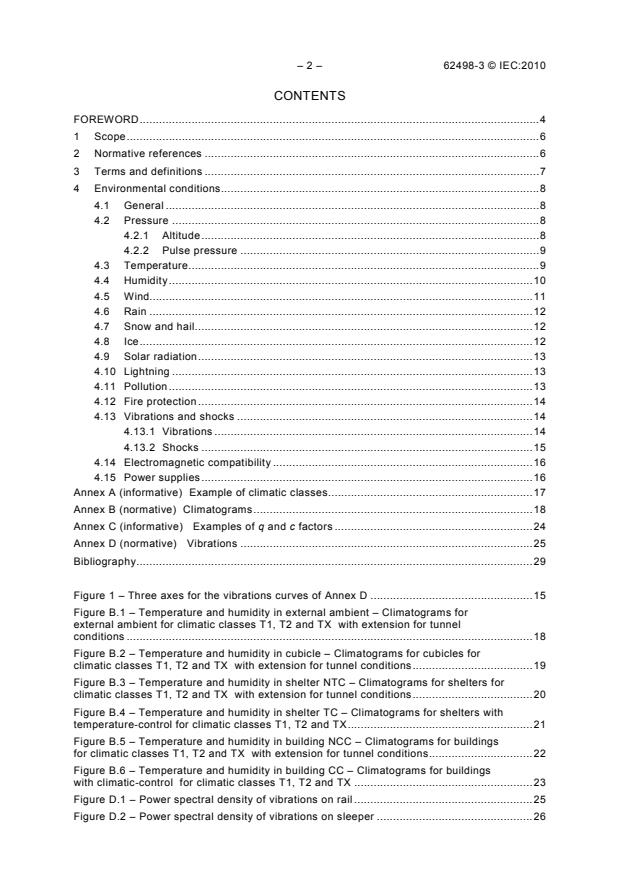
CONTENTS
FOREWORD.4
1 Scope.6
2 Normative references .6
3 Terms and definitions .7
4 Environmental conditions.8
4.1 General .8
4.2 Pressure .8
4.2.1 Altitude.8
4.2.2 Pulse pressure .9
4.3 Temperature.9
4.4 Humidity.10
4.5 Wind.11
4.6 Rain .12
4.7 Snow and hail.12
4.8 Ice.12
4.9 Solar radiation.13
4.10 Lightning .13
4.11 Pollution.13
4.12 Fire protection .14
4.13 Vibrations and shocks .14
4.13.1 Vibrations .14
4.13.2 Shocks .15
4.14 Electromagnetic compatibility .16
4.15 Power supplies.16
Annex A (informative) Example of climatic classes.17
Annex B (normative) Climatograms.18
Annex C (informative) Examples of q and c factors .24
Annex D (normative) Vibrations .25
Bibliography.29
Figure 1 – Three axes for the vibrations curves of Annex D .15
Figure B.1 – Temperature and humidity in external ambient – Climatograms for
external ambient for climatic classes T1, T2 and TX with extension for tunnel
conditions .18
Figure B.2 – Temperature and humidity in cubicle – Climatograms for cubicles for
climatic classes T1, T2 and TX with extension for tunnel conditions.19
Figure B.3 – Temperature and humidity in shelter NTC – Climatograms for shelters for
climatic classes T1, T2 and TX with extension for tunnel conditions.20
Figure B.4 – Temperature and humidity in shelter TC – Climatograms for shelters with
temperature-control for climatic classes T1, T2 and TX.21
Figure B.5 – Temperature and humidity in building NCC – Climatograms for buildings
for climatic classes T1, T2 and TX with extension for tunnel conditions.22
Figure B.6 – Temperature and humidity in building CC – Climatograms for buildings
with climatic-control for climatic classes T1, T2 and TX .23
Figure D.1 – Power spectral density of vibrations on rail .25
Figure D.2 – Power spectral density of vibrations on sleeper .26
62498-3 © IEC:2010 – 3 –
Figure D.3 – Power spectral density of vibrations on ballast.27
Figure D.4 – Power spectral density of vibrations outside the track (from 1 m to 3 m
from the rail) .28
Table 1 – Altitude relative to sea level .9
Table 2 – Temperature ranges at different sites .9
Table 3 – Humidity ranges at different sites .11
Table 4 – External ambient pollution levels .14
Table 5 – Acceleration at track side positions .15
Table 6 – Shocks at different track side positions (vertical axis).15
Table A.1 – Example of European regions and theirs appropriate climatic classes .17
Table A.2 – Example of Japanese regions and theirs appropriate climatic classes .17
Table C.1 – Pressure head in relation to air speed.24
Table C.2 – Typical values of form factor c .24
– 4 – 62498-3 © IEC:2010
INTERNATIONAL ELECTROTECHNICAL COMMISSION
____________
RAILWAY APPLICATIONS –
ENVIRONMENTAL CONDITIONS FOR EQUIPMENT –
Part 3: Equipment for signalling and telecommunications
FOREWORD
1) The International Electrotechnical Commission (IEC) is a worldwide organization for standardization comprising
all national electrotechnical committees (IEC National Committees). The object of IEC is to promote
international co-operation on all questions concerning standardization in the electrical and electronic fields. To
this end and in addition to other activities, IEC publishes International Standards, Technical Specifications,
Technical Reports, Publicly Available Specifications (PAS) and Guides (hereafter referred to as “IEC
Publication(s)”). Their preparation is entrusted to technical committees; any IEC National Committee interested
in the subject dealt with may participate in this preparatory work. International, governmental and non-
governmental organizations liaising with the IEC also participate in this preparation. IEC collaborates closely
with the International Organization for Standardization (ISO) in accordance with conditions determined by
agreement between the two organizations.
2) The formal decisions or agreements of IEC on technical matters express, as nearly as possible, an international
consensus of opinion on the relevant subjects since each technical committee has representation from all
interested IEC National Committees.
3) IEC Publications have the form of recommendations for international use and are accepted by IEC National
Committees in that sense. While all reasonable efforts are made to ensure that the technical content of IEC
Publications is accurate, IEC cannot be held responsible for the way in which they are used or for any
misinterpretation by any end user.
4) In order to promote international uniformity, IEC National Committees undertake to apply IEC Publications
transparently to the maximum extent possible in their national and regional publications. Any divergence
between any IEC Publication and the corresponding national or regional publication shall be clearly indicated in
the latter.
5) IEC itself does not provide any attestation of conformity. Independent certification bodies provide conformity
assessment services and, in some areas, access to IEC marks of conformity. IEC is not responsible for any
services carried out by independent certification bodies.
6) All users should ensure that they have the latest edition of this publication.
7) No liability shall attach to IEC or its directors, employees, servants or agents including individual experts and
members of its technical committees and IEC National Committees for any personal injury, property damage or
other damage of any nature whatsoever, whether direct or indirect, or for costs (including legal fees) and
expenses arising out of the publication, use of, or reliance upon, this IEC Publication or any other IEC
Publications.
8) Attention is drawn to the Normative references cited in this publication. Use of the referenced publications is
indispensable for the correct application of this publication.
9) Attention is drawn to the possibility that some of the elements of this IEC Publication may be the subject of
patent rights. IEC shall not be held responsible for identifying any or all such patent rights.
International Standard IEC 62498-3 has been prepared by IEC technical committee 9:
Electrical equipment and systems for railways.
This standard is based on EN 50125-3.
The text of this standard is based on the following documents:
FDIS Report on voting
9/1404/FDIS 9/1453/RVD
Full information on the voting for the approval of this standard can be found in the report on
voting indicated in the above table.
This publication has been drafted in accordance with the ISO/IEC Directives, Part 2.
62498-3 © IEC:2010 – 5 –
A list of all parts of IEC 62498 series, under the general title Railway applications –
Environmental conditions for equipment, can be found on the IEC website.
The committee has decided that the contents of this publication will remain unchanged until
the stability date indicated on the IEC web site under "http://webstore.iec.ch" in the data
related to the specific publication. At this date, the publication will be
• reconfirmed,
• withdrawn,
• replaced by a revised edition, or
• amended.
The contents of the corrigendum of November 2010 have been included in this copy.
– 6 – 62498-3 © IEC:2010
RAILWAY APPLICATIONS –
ENVIRONMENTAL CONDITIONS FOR EQUIPMENT –
Part 3: Equipment for signalling and telecommunications
1 Scope
This part of IEC 62498 specifies the environmental conditions.
The scope of this International Standard covers the design and the use of equipment and any
portable equipment for signalling and telecommunications systems (including test, measure,
monitoring equipment, etc.).
The portable equipment must comply with the sections of this International Standard relevant
to their use.
This International Standard does not specify the test requirements for equipment.
In particular the standard intends to define
– interface conditions between the equipment and its environment,
– parameters to be used by designers when calculating RAMS (Reliability, Availability,
Maintenability, Safety) and life time with respect to environmental condition effects.
The defined environmental conditions are considered as normal in service.
Microclimates surrounding components may need special requirements to be defined by the
product standard.
The effects of any signalling and telecommunications equipment (in either operating or failure
mode of operation) on the overall signalling system safety are not within the scope of this
International Standard. This International Standard does not provide the designer with
information to enable him to determine the safety risk associated with environmental
conditions. The safety of persons in the vicinity of (or working on) the signalling and
telecommunications equipment is also outside the scope of this International Standard. The
effects of vandalism on the equipment are not considered in this International Standard.
This International Standard applies to all signalling and telecommunications systems except
those used for cranes, mining vehicles and cable cars. It does not define the specifications for
train-borne signalling and telecommunications systems (see IEC 62498-1).
2 Normative references
The following referenced documents are indispensable for the application of this document.
For dated references, only the edition cited applies. For undated references, the latest edition
of the referenced document (including any amendments) applies.
IEC 60529:1989, Degrees of protection provided by enclosures (IP code)
IEC 60721-2-1:1982, Classification of environmental conditions – Part 2-1: Environmental
conditions appearing in nature – Temperature and humidity
Amendment 1 (1987)
62498-3 © IEC:2010 – 7 –
IEC 60721-2-3:1987, Classification of environmental conditions – Part 2-3: Environmental
conditions appearing in nature – Air pressure
IEC 60721-3-3:1994, Classification of environmental conditions – Part 3-3: Classification of
groups of environmental parameters and their severities – Stationary use at weather protected
locations
IEC 60721-3-4:1995, Classification of environmental conditions – Part 3: Classification of
groups of environmental parameters and their severities – Section 4: Stationary use at non-
weather protected locations
IEC 62236-1, Railway applications – Electromagnetic compatibility – Part 1: General
IEC 62236-2, Railway applications – Electromagnetic compatibility – Part 2: Emission of the
whole railway system to the outside world
IEC 62236-4, Railway applications – Electromagnetic compatibility – Part 4: Emission and
immunity of the signalling and telecommunications apparatus
IEC 62497-1, Railway applications – Insulation coordination – Part 1: Basic requirements –
Clearances and creepage distances for all electrical and electronic equipment
IEC 62497-2, Railway applications – Insulation coordination – Part 2: Overvoltages and
related protection
ISO 4354, Wind actions on structures
3 Terms and definitions
For the purposes of this document, the following terms and definitions apply:
3.1
environmental conditions
range of physical, chemical, electrical and biological conditions external to the equipment to
which it is subjected in service
3.2
equipment housing
case, or other protective housing, provided by the manufacturer to mount his equipment and
protect it from accidental damage, and occasionally from EMC or environmental effects. It
may offer protection to personnel e.g. from electric shock.
Where the equipment housing provides the full required environmental protection, then it is
treated as a cubicle to define the relevant environmental parameters.
The housing normally contains only a single supplier’s equipment, and is only a part of a
signalling or telecommunications system
3.3
cubicle
housing for apparatus which normally is used to co-locate various parts of the signalling or
telecommunications system equipment, on occasion from different suppliers. It may contain
various equipment housings installed within the cubicle and offers further environmental
protection.
A cubicle is normally only used to install apparatus and is in general not sufficiently large to
afford protection from weather to staff working on the apparatus.
– 8 – 62498-3 © IEC:2010
No climatic or temperature control is provided on cubicles but ventilation or occasionally fan
assisted ventilation is required.
Large housings which allow access to personnel but do not have the thermal properties of
shelters, should be treated as cubicles
3.4
shelter/container
shelters/containers are normally provided when a larger volume of equipment is to be co-
located at a single point or temperature/humidity sensitive equipment is to be installed.
Shelters/containers normally have double walls with insulation material (or an air gap)
between them. Shelters/containers also normally have limited facilities for personnel.
Shelters/containers may also be provided with temperature control, especially where
temperature sensitive apparatus is installed.
Where shelters/containers are fitted with climatic control (temperature and humidity control),
they shall be treated as buildings with climatic control (buildings CC)
3.5
building
permanent construction provided with main services (e.g. water, electricity, gas, etc.)
designed to protect equipment against the action of environmental conditions. A building may
or may not be provided with climatic control
4 Environmental conditions
4.1 General
In this standard, normal environmental conditions are classified.
The customer shall specify clearly in his technical specification the required class for each
environmental parameter. If no class is specified, the class with suffix 1 shall be assumed.
The severities specified are those which will have a low probability of being exceeded. All
specified values are maximum or limit values. These values may be reached, but do not occur
permanently. Depending on the situation there may be different frequencies of occurrence
related to a certain period of time. Such frequencies of occurrence have not been included in
this International Standard, but should be considered for any environmental parameter.
They should additionally be specified if applicable.
4.2 Pressure
4.2.1 Altitude
Table 1 gives the different classes of altitude relative to sea level at which the equipment
shall perform as specified.
Using AX class, the maximum altitude shall be specified by the customer.
Altitude is relevant, in particular for the air pressure level and its consequence on cooling
systems. The air pressure shall be considered according to IEC 60721-2-3.
62498-3 © IEC:2010 – 9 –
Table 1 – Altitude relative to sea level
Altitude range relative to
Classes sea level
m
A1 up to 1 400
A2 up to 1 000
A3 up to 1 200
AX more than 1 400
4.2.2 Pulse pressure
In case that there are different pressure conditions by area in a tunnel according to train
speed, shape of the train head, cross-section of tunnel, etc., the strength of devices shall be
considered depending on their locations in the tunnel (e.g., in the main tunnel, in the adit, in
the short side branch, in the inclined shaft).
In one example case, variation of pressure caused by train entering tunnel is:
ΔP = ± 5 kPa
The associated rate of change of pressure is:
ΔP/Δt = 0,5 to 1 kPa/s
4.3 Temperature
Table 2 shows the overall system air temperature parameters.
Table 2 – Temperature ranges at different sites
a b a b a b
In cubicle In shelter In building
Climatic External
c d c e
classes ambient
NTC TC NCC CC
T1 (–25 +40) °C (–25 +70) °C (–5 +55) °C (+15 +30) °C (0 +45) °C (+18 +27) °C
T2 (–40 +35) °C (–40 +65) °C (–20 +50) °C (+15 +30) °C (–5 +40) °C (+18 +27) °C
g
T3 Ordinary (–10 +60) °C (–10 +45) °C (–10 +45) °C (0 +45) °C
f
condition
f
T4 Cold district (–20 +60) °C
T5 Severe cold (–30 +60) °C
f
district
TX (–55 +40) °C (–55 +70) °C (–35 +55) °C (+15 +30) °C (–5 +45) °C (+18 +27) °C
a
The temperatures inside cubicle, shelter or building are values measured in free air not directly adjacent to heat emitting
elements.
b
The maximum temperatures inside a cubicle, a shelter NTC and a building NCC are higher than maximum ambient
temperatures because of the effects of solar radiation and power dissipation of installed equipment
c
The higher values of lowest temperatures compared to those for external ambient are due to heat emitting equipment.
d
3K2 of IEC 60721-3-3
e
3K1 of IEC 60721-3-3
f
There is no external ambient.
g
(+5 +35) °C in case of the climate control of high reliability.
CC: with climatic control TC: with temperature control
NCC: without climatic control NTC: without temperature control
– 10 – 62498-3 © IEC:2010
The above table was derived from IEC 60721-2-1 where open air temperatures are measured
2 m above ground. All classes have been extended at the lower temperatures to allow for
installation of signalling and telecommunications equipment at ground level.
The effects of rapid temperature changes shall be considered. Changes of 0,5 °C/min over a
range of 20 °C may be assumed for open air changes.
The designer(s) shall consider such factors as equipment power dissipation, surface exposed
to solar radiation, ventilation including forced ventilation, use of thermostatic controlled
heaters, heat dissipation coefficients of walls.
To enable the customer to verify the supplier compliance with the temperature levels specified
in Table 2 and to verify good temperature design of all installed equipment, the relevant data
shall be exchanged between customer and supplier, such as:
– geometrical characteristics of sub-assemblies,
– localisation of the main heat emitting elements and their heat dissipation,
– thermal parameters (resistance, capacity, etc.),
– characteristics of the cooling system.
The effect of the climatic or temperature control operating outside its specified parameters
should be considered for each individual installation.
All signalling and telecommunications system shall operate within the relevant limits of
Table 2.
The yearly average temperature of each type of site (for RAMS calculation) to be used are the following:
– +40 °C for equipment housing, cubicle;
– +30 °C for shelter NTC;
– +25 °C for shelter TC and building (NCC and CC).
RAMS calculations shall take into account the real yearly average temperature of each
equipment part or sub assembly.
For deviations from the temperatures shown in Table 2, the customer shall specify the
temperature levels required.
4.4 Humidity
The equipment shall be designed to withstand the humidity levels in the complete range of the
air temperature as defined in 4.3 above and as shown in the climatograms of Figures B.1 to
B.6 of Annex B which gives the relationship between humidity and temperature variations for
the different climatic classes.
Table 3 below gives the min. and max. values of relative and absolute humidity for the
different climatic classes.
62498-3 © IEC:2010 – 11 –
Table 3 – Humidity ranges at different sites
In shelter In building
External
In cubicle
Climatic a b
ambient
Humidity NCC CC NCC CC
classes
Min. Max. Min. Max. Min. Max. Min. Max. Min. Max. Min. Max.
T1, R % 15 100 5 100 5 100 10 75 5 95 20 75
3 c c c c
T3, T4, T5
A g/m 0,55 25 0,55 25 0,55 25 2 22 0,55 25 4 15
R % 20 100 5 100 5 100 10 75 5 95 20 75
T2
3 c c c c
A g/m 0,12 22 0,12 22 0,12 22 2 22 0,12 22 4 15
R % 15 100 5 100 5 100 10 75 5 95 20 75
TX
3 c c c c
A g/m 0,02 25 0,02 25 0,02 25 2 22 0,02 25 4 15
a
3K2 of IEC 60721-3-3
b
3K1 of IEC 60721-3-3
c 3
30 g/m for tunnel
CC: with climatic control. R: Relative humidity.
NCC: without climatic control. A: Absolute humidity.
NOTE Table 3 is derived from IEC 60721-2-1 for calculations, from IEC 60721-3-3 and IEC 60721-3-4 for values.
On cold surfaces, 100 % relative humidity may occur causing condensation on parts of
equipment.
Sudden changes of the air temperature may cause localised condensation of water on parts of equipment.
The yearly average humidity level of the external ambient is 75 % of relative humidity.
On 30 days in the year, continuously, the level of the external ambient relative humidity can
be in the range of 75 % to 95 %.
4.5 Wind
Equipment exposed to air movement shall be designed to withstand the stress generated. The
stress caused by air movement can be generated by two sources.
a) Natural wind
The force (F ) produced by natural wind shall be calculated as below:
w
F = q × c × A
w
where
F is the force (N);
w
q is the pressure head (N/m²);
c is the form factor (without dimension);
A is the equipment surface perpendicular to the direction of the wind (m²).
The formula shown above has been simplified for general signalling and telecommunications
applications. For complex installations (e.g. buildings) refer to ISO 4354.
– 12 – 62498-3 © IEC:2010
The pressure head (q) shall be calculated by:
q = δ/2 × v
where
δ is the density of air (kg/m );
v is the speed of air (m/s).
The maximum speed of wind is for example taken as 35 m/s. In this case we have the
following values:
q = 1,25/2 × 35 × 35 = 0,76 kN/m
F = 0,76 × c × A
wMax
If the customer requires a higher wind speed to be used in this calculation, then the relevant
value shall be specified to the supplier.
b) Air movement produced in the area of the track by the passing of a train
The air movement surrounding a moving train is extremely complex and it is not possible to
derive a single value.
The customer shall advise the designer of the value of q to be used to calculate air movement
pressure caused by trains.
Annex C shows some examples of q and c factors which may be used for guidance.
4.6 Rain
Equipment exposed to rain shall be designed to withstand a rain rate of 6 mm/min for classes
T1 and T2 and a rain rate of 3-5 mm/min for classes T3 and a rain rate of 10-20 mm/min for
classes T4 and a rain rate of 15 mm/min for class TX.
The designer shall also consider the combined effect of rain and wind.
The customer should consider whether more severe water protection is required (e.g. flooding)
and specify his requirement to the supplier in accordance with IEC 60529 IP code.
4.7 Snow and hail
Consideration shall be given to the effect of snow and/or hail. The maximum diameter of the
hailstones is for example taken as 15 mm, larger diameter may occur exceptionally.
Consideration shall be given to all forms of snow which may occur.
The effects of snow driven by wind or passing vehicles shall be considered.
4.8 Ice
Equipment exposed to the effects of ice forming or falling shall be designed to operate in that
environment.
62498-3 © IEC:2010 – 13 –
In such conditions the performance of equipment shall be specified either in the product
standard or by the customer.
4.9 Solar radiation
Equipment exposed to the effects of solar radiation shall be designed to ensure that it
continues to operate and comply with the parameters of the design specifications.
The maximum level of solar radiation is 1 120 W/m² for equipment directly exposed according
to IEC 60721-3-4.
Care shall be taken to minimize the effects of UV radiation on the equipment exposed to solar
radiation.
For equipment in other situations (e.g. inside, behind a window, etc.), the designer shall
choose other values and justify his choice to the customer.
4.10 Lightning
Consideration shall be given to the effects of lightning on the equipment.
For protection of the equipment against lightning refer to IEC 62497-2.
4.11 Pollution
The effects of pollution shall be considered in the design of equipment and components.
The micro-environmental conditions and the effects of pollution in combination with humidity
are described in IEC 62497-1.
The severity of pollution will depend upon the location of the equipment.
The effects of pollution may be reduced by the use of appropriate protection. In this case the
protection against water and solid objects shall be specified using the protection degree
definition of IEC 60529.
The effects of the following kinds of pollution shall be considered:
• chemical active substances:
– salinity,
– H S,
– weedkiller (product to be specified by the customer),
– organic elements,
– other chemical substances;
• biological active substances;
• mechanically active substances:
– dust: due to presence of carbon or metallic powder, dust may become electrically
conductive with the presence of humidity,
– stones coming from the ballast,
– sand, if specified for the application.
Table 4 below gives the levels of pollution for "External ambient" areas.
– 14 – 62498-3 © IEC:2010
The external ambient pollution levels defined below are those normally found on equipment
housings located in open air.
Table 4 – External ambient pollution levels
Pollution type
Pollution levels
Chemical active Biological active Mechanical active
substances substances substances
Low 4 C 1 4 B 1 4 S 1
Medium 4 C 2 * 4 B 1 4 S 2
High 4 C 3 * 4 B 1 4 S 3
* Coastal areas are excluded from these classes. The customer shall specify to the designer where protection from
salt mist is required, in which case protection to a minimum 4 C 2 should be provided.
Definitions of classes for chemical, biological and mechanical active substances are given in
the relevant standard IEC 60721-3-4.
The customer shall specify a pollution level (L, M, H) for each pollution type shown in Table 4
which is applicable where the equipment is to be used.
For more severe conditions the customer shall specify the pollution level which is required.
4.12 Fire protection
The level of fire protection should be stated in the relevant product standard specifications.
4.13 Vibrations and shocks
4.13.1 Vibrations
In Europe, the interaction between the track side equipment and the rolling stock varies
considerably between each country.
The specification of vibrations is very complex and depends on a multitude of variables such
as:
– track design and maintenance,
– proximity to rail discontinuities (e.g. block joints, crossings),
– axle loads,
– bogie design,
– wheel flat,
– speed.
Vibrations, energy levels and their distributions across the frequency range are thus variable.
The system designer should ensure, wherever possible, that equipment is situated in a
position such as to minimise the shocks and vibrations experienced by the equipment.
In order to determine a standard for all countries, the shapes shown in Annex D apply for
each application and have been estimated from a number of measurements taken at various
sites.
These values shall be used for all equipment unless more stringent requirements are
specified by the customer.
62498-3 © IEC:2010 – 15 –
The PSD curves are shown in Annex D and the r.m.s. acceleration values of these curves
calculated between 5 Hz and 2 000 Hz are shown in Table 5 below.
Table 5 – Acceleration at track side positions
Position r.m.s. r.m.s. transversal r.m.s. longitudinal Figure
vertical acceleration acceleration (Annex D)
acceleration
m/s² m/s² m/s²
On rail 280 140 50 D.1
On sleeper 130 50 90 D.2
On ballast 10 10 10 D.3
Outside the track
(from 1 m to 3 m 2,3 2,3 2,3 D.4
from the rail)
Beyond 3 m the level of vibrations coming from the track is negligible.
NOTE In some countries, sinusoidal values may be given. These can also be taken for testing. See, for ex.
Japanese standard JIS E 3014.
The vibration curves of Annex D are shown with the three following axis (see Figure 1):
Vertical
Longitudinal
Rail
Transversal
Sleeper
IEC 1907/10
Figure 1 – Three axes for the vibrations curves of Annex D
4.13.2 Shocks
The values of shocks (vertical axis) are shown in Table 6. These values have been derived
from ERRI A 118 Rp 4.
Table 6 – Shocks at different track side positions (vertical axis)
Position Acceleration (in m/s²) /
Duration (in ms)
Mean Peak
On rail 420 / 6 2 500 / 1
On sleeper 300 / 8 800 / 2
On ballast 50 / 11 100 / 8
Into a box upon post,
outside the track (from 1 m 20 / 11 20 / 11
to 3 m from the rail)
– 16 – 62498-3 © IEC:2010
For railways systems not utilising steel wheels running upon steel rails (e.g. pneumatic tyre
metro systems), the customer shall specify vibration and shock requirements in the technical
specifications to the supplier.
4.14 Electromagnetic compatibility
The electromagnetic conditions encountered by apparatus are complex, and many are of a
transient nature. It is not possible therefore to define a comprehensive set of EMC parameters
(see IEC 62236-1 and IEC 62236-2 for generic details). IEC 62236-4 defines a set of test
conditions which represents current best practice for EMC for railway signalling and
telecommunication apparatus.
4.15 Power supplies
The customer shall specify the complete system power supply requirements to ensure that all
equipment and systems will operate safely and reliably, particularly when equipment is
supplied from a variety of different suppliers.
The specifications shall include, for example, nominal voltages, expected variations and
disturbances, nominal frequencies and variations, permitted ripple.
62498-3 © IEC:2010 – 17 –
Annex A
(informative)
Example of climatic classes
Table A.1 – Example of European regions and theirs appropriate climatic classes
Class Type of climate
T1 Warm temperate, warm dry, mild warm dry
T2 Cold temperate
TX Cold
Types of climate as defined in IEC 60721-2-1:1982 + A1:1987.
Table A.2 – Example of Japanese regions and theirs appropriate climatic classes
Class Type of climate
T3 Ordinary condition
T4 Cold district
T5 Severe cold district
Types of climate as defined in JIS E 3017.
– 18 – 62498-3 © IEC:2010
Annex B
(normative)
Climatograms
Absolute air humidity (g/m )
Tunnel
T2 tunnel
TX
T1, TX tunnel
T2
T1
-60 -55 -40 -25 -3,5 0
35 40
-38,6 -24,2
Air temperature (°C)
IEC 1908/10
Figure B.1 – Temperature and humidity in external ambient –
Climatograms for external ambient for climatic classes T1, T2 and TX
with extension for tunnel conditions
Relative air humidity (%)
0,02
0,12
0,55
22,0
25,0
30,0
62498-3 © IEC:2010 – 19 –
Absolute air humidity (g/m )
TX
Tunnel
T2
T1
T1, TX tunnel
T2 tunnel
- 60 - 55 -40 - 28 - 25 -8,5 0 12 50 55 65 70 75
Air temperature (°C)
IEC 1909/10
NOTE Upper temperatures are lower for all classes in tunnels due to the lack of solar radiation.
Figure B.2 – Temperature and humidity in cubicle –
Climatograms for cubicles for climatic classes T1, T2 and TX
with extension for tunnel conditions
Relative air humidity (%)
0,02
0,12
0,55
22,0
25,0
30,0
– 20 – 62498-3 © IEC:2010
Absolute air humidity (g/m )
Tunnel
TX
T2 tunnel
T2
T1, TX tunnel
T1
-60 -35 -28 -20 -8,5 0 12 45 50 55
Air temperature (°C)
IEC 1910/10
NOTE 1 This climatogram assumes the worst case humidity conditions inside the shelter. If the shelter proposed
by the designer has a superior performance then the variations from the ranges shown in the climatogram shall be
demonstrated by the designer to the customer.
NOTE 2 Upper temperatures are lower for all classes in tunnels due to the lack of solar radiation.
Figure B.3 – Temperature and humidity in shelter NTC –
Climatograms for shelters for climatic classes T1, T2 and TX
with extension for tunnel conditions
Relative air humidity (%)
0,02
0,12
0,55
22,0
25,0
30,0
62498-3 © IEC:2010 – 21 –
Absolute air humidity (g/m )
-60 0 15 22,5 30 75
Air temperature (°C)
IEC 1911/10
Figure B.4 – Temperature and humidity in shelter TC –
Climatograms for shelters with temperature-control for climatic classes T1, T2 and TX
Relative air humidity (%)
2,0
22,0
– 22 – 62498-3 © IEC:2010
Absolute air humidity (g/m )
Tunnel
T1, TX tunnel
T2 tunnel
T1 T2
TX
-60 -28 -8,5 0 12 35 40 45 75
-5
Air temperature (°C)
IEC 1912/10
NOTE Upper temperatures are lower for all classes in tunnels due to the lack of solar radiation.
Figure B.5 – Temperature and humidity in building NCC –
Climatograms for buildings for climatic classes T1, T2 and TX
with extension for tunnel conditions
Relative air humidity (%)
0,02
0,12
0,55
22,0
25,0
30,0
62498-3 © IEC:2010 – 23 –
Absolute air humidity (g/m )
-60 0
18 27
22,5
Air temperature (°C)
IEC 1913/10
Figure B.6 – Temperature and humidity in building CC –
Climatograms for buildings with climatic-control
for climatic classes T1, T2 and TX
Relative air humidity (%)
4,0
15,0
– 24 – 62498-3 © IEC:2010
Annex C
(informative)
Examples of q and c factors
For more details, refer to ISO 4354.
As explained in 4.5 the pressure head (q) is calculated by:
q = δ/2 × v
Some examples of pressure head in relation to air speed gives Table C.1:
Table C.1 – Pressure head in relation to air speed
With δ = 1,25 kg / m (density of air)
Pressure head Speed Speed
of air of air
N/m² m/s km/h
500 28,3 102
760 35 126
1 100 42 151
1 300 45,6 164
Typical values of form factors c are shown in Table C.2.
Table C.2 – Typical values of form factor c
Form Form factor c Form Form factor c
2,04
0,34
0,86
l/d c
d
1 0,63
1,11
5 0,74
l
10 0,82
40 0,98
a/b c
...