

IEC 62597:2019
(Main)Magnetic field levels generated by electronic and electrical apparatus in the railway environment with respect to human exposure - Measurement procedures
General Information
- Abstract
IEC 62597:2019 is limited to apparatus, systems and fixed installations which are intended for use in the railway environment. The frequency range covered is 0 Hz to 300 GHz.
Technical considerations and measurements are specified for frequencies up to 20 kHz because no relevant field strengths are expected above due to the physical nature of EMF‑sources in the railway environment.
The object of this document is to provide measurement and calculation procedures of electric and magnetic field levels generated by electronic and electrical apparatus in the railway environment with respect to human exposure.
The regulations regarding the protection of human beings during exposure to non-ionizing electromagnetic fields in the railway environment are different within the countries worldwide. This document offers a procedure regarding measurement, simulation/calculation and evaluation.
The measurement procedures and points of measurement cover also the aspect of persons bearing active implantable medical devices. This document does not apply to the risk assessment for persons bearing active implants in magnetic field generated by electronic and electrical apparatus in the railway environment.
This first edition cancels and replaces IEC TS 62597 published in 2011. This edition includes the following significant technical changes with respect to the Technical Specification:
a) Clause 3.1: The extent of “Terms and definitions” has been updated
b) Clause 3 was expanded by clause 3.2 “abbreviated terms”
c) Clause 4.2: The “surface method” for Rolling Stock measuement was deleted. Mandatory measurement method is former “volume method” with slightly modified measurement heghts.
d) Clause 4.3: Japanese set of measurement heghts for fixed installations was deleted.
e) Clause 5.2 and new Annex B: Measurement technique for lower frequency range up to 5 Hz.
f) New Annex C: Consistency to IEC 62110 in some countries
g) Several editorial improvements have been included in the entire document
- Status
- Published
- Publication Date
- 16-Jul-2019
- Technical Committee
- TC 9 - Electrical equipment and systems for railways
- Drafting Committee
- MT 62597 - TC 9/MT 62597
- Current Stage
- PPUB - Publication issued
- Start Date
- 17-Jul-2019
- Completion Date
- 26-Jul-2019
Buy Documents
IEC 62597:2019 - Magnetic field levels generated by electronic and electrical apparatus in the railway environment with respect to human exposure - Measurement procedures Released:7/17/2019
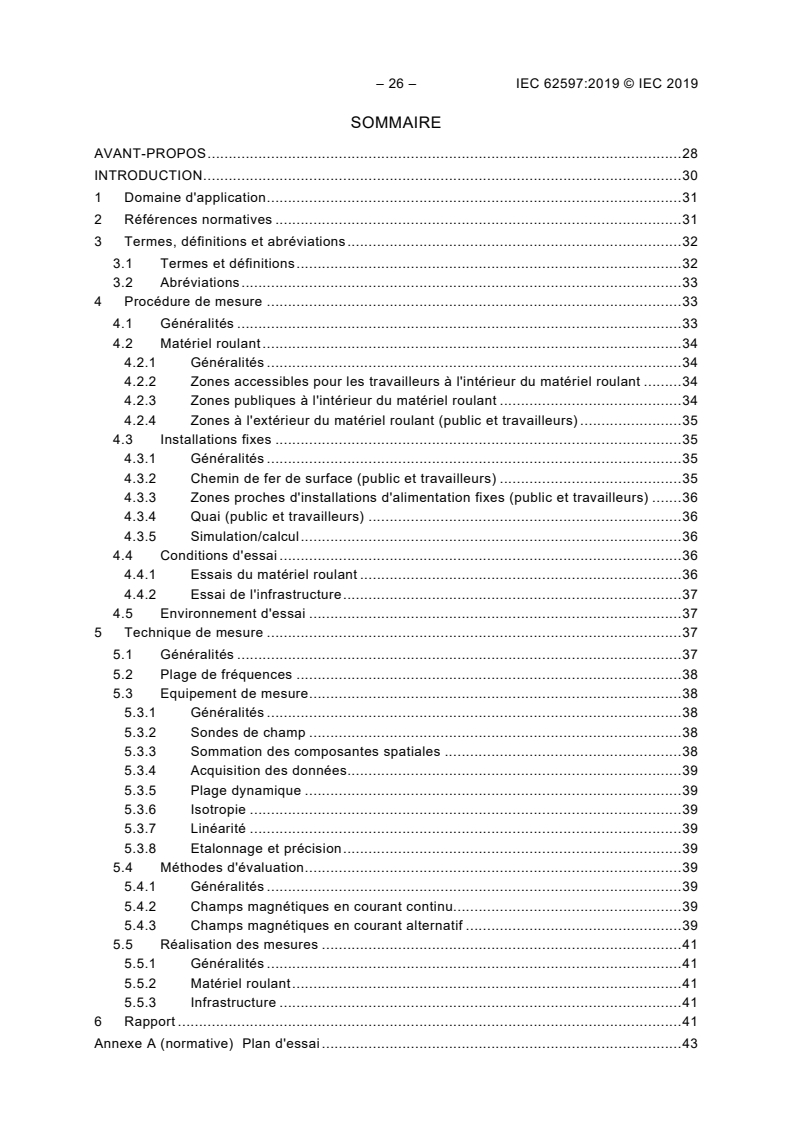
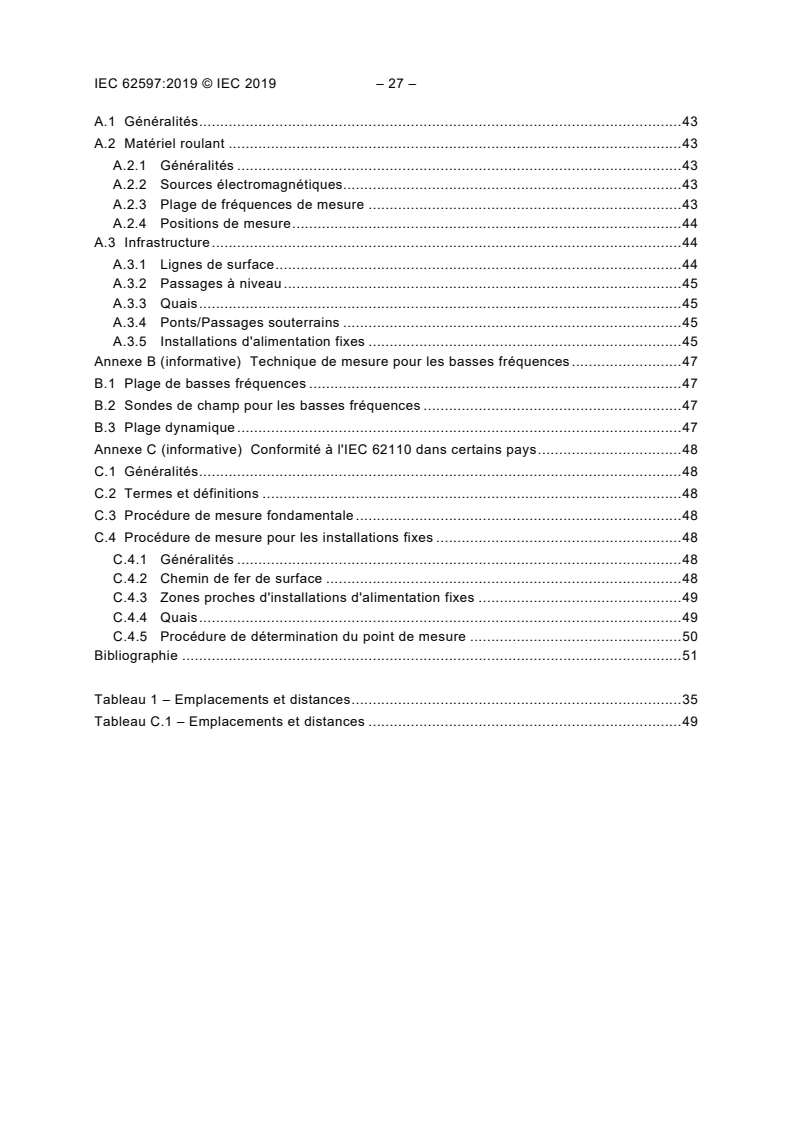
IEC 62597:2019 - Niveaux de champ magnétique générés par les appareils électriques et électroniques dans l'environnement ferroviaire en regard de l'exposition humaine - Procédures de mesure/17/2019
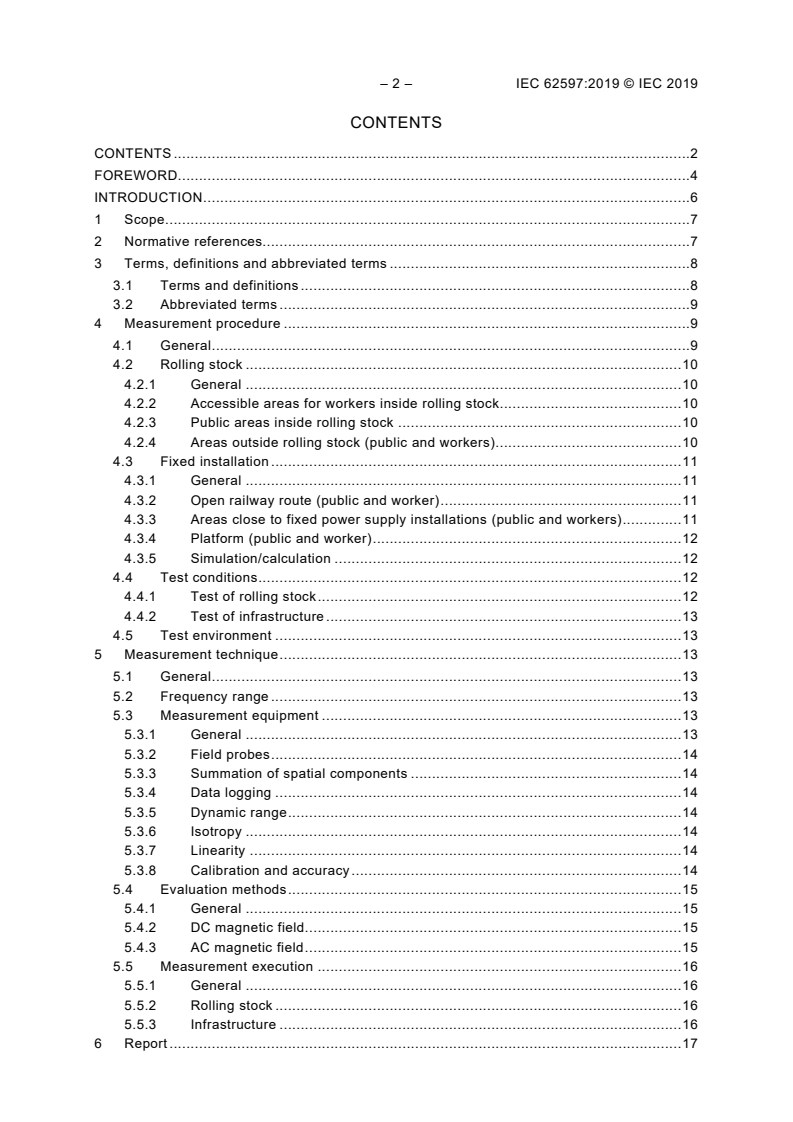
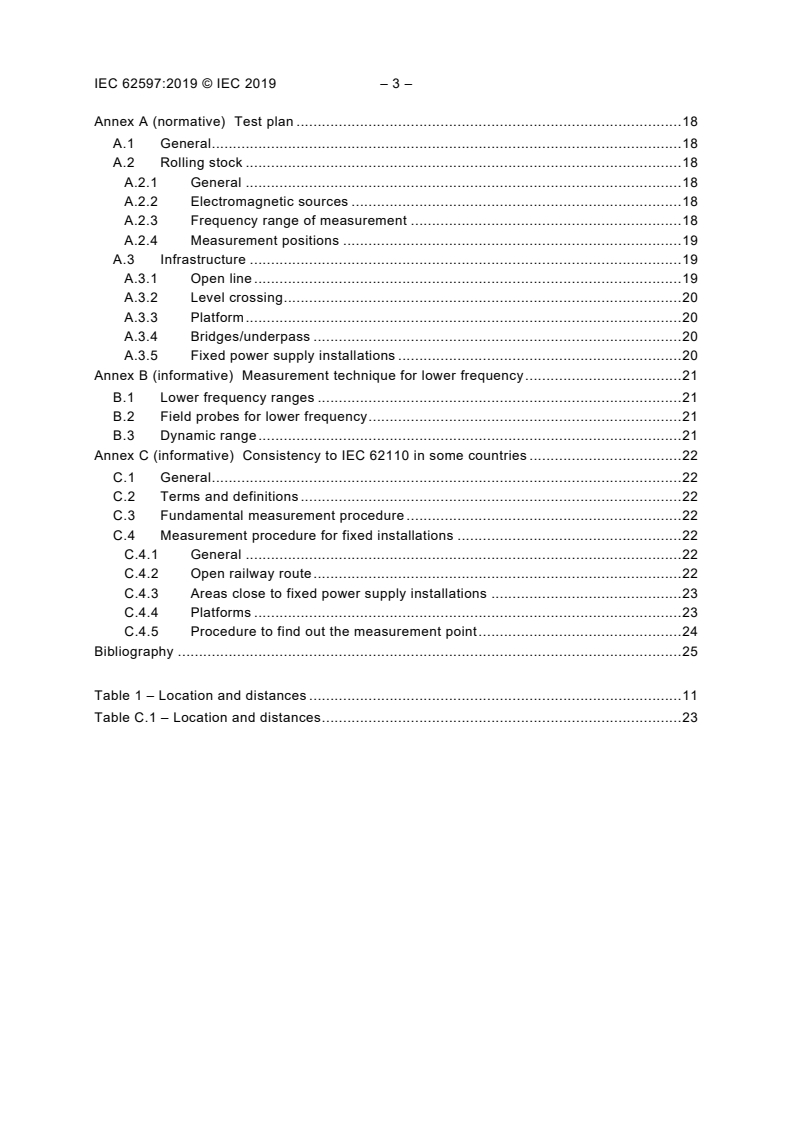
IEC 62597:2019 - Magnetic field levels generated by electronic and electrical apparatus in the railway environment with respect to human exposure - Measurement procedures/17/2019
Overview
IEC 62597:2019 - "Magnetic field levels generated by electronic and electrical apparatus in the railway environment with respect to human exposure - Measurement procedures" - defines standardized procedures for measuring and calculating electric and magnetic fields produced by railway equipment. The standard covers apparatus, systems and fixed installations intended for use in the railway environment across the frequency range 0 Hz to 300 GHz, while technical measurement procedures are specified up to 20 kHz (no relevant field strengths are expected above this in the railway context).
Key topics and technical requirements
- Scope and exclusions
- Applies to rolling stock and fixed railway installations (platforms, open lines, power-supply areas, bridges, underpasses).
- Does not apply to passenger personal electronic devices or intentional transmitters above 20 kHz.
- Measurement procedures include consideration of persons with active implantable medical devices, but the standard does not perform implant risk assessments.
- Measurement and evaluation methods
- Provides procedures for measurement, simulation/calculation and evaluation of magnetic (and electric) fields with respect to human exposure.
- DC and AC magnetic field evaluation methods are specified.
- Measurement execution and points
- Defines measurement positions and distances for rolling stock and fixed installations (platforms, open line, areas near power-supply installations).
- The previously used “surface method” for rolling stock was removed; the volume method (formerly mandatory) is now the required procedure with updated measurement heights.
- Japanese-specific set of measurement heights for fixed installations was removed.
- Instrumentation and quality
- Requirements for field probes, isotropy, dynamic range, linearity, calibration and data logging are included to ensure measurement accuracy.
- Low-frequency considerations and annexes
- New Annex B: measurement technique for very low frequencies (down to 5 Hz and below).
- New Annex C: guidance to ensure consistency with IEC 62110 in some countries.
- Reporting and test plans
- A normative test-plan (Annex A moved into normative text) plus reporting requirements to support reproducible assessments.
Practical applications and users
Who uses IEC 62597:2019:
- Railway system designers and electrical engineers evaluating EMF from traction and onboard equipment
- Rolling stock manufacturers conducting acceptance and compliance testing
- Infrastructure owners and maintenance teams assessing fixed installations and platform exposure
- Accredited testing laboratories and EMF consultants performing measurements and simulations
- Safety officers and regulators seeking standardized methods for human exposure assessment in railway environments
Practical uses:
- Compliance testing and due diligence for new vehicles and installations
- Baseline and periodic EMF surveys for worker and public exposure assessment
- Supporting simulation models and siting decisions for equipment and power-supply elements
- Harmonizing measurement procedures across suppliers and authorities
Related standards
- IEC 62110 (referenced for national consistency in Annex C)
- National and regional EMF exposure regulations (used for evaluation thresholds; vary by country)
Keywords: IEC 62597:2019, magnetic field measurement, railway environment, human exposure, EMF measurement procedures, rolling stock, fixed installations, low-frequency magnetic fields.
Relations
- Effective Date
- 05-Sep-2023
Buy Documents
IEC 62597:2019 - Magnetic field levels generated by electronic and electrical apparatus in the railway environment with respect to human exposure - Measurement procedures Released:7/17/2019
IEC 62597:2019 - Niveaux de champ magnétique générés par les appareils électriques et électroniques dans l'environnement ferroviaire en regard de l'exposition humaine - Procédures de mesure/17/2019
IEC 62597:2019 - Magnetic field levels generated by electronic and electrical apparatus in the railway environment with respect to human exposure - Measurement procedures/17/2019
Get Certified
Connect with accredited certification bodies for this standard

IRIS Certification (UNIFE)
International Railway Industry Standard certification.

TÜV SÜD Rail GmbH
TÜV SÜD railway certification services.

Bureau Veritas Railway Certification
Railway and transportation certification.
Sponsored listings
Frequently Asked Questions
IEC 62597:2019 is a standard published by the International Electrotechnical Commission (IEC). Its full title is "Magnetic field levels generated by electronic and electrical apparatus in the railway environment with respect to human exposure - Measurement procedures". This standard covers: IEC 62597:2019 is limited to apparatus, systems and fixed installations which are intended for use in the railway environment. The frequency range covered is 0 Hz to 300 GHz. Technical considerations and measurements are specified for frequencies up to 20 kHz because no relevant field strengths are expected above due to the physical nature of EMF‑sources in the railway environment. The object of this document is to provide measurement and calculation procedures of electric and magnetic field levels generated by electronic and electrical apparatus in the railway environment with respect to human exposure. The regulations regarding the protection of human beings during exposure to non-ionizing electromagnetic fields in the railway environment are different within the countries worldwide. This document offers a procedure regarding measurement, simulation/calculation and evaluation. The measurement procedures and points of measurement cover also the aspect of persons bearing active implantable medical devices. This document does not apply to the risk assessment for persons bearing active implants in magnetic field generated by electronic and electrical apparatus in the railway environment. This first edition cancels and replaces IEC TS 62597 published in 2011. This edition includes the following significant technical changes with respect to the Technical Specification: a) Clause 3.1: The extent of “Terms and definitions” has been updated b) Clause 3 was expanded by clause 3.2 “abbreviated terms” c) Clause 4.2: The “surface method” for Rolling Stock measuement was deleted. Mandatory measurement method is former “volume method” with slightly modified measurement heghts. d) Clause 4.3: Japanese set of measurement heghts for fixed installations was deleted. e) Clause 5.2 and new Annex B: Measurement technique for lower frequency range up to 5 Hz. f) New Annex C: Consistency to IEC 62110 in some countries g) Several editorial improvements have been included in the entire document
IEC 62597:2019 is limited to apparatus, systems and fixed installations which are intended for use in the railway environment. The frequency range covered is 0 Hz to 300 GHz. Technical considerations and measurements are specified for frequencies up to 20 kHz because no relevant field strengths are expected above due to the physical nature of EMF‑sources in the railway environment. The object of this document is to provide measurement and calculation procedures of electric and magnetic field levels generated by electronic and electrical apparatus in the railway environment with respect to human exposure. The regulations regarding the protection of human beings during exposure to non-ionizing electromagnetic fields in the railway environment are different within the countries worldwide. This document offers a procedure regarding measurement, simulation/calculation and evaluation. The measurement procedures and points of measurement cover also the aspect of persons bearing active implantable medical devices. This document does not apply to the risk assessment for persons bearing active implants in magnetic field generated by electronic and electrical apparatus in the railway environment. This first edition cancels and replaces IEC TS 62597 published in 2011. This edition includes the following significant technical changes with respect to the Technical Specification: a) Clause 3.1: The extent of “Terms and definitions” has been updated b) Clause 3 was expanded by clause 3.2 “abbreviated terms” c) Clause 4.2: The “surface method” for Rolling Stock measuement was deleted. Mandatory measurement method is former “volume method” with slightly modified measurement heghts. d) Clause 4.3: Japanese set of measurement heghts for fixed installations was deleted. e) Clause 5.2 and new Annex B: Measurement technique for lower frequency range up to 5 Hz. f) New Annex C: Consistency to IEC 62110 in some countries g) Several editorial improvements have been included in the entire document
IEC 62597:2019 is classified under the following ICS (International Classification for Standards) categories: 45.060.01 - Railway rolling stock in general. The ICS classification helps identify the subject area and facilitates finding related standards.
IEC 62597:2019 has the following relationships with other standards: It is inter standard links to IEC TS 62597:2011. Understanding these relationships helps ensure you are using the most current and applicable version of the standard.
IEC 62597:2019 is available in PDF format for immediate download after purchase. The document can be added to your cart and obtained through the secure checkout process. Digital delivery ensures instant access to the complete standard document.
Standards Content (Sample)
IEC 62597 ®
Edition 1.0 2019-07
INTERNATIONAL
STANDARD
Magnetic field levels generated by electronic and electrical apparatus in the
railway environment with respect to human exposure – Measurement
procedures
All rights reserved. Unless otherwise specified, no part of this publication may be reproduced or utilized in any form
or by any means, electronic or mechanical, including photocopying and microfilm, without permission in writing from
either IEC or IEC's member National Committee in the country of the requester. If you have any questions about IEC
copyright or have an enquiry about obtaining additional rights to this publication, please contact the address below or
your local IEC member National Committee for further information.
IEC Central Office Tel.: +41 22 919 02 11
3, rue de Varembé info@iec.ch
CH-1211 Geneva 20 www.iec.ch
Switzerland
About the IEC
The International Electrotechnical Commission (IEC) is the leading global organization that prepares and publishes
International Standards for all electrical, electronic and related technologies.
About IEC publications
The technical content of IEC publications is kept under constant review by the IEC. Please make sure that you have the
latest edition, a corrigendum or an amendment might have been published.
IEC publications search - webstore.iec.ch/advsearchform Electropedia - www.electropedia.org
The advanced search enables to find IEC publications by a The world's leading online dictionary on electrotechnology,
variety of criteria (reference number, text, technical containing more than 22 000 terminological entries in English
committee,…). It also gives information on projects, replaced and French, with equivalent terms in 16 additional languages.
and withdrawn publications. Also known as the International Electrotechnical Vocabulary
(IEV) online.
IEC Just Published - webstore.iec.ch/justpublished
Stay up to date on all new IEC publications. Just Published IEC Glossary - std.iec.ch/glossary
details all new publications released. Available online and 67 000 electrotechnical terminology entries in English and
once a month by email. French extracted from the Terms and Definitions clause of
IEC publications issued since 2002. Some entries have been
IEC Customer Service Centre - webstore.iec.ch/csc collected from earlier publications of IEC TC 37, 77, 86 and
If you wish to give us your feedback on this publication or CISPR.
need further assistance, please contact the Customer Service
Centre: sales@iec.ch.
IEC 62597 ®
Edition 1.0 2019-07
INTERNATIONAL
STANDARD
Magnetic field levels generated by electronic and electrical apparatus in the
railway environment with respect to human exposure – Measurement
procedures
INTERNATIONAL
ELECTROTECHNICAL
COMMISSION
ICS 45.060.01 ISBN 978-2-8322-7103-2
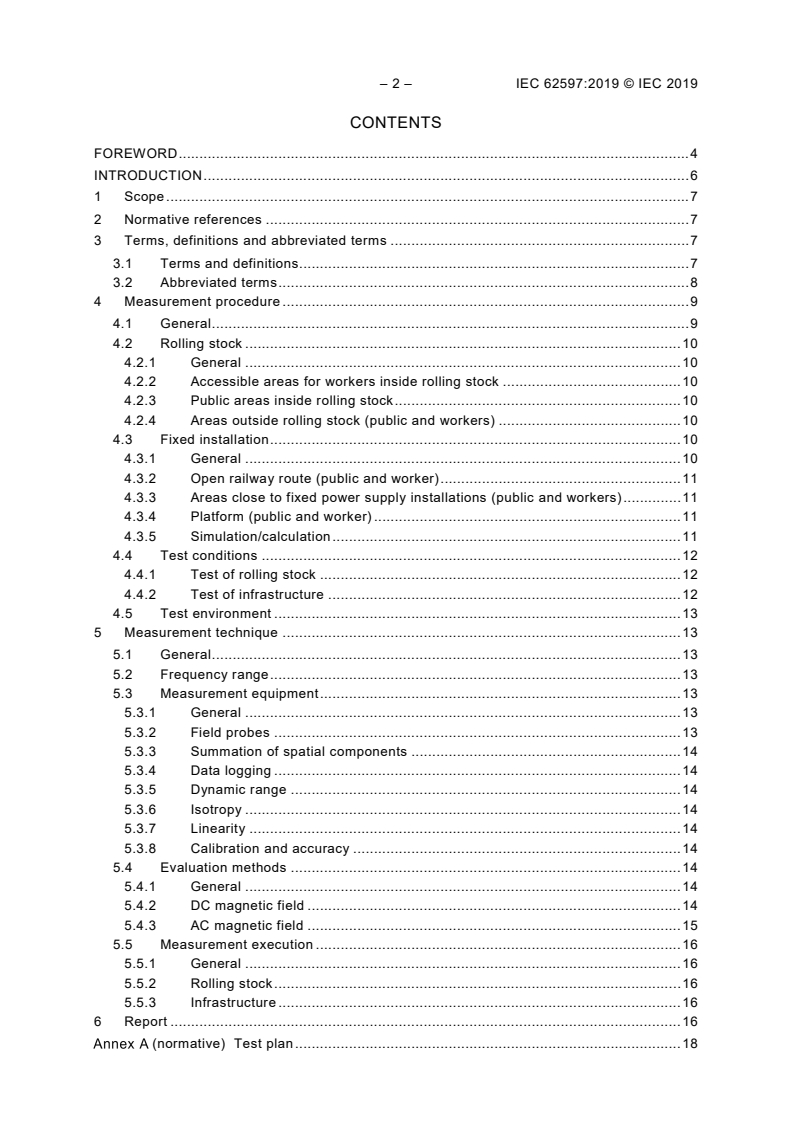
– 2 – IEC 62597:2019 © IEC 2019
CONTENTS
FOREWORD . 4
INTRODUCTION . 6
1 Scope . 7
2 Normative references . 7
3 Terms, definitions and abbreviated terms . 7
3.1 Terms and definitions . 7
3.2 Abbreviated terms . 8
4 Measurement procedure . 9
4.1 General . 9
4.2 Rolling stock . 10
4.2.1 General . 10
4.2.2 Accessible areas for workers inside rolling stock . 10
4.2.3 Public areas inside rolling stock . 10
4.2.4 Areas outside rolling stock (public and workers) . 10
4.3 Fixed installation . 10
4.3.1 General . 10
4.3.2 Open railway route (public and worker) . 11
4.3.3 Areas close to fixed power supply installations (public and workers) . 11
4.3.4 Platform (public and worker) . 11
4.3.5 Simulation/calculation . 11
4.4 Test conditions . 12
4.4.1 Test of rolling stock . 12
4.4.2 Test of infrastructure . 12
4.5 Test environment . 13
5 Measurement technique . 13
5.1 General . 13
5.2 Frequency range . 13
5.3 Measurement equipment . 13
5.3.1 General . 13
5.3.2 Field probes . 13
5.3.3 Summation of spatial components . 14
5.3.4 Data logging . 14
5.3.5 Dynamic range . 14
5.3.6 Isotropy . 14
5.3.7 Linearity . 14
5.3.8 Calibration and accuracy . 14
5.4 Evaluation methods . 14
5.4.1 General . 14
5.4.2 DC magnetic field . 14
5.4.3 AC magnetic field . 15
5.5 Measurement execution . 16
5.5.1 General . 16
5.5.2 Rolling stock . 16
5.5.3 Infrastructure . 16
6 Report . 16
(normative) Test plan . 18
A.1 General . 18
A.2 Rolling stock . 18
A.2.1 General . 18
A.2.2 Electromagnetic sources . 18
A.2.3 Frequency range of measurement. 18
A.2.4 Measurement positions . 19
A.3 Infrastructure . 19
A.3.1 Open line . 19
A.3.2 Level crossing . 19
A.3.3 Platform . 20
A.3.4 Bridges/underpass . 20
A.3.5 Fixed power supply installations . 20
(informative) Measurement technique for lower frequency . 21
B.1 Lower frequency ranges . 21
B.2 Field probes for lower frequency . 21
B.3 Dynamic range . 21
(informative) Consistency to IEC 62110 in some countries . 22
C.1 General . 22
C.2 Terms and definitions . 22
C.3 Fundamental measurement procedure . 22
C.4 Measurement procedure for fixed installations . 22
C.4.1 General . 22
C.4.2 Open railway route . 22
C.4.3 Areas close to fixed power supply installations . 23
C.4.4 Platforms . 23
C.4.5 Procedure to find out the measurement point . 24
Bibliography . 25
Table 1 – Location and distances . 11
Table C.1 – Location and distances . 23
– 4 – IEC 62597:2019 © IEC 2019
INTERNATIONAL ELECTROTECHNICAL COMMISSION
____________
MAGNETIC FIELD LEVELS GENERATED BY ELECTRONIC
AND ELECTRICAL APPARATUS IN THE RAILWAY ENVIRONMENT
WITH RESPECT TO HUMAN EXPOSURE –
MEASUREMENT PROCEDURES
FOREWORD
1) The International Electrotechnical Commission (IEC) is a worldwide organization for standardization comprising
all national electrotechnical committees (IEC National Committees). The object of IEC is to promote
international co-operation on all questions concerning standardization in the electrical and electronic fields. To
this end and in addition to other activities, IEC publishes International Standards, Technical Specifications,
Technical Reports, Publicly Available Specifications (PAS) and Guides (hereafter referred to as “IEC
Publication(s)”). Their preparation is entrusted to technical committees; any IEC National Committee interested
in the subject dealt with may participate in this preparatory work. International, governmental and non-
governmental organizations liaising with the IEC also participate in this preparation. IEC collaborates closely
with the International Organization for Standardization (ISO) in accordance with conditions determined by
agreement between the two organizations.
2) The formal decisions or agreements of IEC on technical matters express, as nearly as possible, an international
consensus of opinion on the relevant subjects since each technical committee has representation from all
interested IEC National Committees.
3) IEC Publications have the form of recommendations for international use and are accepted by IEC National
Committees in that sense. While all reasonable efforts are made to ensure that the technical content of IEC
Publications is accurate, IEC cannot be held responsible for the way in which they are used or for any
misinterpretation by any end user.
4) In order to promote international uniformity, IEC National Committees undertake to apply IEC Publications
transparently to the maximum extent possible in their national and regional publications. Any divergence
between any IEC Publication and the corresponding national or regional publication shall be clearly indicated in
the latter.
5) IEC itself does not provide any attestation of conformity. Independent certification bodies provide conformity
assessment services and, in some areas, access to IEC marks of conformity. IEC is not responsible for any
services carried out by independent certification bodies.
6) All users should ensure that they have the latest edition of this publication.
7) No liability shall attach to IEC or its directors, employees, servants or agents including individual experts and
members of its technical committees and IEC National Committees for any personal injury, property damage or
other damage of any nature whatsoever, whether direct or indirect, or for costs (including legal fees) and
expenses arising out of the publication, use of, or reliance upon, this IEC Publication or any other IEC
Publications.
8) Attention is drawn to the Normative references cited in this publication. Use of the referenced publications is
indispensable for the correct application of this publication.
9) Attention is drawn to the possibility that some of the elements of this IEC Publication may be the subject of
patent rights. IEC shall not be held responsible for identifying any or all such patent rights.
International Standard IEC 62597 has been prepared by IEC technical committee 9: Electrical
equipment and systems for railways.
This first edition cancels and replaces IEC TS 62597 published in 2011. This edition
constitutes a technical revision.
This edition includes the following significant technical changes with respect to the Technical
Specification:
– Annex A test plan has been converted to normative text
– New Annex B (informative) for measurement technique for lower frequency has been
added
– New Annex C (informative) about consistency to IEC 62110 in some countries has been
added
The text of this International Standard is based on the following documents:
FDIS Report on voting
9/2505/FDIS 9/2517/RVD
Full information on the voting for the approval of this International Standard can be found in
the report on voting indicated in the above table.
This document has been drafted in accordance with the ISO/IEC Directives, Part 2.
The committee has decided that the contents of this document will remain unchanged until the
stability date indicated on the IEC website under "http://webstore.iec.ch" in the data related to
the specific document. At this date, the document will be
• reconfirmed,
• withdrawn,
• replaced by a revised edition, or
• amended.
A bilingual version of this publication may be issued at a later date.
– 6 – IEC 62597:2019 © IEC 2019
INTRODUCTION
The intention of this document is to establish a suitable measuring/calculation method for
determining the magnetic fields in the space around the equipment mentioned in the scope, to
standardize operating conditions and to fix measuring/calculation distances.
MAGNETIC FIELD LEVELS GENERATED BY ELECTRONIC
AND ELECTRICAL APPARATUS IN THE RAILWAY ENVIRONMENT
WITH RESPECT TO HUMAN EXPOSURE –
MEASUREMENT PROCEDURES
1 Scope
The scope of this document is limited to apparatus, systems and fixed installations which are
intended for use in the railway environment. The frequency range covered is 0 Hz to 300 GHz.
Technical considerations and measurements are specified for frequencies up to 20 kHz
because no relevant field strengths are expected above due to the physical nature of
EMF-sources in the railway environment.
The object of this document is to provide measurement and calculation procedures of electric
and magnetic field levels generated by electronic and electrical apparatus in the railway
environment with respect to human exposure.
The regulations regarding the protection of human beings during exposure to non-ionizing
electromagnetic fields in the railway environment are different within the countries worldwide.
This document offers a procedure regarding measurement, simulation/calculation and
evaluation.
The measurement procedures and points of measurement cover also the aspect of persons
bearing active implantable medical devices.
This document does not apply to the risk assessment for persons bearing active implants in
magnetic field generated by electronic and electrical apparatus in the railway environment.
This document does not apply to personal electronic devices (e.g. mobile phones, laptop
computers, wireless communication systems, etc.) of passengers and workers.
This document does not apply to intentional transmitters with frequencies higher than 20 kHz.
2 Normative references
The following documents are referred to in the text in such a way that some or all of their
content constitutes requirements of this document. For dated references, only the edition
cited applies. For undated references, the latest edition of the referenced document (including
any amendments) applies.
IEC 62311, Assessment of electronic and electrical equipment related to human exposure
restrictions for electromagnetic fields (0 Hz – 300 GHz)
3 Terms, definitions and abbreviated terms
3.1 Terms and definitions
For the purposes of this document, the following terms and definitions apply.
ISO and IEC maintain terminological databases for use in standardization at the following
addresses:
– 8 – IEC 62597:2019 © IEC 2019
• IEC Electropedia: available at http://www.electropedia.org/
• ISO Online browsing platform: available at http://www.iso.org/obp
3.1.1
worker
driver, train-staff and all people working in the railway environment
3.1.2
fixed installation
infrastructure of railway environment without rolling stock
3.1.3
electric traction system
railway electric distribution network used to provide energy for rolling stock
Note 1 to entry: This system includes:
contact line systems,
return circuit of electric traction systems,
running rails of non-electric traction systems, which are in the vicinity of, and conductively connected to the
running rails of an electric traction system,
electrical installations, which are supplied from contact lines either directly or via a transformer,
electrical installations in power plants and substations, which are utilized solely for generation and distribution
of power directly to the contact line,
electric installations of switching stations.
[SOURCE: IEC 60050-811:2017, 811-36-21]
3.1.4
main line
railway line for passenger and freight trains in regional and long-distances operation
3.1.5
urban transport
railway line for underground trainsets, trams, LRV (Light Rail Vehicles), trolleybuses to
operate within the boundary of a city
3.1.6
rolling stock
smallest unit which can be operated covering all vehicles with or without motors
[SOURCE: IEC 60050-811:2017, 811-02-01, modified – “smallest unit which can be operated
covering” has been added.]”
3.1.7
level crossing
crossing of railway and a road at the same level
[SOURCE: IEC 60050-811: 2017, 811-07-01]
3.2 Abbreviated terms
AC Alternating Current
DC Direct Current
EMF Electromagnetic fields
FFT Fast Fourier transform
ICNIRP International Commission on Non-Ionizing Radiation Protection
IEEE Institute of Electrical and Electronics Engineers
LIM Linear Induction Motor
4 Measurement procedure
4.1 General
In railways three electromagnetic sources can affect human beings: rolling stock, fixed power
supply installation and signalling equipment.
According to generic EMF standard IEC 62311, there are two separate summation regimes for
simultaneous exposure to fields of different frequencies. They depend on the effects of the
exposure. In the frequency range from 1 Hz to 10 MHz the electrical stimulation is relevant
and the underlying basic restriction is induced current density. In the frequency range from
100 kHz to 300 GHz, thermal effects are relevant.
As the detectable emission of rolling stock, fixed power supply installation and signalling
equipment is in the frequency range from DC up to 20 kHz, measurements, simulation and
calculation are restricted to this range. Accordingly only one summation regime is applied. In
this frequency range the magnetic field is dominant and the electric field can be neglected.
As power of signalling equipment is low in comparison with other sources of EMF in the
railway environment, its contribution can be neglected.
The measurement procedure of the whole railway system is divided into two cases.
Case 1: Rolling stock (see 4.2)
- measurements inside rolling stock, and
- measurements outside rolling stock (on platform or alternative).
Case 2: Fixed installation (see 4.3)
- measurement of existing railway infrastructure,
- simulation/calculation of worst case situation (e.g. bridges, level crossing, maximum
possible current in overhead contact line or catenary, third rails).
NOTE 1 Compliance of rolling stock can be demonstrated with the first explained case. Compliance of
infrastructure can be demonstrated with the second explained case.
For the apparatus, systems and fixed installations in railway environment there are basic
restrictions for general public and workers specified in ICNIRP, IEEE and other country-
specific documents (see Bibliography).
With compliance of both cases, it can be assumed that the whole railway system is in
compliance with the regulations referenced in this document.
NOTE 2 The process defined in this subclause applies also to demonstrate the compliance of railway equipment
with active implantable medical devices.
Subclause 4.2 defines the measurement points in established areas inside and outside rolling
stock.
Subclause 4.3 defines the measurement points in established areas in fixed installation and
gives details regarding simulation/calculation.
Subclause 4.4 defines the test conditions during the measurement of the magnetic field.
– 10 – IEC 62597:2019 © IEC 2019
Subclause 4.5 is related to the test environment.
A test plan for rolling stock and infrastructure is given in Annex A.
4.2 Rolling stock
4.2.1 General
The following measurement points are specified inside and outside rolling stock.
4.2.2 Accessible areas for workers inside rolling stock
The measurements indicate the emissions of the train equipment in standstill and dynamic
condition (see 4.4.1).
Measurements shall be carried out close to the sources of emission of the train (e.g. power
converters, power cables and power inductors) where workers usually can be in normal
operating conditions of train and appliance and at the driver seat. The measurement heights
above the floor shall be 0,9 m and 1,5 m. The horizontal measuring distance to the walls is
0,3 m or at the minimum distance (> 0,3 m) where workers can be.
4.2.3 Public areas inside rolling stock
The measurements indicate the emissions of the train equipment in standstill and dynamic
condition (see 4.4.1).
Measurements shall be carried out at the closest possible position of the sources of emission
of the train (e.g. power converters, power cables and power inductors), where public can be.
In this case then the measurement heights above the floor of all the public areas shall be
0,3 m, 0,9 m and 1,5 m. The horizontal measuring distance to the walls is 0,3 m or at the
minimum distance (> 0,3 m) where public can be.
4.2.4 Areas outside rolling stock (public and workers)
The measurements close to rolling stock indicate the emissions of the train equipment in
standstill condition (see 4.4.1) in 0,3 m horizontal distance to the train enclosure at the
closest possible position of the sources of emission of the train (e.g. power converters, power
cables and power inductors) at 0,5 m, 1,5 m and 2,5 m height from the top of the running rails.
Measurements for public shall not be carried out at the same side of the third rail with respect
to the tracks.
4.3 Fixed installation
4.3.1 General
Demonstration of compliance of the existing infrastructure shall include fixed electric traction
system of railway environment.
Positions where compliance has to be demonstrated are given in 4.3.2 to 4.3.4.
Simulation/calculation can give worst case figures (see 4.3.5).
NOTE Country specific measurement procedures can be found in Annex C.
4.3.2 Open railway route (public and worker)
Measurements and/or simulation/calculation regarding public shall be carried out in the
distances from the centre of the nearest track of regarded system as given below in Table 1
or in higher distances within the nearest accessible area for public, 1,5 m above ground level
(standing area) where people can be at the detected location.
Table 1 – Location and distances
Location Horizontal distance from centre of Remark
track
m
Main line 10 (for public) If not regulated by legislative
requirements.
Main line without access to the
rails for public.
Urban transport 3 (for public) If not regulated by legislative
requirements.
Urban transport without access to
the rails for public.
Trams, trolley buses 0
Level crossings 0
Bridges 0
Underpass 0
NOTE 1 Combined systems (main line and urban line close together) have to be regarded individually which
may lead to other distances.
NOTE 2 There are some cases where the location of maximum field strength is different from the centre of the
track. In these cases the place with the maximum field strength has to be considered.
Measurements for workers on open railway routes shall be carried out at the closest possible
(not restricted) position to the sources of emission where workers can be.
Short circuit conditions are excluded.
4.3.3 Areas close to fixed power supply installations (public and workers)
Measurements and/or simulation/calculation shall be carried out at the closest possible (not
restricted) position to the sources of emission from fixed power supply installations where
public and workers can be (e.g. as marked on the floor or given by fences). In this case then
the consideration of all the public areas shall be at heights of 0,3 m, 0,9 m and 1,5 m and of
all the worker areas shall be at heights of 0,9 m and 1,5 m. The horizontal measuring distance
to the walls or fences is 0,3 m or at the minimum distance (> 0,3 m) where public and workers
can be.
4.3.4 Platform (public and worker)
Measurements and/or simulation/calculation on the platform shall be carried out at heights
of 0,9 m and 1,5 m above the platform level and with 0,3 m horizontal distance from the edge
of the platform.
4.3.5 Simulation/calculation
If measurements cannot cover the worst case condition
...
IEC 62597 ®
Edition 1.0 2019-07
NORME
INTERNATIONALE
Niveaux de champ magnétique générés par les appareils électriques et
électroniques dans l'environnement ferroviaire en regard de l'exposition
humaine - Procédures de mesure
ICS 45.060.01 ISBN 978-2-8327-0798-2
Droits de reproduction réservés. Sauf indication contraire, aucune partie de cette publication ne peut être reproduite ni
utilisée sous quelque forme que ce soit et par aucun procédé, électronique ou mécanique, y compris la photocopie et
les microfilms, sans l'accord écrit de l'IEC ou du Comité national de l'IEC du pays du demandeur. Si vous avez des
questions sur le copyright de l'IEC ou si vous désirez obtenir des droits supplémentaires sur cette publication, utilisez
les coordonnées ci-après ou contactez le Comité national de l'IEC de votre pays de résidence.
IEC Secretariat Tel.: +41 22 919 02 11
3, rue de Varembé info@iec.ch
CH-1211 Geneva 20 www.iec.ch
Switzerland
A propos de l'IEC
La Commission Electrotechnique Internationale (IEC) est la première organisation mondiale qui élabore et publie des
Normes internationales pour tout ce qui a trait à l'électricité, à l'électronique et aux technologies apparentées.
A propos des publications IEC
Le contenu technique des publications IEC est constamment revu. Veuillez vous assurer que vous possédez l’édition la
plus récente, un corrigendum ou amendement peut avoir été publié.
Recherche de publications IEC - IEC Products & Services Portal - products.iec.ch
webstore.iec.ch/advsearchform Découvrez notre puissant moteur de recherche et consultez
La recherche avancée permet de trouver des publications gratuitement tous les aperçus des publications, symboles
IEC en utilisant différents critères (numéro de référence, graphiques et le glossaire. Avec un abonnement, vous aurez
texte, comité d’études, …). Elle donne aussi des toujours accès à un contenu à jour adapté à vos besoins.
informations sur les projets et les publications remplacées
ou retirées. Electropedia - www.electropedia.org
Le premier dictionnaire d'électrotechnologie en ligne au
IEC Just Published - webstore.iec.ch/justpublished monde, avec plus de 22 500 articles terminologiques en
Restez informé sur les nouvelles publications IEC. Just anglais et en français, ainsi que les termes équivalents
Published détaille les nouvelles publications parues. dans 25 langues additionnelles. Egalement appelé
Disponible en ligne et une fois par mois par email. Vocabulaire Electrotechnique International (IEV) en ligne.
Service Clients - webstore.iec.ch/csc
Si vous désirez nous donner des commentaires sur cette
publication ou si vous avez des questions contactez-
nous: sales@iec.ch.
– 26 – IEC 62597:2019 © IEC 2019
SOMMAIRE
AVANT-PROPOS . 28
INTRODUCTION . 30
1 Domaine d'application . 31
2 Références normatives . 31
3 Termes, définitions et abréviations . 32
3.1 Termes et définitions . 32
3.2 Abréviations . 33
4 Procédure de mesure . 33
4.1 Généralités . 33
4.2 Matériel roulant . 34
4.2.1 Généralités . 34
4.2.2 Zones accessibles pour les travailleurs à l'intérieur du matériel roulant . 34
4.2.3 Zones publiques à l'intérieur du matériel roulant . 34
4.2.4 Zones à l'extérieur du matériel roulant (public et travailleurs) . 35
4.3 Installations fixes . 35
4.3.1 Généralités . 35
4.3.2 Chemin de fer de surface (public et travailleurs) . 35
4.3.3 Zones proches d'installations d'alimentation fixes (public et travailleurs) . 36
4.3.4 Quai (public et travailleurs) . 36
4.3.5 Simulation/calcul . 36
4.4 Conditions d'essai . 36
4.4.1 Essais du matériel roulant . 36
4.4.2 Essai de l'infrastructure . 37
4.5 Environnement d'essai . 37
5 Technique de mesure . 37
5.1 Généralités . 37
5.2 Plage de fréquences . 38
5.3 Equipement de mesure . 38
5.3.1 Généralités . 38
5.3.2 Sondes de champ . 38
5.3.3 Sommation des composantes spatiales . 38
5.3.4 Acquisition des données. 39
5.3.5 Plage dynamique . 39
5.3.6 Isotropie . 39
5.3.7 Linéarité . 39
5.3.8 Etalonnage et précision . 39
5.4 Méthodes d'évaluation . 39
5.4.1 Généralités . 39
5.4.2 Champs magnétiques en courant continu. 39
5.4.3 Champs magnétiques en courant alternatif . 39
5.5 Réalisation des mesures . 41
5.5.1 Généralités . 41
5.5.2 Matériel roulant . 41
5.5.3 Infrastructure . 41
6 Rapport . 41
Annexe A (normative) Plan d'essai . 43
A.1 Généralités . 43
A.2 Matériel roulant . 43
A.2.1 Généralités . 43
A.2.2 Sources électromagnétiques. 43
A.2.3 Plage de fréquences de mesure . 43
A.2.4 Positions de mesure . 44
A.3 Infrastructure . 44
A.3.1 Lignes de surface . 44
A.3.2 Passages à niveau . 45
A.3.3 Quais . 45
A.3.4 Ponts/Passages souterrains . 45
A.3.5 Installations d'alimentation fixes . 45
Annexe B (informative) Technique de mesure pour les basses fréquences . 47
B.1 Plage de basses fréquences . 47
B.2 Sondes de champ pour les basses fréquences . 47
B.3 Plage dynamique . 47
Annexe C (informative) Conformité à l'IEC 62110 dans certains pays . 48
C.1 Généralités . 48
C.2 Termes et définitions . 48
C.3 Procédure de mesure fondamentale . 48
C.4 Procédure de mesure pour les installations fixes . 48
C.4.1 Généralités . 48
C.4.2 Chemin de fer de surface . 48
C.4.3 Zones proches d'installations d'alimentation fixes . 49
C.4.4 Quais . 49
C.4.5 Procédure de détermination du point de mesure . 50
Bibliographie . 51
Tableau 1 – Emplacements et distances . 35
Tableau C.1 – Emplacements et distances . 49
– 28 – IEC 62597:2019 © IEC 2019
COMMISSION ÉLECTROTECHNIQUE INTERNATIONALE
____________
NIVEAUX DE CHAMP MAGNÉTIQUE
GÉNÉRÉS PAR LES APPAREILS ÉLECTRIQUES ET ÉLECTRONIQUES
DANS L'ENVIRONNEMENT FERROVIAIRE EN REGARD
DE L'EXPOSITION HUMAINE – PROCÉDURES DE MESURE
AVANT-PROPOS
1) La Commission Electrotechnique Internationale (IEC) est une organisation mondiale de normalisation
composée de l'ensemble des comités électrotechniques nationaux (Comités nationaux de l’IEC). L’IEC a pour
objet de favoriser la coopération internationale pour toutes les questions de normalisation dans les domaines
de l'électricité et de l'électronique. A cet effet, l’IEC – entre autres activités – publie des Normes
internationales, des Spécifications techniques, des Rapports techniques, des Spécifications accessibles au
public (PAS) et des Guides (ci-après dénommés "Publication(s) de l’IEC"). Leur élaboration est confiée à des
comités d'études, aux travaux desquels tout Comité national intéressé par le sujet traité peut participer. Les
organisations internationales, gouvernementales et non gouvernementales, en liaison avec l’IEC, participent
également aux travaux. L’IEC collabore étroitement avec l'Organisation Internationale de Normalisation (ISO),
selon des conditions fixées par accord entre les deux organisations.
2) Les décisions ou accords officiels de l’IEC concernant les questions techniques représentent, dans la mesure
du possible, un accord international sur les sujets étudiés, étant donné que les Comités nationaux de l’IEC
intéressés sont représentés dans chaque comité d’études.
3) Les Publications de l’IEC se présentent sous la forme de recommandations internationales et sont agréées
comme telles par les Comités nationaux de l’IEC. Tous les efforts raisonnables sont entrepris afin que l’IEC
s'assure de l'exactitude du contenu technique de ses publications; l’IEC ne peut pas être tenue responsable de
l'éventuelle mauvaise utilisation ou interprétation qui en est faite par un quelconque utilisateur final.
4) Dans le but d'encourager l'uniformité internationale, les Comités nationaux de l’IEC s'engagent, dans toute la
mesure possible, à appliquer de façon transparente les Publications de l’IEC dans leurs publications nationales
et régionales. Toutes divergences entre toutes Publications de l’IEC et toutes publications nationales ou
régionales correspondantes doivent être indiquées en termes clairs dans ces dernières.
5) L’IEC elle-même ne fournit aucune attestation de conformité. Des organismes de certification indépendants
fournissent des services d'évaluation de conformité et, dans certains secteurs, accèdent aux marques de
conformité de l’IEC. L’IEC n'est responsable d'aucun des services effectués par les organismes de certification
indépendants.
6) Tous les utilisateurs doivent s'assurer qu'ils sont en possession de la dernière édition de cette publication.
7) Aucune responsabilité ne doit être imputée à l’IEC, à ses administrateurs, employés, auxiliaires ou
mandataires, y compris ses experts particuliers et les membres de ses comités d'études et des Comités
nationaux de l’IEC, pour tout préjudice causé en cas de dommages corporels et matériels, ou de tout autre
dommage de quelque nature que ce soit, directe ou indirecte, ou pour supporter les coûts (y compris les frais
de justice) et les dépenses découlant de la publication ou de l'utilisation de cette Publication de l’IEC ou de
toute autre Publication de l’IEC, ou au crédit qui lui est accordé.
8) L'attention est attirée sur les références normatives citées dans cette publication. L'utilisation de publications
référencées est obligatoire pour une application correcte de la présente publication.
9) L’attention est attirée sur le fait que certains des éléments de la présente Publication de l’IEC peuvent faire
l’objet de droits de brevet. L’IEC ne saurait être tenue pour responsable de ne pas avoir identifié de tels droits
de brevets et de ne pas avoir signalé leur existence.
La Norme internationale IEC 62597 a été établie par le comité d'études 9 de l'IEC: Matériels
et systèmes électriques ferroviaires.
Cette première édition annule et remplace IEC TS 62597 publiée en 2011. Cette édition
constitue une révision technique.
Cette édition comprend les modifications techniques importantes suivantes par rapport à la
spécification technique:
– Le plan d'essai de l'Annexe A a été converti en texte normatif
– Une nouvelle Annexe B (informative) relative à la technique de mesure pour les basses
fréquences a été ajoutée
– Une nouvelle Annexe C (informative) relative à la conformité à l’IEC 62110 dans certains
pays a été ajoutée
La présente version bilingue (2025-11) correspond à la version anglaise monolingue publiée
2019-07.
La version française de cette norme n'a pas été soumise au vote.
Ce document a été rédigé selon les Directives ISO/IEC, Partie 2.
Le comité a décidé que le contenu de ce document ne sera pas modifié avant la date de
stabilité indiquée sur le site web de l’IEC sous "http://webstore.iec.ch" dans les données
relatives au document recherché. A cette date, le document sera
• reconduit,
• supprimé,
• remplacé par une édition révisée, ou
• amendé.
– 30 – IEC 62597:2019 © IEC 2019
INTRODUCTION
Le présent document vise à définir une méthode adaptée de mesure/calcul des champs
magnétiques dans l'espace situé autour des équipements relevant du domaine d'application
dans le but de normaliser les conditions de fonctionnement et de définir des distances de
mesure/calcul.
NIVEAUX DE CHAMP MAGNÉTIQUE
GÉNÉRÉS PAR LES APPAREILS ÉLECTRIQUES ET ÉLECTRONIQUES
DANS L'ENVIRONNEMENT FERROVIAIRE EN REGARD
DE L'EXPOSITION HUMAINE – PROCÉDURES DE MESURE
1 Domaine d'application
Le domaine d'application du présent document se limite aux appareils, systèmes et
installations fixes destinés à être utilisés dans l'environnement ferroviaire. La plage de
fréquences couverte est comprise entre 0 Hz et 300 GHz.
Les considérations techniques et les mesures sont spécifiées pour des fréquences inférieures
ou égales à 20 kHz, car aucune intensité de champ au-delà de cette valeur n'est attendue en
raison de la nature physique des sources de champs électromagnétiques dans
l'environnement ferroviaire.
L'objet du présent document est de définir les procédures de mesure/calcul des niveaux de
champ magnétique et électrique générés par les appareils électroniques et électriques dans
l'environnement ferroviaire en regard de l'exposition humaine.
La réglementation relative à la protection des êtres humains en cas d'exposition aux champs
électromagnétiques non ionisants dans l'environnement ferroviaire varie d'un pays à l'autre.
Le présent document suggère une procédure de mesure, de simulation/calcul et d'évaluation.
Les procédures et points de mesure couvrent également le cas des personnes équipées de
dispositifs médicaux implantables actifs.
Le présent document ne s'applique pas à l'évaluation du risque concernant les personnes
équipées de dispositifs médicaux implantables actifs et exposées à un champ magnétique
généré par les appareils électriques et électroniques dans l'environnement ferroviaire.
Le présent document ne s'applique pas aux dispositifs électroniques personnels des
passagers et travailleurs (téléphones et ordinateurs portables, systèmes de communication
sans fil, etc.).
Le présent document ne s'applique pas aux émetteurs intentionnels de fréquences
supérieures à 20 kHz.
2 Références normatives
Les documents suivants cités dans le texte constituent, pour tout ou partie de leur contenu,
des exigences du présent document. Pour les références datées, seule l’édition citée
s’applique. Pour les références non datées, la dernière édition du document de référence
s'applique (y compris les éventuels amendements).
IEC 62311, Evaluation des équipements électroniques et électriques en relation avec les
restrictions d'exposition humaine aux champs électromagnétiques (0 Hz – 300 GHz)
– 32 – IEC 62597:2019 © IEC 2019
3 Termes, définitions et abréviations
3.1 Termes et définitions
Pour les besoins du présent document, les termes et définitions suivants s'appliquent.
L'ISO et l'IEC tiennent à jour des bases de données terminologiques destinées à être utilisées
en normalisation, consultables aux adresses suivantes:
• IEC Electropedia: disponible à l'adresse http://www.electropedia.org/
• ISO Online browsing platform: disponible à l'adresse http://www.iso.org/obp
3.1.1
travailleur
conducteurs, personnel des trains et toute personne travaillant dans l'environnement
ferroviaire
3.1.2
installation fixe
infrastructure de l'environnement ferroviaire sans matériel roulant
3.1.3
réseau de traction électrique
réseau de distribution destiné à l’alimentation électrique du matériel roulant
Note 1 à l'article: Le réseau comprend:
- des réseaux de lignes de contact;
- des circuits de retour des réseaux de traction électrique;
- des rails de roulement de réseaux de traction autre qu’électrique, situés à proximité et électriquement reliés
aux rails de roulement d’un réseau de traction électrique;
- des installations électriques alimentées par les lignes de contact soit directement soit par un transformateur;
- des installations électriques dans les postes et les sous-stations utilisées uniquement pour la production et la
distribution d’énergie directement à la ligne de contact;
- des installations électriques des postes de traction électrique.
[SOURCE: IEC 60050-811:2017, 811-36-21]
3.1.4
grande ligne
ligne ferroviaire pour trains de marchandises et de passagers, régionaux et de longues
distances
3.1.5
transports urbains
lignes ferroviaires pour les rames de métro, les tramways, les VLR (Véhicules Légers sur
Rails) et les trolleybus exploitées à l'intérieur des limites d'une ville
3.1.6
matériel roulant
plus petite unité roulante, qu'il s'agisse d'un véhicule avec ou sans moteur
[SOURCE: IEC 60050-811:2017, 811-02-01, modifiée]
3.1.7
passage à niveau
croisement du chemin de fer et d'une route au même niveau
[SOURCE: IEC 60050-811:2017, 811-07-01]
3.2 Abréviations
FFT Transformée de Fourier Rapide
ICNIRP Commission Internationale de Protection contre les Rayonnements Non Ionisants
IEEE Institut des Ingénieurs Électriciens et Électroniciens
LIM Moteur à Induction Linéaire
4 Procédure de mesure
4.1 Généralités
Dans le domaine ferroviaire, trois sources électromagnétiques peuvent affecter les êtres
humains: le matériel roulant, l'installation d'alimentation fixe et l'équipement de signalisation.
Conformément à la norme générique IEC 62311 relative aux champs électromagnétiques, il
existe deux régimes de sommation distincts pour l'exposition simultanée aux champs de
différentes fréquences. Ces régimes dépendent des effets de l'exposition. Dans la plage de
fréquences comprise entre 1 Hz et 10 MHz, la stimulation électrique est considérée et la
restriction de base sous-jacente est la densité de courant induite. Dans la plage de
fréquences comprise entre 100 kHz et 300 GHz, les effets thermiques sont étudiés.
Dans la mesure où les émissions détectables du matériel roulant, de l'installation
d'alimentation fixe et de l'équipement de signalisation se situent dans une plage de
fréquences comprise entre le courant continu et 20 kHz, les mesures, la simulation et les
calculs se limitent à cette plage. En conséquence, seul un régime de sommation est appliqué.
Dans cette plage de fréquences, le champ magnétique est dominant et le champ électrique
peut être négligé.
Comme la puissance de l'équipement de signalisation est faible par rapport à d'autres
sources de champs électromagnétiques dans l'environnement ferroviaire, sa contribution peut
être négligée.
La procédure de mesure pour l'ensemble du système ferroviaire se divise en deux volets:
Volet 1: Matériel roulant (voir 4.2)
– mesures à l'intérieur du matériel roulant et
– mesures à l'extérieur du matériel roulant (sur le quai ou autre)
Volet 2: Installations fixes (voir 4.3)
– mesures sur les infrastructures ferroviaires existantes
– simulation/calcul de la situation la plus défavorable (par exemple: ponts, passages à
niveau, courant maximal possible dans les lignes aériennes de contact ou la caténaire,
troisièmes rails)
NOTE 1 La conformité du matériel roulant peut être démontrée dans le cadre du premier volet indiqué. La
conformité de l'infrastructure peut être démontrée dans le cadre du second volet indiqué.
– 34 – IEC 62597:2019 © IEC 2019
Pour les appareils, systèmes et installations fixes fonctionnant en environnement ferroviaire, il
existe des restrictions de base concernant le public et les travailleurs, spécifiées par les
documents de l'ICNIRP, de l'IEEE et autres documents spécifiques aux pays (voir
Bibliographie).
Lorsque les deux volets sont conformes, on peut considérer que l'ensemble du système
ferroviaire est conforme aux règlements référencés dans le présent document.
NOTE 2 Le processus défini dans le présent paragraphe s'applique également pour démontrer la conformité du
matériel ferroviaire vis-à-vis des dispositifs médicaux implantables actifs.
Le 4.2 définit les points de mesure dans des zones déterminées à l'intérieur et à l'extérieur du
matériel roulant.
Le 4.3 définit les points de mesure dans des zones déterminées sur une installation fixe et
donne les détails de la simulation/du calcul.
Le 4.4 définit les conditions d'essai pour la mesure du champ magnétique.
Le 4.5 concerne l'environnement d'essai.
L'Annexe A donne un plan d'essai pour le matériel roulant et l'infrastructure.
4.2 Matériel roulant
4.2.1 Généralités
Les points de mesure suivants sont spécifiés à l'intérieur et à l'extérieur du matériel roulant:
4.2.2 Zones accessibles pour les travailleurs à l'intérieur du matériel roulant
Les mesures déterminent les émissions de l'équipement des trains à l'arrêt et à l'état
dynamique (voir 4.4.1).
Les mesures doivent être effectuées à proximité des sources d'émission du train (par
exemple: convertisseurs de puissance, câbles de puissance et bobines de puissance) près
desquelles les travailleurs peuvent habituellement se trouver dans des conditions normales
de fonctionnement du train et des appareils, ainsi qu'au niveau du siège du conducteur. Les
mesures doivent être effectuées aux hauteurs de 0,9 m et 1,5 m. La distance de mesure
horizontale par rapport aux parois est égale à 0,3 m ou correspond à la distance minimale
(> 0,3 m) à laquelle des travailleurs peuvent se trouver.
4.2.3 Zones publiques à l'intérieur du matériel roulant
Les mesures déterminent les émissions de l'équipement des trains à l'arrêt et à l'état
dynamique (voir 4.4.1).
Les mesures doivent être effectuées à la position la plus proche possible des sources
d'émission du train (par exemple: convertisseurs de puissance, câbles de puissance et
bobines de puissance) à laquelle peut se trouver le public. Dans l'ensemble des zones
publiques, les mesures doivent être effectuées aux hauteurs de 0,3 m, 0,9 m et 1,5 m. La
distance de mesure horizontale par rapport aux parois est égale à 0,3 m ou correspond à la
distance minimale (> 0,3 m) à laquelle le public peut se trouver.
4.2.4 Zones à l'extérieur du matériel roulant (public et travailleurs)
Les mesures à proximité du matériel roulant déterminent les émissions des équipements du
train à l'arrêt (voir 4.4.1) à une distance horizontale de 0,3 m de l'enveloppe du train à la
position la plus proche possible des sources d'émission du train (par exemple: convertisseurs
de puissance, câbles de puissance et bobines de puissance) aux hauteurs de 0,5 m, 1,5 m et
2,5 m par rapport à la face supérieure des rails de roulement.
Les mesures pour le public ne doivent pas être effectuées du même côté que le troisième rail
par rapport aux voies.
4.3 Installations fixes
4.3.1 Généralités
La démonstration de conformité de l'infrastructure existante doit porter notamment sur le
réseau de traction électrique fixe de l'environnement ferroviaire.
Les positions auxquelles la conformité doit être démontrée sont données aux paragraphes
4.3.2 à 4.3.4.
La simulation/les calculs peuvent donner les chiffres correspondant aux cas les plus
défavorables (voir 4.3.5).
NOTE L'Annexe C donne les procédures de mesure nationales.
4.3.2 Chemin de fer de surface (public et travailleurs)
Les mesures et/ou la simulation/les calculs pour le public doivent être effectués aux distances
ci-dessous dans le Tableau 1 à partir du centre de la voie la plus proche du système
considéré, ou bien à des distances supérieures dans la zone accessible au public la plus
proche, à 1,5 m au-dessus du sol (zone pour voyageurs debout), à la position à laquelle des
personnes peuvent se trouver.
Tableau 1 – Emplacements et distances
Emplacement Distance horizontale à partir du Remarque
centre de la voie
m
Grande ligne 10 (pour le public) Sauf réglementation applicable
Grande ligne sans accès du
public aux rails
Transports urbains 3 (pour le public) Sauf réglementation applicable
Transports urbains sans accès du
public aux rails
Tramways, trolleybus 0
Passages à niveau 0
Ponts 0
Passages souterrains 0
NOTE 1 Les systèmes combinés (grandes lignes et lignes urbaines proches les unes des autres) doivent être
considérés distinctement, ce qui peut conduire à définir d'autres distances.
NOTE 2 Dans certains cas, l'intensité de champ maximale peut ne pas se trouver au centre de la voie. Dans
ces cas, on doit prendre en compte l'emplacement où l'intensité du champ est maximale.
– 36 – IEC 62597:2019 © IEC 2019
Les mesures pour les travailleurs sur des lignes de chemin de fer de surface doivent être
effectuées à la position (non restreinte) la plus proche possible des sources d'émission, où
peuvent se trouver des travailleurs.
Les conditions de court-circuit sont exclues.
4.3.3 Zones proches d'installations d'alimentation fixes (public et travailleurs)
Les mesures et/ou la simulation/les calculs doivent être effectués à la position (non restreinte)
la plus proche possible des sources d'émission des installations d'alimentation fixes à laquelle
peuvent se trouver des travailleurs et le public (par exemple: position délimitée au sol ou par
des clôtures). Dans ce cas, les mesures pour l'ensemble des zones publiques doivent être
réalisées aux hauteurs de 0,3 m, 0,9 m et 1,5 m et les mesures pour l'ensemble des zones
réservées aux travailleurs doivent être effectuées aux hauteurs de 0,9 m et 1,5 m. La distance
de mesure horizontale par rapport aux parois ou aux clôtures est de 0,3 m ou correspond à la
distance minimale (> 0,3 m) à laquelle le public et les travailleurs peuvent se trouver.
4.3.4 Quai (public et travailleurs)
Les mesures et/ou la simulation/les calculs sur le quai doivent être effectués aux hauteurs de
0,9 m et 1,5 m au-dessus du niveau du quai et à une distance horizontale de 0,3 m par
rapport au nez de quai.
4.3.5 Simulation/calcul
Si les mesures ne peuvent pas couvrir les conditions les plus défavorables, une
simulation/des calculs avec les valeurs maximales de courant prévues (à fixer par le
gestionnaire d'infrastructure) doivent être effectués. Les harmoniques censées être
inférieures à une valeur seuil de 10 % de la valeur limite peuvent être négligées.
La validation de la simulation/du calcul doit être réalisée par comparaison des résultats
calculés/simulés et des valeurs mesurées pour des conditions connues.
4.4 Conditions d'essai
4.4.1 Essais du matériel roulant
Les essais doivent être effectués dans les conditions de fonctionnement normales
exclusivement.
L'état du matériel roulant au cours des mesures du champ magnétique est décrit ci-dessous:
– A l'arrêt (S, pour standstill)
Le matériel roulant est à l'arrêt.
Les circuits de traction doivent être sous tension, mais pas en fonctionnement. Les circuits
auxiliaires doivent fonctionner et tous les appareils pertinents doivent être actifs (par
exemple: air conditionné/chauffage, éclairages, dégivreurs, générateurs électriques).
– A l'état dynamique (D)
Le matériel roulant démarre à l'arrêt, en appliquant une accélération maximale jusqu'à
atteindre la vitesse maximale, passe en marche sur l'erre et enclenche le freinage
électrique maximal pour s'arrêter.
Les circuits de traction doivent être sous tension et en fonctionnement. Les circuits
auxiliaires doivent
...
IEC 62597 ®
Edition 1.0 2019-07
INTERNATIONAL
STANDARD
NORME
INTERNATIONALE
Magnetic field levels generated by electronic and electrical apparatus in the
railway environment with respect to human exposure - Measurement procedures
Niveaux de champ magnétique générés par les appareils électriques et
électroniques dans l'environnement ferroviaire en regard de l'exposition
humaine - Procédures de mesure
ICS 45.060.01 ISBN 978-2-8327-0798-2
All rights reserved. Unless otherwise specified, no part of this publication may be reproduced or utilized in any form or
by any means, electronic or mechanical, including photocopying and microfilm, without permission in writing from either
IEC or IEC's member National Committee in the country of the requester. If you have any questions about IEC copyright
or have an enquiry about obtaining additional rights to this publication, please contact the address below or your local
IEC member National Committee for further information.
Droits de reproduction réservés. Sauf indication contraire, aucune partie de cette publication ne peut être reproduite ni
utilisée sous quelque forme que ce soit et par aucun procédé, électronique ou mécanique, y compris la photocopie et
les microfilms, sans l'accord écrit de l'IEC ou du Comité national de l'IEC du pays du demandeur. Si vous avez des
questions sur le copyright de l'IEC ou si vous désirez obtenir des droits supplémentaires sur cette publication, utilisez
les coordonnées ci-après ou contactez le Comité national de l'IEC de votre pays de résidence.
IEC Secretariat Tel.: +41 22 919 02 11
3, rue de Varembé info@iec.ch
CH-1211 Geneva 20 www.iec.ch
Switzerland
About the IEC
The International Electrotechnical Commission (IEC) is the leading global organization that prepares and publishes
International Standards for all electrical, electronic and related technologies.
About IEC publications
The technical content of IEC publications is kept under constant review by the IEC. Please make sure that you have the
latest edition, a corrigendum or an amendment might have been published.
IEC publications search - IEC Products & Services Portal - products.iec.ch
webstore.iec.ch/advsearchform Discover our powerful search engine and read freely all the
The advanced search enables to find IEC publications by a publications previews, graphical symbols and the glossary.
variety of criteria (reference number, text, technical With a subscription you will always have access to up to date
committee, …). It also gives information on projects, content tailored to your needs.
replaced and withdrawn publications.
Electropedia - www.electropedia.org
IEC Just Published - webstore.iec.ch/justpublished The world's leading online dictionary on electrotechnology,
Stay up to date on all new IEC publications. Just Published containing more than 22 500 terminological entries in English
details all new publications released. Available online and and French, with equivalent terms in 25 additional languages.
Also known as the International Electrotechnical Vocabulary
once a month by email.
(IEV) online.
IEC Customer Service Centre - webstore.iec.ch/csc
If you wish to give us your feedback on this publication or
need further assistance, please contact the Customer
Service Centre: sales@iec.ch.
A propos de l'IEC
La Commission Electrotechnique Internationale (IEC) est la première organisation mondiale qui élabore et publie des
Normes internationales pour tout ce qui a trait à l'électricité, à l'électronique et aux technologies apparentées.
A propos des publications IEC
Le contenu technique des publications IEC est constamment revu. Veuillez vous assurer que vous possédez l’édition la
plus récente, un corrigendum ou amendement peut avoir été publié.
Recherche de publications IEC - IEC Products & Services Portal - products.iec.ch
webstore.iec.ch/advsearchform Découvrez notre puissant moteur de recherche et consultez
La recherche avancée permet de trouver des publications gratuitement tous les aperçus des publications, symboles
IEC en utilisant différents critères (numéro de référence, graphiques et le glossaire. Avec un abonnement, vous aurez
texte, comité d’études, …). Elle donne aussi des toujours accès à un contenu à jour adapté à vos besoins.
informations sur les projets et les publications remplacées
ou retirées. Electropedia - www.electropedia.org
Le premier dictionnaire d'électrotechnologie en ligne au
IEC Just Published - webstore.iec.ch/justpublished monde, avec plus de 22 500 articles terminologiques en
Restez informé sur les nouvelles publications IEC. Just anglais et en français, ainsi que les termes équivalents
Published détaille les nouvelles publications parues. dans 25 langues additionnelles. Egalement appelé
Disponible en ligne et une fois par mois par email. Vocabulaire Electrotechnique International (IEV) en ligne.
Service Clients - webstore.iec.ch/csc
Si vous désirez nous donner des commentaires sur cette
publication ou si vous avez des questions contactez-
nous: sales@iec.ch.
– 2 – IEC 62597:2019 © IEC 2019
CONTENTS
CONTENTS . 2
FOREWORD . 4
INTRODUCTION . 6
1 Scope . 7
2 Normative references. 7
3 Terms, definitions and abbreviated terms . 8
3.1 Terms and definitions . 8
3.2 Abbreviated terms . 9
4 Measurement procedure . 9
4.1 General . 9
4.2 Rolling stock . 10
4.2.1 General . 10
4.2.2 Accessible areas for workers inside rolling stock . 10
4.2.3 Public areas inside rolling stock . 10
4.2.4 Areas outside rolling stock (public and workers) . 10
4.3 Fixed installation . 11
4.3.1 General . 11
4.3.2 Open railway route (public and worker) . 11
4.3.3 Areas close to fixed power supply installations (public and workers) . 11
4.3.4 Platform (public and worker) . 12
4.3.5 Simulation/calculation . 12
4.4 Test conditions . 12
4.4.1 Test of rolling stock . 12
4.4.2 Test of infrastructure . 13
4.5 Test environment . 13
5 Measurement technique . 13
5.1 General . 13
5.2 Frequency range . 13
5.3 Measurement equipment . 13
5.3.1 General . 13
5.3.2 Field probes . 14
5.3.3 Summation of spatial components . 14
5.3.4 Data logging . 14
5.3.5 Dynamic range . 14
5.3.6 Isotropy . 14
5.3.7 Linearity . 14
5.3.8 Calibration and accuracy . 14
5.4 Evaluation methods . 15
5.4.1 General . 15
5.4.2 DC magnetic field . 15
5.4.3 AC magnetic field . 15
5.5 Measurement execution . 16
5.5.1 General . 16
5.5.2 Rolling stock . 16
5.5.3 Infrastructure . 16
6 Report . 17
Annex A (normative) Test plan . 18
A.1 General . 18
A.2 Rolling stock . 18
A.2.1 General . 18
A.2.2 Electromagnetic sources . 18
A.2.3 Frequency range of measurement . 18
A.2.4 Measurement positions . 19
A.3 Infrastructure . 19
A.3.1 Open line . 19
A.3.2 Level crossing . 20
A.3.3 Platform . 20
A.3.4 Bridges/underpass . 20
A.3.5 Fixed power supply installations . 20
Annex B (informative) Measurement technique for lower frequency . 21
B.1 Lower frequency ranges . 21
B.2 Field probes for lower frequency . 21
B.3 Dynamic range . 21
Annex C (informative) Consistency to IEC 62110 in some countries . 22
C.1 General . 22
C.2 Terms and definitions . 22
C.3 Fundamental measurement procedure . 22
C.4 Measurement procedure for fixed installations . 22
C.4.1 General . 22
C.4.2 Open railway route . 22
C.4.3 Areas close to fixed power supply installations . 23
C.4.4 Platforms . 23
C.4.5 Procedure to find out the measurement point . 24
Bibliography . 25
Table 1 – Location and distances . 11
Table C.1 – Location and distances . 23
– 4 – IEC 62597:2019 © IEC 2019
INTERNATIONAL ELECTROTECHNICAL COMMISSION
____________
MAGNETIC FIELD LEVELS GENERATED BY ELECTRONIC
AND ELECTRICAL APPARATUS IN THE RAILWAY ENVIRONMENT
WITH RESPECT TO HUMAN EXPOSURE –
MEASUREMENT PROCEDURES
FOREWORD
1) The International Electrotechnical Commission (IEC) is a worldwide organization for standardization comprising
all national electrotechnical committees (IEC National Committees). The object of IEC is to promote
international co-operation on all questions concerning standardization in the electrical and electronic fields. To
this end and in addition to other activities, IEC publishes International Standards, Technical Specifications,
Technical Reports, Publicly Available Specifications (PAS) and Guides (hereafter referred to as "IEC
Publication(s)"). Their preparation is entrusted to technical committees; any IEC National Committee interested
in the subject dealt with may participate in this preparatory work. International, governmental and non-
governmental organizations liaising with the IEC also participate in this preparation. IEC collaborates closely
with the International Organization for Standardization (ISO) in accordance with conditions determined by
agreement between the two organizations.
2) The formal decisions or agreements of IEC on technical matters express, as nearly as possible, an international
consensus of opinion on the relevant subjects since each technical committee has representation from all
interested IEC National Committees.
3) IEC Publications have the form of recommendations for international use and are accepted by IEC National
Committees in that sense. While all reasonable efforts are made to ensure that the technical content of IEC
Publications is accurate, IEC cannot be held responsible for the way in which they are used or for any
misinterpretation by any end user.
4) In order to promote international uniformity, IEC National Committees undertake to apply IEC Publications
transparently to the maximum extent possible in their national and regional publications. Any divergence
between any IEC Publication and the corresponding national or regional publication shall be clearly indicated in
the latter.
5) IEC itself does not provide any attestation of conformity. Independent certification bodies provide conformity
assessment services and, in some areas, access to IEC marks of conformity. IEC is not responsible for any
services carried out by independent certification bodies.
6) All users should ensure that they have the latest edition of this publication.
7) No liability shall attach to IEC or its directors, employees, servants or agents including individual experts and
members of its technical committees and IEC National Committees for any personal injury, property damage or
other damage of any nature whatsoever, whether direct or indirect, or for costs (including legal fees) and
expenses arising out of the publication, use of, or reliance upon, this IEC Publication or any other IEC
Publications.
8) Attention is drawn to the Normative references cited in this publication. Use of the referenced publications is
indispensable for the correct application of this publication.
9) Attention is drawn to the possibility that some of the elements of this IEC Publication may be the subject of
patent rights. IEC shall not be held responsible for identifying any or all such patent rights.
International Standard IEC 62597 has been prepared by IEC technical committee 9: Electrical
equipment and systems for railways.
This first edition cancels and replaces IEC TS 62597 published in 2011. This edition
constitutes a technical revision.
This edition includes the following significant technical changes with respect to the Technical
Specification:
– Annex A test plan has been converted to normative text
– New Annex B (informative) for measurement technique for lower frequency has been
added
– New Annex C (informative) about consistency to IEC 62110 in some countries has been
added
The text of this International Standard is based on the following documents:
FDIS Report on voting
9/2505/FDIS 9/2517/RVD
Full information on the voting for the approval of this International Standard can be found in
the report on voting indicated in the above table.
This document has been drafted in accordance with the ISO/IEC Directives, Part 2.
The committee has decided that the contents of this document will remain unchanged until the
stability date indicated on the IEC website under "http://webstore.iec.ch" in the data related to
the specific document. At this date, the document will be
• reconfirmed,
• withdrawn,
• replaced by a revised edition, or
• amended.
A bilingual version of this publication may be issued at a later date.
– 6 – IEC 62597:2019 © IEC 2019
INTRODUCTION
The intention of this document is to establish a suitable measuring/calculation method for
determining the magnetic fields in the space around the equipment mentioned in the scope, to
standardize operating conditions and to fix measuring/calculation distances.
MAGNETIC FIELD LEVELS GENERATED BY ELECTRONIC
AND ELECTRICAL APPARATUS IN THE RAILWAY ENVIRONMENT
WITH RESPECT TO HUMAN EXPOSURE –
MEASUREMENT PROCEDURES
1 Scope
The scope of this document is limited to apparatus, systems and fixed installations which are
intended for use in the railway environment. The frequency range covered is 0 Hz to 300 GHz.
Technical considerations and measurements are specified for frequencies up to 20 kHz
because no relevant field strengths are expected above due to the physical nature of
EMF-sources in the railway environment.
The object of this document is to provide measurement and calculation procedures of electric
and magnetic field levels generated by electronic and electrical apparatus in the railway
environment with respect to human exposure.
The regulations regarding the protection of human beings during exposure to non-ionizing
electromagnetic fields in the railway environment are different within the countries worldwide.
This document offers a procedure regarding measurement, simulation/calculation and
evaluation.
The measurement procedures and points of measurement cover also the aspect of persons
bearing active implantable medical devices.
This document does not apply to the risk assessment for persons bearing active implants in
magnetic field generated by electronic and electrical apparatus in the railway environment.
This document does not apply to personal electronic devices (e.g. mobile phones, laptop
computers, wireless communication systems, etc.) of passengers and workers.
This document does not apply to intentional transmitters with frequencies higher than 20 kHz.
2 Normative references
The following documents are referred to in the text in such a way that some or all of their
content constitutes requirements of this document. For dated references, only the edition
cited applies. For undated references, the latest edition of the referenced document (including
any amendments) applies.
IEC 62311, Assessment of electronic and electrical equipment related to human exposure
restrictions for electromagnetic fields (0 Hz – 300 GHz)
– 8 – IEC 62597:2019 © IEC 2019
3 Terms, definitions and abbreviated terms
3.1 Terms and definitions
For the purposes of this document, the following terms and definitions apply.
ISO and IEC maintain terminological databases for use in standardization at the following
addresses:
• IEC Electropedia: available at http://www.electropedia.org/
• ISO Online browsing platform: available at http://www.iso.org/obp
3.1.1
worker
driver, train-staff and all people working in the railway environment
3.1.2
fixed installation
infrastructure of railway environment without rolling stock
3.1.3
electric traction system
railway electric distribution network used to provide energy for rolling stock
Note 1 to entry: This system includes:
- contact line systems,
- return circuit of electric traction systems,
- running rails of non-electric traction systems, which are in the vicinity of, and conductively connected to the
running rails of an electric traction system,
- electrical installations, which are supplied from contact lines either directly or via a transformer,
- electrical installations in power plants and substations, which are utilized solely for generation and distribution
of power directly to the contact line,
- electric installations of switching stations.
[SOURCE: IEC 60050-811:2017, 811-36-21]
3.1.4
main line
railway line for passenger and freight trains in regional and long-distances operation
3.1.5
urban transport
railway line for underground trainsets, trams, LRV (Light Rail Vehicles), trolleybuses to
operate within the boundary of a city
3.1.6
rolling stock
smallest unit which can be operated covering all vehicles with or without motors
[SOURCE: IEC 60050-811:2017, 811-02-01, modified – "smallest unit which can be operated
covering" has been added.]"
3.1.7
level crossing
crossing of railway and a road at the same level
[SOURCE: IEC 60050-811: 2017, 811-07-01]
3.2 Abbreviated terms
AC Alternating Current
DC Direct Current
EMF Electromagnetic fields
FFT Fast Fourier transform
ICNIRP International Commission on Non-Ionizing Radiation Protection
IEEE Institute of Electrical and Electronics Engineers
LIM Linear Induction Motor
4 Measurement procedure
4.1 General
In railways three electromagnetic sources can affect human beings: rolling stock, fixed power
supply installation and signalling equipment.
According to generic EMF standard IEC 62311, there are two separate summation regimes for
simultaneous exposure to fields of different frequencies. They depend on the effects of the
exposure. In the frequency range from 1 Hz to 10 MHz the electrical stimulation is relevant
and the underlying basic restriction is induced current density. In the frequency range from
100 kHz to 300 GHz, thermal effects are relevant.
As the detectable emission of rolling stock, fixed power supply installation and signalling
equipment is in the frequency range from DC up to 20 kHz, measurements, simulation and
calculation are restricted to this range. Accordingly only one summation regime is applied. In
this frequency range the magnetic field is dominant and the electric field can be neglected.
As power of signalling equipment is low in comparison with other sources of EMF in the
railway environment, its contribution can be neglected.
The measurement procedure of the whole railway system is divided into two cases.
Case 1: Rolling stock (see 4.2)
– measurements inside rolling stock, and
– measurements outside rolling stock (on platform or alternative).
Case 2: Fixed installation (see 4.3)
– measurement of existing railway infrastructure,
– simulation/calculation of worst case situation (e.g. bridges, level crossing, maximum
possible current in overhead contact line or catenary, third rails).
NOTE 1 Compliance of rolling stock can be demonstrated with the first explained case. Compliance of
infrastructure can be demonstrated with the second explained case.
For the apparatus, systems and fixed installations in railway environment there are basic
restrictions for general public and workers specified in ICNIRP, IEEE and other country-
specific documents (see Bibliography).
– 10 – IEC 62597:2019 © IEC 2019
With compliance of both cases, it can be assumed that the whole railway system is in
compliance with the regulations referenced in this document.
NOTE 2 The process defined in this subclause applies also to demonstrate the compliance of railway equipment
with active implantable medical devices.
Subclause 4.2 defines the measurement points in established areas inside and outside rolling
stock.
Subclause 4.3 defines the measurement points in established areas in fixed installation and
gives details regarding simulation/calculation.
Subclause 4.4 defines the test conditions during the measurement of the magnetic field.
Subclause 4.5 is related to the test environment.
A test plan for rolling stock and infrastructure is given in Annex A.
4.2 Rolling stock
4.2.1 General
The following measurement points are specified inside and outside rolling stock.
4.2.2 Accessible areas for workers inside rolling stock
The measurements indicate the emissions of the train equipment in standstill and dynamic
condition (see 4.4.1).
Measurements shall be carried out close to the sources of emission of the train (e.g. power
converters, power cables and power inductors) where workers usually can be in normal
operating conditions of train and appliance and at the driver seat. The measurement heights
above the floor shall be 0,9 m and 1,5 m. The horizontal measuring distance to the walls is
0,3 m or at the minimum distance (> 0,3 m) where workers can be.
4.2.3 Public areas inside rolling stock
The measurements indicate the emissions of the train equipment in standstill and dynamic
condition (see 4.4.1).
Measurements shall be carried out at the closest possible position of the sources of emission
of the train (e.g. power converters, power cables and power inductors), where public can be.
In this case then the measurement heights above the floor of all the public areas shall be
0,3 m, 0,9 m and 1,5 m. The horizontal measuring distance to the walls is 0,3 m or at the
minimum distance (> 0,3 m) where public can be.
4.2.4 Areas outside rolling stock (public and workers)
The measurements close to rolling stock indicate the emissions of the train equipment in
standstill condition (see 4.4.1) in 0,3 m horizontal distance to the train enclosure at the
closest possible position of the sources of emission of the train (e.g. power converters, power
cables and power inductors) at 0,5 m, 1,5 m and 2,5 m height from the top of the running rails.
Measurements for public shall not be carried out at the same side of the third rail with respect
to the tracks.
4.3 Fixed installation
4.3.1 General
Demonstration of compliance of the existing infrastructure shall include fixed electric traction
system of railway environment.
Positions where compliance has to be demonstrated are given in 4.3.2 to 4.3.4.
Simulation/calculation can give worst case figures (see 4.3.5).
NOTE Country specific measurement procedures can be found in Annex C.
4.3.2 Open railway route (public and worker)
Measurements and/or simulation/calculation regarding public shall be carried out in the
distances from the centre of the nearest track of regarded system as given below in Table 1
or in higher distances within the nearest accessible area for public, 1,5 m above ground level
(standing area) where people can be at the detected location.
Table 1 – Location and distances
Location Horizontal distance from centre of track Remark
m
Main line 10 (for public) If not regulated by legislative
requirements.
Main line without access to the
rails for public.
Urban transport 3 (for public) If not regulated by legislative
requirements.
Urban transport without access to
the rails for public.
Trams, trolley buses 0
Level crossings 0
Bridges 0
Underpass 0
NOTE 1 Combined systems (main line and urban line close together) have to be regarded individually which
may lead to other distances.
NOTE 2 There are some cases where the location of maximum field strength is different from the centre of the
track. In these cases the place with the maximum field strength has to be considered.
Measurements for workers on open railway routes shall be carried out at the closest possible
(not restricted) position to the sources of emission where workers can be.
Short circuit conditions are excluded.
4.3.3 Areas close to fixed power supply installations (public and workers)
Measurements and/or simulation/calculation shall be carried out at the closest possible (not
restricted) position to the sources of emission from fixed power supply installations where
public and workers can be (e.g. as marked on the floor or given by fences). In this case then
the consideration of all the public areas shall be at heights of 0,3 m, 0,9 m and 1,5 m and of
all the worker areas shall be at heights of 0,9 m and 1,5 m. The horizontal measuring distance
to the walls or fences is 0,3 m or at the minimum distance (> 0,3 m) where public and workers
can be.
– 12 – IEC 62597:2019 © IEC 2019
4.3.4 Platform (public and worker)
Measurements and/or simulation/calculation on the platform shall be carried out at heights
of 0,9 m and 1,5 m above the platform level and with 0,3 m horizontal distance from the edge
of the platform.
4.3.5 Simulation/calculation
If measurements cannot cover the worst case conditions, simulation/calculation with maximum
expected current values (to be set by the infrastructure manager) shall be carried out.
Harmonics known to be lower than a threshold value of 10 % of the limit value can be
neglected.
Validation of the simulation/ calculation shall be performed by comparison between
calculated/ simulated results and measured values for known conditions.
4.4 Test conditions
4.4.1 Test of rolling stock
Tests are to be done under normal operating conditions, only.
The condition of the rolling stock during the magnetic field measurements is described below:
– Stand still condition (S)
The rolling stock is not moving.
The traction circuits shall be energized but not operating. The auxiliary circuits shall
operate and all the relevant appliances shall be active (e.g. air conditioning/heating, lights,
window heater, electric generators).
– Dynamic condition (D)
The rolling stock starts from the standstill with maximum acceleration to maximum speed,
coasting and maximum electrical brake to stop.
The traction circuits shall be energized and operating. The auxiliary circuits shall operate
and all the appliances shall be active (e.g. air conditioning/heating, lights, window heater,
electric generators).
There may be rolling stock (e.g. urban transport) which cannot accelerate with maximum line
current under test condition, or supply systems that cannot be deliberately set such that the
rolling stock will draw the maximum line current for the purposes of the test. In these cases
the maximum emission shall be calculated based on the measurement results and monitored
line current using an appropriate method (e.g. extrapolation).
NOTE 1 The emissions of onboard equipment, the third rail or catenary influence the measurement results of
rolling stock respectively. While individual fields from onboard equipment will vary as a function of the current in
the device, catenary or third rail field will vary as a function of number of cars and current.
The test has, as far as possible, to be done without the influence of other rolling stock.
Electrical brake systems utilizing other circuits than the electrical propulsion systems tested
during acceleration need to be tested separately.
NOTE 2 There are some test conditions (interface between rolling stock and power supply) where this separation
is not possible.
4.4.2 Test of infrastructure
– Open railway route and platform
The actual line current of the open railway route/platform as the significant source of
emission shall be noted during emission tests.
Maximum emission shall be calculated based on the measurement results and monitored
line current using an appropriate method (e.g. extrapolation).
– Fixed power supply installations
The actual load of the fixed power supply installations shall be noted during emission
tests.
Maximum emission shall be calculated based on the measurement results and monitored
line current using an appropriate method (e.g. extrapolation).
The load can change widely in short time. Emission is related to load.
4.5 Test environment
Any magnetic induction sources outside the rolling stock and along trackside can influence
the measurements carried out. In order to be able to correlate particular magnetic induction
values it is necessary, beforehand and during the measurements, to indicate the positions of
any possible external sources on a plan of the line run.
5 Measurement technique
5.1 General
This clause defines the frequency range and the measurement equipment, evaluation
methods and measurement execution.
5.2 Frequency range
Measurements and/or calculation and simulation shall be performed at DC up to 1 Hz and in
the frequency range from 5 Hz to 20 kHz.
NOTE 1 In railway environment measurement of the magnetic field-strength respectively the magnetic induction is
sufficient in this frequency range.
NOTE 2 The gap between 1 Hz and 5 Hz is justified by the fact that the limit decreases from 1 Hz to 5 Hz by a
factor 1/f . In matching the limit at 5 Hz it is assumed, that the limit is matched at lower frequencies, too. Moreover
relevant sources in the frequency range 1 Hz to 5 Hz are not expected.
NOTE 3 Measurements are necessary for frequencies up to 20 kHz because no relevant field strengths are
expected above.
NOTE 4 For systems which contain considerable magnetic sources with frequency ranges from DC to 5 Hz, see
also Annex B for additional information.
5.3 Measurement equipment
5.3.1 General
The measurement equipment shall meet the requirements as defined in the basic regulation
and shall be in accordance with the following technical requirements as a minimum.
The centre of each field probe shall be the reference point for the given measuring distances
in this document.
NOTE See also Annex B for country specific additional information for systems which contain considerable
magnetic sources with time-varying magnetic field with frequencies up to 5 Hz.
– 14 – IEC 62597:2019 © IEC 2019
5.3.2 Field probes
The following field probes shall be used for measurement:
• measurement of the DC magnetic field: tri-axial isotropic probe;
• measurement of AC magnetic field: tri-axial probe with three orthogonal loops, loop with
100 cm area, minimum frequency range 5 Hz to 20 kHz.
NOTE For measurements in the railway environment the magnetic flux density B is the magnitude of a field vector
that is equal to the magnetic field strength H multiplied by the permeability of vacuum µ .
B = µ H
5.3.3 Summation of spatial components
Three measurements shall be performed at the same time in three orthogonal planes to obtain
the different components of the field. The resultant H-field would be given by the following
formula:
2 2 2
H= H + H + H
x y z
For AC fields the summation has to be performed either in the time domain after filtering or in
the frequency domain after FFT (Fast Fourier Transform) of the measured components of the
field.
NOTE The formula for H will give worst case values for summation in the frequency domain as the phase relation
between the components is lost. More accurate methods may be used.
5.3.4 Data logging
It is recommended to use a data logging equipment to make the measurement data available
for further offline evaluation.
5.3.5 Dynamic range
The dynamic range of the measurement chain shall cover the range from 5 % of the
applicable limit to 200 % of the applicable limit as a minimum.
5.3.6 Isotropy
The isotropy deviation of the complete system shall be 5 % or less.
5.3.7 Linearity
The linearity of the complete system regarding measured field strength values shall be not
more than ± 5 % in the required dynamic range.
5.3.8 Calibration and accuracy
All relevant measurement equipment shall be calibrated for the used frequency range. The
uncertainty of the complete measurement chain from the field probes to the final display unit
shall be not more than 20 %.
The complete measurement chain shall be checked to verify its performance and accuracy.
5.4 Evaluation methods
5.4.1 General
The methods used for the evaluation and assessment of measurement data should be in line
with the basic regulations.
5.4.2 DC magnetic field
The evaluation of DC magnetic fields shall be done by using the formula stated in 5.3.3.
5.4.3 AC magnetic field
5.4.3.1 General
The methods defined by ICNIRP and IEEE documents (see Bibliography) are frequency
domain (such as FFT, see 5.4.3.2) and time domain (see 5.4.3.3). The frequency domain is
the basic method.
As the frequency domain method overestimates magnetic field strength in comparison with
the results of time domain method (the railway environment is characterized by pulsed and
complex non-sinusoidal waveforms) the application of the time domain method (as mentioned
in ICNIRP statement (see Bibliography)) may be more realistic in some cases.
In case of exceeding the limit because of transients they should be identified. Transients with
a duration of less than 1 s, e.g. during switching events, can be disregarded.
5.4.3.2 FFT
Evaluation in the frequency domain with FFT-analyser, digital signal processor or equivalent
equipment (online or offline of recorded data) and followed by spectral weighting and
summation of spectral components as required by particular basic requirements/standards
and as necessary for conversion of the measured signals to values in terms of magnetic flux
density (B(f)).
Record length of FFT-data (i.e. observation time and bandwidth of spectral signal) and
sampling frequency should be in accordance with the relevant requirements/standards.
Recommendations/typical parameters (not mandatory):
Time window: Hanning (no overlap).
Record length: 0,5 s (realtime FFT).
Sampling frequency: > 40 kHz.
Summation of spectral components: linear, spectral lines under a threshold value of 10 % of
the limit value are not taken into account.
Evaluation of transients and variables frequencies by FFT analysis may cause wrong results.
If peak hold result complies with limit values, a detailed analysis of each time step is not
necessary. Changes in load (e.g. change from accelerating to coasting) may cause errors in
FFT analysis. Therefore a separate investigation of different operating conditions without the
transition is allowed.
– 16 – IEC 62597:2019 © IEC 2019
5.4.3.3 Time domain
Evaluation in the time domain (dB(t)/dt or B(t)) with digital or analogue filters with appropriate
filter characteristics in order to perform the spectral weighting and conversion of the
measured signals to values in terms of magnetic flux density (B(t)), if necessary followed by
evaluation as required by particular basic requirements/standards (example is given in
ICNIRP statement (see Bibliography)).
Sampling frequency: > 40 kHz.
NOTE The two methods:
- will produce identical results for sinusoidal magnetic fields (assuming that the weighting functions are the same
for both methods);
- will produce comparable results for periodic magnetic fields;
- may produce different results for impulse shaped magnetic fields (for multi frequency signals the FFT method
overestimates the exposure).
5.5 Measurement execution
5.5.1 General
Measure all 3 axis of the magnetic field with one axis in parallel to the rails.
For each point of every measurement area, magnetic fields are measured in the following way.
5.5.2 Rolling stock
– Inside rolling stock:
Measuring all 3 axis of the magnetic field in static condition for a duration of (30 to 60) s.
Measuring all 3 axis of the magnetic field in dynamic condition from the standstill with
maximum acceleration to maximum speed, coasting for a duration of at least 10 s and
maximum electrical brake to stop.
For each measuring point and each condition one measurement is sufficient.
– Outside rolling stock:
Measuring all 3 axis of the magnetic field in static condition for a duration of (30 to 60) s.
5.5.3 Infrastructure
Monitor the current affecting the magnetic field at the same time of magnetic field
measurement.
During measurement different railway related and other magnetic field sources may contribute
to measuring result.
During measurement on open railway line no electric active rolling stock shall be between the
fixed power supply installations and the magnetic field measurement point.
NOTE In some countries where national legislative regulations are in compliance with IEC 62110, see also C.4.2
for additional information.
6 Report
Guidelines to the report can be found in ISO/IEC 17025.
The following information pertaining to the instrumentation and measurements should also be
provided in all cases:
– date of measurements;
– post processing method;
– time of measurements;
– test set-up;
– environmental condition (e.g. weather conditions);
– measurement uncertainty;
– relevant results of each performed assessment;
– spectrum analysis for selected places (e.g. with high emission or requested from third
party);
– any deviation from the given test conditions (e.g. measurement duration, maximum
currents) with a justification.
The following should be specifically noted during the rolling stock tests:
– track and direction of travel;
– t
...