


IEC PAS 62030:2004
(Main)Digital data communications for measurement and control - Fieldbus for use in industrial control systems - Section 1: MODBUS® Application Protocol Specification V1.1a - Section 2: Real-Time Publish-Subscribe (RTPS) Wire Protocol Specification Version 1.0
General Information
- Abstract
This PAS has been divided into two sections. Section 1 deals with MODBUS® Application Protocol Specification V1.1a while Section 2 covers the Real-Time Publish-Subscribe (RTPS) Wire Protocol Specification Version 1.0. It is intended that the content of this PAS will be incorporated in the future new editions of the various parts of IEC 61158 series according to the structure of this series.
- Status
- Replaced
- Publication Date
- 25-Nov-2004
- Technical Committee
- SC 65C - Industrial networks
- Drafting Committee
- WG 9 - TC 65/SC 65C/WG 9
- Current Stage
- DELPUB - Deleted Publication
- Start Date
- 14-Dec-2007
- Completion Date
- 28-Aug-2026
Buy Documents
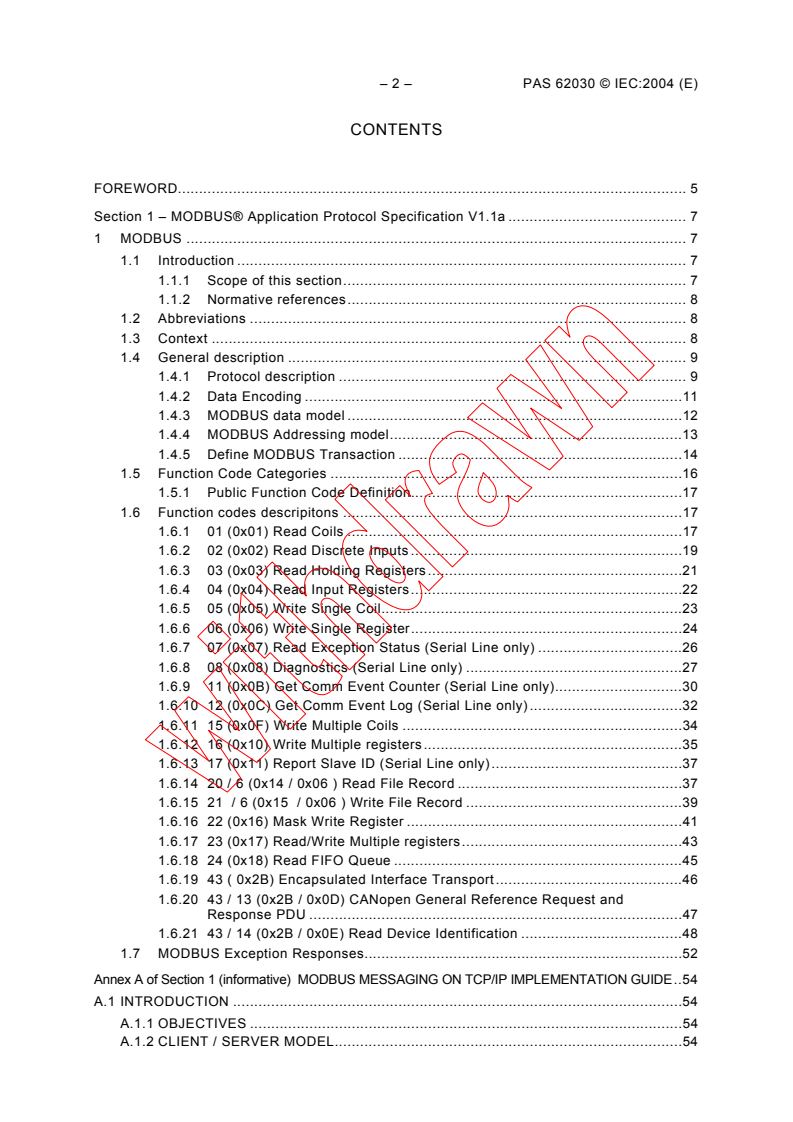
IEC PAS 62030:2004 - Digital data communications for measurement and control - Fieldbus for use in industrial control systems - Section 1: MODBUS® Application Protocol Specification V1.1a - Section 2: Real-Time Publish-Subscribe (RTPS) Wire Protocol Specification Version 1.0 Released:11/26/2004
Relations
- Effective Date
- 05-Sep-2023
- Effective Date
- 05-Sep-2023
Buy Documents
IEC PAS 62030:2004 - Digital data communications for measurement and control - Fieldbus for use in industrial control systems - Section 1: MODBUS® Application Protocol Specification V1.1a - Section 2: Real-Time Publish-Subscribe (RTPS) Wire Protocol Specification Version 1.0 Released:11/26/2004
Get Certified
Connect with accredited certification bodies for this standard

BSI Group
BSI (British Standards Institution) is the business standards company that helps organizations make excellence a habit.

DVS-ZERT GmbH
German welding certification society.
CARES (UK Certification Authority for Reinforcing Steels)
UK certification for reinforcing steels and construction.
Sponsored listings
Frequently Asked Questions
IEC PAS 62030:2004 is a technical specification published by the International Electrotechnical Commission (IEC). Its full title is "Digital data communications for measurement and control - Fieldbus for use in industrial control systems - Section 1: MODBUS® Application Protocol Specification V1.1a - Section 2: Real-Time Publish-Subscribe (RTPS) Wire Protocol Specification Version 1.0". This standard covers: This PAS has been divided into two sections. Section 1 deals with MODBUS® Application Protocol Specification V1.1a while Section 2 covers the Real-Time Publish-Subscribe (RTPS) Wire Protocol Specification Version 1.0. It is intended that the content of this PAS will be incorporated in the future new editions of the various parts of IEC 61158 series according to the structure of this series.
This PAS has been divided into two sections. Section 1 deals with MODBUS® Application Protocol Specification V1.1a while Section 2 covers the Real-Time Publish-Subscribe (RTPS) Wire Protocol Specification Version 1.0. It is intended that the content of this PAS will be incorporated in the future new editions of the various parts of IEC 61158 series according to the structure of this series.
IEC PAS 62030:2004 is classified under the following ICS (International Classification for Standards) categories: 25.040.40 - Industrial process measurement and control; 35.240.50 - IT applications in industry. The ICS classification helps identify the subject area and facilitates finding related standards.
IEC PAS 62030:2004 has the following relationships with other standards: It is inter standard links to IEC 61158-5-15:2007, IEC 61158-6-15:2007. Understanding these relationships helps ensure you are using the most current and applicable version of the standard.
IEC PAS 62030:2004 is available in PDF format for immediate download after purchase. The document can be added to your cart and obtained through the secure checkout process. Digital delivery ensures instant access to the complete standard document.
Standards Content (Sample)
PUBLICLY
IEC
AVAILABLE
PAS 62030
SPECIFICATION
First edition
Pre-Standard
2004-11
Digital data communications
for measurement and control –
Fieldbus for use in industrial
control systems –
Section 1:
MODBUS® Application Protocol
Specification V1.1a –
Section 2:
Real-Time Publish-Subscribe (RTPS)
Wire Protocol Specification Version 1.0
Reference number
IEC/PAS 62030:2004(E)
Publication numbering
As from 1 January 1997 all IEC publications are issued with a designation in the
60000 series. For example, IEC 34-1 is now referred to as IEC 60034-1.
Consolidated editions
The IEC is now publishing consolidated versions of its publications. For example,
edition numbers 1.0, 1.1 and 1.2 refer, respectively, to the base publication, the
base publication incorporating amendment 1 and the base publication incorporating
amendments 1 and 2.
Further information on IEC publications
The technical content of IEC publications is kept under constant review by the IEC,
thus ensuring that the content reflects current technology. Information relating to
this publication, including its validity, is available in the IEC Catalogue of
publications (see below) in addition to new editions, amendments and corrigenda.
Information on the subjects under consideration and work in progress undertaken
by the technical committee which has prepared this publication, as well as the list
of publications issued, is also available from the following:
• IEC Web Site (www.iec.ch)
• Catalogue of IEC publications
The on-line catalogue on the IEC web site (www.iec.ch/searchpub) enables you to
search by a variety of criteria including text searches, technical committees
and date of publication. On-line information is also available on recently issued
publications, withdrawn and replaced publications, as well as corrigenda.
• IEC Just Published
This summary of recently issued publications (www.iec.ch/online_news/ justpub)
is also available by email. Please contact the Customer Service Centre (see
below) for further information.
• Customer Service Centre
If you have any questions regarding this publication or need further assistance,
please contact the Customer Service Centre:
Email: custserv@iec.ch
Tel: +41 22 919 02 11
Fax: +41 22 919 03 00
PUBLICLY
IEC
AVAILABLE
PAS 62030
SPECIFICATION
First edition
Pre-Standard
2004-11
Digital data communications
for measurement and control –
Fieldbus for use in industrial
control systems –
Section 1:
MODBUS® Application Protocol
Specification V1.1a –
Section 2:
Real-Time Publish-Subscribe (RTPS)
Wire Protocol Specification Version 1.0
© IEC 2004 ⎯ Copyright - all rights reserved
No part of this publication may be reproduced or utilized in any form or by any means, electronic or
mechanical, including photocopying and microfilm, without permission in writing from the publisher.
International Electrotechnical Commission, 3, rue de Varembé, PO Box 131, CH-1211 Geneva 20, Switzerland
Telephone: +41 22 919 02 11 Telefax: +41 22 919 03 00 E-mail: inmail@iec.ch Web: www.iec.ch
PRICE CODE
Commission Electrotechnique Internationale
XG
International Electrotechnical Commission
Международная Электротехническая Комиссия
For price, see current catalogue
– 2 – PAS 62030 © IEC:2004 (E)
CONTENTS
FOREWORD.5
Section 1 – MODBUS® Application Protocol Specification V1.1a . 7
1 MODBUS . 7
1.1 Introduction . 7
1.1.1 Scope of this section. 7
1.1.2 Normative references. 8
1.2 Abbreviations . 8
1.3 Context . 8
1.4 General description . 9
1.4.1 Protocol description . 9
1.4.2 Data Encoding .11
1.4.3 MODBUS data model .12
1.4.4 MODBUS Addressing model.13
1.4.5 Define MODBUS Transaction .14
1.5 Function Code Categories .16
1.5.1 Public Function Code Definition.17
1.6 Function codes descripitons .17
1.6.1 01 (0x01) Read Coils .17
1.6.2 02 (0x02) Read Discrete Inputs .19
1.6.3 03 (0x03) Read Holding Registers.21
1.6.4 04 (0x04) Read Input Registers.22
1.6.5 05 (0x05) Write Single Coil.23
1.6.6 06 (0x06) Write Single Register.24
1.6.7 07 (0x07) Read Exception Status (Serial Line only) .26
1.6.8 08 (0x08) Diagnostics (Serial Line only) .27
1.6.9 11 (0x0B) Get Comm Event Counter (Serial Line only).30
1.6.10 12 (0x0C) Get Comm Event Log (Serial Line only).32
1.6.11 15 (0x0F) Write Multiple Coils .34
1.6.12 16 (0x10) Write Multiple registers.35
1.6.13 17 (0x11) Report Slave ID (Serial Line only).37
1.6.14 20 / 6 (0x14 / 0x06 ) Read File Record .37
1.6.15 21 / 6 (0x15 / 0x06 ) Write File Record .39
1.6.16 22 (0x16) Mask Write Register .41
1.6.17 23 (0x17) Read/Write Multiple registers.43
1.6.18 24 (0x18) Read FIFO Queue .45
1.6.19 43 ( 0x2B) Encapsulated Interface Transport.46
1.6.20 43 / 13 (0x2B / 0x0D) CANopen General Reference Request and
Response PDU .47
1.6.21 43 / 14 (0x2B / 0x0E) Read Device Identification .48
1.7 MODBUS Exception Responses.52
Annex A of Section 1 (informative) MODBUS MESSAGING ON TCP/IP IMPLEMENTATION GUIDE.54
A.1 INTRODUCTION .54
A.1.1 OBJECTIVES .54
A.1.2 CLIENT / SERVER MODEL.54
PAS 62030 © IEC:2004 (E) – 3 –
A.1.3 REFERENCE DOCUMENTS .55
A.2 ABBREVIATIONS .55
A.3 CONTEXT .55
A.3.1 PROTOCOL DESCRIPTION .55
A.3.2 MODBUS FUNCTIONS CODES DESCRIPTION .57
A.4 FUNCTIONAL DESCRIPTION.58
A.4.1 MODBUS COMPONENT ARCHITECTURE MODEL.58
A.4.2 TCP CONNECTION MANAGEMENT .61
A.4.3 USE of TCP/IP STACK .65
A.4.4 COMMUNICATION APPLICATION LAYER .71
A.5 IMPLEMENTATION GUIDELINE .82
A.5.1 OBJECT MODEL DIAGRAM .83
A.5.2 IMPLEMENTATION CLASS DIAGRAM.87
A.5.3 SEQUENCE DIAGRAMS.89
A.5.4 CLASSES AND METHODS DESCRIPTION .92
Annex B of Section 1 (Informative) MODBUS RESERVED FUNCTION CODES, SUBCODES
AND MEI TYPES .96
Annex C of Section 1 (Informative) CANOPEN GENERAL REFERENCE COMMAND .96
Section 2 – Real-Time Publish-Subscribe (RTPS) Wire Protocol Specification Version 1.0 .97
2 RTPS .97
2.1 Basic Concepts .97
2.1.1 Introduction.97
2.1.2 The RTPS Object Model.98
2.1.3 The Basic RTPS Transport Interface .99
2.1.4 Notational Conventions .100
2.2 Structure Definitions .101
2.2.1 Referring to Objects: the GUID.101
2.2.2 Building Blocks of RTPS Messages .102
2.3 RTPS Message Format.105
2.3.1 Overall Structure of RTPS Messages .105
2.3.2 Submessage Structure.105
2.3.3 How to Interpret a Message .106
2.3.4 Header .107
2.3.5 ACK.108
2.3.6 GAP.109
2.3.7 HEARTBEAT .110
2.3.8 INFO_DST .112
2.3.9 INFO_REPLY.112
2.3.10 INFO_SRC.113
2.3.11 INFO_TS .114
2.3.12 ISSUE .114
2.3.13 PAD.115
2.3.14 VAR.116
2.3.15 Versioning and Extensibility .117
2.4 RTPS and UDP/IPv4.118
2.4.1 Concepts .118
2.4.2 RTPS Packet Addressing .118
2.4.3 Possible Destinations for Specific Submessages .121
– 4 – PAS 62030 © IEC:2004 (E)
2.5 Attributes of Objects and Metatraffic .122
2.5.1 Concept .122
2.5.2 Wire Format of the ParameterSequence .124
2.5.3 ParameterID Definitions .125
2.5.4 Reserved Objects .126
2.5.5 Examples.130
2.6 Publish-Subscribe Protocol.132
2.6.1 Publication and Subscription Objects .132
2.6.2 Representation of User Data .137
2.7 CST Protocol.139
2.7.1 Object Model .139
2.7.2 Structure of the Composite State (CS).140
2.7.3 CSTWriter.140
2.7.4 CSTReader.145
2.7.5 Overview of Messages used by CST .147
2.8 Discovery with the CST Protocol .149
2.8.1 Overview .149
2.8.2 Managers Keep Track of Their Managees .150
2.8.3 Inter-Manager Protocol .150
2.8.4 The Registration Protocol.151
2.8.5 The Manager-Discovery Protocol.152
2.8.6 The Application Discovery Protocol .152
2.8.7 Services Discovery Protocol.153
Annex A of Section 2 (informative) CDR for RTPS.155
A.1 Primitive Types.155
A.1.1 Semantics .155
A.1.2 Encoding .155
A.1.3 octet.155
A.1.4 boolean .156
A.1.5 unsigned short.156
A.1.6 short.156
A.1.7 unsigned long .156
A.1.8 long.156
A.1.9 unsigned long long .156
A.1.10 long long .156
A.1.11 float 157
A.1.12 double .157
A.1.13 char.157
A.1.14 wchar .157
A.2 Constructed Types .157
A.2.1 Alignment .157
A.2.2 Identifiers .157
A.2.3 List of constructed types .157
A.2.4 Struct .158
A.2.5 Enumeration .158
A.2.6 Sequence .158
A.2.7 Array .158
A.2.8 String .158
A.2.9 Wstring.159
PAS 62030 © IEC:2004 (E) – 5 –
INTERNATIONAL ELECTROTECHNICAL COMMISSION
____________
DIGITAL DATA COMMUNICATIONS FOR MEASUREMENT AND CONTROL –
FIELDBUS FOR USE IN INDUSTRIAL CONTROL SYSTEMS –
*
Section 1: MODBUS® Application Protocol Specification V1.1a –
Section 2: Real-Time Publish-Subscribe (RTPS) Wire Protocol
Specification Version 1.0
FOREWORD
1) The International Electrotechnical Commission (IEC) is a worldwide organization for standardization comprising
all national electrotechnical committees (IEC National Committees). The object of IEC is to promote
international co-operation on all questions concerning standardization in the electrical and electronic fields. To
this end and in addition to other activities, IEC publishes International Standards, Technical Specifications,
Technical Reports, Publicly Available Specifications (PAS) and Guides (hereafter referred to as “IEC
Publication(s)”). Their preparation is entrusted to technical committees; any IEC National Committee interested
in the subject dealt with may participate in this preparatory work. International, governmental and non-
governmental organizations liaising with the IEC also participate in this preparation. IEC collaborates closely
with the International Organization for Standardization (ISO) in accordance with conditions determined by
agreement between the two organizations.
2) The formal decisions or agreements of IEC on technical matters express, as nearly as possible, an
international consensus of opinion on the relevant subjects since each technical committee has representation
from all interested IEC National Committees.
3) IEC Publications have the form of recommendations for international use and are accepted by IEC National
Committees in that sense. While all reasonable efforts are made to ensure that the technical content of IEC
Publications is accurate, IEC cannot be held responsible for the way in which they are used or for any
misinterpretation by any end user.
4) In order to promote international uniformity, IEC National Committees undertake to apply IEC Publications
transparently to the maximum extent possible in their national and regional publications. Any divergence
between any IEC Publication and the corresponding national or regional publication shall be clearly indicated in
the latter.
5) IEC provides no marking procedure to indicate its approval and cannot be rendered responsible for any
equipment declared to be in conformity with an IEC Publication.
6) All users should ensure that they have the latest edition of this publication.
7) No liability shall attach to IEC or its directors, employees, servants or agents including individual experts and
members of its technical committees and IEC National Committees for any personal injury, property damage or
other damage of any nature whatsoever, whether direct or indirect, or for costs (including legal fees) and
expenses arising out of the publication, use of, or reliance upon, this IEC Publication or any other IEC
Publications.
8) Attention is drawn to the Normative references cited in this publication. Use of the referenced publications is
indispensable for the correct application of this publication.
9) Attention is drawn to the possibility that some of the elements of this IEC Publication may be the subject of
patent rights. IEC shall not be held responsible for identifying any or all such patent rights.
A PAS is a technical specification not fulfilling the requirements for a standard but made
available to the public .
IEC-PAS 62030 has been processed by subcommittee 65C: Digital communications, of IEC
technical committee 65: Industrial-process measurement and control.
The text of this PAS is based on the This PAS was approved for
following document: publication by the P-members of the
committee concerned as indicated in
the following document
Draft PAS Report on voting
65C/341A/NP 65C/347/RVN
Following publication of this PAS, which is a pre-standard publication, the technical
committee or subcommittee concerned will transform it into an International Standard.
*
MODBUS is a trademark of Schneider Automation Inc.
– 6 – PAS 62030 © IEC:2004 (E)
It is foreseen that, at a later date, the content of this PAS will be incorporated in the future
new edition of the IEC 61158 series according to its structure.
This PAS shall remain valid for an initial maximum period of three years starting from
2004-11. The validity may be extended for a single three-year period, following which it shall
be revised to become another type of normative document or shall be withdrawn.
PAS 62030 © IEC:2004 (E) – 7 –
Overview ®
This PAS has been divided into two sections. Section 1 deals with MODBUS Application
Protocol Specification V1.1a while Section 2 covers the Real-Time Publish-Subscribe (RTPS)
Wire Protocol Specification Version 1.0.
It is intended that the content of this PAS will be incorporated in the future new editions of the
various parts of IEC 61158 series according to the structure of this series.
Section 1 – MODBUS® Application Protocol Specification V1.1a
1 MODBUS
1.1 Introduction
1.1.1 Scope of this section
MODBUS is an application layer messaging protocol, positioned at level 7 of the OSI model,
that provides client/server communication between devices connected on different types of
buses or networks.
The industry’s serial de facto standard since 1979, MODBUS continues to enable millions of
automation devices to communicate. Today, support for the simple and elegant structure of
MODBUS continues to grow. The Internet community can access MODBUS at a reserved
system port 502 on the TCP/IP stack.
MODBUS is a request/reply protocol and offers services specified by function codes.
MODBUS function codes are elements of MODBUS request/reply PDUs. The objective of this
PAS is to describe the function codes used within the framework of MODBUS transactions.
MODBUS is an application layer messaging protocol for client/server communication between
devices connected on different types of buses or networks.
It is currently implemented using:
y TCP/IP over Ethernet. See Annex A of Section 1: MODBUS MESSAGING ON TCP/IP
IMPLEMENTATION GUIDE.
y Asynchronous serial transmission over a variety of media (wire : EIA/TIA-232-E, EIA-422-A,
EIA/TIA-485-A; fiber, radio, etc.)
y MODBUS PLUS, a high speed token passing network.
NOTE The "Specification" is Clause 1 of this PAS.
NOTE MODBUS Plus is not in this PAS.
MODBUS APPLICATION LAYER
Modbus on TCP
TCP
IP
Other MODBUS+ / HDLC Master / Slave Ethernet II /802.3
EIA/TIA-232 or Ethernet
Other Physical layer
EIA/TIA-485 Physical layer
Figure 1 – MODBUS communication stack
This Figure 1 represents conceptually the MODBUS communication stack.
– 8 – PAS 62030 © IEC:2004 (E)
1.1.2 Normative references
The following referenced documents are indispensable for the application of this document.
For dated references, only the edition cited applies. For undated references, the latest edition
of the referenced document (including any amendments) applies.
IEC 61131 (all parts): Programmable controllers
* **
/TIA -232-E: Interface between Data Terminal Equipment and Data Circuit-Terminating
EIA
Equipment Employing Serial Binary data Interchange
EIA-422-A: Electrical Characteristics-Balanced Voltage Digital Interface Circuit
EIA/TIA-485-A: Electrical Characteristics of Generators and Receivers for Use in balanced
Digital Multipoint Systems
RFC 791, Interne Protocol, Sep81 DARPA
1.2 Abbreviations
ADU Application Data Unit
HDLC High level Data Link Control
HMI Human Machine Interface
IETF Internet Engineering Task Force
I/O Input/Output
IP Internet Protocol
MAC Medium Access Control
MB MODBUS Protocol
MBAP MODBUS Application Protocol
PDU Protocol Data Unit
PLC Programmable Logic Controller
TCP Transport Control Protocol
1.3 Context
The MODBUS protocol allows an easy communication within all types of network
architectures.
*
EIA: Electronic Industries Alliance.
**
TIA: Telecomunication Industry Association.
PAS 62030 © IEC:2004 (E) – 9 –
MODBUS COMMUNICATION
Drive PLC HMI I/ O I/ O PLC
I/ O
MODBUS ON TCP/IP
Gateway Gateway
Gateway
PLC
PLC
I/ O
HMI
I/ O
Device
Drive
Device
I/ O
I/ O
Figure 2 – Example of MODBUS Network Architecture
Every type of devices (PLC, HMI, Control Panel, Driver, Motion control, I/O Device…) can use
MODBUS protocol to initiate a remote operation.
The same communication can be done as well on serial line as on an Ethernet TCP/IP
networks. Gateways allow a communication between several types of buses or network using
the MODBUS protocol.
1.4 General description
1.4.1 Protocol description
The MODBUS protocol defines a simple protocol data unit (PDU) independent of the
underlying communication layers. The mapping of MODBUS protocol on specific buses or
network can introduce some additional fields on the application data unit (ADU).
ADU
Additional address Function code Data Error check
PDU
Figure 3 – General MODBUS frame
The MODBUS application data unit is built by the client that initiates a MODBUS transaction.
The function indicates to the server what kind of action to perform. The MODBUS application
protocol establishes the format of a request initiated by a client.
The function code field of a MODBUS data unit is coded in one byte. Valid codes are in the
range of 1 . 255 decimal (128 – 255 reserved for exception responses). When a message is
sent from a Client to a Server device the function code field tells the server what kind of
action to perform. Function code "0" is not valid.
Sub-function codes are added to some function codes to define multiple actions.
MODBUS ON MB+
MODBUS ON RS232
MODBUS ON RS485
– 10 – PAS 62030 © IEC:2004 (E)
The data field of messages sent from a client to server devices contains additional
information that the server uses to take the action defined by the function code. This can
include items like discrete and register addresses, the quantity of items to be handled, and
the count of actual data bytes in the field.
The data field may be nonexistent (of zero length) in certain kinds of requests, in this case
the server does not require any additional information. The function code alone specifies the
action.
If no error occurs related to the MODBUS function requested in a properly received MODBUS
ADU the data field of a response from a server to a client contains the data requested. If an
error related to the MODBUS function requested occurs, the field contains an exception code
that the server application can use to determine the next action to be taken.
For example a client can read the ON / OFF states of a group of discrete outputs or inputs or
it can read/write the data contents of a group of registers.
When the server responds to the client, it uses the function code field to indicate either a
normal (error-free) response or that some kind of error occurred (called an exception
response). For a normal response, the server simply echoes to the request the original
function code.
Client Server
Initiate request
Function code Data Request
Perform the action
Initiate the response
Function code Data Response
Receive the response
Figure 4 – MODBUS transaction (error free)
For an exception response, the server returns a code that is equivalent to the original
function code from the request PDU with its most significant bit set to logic 1.
Client Server
Initiate request
Function code Data Request
Error detected in the action
Initiate an error
Exception Function code
Exception code
Receive the response
Figure 5 – MODBUS transaction (exception response)
NOTE It is desirable to manage a time out in order not to indefinitely wait for an answer which will perhaps never
arrive.
PAS 62030 © IEC:2004 (E) – 11 –
The size of the MODBUS PDU is limited by the size constraint inherited from the first
MODBUS implementation on Serial Line network (max. RS485 ADU = 256 bytes).
Therefore:
MODBUS PDU for serial line communication = 256 - Server adress (1 byte) - CRC (2
bytes) = 253 bytes.
Consequently:
RS232 / RS485 ADU = 253 bytes + Server adress (1 byte) + CRC (2 bytes) = 256 bytes.
TCP MODBUS ADU = 253 bytes + MBAP (7 bytes) = 260 bytes.
The MODBUS protocol defines three PDUs. They are :
• MODBUS Request PDU, mb_req_pdu
• MODBUS Response PDU, mb_rsp_pdu
• MODBUS Exception Response PDU, mb_excep_rsp_pdu
The mb_req_pdu is defined as:
mb_req_pdu = {function_code, request_data}, where
function_code = [1 byte] MODBUS function code corresponding to the desired
MODBUS function code or requested through the client API,
request_data = [n bytes] This field is function code dependent and usually
contains information such as variable references,
variable counts, data offsets, sub-function codes etc.
The mb_rsp_pdu is defined as:
mb_rsp_pdu = {function_code, response_data}, where
function_code = [1 byte] MODBUS function code
response_data = [n bytes] This field is function code dependent and usually
contains information such as variable references,
variable counts, data offsets, sub-function codes, etc.
The mb_excep_rsp_pdu is defined as:
mb_excep_rsp_pdu = {function_code, request_data}, where
exception-function_code = [1 byte] MODBUS function code + 0x80
exception_code = [1 byte] MODBUS Exception Code Defined in table
"MODBUS Exception Codes" (see 1.7).
1.4.2 Data Encoding
• MODBUS uses a ‘big-Endian’ representation for addresses and data items. This means
that when a numerical quantity larger than a single byte is transmitted, the most
significant byte is sent first. So for example
Register size value
16 - bits 0x1234 the first byte sent is 0x12 then 0x34
NOTE For more details, see [1] in 1.1.2.
– 12 – PAS 62030 © IEC:2004 (E)
1.4.3 MODBUS data model
MODBUS bases its data model on a series of tables that have distinguishing characteristics.
The four primary tables are:
Primary tables Object type Type of Comments
This type of data can be provided by an I/O system.
Discretes Input Single bit Read-Only
This type of data can be alterable by an application
Coils Single bit Read-Write
program.
This type of data can be provided by an I/O system
Input Registers 16-bit word Read-Only
This type of data can be alterable by an application
Holding Registers 16-bit word Read-Write
program.
The distinctions between inputs and outputs, and between bit-addressable and word-
addressable data items, do not imply any application behavior. It is perfectly acceptable, and
very common, to regard all four tables as overlaying one another, if this is the most natural
interpretation on the target machine in question.
For each of the primary tables, the protocol allows individual selection of 65536 data items,
and the operations of read or write of those items are designed to span multiple consecutive
data items up to a data size limit which is dependent on the transaction function code.
It’s obvious that all the data handled via MODBUS (bits, registers) must be located in device
application memory. But physical address in memory should not be confused with data
reference. The only requirement is to link data reference with physical address.
MODBUS logical reference number, which are used in MODBUS functions, are unsigned
integer indices starting at zero.
• Implementation examples of MODBUS model
The examples below show two ways of organizing the data in device. There are different
organizations possible, but not all are described in this document. Each device can have its
own organization of the data according to its application
Example 1 : Device having 4 separate blocks
The example below shows data organization in a device having digital and analog, inputs and
outputs. Each block is separate because data from different blocks have no correlation. Each
block is thus accessible with different MODBUS functions.
Device application memory
MODBUS access
Input Discrete
Coils MODBUS Request
Input Registers
Holding
Registers
MODBUS SERVER DEVICE
Figure 6 – MODBUS Data Model with separate block
PAS 62030 © IEC:2004 (E) – 13 –
Example 2: Device having only 1 block
In this example, the device has only 1 data block. The same data can be reached via several
MODBUS functions, either via a 16 bit access or via an access bit.
Device application memory
MODBUS access
Input Discrete
R
W
Coils MODBUS Request
R
Input Registers
W
Holding
Registers
MODBUS SERVER DEVICE
Figure 7 – MODBUS Data Model with only 1 block
1.4.4 MODBUS Addressing model
The MODBUS application protocol defines precisely PDU addressing rules.
In a MODBUS PDU each data is addressed from 0 to 65535.
It also defines clearly a MODBUS data model composed of 4 blocks that comprises several
elements numbered from 1 to n.
In the MODBUS data Model each element within a data block is numbered from 1 to n.
Afterwards the MODBUS data model has to be bound to the device application (IEC-61131
object, or other application model).
The pre-mapping between the MODBUS data model and the device application is totally
vendor device specific.
– 14 – PAS 62030 © IEC:2004 (E)
Device application
MODBUS data model MODBUS PDU addresses
Read input 0
.
Discrete Input
.
.
.
Coils Read coils 4
.
Read Registers 1
Input Registers 2
.
.
Holding Registers
.
Read Registers 54
Mapping
Application specific MODBUS Standard
Figure 8 – MODBUS Addressing model
The previous figure shows that a MODBUS data numbered X is addressed in the MODBUS
PDU X-1.
1.4.5 Define MODBUS Transaction
The following state diagram describes the generic processing of a MODBUS transaction in
server side.
NOTE In this PAS, a normal response is the function code its specific data.
PAS 62030 © IEC:2004 (E) – 15 –
Wait for a MB
indication
[Receive MB indication]
Validate function
code
[Invalid]
ExeptExeptionCode_1ionCode_1
[Valid]
Validate data
Address
ExceptExceptionCode_2ionCode_2
[Invalid]
[valid]
Validate data
value
ExceptExceptionCode_3ionCode_3
[Invalid]
[valid]
Execute MB
function
ExceptExceptionCode_4_ionCode_4_5_65_6 [Invalid]
[Valid]
Send Modbus
Exception
Send Modbus
Response
Response
Figure 9 – MODBUS Transaction state diagram
Once the request has been processed by a server, a MODBUS response using the
adequate MODBUS server transaction is built.
Depending on the result of the processing two types of response are built :
ƒ A positive MODBUS response :
ƒ the response function code = the request function code
ƒ A MODBUS Exception response ( see 1.7 ):
ƒ the objective is to provide to the client relevant information concerning the
error detected during the processing ;
ƒ the exception function code = the request function code + 0x80 ;
ƒ an exception code is provided to indicate the reason of the error.
– 16 – PAS 62030 © IEC:2004 (E)
1.5 Function Code Categories
There are three categories of MODBUS Functions codes. They are :
Public Function Codes
• Are well defined function codes ,
• guaranteed to be unique,
• validated by the MODBUS-IDA.org community,
• publicly documented
• have available conformance test,
• includes both defined public assigned function codes as well as unassigned function
codes reserved for future use.
User-Defined Function Codes
• there are two ranges of user-defined function codes, ie 65 to 72 and from 100 to 110
decimal.
• user can select and implement a function code that is not supported by the
specification.
• there is no guarantee that the use of the selected function code will be unique
• if the user wants to re-position the functionality as a public function code, he must
initiate an RFC to introduce the change into the public category and to have a new
public function code assigned.
• MODBUS Organization, Inc expressly reserves the right to develop the proposed
RFC.
Reserved Function Codes
• Function Codes currently used by some companies for legacy products and that
are not available for public use.
NOTE The reader should refer to Annex B: MODBUS RESERVED FUNCTION CODES, SUBCODES AND MEI TYPES.
PUBLIC function codes
User Defined Function codes
PUBLIC function codes
User Defined Function codes
PUBLIC function codes
Figure 10 – MODBUS Function Code Categories
NOTE This Figure 10 MODBUS Function Code Categories represents the range where reserved function codes
may reside.
PAS 62030 © IEC:2004 (E) – 17 –
1.5.1 Public Function Code Definition
Function Codes
code Sub (hex) Section
code
Physical Discrete Read Discrete Inputs 02 02 1.6.2
Inputs
Read Coils 01 01 1.6.1
Bit Internal Bits
Write Single Coil 05 05 1.6.5
Or
access
Write Multiple Coils 15 0F 1.6.11
Physical coils
Physical Input Read Input Register 1.6.4
04 04
Data
Registers
Access
Read Holding Registers 1.6.3
03 03
16 bits
Write Single Register 06 06 1.6.6
Internal Registers
access
Write Multiple Registers 1.6.12
Or 16 10
Physical Output
Read/Write Multiple Registers 1.6.17
23 17
Registers
Mask Write Register 22 16 1.6.16
Read FIFO queue 24 18 1.6.18
Read File record 1.6.14
20 6 14
File record access
Write File record 21 6 15 1.6.15
Read Exception status 07 07 1.6.7
Diagnostic 08 00-18,20 08 1.6.8
Diagnostics
Get Com event counter 11 OB 1.6.9
Get Com Event Log 1.6.10
12 0C
Report Slave ID 17 11 1.6.13
Read device Identification 43 14 2B 1.6.21
Other Encapsulated Interface 43 13,14 2B 1.6.19
Transport
CANopen General Reference 43 13 2B 1.6.20
1.6 Function codes descripitons
1.6.1 01 (0x01) Read Coils
This function code is used to read from 1 to 2000 contiguous status of coils in a remote
device. The Request PDU specifies the starting address, ie the address of the first coil
specified, and the number of coils. In the PDU Coils are addressed starting at zero. Therefore
coils numbered 1-16 are addressed as 0-15.
The coils in the response message are packed as one coil per bit of the data field. Status is
indicated as 1= ON and 0= OFF. The LSB of the first data byte contains the output addressed
in the query. The other coils follow toward the high order end of this byte, and from low order
to high order in subsequent bytes.
If the returned output quantity is not a multiple of eight, the remaining bits in the final data
byte will be padded with zeros (toward the high order end of the byte). The Byte Count field
specifies the quantity of complete bytes of data.
– 18 – PAS 62030 © IEC:2004 (E)
Request
Function code 1 Byte 0x01
Starting Address 2 Bytes 0x0000 to 0xFFFF
Quantity of coils 2 Bytes 1 to 2000 (0x7D0)
Response
Function code 1 Byte
0x01
Byte count 1 Byte
N*
Coil Status n Byte n = N or N+1
*N = Quantity of Outputs / 8, if the remainder is different of 0 ⇒ N = N+1
Error
Function code 1 Byte Function code + 0x80
Exception code 1 Byte 01 or 02 or 03 or 04
Here is an example of a request to read discrete outputs 20–38:
Request Response
Field Name (Hex) Field Name (Hex)
Function 01 Function 01
Starting Address Hi 00 Byte Count 03
Starting Address Lo 13 Outputs status 27-20 CD
Quantity of Outputs Hi 00 Outputs status 35-28 6B
Quantity of Outputs Lo 13 Outputs status 38-36 05
The status of outputs 27–20 is shown as the byte value CD hex, or binary 1100 1101. Output
27 is the MSB of this byte, and output 20 is the LSB.
By convention, bits within a byte are shown with the MSB to the left, and the LSB to the right.
Thus the outputs in the first byte are ‘27 through 20’, from left to right. The next byte has
outputs ‘35 through 28’, left to right. As the bits are transmitted serially, they flow from LSB to
MSB: 20 . . . 27, 28 . . . 35, and so on.
In the last data byte, the status of outputs 38-36 is shown as the byte valu
...