

IEC 60079-15:2001
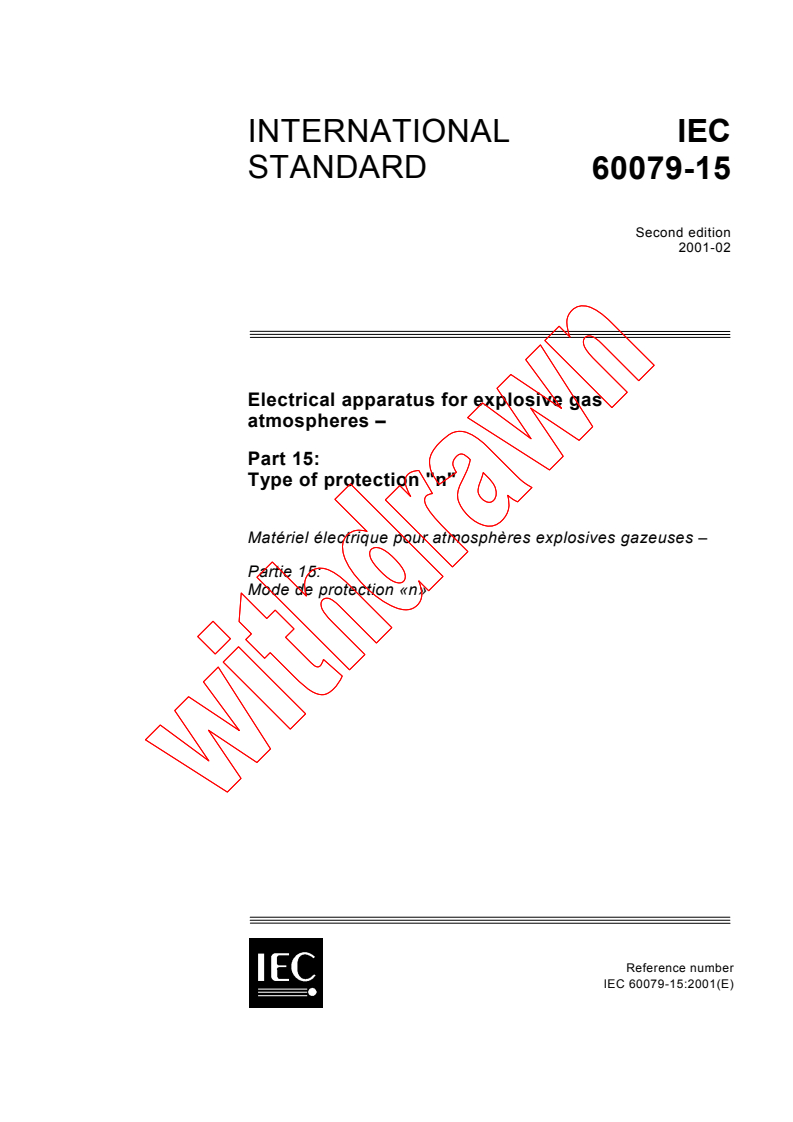
(Main)Electrical apparatus for explosive gas atmospheres - Part 15: Type of protection "n"
General Information
- Abstract
- Status
- Published
- Publication Date
- 26-Feb-2001
- Technical Committee
- TC 31 - Equipment for explosive atmospheres
- Drafting Committee
- MT 19 - TC 17/SC 17C/MT 19
- Current Stage
- DELPUB - Deleted Publication
- Start Date
- 22-Mar-2005
- Completion Date
- 28-Aug-2026
Overview
IEC 60079-15:2001 is the International Electrotechnical Commission standard that specifies requirements for electrical apparatus intended for use in explosive gas atmospheres using the type of protection "n" (non‑sparking). The provided extract contains the consolidated second edition (2001) table of contents and procedural information. (The formal scope text was not included in the extract.)
This standard is part of the IEC 60079 series on equipment for hazardous locations and focuses on design, construction, testing and documentation measures that reduce the likelihood of ignition from electrical equipment in gas/vapor atmospheres.
Key topics and technical requirements
The standard covers practical and testable requirements, including:
- Definitions and general principles - grouping of apparatus, potential ignition sources, surface and ambient temperature considerations.
- Construction and mechanical requirements - degrees of enclosure protection (IP), mechanical strength, guards for light‑transmitting parts, and requirements for non‑metallic enclosures.
- Connections and wiring - terminal and external conductor arrangements, cable entries and clamping methods.
- Clearances, creepage and electrical strength - insulation requirements between live parts and to earth/frame; dielectric and surge considerations.
- Supplementary requirements for specific equipment - rotating machines (motors/generators), luminaires, fuses, instruments, plugs/sockets, batteries and current transformers.
- Protection concepts - sealed/encapsulated devices, enclosed‑break devices, energy‑limited circuits, restricted‑breathing and n‑pressurization enclosures.
- Verification, type testing and documentation - type tests, test configurations, thermal endurance, mechanical tests, IP tests and required specification documentation for certification and factory acceptance.
Practical applications and users
IEC 60079-15 is used where equipment must meet non‑sparking protection ("n") criteria for gas/vapor hazardous areas. Typical applications and stakeholders:
- Industries: oil & gas, petrochemical, chemical processing, mining, pharmaceuticals, power generation and marine.
- Users: electrical designers, equipment manufacturers, safety and compliance engineers, maintenance teams, inspection and testing laboratories, and certification bodies.
- Use cases: designing non‑sparking motors, lighting, switchgear, junction boxes, battery packs and instrumentation for Zone-designated hazardous areas; preparing type test evidence and technical documentation for certification.
Related standards
- Other parts of the IEC 60079 series that cover alternative protection concepts (flameproof, increased safety, intrinsic safety, pressurization, encapsulation) and harmonized national/ex‑product certification schemes.
Keywords: IEC 60079-15, type of protection n, non‑sparking, explosive gas atmospheres, electrical apparatus, hazardous area equipment, IEC 60079 series.
Relations
- Effective Date
- 25-Aug-2026
- Referred By
EN ISO 21049:2004 - Pumps - Shaft sealing systems for centrifugal and rotary pumps (ISO 21049:2004) - Effective Date
- 25-Aug-2026
- Effective Date
- 10-Feb-2026
- Effective Date
- 05-Sep-2023
- Effective Date
- 05-Sep-2023
Get Certified
Connect with accredited certification bodies for this standard

IMQ S.p.A. (Certification)
Italian electrical product certification.

SLG Prüf- und Zertifizierungs GmbH
German testing and certification body.

UL Solutions
Global safety science company with testing, inspection and certification.
Sponsored listings
Frequently Asked Questions
IEC 60079-15:2001 is a standard published by the International Electrotechnical Commission (IEC). Its full title is "Electrical apparatus for explosive gas atmospheres - Part 15: Type of protection "n"". This standard covers: Electrical apparatus for explosive gas atmospheres - Part 15: Type of protection "n"
Electrical apparatus for explosive gas atmospheres - Part 15: Type of protection "n"
IEC 60079-15:2001 is classified under the following ICS (International Classification for Standards) categories: 29.260.20 - Electrical apparatus for explosive atmospheres. The ICS classification helps identify the subject area and facilitates finding related standards.
IEC 60079-15:2001 has the following relationships with other standards: It is inter standard links to EN ISO 13710:2004, EN ISO 21049:2004, EN 61800-2:2015, IEC 60079-15:2005, IEC TR 60079-15:1987. Understanding these relationships helps ensure you are using the most current and applicable version of the standard.
IEC 60079-15:2001 is available in PDF format for immediate download after purchase. The document can be added to your cart and obtained through the secure checkout process. Digital delivery ensures instant access to the complete standard document.
Standards Content (Sample)
INTERNATIONAL IEC
STANDARD
60079-15
Second edition
2001-02
Electrical apparatus for explosive gas
atmospheres –
Part 15:
Type of protection "n"
Matériel électrique pour atmosphères explosives gazeuses –
Partie 15:
Mode de protection «n»
Reference number
Publication numbering
As from 1 January 1997 all IEC publications are issued with a designation in the
60000 series. For example, IEC 34-1 is now referred to as IEC 60034-1.
Consolidated editions
The IEC is now publishing consolidated versions of its publications. For example,
edition numbers 1.0, 1.1 and 1.2 refer, respectively, to the base publication, the
base publication incorporating amendment 1 and the base publication incorporating
amendments 1 and 2.
Further information on IEC publications
The technical content of IEC publications is kept under constant review by the IEC,
thus ensuring that the content reflects current technology. Information relating to
this publication, including its validity, is available in the IEC Catalogue of
publications (see below) in addition to new editions, amendments and corrigenda.
Information on the subjects under consideration and work in progress undertaken
by the technical committee which has prepared this publication, as well as the list
of publications issued, is also available from the following:
• IEC Web Site (www.iec.ch)
• Catalogue of IEC publications
The on-line catalogue on the IEC web site (www.iec.ch/catlg-e.htm) enables
you to search by a variety of criteria including text searches, technical
committees and date of publication. On-line information is also available on
recently issued publications, withdrawn and replaced publications, as well as
corrigenda.
• IEC Just Published
This summary of recently issued publications (www.iec.ch/JP.htm) is also
available by email. Please contact the Customer Service Centre (see below) for
further information.
• Customer Service Centre
If you have any questions regarding this publication or need further assistance,
please contact the Customer Service Centre:
Email: custserv@iec.ch
Tel: +41 22 919 02 11
Fax: +41 22 919 03 00
INTERNATIONAL IEC
STANDARD
60079-15
Second edition
2001-02
Electrical apparatus for explosive gas
atmospheres –
Part 15:
Type of protection "n"
Matériel électrique pour atmosphères explosives gazeuses –
Partie 15:
Mode de protection «n»
IEC 2001 Copyright - all rights reserved
No part of this publication may be reproduced or utilized in any form or by any means, electronic or
mechanical, including photocopying and microfilm, without permission in writing from the publisher.
International Electrotechnical Commission 3, rue de Varembé Geneva, Switzerland
Telefax: +41 22 919 0300 e-mail: inmail@iec.ch IEC web site http://www.iec.ch
Commission Electrotechnique Internationale
PRICE CODE
XB
International Electrotechnical Commission
For price, see current catalogue
– 2 – 60079-15 IEC:2001(E)
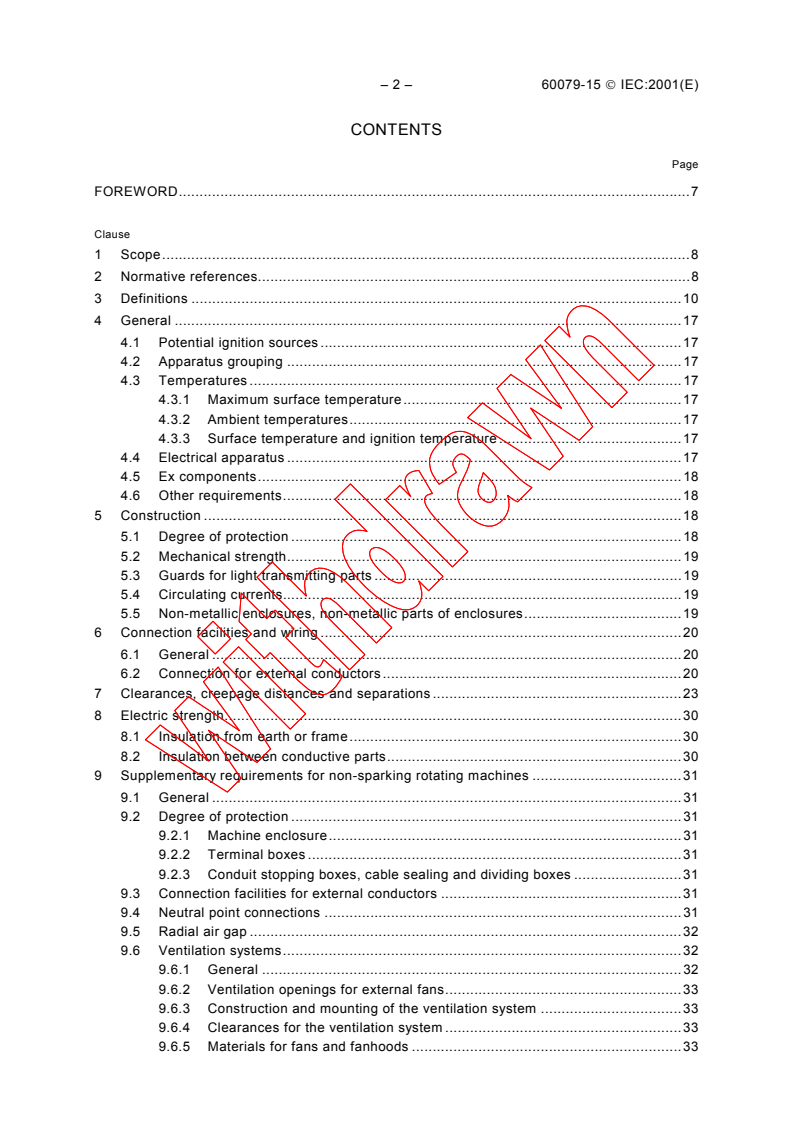
CONTENTS
Page
FOREWORD.7
Clause
1 Scope.8
2 Normative references.8
3 Definitions .10
4 General .17
4.1 Potential ignition sources .17
4.2 Apparatus grouping .17
4.3 Temperatures .17
4.3.1 Maximum surface temperature.17
4.3.2 Ambient temperatures.17
4.3.3 Surface temperature and ignition temperature .17
4.4 Electrical apparatus .17
4.5 Ex components.18
4.6 Other requirements.18
5 Construction .18
5.1 Degree of protection .18
5.2 Mechanical strength.19
5.3 Guards for light transmitting parts .19
5.4 Circulating currents.19
5.5 Non-metallic enclosures, non-metallic parts of enclosures.19
6 Connection facilities and wiring .20
6.1 General .20
6.2 Connection for external conductors.20
7 Clearances, creepage distances and separations .23
8 Electric strength.30
8.1 Insulation from earth or frame.30
8.2 Insulation between conductive parts.30
9 Supplementary requirements for non-sparking rotating machines .31
9.1 General .31
9.2 Degree of protection .31
9.2.1 Machine enclosure.31
9.2.2 Terminal boxes .31
9.2.3 Conduit stopping boxes, cable sealing and dividing boxes .31
9.3 Connection facilities for external conductors .31
9.4 Neutral point connections .31
9.5 Radial air gap .32
9.6 Ventilation systems.32
9.6.1 General .32
9.6.2 Ventilation openings for external fans.33
9.6.3 Construction and mounting of the ventilation system .33
9.6.4 Clearances for the ventilation system .33
9.6.5 Materials for fans and fanhoods .33
60079-15 IEC:2001(E) – 3 –
Clause Page
9.7 Bearing seals and shaft seals .33
9.7.1 Non-rubbing seals and labyrinths .33
9.7.2 Rubbing seals.33
9.8 Rotor cages.34
9.8.1 Rotor cages built from bars connected to end rings .34
9.8.2 Cast rotor cages .34
9.9 Surface temperature limitation .34
9.9.1 Prevention of thermal ignition.34
9.9.2 Operation with a frequency convertor or a non-sinusoidal supply .35
10 Supplementary requirements for non-sparking fuses and fuse assemblies.35
11 Supplementary requirements for non-sparking luminaires.36
11.1 General .36
11.2 Construction .36
11.2.1 General .36
11.2.2 Enclosure of lamp .36
11.2.3 Mounting arrangement .36
11.2.4 Lampholders.36
11.2.5 Auxiliaries.37
11.2.6 Reflectors .38
11.2.7 Creepage distances and clearances.38
11.2.8 Terminals .39
11.2.9 External and internal wiring .40
11.2.10 Endurance tests and thermal tests .40
11.2.11 Resistance to dust and moisture .41
11.2.12 Insulation resistance and electric strength .41
11.3 Other apparatus containing light sources .41
12 Supplementary requirements for non-sparking instruments and low power apparatus .42
13 Supplementary requirements for non-sparking current transformers .42
14 Supplementary requirements for non-sparking plugs and sockets .42
15 Supplementary requirements for non-sparking cells and batteries.43
15.1 Categorization of cells and batteries .43
15.2 General requirements for cells and batteries of types 1 and 2.44
15.3 Charging of type 1 cells and batteries .45
15.4 Charging of type 2 cells and batteries .45
15.5 Requirements for type 3 secondary batteries.46
15.5.1 Types of permissible batteries.46
15.5.2 Battery containers.46
15.5.3 Cells.47
15.5.4 Connections.47
15.6 Verification and tests .47
15.6.1 Insulation resistance .47
15.6.2 Shock test .48
16 Other electrical apparatus .48
– 4 – 60079-15 IEC:2001(E)
Clause Page
17 General supplementary requirements for apparatus producing arcs, sparks
or hot surfaces.48
18 Supplementary requirements for enclosed-break devices and non-incendive
components producing arcs, sparks or hot surfaces .48
18.1 Type testing.48
18.2 Ratings.49
18.3 Construction of enclosed-break devices .49
19 Supplementary requirements for hermetically sealed devices producing arcs,
sparks or hot surfaces .49
20 Supplementary requirements for sealed devices or encapsulated devices producing
arcs, sparks or hot surfaces.49
20.1 Sealed devices or encapsulated devices other than for luminaires.49
20.2 Encapsulated devices for luminaires .50
20.3 Sealed devices for luminaires .50
21 Supplementary requirements for energy-limited apparatus and circuits producing arcs,
sparks or hot surfaces .51
21.1 General .51
21.2 Associated energy-limited apparatus.51
21.3 Energy-limited apparatus .51
21.4 Self protected energy-limited apparatus .51
21.5 Separation of conducting parts.51
21.6 Plugs and sockets .51
21.7 Protection against polarity reversal .52
21.8 Requirements for components on which energy limitation depends.52
21.8.1 Ratings of components .52
21.8.2 Fuses .52
21.8.3 Shunt safety components.52
22 Supplementary requirements for restricted-breathing enclosures protecting apparatus
producing arcs, sparks or hot surfaces.52
23 Supplementary requirements for n-pressurization protecting apparatus producing arcs,
sparks or hot surfaces .53
23.1 Forms of n-pressurization .53
23.2 Requirements for n-pressurization enclosures.54
23.2.1 Degree of protection of enclosure .54
23.2.2 Doors and covers.54
23.2.3 Mechanical strength.54
23.2.4 Apertures, partitions and internal components .54
23.2.5 Spark and particle barriers .54
23.3 Temperature limits.54
23.4 Safety provisions and safety devices (except for static pressurization).54
23.5 Safety provisions and safety devices for static pressurization .54
23.6 Supply of protective gas.54
24 General information on verification and tests.54
25 Specification documentation .55
26 Type tests.55
26.1 General .55
26.2 Test configuration.55
60079-15 IEC:2001(E) – 5 –
Clause Page
26.3 Tests for enclosures .55
26.3.1 Order of tests .55
26.3.2 Thermal endurance tests .56
26.3.3 Mechanical strength tests .56
26.3.4 Tests for degree of protection (IP code) by enclosures .57
26.4 Test for cable entry clamping method.58
26.5 Test for enclosed-break devices and non-incendive components.58
26.5.1 Preparation of enclosed-break device samples.58
26.5.2 Preparation of non-incendive component samples .58
26.5.3 Test conditions for enclosed-break devices and
non-incendive components.58
26.6 Tests for sealed devices and encapsulated devices .59
26.6.1 Apparatus .59
26.6.2 Procedure.59
26.6.3 Test for encapsulated devices for luminaires.60
26.6.4 Test for sealed devices for luminaires .60
26.7 Assessment and test of energy-limited apparatus and circuits .61
26.8 Tests for restricted-breathing enclosures .61
26.8.1 Apparatus with provision for routine checking of restricted-breathing
properties .61
26.8.2 Apparatus without provision for routine checking of restricted-breathing
properties .61
26.8.3 Apparatus where the nominal volume of the enclosure changes due to
pressure .61
26.9 Test for apparatus with n-pressurization.61
26.9.1 Maximum overpressure test .61
26.9.2 Leakage test.61
26.9.3 Purging test for leakage compensation and filling procedure for static
pressurization .61
26.9.4 Verification of minimum overpressure .61
26.9.5 Verification of the ability of the n-pressurization enclosure to limit internal
pressure .62
26.10 Test for screw lampholders .62
26.11 Test for starter holders for luminaires.62
26.12 Tests for ballasts in circuits with ignitors.63
26.12.1 Number of samples .63
26.12.2 Conditioning prior to high-voltage impulse test.63
26.12.3 High-voltage impulse test.64
26.13 Tests for electronic starters for tubular fluorescent lamps and for ignitors for high
pressure sodium or metal halide lamps .66
26.13.1 General. 66
26.13.2 Humidity test . 66
26.13.3 Voltage test. 66
26.13.4 Cut-out device test .67
26.13.5 Life test . 67
26.14 Test for wiring of luminaires subject to high-voltage impulses from ignitors .68
26.15 Shock test for batteries .68
26.16 Insulation resistance test for batteries .68
– 6 – 60079-15 IEC:2001(E)
Clause Page
27 Routine verifications and tests.69
27.1 General .69
27.2 Specific routine tests .69
28 Marking .69
29 Documentation .72
30 Manufacturer's responsibility.73
Bibliography .74
Figure 1 – Parts of a secondary cell.16
Figure 2 – Illustration of entry points and branching points.23
Figure 3 – Examples for determining clearances and creepage distances .30
Figure 4a – Example of acceptable spring leaf screwless terminal .40
Figure 4b – Example of non-acceptable spring leaf screwless terminal .40
Figure 5 – High-voltage impulse test circuit .65
Figure 6 – Full lightning impulse .66
Table 1 – Minimum cross-sectional area of protective conductors .21
Table 2 – Minimum creepage distances, clearances and separations.25
Table 3 – Tracking resistance of insulating materials .26
Table 4 – Separation in compound-filled cable sealing boxes.26
Table 5 – Assumed working voltage of neutral points.32
Table 6 – Creepage distances and clearances at peak values of pulse voltages
greater than 1,5 kV .39
Table 7 – Types and use of cells and batteries .43
Table 8 – Insertion torque .62
Table 9 – Minimum removal torque.62
Table 10 – Electric strength test voltage .64
60079-15 IEC:2001(E) – 7 –
INTERNATIONAL ELECTROTECHNICAL COMMISSION
___________
ELECTRICAL APPARATUS FOR EXPLOSIVE GAS ATMOSPHERES –
Part 15: Type of protection "n"
FOREWORD
1) The IEC (International Electrotechnical Commission) is a worldwide organization for standardization comprising
all national electrotechnical committees (IEC National Committees). The object of the IEC is to promote
international co-operation on all questions concerning standardization in the electrical and electronic fields. To
this end and in addition to other activities, the IEC publishes International Standards. Their preparation is
entrusted to technical committees; any IEC National Committee interested in the subject dealt with may
participate in this preparatory work. International, governmental and non-governmental organizations liaising
with the IEC also participate in this preparation. The IEC collaborates closely with the International Organization
for Standardization (ISO) in accordance with conditions determined by agreement between the two
organizations.
2) The formal decisions or agreements of the IEC on technical matters express, as nearly as possible, an
international consensus of opinion on the relevant subjects since each technical committee has representation
from all interested National Committees.
3) The documents produced have the form of recommendations for international use and are published in the form
of standards, technical specifications, technical reports or guides and they are accepted by the National
Committees in that sense.
4) In order to promote international unification, IEC National Committees undertake to apply IEC International
Standards transparently to the maximum extent possible in their national and regional standards. Any
divergence between the IEC Standard and the corresponding national or regional standard shall be clearly
indicated in the latter.
5) The IEC provides no marking procedure to indicate its approval and cannot be rendered responsible for any
equipment declared to be in conformity with one of its standards.
6) Attention is drawn to the possibility that some of the elements of this International Standard may be the subject
of patent rights. The IEC shall not be held responsible for identifying any or all such patent rights.
International Standard IEC 60079-15 has been prepared by IEC technical committee 31:
Electrical apparatus for explosive atmospheres.
This second edition cancels and replaces the first edition which was issued as a technical
report in 1987. It constitutes a technical revision and now has the status of an International
Standard.
The text of this standard is based on the following documents:
FDIS Report on voting
31/346/FDIS 31/353/RVD
Full information on the voting for the approval of this standard can be found in the report on
voting indicated in the above table.
This publication has been drafted in accordance with the ISO/IEC Directives, Part 3.
The committee has decided that the contents of this publication will remain unchanged until
2004. At this date, the publication will be
• reconfirmed;
• withdrawn;
• replaced by a revised edition, or
• amended.
A bilingual version of this publication may be issued at a later date.
– 8 – 60079-15 IEC:2001(E)
ELECTRICAL APPARATUS FOR EXPLOSIVE GAS ATMOSPHERES –
Part 15: Type of protection "n"
1 Scope
This part of IEC 60079 specifies requirements for the construction, testing and marking for
Group II electrical apparatus with type of protection "n" intended for use in explosive gas
atmospheres.
This standard is applicable to non-sparking electrical apparatus and also to electrical
apparatus with parts or circuits producing arcs or sparks or having hot surfaces which, if not
protected in one of the ways specified in this standard, could be capable of igniting a
surrounding explosive gas atmosphere.
A non-incendive component is limited in use to the particular circuit for which it has been
shown to be non-ignition capable and, therefore, cannot be separately assessed as complying
with this standard.
Compliance with this standard does not imply any removal of, or lowering of, the requirements
of any other standard with which the electrical apparatus complies.
This standard supplements, and may enhance, the requirements for apparatus for normal
industrial applications.
NOTE This standard makes several specific references to IEC 60079-0. It is not intended that apparatus with type
of protection "n" should comply with IEC 60079-0 in its entirety, or that the level of protection achieved by
compliance with this standard should be equal to the level of protection achieved by compliance with IEC 60079-0
and any of the types of protection listed therein.
2 Normative references
The following normative documents contain provisions which, through reference in this text,
constitute provisions of this part of IEC 60079. For dated references, subsequent amendments
to, or revisions of, any of these publications do not apply. However, parties to agreements
based on this part of IEC 60079 are encouraged to investigate the possibility of applying the
most recent editions of the normative documents indicated below. For undated references, the
latest edition of the normative document referred to applies. Members of ISO and IEC maintain
registers of currently valid standards.
IEC 60034 (all parts), Rotating electrical machines
IEC 60034-1:1996, Rotating electrical machines – Part 1: Rating and performance
IEC 60034-5, Rotating electrical machines – Part 5: Classification of degrees of protection
provided by enclosures of rotating electrical machines (IP code)
IEC 60050-411, International Electrotechnical Vocabulary – Chapter 411: Rotating machinery
___________
A consolidated edition 10.2 exists (1999) that includes IEC 60034-1 (1996), its amendment 1 (1997) and its
amendment 2 (1999).
60079-15 IEC:2001(E) – 9 –
IEC 60050(426), International Electrotechnical Vocabulary – Chapter 426: Electrical apparatus
for explosive atmospheres
IEC 60050(486), International Electrotechnical Vocabulary – Chapter 486: Secondary cells and
batteries
IEC 60060 (all parts), High-voltage test techniques
IEC 60061 (all parts), Lamp caps and holders together with gauges for the control of
interchangeability and safety
IEC 60068-2-27:1987, Environmental testing – Part 2: Tests – Test Ea and guidance: Shock
IEC 60079-0:1998, Electrical apparatus for explosive gas atmospheres – Part 0: General
requirements
IEC 60079-2, Electrical apparatus for explosive gas atmospheres – Part 2: Electrical
apparatus, type of protection "p"
IEC 60079-11, Electrical apparatus for explosive gas atmospheres – Part 11: Intrinsic safety "i"
IEC 60081, Double-capped fluorescent lamps – Performance specifications
IEC 60112, Method for determining the comparative and the proof tracking indices of solid
insulating materials under moist conditions
IEC 60155, Glow-starters for fluorescent lamps
IEC 60216-1:1990, Guide for the determination of thermal endurance properties of electrical
insulating materials – Part 1: General guidelines for ageing procedures and evaluation of test
results
IEC 60216-2, Guide for the determination of thermal endurance properties of electrical
insulating materials – Part 2: Choice of test criteria
IEC 60238:1998, Edison screw lampholders
IEC 60269-3, Low-voltage fuses – Part 3: Supplementary requirements for fuses for use by
unskilled persons (fuses mainly for household and similar applications)
IEC 60400, Lampholders for tubular fluorescent lamps and starter holders
IEC 60529:1989, Degrees of protection provided by enclosures (IP Code)
IEC 60598-1:1996, Luminaires – Part 1: General requirements and tests
IEC 60598-2 (all parts), Luminaires – Part 2: Particular requirements
IEC 60662:1992, High-pressure sodium vapour lamps
___________
A consolidated edition 3.1 exists (2000) that includes IEC 60079-0 (1998) and its amendment 1 (2000).
Fourth edition in preparation.
Fifth edition in preparation.
A consolidated edition 7.1 exists (2000) that includes IEC 60238 (1998) and its amendment 1 (1999).
– 10 – 60079-15 IEC:2001(E)
IEC 60664-1, Insulation coordination for equipment within low-voltage systems – Part 1:
Principles, requirements and tests
IEC 60920, Ballasts for tubular fluorescent lamps – General and safety requirements
IEC 60922, Auxiliaries for lamps – Ballasts for discharge lamps (excluding tubular fluorescent
lamps) – General and safety requirements
IEC 60924, D.C. supplied electronic ballasts for tubular fluorescent lamps – General and safety
requirements
IEC 60926, 1995, Auxiliaries for lamps – Starting devices (other than glow starters) – General
and safety requirements
IEC 60927, 1996, Auxiliaries for lamps – Starting devices (other than glow starters) –
Performance requirements
IEC 60928: 1995, Auxiliaries for lamps – A.C. supplied electronic ballasts for tubular
fluorescent lamps – General and safety requirements
IEC 60998-2-4, 1991, Connecting devices for low-voltage circuits for household and similar
purposes – Part 2-4: Particular requirements for twist-on connecting devices
IEC 61048, Capacitors for use in tubular fluorescent and other discharge lamp circuits –
General and safety requirements
IEC 61049, Capacitors for use in tubular fluorescent and other discharge lamp circuits –
Performance requirements
IEC 61184, Bayonet lampholders
3 Definitions
For the purpose of this part of IEC 60079, the definitions given in IEC 60079-0 as well as the
following definitions apply.
1)
NOTE Definitions marked differ from the equivalent definitions in IEC 60079-0. It is proposed that the definitions
in IEC 60079-0 be modified to accommodate the slight differences needed for use with this standard, at which time
definitions in this standard will be deleted.
3.1
cable sealing box
auxiliary enclosure provided specifically for the purpose of sealing the insulation of a cable (for
example, oil insulated cable) where it is connected to an apparatus. The enclosure may also
provide for the connection of separate cable tails to the cable
___________
A consolidated edition 1.1 exists (2000) that includes IEC 60664 (1992) and its amendment 1 (2000).
A consolidated edition 2.1 exists (2000) that includes IEC 60926 (1995) and its amendment 1 (1999).
A consolidated edition 2.1 exists (2000) that includes IEC 60927 (1996) and its amendment 1 (1999).
A consolidated edition 2.1 exists (1999) that includes IEC 60928 (1995) and its amendment 1 (1999).
A consolidated edition 1.2 exists (1999) that includes IEC 61048 (1991), its amendment 1 (1995) and its
amendment 2 (1999).
60079-15 IEC:2001(E) – 11 –
3.2
(electrochemical) cell or battery
electrochemical system capable of storing in chemical form the electric energy received and
which can give it back by reconversion
[IEV 486-01-01]
3.2.1
secondary cell
assembly of electrodes and electrolyte which constitutes the basic unit of a secondary battery
[IEV 486-01-02]
NOTE 1 A cell consists substantially of positive and negative plates and separators, of the items needed for
assembling and connecting (plate lugs, group bars, terminal posts), of the cell container, and the electrolyte.
NOTE 2 A sketch illustrating various parts of a cell is given in figure 1. This sketch is included for descriptive
purposes only and is not intended to imply any requirements or preference for a particular form of construction.
3.2.2
secondary battery
two or more secondary cells connected together and used as a source of electric energy
[IEV 486-01-03]
3.2.3
container (of a cell)
container for the plate pack and electrolyte of a cell made of a material impervious to attack by
the electrolyte
[IEV 486-02-20]
3.2.4
(battery) container
enclosure to contain the battery
NOTE The cover is a part of the battery container.
3.2.5
battery capacity
quantity of electricity or electric charge, which a fully charged battery can deliver under
specified conditions
NOTE The SI unit for electrical charge is the coulomb (1 C = 1 As) but in practice, battery capacity is usually
expressed in ampere-hours (Ah).
[IEV 486-03-01]
3.2.6
plate pack
assembly of the positive and negative plate groups with separators
[IEV 486-02-15]
3.2.7
intercell connector
conductor of electricity used for carrying current between cells
[IEV 486-02-31]
3.3
clearance
shortest distance in air between two conductive parts
(IEC 60664-1)
– 12 – 60079-15 IEC:2001(E)
3.4
continuous operating temperature (COT)
maximum temperature which ensures the stability and integrity of the material for the expected
life of the apparatus, or part, in its intended application
3.5
creepage distance
shortest distance along the surface of an electrically insulating material between two
conductive parts
3.6
duty cycle
repetitive variation of load in which the cycle time is too short for thermal equilibrium to be
attained in the first cycle
[IEV 411-51-07]
3.7
encapsulated device
device, which may or may not contain voids, which is so constructed that it is totally immersed
in an encapsulating compound so that it is sealed to prevent entry of an external atmosphere
NOTE For the purpose of this standard an encapsulated device is considered to be a particular form of sealed
device. It does not provide equivalent protection to encapsulated apparatus constructed in accordance with
IEC 60079-18.
3.8
enclosed-break device
device incorporating electrical contacts that are made and broken and that will withstand an
internal explosion of the flammable gas or vapour which may enter it without suffering damage
and without communicating the internal explosion to the external flammable gas or vapour
3.9
energy limitation
concept applicable to circuits in which no spark or any thermal effect produced in the test
conditions prescribed in this standard is capable of causing ignition of a given flammable gas
or vapour
3.9.1
energy-limited apparatus
electrical apparatus in which the circuits and components are constructed according to the
concept of energy limitation
3.9.2
associated energy-limited apparatus
electrical apparatus which contains both energy-limited and non-energy-limited circuits and is
constructed so that the non-energy-limited circuits cannot adversely affect the energy-limited
circuits. Associated energy-limited apparatus may be either:
a) electrical apparatus which has an alternative method of protection included in this standard
for use in the appropriate explosive gas atmosphere;
b) electrical apparatus which has an alternative type of protection listed in IEC 60079-0 for use
in the appropriate explosive gas atmosphere;
c) electrical apparatus not so protected and which therefore shall not be used within an
explosive gas atmosphere, for example, a recorder which is not of itself in an explosive gas
atmosphere but is connected to a thermocouple situated within an explosive gas
atmosphere where only the recorder input circuit is energy-limited
60079-15 IEC:2001(E) – 13 –
3.9.3
self protected energy-limited apparatus
apparatus which contains energy-limited sparking contacts, the circuits (including, energy-
limiting components and devices) supplying energy-limited power to these contacts, as well as
the non-energy limited source of supply to the circuit
3.10
1)
Ex component
part of electrical apparatus or a module (other than an Ex cable entry), marked with the
symbol "U", which is not intended to be used alone and requires additional consideration when
incorporated into electrical apparatus or systems for use in explosive gas atmospheres
3.11
hand-held apparatus
portable apparatus intended to be supported by one hand during normal use
3.12
hermetically-sealed device
device which is so constructed that the external atmosphere cannot gain access to the interior
and in which the seal is made by fusion, for example by soldering, brazing, welding or the
fusion of glass to metal
3.13
maximum external capacitance, C
o
maximum capacitance in an energy-limited circuit that can be connected to the connection
facilities of the apparatus
3.14
maximum external inductance, L
o
maximum value of inductance in an energy-limited circuit that can be connected to the
connection facilities of the apparatus
3.15
maximum input current, I
i
maximum current (peak a.c. or d.c.) that can be safely applied in normal operation to the
connection facilities of an energy-limited apparatus
3.16
maximum input power, P
i
maximum power that can be safely dissipated in normal operation within an energy-limited
apparatus
3.17
maximum input voltage, U
i
maximum voltage (peak a.c. or d.c.) that can be safely applied in normal operation to the
connection facilities of an energy-limited apparatus
3.18
maximum internal capacitance, C
i
total equivalent internal capacitance of the apparatus containing energy-limited circuits which is
considered as appearing across the connection facilities of the apparatus in normal operation
3.19
maximum internal inductance, L
i
total equivalent internal inductance of the apparatus containing energy-limited circuits which is
considered as appearing at the connection facilities of the apparatus in normal operation
– 14 – 60079-15 IEC:2001(E)
3.20
maximum output current (I )
o
maximum current (peak a.c. or d.c.) that can be taken in normal operation, including short
circuit at the terminals, from the conn
...