

IEC 62403:2005
(Main)High density recording format on CD-R/RW disc systems - HD-BURN format
General Information
- Abstract
IEC 62403:2005 specifies the HD-BURN format applied to CD-R/RW discs. The HD-BURN system is capable of recording the information in double density compared to the conventional CD-R/RW disc. It enables the realization of products with high reliability, high speed and interchangeability, and is especially suitable for consumer applications with high cost-performance. It describes:
- the physical characteristics for the recording and playback;
- the track structure of a disc, the data structure in the track;
- logical format structure.
- Status
- Published
- Publication Date
- 23-Jun-2005
- Technical Committee
- TC 100 - Audio, video and multimedia systems and equipment
- Current Stage
- PPUB - Publication issued
- Start Date
- 24-Jun-2005
- Completion Date
- 31-Dec-2005
Buy Documents
IEC 62403:2005 - High density recording format on CD-R/RW disc systems - HD-BURN format Released:6/24/2005
IEC 62403:2005 - High density recording format on CD-R/RW disc systems - HD-BURN format Released:6/24/2005
Overview
IEC 62403:2005 - High density recording format on CD‑R/RW disc systems (HD‑BURN format) specifies the HD‑BURN format for CD‑R and CD‑RW media. The HD‑BURN system enables recording at double the data density of conventional CD‑R/RW discs, targeting high reliability, high speed and interchangeability for cost‑sensitive consumer applications. The standard defines the physical recording and playback characteristics, on‑disc track and data structures, and the logical format used to organise recorded information.
Key Topics
The standard covers technical requirements and structures needed to implement HD‑BURN on optical discs, including:
- Physical characteristics for recording and playback: optical and mechanical parameters required for compatible read/write behaviour on CD‑R and CD‑RW media.
- Track and sector structure: layout of tracks, physical sectors (PSN), sector numbering and session/lead‑in/lead‑out arrangements.
- Data frame and ECC formats: channel framing, synchronization frames and use of error correction (including Reed‑Solomon product code - RSPC) to maintain data integrity at higher density.
- Pre‑groove and ATIP: guidance track encoding, ATIP (absolute time in pre‑groove) and related synchronization rules used for timing and addressing.
- Program memory data (PMD) and TPMA: on‑disc program memory information, temporary program memory area and rules for multi‑session media.
- Logical format and file system considerations: organisation of recorded data and compatibility with common optical file systems (references to UDF and ISO 9660 are normative).
- Normative annexes: examples and rules such as a standard disc definition, ATIP synchronization, and linking behaviour for recorders.
Applications and who uses IEC 62403:2005
IEC 62403 is practical for companies and professionals involved in optical media and consumer electronics:
- Optical disc drive / recorder manufacturers (firmware and hardware design)
- CD‑R/CD‑RW media manufacturers defining compliant substrates and pre‑groove features
- Consumer electronics designers (multimedia players, set‑top boxes) needing interchangeability
- Software and firmware developers implementing low‑level disc access, session management and write strategies
- Archive and data distribution solutions requiring higher capacity on CD media
Benefits include higher storage per disc, backward‑aware interchangeability, and defined error‑correction and session handling for robust consumer use.
Related standards
IEC 62403 references and complements existing optical disc standards; implementers should consult these for full interoperability:
- IEC 60908 (Compact disc digital audio)
- ISO/IEC 16448 (DVD read‑only)
- ISO 9660 (CD‑ROM volume and file structure)
- ISO/IEC 20563 (DVD‑R)
- IEC 62291 (UDF API)
- Sony/Philips Red Book and Orange Book (CD and CD‑R/CD‑RW system descriptions)
Keywords: IEC 62403:2005, HD‑BURN, CD‑R, CD‑RW, high density recording format, track structure, ATIP, PMD, RSPC, optical disc standards.
Buy Documents
IEC 62403:2005 - High density recording format on CD-R/RW disc systems - HD-BURN format Released:6/24/2005
IEC 62403:2005 - High density recording format on CD-R/RW disc systems - HD-BURN format Released:6/24/2005
Get Certified
Connect with accredited certification bodies for this standard

BSI Group
BSI (British Standards Institution) is the business standards company that helps organizations make excellence a habit.

NYCE
Mexican standards and certification body.
Sponsored listings
Frequently Asked Questions
IEC 62403:2005 is a standard published by the International Electrotechnical Commission (IEC). Its full title is "High density recording format on CD-R/RW disc systems - HD-BURN format". This standard covers: IEC 62403:2005 specifies the HD-BURN format applied to CD-R/RW discs. The HD-BURN system is capable of recording the information in double density compared to the conventional CD-R/RW disc. It enables the realization of products with high reliability, high speed and interchangeability, and is especially suitable for consumer applications with high cost-performance. It describes: - the physical characteristics for the recording and playback; - the track structure of a disc, the data structure in the track; - logical format structure.
IEC 62403:2005 specifies the HD-BURN format applied to CD-R/RW discs. The HD-BURN system is capable of recording the information in double density compared to the conventional CD-R/RW disc. It enables the realization of products with high reliability, high speed and interchangeability, and is especially suitable for consumer applications with high cost-performance. It describes: - the physical characteristics for the recording and playback; - the track structure of a disc, the data structure in the track; - logical format structure.
IEC 62403:2005 is classified under the following ICS (International Classification for Standards) categories: 35.220.30 - Optical storage devices. The ICS classification helps identify the subject area and facilitates finding related standards.
IEC 62403:2005 is available in PDF format for immediate download after purchase. The document can be added to your cart and obtained through the secure checkout process. Digital delivery ensures instant access to the complete standard document.
Standards Content (Sample)
INTERNATIONAL IEC
STANDARD 62403
First edition
2005-06
High density recording format on CD-R/RW disc
systems – HD-BURN format
Reference number
Publication numbering
As from 1 January 1997 all IEC publications are issued with a designation in the
60000 series. For example, IEC 34-1 is now referred to as IEC 60034-1.
Consolidated editions
The IEC is now publishing consolidated versions of its publications. For example,
edition numbers 1.0, 1.1 and 1.2 refer, respectively, to the base publication, the
base publication incorporating amendment 1 and the base publication incorporating
amendments 1 and 2.
Further information on IEC publications
The technical content of IEC publications is kept under constant review by the IEC,
thus ensuring that the content reflects current technology. Information relating to
this publication, including its validity, is available in the IEC Catalogue of
publications (see below) in addition to new editions, amendments and corrigenda.
Information on the subjects under consideration and work in progress undertaken
by the technical committee which has prepared this publication, as well as the list
of publications issued, is also available from the following:
• IEC Web Site (www.iec.ch)
• Catalogue of IEC publications
The on-line catalogue on the IEC web site (www.iec.ch/searchpub) enables you to
search by a variety of criteria including text searches, technical committees
and date of publication. On-line information is also available on recently issued
publications, withdrawn and replaced publications, as well as corrigenda.
• IEC Just Published
This summary of recently issued publications (www.iec.ch/online_news/ justpub)
is also available by email. Please contact the Customer Service Centre (see
below) for further information.
• Customer Service Centre
If you have any questions regarding this publication or need further assistance,
please contact the Customer Service Centre:
Email: custserv@iec.ch
Tel: +41 22 919 02 11
Fax: +41 22 919 03 00
INTERNATIONAL IEC
STANDARD 62403
First edition
2005-06
High density recording format on CD-R/RW disc
systems – HD-BURN format
IEC 2005 Copyright - all rights reserved
No part of this publication may be reproduced or utilized in any form or by any means, electronic or
mechanical, including photocopying and microfilm, without permission in writing from the publisher.
International Electrotechnical Commission, 3, rue de Varembé, PO Box 131, CH-1211 Geneva 20, Switzerland
Telephone: +41 22 919 02 11 Telefax: +41 22 919 03 00 E-mail: inmail@iec.ch Web: www.iec.ch
PRICE CODE
Commission Electrotechnique Internationale U
International Electrotechnical Commission
МеждународнаяЭлектротехническаяКомиссия
For price, see current catalogue
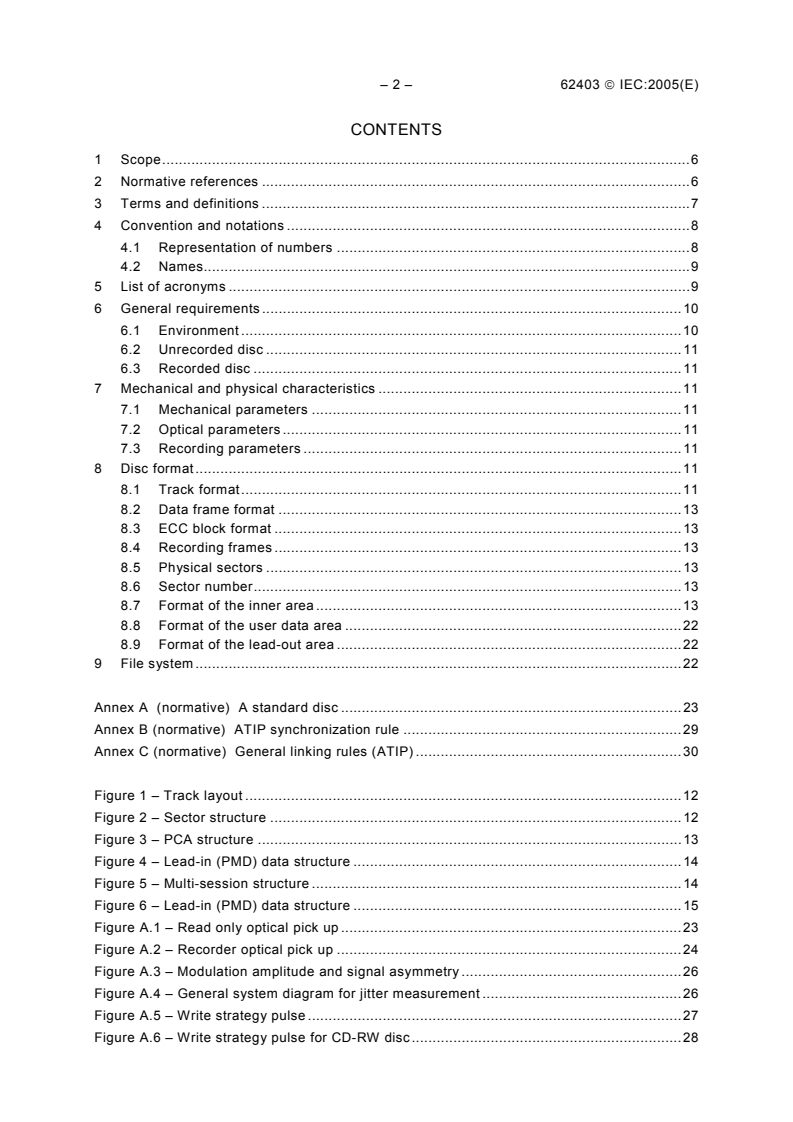
– 2 – 62403 IEC:2005(E)
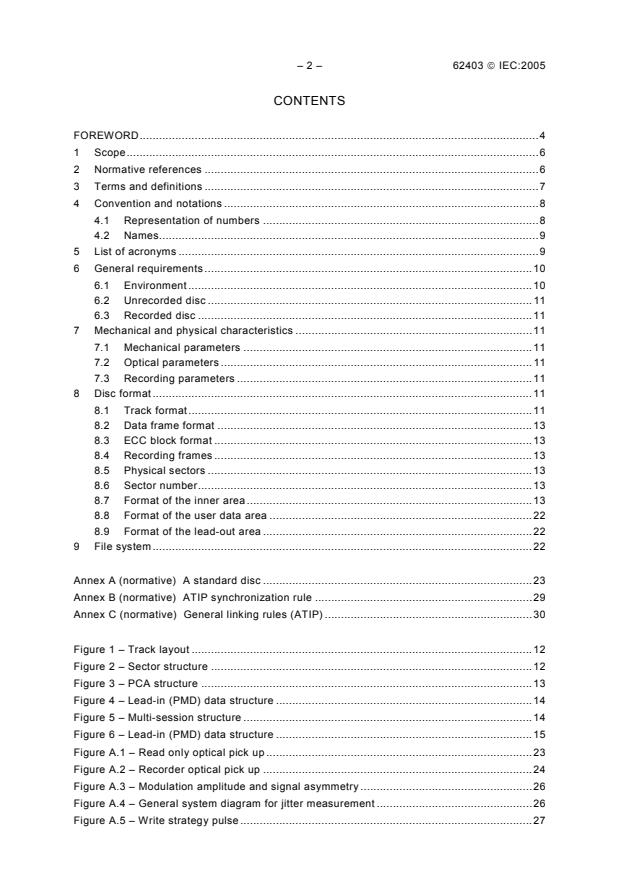
CONTENTS
1 Scope.6
2 Normative references .6
3 Terms and definitions .7
4 Convention and notations .8
4.1 Representation of numbers .8
4.2 Names.9
5 List of acronyms .9
6 General requirements .10
6.1 Environment .10
6.2 Unrecorded disc .11
6.3 Recorded disc .11
7 Mechanical and physical characteristics .11
7.1 Mechanical parameters .11
7.2 Optical parameters .11
7.3 Recording parameters .11
8 Disc format.11
8.1 Track format.11
8.2 Data frame format .13
8.3 ECC block format .13
8.4 Recording frames .13
8.5 Physical sectors .13
8.6 Sector number.13
8.7 Format of the inner area.13
8.8 Format of the user data area .22
8.9 Format of the lead-out area .22
9 File system.22
Annex A (normative) A standard disc .23
Annex B (normative) ATIP synchronization rule .29
Annex C (normative) General linking rules (ATIP) .30
Figure 1 – Track layout .12
Figure 2 – Sector structure .12
Figure 3 – PCA structure .13
Figure 4 – Lead-in (PMD) data structure .14
Figure 5 – Multi-session structure .14
Figure 6 – Lead-in (PMD) data structure .15
Figure A.1 – Read only optical pick up .23
Figure A.2 – Recorder optical pick up .24
Figure A.3 – Modulation amplitude and signal asymmetry .26
Figure A.4 – General system diagram for jitter measurement .26
Figure A.5 – Write strategy pulse .27
Figure A.6 – Write strategy pulse for CD-RW disc.28
62403 IEC:2005(E) – 3 –
Figure B.1 – ATIP synchronization rule .29
Figure C.1 – Write start for general linking rules (ATIP) .30
Figure C.2 – Write stop for general linking rules (ATIP) .30
Table 1 – PMA padding data format .14
Table 2 – TPMA structure-1 .15
Table 3 – TPMA structure-2 .15
Table 4 – TPMA structure-3 .16
Table 5 – Initial data of PMD lead-in of disc information.16
Table 6 – Write type.17
Table 7 – Link size.17
Table 8 – PMD-1.18
Table 9 – PMD-1 item detail.19
Table 10 – PMD lead-in start address .19
Table 11 – Media information.20
Table 12 – Point field.20
Table 13 – PMD-2.20
Table 14 – PMD-3.21
Table 15 – PMD-4.21
Table 16 – PSI.21
Table 17 – PMD lead-in start address .22
Table 18 – Media information.22
– 4 – 62403 IEC:2005(E)
INTERNATIONAL ELECTROTECHNICAL COMMISSION
____________
HIGH DENSITY RECORDING FORMAT
ON CD-R/RW DISC SYSTEMS –
HD-BURN FORMAT
FOREWORD
1) The International Electrotechnical Commission (IEC) is a worldwide organization for standardization comprising
all national electrotechnical committees (IEC National Committees). The object of IEC is to promote
international co-operation on all questions concerning standardization in the electrical and electronic fields. To
this end and in addition to other activities, IEC publishes International Standards, Technical Specifications,
Technical Reports, Publicly Available Specifications (PAS) and Guides (hereafter referred to as “IEC
Publication(s)”). Their preparation is entrusted to technical committees; any IEC National Committee interested
in the subject dealt with may participate in this preparatory work. International, governmental and non-
governmental organizations liaising with the IEC also participate in this preparation. IEC collaborates closely
with the International Organization for Standardization (ISO) in accordance with conditions determined by
agreement between the two organizations.
2) The formal decisions or agreements of IEC on technical matters express, as nearly as possible, an international
consensus of opinion on the relevant subjects since each technical committee has representation from all
interested IEC National Committees.
3) IEC Publications have the form of recommendations for international use and are accepted by IEC National
Committees in that sense. While all reasonable efforts are made to ensure that the technical content of IEC
Publications is accurate, IEC cannot be held responsible for the way in which they are used or for any
misinterpretation by any end user.
4) In order to promote international uniformity, IEC National Committees undertake to apply IEC Publications
transparently to the maximum extent possible in their national and regional publications. Any divergence
between any IEC Publication and the corresponding national or regional publication shall be clearly indicated in
the latter.
5) IEC provides no marking procedure to indicate its approval and cannot be rendered responsible for any
equipment declared to be in conformity with an IEC Publication.
6) All users should ensure that they have the latest edition of this publication.
7) No liability shall attach to IEC or its directors, employees, servants or agents including individual experts and
members of its technical committees and IEC National Committees for any personal injury, property damage or
other damage of any nature whatsoever, whether direct or indirect, or for costs (including legal fees) and
expenses arising out of the publication, use of, or reliance upon, this IEC Publication or any other IEC
Publications.
8) Attention is drawn to the Normative references cited in this publication. Use of the referenced publications is
indispensable for the correct application of this publication.
The IEC draws attention to the fact that it is claimed that compliance with this document may involve the use of
patents.
The IEC takes no position concerning the evidence, validity and scope of this patent right.
The holder of this patent right has assured the IEC that he/she is willing to negotiate licences under reasonable
and non-discriminatory terms and conditions with applicants throughout the world. In this respect, the statement of
the holder of this patent right is registered with IEC. Information may be obtained from:
Sanyo Electric Co., Ltd.
5-5 Keihan-hondori 2-chome Moriguchi City, Osaka, 570-8677, Japan
Attention is drawn to the possibility that some of the elements of this document may be the subject of patent rights
other than those identified above. The IEC shall not be held responsible for identifying any or all such patent rights.
International Standard IEC 62403 has been prepared by technical area 7: Moderate data rate
storage media, equipment and systems of IEC technical committee TC 100: Audio, video and
multimedia systems and equipment.
62403 IEC:2005(E) – 5 –
The text of this standard is based on the following documents:
CDV Report on voting
100/844/CDV 100/926/RVC
Full information on the voting for the approval of this standard can be found in the report on
voting indicated in the above table.
This publication has been drafted in accordance with the ISO/IEC Directives, Part 2.
The committee has decided that the contents of this publication will remain unchanged until
the maintenance result date indicated on the IEC web site under "http://webstore.iec.ch" in
the data related to the specific publication. At this date, the publication will be
• reconfirmed;
• withdrawn;
• replaced by a revised edition, or
• amended.
A bilingual version of this publication may be issued at a later date.
– 6 – 62403 IEC:2005(E)
HIGH DENSITY RECORDING FORMAT
ON CD-R/RW DISC SYSTEMS –
HD-BURN FORMAT
1 Scope
This International Standard specifies the HD-BURN format applied to CD-R/RW discs. The
HD-BURN system is capable of recording the information in double density compared to the
conventional CD-R/RW disc. It enables the realization of products with high reliability, high
speed and interchangeability, and is especially suitable for consumer applications with high
cost-performance.
This document describes:
– the physical characteristics for the recording and playback;
– the track structure of a disc;
– the data structure in the track;
– logical format structure.
2 Normative references
The following references are indispensable for the application of this document. For dated
references, only the cited edition applies. For undated references, the latest edition of the
referenced document (including any amendments) applies.
IEC 60908, Audio recording –Compact disc digital audio system
ISO/IEC 16448:2002, Information technology – 120 mm DVD – Read-only disk
ISO/IEC 20563, Information technology – 80 mm (1,23 Gbytes per side) and 120 mm (3,95
Gbytes per side) DVD-recordable disc (DVD-R)
IEC 62291:2002, Multimedia data storage – Application program interface for UDF based file
systems
ISO 9660:1988, Volume and file structure of CD-ROM for Information Interchange
ISO/IEC 13346-1:1995, Information technology – Volume and file structure of write-once and
rewritable media using non-sequential recording for information interchange – Part 1: General
The Red Book: Compact disk digital Audio System Description Version, May 1999
Sony/Philips
The Orange Book part2: Recordable compact disk systems, Part2 CD-R Version 3.1,
Sony/Philips
The Orange Book part 3: Recordable compact disk system, Part3 CD-RW Volume 3, Ultra-
Speed Ver 1.0
NOTE The Red book and Orange book can be obtained from Sony/Philips.
62403 IEC:2005(E) – 7 –
3 Terms and definitions
For the purposes of this document, the following terms and definitions apply.
3.1
absolute time in pre-groove
ATIP
time-code information contained in the pre-groove with an additional modulation of the wobble
3.2
access guard area
AGA
preamble data area for reading the following ECC blocks
3.3
HD-BURN
high-density write system at CD-R/RW disc
3.4
land pre pit
LPP
pits embossed on the land during the manufacture of the disc substrate, which contain
address information
3.5
multi-session
disc constituted by some sessions
3.6
non CD sector
sector, which has a different structure from the CD
3.7
physical sector number
PSN
serial number, which is allocated to physical sectors on the disc
3.8
pre-groove
guidance track in which clocking and time code information is stored by means of an FM
modulated wobble
3.9
program memory data
PMD
information, which is described on the recording program of the disc, including information on
each recording mode
3.10
program start information
PSI
start address of the first lead-in
– 8 – 62403 IEC:2005(E)
3.11
Reed-Solomon product code
RSPC
method of an error correction code, which corrects errors by multiple bits
3.12
sector
smallest addressable part of a track in the information zone of a disc that can be accessed
independently of other addressable parts
3.13
session
area on the disc consisting of lead-in area, program area and lead-out area
3.14
synchronization frame
group of 1488 channel bits, which is representing a synchronization pattern
3.15
temporary program memory area
TPMA
area, which is used for intermediate storage
3.16
track
path, which is followed by the focus of the optical beam during one revolution of the disc
4 Convention and notations
4.1 Representation of numbers
A measured value is rounded off to the least significant digit of the corresponding specified
value. It implies that a specified value of 1,26 with a positive tolerance of +0,01, and a
negative tolerance of –0,02 allows a range of measured values from 1,235 to 1,275.
– Letters and digits in parentheses represent numbers in hexadecimal notation.
– The setting of a bit is denoted by ZERO or ONE.
– Numbers in binary notation and bit combinations are represented by strings of 0 and 1.
– Numbers in binary notation and bit combinations are shown with the most significant bit to
the left.
– Negative values of numbers in binary notation are given in Two's complement.
– In each field the data is recorded so that the most significant byte (byte 0) is recorded first.
Within each byte the least significant bit is numbered 0 and is recorded first, the most
significant bit (numbered 7 in an 8-bit byte) is recorded last. This order of recording
applies also to the data input of the error detection and correction circuits and to their
output.
62403 IEC:2005(E) – 9 –
4.2 Names
The names of entities, for example specific tracks, fields, etc., are given with a capital letter.
5 List of acronyms
ADB Address Data Bit
ALPC Auto Laser Power Control
ASYM Asymmetry
BCD Binary Coded Decimal
BP Byte Position
BPF Band Pass Filter
CD-R Compact Disk Recordable
CD-RW Compact Disk ReWritable
CDS Codeword Digital Sum
CD-WO Compact Disk Write Once
CLV Constant Linear Velocity
CRC Cyclic Redundancy Check
DCB Data Channel Bit
DSV Digital Sum Value
DVD Digital Versatile Disc
ECC Error Correction Code
EDC Error Detection Code
HDB High Density Burn ( = HD-BURN)
HF High Frequency
ID Identification Data
IED ID Error Detection code
LOS Lead-out Start Address
LPF Low-Pass Filter
LSB Least Significant Byte
MSB Most Significant Byte
NRZI Non Return to Zero Inverted
OPC Optimum Power Control
PAD Padding
PCA Power Calibration Area
PI Parity of Inner-code
PMA Program Memory Area
PO Parity of Outer-code
PUH Pick Up Head
R/W Rewritable
RID Recorder Identifier
RS Reed-Solomon
– 10 – 62403 IEC:2005(E)
6 General requirements
6.1 Environment
6.1.1 Testing environment
The test environment is the environment where the air immediately surrounding the disc has
the following properties.
For dimensional measurements For other measurements
temperature: 23 °C ± 2 °C 15 °C ± 35 °C
relative humidity: 45 % to 55 % 45 % to 75 %
atmospheric pressure: 60 kPa to 106 kPa 60 kPa to 106 kPa
Unless otherwise stated, all tests and measurements shall be made in this test environment.
6.1.2 Operating environment
6.1.2.1 Recorded and unrecorded discs
This International Standard requires that an optical disc which meets all mandatory
requirements of this International Standard in the specified test environment provides data
interchange over the specified ranges of environmental parameters in the operating
environment.
Discs used for data interchange shall be operated under the following conditions, when
mounted in the drive supplied with voltage and measured on the outside surface of the disc.
The disc exposed to storage conditions shall be conditioned in the operating environment for
at least 2 h before operating.
temperature: –25 °C to 70 °C
relative humidity: 3 % to 95 %
3 3
absolute humidity: 0,5 g/m to 60,0 g/m
temperature gradient: 15 °C/h maximum
relative humidity gradient: 10 %/h maximum
There shall be no condensation of moisture on the disc.
6.1.2.2 Unrecorded disc environmental conditions during recording
The disc exposed to storage conditions shall be conditioned in the recording environment for
at least 2 h before operating.
temperature: –5 °C to 55 °C
relative humidity: 10 % to 95 %
3 3
absolute humidity: 0,5 g/m to 30,0 g/m
There shall be no condensation of moisture on the disc.
62403 IEC:2005(E) – 11 –
6.1.2.3 Conditions of measurement
Measurements and mechanical checks shall be carried out within the following limits unless
otherwise specified:
ambient temperature: 15 °C to 35 °C
relative humidity: 45 % to 75 %
air pressure: 86 kPa to 106 kPa
6.2 Unrecorded disc
6.2.1 Unrecorded CD-R disc
Unrecorded CD-R disc fulfils the requirements as written in the Dis
...
IEC 62403 ®
Edition 1.0 2005-06
INTERNATIONAL
STANDARD
NORME
INTERNATIONALE
HIgh density recording format on CD-R/RW disc systems – HD-BURN format
Format d'enregistrement à haute densité sur un système à disque CD-R/RW –
Format HD-BURN
All rights reserved. Unless otherwise specified, no part of this publication may be reproduced or utilized in any form
or by any means, electronic or mechanical, including photocopying and microfilm, without permission in writing from
either IEC or IEC's member National Committee in the country of the requester.
If you have any questions about IEC copyright or have an enquiry about obtaining additional rights to this publication,
please contact the address below or your local IEC member National Committee for further information.
Droits de reproduction réservés. Sauf indication contraire, aucune partie de cette publication ne peut être reproduite ni
utilisée sous quelque forme que ce soit et par aucun procédé, électronique ou mécanique, y compris la photocopie et les
microfilms, sans l'accord écrit de la CEI ou du Comité national de la CEI du pays du demandeur.
Si vous avez des questions sur le copyright de la CEI ou si vous désirez obtenir des droits supplémentaires sur cette
publication, utilisez les coordonnées ci-après ou contactez le Comité national de la CEI de votre pays de résidence.
IEC Central Office Tel.: +41 22 919 02 11
3, rue de Varembé Fax: +41 22 919 03 00
CH-1211 Geneva 20 info@iec.ch
Switzerland www.iec.ch
About the IEC
The International Electrotechnical Commission (IEC) is the leading global organization that prepares and publishes
International Standards for all electrical, electronic and related technologies.
About IEC publications
The technical content of IEC publications is kept under constant review by the IEC. Please make sure that you have the
latest edition, a corrigenda or an amendment might have been published.
Useful links:
IEC publications search - www.iec.ch/searchpub Electropedia - www.electropedia.org
The advanced search enables you to find IEC publications The world's leading online dictionary of electronic and
by a variety of criteria (reference number, text, technical electrical terms containing more than 30 000 terms and
committee,…). definitions in English and French, with equivalent terms in
It also gives information on projects, replaced and additional languages. Also known as the International
withdrawn publications. Electrotechnical Vocabulary (IEV) on-line.
IEC Just Published - webstore.iec.ch/justpublished Customer Service Centre - webstore.iec.ch/csc
Stay up to date on all new IEC publications. Just Published If you wish to give us your feedback on this publication
details all new publications released. Available on-line and or need further assistance, please contact the
also once a month by email. Customer Service Centre: csc@iec.ch.
A propos de la CEI
La Commission Electrotechnique Internationale (CEI) est la première organisation mondiale qui élabore et publie des
Normes internationales pour tout ce qui a trait à l'électricité, à l'électronique et aux technologies apparentées.
A propos des publications CEI
Le contenu technique des publications de la CEI est constamment revu. Veuillez vous assurer que vous possédez
l’édition la plus récente, un corrigendum ou amendement peut avoir été publié.
Liens utiles:
Recherche de publications CEI - www.iec.ch/searchpub Electropedia - www.electropedia.org
La recherche avancée vous permet de trouver des Le premier dictionnaire en ligne au monde de termes
publications CEI en utilisant différents critères (numéro de électroniques et électriques. Il contient plus de 30 000
référence, texte, comité d’études,…). termes et définitions en anglais et en français, ainsi que
Elle donne aussi des informations sur les projets et les les termes équivalents dans les langues additionnelles.
publications remplacées ou retirées. Egalement appelé Vocabulaire Electrotechnique
International (VEI) en ligne.
Just Published CEI - webstore.iec.ch/justpublished
Service Clients - webstore.iec.ch/csc
Restez informé sur les nouvelles publications de la CEI.
Just Published détaille les nouvelles publications parues. Si vous désirez nous donner des commentaires sur
Disponible en ligne et aussi une fois par mois par email. cette publication ou si vous avez des questions
contactez-nous: csc@iec.ch.
IEC 62403 ®
Edition 1.0 2005-06
INTERNATIONAL
STANDARD
NORME
INTERNATIONALE
HIgh density recording format on CD-R/RW disc systems – HD-BURN format
Format d'enregistrement à haute densité sur un système à disque CD-R/RW –
Format HD-BURN
INTERNATIONAL
ELECTROTECHNICAL
COMMISSION
COMMISSION
ELECTROTECHNIQUE
PRICE CODE
INTERNATIONALE
CODE PRIX U
ICS 35.220.30 ISBN 978-2-83220-369-9
– 2 – 62403 IEC:2005
CONTENTS
FOREWORD . 4
1 Scope . 6
2 Normative references . 6
3 Terms and definitions . 7
4 Convention and notations . 8
4.1 Representation of numbers . 8
4.2 Names. 9
5 List of acronyms . 9
6 General requirements . 10
6.1 Environment . 10
6.2 Unrecorded disc . 11
6.3 Recorded disc . 11
7 Mechanical and physical characteristics . 11
7.1 Mechanical parameters . 11
7.2 Optical parameters . 11
7.3 Recording parameters . 11
8 Disc format . 11
8.1 Track format . 11
8.2 Data frame format . 13
8.3 ECC block format . 13
8.4 Recording frames . 13
8.5 Physical sectors . 13
8.6 Sector number . 13
8.7 Format of the inner area . 13
8.8 Format of the user data area . 22
8.9 Format of the lead-out area . 22
9 File system . 22
Annex A (normative) A standard disc . 23
Annex B (normative) ATIP synchronization rule . 29
Annex C (normative) General linking rules (ATIP) . 30
Figure 1 – Track layout . 12
Figure 2 – Sector structure . 12
Figure 3 – PCA structure . 13
Figure 4 – Lead-in (PMD) data structure . 14
Figure 5 – Multi-session structure . 14
Figure 6 – Lead-in (PMD) data structure . 15
Figure A.1 – Read only optical pick up . 23
Figure A.2 – Recorder optical pick up . 24
Figure A.3 – Modulation amplitude and signal asymmetry . 26
Figure A.4 – General system diagram for jitter measurement . 26
Figure A.5 – Write strategy pulse . 27
62403 IEC:2005 – 3 –
Figure A.6 – Write strategy pulse for CD-RW disc . 28
Figure B.1 – ATIP synchronization rule . 29
Figure C.1 – Write start for general linking rules (ATIP) . 30
Figure C.2 – Write stop for general linking rules (ATIP) . 30
Table 1 – PMA padding data format . 14
Table 2 – TPMA structure-1 . 15
Table 3 – TPMA structure-2 . 15
Table 4 – TPMA structure-3 . 16
Table 5 – Initial data of PMD lead-in of disc information . 16
Table 6 – Write type . 17
Table 7 – Link size . 17
Table 8 – PMD-1 . 18
Table 9 – PMD-1 item detail . 19
Table 10 – PMD lead-in start address . 19
Table 11 – Media information . 20
Table 12 – Point field . 20
Table 13 – PMD-2 . 20
Table 14 – PMD-3 . 21
Table 15 – PMD-4 . 21
Table 16 – PSI . 21
Table 17 – PMD lead-in start address . 22
Table 18 – Media information . 22
– 4 – 62403 IEC:2005
INTERNATIONAL ELECTROTECHNICAL COMMISSION
____________
HIGH DENSITY RECORDING FORMAT
ON CD-R/RW DISC SYSTEMS –
HD-BURN FORMAT
FOREWORD
1) The International Electrotechnical Commission (IEC) is a worldwide organization for standardization comprising
all national electrotechnical committees (IEC National Committees). The object of IEC is to promote
international co-operation on all questions concerning standardization in the electrical and electronic fields. To
this end and in addition to other activities, IEC publishes International Standards, Technical Specifications,
Technical Reports, Publicly Available Specifications (PAS) and Guides (hereafter referred to as “IEC
Publication(s)”). Their preparation is entrusted to technical committees; any IEC National Committee interested
in the subject dealt with may participate in this preparatory work. International, governmental and non-
governmental organizations liaising with the IEC also participate in this preparation. IEC collaborates closely
with the International Organization for Standardization (ISO) in accordance with conditions determined by
agreement between the two organizations.
2) The formal decisions or agreements of IEC on technical matters express, as nearly as possible, an international
consensus of opinion on the relevant subjects since each technical committee has representation from all
interested IEC National Committees.
3) IEC Publications have the form of recommendations for international use and are accepted by IEC National
Committees in that sense. While all reasonable efforts are made to ensure that the technical content of IEC
Publications is accurate, IEC cannot be held responsible for the way in which they are used or for any
misinterpretation by any end user.
4) In order to promote international uniformity, IEC National Committees undertake to apply IEC Publications
transparently to the maximum extent possible in their national and regional publications. Any divergence
between any IEC Publication and the corresponding national or regional publication shall be clearly indicated in
the latter.
5) IEC provides no marking procedure to indicate its approval and cannot be rendered responsible for any
equipment declared to be in conformity with an IEC Publication.
6) All users should ensure that they have the latest edition of this publication.
7) No liability shall attach to IEC or its directors, employees, servants or agents including individual experts and
members of its technical committees and IEC National Committees for any personal injury, property damage or
other damage of any nature whatsoever, whether direct or indirect, or for costs (including legal fees) and
expenses arising out of the publication, use of, or reliance upon, this IEC Publication or any other IEC
Publications.
8) Attention is drawn to the Normative references cited in this publication. Use of the referenced publications is
indispensable for the correct application of this publication.
The IEC draws attention to the fact that it is claimed that compliance with this document may involve the use of
patents.
The IEC takes no position concerning the evidence, validity and scope of this patent right.
The holder of this patent right has assured the IEC that he/she is willing to negotiate licences under reasonable
and non-discriminatory terms and conditions with applicants throughout the world. In this respect, the statement of
the holder of this patent right is registered with IEC. Information may be obtained from:
Sanyo Electric Co., Ltd.
5-5 Keihan-hondori 2-chome Moriguchi City, Osaka, 570-8677, Japan
Attention is drawn to the possibility that some of the elements of this document may be the subject of patent rights
other than those identified above. The IEC shall not be held responsible for identifying any or all such patent rights.
International Standard IEC 62403 has been prepared by technical area 7: Moderate data rate
storage media, equipment and systems of IEC technical committee TC 100: Audio, video and
multimedia systems and equipment.
This bilingual version (2012-11) corresponds to the monolingual English version, published in
2005-06.
62403 IEC:2005 – 5 –
The text of this standard is based on the following documents:
CDV Report on voting
100/844/CDV 100/926/RVC
Full information on the voting for the approval of this standard can be found in the report on
voting indicated in the above table.
The French version of this standard has not been voted upon.
This publication has been drafted in accordance with the ISO/IEC Directives, Part 2.
The committee has decided that the contents of this publication will remain unchanged until
the maintenance result date indicated on the IEC web site under "http://webstore.iec.ch" in
the data related to the specific publication. At this date, the publication will be
• reconfirmed;
• withdrawn;
• replaced by a revised edition, or
• amended.
– 6 – 62403 IEC:2005
HIGH DENSITY RECORDING FORMAT
ON CD-R/RW DISC SYSTEMS –
HD-BURN FORMAT
1 Scope
This International Standard specifies the HD-BURN format applied to CD-R/RW discs. The
HD-BURN system is capable of recording the information in double density compared to the
conventional CD-R/RW disc. It enables the realization of products with high reliability, high
speed and interchangeability, and is especially suitable for consumer applications with high
cost-performance.
This document describes:
– the physical characteristics for the recording and playback;
– the track structure of a disc,
– the data structure in the track;
– logical format structure.
2 Normative references
The following references are indispensable for the application of this document. For dated
references, only the cited edition applies. For undated references, the latest edition of the
referenced document (including any amendments) applies.
IEC 60908, Audio recording – Compact disc digital audio system
ISO/IEC16448:2002, Information technology – 120 mm DVD – Read-only disk
ISO/IEC20563, Information technology – 80 mm (1,23 Gbytes per side) and 120 mm (3,95
Gbytes per side) DVD-recordable disc (DVD-R)
IEC 62291:2002, Multimedia data storage – Application program interface for UDF based file
systems
ISO 9660:1988, Volume and file structure of CD-ROM for Information Interchange
ISO/IEC 13346-1:1995, Information technology – Volume and file structure of write-once and
rewritable media using non-sequential recording for information interchange – Part 1: General
The Red Book: Compact disk digital Audio System Description Version, May 1999
Sony/Philips
The Orange Book part 2: Recordable compact disk systems, Part2 CD-R Version 3.1,
Sony/Philips
The Orange Book part 3: Recordable compact disk system, Part3 CD-RW Volume 3, Ultra-
Speed Ver 1.0
NOTE The Red book and Orange book can be obtained from Sony/Philips.
62403 IEC:2005 – 7 –
3 Terms and definitions
For the purposes of this document, the following terms and definitions apply.
3.1
absolute time in pre-groove
ATIP
time-code information contained in the pre-groove with an additional modulation of the wobble
3.2
access guard area
AGA
preamble data area for reading the following ECC blocks
3.3
HD-BURN
high-density write system at CD-R/RW disc
3.4
land pre pit
LPP
pits embossed on the land during the manufacture of the disc substrate, which contain
address information
3.5
multi-session
disc constituted by some sessions
3.6
non CD sector
sector, which has a different structure from the CD
3.7
physical sector number
PSN
serial number, which is allocated to physical sectors on the disc
3.8
pre-groove
guidance track in which clocking and time code information is stored by means of an FM
modulated wobble
3.9
program memory data
PMD
information, which is described on the recording program of the disc, including information on
each recording mode
3.10
program start information
PSI
start address of the first lead-in
– 8 – 62403 IEC:2005
3.11
Reed-Solomon product code
RSPC
method of an error correction code, which corrects errors by multiple bits
3.12
sector
smallest addressable part of a track in the information zone of a disc that can be accessed
independently of other addressable parts
3.13
session
area on the disc consisting of lead-in area, program area and lead-out area
3.14
synchronization frame
group of 1488 channel bits, which is representing a synchronization pattern
3.15
temporary program memory area
TPMA
area, which is used for intermediate storage
3.16
track
path, which is followed by the focus of the optical beam during one revolution of the disc
4 Convention and notations
4.1 Representation of numbers
A measured value is rounded off to the least significant digit of the corresponding specified
value. It implies that a specified value of 1,26 with a positive tolerance of +0,01, and a
negative tolerance of –0,02 allows a range of measured values from 1,235 to 1,275.
– Letters and digits in parentheses represent numbers in hexadecimal notation.
– The setting of a bit is denoted by ZERO or ONE.
– Numbers in binary notation and bit combinations are represented by strings of 0 and 1.
– Numbers in binary notation and bit combinations are shown with the most significant bit to
the left.
– Negative values of numbers in binary notation are given in Two's complement.
– In each field the data is recorded so that the most significant byte (byte 0) is recorded first.
Within each byte the least significant bit is numbered 0 and is recorded first, the most
significant bit (numbered 7 in an 8-bit byte) is recorded last. This order of recording
applies also to the data input of the error detection and correction circuits and to their
output.
62403 IEC:2005 – 9 –
4.2 Names
The names of entities, for example specific tracks, fields, etc., are given with a capital letter.
5 List of acronyms
ADB Address Data Bit
ALPC Auto Laser Power Control
ASYM Asymmetry
BCD Binary Coded Decimal
BP Byte Position
BPF Band Pass Filter
CD-R Compact Disk Recordable
CD-RW Compact Disk ReWritable
CDS Codeword Digital Sum
CD-WO Compact Disk Write Once
CLV Constant Linear Velocity
CRC Cyclic Redundancy Check
DCB Data Channel Bit
DSV Digital Sum Value
DVD Digital Versatile Disc
ECC Error Correction Code
EDC Error Detection Code
HDB High Density Burn ( = HD-BURN)
HF High Frequency
ID Identification Data
IED ID Error Detection code
LOS Lead-out Start Address
LPF Low-Pass Filter
LSB Least Significant Byte
MSB Most Significant Byte
NRZI Non Return to Zero Inverted
OPC Optimum Power Control
PAD Padding
PCA Power Calibration Area
PI Parity of Inner-code
PMA Program Memory Area
PO Parity of Outer-code
PUH Pick Up Head
R/W Rewritable
RID Recorder Identifier
RS Reed-Solomon
– 10 – 62403 IEC:2005
6 General requirements
6.1 Environment
6.1.1 Testing environment
The test environment is the environment where the air immediately surrounding the disc has
the following properties.
For dimensional measurements For other measurements
temperature: 23 °C ± 2 °C 15 °C ± 35 °C
relative humidity: 45 % to 55 % 45 % to 75 %
atmospheric pressure: 60 kPa to 106 kPa 60 kPa to 106 kPa
Unless otherwise stated, all tests and measurements shall be made in this test environment.
6.1.2 Operating environment
6.1.2.1 Recorded and unrecorded discs
This International Standard requires that an optical disc which meets all mandatory
requirements of this International Standard in the specified test environment provides data
interchange over the specified ranges of environmental parameters in the operating
environment.
Discs used for data interchange shall be operated under the following conditions, when
mounted in the drive supplied with voltage and measured on the outside surface of the disc.
The disc exposed to storage conditions shall be conditioned in the operating environment for
at least 2 h before operating.
temperature: –25 °C to 70 °C
relative humidity: 3 % to 95 %
3 3
absolute humidity: 0,5 g/m to 60,0 g/m
temperature gradient: 15 °C/h maximum
relative humidity gradient: 10 %/h maximum
There shall be no condensation of moisture on the disc.
6.1.2.2 Unrecorded disc environmental conditions during recording
The disc exposed to storage conditions shall be conditioned in the recording environment for
at least 2 h before operating.
temperature: –5 °C to 55 °C
relative humidity: 10 % to 95 %
3 3
absolute humidity: 0,5 g/m to 30,0 g/m
There shall be no condensation of moisture on the disc.
62403 IEC:2005 – 11 –
6.1.2.3 Conditions of measurement
Measurements and mechanical checks shall be carried out within the following limits unless
otherwise specified:
ambient temperature: 15 °C to 35 °C
relative humidity: 45 % to 75 %
air pressure: 86 kPa to 106 kPa
6.2 Unrecorded disc
6.2.1 Unrecorded CD-R disc
Unrecorded CD-R disc fulfils the requirements as written in the Disc Specification of the
Orange Book, part 2.
6.2.2 Unrecorded CD-RW disc
Unrecorded CD-RW disc fulfils the requirements as written in the Disc Specification of the
Orange Book, part 3.
6.3 Recorded disc
6.3.1 Recorded CD-R disc
Recorded CD-R disc fulfils the requirements as written in the Disc Specification of the Orange
Book, part 2.
6.3.2 Recorded CD-RW disc
Recorded CD-RW disc fulfils the requirements as written in the Disc Specification of the
Orange Book, part 3.
7 Mechanical and physical characteristics
7.1 Mechanical parameters
Refer to IEC 60908, Clause 5: Mechanical parameters
7.2 Optical parameters
Refer to IEC 60908, Clause 6: Optical parameters
7.3 Recording parameters
Refer to IEC 60908, Clause 7: Recording parameters
8 Disc format
8.1 Track format
8.1.1 General description of track format
The track structure of CD-R/RW disc and HD-BURN disc is shown in the Figure 1.
– 12 – 62403 IEC:2005
Example disc [Type80 (LOS)] for single session structure:
Program area start
ATIP address (BCD) : 00m:00s:00f 00m:02s:00f 79m: 59s: 74f
Normal CD address (LBA) : FFFF6Ah 000000h
CD- PCA PMA Lead-in Pre-gap Program area Lead-out
R/RW (TOC)
Test Count
CD ATIP Address : 99m:59s:74f
HD-BURN PCA PMA Lead-in User data area Lead-out
(PAD) (PMD)
Count
Test
Data area start
High density address (PSN) : 030000h 0DFC7Eh
High density address (LBA) : 000000h
After a recorded HMSF (BCD) : 00h:00m:00s:00f 02h: 39m:59s:72f
IEC 826/05
PMD start address can be read from ATIP information.
Figure 1 – Track layout
Lead-in and lead-out of the number, which is equal to the number of sessions, exist in the
disc in case of the multisession structure.
8.1.2 HD-BURN sector allocation
Relations among CD-R/RW ATIP, HD-BURN physical sector and one ECC block are shown in
Figure 2.
1 ECC block = 8 ATIP = 16 HDB physical sector [32 kbytes]
st nd rd th th th th th
1 2 ATIP 3 4 ATIP 5 ATIP 6 ATIP 7 ATIP 8 ATIP
ATIP ATIP
1 HDB physical sector 1 HDB physical sector
[2 kbytes] [2 kbytes]
1 ATIP (CD-R/RW)
IEC 827/05
Figure 2 – Sector structure
62403 IEC:2005 – 13 –
8.2 Data frame format
Refer to ISO/IEC 16448, Clause 16.
8.3 ECC block format
Refer to ISO/IEC 16448, Clause 18.
8.4 Recording frames
Refer to ISO/IEC 16448, Clause 19.
8.5 Physical sectors
Refer to ISO/IEC 16448, Clause 21.
8.6 Sector number
Refer to ISO/IEC 16448, Clause 25.
8.7 Format of the inner area
8.7.1 Format of the PCA
PCA (CD-R, RW media) should be handled as below.
Use the PCA of CD-R/RW as a PCA of the HD-BURN disc.
PCA for disc shall be used for OPC as well as CD writing. (See Figure 3)
Most inner PCA PMA
side (PAD)
Test area Count area
IEC 828/05
Figure 3 – PCA structure
Test area has 1 500 ATIP capacity.
(Refer to Orange Book, part 2 and part 3.)
1 500 ATIP allows 187 ECC Block to be included.
In the case of testing per 1 ECC, test is possible to be done up to 187 times.
8.7.2 Format of the PMA
PMA shall be padded with data as shown in Table 1 and the recording sector shall be ECC
block (32KB).
In case of the non-formatted PMA, the HD-BURN drive does not handle as a HD-BURN disc.
NOTE In the case of the PMA filled with non CD sector, a usual CD-R/RW record device judges this disc as an
incompatible medium.
– 14 – 62403 IEC:2005
Table 1 – PMA padding data format
PMA padding data
BP Contents Form Byte BP Contents Form
00 ~ 31 Drive manufacturer ID ASCII 32 2 Reserved 00
32 ~ 39 Reserved 00 8 4 Year ASCII
40 ~ 55 Model number ASCII 16 2 Month ASCII
56 ~ 63 Reserved 00 8 2 Date ASCII
64 ~ 79 Serial number ASCII 16 2 Time ASCII
80 ~ 87 Reserved 00 8 2 Minute ASCII
88 ~ 103 Unique disc ID -> 16 2 Second ASCII
104 ~ 111 Reserved 00 8
Unique disc ID
112 ~ 127 HD-BURN Hexadecimal 1x16
Value Contents
128 ~2047 Reserved 00 1 920 00h Reserved
01h 2x
Other Reserved
HD-BURN
8.7.3 Format of the lead-in (PMD)
8.7.3.1 General
The data structure of the lead-in (PMD) for the first session is shown in the Figure 4.
PSN 30000h
Lead-in (PMD) for first session
One PMD unit
PMD
AGA TPMA AGA : PSI AGA User
PMD PMD PMD PMD
PMA lead-in
data
-1 -2 -3 -4
(PAD)
area
1 ECC 8 ECC 2 ECC 1 ECC 1 ECC 1 ECC 1 ECC 5 ECC 5 ECC
ECC :
block blocks blocks block block block block blocks blocks
blocks
IEC 829/05
Figure 4 – Lead-in (PMD) data structure
PMD shall be written when session is closed. The information about track written to data area
shall be generated by each PMA data of TPMA.
Lead-in (PMD) should be specified by the following conditions;
- TPMA exists only in the first lead-in
- Each of PMD-1 ~ PMD-4 consists of one ECC block.
8.7.3.2 Multi-session
The multi-session structure in the HD-BURN writing is shown in the figure 5.
Data area
First
Disc
First session Second session - N-1 session N session
lead-in
Out
Data Lead Lead Data Lead Lead Data Lead Lead Data Lead
- side
area -out -in area -out -in area -out -in area -out
IEC 830/05
Figure 5 – Multi-session structure
62403 IEC:2005 – 15 –
The structure of the second session and after is shown in the Figure 6.
Lead-in (PMD) for second session and after
Next
One PMD unit
Previous PMD session or
AGA : PSI AGA
PMD PMD- PMD- PMD-
lead-in
session next
-1 2 3 4
writable
8 ECC 2 ECC 1 ECC 1 ECC 1 ECC 1 ECC 5 ECC 5 ECC
area
:
blocks blocks block block block block blocks blocks
IEC 831/05
Figure 6 – Lead-in (PMD) data structure
TPMA doesn't exist from the second session and after.
TPMA of the first session shall be used as TPMA of the second session and after.
PMD shall be written when session is closed. The information about track written to data area
shall be generated by each PMA data of TPMA.
8.7.3.3 TPMA structure
TPMA is an area where each track information is temporally stored.
For DAO recording, TPMA shall be padded with 00h.
For TAO or incremental recording, TPMA is recorded at each completion or reservation of one
data track.
A TPMA data shall be recorded by one ECC block (32 kbytes).
Table 2 – TPMA structure-1
TPMA
AGA PMA01 PMA02 : PMA99 PMA100 AGA PMD lead-in
1 ECC 1 ECC : 1 ECC 1 ECC
block block block block
Table 3 – TPMA structure-2
PMA01~PMA100
BP Contents Form Byte Detail
00 ~ 07 PMD number Hexadecimal 1x8 10h
08 ~ 15 Marking ASCII 1x8 HD-BURN
16 ~ 23 Reserved 00h 1x8
24 ~ 35 Item 1 See structure-3 12 1 item + 1 byte
36 ~ 41 Reserved 00h 6
42 ~ 53 Item 2 See structure-3 12 1 item + 1 byte
54 ~ 59 Reserved 00h 6
60 ~ 71 Item 3 See structure-3 12 1 item + 1 byte
72 ~ 77 Reserved 00h 6
78 ~ 89 Item 4 See structure-3 12 1 item + 1 byte
90 ~ 2047 Reserved 00h 1 958
– 16 – 62403 IEC:2005
Table 4 – TPMA structure-3
1 byte 1 byte 1 byte 1 byte 1 byte 1 byte 1 byte 1 byte 1 byte 1 byte 1 byte
Item SessionNo Control/ TNO Point Min Sec Frame Hour Phour Pmin Psec Pframe
No . ADR
1 Total N 4 1 00 D0 Number of total tracks Next TPMA PSN address
2 Current N 4 1 00 N Stop time of track Start time of track
3 Current N 4 1 00 Last TNO FF FF FF Start time of lead-out
4 Current N 4 2 00 Reserved Disc identification Reserved Disc Reserved
type
The hatching field shall be converted to hexadecimal data by the drive if the disc contains a
value between 0 and 99BCD.
D0 pointer: One D0 exists in each session.
8.7.3.4 PMD lead-in structure
The disc information of current session is recorded in PMD lead-in.
Table 5 – Initial data of PMD lead-in of disc information
PMD lead-in
BP Contents Form Byte Detail
00 ~ 07 PMD number Hexadecimal 1x8 10h
08 ~ 15 Marking ASCII 1x8 HD-BURN
16 ~ 23 Reserved 00h 1x8
24 ~ 31 Write type Hexadecimal 1x8 DAO or TAO or
incremental
32 ~ 39 Reserved 00h 8
40 ~ 55 Link size Hexadecimal 1x16 Zero-link or 32 KB-link
56 ~ 63 Reserved 00h 8
64 ~ 79 Next session start address 1 Hexadecimal 4x4 PSN
80 ~ 87 Reserved 00h 8
88 ~ 103 Next session start address 2 Hexadecimal 4x4 LBN (optional)
104 ~ 111 Reserved 00h 8
112 ~ 127 Next session start address 3 BCD 4x4 HMSF (optional)
128 ~ 2047 Reserved 00h 1 920
Next session address 1(PSN): 00 00 00 00h ~ FF FF FF FFh
Next session address 2(LBN): 00 00 00 00h ~ FF FF FF FFh
Next session address 3(HMSF): 00h00m00s00f ~ 09h59h59s74f
62403 IEC:2005 – 17 –
Table 6 – Write type
Value Write type
00h DAO-CD
01h TAO-CD
02h Incremental-CD
10h SAO(DAO)-DVD
11h Reserved
12h Incremental-DVD
Other Reserved
Table 7 – Link size
Value Link size
00h Zero-link
01h 32 KB-link
Other Reserved
PMD lead-in shall be recorded with only two ECC blocks.
The entire capacity of PMD varies from one medium vender to another since PMD uses lead-
in on the CD-R/RW media.
EXAMPLE
In the case of lead-in start address closest to program area address, the lead-in capacity is in
the range of 97m50s00f ~ 99m59s74f and approximately 130 s.
In the above case, converted ATIP sector number 9 750 calculated by 130 s × 75 frames.
In the case of applying this status to the HD-BURN recording, available minimum lead-in
capacity is as follows;
9 750 sectors/8 ATIP sectors = 1 218 ECC blocks, where all digits below the decimal point are
dropped.
The capacity in the lead-in area varies in each disc model.
The above case shows a minimum capacity example.
– 18 – 62403 IEC:2005
8.7.3.5 PMD-1
PMD-1 is current session information.
TOC data are recorded in PMD-1.
Table 8 – PMD-1
PMD-1(current session information)
BP Contents Form Byte Detail
00 ~ 07 PMD number Hexadecimal 1x8 11h
08 ~ 15 Marking ASCII 1x8 HD-BURN
16 ~ 19 Reserved 00h 4
20 ~ 31 Item-01 See Table 9 12 “1 item of Table 9” + 1 byte”
32 ~ 35 Reserved 00h 4
36 ~ 47 Item-02 See Table 9 12 “1 item of Table 9” + 1 byte”
48 ~ 51 Reserved 00h 4
52 ~ 63 Item-03 See Table 9 12 “1 item of Table 9” + 1 byte”
64 ~ 67 Reserved 00h 4
68 ~ 79 Item-04 See Table 9 12 “1 item of Table 9” + 1 byte”
80 ~ 83 Reserved 00h 4
84 ~ 95 Item-05 See Table 9 12 “1 item of Table 9” + 1 byte”
96 ~ 99 Reserved 00h 4
100 ~ 111 Item-06 See Table 9 12 “1 item of Table 9” + 1 byte”
112 ~ 115 Reserved 00h 4
116 ~ 127 Item-07 See Table 9 12 “1 item of Table 9” + 1 byte”
127 ~ 135 Reserved 00h 8
136 ~ 143 PMD lead-in start Hexadecimal 8
address
144 ~ 197 Media information See Table 10 54
198 ~ 2047 Reserved 00h 1 848
62403 IEC:2005 – 19 –
Table 9 – PMD-1 item detail
Item SES-NO CONT ADR TNO Point Min Sec Frame Hour PHour PMin PSec Pframe
No
1 byte 4bit 4bit 1 byte 1 byte 1 1 1 byte 4bit 4bit 1 byte 1 byte 1 byte
byte byte
0 1 2 3 4 5 6 7 8 9 10
1 N 4 1 00 01-63 ATIME (absolute time) Start position of track
2 N 4 1 00 A0 ATIME (absolute time) 00 00 First 00
Track
number
3 N 4 1 00 A1 ATIME (absolute time) 00 00 Last 00
Track
number
4 N 4 1 00 A2 ATIME (absolute time) Start position of lead-out
5 N 4 5 00 B0 Start time of next possible Maximum start time of outer-most
program in the recordable area lead-out area in the recordable
of multi-session disc or area of multi-session disc
F:FF:FF:FF
6 N 4 5 00 C0 Copy of special # of Start time of the first lead-in area
information in ATIP pointe of the multi-session disc
rs in
mode
7 N 4 5 00 C1 Copy of additional 0000b Set to 00h
information in ATIP
The hatching field shall be converted to hexadecimal data by the drive if the disc contains a
value between 0 and 99BCD.
The session number field is shown in hexadecimal.
The non-hatching field shows raw data. It shall not be converted to hexadecimal by the drive.
Table 10 – PMD lead-in start address
PMD lead-in start address 8 bytes Hexadecimal PSN
The value set to this field is limited to 00h or 02xxxxh.
The address is fixed to 029E60h when 00h is set to field.
– 20 – 62403 IEC:2005
Table 11 – Media information
Field name Order Description Notice
Media type 2 bytes Hexadecimal 00h Read only media Mandatory
01h Recordable media
02h Rewritable media
Recording density 2 bytes Hexadecimal 00h 2x Mandatory
Other Reserved
Media name 32 bytes ASCII Reserved Optional
Media version 16 bytes Hexadecimal Reserved Optional
Data type 2 bytes Hexadecimal 00h Data Optional
01h Audio
Table 12 – Point field
ADR Point Description
1 01-63 Track number
1 A0 First track number in the current session
1 A1 Last track number in the current session
1 A2 Start location of the lead-out (current session)
5 B0 The start time for the next possible session’s program area.
st
5 C0 Start time of the first lead-in area of the multi-session disc (only 1 session)
5 C1 Copy of additional information1 in ATIP
8.7.3.6 PMD-2
PMD-2 is an area to record copy protection information.
In the future, when this information is necessary, the value of reserved contents shall be
assigned.
Table 13 – PMD-2
PMD-2 (copy protection information)
BP Contents Form Byte Detail
00 ~ 07 PMD number Hexadecimal 8 12h
08 ~ 15 Marking ASCII 8 HD-BURN
16 ~ 2047 Reserved 00h 2 040
8.7.3.7 PMD-3
PMD-3 is an area to record write strategy and over write information.
This information should be unique to each manufacturer.
62403 IEC:2005 – 21 –
Table 14 – PMD-3
PMD-3 (write strategy and overwrite information)
BP Contents Form Byte Detail
00 ~ 07 PMD number Hexadecimal 8 13h
08 ~ 15 Marking ASCII 8 HD-BURN
16 ~ 2047 Reserved 00h 2 040 Vendor unique
8.7.3.8 PMD-4
PMD-4 is an area to record OPC history information.
Table 15 – PMD-4
PMD-4 (OPC history information)
BP Contents Form Byte Detail
00 ~ 07 PMD number Hexadecimal 8 14h
08 ~ 15 Marking ASCII 8 HD-BURN
16 ~ 23 RID Hexadecimal 8 Unique serial number
24 ~ 31 Reserved 00h 8
32 ~ 159 OPC history Hexadecimal 128
160 ~ 2047 Reserved 00h 1 888
In the case of CD-RW media, overwrite on the recorded portion is possible.
In the case of implementation of overwrite, the information of PMA and PMD should be
rewritten, if it is necessary. However, the overwrite is applicable only for DAO recording and
TAO recording, and should not be applied to any other types of recording.
8.7.3.9 PSI structure format
PSI is an area to record PMD start information.
This information should be recorded to the fixed address in every disc model because the first
lead-in start address is different for each disc.
Table 16 – PSI
PSI (PMD start information)
BP Contents Form Byte Detail
00 ~ 07 RRI ID Hexadecimal 1x8 20h
08 ~ 15 Marking ASCII 1x8 HD-BURN
16 ~ 23 Reserved 00h 8
24 ~ 31 PMD lead-in start address Hexadecimal 8
32 ~ 87 Media information See Table- 56
88 ~ 2047 Reserved 00h
– 22 – 62403 IEC:2005
Table 17 – PMD lead-in start address
PMD lead-in start address 8 bytes Hexadecimal PSN
The value set to this field is limited to 00h or 02xxxxh.
Address is fixed to 029E60h when 00h is set to this field.
Table 18 – Media information
Field name Order Description Notice
Media type 2 bytes Hexadecimal 00h Read only media Mandatory
01h Recordable media
02h Rewritable media
Recording density 2 bytes Hexadecimal 00h 2x Mandatory
Other Reserved
Media name 32 bytes ASCII Reserved Optional
Media version 16 bytes Hexadecimal Reserved Optional
Data type 2 bytes Hexadecimal 00h Data Optional
01h Audio
8.8 Format of the user data area
See Figure 1 for start address of program area.
The position of PSN 030000h is the same position as that of 00minutes/00seconds/00frame.
A minimum record unit is one ECC block.
8.9 Format of the lead-out area
For the physical sector in the lead-out area, the attribute of the lead-out area shall be set in
area type, which exists in the sector information.
The main-data of lead-out shall be recorded to 00h.
Calculate the size based on ATIP sector:
1 First session: For 90 s -> (90 s x 75 frames x 2) + 4 frames
= HD-BURN lead-out capacity
2 Second session For 30 s -> (30 s x 75 frames x 2) + 12 frames
and afterwards = HD-BURN lead-out capacity
NOTE Lead-out exists in each session. The lead-out size of the first session is different from that of the second
session and afterwards.
The lead-out structure is the same as that of CD/DVD's lead-out structure.
9 File system
The file system should be based on the following standards;
IEC 62291: 2002, ISO 9660:1988 and ISO/IEC 13346-1:1995.
62403 IEC:2005 – 23 –
Annex A
(normative)
A standard disc
A.1 PUH
A.1.1 PUH for measuring recorded disc and read only disc
Figure A.1 shows the optical system of PUH, which is used for the performance evaluation of
the recorded disc and the read-only disc.
F
E
D
C
A B
G
IEC 832/05
Key
A Laser diode B Grating lens
C Half-mirror D Collimator lens
E Objective lens F Optical disc
G Split photodiode
Figure A.1 – Read only optical pick up
The parameter of the optical system is indicated as follows:
a) Wavelength (λ): 780 nm ± 10 nm
b) Polarization: Perpend
...