


IEC PAS 61910-1:2007
(Main)Medical electrical equipment - Radiation dose documentation - Part 1: Equipment for radiography and radioscopy
General Information
- Abstract
This Publicly Available Specification (PAS) applies to medical electrical equipment and medical electrical systems. The scope of this document encompasses all forms of projection radiographic equipment incorporating means for measuring or calculating dose related quantities and capable of producing DICOM compatible images and/or reports. This document provides specific units and quantities. It does not apply for: - dental radiography and radioscopy; - mammography; - computed tomography.
- Status
- Replaced
- Publication Date
- 10-Jul-2007
- Technical Committee
- SC 62B - Medical imaging equipment, software, and systems
- Current Stage
- DELPUB - Deleted Publication
- Start Date
- 24-Sep-2014
- Completion Date
- 28-Aug-2026
Relations
- Effective Date
- 05-Sep-2023
- Effective Date
- 10-Feb-2026
- Effective Date
- 10-Feb-2026
Get Certified
Connect with accredited certification bodies for this standard

BSI Group
BSI (British Standards Institution) is the business standards company that helps organizations make excellence a habit.

TÜV Rheinland
TÜV Rheinland is a leading international provider of technical services.

TÜV SÜD
TÜV SÜD is a trusted partner of choice for safety, security and sustainability solutions.
Sponsored listings
Frequently Asked Questions
IEC PAS 61910-1:2007 is a technical specification published by the International Electrotechnical Commission (IEC). Its full title is "Medical electrical equipment - Radiation dose documentation - Part 1: Equipment for radiography and radioscopy". This standard covers: This Publicly Available Specification (PAS) applies to medical electrical equipment and medical electrical systems. The scope of this document encompasses all forms of projection radiographic equipment incorporating means for measuring or calculating dose related quantities and capable of producing DICOM compatible images and/or reports. This document provides specific units and quantities. It does not apply for: - dental radiography and radioscopy; - mammography; - computed tomography.
This Publicly Available Specification (PAS) applies to medical electrical equipment and medical electrical systems. The scope of this document encompasses all forms of projection radiographic equipment incorporating means for measuring or calculating dose related quantities and capable of producing DICOM compatible images and/or reports. This document provides specific units and quantities. It does not apply for: - dental radiography and radioscopy; - mammography; - computed tomography.
IEC PAS 61910-1:2007 is classified under the following ICS (International Classification for Standards) categories: 11.040.50 - Radiographic equipment. The ICS classification helps identify the subject area and facilitates finding related standards.
IEC PAS 61910-1:2007 has the following relationships with other standards: It is inter standard links to IEC 61910-1:2014, EN 60601-2-63:2015, EN 60601-2-63:2015/A1:2019. Understanding these relationships helps ensure you are using the most current and applicable version of the standard.
IEC PAS 61910-1:2007 is available in PDF format for immediate download after purchase. The document can be added to your cart and obtained through the secure checkout process. Digital delivery ensures instant access to the complete standard document.
Standards Content (Sample)
PUBLICLY
IEC
AVAILABLE
PAS 61910-1
SPECIFICATION
First edition
Pre-Standard
2007-07
Medical electrical equipment –
Radiation dose documentation –
Part 1:
Equipment for radiography
and radioscopy
Reference number
IEC/PAS 61910-1:2007(E)
All rights reserved. Unless otherwise specified, no part of this publication may be reproduced or utilized in any form
or by any means, electronic or mechanical, including photocopying and microfilm, without permission in writing from
either IEC or IEC's member National Committee in the country of the requester.
If you have any questions about IEC copyright or have an enquiry about obtaining additional rights to this publication,
please contact the address below or your local IEC member National Committee for further information.
IEC Central Office
3, rue de Varembé
CH-1211 Geneva 20
Switzerland
Email: inmail@iec.ch
Web: www.iec.ch
About the IEC
The International Electrotechnical Commission (IEC) is the leading global organization that prepares and publishes
International Standards for all electrical, electronic and related technologies.
About IEC publications
The technical content of IEC publications is kept under constant review by the IEC. Please make sure that you have the
latest edition, a corrigenda or an amendment might have been published.
ƒ Catalogue of IEC publications: www.iec.ch/searchpub
The IEC on-line Catalogue enables you to search by a variety of criteria (reference number, text, technical committee,…).
It also gives information on projects, withdrawn and replaced publications.
ƒ IEC Just Published: www.iec.ch/online_news/justpub
Stay up to date on all new IEC publications. Just Published details twice a month all new publications released. Available
on-line and also by email.
ƒ Customer Service Centre: www.iec.ch/webstore/custserv
If you wish to give us your feedback on this publication or need further assistance, please visit the Customer Service
Centre FAQ or contact us:
Email: csc@iec.ch
Tel.: +41 22 919 02 11
Fax: +41 22 919 03 00
PUBLICLY
IEC
AVAILABLE
PAS 61910-1
SPECIFICATION
First edition
Pre-Standard
2007-07
Medical electrical equipment –
Radiation dose documentation –
Part 1:
Equipment for radiography
and radioscopy
PRICE CODE
Commission Electrotechnique Internationale T
International Electrotechnical Commission
МеждународнаяЭлектротехническаяКомиссия
For price, see current catalogue
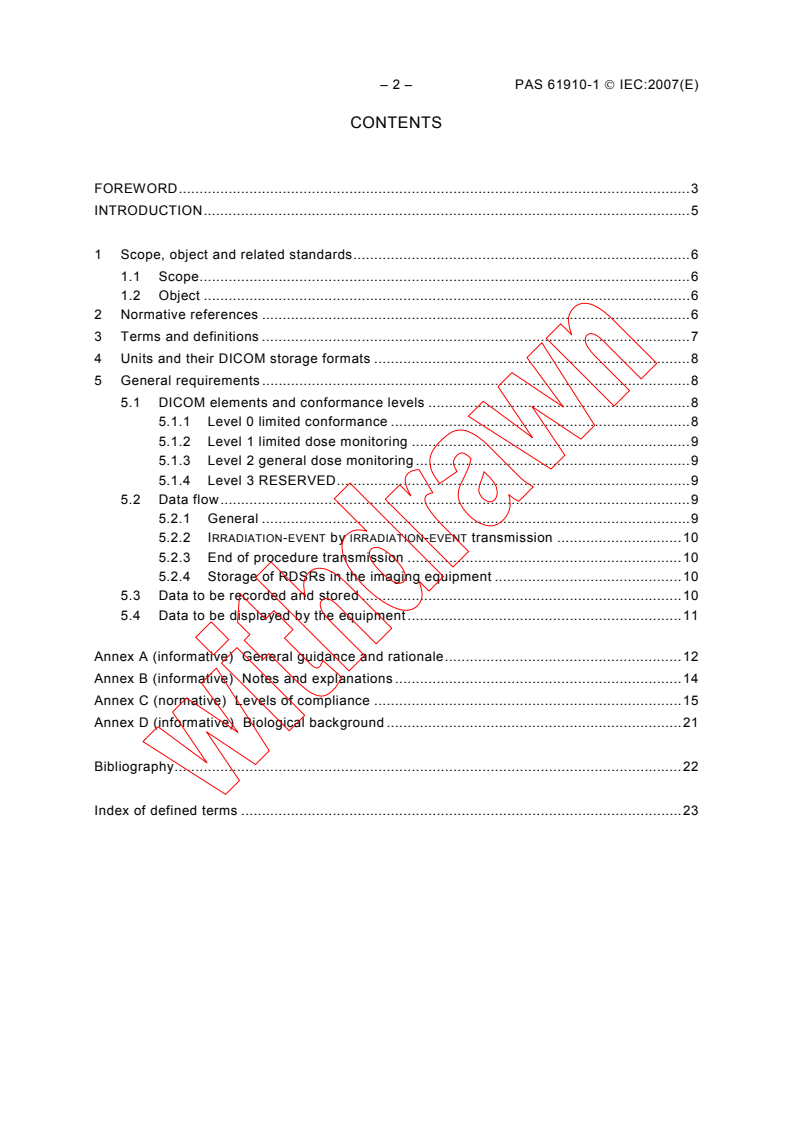
– 2 – PAS 61910-1 © IEC:2007(E)
CONTENTS
FOREWORD.3
INTRODUCTION.5
1 Scope, object and related standards.6
1.1 Scope.6
1.2 Object .6
2 Normative references .6
3 Terms and definitions .7
4 Units and their DICOM storage formats .8
5 General requirements .8
5.1 DICOM elements and conformance levels .8
5.1.1 Level 0 limited conformance .8
5.1.2 Level 1 limited dose monitoring .9
5.1.3 Level 2 general dose monitoring .9
5.1.4 Level 3 RESERVED.9
5.2 Data flow.9
5.2.1 General .9
5.2.2 IRRADIATION-EVENT by IRRADIATION-EVENT transmission .10
5.2.3 End of procedure transmission .10
5.2.4 Storage of RDSRs in the imaging equipment .10
5.3 Data to be recorded and stored .10
5.4 Data to be displayed by the equipment.11
Annex A (informative) General guidance and rationale.12
Annex B (informative) Notes and explanations .14
Annex C (normative) Levels of compliance .15
Annex D (informative) Biological background .21
Bibliography.22
Index of defined terms .23
PAS 61910-1 © IEC:2007(E) – 3 –
INTERNATIONAL ELECTROTECHNICAL COMMISSION
____________
MEDICAL ELECTRICAL EQUIPMENT –
RADIATION DOSE DOCUMENTATION –
Part 1: Equipment for radiography and radioscopy
FOREWORD
1) The International Electrotechnical Commission (IEC) is a worldwide organization for standardization comprising
all national electrotechnical committees (IEC National Committees). The object of IEC is to promote
international co-operation on all questions concerning standardization in the electrical and electronic fields. To
this end and in addition to other activities, IEC publishes International Standards, Technical Specifications,
Technical Reports, and Guides (hereafter referred to as “IEC Publication(s)”). Their preparation is entrusted to
technical committees; any IEC National Committee interested in the subject dealt with may participate in this
preparatory work. International, governmental and non-governmental organizations liaising with the IEC also
participate in this preparation. IEC collaborates closely with the International Organization for Standardization
(ISO) in accordance with conditions determined by agreement between the two organizations.
2) The formal decisions or agreements of IEC on technical matters express, as nearly as possible, an international
consensus of opinion on the relevant subjects since each technical committee has representation from all
interested IEC National Committees.
3) IEC Publications have the form of recommendations for international use and are accepted by IEC National
Committees in that sense. While all reasonable efforts are made to ensure that the technical content of IEC
Publications is accurate, IEC cannot be held responsible for the way in which they are used or for any
misinterpretation by any end user.
4) In order to promote international uniformity, IEC National Committees undertake to apply IEC Publications
transparently to the maximum extent possible in their national and regional publications. Any divergence
between any IEC Publication and the corresponding national or regional publication shall be clearly indicated in
the latter.
5) IEC provides no marking procedure to indicate its approval and cannot be rendered responsible for any
equipment declared to be in conformity with an IEC Publication.
6) All users should ensure that they have the latest edition of this publication.
7) No liability shall attach to IEC or its directors, employees, servants or agents including individual experts and
members of its technical committees and IEC National Committees for any personal injury, property damage or
other damage of any nature whatsoever, whether direct or indirect, or for costs (including legal fees) and
expenses arising out of the publication, use of, or reliance upon, this IEC Publication or any other IEC
Publications.
8) Attention is drawn to the Normative references cited in this publication. Use of the referenced publications is
indispensable for the correct application of this publication.
9) Attention is drawn to the possibility that some of the elements of this IEC Publication may be the subject of
patent rights. IEC shall not be held responsible for identifying any or all such patent rights.
A PAS is a technical specification not fulfilling the requirements for a standard, but made
available to the public.
IEC-PAS 61910-1 has been prepared by maintenance team 38 of IEC subcommittee 62B of
IEC technical committee 62: Electrical equipment in medical practice.
The text of this PAS is based on the This PAS was approved for
following document: publication by the P-members of the
committee concerned as indicated in
the following document
Draft PAS Report on voting
62B/645/PAS 62B/653/RVN
Following publication of this PAS, which is a pre-standard publication, the technical committee
or subcommittee concerned will transform it into an International Standard. Its structure will
then be adapted to the IEC rules.
– 4 – PAS 61910-1 © IEC:2007(E)
This PAS shall remain valid for an initial maximum period of three years starting from
2007-07. The validity may be extended for a single three-year period, following which it shall
be revised to become another type of normative document or shall be withdrawn.
In this publicly available specification, the following print types are used:
– Requirements and definitions: roman type.
– Test specifications: italic type.
– Informative material appearing outside of tables, such as notes, examples and references: in smaller type.
Normative text of tables is also in a smaller type.
– TERMS DEFINED IN CLAUSE 3 OF THE GENERAL STANDARD, IN THIS PAS OR AS NOTED: SMALL
CAPITALS.
In referring to the structure of this document, the term
– “clause” means one of the seventeen numbered divisions within the table of contents,
inclusive of all subdivisions (e.g. Clause 7 includes subclauses 7.1, 7.2, etc.);
– “subclause” means a numbered subdivision of a clause (e.g. 7.1, 7.2 and 7.2.1 are all
subclauses of Clause 7).
References to clauses within this PAS are preceded by the term “Clause” followed by the
clause number. References to subclauses within this collateral standard are by number only.
In this document, the conjunctive “or” is used as an “inclusive or” so a statement is true if any
combination of the conditions is true.
The verbal forms used in this document conform to usage described in Annex H of the
ISO/IEC Directives, Part 2. For the purposes of this PAS, the auxiliary verb:
– “shall” means that compliance with a requirement or a test is mandatory for compliance
with this PAS;
– “should” means that compliance with a requirement or a test is recommended but is not
mandatory for compliance with this PAS;
– “may” is used to describe a permissible way to achieve compliance with a requirement or
test.
Clauses, subclauses and definitions for which a rationale is provided in informative Annex A
are marked with an asterisk (*).
PAS 61910-1 © IEC:2007(E) – 5 –
INTRODUCTION
Documentation of the amount of radiation used during an imaging procedure is valuable for
several reasons. For all procedures dose documentation provides information needed to
estimate radiogenic risk to the population. It also plays a role in general institutional quality
assurance by providing data for performance validation against established radiation dose
reference levels. Detailed documentation makes a significant contribution to clinical
management of patients following those interventional procedures that might induce
deterministic injuries.
The transition of imaging from film to stored digital images opened the possibility of
automatically recording dose and other data with the images. The DICOM structure
traditionally provides some relevant facilities for doing this in image headers. This system had
several limitations. The most obvious of these is the lack of a means for storing dose data
without storing images. Thus, radioscopic data was seldom stored; and no data was stored if
the images were not stored.
Improving dose documentation was addressed jointly by the International Electrotechnical
Commission (IEC) and the DICOM Committee. The supplement 94 to the DICOM standard
was approved in 2005. This supplement provides the technical format needed to store the
entire description of the dose used to perform a single imaging procedure. The companion
IEC publicly available specification defines the relevant radiation quantities and establishes
equipment compliance levels. These represent a combination of increasing patient risk and an
increasing interest in quality assurance. Compliance level one is intended for equipment that
produces dose levels below significant deterministic thresholds for all intended uses.
Compliance level two is intended for equipment used for procedures that could cause
significant deterministic injuries. Compliance level three, while not described in this document,
will eventually contain specifications for advanced dose modelling on individual patients.
The process resulting from this work is summarized as follows: Information is gathered into a
Radiation Dose Structured Report (RDSR). This new object is designed to be stored in a
PACS system, in a medical informatics system, in a freestanding dose management
workstation, or in the imaging equipment itself. The data structure permits the transfer of
entire studies at once or the streaming of individual irradiations.
At present, the scope of DICOM DOSE is limited to aspects of projection radiography and
radioscopy. Expansion of DICOM DOSE to all X-ray imaging modalities is planned.
– 6 – PAS 61910-1 © IEC:2007(E)
MEDICAL ELECTRICAL EQUIPMENT –
RADIATION DOSE DOCUMENTATION –
Part 1: Equipment for radiography and radioscopy
1 Scope, object and related standards
1.1 Scope
This Publicly Available Specification (PAS) applies to MEDICAL ELECTRICAL EQUIPMENT and
MEDICAL ELECTRICAL SYSTEMS, hereafter referred to as ME EQUIPMENT and ME SYSTEMS.
The scope of this document encompasses all forms of projection radiographic equipment
incorporating means for measuring or calculating dose related quantities and capable of
producing DICOM compatible images and/or reports.
This document provides specific units and quantities. It does not apply for:
– dental radiography and radioscopy;
– mammography;
– computed tomography.
NOTE A system that uses a film-screen image receptor may conform to this PAS if it can produce reports
confirming to a level of this document.
The intent is to develop and publish similar documents for all X-ray imaging modalities capable of producing
DICOM compatible images and/or reports.
Parallel documents are currently under development for mammography and computed tomography.
This document defines data storage formats. It does not put specific requirements on the accuracy of the data.
The data formats are specified such that the numerical uncertainty attributable to the stored format is likely to be
small compared to other data uncertainties.
This document does not present any requirements on the form of display of such information to operators or other
individuals.
1.2 Object
The object of this PAS, and associated DICOM standard, is to provide a standard public data
structure intended for recording dosimetric and related information associated with the
production of projection radiographic and radioscopic images.
NOTE The data fields and reporting structure are intended to facilitate the collection of dosimetric data useful for;
management of procedures requiring significant dose, facility quality programs, establishment of reference levels,
teaching, and similar purposes.
A public structure facilitates data analysis by any appropriate individual or organization.
2 Normative references
The following referenced documents are indispensable for the application of this PAS. For
dated references, only the edition cited applies. For undated references, the latest edition of
the referenced document (including any amendments) applies.
IEC 60601-1:2005, Medical electrical equipment – Part 1: General requirements for basic
safety and essential performance
IEC 60601-2-43:2000, Medical electrical equipment – Part 2-43: Particular requirements for
the safety of X-ray equipment for interventional procedures
PAS 61910-1 © IEC:2007(E) – 7 –
IEC TR 60788:2004, Medical electrical equipment – Glossary of defined terms
Digital Imaging and Communications in Medicine (DICOM)
IHE Technical Framework, Volume I, Integration Profiles, Revision 7.0 - Final Text, May 15,
3 Terms and definitions
For the purposes of this document, the terms and definitions given in IEC 60601-1:2005,
IEC TR 60788, the DICOM standard, and the following terms and definitions apply.
NOTE The term “electrical equipment” is used to mean ME EQUIPMENT or other electrical equipment. This
document also uses the term “equipment” to mean ME EQUIPMENT or other electrical or non-electrical equipment in
the context of an ME SYSTEM.
The Radiation Dose Structured Report (RDSR) is an essential part of this document. Its formal definition appears in
the DICOM standard. Please see Clause B.2 for further discussions.
An index of defined terms is found at the end of this document.
3.1
IRRADIATION-EVENT
LOADING of equipment caused by a single continuous actuation of the equipment’s irradiation
control device
NOTE 1 An IRRADIATION-EVENT might produce a single image (e.g. chest-radiograph), a defined series of images
(e.g. DSA acquisition), or an indefinite series of images (e.g. radioscopy).
NOTE 2 The images resulting from an IRRADIATION-EVENT may or may not be stored in the imaging device or in an
image archive.
NOTE 3 Corresponding statement in the DICOM standard: An IRRADIATION-EVENT is the occurrence of radiation
being applied to a patient in single continuous time-frame between the start (release) and the stop (cease) of the
irradiation. Any on-off switching of the irradiation source during the event shall not be treated as separate events,
rather the event includes the time between start and stop of irradiation as triggered by the user. E.g., a pulsed
fluoro X-Ray acquisition shall be treated as a single IRRADIATION-EVENT.
3.2
DOSE AREA PRODUCT
DAP
product of the area of the cross-section of an X-RAY BEAM and the averaged AIR KERMA over
that cross-section
[IEC 60601-2-43:2000, definition 2.105]
NOTE 1 The unit is the Gray square metre (Gym ).
NOTE 2 DOSE AREA PRODUCT is measured under low scatter conditions.
NOTE 3 If the X-ray beam can be oriented such that it does not always pass through the PATIENT SUPPORT
(including ACCESSORIES) before entering the PATIENT, then DOSE AREA PRODUCT is measured without the beam
passing through the PATIENT SUPPORT (and ACCESSORIES).
3.3
AIR KERMA
K
quotient of dE by dm, where dE is the sum of the initial kinetic energies of all the charged
tr tr
ionizing particles liberated by uncharged ionizing particles in air of mass dm
[IEC 60731:1997: definition 3.27]
NOTE 1 The unit of AIR KERMA is Gy (where 1 Gy = 1 J · kg-1), (see C.6 of ICRU 33).
NOTE 2 AIR KERMA is measured under low scatter conditions.
NOTE 3 If the X-ray beam can be oriented such that it does not always pass through the patient support
(including accessories) before entering the patient, then AIR KERMA is measured without the beam passing through
the patient support (and accessories).
– 8 – PAS 61910-1 © IEC:2007(E)
3.4
ESTIMATED MAXIMUM ENTRANCE SKIN AIR KERMA
maximum AIR KERMA (excluding scatter) delivered to any point on the patient’s skin during a
single procedure
NOTE This is a potentially calculated value. The location of this point is highly dependent on many factors
including the patient’s size, location relative to the gantry, and procedural details.
3.5
ACTOR
information systems or components of information systems that produce, manage, or act on
information associated with operational activities in the enterprise
[IHE Technical Framework:2006, 1.6.1]
4 Units and their DICOM storage formats
All quantities not specifically defined in this section shall use the units given in the DICOM
standard.
The numerical values of all quantities shall be stored in a format such that storage uncertainty
introduces less than 0,5 % total additional uncertainty in to the statement of value.
5 General requirements
5.1 DICOM elements and conformance levels
An equipment claiming a level of conformance with this document shall generate and export a
Radiation Dose Structured Report (RDSR) for each examination (study) containing at least
the DICOM elements listed in Annex C for that conformance level.
Equipment providing radiography only may not supply information for radioscopy elements.
Equipment providing radioscopy only may not supply information for radiography elements.
Equipment may conform to a higher level than that indicated by the maximum estimated
entrance skin AIR KERMA for normal use.
NOTE The Radiation Dose Structured Report (RDSR) is defined in the DICOM standard. Conformance with a
higher level provides information that can be of use for public health purposes. Conforming to the highest level for
which an equipment has the necessary measurement means is suggested. Level 2 conformance is recommended
for dedicated paediatric equipment.
Conformance with a higher level shall include conformance with all lower levels.
Equipment with different modes of operation conforming to different levels should report
RDSRs for all procedures at the highest level claimed for the equipment.
5.1.1 Level 0 limited conformance
Equipment not conforming to a higher level but capable of generating a RDSR with some
information.
MANUFACTURER.
DICOM elements that are stored are defined by the
NOTE 1 Most of the equipment within the scope of this PAS is expected to conform to class 1 or class 2.
NOTE 2 Level 0 is intended to provide a structural method for reporting any available data from simple or special
purpose equipment using the DICOM-DOSE framework. An example is a simple radiographic machine used with a
third-party digital detector. The detector associated with such a system might only be able to report the AIR KERMA
at the detector used to form the image.
PAS 61910-1 © IEC:2007(E) – 9 –
DICOM elements that are unique to level 0 may not be stored by equipment conforming to a
higher level.
5.1.2 Level 1 limited dose monitoring
Equipment where the ESTIMATED MAXIMUM ENTRANCE SKIN AIR KERMA for any examination
(study) is expected to be less than two gray (Gy) for all normal uses.
The defining dose is the cumulative dose for a complete examination at the interventional
reference point defined in IEC 60601-2-43 (for equipment capable of measuring AIR KERMA at
this point
or
the equipment manufacturers estimate of the cumulative dose for a complete examination at
the closest point to the X-ray source where the patient’s skin might be placed.
NOTE The defining dose resets the maximum AIR KERMA delivered to the patient’s skin (measured under low
scatter conditions). The safe assumption is made that the entire procedure is performed with one beam/patient
orientation. The purpose is to supply:
– Basic dose information
– General patient and physician information
– Basic tools for quality management
– Teaching information
5.1.3 Level 2 general dose monitoring
Equipment where the ESTIMATED MAXIMUM ENTRANCE SKIN AIR KERMA for any examination
(study) may exceed two Gray (Gy) for any normal use.
The defining dose is the cumulative dose for a complete examination at the interventional
reference point defined in IEC 60601-2-43:2000 (for equipment capable of measuring AIR
KERMA at this point)
or
the equipment manufacturers estimate of the cumulative dose for a complete examination at
the closest point to the X-ray source where the patient’s skin might be placed.
NOTE The defining dose resets the maximum AIR KERMA delivered to the patient’s skin (measured under low
scatter conditions). The safe assumption is made that the entire procedure is performed with one beam/patient
orientation.
The purpose is to supply:
– dose information for managing potential tissue reactions;
– specific patient and procedure information;
– quality management;
– teaching information.
5.1.4 Level 3 RESERVED
NOTE This level will be used to define compliance for equipment recommended for use in performing procedures
where the cumulative dose at the interventional reference point is likely to exceed 5 Gy for any single procedure.
Major fluoroscopically guided interventional equipment is an example.
5.2 Data flow
5.2.1 General
Data flow describing an IRRADIATION-EVENT between imaging equipment and a compatible
ACTOR may occur either after each IRRADIATION-EVENT or at the end of an examination. An
ACTOR is meant in its IHE sense.
– 10 – PAS 61910-1 © IEC:2007(E)
5.2.2 IRRADIATION-EVENT by IRRADIATION-EVENT transmission
After each IRRADIATION-EVENT, the imaging equipment shall send a full RSDR to the ACTOR.
The completion Flag (0040,A491) shall be set to “Partial”.
The header(s) shall be complete and contain summary data updated to include the results of
the most current irradiation.
The body of the RDSR shall include each set of IRRADIATION-EVENT entries.
When an examination is marked as complete, or a new PATIENT is registered on the imaging
equipment, a final RDSR shall be sent with the completion Flag (0040,A491) set to
“Complete”.
NOTE 1 The IRRADIATION-EVENT by IRRADIATION-EVENT work-flow enables near-real time dose analysis and
feedback to the operator.
NOTE 2 Sending a RSDR with an updated header and a list of all the IRRADIATION-EVENT data after each
IRRADIATION-EVENT will assure that the ACTOR receives the most complete available data on a particular procedure.
It is assumed that the ACTOR will discard earlier partial reports when it receives a later partial report or a complete
report.
NOTE 3 Sending a RDSR flagged as complete at the end of the examination maximizes data integrity. It is
presumed that each partial RSDR is discarded when the “complete” or next “partial RDSR is received.
NOTE 4 An ACTOR is allowed to append value-added computations to the RDSR.
5.2.3 End of procedure transmission
When an examination is marked as complete, or a new patient is registered on the imaging
equipment, a single RDSR shall be sent to the ACTOR with the completion tag (0400,A491) set
to “Complete”.
5.2.4 Storage of RDSRs in the imaging equipment
The imaging equipment shall store a minimum of 500 RDSRs internally and independent of
storage of the associated images.
RSDRs shall be internally stored in the equipment as long as the associated images are
stored internally in the equipment.
Facilities shall be provided to locally transfer RDSRs to compatible storage
...