


IEC TS 62607-4-3:2015
(Main)Nanomanufacturing - Key control characteristics - Part 4-3: Nano-enabled electrical energy storage - Contact and coating resistivity measurements for nanomaterials
Nanomanufacturing - Key control characteristics - Part 4-3: Nano-enabled electrical energy storage - Contact and coating resistivity measurements for nanomaterials
IEC TS 62607-4-3:2015(E) provides a standardized test method for the measurement of contact and coating resistivity of nano-enabled electrode materials. This method will enable a customer to decide whether or not a coating composite material is usable, and select best combinations of coating composite material with fabrication technologies suitable for their application.
General Information
- Status
- Published
- Publication Date
- 17-Aug-2015
- Technical Committee
- TC 113 - Nanotechnology for electrotechnical products and systems
- Drafting Committee
- PT 62607-4-3 - TC 113/PT 62607-4-3
- Current Stage
- PPUB - Publication issued
- Start Date
- 18-Aug-2015
- Completion Date
- 15-Oct-2015
Overview
IEC TS 62607-4-3:2015 - Nanomanufacturing – Key control characteristics, Part 4-3 - defines a standardized test method for measuring contact resistivity and coating resistivity of nano-enabled electrode materials used in electrical energy storage. The Technical Specification covers sample preparation, measurement procedures, data analysis and interpretation, and includes a case study for practical guidance. It is intended for study-stage comparison of composite electrode coatings (for example, lithium‑ion and supercapacitor electrodes) rather than final product qualification.
Key topics and requirements
- Scope and definitions: Terminology for electrode nanomaterials and related concepts is aligned with ISO/TS 80004‑1.
- Sample preparation: Recommendations for preparing casting slurries, isolator substrates, metal collector strips and electrode test samples to ensure reproducible measurements.
- Measurement methods:
- Coating resistivity - procedures for demarcation of the method, sample thickness measurement and experimental conditions to quantify the bulk resistance of electrode coatings.
- Contact resistivity - procedures to evaluate electrical contact between the electrode coating and metal current collectors.
- Data analysis and interpretation: Calculation methods, expected behaviours (e.g., ohmic linearity), and guidance on correlating resistivity with composition variables such as carbon nanomaterial content and coating thickness.
- Case study: Worked examples for a supercapacitor EDLC electrode and a lithium‑ion NCM cathode illustrating sample preparation, results interpretation and practical comparisons (as-cast vs densified states).
Practical applications
- Compare and rank coating composite formulations and fabrication processes based on measurable resistivity performance.
- Optimize carbon nanomaterial additives and binder/carbon ratios to improve electron transport in electrode coatings.
- Screen candidate electrode recipes early in R&D to decide if a coating composite is usable for a given device concept (battery, supercapacitor).
- Support reproducible laboratory-to-laboratory comparisons of nanomaterial-enabled electrodes and accelerate materials selection for energy storage development.
Who should use this standard
- Materials scientists and researchers working on nano-enabled electrical energy storage.
- Battery and supercapacitor developers evaluating electrode composites.
- Process engineers and QA teams assessing coating and contact resistivity during development.
- Nanomanufacturing labs seeking harmonized methods for resistivity testing and inter-lab comparison.
Related standards
- ISO/TS 80004‑1 (Nanotechnologies - Vocabulary - Part 1: Core terms) - normative reference.
- Other parts of the IEC 62607 series covering nanomanufacturing key control characteristics.
Keywords: IEC TS 62607-4-3:2015, nanomanufacturing, contact resistivity, coating resistivity, nano-enabled electrode materials, electrical energy storage, lithium-ion, supercapacitor, carbon nanomaterials.
Frequently Asked Questions
IEC TS 62607-4-3:2015 is a technical specification published by the International Electrotechnical Commission (IEC). Its full title is "Nanomanufacturing - Key control characteristics - Part 4-3: Nano-enabled electrical energy storage - Contact and coating resistivity measurements for nanomaterials". This standard covers: IEC TS 62607-4-3:2015(E) provides a standardized test method for the measurement of contact and coating resistivity of nano-enabled electrode materials. This method will enable a customer to decide whether or not a coating composite material is usable, and select best combinations of coating composite material with fabrication technologies suitable for their application.
IEC TS 62607-4-3:2015(E) provides a standardized test method for the measurement of contact and coating resistivity of nano-enabled electrode materials. This method will enable a customer to decide whether or not a coating composite material is usable, and select best combinations of coating composite material with fabrication technologies suitable for their application.
IEC TS 62607-4-3:2015 is classified under the following ICS (International Classification for Standards) categories: 07.030 - Physics. Chemistry; 07.120 - Nanotechnologies. The ICS classification helps identify the subject area and facilitates finding related standards.
You can purchase IEC TS 62607-4-3:2015 directly from iTeh Standards. The document is available in PDF format and is delivered instantly after payment. Add the standard to your cart and complete the secure checkout process. iTeh Standards is an authorized distributor of IEC standards.
Standards Content (Sample)
IEC TS 62607-4-3 ®
Edition 1.0 2015-08
TECHNICAL
SPECIFICATION
colour
inside
Nanomanufacturing – Key control characteristics –
Part 4-3: Nano-enabled electrical energy storage – Contact and coating
resistivity measurements for nanomaterials
All rights reserved. Unless otherwise specified, no part of this publication may be reproduced or utilized in any form
or by any means, electronic or mechanical, including photocopying and microfilm, without permission in writing from
either IEC or IEC's member National Committee in the country of the requester. If you have any questions about IEC
copyright or have an enquiry about obtaining additional rights to this publication, please contact the address below or
your local IEC member National Committee for further information.
IEC Central Office Tel.: +41 22 919 02 11
3, rue de Varembé Fax: +41 22 919 03 00
CH-1211 Geneva 20 info@iec.ch
Switzerland www.iec.ch
About the IEC
The International Electrotechnical Commission (IEC) is the leading global organization that prepares and publishes
International Standards for all electrical, electronic and related technologies.
About IEC publications
The technical content of IEC publications is kept under constant review by the IEC. Please make sure that you have the
latest edition, a corrigenda or an amendment might have been published.
IEC Catalogue - webstore.iec.ch/catalogue Electropedia - www.electropedia.org
The stand-alone application for consulting the entire The world's leading online dictionary of electronic and
bibliographical information on IEC International Standards, electrical terms containing more than 30 000 terms and
Technical Specifications, Technical Reports and other definitions in English and French, with equivalent terms in 15
documents. Available for PC, Mac OS, Android Tablets and additional languages. Also known as the International
iPad. Electrotechnical Vocabulary (IEV) online.
IEC publications search - www.iec.ch/searchpub IEC Glossary - std.iec.ch/glossary
The advanced search enables to find IEC publications by a More than 60 000 electrotechnical terminology entries in
variety of criteria (reference number, text, technical English and French extracted from the Terms and Definitions
committee,…). It also gives information on projects, replaced clause of IEC publications issued since 2002. Some entries
and withdrawn publications. have been collected from earlier publications of IEC TC 37,
77, 86 and CISPR.
IEC Just Published - webstore.iec.ch/justpublished
Stay up to date on all new IEC publications. Just Published IEC Customer Service Centre - webstore.iec.ch/csc
details all new publications released. Available online and If you wish to give us your feedback on this publication or
also once a month by email. need further assistance, please contact the Customer Service
Centre: csc@iec.ch.
IEC TS 62607-4-3 ®
Edition 1.0 2015-08
TECHNICAL
SPECIFICATION
colour
inside
Nanomanufacturing – Key control characteristics –
Part 4-3: Nano-enabled electrical energy storage – Contact and coating
resistivity measurements for nanomaterials
INTERNATIONAL
ELECTROTECHNICAL
COMMISSION
ICS 07.030 ISBN 978-2-8322-2851-7
– 2 – IEC TS 62607-4-3:2015 © IEC 2015
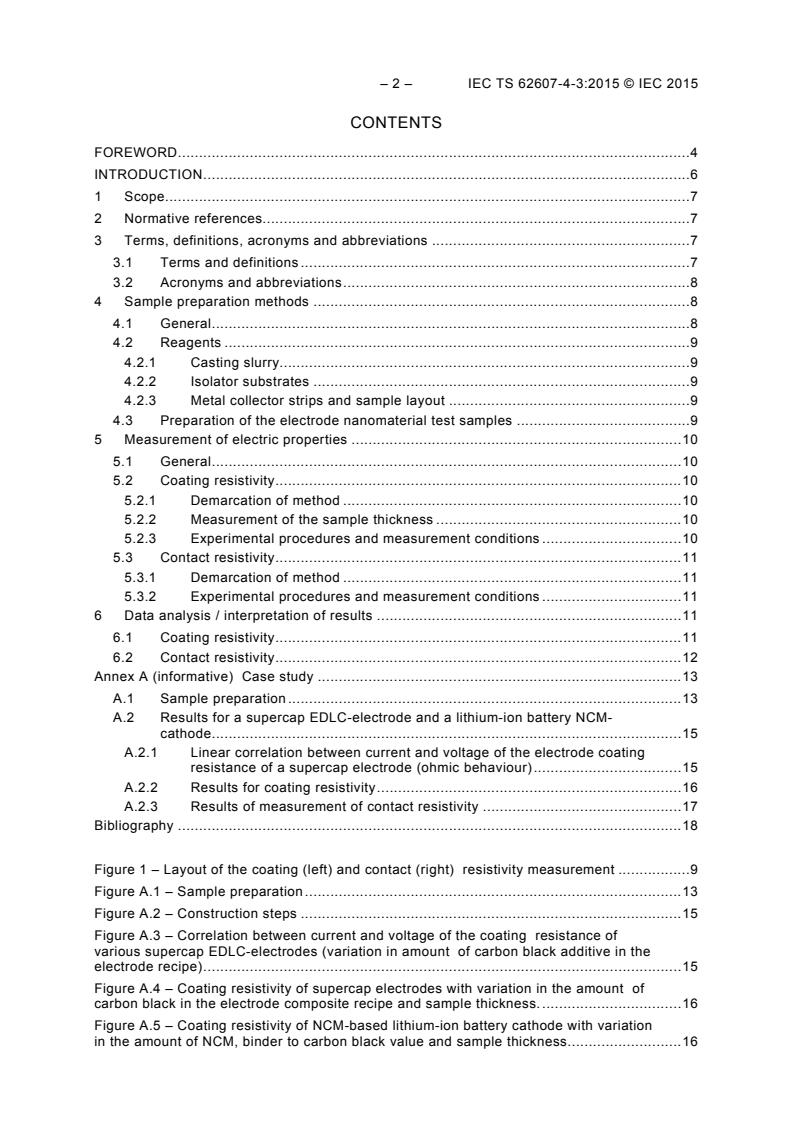
CONTENTS
FOREWORD . 4
INTRODUCTION . 6
1 Scope . 7
2 Normative references. 7
3 Terms, definitions, acronyms and abbreviations . 7
3.1 Terms and definitions . 7
3.2 Acronyms and abbreviations . 8
4 Sample preparation methods . 8
4.1 General . 8
4.2 Reagents . 9
4.2.1 Casting slurry. 9
4.2.2 Isolator substrates . 9
4.2.3 Metal collector strips and sample layout . 9
4.3 Preparation of the electrode nanomaterial test samples . 9
5 Measurement of electric properties . 10
5.1 General . 10
5.2 Coating resistivity . 10
5.2.1 Demarcation of method . 10
5.2.2 Measurement of the sample thickness . 10
5.2.3 Experimental procedures and measurement conditions . 10
5.3 Contact resistivity . 11
5.3.1 Demarcation of method . 11
5.3.2 Experimental procedures and measurement conditions . 11
6 Data analysis / interpretation of results . 11
6.1 Coating resistivity . 11
6.2 Contact resistivity . 12
Annex A (informative) Case study . 13
A.1 Sample preparation . 13
A.2 Results for a supercap EDLC-electrode and a lithium-ion battery NCM-
cathode . 15
A.2.1 Linear correlation between current and voltage of the electrode coating
resistance of a supercap electrode (ohmic behaviour) . 15
A.2.2 Results for coating resistivity . 16
A.2.3 Results of measurement of contact resistivity . 17
Bibliography . 18
Figure 1 – Layout of the coating (left) and contact (right) resistivity measurement . 9
Figure A.1 – Sample preparation . 13
Figure A.2 – Construction steps . 15
Figure A.3 – Correlation between current and voltage of the coating resistance of
various supercap EDLC-electrodes (variation in amount of carbon black additive in the
electrode recipe) . 15
Figure A.4 – Coating resistivity of supercap electrodes with variation in the amount of
carbon black in the electrode composite recipe and sample thickness. . 16
Figure A.5 – Coating resistivity of NCM-based lithium-ion battery cathode with variation
in the amount of NCM, binder to carbon black value and sample thickness . 16
Figure A.6 – Contact resistivity of a supercap electrode in the state “as cast” and
“densified” . 17
Figure A.7 – Contact resistivity of a NCM-based lithium-ion battery cathode
(81,3 vol.-% NCM) in the state “as cast” and “as densified” . 17
– 4 – IEC TS 62607-4-3:2015 © IEC 2015
INTERNATIONAL ELECTROTECHNICAL COMMISSION
____________
NANOMANUFACTURING – KEY CONTROL CHARACTERISTICS –
Part 4-3: Nano-enabled electrical energy storage –
Contact and coating resistivity measurements for nanomaterials
FOREWORD
1) The International Electrotechnical Commission (IEC) is a worldwide organization for standardization comprising
all national electrotechnical committees (IEC National Committees). The object of IEC is to promote
international co-operation on all questions concerning standardization in the electrical and electronic fields. To
this end and in addition to other activities, IEC publishes International Standards, Technical Specifications,
Technical Reports, Publicly Available Specifications (PAS) and Guides (hereafter referred to as “IEC
Publication(s)”). Their preparation is entrusted to technical committees; any IEC National Committee interested
in the subject dealt with may participate in this preparatory work. International, governmental and non-
governmental organizations liaising with the IEC also participate in this preparation. IEC collaborates closely
with the International Organization for Standardization (ISO) in accordance with conditions determined by
agreement between the two organizations.
2) The formal decisions or agreements of IEC on technical matters express, as nearly as possible, an international
consensus of opinion on the relevant subjects since each technical committee has representation from all
interested IEC National Committees.
3) IEC Publications have the form of recommendations for international use and are accepted by IEC National
Committees in that sense. While all reasonable efforts are made to ensure that the technical content of IEC
Publications is accurate, IEC cannot be held responsible for the way in which they are used or for any
misinterpretation by any end user.
4) In order to promote international uniformity, IEC National Committees undertake to apply IEC Publications
transparently to the maximum extent possible in their national and regional publications. Any divergence
between any IEC Publication and the corresponding national or regional publication shall be clearly indicated in
the latter.
5) IEC itself does not provide any attestation of conformity. Independent certification bodies provide conformity
assessment services and, in some areas, access to IEC marks of conformity. IEC is not responsible for any
services carried out by independent certification bodies.
6) All users should ensure that they have the latest edition of this publication.
7) No liability shall attach to IEC or its directors, employees, servants or agents including individual experts and
members of its technical committees and IEC National Committees for any personal injury, property damage or
other damage of any nature whatsoever, whether direct or indirect, or for costs (including legal fees) and
expenses arising out of the publication, use of, or reliance upon, this IEC Publication or any other IEC
Publications.
8) Attention is drawn to the Normative references cited in this publication. Use of the referenced publications is
indispensable for the correct application of this publication.
9) Attention is drawn to the possibility that some of the elements of this IEC Publication may be the subject of
patent rights. IEC shall not be held responsible for identifying any or all such patent rights.
The main task of IEC technical committees is to prepare International Standards. In
exceptional circumstances, a technical committee may propose the publication of a Technical
Specification when
• the required support cannot be obtained for the publication of an International Standard,
despite repeated efforts, or
• the subject is still under technical development or where, for any other reason, there is the
future but no immediate possibility of an agreement on an International Standard.
Technical Specifications are subject to review within three years of publication to decide
whether they can be transformed into International Standards.
IEC 62607-4-3, which is a Technical Specification, has been prepared by IEC technical
committee 113: Nanotechnology standardization for electrical and electronic products and
systems.
The text of this Technical Specification is based on the following documents:
Enquiry draft Report on voting
113/239/DTS 113/263A/RVC
Full information on the voting for the approval of this Technical Specification can be found in
the report on voting indicated in the above table.
This publication has been drafted in accordance with the ISO/IEC Directives, Part 2.
A list of all parts in the IEC 62607 series, published under the general title
Nanomanufacturing – Key control characteristics, can be found on the IEC website.
The committee has decided that the contents of this publication will remain unchanged until
the stability date indicated on the IEC website under "http://webstore.iec.ch" in the data
related to the specific publication. At this date, the publication will be
• transformed into an International Standard,
• reconfirmed,
• withdrawn,
• replaced by a revised edition, or
• amended.
A bilingual version of this publication may be issued at a later date.
IMPORTANT – The 'colour inside' logo on the cover page of this publication indicates
that it contains colours which are considered to be useful for the correct
understanding of its contents. Users should therefore print this document using a
colour printer.
– 6 – IEC TS 62607-4-3:2015 © IEC 2015
INTRODUCTION
The future utilization of renewable energy technologies including e-mobility for individual
transportation significantly depends on the development of efficient systems for energy
storage. From today's perspective, lithium-ion batteries, supercapacitors and their derivative
concepts are regarded as the most promising innovative candidates.
A high energy density for the desired power and a long life time (recharge characteristics) are
the two most important criteria for electrode materials. Because many electrochemically active
materials such as metal oxides show an inherently lower and insufficient conductivity for the
electron transport, composite materials with carbon nanomaterial content are used for
optimization of the current flow in the electrodes of a battery. The electrochemical reactions
and the ensuing energy density of the battery cells are influenced by the movement of
electrons in a composite. Furthermore, the electronic contact resistivity between the electrode
material and the metal collector is important to realize a low ohmic internal resistance of the
battery or capacitor device.
This part of IEC 62607 provides standard methods to measure coating and contact resistivity
of nano-enabled electrode materials and to evaluate the best combinations of the composite
material recipes and fabrication technologies for carbon containing coatings of such nano-
enabled electrodes. Following this method will allow comparison of the results of different
research groups.
This standardized method is intended for comparing the contact and coating resistivity of
composite materials with carbon nanomaterial content in the study stage, not for evaluating
the electrode in end products.
The method is applicable for nano-enabled materials exhibiting function or performance only
possible with nanotechnology, intentionally added to composite materials for measurable and
significant improvement of the current flow in the electrodes of electrical energy storage
devices.
In this context it is important to note that the percentage content of nanomaterial of the device
in question has no direct relation to the applicability of this part of IEC 62607, because minute
quantities of nanomaterial are frequently sufficient to improve the performance significantly.
The fraction of nanomaterials in electrodes, electrode coatings, separators or electrolyte is
not of relevance for using this method.
NANOMANUFACTURING – KEY CONTROL CHARACTERISTICS –
Part 4-3: Nano-enabled electrical energy storage –
Contact and coating resistivity measurements for nanomaterials
1 Scope
This part of IEC 62607 provides a standardized test method for the measurement of contact
and coating resistivity of nano-enabled electrode materials. This method will enable a
customer to:
a) decide whether or not a coating composite material is usable, and
b) select best combinations of coating composite material with fabrication technologies
suitable for their application.
This part of IEC 62607 includes:
– definitions of terminology used in this part of IEC 62607,
– recommendations for sample preparation,
– outlines of the experimental procedures used to measure and calculate the contact and
coating resistivity,
– methods of interpretation of results and discussion of data analysis, and
– a case study.
2 Normative references
The following documents, in whole or in part, are normatively referenced in this document and
are indispensable for its application. For dated references, only the edition cited applies. For
undated references, the latest edition of the referenced document (including any
amendments) applies.
ISO/TS 80004-1, Nanotechnologies – Vocabulary – Part 1: Core terms
3 Terms, definitions, acronyms and abbreviations
3.1 Terms and definitions
For the purposes of this document, the terms and definitions given in ISO/TS 80004-1 and the
following apply.
3.1.1
electrode nanomaterial
material used in nano-enabled energy storage devices such as lithium-ion batteries or super-
capacitors which contains a fraction o
...
Questions, Comments and Discussion
Ask us and Technical Secretary will try to provide an answer. You can facilitate discussion about the standard in here.
Loading comments...