

IEC 60051-5:2017
(Main)Direct acting indicating analogue electrical measuring instruments and their accessories - Part 5: Special requirements for phase meters, power factor meters and synchroscopes
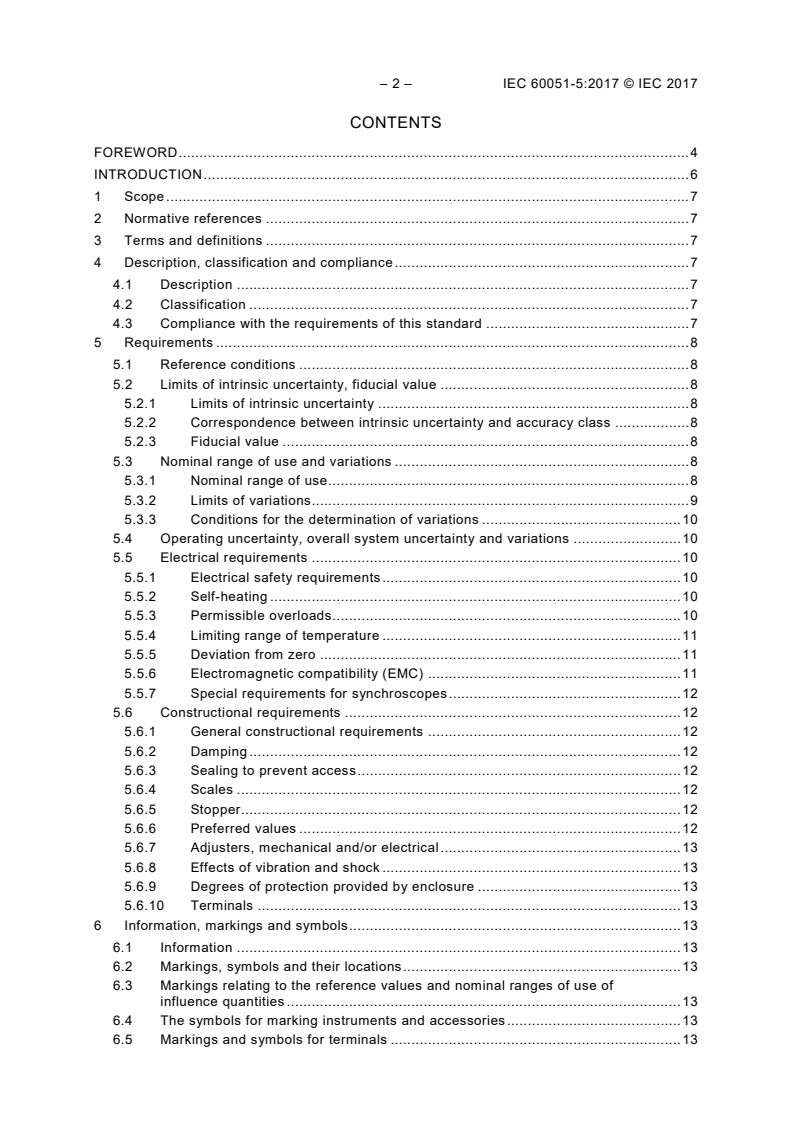
General Information
- Abstract
IEC 60051-5:2017 applies to direct acting indicating phase meters, power factor meters and synchroscopes having an analogue display.
This document also applies to non-interchangeable accessories (as defined in 3.1.23 of IEC 60051-1:2016) used with phase meters, power factor meters and synchroscopes.
This document also applies to a phase meter or power factor meter whose scale marks do not correspond directly to its electrical input quantity, provided that the relationship between them is known.
This fifth edition cancels and replaces the fourth edition published in 1985. This edition constitutes a technical revision.
This edition includes the following significant technical changes with respect to the previous edition:
a) updating of content in line with new editions of IEC 60051-1 and IEC 60051-9;
b) addition of Annex A to specify the nonconformity classification of test items.
- Status
- Published
- Publication Date
- 14-Dec-2017
- Technical Committee
- TC 85 - Measuring equipment for electrical and electromagnetic quantities
- Drafting Committee
- MT 23 - TC 85/MT 23
- Current Stage
- PPUB - Publication issued
- Start Date
- 15-Dec-2017
- Completion Date
- 18-Jan-2018
Buy Documents
IEC 60051-5:2017 - Direct acting indicating analogue electrical measuring instruments and their accessories - Part 5: Special requirements for phase meters, power factor meters and synchroscopes Released:12/15/2017
Overview
IEC 60051-5:2017 is an international standard developed by the International Electrotechnical Commission (IEC) that specifies special requirements for direct acting indicating analogue electrical measuring instruments-specifically, phase meters, power factor meters, and synchroscopes. This standard is part of the IEC 60051 series that deals with analogue electrical measuring instruments and their accessories.
This fifth edition, published in 2017, supersedes the previous 1985 edition, incorporating technical revisions to align with updated editions of related IEC standards IEC 60051-1 and IEC 60051-9. It applies to instruments with analogue displays used for measuring phase angles, power factors, and synchronization signals, including their non-interchangeable accessories.
Key Topics
Scope and Application
IEC 60051-5:2017 covers analogue direct acting phase meters, power factor meters, and synchroscopes. It also applies to devices whose scales do not directly correspond to electrical input but maintain known relationships to measured quantities. The standard defines specifications for performance, construction, and safety.Performance Requirements
- Limits of intrinsic and operating uncertainty
- Accuracy classes corresponding to uncertainty limits
- Reference conditions and nominal ranges for use
- Electrical safety including self-heating, permissible overloads, and electromagnetic compatibility (EMC)
- Deviation from zero and damping factors
Constructional and Design Specifications
- Mechanical construction and degree of protection against environmental factors
- Scale marks, including requirements where scales are not directly proportional to inputs
- Sealing and prevention of unauthorized access
- Adjustment mechanisms (mechanical and electrical)
- Terminals and markings, especially for earthing and measuring circuits
Testing and Compliance
- Nonconformity classifications for tests included in Annex A
- Clear definitions of test conditions and tolerances for evaluation
- Packaging and instructions for use to ensure integrity and usability
Applications
IEC 60051-5:2017 plays a crucial role in industries where accurate measurement of phase angle, power factor, and synchronization between electrical systems is critical. Common applications include:
- Power Generation and Distribution
Ensuring correct phase matching and load power factor measurement for energy efficiency and system stability. - Industrial Electrical Equipment
Monitoring and control of electrical motors, converters, and synchronous machines. - Electrical Maintenance and Testing
Calibration and fault diagnosis using standardized instruments adhering to this standard. - Renewable Energy Systems
Synchronization of renewable power sources with grid systems through compliant synchroscopes.
Compliance with IEC 60051-5 ensures that analogue measurement instruments used in these fields meet international performance, safety, and durability criteria, fostering interoperability and reliability.
Related Standards
- IEC 60051-1:2016 – General requirements and definitions for direct acting indicating analogue electrical measuring instruments, which serves as the foundational reference for part 5.
- IEC 60051-9 – Specific requirements relating to other types of analogue electrical measuring instruments.
- IEC 61010 series – Safety requirements for electrical equipment for measurement, control, and laboratory use.
- IEC 61326 – Electromagnetic compatibility (EMC) requirements for electrical measurement equipment.
Together, these standards form a comprehensive framework guiding the design, testing, and application of analogue electrical measurement devices worldwide.
Keywords: IEC 60051-5, analogue electrical measuring instruments, phase meters, power factor meters, synchroscopes, IEC standards, direct acting indicating instruments, electrical measurement, calibration, power system synchronization, instrumentation accuracy, electromagnetic compatibility.
Buy Documents
IEC 60051-5:2017 - Direct acting indicating analogue electrical measuring instruments and their accessories - Part 5: Special requirements for phase meters, power factor meters and synchroscopes Released:12/15/2017
Get Certified
Connect with accredited certification bodies for this standard

BSMI (Bureau of Standards, Metrology and Inspection)
Taiwan's standards and inspection authority.
Sponsored listings
Frequently Asked Questions
IEC 60051-5:2017 is a standard published by the International Electrotechnical Commission (IEC). Its full title is "Direct acting indicating analogue electrical measuring instruments and their accessories - Part 5: Special requirements for phase meters, power factor meters and synchroscopes". This standard covers: IEC 60051-5:2017 applies to direct acting indicating phase meters, power factor meters and synchroscopes having an analogue display. This document also applies to non-interchangeable accessories (as defined in 3.1.23 of IEC 60051-1:2016) used with phase meters, power factor meters and synchroscopes. This document also applies to a phase meter or power factor meter whose scale marks do not correspond directly to its electrical input quantity, provided that the relationship between them is known. This fifth edition cancels and replaces the fourth edition published in 1985. This edition constitutes a technical revision. This edition includes the following significant technical changes with respect to the previous edition: a) updating of content in line with new editions of IEC 60051-1 and IEC 60051-9; b) addition of Annex A to specify the nonconformity classification of test items.
IEC 60051-5:2017 applies to direct acting indicating phase meters, power factor meters and synchroscopes having an analogue display. This document also applies to non-interchangeable accessories (as defined in 3.1.23 of IEC 60051-1:2016) used with phase meters, power factor meters and synchroscopes. This document also applies to a phase meter or power factor meter whose scale marks do not correspond directly to its electrical input quantity, provided that the relationship between them is known. This fifth edition cancels and replaces the fourth edition published in 1985. This edition constitutes a technical revision. This edition includes the following significant technical changes with respect to the previous edition: a) updating of content in line with new editions of IEC 60051-1 and IEC 60051-9; b) addition of Annex A to specify the nonconformity classification of test items.
IEC 60051-5:2017 is classified under the following ICS (International Classification for Standards) categories: 17.220.20 - Measurement of electrical and magnetic quantities. The ICS classification helps identify the subject area and facilitates finding related standards.
IEC 60051-5:2017 is available in PDF format for immediate download after purchase. The document can be added to your cart and obtained through the secure checkout process. Digital delivery ensures instant access to the complete standard document.
Standards Content (Sample)
IEC 60051-5 ®
Edition 5.0 2017-12
INTERNATIONAL
STANDARD
NORME
INTERNATIONALE
Direct acting indicating analogue electrical measuring instruments and their
accessories –
Part 5: Special requirements for phase meters, power factor meters and
synchroscopes
Appareils mesureurs électriques indicateurs analogiques à action directe et
leurs accessoires –
Partie 5: Exigences particulières pour les phasemètres, les appareils de mesure
de facteur de puissance et les synchronoscopes
All rights reserved. Unless otherwise specified, no part of this publication may be reproduced or utilized in any form
or by any means, electronic or mechanical, including photocopying and microfilm, without permission in writing from
either IEC or IEC's member National Committee in the country of the requester. If you have any questions about IEC
copyright or have an enquiry about obtaining additional rights to this publication, please contact the address below or
your local IEC member National Committee for further information.
Droits de reproduction réservés. Sauf indication contraire, aucune partie de cette publication ne peut être reproduite
ni utilisée sous quelque forme que ce soit et par aucun procédé, électronique ou mécanique, y compris la photocopie
et les microfilms, sans l'accord écrit de l'IEC ou du Comité national de l'IEC du pays du demandeur. Si vous avez des
questions sur le copyright de l'IEC ou si vous désirez obtenir des droits supplémentaires sur cette publication, utilisez
les coordonnées ci-après ou contactez le Comité national de l'IEC de votre pays de résidence.
IEC Central Office Tel.: +41 22 919 02 11
3, rue de Varembé Fax: +41 22 919 03 00
CH-1211 Geneva 20 info@iec.ch
Switzerland www.iec.ch
About the IEC
The International Electrotechnical Commission (IEC) is the leading global organization that prepares and publishes
International Standards for all electrical, electronic and related technologies.
About IEC publications
The technical content of IEC publications is kept under constant review by the IEC. Please make sure that you have the
latest edition, a corrigenda or an amendment might have been published.
IEC Catalogue - webstore.iec.ch/catalogue Electropedia - www.electropedia.org
The stand-alone application for consulting the entire The world's leading online dictionary of electronic and
bibliographical information on IEC International Standards, electrical terms containing 20 000 terms and definitions in
Technical Specifications, Technical Reports and other English and French, with equivalent terms in 16 additional
documents. Available for PC, Mac OS, Android Tablets and languages. Also known as the International Electrotechnical
iPad. Vocabulary (IEV) online.
IEC publications search - www.iec.ch/searchpub IEC Glossary - std.iec.ch/glossary
The advanced search enables to find IEC publications by a 65 000 electrotechnical terminology entries in English and
variety of criteria (reference number, text, technical French extracted from the Terms and Definitions clause of
committee,…). It also gives information on projects, replaced IEC publications issued since 2002. Some entries have been
and withdrawn publications. collected from earlier publications of IEC TC 37, 77, 86 and
CISPR.
IEC Just Published - webstore.iec.ch/justpublished
Stay up to date on all new IEC publications. Just Published IEC Customer Service Centre - webstore.iec.ch/csc
details all new publications released. Available online and If you wish to give us your feedback on this publication or
also once a month by email. need further assistance, please contact the Customer Service
Centre: csc@iec.ch.
A propos de l'IEC
La Commission Electrotechnique Internationale (IEC) est la première organisation mondiale qui élabore et publie des
Normes internationales pour tout ce qui a trait à l'électricité, à l'électronique et aux technologies apparentées.
A propos des publications IEC
Le contenu technique des publications IEC est constamment revu. Veuillez vous assurer que vous possédez l’édition la
plus récente, un corrigendum ou amendement peut avoir été publié.
Catalogue IEC - webstore.iec.ch/catalogue Electropedia - www.electropedia.org
Application autonome pour consulter tous les renseignements
Le premier dictionnaire en ligne de termes électroniques et
bibliographiques sur les Normes internationales,
électriques. Il contient 20 000 termes et définitions en anglais
Spécifications techniques, Rapports techniques et autres
et en français, ainsi que les termes équivalents dans 16
documents de l'IEC. Disponible pour PC, Mac OS, tablettes
langues additionnelles. Egalement appelé Vocabulaire
Android et iPad.
Electrotechnique International (IEV) en ligne.
Recherche de publications IEC - www.iec.ch/searchpub
Glossaire IEC - std.iec.ch/glossary
65 000 entrées terminologiques électrotechniques, en anglais
La recherche avancée permet de trouver des publications IEC
en utilisant différents critères (numéro de référence, texte, et en français, extraites des articles Termes et Définitions des
comité d’études,…). Elle donne aussi des informations sur les publications IEC parues depuis 2002. Plus certaines entrées
projets et les publications remplacées ou retirées. antérieures extraites des publications des CE 37, 77, 86 et
CISPR de l'IEC.
IEC Just Published - webstore.iec.ch/justpublished
Service Clients - webstore.iec.ch/csc
Restez informé sur les nouvelles publications IEC. Just
Published détaille les nouvelles publications parues. Si vous désirez nous donner des commentaires sur cette
Disponible en ligne et aussi une fois par mois par email. publication ou si vous avez des questions contactez-nous:
csc@iec.ch.
IEC 60051-5 ®
Edition 5.0 2017-12
INTERNATIONAL
STANDARD
NORME
INTERNATIONALE
Direct acting indicating analogue electrical measuring instruments and their
accessories –
Part 5: Special requirements for phase meters, power factor meters and
synchroscopes
Appareils mesureurs électriques indicateurs analogiques à action directe et
leurs accessoires –
Partie 5: Exigences particulières pour les phasemètres, les appareils de mesure
de facteur de puissance et les synchronoscopes
INTERNATIONAL
ELECTROTECHNICAL
COMMISSION
COMMISSION
ELECTROTECHNIQUE
INTERNATIONALE
ICS 17.220.20 ISBN 978-2-8322-5187-4
– 2 – IEC 60051-5:2017 © IEC 2017
CONTENTS
FOREWORD . 4
INTRODUCTION . 6
1 Scope . 7
2 Normative references . 7
3 Terms and definitions . 7
4 Description, classification and compliance . 7
4.1 Description . 7
4.2 Classification . 7
4.3 Compliance with the requirements of this standard . 7
5 Requirements . 8
5.1 Reference conditions . 8
5.2 Limits of intrinsic uncertainty, fiducial value . 8
5.2.1 Limits of intrinsic uncertainty . 8
5.2.2 Correspondence between intrinsic uncertainty and accuracy class . 8
5.2.3 Fiducial value . 8
5.3 Nominal range of use and variations . 8
5.3.1 Nominal range of use . 8
5.3.2 Limits of variations. 9
5.3.3 Conditions for the determination of variations . 10
5.4 Operating uncertainty, overall system uncertainty and variations . 10
5.5 Electrical requirements . 10
5.5.1 Electrical safety requirements . 10
5.5.2 Self-heating . 10
5.5.3 Permissible overloads . 10
5.5.4 Limiting range of temperature . 11
5.5.5 Deviation from zero . 11
5.5.6 Electromagnetic compatibility (EMC) . 11
5.5.7 Special requirements for synchroscopes . 12
5.6 Constructional requirements . 12
5.6.1 General constructional requirements . 12
5.6.2 Damping . 12
5.6.3 Sealing to prevent access . 12
5.6.4 Scales . 12
5.6.5 Stopper. 12
5.6.6 Preferred values . 12
5.6.7 Adjusters, mechanical and/or electrical . 13
5.6.8 Effects of vibration and shock . 13
5.6.9 Degrees of protection provided by enclosure . 13
5.6.10 Terminals . 13
6 Information, markings and symbols . 13
6.1 Information . 13
6.2 Markings, symbols and their locations . 13
6.3 Markings relating to the reference values and nominal ranges of use of
influence quantities . 13
6.4 The symbols for marking instruments and accessories . 13
6.5 Markings and symbols for terminals . 13
6.5.1 Requirements for markings . 13
6.5.2 Earthing (grounding) terminals . 13
6.5.3 Measuring circuit terminals . 14
6.5.4 Special markings for terminals . 14
6.6 Instructions for use . 14
7 Package . 14
8 Test rules . 14
Annex A (normative) Nonconformity classification of tests . 15
Bibliography . 16
Table 1 – Reference conditions and tolerances, additional to those given in Table 2 of
IEC 60051-1:2016, for testing purposes relating to the influence quantities . 8
Table 2 – Limits of the nominal range of use and permissible variations in addition to
those given in Table 3 of IEC 60051-1:2016 . 9
Table 3 – Overloads of short duration . 11
Table A.1 – Nonconformity classification of tests . 15
– 4 – IEC 60051-5:2017 © IEC 2017
INTERNATIONAL ELECTROTECHNICAL COMMISSION
____________
DIRECT ACTING INDICATING ANALOGUE ELECTRICAL
MEASURING INSTRUMENTS AND THEIR ACCESSORIES –
Part 5: Special requirements for phase meters,
power factor meters and synchroscopes
FOREWORD
1) The International Electrotechnical Commission (IEC) is a worldwide organization for standardization comprising
all national electrotechnical committees (IEC National Committees). The object of IEC is to promote
international co-operation on all questions concerning standardization in the electrical and electronic fields. To
this end and in addition to other activities, IEC publishes International Standards, Technical Specifications,
Technical Reports, Publicly Available Specifications (PAS) and Guides (hereafter referred to as “IEC
Publication(s)”). Their preparation is entrusted to technical committees; any IEC National Committee interested
in the subject dealt with may participate in this preparatory work. International, governmental and non-
governmental organizations liaising with the IEC also participate in this preparation. IEC collaborates closely
with the International Organization for Standardization (ISO) in accordance with conditions determined by
agreement between the two organizations.
2) The formal decisions or agreements of IEC on technical matters express, as nearly as possible, an international
consensus of opinion on the relevant subjects since each technical committee has representation from all
interested IEC National Committees.
3) IEC Publications have the form of recommendations for international use and are accepted by IEC National
Committees in that sense. While all reasonable efforts are made to ensure that the technical content of IEC
Publications is accurate, IEC cannot be held responsible for the way in which they are used or for any
misinterpretation by any end user.
4) In order to promote international uniformity, IEC National Committees undertake to apply IEC Publications
transparently to the maximum extent possible in their national and regional publications. Any divergence
between any IEC Publication and the corresponding national or regional publication shall be clearly indicated in
the latter.
5) IEC itself does not provide any attestation of conformity. Independent certification bodies provide conformity
assessment services and, in some areas, access to IEC marks of conformity. IEC is not responsible for any
services carried out by independent certification bodies.
6) All users should ensure that they have the latest edition of this publication.
7) No liability shall attach to IEC or its directors, employees, servants or agents including individual experts and
members of its technical committees and IEC National Committees for any personal injury, property damage or
other damage of any nature whatsoever, whether direct or indirect, or for costs (including legal fees) and
expenses arising out of the publication, use of, or reliance upon, this IEC Publication or any other IEC
Publications.
8) Attention is drawn to the Normative references cited in this publication. Use of the referenced publications is
indispensable for the correct application of this publication.
9) Attention is drawn to the possibility that some of the elements of this IEC Publication may be the subject of
patent rights. IEC shall not be held responsible for identifying any or all such patent rights.
International Standard IEC 60051-5 has been prepared by IEC technical committee 85:
Measuring equipment for electrical and electromagnetic quantities.
This fifth edition cancels and replaces the fourth edition published in 1985. This edition
constitutes a technical revision.
This edition includes the following significant technical changes with respect to the previous
edition:
a) updating of content in line with new editions of IEC 60051-1 and IEC 60051-9;
b) addition of Annex A to specify the nonconformity classification of test items.
The text of this International Standard is based on the following documents:
CDV Report on voting
85/581/CDV 85/581A/RVC
Full information on the voting for the approval of this International Standard can be found in
the report on voting indicated in the above table.
This International Standard is to be used in conjunction with IEC 60051-1:2016.
This document has been drafted in accordance with the ISO/IEC Directives, Part 2.
A list of all parts in the IEC 60051 series, published under the general title Direct acting
indicating analogue electrical measuring instruments and their accessories, can be found on
the IEC website.
The committee has decided that the contents of this document will remain unchanged until the
stability date indicated on the IEC website under "http://webstore.iec.ch" in the data related to
the specific document. At this date, the document will be
• reconfirmed,
• withdrawn,
• replaced by a revised edition, or
• amended.
– 6 – IEC 60051-5:2017 © IEC 2017
INTRODUCTION
IEC 60051 is published in separate parts according to the following structure and under the
general title: Direct acting indicating analogue electrical measuring instruments and their
accessories.
Part 1: Definitions and general requirements common to all parts
Part 2: Special requirements for ammeters and voltmeters
Part 3: Special requirements for wattmeters and varmeters
Part 4: Special requirements for frequency meters
Part 5: Special requirements for phase meters, power factor meters and synchroscopes
Part 6: Special requirements for ohmmeters (impedance meters) and conductance meters
Part 7: Special requirements for multi-function instruments
Part 8: Special requirements for accessories
Part 9: Recommended test methods
IEC 60051-5 is not complete in itself and is read in conjunction with IEC 60051-1.
All of these parts are arranged in the same format and a standard relationship between
subject and clause number is maintained throughout these parts. This arrangement will assist
the reader of IEC 60051 to distinguish information relating to the different types of instruments.
DIRECT ACTING INDICATING ANALOGUE ELECTRICAL
MEASURING INSTRUMENTS AND THEIR ACCESSORIES –
Part 5: Special requirements for phase meters,
power factor meters and synchroscopes
1 Scope
This part of IEC 60051 applies to direct acting indicating phase meters, power factor meters
and synchroscopes having an analogue display.
This document also applies to non-interchangeable accessories (as defined in 3.1.23 of
IEC 60051-1:2016) used with phase meters, power factor meters and synchroscopes.
This document also applies to a phase meter or power factor meter whose scale marks do not
correspond directly to its electrical input quantity, provided that the relationship between them
is known.
2 Normative references
The following documents are referred to in the text in such a way that some or all of their
content constitutes requirements of this document. For dated references, only the edition
cited applies. For undated references, the latest edition of the referenced document (including
any amendments) applies.
IEC 60051-1:2016, Direct acting indicating analogue electrical measuring instruments and
their accessories – Part 1: Definitions and general requirements common to all parts
3 Terms and definitions
See IEC 60051-1:2016.
4 Description, classification and compliance
4.1 Description
See IEC 60051-1:2016.
4.2 Classification
Phase meters, power factor meters and synchroscopes shall be classified in one of the
accuracy classes denoted by the following class indices:
0,1, 0,2, 0,3, 0,5, 1, 1,5, 2, 2,5, 3, 5
4.3 Compliance with the requirements of this standard
See IEC 60051-1:2016.
– 8 – IEC 60051-5:2017 © IEC 2017
5 Requirements
5.1 Reference conditions
See IEC 60051-1:2016. The reference value of the influence quantities should be as given in
Table 2 of IEC 60051-1:2016 and Table 1.
Table 1 – Reference conditions and tolerances, additional to those given in Table 2
of IEC 60051-1:2016, for testing purposes relating to the influence quantities
Influence quantity Reference conditions unless otherwise marked Tolerance permitted for
testing purposes,
applicable for a single
a
reference value
Voltage component of the Rated voltage or any voltage within the reference range ±2 % of the rated value
measured quantity
Current component of the 40 % . 100 % of rated current –
measured quantity
Frequency of voltage and Instruments using phase Reference frequency ±0,1 % of the reference
current components of the shifting devices frequency
measured quantity
Other instruments 45 Hz to 65 Hz ±2 % of the reference
frequency
b
Phase balance (for Symmetrical voltages and currents
polyphase instruments)
a
This tolerance applies when a single reference value is specified in this table or is marked by the
manufacturer. For a reference range, no tolerance is allowed.
b
Each of the voltages (between any two lines or between line and neutral) should not differ by more than 1 %
from the average of the voltages (line-to-line or line-to-neutral) of the system.
Each of the currents in the phases should not differ by more than 1 % from the average of the currents.
The angles between each of the currents and the corresponding phase-to-neutral voltages should not differ by
more than 2° from the average of the angles.
5.2 Limits of intrinsic uncertainty, fiducial value
5.2.1 Limits of intrinsic uncertainty
See IEC 60051-1:2016.
For a synchroscope, the accuracy requirements apply only at the synchronizing mark.
5.2.2 Correspondence between intrinsic uncertainty and accuracy class
See IEC 60051-1:2016.
5.2.3 Fiducial value
The fiducial value corresponds to a phase angle of 90°.
The class index is marked using symbol E-1 given in Table 6 of IEC 60051-1:2016 (see
Clause 6 of IEC 60051-1:2016).
5.3 Nominal range of use and variations
5.3.1 Nominal range of use
See IEC 60051-1:2016. The limits of the nominal range of use for influence quantities shall be
as given in Table 3 of IEC 60051-1:2016 and Table 2.
Table 2 – Limits of the nominal range of use and permissible variations
in addition to those given in Table 3 of IEC 60051-1:2016
Influence quantity Limits of the nominal range of Permissible variation expressed
use unless otherwise marked
Distortion of Distortion factor 5 % 100 %
voltage and/or
a b
Peak factor 1 to 3 Under consideration
current
components of the
measured quantity
Frequency of Instruments using Reference frequency ±1 % or lower 100 %
voltage and phase shifting limit of reference range -1 % and
current devices upper limit of reference range +1 %
components of the
Other instruments Reference frequency ±10 % or
measured quantity
lower limit of reference range -10 %
and upper limit of reference range
+10 %
Voltage components of the measured Reference voltage ±15 % or lower 100 %
quantity limit of reference range -15 % and
upper limit of reference range
+15 %
20 %.120 % of rated current 100 %
Current components of the measured
quantity
Phase balance (for polyphase Disconnection of one current 200 %
instruments) component of the measured quantity
Magnetic field of external origin 0,4 kA/m Class Class
indices indices
0,3 and 0,5 and
smaller greater
Electro- 3 % of the 6 % of the
dynamic fiducial fiducial
c c
instruments values values
if not static
and/or not
having a
magnetic
screen
Ferro- 1,5 % of the 3 % of the
dynamic fiducial fiducial
c c
instruments values values
if not static
and/or not
having a
magnetic
screen
All other 0,75 % of 1,5 % of the
instruments the fiducial fiducial
c c
values values
a
For instruments having electronic devices in their measuring circuits.
b
The permissible variation due to a peak factor of other than (corresponding to a sine wave) is included in
the permissible variation due to distortion of the measured quantity.
For instruments having a peak factor capability greater than 3, the manufacturer shall state:
1)
The peak factor producing a variation of 100 % of the class index.
2)
The upper and lower limits of the frequency response (bandwidth) to 0,707 times the indication at the
reference frequency.
3)
The effective maximum rate of change of internal instrument AC amplifier response (slew rate), expressed
in volts per second, using appropriate SI prefixes.
c
Not as a percentage of the class index.
5.3.2 Limits of variations
See IEC 60051-1:2016 and Table 2.
– 10 – IEC 60051-5:2017 © IEC 2017
5.3.3 Conditions for the determination of variations
See IEC 60051-1:2016.
5.4 Operating uncertainty, overall system uncertainty and variations
See IEC 60051-1:2016.
5.5 Electrical requirements
5.5.1 Electrical safety requirements
See IEC 60051-1:2016.
5.5.2 Self-heating
See IEC 60051-1:2016.
However, the requirements of IEC 60051-1:2016 do not apply to synchroscopes.
5.5.3 Permissible overloads
5.5.3.1 Continuous overload
For the recommended test, see IEC 60051-9.
All phase meters and power factor meters, together with their non-interchangeable
accessory(ies), if any, except for instruments fitted with a non-locking switch, shall be
subjected to a continuous overload of 120 % of the rated value for all current circuits
simultaneously for a period of 2 h.
After having cooled to the reference temperature, the instrument, together with its non-inter-
changeable accessory(ies), if any, shall comply with its accuracy requirements but without
repeating the overload.
The continuous overload test shall be carried out under reference conditions except for
current.
The requirements for continuous overload do not apply to synchroscopes.
5.5.3.2 Overloads of short duration
5.5.3.2.1 For the recommended test, see IEC 60051-9.
All phase meters, power factor meters and synchroscopes, together with their non-
interchangeable accessory(ies), if any, shall be subjected to overloads of short duration.
However, these requirements do not apply to instruments whose scale marks do not
correspond directly to their electrical input quantities (but not excluding instruments intended
to be used with (an) instrument transformer(s)).
5.5.3.2.2 The values of current and voltage for the overloads of short duration shall be the
product of the relevant factor given in Table 3 and the rated value of voltage or the upper limit
of the nominal range of use for current unless other values are stated by the manufacturer.
The overloads shall be applied separately to each input circuit.
Table 3 – Overloads of short duration
Measuring circuit Overload factor Number of Duration of each Interval between
overloads overload successive
overloads
(s) (s)
Class indices 0,5 and smaller
Current circuit 2
5 1 15
Voltage circuit 2
Class indices 1 and greater
Current circuit 10
9 0,5 60
Voltage circuit 2
Current circuit 10
1 5 –
Voltage circuit 2
Where two series of tests are specified, they should both be carried out, in the order given.
5.5.3.2.3 The full duration of each overload shall be applied except when an automatic cut-
out (fuse) fitted to the instrument has interrupted the circuit in less than the time specified in
Table 3.
The automatic cut-out shall be reset (or the fuse replaced) before the application of the next
overload.
5.5.3.2.4 After having been subjected to the overloads of short duration and after having
cooled to the reference temperature, phase meters, power factor meters and synchroscopes,
together with their non-interchangeable accessory(ies), if any, shall comply with their
accuracy requirements; however, the overloads shall not be repeated.
5.5.4 Limiting range of temperature
See IEC 60051-1:2016.
5.5.5 Deviation from zero
5.5.5.1 General
For the recommended test, see IEC 60051-9.
If a phase meter or a power factor meter has a setting mark (zero position mark) on the scale,
it shall be tested for return to that mark when de-energized.
The test shall be carried out under reference conditions.
5.5.5.2 All circuits energized
After a period of energization of 30 s at the upper limit of the measuring range, the deviation
of the index from the setting mark (zero position mark), expressed as a percentage of the
scale length, shall not exceed a value corresponding to 50 % of the class index.
This requirement does not apply to synchroscopes.
5.5.6 Electromagnetic compatibility (EMC)
See IEC 60051-1:2016
– 12 – IEC 60051-5:2017 © IEC 2017
5.5.7 Special requirements for synchroscopes
5.5.7.1 Separate circuits
Synchroscopes shall have two separate input circuits, with no conductive connection between
them.
5.5.7.2 Index rotation
For polyphase synchroscopes, the index shall be rotating in the correct direction when the
difference between the frequencies applied to the two input circuits has been reduced to
1,5 Hz, one of the frequencies being the reference frequency or any frequency within the
reference range for frequency (if any).
For single-phase synchroscopes, use 1 Hz instead of 1,5 Hz.
5.5.7.3 Rotation rate
For polyphase synchroscopes, for any constant frequency difference not exceeding 1,5 Hz,
the rate of rotation of the index shall be substantially uniform as judged visually.
For single-phase synchroscopes, use 1 Hz instead of 1,5 Hz.
5.5.7.4 Index indication
Under reference conditions, but with one or both circuits disconnected, the index shall not
indicate, at any time, an angle ≤ 30° on either side of the synchronizing mark. This
requirement also applies if the disconnected circuit(s) remain(s) connected to the secondary
of the instrument transformer(s) with which it(they) is(are) normally associated, the
disconnection being achieved on the primary of the transformer(s).
5.6 Constructional requirements
5.6.1 General constructional requirements
See IEC 60051-1:2016.
5.6.2 Damping
The requirements of IEC 60051-1:2016 do not apply to phase meters, power factor meters
and synchroscopes.
5.6.3 Sealing to prevent access
See IEC 60051-1:2016.
5.6.4 Scales
See IEC 60051-1:2016.
5.6.5 Stopper
See IEC 60051-1:2016.
5.6.6 Preferred values
The rated values for phase meters, power factor meters and synchroscopes shall be the
subject of agreement between the manufacturer and the user.
5.6.7 Adjusters, mechanical and/or electrical
See IEC 60051-1:2016.
Phase meters and power factor meters having a mechanical zero position on the scale shall
have a setting mark (zero position mark) at that position.
Phase meters and power factor meters not having a determinate mechanical zero or having a
mechanical zero which is outside the scale shall not be provided with an accessible zero
adjuster.
This requirement does not apply to synchroscopes.
5.6.8 Effects of vibration and shock
See IEC 60051-1:2016.
5.6.9 Degrees of protection provided by enclosure
See IEC 60051-1:2016.
5.6.10 Terminals
See IEC 60051-1:2016.
6 Information, markings and symbols
6.1 Information
See IEC 60051-1:2016.
If an instrument is provided with a phase shifting device, this shall be stated as required by
items m) and z) (see 6.1 of IEC 60051-1:2016).
6.2 Markings, symbols and their locations
See IEC 60051-1:2016.
6.3 Markings relating to the reference values and nominal ranges of use of influence
quantities
See IEC 60051-1:2016.
6.4 The symbols for marking instruments and accessories
See IEC 60051-1:2016.
6.5 Markings and symbols for terminals
6.5.1 Requirements for markings
See IEC 60051-1:2016.
6.5.2 Earthing (grounding) terminals
See IEC 60051-1:2016.
– 14 – IEC 60051-5:2017 © IEC 2017
6.5.3 Measuring circuit terminals
See IEC 60051-1:2016.
6.5.4 Special markings for terminals
All terminals shall be marked to ensure that they can be uniquely identified.
6.6 Instructions for use
See IEC 60051-1:2016.
7 Package
See IEC 60051-1:2016.
8 Test rules
See IEC 60051-1:2016.
The recommended nonconformity classification of tests is given in Annex A.
The method of acceptance inspection may be agreed between the manufacturer and the
customer.
Annex A
(normative)
Nonconformity classification of tests
The recommended nonconformity classification of tests is listed in Table A.1.
Table A.1 – Nonconformity classification of tests
Test Nonconformity class
Limits of intrinsic uncertainty (5.2.1) A
Limits of variations (5.3.2) B
Electrical safety requirements (5.5.1) A
Self-heating (5.5.2) B
Permissible overloads (5.5.3) B
Limiting range of temperature (5.5.4) B
Deviation from zero (5.5.5) B
Electromagnetic compatibility (EMC) (5.5.6) B
Adjusters, mechanical and/or electrical (5.6.7) B
Effects of vibration and shock (5.6.8) B
Degrees of protection provided by enclosure (5.6.9) B
Terminals (5.6.10) B
– 16 – IEC 60051-5:2017 © IEC 2017
Bibliography
IEC 60051-9 , Direct acting indicating analogue electrical measuring instruments and their
accessories – Part 9: Recommended test methods
___________
Under preparation.
– 18 – IEC 60051-5:2017 © IEC 2017
SOMMAIRE
AVANT-PROPOS . 20
INTRODUCTION . 22
1 Domaine d'application . 23
2 Références normatives . 23
3 Termes et définitions . 23
4 Description, classification et conformité . 23
4.1 Description . 23
4.2 Classification . 23
4.3 Conformité aux exigences de la présente norme . 23
5 Exigences . 24
5.1 Conditions de référence . 24
5.2 Limites de l'incertitude intrinsèque, valeur de repère . 24
5.2.1 Limites de l'incertitude intrinsèque . 24
5.2.2 Correspondance entre l'incertitude intrinsèque et la classe d'exactitude . 24
5.2.3 Valeur de repère . 24
5.3 Domaine nominal d'utilisation et variations . 25
5.3.1 Domaine nominal d'utilisation . 25
5.3.2 Limites des variations . 26
5.3.3 Conditions à respecter pour la détermination des variations . 26
5.4 Incertitude de fonctionnement, incertitude globale du système et variations . 26
5.5 Exigences électriques . 26
5.5.1 Exigences de sécurité électrique . 26
5.5.2 Autoéchauffement . 26
5.5.3 Surcharges admissibles . 26
5.5.4 Limites de la plage de températures . 27
5.5.5 Ecart de zéro . 27
5.5.6 Compatibilité électromagnétique (CEM) . 28
5.5.7 Exigences particulières pour les synchronoscopes . 28
5.6 Exigences de construction . 28
5.6.1 Exigences générales de construction . 28
5.6.2 Amortissement . 28
5.6.3 Plombage destiné à interdire l'accès à l'intérieur de l'appareil. 28
5.6.4 Echelles . 29
5.6.5 Butoir . 29
5.6.6 Valeurs préférentielles . 29
5.6.7 Appareils de réglage, mécaniques et/ou électriques . 29
5.6.8 Effets des vibrations et des chocs. 29
5.6.9 Degrés de protection procurés par l'enveloppe . 29
5.6.10 Bornes . 29
6 Informations, marquages et symboles . 29
6.1 Informations . 29
6.2 Marquages, symboles et leurs emplacements . 29
6.3 Marquages relatifs aux valeurs de référence et aux plages nominales
d'utilisation des grandeurs d'influence . 29
6.4 Symboles pour le marquage des appareils et accessoires . 30
6.5 Marquages et symboles pour les bornes . 30
6.5.1 Exigences relatives aux marquages . 30
6.5.2 Bornes de mise à la terre . 30
6.5.3 Bornes du circuit de mesure . 30
6.5.4 Marquages spéciaux pour les bornes . 30
6.6 Instructions d'utilisation. 30
7 Emballage . 30
8 Règles d'essai . 30
Annexe A (normative) Classification des non-conformités identifiées lors des essais . 31
Bibliography . 32
Tableau 1 – Conditions de référence et tolérances qui s'ajoutent à celles du Tableau 2
de l'IEC 60051-1:2016 pour les essais relatifs aux grandeurs d'influence . 24
Tableau 2 – Limites du domaine nominal d'utilisation et variations admissibles qui
s'ajoutent à celles du Tableau 3 de l'IEC 60051-1:2016 . 25
Tableau 3 – Surcharges de courte durée . 27
Tableau A.1 – Classification des non-conformités identifiées lors des essais . 31
– 20 – IEC 60051-5:2017 © IEC 2017
COMMISSION ÉLECTROTECHNIQUE INTERNATIONALE
____________
APPAREILS MESUREURS ÉLECTRIQUES INDICATEURS ANALOGIQUES
À ACTION DIRECTE ET LEURS ACCESSOIRES –
Partie 5: Exigences particulières pour les phasemètres, les appareils
de mesure de facteur de puissance et les synchronoscopes
AVANT-PROPOS
1) La Commission Electrotechnique Internationale (IEC) est une organisation mondiale de normalisation
composée de l'ensemble des comités électrotechniques nationaux (Comités nationaux de l’IEC). L’IEC a pour
objet de favoriser la coopération internationale pour toutes les questions de normalisation dans les domaines
de l'électricité et de l'électronique. A cet effet, l’IEC – entre autres activités – publie des Normes internationales,
des Spécifications techniques, des Rapports techniques, des Spécifications accessibles au public (PAS) et des
Guides (ci-après dénommés "Publication(s) de l’IEC"). Leur élaboration est confiée à des comités d'études, aux
travaux desquels tout Comité national intéressé par le sujet traité peut participer. Les organisations
internationales, gouvernementales e
...