


IEC TR 61499-3:2004
(Main)Function blocks for industrial-process measurement and control systems - Part 3: Tutorial information
General Information
- Abstract
is intended to provide a simple shorthand for common functionality in a broad number of "application domains" and, to that extent, may be considered a "language". It should be noted that IEC 61499 is not a programming methodology per se.
- Status
- Withdrawn
- Publication Date
- 15-Jun-2004
- Withdrawal Date
- 14-Jan-2008
- Technical Committee
- SC 65B - Measurement and control devices
- Drafting Committee
- WG 15 - TC 65/SC 65B/WG 15
- Current Stage
- WPUB - Publication withdrawn
- Start Date
- 18-May-2007
- Completion Date
- 28-Aug-2026
Get Certified
Connect with accredited certification bodies for this standard

BSI Group
BSI (British Standards Institution) is the business standards company that helps organizations make excellence a habit.

DVS-ZERT GmbH
German welding certification society.
CARES (UK Certification Authority for Reinforcing Steels)
UK certification for reinforcing steels and construction.
Sponsored listings
Frequently Asked Questions
IEC TR 61499-3:2004 is a technical report published by the International Electrotechnical Commission (IEC). Its full title is "Function blocks for industrial-process measurement and control systems - Part 3: Tutorial information". This standard covers: is intended to provide a simple shorthand for common functionality in a broad number of "application domains" and, to that extent, may be considered a "language". It should be noted that IEC 61499 is not a programming methodology per se.
is intended to provide a simple shorthand for common functionality in a broad number of "application domains" and, to that extent, may be considered a "language". It should be noted that IEC 61499 is not a programming methodology per se.
IEC TR 61499-3:2004 is classified under the following ICS (International Classification for Standards) categories: 25.040.40 - Industrial process measurement and control; 35.240.50 - IT applications in industry. The ICS classification helps identify the subject area and facilitates finding related standards.
IEC TR 61499-3:2004 is available in PDF format for immediate download after purchase. The document can be added to your cart and obtained through the secure checkout process. Digital delivery ensures instant access to the complete standard document.
Standards Content (Sample)
TECHNICAL IEC
REPORT TR 61499-3
First edition
2004-06
Function blocks for industrial-process
measurement and control systems –
Part 3:
Tutorial information
Reference number
IEC/TR 61499-3:2004(E)
Publication numbering
As from 1 January 1997 all IEC publications are issued with a designation in the
60000 series. For example, IEC 34-1 is now referred to as IEC 60034-1.
Consolidated editions
The IEC is now publishing consolidated versions of its publications. For example,
edition numbers 1.0, 1.1 and 1.2 refer, respectively, to the base publication, the
base publication incorporating amendment 1 and the base publication incorporating
amendments 1 and 2.
Further information on IEC publications
The technical content of IEC publications is kept under constant review by the IEC,
thus ensuring that the content reflects current technology. Information relating to
this publication, including its validity, is available in the IEC Catalogue of
publications (see below) in addition to new editions, amendments and corrigenda.
Information on the subjects under consideration and work in progress undertaken
by the technical committee which has prepared this publication, as well as the list
of publications issued, is also available from the following:
• IEC Web Site (www.iec.ch)
• Catalogue of IEC publications
The on-line catalogue on the IEC web site (www.iec.ch/searchpub) enables you to
search by a variety of criteria including text searches, technical committees
and date of publication. On-line information is also available on recently issued
publications, withdrawn and replaced publications, as well as corrigenda.
• IEC Just Published
This summary of recently issued publications (www.iec.ch/online_news/ justpub)
is also available by email. Please contact the Customer Service Centre (see
below) for further information.
• Customer Service Centre
If you have any questions regarding this publication or need further assistance,
please contact the Customer Service Centre:
Email: custserv@iec.ch
Tel: +41 22 919 02 11
Fax: +41 22 919 03 00
TECHNICAL IEC
REPORT TR 61499-3
First edition
2004-06
Function blocks for industrial-process
measurement and control systems –
Part 3:
Tutorial information
IEC 2004 Copyright - all rights reserved
No part of this publication may be reproduced or utilized in any form or by any means, electronic or
mechanical, including photocopying and microfilm, without permission in writing from the publisher.
International Electrotechnical Commission, 3, rue de Varembé, PO Box 131, CH-1211 Geneva 20, Switzerland
Telephone: +41 22 919 02 11 Telefax: +41 22 919 03 00 E-mail: inmail@iec.ch Web: www.iec.ch
PRICE CODE
Commission Electrotechnique Internationale X
International Electrotechnical Commission
МеждународнаяЭлектротехническаяКомиссия
For price, see current catalogue
– 2 – TR 61499-3 IEC:2004(E)
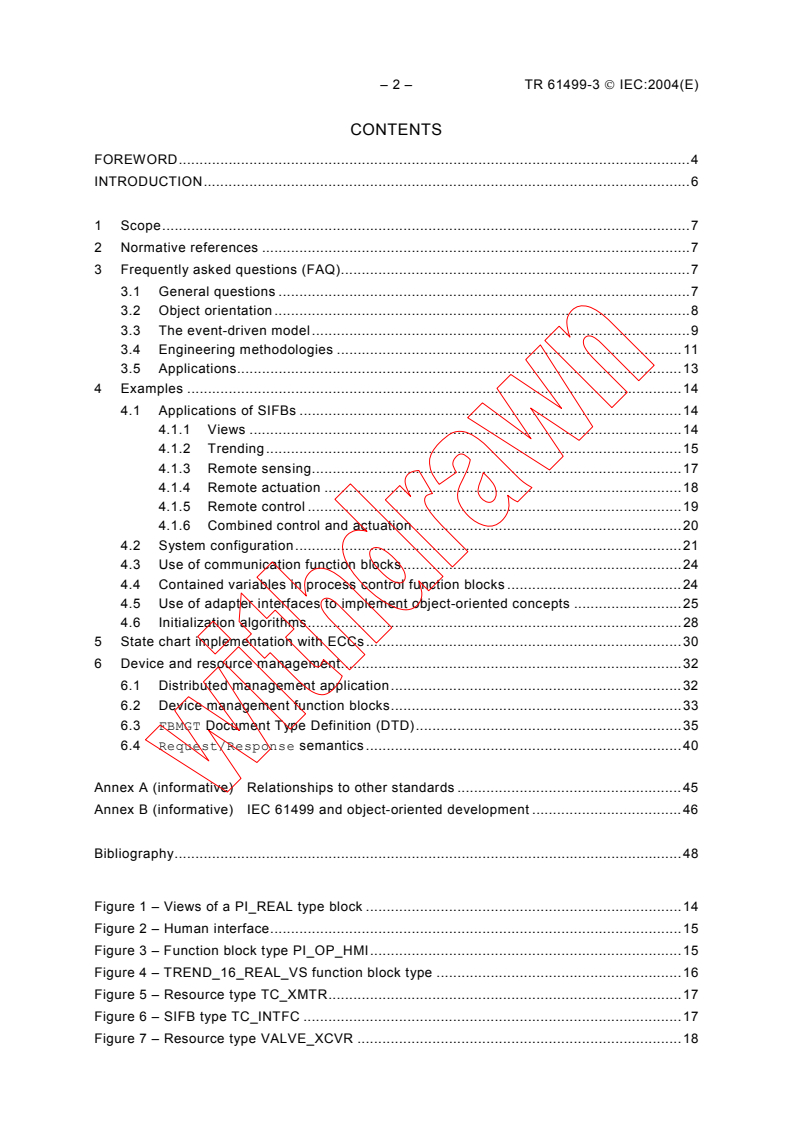
CONTENTS
FOREWORD.4
INTRODUCTION.6
1 Scope.7
2 Normative references.7
3 Frequently asked questions (FAQ).7
3.1 General questions.7
3.2 Object orientation.8
3.3 The event-driven model.9
3.4 Engineering methodologies.11
3.5 Applications.13
4 Examples.14
4.1 Applications of SIFBs.14
4.1.1 Views.14
4.1.2 Trending.15
4.1.3 Remote sensing.17
4.1.4 Remote actuation.18
4.1.5 Remote control.19
4.1.6 Combined control and actuation .20
4.2 System configuration.21
4.3 Use of communication function blocks .24
4.4 Contained variables in process control function blocks .24
4.5 Use of adapter interfaces to implement object-oriented concepts .25
4.6 Initialization algorithms.28
5 State chart implementation with ECCs.30
6 Device and resource management.32
6.1 Distributed management application.32
6.2 Device management function blocks.33
6.3 FBMGT Document Type Definition (DTD).35
6.4 Request/Response semantics .40
Annex A (informative) Relationships to other standards .45
Annex B (informative) IEC 61499 and object-oriented development .46
Bibliography.48
Figure 1 – Views of a PI_REAL type block .14
Figure 2 – Human interface.15
Figure 3 – Function block type PI_OP_HMI.15
Figure 4 – TREND_16_REAL_VS function block type .16
Figure 5 – Resource type TC_XMTR.17
Figure 6 – SIFB type TC_INTFC .17
Figure 7 – Resource type VALVE_XCVR .18
TR 61499-3 IEC:2004(E) – 3 –
Figure 8 – S type VALVE_INTFC .19
Figure 9 – Resource type PID_RSRC .20
Figure 10 – SIFB type PID .20
Figure 11 – Resource type PID_VALVE .21
Figure 12 – System configuration TC_LOOP.23
Figure 13 – Example system timing.23
Figure 14 – Polymorphic adapter type declaration.26
Figure 15 – Polymorphic acceptor ("client") function block type.26
Figure 16 – Provider ("server") function block types.27
Figure 17 – Resource configuration for testing adapter interfaces .28
Figure 18 – Test results .28
Figure 19 – HMI example.30
Figure 20 – State machine for hypothetical VCR motor control.31
Figure 21 – Basic function block implementation of state chart .32
Figure 22 – Device management application.32
Figure 23 – Remote device proxy.33
Figure 24 – Device management resource .33
Figure 25 – Device management kernel .34
Figure 26 – Device management service interface .35
Table 1 – FBMGT DTD .35
Table 2 – FBMGT DTD Elements.38
Table 3 – Request elements and Response Reason codes .40
Table 4 – QUERY Request and Response elements .42
– 4 – TR 61499-3 IEC:2004(E)
INTERNATIONAL ELECTROTECHNICAL COMMISSION
____________
FUNCTION BLOCKS FOR INDUSTRIAL-PROCESS
MEASUREMENT AND CONTROL SYSTEMS –
Part 3: Tutorial information
FOREWORD
1) The International Electrotechnical Commission (IEC) is a worldwide organization for standardization comprising
all national electrotechnical committees (IEC National Committees). The object of IEC is to promote
international co-operation on all questions concerning standardization in the electrical and electronic fields. To
this end and in addition to other activities, IEC publishes International Standards, Technical Specifications,
Technical Reports, Publicly Available Specifications (PAS) and Guides (hereafter referred to as “IEC
Publication(s)”). Their preparation is entrusted to technical committees; any IEC National Committee interested
in the subject dealt with may participate in this preparatory work. International, governmental and non-
governmental organizations liaising with the IEC also participate in this preparation. IEC collaborates closely
with the International Organization for Standardization (ISO) in accordance with conditions determined by
agreement between the two organizations.
2) The formal decisions or agreements of IEC on technical matters express, as nearly as possible, an international
consensus of opinion on the relevant subjects since each technical committee has representation from all
interested IEC National Committees.
3) IEC Publications have the form of recommendations for international use and are accepted by IEC National
Committees in that sense. While all reasonable efforts are made to ensure that the technical content of IEC
Publications is accurate, IEC cannot be held responsible for the way in which they are used or for any
misinterpretation by any end user.
4) In order to promote international uniformity, IEC National Committees undertake to apply IEC Publications
transparently to the maximum extent possible in their national and regional publications. Any divergence
between any IEC Publication and the corresponding national or regional publication shall be clearly indicated in
the latter.
5) IEC provides no marking procedure to indicate its approval and cannot be rendered responsible for any
equipment declared to be in conformity with an IEC Publication.
6) All users should ensure that they have the latest edition of this publication.
7) No liability shall attach to IEC or its directors, employees, servants or agents including individual experts and
members of its technical committees and IEC National Committees for any personal injury, property damage or
other damage of any nature whatsoever, whether direct or indirect, or for costs (including legal fees) and
expenses arising out of the publication, use of, or reliance upon, this IEC Publication or any other IEC
Publications.
8) Attention is drawn to the Normative references cited in this publication. Use of the referenced publications is
indispensable for the correct application of this publication.
9) Attention is drawn to the possibility that some of the elements of this IEC Publication may be the subject of
patent rights. IEC shall not be held responsible for identifying any or all such patent rights.
The main task of IEC technical committees is to prepare International Standards. However, a
technical committee may propose the publication of a technical report when it has collected
data of a different kind from that which is normally published as an International Standard, for
example "state of the art".
IEC 61499-3, which is a technical report, has been prepared by working group 6: Function
blocks, of IEC technical committee 65: Industrial-process measurement and control systems.
The text of this technical report is based on the following documents:
Enquiry draft Report on voting
65/308/DTR 65/321/RVC
Full information on the voting for the approval of this technical report can be found in the
report on voting indicated in the above table.
TR 61499-3 IEC:2004(E) – 5 –
This publication has been drafted in accordance with the ISO/IEC Directives, Part 2.
IEC 61499 consists of the following parts under the general title Function blocks for industrial-
process measurement and control systems:
Part 1: Architecture
Part 2: Software tools requirements
Part 3: Tutorial information
Part 4: Communication requirements
NOTE Parts 1 and 2 are under consideration.
The committee has decided that the contents of this publication will remain unchanged until
the maintenance result date indicated on the IEC web site under "http://webstore.iec.ch" in
the data related to the specific publication. At this date, the publication will be
• reconfirmed;
• withdrawn;
• replaced by a revised edition, or
• amended.
A bilingual version of this publication may be issued at a later date.
– 6 – TR 61499-3 IEC:2004(E)
INTRODUCTION
The following gives a description of the contents of the various parts of IEC 61499.
a) Part 1 contains
• general requirements, including an introduction, scope, normative references,
definitions, and reference models;
• rules for the declaration of function block types, and rules for the behaviour of
instances of the types so declared;
• rules for the use of function blocks in the configuration of distributed industrial-process
measurement and control systems (IPMCSs);
• rules for the use of function blocks in meeting the communication requirements of
distributed IPMCSs;
• rules for the use of function blocks in the management of applications, resources and
devices in distributed IPMCSs.
b) Part 2 defines requirements for software tools to support the following systems
engineering tasks enumerated in 1.1 of IEC 61499-1:
• the specification of function block types;
• the functional specification of resource types and device types;
• the specification, analysis, and validation of distributed IPMCSs;
• the configuration, implementation, operation, and maintenance of distributed IPMCSs;
• the exchange of information among software tools.
c) Part 3 has the purpose of increasing the understanding, acceptance, and both generic and
domain-specific applicability of IPMCS architectures and software tools meeting the
requirements of the other parts, by providing
• answers to Frequently Asked Questions (FAQs) regarding IEC 61499;
• examples of the use of IEC 61499 constructs to solve frequently encountered
problems in control and automation engineering.
d) Part 4 defines rules for the development of compliance profiles which specify the features
of IEC 61499-1 and IEC 61499-2 to be implemented in order to promote the following
attributes of IEC 61499-based systems, devices and software tools:
• interoperability of devices from multiple suppliers;
• portability of software between software tools of multiple suppliers; and
• configurability of devices from multiple vendors by software tools of multiple suppliers.
TR 61499-3 IEC:2004(E) – 7 –
FUNCTION BLOCKS FOR INDUSTRIAL-PROCESS
MEASUREMENT AND CONTROL SYSTEMS –
Part 3: Tutorial information
1 Scope
This part of IEC 61499, which is a technical report, is intended to provide a simple shorthand
for common functionality in a broad number of "application domains" and, to that extent, may
be considered a "language". It should be noted that IEC 61499 is not a programming
methodology per se.
2 Normative references
The following referenced documents are indispensable for the application of this document.
For dated references, only the edition cited applies. For undated references, the latest edition
of the referenced document (including any amendments) applies.
IEC 61131-3:2003, Programmable controllers – Part 3: Programming languages
IEC 61804-1:2003, Function blocks (FB) for process control – Part 1: Overview of system
aspects
IEC 61804-2:2004, Function blocks (FB) for process control – Part 2: Specification of FB
concept and Electronic Device Description Language (EDDL)
3 Frequently asked questions (FAQ)
3.1 General questions
What is this clause about?
This clause is a compilation of responses to FAQ about the various parts of IEC 61499.
What good is IEC 61499?
IEC 61499-compliant distributed industrial-process measurement and control systems
(IPMCSs), devices, and their associated life-cycle support systems will be able to deliver a
number of significant benefits to their owners and system integrators, including:
a) IEC 61499-compliant life-cycle support systems will be able to reduce engineering costs
through integrated facilities for configuration, programming and data management.
Additional engineering cost savings will result from the ease of system integration
provided by IEC 61499's simple yet complete model of distributed systems. This model
provides hardware- and operating-system-independent representations for all functions of
the system, including control and information processing as well as communications and
process interfaces.
b) Engineers and technicians will be able to reduce system implementation time by
applying a common set of concepts and skills to all elements of the system. Further
reductions in implementation time will result from the elimination of software patches and
"glueware" formerly required to integrate incompatible system elements and software
tools.
1) The elimination of patchware and glueware, the availability of interoperable software
tool sets, the portability of engineering skills, and the ease of integration of system
elements, will yield higher reliability and maintainability over the system life cycle.
– 8 – TR 61499-3 IEC:2004(E)
2) IEC 61499 provides an abstract, implementation-independent means of representing
system functions. This common "target" will lead to simplified migration from
existing systems to IEC 61499-compliant systems, and from older to newer
technological platforms (operating systems, communications, etc.) in IEC 61499-
compliant systems.
3) Economies of scale from uniform application of common software and firmware
technologies will provide lower hardware cost per function, since the most
significant cost items in modern control hardware are its firmware and supporting
software.
Is IEC 61499 a "stand-alone" document?
No. In order to realize the benefits listed above, distributed industrial-process measurement
and control systems (IPMCSs) will need
• compliance profiles following the rules given in IEC 61499-4, including full definitions of
the communication protocols utilized;
• standard programming languages such as those defined in IEC 61131-3 for the
specification of algorithms in basic function block types;
• libraries of standardized and customized function block types, resource types and device
types and guidelines for their application in specific domains.
How can IEC 61499 function blocks be distinguished from IEC 61131-3 function blocks?
Unfortunately, the term was already used differently in IEC 61131-3 and in the process control
domain as reflected in IEC 61804. IEC 61499 defines the term most generically in terms of a
distributed, event-driven architecture, of which the centralized, scanned architecture
underlying IEC 61131-3 and the distributed, scanned architecture underlying IEC 61804 may
be considered special cases. IEC 61131-3 and IEC 61804 may, in future, choose to specify
their own compliance profiles following the rules of IEC 61499-4 in order to provide full
harmonization of these standards.
3.2 Object orientation
Why use such a heavily object-oriented model?
The degree of object orientation used in IEC 61499 is necessary in order to achieve the
required level of distributability of encapsulated, reusable software modules (function blocks).
The benefits of using object-oriented development, and the extent to which IEC 61499
realizes these benefits, are discussed in Annex B of this document.
Is this not very expensive to implement?
Not necessarily; a full object-oriented implementation is not required by the IEC 61499 model
– only that the externally visible behaviour of function blocks and compliant devices conform
to the requirements of IEC 61499 and possibly of compliance profiles as defined in
IEC 61499-4.
Why not use a general-purpose distributed object model, like DCOM or CORBA?
Implementation of the features specified for these information-technology models would be
too expensive, and their performance would almost always be too slow for use in a distributed
real-time industrial-process measurement and control system (IPMCS).
Additionally, there is no standard, easily understood graphical model for representing the
interconnections of events and data among these kinds of objects in distributed applications.
TR 61499-3 IEC:2004(E) – 9 –
Are data connections and event connections a kind of object?
The declarations of data and event connections contained in library elements can be
considered objects to be manipulated by software tools, as shown in Annex C of IEC 61499-1.
Additionally, data and event connections are regarded as managed objects within
resources, as shown in Annex C of IEC 61499-1.
Why are there no GLOBAL or EXTERNAL variables?
All variables are encapsulated. There is no guarantee that there will be an implicit global
distribution mechanism available. When such mechanisms are available, they can always be
mapped to service interface function blocks.
How can "contained parameters" be accessed?
External access to internal variables of function blocks is contrary to the principles of good
software design. Nonetheless, to accommodate exceptional cases and previous practice, the
READ and WRITE services and associated access paths to internal variables are defined for
management function blocks. However, this practice may substantially degrade system
performance, reliability, maintainability and safety, especially if used instead of the standard
PUBLISH/SUBSCRIBE or CLIENT/SERVER services for high-rate, periodic access to
variables.
Why use function blocks to model device or resource management applications?
The benefits of this approach are
• a consistent model of all applications in the system, including management applications;
• a consistent means of encapsulating and reusing all functions, including management
functions;
• reuse of existing data types;
• use of existing, standardized means for the definition of required new data types and
specification of management messages.
3.3 The event-driven model
Why an event-driven model?
Any execution control strategy (cyclic, time-scheduled, etc.) can be represented in terms of an
event-driven model, but the converse is not necessarily true. IEC 61499 opts for the more
general model in order to provide maximum flexibility and descriptive power to compliant
standards and systems.
How can a change in a data value generate an event?
E_R_TRIG and E_F_TRIG function block types, defined in Annex A of IEC 61499-1, propagate
an input event when the value of a Boolean input rises or falls, respectively, between
successive occurrences of the input event. Instances of this type may be combined with other
function blocks to produce rising- and falling-edge triggers, threshold detection events, etc.
What are event types? What are they used for?
An event type is an identifier associated with an event input or an event output of a function
block type, assigned as part of the event input or output declaration, as described in 2.2.1.1 of
IEC 61499-1. It can be used by software tools to assure that event connections are not
improperly mixed, for instance, to assure that an event output that is intended to be used for
initialization is not connected to an event input that is intended to be used for alarm
processing.
– 10 – TR 61499-3 IEC:2004(E)
Event types cannot be detected by execution control charts (ECCs), which control the
execution of algorithms in basic function block types as defined in 2.2 of IEC 61499-1, so the
type of event cannot be used to influence the processing of events in such function block
types.
IEC 61499 does not define any standard event types other than the default type EVENT.
How can this model accommodate sampled-data systems?
The major issues in sampled-data systems such as those used in motion, robotic and
continuous process control are
• how to achieve synchronized sampling of process or machine inputs;
• how to assure that all data has arrived in time for processing by control algorithms;
• how to assure that all outputs are present and ready for sampling before beginning the
next cycle of sampling and execution.
Solutions to these problems typically require specialized communication and operating system
services, which can be represented in terms of the IEC 61499 model by service interface
function blocks. The inputs and outputs to be sampled can likewise be represented by
service interface function blocks, while the algorithms to be performed will typically be
encapsulated in basic function blocks. The relationships between the system services, input
and output sampling, and algorithm execution can then be expressed as event connections
and data connections.
What happens if a critical event is lost by the communication subsystem?
This issue is common to all distributed control systems and its solutions are well known; for
example, via periodic communication, missing event detection and/or positive acknowledge-
ment protocols. The IEC 61499 model provides for notification of abnormal operation via the
IND-, CNF- and INITO- service primitives and STATUS output of service interface function
blocks.
Is there any way to distinguish between "process events" and "execution scheduling
events"?
These events can be distinguished from each other by the event type mechanism. They can
be used by software tools to show only the event types of interest and to restrict connections
to be only among compatible event types.
How can a function block respond to faults and exceptions?
In the IEC 61499 model, faults and exceptions are modelled as event outputs and associated
data outputs of service interface function blocks. These outputs can be connected to
appropriate event inputs and associated data inputs of any function blocks, which must
respond to the fault or exception, for example, by changing their operational modes.
Where can event handling function blocks (E_CYCLE, E_RESTART, etc.) be instantiated?
The standard does not restrict the context for instantiation of event handling function blocks or
service interface function blocks in general. They can, in principle, be used wherever any
other function block type may be instantiated, for instance, as components of composite
function blocks or as part of a resource configuration.
Are there any mechanisms to prioritize execution of algorithms or events ?
There is just some description of priority attributes for algorithms in Annex H of IEC 61499-1;
however, this description is not normative.
TR 61499-3 IEC:2004(E) – 11 –
The rules for algorithm invocation given in 2.2.2.2 of IEC 61499-1 provide a substantial
degree of control over prioritization by defining specifically the processing order of transitions
and actions of an Execution Control Chart (ECC).
How can IEC 61131-3 tasks with priorities and cycling time be converted to IEC 61499?
The E_CYCLE function block is intended to be used mainly for the control of cyclic execution
like the cyclic tasks of IEC 61131-3. See the previous question for a discussion of priorities.
3.4 Engineering methodologies
How can I use IEC 61499 to design and implement state-machine control?
There are various formal and informal methodologies for the design of state-machine control
systems. A general outline of these methods and how IEC 61499 models and software tools
can be used is as follows.
a) Define the desired sequence of operations for the controlled machine or process, as well
as the abnormal sequences which may occur, if possible. This may be done informally in
ordinary language, or by using more formal notations such as Petri nets or IEC 61131-3
Sequential Function Charts (SFCs).
b) Define the actuators that are to be used to implement the desired behaviour, the sensors
that are to be used to determine the actual state of the controlled machine or process, and
their interfaces to the state-machine controller(s). IEC 61499 service interface function
block types may be used for this purpose; such type definitions will typically be provided
for this purpose by the supplier of the IEC 61499-compliant sensor and actuator devices.
c) Model the behaviour of the machine or process in response to commands (events plus
data) given to the actuators, and the resulting, observable time-dependent outputs (events
plus data) from the sensors. This modelling may be done formally using notations such as
Petri nets, or informally using simulation models (which may be implemented with
appropriate IEC 61499 models).
d) Define the appropriate state-machine controllers, typically as the ECCs and algorithms of
basic function block types. Methodologies for doing this step may be informal, based on
engineering experience, or more formal, using for example Petri-net theory. The best
method is to reuse existing, proven state-machine controllers from an IEC 61499 function
block library!
e) Validate the proposed state-machine controllers versus the model of the controlled
machine or process. In order to catch possible design or specification errors, this would
usually be done using simulation; in addition, more formal validation methods may be
used if available.
f) Finally, replace the simulated sensor and actuator interfaces with the service interfaces to
the actual machine or process to be controlled. This installation should normally be
carried out piecewise for testing purposes.
What is an ECC? Why should I use it and when?
An ECC is a specialized state machine to enable multiple events to trigger multiple algorithms
in a basic function block type, possibly dependent on some internal state. It should be used
when maximum flexibility in algorithm selection and scheduling or when a high-performance,
event-driven state machine is needed. Otherwise, the mechanisms in Annex D of IEC 61499-1
for converting IEC 61131-3 function blocks to IEC 61499-style blocks can be used.
Why can a composite function block not have internal variables?
Internal variables are not required in composite function blocks, since all possible sources of
data are accounted for as input or output variables of the composite function block or of its
component function blocks.
– 12 – TR 61499-3 IEC:2004(E)
Are extensible user-defined function blocks permitted?
IEC 61499 follows the usage of IEC 61131-3 and does not define a specific syntax for
specification of extensible inputs and outputs of user-defined function blocks. The use of the
ellipsis (.) and accompanying textual descriptions is considered adequate for the
specification of extensible inputs and outputs of standard and service interface function block
types.
Can alternative graphical representations be used?
Software tools can use alternative graphical, textual or tabular representations, as long as the
accompanying documentation specifies an unambiguous mapping to the graphical elements
and associated textual syntax defined in IEC 61499-1.
How can "trend" and "view" objects be created?
In some process control terminologies, a view is a collection of data values from various
sources, arranged for remote access. This function is performed by standard IEC 61499
communication function blocks.
NOTE This usage of the term "view" differs from the well-known Model/View/Controller (MVC) model for user
interface applications.
A trend is a sequence of data values from the same source. The function of collecting trend
data can be implemented as an algorithm of a basic function block, and remote access to the
data so collected can be provided by standard communication function blocks. See 4.1.1 and
4.1.2 for further information.
Why and when should I use the WITH construct?
When you are designing function block types, you use the WITH construct to specify an
association between an event input and a set of input variables, or between an event output
and a set of output variables. Subclause 2.2.2.2 of IEC 61499-1 states that this association
means that the associated input variables are to be sampled at a particular transition of the
ECC state machine; no specific semantics are given for the WITH associations of event
outputs and output variables. It is recommended, but not required, that the following
interpretations be placed on these semantics.
IEC 61499-1 states that the WITH construct is used to determine
• which input variables to sample when an event occurs at the associated event input of an
instance of the type;
• which output events are used to indicate when values of associated output variables
change.
In either case, it is expected that this information will be used by software tools to assist the
user to ensure that
• the data used by an algorithm in one function block is consistent with the data produced
by an algorithm in another function block and delivered over one or more data connections
associated with one or more event connections;
• the messages transmitted over communication connections between resources in a
distributed application carry consistent data and events between the function block
instances in the application in the way intended by the application designer.
TR 61499-3 IEC:2004(E) – 13 –
Are the "sequences" of service interface function blocks (SIFBs) only for documenta-
tion or can they be used for programming purposes?
The use of service sequences for SIFBs was intended for documentation purposes and
especially to show a direct mapping for well-specified services which follow the ISO 8509
conventions. Even in documentation terms, however, they should be considered as imposing
constraints on the externally observable operational sequences of the corresponding SIFBs.
Software tools may, but are not required to, use these specifications to generate skeleton
code for an implementation language such as IEC 61131-3 ST, C++ or Java.
How is IEC 61499 related to conventional methods of object-oriented development?
See Annex B.
3.5 Applications
Why does IEC 61499 not define applications as instances of application types?
It was determined that an implementation-independent specification of an application type
would be identical to a composite function block type; however, this view has now evolved to
that of a sub-application type. The configuration of applications could then be carried out
according to the following process.
a) Create and interconnect one or more instances of the sub-application types (and possibly
additional function block types) representing the application.
b) Create instances of the service interface function block types representing the process
interfaces of the application.
c) Create appropriate event connections and data connections between the process
interface function blocks and the sub-applications representing the application.
d) Remove the encapsulation around the sub-applications, exposing their component
function blocks (which may also be sub-applications) as distributable elements of the
application.
e) Remove the encapsulation of all of the newly exposed sub-applications, repeating as
necessary.
f) Distribute the application by allocating its function block instances to appropriate
resources.
g) Create and configure appropriate instances of communication function block types to
maintain the event and data flows of the application.
NOTE Software tools would typically provide means of automating many of the operations in this process,
especially in steps d), e) and f).
Can an application contain "sub-applications"?
Yes. See the above description as well as 2.4 of IEC 61499-1.
Can an application interface with other applications?
Not directly, since there is no application type within which an interface could be defined.
However, applications may communicate with each other by means of communication
SIFBs. Also, sub-applications may interface with each other via event connections and data
connections.
How is the loading and starting of applications managed?
Software tools for this purpose will take as input a system configuration and generate
sequences of commands to management function blocks to perform loading and starting of
applications, either locally or remotely via communication function blocks. Details of this
functionality will typically be contained in compliance profiles following the rules given in
IEC 61499-4.
– 14 – TR 61499-3 IEC:2004(E)
4 Examples
4.1 Applications of SIFBs
4.1.1 Views
Some system architectures define unique objects to provide specified functions. Such objects
may include "transducer blocks", "views", "trends", "alerts", and remote "links". The purpose
of this subclause is to illustrate the use of SIFBs to replace such specialized objects.
This example illustrates the use of communication function blocks to provide controlled
remote access to real-time data and parameters of function blocks. The general approach is
as follows.
a) Model the desired functionality as a function block with all accessible parameters
externally visible.
b) Use appropriate SIFBs, for example, SERVER, to model the grouping and access control to
parameters.
c) Encapsulate the resulting model with "invisible" contained parameters and internal access
mechanisms.
Figure 1 shows a partial configuration of a resource type which provides an "operator view"
via the block labelled OP_VIEW and an "engineering view" via the block labelled ENG_VIEW of
the data associated with an instance of the PI_REAL composite function block example
described in 2.3.1 of IEC 61499-1. The ENG_VIEW block supplies the KP and KI parameters
and the HOLD variable to the PI block, while the OP_VIEW block supplies the SP variable and
returns the PV variable (provided by a remote publisher via the PV_SUB block) and the XOUT
variable of the PI block.
NOTE 1 The XOUT parameter would typically be connected to a PUBLISH block or a local output point to effect
the desired control; this connection is not shown in this example.
NOTE 2 The naming of the communication SIFB types in this subclause shows a useful convention. The block is
named XXXX_NI_NO, where XXXX is the name of the service, for example, SERVER; NI is the number of inputs,
for example, 2 and NO is the number of outputs, for example, 1. In this example, the block type is SERVER_2_1; the
service interface at the other end of the communication connection then has the reversed number of inputs and
outputs, for example, CLIENT_1_2.
Figure 1 – Views of a PI_REAL type block
TR 61499-3 IEC:2004(E) – 15 –
Figure 2a illustrates a partial resource configuration for a simple remote operator interface for
the remote resource shown in Figure 1. An instance of a specialized version of the CLIENT
function block type described in Annex F of IEC 61499-1 provides the remote interface for
setting the SP (set point) of the PI algorithm, and reading the PV (process variable) input and
XOUT output of the algorithm. A similar configuration could be used for an engineering
interface; if these two interfaces are placed side-by-side, a display such as that in Figure 2b
could be obtained.
Figure 2b −−−− Typical display
Figure 2a −−−− Partial resource configuration
Figure 2 – Human interface
Figure 3 shows the external interface and internal function block network of the PI_OP_HMI
function block type used for the simple human interface in Figure 2. In practice, a bar chart
display of the three values SP, PV and OUT is typically used.
Figure 3a −− External interface
−−
Figure 3b −− Implementation
−−
Figure 3 – Function block type PI_OP_HMI
4.1.2 Trending
Figure 4 shows a 16-sample trending function implemented in a TREND_16_REAL_VS function
block. The function block provides an RD/RDO pair to assure that data being read is properly
synchronized. The input data is of type REAL_VS providing both value and status of the data,
as given by the declaration
– 16 – TR 61499-3 IEC:2004(E)
TYPE REAL_VS: (* REAL Value with Status byte *)
STRUCT
Status: BYTE; (* Implementation dependent encoding *)
Value: REAL;
END_STRUCT;
END_TYPE
Information encoded in the Status byte may include
• good (cascade) – variable value may be used for control;
• good (non-cascade) – the value may be used in operation;
• uncertain – the variable value is suspect;
• bad – the variable value does not reflect the true measurement, calculation, or control
value;
• additional status attributes (i.e., attributes whose interpre
...