


IEC 61238-1:2003
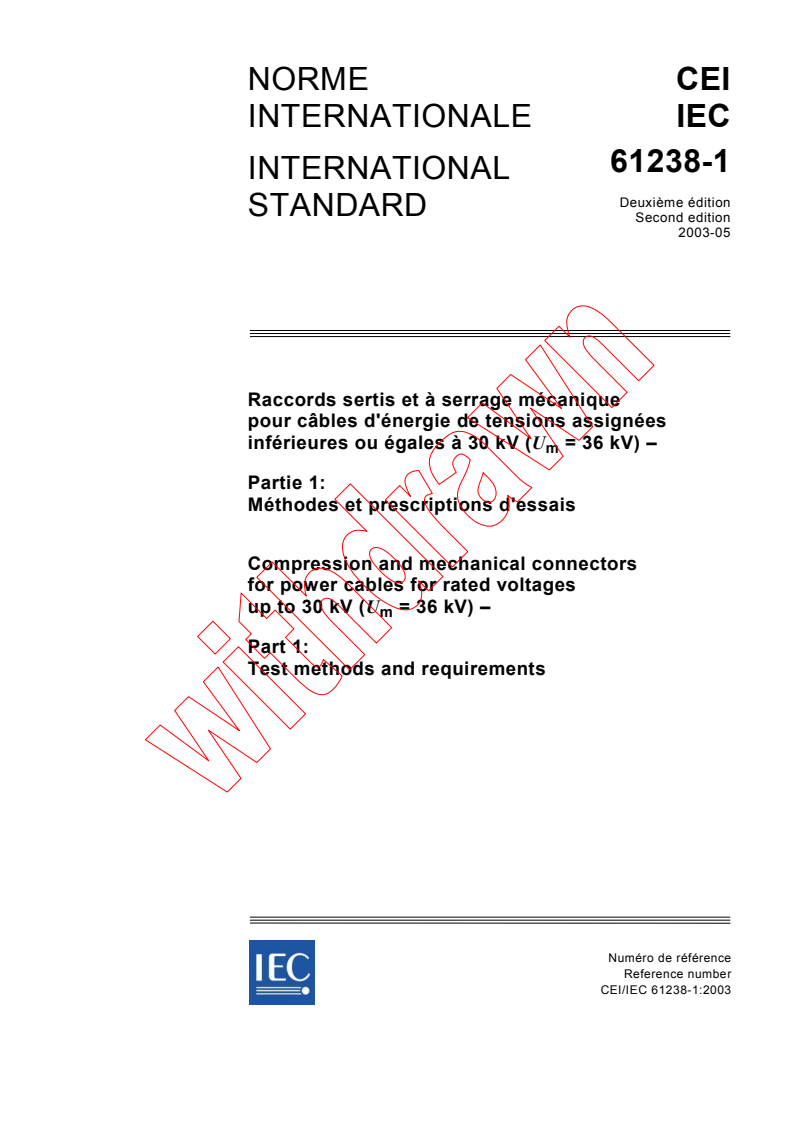
(Main)Compression and mechanical connectors for power cables for rated voltages up to 30 kV (Um = 36 kV) - Part 1: Test methods and requirements
General Information
- Abstract
Applies to compression and mechanical connectors for power cables for rated voltages up to 30 kV (Um = 36 kV), e.g. buried cables or cables installed in buildings, having - conductors complying with IEC 60228 and IEC 60228A with cross-sectional areas 10 mm2 and greater for copper and 16 mm2 and greater for aluminium, - a maximum continuous conductor temperature not exceeding 90 °C. This standard is not applicable to connectors for overhead conductors, which are designed for special mechanical requirements, or to separable connectors with a sliding contact or multi-core connectors (i.e. ring connectors). Although it is not possible to define precisely the service conditions for all applications, two broad classes of connectors have been identified. Class A These are connectors intended for electricity distribution or industrial networks in which they can be subjected to short-circuits of relatively high intensity and duration. As a consequence, Class A connectors are suitable for the majority of applications. Class B These are connectors for networks in which overloads or short-circuits are rapidly cleared by the installed protective devices, e.g. fast-acting fuses. Depending on the application, the connectors are subjected to the following tests: Class A: heat cycle and short-circuit tests. Class B: heat cycle tests only. The object of this standard is to define the type test methods and requirements, which apply to compression and mechanical connectors for power cables with copper or aluminium conductors. Formerly, approval for such products has been achieved on the basis of national standards and specifications and/or the demonstration of satisfactory service performance. The publication of this IEC standard does not invalidate existing approvals. However, products approved according to these earlier standards or specifications cannot claim approval to this IEC standard unless specifically tested to it. After they have been made, these tests need not be repeated unless changes are made in the connector material, design or manufacturing process which might affect the performance characteristics. Significant technical changes with respect to the previous edition are as follows: - The scope is now restricted to connectors to be used on power cables for rated voltages up to 30 kV (Um = 36 kV); - The concept of direct measurement of resistance has been introduced as an alternative to the indirect measurement, with associated tolerances; - Temperature limits have been given for insulation piercing connectors, depending on the type of cable insulation; - For short-circuit tests, tolerances have been given on the duration and recommendations have been given for large cross-sections; - Some approval criteria have been revised and harmonized between mechanical connectors and compression connectors; - The information to be included in the test report has been added; - Informative annexes have been added, with information on measuring accuracy, the calcul-ation method, the temperature profile and the statistical method.
- Status
- Replaced
- Publication Date
- 08-May-2003
- Technical Committee
- TC 20 - Electric cables
- Drafting Committee
- WG 16 - TC 20/WG 16
- Current Stage
- DELPUB - Deleted Publication
- Start Date
- 08-May-2018
- Completion Date
- 28-Aug-2026
Relations
- Effective Date
- 05-Sep-2023
- Effective Date
- 05-Sep-2023
- Effective Date
- 05-Sep-2023
Get Certified
Connect with accredited certification bodies for this standard

IMQ S.p.A. (Certification)
Italian electrical product certification.

SLG Prüf- und Zertifizierungs GmbH
German testing and certification body.

UL Solutions
Global safety science company with testing, inspection and certification.
Sponsored listings
Frequently Asked Questions
IEC 61238-1:2003 is a standard published by the International Electrotechnical Commission (IEC). Its full title is "Compression and mechanical connectors for power cables for rated voltages up to 30 kV (Um = 36 kV) - Part 1: Test methods and requirements". This standard covers: Applies to compression and mechanical connectors for power cables for rated voltages up to 30 kV (Um = 36 kV), e.g. buried cables or cables installed in buildings, having - conductors complying with IEC 60228 and IEC 60228A with cross-sectional areas 10 mm2 and greater for copper and 16 mm2 and greater for aluminium, - a maximum continuous conductor temperature not exceeding 90 °C. This standard is not applicable to connectors for overhead conductors, which are designed for special mechanical requirements, or to separable connectors with a sliding contact or multi-core connectors (i.e. ring connectors). Although it is not possible to define precisely the service conditions for all applications, two broad classes of connectors have been identified. Class A These are connectors intended for electricity distribution or industrial networks in which they can be subjected to short-circuits of relatively high intensity and duration. As a consequence, Class A connectors are suitable for the majority of applications. Class B These are connectors for networks in which overloads or short-circuits are rapidly cleared by the installed protective devices, e.g. fast-acting fuses. Depending on the application, the connectors are subjected to the following tests: Class A: heat cycle and short-circuit tests. Class B: heat cycle tests only. The object of this standard is to define the type test methods and requirements, which apply to compression and mechanical connectors for power cables with copper or aluminium conductors. Formerly, approval for such products has been achieved on the basis of national standards and specifications and/or the demonstration of satisfactory service performance. The publication of this IEC standard does not invalidate existing approvals. However, products approved according to these earlier standards or specifications cannot claim approval to this IEC standard unless specifically tested to it. After they have been made, these tests need not be repeated unless changes are made in the connector material, design or manufacturing process which might affect the performance characteristics. Significant technical changes with respect to the previous edition are as follows: - The scope is now restricted to connectors to be used on power cables for rated voltages up to 30 kV (Um = 36 kV); - The concept of direct measurement of resistance has been introduced as an alternative to the indirect measurement, with associated tolerances; - Temperature limits have been given for insulation piercing connectors, depending on the type of cable insulation; - For short-circuit tests, tolerances have been given on the duration and recommendations have been given for large cross-sections; - Some approval criteria have been revised and harmonized between mechanical connectors and compression connectors; - The information to be included in the test report has been added; - Informative annexes have been added, with information on measuring accuracy, the calcul-ation method, the temperature profile and the statistical method.
Applies to compression and mechanical connectors for power cables for rated voltages up to 30 kV (Um = 36 kV), e.g. buried cables or cables installed in buildings, having - conductors complying with IEC 60228 and IEC 60228A with cross-sectional areas 10 mm2 and greater for copper and 16 mm2 and greater for aluminium, - a maximum continuous conductor temperature not exceeding 90 °C. This standard is not applicable to connectors for overhead conductors, which are designed for special mechanical requirements, or to separable connectors with a sliding contact or multi-core connectors (i.e. ring connectors). Although it is not possible to define precisely the service conditions for all applications, two broad classes of connectors have been identified. Class A These are connectors intended for electricity distribution or industrial networks in which they can be subjected to short-circuits of relatively high intensity and duration. As a consequence, Class A connectors are suitable for the majority of applications. Class B These are connectors for networks in which overloads or short-circuits are rapidly cleared by the installed protective devices, e.g. fast-acting fuses. Depending on the application, the connectors are subjected to the following tests: Class A: heat cycle and short-circuit tests. Class B: heat cycle tests only. The object of this standard is to define the type test methods and requirements, which apply to compression and mechanical connectors for power cables with copper or aluminium conductors. Formerly, approval for such products has been achieved on the basis of national standards and specifications and/or the demonstration of satisfactory service performance. The publication of this IEC standard does not invalidate existing approvals. However, products approved according to these earlier standards or specifications cannot claim approval to this IEC standard unless specifically tested to it. After they have been made, these tests need not be repeated unless changes are made in the connector material, design or manufacturing process which might affect the performance characteristics. Significant technical changes with respect to the previous edition are as follows: - The scope is now restricted to connectors to be used on power cables for rated voltages up to 30 kV (Um = 36 kV); - The concept of direct measurement of resistance has been introduced as an alternative to the indirect measurement, with associated tolerances; - Temperature limits have been given for insulation piercing connectors, depending on the type of cable insulation; - For short-circuit tests, tolerances have been given on the duration and recommendations have been given for large cross-sections; - Some approval criteria have been revised and harmonized between mechanical connectors and compression connectors; - The information to be included in the test report has been added; - Informative annexes have been added, with information on measuring accuracy, the calcul-ation method, the temperature profile and the statistical method.
IEC 61238-1:2003 is classified under the following ICS (International Classification for Standards) categories: 29.060.20 - Cables. The ICS classification helps identify the subject area and facilitates finding related standards.
IEC 61238-1:2003 has the following relationships with other standards: It is inter standard links to IEC 61238-1-2:2018, IEC 61238-1-3:2018, IEC 61238-1-1:2018. Understanding these relationships helps ensure you are using the most current and applicable version of the standard.
IEC 61238-1:2003 is available in PDF format for immediate download after purchase. The document can be added to your cart and obtained through the secure checkout process. Digital delivery ensures instant access to the complete standard document.
Standards Content (Sample)
NORME CEI
INTERNATIONALE IEC
61238-1
INTERNATIONAL
Deuxième édition
STANDARD
Second edition
2003-05
Raccords sertis et à serrage mécanique
pour câbles d'énergie de tensions assignées
inférieures ou égales à 30 kV (U = 36 kV) –
m
Partie 1:
Méthodes et prescriptions d'essais
Compression and mechanical connectors
for power cables for rated voltages
up to 30 kV (U = 36 kV) –
m
Part 1:
Test methods and requirements
Numéro de référence
Reference number
CEI/IEC 61238-1:2003
Numérotation des publications Publication numbering
Depuis le 1er janvier 1997, les publications de la CEI As from 1 January 1997 all IEC publications are
sont numérotées à partir de 60000. Ainsi, la CEI 34-1 issued with a designation in the 60000 series. For
devient la CEI 60034-1. example, IEC 34-1 is now referred to as IEC 60034-1.
Editions consolidées Consolidated editions
Les versions consolidées de certaines publications de la The IEC is now publishing consolidated versions of its
CEI incorporant les amendements sont disponibles. Par publications. For example, edition numbers 1.0, 1.1
exemple, les numéros d’édition 1.0, 1.1 et 1.2 indiquent and 1.2 refer, respectively, to the base publication,
respectivement la publication de base, la publication de the base publication incorporating amendment 1 and
base incorporant l’amendement 1, et la publication de the base publication incorporating amendments 1
base incorporant les amendements 1 et 2. and 2.
Informations supplémentaires Further information on IEC publications
sur les publications de la CEI
Le contenu technique des publications de la CEI est The technical content of IEC publications is kept
constamment revu par la CEI afin qu'il reflète l'état under constant review by the IEC, thus ensuring that
actuel de la technique. Des renseignements relatifs à the content reflects current technology. Information
cette publication, y compris sa validité, sont dispo- relating to this publication, including its validity, is
nibles dans le Catalogue des publications de la CEI available in the IEC Catalogue of publications
(voir ci-dessous) en plus des nouvelles éditions, (see below) in addition to new editions, amendments
amendements et corrigenda. Des informations sur les and corrigenda. Information on the subjects under
sujets à l’étude et l’avancement des travaux entrepris consideration and work in progress undertaken by the
par le comité d’études qui a élaboré cette publication, technical committee which has prepared this
ainsi que la liste des publications parues, sont publication, as well as the list of publications issued,
également disponibles par l’intermédiaire de: is also available from the following:
• Site web de la CEI (www.iec.ch) • IEC Web Site (www.iec.ch)
• Catalogue des publications de la CEI • Catalogue of IEC publications
Le catalogue en ligne sur le site web de la CEI The on-line catalogue on the IEC web site
(http://www.iec.ch/searchpub/cur_fut.htm) vous permet (http://www.iec.ch/searchpub/cur_fut.htm) enables
de faire des recherches en utilisant de nombreux you to search by a variety of criteria including text
critères, comprenant des recherches textuelles, par searches, technical committees and date of
comité d’études ou date de publication. Des publication. On-line information is also available
informations en ligne sont également disponibles sur on recently issued publications, withdrawn and
les nouvelles publications, les publications rempla- replaced publications, as well as corrigenda.
cées ou retirées, ainsi que sur les corrigenda.
• IEC Just Published • IEC Just Published
Ce résumé des dernières publications parues This summary of recently issued publications
(http://www.iec.ch/online_news/justpub/jp_entry.htm) (http://www.iec.ch/online_news/justpub/jp_entry.htm)
est aussi disponible par courrier électronique. is also available by email. Please contact the
Veuillez prendre contact avec le Service client Customer Service Centre (see below) for further
(voir ci-dessous) pour plus d’informations. information.
• Service clients • Customer Service Centre
Si vous avez des questions au sujet de cette If you have any questions regarding this
publication ou avez besoin de renseignements publication or need further assistance, please
supplémentaires, prenez contact avec le Service contact the Customer Service Centre:
clients:
Email: custserv@iec.ch Email: custserv@iec.ch
Tél: +41 22 919 02 11 Tel: +41 22 919 02 11
Fax: +41 22 919 03 00 Fax: +41 22 919 03 00
.
NORME CEI
INTERNATIONALE IEC
61238-1
INTERNATIONAL
Deuxième édition
STANDARD
Second edition
2003-05
Raccords sertis et à serrage mécanique
pour câbles d'énergie de tensions assignées
inférieures ou égales à 30 kV (U = 36 kV) –
m
Partie 1:
Méthodes et prescriptions d'essais
Compression and mechanical connectors
for power cables for rated voltages
up to 30 kV (U = 36 kV) –
m
Part 1:
Test methods and requirements
IEC 2003 Droits de reproduction réservés Copyright - all rights reserved
Aucune partie de cette publication ne peut être reproduite ni No part of this publication may be reproduced or utilized in any
utilisée sous quelque forme que ce soit et par aucun procédé, form or by any means, electronic or mechanical, including
électronique ou mécanique, y compris la photocopie et les photocopying and microfilm, without permission in writing from
microfilms, sans l'accord écrit de l'éditeur. the publisher.
International Electrotechnical Commission, 3, rue de Varembé, PO Box 131, CH-1211 Geneva 20, Switzerland
Telephone: +41 22 919 02 11 Telefax: +41 22 919 03 00 E-mail: inmail@iec.ch Web: www.iec.ch
CODE PRIX
XA
Commission Electrotechnique Internationale PRICE CODE
International Electrotechnical Commission
Международная Электротехническая Комиссия
Pour prix, voir catalogue en vigueur
For price, see current catalogue
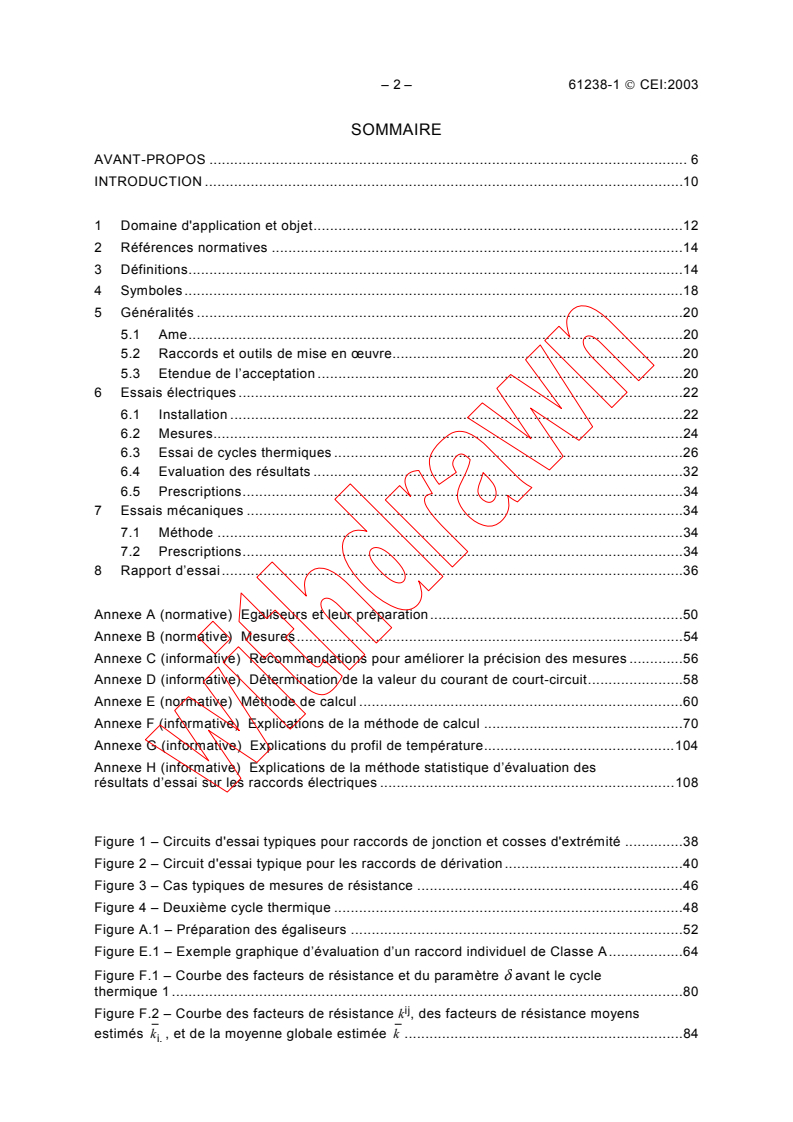
– 2 – 61238-1 CEI:2003
SOMMAIRE
AVANT-PROPOS . 6
INTRODUCTION .10
1 Domaine d'application et objet.12
2 Références normatives .14
3 Définitions.14
4 Symboles.18
5 Généralités .20
5.1 Ame.20
5.2 Raccords et outils de mise en oeuvre.20
5.3 Etendue de l’acceptation .20
6 Essais électriques .22
6.1 Installation .22
6.2 Mesures.24
6.3 Essai de cycles thermiques .26
6.4 Evaluation des résultats .32
6.5 Prescriptions.34
7 Essais mécaniques .34
7.1 Méthode .34
7.2 Prescriptions.34
8 Rapport d’essai.36
Annexe A (normative) Egaliseurs et leur préparation.50
Annexe B (normative) Mesures.54
Annexe C (informative) Recommandations pour améliorer la précision des mesures .56
Annexe D (informative) Détermination de la valeur du courant de court-circuit.58
Annexe E (normative) Méthode de calcul .60
Annexe F (informative) Explications de la méthode de calcul .70
Annexe G (informative) Explications du profil de température.104
Annexe H (informative) Explications de la méthode statistique d’évaluation des
résultats d’essai sur les raccords électriques .108
Figure 1 – Circuits d'essai typiques pour raccords de jonction et cosses d'extrémité .38
Figure 2 – Circuit d'essai typique pour les raccords de dérivation .40
Figure 3 – Cas typiques de mesures de résistance .46
Figure 4 – Deuxième cycle thermique .48
Figure A.1 – Préparation des égaliseurs .52
Figure E.1 – Exemple graphique d’évaluation d’un raccord individuel de Classe A.64
Figure F.1 – Courbe des facteurs de résistance et du paramètre δ avant le cycle
thermique 1 .80
ij
Figure F.2 – Courbe des facteurs de résistance k , des facteurs de résistance moyens
estimés k , et de la moyenne globale estimée k .84
i.
61238-1 IEC:2003 – 3 –
CONTENTS
FOREWORD . 7
INTRODUCTION .11
1 Scope and object .13
2 Normative references.15
3 Definitions.15
4 Symbols.19
5 General.21
5.1 Conductor.21
5.2 Connectors and tooling .21
5.3 Range of approval.21
6 Electrical tests .23
6.1 Installation .23
6.2 Measurements .25
6.3 Heat cycle test .27
6.4 Assessment of results.33
6.5 Requirements .35
7 Mechanical tests .35
7.1 Method .35
7.2 Requirements .35
8 Test report .37
Annex A (normative) Equalizers and their preparation .51
Annex B (normative) Measurements .55
Annex C (informative) Recommendations to improve accuracy of measurement.57
Annex D (informative) Determination of the value of the short-circuit-current.59
Annex E (normative) Calculation method .61
Annex F (informative) Explanation of the calculation method.71
Annex G (informative) Explanation of the temperature profile .105
Annex H (informative) Explanation of the statistical method of assessing results of tests
on electrical connectors.109
Figure 1 – Typical test circuit for through connectors and terminal lugs .39
Figure 2 – Typical test circuit for branch connectors.41
Figure 3 – Typical cases of resistance measurements .47
Figure 4 – Second heat cycle.49
Figure A.1 – Preparation of equalizers .53
Figure E.1 – Graphic example of assessment of an individual connector for Class A .65
Figure F.1 – Plot of connector resistance factors and parameter δ before heat cycle 1 .81
k
ij
Figure F.2 – Plot of resistance factors k , estimated mean resistance factors and
i.
k
estimated overall mean .85
– 4 – 61238-1 CEI:2003
Figure F.3 – Tracé des facteurs de résistance moyens estimés k , de la moyenne
i.
globale estimée k et du paramètre β.86
Figure F.4 – Vieillissement typique d’un raccord électrique (k facteur limite de
lim
résistance; t durée de vie).88
L
Figure F.5 – Tracé des facteurs de résistance, des valeurs ajustées, ordonnée à
l’origine et pente estimées .90
i
Figure F.6 – Tracé des valeurs ajustées, des résiduels et du paramètre M .92
Figure F.7 – Tracé de l’intervalle de confiance à 90 % pour la réponse moyenne et
i
le paramètre S .96
i i i
Figure F.8 – Tracé des paramètres M , S et D et de la droite de régression .98
Tableau 1 – Durée minimale de chauffage sous intensité élevée.30
Tableau 2 – Prescriptions pour l'essai électrique.34
Tableau 3 – Effort de traction pour les essais mécaniques .34
Tableau A.1 – Dimensions des égaliseurs.50
Tableau F.1 – Indices .70
Tableau F.2 – Variables mesurées.70
Tableau F.3 – Constantes.70
Tableau F.4 – Calcul des variables .72
Tableau F.5 – Paramètres mesurés régulièrement .74
ij
Tableau F.6 – Nombre de facteurs de résistance k pour les raccords de Classe A .76
i
Tableau F.7 – Facteurs de résistance des raccords k , pour la Classe A, en fonction de
la variable intermédiaire x, de la dispersion initiale δ, et de la dispersion moyenne β .82
Tableau F.8 – Nombre de rapports de facteurs de résistance pour les raccords de
Classe A .100
Tableau F.9 – Températures maximales enregistrées pendant les cycles thermiques .102
Tableau H.1 – Résumé des prescriptions.112
61238-1 IEC:2003 – 5 –
k
Figure F.3 – Plot of estimated mean resistance factors k , estimated overall mean
i.
and parameter β .87
Figure F.4 – Typical ageing behaviour of an electrical connector (k limiting resistance
lim
factor; t lifetime).89
L
Figure F.5 – Plot of the resistance factors, fitted values, estimated intercept and
estimated slope .91
i
Figure F.6 – Plot of the fitted values, residuals and parameter M .93
Figure F.7 – Plot of the pointwise 90 % confidence interval for the mean response and
i
parameter S .97
i i i
Figure F.8 – Plot of parameters M , S and D with regression line .99
Table 1 – Minimum elevated current heating time .31
Table 2 – Electrical test requirements .35
Table 3 – Tensile force for mechanical tests .35
Table A.1 – Equalizer dimensions .51
Table F.1 – Indices.71
Table F.2 – Measured variables.71
Table F.3 – Constants .71
Table F.4 – Calculated variables.73
Table F.5 – Repeatedly measured parameters .75
ij
Table F.6 – Number of calculated connector resistance factors k for Class A
connectors .77
ij
Table F.7 – Connector resistance factors k for Class A connectors related to the
dummy variable x, the initial scatter δ and the mean scatter β .83
Table F.8 – Number of resistance factor ratios for connectors of Class A .101
Table F.9 – Recorded maximum temperatures during heat cycling .103
Table H.1 – Summary of requirements.113
– 6 – 61238-1 CEI:2003
COMMISSION ÉLECTROTECHNIQUE INTERNATIONALE
____________
RACCORDS SERTIS ET À SERRAGE MÉCANIQUE
POUR CÂBLES D'ÉNERGIE DE TENSIONS ASSIGNÉES
INFÉRIEURES OU ÉGALES À 30 kV (U = 36 kV) –
m
Partie 1: Méthodes et prescriptions d'essais
AVANT-PROPOS
1) La CEI (Commission Electrotechnique Internationale) est une organisation mondiale de normalisation composée
de l'ensemble des comités électrotechniques nationaux (Comités nationaux de la CEI). La CEI a pour objet de
favoriser la coopération internationale pour toutes les questions de normalisation dans les domaines de
l'électricité et de l'électronique. A cet effet, la CEI, entre autres activités, publie des Normes internationales.
Leur élaboration est confiée à des comités d'études, aux travaux desquels tout Comité national intéressé par le
sujet traité peut participer. Les organisations internationales, gouvernementales et non gouvernementales, en
liaison avec la CEI, participent également aux travaux. La CEI collabore étroitement avec l'Organisation
Internationale de Normalisation (ISO), selon des conditions fixées par accord entre les deux organisations.
2) Les décisions ou accords officiels de la CEI concernant des questions techniques, représentent, dans la mesure
du possible, un accord international sur les sujets étudiés, étant donné que les Comités nationaux intéressés
sont représentés dans chaque comité d'études.
3) Les documents produits se présentent sous la forme de recommandations internationales; ils sont publiés
comme normes, spécifications techniques, rapports techniques ou guides et agréés comme tels par les Comités
nationaux.
4) Dans le but d'encourager l'unification internationale, les Comités nationaux de la CEI s'engagent à appliquer de
façon transparente, dans toute la mesure possible, les Normes internationales de la CEI dans leurs normes
nationales et régionales. Toute divergence entre la norme de la CEI et la norme nationale ou régionale
correspondante doit être indiquée en termes clairs dans cette dernière.
5) La CEI n'a fixé aucune procédure concernant le marquage comme indication d'approbation et sa responsabilité
n'est pas engagée quand un matériel est déclaré conforme à l'une de ses normes.
6) L'attention est attirée sur le fait que certains des éléments de la présente Norme internationale peuvent faire
l'objet de droits de propriété intellectuelle ou de droits analogues. La CEI ne saurait être tenue pour
responsable de ne pas avoir identifié de tels droits de propriété et de ne pas avoir signalé leur existence.
La Norme internationale CEI 61238-1 a été établie par le comité d'études 20 de la CEI: Câbles
électriques.
Cette deuxième édition annule et remplace la première édition parue en 1993, et constitue une
révision technique.
Par rapport à l’édition précédente, les modifications techniques majeures sont les suivantes:
a) Le domaine d’application est désormais restreint aux raccords destinés aux câbles
d’énergie de tension assignée inférieure ou égale à 30 kV (U = 36 kV);
m
b) La notion de mesure directe de résistance a été introduite, en variante de la mesure
indirecte, avec des tolérances associées;
c) Des limites de température ont été indiquées pour les raccords à perforation d’isolant, en
fonction de la nature de l’enveloppe isolante;
d) Pour les essais de court-circuit, des tolérances sur la durée ont été indiquées et des
recommandations ont été introduites pour les fortes sections;
e) Certains critères d’acceptation ont été révisés et harmonisés entre les raccords à serrage
mécanique et les raccords sertis;
f) L’information devant figurer dans le rapport d’essai a été ajoutée;
g) Des annexes informatives ont été introduites, donnant des indications sur la précision des
mesures, la méthode de calcul, le profil de température et la méthode d’évaluation
statistique.
61238-1 IEC:2003 – 7 –
INTERNATIONAL ELECTROTECHNICAL COMMISSION
____________
COMPRESSION AND MECHANICAL CONNECTORS
FOR POWER CABLES FOR RATED VOLTAGES
UP TO 30 kV (U = 36 kV) –
m
Part 1: Test methods and requirements
FOREWORD
1) The IEC (International Electrotechnical Commission) is a worldwide organization for standardization comprising
all national electrotechnical committees (IEC National Committees). The object of the IEC is to promote
international co-operation on all questions concerning standardization in the electrical and electronic fields. To
this end and in addition to other activities, the IEC publishes International Standards. Their preparation is
entrusted to technical committees; any IEC National Committee interested in the subject dealt with may
participate in this preparatory work. International, governmental and non-governmental organizations liaising
with the IEC also participate in this preparation. The IEC collaborates closely with the International Organization
for Standardization (ISO) in accordance with conditions determined by agreement between the two
organizations.
2) The formal decisions or agreements of the IEC on technical matters express, as nearly as possible, an
international consensus of opinion on the relevant subjects since each technical committee has representation
from all interested National Committees.
3) The documents produced have the form of recommendations for international use and are published in the form
of standards, technical specifications, technical reports or guides and they are accepted by the National
Committees in that sense.
4) In order to promote international unification, IEC National Committees undertake to apply IEC International
Standards transparently to the maximum extent possible in their national and regional standards. Any
divergence between the IEC Standard and the corresponding national or regional standard shall be clearly
indicated in the latter.
5) The IEC provides no marking procedure to indicate its approval and cannot be rendered responsible for any
equipment declared to be in conformity with one of its standards.
6) Attention is drawn to the possibility that some of the elements of this International Standard may be the subject
of patent rights. The IEC shall not be held responsible for identifying any or all such patent rights.
International Standard IEC 61238-1 has been prepared by IEC technical committee 20: Electric
cables.
This second edition cancels and replaces the first edition published in 1993 and constitutes
a technical revision.
Significant technical changes with respect to the previous edition are as follows:
a) The scope is now restricted to connectors to be used on power cables for rated voltages up
to 30 kV (U = 36 kV);
m
b) The concept of direct measurement of resistance has been introduced as an alternative to
the indirect measurement, with associated tolerances;
c) Temperature limits have been given for insulation piercing connectors, depending on the
type of cable insulation;
d) For short-circuit tests, tolerances have been given on the duration and recommendations
have been given for large cross-sections;
e) Some approval criteria have been revised and harmonized between mechanical connectors
and compression connectors;
f) The information to be included in the test report has been added;
g) Informative annexes have been added, with information on measuring accuracy, the calcul-
ation method, the temperature profile and the statistical method.
– 8 – 61238-1 CEI:2003
Le texte de cette norme est issu des documents suivants:
FDIS Rapport de vote
20/599/FDIS 20/632/RVD
Le rapport de vote indiqué dans le tableau ci-dessus donne toute information sur le vote ayant
abouti à l'approbation de cette norme.
Cette publication a été rédigée selon les Directives ISO/CEI, Partie 2.
Le comité a décidé que le contenu de cette publication ne sera pas modifié avant 2012. A cette
date, la publication sera
• reconduite;
• supprimée;
• remplacée par une édition révisée, ou
• amendée.
61238-1 IEC:2003 – 9 –
The text of this standard is based on the following documents:
FDIS Report on voting
20/599/FDIS 20/632/RVD
Full information on the voting for the approval of this standard can be found in the report on
voting indicated in the above table.
This publication has been drafted in accordance with the ISO/IEC Directives, Part 2.
The committee has decided that the contents of this publication will remain unchanged until 2012.
At this date, the publication will be
• reconfirmed;
• withdrawn;
• replaced by a revised edition, or
• amended.
– 10 – 61238-1 CEI:2003
INTRODUCTION
La présente partie de la CEI 61238 traite des essais de type pour les raccords sertis et à
serrage mécanique, utilisables sur les âmes en cuivre ou en aluminium de câbles d’énergie de
tensions assignées inférieures ou égales à 30 kV (U = 36 kV). Quand un type de connexion
m
répond aux prescriptions de cette norme, il est attendu qu'en service:
a) la résistance de la connexion reste stable;
b) la température du raccord soit du même ordre de grandeur ou inférieure à celle de l'âme;
c) la tenue mécanique soit adéquate pour l’utilisation envisagée;
d) si l'utilisation prévue nécessite l'application de courants de court-circuit, celle-ci n'affecte
ni a), ni b).
Il convient de signaler que, si les essais électriques et mécaniques spécifiés dans la présente
norme doivent prouver l'adéquation des raccords pour la plupart des conditions de fonction-
nement, ils ne s'appliquent pas nécessairement aux situations dans lesquelles un raccord peut
être porté à une température élevée du fait de la connexion à des équipements subissant des
contraintes très sévères, ou si le raccord est soumis à des vibrations ou à des chocs
mécaniques excessifs ou à des conditions de corrosion. Dans ces différents cas, il peut être
nécessaire que les essais de la présente norme soient complétés par des essais spéciaux
définis d'un commun accord entre le fournisseur et l'acheteur.
61238-1 IEC:2003 – 11 –
INTRODUCTION
This part of IEC 61238 deals with type tests for compression and mechanical connectors for
use on copper or aluminium conductors of power cables for rated voltages up to 30 kV
(U = 36 kV). When a design of connector meets the requirements of this standard, then it is
m
expected that in service:
a) the resistance of the connection will remain stable;
b) the temperature of the connector will be of the same order or less than that of the
conductor;
c) the mechanical strength will be fit for the purpose;
d) if the intended use demands it, application of short-circuit currents will not affect a) and b).
It should be stressed that, although the electrical and mechanical tests specified in this
standard are to prove the suitability of connectors for most operating conditions, they do not
necessarily apply to situations where a connector may be raised to a high temperature by virtue
of connection to highly rated plant, or where the connector is subjected to excessive
mechanical vibration or shock or to corrosive conditions. In these instances, the tests in
this standard may need to be supplemented by special tests agreed between supplier and
purchaser.
– 12 – 61238-1 CEI:2003
RACCORDS SERTIS ET À SERRAGE MÉCANIQUE
POUR CÂBLES D'ÉNERGIE DE TENSIONS ASSIGNÉES
INFÉRIEURES OU ÉGALES À 30 kV (U = 36 kV) –
m
Partie 1: Méthodes et prescriptions d'essais
1 Domaine d'application et objet
La présente partie de la CEI 61238 est applicable aux raccords sertis et à serrage mécanique
pour câbles d'énergie de tensions assignées inférieures ou égales à 30 kV (U = 36 kV), par
m
exemple pour les câbles enterrés ou ceux installés à l'intérieur des bâtiments, ayant
a) des âmes conformes aux prescriptions de la CEI 60228 et de la CEI 60228A, de section
2 2
nominale au moins égale à 10 mm pour le cuivre et au moins égale à 16 mm pour
l'aluminium,
b) une température maximale de fonctionnement en service permanent au plus égale à 90 °C.
La présente norme n'est pas applicable aux raccords pour conducteurs aériens, qui sont
conçus pour des prescriptions mécaniques spécifiques, ni aux raccords des connecteurs
séparables équipés d’un contact glissant, ni aux raccords multipolaires (c’est-à-dire les
connecteurs à arceau).
Bien qu'il ne soit pas possible de définir avec précision les conditions d'utilisation pour toutes
les applications, deux grandes classes de raccords ont été définies.
Classe A
Il s'agit des raccords destinés à la distribution d'électricité ou aux réseaux industriels, dans
lesquels ils peuvent être soumis à des courts-circuits d'intensité et de durée relativement
élevées. En conséquence, les raccords de Classe A sont adaptés à la majorité des
applications.
Classe B
Il s'agit des raccords destinés aux réseaux dans lesquels les surcharges ou les courts-circuits
sont rapidement éliminés par des dispositifs de protection installés, par exemple des fusibles à
coupure rapide.
Selon leur application, les raccords sont soumis aux essais suivants:
Classe A: cycles thermiques et essais de court-circuit;
Classe B: cycles thermiques uniquement.
L'objet de la présente norme est de définir les méthodes d'essais de type et les prescriptions à
appliquer aux raccords sertis et à serrage mécanique utilisables sur les câbles d'énergie à
conducteurs en cuivre ou en aluminium.
Antérieurement, les acceptations des produits ont été prononcées sur la base de normes et
spécifications nationales et/ou la démonstration d’un comportement satisfaisant en service. La
publication de la présente norme CEI ne rend pas caduques les acceptations existantes.
Toutefois, les produits acceptés selon les normes ou spécifications antérieures ne peuvent se
prévaloir d’une acceptation selon la présente norme CEI que s’ils ont été essayés spécifi-
quement selon les modalités qui y sont indiquées.
61238-1 IEC:2003 – 13 –
COMPRESSION AND MECHANICAL CONNECTORS
FOR POWER CABLES FOR RATED VOLTAGES
UP TO 30 kV (U = 36 kV) –
m
Part 1: Test methods and requirements
1 Scope and object
This part of IEC 61238 applies to compression and mechanical connectors for power cables for
rated voltages up to 30 kV (U = 36 kV), e.g. buried cables or cables installed in buildings,
m
having
a) conductors complying with IEC 60228 and IEC 60228A with cross-sectional areas 10 mm
and greater for copper and 16 mm and greater for aluminium,
b) a maximum continuous conductor temperature not exceeding 90 °C.
This standard is not applicable to connectors for overhead conductors, which are designed for
special mechanical requirements, or to separable connectors with a sliding contact or multi-
core connectors (i.e. ring connectors).
Although it is not possible to define precisely the service conditions for all applications, two
broad classes of connectors have been identified.
Class A
These are connectors intended for electricity distribution or industrial networks in which they
can be subjected to short-circuits of relatively high intensity and duration. As a consequence,
Class A connectors are suitable for the majority of applications.
Class B
These are connectors for networks in which overloads or short-circuits are rapidly cleared by
the installed protective devices, e.g. fast-acting fuses.
Depending on the application, the connectors are subjected to the following tests:
Class A: heat cycle and short-circuit tests;
Class B: heat cycle tests only.
The object of this standard is to define the type test methods and requirements, which apply
to compression and mechanical connectors for power cables with copper or aluminium
conductors.
Formerly, approval for such products has been achieved on the basis of national standards and
specifications and/or the demonstration of satisfactory service performance. The publication of
this IEC standard does not invalidate existing approvals. However, products approved
according to these earlier standards or specifications cannot claim approval to this IEC
standard unless specifically tested to it.
– 14 – 61238-1 CEI:2003
Une fois ces essais effectués, il n’est pas nécessaire de les répéter, à moins que des modifi-
cations n’aient été introduites dans le matériau du raccord, dans sa conception ou dans son
procédé de fabrication, susceptibles d’en modifier les caractéristiques de fonctionnement.
2 Références normatives
Les documents de référence suivants sont indispensables pour l'application du présent
document. Pour les références datées, seule l'édition citée s'applique. Pour les références non
datées, la dernière édition du document de référence s'applique (y compris les éventuels
amendements).
CEI 60050(461):1984, Vocabulaire Electrotechnique International (VEI) – Chapitre 461: Câbles
électriques
Amendement 1 (1993)
CEI 60228:1978, Ames des câbles isolés
CEI 60228A:1982, Premier supplément – Ames des câbles isolés – Guide pour les limites
dimensionnelles des âmes circulaires
CEI 60493-1:1974, Guide pour l'analyse statistique de données d'essai de vieillissement –
Première partie: Méthodes basées sur les valeurs moyennes de résultats d'essais normale-
ment distribués
3 Définitions
Pour les besoins de la présente partie de la CEI 61238, les définitions suivantes s'appliquent.
Lorsque cela est possible, les définitions utilisées sont conformes à la CEI 60050(461).
3.1
raccord de connexion (de câbles)
pièce métallique permettant de raccorder une âme à une partie d'équipement ou pour
raccorder entre elles deux ou plusieurs âmes les unes aux autres
[VEI 461-17-03 modifiée]
3.2
raccord de jonction
pièce métallique permettant de raccorder les âmes de deux longueurs successives de câble
[VEI 461-17-04]
3.3
raccord de dérivation
pièce métallique permettant de raccorder l'âme d'un câble dérivé à celle d'un câble principal en
un point intermédiaire de celui-ci
[VEI 461-17-05]
3.4
cosse d'extrémité
pièce métallique permettant de raccorder l’âme d’un câble à un autre élément d’équipement
électrique
[VEI 461-17-01]
61238-1 IEC:2003 – 15 –
After they have been made, these tests need not be repeated unless changes are made in the
connector material, design or manufacturing process which might affect the performance
characteristics.
2 Normative references
The following referenced documents are indispensable for the application of this document. For
dated references, only the edition cited applies. For undated references, the latest edition of
the referenced document (including any amendments) applies.
IEC 60050(461):1984, International Electrotechnical Vocabulary (IEV) – Chapter 461: Electric
cables
Amendment 1 (1993)
IEC 60228:1978, Conductors of insulated cables
IEC 60228A:1982, First supplement – Conductors of insulated cables – Guide to the dimen-
sional limits of circular conductors
IEC 60493-1:1974, Guide for the statistical analysis of ageing test data – Part 1: Methods
based on mean values of normally distributed test results
3 Definitions
For the purposes of part of IEC 61238, the following definitions apply. Where possible, the
definitions used are in accordance with IEC 60050(461).
3.1
connector (of cables)
metallic device for connecting a conductor to an equipment terminal or for connecting two or
more conductors to each other
[IEV 461-17-03, modified]
3.2
through connector
metallic device for connecting two consecutive lengths of conductor
[IEV 461-17-04]
3.3
branch connector
metallic device for connecting a branch conductor to a main conductor at an intermediate point
on the latter
[IEV 461-17-05]
3.4
(terminal) lug
metallic device to connect a cable conductor to other electrical equipment
[IEV 461-17-01]
– 16 – 61238-1 CEI:2003
3.5
plage de raccordement (d’une cosse d’extrémité)
partie de la cosse assurant le raccordement à un élément d’équipement électrique
[VEI 461-17-07]
3.6
fût (d’une cosse d’extrémité, d’un raccord.)
partie de la pièce dans laquelle est introduite l'âme à raccorder
[VEI 461-17-06]
3.7
conducteur de référence
longueur d'âme nue ou dénudée, sans raccordement, insérée dans la boucle d'essai et utilisée
pour déterminer la température et les résistances électriques de référence
3.8
égaliseur
dispositif utilisé dans la boucle d'essai pour assurer un point équipotentiel dans une âme
câblée
3.9
raccordement par sertissage
méthode consistant à fixer un raccord à une âme par déformation permanente du raccord et de
l'âme, au moyen d'un outil approprié
3.10
raccordement par serrage mécanique
méthode destinée à fixer un raccord à une âme, par exemple au moyen d'un boulon ou d'une
vis agissant sur celle-ci, ou par tout autre moyen
3.11
raccord médian
raccord qui, parmi les six de la boucle d'essai et au cours du premier cycle thermique, atteint la
température de rang trois en partant de la plus élevée
3.12
raccord à perforation d’isolant
raccord dans lequel le contact électrique avec l’âme est réalisé par des dents métalliques
traversant l’isolation du conducteur
[VEI 461-11-08 modifiée]
NOTE En français, il n’existe pas d’abréviation pour désigner un raccord à perforation d’isolant.
61238-1 IEC:2003 – 17 –
3.5
palm (of terminal lug)
part of a terminal lug used to make the connection to electrical equipment
[IEV 461-17-07]
3.6
barrel (of terminal lug, of connector, etc.)
part of a device into which the conductor to be connected is introduced
[IEV 461-17-06]
3.7
reference conductor
length of unjointed bare conductor or conductor with the insulation removed, which is included
in the test loop and which enables the reference temperature and reference resistance to be
determined
3.8
equalizer
arrangement used in the test loop to ensure a point of equipotential in a stranded conductor
3.9
compression jointing
method of securing a connector to a conductor by using a special tool to produce permanent
deformation of the connector and the conductor
3.10
mechanical jointing
method of securing a connector to a conductor, for example by means of a bolt or screw acting
on the latter or by alternative methods
3.11
median connector
connector which during the first heat cycle records the third highest temperature of the six
connectors in the test loop
3.12
insulation piercing connector (IPC)
connector in which electrical contact with the conductor is made by metallic protrusions which
pierce the insulation of the cable core
[IEV 461-11-08]
NOTE The abbreviation IPC will be used throughout the standard.
– 18 – 61238-1 CEI:2003
4 Symboles
A section nominale de l'âme
D variation du facteur de résistance du raccord
I courant continu de mesure
...