

IEC 60884-2-5:2017
(Main)Plugs and socket-outlets for household and similar purposes - Part 2-5: Particular requirements for adaptors
General Information
- Abstract
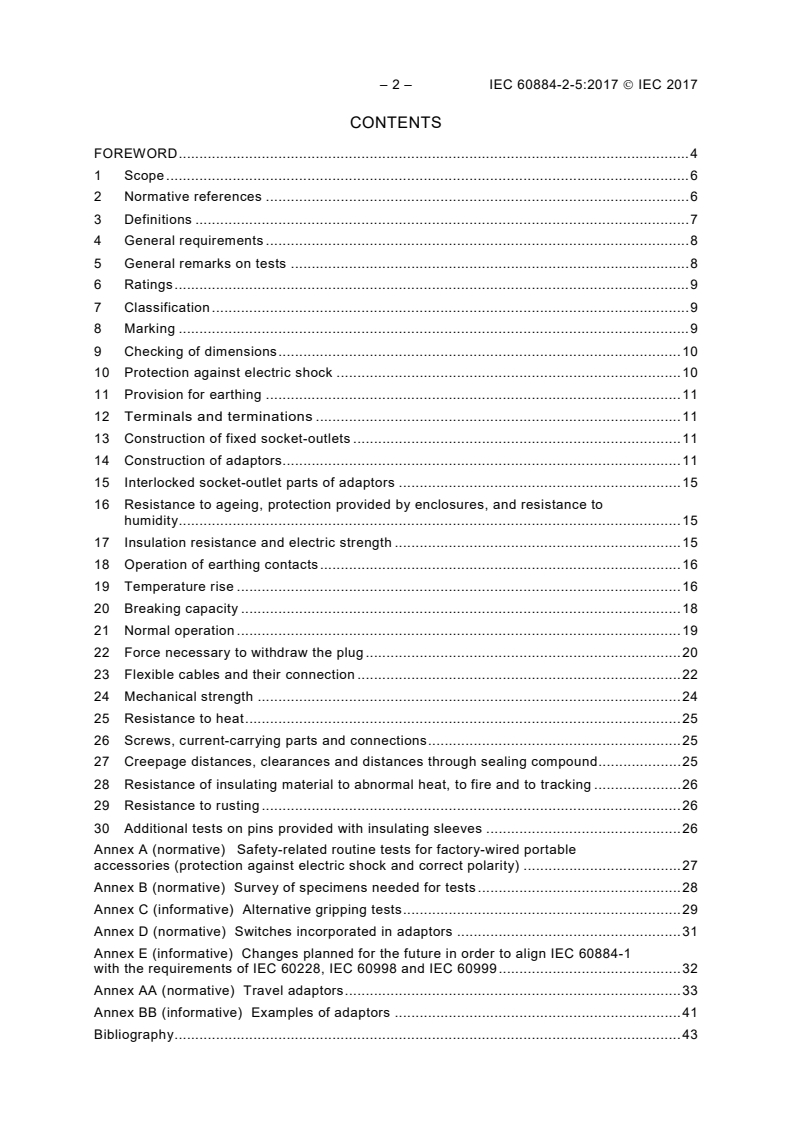
IEC 60884-2-5:2017 applies to adaptors for a.c. only with or without earthing contact, with a rated voltage greater than 50 V but not exceeding 440 V and a rated current not exceeding 32 A, intended for household and similar purposes, either indoors or outdoors.
This document also applies to travel adaptors (see Annex AA). For travel adaptors the scope is limited to a voltage rating greater than 50 V but not exceeding 250 V and to a current rating not exceeding 20 A.
Travel adaptors allowing the simultaneous connection of two or more plugs are not covered by this document.
This second edition cancels and replaces the first edition published in 1995. This edition constitutes a technical revision.
This edition includes the following significant technical changes with respect to the previous edition:
a) a general alignment with IEC 60884-1:2002, Amendment 1:2006 and Amendment 2:2013;
b) new and modified definitions;
c) requirements for travel adaptors, for adaptors with additional functions and for adaptors with a cable outlet;
d) requirements for adaptors with incorporated overcurrent protective devices;
e) requirement to warn against inserting an adaptor into another adaptor;
f) new requirements for the construction and shape of the adaptors.
- Status
- Published
- Publication Date
- 10-May-2017
- Technical Committee
- SC 23B - Plugs, socket-outlets and switches
- Drafting Committee
- MT 9 - TC 23/SC 23B/MT 9
- Current Stage
- PPUB - Publication issued
- Start Date
- 11-May-2017
- Completion Date
- 12-May-2017
Buy Documents
IEC 60884-2-5:2017 - Plugs and socket-outlets for household and similar purposes - Part 2-5: Particular requirements for adaptors Released:5/11/2017
IEC 60884-2-5:2017 - Plugs and socket-outlets for household and similar purposes - Part 2-5: Particular requirements for adaptors Released:7/5/2018
Overview
IEC 60884-2-5:2017 - "Plugs and socket-outlets for household and similar purposes - Part 2-5: Particular requirements for adaptors" is the IEC technical specification that sets safety, construction and testing requirements for portable adaptors used with AC supply. It applies to adaptors with or without earthing, rated for voltages >50 V up to 440 V and currents up to 32 A for household and similar purposes (indoor/outdoor). Travel adaptors are included under Annex AA with a limited scope (≤250 V and ≤20 A). Multi-plug travel adaptors that allow simultaneous connection of two or more plugs are excluded.
Key topics and technical requirements
- Scope and ratings: Defined rated voltage/current limits and ambient temperature conditions (suitable for environments not normally exceeding +40 °C; 24 h average ≤ +35 °C; lower limit −5 °C).
- Construction and shape: New requirements for adaptor geometry to improve safety and compatibility with sockets and plugs.
- Protection against electric shock: Requirements for insulation, shutters (national variations noted), earthing provisions and marking to avoid incorrect insertion or hazardous contact.
- Travel adaptors: Specific rules in Annex AA including voltage/current limits and exclusions (no multi-plug travel adaptors).
- Adaptors with additional functions: Requirements for adaptors that include extra electronics (timers, dimmers, power supplies) or cable outlets - the additional function itself is not covered by this standard.
- Fused and overcurrent-protected adaptors: Rules for adaptors incorporating replaceable fuses or overcurrent protective devices (references include IEC 60127 and IEC 60269 series).
- Testing and performance: Provisions for temperature-rise, insulation resistance, mechanical strength, resistance to heat/humidity/ageing, terminal/connection integrity and withdrawal force.
- Warnings and labeling: Mandatory warnings such as against inserting an adaptor into another adaptor, plus marking and polarity requirements.
- Alignment and definitions: Edition 2 aligns content and terminology with IEC 60884-1 and includes revised/added definitions.
Practical applications and users
Who uses IEC 60884-2-5:2017:
- Manufacturers and product designers of portable adaptors, travel adaptors and fused adaptors
- Test laboratories and conformity assessment bodies performing safety and type testing
- Certification bodies and market surveillance authorities verifying compliance
- Procurement teams and facility managers selecting safe adaptors for household, commercial and outdoor use
Typical uses:
- Designing compliant adaptors (earthing, dimensions, fuse incorporation)
- Preparing technical files and test reports for certification
- Ensuring safe travel adaptor products meet national and international safety expectations
Related standards
- IEC 60884-1 (General requirements for plugs and socket-outlets) - Part 2-5 supplements/modifies Part 1
- IEC 60127 series (miniature fuses)
- IEC 60269-3 (low-voltage fuses for household use)
- Note: The standard excludes adaptors that incorporate IEC 60320 connectors.
Keywords: IEC 60884-2-5:2017, adaptors, travel adaptors, fused adaptors, plugs and socket-outlets, electrical safety, earthing, overcurrent protection, IEC 60884-1.
Buy Documents
IEC 60884-2-5:2017 - Plugs and socket-outlets for household and similar purposes - Part 2-5: Particular requirements for adaptors Released:5/11/2017
IEC 60884-2-5:2017 - Plugs and socket-outlets for household and similar purposes - Part 2-5: Particular requirements for adaptors Released:7/5/2018
Get Certified
Connect with accredited certification bodies for this standard

IMQ S.p.A. (Certification)
Italian electrical product certification.

SLG Prüf- und Zertifizierungs GmbH
German testing and certification body.

UL Solutions
Global safety science company with testing, inspection and certification.
Sponsored listings
Frequently Asked Questions
IEC 60884-2-5:2017 is a standard published by the International Electrotechnical Commission (IEC). Its full title is "Plugs and socket-outlets for household and similar purposes - Part 2-5: Particular requirements for adaptors". This standard covers: IEC 60884-2-5:2017 applies to adaptors for a.c. only with or without earthing contact, with a rated voltage greater than 50 V but not exceeding 440 V and a rated current not exceeding 32 A, intended for household and similar purposes, either indoors or outdoors. This document also applies to travel adaptors (see Annex AA). For travel adaptors the scope is limited to a voltage rating greater than 50 V but not exceeding 250 V and to a current rating not exceeding 20 A. Travel adaptors allowing the simultaneous connection of two or more plugs are not covered by this document. This second edition cancels and replaces the first edition published in 1995. This edition constitutes a technical revision. This edition includes the following significant technical changes with respect to the previous edition: a) a general alignment with IEC 60884-1:2002, Amendment 1:2006 and Amendment 2:2013; b) new and modified definitions; c) requirements for travel adaptors, for adaptors with additional functions and for adaptors with a cable outlet; d) requirements for adaptors with incorporated overcurrent protective devices; e) requirement to warn against inserting an adaptor into another adaptor; f) new requirements for the construction and shape of the adaptors.
IEC 60884-2-5:2017 applies to adaptors for a.c. only with or without earthing contact, with a rated voltage greater than 50 V but not exceeding 440 V and a rated current not exceeding 32 A, intended for household and similar purposes, either indoors or outdoors. This document also applies to travel adaptors (see Annex AA). For travel adaptors the scope is limited to a voltage rating greater than 50 V but not exceeding 250 V and to a current rating not exceeding 20 A. Travel adaptors allowing the simultaneous connection of two or more plugs are not covered by this document. This second edition cancels and replaces the first edition published in 1995. This edition constitutes a technical revision. This edition includes the following significant technical changes with respect to the previous edition: a) a general alignment with IEC 60884-1:2002, Amendment 1:2006 and Amendment 2:2013; b) new and modified definitions; c) requirements for travel adaptors, for adaptors with additional functions and for adaptors with a cable outlet; d) requirements for adaptors with incorporated overcurrent protective devices; e) requirement to warn against inserting an adaptor into another adaptor; f) new requirements for the construction and shape of the adaptors.
IEC 60884-2-5:2017 is classified under the following ICS (International Classification for Standards) categories: 29.120.30 - Plugs, socket-outlets, couplers. The ICS classification helps identify the subject area and facilitates finding related standards.
IEC 60884-2-5:2017 is available in PDF format for immediate download after purchase. The document can be added to your cart and obtained through the secure checkout process. Digital delivery ensures instant access to the complete standard document.
Standards Content (Sample)
IEC 60884-2-5 ®
Edition 2.0 2017-05
INTERNATIONAL
STANDARD
Plugs and socket-outlets for household and similar purposes –
Part 2-5: Particular requirements for adaptors
All rights reserved. Unless otherwise specified, no part of this publication may be reproduced or utilized in any form
or by any means, electronic or mechanical, including photocopying and microfilm, without permission in writing from
either IEC or IEC's member National Committee in the country of the requester. If you have any questions about IEC
copyright or have an enquiry about obtaining additional rights to this publication, please contact the address below or
your local IEC member National Committee for further information.
IEC Central Office Tel.: +41 22 919 02 11
3, rue de Varembé Fax: +41 22 919 03 00
CH-1211 Geneva 20 info@iec.ch
Switzerland www.iec.ch
About the IEC
The International Electrotechnical Commission (IEC) is the leading global organization that prepares and publishes
International Standards for all electrical, electronic and related technologies.
About IEC publications
The technical content of IEC publications is kept under constant review by the IEC. Please make sure that you have the
latest edition, a corrigenda or an amendment might have been published.
IEC Catalogue - webstore.iec.ch/catalogue Electropedia - www.electropedia.org
The stand-alone application for consulting the entire The world's leading online dictionary of electronic and
bibliographical information on IEC International Standards, electrical terms containing 20 000 terms and definitions in
Technical Specifications, Technical Reports and other English and French, with equivalent terms in 16 additional
documents. Available for PC, Mac OS, Android Tablets and languages. Also known as the International Electrotechnical
iPad. Vocabulary (IEV) online.
IEC publications search - www.iec.ch/searchpub IEC Glossary - std.iec.ch/glossary
The advanced search enables to find IEC publications by a 65 000 electrotechnical terminology entries in English and
variety of criteria (reference number, text, technical French extracted from the Terms and Definitions clause of
committee,…). It also gives information on projects, replaced IEC publications issued since 2002. Some entries have been
and withdrawn publications. collected from earlier publications of IEC TC 37, 77, 86 and
CISPR.
IEC Just Published - webstore.iec.ch/justpublished
Stay up to date on all new IEC publications. Just Published IEC Customer Service Centre - webstore.iec.ch/csc
details all new publications released. Available online and If you wish to give us your feedback on this publication or
also once a month by email. need further assistance, please contact the Customer Service
Centre: csc@iec.ch.
IEC 60884-2-5 ®
Edition 2.0 2017-05
INTERNATIONAL
STANDARD
Plugs and socket-outlets for household and similar purposes –
Part 2-5: Particular requirements for adaptors
INTERNATIONAL
ELECTROTECHNICAL
COMMISSION
ICS 29.120.30 ISBN 978-2-8322-4275-9
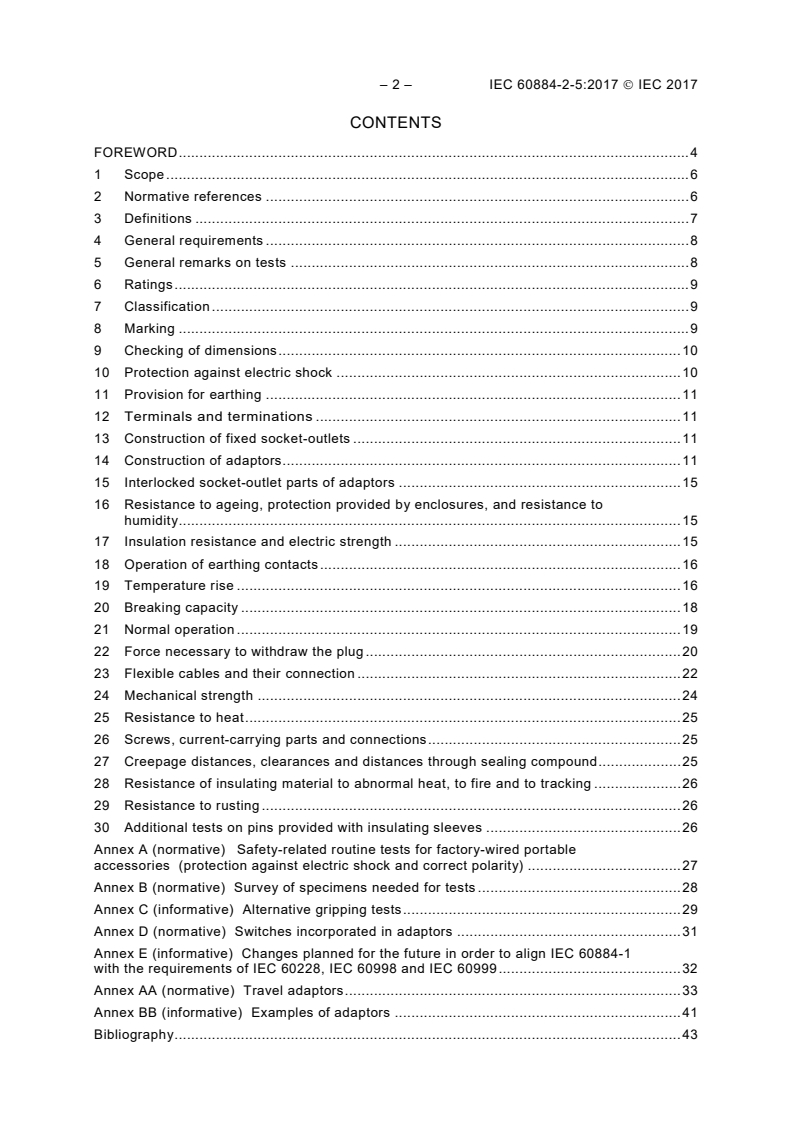
– 2 – IEC 60884-2-5:2017 IEC 2017
CONTENTS
FOREWORD . 4
1 Scope . 6
2 Normative references . 6
3 Definitions . 7
4 General requirements . 8
5 General remarks on tests . 8
6 Ratings . 9
7 Classification . 9
8 Marking . 9
9 Checking of dimensions . 10
10 Protection against electric shock . 10
11 Provision for earthing . 11
12 Terminals and terminations . 11
13 Construction of fixed socket-outlets . 11
14 Construction of adaptors . 11
15 Interlocked socket-outlet parts of adaptors . 15
16 Resistance to ageing, protection provided by enclosures, and resistance to
humidity . 15
17 Insulation resistance and electric strength . 15
18 Operation of earthing contacts . 16
19 Temperature rise . 16
20 Breaking capacity . 18
21 Normal operation . 19
22 Force necessary to withdraw the plug . 20
23 Flexible cables and their connection . 22
24 Mechanical strength . 24
25 Resistance to heat . 25
26 Screws, current-carrying parts and connections . 25
27 Creepage distances, clearances and distances through sealing compound . 25
28 Resistance of insulating material to abnormal heat, to fire and to tracking . 26
29 Resistance to rusting . 26
30 Additional tests on pins provided with insulating sleeves . 26
Annex A (normative) Safety-related routine tests for factory-wired portable
accessories (protection against electric shock and correct polarity) . 27
Annex B (normative) Survey of specimens needed for tests . 28
Annex C (informative) Alternative gripping tests . 29
Annex D (normative) Switches incorporated in adaptors . 31
Annex E (informative) Changes planned for the future in order to align IEC 60884-1
with the requirements of IEC 60228, IEC 60998 and IEC 60999 . 32
Annex AA (normative) Travel adaptors . 33
Annex BB (informative) Examples of adaptors . 41
Bibliography . 43
Figure AA.1 – World plug types . 35
Table 101 – Nominal cross-sectional areas of flexible copper conductors for the
temperature-rise test . 17
Table 16 – Maximum and minimum withdrawal force for plug and socket-outlet parts of
adaptors . 22
– 4 – IEC 60884-2-5:2017 IEC 2017
INTERNATIONAL ELECTROTECHNICAL COMMISSION
____________
PLUGS AND SOCKET-OUTLETS
FOR HOUSEHOLD AND SIMILAR PURPOSES –
Part 2-5: Particular requirements for adaptors
FOREWORD
1) The International Electrotechnical Commission (IEC) is a worldwide organization for standardization comprising
all national electrotechnical committees (IEC National Committees). The object of IEC is to promote
international co-operation on all questions concerning standardization in the electrical and electronic fields. To
this end and in addition to other activities, IEC publishes International Standards, Technical Specifications,
Technical Reports, Publicly Available Specifications (PAS) and Guides (hereafter referred to as “IEC
Publication(s)”). Their preparation is entrusted to technical committees; any IEC National Committee interested
in the subject dealt with may participate in this preparatory work. International, governmental and non-
governmental organizations liaising with the IEC also participate in this preparation. IEC collaborates closely
with the International Organization for Standardization (ISO) in accordance with conditions determined by
agreement between the two organizations.
2) The formal decisions or agreements of IEC on technical matters express, as nearly as possible, an international
consensus of opinion on the relevant subjects since each technical committee has representation from all
interested IEC National Committees.
3) IEC Publications have the form of recommendations for international use and are accepted by IEC National
Committees in that sense. While all reasonable efforts are made to ensure that the technical content of IEC
Publications is accurate, IEC cannot be held responsible for the way in which they are used or for any
misinterpretation by any end user.
4) In order to promote international uniformity, IEC National Committees undertake to apply IEC Publications
transparently to the maximum extent possible in their national and regional publications. Any divergence
between any IEC Publication and the corresponding national or regional publication shall be clearly indicated in
the latter.
5) IEC itself does not provide any attestation of conformity. Independent certification bodies provide conformity
assessment services and, in some areas, access to IEC marks of conformity. IEC is not responsible for any
services carried out by independent certification bodies.
6) All users should ensure that they have the latest edition of this publication.
7) No liability shall attach to IEC or its directors, employees, servants or agents including individual experts and
members of its technical committees and IEC National Committees for any personal injury, property damage or
other damage of any nature whatsoever, whether direct or indirect, or for costs (including legal fees) and
expenses arising out of the publication, use of, or reliance upon, this IEC Publication or any other IEC
Publications.
8) Attention is drawn to the Normative references cited in this publication. Use of the referenced publications is
indispensable for the correct application of this publication.
9) Attention is drawn to the possibility that some of the elements of this IEC Publication may be the subject of
patent rights. IEC shall not be held responsible for identifying any or all such patent rights.
International Standard IEC 60884-2-5 has been prepared by subcommittee 23B: Plugs,
socket-outlets and switches, of IEC technical committee 23: Electrical accessories.
This second edition cancels and replaces the first edition published in 1995. This edition
constitutes a technical revision.
This edition includes the following significant technical changes with respect to the previous
edition:
a) a general alignment with IEC 60884-1:2002, Amendment 1:2006 and Amendment 2:2013;
b) new and modified definitions;
c) requirements for travel adaptors, for adaptors with additional functions and for adaptors
with a cable outlet;
d) requirements for adaptors with incorporated overcurrent protective devices;
e) requirement to warn against inserting an adaptor into another adaptor;
f) new requirements for the construction and shape of the adaptors.
The text of this International Standard is based on the following documents:
FDIS Report on voting
23B/1242/FDIS 23B/1246/RVD
Full information on the voting for the approval of this International Standard can be found in
the report on voting indicated in the above table.
This document has been drafted in accordance with the ISO/IEC Directives, Part 2.
This Part 2-5 shall be used in conjunction with IEC 60884-1. It was established on the basis of
the third edition of IEC 60884-1 (2002) and of its Amendments 1 (2006) and 2 (2013).
This Part 2-5 supplements or modifies the corresponding clauses in IEC 60884-1, so as to
convert that publication into the IEC Standard: Particular requirements for adaptors.
Where this Part 2-5 states "addition“, "modification“ or "replacement“, the relevant
requirement, test specifications or explanatory matter in Part 1 shall be adapted accordingly.
Subclauses, figures, tables or notes which are additional to those in Part 1 are numbered
starting from 101. Additional annexes are lettered starting from AA.
A list of all parts in the IEC 60884 series, published under the general title Plugs and socket-
outlets for household and similar purposes, can be found on the IEC website.
The committee has decided that the contents of this document will remain unchanged until the
stability date indicated on the IEC website under "http://webstore.iec.ch" in the data related to
the specific document. at this date, the document will be
• reconfirmed,
• withdrawn,
• replaced by a revised edition, or
• amended.
A bilingual version of this publication may be issued at a later date.
– 6 – IEC 60884-2-5:2017 IEC 2017
PLUGS AND SOCKET-OUTLETS
FOR HOUSEHOLD AND SIMILAR PURPOSES –
Part 2-5: Particular requirements for adaptors
1 Scope
Replacement:
This part of IEC 60884 applies to adaptors for a.c. only with or without earthing contact, with a
rated voltage greater than 50 V but not exceeding 440 V and a rated current not exceeding
32 A, intended for household and similar purposes, either indoors or outdoors.
This document also applies to travel adaptors (see Annex AA). For travel adaptors the scope
is limited to a voltage rating greater than 50 V but not exceeding 250 V and to a current rating
not exceeding 20 A.
Travel adaptors allowing the simultaneous connection of two or more plugs are not covered
by this document.
NOTE 1 In the following countries the use of non-shuttered adaptors is not allowed: BE, CN, DK, ES, FR, IT, NO,
MY, PT, SE, SG, UK, ZA.
NOTE 2 In the following countries adaptors having IP classes below IPX4 shall be provided with shutters: FI.
NOTE 3 In the following countries fused adaptors are not allowed: ZA.
NOTE 4 In the following countries rewirable external flexible cables connected to adaptors are not allowed: ZA.
NOTE 5 In the following countries, travel adaptors shall not be used for charging electrical vehicles: CH, SE.
This document covers the requirements for adaptors with additional functions, however the
additional function itself is not covered by this standard.
NOTE 6 Examples of additional functions are electronic power supply units, dimmers, timers, protection devices,
infrared switches.
This document does not apply to adaptors incorporating connectors according to IEC 60320
(all parts).
Adaptors complying with this document are suitable for use at ambient temperatures not
normally exceeding +40 °C, but their average over a period of 24 h does not exceed +35 °C,
with a lower limit of the ambient air temperature of –5 °C.
NOTE 7 Tests for temperatures below normal range are under consideration.
2 Normative references
This clause of Part 1 is applicable except as follows:
Addition:
IEC 60127-2, Miniature fuses – Part 2: Cartridge fuse-links
IEC 60127-3, Miniature fuses – Part 3: Sub-miniature fuse-links
IEC 60269-3, Low-voltage fuses – Part 3: Supplementary requirements for fuses for use by
unskilled persons (fuses mainly for household or similar applications) – Examples of
standardized systems of fuses A to F
IEC 60884-1:2002, Plugs and socket-outlets for household and similar purposes – Part 1:
General requirements
IEC 60884-1:2002/AMD1:2006
IEC 60884-1:2002/AMD 2:2013
3 Definitions
This clause of Part 1 is applicable except as follows:
Replacement of NOTE 3:
NOTE 3 The term "accessory" is used as a general term covering plugs, socket-outlets and adaptors; the term
"portable accessory" covers plugs, portable socket-outlets and adaptors.
Addition:
NOTE 101 The term "adaptor" is used as a general term covering all types of adaptors except where reference
is made to one particular type.
3.25 Replacement:
rated voltage
value of voltage assigned to the accessory by the manufacturer
3.26 Replacement:
rated current
value of current assigned to the accessory by the manufacturer
Addition:
3.101
adaptor
portable accessory constructed as an integral unit incorporating one plug part and one or
more socket-outlet parts, with or without integrated additional functions, allowing the
connection of one or more plugs to a socket-outlet, both the socket-outlet and the plugs
belonging to the same national system
Note 1 to entry: Examples of national systems are listed in IEC TR 60083.
3.102
fused adaptor
adaptor incorporating a replaceable fuse link in one or more current-carrying poles
Note 1 to entry: Fuses of fused adaptors are not intended to protect appliances or parts of them against overload.
3.103
polarized adaptor
adaptor constructed so that, when inserted in a socket-outlet installed in a polarized wiring
installation, the correct relationship between the neutral and the line pole or poles is
maintained
3.104
single-way adaptor
adaptor with one socket-outlet part allowing the connection of one plug
– 8 – IEC 60884-2-5:2017 IEC 2017
3.105
multi-way adaptor
adaptor with more than one socket-outlet part allowing the simultaneous connection of two or
more plugs
3.106
travel adaptor
portable accessory, intended for temporary use, allowing the connection of one or more plug
type(s) of different national systems to a socket-outlet that is not designed to accept such
plugs
Note 1 to entry: A travel adaptor is not necessarily an integral unit and it can include integrated additional
functions.
Note 2 to entry: Examples of national systems are listed in IEC TR 60083.
3.107
travel adaptor with movable pins
travel adaptor where plug pins may slide in and out, rotate or fold in any direction, so that
they are not permanently fixed but have means to be locked in position for normal use
3.108
intermediate adaptor
adaptor allowing the connection of one or more plugs to a socket-outlet via a control device
such as a dimmer, photo-electric switch, etc., which is connected to the adaptor by an
external flexible cable
3.109
rewirable intermediate adaptor
intermediate adaptor constructed in such a way that the external flexible cable can be
replaced
3.110
non-rewirable intermediate adaptor
intermediate adaptor constructed in such a way that it forms a complete unit with the external
flexible cable after connection and assembly by the manufacturer of the adaptor
Note 1 to entry: See also 14.1.
3.111
adaptor with cable outlet
adaptor which may be rewirable or non-rewirable, and constructed in such a way that it allows
the connection of an external flexible cable through a cable outlet
3.112
rated power
power value assigned to the accessory by the manufacturer
4 General requirements
This clause of Part 1 is applicable.
5 General remarks on tests
This clause of Part 1 is applicable except as follows:
Addition:
For the purposes of the tests, unless otherwise specified, the word “adaptors” covers all
adaptors including fused adaptors, polarized adaptors, single-way adaptors, multi-way
adaptors, intermediate adaptors, adaptors with cable outlet and travel adaptors.
6 Ratings
This clause of Part 1 is applicable except as follows:
Addition:
6.101 The rated voltage of the adaptor shall not be lower than the nominal voltage of the
supply system to which it can be connected via a socket-outlet.
NOTE Nominal voltages are defined in IEC 60038.
6.102 The rated current of the adaptor shall be the lowest value of the following:
– the rated current of the plug part; or
– the arithmetic sum of the highest rated currents of all plugs which can be simultaneously
inserted into the adaptor; or
– the rated current of the incorporated overcurrent protective device, if any.
6.103 When assigned, the rated power of the adaptor shall be calculated by multiplying the
rated current (as determined in 6.102) and the rated voltage (as determined in 6.101) at a
power factor equal to 1.
Compliance with the requirements of 6.101 to 6.103 is checked by inspection of the marking.
7 Classification
This clause of Part 1 is applicable.
8 Marking
This clause of Part 1 is applicable except as follows:
8.1 Replacement of the first dashed item:
– rated current in amperes or rated power in watts, or both;
Addition at the end of the subclause:
The marking for the rated power, if any, shall be completed by the word MAX.
NOTE 101 These markings can be shown as in the examples: MAX 2 000 W or 2 000 W MAX.
The rated power and/or rated current marking shall be easily discernible until the last plug
is connected.
NOTE 102 In the following country, marking of the rated power in watts, visible when the adaptor is in use, is
mandatory: FR.
Fused adaptors shall be marked to indicate the presence of a fuse within the adaptor and this
marking may be in the form of a symbol.
– 10 – IEC 60884-2-5:2017 IEC 2017
Fused adaptors shall be marked with the rated current and type of fuse on the fuse-holder or
in the proximity of the fuse.
An instruction, which may be a symbol or a sentence, warning against inserting an adaptor
into another adaptor shall be provided by the manufacturer:
– on the adaptor, or
– on the smallest package unit, or
– on the instruction sheet accompanying the adaptor.
NOTE 103 A standardized symbol and/or sentence can be defined by the National Committees.
8.2 Addition before NOTE 1:
Watts . W
Fuse .
(see IEC 60417-5016:2002-10)
9 Checking of dimensions
This clause of Part 1 is applicable.
10 Protection against electric shock
This clause of Part 1 is applicable except as follows:
10.1 Replacement of the second paragraph and NOTE:
Live parts shall not be accessible when the plug part of an adaptor is in partial or
complete engagement with a socket-outlet of the same system.
NOTE In the following countries this requirement does not apply when the plug part of the adaptor is partially
engaged: CA, DK, JP, US.
Replacement of the fifth paragraph:
For adaptors, the test finger is applied in every possible position when the adaptor is in partial
or complete engagement with a socket-outlet of the same system.
10.3 Replacement of the first paragraph:
It shall not be possible to make contact between a pin of a plug and a live socket contact of
an adaptor or between a pin of an adaptor and a live socket contact of a socket-outlet, of
the same system, whilst any other current-carrying pin is accessible.
10.4 Replacement of the first paragraph:
External parts of plugs, with the exception of assembly screws and the like, current-carrying
and earthing pins, earthing straps and metal rings around pins and accessible metal parts
fulfilling the requirements of 10.2.1 or 10.2.2 of IEC 60884-1:2002, IEC 60884-
1:2002/AMD1:2006 and IEC 60884-1:2002/AMD2:2013 , shall be of insulating material.
10.5 Replacement of the first paragraph:
Shuttered socket-outlet parts of adaptors shall, in addition, be constructed in such a way
that live parts are not accessible without a plug in engagement, when checked with the
gauges shown in Figures 9 and 10
Addition:
10.101 Removal of the fuse and/or fuse carrier shall not result in live parts becoming
accessible when the adaptor is in full engagement with a socket-outlet.
Compliance is checked by inspection and, in case of doubt, by applying test probe 13
according to IEC 61032 with a force not exceeding 5 N when the fuse and/or fuse carrier are
not in position as in normal use and with the adaptor in full engagement with a socket-outlet.
The test probe shall not touch live parts.
11 Provision for earthing
This clause of Part 1 is applicable.
12 Terminals and terminations
This clause of Part 1 is applicable except as follows:
12.1.1 Replacement of the second paragraph:
Adaptors with a cable outlet and rewirable intermediate adaptors shall be provided with
terminals with screw clamping.
13 Construction of fixed socket-outlets
This clause of Part 1 is not applicable.
14 Construction of plugs and portable socket-outlets
This clause of Part 1 is applicable except as follows:
Replacement of the title:
14 Construction of adaptors
14.1 Replacement:
Adaptors shall be constructed in such a way that they cannot be opened by hand or by using
a general purpose tool, for example a screwdriver used as such, without making it
permanently useless.
Exception is made for adaptors with a cable outlet and rewirable intermediate adaptors, where
they shall be constructed in such a way that they can be opened using a general purpose tool,
for example a screwdriver used as such.
Compliance is checked by inspection.
NOTE 1 An adaptor is considered permanently useless, when, while re-assembling the adaptor, parts or
materials other than the original are used.
– 12 – IEC 60884-2-5:2017 IEC 2017
NOTE 2 In the following country multiway adaptors shall be so designed and constructed that it is not possible to
create additional outputs when plugging two or more multiway adaptors into each other: BE.
NOTE 3 In the following country rewirable adaptors are not allowed: ZA.
14.2 Replacement of the first paragraph:
Pins of adaptors shall have adequate mechanical strength.
14.3 Replacement of the first and second paragraphs:
Pins of adaptors shall be:
– locked against rotation, except where rotation is not likely to impair safety or function;
– impossible to remove without dismantling the adaptor;
– adequately fixed in the body of the adaptor when the adaptor is wired and assembled as
for normal use.
It shall not be possible to arrange the pins or contacts of adaptors in an incorrect position.
14.4 Replacement of the first paragraph:
Earthing contacts, phase contacts and neutral contacts of adaptors shall, when in use, be
locked against rotation and removable only with the aid of a tool, after dismantling the
adaptor.
14.11 Replacement of the first line of the first paragraph:
For adaptors with a cable outlet and rewirable intermediate adaptors:
14.13 Replacement:
bushes
If covers of adaptors are provided with bushes for entry holes for the pins, these
shall not become detached inadvertently from the inside when the cover is removed.
Compliance is checked by inspection.
14.15 Replacement of the first paragraph:
The engagement face of the plug part of adaptors shall have no projections other than the
pins, when the adaptor is wired and assembled as for normal use.
14.16 Replacement of the first paragraph:
The socket-outlet parts of adaptors shall be designed in such a way that full engagement of
associated plugs is not prevented by any projection from their engagement face.
14.23 Replacement:
Adaptors shall not impose undue strain on fixed socket-outlets.
Compliance is checked by the following test.
The adaptor is inserted into a fixed socket-outlet complying with Part 1.
Each socket-outlet part is first fitted with a relevant plug completed with 1 m of 0,75 mm
circular flexible cable of 60227 lEC 53 type.
The number of conductors shall be the same as that of the poles of the relevant plug.
The socket-outlet is pivoted about a horizontal axis through the axis of the live socket
contacts at a distance of 8 mm behind the engagement face of the socket-outlet and parallel
to this engagement face.
The additional torque which has to be applied to the socket-outlet in order to maintain the
engagement face in the vertical plane shall not exceed 0,25 Nm.
During the test, care shall be taken that the flexible cable(s) hang(s) freely.
NOTE In the following countries a torque value of 0,5 Nm is allowed: CH, SE.
Addition:
14.23.101 Adaptors shall withstand the lateral strain imposed by equipment likely to be
introduced into them.
Compliance is checked by the following test using the device shown in Figure 13.
The specimen is mounted on a vertical surface with, initially, the plane through the live socket
contacts horizontal. The face to be tested shall be in a vertical position and parallel to the
vertical mounting surface.
The device is then fully-engaged, and a force of 5 N is applied in a vertically downward
direction.
The device is removed after 1 min and the adaptor is turned 90° on the mounting surface. The
test is made four times, the adaptor being turned 90° after each engagement. During the test
the device shall not come out. The test is repeated for each socket-outlet part of the adaptor.
After the test, the adaptor shall show no damage within the context of this document, in
particular it shall comply with the requirements of Clause 22.
14.24 Replacement:
Adaptors shall be shaped in such a way and/or made of such a material that they can be
easily withdrawn by hand from the relevant socket-outlet.
In addition, the gripping surfaces shall be designed in such a way that the adaptor can be
withdrawn without having to pull the flexible cable, if any.
Compliance is checked by inspection and in case of doubt by test.
NOTE Examples of possible tests are given in Annex C and by replacing the word “plug” by “adaptor”.
14.25 This subclause of Part 1 is not applicable.
Addition:
14.101 The plug part of adaptors shall be provided with earthing pins or contacts if any one
of the socket-outlet parts is provided with an earthing pin or contact.
– 14 – IEC 60884-2-5:2017 IEC 2017
An adaptor allowing the connection between a socket-outlet with earthing contact and a plug
without earthing contact for class zero equipment is not permitted.
Compliance is checked by inspection and by the test of 11.5.
14.102 Adaptors for use in polarized socket-outlets shall be designed in such a way that the
internal connection shall ensure that plug pins, socket-contacts and terminals, if any, maintain
the same polarity at the input and output parts of the adaptor.
Compliance is checked by inspection and if necessary by an electrical continuity test.
14.103 If the insulation of an external flexible cable is not equivalent at least to that of
cables according to the relevant IEC standard, and it does not comply with the electric
strength test carried out between the cable and a metallic sheet wrapped around the
insulation according to the specifications of 17.2, the cable shall be considered as a bare
conductor.
14.104 Provision shall be made within the body of a fused adaptor for suitable fuse-link
complying with IEC 60269-3, IEC 60127-2 or IEC 60127-3 as far as they reasonably apply.
The fuse-link shall be connected between an adaptor plug pin and the corresponding socket
contact(s).
In polarized systems the fuse-link shall be mounted between the line plug pin and the
corresponding line socket contact(s).
Fuse-links shall not be fitted in the earthing circuit.
The design of the adaptor shall be such that the fuse-link cannot be left in inadequate contact
when the adaptor is assembled.
Compliance is checked by inspection.
14.105 Adaptors having a plug part standardized with a rated current of 2,5 A shall be
provided with an overcurrent protective device rated 2,5 A or less.
NOTE Examples of a plug part standardized with a rated current of 2,5 A are provided in EN 50075.
Compliance is checked by inspection.
14.106 Adaptors shall not have an enclosure that is shaped or decorated like a toy.
NOTE Examples of such enclosures are those representing animals, characters, persons or scale models.
Compliance is checked by inspection.
14.107 Adaptors shall not have any socket-outlet part which permits the insertion of a plug
with a higher current rating than the rated current of the plug part of the adaptor, unless the
adaptor is provided with an overcurrent protective device rated less than or equal to the rated
current of the plug part.
NOTE In the following country different rules may apply: IT.
Compliance is checked by inspection.
15 Interlocked socket-outlets
This clause of Part 1 is applicable except as follows:
Replacement of the title:
15 Interlocked socket-outlet parts of adaptors
Replacement of the first paragraph:
Socket-outlet parts of adaptors interlocked with a switch shall be constructed in such a way
that a plug cannot be inserted or completely withdrawn from the adaptor while the socket-
contacts are live, and the socket-contacts of the adaptor cannot be made live until a plug is
almost completely in engagement.
16 Resistance to ageing, protection provided by enclosures, and resistance to
humidity
This clause of Part 1 is applicable except as follows:
16.1 Resistance to ageing
Replacement of the seventh, eighth and ninth paragraphs:
For adaptors, the plug of the same national system shall be inserted into each socket-outlet
part during the test. A plug available in the market can be suitably modified if necessary to
allow the closure of the lid, if any.
Within a national system, the plug which is deemed to give the most severe condition shall be
used for the test where more than one plug type can be inserted in the socket-outlet part.
NOTE 101 The national systems are listed in IEC TR 60083.
For adaptors, after having withdrawn the test plug from the socket-outlet part, the contact
pressure of the contact assembly is checked as specified in 22.2 with the single-pin gauge.
The gauge shall not fall from the contact assembly within 30 s.
17 Insulation resistance and electric strength
This clause of Part 1 is applicable except as follows:
17.1.1 Replacement:
For adaptors the insulation resistance is measured consecutively:
a) between all poles connected together and a metal foil in contact with the outer surface of
accessible external parts of insulating material including external assembly screws, the
measurements being made with plug(s) in engagement;
b) between each pole in turn, and all others, these being connected together to a metal foil in
contact with the outer surface of accessible external parts of insulating material including
external assembly screws with plug(s) in engagement;
c) for adaptors with cable outlet and rewirable intermediate adaptors, between any metal
part of any cable anchorage, including clamping screws, and the earthing pin or terminal,
if any;
– 16 – IEC 60884-2-5:2017 IEC 2017
d) for adaptors with cable outlet and rewirable intermediate adaptors, between any metal
part of the cable anchorage and a metal rod of the maximum diameter of the flexible cable
inserted in its place (see Table 17).
Incorporated components connected in parallel to the line contacts shall be disconnected. For
this test, if required, the specimens shall be prepared by the manufacturer.
While the metal foil is wrapped round the outer surface or placed in contact with the inner
surface of parts of insulating material, it is pressed against holes or grooves without any
appreciable force by means of test probe 11 of IEC 61032.
17.1.2 This subclause of Part 1 is not applicable.
18 Operation of earthing contacts
This clause of Part 1 is applicable.
19 Temperature rise
Replacement:
Adaptors shall be constructed in such a way that they comply with the following temperature
rise test.
All adaptors are tested according to 19.101 and adaptors with incorporated components are
additionally tested according to 19.102.
For the test of 19.101, if required, the specimens shall be prepared by the manufacturer.
19.101 Adaptors shall be tested in a draught-free environment at the centre of a plane
wooden sheet which shall be at least 20 mm thick, 500 mm wide and 500 mm high.
Socket-outlet parts of adaptors are tested using a test plug with brass pins having the
minimum specified dimensions.
Clamping units having the dimensions specified in Figure 44 are fitted on each live pin and
earthing pin, if any, of the plug part of the adaptor. Each clamping unit is equipped with a
thermocouple which can be mounted either together with the pin or fixed permanently within
the dotted area of Figure 44.
If it is not possible to use the clamping unit of Figure 44 due to the design of the plug, the
clamping unit may be modified in order to perform the test.
In this case the diameter of the screw, the threaded hole and the total volume of the modified
clamping unit shall be identical to Figure 44.
The screw is then placed approximately in the middle of the bare part of the pin and tightened
with a torque of 0,8 Nm.
+5
An alternating current of the value specified below is then passed for 60 min.
Adaptors with a plug part having lateral earthing contacts or resilient earthing contacts are
tested using a fixed socket-outlet complying with the relevant national standard and having as
near to-average characteristics as can be selected, but with minimum size of the earthing pin,
if any.
In this latter case, the adaptor under test is inserted into the fixed socket-outlet and an
+5
alternating current of the value specified below is then passed for 60 min.
Adaptors with incorporated components are tested as follows:
– incorporated components connected in series to the line contacts are short circuited;
– incorporated components connected in parallel to the line contacts are disconnected.
Non-rewirable adaptors with a cable outlet and non-rewirable intermediate adaptors are tested
with the cable supplied.
Adaptors with a cable outlet and rewirable intermediate adaptors are fitted with flexible
polyvinyl chloride insulated conductors having a nominal cross-sectional area as shown in
Table 101.
Adaptors with a cable outlet are tested as multi-way adaptors, considering the cable outlet as
being a socket-outlet part.
Table 101 – Nominal cross-sectional areas of flexible copper conductors
for the temperature-rise test
Rated current Nominal cross-sectional area
A mm
Up to and including 13 1
Over 13 and up to and including 16 1,5
Over 16 4
The terminal screws or nuts are tightened with a torque equal to two-thirds of that specified in
12.2.8.
To ensure normal cooling of the terminals, the conductors connected to them shall have a
length of at least 1 m.
A test current shall be applied:
a) through each separate socket-outlet part in turn,
1) for adaptors without incorporated overcurrent protective device, the test current being
as follows:
– for I ≤10 A, test current = 1,4 I ,
n n
– for I >10 A, test current = 1,25 I ,
n n
where I is the rated current of the plug that can be inserted in the socket-outlet
n
part;
2) for adaptors with incorporated overcurrent protective device, the test current being the
conventional tripping/fusing current of the incorporated overcurrent protective device
after 1 h, but not higher than the value calculated in the first bullet;
b) through all socket-outlet parts simultaneously, when the rated current of all the plugs that
can be inserted in the socket-outlet parts are lower than the rated current of the plug part,
dividing the total test current among the socket-outlet parts in proportion to the rated
current of the plugs that can be inserted,
– 18 – IEC 60884-2-5:2017 IEC 2017
1) for multi-way adaptors without incorporated overcurrent protective device, the total test
current being as follows:
– for I ≤10 A, test current = 1,4 I ,
n n
– for I >10 A, test current = 1,25 I ,
n n
where I is the rated current of the adaptor;
n
2) for multi-way adaptors with incorporated overcurrent protective device, the total test
current being the conventional tripping/fusing current of the incorporated overcurrent
protective device after 1 h, but not higher than the value calculated in the first bullet.
In the case of non-rewirable adaptors care should be taken to minimize the influence on the
structure/design/performance of the adaptor when accessing the terminations of the adaptor.
For adaptors having three poles or more, the current during the test shall be passed through
the phase contacts, where applicable. In addition, separate tests shall be made passing the
current through the neutral contact, if any, and the adjacent phase contact and through the
earthing contact, if any, and the nearest phase contact. For the purpose of this test, earthing
contacts, irrespective of their number, are considered as one pole.
The temperature rise of the terminals, terminations and clamping units according to Figure 44
determined by means of thermocouples shall not exceed 45 K.
For the purpose of the test of 25.3, the temperature rise of external parts of insulating
material not necessary to retain current-carrying parts and parts of the earthing circuit in
position, even though they are in contact with them, shall also be determined.
19.102 In addition to the tests of 19.101, adaptors with incorporated components are tested
as in 19.101 item a) but with the incorporated components not short circuited or disconnected
and with a test current which is the lowest between the rated current of the incorporated
overcurrent protective device, if any, a
...
IEC 60884-2-5 ®
Edition 2.0 2017-05
INTERNATIONAL
STANDARD
NORME
INTERNATIONALE
Plugs and socket-outlets for household and similar purposes –
Part 2-5: Particular requirements for adaptors
Prises de courant pour usages domestiques et analogues –
Partie 2-5: Exigences particulières pour les adaptateurs
All rights reserved. Unless otherwise specified, no part of this publication may be reproduced or utilized in any form
or by any means, electronic or mechanical, including photocopying and microfilm, without permission in writing from
either IEC or IEC's member National Committee in the country of the requester. If you have any questions about IEC
copyright or have an enquiry about obtaining additional rights to this publication, please contact the address below or
your local IEC member National Committee for further information.
Droits de reproduction réservés. Sauf indication contraire, aucune partie de cette publication ne peut être reproduite
ni utilisée sous quelque forme que ce soit et par aucun procédé, électronique ou mécanique, y compris la photocopie
et les microfilms, sans l'accord écrit de l'IEC ou du Comité national de l'IEC du pays du demandeur. Si vous avez des
questions sur le copyright de l'IEC ou si vous désirez obtenir des droits supplémentaires sur cette publication, utilisez
les coordonnées ci-après ou contactez le Comité national de l'IEC de votre pays de résidence.
IEC Central Office Tel.: +41 22 919 02 11
3, rue de Varembé info@iec.ch
CH-1211 Geneva 20 www.iec.ch
Switzerland
About the IEC
The International Electrotechnical Commission (IEC) is the leading global organization that prepares and publishes
International Standards for all electrical, electronic and related technologies.
About IEC publications
The technical content of IEC publications is kept under constant review by the IEC. Please make sure that you have the
latest edition, a corrigenda or an amendment might have been published.
IEC Catalogue - webstore.iec.ch/catalogue Electropedia - www.electropedia.org
The stand-alone application for consulting the entire The world's leading online dictionary of electronic and
bibliographical information on IEC International Standards, electrical terms containing 21 000 terms and definitions in
Technical Specifications, Technical Reports and other English and French, with equivalent terms in 16 additional
documents. Available for PC, Mac OS, Android Tablets and languages. Also known as the International Electrotechnical
iPad. Vocabulary (IEV) online.
IEC publications search - webstore.iec.ch/advsearchform IEC Glossary - std.iec.ch/glossary
The advanced search enables to find IEC publications by a 67 000 electrotechnical terminology entries in English and
variety of criteria (reference number, text, technical French extracted from the Terms and Definitions clause of
committee,…). It also gives information on projects, replaced IEC publications issued since 2002. Some entries have been
and withdrawn publications. collected from earlier publications of IEC TC 37, 77, 86 and
CISPR.
IEC Just Published - webstore.iec.ch/justpublished
Stay up to date on all new IEC publications. Just Published IEC Customer Service Centre - webstore.iec.ch/csc
details all new publications released. Available online and If you wish to give us your feedback on this publication or
also once a month by email. need further assistance, please contact the Customer Service
Centre: sales@iec.ch.
A propos de l'IEC
La Commission Electrotechnique Internationale (IEC) est la première organisation mondiale qui élabore et publie des
Normes internationales pour tout ce qui a trait à l'électricité, à l'électronique et aux technologies apparentées.
A propos des publications IEC
Le contenu technique des publications IEC est constamment revu. Veuillez vous assurer que vous possédez l’édition la
plus récente, un corrigendum ou amendement peut avoir été publié.
Catalogue IEC - webstore.iec.ch/catalogue Electropedia - www.electropedia.org
Application autonome pour consulter tous les renseignements
Le premier dictionnaire en ligne de termes électroniques et
bibliographiques sur les Normes internationales,
électriques. Il contient 21 000 termes et définitions en anglais
Spécifications techniques, Rapports techniques et autres
et en français, ainsi que les termes équivalents dans 16
documents de l'IEC. Disponible pour PC, Mac OS, tablettes
langues additionnelles. Egalement appelé Vocabulaire
Android et iPad.
Electrotechnique International (IEV) en ligne.
Recherche de publications IEC -
Glossaire IEC - std.iec.ch/glossary
webstore.iec.ch/advsearchform
67 000 entrées terminologiques électrotechniques, en anglais
La recherche avancée permet de trouver des publications IEC et en français, extraites des articles Termes et Définitions des
en utilisant différents critères (numéro de référence, texte, publications IEC parues depuis 2002. Plus certaines entrées
comité d’études,…). Elle donne aussi des informations sur les antérieures extraites des publications des CE 37, 77, 86 et
projets et les publications remplacées ou retirées. CISPR de l'IEC.
IEC Just Published - webstore.iec.ch/justpublished Service Clients - webstore.iec.ch/csc
Restez informé sur les nouvelles publications IEC. Just Si vous désirez nous donner des commentaires sur cette
Published détaille les nouvelles publications parues. publication ou si vous avez des questions contactez-nous:
Disponible en ligne et aussi une fois par mois par email. sales@iec.ch.
IEC 60884-2-5 ®
Edition 2.0 2017-05
INTERNATIONAL
STANDARD
NORME
INTERNATIONALE
Plugs and socket-outlets for household and similar purposes –
Part 2-5: Particular requirements for adaptors
Prises de courant pour usages domestiques et analogues –
Partie 2-5: Exigences particulières pour les adaptateurs
INTERNATIONAL
ELECTROTECHNICAL
COMMISSION
COMMISSION
ELECTROTECHNIQUE
INTERNATIONALE
ICS 29.120.30 ISBN 978-2-8322-5820-0
– 2 – IEC 60884-2-5:2017 IEC 2017
CONTENTS
FOREWORD . 4
1 Scope . 6
2 Normative references . 6
3 Definitions . 7
4 General requirements . 8
5 General remarks on tests . 8
6 Ratings . 9
7 Classification . 9
8 Marking . 9
9 Checking of dimensions . 10
10 Protection against electric shock . 10
11 Provision for earthing . 11
12 Terminals and terminations . 11
13 Construction of fixed socket-outlets . 11
14 Construction of adaptors . 11
15 Interlocked socket-outlet parts of adaptors . 15
16 Resistance to ageing, protection provided by enclosures, and resistance to
humidity . 15
17 Insulation resistance and electric strength . 15
18 Operation of earthing contacts . 16
19 Temperature rise . 16
20 Breaking capacity . 18
21 Normal operation . 19
22 Force necessary to withdraw the plug . 20
23 Flexible cables and their connection . 22
24 Mechanical strength . 24
25 Resistance to heat . 25
26 Screws, current-carrying parts and connections . 25
27 Creepage distances, clearances and distances through sealing compound . 25
28 Resistance of insulating material to abnormal heat, to fire and to tracking . 26
29 Resistance to rusting . 26
30 Additional tests on pins provided with insulating sleeves . 26
Annex A (normative) Safety-related routine tests for factory-wired portable
accessories (protection against electric shock and correct polarity) . 27
Annex B (normative) Survey of specimens needed for tests . 28
Annex C (informative) Alternative gripping tests . 29
Annex D (normative) Switches incorporated in adaptors . 31
Annex E (informative) Changes planned for the future in order to align IEC 60884-1
with the requirements of IEC 60228, IEC 60998 and IEC 60999 . 32
Annex AA (normative) Travel adaptors . 33
Annex BB (informative) Examples of adaptors . 41
Bibliography . 43
Figure AA.1 – World plug types . 35
Table 101 – Nominal cross-sectional areas of flexible copper conductors for the
temperature-rise test . 17
Table 16 – Maximum and minimum withdrawal force for plug and socket-outlet parts of
adaptors . 22
– 4 – IEC 60884-2-5:2017 IEC 2017
INTERNATIONAL ELECTROTECHNICAL COMMISSION
____________
PLUGS AND SOCKET-OUTLETS
FOR HOUSEHOLD AND SIMILAR PURPOSES –
Part 2-5: Particular requirements for adaptors
FOREWORD
1) The International Electrotechnical Commission (IEC) is a worldwide organization for standardization comprising
all national electrotechnical committees (IEC National Committees). The object of IEC is to promote
international co-operation on all questions concerning standardization in the electrical and electronic fields. To
this end and in addition to other activities, IEC publishes International Standards, Technical Specifications,
Technical Reports, Publicly Available Specifications (PAS) and Guides (hereafter referred to as “IEC
Publication(s)”). Their preparation is entrusted to technical committees; any IEC National Committee interested
in the subject dealt with may participate in this preparatory work. International, governmental and non-
governmental organizations liaising with the IEC also participate in this preparation. IEC collaborates closely
with the International Organization for Standardization (ISO) in accordance with conditions determined by
agreement between the two organizations.
2) The formal decisions or agreements of IEC on technical matters express, as nearly as possible, an international
consensus of opinion on the relevant subjects since each technical committee has representation from all
interested IEC National Committees.
3) IEC Publications have the form of recommendations for international use and are accepted by IEC National
Committees in that sense. While all reasonable efforts are made to ensure that the technical content of IEC
Publications is accurate, IEC cannot be held responsible for the way in which they are used or for any
misinterpretation by any end user.
4) In order to promote international uniformity, IEC National Committees undertake to apply IEC Publications
transparently to the maximum extent possible in their national and regional publications. Any divergence
between any IEC Publication and the corresponding national or regional publication shall be clearly indicated in
the latter.
5) IEC itself does not provide any attestation of conformity. Independent certification bodies provide conformity
assessment services and, in some areas, access to IEC marks of conformity. IEC is not responsible for any
services carried out by independent certification bodies.
6) All users should ensure that they have the latest edition of this publication.
7) No liability shall attach to IEC or its directors, employees, servants or agents including individual experts and
members of its technical committees and IEC National Committees for any personal injury, property damage or
other damage of any nature whatsoever, whether direct or indirect, or for costs (including legal fees) and
expenses arising out of the publication, use of, or reliance upon, this IEC Publication or any other IEC
Publications.
8) Attention is drawn to the Normative references cited in this publication. Use of the referenced publications is
indispensable for the correct application of this publication.
9) Attention is drawn to the possibility that some of the elements of this IEC Publication may be the subject of
patent rights. IEC shall not be held responsible for identifying any or all such patent rights.
International Standard IEC 60884-2-5 has been prepared by subcommittee 23B: Plugs,
socket-outlets and switches, of IEC technical committee 23: Electrical accessories.
This bilingual version (2018-07) corresponds to the monolingual English version, published in
2017-05.
This second edition cancels and replaces the first edition published in 1995. This edition
constitutes a technical revision.
This edition includes the following significant technical changes with respect to the previous
edition:
a) a general alignment with IEC 60884-1:2002, Amendment 1:2006 and Amendment 2:2013;
b) new and modified definitions;
c) requirements for travel adaptors, for adaptors with additional functions and for adaptors
with a cable outlet;
d) requirements for adaptors with incorporated overcurrent protective devices;
e) requirement to warn against inserting an adaptor into another adaptor;
f) new requirements for the construction and shape of the adaptors.
The text of this International Standard is based on the following documents:
FDIS Report on voting
23B/1242/FDIS 23B/1246/RVD
Full information on the voting for the approval of this International Standard can be found in
the report on voting indicated in the above table.
The French version of this standard has not been voted upon.
This document has been drafted in accordance with the ISO/IEC Directives, Part 2.
This Part 2-5 shall be used in conjunction with IEC 60884-1. It was established on the basis of
the third edition of IEC 60884-1 (2002) and of its Amendments 1 (2006) and 2 (2013).
This Part 2-5 supplements or modifies the corresponding clauses in IEC 60884-1, so as to
convert that publication into the IEC Standard: Particular requirements for adaptors.
Where this Part 2-5 states "addition“, "modification“ or "replacement“, the relevant
requirement, test specifications or explanatory matter in Part 1 shall be adapted accordingly.
Subclauses, figures, tables or notes which are additional to those in Part 1 are numbered
starting from 101. Additional annexes are lettered starting from AA.
A list of all parts in the IEC 60884 series, published under the general title Plugs and socket-
outlets for household and similar purposes, can be found on the IEC website.
The committee has decided that the contents of this document will remain unchanged until the
stability date indicated on the IEC website under "http://webstore.iec.ch" in the data related to
the specific document. at this date, the document will be
• reconfirmed,
• withdrawn,
• replaced by a revised edition, or
• amended.
– 6 – IEC 60884-2-5:2017 IEC 2017
PLUGS AND SOCKET-OUTLETS
FOR HOUSEHOLD AND SIMILAR PURPOSES –
Part 2-5: Particular requirements for adaptors
1 Scope
Replacement:
This part of IEC 60884 applies to adaptors for a.c. only with or without earthing contact, with a
rated voltage greater than 50 V but not exceeding 440 V and a rated current not exceeding
32 A, intended for household and similar purposes, either indoors or outdoors.
This document also applies to travel adaptors (see Annex AA). For travel adaptors the scope
is limited to a voltage rating greater than 50 V but not exceeding 250 V and to a current rating
not exceeding 20 A.
Travel adaptors allowing the simultaneous connection of two or more plugs are not covered
by this document.
NOTE 1 In the following countries the use of non-shuttered adaptors is not allowed: BE, CN, DK, ES, FR, IT, NO,
MY, PT, SE, SG, UK, ZA.
NOTE 2 In the following countries adaptors having IP classes below IPX4 shall be provided with shutters: FI.
NOTE 3 In the following countries fused adaptors are not allowed: ZA.
NOTE 4 In the following countries rewirable external flexible cables connected to adaptors are not allowed: ZA.
NOTE 5 In the following countries, travel adaptors shall not be used for charging electrical vehicles: CH, SE.
This document covers the requirements for adaptors with additional functions, however the
additional function itself is not covered by this standard.
NOTE 6 Examples of additional functions are electronic power supply units, dimmers, timers, protection devices,
infrared switches.
This document does not apply to adaptors incorporating connectors according to IEC 60320
(all parts).
Adaptors complying with this document are suitable for use at ambient temperatures not
normally exceeding +40 °C, but their average over a period of 24 h does not exceed +35 °C,
with a lower limit of the ambient air temperature of –5 °C.
NOTE 7 Tests for temperatures below normal range are under consideration.
2 Normative references
This clause of Part 1 is applicable except as follows:
Addition:
IEC 60127-2, Miniature fuses – Part 2: Cartridge fuse-links
IEC 60127-3, Miniature fuses – Part 3: Sub-miniature fuse-links
IEC 60269-3, Low-voltage fuses – Part 3: Supplementary requirements for fuses for use by
unskilled persons (fuses mainly for household or similar applications) – Examples of
standardized systems of fuses A to F
IEC 60884-1:2002, Plugs and socket-outlets for household and similar purposes – Part 1:
General requirements
IEC 60884-1:2002/AMD1:2006
IEC 60884-1:2002/AMD 2:2013
3 Definitions
This clause of Part 1 is applicable except as follows:
Replacement of NOTE 3:
NOTE 3 The term "accessory" is used as a general term covering plugs, socket-outlets and adaptors; the term
"portable accessory" covers plugs, portable socket-outlets and adaptors.
Addition:
NOTE 101 The term "adaptor" is used as a general term covering all types of adaptors except where reference
is made to one particular type.
3.25 Replacement:
rated voltage
value of voltage assigned to the accessory by the manufacturer
3.26 Replacement:
rated current
value of current assigned to the accessory by the manufacturer
Addition:
3.101
adaptor
portable accessory constructed as an integral unit incorporating one plug part and one or
more socket-outlet parts, with or without integrated additional functions, allowing the
connection of one or more plugs to a socket-outlet, both the socket-outlet and the plugs
belonging to the same national system
Note 1 to entry: Examples of national systems are listed in IEC TR 60083.
3.102
fused adaptor
adaptor incorporating a replaceable fuse link in one or more current-carrying poles
Note 1 to entry: Fuses of fused adaptors are not intended to protect appliances or parts of them against overload.
3.103
polarized adaptor
adaptor constructed so that, when inserted in a socket-outlet installed in a polarized wiring
installation, the correct relationship between the neutral and the line pole or poles is
maintained
3.104
single-way adaptor
adaptor with one socket-outlet part allowing the connection of one plug
– 8 – IEC 60884-2-5:2017 IEC 2017
3.105
multi-way adaptor
adaptor with more than one socket-outlet part allowing the simultaneous connection of two or
more plugs
3.106
travel adaptor
portable accessory, intended for temporary use, allowing the connection of one or more plug
type(s) of different national systems to a socket-outlet that is not designed to accept such
plugs
Note 1 to entry: A travel adaptor is not necessarily an integral unit and it can include integrated additional
functions.
Note 2 to entry: Examples of national systems are listed in IEC TR 60083.
3.107
travel adaptor with movable pins
travel adaptor where plug pins may slide in and out, rotate or fold in any direction, so that
they are not permanently fixed but have means to be locked in position for normal use
3.108
intermediate adaptor
adaptor allowing the connection of one or more plugs to a socket-outlet via a control device
such as a dimmer, photo-electric switch, etc., which is connected to the adaptor by an
external flexible cable
3.109
rewirable intermediate adaptor
intermediate adaptor constructed in such a way that the external flexible cable can be
replaced
3.110
non-rewirable intermediate adaptor
intermediate adaptor constructed in such a way that it forms a complete unit with the external
flexible cable after connection and assembly by the manufacturer of the adaptor
Note 1 to entry: See also 14.1.
3.111
adaptor with cable outlet
adaptor which may be rewirable or non-rewirable, and constructed in such a way that it allows
the connection of an external flexible cable through a cable outlet
3.112
rated power
power value assigned to the accessory by the manufacturer
4 General requirements
This clause of Part 1 is applicable.
5 General remarks on tests
This clause of Part 1 is applicable except as follows:
Addition:
For the purposes of the tests, unless otherwise specified, the word “adaptors” covers all
adaptors including fused adaptors, polarized adaptors, single-way adaptors, multi-way
adaptors, intermediate adaptors, adaptors with cable outlet and travel adaptors.
6 Ratings
This clause of Part 1 is applicable except as follows:
Addition:
6.101 The rated voltage of the adaptor shall not be lower than the nominal voltage of the
supply system to which it can be connected via a socket-outlet.
NOTE Nominal voltages are defined in IEC 60038.
6.102 The rated current of the adaptor shall be the lowest value of the following:
– the rated current of the plug part; or
– the arithmetic sum of the highest rated currents of all plugs which can be simultaneously
inserted into the adaptor; or
– the rated current of the incorporated overcurrent protective device, if any.
6.103 When assigned, the rated power of the adaptor shall be calculated by multiplying the
rated current (as determined in 6.102) and the rated voltage (as determined in 6.101) at a
power factor equal to 1.
Compliance with the requirements of 6.101 to 6.103 is checked by inspection of the marking.
7 Classification
This clause of Part 1 is applicable.
8 Marking
This clause of Part 1 is applicable except as follows:
8.1 Replacement of the first dashed item:
– rated current in amperes or rated power in watts, or both;
Addition at the end of the subclause:
The marking for the rated power, if any, shall be completed by the word MAX.
NOTE 101 These markings can be shown as in the examples: MAX 2 000 W or 2 000 W MAX.
The rated power and/or rated current marking shall be easily discernible until the last plug
is connected.
NOTE 102 In the following country, marking of the rated power in watts, visible when the adaptor is in use, is
mandatory: FR.
Fused adaptors shall be marked to indicate the presence of a fuse within the adaptor and this
marking may be in the form of a symbol.
– 10 – IEC 60884-2-5:2017 IEC 2017
Fused adaptors shall be marked with the rated current and type of fuse on the fuse-holder or
in the proximity of the fuse.
An instruction, which may be a symbol or a sentence, warning against inserting an adaptor
into another adaptor shall be provided by the manufacturer:
– on the adaptor, or
– on the smallest package unit, or
– on the instruction sheet accompanying the adaptor.
NOTE 103 A standardized symbol and/or sentence can be defined by the National Committees.
8.2 Addition before NOTE 1:
Watts . W
Fuse .
(see IEC 60417-5016:2002-10)
9 Checking of dimensions
This clause of Part 1 is applicable.
10 Protection against electric shock
This clause of Part 1 is applicable except as follows:
10.1 Replacement of the second paragraph and NOTE:
Live parts shall not be accessible when the plug part of an adaptor is in partial or
complete engagement with a socket-outlet of the same system.
NOTE In the following countries this requirement does not apply when the plug part of the adaptor is partially
engaged: CA, DK, JP, US.
Replacement of the fifth paragraph:
For adaptors, the test finger is applied in every possible position when the adaptor is in partial
or complete engagement with a socket-outlet of the same system.
10.3 Replacement of the first paragraph:
It shall not be possible to make contact between a pin of a plug and a live socket contact of
an adaptor or between a pin of an adaptor and a live socket contact of a socket-outlet, of
the same system, whilst any other current-carrying pin is accessible.
10.4 Replacement of the first paragraph:
External parts of plugs, with the exception of assembly screws and the like, current-carrying
and earthing pins, earthing straps and metal rings around pins and accessible metal parts
fulfilling the requirements of 10.2.1 or 10.2.2 of IEC 60884-1:2002,
IEC 60884-1:2002/AMD1:2006 and IEC 60884-1:2002/AMD2:2013 , shall be of insulating
material.
10.5 Replacement of the first paragraph:
Shuttered socket-outlet parts of adaptors shall, in addition, be constructed in such a way
that live parts are not accessible without a plug in engagement, when checked with the
gauges shown in Figures 9 and 10
Addition:
10.101 Removal of the fuse and/or fuse carrier shall not result in live parts becoming
accessible when the adaptor is in full engagement with a socket-outlet.
Compliance is checked by inspection and, in case of doubt, by applying test probe 13
according to IEC 61032 with a force not exceeding 5 N when the fuse and/or fuse carrier are
not in position as in normal use and with the adaptor in full engagement with a socket-outlet.
The test probe shall not touch live parts.
11 Provision for earthing
This clause of Part 1 is applicable.
12 Terminals and terminations
This clause of Part 1 is applicable except as follows:
12.1.1 Replacement of the second paragraph:
Adaptors with a cable outlet and rewirable intermediate adaptors shall be provided with
terminals with screw clamping.
13 Construction of fixed socket-outlets
This clause of Part 1 is not applicable.
14 Construction of plugs and portable socket-outlets
This clause of Part 1 is applicable except as follows:
Replacement of the title:
14 Construction of adaptors
14.1 Replacement:
Adaptors shall be constructed in such a way that they cannot be opened by hand or by using
a general purpose tool, for example a screwdriver used as such, without making it
permanently useless.
Exception is made for adaptors with a cable outlet and rewirable intermediate adaptors, where
they shall be constructed in such a way that they can be opened using a general purpose tool,
for example a screwdriver used as such.
Compliance is checked by inspection.
NOTE 1 An adaptor is considered permanently useless, when, while re-assembling the adaptor, parts or
materials other than the original are used.
– 12 – IEC 60884-2-5:2017 IEC 2017
NOTE 2 In the following country multiway adaptors shall be so designed and constructed that it is not possible to
create additional outputs when plugging two or more multiway adaptors into each other: BE.
NOTE 3 In the following country rewirable adaptors are not allowed: ZA.
14.2 Replacement of the first paragraph:
Pins of adaptors shall have adequate mechanical strength.
14.3 Replacement of the first and second paragraphs:
Pins of adaptors shall be:
– locked against rotation, except where rotation is not likely to impair safety or function;
– impossible to remove without dismantling the adaptor;
– adequately fixed in the body of the adaptor when the adaptor is wired and assembled as
for normal use.
It shall not be possible to arrange the pins or contacts of adaptors in an incorrect position.
14.4 Replacement of the first paragraph:
Earthing contacts, phase contacts and neutral contacts of adaptors shall, when in use, be
locked against rotation and removable only with the aid of a tool, after dismantling the
adaptor.
14.11 Replacement of the first line of the first paragraph:
For adaptors with a cable outlet and rewirable intermediate adaptors:
14.13 Replacement:
bushes
If covers of adaptors are provided with bushes for entry holes for the pins, these
shall not become detached inadvertently from the inside when the cover is removed.
Compliance is checked by inspection.
14.15 Replacement of the first paragraph:
The engagement face of the plug part of adaptors shall have no projections other than the
pins, when the adaptor is wired and assembled as for normal use.
14.16 Replacement of the first paragraph:
The socket-outlet parts of adaptors shall be designed in such a way that full engagement of
associated plugs is not prevented by any projection from their engagement face.
14.23 Replacement:
Adaptors shall not impose undue strain on fixed socket-outlets.
Compliance is checked by the following test.
The adaptor is inserted into a fixed socket-outlet complying with Part 1.
Each socket-outlet part is first fitted with a relevant plug completed with 1 m of 0,75 mm
circular flexible cable of 60227 lEC 53 type.
The number of conductors shall be the same as that of the poles of the relevant plug.
The socket-outlet is pivoted about a horizontal axis through the axis of the live socket
contacts at a distance of 8 mm behind the engagement face of the socket-outlet and parallel
to this engagement face.
The additional torque which has to be applied to the socket-outlet in order to maintain the
engagement face in the vertical plane shall not exceed 0,25 Nm.
During the test, care shall be taken that the flexible cable(s) hang(s) freely.
NOTE In the following countries a torque value of 0,5 Nm is allowed: CH, SE.
Addition:
14.23.101 Adaptors shall withstand the lateral strain imposed by equipment likely to be
introduced into them.
Compliance is checked by the following test using the device shown in Figure 13.
The specimen is mounted on a vertical surface with, initially, the plane through the live socket
contacts horizontal. The face to be tested shall be in a vertical position and parallel to the
vertical mounting surface.
The device is then fully-engaged, and a force of 5 N is applied in a vertically downward
direction.
The device is removed after 1 min and the adaptor is turned 90° on the mounting surface. The
test is made four times, the adaptor being turned 90° after each engagement. During the test
the device shall not come out. The test is repeated for each socket-outlet part of the adaptor.
After the test, the adaptor shall show no damage within the context of this document, in
particular it shall comply with the requirements of Clause 22.
14.24 Replacement:
Adaptors shall be shaped in such a way and/or made of such a material that they can be
easily withdrawn by hand from the relevant socket-outlet.
In addition, the gripping surfaces shall be designed in such a way that the adaptor can be
withdrawn without having to pull the flexible cable, if any.
Compliance is checked by inspection and in case of doubt by test.
NOTE Examples of possible tests are given in Annex C and by replacing the word “plug” by “adaptor”.
14.25 This subclause of Part 1 is not applicable.
Addition:
14.101 The plug part of adaptors shall be provided with earthing pins or contacts if any one
of the socket-outlet parts is provided with an earthing pin or contact.
– 14 – IEC 60884-2-5:2017 IEC 2017
An adaptor allowing the connection between a socket-outlet with earthing contact and a plug
without earthing contact for class zero equipment is not permitted.
Compliance is checked by inspection and by the test of 11.5.
14.102 Adaptors for use in polarized socket-outlets shall be designed in such a way that the
internal connection shall ensure that plug pins, socket-contacts and terminals, if any, maintain
the same polarity at the input and output parts of the adaptor.
Compliance is checked by inspection and if necessary by an electrical continuity test.
14.103 If the insulation of an external flexible cable is not equivalent at least to that of
cables according to the relevant IEC standard, and it does not comply with the electric
strength test carried out between the cable and a metallic sheet wrapped around the
insulation according to the specifications of 17.2, the cable shall be considered as a bare
conductor.
14.104 Provision shall be made within the body of a fused adaptor for suitable fuse-link
complying with IEC 60269-3, IEC 60127-2 or IEC 60127-3 as far as they reasonably apply.
The fuse-link shall be connected between an adaptor plug pin and the corresponding socket
contact(s).
In polarized systems the fuse-link shall be mounted between the line plug pin and the
corresponding line socket contact(s).
Fuse-links shall not be fitted in the earthing circuit.
The design of the adaptor shall be such that the fuse-link cannot be left in inadequate contact
when the adaptor is assembled.
Compliance is checked by inspection.
14.105 Adaptors having a plug part standardized with a rated current of 2,5 A shall be
provided with an overcurrent protective device rated 2,5 A or less.
NOTE Examples of a plug part standardized with a rated current of 2,5 A are provided in EN 50075.
Compliance is checked by inspection.
14.106 Adaptors shall not have an enclosure that is shaped or decorated like a toy.
NOTE Examples of such enclosures are those representing animals, characters, persons or scale models.
Compliance is checked by inspection.
14.107 Adaptors shall not have any socket-outlet part which permits the insertion of a plug
with a higher current rating than the rated current of the plug part of the adaptor, unless the
adaptor is provided with an overcurrent protective device rated less than or equal to the rated
current of the plug part.
NOTE In the following country different rules may apply: IT.
Compliance is checked by inspection.
15 Interlocked socket-outlets
This clause of Part 1 is applicable except as follows:
Replacement of the title:
15 Interlocked socket-outlet parts of adaptors
Replacement of the first paragraph:
Socket-outlet parts of adaptors interlocked with a switch shall be constructed in such a way
that a plug cannot be inserted or completely withdrawn from the adaptor while the socket-
contacts are live, and the socket-contacts of the adaptor cannot be made live until a plug is
almost completely in engagement.
16 Resistance to ageing, protection provided by enclosures, and resistance to
humidity
This clause of Part 1 is applicable except as follows:
16.1 Resistance to ageing
Replacement of the seventh, eighth and ninth paragraphs:
For adaptors, the plug of the same national system shall be inserted into each socket-outlet
part during the test. A plug available in the market can be suitably modified if necessary to
allow the closure of the lid, if any.
Within a national system, the plug which is deemed to give the most severe condition shall be
used for the test where more than one plug type can be inserted in the socket-outlet part.
NOTE 101 The national systems are listed in IEC TR 60083.
For adaptors, after having withdrawn the test plug from the socket-outlet part, the contact
pressure of the contact assembly is checked as specified in 22.2 with the single-pin gauge.
The gauge shall not fall from the contact assembly within 30 s.
17 Insulation resistance and electric strength
This clause of Part 1 is applicable except as follows:
17.1.1 Replacement:
For adaptors the insulation resistance is measured consecutively:
a) between all poles connected together and a metal foil in contact with the outer surface of
accessible external parts of insulating material including external assembly screws, the
measurements being made with plug(s) in engagement;
b) between each pole in turn, and all others, these being connected together to a metal foil in
contact with the outer surface of accessible external parts of insulating material including
external assembly screws with plug(s) in engagement;
c) for adaptors with cable outlet and rewirable intermediate adaptors, between any metal
part of any cable anchorage, including clamping screws, and the earthing pin or terminal,
if any;
– 16 – IEC 60884-2-5:2017 IEC 2017
d) for adaptors with cable outlet and rewirable intermediate adaptors, between any metal
part of the cable anchorage and a metal rod of the maximum diameter of the flexible cable
inserted in its place (see Table 17).
Incorporated components connected in parallel to the line contacts shall be disconnected. For
this test, if required, the specimens shall be prepared by the manufacturer.
While the metal foil is wrapped round the outer surface or placed in contact with the inner
surface of parts of insulating material, it is pressed against holes or grooves without any
appreciable force by means of test probe 11 of IEC 61032.
17.1.2 This subclause of Part 1 is not applicable.
18 Operation of earthing contacts
This clause of Part 1 is applicable.
19 Temperature rise
Replacement:
Adaptors shall be constructed in such a way that they comply with the following temperature
rise test.
All adaptors are tested according to 19.101 and adaptors with incorporated components are
additionally tested according to 19.102.
For the test of 19.101, if required, the specimens shall be prepared by the manufacturer.
19.101 Adaptors shall be tested in a draught-free environment at the centre of a plane
wooden sheet which shall be at least 20 mm thick, 500 mm wide and 500 mm high.
Socket-outlet parts of adaptors are tested using a test plug with brass pins having the
minimum specified dimensions.
Clamping units having the dimensions specified in Figure 44 are fitted on each live pin and
earthing pin, if any, of the plug part of the adaptor. Each clamping unit is equipped with a
thermocouple which can be mounted either together with the pin or fixed permanently within
the dotted area of Figure 44.
If it is not possible to use the clamping unit of Figure 44 due to the design of the plug, the
clamping unit may be modified in order to perform the test.
In this case the diameter of the screw, the threaded hole and the total volume of the modified
clamping unit shall be identical to Figure 44.
The screw is then placed approximately in the middle of the bare part of the pin and tightened
with a torque of 0,8 Nm.
+5
An alternating current of the value specified below is then passed for 60 min.
Adaptors with a plug part having lateral earthing contacts or resilient earthing contacts are
tested using a fixed socket-outlet complying with the relevant national standard and having as
near to-average characteristics as can be selected, but with minimum size of the earthing pin,
if any.
In this latter case, the adaptor under test is inserted into the fixed socket-outlet and an
+5
alternating current of the value specified below is then passed for 60 min.
Adaptors with incorporated components are tested as follows:
– incorporated components connected in series to the line contacts are short circuited;
– incorporated components connected in parallel to the line contacts are disconnected.
Non-rewirable adaptors with a cable outlet and non-rewirable intermediate adaptors are tested
with the cable supplied.
Adaptors with a cable outlet and rewirable intermediate adaptors are fitted with flexible
polyvinyl chloride insulated conductors having a nominal cross-sectional area as shown in
Table 101.
Adaptors with a cable outlet are tested as multi-way adaptors, considering the cable outlet as
being a socket-outlet part.
Table 101 – Nominal cross-sectional areas of flexible copper conductors
for the temperature-rise test
Rated current Nominal cross-sectional area
A mm
Up to an
...