

IEC TR 62453-51-20:2017
(Main)Field device tool (FDT) interface specification - Part 51-20: Communication implementation for common object model - IEC 61784 CPF 2
General Information
- Abstract
IEC TR 62453-51‑20:2017(E) provides information for integrating the CIP™ technology into the COM-based implementation of FDT interface specification (IEC TR 62453-41). The Communication Profile Family 2 (commonly known as CIP™ defines communication profiles based on IEC 61158‑2 Type 2, IEC 61158‑3‑2, IEC 61158‑4‑2, IEC 61158‑5‑2, and IEC 61158‑6‑2, IEC 62026‑3. The basic profiles CP 2/1 (ControlNet™, CP 2/2 (EtherNet/IP™, and CP 2/3 (DeviceNet™1) are defined in IEC 61784‑1 and IEC 61784‑2. An additional communication profile (CompoNet™),also based on CIP™, is defined in [15]. This document specifies implementation of communication and other services based on IEC 62453‑302.
- Status
- Published
- Publication Date
- 14-Jun-2017
- Technical Committee
- SC 65E - Devices and integration in enterprise systems
- Current Stage
- PPUB - Publication issued
- Start Date
- 15-Jun-2017
- Completion Date
- 22-May-2017
Overview
IEC TR 62453-51-20:2017 is a technical report from the IEC that provides guidance for integrating CIP™ (Communication Profile Family 2 / IEC 61784 CPF 2) technologies into the COM-based implementation of the Field Device Tool (FDT) interface specification. It explains how CIP-based networks (ControlNet™, Ethernet/IP™, DeviceNet™, CompoNet™) map into the FDT common object model and specifies communication- and service-related implementation details referenced to IEC 62453-302. This report is aimed at improving interoperability of Device Type Managers (DTMs) and engineering tools when working with CPF‑2 (CIP) fieldbuses, with enhanced coverage for Ethernet/IP.
Key topics and technical requirements
- Integration guidance for CIP technologies into the COM-based FDT common object model (FDT COM implementation).
- Protocol-specific behaviour and mappings for CIP profiles (ControlNet, Ethernet/IP, DeviceNet, CompoNet).
- Data type schemas and definitions (e.g., DTMCIPDataTypeSchema, DTMEIPDataTypeSchema) to standardize how device and communication data are represented.
- Access to instance and device data, including network management and communication data types required by DTMs.
- Channel and parameter data types for scanner/master and device channel configuration (FDTCIPDTMParameterSchema).
- Device identification and topology scanning schemas (FDTCIPIdentSchema, FDTCIPScanIdentSchema, FDTCIPDeviceTypeIdentSchema) to support device discovery and topology management.
- Implementation hints (XML character handling, FDT 1.2 support, addressing examples, unique connection identification, modular device handling) to aid developers in robust implementations.
Practical applications and who uses it
- DTM developers and device vendors: implement CIP-based DTMs that interoperate with FDT-compliant engineering tools.
- Automation and control system integrators: ensure consistent device configuration, discovery and diagnostics across heterogeneous networks.
- Engineering tool vendors: integrate CIP fieldbus support into FDT host applications via the common object model.
- Process and factory automation engineers: leverage standardized DTM behavior for commissioning, maintenance, and lifecycle management of field devices across Ethernet/IP, DeviceNet, ControlNet and CompoNet networks.
Practical benefits include simplified interoperability, consistent device representation, standardized scanning and parameterization, and improved support for Ethernet/IP deployments in FDT ecosystems.
Related standards
- IEC 62453-302 (corresponding communication services)
- IEC TR 62453-41 (COM-based FDT implementation)
- IEC 61784-1 / IEC 61784-2 (CPF 2 profiles and fieldbus profiles)
- IEC 61158 parts 2, 3-2, 4-2, 5-2, 6-2 (fieldbus layers for Type 2 / CPF 2)
- IEC 62026-3 (DeviceNet controller-device interfaces)
Keywords: IEC TR 62453-51-20:2017, FDT, CIP, Communication Profile Family 2, IEC 61784 CPF 2, Ethernet/IP, DeviceNet, ControlNet, CompoNet, Device Type Manager, DTM, common object model, fieldbus integration.
Relations
- Effective Date
- 05-Sep-2023
Get Certified
Connect with accredited certification bodies for this standard

BSI Group
BSI (British Standards Institution) is the business standards company that helps organizations make excellence a habit.

DVS-ZERT GmbH
German welding certification society.
CARES (UK Certification Authority for Reinforcing Steels)
UK certification for reinforcing steels and construction.
Sponsored listings
Frequently Asked Questions
IEC TR 62453-51-20:2017 is a technical report published by the International Electrotechnical Commission (IEC). Its full title is "Field device tool (FDT) interface specification - Part 51-20: Communication implementation for common object model - IEC 61784 CPF 2". This standard covers: IEC TR 62453-51‑20:2017(E) provides information for integrating the CIP™ technology into the COM-based implementation of FDT interface specification (IEC TR 62453-41). The Communication Profile Family 2 (commonly known as CIP™ defines communication profiles based on IEC 61158‑2 Type 2, IEC 61158‑3‑2, IEC 61158‑4‑2, IEC 61158‑5‑2, and IEC 61158‑6‑2, IEC 62026‑3. The basic profiles CP 2/1 (ControlNet™, CP 2/2 (EtherNet/IP™, and CP 2/3 (DeviceNet™1) are defined in IEC 61784‑1 and IEC 61784‑2. An additional communication profile (CompoNet™),also based on CIP™, is defined in [15]. This document specifies implementation of communication and other services based on IEC 62453‑302.
IEC TR 62453-51‑20:2017(E) provides information for integrating the CIP™ technology into the COM-based implementation of FDT interface specification (IEC TR 62453-41). The Communication Profile Family 2 (commonly known as CIP™ defines communication profiles based on IEC 61158‑2 Type 2, IEC 61158‑3‑2, IEC 61158‑4‑2, IEC 61158‑5‑2, and IEC 61158‑6‑2, IEC 62026‑3. The basic profiles CP 2/1 (ControlNet™, CP 2/2 (EtherNet/IP™, and CP 2/3 (DeviceNet™1) are defined in IEC 61784‑1 and IEC 61784‑2. An additional communication profile (CompoNet™),also based on CIP™, is defined in [15]. This document specifies implementation of communication and other services based on IEC 62453‑302.
IEC TR 62453-51-20:2017 is classified under the following ICS (International Classification for Standards) categories: 25.040.40 - Industrial process measurement and control; 35.100.05 - Multilayer applications; 35.110 - Networking. The ICS classification helps identify the subject area and facilitates finding related standards.
IEC TR 62453-51-20:2017 has the following relationships with other standards: It is inter standard links to IEC TR 62453-502:2009. Understanding these relationships helps ensure you are using the most current and applicable version of the standard.
IEC TR 62453-51-20:2017 is available in PDF format for immediate download after purchase. The document can be added to your cart and obtained through the secure checkout process. Digital delivery ensures instant access to the complete standard document.
Standards Content (Sample)
IEC TR 62453-51-20 ®
Edition 1.0 2017-06
TECHNICAL
REPORT
colour
inside
Field device tool (FDT) interface specification –
Part 51-20: Communication implementation for common object model –
IEC 61784 CPF 2
All rights reserved. Unless otherwise specified, no part of this publication may be reproduced or utilized in any form
or by any means, electronic or mechanical, including photocopying and microfilm, without permission in writing from
either IEC or IEC's member National Committee in the country of the requester. If you have any questions about IEC
copyright or have an enquiry about obtaining additional rights to this publication, please contact the address below or
your local IEC member National Committee for further information.
IEC Central Office Tel.: +41 22 919 02 11
3, rue de Varembé Fax: +41 22 919 03 00
CH-1211 Geneva 20 info@iec.ch
Switzerland www.iec.ch
About the IEC
The International Electrotechnical Commission (IEC) is the leading global organization that prepares and publishes
International Standards for all electrical, electronic and related technologies.
About IEC publications
The technical content of IEC publications is kept under constant review by the IEC. Please make sure that you have the
latest edition, a corrigenda or an amendment might have been published.
IEC Catalogue - webstore.iec.ch/catalogue Electropedia - www.electropedia.org
The stand-alone application for consulting the entire The world's leading online dictionary of electronic and
bibliographical information on IEC International Standards, electrical terms containing 20 000 terms and definitions in
Technical Specifications, Technical Reports and other English and French, with equivalent terms in 16 additional
documents. Available for PC, Mac OS, Android Tablets and languages. Also known as the International Electrotechnical
iPad. Vocabulary (IEV) online.
IEC publications search - www.iec.ch/searchpub IEC Glossary - std.iec.ch/glossary
The advanced search enables to find IEC publications by a 65 000 electrotechnical terminology entries in English and
variety of criteria (reference number, text, technical French extracted from the Terms and Definitions clause of
committee,…). It also gives information on projects, replaced IEC publications issued since 2002. Some entries have been
and withdrawn publications. collected from earlier publications of IEC TC 37, 77, 86 and
CISPR.
IEC Just Published - webstore.iec.ch/justpublished
Stay up to date on all new IEC publications. Just Published IEC Customer Service Centre - webstore.iec.ch/csc
details all new publications released. Available online and If you wish to give us your feedback on this publication or
also once a month by email. need further assistance, please contact the Customer Service
Centre: csc@iec.ch.
IEC TR 62453-51-20 ®
Edition 1.0 2017-06
TECHNICAL
REPORT
colour
inside
Field device tool (FDT) interface specification –
Part 51-20: Communication implementation for common object model –
IEC 61784 CPF 2
INTERNATIONAL
ELECTROTECHNICAL
COMMISSION
ICS 25.040.40; 35.110.05; 35.110 ISBN 978-2-8322-4315-2
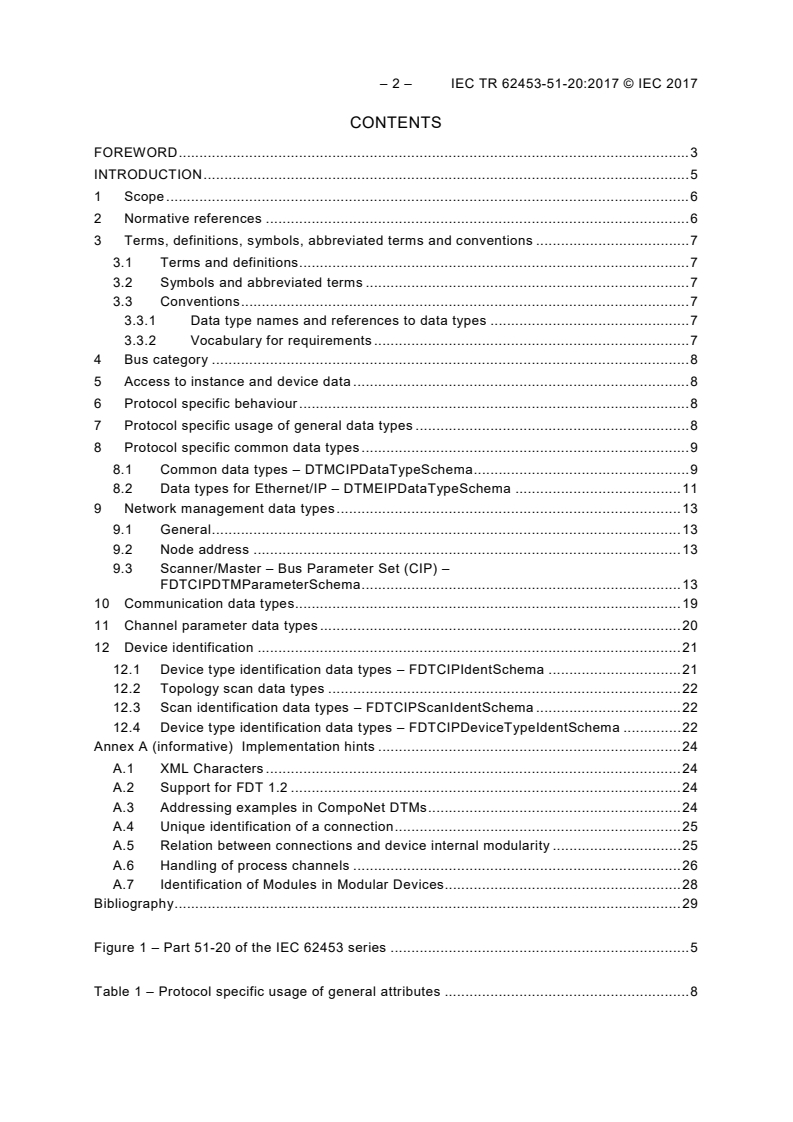
– 2 – IEC TR 62453-51-20:2017 © IEC 2017
CONTENTS
FOREWORD . 3
INTRODUCTION . 5
1 Scope . 6
2 Normative references . 6
3 Terms, definitions, symbols, abbreviated terms and conventions . 7
3.1 Terms and definitions . 7
3.2 Symbols and abbreviated terms . 7
3.3 Conventions . 7
3.3.1 Data type names and references to data types . 7
3.3.2 Vocabulary for requirements . 7
4 Bus category . 8
5 Access to instance and device data . 8
6 Protocol specific behaviour . 8
7 Protocol specific usage of general data types . 8
8 Protocol specific common data types . 9
8.1 Common data types – DTMCIPDataTypeSchema . 9
8.2 Data types for Ethernet/IP – DTMEIPDataTypeSchema . 11
9 Network management data types . 13
9.1 General . 13
9.2 Node address . 13
9.3 Scanner/Master – Bus Parameter Set (CIP) –
FDTCIPDTMParameterSchema . 13
10 Communication data types. 19
11 Channel parameter data types . 20
12 Device identification . 21
12.1 Device type identification data types – FDTCIPIdentSchema . 21
12.2 Topology scan data types . 22
12.3 Scan identification data types – FDTCIPScanIdentSchema . 22
12.4 Device type identification data types – FDTCIPDeviceTypeIdentSchema . 22
Annex A (informative) Implementation hints . 24
A.1 XML Characters . 24
A.2 Support for FDT 1.2 . 24
A.3 Addressing examples in CompoNet DTMs . 24
A.4 Unique identification of a connection . 25
A.5 Relation between connections and device internal modularity . 25
A.6 Handling of process channels . 26
A.7 Identification of Modules in Modular Devices. 28
Bibliography . 29
Figure 1 – Part 51-20 of the IEC 62453 series . 5
Table 1 – Protocol specific usage of general attributes . 8
INTERNATIONAL ELECTROTECHNICAL COMMISSION
____________
FIELD DEVICE TOOL (FDT) INTERFACE SPECIFICATION –
Part 51-20: Communication implementation
for common object model – IEC 61784 CPF 2
FOREWORD
1) The International Electrotechnical Commission (IEC) is a worldwide organization for standardization comprising
all national electrotechnical committees (IEC National Committees). The object of IEC is to promote
international co-operation on all questions concerning standardization in the electrical and electronic fields. To
this end and in addition to other activities, IEC publishes International Standards, Technical Specifications,
Technical Reports, Publicly Available Specifications (PAS) and Guides (hereafter referred to as “IEC
Publication(s)”). Their preparation is entrusted to technical committees; any IEC National Committee interested
in the subject dealt with may participate in this preparatory work. International, governmental and non-
governmental organizations liaising with the IEC also participate in this preparation. IEC collaborates closely
with the International Organization for Standardization (ISO) in accordance with conditions determined by
agreement between the two organizations.
2) The formal decisions or agreements of IEC on technical matters express, as nearly as possible, an international
consensus of opinion on the relevant subjects since each technical committee has representation from all
interested IEC National Committees.
3) IEC Publications have the form of recommendations for international use and are accepted by IEC National
Committees in that sense. While all reasonable efforts are made to ensure that the technical content of IEC
Publications is accurate, IEC cannot be held responsible for the way in which they are used or for any
misinterpretation by any end user.
4) In order to promote international uniformity, IEC National Committees undertake to apply IEC Publications
transparently to the maximum extent possible in their national and regional publications. Any divergence
between any IEC Publication and the corresponding national or regional publication shall be clearly indicated in
the latter.
5) IEC itself does not provide any attestation of conformity. Independent certification bodies provide conformity
assessment services and, in some areas, access to IEC marks of conformity. IEC is not responsible for any
services carried out by independent certification bodies.
6) All users should ensure that they have the latest edition of this publication.
7) No liability shall attach to IEC or its directors, employees, servants or agents including individual experts and
members of its technical committees and IEC National Committees for any personal injury, property damage or
other damage of any nature whatsoever, whether direct or indirect, or for costs (including legal fees) and
expenses arising out of the publication, use of, or reliance upon, this IEC Publication or any other IEC
Publications.
8) Attention is drawn to the Normative references cited in this publication. Use of the referenced publications is
indispensable for the correct application of this publication.
9) Attention is drawn to the possibility that some of the elements of this IEC Publication may be the subject of
patent rights. IEC shall not be held responsible for identifying any or all such patent rights.
The main task of IEC technical committees is to prepare International Standards. However, a
technical committee may propose the publication of a technical report when it has collected
data of a different kind from that which is normally published as an International Standard, for
example "state of the art".
IEC TR 62453-51-20, which is a technical report, has been prepared by subcommittee 65E:
Devices and integration in enterprise systems, of IEC technical committee 65: Industrial-
process management, control and automation.
This document cancels and replaces IEC TR 62453-502 published in 2009. This edition
constitutes a technical revision. The main change consists in improved support for
Ethernet/IP.
– 4 – IEC TR 62453-51-20:2017 © IEC 2017
Each part of the IEC 62453-51-xy series is intended to be read in conjunction with its
corresponding part in the IEC 62453-3xy series. This document corresponds to
IEC 62453-302.
The text of this technical report is based on the following documents:
Enquiry draft Report on voting
65E/440/DTR 65E/514/RVC
Full information on the voting for the approval of this technical report can be found in the
report on voting indicated in the above table.
This document has been drafted in accordance with the ISO/IEC Directives, Part 2.
The list of all parts of the IEC 62453 series, under the general title Field device tool (FDT)
interface specification, can be found on the IEC website.
The committee has decided that the contents of this document will remain unchanged until the
stability date indicated on the IEC website under "http://webstore.iec.ch" in the data related to
the specific document. At this date, the document will be
• reconfirmed,
• withdrawn,
• replaced by a revised edition, or
• amended.
A bilingual version of this publication may be issued at a later date.
IMPORTANT – The 'colour inside' logo on the cover page of this publication indicates
that it contains colours which are considered to be useful for the correct
understanding of its contents. Users should therefore print this document using a
colour printer.
INTRODUCTION
This part of IEC 62453 is an interface specification for developers of Field Device Tool (FDT)
components for function control and data access within a client/server architecture. The
specification is a result of an analysis and design process to develop standard interfaces to
facilitate the development of servers and clients by multiple vendors that need to interoperate
seamlessly.
With the integration of fieldbuses into control systems, there are a few other tasks which need
to be performed. In addition to fieldbus- and device-specific tools, there is a need to integrate
these tools into higher-level system-wide planning or engineering tools. In particular, for use
in extensive and heterogeneous control systems, typically in the area of the process industry,
the unambiguous definition of engineering interfaces that are easy to use for all those
involved is of great importance.
A device-specific software component, called Device Type Manager (DTM), is supplied by the
field device manufacturer with its device. The DTM is integrated into engineering tools via the
FDT interfaces defined in this specification. The approach to integration is in general open for
all kind of fieldbuses and thus meets the requirements for integrating different kinds of
devices into heterogeneous control systems.
Figure 1 shows how this part of the IEC 62453-51-xy series is aligned in the structure of the
IEC 62453 series.
Part 51-20
Communication
Implementation
for common
object model –
IEC 61784 CPF 2
IEC
Figure 1 – Part 51-20 of the IEC 62453 series
– 6 – IEC TR 62453-51-20:2017 © IEC 2017
FIELD DEVICE TOOL (FDT) INTERFACE SPECIFICATION –
Part 51-20: Communication implementation
for common object model – IEC 61784 CPF 2
1 Scope
This part of the IEC 62453-51-xy series, which is a Technical Report, provides information for
integrating the CIP™ technology into the COM-based implementation of FDT interface
specification (IEC TR 62453-41).
The Communication Profile Family 2 (commonly known as CIP™ ) defines communication
profiles based on IEC 61158-2 Type 2, IEC 61158-3-2, IEC 61158-4-2, IEC 61158-5-2, and
IEC 61158-6-2, IEC 62026-3. The basic profiles CP 2/1 (ControlNet™), CP 2/2
(EtherNet/IP™ ), and CP 2/3 (DeviceNet™ ) are defined in IEC 61784-1 and IEC 61784-2. An
additional communication profile (CompoNet™),also based on CIP™, is defined in [15] .
This document specifies implementation of communication and other services based on
IEC 62453-302.
This document neither contains the FDT specification nor modifies it.
2 Normative references
The following documents are referred to in the text in such a way that some or all of their
content constitutes requirements of this document. For dated references, only the edition
cited applies. For undated references, the latest edition of the referenced document (including
any amendments) applies.
IEC 61158-2, Industrial communication networks – Fieldbus specifications – Part 2: Physical
layer specification and service definition
IEC 61158-3-2, Industrial communication networks – Fieldbus specifications – Part 3-2: Data-
link layer service definition – Type 2 elements
IEC 61158-4-2, Industrial communication networks – Fieldbus specifications – Part 4-2: Data-
link layer protocol specification – Type 2 elements
___________
CIP™ (Common Industrial Protocol), DeviceNet™ and CompoNet™ are trade names of Open DeviceNet Vendor
Association, Inc (ODVA). This information is given for the convenience of users of this document and does not
constitute an endorsement by IEC of the trade name holder or any of its products. Compliance to this profile
does not require use of the trade names CIP™, DeviceNet™ or CompoNet™. Use of the trade names CIP™,
DeviceNet™ or CompoNet™ requires permission of Open DeviceNet Vendor Association,Inc.
ControlNet™ is a trade name of ControlNet International, Ltd. This information is given for the convenience of
users of this document and does not constitute an endorsement by IEC of the trademark holder or any of its
products. Compliance to this profile does not require use of the trade name ControlNet™. Use of the trade
name ControlNet™ requires permission of ControlNet International, Ltd.
EtherNet/IP™ is a trade name of ControlNet International, Ltd. and Open DeviceNet Vendor Association, Inc.
This information is given for the convenience of users of this document and does not constitute an endorsement
by IEC of the trademark holder or any of its products. Compliance to this profile does not require use of the
trade name EtherNet/IP™. Use of the trade name EtherNet/IP™ requires permission of either ControlNet
International, Ltd. or Open DeviceNet Vendor Association, Inc.
Figures in square brackets refer to the Bibliography.
IEC 61158-5-2, Industrial communication networks – Fieldbus specifications – Part 5-2:
Application layer service definition – Type 2 elements
IEC 61158-6-2, Industrial communication networks – Fieldbus specifications – Part 6-2:
Application layer protocol specification – Type 2 elements
IEC 61784-1:2014, Industrial communication networks – Profiles – Part 1: Fieldbus profiles
IEC 61784-2, Industrial communication networks – Profiles – Part 2: Additional fieldbus
profiles for real-time networks based on ISO/IEC 8802-3
IEC 62026-3, Low-voltage switchgear and controlgear – Controller-device interfaces (CDIs) –
Part 3: DeviceNet
IEC 62453-1:2016, Field device tool (FDT) interface specification – Part 1: Overview and
guidance
IEC 62453-2:2016, Field device tool (FDT) interface specification – Part 2: Concepts and
detailed description
IEC TR 62453-41:2016, Field device tool (FDT) interface specification – Part 41: Object model
integration profile – Common object model
IEC 62453-302:2016, Field device tool (FDT) interface specification – Part 302:
Communication profile integration – IEC 61784 CPF 2
3 Terms, definitions, symbols, abbreviated terms and conventions
3.1 Terms and definitions
For the purposes of this document, the terms and definitions given in IEC 62453-1,
IEC 62453-2, IEC TR 62453-41, and IEC 62453-301 apply.
ISO and IEC maintain terminological databases for use in standardization at the following
addresses:
• IEC Electropedia: available at http://www.electropedia.org/
• ISO Online browsing platform: available at http://www.iso.org/obp
3.2 Symbols and abbreviated terms
For the purposes of this document, the symbols and abbreviations given in IEC 62453-1,
IEC 62453-2, IEC 62453-302, and IEC TR 62453-41 apply.
3.3 Conventions
3.3.1 Data type names and references to data types
The conventions for naming and referencing of data types are explained in IEC 62453-2:2016,
Clause A.1.
3.3.2 Vocabulary for requirements
The following expressions are used when specifying requirements.
Usage of “shall” or “mandatory” No exceptions allowed.
– 8 – IEC TR 62453-51-20:2017 © IEC 2017
Usage of “should” or “recommended” Strong recommendation. It may make sense in
special exceptional cases to differ from the
described behaviour.
Usage of “can” or “optional” Function or behaviour may be provided,
depending on defined conditions.
4 Bus category
IEC 61784 CPF 2 protocol is identified in the attribute busCategory of the BusCategory
element by the identifiers, as specified in IEC 62453-302.
5 Access to instance and device data
The elements and attributes specified in this clause are used at the following methods:
• IDtmParameter methods
• IDtmSingleDeviceDataAccess methods
• IDtmSingleInstanceDataAccess methods
All parameters defined in the Params section of the EDS shall be exposed. For
IdtmParameter, the parameters are exposed in the ExportedVariables element of the
DtmParameter schema.
6 Protocol specific behaviour
IEC 61784 CPF 2 protocol specific requirements are specified in IEC 62453-302.
7 Protocol specific usage of general data types
Table 1 shows how general attributes are used with IEC 61784 CPF 2 devices.
Table 1 – Protocol specific usage of general attributes
Attribute Description for use
fdt:address All these attributes of the FDTDatatype schema are
used as defined in IEC 62453-302.
fdt:protocolId
fdt:deviceTypeId
fdt:deviceTypeInformation
fdt:deviceTypeInformationPath
fdt:manufacturerId
fdt:semanticId
fdt:applicationDomain
fdt:tag
8 Protocol specific common data types
8.1 Common data types – DTMCIPDataTypeSchema
This schema specifies the protocol specific common XML elements and attributes, which are
used in other schemas. The definition of the elements and attributes follows the data type
definitions in IEC 62453-302.
– 10 – IEC TR 62453-51-20:2017 © IEC 2017
8.2 Data types for Ethernet/IP – DTMEIPDataTypeSchema
This schema specifies the protocol specific common XML elements and attributes for
Ethernet/IP, which are used in other schemas. The definition of the elements and attributes
follows the data type definitions in IEC 62453-302.
– 12 – IEC TR 62453-51-20:2017 © IEC 2017
9 Network management data types
9.1 General
The elements and attributes specified in this clause are used at the following methods:
• IDtmParameter:GetParameters
• IDtmParameter:SetParameters
9.2 Node address
The CIPNodeID will be stored in the busAddress attribute of the fdt:MasterSlaveBus element.
This is not used for CompoNet because the master has a fixed address – since this is a
mandatory element, the recommendation is to use the value “0”.
9.3 Scanner/Master – Bus Parameter Set (CIP) – FDTCIPDTMParameterSchema
Information is sent to the CIP scanner/master within the UserDefinedBus element in the
BusInformation element, using the CIPNode element defined in the schema below. This
information shall be set to configure the scan list of scanner/master.
xmlns:dt="urn:schemas-microsoft-com:datatypes" xmlns:fdt="x-schema:FDTDataTypesSchema.xml" xmlns:cip="x-
schema:DTMCIPDataTypeSchema.xml" xmlns:fdtpar="x-schema:DTMParameterSchema.xml">
– 14 – IEC TR 62453-51-20:2017 © IEC 2017
...