


IEC 61338-2:2004
(Main)Waveguide type dielectric resonators - Part 2: Guidelines for oscillator and filter applications
General Information
- Abstract
IEC 61338-2:2004-05(en-fr) contains guidelines for use, is limited to the waveguide type dielectric resonators that are used for oscillator and filter applications. The applications are oscillators for direct broadcasting or communication satellite systems, oscillators for radio links, voltage-controlled oscillators for mobile communication systems and so on. This standard cancels and replaces IEC PAS 61338-2 published in 2000. This first edition constitutes a technical revision.
- Status
- Published
- Publication Date
- 26-May-2004
- Technical Committee
- TC 49 - Piezoelectric, dielectric and electrostatic devices and associated materials for frequency control, selection and detection
- Drafting Committee
- WG 10 - TC 49/WG 10
- Current Stage
- PPUB - Publication issued
- Start Date
- 27-May-2004
- Completion Date
- 15-Sep-2004
Buy Documents
IEC 61338-2:2004 - Waveguide type dielectric resonators - Part 2: Guidelines for oscillator and filter applications Released:5/27/2004
IEC 61338-2:2004 - Waveguide type dielectric resonators - Part 2: Guidelines for oscillator and filter applications Released:5/27/2004
Overview
IEC 61338-2:2004 - "Waveguide type dielectric resonators - Part 2: Guidelines for oscillator and filter applications" provides practical guidance for the selection, application and integration of waveguide‑type dielectric resonators in oscillators and filters. Published by IEC in May 2004 as a technical revision that cancels IEC PAS 61338‑2 (2000), this first edition focuses on real‑world design and application issues rather than on full theoretical derivations.
Key topics
- Scope and intended use: Guidelines limited to waveguide‑type dielectric resonators used in oscillators and filters for telecommunications and radar systems.
- Principles and structure: Basic operating principles (e.g., wave propagation and mode confinement at dielectric/air interfaces) and typical resonator geometries.
- Resonator characteristics: Material properties, shielding conductor behavior, resonance modes (TE, TM and quarter‑wavelength TEM), and how these affect resonance frequency and unloaded quality factor (Q).
- Application guidance for oscillators: Practical remarks, recommended oscillator topologies (reflection‑type and feedback‑type), and VCO implementation using different resonator modes.
- Environmental and test considerations: Reference to normative environmental standards (IEC 60068 series) and guidance on operating temperature ranges, stability and ageing.
- Figures and tables: Mode charts, dimensional guidance, examples of tuning mechanisms and comparison tables for materials and Q/performance tradeoffs.
- Normative annex and bibliography: References to related measurement and test methods in the IEC 61338 series.
Applications
IEC 61338‑2 is directly applicable to:
- Oscillators for direct broadcasting and communications satellite systems.
- Radio‑link oscillators and voltage‑controlled oscillators (VCOs) for mobile communication systems.
- Miniaturized filter components where high Q and small size are required. Practical benefits include improved frequency stability, reduced size and mass, and faster design cycles through use of standardized guidance for resonator selection and circuit interfacing.
Who should use this standard
- RF/microwave designers specifying dielectric resonators for oscillators and filters
- Component manufacturers and suppliers of waveguide‑type dielectric resonators
- Test laboratories and procurement engineers verifying performance and environmental compliance
- Systems engineers working on satellite comms, broadcast transmitters, radio links, and mobile VCO modules
Related standards
- IEC 61338 series (Part 1 - general information and test conditions; Parts on permittivity measurement)
- IEC 60068 environmental testing series (referenced for reliability and qualification)
Keywords: IEC 61338‑2, waveguide type dielectric resonator, dielectric resonator oscillator, dielectric resonator filter, TE mode, TM mode, TEM mode, VCO, microwave resonator, IEC standard, oscillator guidelines.
Buy Documents
IEC 61338-2:2004 - Waveguide type dielectric resonators - Part 2: Guidelines for oscillator and filter applications Released:5/27/2004
IEC 61338-2:2004 - Waveguide type dielectric resonators - Part 2: Guidelines for oscillator and filter applications Released:5/27/2004
Frequently Asked Questions
IEC 61338-2:2004 is a standard published by the International Electrotechnical Commission (IEC). Its full title is "Waveguide type dielectric resonators - Part 2: Guidelines for oscillator and filter applications". This standard covers: IEC 61338-2:2004-05(en-fr) contains guidelines for use, is limited to the waveguide type dielectric resonators that are used for oscillator and filter applications. The applications are oscillators for direct broadcasting or communication satellite systems, oscillators for radio links, voltage-controlled oscillators for mobile communication systems and so on. This standard cancels and replaces IEC PAS 61338-2 published in 2000. This first edition constitutes a technical revision.
IEC 61338-2:2004-05(en-fr) contains guidelines for use, is limited to the waveguide type dielectric resonators that are used for oscillator and filter applications. The applications are oscillators for direct broadcasting or communication satellite systems, oscillators for radio links, voltage-controlled oscillators for mobile communication systems and so on. This standard cancels and replaces IEC PAS 61338-2 published in 2000. This first edition constitutes a technical revision.
IEC 61338-2:2004 is classified under the following ICS (International Classification for Standards) categories: 31.140 - Piezoelectric devices. The ICS classification helps identify the subject area and facilitates finding related standards.
IEC 61338-2:2004 is available in PDF format for immediate download after purchase. The document can be added to your cart and obtained through the secure checkout process. Digital delivery ensures instant access to the complete standard document.
Standards Content (Sample)
INTERNATIONAL IEC
STANDARD 61338-2
First edition
2004-05
Waveguide type dielectric resonators –
Part 2:
Guidelines for oscillator
and filter applications
Reference number
Publication numbering
As from 1 January 1997 all IEC publications are issued with a designation in the
60000 series. For example, IEC 34-1 is now referred to as IEC 60034-1.
Consolidated editions
The IEC is now publishing consolidated versions of its publications. For example,
edition numbers 1.0, 1.1 and 1.2 refer, respectively, to the base publication, the
base publication incorporating amendment 1 and the base publication incorporating
amendments 1 and 2.
Further information on IEC publications
The technical content of IEC publications is kept under constant review by the IEC,
thus ensuring that the content reflects current technology. Information relating to
this publication, including its validity, is available in the IEC Catalogue of
publications (see below) in addition to new editions, amendments and corrigenda.
Information on the subjects under consideration and work in progress undertaken
by the technical committee which has prepared this publication, as well as the list
of publications issued, is also available from the following:
• IEC Web Site (www.iec.ch)
• Catalogue of IEC publications
The on-line catalogue on the IEC web site (www.iec.ch/searchpub) enables you to
search by a variety of criteria including text searches, technical committees
and date of publication. On-line information is also available on recently issued
publications, withdrawn and replaced publications, as well as corrigenda.
• IEC Just Published
This summary of recently issued publications (www.iec.ch/online_news/ justpub)
is also available by email. Please contact the Customer Service Centre (see
below) for further information.
• Customer Service Centre
If you have any questions regarding this publication or need further assistance,
please contact the Customer Service Centre:
Email: custserv@iec.ch
Tel: +41 22 919 02 11
Fax: +41 22 919 03 00
INTERNATIONAL IEC
STANDARD 61338-2
First edition
2004-05
Waveguide type dielectric resonators –
Part 2:
Guidelines for oscillator
and filter applications
IEC 2004 Copyright - all rights reserved
No part of this publication may be reproduced or utilized in any form or by any means, electronic or
mechanical, including photocopying and microfilm, without permission in writing from the publisher.
International Electrotechnical Commission, 3, rue de Varembé, PO Box 131, CH-1211 Geneva 20, Switzerland
Telephone: +41 22 919 02 11 Telefax: +41 22 919 03 00 E-mail: inmail@iec.ch Web: www.iec.ch
PRICE CODE
Commission Electrotechnique Internationale V
International Electrotechnical Commission
МеждународнаяЭлектротехническаяКомиссия
For price, see current catalogue
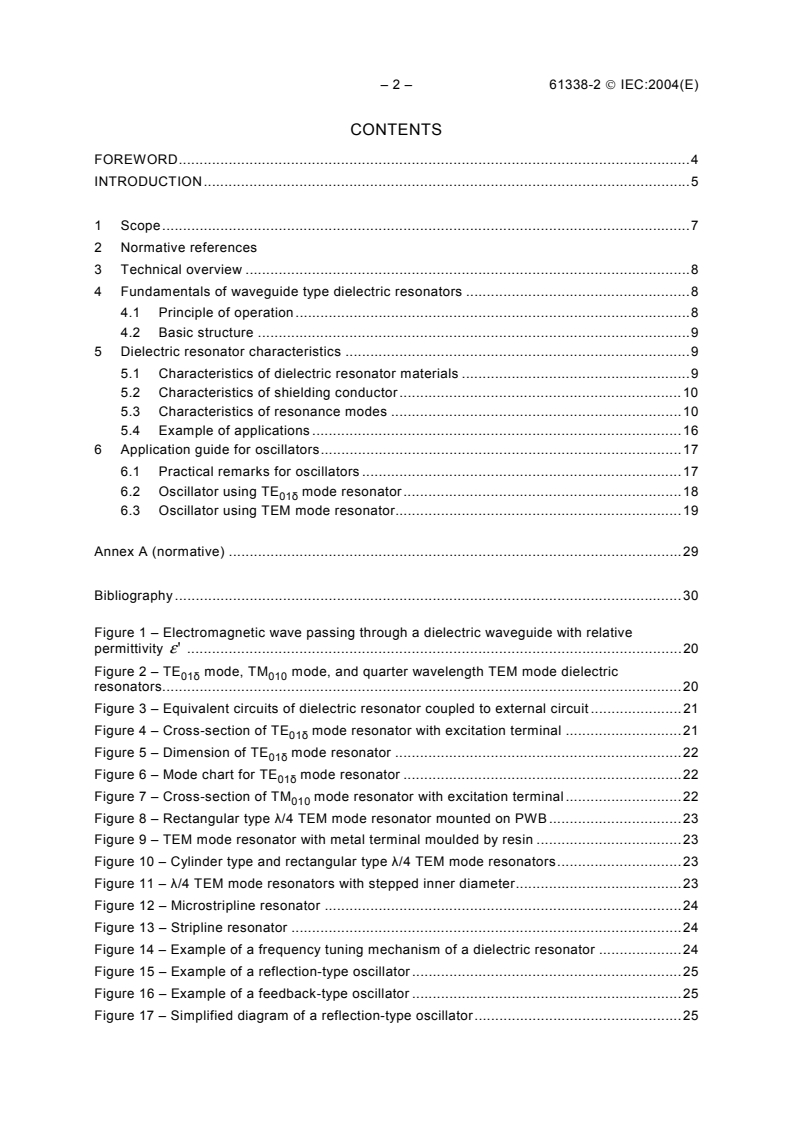
– 2 – 61338-2 IEC:2004(E)
CONTENTS
FOREWORD.4
INTRODUCTION.5
1 Scope.7
2 Normative references
3 Technical overview.8
4 Fundamentals of waveguide type dielectric resonators .8
4.1 Principle of operation.8
4.2 Basic structure.9
5 Dielectric resonator characteristics .9
5.1 Characteristics of dielectric resonator materials .9
5.2 Characteristics of shielding conductor.10
5.3 Characteristics of resonance modes .10
5.4 Example of applications .16
6 Application guide for oscillators.17
6.1 Practical remarks for oscillators .17
6.2 Oscillator using TE mode resonator.18
01δ
6.3 Oscillator using TEM mode resonator.19
Annex A (normative) .29
Bibliography .30
Figure 1 – Electromagnetic wave passing through a dielectric waveguide with relative
permittivity ε' .20
Figure 2 – TE mode, TM mode, and quarter wavelength TEM mode dielectric
01δ 010
resonators.20
Figure 3 – Equivalent circuits of dielectric resonator coupled to external circuit .21
Figure 4 – Cross-section of TE mode resonator with excitation terminal .21
01δ
Figure 5 – Dimension of TE mode resonator .22
01δ
Figure 6 – Mode chart for TE mode resonator .22
01δ
Figure 7 – Cross-section of TM mode resonator with excitation terminal.22
Figure 8 – Rectangular type λ/4 TEM mode resonator mounted on PWB.23
Figure 9 – TEM mode resonator with metal terminal moulded by resin .23
Figure 10 – Cylinder type and rectangular type λ/4 TEM mode resonators.23
Figure 11 – λ/4 TEM mode resonators with stepped inner diameter.23
Figure 12 – Microstripline resonator .24
Figure 13 – Stripline resonator .24
Figure 14 – Example of a frequency tuning mechanism of a dielectric resonator .24
Figure 15 – Example of a reflection-type oscillator .25
Figure 16 – Example of a feedback-type oscillator .25
Figure 17 – Simplified diagram of a reflection-type oscillator.25
61338-2 IEC:2004(E) – 3 –
Figure 18 – Example of a reflection-type voltage-controlled oscillator.26
Figure 19 – Example of a feedback-type voltage-controlled oscillator.26
Figure 20 – Configuration of VCO using a TEM mode resonator.26
Table 1 – Characteristics of available dielectric resonator materials.27
Table 2 – Characteristics of substrate materials .27
Table 3 – Comparison of size and unloaded Q of dielectric resonators with three
resonance modes.27
Table 4 – Example of applications .28
Table A.1 – References to relevant publications .29
– 4 – 61338-2 IEC:2004(E)
INTERNATIONAL ELECTROTECHNICAL COMMISSION
____________
WAVEGUIDE TYPE DIELECTRIC RESONATORS –
Part 2: Guidelines for oscillator and filter applications
FOREWORD
1) The International Electrotechnical Commission (IEC) is a worldwide organization for standardization comprising
all national electrotechnical committees (IEC National Committees). The object of IEC is to promote
international co-operation on all questions concerning standardization in the electrical and electronic fields. To
this end and in addition to other activities, IEC publishes International Standards, Technical Specifications,
Technical Reports, Publicly Available Specifications (PAS) and Guides (hereafter referred to as “IEC
Publication(s)”). Their preparation is entrusted to technical committees; any IEC National Committee interested
in the subject dealt with may participate in this preparatory work. International, governmental and non-
governmental organizations liaising with the IEC also participate in this preparation. IEC collaborates closely
with the International Organization for Standardization (ISO) in accordance with conditions determined by
agreement between the two organizations.
2) The formal decisions or agreements of IEC on technical matters express, as nearly as possible, an international
consensus of opinion on the relevant subjects since each technical committee has representation from all
interested IEC National Committees.
3) IEC Publications have the form of recommendations for international use and are accepted by IEC National
Committees in that sense. While all reasonable efforts are made to ensure that the technical content of IEC
Publications is accurate, IEC cannot be held responsible for the way in which they are used or for any
misinterpretation by any end user.
4) In order to promote international uniformity, IEC National Committees undertake to apply IEC Publications
transparently to the maximum extent possible in their national and regional publications. Any divergence
between any IEC Publication and the corresponding national or regional publication shall be clearly indicated in
the latter.
5) IEC provides no marking procedure to indicate its approval and cannot be rendered responsible for any
equipment declared to be in conformity with an IEC Publication.
6) All users should ensure that they have the latest edition of this publication.
7) No liability shall attach to IEC or its directors, employees, servants or agents including individual experts and
members of its technical committees and IEC National Committees for any personal injury, property damage or
other damage of any nature whatsoever, whether direct or indirect, or for costs (including legal fees) and
expenses arising out of the publication, use of, or reliance upon, this IEC Publication or any other IEC
Publications.
8) Attention is drawn to the Normative references cited in this publication. Use of the referenced publications is
indispensable for the correct application of this publication.
9) Attention is drawn to the possibility that some of the elements of this IEC Publication may be the subject of
patent rights. IEC shall not be held responsible for identifying any or all such patent rights.
International Standard IEC 61338-2 has been prepared by IEC technical committee 49:
Piezoelectric and dielectric devices for frequency control and selection.
This standard cancels and replaces IEC/PAS 61338-2 published in 2000. This first edition
constitutes a technical revision.
The text of this standard is based on the following documents:
FDIS Report on voting
49/656/FDIS 49/674/RVD
Full information on the voting for the approval of this standard can be found in the report on
voting indicated in the above table.
This publication has been drafted in accordance with the ISO/IEC Directives, Part 2.
61338-2 IEC:2004(E) – 5 –
The committee has decided that the contents of this publication will remain unchanged until
2008. At this date, the publication will be
• reconfirmed;
• withdrawn;
• replaced by a revised edition, or
• amended.
IEC 61338 consists of the following parts, under the general title Waveguide type dielectric
resonators:
Part 1: Generic specification
Part 1-1: General information and test conditions – General information
Part 1-2: General information and test conditions – Test conditions
Part 1-3: General information and test conditions – Measurement method of complex relative
permittivity for dielectric resonator materials at microwave frequency
Part 1-4: General information and test conditions – Measurement method of complex relative
permittivity for dielectric resonator materials at millimeter-wave frequency
Part 2: Guidelines for oscillator and filter applications (the present standard)
Part 4: Sectional specification
Part 4-1: Blank detail specification
A bilingual version may be issued at a later date
___________
To be published.
To be replaced by IEC 61338-1 in the near future.
Under consideration.
– 6 – 61338-2 IEC:2004(E)
INTRODUCTION
This part of IEC 61338 gives practical guidance on the use of waveguide type dielectric
resonators that are used in telecommunications and radar systems (for general information,
standard values, and test conditions, see the other parts of this series).
The features of these dielectric resonators are small size without degradation of quality factor,
low mass, high reliability and high stability against temperature and ageing. The dielectric
resonators are suitable for applications to miniaturized oscillators and filters with high
performance.
This standard has been compiled in response to a generally expressed desire on the part of
both users and manufacturers for guidelines for the use of dielectric resonators, so that the
resonators may be used to their best advantage. For this purpose, general and fundamental
characteristics have been explained in this standard.
61338-2 IEC:2004(E) – 7 –
WAVEGUIDE TYPE DIELECTRIC RESONATORS –
Part 2: Guidelines for oscillator and filter applications
1 Scope
This part of IEC 61338, which contains guidelines for use, is limited to the waveguide type
dielectric resonators that are used for oscillator and filter applications. These types of
resonators are now widely used in oscillators for direct broadcasting or communication satellite
systems, oscillators for radio links, voltage-controlled oscillators for mobile communication
systems and so on. In addition, these dielectric resonators are also used as an essential
component of miniaturized filters for the same kind of applications.
It is not the aim of this standard either to explain theory or to attempt to cover all the
eventualities that may arise in practical circumstances. This standard draws attention to some
of the more fundamental questions, which should be considered by the user before he places
an order for dielectric resonators for a new application. Such a procedure will be the user's
insurance against unsatisfactory performance.
Standard specifications, such as those in the IEC 61338 series and national specifications or
detail specifications issued by manufacturers, will define the available combinations of
resonance frequency, the quality factor, the temperature coefficient of resonance frequency,
etc. These specifications are compiled to include a wide range of dielectric resonators with
standardized performances. It cannot be over-emphasized that the user should, wherever
possible, select his dielectric resonators from these specifications, when available, even if it
may lead to making small modifications to his circuit to enable standard resonators to be used.
This applies particularly to the selection of the nominal frequency.
2 Normative references
The following referenced documents are indispensable for the application of this document. For
dated references, only the edition cited applies. For undated references, the latest edition of
the referenced document (including any amendments) applies.
IEC 60068-1, Environmental testing – Part 1: General and guidance
IEC 60068-2-1, Environmental testing – Part 2: Tests – Test A: Cold
IEC 60068-2-2, Environmental testing – Part 2: Tests – Tests B: Dry heat
IEC 60068-2-6, Environmental testing – Part 2: Tests – Test Fc: Vibration (sinusoidal)
IEC 60068-2-7, Environmental testing – Part 2: Tests – Test Ga: Acceleration, steady state
IEC 60068-2-13, Environmental testing – Part 2: Tests – Test M: Low air pressure
IEC 60068-2-14, Environmental testing – Part 2: Tests – Test N: Change of temperature
IEC 60068-2-20, Environmental testing – Part 2: Tests – Test T: Soldering
IEC 60068-2-21, Environmental testing – Part 2-21: Tests – Test U: Robustness of terminations
– 8 – 61338-2 IEC:2004(E)
IEC 60068-2-27, Environmental testing – Part 2: Tests – Test Ea and guidance: Shock
IEC 60068-2-29, Environmental testing – Part 2: Tests – Test Eb and guidance: Bump
IEC 60068-2-30, Environmental testing – Part 2: Tests – Test Db and guidance: Damp heat,
cyclic (12 + 12-hour cycle)
IEC 60068-2-58, Environmental testing – Part 2-58: Tests – Test Td: Test methods for
solderability, resistance to dissolution of metallization and to soldering heat of surface
mounting devices (SMD)
IEC 60068-2-78, Environmental testing – Part 2-78: Tests – Test Cab: Damp heat, steady state
IEC 61338-1-1, Waveguide type dielectric resonators – Part 1-1: General information and test
conditions – General information
IEC 61338-1-2, Waveguide type dielectric resonators – Part 1-2: General information and test
conditions – Test conditions
IEC 61338-1-3, Waveguide type dielectric resonators – Part 1-3: General information and test
conditions – Measurement method of complex relative permittivity for dielectric resonator
materials at microwave frequency
3 Technical overview
It is of prime interest to a user that the resonator characteristics should satisfy particular
specifications. The selection of oscillating circuits and dielectric resonators to meet that
specification should be a matter of agreement between user and manufacturer.
Resonator characteristics are usually expressed in terms of resonance frequency, quality factor,
etc. These characteristics are related to the dielectric characteristics in 5.3.
The specifications shall be satisfied between the lowest and highest temperatures of the
specified operating temperature range and before and after environmental tests.
4 Fundamentals of waveguide type dielectric resonators
4.1 Principle of operation
When an electromagnetic wave passes through a dielectric waveguide with a relative
permittivity of ε' , the interface between air and a dielectric will be a perfect reflector if the angle
of incidence is greater than the critical angle θ , θ = arcsin (1/ ε' ) , as shown in Figure 1.
In a very rough approximation, the air/dielectric interface can be considered to work as a
magnetic wall (open-circuit), on which a normal component of the electric field and a tangential
component of a magnetic field vanish. Thus, a dielectric rod with finite length functions as a
resonator due to internal reflections of electromagnetic waves at the air/dielectric interface.
The size of a dielectric resonator can be considerably smaller than an empty resonant cavity at
the same frequency. This is because the resonance frequency is determined when the
resonator dimensions are of the order of half a wavelength of the electromagnetic wave, and
because the wavelength is shortened in the dielectric according to the following equation:
61338-2 IEC:2004(E) – 9 –
λ
λ = (1)
g
′
ε
where λ and λ are the wavelengths in a dielectric with relative permittivity ε' and in vacuum.
g 0
This size-reduction effect on microwave components is the biggest advantage in using the
dielectric resonator.
4.2 Basic structure
The shape of a dielectric resonator is usually a disc or a cylinder which is a dielectric rod
waveguide with finite length. Although the air/dielectric interface is considered to work roughly
as a magnetic wall, some of the field actually leaks out (radiates) especially at the end faces,
where the angle of incidences is less than the critical angle. In order to prevent such radiation
losses, the resonator must be inside some form of shielding conductor.
As in a conventional metal wall cavity, there are various types of dielectric resonator structure
and a number of modes can exist in each structure. Among these modes, the one with the
lowest resonance frequency for certain diameter/length ratio is designated as the dominant
mode. Figure 2 shows the three most commonly utilized dominant modes for dielectric
resonators.
The TE mode dielectric resonator is characterized by a dominant TE (transverse electric)
01δ
mode field distribution, the field of which leaks in the direction of wave propagation. This kind
of mode resonator consists of a disc or a cylindrical-shaped dielectric resonator, a low ε'
dielectric support, and a shielding conductor made of high-conductivity metals such as copper
and silver. A high unloaded quality factor can be achieved using this mode.
The TM mode dielectric resonator is characterized by a TM (transverse magnetic) mode
field distribution. This mode resonator has the middle levels of unloaded Q and size reduction
effect between TE and TEM mode resonators. The TM mode resonator is often used for
01δ 010
high-power applications such as filters for cellular base stations because of its construction
which aids in the release of heat.
The TEM (transverse electromagnetic) mode dielectric resonator is characterized by a guided
mode field distribution of a TEM mode with standing wave of a quarter wavelength. The inside,
outside and one end of walls of a cylindrical dielectric resonator are fired or plated with a high-
conductivity metal such as copper and silver. This mode dielectric resonator causes a
significant size-reduction effect.
5 Dielectric resonator characteristics
5.1 Characteristics of dielectric resonator materials
The materials used to produce dielectric resonators should have a high relative permittivity ( ε' ),
a low loss factor ( tanδ ) and a minimal temperature coefficient of resonance frequency ( ).
TCF
Table 1 shows the composition of several resonator materials with their dielectric properties at
microwave frequencies.
Table 2 shows the dielectric properties of substrate materials. Dielectric resonators are
mounted on these boards.
5.1.1 Relative permittivity ( ε' )
Relative permittivity of dielectric resonator materials is independent of frequency (i.e. constant)
over the practical microwave frequency range, because the materials are made of para-electric
ceramics. Materials with ε' from 20 to 100 are now typically used for dielectric resonators.
– 10 – 61338-2 IEC:2004(E)
5.1.2 Loss factor ( tanδ )
The quality factor of a material ( Q ) is defined as the reciprocal of loss factor:
Q = 1/ tanδ (2)
As tanδ increases proportionately with frequency for the ionic crystals, the product of Q and
frequency is approximately constant at microwave frequencies. So, the Qf product is often
used as a figure of merit for each material. The materials with lower ε' generally have the
lower tanδ .
5.1.3 Temperature coefficient of resonance frequency ( )
TCF
The TCF is given by the following equation as a material constant:
TCF = − TCε −α (3)
where
TCε is the temperature coefficient of relative permittivity, and
α is the coefficient of thermal expansion of the dielectric resonator.
The TCF is obtained by the following equation:
f − f
T ref
TCF = ×10 (4)
f()T − T
ref ref
where
is the resonance frequency at temperature , and
f T
T
f is the resonance frequency at reference temperature T .
ref ref
–6
The of dielectric resonator material can be selected with a precision of ±1⋅10 /K.
TCF
In the case where a material has a significant non-linear dependency on temperature, the following
second-order temperature coefficient of resonance frequency is used.
TCF"
f − f
T ref
′ ′′
= TCF()T − T + TCF()T − T (5)
ref ref
f
ref
5.1.4 Insulation breakdown voltage
The breakdown voltage of dielectric resonator materials is usually higher than 10 kV/mm. For
high-power applications such as filters for cellular base stations, precautions should be taken
to ensure good heat dissipation from dielectric resonators, so as to prevent the decrease of
breakdown voltage.
5.1.5 Coefficient of linear thermal expansion (α )
–6 –6
Dielectric resonators have a coefficient of linear thermal expansion from +6⋅10 /K to +12⋅10 /K.
When the resonator is soldered direct on a printed wired board (PWB), care must be taken to
avoid the cracking of the ceramic body caused by the difference of coefficient of linear thermal
expansion between the dielectric resonator and the PWB.
61338-2 IEC:2004(E) – 11 –
5.1.6 Mechanical strength
Dielectric resonators have practical robustness for usual application usage, the bending
strength of which is approximately 80 MPa to 200 MPa. When the dielectric resonators are
mounted on a PWB, precautions are needed to ensure that the mechanical stress caused by
the bending of the PWB does not break the dielectric resonators.
5.1.7 Resistance to soldering heat
In the case of large-size TEM mode resonators, abrupt temperature elevation by soldering
might cause cracking in the body. Preheating in advance of soldering is recommended. Users
should follow the soldering conditions issued by suppliers.
5.1.8 Long-term stability
The relative permittivity and loss factor of dielectric resonator materials have good long-term
stability. However, the resonator element should be handled in a dry atmosphere to avoid the
deterioration of unloaded Q value due to the existence of moisture and the oxidation of
shielding conductor. Handling with bare hands should also be avoided to protect the conductor
from being sulfurized, chloridized or stained.
5.1.9 Available frequency range
Dielectric resonators currently available in the market are used at the frequencies from
200 MHz to 60 GHz.
5.2 Characteristics of shielding conductors
5.2.1 Shielding conductors for TE mode dielectric resonator
01δ
Silver-plated brass and copper are usually selected because of their high electrical conductivity
and preferable mechanical properties. Aluminum is occasionally selected according to its low
cost.
5.2.2 Shielding conductors for TEM and TM mode dielectric resonators
Electrodes are directly formed on the dielectric surface of TEM and TM mode resonators by
using silver or copper. The electrode layer is usually electroplated with an appropriate top layer
to improve solderability.
5.3 Characteristics of resonance modes
5.3.1 Quality factors
In practice, dielectric resonators are excited by external circuits. Figure 3 shows the equivalent
circuits of dielectric resonators coupled to external circuits. Most of the TE and TM mode
01δ 010
resonators are coupled magnetically and electrically to the external circuits, respectively. The
TEM mode resonators are generally coupled electrically to the external circuits.
In Figure 3, Q indicates the loaded quality factor, which is the total quality factor for the
L
resonator system including energy losses both in the resonator and in the external circuit. Q
L
is given by the following equations:
1 1 1
= + (for reflection and reaction type) (6)
Q Q Q
L u e
1 1 1 1
= + + (for transmission type) (7)
Q Q Q Q
L u eg el
– 12 – 61338-2 IEC:2004(E)
where
Q , Q and Q indicate the external quality factors determined by the coupling coefficient
e eg el
between the resonator and the external circuits;
Q is the Q on the generator side and Q is that on the load side;
eg e el
Q indicates the unloaded quality factor of a dielectric resonator with shielding conductor.
u
The unloaded quality factor is mainly determined by the loss factor of a dielectric resonator
material and the conduction loss on surfaces of a shielding conductor. Q is given by the
u
follow
...
IEC 61338-2 ®
Edition 1.0 2004-05
INTERNATIONAL
STANDARD
NORME
INTERNATIONALE
Waveguide type dielectric resonators –
Part 2: Guidelines for oscillator and filter applications
Résonateurs diélectriques à modes guidés –
Partie 2: Lignes directrices pour l'application aux filtres et aux oscillateurs
All rights reserved. Unless otherwise specified, no part of this publication may be reproduced or utilized in any form
or by any means, electronic or mechanical, including photocopying and microfilm, without permission in writing from
either IEC or IEC's member National Committee in the country of the requester. If you have any questions about IEC
copyright or have an enquiry about obtaining additional rights to this publication, please contact the address below or
your local IEC member National Committee for further information.
Droits de reproduction réservés. Sauf indication contraire, aucune partie de cette publication ne peut être reproduite
ni utilisée sous quelque forme que ce soit et par aucun procédé, électronique ou mécanique, y compris la photocopie
et les microfilms, sans l'accord écrit de l'IEC ou du Comité national de l'IEC du pays du demandeur. Si vous avez des
questions sur le copyright de l'IEC ou si vous désirez obtenir des droits supplémentaires sur cette publication, utilisez
les coordonnées ci-après ou contactez le Comité national de l'IEC de votre pays de résidence.
IEC Central Office Tel.: +41 22 919 02 11
3, rue de Varembé Fax: +41 22 919 03 00
CH-1211 Geneva 20 info@iec.ch
Switzerland www.iec.ch
About the IEC
The International Electrotechnical Commission (IEC) is the leading global organization that prepares and publishes
International Standards for all electrical, electronic and related technologies.
About IEC publications
The technical content of IEC publications is kept under constant review by the IEC. Please make sure that you have the
latest edition, a corrigenda or an amendment might have been published.
IEC Catalogue - webstore.iec.ch/catalogue Electropedia - www.electropedia.org
The stand-alone application for consulting the entire The world's leading online dictionary of electronic and
bibliographical information on IEC International Standards, electrical terms containing more than 30 000 terms and
Technical Specifications, Technical Reports and other definitions in English and French, with equivalent terms in 14
documents. Available for PC, Mac OS, Android Tablets and additional languages. Also known as the International
iPad. Electrotechnical Vocabulary (IEV) online.
IEC publications search - www.iec.ch/searchpub IEC Glossary - std.iec.ch/glossary
The advanced search enables to find IEC publications by a More than 55 000 electrotechnical terminology entries in
variety of criteria (reference number, text, technical English and French extracted from the Terms and Definitions
committee,…). It also gives information on projects, replaced clause of IEC publications issued since 2002. Some entries
and withdrawn publications. have been collected from earlier publications of IEC TC 37,
77, 86 and CISPR.
IEC Just Published - webstore.iec.ch/justpublished
Stay up to date on all new IEC publications. Just Published IEC Customer Service Centre - webstore.iec.ch/csc
details all new publications released. Available online and If you wish to give us your feedback on this publication or
also once a month by email. need further assistance, please contact the Customer Service
Centre: csc@iec.ch.
A propos de l'IEC
La Commission Electrotechnique Internationale (IEC) est la première organisation mondiale qui élabore et publie des
Normes internationales pour tout ce qui a trait à l'électricité, à l'électronique et aux technologies apparentées.
A propos des publications IEC
Le contenu technique des publications IEC est constamment revu. Veuillez vous assurer que vous possédez l’édition la
plus récente, un corrigendum ou amendement peut avoir été publié.
Catalogue IEC - webstore.iec.ch/catalogue Electropedia - www.electropedia.org
Application autonome pour consulter tous les renseignements
Le premier dictionnaire en ligne de termes électroniques et
bibliographiques sur les Normes internationales,
électriques. Il contient plus de 30 000 termes et définitions en
Spécifications techniques, Rapports techniques et autres
anglais et en français, ainsi que les termes équivalents dans
documents de l'IEC. Disponible pour PC, Mac OS, tablettes
14 langues additionnelles. Egalement appelé Vocabulaire
Android et iPad.
Electrotechnique International (IEV) en ligne.
Recherche de publications IEC - www.iec.ch/searchpub
Glossaire IEC - std.iec.ch/glossary
Plus de 55 000 entrées terminologiques électrotechniques, en
La recherche avancée permet de trouver des publications IEC
en utilisant différents critères (numéro de référence, texte, anglais et en français, extraites des articles Termes et
comité d’études,…). Elle donne aussi des informations sur les Définitions des publications IEC parues depuis 2002. Plus
projets et les publications remplacées ou retirées. certaines entrées antérieures extraites des publications des
CE 37, 77, 86 et CISPR de l'IEC.
IEC Just Published - webstore.iec.ch/justpublished
Service Clients - webstore.iec.ch/csc
Restez informé sur les nouvelles publications IEC. Just
Published détaille les nouvelles publications parues. Si vous désirez nous donner des commentaires sur cette
Disponible en ligne et aussi une fois par mois par email. publication ou si vous avez des questions contactez-nous:
csc@iec.ch.
IEC 61338-2 ®
Edition 1.0 2004-05
INTERNATIONAL
STANDARD
NORME
INTERNATIONALE
Waveguide type dielectric resonators –
Part 2: Guidelines for oscillator and filter applications
Résonateurs diélectriques à modes guidés –
Partie 2: Lignes directrices pour l'application aux filtres et aux oscillateurs
INTERNATIONAL
ELECTROTECHNICAL
COMMISSION
COMMISSION
ELECTROTECHNIQUE
PRICE CODE
INTERNATIONALE
CODE PRIX V
ICS 31.140 ISBN 978-2-8322-1338-4
– 2 – 61338-2 IEC:2004
CONTENTS
FOREWORD . 4
INTRODUCTION . 5
1 Scope . 7
2 Normative references. 7
3 Technical overview . 8
4 Fundamentals of waveguide type dielectric resonators . 8
4.1 Principle of operation . 8
4.2 Basic structure . 9
5 Dielectric resonator characteristics . 9
5.1 Characteristics of dielectric resonator materials . 9
5.2 Characteristics of shielding conductor . 10
5.3 Characteristics of resonance modes . 10
5.4 Example of applications . 16
6 Application guide for oscillators . 17
6.1 Practical remarks for oscillators . 17
6.2 Oscillator using TE mode resonator . 18
01δ
6.3 Oscillator using TEM mode resonator. 19
Annex A (normative) . 29
Bibliography . 30
Figure 1 – Electromagnetic wave passing through a dielectric waveguide with relative
....................................................................................................................... 20
permittivity ε'
Figure 2 – TE mode, TM mode, and quarter wavelength TEM mode dielectric
01δ 010
resonators. 20
Figure 3 – Equivalent circuits of dielectric resonator coupled to external circuit . 21
Figure 4 – Cross-section of TE mode resonator with excitation terminal . 21
01δ
mode resonator . 22
Figure 5 – Dimension of TE
01δ
Figure 6 – Mode chart for TE mode resonator . 22
01δ
Figure 7 – Cross-section of TM mode resonator with excitation terminal . 22
Figure 8 – Rectangular type λ/4 TEM mode resonator mounted on PWB . 23
Figure 9 – TEM mode resonator with metal terminal moulded by resin . 23
Figure 10 – Cylinder type and rectangular type λ/4 TEM mode resonators . 23
Figure 11 – λ/4 TEM mode resonators with stepped inner diameter . 23
Figure 12 – Microstripline resonator . 24
Figure 13 – Stripline resonator . 24
Figure 14 – Example of a frequency tuning mechanism of a dielectric resonator . 24
Figure 15 – Example of a reflection-type oscillator . 25
Figure 16 – Example of a feedback-type oscillator . 25
Figure 17 – Simplified diagram of a reflection-type oscillator . 25
61338-2 IEC:2004 – 3 –
Figure 18 – Example of a reflection-type voltage-controlled oscillator . 26
Figure 19 – Example of a feedback-type voltage-controlled oscillator . 26
Figure 20 – Configuration of VCO using a TEM mode resonator. 26
Table 1 – Characteristics of available dielectric resonator materials . 27
Table 2 – Characteristics of substrate materials . 27
Table 3 – Comparison of size and unloaded Q of dielectric resonators with three
resonance modes . 27
Table 4 – Example of applications . 28
Table A.1 – References to relevant publications . 29
– 4 – 61338-2 IEC:2004
INTERNATIONAL ELECTROTECHNICAL COMMISSION
____________
WAVEGUIDE TYPE DIELECTRIC RESONATORS –
Part 2: Guidelines for oscillator and filter applications
FOREWORD
1) The International Electrotechnical Commission (IEC) is a worldwide organization for standardization comprising
all national electrotechnical committees (IEC National Committees). The object of IEC is to promote
international co-operation on all questions concerning standardization in the electrical and electronic fields. To
this end and in addition to other activities, IEC publishes International Standards, Technical Specifications,
Technical Reports, Publicly Available Specifications (PAS) and Guides (hereafter referred to as “IEC
Publication(s)”). Their preparation is entrusted to technical committees; any IEC National Committee interested
in the subject dealt with may participate in this preparatory work. International, governmental and non-
governmental organizations liaising with the IEC also participate in this preparation. IEC collaborates closely
with the International Organization for Standardization (ISO) in accordance with conditions determined by
agreement between the two organizations.
2) The formal decisions or agreements of IEC on technical matters express, as nearly as possible, an international
consensus of opinion on the relevant subjects since each technical committee has representation from all
interested IEC National Committees.
3) IEC Publications have the form of recommendations for international use and are accepted by IEC National
Committees in that sense. While all reasonable efforts are made to ensure that the technical content of IEC
Publications is accurate, IEC cannot be held responsible for the way in which they are used or for any
misinterpretation by any end user.
4) In order to promote international uniformity, IEC National Committees undertake to apply IEC Publications
transparently to the maximum extent possible in their national and regional publications. Any divergence
between any IEC Publication and the corresponding national or regional publication shall be clearly indicated in
the latter.
5) IEC provides no marking procedure to indicate its approval and cannot be rendered responsible for any
equipment declared to be in conformity with an IEC Publication.
6) All users should ensure that they have the latest edition of this publication.
7) No liability shall attach to IEC or its directors, employees, servants or agents including individual experts and
members of its technical committees and IEC National Committees for any personal injury, property damage or
other damage of any nature whatsoever, whether direct or indirect, or for costs (including legal fees) and
expenses arising out of the publication, use of, or reliance upon, this IEC Publication or any other IEC
Publications.
8) Attention is drawn to the Normative references cited in this publication. Use of the referenced publications is
indispensable for the correct application of this publication.
9) Attention is drawn to the possibility that some of the elements of this IEC Publication may be the subject of
patent rights. IEC shall not be held responsible for identifying any or all such patent rights.
International Standard IEC 61338-2 has been prepared by IEC technical committee 49:
Piezoelectric and dielectric devices for frequency control and selection.
This standard cancels and replaces IEC/PAS 61338-2 published in 2000. This first edition
constitutes a technical revision.
This bilingual version (2014-02) corresponds to the monolingual English version, published in
2004-05.
The text of this standard is based on the following documents:
FDIS Report on voting
49/656/FDIS 49/674/RVD
Full information on the voting for the approval of this standard can be found in the report on
voting indicated in the above table.
61338-2 IEC:2004 – 5 –
The French version of this standard has not been voted upon.
This publication has been drafted in accordance with the ISO/IEC Directives, Part 2.
The committee has decided that the contents of this publication will remain unchanged until
2008. At this date, the publication will be
• reconfirmed;
• withdrawn;
• replaced by a revised edition, or
• amended.
IEC 61338 consists of the following parts, under the general title Waveguide type dielectric
resonators:
Part 1: Generic specification
Part 1-1: General information and test conditions – General information
Part 1-2: General information and test conditions – Test conditions
Part 1-3: General information and test conditions – Measurement method of complex relative
permittivity for dielectric resonator materials at microwave frequency
Part 1-4: General information and test conditions – Measurement method of complex relative
permittivity for dielectric resonator materials at millimeter-wave frequency
Part 2: Guidelines for oscillator and filter applications (the present standard)
Part 4: Sectional specification
Part 4-1: Blank detail specification
___________
To be published.
To be replaced by IEC 61338-1 in the near future.
Under consideration.
– 6 – 61338-2 IEC:2004
INTRODUCTION
This part of IEC 61338 gives practical guidance on the use of waveguide type dielectric
resonators that are used in telecommunications and radar systems (for general information,
standard values, and test conditions, see the other parts of this series).
The features of these dielectric resonators are small size without degradation of quality factor,
low mass, high reliability and high stability against temperature and ageing. The dielectric
resonators are suitable for applications to miniaturized oscillators and filters with high
performance.
This standard has been compiled in response to a generally expressed desire on the part of
both users and manufacturers for guidelines for the use of dielectric resonators, so that the
resonators may be used to their best advantage. For this purpose, general and fundamental
characteristics have been explained in this standard.
61338-2 IEC:2004 – 7 –
WAVEGUIDE TYPE DIELECTRIC RESONATORS –
Part 2: Guidelines for oscillator and filter applications
1 Scope
This part of IEC 61338, which contains guidelines for use, is limited to the waveguide type
dielectric resonators that are used for oscillator and filter applications. These types of
resonators are now widely used in oscillators for direct broadcasting or communication satellite
systems, oscillators for radio links, voltage-controlled oscillators for mobile communication
systems and so on. In addition, these dielectric resonators are also used as an essential
component of miniaturized filters for the same kind of applications.
It is not the aim of this standard either to explain theory or to attempt to cover all the
eventualities that may arise in practical circumstances. This standard draws attention to some
of the more fundamental questions, which should be considered by the user before he places
an order for dielectric resonators for a new application. Such a procedure will be the user's
insurance against unsatisfactory performance.
Standard specifications, such as those in the IEC 61338 series and national specifications or
detail specifications issued by manufacturers, will define the available combinations of
resonance frequency, the quality factor, the temperature coefficient of resonance frequency,
etc. These specifications are compiled to include a wide range of dielectric resonators with
standardized performances. It cannot be over-emphasized that the user should, wherever
possible, select his dielectric resonators from these specifications, when available, even if it
may lead to making small modifications to his circuit to enable standard resonators to be used.
This applies particularly to the selection of the nominal frequency.
2 Normative references
The following referenced documents are indispensable for the application of this document. For
dated references, only the edition cited applies. For undated references, the latest edition of
the referenced document (including any amendments) applies.
IEC 60068-1, Environmental testing – Part 1: General and guidance
IEC 60068-2-1, Environmental testing – Part 2: Tests – Test A: Cold
IEC 60068-2-2, Environmental testing – Part 2: Tests – Tests B: Dry heat
IEC 60068-2-6, Environmental testing – Part 2: Tests – Test Fc: Vibration (sinusoidal)
IEC 60068-2-7, Environmental testing – Part 2: Tests – Test Ga: Acceleration, steady state
IEC 60068-2-13, Environmental testing – Part 2: Tests – Test M: Low air pressure
IEC 60068-2-14, Environmental testing – Part 2: Tests – Test N: Change of temperature
IEC 60068-2-20, Environmental testing – Part 2: Tests – Test T: Soldering
IEC 60068-2-21, Environmental testing – Part 2-21: Tests – Test U: Robustness of terminations
– 8 – 61338-2 IEC:2004
IEC 60068-2-27, Environmental testing – Part 2: Tests – Test Ea and guidance: Shock
IEC 60068-2-29, Environmental testing – Part 2: Tests – Test Eb and guidance: Bump
IEC 60068-2-30, Environmental testing – Part 2: Tests – Test Db and guidance: Damp heat,
cyclic (12 + 12-hour cycle)
IEC 60068-2-58, Environmental testing – Part 2-58: Tests – Test Td: Test methods for
solderability, resistance to dissolution of metallization and to soldering heat of surface
mounting devices (SMD)
IEC 60068-2-78, Environmental testing – Part 2-78: Tests – Test Cab: Damp heat, steady state
IEC 61338-1-1, Waveguide type dielectric resonators – Part 1-1: General information and test
conditions – General information
IEC 61338-1-2, Waveguide type dielectric resonators – Part 1-2: General information and test
conditions – Test conditions
IEC 61338-1-3, Waveguide type dielectric resonators – Part 1-3: General information and test
conditions – Measurement method of complex relative permittivity for dielectric resonator
materials at microwave frequency
3 Technical overview
It is of prime interest to a user that the resonator characteristics should satisfy particular
specifications. The selection of oscillating circuits and dielectric resonators to meet that
specification should be a matter of agreement between user and manufacturer.
Resonator characteristics are usually expressed in terms of resonance frequency, quality factor,
etc. These characteristics are related to the dielectric characteristics in 5.3.
The specifications shall be satisfied between the lowest and highest temperatures of the
specified operating temperature range and before and after environmental tests.
4 Fundamentals of waveguide type dielectric resonators
4.1 Principle of operation
When an electromagnetic wave passes through a dielectric waveguide with a relative
permittivity of ε' , the interface between air and a dielectric will be a perfect reflector if the angle
of incidence is greater than the critical angle θ , θ = arcsin (1/ ε' ) , as shown in Figure 1.
In a very rough approximation, the air/dielectric interface can be considered to work as a
magnetic wall (open-circuit), on which a normal component of the electric field and a tangential
component of a magnetic field vanish. Thus, a dielectric rod with finite length functions as a
resonator due to internal reflections of electromagnetic waves at the air/dielectric interface.
The size of a dielectric resonator can be considerably smaller than an empty resonant cavity at
the same frequency. This is because the resonance frequency is determined when the
resonator dimensions are of the order of half a wavelength of the electromagnetic wave, and
because the wavelength is shortened in the dielectric according to the following equation:
61338-2 IEC:2004 – 9 –
λ
λ = (1)
g
′
ε
where λ and λ are the wavelengths in a dielectric with relative permittivity ε' and in vacuum.
g 0
This size-reduction effect on microwave components is the biggest advantage in using the
dielectric resonator.
4.2 Basic structure
The shape of a dielectric resonator is usually a disc or a cylinder which is a dielectric rod
waveguide with finite length. Although the air/dielectric interface is considered to work roughly
as a magnetic wall, some of the field actually leaks out (radiates) especially at the end faces,
where the angle of incidences is less than the critical angle. In order to prevent such radiation
losses, the resonator must be inside some form of shielding conductor.
As in a conventional metal wall cavity, there are various types of dielectric resonator structure
and a number of modes can exist in each structure. Among these modes, the one with the
lowest resonance frequency for certain diameter/length ratio is designated as the dominant
mode. Figure 2 shows the three most commonly utilized dominant modes for dielectric
resonators.
The TE mode dielectric resonator is characterized by a dominant TE (transverse electric)
01δ
mode field distribution, the field of which leaks in the direction of wave propagation. This kind
of mode resonator consists of a disc or a cylindrical-shaped dielectric resonator, a low ε'
dielectric support, and a shielding conductor made of high-conductivity metals such as copper
and silver. A high unloaded quality factor can be achieved using this mode.
The TM mode dielectric resonator is characterized by a TM (transverse magnetic) mode
field distribution. This mode resonator has the middle levels of unloaded Q and size reduction
effect between TE and TEM mode resonators. The TM mode resonator is often used for
01δ 010
high-power applications such as filters for cellular base stations because of its construction
which aids in the release of heat.
The TEM (transverse electromagnetic) mode dielectric resonator is characterized by a guided
mode field distribution of a TEM mode with standing wave of a quarter wavelength. The inside,
outside and one end of walls of a cylindrical dielectric resonator are fired or plated with a high-
conductivity metal such as copper and silver. This mode dielectric resonator causes a
significant size-reduction effect.
5 Dielectric resonator characteristics
5.1 Characteristics of dielectric resonator materials
The materials used to produce dielectric resonators should have a high relative permittivity ( ),
ε'
a low loss factor ( tanδ ) and a minimal temperature coefficient of resonance frequency ( ).
TCF
Table 1 shows the composition of several resonator materials with their dielectric properties at
microwave frequencies.
Table 2 shows the dielectric properties of substrate materials. Dielectric resonators are
mounted on these boards.
5.1.1 Relative permittivity ( ε' )
Relative permittivity of dielectric resonator materials is independent of frequency (i.e. constant)
over the practical microwave frequency range, because the materials are made of para-electric
ceramics. Materials with ε' from 20 to 100 are now typically used for dielectric resonators.
– 10 – 61338-2 IEC:2004
5.1.2 Loss factor ( tanδ )
The quality factor of a material ( Q ) is defined as the reciprocal of loss factor:
Q = 1/ tanδ (2)
As tanδ increases proportionately with frequency for the ionic crystals, the product of Q and
frequency is approximately constant at microwave frequencies. So, the product is often
Q f
used as a figure of merit for each material. The materials with lower generally have the
ε'
lower .
tanδ
5.1.3 Temperature coefficient of resonance frequency ( )
TCF
The TCF is given by the following equation as a material constant:
TCF = − TCε − α (3)
where
TCε is the temperature coefficient of relative permittivity, and
is the coefficient of thermal expansion of the dielectric resonator.
α
The TCF is obtained by the following equation:
f − f
T ref 6
(4)
TCF = ×10
f (T − T )
ref ref
where
is the resonance frequency at temperature , and
f T
T
f is the resonance frequency at reference temperature T .
ref ref
–6
The of dielectric resonator material can be selected with a precision of ±1⋅10 /K.
TCF
In the case where a material has a significant non-linear dependency on temperature, the following
second-order temperature coefficient of resonance frequency is used.
TCF"
f − f
T ref 2
′ ′′
= TCF (T − T )+ TCF (T − T ) (5)
ref ref
f
ref
5.1.4 Insulation breakdown voltage
The breakdown voltage of dielectric resonator materials is usually higher than 10 kV/mm. For
high-power applications such as filters for cellular base stations, precautions should be taken
to ensure good heat dissipation from dielectric resonators, so as to prevent the decrease of
breakdown voltage.
5.1.5 Coefficient of linear thermal expansion ( α )
–6 –6
Dielectric resonators have a coefficient of linear thermal expansion from +6⋅10 /K to +12⋅10 /K.
When the resonator is soldered direct on a printed wired board (PWB), care must be taken to
avoid the cracking of the ceramic body caused by the difference of coefficient of linear thermal
expansion between the dielectric resonator and the PWB.
61338-2 IEC:2004 – 11 –
5.1.6 Mechanical strength
Dielectric resonators have practical robustness for usual application usage, the bending
strength of which is approximately 80 MPa to 200 MPa. When the dielectric resonators are
mounted on a PWB, precautions are needed to ensure that the mechanical stress caused by
the bending of the PWB does not break the dielectric resonators.
5.1.7 Resistance to soldering heat
In the case of large-size TEM mode resonators, abrupt temperature elevation by soldering
might cause cracking in the body. Preheating in advance of soldering is recommended. Users
should follow the soldering conditions issued by suppliers.
5.1.8 Long-term stability
The relative permittivity and loss factor of dielectric resonator materials have good long-term
stability. However, the resonator element should be handled in a dry atmosphere to avoid the
deterioration of unloaded Q value due to the existence of moisture and the oxidation of
shielding conductor. Handling with bare hands should also be avoided to protect the conductor
from being sulfurized, chloridized or stained.
5.1.9 Available frequency range
Dielectric resonators currently available in the market are used at the frequencies from
200 MHz to 60 GHz.
5.2 Characteristics of shielding conductors
5.2.1 Shielding conductors for TE mode dielectric resonator
01δ
Silver-plated brass and copper are usually selected because of their high electrical conductivity
and preferable mechanical properties. Aluminum is occasionally selected according to its low
cost.
5.2.2 Shielding conductors for TEM and TM mode dielectric resonators
Electrodes are directly formed on the dielectric surface of TEM and TM mode resonators by
using silver or copper. The electrode layer is usually electroplated with an appropriate top layer
to improve solderability.
5.3 Characteristics of resonance modes
5.3.1 Quality factors
In practice, dielectric resonators are excited by external circuits. Figure 3 shows the equivalent
circuits of dielectric resonators coupled to external circuits. Most of the TE and TM mode
01δ 010
resonators are coupled magnetically and electrically to the external circuits, respectively. The
TEM mode resonators are generally coupled electrically to the external circuits.
In Figure 3, Q indicates the loaded quality factor, which is the total quality factor for the
L
resonator system including energy losses both in the resonator and in the external circuit. Q
L
is given by the following equations:
1 1 1
(for reflection and reaction type) (6)
= +
Q Q Q
L u e
1 1 1 1
(for transmission type) (7)
= + +
Q Q Q Q
L u eg el
– 12 – 61338-2 IEC:2004
where
Q , Q and Q indicate the external quality factors determined by the coupling coefficient
e eg el
between the resonator and the external circuits;
Q is the Q on the generator side and Q is that on the load side;
eg e el
Q indicates the unloaded quality factor of a dielectric resonator with shielding conductor.
u
The unloaded quality factor is mainly determined by the loss factor of a dielectric resonator
material and the conduction loss on surfaces of a shielding conductor. Q is given by the
u
following equation:
1 1 1
= + (8)
Q Q Q
u d c
where
tanδ
Q is the quality factor due to the of a material; and
d
Q is the quality factor due to the conduction loss of a shielding conductor.
c
The quality factor of a material is defined as . Using Q , Q is given by the
Q = 1 tanδ
0 0 d
following equation:
Q = (1+ A)⋅ Q (9)
d 0
where
A is the geometrical factor determined by the structure of the dielectric resonator and given by
A = W W , where W and W are the electric energy stored outside and inside of the
O I O I
dielectric element, respectively. The value equals zero when all the electric field energy is
A
concentrated inside the dielectric element.
The value Q is strongly dependent on the resonance mode and the dimension of the dielectric
c
resonator.
Table 3 shows an example of the Q , Q and Q for three kinds of dielectric resonators with
d c u
different resonance modes. The values Q and Q were calculated under the conditions that a
d c
ε'= Q =1/ tanδ =
dielectric resonator material has the property of the 38 and 50 000. The
value 5,8 × 10 (S/m) was used as the conductivity of a shielding conductor for Cu. The size of
each resonator was determined so that each one has the same resonance frequency of 1 GHz.
As shown in Table 3, the value Q is determined by Q for the TE mode resonator and by Q
u d 01δ c
for the TEM mode resonator (these being the lower value between Q and Q in each case).
d c
5.3.2 TE mode resonator
01δ
a) Structure
Figure 4 shows a cross-section of a TE mode resonator with an excitation terminal. The
01δ
dielectric element with the shape of a disc or a ring is fixed at the centre of a shielding
conductor by using a low ε ′ support that is usually made of forstelite, alumina or quartz.
61338-2 IEC:2004 – 13 –
b) Resonance frequency
Figure 5 shows the dimensions of the TE mode resonator. The height of the shielding
01δ
conductor should be less than , where is the wavelength in vacuum at the
h λ 2 λ
0 0
resonance frequency.
Under the condition of d ≈ 2D to 3D , h ≈ 2L to 3L , the resonance frequency is given by
c
f =1,1 (10)
D ′
ε
where c is the velocity of light in vacuum.
Figure 6 shows a mode chart for a TE mode resonator. At the ratio of D L ≈ 5 , the TE
01δ 01δ
dominant mode is mostly separated from the adjacent higher mode. It is, therefore,
recommended to use this ratio to obtain the desirable spurious response. A ring-shaped
dielectric element gives a more improved spurious response.
c) Quality factor
The unloaded Q of this mode is given by the following equation:
1 1 1
= + = (A tanδ + A tanδ + A tanδ )+ A R (11)
1 2 S 3 a 4 S
Q Q Q
u d C
where tanδ , tanδ and tanδ are the loss factors for a dielectric element, a dielectric
S a
support and adhesive glue, respectively. R is the surface resistance of a shielding conductor
S
that is given by the following equation:
ωμ
R = (12)
S
2σ
where
ω is the angular resonance frequency;
μ is the permeability in vacuum; and
σ is the conductivity of the shielding conductor.
′
The constants A to A are determined by ε of a dielectric element and by dimensions of the
1 4
resonator.
d) Temperature coefficient of resonance frequency
The temperature coefficient of resonance frequency TCF of a material is selected so that it
compensates the effect of thermal expansion of a shielding conductor on a resonator’s
temperature coefficient of resonance frequency. The value TCF ≈ 3 is recommended for the
TE mode resonator with dimensions of d ≈ 2D to 3D , h ≈ 2L to 3L .
01δ
5.3.3 TM mode resonators
a) Structure
Figure 7 shows a cross-section of the TM mode resonator with an excitation terminal. A rod
type dielectric element is set at the centre of a shielding conductor. Both ends of it are
electrically contacted to the upper and the lower conductor.
– 14 – 61338-2 IEC:2004
b) Resonance frequency
The resonance frequency of the TM mode resonator is determined by the diameter of
dielectric element. Under the conditions of of 30 to 40 and , where is the
ε' D d = 1 3 D
diameter of dielectric element and is the inner diameter of shielding conductor, the
d
resonance frequency of TM mode resonator is given by the following equation:
c 0,13
f = (13)
′
D ε
c) Unloaded quality factor
The unloaded Q of this mode is given by the following equation:
1 1 1
= + = (A tanδ + A R ) (14)
1 2 S
Q Q Q
u d C
where
is the loss factor of the dielectric element; and
tanδ
R is a surface resistance of the shielding conductor.
S
The constants A and A are determined by the ε ′ of the dielectric element and the
1 2
dimensions of the resonator. The effect of R on Q for the TM mode resonator is
S u 010
comparatively larger than that for the TE mode resonator. A longer dielectric element gives
01δ
a higher unloaded Q.
d) Temperature coefficient of resonance frequency
The air gap between a dielectric element and a shielding conductor shifts the resonance
frequency drastically. Therefore, the thermal expansion of these two materials must be
coincided to prevent the creation of an air gap.
5.3.4 TEM mode resonator
a) Structure
Figure 8 shows a rectangular type λ/4 TEM mode resonator mounted on a PWB by reflow
soldering. For coupling with a transmission line, a metal terminal is connected to the inner wall
of the resonator. In the case where a capacitance is needed on the resonator side, a resin is
inserted between a metal terminal and an inner wall of the resonator (Figure 9).
b) Resonance frequency
Figure 10 shows the dimensions of a cylinder type and a rectangular type λ/4 TEM mode
resonators. The outer wall, inner wall and one end of the resonator are metallized by silver or
copper.
The resonance frequency of this mode is determined by the length of the resonator:
c
f = (15)
4L ε ′
The next higher mode response appears at 3 f . A different higher mode appears at the
frequency given by the following equation:
c a + b
= λ = 2π (16)
f 2
61338-2 IEC:2004 – 15 –
Figure 11 shows a λ/4 TEM mode resonator with a step in the inner diameter. This step
shortens the length by 10 % to 20 % compared with the straight inner diameter resonator but
degrades the unloaded quality factor according to the shorter length.
c) Unloaded quality factor
The unloaded Q of this mode is given by the following equation:
1 1 1
= + (17)
Q Q Q
u d C
where Q = 1 tanδ and Q is given by the following equation for a cylinder type λ/4 TEM mode
d c
resonator:
ln(b a)
Q = 2σωμ (18)
C 0
1 a + 1 b + (2 L)ln(b a)
For a rectangular type resonator, the transformation of is acceptable. The
4W = 2πb
dimensional condition of = 3,6 gives the maximum Q value.
b a
c
d) Temperature coefficient of resonance frequency
The temperature coefficient of the resonance frequency of this mode coincides approximately
with the of a dielectric element.
TCF
5.3.5 Microstripline resonator
a) Structure
Figure 12 shows a microstripline resonator. This operates as a λ/4 resonator when one end of
the microstripline is shorted and as a λ/2 resonator when both ends of the microstripline are
open- or short-circuited.
b) Resonance frequency
Resonance frequency is given by the following equation for a λ/4 microstripline resonator:
c
f = (19)
4L ε
eff
where ε is the effective permittivity of the microstripline resonator. ε is given by the
eff eff
following equation using a width of microstripline and a thickness of substrate:
w h
′ ′
ε + 1 ε −1 1
ε = + (20)
eff
2 2
1+ 10h w
– 16 – 61338-2 IEC:2004
c) Unloaded quality factor
The unloaded Q of this mode is given by the following equation:
1 1 1
= + = (A tanδ + A R + A R ) (21)
1 2 S1 3 S2
Q Q Q
u d C
where
tanδ is the loss factor of dielectric substrate; and
R and R are the surface resistances of the microstripline and the ground-plane
S1 S2
electrode, respectively.
This type of resonator is usually set in a shielding conductor to avoid electromagnetic radiation
loss.
d) Temperature coefficient of resonance frequency
The temperature coefficient of resonance frequency of this mode coincides approximately with
the of dielectric substrate.
TCF
5.3.6 Stripline resonator
a) Structure
Figure 13 shows a stripline resonator. This operates as a λ/4 resonator when one end of the
stripline is shorted and as a λ/2 resonator when both ends of the stripline are open- or short-
circuited.
b) Resonance frequency
This resonator has a similar structure to the TEM mode resonator. Resonance frequency is
given by the following equation for a λ/4 stripline resonator:
c
f = (22)
′
4L ε
c) Unloaded quality factor
The unloaded Q of this mode is given by the following equation:
1 1 1
= + = (A tanδ + A R + A R ) (23)
1 2 S1 3 S2
Q Q Q
u d C
where
tanδ is the loss factor of dielectric substrate; and
R and R are the surface resistances of the microstripline and the ground-plane electrode,
S1 S2
respectively.
The ratio of is recommended to be greater than 3 to prevent the deterioration of unloaded
W w
Q caused by the interference at the edge of the stripline.
d) Temperature coefficient of resonance frequency
The temperature coefficient of resonance frequency of this mode coincides approximately with
the of dielectric substrate.
TCF
61338-2 IEC:2004 – 17 –
5.4 Example of applications
Table 4 shows the application of dielectric resonators in microwave filters and oscillators. For
the filters of mobile communication systems at 900 MHz, the BaO-Nd O -TiO based materials
2 3 2
with a ε' higher than 90 are popularly used. The λ/4 TEM resonance mode is utilized for this
application to obtain the greatest size-reduction effect.
The applicable frequency range of (Zr,Sn)TiO and Ba Ti O materials is as wide as 0,2 GHz
4 2 9 20
to 10 GHz. They have a high ε' of 38 and a high Q value and are used for the filters of
cellular base stations, for the filters of many kinds of communication systems and for the
oscillators of direct broadcasting satellite TV. The TE resonance mode is used when an
01δ
application needs the high unloaded quality factor. For high-power applications such as cellular
base stations, the TM resonance mode has the advantage of aiding the release of heat from
the dielectric element to the shielding conductors. Designers of high-power applications should
take care to avoid the electric discharge that rises around a dielectric element at low air
pressure. The low third harmonic distortion level is another subject to be considered to avoid
the crosstalk between signals. (Zr,Sn)TiO material has a low third harmonic distortion level.
The complex perovskite materials such as Ba(Zn,Ta)O and Ba(Mg,Ta)O have an extremely
3 3
high Q value. They are used at higher frequencies from 10 GHz to 80 GHz. The TE
0 01δ
resonance mode is mainly used to obtain a higher unloaded quality factor.
6 Application guide for oscillators
6.1 Practical remarks for oscillators
Dielectric resonators are used for stabilizing the oscillation frequency and reducing the phase
noise of
...