

IEC 60947-4-2:2011
(Main)Low-voltage switchgear and controlgear - Part 4-2: Contactors and motor-starters - AC semiconductor motor controllers and starters
General Information
- Abstract
IEC 60947-4-2:2011 applies to a.c. semiconductor motor controllers and starters, which may include a series mechanical switching device, intended to be connected to circuits, the rated voltage of which does not exceed 1 000 V a.c. This standard characterizes a.c. semiconductor motor controllers and starters with and without bypass means. This third edition replaces the second edition published in 1999 and its Amendments 1 (2001) and 2 (2006). It is a technical revision. This edition includes the following significant technical changes with respect to the previous edition and its amendments:
- updated EMC normative references and associated requirements,
- new references to IEC 60947-1,
- marking of electronic relays without thermal memory,
- marking of tripping time at 0 °C ambient or below,
- new test requirements for limits of operation of time-delay overload relays,
- new classes of overload current withstand time,
- damp heat, salt mist, vibration and shock tests,
- short-circuit test in the smallest enclosure,
- update of the routine and sampling tests.
The contents of the corrigendum of July 2012 have been included in this copy.
This publication is to be read in conjunction with IEC 60947-1:2007.
- Status
- Published
- Publication Date
- 17-May-2011
- Technical Committee
- SC 121A - Low-voltage switchgear and controlgear
- Current Stage
- DELPUB - Deleted Publication
- Start Date
- 26-Jun-2020
- Completion Date
- 30-Jun-2017
Overview
IEC 60947-4-2:2011 is an international standard established by the International Electrotechnical Commission (IEC) that specifies requirements for low-voltage switchgear and controlgear, particularly focusing on AC semiconductor motor controllers and starters. This third edition supersedes the earlier 1999 edition and its amendments, providing a comprehensive technical revision aligned with current electrical engineering practices.
The scope covers AC semiconductor motor controllers and starters designed for connection to circuits with a rated voltage not exceeding 1,000 V AC. It includes controllers with or without bypass means and may incorporate mechanical switching elements. This standard forms an essential benchmark for manufacturers and users by detailing construction, performance, testing, and marking requirements to ensure safety, reliability, and interoperability in electrical control systems.
Key Topics
- Scope and Application: Defines semiconductor motor controllers and starters used in low-voltage AC circuits up to 1,000 volts.
- Updated Normative References: Incorporates current EMC requirements and references to IEC 60947-1 to maintain consistency with low-voltage switchgear standards.
- Marking Requirements: Specifies clear marking for electronic relays without thermal memory and tripping times at or below 0 °C ambient to improve operational clarity.
- Performance Testing:
- Thermal, dielectric, shock, vibration, and salt mist tests ensure durability under diverse environments.
- New short-circuit testing protocols for devices in the smallest enclosures enhance safety verification.
- Overload Relays:
- Introduces new time-delay overload relay test criteria and defines new classes of overload current withstand time.
- Guidance on current settings and thermal influences to optimize control and protection.
- Electromagnetic Compatibility (EMC): Strengthened EMC requirements for emission and immunity reduce the risk of electromagnetic interference in industrial environments.
- Installation and Maintenance: Details normative information, marking, and instructions vital for correct assembly, operation, and upkeep.
- Product Classification and Characteristics: Covers equipment types, rated values, utilization categories, and control circuit parameters to ensure appropriate application.
Applications
IEC 60947-4-2:2011 is particularly applicable in industries and systems that require precise and reliable control of AC electric motors using semiconductor technologies. Typical applications include:
- Industrial Automation: Semiconductor motor controllers and starters used in assembly lines, robotics, and manufacturing plants.
- HVAC Systems: Motor control in heating, ventilation, and air-conditioning units for efficient energy use.
- Pumping and Water Treatment: Control of pumps and motors in municipal or industrial water systems.
- Material Handling: Conveyors, lifts, and other motor-driven machinery requiring smooth operation and protection.
- Energy Sector: Integration of soft starters and semiconductor controllers in renewable energy systems and traditional power generation. The standard ensures that these devices operate reliably under normal and severe environmental conditions while meeting safety and electromagnetic compatibility norms.
Related Standards
- IEC 60947-1: General rules for low-voltage switchgear and controlgear, referenced for foundational definitions and requirements.
- IEC 60947 Series: Includes other parts related to contactors, motor starters, and auxiliary equipment, facilitating a full suite of standards for controlgear.
- EMC Standards: Referenced within the document, these address electromagnetic emission and immunity to ensure compliant and interference-free operation.
- National and Regional Standards: IEC 60947-4-2 serves as a global benchmark that informs regional standards such as UL and EN norms for motor starters and controllers.
Embracing IEC 60947-4-2:2011 guarantees adherence to internationally recognized safety, reliability, and performance criteria for AC semiconductor motor controllers and starters, supporting compliance, operational efficiency, and product interoperability across industries.
Relations
- Effective Date
- 05-Sep-2023
- Effective Date
- 05-Sep-2023
- Effective Date
- 05-Sep-2023
- Effective Date
- 05-Sep-2023
- Effective Date
- 05-Sep-2023
- Effective Date
- 05-Sep-2023
Get Certified
Connect with accredited certification bodies for this standard

IMQ S.p.A. (Certification)
Italian electrical product certification.

SLG Prüf- und Zertifizierungs GmbH
German testing and certification body.

UL Solutions
Global safety science company with testing, inspection and certification.
Sponsored listings
Frequently Asked Questions
IEC 60947-4-2:2011 is a standard published by the International Electrotechnical Commission (IEC). Its full title is "Low-voltage switchgear and controlgear - Part 4-2: Contactors and motor-starters - AC semiconductor motor controllers and starters". This standard covers: IEC 60947-4-2:2011 applies to a.c. semiconductor motor controllers and starters, which may include a series mechanical switching device, intended to be connected to circuits, the rated voltage of which does not exceed 1 000 V a.c. This standard characterizes a.c. semiconductor motor controllers and starters with and without bypass means. This third edition replaces the second edition published in 1999 and its Amendments 1 (2001) and 2 (2006). It is a technical revision. This edition includes the following significant technical changes with respect to the previous edition and its amendments: - updated EMC normative references and associated requirements, - new references to IEC 60947-1, - marking of electronic relays without thermal memory, - marking of tripping time at 0 °C ambient or below, - new test requirements for limits of operation of time-delay overload relays, - new classes of overload current withstand time, - damp heat, salt mist, vibration and shock tests, - short-circuit test in the smallest enclosure, - update of the routine and sampling tests. The contents of the corrigendum of July 2012 have been included in this copy. This publication is to be read in conjunction with IEC 60947-1:2007.
IEC 60947-4-2:2011 applies to a.c. semiconductor motor controllers and starters, which may include a series mechanical switching device, intended to be connected to circuits, the rated voltage of which does not exceed 1 000 V a.c. This standard characterizes a.c. semiconductor motor controllers and starters with and without bypass means. This third edition replaces the second edition published in 1999 and its Amendments 1 (2001) and 2 (2006). It is a technical revision. This edition includes the following significant technical changes with respect to the previous edition and its amendments: - updated EMC normative references and associated requirements, - new references to IEC 60947-1, - marking of electronic relays without thermal memory, - marking of tripping time at 0 °C ambient or below, - new test requirements for limits of operation of time-delay overload relays, - new classes of overload current withstand time, - damp heat, salt mist, vibration and shock tests, - short-circuit test in the smallest enclosure, - update of the routine and sampling tests. The contents of the corrigendum of July 2012 have been included in this copy. This publication is to be read in conjunction with IEC 60947-1:2007.
IEC 60947-4-2:2011 is classified under the following ICS (International Classification for Standards) categories: 29.130.20 - Low voltage switchgear and controlgear. The ICS classification helps identify the subject area and facilitates finding related standards.
IEC 60947-4-2:2011 has the following relationships with other standards: It is inter standard links to IEC 60947-4-2:2011/COR1:2012, IEC 60947-4-2:1999/AMD2:2006, IEC 60947-4-2:2020, IEC 60947-4-2:1999, IEC 60947-4-2:1999/AMD1:2001, IEC 60947-4-2:1999/AMD1:2001/COR1:2002. Understanding these relationships helps ensure you are using the most current and applicable version of the standard.
IEC 60947-4-2:2011 is available in PDF format for immediate download after purchase. The document can be added to your cart and obtained through the secure checkout process. Digital delivery ensures instant access to the complete standard document.
Standards Content (Sample)
IEC 60947-4-2 ®
Edition 3.0 2011-05
INTERNATIONAL
STANDARD
NORME
INTERNATIONALE
Low-voltage switchgear and controlgear –
Part 4-2: Contactors and motor-starters – AC semiconductor motor controllers
and starters
Appareillage à basse tension –
Partie 4-2: Contacteurs et démarreurs de moteurs – Gradateurs et démarreurs à
semiconducteurs de moteurs à courant alternatif
All rights reserved. Unless otherwise specified, no part of this publication may be reproduced or utilized in any form or by
any means, electronic or mechanical, including photocopying and microfilm, without permission in writing from either IEC or
IEC's member National Committee in the country of the requester.
If you have any questions about IEC copyright or have an enquiry about obtaining additional rights to this publication,
please contact the address below or your local IEC member National Committee for further information.
Droits de reproduction réservés. Sauf indication contraire, aucune partie de cette publication ne peut être reproduite
ni utilisée sous quelque forme que ce soit et par aucun procédé, électronique ou mécanique, y compris la photocopie
et les microfilms, sans l'accord écrit de la CEI ou du Comité national de la CEI du pays du demandeur.
Si vous avez des questions sur le copyright de la CEI ou si vous désirez obtenir des droits supplémentaires sur cette
publication, utilisez les coordonnées ci-après ou contactez le Comité national de la CEI de votre pays de résidence.
IEC Central Office
3, rue de Varembé
CH-1211 Geneva 20
Switzerland
Email: inmail@iec.ch
Web: www.iec.ch
About the IEC
The International Electrotechnical Commission (IEC) is the leading global organization that prepares and publishes
International Standards for all electrical, electronic and related technologies.
About IEC publications
The technical content of IEC publications is kept under constant review by the IEC. Please make sure that you have the
latest edition, a corrigenda or an amendment might have been published.
Catalogue of IEC publications: www.iec.ch/searchpub
The IEC on-line Catalogue enables you to search by a variety of criteria (reference number, text, technical committee,…).
It also gives information on projects, withdrawn and replaced publications.
IEC Just Published: www.iec.ch/online_news/justpub
Stay up to date on all new IEC publications. Just Published details twice a month all new publications released. Available
on-line and also by email.
Electropedia: www.electropedia.org
The world's leading online dictionary of electronic and electrical terms containing more than 20 000 terms and definitions
in English and French, with equivalent terms in additional languages. Also known as the International Electrotechnical
Vocabulary online.
Customer Service Centre: www.iec.ch/webstore/custserv
If you wish to give us your feedback on this publication or need further assistance, please visit the Customer Service
Centre FAQ or contact us:
Email: csc@iec.ch
Tel.: +41 22 919 02 11
Fax: +41 22 919 03 00
A propos de la CEI
La Commission Electrotechnique Internationale (CEI) est la première organisation mondiale qui élabore et publie des
normes internationales pour tout ce qui a trait à l'électricité, à l'électronique et aux technologies apparentées.
A propos des publications CEI
Le contenu technique des publications de la CEI est constamment revu. Veuillez vous assurer que vous possédez
l’édition la plus récente, un corrigendum ou amendement peut avoir été publié.
Catalogue des publications de la CEI: www.iec.ch/searchpub/cur_fut-f.htm
Le Catalogue en-ligne de la CEI vous permet d’effectuer des recherches en utilisant différents critères (numéro de référence,
texte, comité d’études,…). Il donne aussi des informations sur les projets et les publications retirées ou remplacées.
Just Published CEI: www.iec.ch/online_news/justpub
Restez informé sur les nouvelles publications de la CEI. Just Published détaille deux fois par mois les nouvelles
publications parues. Disponible en-ligne et aussi par email.
Electropedia: www.electropedia.org
Le premier dictionnaire en ligne au monde de termes électroniques et électriques. Il contient plus de 20 000 termes et
définitions en anglais et en français, ainsi que les termes équivalents dans les langues additionnelles. Egalement appelé
Vocabulaire Electrotechnique International en ligne.
Service Clients: www.iec.ch/webstore/custserv/custserv_entry-f.htm
Si vous désirez nous donner des commentaires sur cette publication ou si vous avez des questions, visitez le FAQ du
Service clients ou contactez-nous:
Email: csc@iec.ch
Tél.: +41 22 919 02 11
Fax: +41 22 919 03 00
IEC 60947-4-2 ®
Edition 3.0 2011-05
INTERNATIONAL
STANDARD
NORME
INTERNATIONALE
Low-voltage switchgear and controlgear –
Part 4-2: Contactors and motor-starters – AC semiconductor motor controllers
and starters
Appareillage à basse tension –
Partie 4-2: Contacteurs et démarreurs de moteurs – Gradateurs et démarreurs à
semiconducteurs de moteurs à courant alternatif
INTERNATIONAL
ELECTROTECHNICAL
COMMISSION
COMMISSION
ELECTROTECHNIQUE
PRICE CODE
INTERNATIONALE
CODE PRIX XD
ICS 29.130.20 ISBN 978-2-88912-505-0
– 2 – 60947-4-2 © IEC:2011
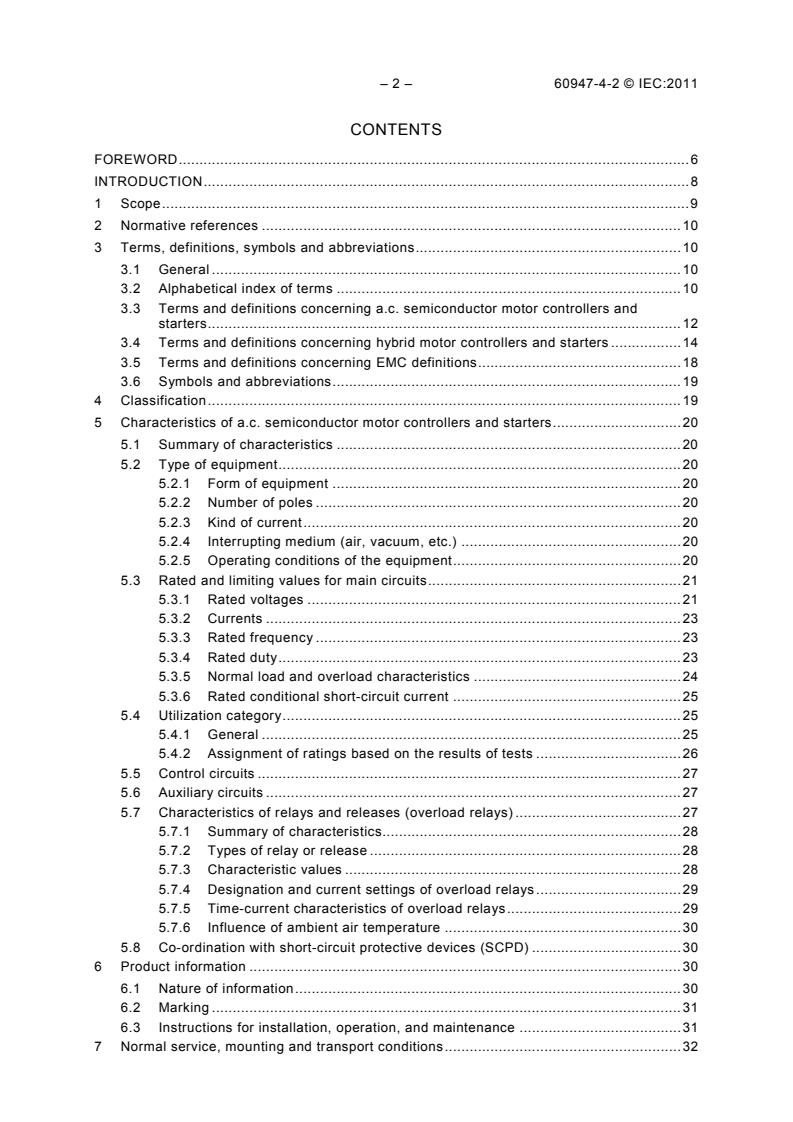
CONTENTS
FOREWORD . 6
INTRODUCTION . 8
1 Scope . 9
2 Normative references . 10
3 Terms, definitions, symbols and abbreviations . 10
3.1 General . 10
3.2 Alphabetical index of terms . 10
3.3 Terms and definitions concerning a.c. semiconductor motor controllers and
starters . 12
3.4 Terms and definitions concerning hybrid motor controllers and starters . 14
3.5 Terms and definitions concerning EMC definitions . 18
3.6 Symbols and abbreviations . 19
4 Classification . 19
5 Characteristics of a.c. semiconductor motor controllers and starters . 20
5.1 Summary of characteristics . 20
5.2 Type of equipment . 20
5.2.1 Form of equipment . 20
5.2.2 Number of poles . 20
5.2.3 Kind of current . 20
5.2.4 Interrupting medium (air, vacuum, etc.) . 20
5.2.5 Operating conditions of the equipment . 20
5.3 Rated and limiting values for main circuits . 21
5.3.1 Rated voltages . 21
5.3.2 Currents . 23
5.3.3 Rated frequency . 23
5.3.4 Rated duty . 23
5.3.5 Normal load and overload characteristics . 24
5.3.6 Rated conditional short-circuit current . 25
5.4 Utilization category . 25
5.4.1 General . 25
5.4.2 Assignment of ratings based on the results of tests . 26
5.5 Control circuits . 27
5.6 Auxiliary circuits . 27
5.7 Characteristics of relays and releases (overload relays) . 27
5.7.1 Summary of characteristics. 28
5.7.2 Types of relay or release . 28
5.7.3 Characteristic values . 28
5.7.4 Designation and current settings of overload relays . 29
5.7.5 Time-current characteristics of overload relays . 29
5.7.6 Influence of ambient air temperature . 30
5.8 Co-ordination with short-circuit protective devices (SCPD) . 30
6 Product information . 30
6.1 Nature of information . 30
6.2 Marking . 31
6.3 Instructions for installation, operation, and maintenance . 31
7 Normal service, mounting and transport conditions . 32
60947-4-2 © IEC:2011 – 3 –
7.1 Normal service conditions . 32
7.1.1 Ambient air temperature . 32
7.1.2 Altitude . 32
7.1.3 Atmospheric conditions . 32
7.1.4 Shock and vibrations . 32
7.2 Conditions during transport and storage . 32
7.3 Mounting . 32
7.4 Electrical system disturbances and influences . 32
8 Constructional and performance requirements . 33
8.1 Constructional requirements . 33
8.1.1 General . 33
8.1.2 Materials . 33
8.1.3 Current-carrying parts and their connections . 33
8.1.4 Clearances and creepage distances . 33
8.1.5 Actuator . 33
8.1.6 Indication of the contact position . 33
8.1.7 Additional requirements for equipment suitable for isolation . 33
8.1.8 Terminals . 33
8.1.9 Additional requirements for equipment provided with a neutral pole . 34
8.1.10 Provisions for protective earthing . 34
8.1.11 Enclosures for equipment . 34
8.1.12 Degrees of protection of enclosed equipment . 34
8.1.13 Conduit pull-out, torque and bending with metallic conduits . 34
8.2 Performance requirements . 34
8.2.1 Operating conditions . 34
8.2.2 Temperature rise . 38
8.2.3 Dielectric properties. 41
8.2.4 Normal load and overload performance requirements . 42
8.2.5 Co-ordination with short-circuit protective devices . 47
8.3 EMC requirements . 47
8.3.1 General . 47
8.3.2 Emission . 48
8.3.3 Immunity . 48
9 Tests . 50
9.1 Kinds of tests . 50
9.1.1 General . 50
9.1.2 Type tests . 50
9.1.3 Routine tests . 50
9.1.4 Sampling tests . 50
9.1.5 Special tests . 51
9.2 Compliance with constructional requirements . 51
9.3 Compliance with performance requirements . 51
9.3.1 Test sequences . 51
9.3.2 General test conditions . 52
9.3.3 Performance under no load, normal load, and overload conditions . 52
9.3.4 Performance under short-circuit conditions . 62
9.3.5 EMC tests . 65
9.3.6 Routine and sampling tests . 68
Annex A (normative) Marking and identification of terminals . 70
– 4 – 60947-4-2 © IEC:2011
Annex B Vacant . 73
Annex C (normative) Co-ordination at the crossover current between the starter and
associated SCPD . 74
Annex D Vacant . 78
Annex E Vacant . 79
Annex F (informative) Operating capability. 80
Annex G (informative) Examples of control circuit configurations . 83
Annex H Vacant . 85
Annex I (normative) Modified test circuit for short-circuit testing of semiconductor
motor controllers and starters . 86
Annex J (informative) Flowchart for constructing bypassed semiconductor controllers
tests . 88
Annex K (normative) Extended functions within electronic overload relays . 89
Bibliography . 94
Figure 1 – Semiconductor motor control devices . 13
Figure 2 – Connecting methods . 22
Figure 3 – Thermal memory test . 36
Figure 4 – Multiple of current setting limits for ambient air temperature compensated
time-delay overload relays . 62
Figure C.1 – Examples of time-current withstand characteristic . 77
Figure F.1 – Thermal stability test profile . 80
Figure F.2 – Overload capability test profile . 81
Figure F.3 – Blocking and commutating capability test profile . 82
Figure G.1 – Diagrammatic representation of an ECD . 83
Figure G.2 – Single supply and control input . 83
Figure G.3 – Single supply and control input . 84
Figure G.4 – Controllers with an internal control supply and control input only . 84
Figure I.1 − Modified circuit for short-circuit testing of semiconductor devices . 86
Figure I.2 − Time line for the short-circuit test of 9.3.4.1.6 . 87
Figure K.1 – Test circuit for the verification of the operating characteristic of a residual
current electronic overload relay . 93
Table 1 – Functional possibilities of semiconductor motor control devices . 14
Table 2 – Utilization categories . 26
Table 3 – Relative levels of severity . 27
Table 4 – Trip classes of overload relays . 29
Table 5 – Limits of operation of time-delay overload relays when energized on all poles . 35
Table 6 – Limits of operation of three-pole time-delay overload relays when energized
on two poles only . 37
Table 7 – Temperature rise limits for insulated coils in air and in oil . 40
Table 8 – Intermittent duty test cycle data . 40
Table 9 – Minimum overload current withstand time (T ) in relation to overload current
x
ratio (X) and corresponding to overload relay trip class (see Table 19) . 43
a
Table 10 – Minimum requirements for thermal stability test conditions . 43
60947-4-2 © IEC:2011 – 5 –
Table 11 – Minimum requirements for overload capability test conditions . 44
Table 12 – Minimum requirements and conditions for performance testing with an
induction motor load . 44
Table 13 – Making and breaking capacity test; making and breaking conditions
according to utilization categories for the mechanical switching device of hybrid motor
controllers H1, H2, H3 and for certain forms of bypassed controllers . 46
Table 14 – Conventional operational performance making and breaking conditions
according to utilization categories for the mechanical switching device of hybrid motor
controllers H1B, H2B, H3B and for certain forms of bypassed controllers . 46
Table 15 – Specific acceptance or performance criteria when EM disturbances are
present . 49
Table 16 – Thermal stability test specifications . 57
Table 17 – Initial case temperature requirements . 57
Table 18 – Blocking and commutating capability test specifications . 59
Table 19 – Terminal disturbance voltage limits for conducted radio-frequency emission . 67
Table 20 – Radiated emissions test limits . 67
Table A.1 – Main circuit terminal markings . 70
Table C.1 – Test conditions . 76
Table K.1 – Operating time of residual current electronic overload relays . 90
– 6 – 60947-4-2 © IEC:2011
INTERNATIONAL ELECTROTECHNICAL COMMISSION
____________
LOW-VOLTAGE SWITCHGEAR AND CONTROLGEAR –
Part 4-2: Contactors and motor-starters –
AC semiconductor motor controllers and starters
FOREWORD
1) The International Electrotechnical Commission (IEC) is a worldwide organization for standardization comprising
all national electrotechnical committees (IEC National Committees). The object of IEC is to promote
international co-operation on all questions concerning standardization in the electrical and electronic fields. To
this end and in addition to other activities, IEC publishes International Standards, Technical Specifications,
Technical Reports, Publicly Available Specifications (PAS) and Guides (hereafter referred to as “IEC
Publication(s)”). Their preparation is entrusted to technical committees; any IEC National Committee interested
in the subject dealt with may participate in this preparatory work. International, governmental and non-
governmental organizations liaising with the IEC also participate in this preparation. IEC collaborates closely
with the International Organization for Standardization (ISO) in accordance with conditions determined by
agreement between the two organizations.
2) The formal decisions or agreements of IEC on technical matters express, as nearly as possible, an international
consensus of opinion on the relevant subjects since each technical committee has representation from all
interested IEC National Committees.
3) IEC Publications have the form of recommendations for international use and are accepted by IEC National
Committees in that sense. While all reasonable efforts are made to ensure that the technical content of IEC
Publications is accurate, IEC cannot be held responsible for the way in which they are used or for any
misinterpretation by any end user.
4) In order to promote international uniformity, IEC National Committees undertake to apply IEC Publications
transparently to the maximum extent possible in their national and regional publications. Any divergence
between any IEC Publication and the corresponding national or regional publication shall be clearly indicated in
the latter.
5) IEC itself does not provide any attestation of conformity. Independent certification bodies provide conformity
assessment services and, in some areas, access to IEC marks of conformity. IEC is not responsible for any
services carried out by independent certification bodies.
6) All users should ensure that they have the latest edition of this publication.
7) No liability shall attach to IEC or its directors, employees, servants or agents including individual experts and
members of its technical committees and IEC National Committees for any personal injury, property damage or
other damage of any nature whatsoever, whether direct or indirect, or for costs (including legal fees) and
expenses arising out of the publication, use of, or reliance upon, this IEC Publication or any other IEC
Publications.
8) Attention is drawn to the Normative references cited in this publication. Use of the referenced publications is
indispensable for the correct application of this publication.
9) Attention is drawn to the possibility that some of the elements of this IEC Publication may be the subject of
patent rights. IEC shall not be held responsible for identifying any or all such patent rights.
International Standard IEC 60947-4-2 has been prepared by subcommittee 17B: Low-voltage
switchgear and controlgear, of IEC technical committee 17: Switchgear and controlgear.
This third edition replaces the second edition published in 1999 and its Amendments 1 (2001)
and 2 (2006). It is a technical revision.
This edition includes the following significant technical changes with respect to the previous
edition and its amendments:
• updated EMC normative references and associated requirements,
• new references to IEC 60947-1,
• marking of electronic relays without thermal memory,
• marking of tripping time at 0 °C ambient or below,
• new test requirements for limits of operation of time-delay overload relays,
60947-4-2 © IEC:2011 – 7 –
new classes of overload current withstand time,
damp heat, salt mist, vibration and shock tests,
short-circuit test in the smallest enclosure,
update of the routine and sampling tests.
This standard shall be read in conjunction with IEC 60947-1:2007, Low-voltage switchgear
and controlgear – Part 1: General rules. The provisions of the general rules are applicable to
this standard, where specifically called for.
The text of this standard is based on the following documents:
FDIS Report on voting
17B/1734/FDIS 17B/1741/RVD
Full information on the voting for the approval of this standard can be found in the report on
voting indicated in the above table.
This publication has been drafted in accordance with the ISO/IEC Directives, Part 2.
A list of all the parts in the IEC 60947 series, under the general title Low-voltage switchgear
and controlgear, can be found on the IEC website.
The committee has decided that the contents of this publication will remain unchanged until
the stability date indicated on the IEC web site under "http://webstore.iec.ch" in the data
related to the specific publication. At this date, the publication will be
• reconfirmed,
• withdrawn,
• replaced by a revised edition, or
• amended.
The contents of the corrigendum of July 2012 have been included in this copy.
– 8 – 60947-4-2 © IEC:2011
INTRODUCTION
This standard covers low-voltage a.c. semiconductor motor controllers and starters that have
many capabilities and features beyond the simple starting and stopping of an induction motor,
such as controlled starting and stopping, manoeuvring and controlled running.
The generic term “controller” is used in this standard wherever the unique features of the
power semiconductor switching elements are the most significant points of interest. The
generic term “starter” is used wherever the consequences of operating the power semi-
conductor switching elements, together with suitable overload protective means, are the most
significant points of interest. Specific designations (for example form 1, form HxB, etc.) are
used wherever the unique features of various configurations comprise significant points of
interest.
60947-4-2 © IEC:2011 – 9 –
LOW-VOLTAGE SWITCHGEAR AND CONTROLGEAR –
Part 4-2: Contactors and motor-starters –
AC semiconductor motor controllers and starters
1 Scope
This standard applies to a.c. semiconductor motor controllers and starters, which may include
a series mechanical switching device, intended to be connected to circuits, the rated voltage
of which does not exceed 1 000 V a.c.
This standard characterizes a.c. semiconductor motor controllers and starters with and
without bypass means.
AC semiconductor motor controllers and starters dealt with in this standard are not normally
designed to interrupt short-circuit currents. Therefore, suitable short-circuit protection (see
8.2.5) should form part of the installation, but not necessarily of the a.c. semiconductor motor
controller or starter.
In this context, this standard gives requirements for a.c. semiconductor motor controllers and
starters associated with separate short-circuit protective devices.
This standard does not apply to
– continuous operation of a.c. motors at motor speeds other than the normal speed;
– semiconductor equipment, including semiconductor contactors (see 2.2.13 of
IEC 60947-1:2007) controlling non-motor loads;
– electronic a.c. power controllers covered by IEC 60146 series.
Contactors, overload relays and control circuit devices used in a.c. semiconductor motor
controllers and starters should comply with the requirements of their relevant product
standard. Where mechanical switching devices are used, they should meet the requirements
of their own IEC product standard, and the additional requirements of this standard.
The object of this standard is to state as follows:
– the characteristics of a.c. semiconductor motor controllers and starters and associated
equipment;
– the conditions with which a.c. semiconductor motor controllers and starters comply with
reference to
a) their operation and behaviour;
b) their dielectric properties;
c) the degrees of protection provided by their enclosures where applicable;
d) their construction;
– the tests intended for confirming that these conditions have been met, and the methods to
be adopted for these tests;
– the information to be given with the equipment, or in the manufacturer's literature.
NOTE For the purpose of this standard, the term "controller" may be used instead of
"a.c. semiconductor motor controller".
– 10 – 60947-4-2 © IEC:2011
2 Normative references
The following referenced documents are indispensable for the application of this document.
For dated references, only the edition cited applies. For undated references, the latest edition
of the referenced document (including any amendments) applies.
IEC 60034-1:2010, Rotating electrical machines – Part 1: Rating and performance
IEC 60085:2007, Electrical insulation – Thermal evaluation and designation
IEC 60269-1:2006, Low-voltage fuses – Part 1: General requirements
Amendment 1 (2009)
IEC 60410:1973, Sampling plans and procedures for inspection by attributes
IEC 60664 (all parts), Insulation coordination for equipment within low-voltage systems
IEC 60947-1:2007, Low-voltage switchgear and controlgear – Part 1: General rules
IEC 61000-4 (all parts), Electromagnetic compatibility (EMC) – Part 4: Testing and
measurement techniques
CISPR 11:2009, Industrial, scientific and medical equipment – Radio-frequency disturbance
characteristics – Limits and methods of measurement
Amendment 1 (2010)
3 Terms, definitions, symbols and abbreviations
3.1 General
For the purposes of this document, the terms and definitions of Clause 2 of IEC 60947-
1:2007, as well as the following terms, definitions, symbol and abbreviations apply.
3.2 Alphabetical index of terms
Reference
A
a.c. semiconductor motor controller . 3.3.2
B
burst (of pulses or oscillations) . 3.5.7
bypassed controller . 3.4.31
C
CO operation . 3.4.32
controlled acceleration . 3.4.6
controlled deceleration . 3.4.7
controlled running . 3.4.8
current-limit function . 3.4.4
E
electromagnetic compatibility [EMC] . 3.5.1
electromagnetic disturbance . 3.5.3
electromagnetic emission . 3.5.2
60947-4-2 © IEC:2011 – 11 –
F
FULL-ON (state of controllers) . 3.4.12
H
hybrid motor controller or starter, form HxA (where x = 1, 2 or 3) . 3.4.1
hybrid motor controller or starter, form HxB . 3.4.2
I
inhibit time . 3.4.28
J
jam sensitive electronic overload relay . 3.4.27
M
manoeuvre . 3.4.5
minimum load current . 3.4.13
O
O operation . 3.4.33
OFF-state . 3.4.14
OFF-state leakage current [I ]. 3.4.15
L
OFF-time . 3.4.30
ON-state . 3.4.11
ON-time . 3.4.29
OPEN position . 3.4.3
operating capability . 3.4.18
operating cycle (of a controller) . 3.4.17
operation (of a controller). 3.4.16
overload current profile . 3.4.19
P
phase loss sensitive overload relay or release . 3.4.23
prospective current (of a circuit and with respect to a switching device or a fuse) . 3.4.9
prospective locked rotor current [I ] . 3.4.10
LRP
R
radio (frequency) disturbance . 3.5.4
radio frequency interference [RFI] . 3.5.5
rating index . 3.4.20
S
semiconductor direct on line (DOL) motor controller (form 3) . 3.3.5
semiconductor motor controller (form 1) . 3.3.3
semiconductor motor starter (form 1, form 2, form 3) . 3.3.6
semiconductor soft-start motor controller (form 2) . 3.3.4
semiconductor switching device . 3.3.1
stall sensitive electronic overload relay . 3.4.26
T
transient (adjective and noun) . 3.5.6
trip-free controller or starter . 3.4.22
tripping operation (of a controller or starter) . 3.4.21
U
under-current relay or release . 3.4.24
under-voltage relay or release . 3.4.25
– 12 – 60947-4-2 © IEC:2011
V
voltage surge . 3.5.8
3.3 Terms and definitions concerning a.c. semiconductor motor controllers and
starters
3.3.1
semiconductor switching device
switching device designed to make and/or break the current in an electric circuit by means of
the controlled conductivity of a semiconductor
NOTE This definition differs from IEC 60050-441:1984, 441-14-03 since a semiconductor switching device is also
designed for breaking the current.
[IEC 60947-1:2007, 2.2.3]
3.3.2
a.c. semiconductor motor controller
semiconductor switching device that provides the starting function for an a.c. motor and an
OFF-state
NOTE 1 Because dangerous levels of leakage currents can exist in a semiconductor motor controller in the OFF-
state, the load terminals should be considered as live parts at all times.
NOTE 2 In a circuit where the current passes through zero (alternately or otherwise), the effect of "not making"
the current following such a zero value is equivalent to breaking the current.
3.3.3
semiconductor motor controller (form 1)
a.c. semiconductor motor controller, in which the starting function may comprise any starting
method specified by the manufacturer, and that provides control functions which may include
any combination of manoeuvring, controlled acceleration, running or controlled deceleration of
an a.c. motor. A FULL-ON state may also be provided
NOTE See Figure 1 and Table 1.
3.3.4
semiconductor soft-start motor controller (form 2)
special form of a.c. semiconductor motor controller, in which the starting function is limited to
a voltage and/or current ramp which may include controlled acceleration, and where the
additional control function is limited to providing FULL-ON
NOTE See Figure 1 and Table 1.
3.3.5
semiconductor direct on line (DOL) motor controller (form 3)
special form of a.c. semiconductor motor controller, in which the starting function is limited to
a full-voltage, unramped starting method only, and where the additional control function is
limited to providing FULL-ON
NOTE See Figure 1 and Table 1.
3.3.6
semiconductor motor starter (form 1, form 2, form 3)
a.c. semiconductor motor controller with suitable overload protection, rated as a unit
NOTE See Figure 1 and Table 1.
60947-4-2 © IEC:2011 – 13 –
Device
Semiconductor
motor controller
(forms 1, 2, 3)
IEC 1731/99
Semiconductor
motor starter
(forms 1, 2, 3)
IEC 1732/99
Hybrid motor
controller
a
HxA
where x = 1, 2 or 3
IEC 1733/99
Hybrid motor
controller
b
HxB
IEC 1734/99
Parallel mechanical
contact
Bypassed controller
Semiconductor controller
L T
(Forms 1, 2, 3)
IEC 2344/01
Parallel mechanical
contact
Hybrid motor controller
Bypassed hybrid motor
c
controller
Series Semiconductor
L
T
mechanical controller
contact
(Forms HxA, HxB)
IEC 2345/01
Form H1A or H1B Form H2A or H2B Form H3A or H3B
Hybrid motor
with motor overload with motor overload with motor overload
starter
protection protection protection
a
Two separate controls for the controller and the series mechanical switching device.
b
One control only for the series mechanical switching device.
c
For other configurations, tests may be suitably adapted by agreement between the user and the
manufacturer.
Figure 1 – Semiconductor motor control devices
– 14 – 60947-4-2 © IEC:2011
Table 1 – Functional possibilities of semiconductor motor control devices
Device Form 1 Form 2 Form 3
Semiconductor – OFF – OFF state Not available
motor controller
– Starting function – Starting function
– Manoeuvring – Controlled acceleration
– Controlled acceleration – FULL ON
– Running
– FULL ON
– Controlled deceleration
Semiconductor DOL Not available Not available – OFF state
motor controller
– Starting function
– FULL ON
Semiconductor Form 1 controller with motor Form 2 controller with Not available
motor starter overload protection motor overload protection
Semiconductor DOL Not available Not available Form 3 DOL motor
motor starter controller with motor
overload
protection
Hybrid motor H1A: H2A: H3A:
a
controller HxA
– Open – Open – Open
where x = 1, 2 or 3
– OFF state – OFF state – OFF state
– Starting function – Starting function – Starting function
– Manoeuvring – Controlled acceleration – FULL ON
– Controlled acceleration – FULL ON
– Ru
...