

IEC 60444-1:1986/AMD1:1999
(Amendment)Amendment 1 - Measurement of quartz crystal unit parameters by zero phase technique in a pi-network. Part 1: Basic method for the measurement of resonance frequency and resonance resistance of quartz crystal units by zero phase technique in a pi-network
General Information
- Abstract
- Status
- Published
- Publication Date
- 12-Aug-1999
- Technical Committee
- TC 49 - Piezoelectric, dielectric and electrostatic devices and associated materials for frequency control, selection and detection
- Drafting Committee
- WG 11 - TC 49/WG 11
- Current Stage
- PPUB - Publication issued
- Start Date
- 13-Aug-1999
- Completion Date
- 30-Sep-1999
Buy Documents
IEC 60444-1:1986/AMD1:1999 - Amendment 1 - Measurement of quartz crystal unit parameters by zero phase technique in a pi-network. Part 1: Basic method for the measurement of resonance frequency and resonance resistance of quartz crystal units by zero phase technique in a pi-network
IEC 60444-1:1986/AMD1:1999 – Quartz Crystal Unit Parameter Measurement Using Zero Phase Technique in a Pi-Network
Overview
IEC 60444-1 Amendment 1 (1999) updates the international standard for measuring quartz crystal unit parameters using the zero phase technique within a pi-network. This technical update enhances the fundamental method for accurately determining the resonance frequency and resonance resistance of quartz crystal units. It refines key formulas and calibration procedures essential for precision measurement in piezoelectric frequency control devices.
This amendment is crafted by IEC Technical Committee 49, specializing in piezoelectric and dielectric devices for frequency control and selection. It addresses improved measurement methodologies aligned with practical calibration using a 25 Ω reference resistor, instead of traditional short-circuit calibration, optimizing accuracy in resonance parameter evaluations.
Key Topics
Zero Phase Technique
Utilizes phase-slope analysis within a pi-network circuit to determine resonance parameters with minimal phase errors, ensuring high measurement fidelity.Pi-Network Calibration Update
Replacement of short-circuit calibration with a 25 Ω reference resistor in the pi-network improves error analysis and formula precision, leading to more reliable resonance resistance measurements.Resonance Frequency & Resistance Measurement
Defines the procedure to accurately extract resonance frequency and resistance from voltage measurements across the crystal in a pi-network configuration.Voltage Transfer Factor Derivation
Provides a comprehensive formula for voltage transfer in the pi-network, including the effects of the crystal's impedance and termination resistors, reflective of real-world measurement setups.Error Analysis Methodology
Presents detailed relationships to quantify measurement deviations' impact on resonance resistance, including errors arising from voltage channel deviations and reference resistor tolerances.Crystal Current and Drive Level
Calculates the resonator current and excitation power in the pi-network, critical for understanding device stress and operational limits during measurement.Phase Slope and Quality Factor (Q) Correction
Updates to the expression for the effective quality factor Q based on the phase response near resonance, replacing previously incorrect formulas and improving resonator characterization accuracy.
Applications
Frequency Control Device Testing
Enables manufacturers and laboratories to precisely measure and characterize quartz crystal units, a vital step in quality assurance and device specification compliance.Piezoelectric Resonator Development
Supports improved design and testing of piezoelectric components used in oscillators, filters, and timing circuits by providing accurate resonance parameter measurements.Calibration of Measurement Instruments
Offers updated calibration procedures for test equipment utilizing the pi-network to ensure reliable and repeatable measurements in industrial and research settings.Signal Processing and Telecommunications
Supports component validation critical to telecommunications infrastructure where stable and accurate frequency standards are required.
Related Standards
IEC 61080:1991 – Guide for the measurement of equivalent electrical parameters of quartz crystal units, supporting the theoretical background and narrow band approximation used in IEC 60444-1 Amendment 1.
IEC 60444 (original series) – Standard series covering measurement techniques for piezoelectric quartz crystal units, providing the broader context for the methodology updated in this amendment.
IEEE Standards for Piezoelectric Devices – Complementary standards used alongside IEC protocols in industry, focusing on reliability and performance of piezoelectric components.
Practical Value and Keywords
This amendment introduces vital formula refinements and a more practical calibration approach facilitating improved accuracy in quartz crystal resonance measurements. By incorporating enhanced error analysis and updated calculations for crystal current and phase slopes, IEC 60444-1 Amendment 1 ensures higher confidence in device characterization critical to electronics manufacturing and frequency control applications.
Keywords: quartz crystal unit, zero phase technique, pi-network, resonance frequency measurement, resonance resistance, calibration procedure, piezoelectric resonator, crystal drive level, quality factor Q, voltage transfer factor, IEC 60444-1 amendment, frequency control devices, piezoelectric measurement, resonance impedance, resonance parameter error analysis.
Buy Documents
IEC 60444-1:1986/AMD1:1999 - Amendment 1 - Measurement of quartz crystal unit parameters by zero phase technique in a pi-network. Part 1: Basic method for the measurement of resonance frequency and resonance resistance of quartz crystal units by zero phase technique in a pi-network
Frequently Asked Questions
IEC 60444-1:1986/AMD1:1999 is a standard published by the International Electrotechnical Commission (IEC). Its full title is "Amendment 1 - Measurement of quartz crystal unit parameters by zero phase technique in a pi-network. Part 1: Basic method for the measurement of resonance frequency and resonance resistance of quartz crystal units by zero phase technique in a pi-network". This standard covers: Amendment 1 - Measurement of quartz crystal unit parameters by zero phase technique in a pi-network. Part 1: Basic method for the measurement of resonance frequency and resonance resistance of quartz crystal units by zero phase technique in a pi-network
Amendment 1 - Measurement of quartz crystal unit parameters by zero phase technique in a pi-network. Part 1: Basic method for the measurement of resonance frequency and resonance resistance of quartz crystal units by zero phase technique in a pi-network
IEC 60444-1:1986/AMD1:1999 is classified under the following ICS (International Classification for Standards) categories: 31.140 - Piezoelectric devices. The ICS classification helps identify the subject area and facilitates finding related standards.
IEC 60444-1:1986/AMD1:1999 is available in PDF format for immediate download after purchase. The document can be added to your cart and obtained through the secure checkout process. Digital delivery ensures instant access to the complete standard document.
Standards Content (Sample)
NORME CEI
INTERNATIONALE IEC
60444-1
INTERNATIONAL
STANDARD
AMENDEMENT 1
AMENDMENT 1
1999-08
Amendement 1
Mesure des paramètres des quartz
piézoélectriques par la technique de phase nulle
dans le circuit en pi –
Partie 1:
Méthode fondamentale pour la mesure de la
fréquence de résonance et de la résistance de
résonance des quartz piézoélectriques par la
technique de phase nulle dans le circuit en pi
Amendment 1
Measurement of quartz crystal unit parameters
by zero phase technique in a pi-network –
Part 1:
Basic method for the measurement of resonance
frequency and resonance resistance of quartz
crystal units by zero phase technique in
a pi-network
IEC 1999 Droits de reproduction réservés Copyright - all rights reserved
International Electrotechnical Commission 3, rue de Varembé Geneva, Switzerland
Telefax: +41 22 919 0300 e-mail: inmail@iec.ch IEC web site http://www.iec.ch
CODE PRIX
Commission Electrotechnique Internationale
H
PRICE CODE
International Electrotechnical Commission
Pour prix, voir catalogue en vigueur
For price, see current catalogue
– 2 – 60444-1 amend. 1 © CEI:1999
AVANT-PROPOS
Le présent amendement a été établi par le comité d'études 49 de la CEI: Dispositifs
piézoélectriques et diélectriques pour la commande et le choix de la fréquence.
Le texte de cet amendement est issu des documents suivants:
FDIS Rapport de vote
49/442/FDIS 49/445/RVD
Le rapport de vote indiqué dans le tableau ci-dessus donne toute information sur le vote ayant
abouti à l'approbation de cet amendement.
___________
Page 2
SOMMAIRE
Ajouter le titre de l'annexe B comme suit:
Annexe B – Mise à jour de certaines formules de l'annexe A
Page 42
Ajouter, après l'annexe A, la nouvelle annexe B comme suit:
Annexe B
(normative)
Mise à jour de certaines formules de l'annexe A
B.1 Objectifs
Dans cette annexe, certaines formules de l'annexe A sont mises à jour en prenant en
considération la procédure modifiée d'étalonnage d'un réseau en π avec la résistance de
référence R = 25 Ω à la place de la lame court-circuit.
n
La formule reliant R aux tensions mesurées est dérivée pour les valeurs arbitraires de la
r
résistance de référence R . L'erreur sur R est prise en considération dans l'analyse des
n n
erreurs pour R .
r
La formule est donnée pour le courant et le niveau d'excitation d'un résonateur à quartz inséré
dans le réseau en π. La pente de phase d'un résonateur à quartz inséré dans le réseau en π
est obtenue et la formule pour Q est corrigée.
eff
60444-1 Amend. 1 © IEC:1999 – 3 –
FOREWORD
This amendment has been prepared by IEC technical committee 49: Piezoelectric and
dielectric devices for frequency control and selection.
The text of this amendment is based on the following documents:
FDIS Report on voting
49/442/FDIS 49/445/RVD
Full information on the voting for the approval of this amendment can be found in the report on
voting indicated above.
___________
Page 3
CONTENTS
Add the title of annex B as follows:
Annex B – Updating of some formulae of appendix A
Page 43
Add, after appendix A, the new annex B as follows:
Annex B
(normative)
Updating of some formulae of appendix A
B.1 Purposes
In this annex some formulae of the appendix A are updated, taking into account the modified
calibration procedure of the π-network with a reference resistor R = 25 Ω instead of a short.
n
The formula relating R to the measured voltages is derived for arbitrary values of the
r
reference resistor R . The error of R is taken into account in the error analysis for R .
n n r
The formula for current and drive level of the crystal in the π-network is given. The phase slope
of the crystal inserted in the π-network is derived and the formula for Q is corrected.
eff
– 4 – 60444-1 amend. 1 © CEI:1999
B.2 Circuit en π chargé par Z = 50 Ω (avec le circuit en dérivation conforme à la
figure 5a)
Circuit en dérivation
(voir figure 5a)
Z
c
R R
Z 4
Z
Z
R R R
3 5 6 Z
R V
B
Z
V
V
AA V V
V AAV
B0
IEC 1019/99
Figure B.1 – Circuit en π chargé
B.3 Facteur de transfert de la tension d'un circuit en π chargé
Ci-dessous la dérivation élémentaire du facteur de transfert de la tension est présentée pour
obtenir une formule plus complète.
−1
1 1
′
Soit R = R Z = +
6 6
R Z
6
′
R
V
B 6
Alors = = k = 0,3649 (B.1)
π
′ ′
V R + R
B 6 7
−1
1 1
′ ′
R = R R + R = + = R = Ω
Définir 12,5
5 5 6 7 T2
′
R
R + R
6 7
R π
où est la résistance de terminaison à la sortie du circuit en comme vu de la part d'un
T2
résonateur.
′
′
V R
B 5
Alors = (B.2)
′′′ ′
V
R + Z
A
5 c
−
′ ′ 1 1
Définir R = R R + Z = +
3 3 5 c
′
R
R + Z
5 c
′
′′′
V R
A 3
Alors = (B.3)
″ ′
V R + R
A 3 4
60444-1 Amend. 1 © IEC:1999 – 5 –
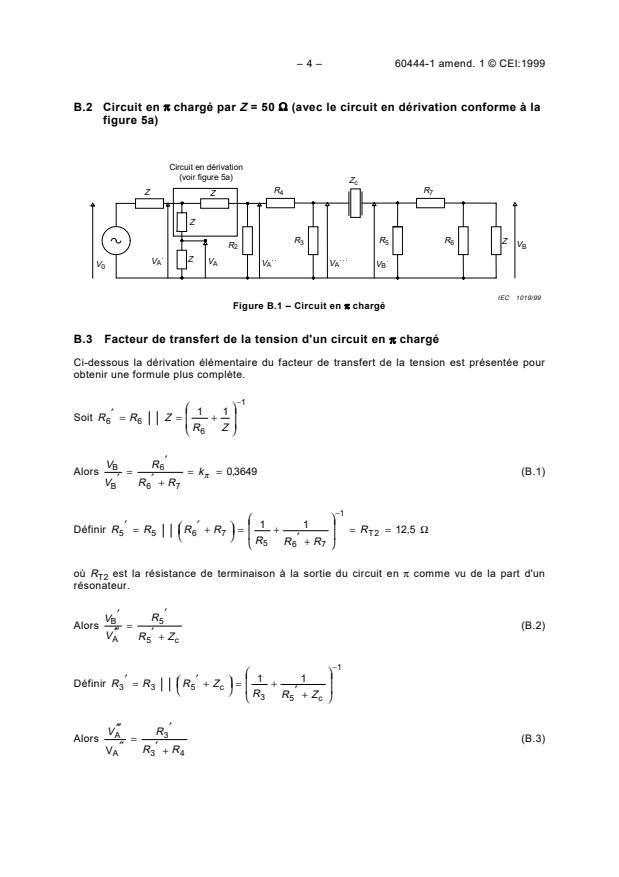
B.2 The -network terminated by Z = 50 (with power splitter according to
π Ω
figure 5a)
Power splitter
(see figure 5a)
Z
c
R R
Z 4
Z
Z
R R R
3 5 6 Z
R V
B
Z
V
V
AA V V
V AAV
B0
IEC 1019/99
Figure B.1 – Terminated π-network
B.3 Voltage transfer factor of the terminated π-network
In the following an elementary derivation of the voltage transfer factor is presented to provide a
more comprehensive formula.
−1
1 1
′
= = +
Let R R Z
6 6
R Z
6
′
V R
B 6
= = =
Then k 0,3649 (B.1)
π
′ ′
V R + R
B 6 7
−1
1 1
′ ′
Define = + = + = = 12,5 Ω
R R R R R
5 5 6 7 T2
′
R
R + R
6 7
where R is the termination resistance at the output of the π-network as seen by the crystal.
T2
′ ′
R
V
B 5
=
Then (B.2)
′′′ ′
V R + Z
A
5 c
−1
′ ′ 1 1
Define R = R R + Z = +
3 3 5 c
′
R
+
R Z
5 c
′
′′′
V R
A 3
Then = (B.3)
″ ′
V R + R
A 3 4
– 6 – 60444-1 amend. 1 © CEI:1999
−1
1 1
′ ′
Définir R = R R + R = +
2 2 3 4
′
R
2 R + R
3 4
Il s'ensuit que pour le circuit en dérivation conforme à la figure 5a et ne prenant pas en
considération les câbles:
″ ′
V R
A 2
= (B.4)
′ ′
V R + Z
A 2
′
V
2Z
A
et = = 2 (B.5)
V Z
A
Le facteur de transfert de la tension V /V est obtenu en multipliant les formules (B.1) × (B.2)
B A
× (B.3) × (B.4) × (B.5):
′ ″ ′
′′′
V V V V V V
B B B A A A
= × × × ×
′ ′′′ ″ ′
V V
V
A V V V A
A
B A A
Après certaines substitutions et réarrangements, on peut montrer que
V RR2ZRR
B 2T1T26
= × (B.6)
V()Z()R+R+RR×()Z(R+R)+RRZ+R+R
A 2424 6767cT1T2
où
−1
1 1
R = + = 12,5 Ω
T1
−1
R
3
1 1
+ +
R
R Z
2
et
−1
1 1
R = + = 12,5 Ω
T2
−1
R
1 1
R + +
R Z
V /V est symétrique par rapport à l'entrée et à la sortie du circuit en π et se divise en un
B A
facteur qui dépend de Z et des valeurs de la résistance du circuit en π seulement, et en un
facteur qui dépend de l'impédance du résonateur Z chargée par les impédances de
c
terminaison du circuit en π.
60444-1 Amend. 1 © IEC:1999 – 7 –
−1
1 1
′ ′
Define R = R R + R = +
2 2 3 4
′
R
2 R + R
3 4
Then, for a power splitter according to figure 5a and disregarding the cables:
″ ′
V R
A 2
= (B.4)
′ ′
V R + Z
A 2
′
V
2Z
A
= =
and 2 (B.5)
V Z
A
The voltage transfer factor V / V is obtained by multiplying formulae (B.1) (B.2) (B.3)
× × ×
B A
(B.4) (B.5):
×
′ ′′′ ″ ′
V V V V V V
B B B A A A
= × × × ×
′ ′′′ ″ ′
V V
V
V V V
A A
A
B A A
After some substitutions and rearrangements it can be shown that
V RR2ZRR
B 2T1T26
= × (B.6)
V()Z()R+R+RR×()Z(R+R)+RRZ+R+R
A 2424 6767cT1T2
where
−1
1 1
R = + = 12,5
Ω
T1
−1
R
1 1
R + +
R Z
and
−1
1 1
R = + = 12,5
Ω
T2
−1
R
1 1
R + +
R Z
6
V /V is symmetric with respect to the input and the output of the π-network and splits into a
B A
factor which depends only on Z and the resistance values of the π-network and a factor which
depends on the crystal impedance Z loaded by the termination impedances of the π-network.
c
– 8 – 60444-1 amend. 1 © CEI:1999
V
B
= K()R .R, Z ×
2 7
V Z + R
A c T
où R = R + R = 25 Ω.
T T1 T2
A ce stade, les approximations ne sont pas faites. L'équation (B.6) est valable même si on
admet que les résistances ont une impédance complexe.
La valeur de V /V pour Z = 0 Ω est
B A c
K/R = 0,0333
T
ce qui correspond à l'affaiblissement de 29,6 dB.
B.4 Calibration avec la résistance de référence R = 25 Ω
n
Comme K ne dépend pas de Z , l'application de la formule (B.6) donne ce qui suit:
c
pour la résistance de référence R insérée dans le circuit en π,
n
V K
Bn
= (B.7)
V R + R
An n T
et pour le résonateu
...