


IEC PAS 61804-1:2002
(Main)Function blocks (FB)for process control - Part 1: Overview of system aspects
General Information
- Abstract
provides a specification for suppliers to meet evolving requirements for digital process control systems by having a common standard through which users can be assured of compatibility, interworkability, interconnectability, interoperability and interchangeability of the devices they choose. defines the requirements for FBs to provide control, and to facilitate maintenance and technical management as applications, which interact with actuators and measurement devices
- Status
- Replaced
- Publication Date
- 14-Oct-2002
- Technical Committee
- SC 65C - Industrial networks
- Current Stage
- DELPUB - Deleted Publication
- Start Date
- 10-Oct-2003
- Completion Date
- 28-Aug-2026

Relations
- Replaced By
IEC TS 61804-1:2003 - Function blocks (FB) for process control - Part 1: Overview of system aspects - Effective Date
- 05-Sep-2023
Get Certified
Connect with accredited certification bodies for this standard

BSI Group
BSI (British Standards Institution) is the business standards company that helps organizations make excellence a habit.

DVS-ZERT GmbH
German welding certification society.
CARES (UK Certification Authority for Reinforcing Steels)
UK certification for reinforcing steels and construction.
Sponsored listings
Frequently Asked Questions
IEC PAS 61804-1:2002 is a technical specification published by the International Electrotechnical Commission (IEC). Its full title is "Function blocks (FB)for process control - Part 1: Overview of system aspects". This standard covers: provides a specification for suppliers to meet evolving requirements for digital process control systems by having a common standard through which users can be assured of compatibility, interworkability, interconnectability, interoperability and interchangeability of the devices they choose. defines the requirements for FBs to provide control, and to facilitate maintenance and technical management as applications, which interact with actuators and measurement devices
provides a specification for suppliers to meet evolving requirements for digital process control systems by having a common standard through which users can be assured of compatibility, interworkability, interconnectability, interoperability and interchangeability of the devices they choose. defines the requirements for FBs to provide control, and to facilitate maintenance and technical management as applications, which interact with actuators and measurement devices
IEC PAS 61804-1:2002 is classified under the following ICS (International Classification for Standards) categories: 25.040.40 - Industrial process measurement and control; 35.240.50 - IT applications in industry. The ICS classification helps identify the subject area and facilitates finding related standards.
IEC PAS 61804-1:2002 has the following relationships with other standards: It is inter standard links to IEC TS 61804-1:2003. Understanding these relationships helps ensure you are using the most current and applicable version of the standard.
IEC PAS 61804-1:2002 is available in PDF format for immediate download after purchase. The document can be added to your cart and obtained through the secure checkout process. Digital delivery ensures instant access to the complete standard document.
Standards Content (Sample)
IEC/PAS 61804-1
Edition 1.0
2002-10
PRE-STANDARD
Function blocks (FB)
for process control –
Part 1:
Overview of system aspects
PUBLICLY AVAILABLE SPECIFICATION
IN TE RNA TI ONA L
ELECTROTEC HNICAL
Reference number
COM M IS SION
IEC/PAS 61804-1
IEC/PAS 61804-1
Edition 1.0
2002-10
PRE-STANDARD
Function blocks (FB)
for process control –
Part 1:
Overview of system aspects
PUBLICLY AVAILABLE SPECIFICATION
IN TE RNA TI ONA L
ELECTROTEC HNICAL
Reference number
COM M IS SION
IEC/PAS 61804-1
– 2 – Copyright IEC, 2002
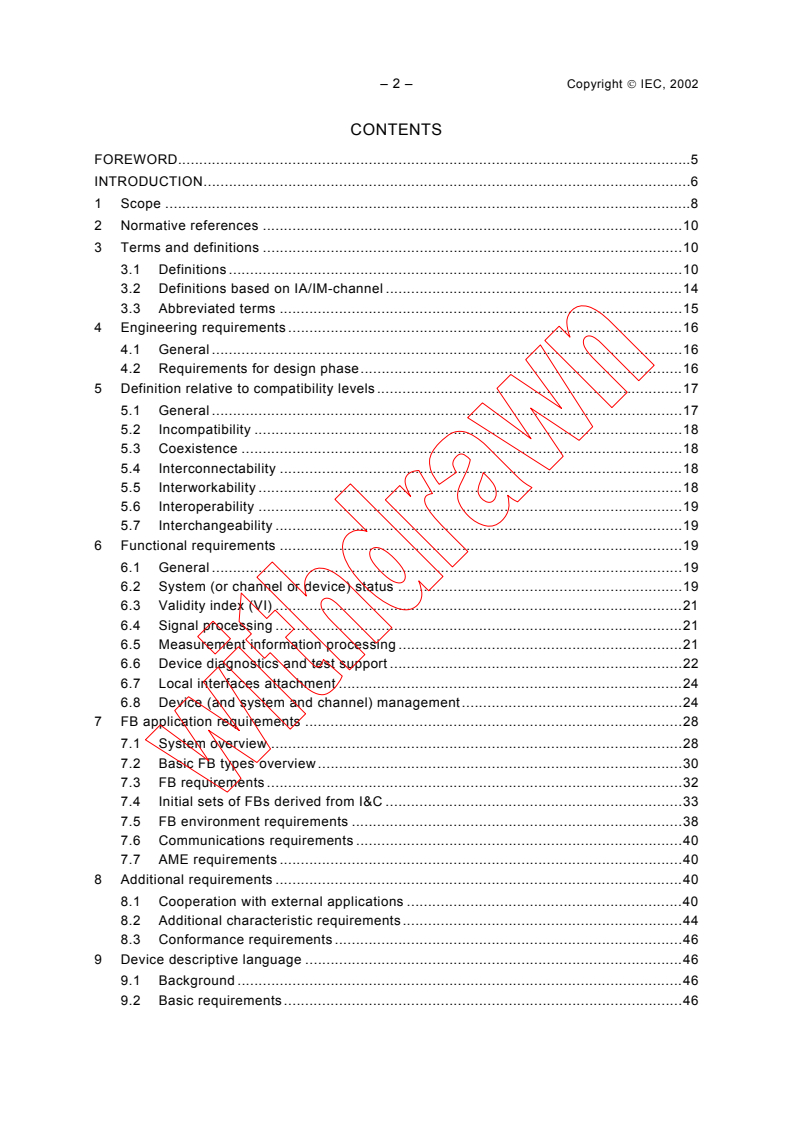
CONTENTS
FOREWORD.5
INTRODUCTION.6
1 Scope .8
2 Normative references .10
3 Terms and definitions .10
3.1 Definitions .10
3.2 Definitions based on IA/IM-channel .14
3.3 Abbreviated terms .15
4 Engineering requirements .16
4.1 General .16
4.2 Requirements for design phase.16
5 Definition relative to compatibility levels .17
5.1 General .17
5.2 Incompatibility .18
5.3 Coexistence .18
5.4 Interconnectability .18
5.5 Interworkability .18
5.6 Interoperability .19
5.7 Interchangeability .19
6 Functional requirements .19
6.1 General .19
6.2 System (or channel or device) status .19
6.3 Validity index (VI) .21
6.4 Signal processing .21
6.5 Measurement information processing .21
6.6 Device diagnostics and test support .22
6.7 Local interfaces attachment .24
6.8 Device (and system and channel) management.24
7 FB application requirements .28
7.1 System overview .28
7.2 Basic FB types overview .30
7.3 FB requirements .32
7.4 Initial sets of FBs derived from I&C .33
7.5 FB environment requirements .38
7.6 Communications requirements .40
7.7 AME requirements .40
8 Additional requirements .40
8.1 Cooperation with external applications .40
8.2 Additional characteristic requirements.44
8.3 Conformance requirements .46
9 Device descriptive language .46
9.1 Background .46
9.2 Basic requirements.46
Copyright IEC, 2002 – 3 –
9.3 General requirements .48
Annex A (informative) Lifecycle of the system.50
Annex B (informative) FB functional requirements: the user’s view.73
Annex C (informative) Relation between IEC 61804 series and IEC 61499-1 .90
Annex D (informative) Mapping of analogue input FB to IEC1499.102
Annex E (informative) FB requirement overview support .115
Annex F (informative) AME requirements .117
Bibliography .123
Figure 1 – Interactions of applications .7
Figure 2 – Influences on IEC 61804 .9
Figure 3 – Levels of functional device compatibility.17
Figure 4 – Device (or channel or system) status .20
Figure 5 – Components of a FB device.28
Figure 6 – Device structure for a FB application for the process industry.31
Figure 7– Functional hierarchy of sensors: example .37
Figure 8– Data access of non-FB applications .41
Figure A.1 – Life cycle from the Process circuit to the FRDs .51
Figure A.2 – PFD composed of two process elementary operations.52
FigureA 3 – Control functions explicitly represented on the extended P&ID .54
Figure A.4– Extraction of control functions from the extended P&ID .55
Figure A.5– Requirements for control functions and ABs.56
Figure A.6– Structured documentation for the requirements of the control functions .56
Figure A.7– The four sections of a folio .57
Figure A.8 – Selection of a folio from the CHD.58
Figure A.9– Folio for detailed requirements of the control function "to control the
pumps" .58
FigureA 10 – Example of FRDs .59
Figure A.11 – Functional Requirements Diagrams independent of I&C system
implementation .60
Figure A.12 – The need of a standardized FB language .60
Figure A.13 – Library of standardized EFBs.61
Figure A.14 – From FRDs down to the I&C system and devices .62
Figure A.15 – Design of an actuation and its AB from off the shelf actuation devices .63
Figure A.16 – Designing internal behaviour of actuation AB from actuation devices of
the shelf .64
Figure A.17 – Networking of the internal blocks inside the AB and with upstream and
downstream EFBs and ABs of the control function .64
Figure A.18 – Actuation AB graphic symbol and implicit internal description .65
Figure A.19 – OFF/ON value actuation AB using the IEC 61499-1 system model.66
Figure A.20 – OFF/ON value actuation AB using the IEC 61499-1 system model.66
Figure A.21 – Example of a safe switch over 2/3 AB .67
Figure A.22 – Switch over 2/3 AB using the IEC 61499-1 system model .67
Figure A.23 – From a FRD to a programming scheme using IEC 61499-1 system model.68
Figure A.24 – Distribution of the internal blocks of a pump AB .68
– 4 – Copyright IEC, 2002
Figure A.25 – Distribution the EFBs and ABs of the control function "to control the
pumps" into the I&C architecture .69
FigureA 26 – Implementation of the control function into the I&C devices .70
Figure A.27 – Distribution ot the control function "to control the pumps" using the IEC
61499-1.71
Figure A.28 – From FRDs to programming schemes .71
Figure B.1– System properties .75
Figure B.2 – IA/IM channel validation .77
Figure B.3 – Reference functional architecture for distributed automation systems. .79
Figure B.4 – User view of the major component functions of each IAM function .81
Figure B.5 – IM channel/CMM interaction: user vision.82
Figure B.6 – Distributed platform using fieldbus: physical composition .82
Figure B.7 – Intelligent transmitter reference model.84
Figure C.1 – Structure of IEC 61499-1 FBs.91
Figure C.2 – Type specific aspects of IEC 61499-1 FBs.91
Figure C.3– Implementation specific aspects .92
Figure C.4 – Distributed application and distributed operating system .92
Figure C.5 – Basic concepts of process control FBs .94
Figure C.6 – Functional components in process control FBs .95
Figure C.7 – IEC 61499-1 graphical representation of a process control FB (example) .95
Figure C.8 – Full structure of an EFB (example) .96
Figure C.9 – Relationship between IEC 61499-1, IEC 61804 series and other
standardization activities.97
Figure D.1 – Summary of the parameter of analogue input blocks. .103
Figure D.2 – Simulation, mode and status diagram of analogue input block.103
Figure D.3 – Conditions of Mode and Status generation.103
Figure D.4 – state machine of the analogue input block .104
Figure D.5 – Example for the analogue input block parameter.108
Figure D.6 – AI FB graphical representation .109
Figure D.7 – AI FB ECC.110
Figure F 1 – Naming and addressing approach.119
Table 1 – Functionality features .18
Table 2 – Initial FB set .34
Table 3 – Common list of EFB.36
Table C.1 – Aspects overview of IEC 61499-1 FBs .93
Table C.2 – Reference between IEC 61499-1 and IEC 61804 components .101
Table D.1 – Conditions and results of the actual mode calculation .105
Table D.2 – Conditions and Results of the Status calculation from the output parameter .105
Table D.3 – Parameter attributes for the Analogue Input Block.106
Table D.4 – Process parameter description .106
Table D.5– Alarm parameter description.107
Table D.6– Simulation.108
Table E.1– Allocation of requirements to architecture components .115
Table E.2 – Overview of related requirements .116
Copyright IEC, 2002 – 5 –
INTERNATIONAL ELECTROTECHNICAL COMMISSION
____________
FUNCTION BLOCKS (FB) FOR PROCESS CONTROL –
Part 1: Overview of system aspects
FOREWORD
1) The IEC (International Electrotechnical Commission) is a worldwide organization for standardization comprising
all national electrotechnical committees (IEC National Committees). The object of the IEC is to promote
international co-operation on all questions concerning standardization in the electrical and electronic fields. To
this end and in addition to other activities, the IEC publishes International Standards. Their preparation is
entrusted to technical committees; any IEC National Committee interested in the subject dealt with may
participate in this preparatory work. International, governmental and non-governmental organizations liaising
with the IEC also participate in this preparation. The IEC collaborates closely with the International
Organization for Standardization (ISO) in accordance with conditions determined by agreement between the
two organizations.
2) The formal decisions or agreements of the IEC on technical matters express, as nearly as possible, an
international consensus of opinion on the relevant subjects since each technical committee has representation
from all interested National Committees.
3) The documents produced have the form of recommendations for international use and are published in the form
of standards, technical specifications, technical reports or guides and they are accepted by the National
Committees in that sense.
4) In order to promote international unification, IEC National Committees undertake to apply IEC International
Standards transparently to the maximum extent possible in their national and regional standards. Any
divergence between the IEC Standard and the corresponding national or regional standard shall be clearly
indicated in the latter.
5) The IEC provides no marking procedure to indicate its approval and cannot be rendered responsible for any
equipment declared to be in conformity with one of its standards.
6) Attention is drawn to the possibility that some of the elements of this PAS may be the subject of patent rights.
The IEC shall not be held responsible for identifying any or all such patent rights.
This PAS Pre-Standard has been published using a rapid procedure as a result of technical
consensus at the level of experts working on the subject within the IEC. The normal IEC
procedure for the preparation of an International Standard is pursued in parallel and this Pre-
Standard will be withdrawn upon publication of the corresponding International Standard.
IEC/PAS 61804-1 has been prepared by subcommittee 65C: Digital communications, of IEC
technical committee 65: Industrial-process measurement and control.
The text of this PAS is based on the This PAS was approved for
following document: publication by the P-members of the
committee concerned as indicated in
the following document:
Draft PAS Report on voting
65C/283/PAS 65C/286/RVD
Full information on the voting for the approval of this PAS Pre-Standard can be found in the
report on voting indicated in the above table.
IEC 61804 consists of the following parts, under general title Function Blocks (FB) for
Process Control
– Part 1: Overview of system aspects
– Part 2: Specification of FB concept and electronic device description language (EDDL)
– 6 – Copyright IEC, 2002
INTRODUCTION
This PAS pre-standard is an end-user driven specification of the requirements of distributed
process control systems based on Function Blocks (FB). This general requirement pre-
standard and its associated FB standard (IEC/PAS 61804-2) originate from the power-plant
industrial sector. It is validated by applications in oil and gas, petrochemicals,
pharmaceuticals and fine chemicals, pulp and paper, food and beverage, waste water
treatment plants, steel milling and others. There will be other general requirement standards
and associated specifications for other industrial sectors.
Present and future digital process control systems need to fulfil the following requirements:
• increase security and safety;
• reduce time to market;
• be supportable with available tools;
• reduce costs of development and support;
• minimize training costs;
• support integration of distributed control applications
• support integrated methodology for implementation;
• have increased maintainability, modifiability, agility, upgradability, flexibility, ability to
validate, accessibility, availability, compatibility of support tools, multi-vendor
device/application compatibility, re-usability of knowledge and designs, re-usability of
software components;
• be made up of digital devices that are compatible, interworkable, interconnectable
interoperable and interchangeable with each other.
Process control systems are required to fulfil these requirements in terms of their architecture
and their operation during all the phases of the life cycle. The accepted basic concept for the
design process control system is to describe all necessary implementation-specific functions
with FB. A FB is an encapsulation of data and algorithms to provide a specific function, which
can be self-standing. Process control systems can involve many instances of many different
FBs operating in an environment providing common services (for example communications)
and interfaces to other applications. See Figure 1.
Copyright IEC, 2002 – 7 –
Configuration
Control, maintenance
function
monitoring, HMI*,
application
application
Different
interaction
types
D1 D2 Dn
D1 Devices, part of
...
a distributed
automation
Dn
* Human Machine Interface
system
Figure 1– Interactions of applications
– 8 – Copyright IEC, 2002
FUNCTION BLOCKS (FB) FOR PROCESS CONTROL –
Part 1: Overview of system aspects
1 Scope
This part of IEC 61804 provides a specification for suppliers to meet evolving requirements for
digital process control systems by having a common standard through which users can be
assured of compatibility, interworkability, interconnectability, interoperability and interchange-
ability of the devices they choose. This part gives the overall requirements. For better
understanding, this part gives background information and examples in annexes.
This document defines the requirements for FBs to provide control, and to facilitate
maintenance and technical management as applications, which interact with actuators and
measurement devices:
• control covers functions necessary to bring and hold the process at the desired behaviour;
• maintenance covers functions to acquire information about the state of the process
equipment and the state of automation devices including their adjustments for example
calibrate a sensor that has drifted;
• technical management deals with information for the optimization of the process.
A prerequisite for designing, implementing and operating a FB-based process control system
is that the tools, the devices and other components follow the same architecture based on a
common specification. The architecture is required to define the components of the systems,
for example FB, device, data, data connections and more as well as relations between these
components. The IEC 61499 series generic FB model on which this general requirement pre-
standard is related is able to provide these basic components for FBs for process control. One
add-on to the IEC 61499 series is the specification of parameters and functions of FBs that
are implementable in devices.
The architecture and the range of FBs that have to be specified are described in clause 6.
Subclause 6.4 contains a minimum set of FBs that will be required for the process industries.
These are presented in 2 different clauses. One deals with “rich” FBs covering complex but
common functions such as control loop (for example proportional, integral, differential - PID)
required by the majority of the process industries. Another covers a set of elementary FBs
(EFB) such as Boolean functions required to compose very specific and unique functionality.
FBs are used during the complete life cycle of process control systems but viewed from
different aspects. This is covered in detail in annex A. The process design starts with the
Piping & Instrumentation Diagram (P&ID), which gives the requirements of the process and
instrumentation from a purely functional point of view. From the P&ID, the desired behaviour
of the process control system is extracted into a functional requirements diagram (FRD)
without considering the detailed behaviour of the underlying devices. The bricks making up
the FRD are application blocks (AB), the representation of the data and algorithms in the
design phase. After discussion between the process and automation engineers (end-user and
system integrator), the FRDs are turned into detailed designs for the application via several
design using devices available on the market together with interconnections and
configurations of these devices. In this way a PID loop shown in via bubbles on a P&ID will be
transformed into implementable FBs in specific field and/or control-room devices. It should be
noted that many parts of the process industries, in particular those with many similar and
relatively simple processes (for example the water industry), do not use the concept or term
FRD. They go directly from P&IDs to the implementable FBs and will use a variety of names
to describe the process and the resulting design documents. The FRD approach is used here
Copyright IEC, 2002 – 9 –
since it represents the most formal view of the design cycle and illustrates the use of FBs at
the earliest of phases in the life cycle. Clause 4 summarizes the requirements from this life
cycle point of view.
This document specifies a system (an industrial process measurement and control system
based on distributed FB application). A system is described step-vice in terms of architecture,
models and the life cycle. The architecture is the "road map" which names the components
and presents the structure of the system. The models describe the details of the components,
i.e. their functions in the system. The life cycle makes visible how the components work
together during their use in different phases of the lifetime, i.e. it makes the operation visible.
Figure 2 shows the different influences, basic specifications and technology support on
IEC 61804 from the top-down and bottom-up point of view.
IEC 61499 series
generic FB model
USER REQUIREMENTS
PRIAM METHODOLOGY
User Layer for
process control
ISO TC184, SC4
ISA SP50 User Layer TR
(implicit)
ACORN
Specify the application with FB independent of the technology supported
Top-down
IEC 61804
Bottom-up
Provide the knowledge to implement the application
FB Specification
IEC 61158 and
ISA SP50 User Layer TR
IEC 61784
Fieldbus Foundation
Fieldbus specification
PROFIBUS
NOAH
IEC 61131 series
Application description
Basic models
Figure 2 – Influences on IEC 61804
The influences are international standards and projects, which relate to the same area as
IEC 61804. These standards are either technology-independent ones supporting the top-down
approach or dedicated to a certain technology, for example programmable controller or
fieldbus. Both together will build the basis of the standard specified by IEC 61804.
The main purpose of this document is the harmonization of different views, models and
starting points of end-users, system providers and device manufacturers. It will be the
reference document leading the discussions during the specification and the guideline for the
readers of IEC 61804-2.
– 10 – Copyright IEC, 2002
2 Normative references
The following referenced documents are indispensable for the application of this document.
For dated references, only the edition cited applies. For undated references, the latest edition
of the referenced document (including any amendments) applies.
IEC 60050-351:1998, International Electrotechnical Vocabulary (IEV) – Part 351: Automation
control. Terms and definition
IEC 61131-3:1992, Programmable controllers – Part 3: Programming languages
IEC/PAS 61499-1:2000, FBs for industrial-process measurement and control systems –
Part 1: Architecture
IEC 61512-1:1997, Batch control – Part 1:Model and terminology
IEC 61784:2001, Digital data communication for measurement and control – Fieldbus for use
in industrial control systems – Profile sets for continuos and discrete manufacturing
ISO/IEC 7498-1:1994, Information technology – Open System Interconnection – Basic
Reference – Basic Model
ISO/IEC/TR 10000-1:1998, Information technology – Framework and taxonomy of
International Standardized Profiles – Part 1: General principles and documentation framework
EN 50170 series:1995, General Purpose Fieldbus Communication System
3 Terms and definitions
3.1 Definitions
For the purpose of this part of IEC 61804, the following definitions apply.
3.1.1 Interface
A shared boundary between two functional units, defined by functional characteristics, signal
characteristics, or other characteristics as appropriate.
[60050-351:1998, 11-19]
3.1.2 System
A set of interrelated elements considered in a defined context as a whole and separated from its
environment.
[IEC 60050-351:1998, 11-01]
NOTE 1 Such element may be material objects and concepts as well as the results thereof (for example forms of
organization, mathematical methods, and programming languages).
NOTE 2 The system is considered to be separated from the environment and other external systems by an
imaginary surface, which can cut the links between them and the considered system.
Copyright IEC, 2002 – 11 –
3.1.3 Data type
A set of values together with a set of permitted operations.
[ISO 2382 series]
3.1.4 Data connection
An association established between functional units for the conveyance of data.
[IEC/PAS 61499-1:2000, 1.3.2.22]
3.1.5 Data
A representation of facts, concepts or instructions in a formalized manner suitable for communication,
interpretation or processing by human beings or by automatic means[ISO modified ].
3.1.6 Functional unit
An entity of hardware or software, or both, capable of accomplishing a specified purpose.
[ISO 2382 series]
3.1.7 Hardware
Physical equipment, as opposed to programs, procedures, rules and associated documentation.
[ISO/AFNOR Dictionary of Computer Science]
3.1.8 Mapping
A set of values having defined correspondence with the quantities or values of another set.
[ISO 2382 series]
3.1.9 Parameter
A variable that is given a constant value for a specified application and that may denote the
application.
[ISO 2382 series]
3.1.10 Algorithm
A finite set of well-defined rules for the solution of a problem in a finite number of operations.
[IEC/PAS 61499-1:2000, 1.3.2.5]
3.1.11 Application
A software functional unit that is specific to the solution of a problem in industrial-process
measurement and control.
[IEC/PAS 61499-1:2000, 1.3.2.6]
NOTE An application may be distributed among resources, and may communicate with other applications.
3.1.12 Attribute
a property or characteristic of an entity, for instance, the version identifier of a FB type specification.
[IEC/PAS 61499-1:2000, 1.3.2.7]
NOTE The formal description of Attributes is to specify to get interoperability. IEC 61499-1 do not specify certain
Attributes like FB Type-Info. IEC 61499-1 gives the general rules to define the attributes and IEC 61804-2 specifies
the attributes for process control like other groups may specify their own. Rules are required able to prevent non-
unique attribute names.
3.1.13 Configuration (of a system or device)
A step in system design: selecting functional units, assigning their locations and defining their
interconnections.
[IEC/PAS 61499-1:2000, 1.3.2.17]
– 12 – Copyright IEC, 2002
3.1.14 Device
An independent physical entity capable of performing one or more specified functions in a particular
context and delimited by its interfaces.
[IEC/PAS 61499-1:2000, 1.3.2.26]
3.1.15 Device management application
An application whose primary function is the management of a multiple resources within a device.
[IEC/PAS 61499-1:2000, 1.3.2.27]
3.1.16 Entity
A particular thing, such as a person, place, process, object, concept, association, or event.
[IEC/PAS 61499-1:2000, 1.3.2.28]
3.1.17 Event
An instantaneous occurrence that is significant to scheduling the execution of an algorithm.
[IEC/PAS 61499-1:2000, 1.3.2.29]
NOTE The execution of an algorithm may make use of variables associated with an event.
3.1.18 Exception
An event that causes suspension of normal execution.
[IEC/PAS 61499-1:2000, 1.3.2.35]
3.1.19 Function
A specific purpose of an entity or its characteristic action.
[IEC/PAS 61499-1:2000, 1.3.2.42]
3.1.20 FB (FB instance)
A software functional unit comprising an individual, named copy of a data structure and associated
operations specified by a corresponding FB type.
NOTE Typical operations of a FB include modification of the values of the data in its associated data structure.
[IEC/PAS 61499-1:2000, 1.3.2.43]
3.1.21 FB diagram
A network in which the nodes are FB instances, variables, literals, and events.
NOTE This is not the same as the FB diagram defined in IEC 61131-3.
3.1.22 Implementation
The development phase in which the hardware and software of a system become operational.
[ISO modified ]
3.1.23 Input variable
A variable whose value is supplied by a data input, and which may be used in one or more operations
of a FB.
NOTE An input parameter of a FB, as defined in IEC 61131-3, is an input variable.
[IEC/PAS 61499-1:2000, 1.3.2.48]
Copyright IEC, 2002 – 13 –
3.1.24 Instance
A functional unit comprising an individual, named entity with the attributes of a defined type.
[IEC/PAS 61499-1:2000, 1.3.2.49]
3.1.25 Instance name
An identifier associated with and designating an instance.
[IEC/PAS 61499-1:2000, 1.3.2.50]
3.1.26 Instantiation
The creation of an instance of a specified type.
[IEC/PAS 61499-1:2000, 1.3.2.51]
3.1.27 Internal operations (of a FB)
Operations associated with an algorithm of a FB, with its execution control, or with the functional
capabilities of the associated resource.
[IEC/PAS 61499-1:2000, 1.3.2.52]
3.1.28 Internal variable
A variable whose value is used or modified by one or more operations of a FB but is not supplied by a
data input or to a data output.
[IEC/PAS 61499-1:2000, 1.3.2.53]
3.1.29 Invocation
The process of initiating the execution of the sequence of operations specified in an algorithm.
[IEC 61131-3 modified]
3.1.30 Management FB
A FB whose primary function is the management of applications within a resource.
[IEC/PAS 61499-1, 1.3.2.56]
3.1.31 Management resource
A resource whose primary function is the management of other resources.
[IEC/PAS 61499-1:2000, 1.3.2.57]
3.1.32 Model
A representation of a real world process, device, or concept.
[IEC/PAS 61499-1:2000, 1.3.2.58]
3.1.33 Output variable
A variable whose value is established by one or more operations of a FB, and is supplied to a data
output.
NOTE An output parameter of a FB, as defined in IEC 61131-3, is an output variable.
[IEC/PAS 61499-1:2000, 1.3.2.60]
3.1.34 Resource
A functional unit which has independent control of its operation, and which provides various services
to applications, including the scheduling and execution of algorithms.
NOTE 1 The RESOURCE defined in IEC 61131-3 is a programming language element corresponding to the
resource defined above.
NOTE 2 A device contains one or more resources.
[IEC/PAS 61499-1:2000, modified]
– 14 – Copyright IEC, 2002
3.1.35 Resource management application
An application whose primary function is the management of a single resource.
[IEC/PAS 61499-1:2000, 1.3.2.66]
3.1.36 Scheduling function
A function which selects algorithms or operations for execution, and initiates and terminates such
execution.
[IEC/PAS 61499-1:2000, 1.3.2.70]
3.1.37 Service
A functional capability of a resource which can be modeled by a sequence of service primitives.
[ISO/IEC 7498-1 modified]
3.1.38 Software
An intellectual creation comprising the programs, procedures, rules and any associated
documentation pertaining to the operation of a system.
[ISO modified ]
3.1.39 Transaction
An unit of service in which a request and possibly data is conveyed from an requester to a responder,
and in which a response and possibly data may also be conveyed from the responder back to the
requester.
[IEC/PAS 61499-1:2000, 1.3.2.79]
3.1.40 Type
A software element which specifies the common attributes shared by all instances of the type.
[IEC/PAS 61499-1:2000, 1.3.2.80]
3.1.41 Type name
An identifier associated with and designating a type.
[IEC/PAS 61499-1:2000, 1.3.2.81]
3.1.42 Variable
A software entity that may take different values, one at a time.
NOTE 1 The values of a variable are usually restricted to a certain data type.
NOTE 2 Variables may be classified as input variables, output variables, and internal variables.
[ISO modified ]
3.2 Definitions based on IA/IM-channel
3.2.1 Actuation (measurement) channel
Sum of all the items necessary to perform each actuation (measurement) as users need it.
The physical composition extends from the attachment-to-the-process, to the valve, motor,
actuator (sensor, transmitter), the network, the complementary processing in the computers.
NOTE The expression IA/IM-channel means intelligent actuation/measurement solution of all the requirements for
each needed actuation/measurement. Intelligent here means provided with all the functionalities as users need it.
———————
The notation [ISO modified] following a definition indicates that the definition is taken from “ISO/AFNOR
Dictionary of Computer Science” and has been modified.
Copyright IEC, 2002 – 15 –
3.2.2 System (or channel or device) status
Actual health (or condition) of the related item (system or channel or device). In other words it
is defined at the several levels of system distribution: the system as a whole, each IA/IM-
channel of the system, each device composing the channel
NOTE Detailed explanation is given in 6.2.
3.2.3 Validity index (VI)
A qualifier of the information to which it is added. It can be seen as a quality index.
NOTE Detailed explanation is given in 6.3.
3.2.4 Measurement uncertainty
A parameter associated with the actual result of a measurement, which characterizes the
dispersion of the values that could reasonably be attributed to the measured.
NOTE 1 The word "uncertainty" means "doubt", and thus in its broadest sense "uncertainty of measurement"
means the extent of doubt about the exactness or accuracy of the result of a measurement.
NOTE 2 The uncertainty may be, for example, a standard deviation or the width of a confidence interval.
NOTE 3 The uncertainty can be expressed with a data which can be treated mathematically, so that the
uncertainty of an indirect measurement can be calculated if the uncertainty of the several component direct
measurements in known.
3.2.5 Profile
A set of one or more base standards and/or ISPs, and, where applicable, the identification of
chosen classes, conforming subsets, options and parameters of those base standards, or
ISPs necessary to accomplish a particular function.
[ISO/IEC TR 10000-1]
NOTE ISPs may contain normative references to specifications other than International Standards.
3.3 Abbreviated terms
AB Application Block
AME Application Management Entity
CHD Control Hierarchy Diagram
DCS Distributed Control System
DFBAP Distributed FB Application Process
EFB Elementary FB
FB Function Block
FRD Functional Requirement Diagram
HMI Human Machine Interface
IA/IM-channel Intelligent Actuation/Intelligent Measurement-channel
ISP International Standard Profile
MIB Management Information Base
MGT Management
PFD Process Flow Diagram
PID Proportional, Integral, Derivative
PRIAM Prenormative Requirements for Intelligent Actuation and Measurement
P&ID Piping & Instrumentation Diagram
SCADA Supervision Configuration And Data Acquisition
SM System Management
ST Structured Text
VI Validity Index
– 16 – Copyright IEC, 2002
4 Engineering requirements
4.1 General
This clause expects from the reader certain knowledge engineering of a distributed FB
system. See annex A for a background information. It is designed to give the reader an
overview of the life of a FB oriented control system from conception through design and
engineering and onto operation support and maintenance. Each of these phases has different
environments for the actual FB entities and their own specific requirements.
4.2 Requirements for design phase
a) To identify a FB as part of a particular functional requirement diagram (FRD) or a certain
application blocks (AB) in a distributed field device system, a FB is required to be able to
carry an identification of a particular FRD block.
NOTE This is required to be a parameter and may be called STRATEGY. Based on this parameter an engineering
system may be able to identify the distributed FBs, which are combined in a FRD as one FB for reverse
engineering purposes.
b) To identify a FB type a type name is required. This type name is required to be unique
within a project. An engineering tool may navigate by this information to an online help
file.
c) To identify a device that hosts one or more FBs a device type identifier is required that
allows a link of a device description type to this device type. This device type identifier is
required to be based on a profile and not on a vendor specific type to support
interchangeability during design phase.
d) Graphical representation of a device type is required to be referenced within device
description as an option. That icon is not used for FB chart nor for P&ID, it is only usable
within a topological view of field devices. There is no requirement of this representation
within this standard.
e) To identify the elements of control hierarchy diagram (CHD), which are comparable with
IEC 61512-1 BATCH processes, some parameters are required that are defined according
to this batch standard.
Example:
FBs carry these parameters. There is no algorithm necessary within a FB. The EFBs
do not carry these parameters.
Batch ID (BATCH_ID)
No. of recipe unit procedure or of unit
No. of recipe operation
No. of recipe phase
f) FB invocation is required to be supported by scheduling FBs in cyclic time slots.
g) There is no requirement to field devices and their FBs based on ABs.
h) EFBs are required to be defined and gathered within a library. An EFB is a repetitive logic-
mathematics treatment, which is embedded into a FB or a function as defined in IEC
61131 series. An EFB is a processing module restricted to the process control domain. An
EFB cannot be split. All FBs (not functions) are required to carry a Library Name. The
combination of a FB Name and a Library Name is a unique identifier of a FB. That means
to identify this FB type when instantiated in a Device mixed with FBs of branch or
application specific libraries it can be identified as an IEC EFB. This is necessary for
version control, link to an online help and so on. A formal internal description of the
behaviour the EFB is required to be specified in IEC 61131-3 Structured Text (ST)
language. Missing elements within ST has to be programmed in several statements and
may lead in additional parameter for instance exception handling results.
Copyright IEC, 2002 – 17 –
i)
...