

IEC TR 63534:2025
(Main)Integrating distributed PV into LVDC systems and use cases
General Information
- Abstract
IEC TR 63534:2025 reviews existing theoretical attempts and engineering applications in the area of solar PV systems coupled to LVDC systems. There are three aspects that are identified to be highly relevant to standard compilations:
power converters and possible control mechanisms that are eligible for facilitating the interlinking between PV and LVDC networks;
local PV system islanding detection algorithms and fault ride through in case of main grid faults;
stability analysis of PV interacting with LVDC systems and corresponding stabilization methods;
An inventory of existing (mostly IEC and national) standards is also presented, based on which different sorts of PV integration scenarios are elaborated. Gaps between actual standards and future needs are analyzed and guidelines for evolution are presented.
- Status
- Published
- Publication Date
- 05-May-2025
- Technical Committee
- SC 8A - Grid Integration of Renewable Energy Generation
Overview - IEC TR 63534:2025 (Integrating distributed PV into LVDC systems and use cases)
IEC TR 63534:2025 is a Technical Report from the IEC that reviews theoretical approaches and engineering experience for integrating distributed photovoltaic (PV) generation into Low Voltage Direct Current (LVDC) systems. Edition 1.0 (2025-05) surveys converter-level and system-level topics, inventories relevant IEC and national standards, describes real-world LVDC use cases (e.g., Nushima Island, Tongli hybrid AC/DC, Aachen campus, hydrogen generation testbeds, green buildings, Future Tower) and identifies gaps to guide future standard development.
Key topics and technical requirements
- DC interfaces and power converters
- Classification of PV-to-LVDC interfacing architectures and converter topologies.
- Discussion of controllability requirements for PV converters when connected to LVDC networks.
- Islanding detection and fault response
- Algorithms and methods for local PV islanding detection in LVDC contexts.
- Fault ride-through considerations for PV converters during upstream grid disturbances.
- Stability and oscillation suppression
- Stability analysis of PV–LVDC interactions, modelling challenges and stabilization strategies (including virtual impedance and coordinated control concepts).
- Standards coordination and gap analysis
- Inventory of related standards (IEC, IEEE, national) and mapping of where existing documents meet - or fail to meet - LVDC+PV needs.
- Guidelines for evolving standards to support high-penetration distributed PV in LVDC systems.
Practical applications and users
Who benefits from IEC TR 63534:
- OEMs and power converter manufacturers designing front-end and bi-directional converters for PV-to-LVDC connection.
- EPCs and system integrators planning hybrid AC/DC microgrids, building energy systems, islanded communities or campus DC networks.
- Distribution system operators and utilities assessing integration, protection and fault response for LVDC feeders with high PV penetration.
- Standards developers and regulators using the gap analysis and guidelines to update technical requirements and certification schemes.
- Researchers and consultants studying stability, control algorithms, and new LVDC use cases (hydrogen production, green buildings, transport electrification).
Related standards (selected)
- IEEE 1547-2018 (DER interconnection)
- IEC 61727, IEC 61215-1 (PV system characteristics and module qualification)
- IEC-SEG 4 (LVDC applications and safety guidance)
- IEC TR 63282:2024 (LVDC voltages and power quality)
- IEC 62109-1, IEC 62446-1, IEC TS 62257, IEC 60364 series, IEC TS 62786-1
IEC TR 63534:2025 is a roadmap for integrating distributed PV into LVDC networks - useful for practitioners and standards bodies working to enable efficient, safe and stable DC-based renewable energy systems. Keywords: LVDC, distributed PV, PV integration, islanding detection, fault ride-through, power converters, stability analysis, DC interfaces, standards gap.
Get Certified
Connect with accredited certification bodies for this standard

IMQ S.p.A. (Certification)
Italian electrical product certification.

SLG Prüf- und Zertifizierungs GmbH
German testing and certification body.

UL Solutions
Global safety science company with testing, inspection and certification.
Sponsored listings
Frequently Asked Questions
IEC TR 63534:2025 is a technical report published by the International Electrotechnical Commission (IEC). Its full title is "Integrating distributed PV into LVDC systems and use cases". This standard covers: IEC TR 63534:2025 reviews existing theoretical attempts and engineering applications in the area of solar PV systems coupled to LVDC systems. There are three aspects that are identified to be highly relevant to standard compilations: power converters and possible control mechanisms that are eligible for facilitating the interlinking between PV and LVDC networks; local PV system islanding detection algorithms and fault ride through in case of main grid faults; stability analysis of PV interacting with LVDC systems and corresponding stabilization methods; An inventory of existing (mostly IEC and national) standards is also presented, based on which different sorts of PV integration scenarios are elaborated. Gaps between actual standards and future needs are analyzed and guidelines for evolution are presented.
IEC TR 63534:2025 reviews existing theoretical attempts and engineering applications in the area of solar PV systems coupled to LVDC systems. There are three aspects that are identified to be highly relevant to standard compilations: power converters and possible control mechanisms that are eligible for facilitating the interlinking between PV and LVDC networks; local PV system islanding detection algorithms and fault ride through in case of main grid faults; stability analysis of PV interacting with LVDC systems and corresponding stabilization methods; An inventory of existing (mostly IEC and national) standards is also presented, based on which different sorts of PV integration scenarios are elaborated. Gaps between actual standards and future needs are analyzed and guidelines for evolution are presented.
IEC TR 63534:2025 is classified under the following ICS (International Classification for Standards) categories: 29.020 - Electrical engineering in general. The ICS classification helps identify the subject area and facilitates finding related standards.
IEC TR 63534:2025 is available in PDF format for immediate download after purchase. The document can be added to your cart and obtained through the secure checkout process. Digital delivery ensures instant access to the complete standard document.
Standards Content (Sample)
IEC TR 63534 ®
Edition 1.0 2025-05
TECHNICAL
REPORT
Integrating distributed PV into LVDC systems and use cases
ICS 29.020 ISBN 978-2-8327-0373-1
All rights reserved. Unless otherwise specified, no part of this publication may be reproduced or utilized in any form or
by any means, electronic or mechanical, including photocopying and microfilm, without permission in writing from either
IEC or IEC's member National Committee in the country of the requester. If you have any questions about IEC copyright
or have an enquiry about obtaining additional rights to this publication, please contact the address below or your local
IEC member National Committee for further information.
IEC Secretariat Tel.: +41 22 919 02 11
3, rue de Varembé info@iec.ch
CH-1211 Geneva 20 www.iec.ch
Switzerland
About the IEC
The International Electrotechnical Commission (IEC) is the leading global organization that prepares and publishes
International Standards for all electrical, electronic and related technologies.
About IEC publications
The technical content of IEC publications is kept under constant review by the IEC. Please make sure that you have the
latest edition, a corrigendum or an amendment might have been published.
IEC publications search - IEC Products & Services Portal - products.iec.ch
webstore.iec.ch/advsearchform Discover our powerful search engine and read freely all the
The advanced search enables to find IEC publications by a publications previews, graphical symbols and the glossary.
variety of criteria (reference number, text, technical With a subscription you will always have access to up to date
committee, …). It also gives information on projects, content tailored to your needs.
replaced and withdrawn publications.
Electropedia - www.electropedia.org
The world's leading online dictionary on electrotechnology,
IEC Just Published - webstore.iec.ch/justpublished
Stay up to date on all new IEC publications. Just Published containing more than 22 500 terminological entries in English
details all new publications released. Available online and and French, with equivalent terms in 25 additional languages.
once a month by email. Also known as the International Electrotechnical Vocabulary
(IEV) online.
IEC Customer Service Centre - webstore.iec.ch/csc
If you wish to give us your feedback on this publication or
need further assistance, please contact the Customer
Service Centre: sales@iec.ch.
– 2 – IEC TR 63534:2025 © IEC 2025
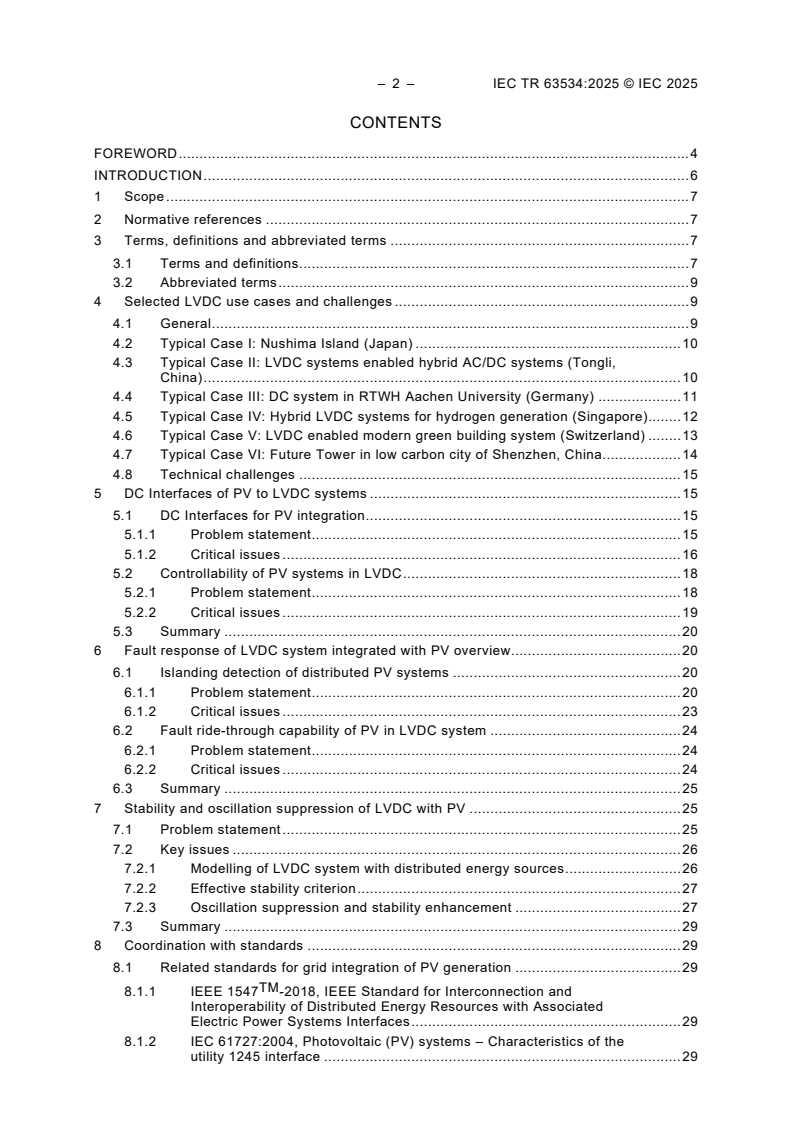
CONTENTS
FOREWORD . 4
INTRODUCTION . 6
1 Scope . 7
2 Normative references . 7
3 Terms, definitions and abbreviated terms . 7
3.1 Terms and definitions . 7
3.2 Abbreviated terms . 9
4 Selected LVDC use cases and challenges . 9
4.1 General . 9
4.2 Typical Case I: Nushima Island (Japan) . 10
4.3 Typical Case II: LVDC systems enabled hybrid AC/DC systems (Tongli,
China) . 10
4.4 Typical Case III: DC system in RTWH Aachen University (Germany) . 11
4.5 Typical Case IV: Hybrid LVDC systems for hydrogen generation (Singapore). 12
4.6 Typical Case V: LVDC enabled modern green building system (Switzerland) . 13
4.7 Typical Case VI: Future Tower in low carbon city of Shenzhen, China. 14
4.8 Technical challenges . 15
5 DC Interfaces of PV to LVDC systems . 15
5.1 DC Interfaces for PV integration . 15
5.1.1 Problem statement . 15
5.1.2 Critical issues . 16
5.2 Controllability of PV systems in LVDC . 18
5.2.1 Problem statement . 18
5.2.2 Critical issues . 19
5.3 Summary . 20
6 Fault response of LVDC system integrated with PV overview . 20
6.1 Islanding detection of distributed PV systems . 20
6.1.1 Problem statement . 20
6.1.2 Critical issues . 23
6.2 Fault ride-through capability of PV in LVDC system . 24
6.2.1 Problem statement . 24
6.2.2 Critical issues . 24
6.3 Summary . 25
7 Stability and oscillation suppression of LVDC with PV . 25
7.1 Problem statement . 25
7.2 Key issues . 26
7.2.1 Modelling of LVDC system with distributed energy sources . 26
7.2.2 Effective stability criterion . 27
7.2.3 Oscillation suppression and stability enhancement . 27
7.3 Summary . 29
8 Coordination with standards . 29
8.1 Related standards for grid integration of PV generation . 29
TM
8.1.1 IEEE 1547 -2018, IEEE Standard for Interconnection and
Interoperability of Distributed Energy Resources with Associated
Electric Power Systems Interfaces . 29
8.1.2 IEC 61727:2004, Photovoltaic (PV) systems – Characteristics of the
utility 1245 interface . 29
8.1.3 IEC 61215-1:2021, Terrestrial photovoltaic (PV) modules - Design
qualification and type approval – Part 1: Test requirements . 29
8.2 Related standards for the LVDC distribution system . 29
8.2.1 IEC-SEG 4 Systems Evaluation Group – Low Voltage Direct Current
Applications, Distribution, and Safety for Use in Developed and
Developing Economies . 29
8.2.2 IEC TR 63282:2024, LVDC systems – Assessment of standard voltages
and power quality requirements . 30
8.3 Other related standards . 30
8.3.1 IEC 62109-1:2010, Safety of power converters for use in photovoltaic
power systems – Part 1: General requirements . 30
8.3.2 IEC 62446-1:2016 and IEC 62446-1:2016/AMD1:2018, Photovoltaic
(PV) systems – Requirements for testing, documentation and
maintenance – Part 1: Grid connected systems – Documentation,
commissioning tests and inspections . 31
8.3.3 IEC TS 62257 series, Recommendations for renewable energy and
hybrid systems for rural electrification . 31
8.3.4 IEC 60364 series, Low-voltage electrical installations . 31
8.3.5 IEC 60364-1:2005, Low-voltage electrical installations – Part 1:
Fundamental principles, assessment of general characteristics,
definitions . 32
8.3.6 IEC TS 62786-1:2023, Distributed energy resources connection with the
grid – Part 1: General requirements . 32
9 Summary . 32
Annex A (informative) Points of connection in a typical distribution network . 34
Bibliography . 35
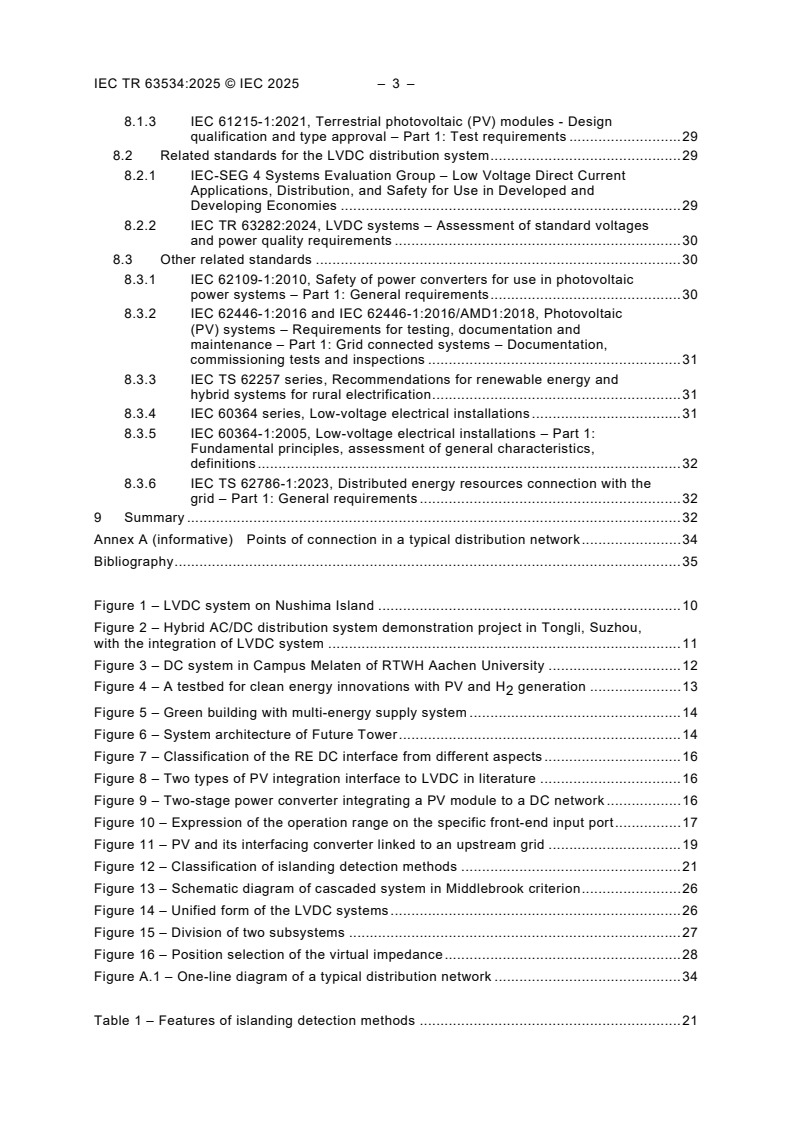
Figure 1 – LVDC system on Nushima Island . 10
Figure 2 – Hybrid AC/DC distribution system demonstration project in Tongli, Suzhou,
with the integration of LVDC system . 11
Figure 3 – DC system in Campus Melaten of RTWH Aachen University . 12
Figure 4 – A testbed for clean energy innovations with PV and H generation . 13
Figure 5 – Green building with multi-energy supply system . 14
Figure 6 – System architecture of Future Tower . 14
Figure 7 – Classification of the RE DC interface from different aspects . 16
Figure 8 – Two types of PV integration interface to LVDC in literature . 16
Figure 9 – Two-stage power converter integrating a PV module to a DC network . 16
Figure 10 – Expression of the operation range on the specific front-end input port . 17
Figure 11 – PV and its interfacing converter linked to an upstream grid . 19
Figure 12 – Classification of islanding detection methods . 21
Figure 13 – Schematic diagram of cascaded system in Middlebrook criterion . 26
Figure 14 – Unified form of the LVDC systems . 26
Figure 15 – Division of two subsystems . 27
Figure 16 – Position selection of the virtual impedance . 28
Figure A.1 – One-line diagram of a typical distribution network . 34
Table 1 – Features of islanding detection methods . 21
– 4 – IEC TR 63534:2025 © IEC 2025
INTERNATIONAL ELECTROTECHNICAL COMMISSION
____________
INTEGRATING DISTRIBUTED PV INTO LVDC SYSTEMS AND USE CASES
FOREWORD
1) The International Electrotechnical Commission (IEC) is a worldwide organization for standardization comprising
all national electrotechnical committees (IEC National Committees). The object of IEC is to promote international
co-operation on all questions concerning standardization in the electrical and electronic fields. To this end and
in addition to other activities, IEC publishes International Standards, Technical Specifications, Technical Reports,
Publicly Available Specifications (PAS) and Guides (hereafter referred to as “IEC Publication(s)”). Their
preparation is entrusted to technical committees; any IEC National Committee interested in the subject dealt with
may participate in this preparatory work. International, governmental and non-governmental organizations liaising
with the IEC also participate in this preparation. IEC collaborates closely with the International Organization for
Standardization (ISO) in accordance with conditions determined by agreement between the two organizations.
2) The formal decisions or agreements of IEC on technical matters express, as nearly as possible, an international
consensus of opinion on the relevant subjects since each technical committee has representation from all
interested IEC National Committees.
3) IEC Publications have the form of recommendations for international use and are accepted by IEC National
Committees in that sense. While all reasonable efforts are made to ensure that the technical content of IEC
Publications is accurate, IEC cannot be held responsible for the way in which they are used or for any
misinterpretation by any end user.
4) In order to promote international uniformity, IEC National Committees undertake to apply IEC Publications
transparently to the maximum extent possible in their national and regional publications. Any divergence between
any IEC Publication and the corresponding national or regional publication shall be clearly indicated in the latter.
5) IEC itself does not provide any attestation of conformity. Independent certification bodies provide conformity
assessment services and, in some areas, access to IEC marks of conformity. IEC is not responsible for any
services carried out by independent certification bodies.
6) All users should ensure that they have the latest edition of this publication.
7) No liability shall attach to IEC or its directors, employees, servants or agents including individual experts and
members of its technical committees and IEC National Committees for any personal injury, property damage or
other damage of any nature whatsoever, whether direct or indirect, or for costs (including legal fees) and
expenses arising out of the publication, use of, or reliance upon, this IEC Publication or any other IEC
Publications.
8) Attention is drawn to the Normative references cited in this publication. Use of the referenced publications is
indispensable for the correct application of this publication.
9) IEC draws attention to the possibility that the implementation of this document may involve the use of (a)
patent(s). IEC takes no position concerning the evidence, validity or applicability of any claimed patent rights in
respect thereof. As of the date of publication of this document, IEC had not received notice of (a) patent(s), which
may be required to implement this document. However, implementers are cautioned that this may not represent
the latest information, which may be obtained from the patent database available at https://patents.iec.ch. IEC
shall not be held responsible for identifying any or all such patent rights.
IEC TR 63534 has been prepared by subcommittee SC 8A: Grid integration of renewable
energy generation, of IEC technical committee TC 8: Systems aspects of electrical energy
supply. It is a Technical Report.
The text of this Technical Report is based on the following documents:
Draft Report on voting
8A/187/DTR 8A/191/RVDTR
Full information on the voting for its approval can be found in the report on voting indicated in
the above table.
The language used for the development of this Technical Report is English.
This document was drafted in accordance with ISO/IEC Directives, Part 2, and developed in
accordance with ISO/IEC Directives, Part 1 and ISO/IEC Directives, IEC Supplement, available
at www.iec.ch/members_experts/refdocs. The main document types developed by IEC are
described in greater detail at www.iec.ch/publications.
The committee has decided that the contents of this document will remain unchanged until the
stability date indicated on the IEC website under webstore.iec.ch in the data related to the
specific document. At this date, the document will be
• reconfirmed,
• withdrawn, or
• revised.
– 6 – IEC TR 63534:2025 © IEC 2025
INTRODUCTION
During the 2019 IEC SC 8A plenary meeting in Shanghai, China, DECISION 2019/5, based on
a proposition by the China National Committee, was approved and written into List of Decisions
(see document 8A/61/DL): It consisted in a new Preliminary Work Item (PWI) called “Integrating
distributed PV into LVDC systems and use cases”. It was approved to create a new WG led by
SC 8A, with participation from SC 8B called “Integrating distributed PV into DC systems and
use cases”. It was approved to nominate Prof. ZHU Miao from CN NC as the convenor.
The task is to develop a series of projects regarding integrating distributed PV into DC systems
and use cases with emphasis on large-scale and high penetration of renewable energy (RE) via
low voltage direct current (LVDC) system within the following scopes of operational behaviour
and coordinated control between RE and DC system, for example including DC interface for RE
integration, fault response and stability issues of LVDC integrated RE, etc.
It is increasingly important to optimize the performance and efficiency of renewable-enabled
power systems by integrating DC power into various low voltage applications, such as buildings,
vehicles, and electronic devices. DC power generated by PV systems is more compatible with
the DC-based electronic devices used in these applications, making it more efficient and cost-
effective.
Nonetheless, there lacks a standard or reference framework that would orient original
equipment manufacturers (OEMs), engineering, procurement, and construction (EPC) as well
as other RE system operators to provide continuous high-quality generation services to grids.
In this context, the intention of this document is to present necessary technical screening and
then to offer profound insights to the formulation of relevant standards. It helps to deal with both
the converter-level and grid-level requirements on PV integration via DC integration, to pave a
way to further develop a series of standards/technical reports with emphasis on high penetration
of PV via LVDC system.
INTEGRATING DISTRIBUTED PV INTO LVDC SYSTEMS AND USE CASES
1 Scope
This document reviews existing theoretical attempts and engineering applications in the area
of solar PV systems coupled to LVDC systems. There are three aspects that are identified to
be highly relevant to standard compilations:
• power converters and possible control mechanisms that are eligible for facilitating the
interlinking between PV and LVDC networks;
• local PV system islanding detection algorithms and fault ride through in case of main grid
faults;
• stability analysis of PV interacting with LVDC systems and corresponding stabilization
methods;
An inventory of existing (mostly IEC and national) standards is also presented, based on which
different sorts of PV integration scenarios are elaborated. Gaps between actual standards and
future needs are analyzed and guidelines for evolution are presented.
2 Normative references
The following documents are referred to in the text in such a way that some or all of their content
constitutes requirements of this document. For dated references, only the edition cited applies.
For undated references, the latest edition of the referenced document (including any
amendments) applies.
IEC 62934, Grid integration of renewable energy generation – Terms and definitions
3 Terms, definitions and abbreviated terms
3.1 Terms and definitions
For the purposes of this document, the terms and definitions given in IEC 62934 and the
following apply.
ISO and IEC maintain terminology databases for use in standardization at the following
addresses:
• IEC Electropedia: available at https://www.electropedia.org/
• ISO Online browsing platform: available at https://www.iso.org/obp
3.1.1
point of common coupling
PCC
point in an electric power system, electrically nearest to a particular load, at which other loads
are, or may be, connected
Note 1 to entry: These loads can be either devices, equipment or systems, or distinct network users' installations.
[SOURCE: IEC 60050-614:2016 [21], 614-01-12]
– 8 – IEC TR 63534:2025 © IEC 2025
3.1.2
point of connection
POC
reference point on the electric power system where the user’s electrical facility is connected
Note 1 to entry: The difference between PCC and POC is shown in Figure A.1.
[SOURCE: IEC 60050-617:2009 [22], 617-04-01, modified – a note has been added.]
3.1.3
energy management system
computer system comprising a software platform providing basic support services and a set of
applications providing the functionality needed for the effective operation of electrical
generation and transmission facilities so as to assure adequate security of energy supply at
minimum cost
[SOURCE: IEC 61970-301:2020 [23], 3.1]
3.1.4
distributed energy resources, pl
generators (with their auxiliaries, protection and connection equipment), including loads having
a generating mode (such as electrical energy storage systems), connected to a low voltage or
a medium-voltage network
[SOURCE: IEC 60060-617:2017 [22], 617-04-20, modified – the note has been removed.]
3.1.5
islanding
network splitting
process whereby a power system is split into two or more islands
Note 1 to entry: Islanding is either a deliberate emergency measure (intentional islanding mode), or the result of
automatic protection or control action, or the result of human error (unintentional islanding mode).
[SOURCE: IEC 60060-603:1986 [24], 603-04-31]
3.1.6
islanding detection methods, pl.
techniques used in grid-tied systems to detect the occurrence of islanding
3.1.7
voltage sag
voltage dip
sudden voltage reduction at a point in an electric power system, followed by voltage recovery
after a short time interval, from a few periods of the sinusoidal wave of the voltage to a few
seconds
[SOURCE: IEC 60050-614:2016 [21], 614-01-08]
3.1.8
non-detection zone
region where islanding detection schemes fail to detect the islanding mode
3.1.9
hazard
potential source of harm
Note 1 to entry: The term hazard may be qualified in order to define its origin or the nature of the expected harm
(e.g., electric shock hazard, crushing hazard, cutting hazard, toxic hazard, fire hazard, drowning hazard).
[SOURCE:IEC 60050-351:2013 [25], 351-57-01]
3.2 Abbreviated terms
BCCC bus current-controlled converter
BVCC bus voltage-controlled converter
CPL constant power load
CHP combined heat and power
DER distributed energy resources
EMS energy management system
EPC engineering, procurement, and construction
ESS energy storage system
FRT fault ride through
IBC intermediate bus converter
IDMs islanding detection methods
LVDC low voltage direct current
MPPT maximum power point tracking
NDZ non-detection zone
OEM original equipment manufacturer
PCC point of common coupling
POC point of connection
PWM pulse width modulation
RE renewable energy
RHP right-half-plane
SEG standardization evaluation groups
SMB standardization management board
4 Selected LVDC use cases and challenges
4.1 General
The rapid development of DC power systems such as DC microgrids and DC distribution
networks, as well as the advances in power electronic converters, have made it technically
feasible for PVs to be directly integrated into LVDC systems. The LVDC system integration of
PV has attracted worldwide interests from both academic and industry perspectives. There are
quite a few practical demonstrative projects across the whole world and in this document, six
typical cases are presented. They can be classified into three categories: Case I to Case III
show typical LVDC systems either in islanding or grid-connected mode. Case IV shows how
LVDC integrated with PV would add values to the hydrogen industry. Case V and Case VI show
that LVDC could help to decarbonize modern green buildings.
– 10 – IEC TR 63534:2025 © IEC 2025
4.2 Typical Case I: Nushima Island (Japan)
The LVDC system on Nushima Island features community-level renewable energy utilization
and local utilization. In this use case (see Figure 1), 8 kW distributed PV arrays, 1 kW wind
turbines, and 46 kWh lithium-ion batteries are connected to a 360 V LVDC bus via specially
designed interface converters to supply a self-sustainable decentralized energy system. This
LVDC system also features dynamic coordination between RE generations and household
power consumption [1] .
Japan’s Nushima Island DC system successfully builds a low-voltage DC power distribution
system covering PV, wind power, energy storage, and mixed AC and DC loads [2]. This project
fully explores the combined operation of multiple renewable energy sources and energy loads
based on LVDC systems and provides important theoretical and technical bases and
engineering empirical references for the construction and operation of LVDC systems
containing high proportion of distributed RE in the future. The project focuses on the following
technical contents:
1) LVDC interface for RE integration (PV and wind turbines);
2) networking and system operation with multiple RE sources, energy storage systems (ESSs)
and hybrid DC and AC loads.
Figure 1 – LVDC system on Nushima Island
4.3 Typical Case II: LVDC systems enabled hybrid AC/DC systems (Tongli, China)
In 2017, with the support of the "Research on Hybrid Renewable Energy Technology Based on
Power Electronic Transformer", a National Key Research and Development Project under the
13th Five-Year Plan, the demonstration was carried out in Tongli, Suzhou. It includes wind
power generation, photovoltaic power generation, solar thermal power generation and thermal
utilizations, power storages, and grid power supplies.
___________
Numbers in square brackets refer to the Bibliography.
As shown in Figure 2, the demonstration project relies on large-capacity multi-port power
electronic transformers to build an AC/DC hybrid distribution network, which can realize voltage
support and power flow balance through DC cross-feeder interconnections, improve system
reliability and power quality, and better adapt to distributed power sources, energy storage
devices and DC power sources.
The DC power sources across the whole project include the PV power station in a new energy
town, the PV power introduced by external grid and the DC wind turbine in the town. The AC
power is brought from the external grid by AC medium voltage lines. The loads in the town
mainly include air conditioners, lighting and electrical loads in a large number of distributed
buildings, integrated with multi-functional street lighting units, and EV charging stations.
Figure 2 – Hybrid AC/DC distribution system demonstration project in Tongli, Suzhou,
with the integration of LVDC system
4.4 Typical Case III: DC system in RTWH Aachen University (Germany)
The DC distribution system in Campus Melaten of RWTH Aachen University includes a 4 MW
test bench at the Center for Wind Power Drives (CWD) which serves as an interface for the
integration of wind turbines (see Figure 3). Compared with conventional AC grid-connection of
wind turbine, DC grid-connection requires fewer power conversion stages: the grid-side inverter,
LCL filter, and transformer can be omitted. Then the overall efficiency of the wind energy
generation system can be improved.
– 12 – IEC TR 63534:2025 © IEC 2025
Figure 3 – DC system in Campus Melaten of RTWH Aachen University
It is worth mentioning that the DC grid on the campus of RWTH Aachen in Germany is one of
the most celebrated engineering practice cases in the field of medium and LVDC distribution
systems for renewable energy integrations. This project realizes the direct connection of the
wind power grid and all kinds of DC loads, which is of exemplary significance to diverse
application scenarios and the development of a technical road map.
4.5 Typical Case IV: Hybrid LVDC systems for hydrogen generation (Singapore)
The project aims to demonstrate an innovative concept of using a virtual ledger to support the
24/7 production of green hydrogen powered with offsite solar energy generation [3] (see
Figure 4).
Up to 1,5 megawatt peak (MWp) of solar photovoltaic systems will be deployed at Tuas Power
facilities at Tuas South and Jurong Island. The Renewable Energy Certificates (RECs)
generated by the export of solar energy to the grid will be tracked via a virtual ledger. The RECs
will, in turn, enable the electrolyzer to draw green electricity from the grid to generate a
consistent stream of green hydrogen. The electrolyzer will be installed at Tuas Power’s Multi-
Utilities Complex in Jurong Island near a potential buyer to minimize the transportation cost of
green hydrogen.
If successful, the solution will form up a complete process and business model to produce green
hydrogen locally. It addresses the intermittency of RE such that the production of green
hydrogen would not rely on RE availability.
The Green Virtual Ledger also integrates the energy management system and the REC platform
to optimize the forecasting of power generation and demand.
Figure 4 – A testbed for clean energy innovations with PV and H generation
4.6 Typical Case V: LVDC enabled modern green building system (Switzerland)
The Monte Rosa hut (see Figure 5) was built using the latest building technologies and
architecture to ensure the highest possible energy self-sustainability [4].
A 122 m photovoltaic cell installation on the south side of the hut together with a new CHP
plant provides electricity for wastewater treatment, ventilation, lighting, and household
appliances. In front of the hut, 60,5 m of thermal solar collectors are installed. The collectors
cover the thermal requirements for heating and hot water preparations in combination with the
CHP plant. Water is used several times in the new Monte Rosa hut. Meltwater, which is collected
in summer in a cavern, is used for washing and kitchen. In part, it is used a second time as grey
water for restroom flushing and washing machines. A microbiological treatment plant purifies
the water to the greatest extent and returns it to the environment with virtually drinking water
quality. In the new Monte Rosa hut controlled ventilation ensures that warmth remains in the
building, the air is always fresh and even the waste air is used. The heat contained in the latter
is reused.
– 14 – IEC TR 63534:2025 © IEC 2025
Figure 5 – Green building with multi-energy supply system
4.7 Typical Case VI: Future Tower in low carbon city of Shenzhen, China
Future Tower is the headquarter of IBR (Shenzhen Institute of Building Research), located in
the Low Carbon City of Shenzhen, China. It was planned and designed in 2017. The
construction was finished in 2019 and the DC distribution system was installed in August 2020.
One-third area of the Future Tower runs a demo DC distribution system managed by Alliance
of DC Building (ADBC). ADBC is a technical committee of China Association of Building Energy
Efficiency and coordinated the DCB initiatives in China. The Future Tower DC system consists
of a system of solar PV, storage, DC, flexible loads. The system architecture is shown in
Figure 6.
Figure 6 – System architecture of Future Tower
4.8 Technical challenges
From the real engineering practice, there are four salient weaknesses of PV-driven LVDC
systems.
First, at a critical stage of PV integration into an LVDC system, it is crucial for the power
converter interface linking PV to the DC network to possess characteristics of low loss, high
controllability, stable operation, explicit regulation, a wide operating range, and high safety
criteria. Second, PV arrays and interfacing converters are expected to exhibit desirable
responsiveness, effective islanding detection capabilities, and possible fault ride-through
functionalities. Third, it is important to note that when multiple different dynamic systems are
aggregated together, the electrically-coupled systems tend to be unstable because dynamic
interactions can incur unstable modes. Moreover, the criteria of the LVDC system require
specification so that engineering practitioners can refer to them to ensure stable operations.
Responding to the above needs, in this document the technical review in the following area will
be addressed:
• DC interface for PV LVDC integration with regulation (interface and control);
• fault response of LVDC-integrated PV;
• stability and oscillation suppression of LVDC-integrated PV.
Each part consists of three steps:
1) the problem statement, which includes the development background, the function, and an
introduction of the technology itself;
2) the core and key issues, which includes the present research activities;
3) the summary, where the new requirements and trends in technology are outlined.
5 DC Interfaces of PV to LVDC systems
5.1 DC Interfaces for PV integration
5.1.1 Problem statement
Power electronic converters play a crucial role in interfacing PV systems with LVDC grids by
ensuring that the power generated by the PV system is compatible with the grid, and by
optimizing the power output of the PV system for maximum efficiency [5] [6].
As of now, PV-LVDC interfaces can be classified based on different aspects, port number,
power flow directions, and topologies, as presented in Figure 7. As in Figure 8 a), the two-port
power converter is used to deliver PV power to a DC bus. To fully utilize the PV power and
avoid any possible PV cutoff, a battery system is recommended to cooperate with PV through
a three-port power converter, see Figure 8 b). Given the fact that batteries provide extensive
flexibility for responding to the request of the system operator, it is highly possible to use the
battery to absorb the surplus power in the DC network and in this way, inverse power flow will
happen in a way that energy can be conveyed from the network to the PV + battery unit.
Moreover, PV arrays would be linked to the DC grid simply with one-stage converter with no
intermediate DC bus where the battery or additional power electronic devices can be installed
here to achieve different targets. In Figure 9, an example of a configuration of a two-stage PV
integration system is portrayed. Note that the power converter in the two-stage system can be
a boost, buck or other eligible power converter. The selection of power converter topology is
supposed to comply with the needs of the end-users [7].
– 16 – IEC TR 63534:2025 © IEC 2025
Figure 7 – Classification of the RE DC interface from different aspects
a) two ports b) three ports
Figure 8 – Two types of PV integration interface to LVDC in literature
Figure 9 – Two-stage power converter integrating a PV module to a DC network
5.1.2 Critical issues
5.1.2.1 Operation range
Normally, PV power converters are operated under the mode of maximum power point tracking
(MPPT). Although MPPT helps to harvest full clean energy, the power delivered by PV
unavoidably features high uncertainty and intermittency as ambient environments and weather
constantly change. As such, it is highly preferable for power converters to tolerate the scenario
of the highest PV production, and maintain sufficient reliability and resilience. In other words,
the PV interfacing converter is expected to operate in a proper wide range while not incurring
overly high costs. The possible u-i operation range of each front-end input port (i.e., feasible
region of u and i on the u-i plane, i = 1~n), which is presented in Figure 10.
RE-i RE-i
Figure 10 – Expression of the operation range on the specific front-end input port
5.1.2.2 Converter modeling
It is worth noting that accurate modeling of the power converter plays an important role in
identifying a rational operation range. Accurate modeling can help identify areas for cost
reduction in the power converter design by minimizing the need for expensive physical
prototyping and testing.
With accurate modelling, engineers can simulate the behaviour of the power converter in a
virtual environment and explore different design configurations, operating parameters, and
control strategies. This allows them to optimize the design for improved efficiency, reduced size
and weight, lower cost, and other performance metrics. By making design improvements
through modelling and simulation, engineers can reduce the number of physical prototypes
needed, which can lead to significant cost savings in terms of material and labor costs.
Moreover, higher accurate modelling can also help to better formulate systematic simulations.
When different power modules are aggregated collectively to from a comparatively large-scale
power system, there are various interactions among different modules, and these interactions
could lead to undesired power and voltage oscillations. If the modelling of power converter is
skewed or of low accuracy, systematic simulation would give a wrong indication of system
performance, which induces time-consuming debug process.
5.1.2.3 Power efficiency
More efficient converters will result in less power loss and lower energy costs, which can be
significant over the lifetime of a PV system. By improving power efficiency, a PV system can
generate more electricity for the same amount of sunlight, reducing the cost of electricity
production.
Firstly, high power efficiency helps to reduce environmental impacts. The environmental impact
of PV systems can be significant due to the materials and resources required to manufacture
and install the system, as well as the energy consumed during operation. By improving the
power efficiency of PV-interfaced power converters, the system can generate more electricity
from the same amount of sunlight, which can reduce the need for additional PV panels and
associated resources. This can reduce the environmental impact of the PV system by reducing
the amount of materials needed for manufacturing, transportation, and installation, as well as
reducing the carbon footprint associated with the production and transportation of the additional
PV panels. In addition to reducing the environmental impact of the system, improving power
efficiency can also make PV systems more economically viable. By reducing the cost of energy
production, PV systems can become more competitive with traditional energy sources, leading
to more widespread adoption and greater reductions in greenhouse gas emissions.
– 18 – IEC TR 63534:2025 © IEC 2025
Secondly, high power efficiency helps to improve holistic system performance. The power
converter is responsible for converting the DC voltage at the PV array end into DC voltage
suitable for use by the grid. During this process, some power is lost due to factors such as heat
dissipation, switching losses, and conduction losses. If the power converter is not efficient, a
larger percentage of the power generated by the PV panels will be lost during the conversion
process, reducing the overall power output of the system. This can also result in a decrease in
the system's reliability and stability, as the power quality of the output could be compromised.
Improving the power efficiency of the PV-interfaced power converter can help to address these
issues by reducing power loss during the conversion process. This can result in higher power
output from the PV system, improving its overall performance.
Thirdly, high power efficiency helps to fit regulation compliance. Regulatory compliance with
energy efficiency standards is normally established by governments or regulatory bodies in
different regions. These standards could set minimum efficiency levels for PV systems or PV-
interfaced power converters to reduce energy consumption, and greenhouse gas emissions,
and improve grid stability. In the European Union (EU), the Eco-design Directive (2009/125/EC)
sets energy efficiency requirements for a wide range of energy-related products, including
power converters. The directive aims to reduce energy consumption and greenhouse gas
emissions, improve the functioning of the internal market, and promote energy-efficient
products. The European Committee for Standardization (CEN) and the European Committee for
Electrotechnical Standardization (CENELEC) have also developed standards and regulations
that prescribe the minimum energy efficiency requirements for power converters. In addition,
many countries have established regulations or incentive programs that require or encourage
the use of energy-efficient products, including PV systems and power converters. In the United
States, for example, the Department of Energy (DOE) sets energy efficiency standards for a
range of products, including power converters. Compliance with these standards is mandatory
for products sold in the U.S. market. By improving the power efficiency of PV connection power
converters, manufacturers and users can ensure that their products comply with these
regulatory requirements, avoid penalties or fines, and gain a competitive advantage in the
market.
5.2 Controllability of PV systems in LVDC
5.2.1 Problem statement
The controllability of a PV system in an LVDC network refers to the ability to control and adjust
the power output of the PV system in response to changes in the network conditions or user
requirements. PV systems can have varying degrees of controllability, depending on the type
of PV technology used and the control strategies employed.
Some PV technologies, such as crystalline silicon PV, have a fixed maximum power output,
which is determined by the size and orientation of the PV panels and the intensity of sunlight.
In these systems, the power output can be adjusted by changing the panel orientation or
shading the panels to reduce sunlight exposure, but the overall controllability is limited. Other
PV technologies, such as thin-film PV cells, have a more flexible power output
...