


IEC 61747-6-2:2011
(Main)Liquid crystal display devices - Part 6-2: Measuring methods for liquid crystal display modules - Reflective type
General Information
- Abstract
IEC 61747-6-2:2011 gives details of the quality assessment procedures, the inspection requirements, screening sequences, sampling requirements, and test and measurement procedures required for the assessment of liquid crystal display modules. The purpose of this standard is to indicate and list the procedure-dependent parameters and to prescribe the specific methods and conditions that are to be used for their uniform numerical determination. The contents of the corrigendum of January 2012 have been included in this copy.
- Status
- Published
- Publication Date
- 09-Jun-2011
- Technical Committee
- TC 110 - Electronic displays
- Drafting Committee
- WG 2 - TC 110/WG 2
- Current Stage
- PPUB - Publication issued
- Start Date
- 10-Jun-2011
- Completion Date
- 15-Jun-2011
Overview
IEC 61747-6-2:2011 specifies standardized measurement methods for reflective liquid crystal display (LCD) modules. Published by the International Electrotechnical Commission (IEC), this standard details quality assessment procedures, inspection requirements, and precise test methods needed for the reliable evaluation of reflective-type LCD modules. It aims to ensure that quality control, product testing, and performance specifications are both accurate and globally uniform by defining procedure-dependent parameters and measurement conditions.
Reflective LCD modules are widely used in electronic devices for their ability to utilize ambient light, making their optical properties highly dependent on environmental factors. Accurate measurement, as outlined in this standard, is crucial for maintaining consistent performance and quality across different manufacturing batches and suppliers.
Key Topics
The standard covers a variety of important aspects in measuring and assessing reflective LCD modules:
Quality Assessment Procedures
- Screening sequences
- Sampling requirements
- Inspection criteria
Measurement Methods
- Procedures for measuring optical and electrical properties
- Standard geometries for illumination (directional, conical, hemispherical)
- Use of precise light measuring devices (LMDs)
- Calibration and traceability of equipment
Critical Parameters
- Reflectance (photometric evaluation)
- Contrast ratio
- Viewing angle and direction
- Chromaticity and colorimetric data
- Electro-optical response (including transfer function)
- Lateral and temporal variations
- Electrical characteristics (e.g., power consumption)
Measurement Set-Up
- Arrangement of equipment and display under test (DUT)
- Positioning and alignment for accurate data
- Control of ambient conditions and unwanted reflections
Applications
IEC 61747-6-2:2011 is essential for manufacturers, quality assurance professionals, and laboratories involved in the development and production of reflective LCD modules. Key application areas include:
- Product Development: Ensures that new reflective LCD modules meet industry standards for optical and electrical performance.
- Quality Control: Provides repeatable measurement benchmarks for comparing LCD modules from different production batches or suppliers.
- Compliance Testing: Helps organizations demonstrate conformity to international standards for performance claims and market entry.
- OEM & Integration: Supports evaluation of third-party components in complex electronic assemblies.
- Procurement: Enables informed purchasing decisions through comparable and reliable specification data.
By implementing the specified methods, manufacturers can minimize measurement variations due to environmental and instrumental factors, leading to more consistent display performance and customer satisfaction.
Related Standards
IEC 61747-6-2:2011 is part of the broader IEC 61747 series covering liquid crystal display devices. Additional relevant standards include:
- IEC 61747 Series: Comprehensive coverage for various types of LCD modules, including transmissive and transflective types.
- ISO 11664-2:2007: Colorimetry - CIE standard illuminants, vital for uniform color measurement.
- CIE Standards such as CIE 15.2, 17.4, 38, 1931, and 1976: References on color spaces, lighting vocabulary, and photometric/ radiometric measurement, essential for accurate assessment of display properties.
Practical Value
Adhering to IEC 61747-6-2:2011 enables organizations to:
- Benchmark reflective LCD performance using standardized, internationally recognized procedures
- Enhance product reliability through rigorous, repeatable measurement and evaluation methods
- Consistently meet customer and regulatory expectations for display quality
- Facilitate product certification and global market access by demonstrating compliance with international standards
For any entity involved in the design, production, or procurement of reflective LCD modules, following IEC 61747-6-2:2011 ensures high quality, reproducibility, and competitiveness in today’s display technology market.
Relations
- Effective Date
- 05-Sep-2023
Frequently Asked Questions
IEC 61747-6-2:2011 is a standard published by the International Electrotechnical Commission (IEC). Its full title is "Liquid crystal display devices - Part 6-2: Measuring methods for liquid crystal display modules - Reflective type". This standard covers: IEC 61747-6-2:2011 gives details of the quality assessment procedures, the inspection requirements, screening sequences, sampling requirements, and test and measurement procedures required for the assessment of liquid crystal display modules. The purpose of this standard is to indicate and list the procedure-dependent parameters and to prescribe the specific methods and conditions that are to be used for their uniform numerical determination. The contents of the corrigendum of January 2012 have been included in this copy.
IEC 61747-6-2:2011 gives details of the quality assessment procedures, the inspection requirements, screening sequences, sampling requirements, and test and measurement procedures required for the assessment of liquid crystal display modules. The purpose of this standard is to indicate and list the procedure-dependent parameters and to prescribe the specific methods and conditions that are to be used for their uniform numerical determination. The contents of the corrigendum of January 2012 have been included in this copy.
IEC 61747-6-2:2011 is classified under the following ICS (International Classification for Standards) categories: 31.120 - Electronic display devices. The ICS classification helps identify the subject area and facilitates finding related standards.
IEC 61747-6-2:2011 has the following relationships with other standards: It is inter standard links to IEC 61747-6-2:2011/COR1:2012. Understanding these relationships helps ensure you are using the most current and applicable version of the standard.
IEC 61747-6-2:2011 is available in PDF format for immediate download after purchase. The document can be added to your cart and obtained through the secure checkout process. Digital delivery ensures instant access to the complete standard document.
Standards Content (Sample)
IEC 61747-6-2 ®
Edition 1.0 2011-06
INTERNATIONAL
STANDARD
NORME
INTERNATIONALE
colour
inside
Liquid crystal display devices –
Part 6-2: Measuring methods for liquid crystal display modules – Reflective type
Dispositifs d'affichage à cristaux liquides –
Partie 6-2: Méthodes de mesure pour les modules d'affichage à cristaux liquides –
Type réflexible
All rights reserved. Unless otherwise specified, no part of this publication may be reproduced or utilized in any form or by
any means, electronic or mechanical, including photocopying and microfilm, without permission in writing from either IEC or
IEC's member National Committee in the country of the requester.
If you have any questions about IEC copyright or have an enquiry about obtaining additional rights to this publication,
please contact the address below or your local IEC member National Committee for further information.
Droits de reproduction réservés. Sauf indication contraire, aucune partie de cette publication ne peut être reproduite
ni utilisée sous quelque forme que ce soit et par aucun procédé, électronique ou mécanique, y compris la photocopie
et les microfilms, sans l'accord écrit de la CEI ou du Comité national de la CEI du pays du demandeur.
Si vous avez des questions sur le copyright de la CEI ou si vous désirez obtenir des droits supplémentaires sur cette
publication, utilisez les coordonnées ci-après ou contactez le Comité national de la CEI de votre pays de résidence.
IEC Central Office
3, rue de Varembé
CH-1211 Geneva 20
Switzerland
Email: inmail@iec.ch
Web: www.iec.ch
About the IEC
The International Electrotechnical Commission (IEC) is the leading global organization that prepares and publishes
International Standards for all electrical, electronic and related technologies.
About IEC publications
The technical content of IEC publications is kept under constant review by the IEC. Please make sure that you have the
latest edition, a corrigenda or an amendment might have been published.
Catalogue of IEC publications: www.iec.ch/searchpub
The IEC on-line Catalogue enables you to search by a variety of criteria (reference number, text, technical committee,…).
It also gives information on projects, withdrawn and replaced publications.
IEC Just Published: www.iec.ch/online_news/justpub
Stay up to date on all new IEC publications. Just Published details twice a month all new publications released. Available
on-line and also by email.
Electropedia: www.electropedia.org
The world's leading online dictionary of electronic and electrical terms containing more than 20 000 terms and definitions
in English and French, with equivalent terms in additional languages. Also known as the International Electrotechnical
Vocabulary online.
Customer Service Centre: www.iec.ch/webstore/custserv
If you wish to give us your feedback on this publication or need further assistance, please visit the Customer Service
Centre FAQ or contact us:
Email: csc@iec.ch
Tel.: +41 22 919 02 11
Fax: +41 22 919 03 00
A propos de la CEI
La Commission Electrotechnique Internationale (CEI) est la première organisation mondiale qui élabore et publie des
normes internationales pour tout ce qui a trait à l'électricité, à l'électronique et aux technologies apparentées.
A propos des publications CEI
Le contenu technique des publications de la CEI est constamment revu. Veuillez vous assurer que vous possédez
l’édition la plus récente, un corrigendum ou amendement peut avoir été publié.
Catalogue des publications de la CEI: www.iec.ch/searchpub/cur_fut-f.htm
Le Catalogue en-ligne de la CEI vous permet d’effectuer des recherches en utilisant différents critères (numéro de référence,
texte, comité d’études,…). Il donne aussi des informations sur les projets et les publications retirées ou remplacées.
Just Published CEI: www.iec.ch/online_news/justpub
Restez informé sur les nouvelles publications de la CEI. Just Published détaille deux fois par mois les nouvelles
publications parues. Disponible en-ligne et aussi par email.
Electropedia: www.electropedia.org
Le premier dictionnaire en ligne au monde de termes électroniques et électriques. Il contient plus de 20 000 termes et
définitions en anglais et en français, ainsi que les termes équivalents dans les langues additionnelles. Egalement appelé
Vocabulaire Electrotechnique International en ligne.
Service Clients: www.iec.ch/webstore/custserv/custserv_entry-f.htm
Si vous désirez nous donner des commentaires sur cette publication ou si vous avez des questions, visitez le FAQ du
Service clients ou contactez-nous:
Email: csc@iec.ch
Tél.: +41 22 919 02 11
Fax: +41 22 919 03 00
IEC 61747-6-2 ®
Edition 1.0 2011-06
INTERNATIONAL
STANDARD
NORME
INTERNATIONALE
colour
inside
Liquid crystal display devices –
Part 6-2: Measuring methods for liquid crystal display modules – Reflective type
Dispositifs d'affichage à cristaux liquides –
Partie 6-2: Méthodes de mesure pour les modules d'affichage à cristaux liquides –
Type réflexible
INTERNATIONAL
ELECTROTECHNICAL
COMMISSION
COMMISSION
ELECTROTECHNIQUE
PRICE CODE
INTERNATIONALE
CODE PRIX XA
ICS 31.120 ISBN 978-2-88912-507-4
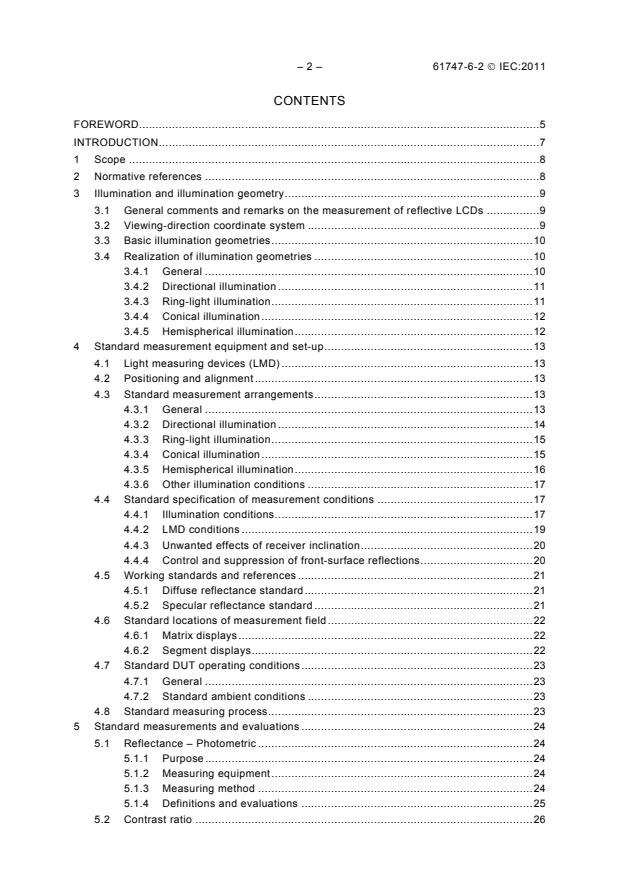
– 2 – 61747-6-2 IEC:2011
CONTENTS
FOREWORD. 5
INTRODUCTION . 7
1 Scope . 8
2 Normative references . 8
3 Illumination and illumination geometry . 9
3.1 General comments and remarks on the measurement of reflective LCDs . 9
3.2 Viewing-direction coordinate system . 9
3.3 Basic illumination geometries . 10
3.4 Realization of illumination geometries . 10
3.4.1 General . 10
3.4.2 Directional illumination . 11
3.4.3 Ring-light illumination . 11
3.4.4 Conical illumination . 12
3.4.5 Hemispherical illumination . 12
4 Standard measurement equipment and set-up . 13
4.1 Light measuring devices (LMD) . 13
4.2 Positioning and alignment . 13
4.3 Standard measurement arrangements . 13
4.3.1 General . 13
4.3.2 Directional illumination . 14
4.3.3 Ring-light illumination . 15
4.3.4 Conical illumination . 15
4.3.5 Hemispherical illumination . 16
4.3.6 Other illumination conditions . 17
4.4 Standard specification of measurement conditions . 17
4.4.1 Illumination conditions . 17
4.4.2 LMD conditions . 19
4.4.3 Unwanted effects of receiver inclination . 20
4.4.4 Control and suppression of front-surface reflections . 20
4.5 Working standards and references . 21
4.5.1 Diffuse reflectance standard . 21
4.5.2 Specular reflectance standard . 21
4.6 Standard locations of measurement field . 22
4.6.1 Matrix displays . 22
4.6.2 Segment displays . 22
4.7 Standard DUT operating conditions . 23
4.7.1 General . 23
4.7.2 Standard ambient conditions . 23
4.8 Standard measuring process . 23
5 Standard measurements and evaluations . 24
5.1 Reflectance – Photometric . 24
5.1.1 Purpose . 24
5.1.2 Measuring equipment . 24
5.1.3 Measuring method . 24
5.1.4 Definitions and evaluations . 25
5.2 Contrast ratio . 26
61747-6-2 IEC:2011 – 3 –
5.2.1 Purpose . 26
5.2.2 Measuring equipment . 26
5.2.3 Measurement method . 26
5.2.4 Definitions and evaluations . 27
5.3 Peak viewing direction / viewing angle range . 27
5.3.1 Purpose / definition . 27
5.3.2 Measuring equipment . 27
5.3.3 Viewing angle . 27
5.3.4 Viewing angle range without gray-level inversion . 28
5.3.5 Specular reflectance from the active area surface . 29
5.4 Chromaticity . 31
5.4.1 Purpose . 31
5.4.2 Measuring equipment . 31
5.4.3 Measuring method . 31
5.4.4 Definitions and evaluations . 31
5.4.5 Specified conditions . 33
5.5 Electro-optical transfer function – Photometric . 33
5.5.1 Purpose . 33
5.5.2 Set-up . 33
5.5.3 Procedure . 33
5.5.4 Evaluation and representation . 34
5.6 Electro-optical transfer function – Colorimetric . 34
5.6.1 Purpose . 34
5.6.2 Set-up . 34
5.6.3 Procedure . 34
5.6.4 Evaluation and representation . 35
5.7 Lateral variations (photometric, colorimetric) . 36
5.7.1 Purpose . 36
5.7.2 Measuring equipment . 36
5.7.3 Uniformity of reflectance . 36
5.7.4 Uniformity of white . 37
5.7.5 Uniformity of chromaticity . 37
5.7.6 Uniformity of primary colours . 38
5.7.7 Cross-talk . 39
5.7.8 Specified conditions . 40
5.8 Temporal variations . 41
5.8.1 Response time . 41
5.8.2 Flicker / frame response (multiplexed displays) . 43
5.8.3 Specified conditions . 45
5.9 Electrical characteristics . 46
5.9.1 Purpose . 46
5.9.2 Measuring instruments . 46
5.9.3 Measuring method . 46
5.9.4 Definitions and evaluations . 46
5.9.5 Specified conditions . 47
Annex A (informative) Standard measuring conditions . 48
Bibliography . 52
– 4 – 61747-6-2 IEC:2011
Figure 1 – Representation of the viewing-direction (equivalent to the direction of
measurement) by the angle of inclination, θ and the angle of rotation (azimuth angle),
φ in a polar coordinate system . 9
Figure 2 – Directional illumination with a flat source disk . 10
Figure 3 – Realization alternatives for directional illumination . 11
Figure 4 – Examples of ring-light illumination . 12
Figure 5 – Examples of conical illumination with a spherical dome (left) and an
integrating sphere with large aperture (right) . 12
Figure 6 – Examples of hemispherical illumination . 13
Figure 7 – Side-view of the measuring set-up using directional illumination . 14
Figure 8 – Side-view of the ring-light illumination measuring set-up . 15
Figure 9 – Side-view of the conical illumination measuring set-up . 16
Figure 10 – Side-view of the hemispherical illumination measuring set-up . 17
Figure 11 – Hemispherical illumination with gloss-trap (GT) opposite to receiver
inclination . 18
Figure 12 – Normalized illuminance at the location of the measuring spot . 18
Figure 13 – Lines of equal chromaticity differences ∆u' (left), ∆v' (right) . 19
Figure 14 – Shape of measuring spot on DUT for two angles of receiver inclination . 20
Figure 15 – Reflections from the first surface of a transparent medium (glass substrate,
polarizer, etc.) superimposed to the reflection component that is modulated by the
display device . 21
Figure 16 – Standard measurement positions are at the centres of all rectangles p0-
p24. Height and width of each rectangle is 20 % of display height and width
respectively. . 22
Figure 17 – Example of standard set-up for specular reflection measurements . 30
Figure 18 – Example of equipment for measurement of temporal variations . 41
Figure 19 – Relationship between driving signal and optical response times . 43
Figure 20 – Frequency characteristics of the integrator (response of human visual
system) . 44
Figure 21 – Example of power spectrum . 45
Figure 22 – Checker-flag pattern for current and power consumption measurements . 46
Figure 23 – Example of measuring block diagram for current and power consumption
of a liquid crystal display device . 47
Figure A.1 – Coordinate system for measurement of the BRDF, index "i" for incident
light, index "r" for reflected light. Directions are described by two angles, θ and φ
(inclination and azimuth) in a polar coordinate system as shown. . 49
Figure A.2 – Terminology for LMDs . 50
61747-6-2 IEC:2011 – 5 –
INTERNATIONAL ELECTROTECHNICAL COMMISSION
___________
LIQUID CRYSTAL DISPLAY DEVICES –
Part 6-2: Measuring methods for liquid crystal display modules –
Reflective type
FOREWORD
1) The International Electrotechnical Commission (IEC) is a worldwide organization for standardization comprising
all national electrotechnical committees (IEC National Committees). The object of IEC is to promote
international co-operation on all questions concerning standardization in the electrical and electronic fields. To
this end and in addition to other activities, IEC publishes International Standards, Technical Specifications,
Technical Reports, Publicly Available Specifications (PAS) and Guides (hereafter referred to as “IEC
Publication(s)”). Their preparation is entrusted to technical committees; any IEC National Committee interested
in the subject dealt with may participate in this preparatory work. International, governmental and non-
governmental organizations liaising with the IEC also participate in this preparation. IEC collaborates closely
with the International Organization for Standardization (ISO) in accordance with conditions determined by
agreement between the two organizations.
2) The formal decisions or agreements of IEC on technical matters express, as nearly as possible, an international
consensus of opinion on the relevant subjects since each technical committee has representation from all
interested IEC National Committees.
3) IEC Publications have the form of recommendations for international use and are accepted by IEC National
Committees in that sense. While all reasonable efforts are made to ensure that the technical content of IEC
Publications is accurate, IEC cannot be held responsible for the way in which they are used or for any
misinterpretation by any end user.
4) In order to promote international uniformity, IEC National Committees undertake to apply IEC Publications
transparently to the maximum extent possible in their national and regional publications. Any divergence
between any IEC Publication and the corresponding national or regional publication shall be clearly indicated in
the latter.
5) IEC itself does not provide any attestation of conformity. Independent certification bodies provide conformity
assessment services and, in some areas, access to IEC marks of conformity. IEC is not responsible for any
services carried out by independent certification bodies.
6) All users should ensure that they have the latest edition of this publication.
7) No liability shall attach to IEC or its directors, employees, servants or agents including individual experts and
members of its technical committees and IEC National Committees for any personal injury, property damage or
other damage of any nature whatsoever, whether direct or indirect, or for costs (including legal fees) and
expenses arising out of the publication, use of, or reliance upon, this IEC Publication or any other IEC
Publications.
8) Attention is drawn to the Normative references cited in this publication. Use of the referenced publications is
indispensable for the correct application of this publication.
9) Attention is drawn to the possibility that some of the elements of this IEC Publication may be the subject of
patent rights. IEC shall not be held responsible for identifying any or all such patent rights.
International Standard IEC 61747-6-2 has been prepared by IEC technical committee 110:
Flat panel display devices.
This standard should be read together with the generic specification to which it refers.
The text of this standard is based on the following documents:
FDIS Report on voting
110/281/FDIS 110/299/RVD
Full information on the voting for the approval on this standard can be found in the report on
voting indicated in the above table.
This publication has been drafted in accordance with the ISO/IEC Directives, Part 2.
– 6 – 61747-6-2 IEC:2011
A list of all the parts in the IEC 61747 series, under the general title Liquid crystal display
devices, can be found on the IEC website.
Future standards in this series will carry the new general title as cited above. Titles of existing
standards in this series will be updated at the time of the next edition.
The committee has decided that the contents of this publication will remain unchanged until
the stability date indicated on the IEC web site under "http://webstore.iec.ch" in the data
related to the specific publication. At this date, the publication will be
• reconfirmed,
• withdrawn,
• replaced by a revised edition, or
• amended.
The contents of the corrigendum of January 2012 have been included in this copy.
IMPORTANT – The 'colour inside' logo on the cover page of this publication indicates that it
contains colours which are considered to be useful for the correct understanding of its
contents. Users should therefore print this document using a colour printer.
61747-6-2 IEC:2011 – 7 –
INTRODUCTION
In order to achieve a useful and uniform description of the performance of these devices,
specifications for commonly accepted relevant parameters are put forward. These fall into the
following categories:
a) general type specification (e.g. pixel resolution, diagonal, pixel layout);
b) optical specification (e.g. contrast ratio, response time, viewing direction, crosstalk,
etc.);
c) electrical specification (e.g. power consumption, EMC);
d) mechanical specification (e.g. module geometry, weight);
e) specification of passed environmental endurance test;
f) specification of reliability and hazard / safety.
In most of the above cases, the specification is self-explanatory. For some specification
points however, notably in the area of optical and electrical performance, the specified value
may depend on the measuring method.
It is assumed that all measurements are performed by personnel skilled in the general art of
radiometric and electrical measurements as the purpose of this standard is not to give a
detailed account of good practice in electrical and optical experimental physics. Furthermore,
it must be assured that all equipment is suitably calibrated as is known to people skilled in the
art and records of the calibration data and traceability are kept.
– 8 – 61747-6-2 IEC:2011
LIQUID CRYSTAL DISPLAY DEVICES –
Part 6-2: Measuring methods for liquid crystal display modules –
Reflective type
1 Scope
This part of IEC 61747 gives details of the quality assessment procedures, the inspection
requirements, screening sequences, sampling requirements, and test and measurement
procedures required for the assessment of liquid crystal display modules.
This standard is restricted to reflective liquid crystal display-modules using either segment,
passive or active matrix and a-chromatic or colour type LCDs (see Note). Furthermore, the
reflective modes of transflective LCD modules with backlights OFF and reflective LCD
modules of front light type without its front-light-unit, are comprised in this standard. A
reflective LCD module with combination of a touch-key-panel or a front-light-unit is out of the
scope of this standard, because its measurements are frequently inaccurate. Its touch-key-
panel or front-light-unit should be removed before it can be included in this scope.
NOTE Several points of view with respect to the preferred terminology on "monochrome", "achromatic",
"chromatic", "colour", "full-colour", etc. can be encountered in the field amongst spectroscopists, (general-)
physicists, colour-perception scientists, physical engineers and electrical engineers. In general, all LCDs
demonstrate some sort of chromaticity (e.g. as function of viewing angle, ambient temperature or externally
addressable means). Pending detailed official description of the subject, the pre-fix pertaining to the "chromaticity"
of the display will be used so as to describe the colour capability of the display that is externally (and electrically)
addressable by the user. This leads us to the following definitions (see also [19])
a) a monochrome display has NO user-addressable chromaticity ("colours"). It may or may not be "black and
white" or a-chromatic;
b) a colour display has at least two user-addressable chromaticities ("colours"). A 64-colour display has 64
addressable colours (often made using 2 bits per primary for 3 primaries), etc. A full-colour display has at
least 6 bits per primary (≥ 260 thousand colours).
The purpose of this standard is to indicate and list the procedure-dependent parameters and
to prescribe the specific methods and conditions that are to be used for their uniform
numerical determination.
2 Normative references
The following referenced documents are indispensable for the application of this document.
For dated references, only the edition cited applies. For undated references, the latest edition
of the referenced document (including any amendments) applies.
ISO 11664-2:2007, Colorimetry – Part 2: CIE standard illuminants
CIE 15.2, CIE Recommendations on Colorimetry
CIE 17.4, International Lighting Vocabulary
CIE 38, Radiometric and photometric characteristics of materials and their measurement
CIE 1931, CIE XYZ colour space
CIE 1976, CIE LAB colour space
61747-6-2 IEC:2011 – 9 –
3 Illumination and illumination geometry
3.1 General comments and remarks on the measurement of reflective LCDs
Reflective LCDs make use of the ambient illumination to display visual information; often, they
do not posses their own integrated source of illumination. It is difficult to achieve the required
significance and reproducibility of the results of measurements because of the close coupling
between the apparatus providing the illumination, the LMD (light measuring device) and the
device under test (DUT). This dependence of results on the instrumentation implies that e.g.
the contrast of reflective LCDs is not an intrinsic property of the device itself, but the contrast
can only be evaluated under specific and well defined conditions for illumination and detection
[3] , [4], [5], [6], [7], [8] .[.].
This part describes a selection of different geometries suitable for measuring and
characterizing reflective LCDs as a function of the direction of observation (i.e. viewing-
direction = direction of measurement), as examples. The range of geometries for illumination
of the DUT and detection of the light reflected from the DUT shall not be limited to the
examples presented here. A set of parameters provides detailed specification of the
conditions that are used for measurement of the electro-optical characteristics as listed below.
3.2 Viewing-direction coordinate system
The viewing-direction is the direction under which the observer looks at the spot of interest on
the display. During the measurement the light-measuring device replaces the observer,
looking from the same direction at a specified spot (i.e. measuring spot, measurement field)
on the DUT. The viewing-direction is conveniently defined by two angles: the angle of
inclination θ (related to the surface normal of the DUT) and the angle of rotation φ (also called
azimuth angle) as illustrated in Figure 1. The azimuth angle is related with the directions on a
watch-dial as follows: refer to φ = 0 ° as the 3 o'clock direction ("right"), to φ = 90 ° as the
12 o'clock direction ("top"), φ = 180 ° as the 9 o'clock direction ("left") and to φ = 270 ° as the
6 o'clock direction ("bottom").
IEC 951/11
Figure 1 – Representation of the viewing-direction
(equivalent to the direction of measurement)
θ and the angle of rotation
by the angle of inclination,
(azimuth angle), φ in a polar coordinate system
—————————
Figures in square brackets refer to the bibliography.
– 10 – 61747-6-2 IEC:2011
3.3 Basic illumination geometries
Typical illumination geometries are (according to CIE 38):
• directional illumination
An illumination source where the incident rays are approximately parallel (max. deviation from
optical axis < 5 °) is directed at the DUT, the direction of illumination is specified by θ and φ.
The intensity across the cross-section of the beam shall be constant within 5 %. Any source of
light sufficiently distant from the DUT provides a directional illumination (e.g. sun, moon).
Figure 2 provides an example of directional illumination with a flat source disk (Lambertian
emission) of radius r , distance to measuring spot d and measuring spot radius r .
s ms
The maximum deviation from the optical axis is depending on the diameter of both source and
measuring spot. The maximum angle of deviation from the optical axis is given by the
following Equation (1)
atan ([r + r ] / |d|) < 5 ° (1)
ms s
• conical illumination
Ω with the apex of this solid angle
Illumination is provided out of an extended solid angle
SC
fixed to the centre of the measuring spot on the DUT. The variation of illuminance with
direction inside this solid angle shall be specified. The recommended method for measuring
this variation is given in Annex A. The cone of illumination itself is specified by the direction of
the axis of the cone and the maximum inclination with respect to the axis (i.e. cone-angle).
• hemispherical illumination
Illumination is provided out of a wide solid angle Ω with the apex of this solid angle fixed to
SH
the centre of the measuring spot on the DUT. In the true hemispherical case the solid angle
Ω extends to an angle of inclination of 90 °. For the purpose of this standard, the term
SH
hemispherical illumination shall be applicable when illumination is provided such that the
illuminance does not drop below 50 % of the maximum value at an angle of inclination of 60 °.
The variation of luminous intensity with direction inside the solid angle Ω shall be specified.
SH
The recommended method for measuring this variation is given in Annex A.
Mixtures and modifications of the three basic illumination geometries are possible as long as
the conditions are sufficiently specified.
r
rrs
ss
5° max.
d
d
r
r
ms
ms
IEC 952/11
Figure 2 – Directional illumination with a flat source disk
3.4 Realization of illumination geometries
3.4.1 General
The three basic types of illumination can be realized in different ways as illustrated in this
clause. Implementation results in the following four examples for geometries of illumination.
61747-6-2 IEC:2011 – 11 –
3.4.2 Directional illumination
Directional illumination can be realized with three different types of sources when the source
dimensions are kept small enough compared to the distance between source and the
measuring field on the sample. The following geometries are depicted in Figure 3:
• flat Lambertian source, e.g. the exit port of an integrating sphere (top),
• spherical isotropic source (e.g. incandescent bulb inside a diffusing glass-sphere) (middle),
• projection system with lenses or mirrors (bottom).
Condition: atan ([r + r ] / |d|) < 5 ° (2)
ms s
rrr
sss
55° ° mmaax.x. dd
rr
msms
rrr
sss
55° ° mmaax.x. dd
r
r
msms
rr
ss
55° ° mmaax.x.
dd
rr
msms
IEC 953/11
Figure 3 – Realization alternatives for directional illumination
3.4.3 Ring-light illumination
A ring-light illumination can be realized by application of :
• a ring-shaped fluorescent lamp (Figure 4a),
• fiber-optical ring-light,
• integrating sphere with a ring-shaped aperture (annulus) (Figure 4b),
• others.
– 12 – 61747-6-2 IEC:2011
d
DUT
IEC 954/11
IEC 955/11
DUT
Figure 4a – Ring-shaped fluorescent lamp Figure 4b – Integrating sphere with annulus
NOTE Ring-light illumination is not intended to provide a diffuse illumination. It provides a directed illumination
with rotatory symmetry around the normal of the display in the measurement spot.
Figure 4 – Examples of ring-light illumination
3.4.4 Conical illumination
Conical illumination can be realized with three different geometries:
• The exit port of an integrating sphere at some distance to the measuring spot produces a
conical illumination with constant intensity from all directions of light incidence (Figure 5b).
• A hemispherical dome (reflective or transmissive section of a sphere) produces conical
illumination (up to angles of inclination of e.g. 80 °) usually with variations of the
illuminance versus direction of light incidence (Figure 5a).
• A flat Lambertian luminance source parallel to the DUT-surface produces an illumination
of the measuring spot that drops with cos θ (θ is the angle of inclination of the direction of
light incidence).
d
DUT
DUT
IEC 956/11 IEC 957/11
Figure 5a – Spherical dome Figure 5b – Integrating sphere with large aperture
Figure 5 – Examples of conical illumination with a spherical dome (Figure 5a)
and an integrating sphere with large aperture (Figure 5b)
3.4.5 Hemispherical illumination
Good approximation of ideal hemispherical illumination (i.e. constant illuminance from all
directions up to 90 °) can only be provided by integrating spheres with a small exit port
diameter compared to the diameter of the sphere. The exit port must be directly adjacent to
61747-6-2 IEC:2011 – 13 –
the surface of the DUT in order to assure good hemispherical illumination (up to inclination
angles of 90 °) (Figure 6a).
Other approximations of hemispherical illumination may be realized by:
• diffusing hemispheres with diffuse reflective coatings (Figure 6b),
• transmissive diffusing spheres and domes.
DUT
DUT
IEC 958/11
IEC 959/11
Figure 6a – Integrating sphere Figure 6b – Diffuse hemisphere
Figure 6 – Examples of hemispherical illumination
4 Standard measurement equipment and set-up
4.1 Light measuring devices (LMD)
The light measuring devices used for evaluation of the reflectance of reflective LCDs shall be
checked for the following criteria and specified accordingly:
• sensitivity of the measured quantity to polarization of light,
• errors caused by veiling glare and lens flare (i.e. stray-light in optical system),
• timing of data-acquisition, low-pass filtering and aliasing-effects,
• linearity of detection and data-conversion.
4.2 Positioning and alignment
The LMD has to be positioned with respect to the measurement field on the DUT in order to
adjust the direction of measurement (viewing-direction) and to adjust the distance from the
centre of the measuring spot to assure an angular aperture of smaller than 5 °. Such
adjustment can be realized with a mechanical system (often motorized) and alternatively with
an appropriate optical system (conoscopic optics) as described in e.g. [9].
4.3 Standard measurement arrangements
4.3.1 General
The following standard measuring geometries are introduced:
a) directional illumination,
b) ring-light illumination,
c) conical illumination,
d) hemispherical illumination.
– 14 – 61747-6-2 IEC:2011
These geometries are frequently used, and extensive model calculations have been published
concerning the reproducibility and repeatability of measurements done using these
geometries [15].
4.3.2 Directional illumination
This is a light-source with a small diameter (compared to the distance to the measurement
field) aligned to form an angle θ with respect to the surface-normal of the DUT. This light
S
source illuminates the DUT to form a directional illumination for the measurement field. The
LMD is in the plane of light incidence, aligned at an angle θ with respect to the surface
R
normal of the DUT. The measurement field on the DUT is defined by the area element that is
imaged on the detector of the LMD.
LMD
Light
source
φ
θ
IEC 961/11
DUT
IEC 960/11
Figure 7a – Directional illumination – Side view Figure 7b – Directional illumination – Top view
Figure 7 – Side-view of the measuring set-up using directional illumination
The light-source as well as the LMD in this set-up can be adjusted to a range of angles of
inclinations, but the LMD shall remain in the plane of light-incidence (i.e. φ = φ + 180 °).
S R
Alignment accuracy to within 0,2 ° is required to achieve good reproducibility [15], [17].
This configuration is shown in Figure 7a, with its representation in a polar coordinate system
(Figure 7b) for, in this example, an angle of LMD-inclination, θ = 30 ° and angle of source
R
inclination, θ = 40 °.
S
NOTE Standard conditions of θ = 0 ° and θ = 30 ° are recommended. Alignment accuracy to within ± 0,4 ° is
S R
recommended to assure measurement error within ± 5 % [16].
61747-6-2 IEC:2011 – 15 –
4.3.3 Ring-light illumination
A ring-shaped light-source centered about the surface normal of the DUT illuminates the DUT
from an angle of inclination θ ± ∆ for all azimuthal angles φ = 0 ° - 360 °. The LMD is
S S
aligned to form an angle θ < θ with respect to the surface normal of the DUT. Figure 8
R S
shows a side-view of the measuring set-up (Figure 8a) and its representation in a polar
coordinate system (Figure 8b) for, in this example, an angle of LMD-inclination, θ = 0 ° and a
R
subtense of the source, θ ± ∆ = 35 ° ± 5 °. The measurement field on the DUT is defined by
S
the area element that is imaged on the detector of the LMD.
LMD
φ
Ring-light-source
θ
IEC 963/11
DUT
IEC 962/11
Figure 8a – Ring illumination – Side view Figure 8b – Ring illumination – Top view
Figure 8 – Side-view of the ring-light illumination measuring set-up
The measuring spot on the DUT as "seen" by the LMD shall be enclosed and centered in the
illuminated area on the DUT and it shall be illuminated in a uniform way. The width of the ring
light shall be specified. The source and detector shall be aligned to the defined geometry to
within +3 ° [15], [17].
This set-up is used with the source fixed and the LMD can remain adjustable within the limits
of the opening of the illuminating ring of light.
NOTE Standard conditions of θ = 0 ° and a subtense of the source of θ ± ∆ = (20 ± 3) ° are recommended.
R S
Alignment accuracy to within ± 0,7 ° is recommended to assure measurement error within ± 5% [16].
4.3.4 Conical illumination
A light-source centred about the surface normal of the DUT illuminates the DUT from a range
of inclination angles θ (0 ° < θ < θ ) for all azimuthal angles φ = 0 ° - 360 °. The LMD
S S S-max S
is aligned to form an angle θ with respect to the surface normal of the DUT. Figure 9 shows
R
a side-view of the measuring set-up (left) and its representation in a polar coordinate system
(Figure 9b) for, in this example, an angle of LMD-inclination, θ = 50 ° and a subtense of the
R
– 16 – 61747-6-2 IEC:2011
source, 2 x θ = 120 °. The measurement field on the DUT is defined by the area element
S-max
that is imaged on the detector of the LMD.
LMD
φ
θ
IEC 965/11
DUT
IEC 964/11
Figure 9a – Conical illumination – Side view Figure 9b – Conical illumination – Top view
Figure 9 – Side-view of the conical illumination measuring set-up
The distance of the source from the DUT shall be accurate within 5 mm and the direction of
the illuminating device shall be aligned within 4 °. The LMD shall be aligned within 0,5 °.
Means shall be provided for the LMD to look on the DUT through the illuminating device (e.g.
slit, aperture). The actual realization shall be specified in detail [15], [17].
NOTE 1 Standard conditions of θ = 0 ° and a subtense of the source, 2 x θ = 90 ° are recommended.
R S-max
Alignment accuracy of θ within ± 1,5 ° is recommended to assure measurement error within ± 5 % [16]
S-max
NOTE 2 When the display has a haze componen
...