


IEC 61747-5-2:2011
(Main)Liquid crystal display devices - Part 5-2: Environmental, endurance and mechanical test methods - Visual inspection of active matrix colour liquid crystal display modules
General Information
- Abstract
IEC 61747-5-2:2011 gives the details of the quality assessment procedures and provides general rules for visual inspection of the active area of transmissive type active matrix colour liquid crystal display modules by the human eye. Furthermore, this standard includes defect definitions and the method for visual defect inspection.
NOTE 1 - Mura is excluded from this standard because it was not clearly specified at the time this standard was developed.
NOTE 2 - Restrictions on defect types, number, and sizes are specified in the quality contract (customer acceptance specification and incoming inspection specification) between panel and set makers.
- Status
- Replaced
- Publication Date
- 15-Jun-2011
- Technical Committee
- TC 110 - Electronic displays
- Drafting Committee
- WG 2 - TC 110/WG 2
- Current Stage
- DELPUB - Deleted Publication
- Start Date
- 24-Feb-2016
- Completion Date
- 28-Aug-2026
Buy Documents

IEC 61747-5-2:2011 - Liquid crystal display devices - Part 5-2: Environmental, endurance and mechanical test methods - Visual inspection of active matrix colour liquid crystal display modules Released:6/16/2011
Relations
- Effective Date
- 05-Sep-2023
Buy Documents
IEC 61747-5-2:2011 - Liquid crystal display devices - Part 5-2: Environmental, endurance and mechanical test methods - Visual inspection of active matrix colour liquid crystal display modules Released:6/16/2011
Frequently Asked Questions
IEC 61747-5-2:2011 is a standard published by the International Electrotechnical Commission (IEC). Its full title is "Liquid crystal display devices - Part 5-2: Environmental, endurance and mechanical test methods - Visual inspection of active matrix colour liquid crystal display modules". This standard covers: IEC 61747-5-2:2011 gives the details of the quality assessment procedures and provides general rules for visual inspection of the active area of transmissive type active matrix colour liquid crystal display modules by the human eye. Furthermore, this standard includes defect definitions and the method for visual defect inspection. NOTE 1 - Mura is excluded from this standard because it was not clearly specified at the time this standard was developed. NOTE 2 - Restrictions on defect types, number, and sizes are specified in the quality contract (customer acceptance specification and incoming inspection specification) between panel and set makers.
IEC 61747-5-2:2011 gives the details of the quality assessment procedures and provides general rules for visual inspection of the active area of transmissive type active matrix colour liquid crystal display modules by the human eye. Furthermore, this standard includes defect definitions and the method for visual defect inspection. NOTE 1 - Mura is excluded from this standard because it was not clearly specified at the time this standard was developed. NOTE 2 - Restrictions on defect types, number, and sizes are specified in the quality contract (customer acceptance specification and incoming inspection specification) between panel and set makers.
IEC 61747-5-2:2011 is classified under the following ICS (International Classification for Standards) categories: 31.120 - Electronic display devices. The ICS classification helps identify the subject area and facilitates finding related standards.
IEC 61747-5-2:2011 has the following relationships with other standards: It is inter standard links to IEC 61747-20-3:2016. Understanding these relationships helps ensure you are using the most current and applicable version of the standard.
IEC 61747-5-2:2011 is available in PDF format for immediate download after purchase. The document can be added to your cart and obtained through the secure checkout process. Digital delivery ensures instant access to the complete standard document.
Standards Content (Sample)
IEC 61747-5-2 ®
Edition 1.0 2011-06
INTERNATIONAL
STANDARD
NORME
INTERNATIONALE
colour
inside
Liquid crystal display devices –
Part 5-2: Environmental, endurance and mechanical test methods – Visual
inspection of active matrix colour liquid crystal display modules
Dispositifs d'affichage à cristaux liquides –
Partie 5-2: Méthodes d'essais d'environnement, d'endurance et mécaniques –
Inspection visuelle des modules d'affichage à cristaux liquides couleurs à
matrice active
All rights reserved. Unless otherwise specified, no part of this publication may be reproduced or utilized in any form or by
any means, electronic or mechanical, including photocopying and microfilm, without permission in writing from either IEC or
IEC's member National Committee in the country of the requester.
If you have any questions about IEC copyright or have an enquiry about obtaining additional rights to this publication,
please contact the address below or your local IEC member National Committee for further information.
Droits de reproduction réservés. Sauf indication contraire, aucune partie de cette publication ne peut être reproduite
ni utilisée sous quelque forme que ce soit et par aucun procédé, électronique ou mécanique, y compris la photocopie
et les microfilms, sans l'accord écrit de la CEI ou du Comité national de la CEI du pays du demandeur.
Si vous avez des questions sur le copyright de la CEI ou si vous désirez obtenir des droits supplémentaires sur cette
publication, utilisez les coordonnées ci-après ou contactez le Comité national de la CEI de votre pays de résidence.
IEC Central Office
3, rue de Varembé
CH-1211 Geneva 20
Switzerland
Email: inmail@iec.ch
Web: www.iec.ch
About the IEC
The International Electrotechnical Commission (IEC) is the leading global organization that prepares and publishes
International Standards for all electrical, electronic and related technologies.
About IEC publications
The technical content of IEC publications is kept under constant review by the IEC. Please make sure that you have the
latest edition, a corrigenda or an amendment might have been published.
Catalogue of IEC publications: www.iec.ch/searchpub
The IEC on-line Catalogue enables you to search by a variety of criteria (reference number, text, technical committee,…).
It also gives information on projects, withdrawn and replaced publications.
IEC Just Published: www.iec.ch/online_news/justpub
Stay up to date on all new IEC publications. Just Published details twice a month all new publications released. Available
on-line and also by email.
Electropedia: www.electropedia.org
The world's leading online dictionary of electronic and electrical terms containing more than 20 000 terms and definitions
in English and French, with equivalent terms in additional languages. Also known as the International Electrotechnical
Vocabulary online.
Customer Service Centre: www.iec.ch/webstore/custserv
If you wish to give us your feedback on this publication or need further assistance, please visit the Customer Service
Centre FAQ or contact us:
Email: csc@iec.ch
Tel.: +41 22 919 02 11
Fax: +41 22 919 03 00
A propos de la CEI
La Commission Electrotechnique Internationale (CEI) est la première organisation mondiale qui élabore et publie des
normes internationales pour tout ce qui a trait à l'électricité, à l'électronique et aux technologies apparentées.
A propos des publications CEI
Le contenu technique des publications de la CEI est constamment revu. Veuillez vous assurer que vous possédez
l’édition la plus récente, un corrigendum ou amendement peut avoir été publié.
Catalogue des publications de la CEI: www.iec.ch/searchpub/cur_fut-f.htm
Le Catalogue en-ligne de la CEI vous permet d’effectuer des recherches en utilisant différents critères (numéro de référence,
texte, comité d’études,…). Il donne aussi des informations sur les projets et les publications retirées ou remplacées.
Just Published CEI: www.iec.ch/online_news/justpub
Restez informé sur les nouvelles publications de la CEI. Just Published détaille deux fois par mois les nouvelles
publications parues. Disponible en-ligne et aussi par email.
Electropedia: www.electropedia.org
Le premier dictionnaire en ligne au monde de termes électroniques et électriques. Il contient plus de 20 000 termes et
définitions en anglais et en français, ainsi que les termes équivalents dans les langues additionnelles. Egalement appelé
Vocabulaire Electrotechnique International en ligne.
Service Clients: www.iec.ch/webstore/custserv/custserv_entry-f.htm
Si vous désirez nous donner des commentaires sur cette publication ou si vous avez des questions, visitez le FAQ du
Service clients ou contactez-nous:
Email: csc@iec.ch
Tél.: +41 22 919 02 11
Fax: +41 22 919 03 00
IEC 61747-5-2 ®
Edition 1.0 2011-06
INTERNATIONAL
STANDARD
NORME
INTERNATIONALE
colour
inside
Liquid crystal display devices –
Part 5-2: Environmental, endurance and mechanical test methods – Visual
inspection of active matrix colour liquid crystal display modules
Dispositifs d'affichage à cristaux liquides –
Partie 5-2: Méthodes d'essais d'environnement, d'endurance et mécaniques –
Inspection visuelle des modules d'affichage à cristaux liquides couleurs à
matrice active
INTERNATIONAL
ELECTROTECHNICAL
COMMISSION
COMMISSION
ELECTROTECHNIQUE
PRICE CODE
INTERNATIONALE
CODE PRIX N
ICS 31.120 ISBN 978-2-88912-533-3
– 2 – 61747-5-2 IEC:2011
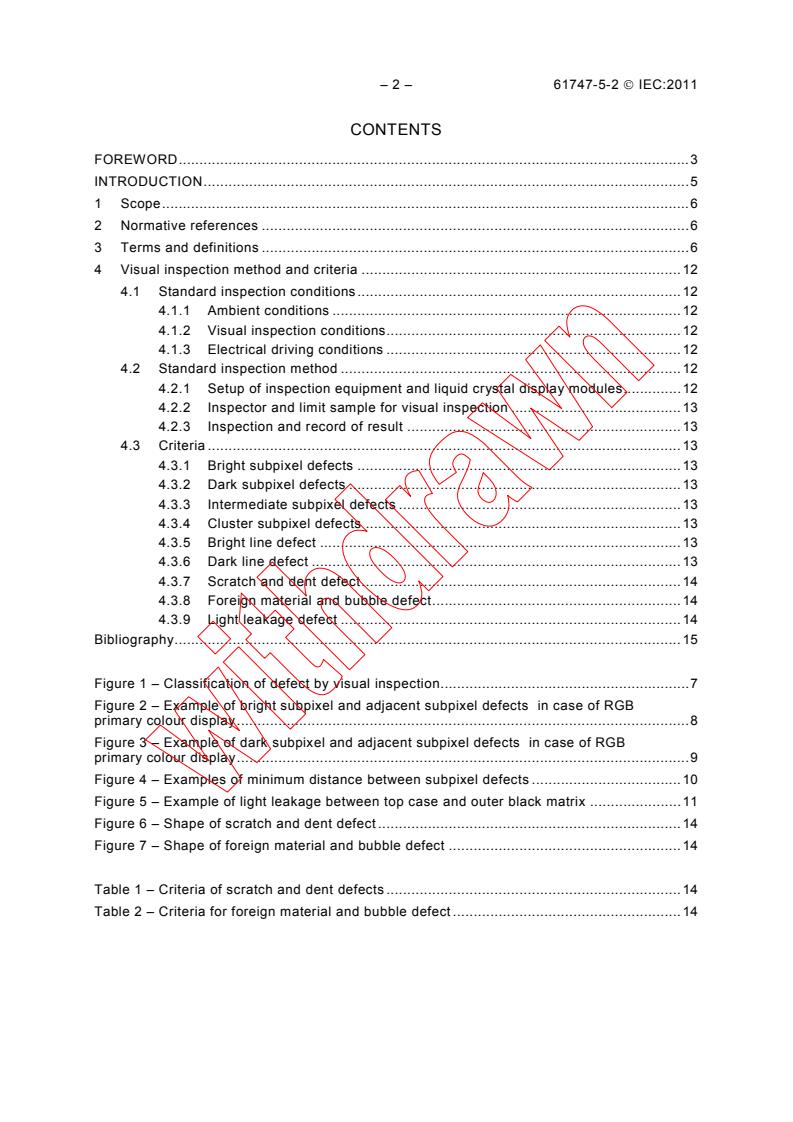
CONTENTS
FOREWORD . 3
INTRODUCTION . 5
1 Scope . 6
2 Normative references . 6
3 Terms and definitions . 6
4 Visual inspection method and criteria . 12
4.1 Standard inspection conditions . 12
4.1.1 Ambient conditions . 12
4.1.2 Visual inspection conditions . 12
4.1.3 Electrical driving conditions . 12
4.2 Standard inspection method . 12
4.2.1 Setup of inspection equipment and liquid crystal display modules . 12
4.2.2 Inspector and limit sample for visual inspection . 13
4.2.3 Inspection and record of result . 13
4.3 Criteria . 13
4.3.1 Bright subpixel defects . 13
4.3.2 Dark subpixel defects . 13
4.3.3 Intermediate subpixel defects . 13
4.3.4 Cluster subpixel defects . 13
4.3.5 Bright line defect . 13
4.3.6 Dark line defect . 13
4.3.7 Scratch and dent defect . 14
4.3.8 Foreign material and bubble defect . 14
4.3.9 Light leakage defect . 14
Bibliography . 15
Figure 1 – Classification of defect by visual inspection. 7
Figure 2 – Example of bright subpixel and adjacent subpixel defects in case of RGB
primary colour display . 8
Figure 3 – Example of dark subpixel and adjacent subpixel defects in case of RGB
primary colour display . 9
Figure 4 – Examples of minimum distance between subpixel defects . 10
Figure 5 – Example of light leakage between top case and outer black matrix . 11
Figure 6 – Shape of scratch and dent defect . 14
Figure 7 – Shape of foreign material and bubble defect . 14
Table 1 – Criteria of scratch and dent defects . 14
Table 2 – Criteria for foreign material and bubble defect . 14
61747-5-2 IEC:2011 – 3 –
INTERNATIONAL ELECTROTECHNICAL COMMISSION
___________
LIQUID CRYSTAL DISPLAY DEVICES –
Part 5-2: Environmental, endurance
and mechanical test methods –
Visual inspection of active matrix
colour liquid crystal display modules
FOREWORD
1) The International Electrotechnical Commission (IEC) is a worldwide organization for standardization comprising
all national electrotechnical committees (IEC National Committees). The object of IEC is to promote
international co-operation on all questions concerning standardization in the electrical and electronic fields. To
this end and in addition to other activities, IEC publishes International Standards, Technical Specifications,
Technical Reports, Publicly Available Specifications (PAS) and Guides (hereafter referred to as “IEC
Publication(s)”). Their preparation is entrusted to technical committees; any IEC National Committee interested
in the subject dealt with may participate in this preparatory work. International, governmental and non-
governmental organizations liaising with the IEC also participate in this preparation. IEC collaborates closely
with the International Organization for Standardization (ISO) in accordance with conditions determined by
agreement between the two organizations.
2) The formal decisions or agreements of IEC on technical matters express, as nearly as possible, an international
consensus of opinion on the relevant subjects since each technical committee has representation from all
interested IEC National Committees.
3) IEC Publications have the form of recommendations for international use and are accepted by IEC National
Committees in that sense. While all reasonable efforts are made to ensure that the technical content of IEC
Publications is accurate, IEC cannot be held responsible for the way in which they are used or for any
misinterpretation by any end user.
4) In order to promote international uniformity, IEC National Committees undertake to apply IEC Publications
transparently to the maximum extent possible in their national and regional publications. Any divergence
between any IEC Publication and the corresponding national or regional publication shall be clearly indicated in
the latter.
5) IEC itself does not provide any attestation of conformity. Independent certification bodies provide conformity
assessment services and, in some areas, access to IEC marks of conformity. IEC is not responsible for any
services carried out by independent certification bodies.
6) All users should ensure that they have the latest edition of this publication.
7) No liability shall attach to IEC or its directors, employees, servants or agents including individual experts and
members of its technical committees and IEC National Committees for any personal injury, property damage or
other damage of any nature whatsoever, whether direct or indirect, or for costs (including legal fees) and
expenses arising out of the publication, use of, or reliance upon, this IEC Publication or any other IEC
Publications.
8) Attention is drawn to the Normative references cited in this publication. Use of the referenced publications is
indispensable for the correct application of this publication.
9) Attention is drawn to the possibility that some of the elements of this IEC Publication may be the subject of
patent rights. IEC shall not be held responsible for identifying any or all such patent rights.
International Standard IEC 61747-5-2 has been prepared by IEC technical committee 110:
Flat panel display devices.
The text of this standard is based on the following documents:
FDIS Report on voting
110/287/FDIS 110/306/RVD
Full information on the voting for the approval on this standard can be found in the report on
voting indicated in the above table.
This publication has been drafted in accordance with the ISO/IEC Directives, Part 2.
– 4 – 61747-5-2 IEC:2011
A list of all parts of the IEC 61747 series, under the general title Liquid crystal display devices,
can be found on the IEC website.
Future standards in this series will carry the new general title as cited above. Titles of existing
standards in this series will be updated at the time of the next edition.
The committee has decided that the contents of this publication will remain unchanged until
the stability date indicated on the IEC web site under "http://webstore.iec.ch" in the data
related to the specific publication. At this date, the publication will be
• reconfirmed,
• withdrawn,
• replaced by a revised edition, or
• amended.
IMPORTANT – The 'colour inside' logo on the cover page of this publication indicates
that it contains colours which are considered to be useful for the correct
understanding of its contents. Users should therefore print this document using a
colour printer.
61747-5-2 IEC:2011 – 5 –
INTRODUCTION
IEC 61747-5-2 facilitates subjective visual inspection of image defects of LCD modules by the
human eye. Visual inspection is performed under specified conditions and criteria, and the
objective measurement method of visual image defect by instrument will be studied and
standardized.
– 6 – 61747-5-2 IEC:2011
LIQUID CRYSTAL DISPLAY DEVICES –
Part 5-2: Environmental, endurance
and mechanical test methods –
Visual inspection of active matrix
colour liquid crystal display modules
1 Scope
This part of IEC 61747 gives the details of the quality assessment procedures and provides
general rules for visual inspection of the active area of transmissive type active matrix colour
liquid crystal display modules by the human eye. Furthermore, this standard includes defect
definitions and the method for visual defect inspection.
NOTE 1 Mura is excluded from this standard because it was not clearly specified at the time this standard was
developed.
NOTE 2 Restrictions on defect types, number, and sizes are specified in the quality contract (customer
acceptance specification and incoming inspection specification) between panel and set makers.
2 Normative references
The following referenced documents are indispensable for the application of this document.
For dated references, only the edition cited applies. For undated references, the latest edition
of the referenced document (including any amendments) applies.
IEC 61747-1:2003, Liquid crystal and solid-state display devices – Part 1: Generic
specification
IEC 61747-5:1998, Liquid crystal and solid-state display devices – Part 5: Environmental,
endurance and mechanical test methods
3 Terms and definitions
For the purposes of this document, the terms and definitions given in IEC 61747-1, as well as
the following, apply.
3.1
visual inspection
method by human eye for checking display defects that are difficult to objectively measure
and characterize with an instrument
NOTE The limitation on display defects depends on supplier and customer. Therefore a limit sample, with well
defined observation and operational conditions, can be used as a reference for the defect level.
3.2
defect
defined as any observable abnormal phenomena appearing in the active display area
NOTE It includes all kinds of defects such as one / more subpixel (dot) defect, line defect, scratch, foreign
material and stain with unclear boundary larger than a pixel.
Figure 1 shows a classification of defects into two categories. The first category is classified
as defects with a clear boundary, and the second category is classified as defects with an
61747-5-2 IEC:2011 – 7 –
unclear boundary. The latter category is not yet well defined, and hence difficult to evaluate.
For this reason, defects in the second category are excluded from this standard.
Small
bright
Subpixel
Single Dark
defect
Clear
Intermediate
boundary
(high CR)
Plural Adjacent bright
Point
Adjacent dark
defect
Foreign
Defect
Bubble
Line defect
S cratch and dent defect
Unclear
Large
boundary
Mura
(low CR)
IEC 1170/11
Figure 1 – Classification of defect by visual inspection
3.2.1
subpixel defect
defect in the smallest pixel element when it appears in a different than the intended state, for
instance bright subpixels appear on the dark pattern, and dark subpixels appear on a bright pattern
3.2.1.1
bright subpixel defects
defects which appear bright on the screen when a dark pattern is displayed
Figure 2a) shows a single subpixel bright defect of red, green, and blue respectively. And
Figure 2b) shows two adjacent bright subpixel defects connected or disconnected in
horizontal or (and) vertical one pixel area. Figure 2c) shows adjacent three bright subpixel
defects connected in three horizontal or (and) vertical subpixel area.
– 8 – 61747-5-2 IEC:2011
RR
BB GG
IEC 1171/11
Figure 2 a) – Examples of one bright subpixel defect
BB RR GG RR BB GG
BB GG GG
BB BB RR
IEC 1172/11
Figure 2 b) – Examples of two adjacent bright subpixel defects
BB
GG RR
BB
GG
BB
BB
RR
GG
BB
RR BB
GG
GG BB
IEC 1173/11
Figure 2 c) – Examples of three adjacent bright subpixel defects
Figure 2 – Example of bright subpixel and adjacent subpixel defects
in case of RGB primary colour display
3.2.1.2
dark subpixel defects
defects which appear dark on the screen when a bright pattern is displayed
Figure 3 a) shows single subpixel defects of the dark-type of red, green, blue, respectively.
Figure 3 b) shows two adjacent dark subpixel defects connected or disconnected in horizontal
or(and) vertical one pixel area. Figure 3 c) shows adjacent three dark subpixel defects
connected in three horizontal or(and) vertical subpixel area.
61747-5-2 IEC:2011 – 9 –
RR GG BB GG BB RR GG BB RR GG
RR GG RR GG BB
IEC 1174/11
Figure 3 a) – One dark subpixel defect
R G G B R B G B R G R B
R B R G B
R G R G B R B R G B
R G R G B R G R G B R G B G B
IEC 1175/11
Figure 3 b) – Two adjacent dark subpixel defects
RR GG BB
RR BB RR GG BB RR GG RR GG BB
RR GG RR GG BB RR GG RR GG BB
RR RR GG BB GG BB RR GG BB
RR GG BB GG BB RR GG RR GG BB
RR BB RR GG BB RR RR GG BB
IEC 1176/11
Figure 3 c) – Three adjacent dark subpixel defects
Figure 3 – Example of dark subpixel and adjacent subpixel defects
in case of RGB primary colour display
3.2.1.3
intermediate subpixel defects
defects which appear with an intermediate level on the screen when a bright or dark pattern is
displayed
3.2.1.4
cluster subpixel defects
defects clustered in a specified area or within a specified distance with many subpixel defects
Figures 4 a) and Figure 4 b) show an example of bright and dark cluster subpixel defects in
which the minimum distance between the defects is specified.
– 10 – 61747-5-2 IEC:2011
d > minimum distance d < minimum distance
h h
Pass Fail
IEC 1177/11
Figure 4a) – Bright subpixel defect to bright subpixel defect
d > minimum distance d < minimum distance
h h
Pass Fail
IEC 1178/11
Figure 4 b) – Dark subpixel defect to dark subpixel defect
Figure 4 – Examples of minimum distance between subpixel defects
3.2.2
line defect
vertical or horizontal line which appears in the bright or dark state when a dark or bright
pattern is displayed
3.2.2.1
bright line defect
line that appears bright on the screen when a dark pattern is displayed
3.2.2.2
dark line defect
line that appears dark on the screen when a bright pattern is displayed
d > minimum distance
d > minimum distance
v
v
d < minimum distance d < minimum distance
v
v
61747-5-2 IEC:2011 – 11 –
3.2.3
scratch and dent defect
defects on top of or underneath the polarizer, or other optical components in the active
display area
3.2.3.1
scratch defect
light(white) line that can be seen over a darker background and does not vary in size
3.2.3.2
dent defect
light (white) spot that can be seen over a darker background and does not vary in size
3.2.4
foreign material defect
defect that is located between panel and backlight unit
3.2.5
bubble defect
defect that is caused by a cavity or gas in the liquid crystal material in paste of polarizer /
reflector
3.2.6
light leakage defect
light that is visible between top case (chassis) and outer black matrix in bezel open area
Bezel
Active area
Outer black
active area
matrix
Light leakage
IEC 1179/11
Figure 5 – Example of light leakage between top case and outer black matrix
3.2.7
mura
non-uniformity
visual imperfection in luminance or chromaticity
[definition 3.3.27 of IEC 61747-1:2003]
Under consideration.
– 12 – 61747-5-2 IEC:2011
4 Visual inspection method and criteria
4.1 Standard inspection conditions
4.1.1 Ambient conditions
4.1.1.1 Temperature
All visual inspection shall be carried out under specified temperature. Follow IEC 61747-5,
1.4.3 “Standard atmospheric conditions for measurements and tests”.
4.1.1.2 Humidity
All visual inspection shall be carried out under specified humidity. Follow IEC 61747-5, 1.4.3
“Standard atmospheric conditions for measurements and tests”.
4.1.1.3 Illuminance
All visual inspection shall be carried out under illumination levels as specified in detail
specification. The illumination level shall be adjusted in such a way that it allows for an
accurate visual inspection.
4.1.2 Visual inspection conditions
4.1.2.1 Viewing angle range
The inspection shall be conducted within specified viewing angle range of liquid crystal
display modules.
4.1.2.2 Viewing distance
The distance between device under test (DUT) and inspector’s eyes should be set at optimum
distance. The optimum distance depends on pixel size, display size, application type, and
defect size.
4.1.3 Electrical driving conditions
4.1.3.1 Driving supply voltage or current of DUT
Specified voltage and / or current shall be supplied to DUT.
4.1.3.2 Test pattern
Test patterns shall be specified in detail specification. For example, the test patterns for
visual inspection are the full raster of white, gray, all primary colour patterns under the
specified luminance range.
4.2 Standard inspection method
4.2.1 Setup of inspection equipment and liquid crystal display modules
DUT will be installed on a rotatable fixture to enable the changes in horizontal and vertical
viewing direction range. Or alternatively, the inspector moves around and the DUT is fixed.
Turn on direct current power supply and pattern generator and warm up for stabilization.
Supply the driving voltage and pattern to DUT. The warm-up time of the DUT shall be
sufficiently long to obtain a stable signal, necessary for the visual inspection.
61747-5-2 IEC:2011 – 13 –
4.2.2 Inspector and limit sample for visual inspection
Inspector shall have (corrected-to) normal vision, normal colour vision and shall be
periodically trained with specified limit samples in order to accurately carry out the visual
examination.
4.2.3 Inspection and record of result
Inspector shall carry out the visual inspection based on specified procedure and record the
result on recording sheets with specified inspection condition.
4.3 Criteria
4.3.1 Bright subpixel defects
The maximum number of bright defects shall be specified in specification.
– One subpixel--------------------------------------------------- To be specified in detail specification
– Adjacent subpixels--------------------------------------------To be specified in detail specification
– Total amount of bright subpixels--------------------------- To be specified in detail
specification
4.3.2 Dark subpixel defects
The maximum number of dark defects shall be specified in specification.
– One subpixel--------------------------------------------------- To be specified in detail specification
– Adjacent subpixels-------------------------------------------- To be specified in detail specification
– Total amount of dark subpixels------------------------------To be specified in detail
specification
4.3.3 Intermediate subpixel defects
The maximum number of intermediate defects shall be specified in specification:
– One subpixel--------------------------------------------------- To be specified in detail specification
– Adjacent subpixels--------------------------------------------To be specified in detail specification
– Total amount of subpixels------------------------------------To be specified in detail
specification
4.3.4 Cluster subpixel defects
The maximum number of cluster defects shall be specified in specification.
Also the minimum distance between subpixel defects (d and d , see Figure 4) shall be
v h
specified.
– Cluster subpixels---------------------------------------------- To be specified in detail specification
4.3.5 Bright line defect
All kinds of bright line defects such as vertical, horizontal or cross are not allowed.
4.3.6 Dark line defect
All kinds of dark line defects such as vertical, horizontal or cross are not allowed.
– 14 – 61747-5-2 IEC:2011
4.3.7 Scratch and dent defect
The criteria for scratch and dent defects are provided in Table 1 and Figure 6. The symbol of
“a” and “b” indicates the major axis and minor axis of polarizer defect.
Extraneous substances which can be wiped out, like finger print, particles, are not considered
as a defect. Scratches and dents located on the black matrix (outside of
...