

IEC TR 61000-4-38:2015
(Main)Electromagnetic compatibility (EMC) - Part 4-38: Testing and measurement techniques - Test, verification and calibration protocol for voltage fluctuation and flicker compliance test systems
General Information
- Abstract
IEC TR 61000-4-38:2015(E) defines a test protocol for flicker test systems designed to perform compliance tests in accordance with IEC 61000-3-3 and IEC 61000-3-11. It is intended to provide test system manufacturers and testing laboratories with systematic methods to determine if the flicker test system meets the IEC design specifications for a wide range of voltage fluctuations and fluctuation frequencies, as specified in IEC 61000-4-15:2010, Table 5, that have been observed in product testing. It has the status of a basic EMC publication in accordance with IEC Guide 107.
- Status
- Published
- Publication Date
- 23-Aug-2015
- Technical Committee
- SC 77A - EMC - Low frequency phenomena
- Drafting Committee
- WG 2 - TC 77/SC 77A/WG 2
- Current Stage
- PPUB - Publication issued
- Start Date
- 24-Aug-2015
- Completion Date
- 15-Dec-2015
Buy Documents
IEC TR 61000-4-38:2015 - Electromagnetic compatibility (EMC) - Part 4-38: Testing and measurement techniques - Test, verification and calibration protocol for voltage fluctuation and flicker compliance test systems Released:8/24/2015
Overview
IEC TR 61000-4-38:2015 is a technical report developed by the International Electrotechnical Commission (IEC) that addresses the verification and calibration of voltage fluctuation and flicker compliance test systems. As a part of the IEC 61000 series on Electromagnetic Compatibility (EMC), this document specifically provides a systematic protocol for testing flicker test systems, ensuring their performance and compliance with IEC 61000-3-3 and IEC 61000-3-11 requirements. The report is intended for use by test system manufacturers and testing laboratories engaged in assessing flicker and voltage fluctuations in electrical and electronic equipment.
Key Topics
- Flicker and Voltage Fluctuations: The document defines methods for measuring the fluctuations in voltage (commonly known as "flicker") caused by the operation of electrical devices and ensures these measurements are accurate and consistent.
- System Calibration and Verification: It outlines periodic calibration procedures for complete flicker test systems, not only focusing on the flicker meter itself, but also including the power source and reference impedance as per IEC design specifications.
- Performance Criteria: The report provides detailed criteria for evaluating test system performance, focusing on parameters such as measureable voltage deviations and correct calculation of flicker indices like Pst.
- Test Protocols: IEC TR 61000-4-38 defines a series of tests using various modulation rates and load conditions, simulating real-world scenarios to verify system accuracy and reliability.
- Documentation Requirements: The report highlights the necessary information manufacturers or owners must provide (e.g., device specifications, software versions, calibration status) for effective application and accurate test results.
Applications
- Accreditation of Testing Laboratories: Testing laboratories can use IEC TR 61000-4-38 as a foundation to demonstrate competence and system reliability, which is crucial for accreditation processes.
- Type Testing and Regular Audit: The protocol enables systematic, regular verification of flicker test system performance, helping ensure ongoing compliance with international EMC standards.
- System Integration Evaluation: The report supports engineers in assessing the impact of integrating different system components (like power sources, load units, and reference impedances) on flicker measurements.
- Product Compliance: Manufacturers of electrical and electronic equipment rely on correctly calibrated flicker test systems to demonstrate that their products meet mandatory limits on voltage fluctuations set out in IEC 61000-3-3 and IEC 61000-3-11.
Related Standards
- IEC 61000-3-3: Specifies limits for voltage changes, voltage fluctuations, and flicker in public low-voltage supply systems for equipment with rated current ≤16 A.
- IEC 61000-3-11: Covers similar requirements for equipment with rated current ≤75 A, subject to conditional connection.
- IEC 61000-4-15: Defines the functional and design specifications for flickermeters used in testing.
- IEC TR 60725: Provides reference and public supply network impedances for determining disturbance characteristics.
- ISO/IEC 17025: General requirements for the competence of testing and calibration laboratories.
Practical Value
IEC TR 61000-4-38:2015 provides essential test and calibration protocols, enabling manufacturers and test labs to confidently verify the performance of flicker test systems. By following its guidelines, organizations ensure consistent, accurate EMC testing, helping products meet international requirements for power quality and electromagnetic compatibility. This guidance supports both periodic verification and root cause analysis, minimizing risks associated with non-compliant electrical equipment and supporting market access for compliant products.
Keywords: IEC 61000-4-38, flicker measurement, voltage fluctuation, EMC testing, calibration protocol, compliance test systems, IEC 61000-3-3, IEC 61000-3-11, flickermeter, reference impedance, test laboratory accreditation.
Buy Documents
IEC TR 61000-4-38:2015 - Electromagnetic compatibility (EMC) - Part 4-38: Testing and measurement techniques - Test, verification and calibration protocol for voltage fluctuation and flicker compliance test systems Released:8/24/2015
Get Certified
Connect with accredited certification bodies for this standard

ANCE
Mexican certification and testing association.

Intertek Slovenia
Intertek testing, inspection, and certification services in Slovenia.

LNE (Laboratoire National de Métrologie et d'Essais)
French national laboratory for metrology and testing.
Sponsored listings
Frequently Asked Questions
IEC TR 61000-4-38:2015 is a technical report published by the International Electrotechnical Commission (IEC). Its full title is "Electromagnetic compatibility (EMC) - Part 4-38: Testing and measurement techniques - Test, verification and calibration protocol for voltage fluctuation and flicker compliance test systems". This standard covers: IEC TR 61000-4-38:2015(E) defines a test protocol for flicker test systems designed to perform compliance tests in accordance with IEC 61000-3-3 and IEC 61000-3-11. It is intended to provide test system manufacturers and testing laboratories with systematic methods to determine if the flicker test system meets the IEC design specifications for a wide range of voltage fluctuations and fluctuation frequencies, as specified in IEC 61000-4-15:2010, Table 5, that have been observed in product testing. It has the status of a basic EMC publication in accordance with IEC Guide 107.
IEC TR 61000-4-38:2015(E) defines a test protocol for flicker test systems designed to perform compliance tests in accordance with IEC 61000-3-3 and IEC 61000-3-11. It is intended to provide test system manufacturers and testing laboratories with systematic methods to determine if the flicker test system meets the IEC design specifications for a wide range of voltage fluctuations and fluctuation frequencies, as specified in IEC 61000-4-15:2010, Table 5, that have been observed in product testing. It has the status of a basic EMC publication in accordance with IEC Guide 107.
IEC TR 61000-4-38:2015 is classified under the following ICS (International Classification for Standards) categories: 33.100.20 - Immunity. The ICS classification helps identify the subject area and facilitates finding related standards.
IEC TR 61000-4-38:2015 is available in PDF format for immediate download after purchase. The document can be added to your cart and obtained through the secure checkout process. Digital delivery ensures instant access to the complete standard document.
Standards Content (Sample)
IEC TR 61000-4-38 ®
Edition 1.0 2015-08
TECHNICAL
REPORT
colour
inside
BASIC EMC PUBLICATION
Electromagnetic compatibility (EMC) –
Part 4-38: Testing and measurement techniques – Test, verification and
calibration protocol for voltage fluctuation and flicker compliance test systems
All rights reserved. Unless otherwise specified, no part of this publication may be reproduced or utilized in any form
or by any means, electronic or mechanical, including photocopying and microfilm, without permission in writing from
either IEC or IEC's member National Committee in the country of the requester. If you have any questions about IEC
copyright or have an enquiry about obtaining additional rights to this publication, please contact the address below or
your local IEC member National Committee for further information.
IEC Central Office Tel.: +41 22 919 02 11
3, rue de Varembé Fax: +41 22 919 03 00
CH-1211 Geneva 20 info@iec.ch
Switzerland www.iec.ch
About the IEC
The International Electrotechnical Commission (IEC) is the leading global organization that prepares and publishes
International Standards for all electrical, electronic and related technologies.
About IEC publications
The technical content of IEC publications is kept under constant review by the IEC. Please make sure that you have the
latest edition, a corrigenda or an amendment might have been published.
IEC Catalogue - webstore.iec.ch/catalogue Electropedia - www.electropedia.org
The stand-alone application for consulting the entire The world's leading online dictionary of electronic and
bibliographical information on IEC International Standards, electrical terms containing more than 30 000 terms and
Technical Specifications, Technical Reports and other definitions in English and French, with equivalent terms in 15
documents. Available for PC, Mac OS, Android Tablets and additional languages. Also known as the International
iPad. Electrotechnical Vocabulary (IEV) online.
IEC publications search - www.iec.ch/searchpub IEC Glossary - std.iec.ch/glossary
The advanced search enables to find IEC publications by a More than 60 000 electrotechnical terminology entries in
variety of criteria (reference number, text, technical English and French extracted from the Terms and Definitions
committee,…). It also gives information on projects, replaced clause of IEC publications issued since 2002. Some entries
and withdrawn publications. have been collected from earlier publications of IEC TC 37,
77, 86 and CISPR.
IEC Just Published - webstore.iec.ch/justpublished
Stay up to date on all new IEC publications. Just Published IEC Customer Service Centre - webstore.iec.ch/csc
details all new publications released. Available online and If you wish to give us your feedback on this publication or
also once a month by email. need further assistance, please contact the Customer Service
Centre: csc@iec.ch.
IEC TR 61000-4-38 ®
Edition 1.0 2015-08
TECHNICAL
REPORT
colour
inside
BASIC EMC PUBLICATION
Electromagnetic compatibility (EMC) –
Part 4-38: Testing and measurement techniques – Test, verification and
calibration protocol for voltage fluctuation and flicker compliance test systems
INTERNATIONAL
ELECTROTECHNICAL
COMMISSION
ICS 33.100.20 ISBN 978-2-8322-2870-8
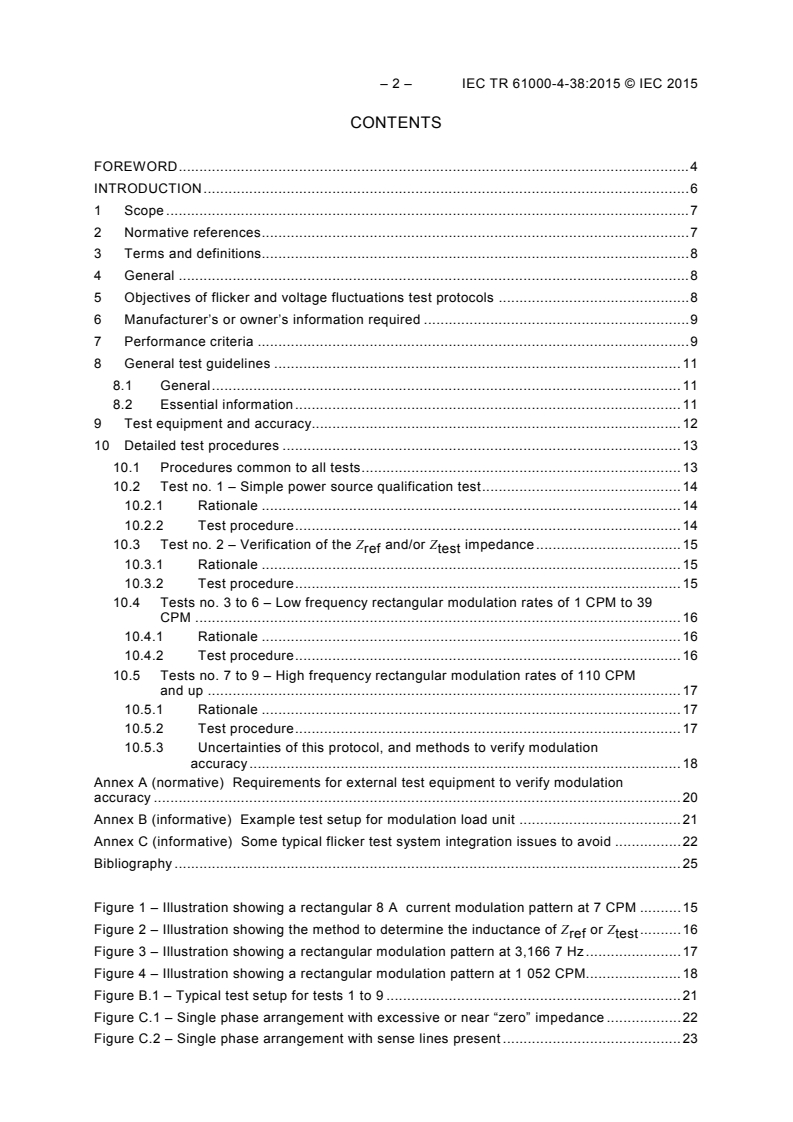
– 2 – IEC TR 61000-4-38:2015 © IEC 2015
CONTENTS
FOREWORD . 4
INTRODUCTION . 6
1 Scope . 7
2 Normative references . 7
3 Terms and definitions. 8
4 General . 8
5 Objectives of flicker and voltage fluctuations test protocols . 8
6 Manufacturer’s or owner’s information required . 9
7 Performance criteria . 9
8 General test guidelines . 11
8.1 General . 11
8.2 Essential information . 11
9 Test equipment and accuracy . 12
10 Detailed test procedures . 13
10.1 Procedures common to all tests . 13
10.2 Test no. 1 – Simple power source qualification test . 14
10.2.1 Rationale . 14
10.2.2 Test procedure . 14
10.3 Test no. 2 – Verification of the Z and/or Z impedance . 15
ref test
10.3.1 Rationale . 15
10.3.2 Test procedure . 15
10.4 Tests no. 3 to 6 – Low frequency rectangular modulation rates of 1 CPM to 39
CPM . 16
10.4.1 Rationale . 16
10.4.2 Test procedure . 16
10.5 Tests no. 7 to 9 – High frequency rectangular modulation rates of 110 CPM
and up . 17
10.5.1 Rationale . 17
10.5.2 Test procedure . 17
10.5.3 Uncertainties of this protocol, and methods to verify modulation
accuracy . 18
Annex A (normative) Requirements for external test equipment to verify modulation
accuracy . 20
Annex B (informative) Example test setup for modulation load unit . 21
Annex C (informative) Some typical flicker test system integration issues to avoid . 22
Bibliography . 25
Figure 1 – Illustration showing a rectangular 8 A current modulation pattern at 7 CPM . 15
Figure 2 – Illustration showing the method to determine the inductance of Z or Z . 16
ref test
Figure 3 – Illustration showing a rectangular modulation pattern at 3,166 7 Hz . 17
Figure 4 – Illustration showing a rectangular modulation pattern at 1 052 CPM. 18
Figure B.1 – Typical test setup for tests 1 to 9 . 21
Figure C.1 – Single phase arrangement with excessive or near “zero” impedance . 22
Figure C.2 – Single phase arrangement with sense lines present . 23
Figure C.3 – Single phase arrangement with connecting lines to power analyzer . 23
Figure C.4 – Neutral impedance bypassed externally . 24
Table 1 – Calibration points from IEC 61000-4-15:2010, Table 5 . 10
Table 2 – Summary of tests to verify/calibrate flicker test systems . 11
– 4 – IEC TR 61000-4-38:2015 © IEC 2015
INTERNATIONAL ELECTROTECHNICAL COMMISSION
____________
ELECTROMAGNETIC COMPATIBILITY (EMC) –
Part 4-38: Testing and measurement techniques –
Test, verification and calibration protocol for voltage
fluctuation and flicker compliance test systems
FOREWORD
1) The International Electrotechnical Commission (IEC) is a worldwide organization for standardization comprising
all national electrotechnical committees (IEC National Committees). The object of IEC is to promote
international co-operation on all questions concerning standardization in the electrical and electronic fields. To
this end and in addition to other activities, IEC publishes International Standards, Technical Specifications,
Technical Reports, Publicly Available Specifications (PAS) and Guides (hereafter referred to as “IEC
Publication(s)”). Their preparation is entrusted to technical committees; any IEC National Committee interested
in the subject dealt with may participate in this preparatory work. International, governmental and non-
governmental organizations liaising with the IEC also participate in this preparation. IEC collaborates closely
with the International Organization for Standardization (ISO) in accordance with conditions determined by
agreement between the two organizations.
2) The formal decisions or agreements of IEC on technical matters express, as nearly as possible, an international
consensus of opinion on the relevant subjects since each technical committee has representation from all
interested IEC National Committees.
3) IEC Publications have the form of recommendations for international use and are accepted by IEC National
Committees in that sense. While all reasonable efforts are made to ensure that the technical content of IEC
Publications is accurate, IEC cannot be held responsible for the way in which they are used or for any
misinterpretation by any end user.
4) In order to promote international uniformity, IEC National Committees undertake to apply IEC Publications
transparently to the maximum extent possible in their national and regional publications. Any divergence
between any IEC Publication and the corresponding national or regional publication shall be clearly indicated in
the latter.
5) IEC itself does not provide any attestation of conformity. Independent certification bodies provide conformity
assessment services and, in some areas, access to IEC marks of conformity. IEC is not responsible for any
services carried out by independent certification bodies.
6) All users should ensure that they have the latest edition of this publication.
7) No liability shall attach to IEC or its directors, employees, servants or agents including individual experts and
members of its technical committees and IEC National Committees for any personal injury, property damage or
other damage of any nature whatsoever, whether direct or indirect, or for costs (including legal fees) and
expenses arising out of the publication, use of, or reliance upon, this IEC Publication or any other IEC
Publications.
8) Attention is drawn to the Normative references cited in this publication. Use of the referenced publications is
indispensable for the correct application of this publication.
9) Attention is drawn to the possibility that some of the elements of this IEC Publication may be the subject of
patent rights. IEC shall not be held responsible for identifying any or all such patent rights.
The main task of IEC technical committees is to prepare International Standards. However, a
technical committee may propose the publication of a technical report when it has collected
data of a different kind from that which is normally published as an International Standard, for
example "state of the art".
IEC 61000-4-38, which is a technical report, has been prepared by subcommittee 77A: EMC –
Low frequency phenomena, of IEC technical committee 77: Electromagnetic compatibility.
It forms Part 4-38 of IEC 61000. It has the status of a basic EMC publication in accordance
with IEC Guide 107.
The text of this technical report is based on the following documents:
Enquiry draft Report on voting
77A/881/DTR 77A/898/RVC
Full information on the voting for the approval of this technical report can be found in the report
on voting indicated in the above table.
This publication has been drafted in accordance with the ISO/IEC Directives, Part 2.
A list of all parts in the IEC 61000 series, published under the general title Electromagnetic
compatibility (EMC), can be found on the IEC website.
The committee has decided that the contents of this publication will remain unchanged until the
stability date indicated on the IEC website under "http://webstore.iec.ch" in the data related to
the specific publication. At this date, the publication will be
• reconfirmed,
• withdrawn,
• replaced by a revised edition, or
• amended.
A bilingual version of this publication may be issued at a later date.
IMPORTANT – The 'colour inside' logo on the cover page of this publication indicates
that it contains colours which are considered to be useful for the correct
understanding of its contents. Users should therefore print this document using a
colour printer.
– 6 – IEC TR 61000-4-38:2015 © IEC 2015
INTRODUCTION
Flicker measurement systems are used to measure voltage fluctuations from equipment that is
tested in accordance with IEC 61000-3-3 and/or IEC 61000-3-11 standards. The IEC adopted
measurement and evaluation techniques that are specified in IEC 61000-4-15, but limits, limit
comparisons, certain exclusions, and test conditions for a variety of products are specified in
IEC 61000-3-3 (for 16 A/phase and below) and IEC 61000-3-11 (up to 75 A/phase).
This TR specifies recommended methods and acceptability criteria for performance verification
of test systems designed to measure voltage fluctuations and flicker in accordance with
IEC 61000-3-3 and IEC 61000-3-11.
A typical IEC 61000-3-3 and IEC 61000-3-11 compliance test system includes not only the
flicker meter, but also a suitable power source and a test impedance. The reference
impedance, per IEC TR 60725, is used for IEC 61000-3-3 tests, while the Z as specified in
test
IEC 61000-3-11 is used for higher power products. This TR therefore also includes a method to
verify that the impedance, according to IEC TR 60725 or the Z specification, is within
test
reasonable tolerances and that the power source does not contribute more to the measured
flicker levels as is permitted in IEC 61000-3-3 and IEC 61000-311.
This protocol is neither intended as a type test nor as an exhaustive test of all required flicker
meter capabilities according to IEC 61000-4-15. The primary objective is to verify, on a periodic
basis, that the flicker test system, consisting of a previously type tested analyzer, a suitable
power source and impedance unit, performs correctly, and that the system performance is not
adversely affected by the system integration or by deterioration of one of the system
components. For example this TR can be one of the methods to achieve accreditation of a test
laboratory or facility.
NOTE To characterize individual system components, both digital volt meters 1 and 2 (DVM-1 and DVM-2) in
Figure B.1 are needed, and care is taken that DVM-2 measures the exact same voltage point that the flicker meter
uses as its input. For previously calibrated systems undergoing a periodic verification, the measurement of current
will generally suffice and the use of DVM-2 is not mandatory.
The purpose of the flicker test system is to evaluate voltage fluctuations that may be caused by
the tested equipment when this equipment will be connected to the public electricity supply.
The flicker test system may have automatic limit evaluation software or firmware, data storage,
additional analysis capabilities, and report generation capabilities that facilitate the process of
certifying the tested products according to IEC 61000-3-3 and/or IEC 61000-3-11.
The primary purpose of the test, verification, and calibration protocol in this technical report is
to establish methods that may be used to verify that a given flicker test system measures and
evaluates common voltage fluctuations in accordance with the standards and thus allows the
user to perform a correct pass/fail analysis of the tested product. Additional capabilities, such
as the data storage, reporting, or analysis functions of the analyzer or test system may also be
tested using some of the tests described in this protocol.
The methodology used in this protocol consists of applying a known load to the flicker test
system. This known load is modulated on/off, simulating an electrical product with varying
power demand, which in turn causes voltage fluctuations. Thus, not only is the flicker meter
tested, but also the power source that has to accommodate the varying power level and the
reference impedance or the Z as specified in IEC 61000-3-3 or IEC 61000-3-11 is tested.
test
The tests as summarized in Table 2 and Clause 10 may also be used to calibrate or adjust the
flicker test system, including adjustments to the test impedance and/or power source. This
calibration can be done by means of comparing the generated voltage fluctuations, verified by
using external reference equipment if so required, with the values reported by the system. This
calibration includes the response of the power source and the impedance that are part of the
test system.
ELECTROMAGNETIC COMPATIBILITY (EMC) –
Part 4-38: Testing and measurement techniques –
Test, verification and calibration protocol for voltage
fluctuation and flicker compliance test systems
1 Scope
This part of IEC 61000, which is a Technical Report, defines a test protocol for flicker test
systems designed to perform compliance tests in accordance with IEC 61000-3-3 and
IEC 61000-3-11. It is intended to provide test system manufacturers and testing laboratories
with systematic methods to determine if the flicker test system meets the IEC design
specifications for a wide range of voltage fluctuations and fluctuation frequencies, as specified
in IEC 61000-4-15:2010, Table 5, that have been observed in product testing.
This protocol is intended to be compatible with related standards, in particular with any
requirements set forth by listing organizations or measurement standards of the IEC. Meeting
the criteria defined herein should not be construed as a waiver of any other relevant
performance or safety requirements.
The main purpose of this technical report is to provide guidance and methods for periodic
calibration and verification of systems consisting of previously type tested equipment. For
complete flicker test systems that exhibit deviations of less than 5 % from the specifications of
this protocol, it can be assumed that individual components are performing properly and
separate calibration of individual system components is therefore not necessary.
2 Normative references
The following documents, in whole or in part, are normatively referenced in this document and
are indispensable for its application. For dated references, only the edition cited applies. For
undated references, the latest edition of the referenced document (including any amendments)
applies.
IEC 60050-161, International Electrotechnical Vocabulary – Part 161: Electromagnetic
compatibility
IEC TR 60725, Consideration of reference impedances and public supply network impedances
for use in determining the disturbance characteristics of electrical equipment having a rated
current ≤ 75 A per phase
IEC 61000-3-3:2013, Electromagnetic compatibility (EMC) – Part 3-3: Limits – Limitation of
voltage changes, voltage fluctuations and flicker in public low-voltage supply systems, for
equipment with rated current ≤16 A per phase and not subject to conditional connection
IEC 61000-3-11, Electromagnetic compatibility (EMC) – Part 3-11: Limits – Limitation of voltage
changes, voltage fluctuations and flicker in public low-voltage supply systems, for equipment
with rated current ≤75 A per phase and subject to conditional connection.
IEC 61000-4-15:2010, Electromagnetic compatibility (EMC) – Part 4-15: Testing and
measurement techniques – Flickermeter – Functional and design specifications
ISO/IEC 17025, General requirements for the competence of testing and calibration
laboratories
– 8 – IEC TR 61000-4-38:2015 © IEC 2015
3 Terms and definitions
For the purposes of this document, the terms and definitions given in IEC 60050-161 as well as
the following apply.
3.1
linear resistive load
load unit that is predominantly resistive in nature, with negligible inductance and capacitance
3.2
load modulation
method to turn the load on and off, usually in a 50 % duty cycle pattern, with a frequency that is
controlled, either manually by the user or automatically by the test equipment
4 General
In this technical report, all voltages and currents are stated as r.m.s values unless otherwise
described.
Flicker meters in accordance with IEC 61000-4-15 may be used for power quality analysis and
surveys covering a very wide range of voltage fluctuations. Flicker test systems, used to verify
that a product complies with IEC 61000-3-3 and/or IEC 61000-3-11, have a more limited range
of applications. The test class definition for flicker meters used in a compliance test system, is
Class- F2 according to IEC 61000-4-15, and a reduced set of tests is applied.
For example, the highest permitted d according to IEC 61000-3-3 or IEC 61000-3-11 is 7 %.
max
Even with a substantial margin, allowing voltage fluctuations of say 10 %, i.e. more than 40 %
above the highest permitted d , the instantaneous flicker sensation P will be limited to no
max inst
more than 1 600. In addition, a d level of 10 % would require a power source that is capable
max
of delivering up to 58 A for at least a half cycle if the test is done according to IEC 61000-3-3,
and in fact, as much as 92 A if tested according to IEC 61000-3-11.
Higher amplitude voltage fluctuations are therefore extremely unlikely during product testing,
and thus tests at these higher levels are not provided for in this protocol as they would impose
unnecessary demands and costs upon the system and the test method. Equally, the P level a
st
product is permitted to exhibit is 1,0, and thus tests exceeding a P of 4,0 are not necessary
st
for a flicker compliance test system. Similarly, since a product is permitted to have a P of at
lt
least 0,65, it is not necessary to have extreme resolution or accuracy below a P of 0,4,
st
although the testing authority may include tests to P and P levels below 0,4 or higher than
st lt
4,0 using the methodology described in this protocol.
In general, the procedures and methodologies specified in ISO/IEC 17025 should be followed
to verify that the test and verification signals, measurement protocols, external reference
equipment and evaluation methods specified in this technical report are produced with
sufficient accuracy to meet the stated goal of evaluating the flicker test system.
The test protocol uses rectangular voltage fluctuation patterns in accordance with
IEC 61000-4-15:2010, Table 5, possibly augmented – at the user’s discretion – by additional
tests from IEC 61000-4-15:2010, Table 1 and Table 2, and also employs a non-linear current
pattern to evaluate not only the flicker meter, but also the suitability of the power source and
the flicker test impedance.
5 Objectives of flicker and voltage fluctuations test protocols
The primary objective of this test protocol is to assure that a flicker test system meets the
requirements set forth in this technical report and produces results that lead to correct and
reproducible pass/fail evaluations when testing products in accordance with IEC 61000-3-3
and/or IEC 61000-3-11. Thus, it is intended that various test systems that pass the tests
described in this protocol produce similar test results, within specified tolerances, when
evaluating the same equipment (unit) under test (EUT or UUT) under identical or near identical
environmental and test conditions.
Flicker test systems that are evaluated using this protocol should be obtained with the
cooperation of the system owner or the system manufacturer. The testing authority should
ensure that only the tests of this protocol are applied and that they correspond to the power
and current range for which the system is specified.
6 Manufacturer’s or owner’s information required
To assist the user in correctly applying the tests in this protocol, the manufacturer or system
owner should provide detailed accuracy specifications on the flicker test system in accordance
with its intended use. That is, the user should have enough information so that, in its intended
environment, the flicker test system will be used within its voltage, current, d , d , P , and
max c inst
P ranges. Essential information should be provided with the flicker test system package. The
st
following list is provided as an example, and may be expanded as required.
a) Manufacturer’s name or trademark.
b) Product name and/or model number, serial number, and software or firmware identification.
c) Mains voltage and frequency operating range.
d) Limits for nominal voltage and current input range(s).
e) Limit for voltage variations at the flicker meter input (±x,x % d and d ).
max c
f) Operating range of output 5 (P ) of the flicker meter.
inst
g) P operating range of the flicker meter.
st
h) Compliance with applicable standards (e.g. IEC 61000-3-3, IEC TR 60725, IEC 61000-3-11,
IEC 61000-4-15 and applicable editions).
i) Device specifications and accuracy specification.
j) Installation and usage instructions.
k) Maintenance instructions as appropriate.
7 Performance criteria
IEC 61000-4-15 defines the flicker meter in detail and provides certain accuracy requirements
including those shown in Table 1 (reproduced from IEC 61000-4-15:2010, Table 5). It has been
shown, however, that different flicker test system implementations– all claiming to meet the
accuracies defined in IEC 61000-4-15 – can still disagree significantly in some actual
measurements. It has been shown that the AC test source and the reference impedance can
substantially affect the measured parameters. Problems with flicker analyzer implementations,
and initial differences in interpretation of requirements in standards IEC 61000-3-3 and
IEC 61000-3-11 have been found as well, although IEC 61000-4-15 has substantially reduced
the interpretation ambiguities. The informative Annex C provides some examples of typical
integration problems that have been found using the methods defined in this protocol.
The individual steps of the test protocol in this technical report are intended therefore to
provide a set of tests to ensure that the analyzer, AC power source, reference impedance or
Z and overall system implementation are correct and produce the desired results. To
test
characterize individual system components, both DVM-1 and DVM-2 in Figure A.1 are
mandatory, and care should be taken that DVM-2 measures the voltage at the exact same
point that the flicker meter uses as its input. For complete flicker test systems that exhibit
deviations of less than 5 % from the specifications in Clause 10 of this protocol, it can be
assumed that individual components are performing properly and separate calibration of
individual system components is therefore not necessary. If performance requirements are not
– 10 – IEC TR 61000-4-38:2015 © IEC 2015
met during a periodic verification, the use of DVM-2 is necessary in order to isolate and identify
the cause of deviations.
The performance criteria can be separated into two main categories, one being the directly
measured parameters such as d and d and the other being the correct indication of the P
c max st
value and calculation of the P value. The first category can be viewed as a system level test,
lt
as it will reveal any errors in either the flicker meter, the test impedance, the power source, or
the overall system integration.
For test systems with a limited scope of use, only a subset of the tests might be required so as
to demonstrate acceptable performance over some specific range of application. For example,
if a particular manufacturer’s EMC test facility only needs to test to a reduced power level,
there is no need to apply current levels that are higher than needed for the user’s products.
In some cases, the user may adjust the system impedance, either by changing passive
components or by adjusting the programmable impedance. If required, and provided the flicker
meter has appropriate adjustments, the accuracy of directly measured parameters – mainly
voltage – may be optimized by adjusting the instrument.
A test system meeting the requirements of this TR is recommended for testing in accordance
with the requirements of IEC 61000-3-3 and IEC 61000-3-11. Alternatively, this TR may be
used to demonstrate that a test system is not recommended for testing in accordance with
IEC 61000-3-3 and IEC 61000-3-11.
Table 1 – Calibration points from IEC 61000-4-15:2010, Table 5
Rectangular Voltage fluctuation %
changes per
120 V lamp 50 Hz 120 V lamp 60 Hz 230 V lamp 50 Hz 230 V lamp 60 Hz
minute (CPM)
system system system system
1 3,178 3,181 2,715 2,719
2 2,561 2,564 2,191 2,194
7 1,694 1,694 1,450 1,450
39 1,045 1,040 0,894 0,895
110 0,844 0,844 0,722 0,723
1 620 0,545 0,548 0,407 0,409
4 000 3,426 Test not required 2,343 Test not required
4 800 Test not required 4,837 Test not required 3,263
NOTE 1 620 rectangular changes per minute correspond to a rectangular square wave modulation frequency of
13,5 Hz.
Table 2 – Summary of tests to verify/calibrate flicker test systems
IEC 61000-3-3 and Test no. Description of load Required Comments
IEC 61000-3-11 settings and current result
Initial system test with a 1 Linear load of This test verifies that the
< 0,4 P
st
linear load, producing a approximately 29 Ω AC source impedance is
sinusoidal current at resulting in a current level low enough, so that the
approximately 8 A of 8 A. The reference source does not contribute
modulated on/off impedance is in bypass more than 0,4 to the P
st
mode, or the source with
value, in accordance with
programma
...