


IEC 60404-8-2:1998
(Main)Magnetic materials - Part 8-2: Specifications for individual materials - Cold-rolled electrical alloyed steel sheet and strip delivered in the semi-processed state
General Information
- Abstract
Defines the grades of cold-rolled electrical non-oriented alloyed steel sheet and strip delivered in the semi-processed condition, that is without final heat treatment, of 0.50 mm and 0.65 mm nominal thickness. It specifies general requirements, the magnetic properties, the geometric characteristics and tolerances, technological characteristics as well as the inspection procedure. Applies to material intended for the construction of magnetic circuits.
- Status
- Replaced
- Publication Date
- 19-May-1998
- Technical Committee
- TC 68 - Magnetic alloys and steels
- Drafting Committee
- WG 1 - TC 68/WG 1
- Current Stage
- WPUB - Publication withdrawn
- Start Date
- 08-Aug-2005
- Completion Date
- 28-Aug-2026
Buy Documents
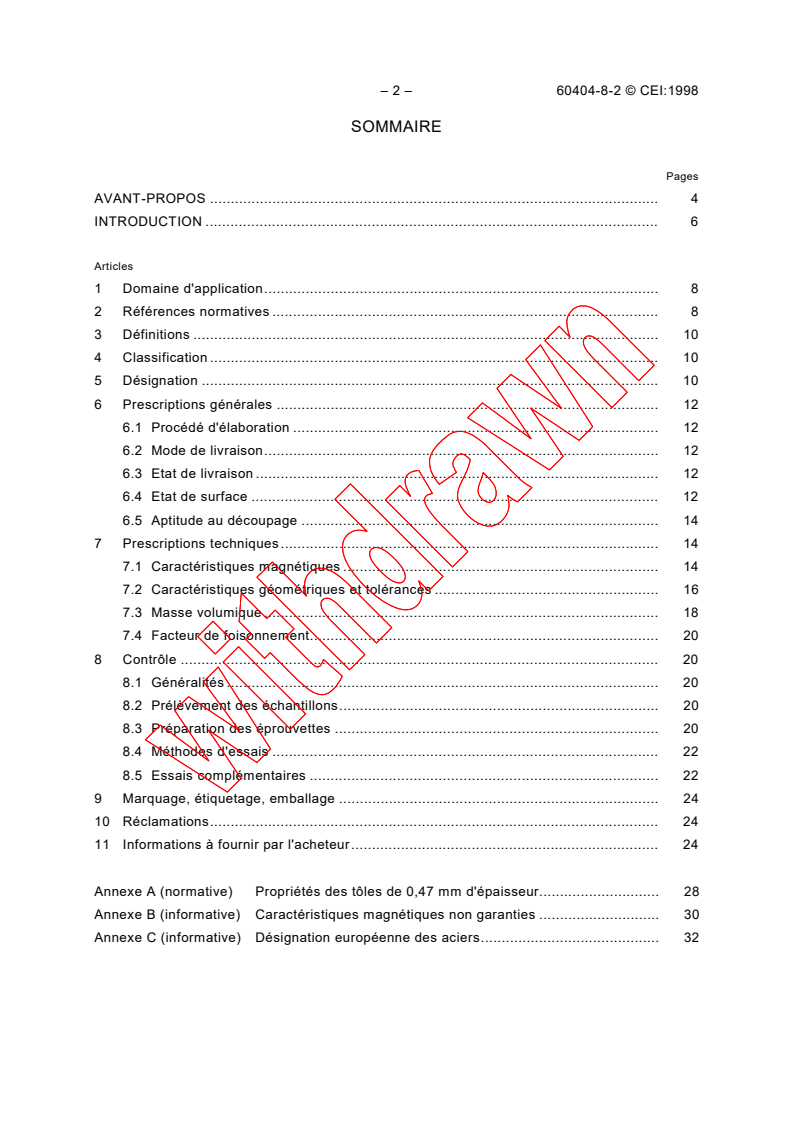
IEC 60404-8-2:1998 - Magnetic materials - Part 8-2: Specifications for individual materials - Cold-rolled electrical alloyed steel sheet and strip delivered in the semi-processed state Released:5/20/1998
Relations
- Effective Date
- 05-Sep-2023
Buy Documents
IEC 60404-8-2:1998 - Magnetic materials - Part 8-2: Specifications for individual materials - Cold-rolled electrical alloyed steel sheet and strip delivered in the semi-processed state Released:5/20/1998
Get Certified
Connect with accredited certification bodies for this standard

IMQ S.p.A. (Certification)
Italian electrical product certification.

SLG Prüf- und Zertifizierungs GmbH
German testing and certification body.

UL Solutions
Global safety science company with testing, inspection and certification.
Sponsored listings
Frequently Asked Questions
IEC 60404-8-2:1998 is a standard published by the International Electrotechnical Commission (IEC). Its full title is "Magnetic materials - Part 8-2: Specifications for individual materials - Cold-rolled electrical alloyed steel sheet and strip delivered in the semi-processed state". This standard covers: Defines the grades of cold-rolled electrical non-oriented alloyed steel sheet and strip delivered in the semi-processed condition, that is without final heat treatment, of 0.50 mm and 0.65 mm nominal thickness. It specifies general requirements, the magnetic properties, the geometric characteristics and tolerances, technological characteristics as well as the inspection procedure. Applies to material intended for the construction of magnetic circuits.
Defines the grades of cold-rolled electrical non-oriented alloyed steel sheet and strip delivered in the semi-processed condition, that is without final heat treatment, of 0.50 mm and 0.65 mm nominal thickness. It specifies general requirements, the magnetic properties, the geometric characteristics and tolerances, technological characteristics as well as the inspection procedure. Applies to material intended for the construction of magnetic circuits.
IEC 60404-8-2:1998 is classified under the following ICS (International Classification for Standards) categories: 17.220.20 - Measurement of electrical and magnetic quantities; 29.030 - Magnetic materials. The ICS classification helps identify the subject area and facilitates finding related standards.
IEC 60404-8-2:1998 has the following relationships with other standards: It is inter standard links to IEC 60404-8-3:2005. Understanding these relationships helps ensure you are using the most current and applicable version of the standard.
IEC 60404-8-2:1998 is available in PDF format for immediate download after purchase. The document can be added to your cart and obtained through the secure checkout process. Digital delivery ensures instant access to the complete standard document.
Standards Content (Sample)
NORME
CEI
INTERNATIONALE
IEC
60404-8-2
INTERNATIONAL
Deuxième édition
STANDARD
Second edition
1998-05
Matériaux magnétiques –
Partie 8-2:
Spécifications pour matériaux particuliers –
Tôles magnétiques en acier allié, laminées à froid
et livrées à l’état semi-fini
Magnetic materials –
Part 8-2:
Specifications for individual materials –
Cold-rolled electrical alloyed steel sheet and strip
delivered in the semi-processed state
Numéro de référence
Reference number
CEI/IEC 60404-8-2:1998
Numéros des publications Numbering
Depuis le 1er janvier 1997, les publications de la CEI As from 1 January 1997 all IEC publications are
sont numérotées à partir de 60000. issued with a designation in the 60000 series.
Publications consolidées Consolidated publications
Les versions consolidées de certaines publications de Consolidated versions of some IEC publications
la CEI incorporant les amendements sont disponibles. including amendments are available. For example,
Par exemple, les numéros d’édition 1.0, 1.1 et 1.2 edition numbers 1.0, 1.1 and 1.2 refer, respectively, to
indiquent respectivement la publication de base, la the base publication, the base publication
publication de base incorporant l’amendement 1, et la incorporating amendment 1 and the base publication
publication de base incorporant les amendements 1 incorporating amendments 1 and 2.
et 2.
Validité de la présente publication Validity of this publication
Le contenu technique des publications de la CEI est The technical content of IEC publications is kept under
constamment revu par la CEI afin qu'il reflète l'état constant review by the IEC, thus ensuring that the
actuel de la technique. content reflects current technology.
Des renseignements relatifs à la date de Information relating to the date of the reconfirmation of
reconfirmation de la publication sont disponibles dans the publication is available in the IEC catalogue.
le Catalogue de la CEI.
Les renseignements relatifs à des questions à l’étude et Information on the subjects under consideration and
des travaux en cours entrepris par le comité technique work in progress undertaken by the technical
qui a établi cette publication, ainsi que la liste des committee which has prepared this publication, as well
publications établies, se trouvent dans les documents ci- as the list of publications issued, is to be found at the
dessous: following IEC sources:
• «Site web» de la CEI* • IEC web site*
• Catalogue des publications de la CEI • Catalogue of IEC publications
Publié annuellement et mis à jour régulièrement Published yearly with regular updates
(Catalogue en ligne)* (On-line catalogue)*
• Bulletin de la CEI • IEC Bulletin
Disponible à la fois au «site web» de la CEI* et Available both at the IEC web site* and as a
comme périodique imprimé printed periodical
Terminologie, symboles graphiques Terminology, graphical and letter
et littéraux symbols
En ce qui concerne la terminologie générale, le lecteur For general terminology, readers are referred to
se reportera à la CEI 60050: Vocabulaire Electro- IEC 60050: International Electrotechnical Vocabulary
technique International (VEI). (IEV).
Pour les symboles graphiques, les symboles littéraux For graphical symbols, and letter symbols and signs
et les signes d'usage général approuvés par la CEI, le approved by the IEC for general use, readers are
lecteur consultera la CEI 60027: Symboles littéraux à referred to publications IEC 60027: Letter symbols to
utiliser en électrotechnique, la CEI 60417: Symboles be used in electrical technology, IEC 60417: Graphical
graphiques utilisables sur le matériel. Index, relevé et symbols for use on equipment. Index, survey and
compilation des feuilles individuelles, et la CEI 60617: compilation of the single sheets and IEC 60617:
Symboles graphiques pour schémas. Graphical symbols for diagrams.
* Voir adresse «site web» sur la page de titre. * See web site address on title page.
NORME
CEI
INTERNATIONALE
IEC
60404-8-2
INTERNATIONAL
Deuxième édition
STANDARD
Second edition
1998-05
Matériaux magnétiques –
Partie 8-2:
Spécifications pour matériaux particuliers –
Tôles magnétiques en acier allié, laminées à froid
et livrées à l’état semi-fini
Magnetic materials –
Part 8-2:
Specifications for individual materials –
Cold-rolled electrical alloyed steel sheet and strip
delivered in the semi-processed state
IEC 1998 Droits de reproduction réservés Copyright - all rights reserved
Aucune partie de cette publication ne peut être reproduite ni No part of this publication may be reproduced or utilized in
utilisée sous quelque forme que ce soit et par aucun any form or by any means, electronic or mechanical,
procédé, électronique ou mécanique, y compris la photo- including photocopying and microfilm, without permission in
copie et les microfilms, sans l'accord écrit de l'éditeur. writing from the publisher.
International Electrotechnical Commission 3, rue de Varembé Geneva, Switzerland
Telefax: +41 22 919 0300 e-mail: inmail@iec.ch IEC web site http: //www.iec.ch
CODE PRIX
Commission Electrotechnique Internationale
PRICE CODE Q
International Electrotechnical Commission
Pour prix, voir catalogue en vigueur
For price, see current catalogue
– 2 – 60404-8-2 © CEI:1998
SOMMAIRE
Pages
AVANT-PROPOS . 4
INTRODUCTION . 6
Articles
1 Domaine d'application. 8
2 Références normatives . 8
3 Définitions . 10
4 Classification . 10
5 Désignation . 10
6 Prescriptions générales . 12
6.1 Procédé d'élaboration . 12
6.2 Mode de livraison. 12
6.3 Etat de livraison . 12
6.4 Etat de surface . 12
6.5 Aptitude au découpage . 14
7 Prescriptions techniques . 14
7.1 Caractéristiques magnétiques . 14
7.2 Caractéristiques géométriques et tolérances . 16
7.3 Masse volumique . 18
7.4 Facteur de foisonnement. 20
8 Contrôle . 20
8.1 Généralités . 20
8.2 Prélèvement des échantillons. 20
8.3 Préparation des éprouvettes . 20
8.4 Méthodes d'essais . 22
8.5 Essais complémentaires . 22
9 Marquage, étiquetage, emballage . 24
10 Réclamations. 24
11 Informations à fournir par l'acheteur. 24
Annexe A (normative) Propriétés des tôles de 0,47 mm d'épaisseur. 28
Annexe B (informative) Caractéristiques magnétiques non garanties . 30
Annexe C (informative) Désignation européenne des aciers. 32
60404-8-2 © IEC:1998 – 3 –
CONTENTS
Page
FOREWORD . 5
INTRODUCTION . 7
Clause
1 Scope. 9
2 Normative references. 9
3 Definitions . 11
4 Classification . 11
5 Designation . 11
6 General requirements . 13
6.1 Production process . 13
6.2 Form of supply. 13
6.3 Delivery condition. 13
6.4 Surface condition . 13
6.5 Suitability for cutting. 15
7 Technical requirements. 15
7.1 Magnetic properties . 15
7.2 Geometric characteristics and tolerances . 17
7.3 Density . 19
7.4 Stacking factor. 21
8 Inspection and testing. 21
8.1 General . 21
8.2 Selection of samples. 21
8.3 Preparation of test specimens . 21
8.4 Test methods. 23
8.5 Retests . 23
9 Marking, labelling and packaging . 25
10 Complaints . 25
11 Information to be supplied by the purchaser . 25
Annex A (normative) Properties of sheet and strip of thickness 0,47 mm. 29
Annex B (informative) Non-specified magnetic properties. 31
Annex C (informative) European steel designation . 33
– 4 – 60404-8-2 © CEI:1998
COMMISSION ÉLECTROTECHNIQUE INTERNATIONALE
___________
MATÉRIAUX MAGNÉTIQUES –
Partie 8-2: Spécifications pour matériaux particuliers –
Tôles magnétiques en acier allié,
laminées à froid et livrées à l'état semi-fini
AVANT-PROPOS
1) La CEI (Commission Electrotechnique Internationale) est une organisation mondiale de normalisation composée
de l'ensemble des comités électrotechniques nationaux (Comités nationaux de la CEI). La CEI a pour objet de
favoriser la coopération internationale pour toutes les questions de normalisation dans les domaines de
l'électricité et de l'électronique. A cet effet, la CEI, entre autres activités, publie des Normes internationales.
Leur élaboration est confiée à des comités d'études, aux travaux desquels tout Comité national intéressé par le
sujet traité peut participer. Les organisations internationales, gouvernementales et non gouvernementales, en
liaison avec la CEI, participent également aux travaux. La CEI collabore étroitement avec l'Organisation
Internationale de Normalisation (ISO), selon des conditions fixées par accord entre les deux organisations.
2) Les décisions ou accords officiels de la CEI concernant les questions techniques, représentent, dans la mesure
du possible un accord international sur les sujets étudiés, étant donné que les Comités nationaux intéressés
sont représentés dans chaque comité d’études.
3) Les documents produits se présentent sous la forme de recommandations internationales. Ils sont publiés
comme normes, rapports techniques ou guides et agréés comme tels par les Comités nationaux.
4) Dans le but d'encourager l'unification internationale, les Comités nationaux de la CEI s'engagent à appliquer de
façon transparente, dans toute la mesure possible, les Normes internationales de la CEI dans leurs normes
nationales et régionales. Toute divergence entre la norme de la CEI et la norme nationale correspondante doit
être indiquée en termes clairs dans cette dernière.
5) La CEI n’a fixé aucune procédure concernant le marquage comme indication d’approbation et sa responsabilité
n’est pas engagée quand un matériel est déclaré conforme à l’une de ses normes.
6) L’attention est attirée sur le fait que certains des éléments de la présente Norme internationale peuvent faire
l’objet de droits de propriété intellectuelle ou de droits analogues. La CEI ne saurait être tenue pour
responsable de ne pas avoir identifié de tels droits de propriété et de ne pas avoir signalé leur existence.
La Norme internationale CEI 60404-8-2 a été établie par le comité d'études 68 de la CEI:
Matériaux magnétiques tels qu'alliages et aciers.
Cette deuxième édition annule et remplace la première édition parue en 1985, dont elle
constitue une révision technique.
Le texte de cette norme est issu des documents suivants:
FDIS Rapport de vote
68/175/FDIS 68/180/RVD
Le rapport de vote indiqué dans le tableau ci-dessus donne toute information sur le vote ayant
abouti à l'approbation de cette norme.
L'annexe A fait partie intégrante de cette norme.
Les annexes B et C sont données uniquement à titre d'information.
60404-8-2 © IEC:1998 – 5 –
INTERNATIONAL ELECTROTECHNICAL COMMISSION
___________
MAGNETIC MATERIALS –
Part 8-2: Specifications for individual materials –
Cold-rolled electrical alloyed steel sheet and strip
delivered in the semi-processed state
FOREWORD
1) The IEC (International Electrotechnical Commission) is a worldwide organization for standardization comprising
all national electrotechnical committees (IEC National Committees). The object of the IEC is to promote
international co-operation on all questions concerning standardization in the electrical and electronic fields. To
this end and in addition to other activities, the IEC publishes International Standards. Their preparation is
entrusted to technical committees; any IEC National Committee interested in the subject dealt with may
participate in this preparatory work. International, governmental and non-governmental organizations liaising
with the IEC also participate in this preparation. The IEC collaborates closely with the International Organization
for Standardization (ISO) in accordance with conditions determined by agreement between the two
organizations.
2) The formal decisions or agreements of the IEC on technical matters express, as nearly as possible, an
international consensus of opinion on the relevant subjects since each technical committee has representation
from all interested National Committees.
3) The documents produced have the form of recommendations for international use and are published in the form
of standards, technical reports or guides and they are accepted by the National Committees in that sense.
4) In order to promote international unification, IEC National Committees undertake to apply IEC International
Standards transparently to the maximum extent possible in their national and regional standards. Any
divergence between the IEC Standard and the corresponding national or regional standard shall be clearly
indicated in the latter.
5) The IEC provides no marking procedure to indicate its approval and cannot be rendered responsible for any
equipment declared to be in conformity with one of its standards.
6) Attention is drawn to the possibility that some of the elements of this International Standard may be the subject
of patent rights. The IEC shall not be held responsible for identifying any or all such patent rights.
International Standard IEC 60404-8-2 has been prepared by IEC technical committee 68:
Magnetic alloys and steels.
This second edition cancels and replaces the first edition published in 1985, of which it
constitutes a technical revision.
The text of this standard is based on the following documents:
FDIS Report on voting
68/175/FDIS 68/180/RVD
Full information on the voting for the approval of this standard can be found in the report on
voting indicated in the above table.
Annex A forms an integral part of this standard.
Annexes B and C are for information only.
– 6 – 60404-8-2 © CEI:1998
INTRODUCTION
Le recuit final des bandes magnétiques en acier allié, laminées à froid et livrées à l'état semi-
fini étant effectué par les soins de l'utilisateur, l'attention est attirée sur l'importance de ce
traitement sur les caractéristiques du produit.
Pour cette raison, les caractéristiques magnétiques figurant dans le tableau 2 sont données
pour un état de référence obtenu grâce à un traitement thermique adéquat. Pour que les
caractéristiques d'emploi soient équivalentes à celles qui sont spécifiées, il importe que le
traitement thermique effectué par l'utilisateur soit équivalent à celui qui a été appliqué pour
définir l'état de référence (voir 7.1.1).
60404-8-2 © IEC:1998 – 7 –
INTRODUCTION
As the final annealing of cold-rolled electrical alloyed steel sheet and strip delivered in the
semi-processed state is the responsibility of the purchaser, attention is drawn to the
importance of this treatment for the properties of the material.
For this reason, the magnetic properties in table 2 are given for a reference condition obtained
by suitable heat treatment. To ensure that the properties in use are equivalent to those
specified, it is important that the heat treatment carried out by the purchaser is equivalent to
that used to define the reference condition (see 7.1.1).
– 8 – 60404-8-2 © CEI:1998
MATÉRIAUX MAGNÉTIQUES –
Partie 8-2: Spécifications pour matériaux particuliers –
Tôles magnétiques en acier allié,
laminées à froid et livrées à l'état semi-fini
1 Domaine d'application
1)
La présente partie de la CEI 60404 définit les qualités des bandes magnétiques en acier allié
à grains non orientés, laminées à froid et livrées à l'état semi-fini, c'est-à-dire sans recuit final,
de 0,50 mm et 0,65 mm d'épaisseur nominale ainsi que des feuilles découpées dans les
bandes. Elle donne également les prescriptions générales, les caractéristiques magnétiques,
les caractéristiques géométriques et les tolérances, les caractéristiques technologiques ainsi
que les conditions de réception.
La présente norme est applicable aux produits destinés à la construction des circuits
magnétiques.
Ces produits correspondent à l'article C21 de la CEI 60404-1.
2 Références normatives
Les documents normatifs suivants contiennent des dispositions qui, par suite de la référence
qui y est faite, constituent des dispositions valables pour la présente partie de la CEI 60404.
Au moment de la publication, les éditions indiquées étaient en vigueur. Tout document normatif
est sujet à révision et les parties prenantes aux accords fondés sur la présente partie de la
CEI 60404 sont invitées à rechercher la possibilité d'appliquer les éditions les plus récentes
des documents normatifs indiqués ci-après. Les membres de la CEI et de l'ISO possèdent le
registre des Normes internationales en vigueur.
CEI 60050(121):1978, Vocabulaire Electrotechnique International (VEI) – Chapitre 121:
Electromagnétisme
CEI 60050(221):1990, Vocabulaire Electrotechnique International (VEI) – Chapitre 221:
Matériaux et composants magnétiques
CEI 60404-1:1979, Matériaux magnétiques – Partie 1: Classification
CEI 60404-2:1996, Matériaux magnétiques – Partie 2: Méthodes de mesure des propriétés
magnétiques des tôles et bandes magnétiques au moyen d'un cadre Epstein
CEI 60404-3:1992, Matériaux magnétiques – Partie 3: Méthodes de mesure des
caractéristiques magnétiques des tôles et feuillards magnétiques à l'aide de l'essai sur tôle
unique
CEI 60404-9:1987, Matériaux magnétiques – Partie 9: Méthodes de détermination des
caractéristiques géométriques des tôles magnétiques en acier
___________
1)
L'acier allié a pour constituant de base le fer et contient des éléments d'alliage en teneurs égales ou
supérieures aux valeurs fixées par l'ISO 4948-1.
60404-8-2 © IEC:1998 – 9 –
MAGNETIC MATERIALS –
Part 8-2: Specifications for individual materials –
Cold-rolled electrical alloyed steel sheet and strip
delivered in the semi-processed state
1 Scope
1)
This part of IEC 60404 defines the grades of cold-rolled electrical non-oriented alloyed steel
sheet and strip delivered in the semi-processed condition, that is without final heat treatment,
of 0,50 mm and 0,65 mm nominal thickness. It specifies general requirements, the magnetic
properties, the geometric characteristics and tolerances, technological characteristics as well
as the inspection procedure.
This standard applies to material intended for the construction of magnetic circuits.
These magnetic materials correspond to clause C21 of IEC 60404-1.
2 Normative references
The following normative documents contain provisions which, through reference in this text,
constitute provisions of this part of IEC 60404. At the time of publication, the editions indicated
were valid. All normative documents are subject to revision, and parties to agreements based
on this part of IEC 60404 are encouraged to investigate the possibility of applying the most
recent editions of the normative documents indicated below. Members of IEC and ISO maintain
registers of currently valid International Standards.
IEC 60050(121):1978, International Electrotechnical Vocabulary (IEV) – Chapter 121:
Electromagnetism
IEC 60050(221):1990, International Electrotechnical Vocabulary (IEV) – Chapter 221: Magnetic
materials and components
IEC 60404-1:1979, Magnetic materials – Part 1: Classification
IEC 60404-2:1996, Magnetic materials – Part 2: Methods of measurement of the magnetic
properties of electric steel sheet and strip by means of an Epstein frame
IEC 60404-3:1992, Magnetic materials – Part 3: Methods of measurement of the magnetic
properties of magnetic sheet and strip by means of a single sheet tester
IEC 60404-9:1987, Magnetic materials – Part 9: Methods of determination of the geometrical
characteristics of magnetic steel sheet and strip
1)
Alloyed steel is that steel the basic constituent of which is iron containing alloying elements in amounts equal to
or greater than the values fixed by ISO 4948-1.
– 10 – 60404-8-2 © CEI:1998
CEI 60404-13:1995, Matériaux magnétiques – Partie 13: Méthodes de mesure de la masse
volumique, de la résistivité et du facteur de foisonnement des tôles et bandes magnétiques
ISO 404:1992, Aciers et produits sidérurgiques – Conditions générales techniques de livraison
ISO 4948-1:1982, Aciers – Classification – Partie 1: Classification en aciers alliés et en aciers
non alliés basée sur la composition chimique
ISO 10474:1991, Aciers et produits sidérurgiques – Documents de contrôle
3 Définitions
Pour les besoins de la présente Norme internationale, les définitions des principaux termes
relatifs aux caractéristiques magnétiques, données dans la CEI 60050(121) et la
CEI 60050(221), s'appliquent, ainsi que les définitions suivantes:
3.1
rectitude
écart le plus grand entre une rive longitudinale d'une longueur de bande et la droite reliant les
deux extrémités de la section de mesure correspondant à cette rive
3.2
planéité (facteur d'ondulation)
propriété d'une feuille ou d'une longueur de bande qui est caractérisée par le facteur
d'ondulation, c'est-à-dire le rapport de la hauteur de l'ondulation à sa longueur
3.3
courbure résiduelle
courbure rémanente dans le sens du laminage, présente dans la bobine à l'état de livraison
4 Classification
Les qualités prévues dans la présente norme sont échelonnées d'après la valeur des pertes
totales spécifiques maximales, en watts par kilogramme à 1,5 T, ainsi que d'après l'épaisseur
nominale du produit (0,50 mm ou 0,65 mm et 0,47 mm dans l'annexe A).
5 Désignation
La désignation symbolique de l'acier comprend dans l'ordre
1) la lettre M, pour l'acier magnétique;
2) le centuple de la valeur spécifiée des pertes totales spécifiques maximales, en watts par
kilogramme correspondant à l'épaisseur nominale du produit, à une fréquence de 50 Hz ou
60 Hz pour les produits de 0,47 mm d'épaisseur et pour une induction de 1,5 T;
3) le centuple de l'épaisseur nominale du produit en millimètres;
4) la lettre caractéristique E pour les tôles magnétiques en acier allié livrées à l'état semi-fini;
5) le dixième de la fréquence 50 Hz ou 60 Hz pour les produits de 0,47 mm d'épaisseur, soit 5
ou 6.
EXEMPLE M520-65E 5 pour une tôle magnétique en acier allié avec des pertes totales
spécifiques maximales à 1,5 T de 5,20 W/kg à 50 Hz et une épaisseur nominale de 0,65 mm,
livrée à l'état semi-fini.
NOTE – L'annexe C donne la désignation numérique des aciers utilisée dans la norme européenne correspondante.
60404-8-2 © IEC:1998 – 11 –
IEC 60404-13:1995, Magnetic materials – Part 13: Methods of measurement of density,
resistivity and stacking factor of electrical steel sheet and strip
ISO 404:1992, Steel and steel products – General technical delivery requirements
ISO 4948-1:1982, Steels – Classification – Part 1: Classification of steels into unalloyed and
alloy steels based on chemical composition
ISO 10474:1991, Steel and steel products – Inspection documents
3 Definitions
For the purpose of this International Standard, the definitions of the principal terms relating to
magnetic properties given in IEC 60050(121) and IEC 60050(221) apply, as well as the
following definitions:
3.1
edge camber
the greatest distance between one longitudinal edge of a length of strip and the line joining the
two ends of the measured section corresponding to this edge
3.2
flatness (wave factor)
the property of a sheet or a length of strip which is characterized by the wave factor, i.e. the
relation of the height of the wave to its length
3.3
residual curvature
the permanent curvature in the direction of rolling present in the coil in the delivery condition
4 Classification
The grades covered by this standard are classified according to the value of maximum specific
total loss in watts per kilogram at 1,5 T and according to the nominal thickness of the material
(0,50 mm or 0,65 mm and 0,47 mm in annex A).
5 Designation
The steel name comprises the following in the order given:
1) the letter M for electrical steel;
2) one hundred times the specified value of maximum specific total loss at 1,5 T and 50 Hz or
60 Hz for material of thickness 0,47 mm, in watts per kilogram and corresponding to the
nominal product thickness;
3) one hundred times the nominal thickness of the material, in millimetres;
4) the characteristic letter E for alloyed electrical sheet or strip delivered in semi-processed
state;
5) one tenth of the frequency 50 Hz or 60 Hz for material of thickness 0,47 mm: i.e. 5 or 6.
EXAMPLE M520-65E 5 for electrical alloyed steel sheet or strip with a maximum specific total
loss at 1,5 T of 5,20 W/kg at 50 Hz and a nominal thickness of 0,65 mm supplied in the semi-
processed state.
NOTE – The corresponding steel numbers used in the European standard are given in annex C.
– 12 – 60404-8-2 © CEI:1998
6 Prescriptions générales
6.1 Procédé d'élaboration
Le procédé d'élaboration de l'acier et sa composition chimique sont laissés à l'initiative du
producteur.
6.2 Mode de livraison
Les produits sont livrés en paquets pour les feuilles et en bobines pour les bandes.
Les masses des paquets de feuilles ou des bobines doivent faire l'objet d'un accord lors de la
commande.
Les valeurs les plus usuelles pour le diamètre intérieur des bobines sont approximativement de
500 mm et 600 mm. La valeur recommandée est de 500 mm approximativement. Le diamètre
extérieur doit être fixé par accord de la commande.
Les feuilles constituant chaque paquet doivent être superposées, de telle sorte que les faces
latérales des paquets soient sensiblement planes et à peu près perpendiculaires à la face
supérieure.
La bande doit être de largeur constante et son enroulement doit être réalisé de façon telle que
les faces latérales de la bobine soient sensiblement planes.
Les bobines doivent être suffisamment serrées à l'enroulement pour qu'elles ne s'affaissent
pas sous leur propre masse.
Les bandes peuvent présenter occasionnellement des soudures ou des discontinuités résultant
de l'élimination de zones défectueuses, selon accord préalable entre les parties. En cas de
besoin, un repérage des soudures ou des discontinuités peut faire l'objet d'un accord à la
commande.
Pour les bobines présentant des cordons de soudure ou des discontinuités, chaque partie de
bande doit appartenir à la même nuance.
Les rives des parties soudées l'une à l'autre ne doivent pas être décalées l'une par rapport à
l'autre dans une proportion telle que la mise en oeuvre en soit compromise.
6.3 Etat de livraison
Les produits livrés avec rives cisaillées ne doivent pas comporter de bavures préjudiciables à
la mise en oeuvre ou à l'utilisation du produit.
Par suite du mode de fabrication et du mode de livraison en bobines, les produits peuvent
présenter, à l'état de livraison, une courbure résiduelle dans le sens de l'enroulement ainsi que
certaines tensions internes. Des précautions doivent être prises par l'utilisateur pour diminuer
ou éliminer l'incidence de ces paramètres sur la mise en oeuvre et l'utilisation du produit.
Les produits sont habituellement livrés sans revêtement isolant.
6.4 Etat de surface
Les surfaces doivent être unies et propres. Des défauts dispersés tels que stries, soufflures,
criques, etc. sont tolérés s'ils se situent dans les limites des écarts tolérés sur l'épaisseur et
s'ils ne sont pas susceptibles de nuire à l'utilisation correcte du produit fini.
L'état de surface et en particulier la rugosité du produit peuvent faire l'objet d'un accord lors de
la commande.
60404-8-2 © IEC:1998 – 13 –
6 General requirements
6.1 Production process
The production process of the steel and its chemical composition are left to the discretion of
the manufacturer.
6.2 Form of supply
The material is supplied in bundles in the case of sheets and in coils in the case of strip.
The mass of bundles of sheets or coils shall be agreed at the time of ordering.
The most usual values for internal diameter of coils are approximately 500 mm and 600 mm.
The recommended value is approximately 500 mm. The external diameter shall be agreed at
the time of ordering.
Sheets which make up each bundle shall be stacked, so that the side faces are substantially
flat and approximately perpendicular to the top face.
Strip shall be of constant width and wound in such a manner that the side faces of the coil are
substantially flat.
Coils shall be sufficiently tightly wound in order that they do not collapse under their own
weight.
Strip can occasionally exhibit welds or interleaves resulting from the removal of defective
zones, subject to prior agreement between the parties. If necessary, marking of welds or
interleaves may be agreed at the time of ordering.
For coils containing welds or interleaves, each part of the strip shall be of the same grade.
The edges of parts welded together shall not be so much out of alignment as to affect the
further processing of the material.
6.3 Delivery condition
Material supplied with trimmed edges shall not have any burrs which will adversely affect its
further application or use.
As the result of the method of manufacture and delivery in the form of coils, material may, in
the delivery condition, exhibit residual curvature in the rolling direction as well as certain
internal stresses. Precautions shall be taken by the user to reduce or eliminate the effect of
these factors on the application or use of the material.
The material is usually supplied without an insulating coating.
6.4 Surface condition
The surfaces shall be uniform and clean. Dispersed defects such as scratches, blisters,
cracks, etc., are permitted if they are within the limits of tolerance on thickness and if they are
not detrimental to the correct use of the supplied material.
The surface condition and in particular the roughness of the material can be agreed at the time
of ordering.
– 14 – 60404-8-2 © CEI:1998
6.5 Aptitude au découpage
Les produits doivent pouvoir être découpés ou poinçonnés sans entraîner une usure
prématurée des outils; ils doivent pouvoir être découpés en tout point et suivant des formes
usuelles en assurant un travail précis avec des outils appropriés et corrects. Dans le cas
d'exigences particulières au découpage et au poinçonnage, des conventions sur un essai
d'aptitude doivent être établies entre le producteur et l'acheteur.
7 Prescriptions techniques
7.1 Caractéristiques magnétiques
7.1.1 Etat de référence
Les caractéristiques magnétiques (polarisation magnétique et pertes totales spécifiques) ne
s'appliquent qu'à des éprouvettes prises dans l'état de référence obtenu par le traitement
thermique suivant.
Les bandes constituant l'éprouvette doivent être soumises à un traitement thermique sous
atmosphère décarburante à la température spécifiée au tableau 2 et doivent être maintenues
pendant 2 h à cette température. La vitesse de chauffage ne doit pas dépasser 200 °C/h. La
vitesse de refroidissement de la température spécifiée au tableau 2 à 550 °C ne doit pas
dépasser 120 °C/h. Le gaz nécessaire à la décarburation doit se composer d'une fraction
volumique de 20 % de H , 80 % de N avec de la vapeur d'eau, le point de rosée étant de
2 2
+20 °C à la pression atmosphérique.
L'établissement de l'atmosphère décarburante exige l'évacuation de l'air du four à recuire
avant la mise en température. Cette évacuation se fait par insufflation en continu dans le four
d'un gaz de protection ininflammable. Le débit du gaz de protection ainsi que la pression
doivent être réglés de façon à assurer une bonne décarburation en tout point de l'éprouvette et
un renouvellement complet de l'atmosphère du four plusieurs fois pendant le recuit.
Il est recommandé que les bandes n'aient pas de contact entre elles.
7.1.2 Polarisation magnétique
Les valeurs minimales garanties pour la polarisation magnétique dans le cas des intensités de
champ magnétique H de 2 500 A/m, 5 000 A/m et 10 000 A/m doivent être telles que cela est
indiqué au tableau 2.
La polarisation magnétique doit être déterminée en champ magnétique alternatif (exprimé en
valeur de crête) à 50 Hz.
7.1.3 Pertes totales spécifiques
Les valeurs garanties des pertes totales spécifiques maximales à 50 Hz ou 60 Hz, en watts par
kilogramme, doivent être telles que cela est indiqué au tableau 2.
Les pertes totales spécifiques sont garanties pour une polarisation magnétique de 1,5 T.
L'essai doit être effectué dans un champ magnétique alternatif à 50 Hz ou à 60 Hz.
L'annexe A donne les pertes totales spécifiques maximales de produits de 0,47 mm
d'épaisseur pour une polarisation magnétique de 1,5 T à 60 Hz et 50 Hz.
L'annexe B donne, à titre indicatif, les pertes totales spécifiques maximales pour une
polarisation magnétique de 1,0 T à 50 Hz.
60404-8-2 © IEC:1998 – 15 –
6.5 Suitability for cutting
The material shall be able to be cut or punched without causing premature wear of tools; it
shall be able to be cut at any point and in the usual shapes thus ensuring accurate working with
the correct cutting tools. If there are special requirements with regard to a suitability test for
cutting or punching, these shall be established by agreement between the manufacturer and
the purchaser.
7 Technical requirements
7.1 Magnetic properties
7.1.1 Reference condition
The magnetic properties (magnetic polarization and specific total loss) only apply to test
specimens in the reference condition which is obtained by the following heat treatment.
Test strips shall be subjected to a heat treatment in a decarburizing atmosphere at the
temperature specified in table 2 and shall be maintained for 2 h at this temperature. The
heating rate shall not exceed 200 °C/h. The cooling rate from the temperatures specified in
table 2 to 550 °C shall not exceed 120 °C/h. The gas necessary for decarburization shall have
a volume fraction of 20 % H , 80 % N with water vapour, the dew-point being +20 °C at
2 2
atmospheric pressure.
The establishment of the decarburizing atmosphere requires the removal of air from the
annealing furnace before raising the temperature. This removal is effected by continuously
purging the furnace with an inert protective gas. The flow and pressure of the decarburizing
gas shall be regulated to ensure good decarburization at any point on the test specimen and a
complete renewal of the atmosphere in the furnace several times during the heat treatment.
It is desirable that the test strips do not have any contact with each other.
7.1.2 Magnetic polarization
The specified minimum values for the magnetic polarization for magnetic field strengths H of
2 500 A/m, 5 000 A/m and 10 000 A/m shall be as given in table 2.
The magnetic polarization shall be determined in an alternating magnetic field (expressed as a
peak value) at 50 Hz.
7.1.3 Specific total loss
The specified values of maximum specific total loss at 50 Hz or 60 Hz in watts per kilogram
shall be as given in table 2.
The values of specific total loss are specified for a magnetic polarization of 1,5 T.
The test shall be made in an alternating magnetic field at 50 Hz or 60 Hz.
Annex A gives the maximum specific total loss for product of 0,47 mm thickness for a magnetic
polarization of 1,5 T at 60 Hz and 50 Hz.
Annex B gives for guidance only the maximum specific total loss for a magnetic polarization of
1,0 T at 50 Hz.
– 16 – 60404-8-2 © CEI:1998
7.1.4 Anisotropie des pertes et de la polarisation magnétique
L'anisotropie des pertes et de la polarisation magnétique peut faire l'objet d'un accord entre les
parties lors de la commande.
7.2 Caractéristiques géométriques et tolérances
7.2.1 Epaisseur
Les épaisseurs nominales des produits sont de 0,50 mm et 0,65 mm.
NOTE – L'épaisseur 0,47 mm est également prévue dans l'annexe A.
Pour les tolérances sur l'épaisseur, on distingue
– l'écart toléré par rapport à l'épaisseur nominale à l'intérieur d'une même unité de réception;
– la différence d'épaisseur suivant une direction parallèle au sens du laminage, dans une
feuille ou une longueur de bande;
– la différence d'épaisseur suivant une direction perpendiculaire au sens du laminage. Cette
tolérance ne s'applique qu'aux produits de largeur supérieure à 150 mm.
L'écart toléré sur l'épaisseur nominale à l'intérieur d'une même unité de réception doit être de
±8 % de la valeur nominale. La surépaisseur due à la soudure par rapport à l'épaisseur
mesurée de la tôle ne doit pas dépasser 0,050 mm.
La différence d'épaisseur dans une direction parallèle au sens de laminage sur une bande ou
une feuille (voir 8.3.2) ne doit pas dépasser 8 % de l'épaisseur nominale.
La différence d'épaisseur dans une direction perpendiculaire au sens du laminage ne doit pas
dépasser 0,020 mm pour les épaisseurs nominales de 0,47 mm, 0,50 mm et 0,030 mm pour
l'épaisseur nominale de 0,65 mm (voir 8.4.2.1). Cette tolérance ne s'applique qu'aux produits
de largeur supérieure à 150 mm. Pour les bandes étroites, d'autres conventions peuvent être
prévues par accord.
7.2.2 Largeur
Les largeurs nominales courantes sont inférieures ou égales à 1 250 mm.
Pour les tolérances sur la largeur, une distinction est faite entre les produits livrés avec des
rives à l'état brut de laminage et les produits livrés avec rives cisaillées.
Pour les produits livrés avec rives cisaillées, les tolérances du tableau 1 doivent être
appliquées.
60404-8-2 © IEC:1998 – 17 –
7.1.4 Anisotropy of loss and of magnetic polarization
The anisotropy of loss and of magnetic polarization can be the subject of special agreement
between the parties when ordering.
7.2 Geometric characteristics and tolerances
7.2.1 Thickness
The nominal thicknesses of the material are 0,50 mm and 0,65 mm.
NOTE – The thickness 0,47 mm is also given in annex A.
For thickness tolerance, a distinction is made between
– the allowable tolerance on the nominal thickness within the same acceptance unit,
– the difference in thickness in a sheet or in a length strip in a direction parallel to the
direction of rolling,
– the difference in thickness in a direction perpendicular to the direction of rolling. This
tolerance applies only to materials with a width greater than 150 mm.
The allowable tolerance on the nominal thickness within the same acceptance unit shall be
±8 % of the nominal value. The additional thickness due to welds, with respect to the measured
thickness of the steel sheet and strip shall not exceed 0,050 mm.
The difference in thickness in a sheet or in a length of strip (see 8.3.2) in a direction parallel to
the direction of rolling shall not exceed 8 % of nominal thickness.
The difference in thickness in a direction perpendicular to the direction of rolling shall not
exceed 0,020 mm for the thicknesses 0,47 mm and 0,50 mm and 0,
...