

IEC 60947-8:2003
(Main)Low-voltage switchgear and controlgear - Part 8: Control units for built-in thermal protection (PTC) for rotating electrical machines
General Information
- Abstract
Specifies rules for control units, which perform the switching functions in response to the thermal detectors incorporated in rotating electrical machines according to IEC 60034-11, and the industrial application. It specifies rules for that type of system comprising a positive temperature coefficient (PTC) thermistor detector having particular characteristics, and its associated control unit. The PT100 detectors are covered by IEC 60751, where the resistor values are given according to the temperatures of the detector. The present rules lay down the characteristics of association of this particular positive temperature coefficient thermistor detector and its associated control unit (designated "Mark A detector" and "Mark A control unit"), when they are used in thermal protection systems. NOTE It is not possible to specify all the requirements for the operating characteristics of a control unit, as they are dependent on some aspects of the thermal detectors. Some aspects of the requirements of the thermal protector system can only be specified when account is taken of the characteristics of the rotating machine to be protected and the method of installation of the detector within the machine. For these reasons, for each characteristic it is necessary to specify who is responsible for stating the required values and who is responsible for compliance with the requirement and for carrying out any confirmatory test.
- Status
- Published
- Publication Date
- 17-Oct-2011
- Technical Committee
- SC 121A - Low-voltage switchgear and controlgear
- Current Stage
- DELPUB - Deleted Publication
- Start Date
- 28-Jul-2021
- Completion Date
- 12-Apr-2019
Buy Documents
IEC 60947-8:2003+AMD1:2006 CSV - Low-voltage switchgear and controlgear - Part 8: Control units for built-in thermal protection (PTC) for rotating electrical machines Released:11/24/2006
IEC 60947-8:2003+AMD1:2006 CSV - Appareillage a basse tension - Partie 8: Unités de commande pour la protection thermique incorporée (CTP) aux machines électriques tournantes Released:11/24/2006
IEC 60947-8:2003 - Low-voltage switchgear and controlgear - Part 8: Control units for built-in thermal protection (PTC) for rotating electrical machines Released:5/27/2003
IEC 60947-8:2003+AMD1:2006 CSV - Low-voltage switchgear and controlgear - Part 8: Control units for built-in thermal protection (PTC) for rotating electrical machines Released:11/24/2006
IEC 60947-8:2003+AMD1:2006+AMD2:2011 CSV - Low-voltage switchgear and controlgear - Part 8: Control units for built-in thermal protection (PTC) for rotating electrical machines Released:10/18/2011
Overview
IEC 60947-8:2003 (consolidated with Amendment 1:2006) is an international standard in the IEC 60947 series that specifies rules for control units used with built‑in thermal protection (PTC) detectors in rotating electrical machines. It defines the characteristics and the association between a particular type of positive temperature coefficient (PTC) thermistor detector (designated “Mark A detector”) and its Mark A control unit, used to convert detector characteristic changes into switching functions for motor protection. The standard is part of the low‑voltage switchgear and controlgear family and is intended to be used with IEC 60947-1 (general rules).
Key topics and requirements
The standard covers technical and practical requirements relevant to designers, manufacturers and testers of motor thermal protection systems:
- Scope and definitions: Specifies the application to rotating electrical machines and the interchangeable PTC detector/control‑unit system (Mark A).
- Association characteristics: Defines how a PTC thermistor detector and its control unit must be matched for predictable thermal protection performance.
- Rated values and electrical characteristics: Requirements for rated electrical values of protection systems and detector circuits.
- Product information and marking: Required documentation, installation, operation and maintenance instructions, and marking for safe use.
- Construction and performance: Constructional requirements, performance criteria and conditions of service, mounting and transport.
- Electromagnetic compatibility (EMC): Immunity and emission requirements referencing IEC 61000 series (e.g., 61000‑4‑2, 4‑3, 4‑4, 4‑5, 4‑6, 4‑8, 4‑11) and CISPR standards.
- Testing: Types of tests, compliance verification, routine and sampling tests; normative annexes cover thermal detectors (Annex A) and special tests (Annex B).
- Responsibilities: Clarifies that some performance characteristics depend on detector placement and machine characteristics - indicating who must specify required values and perform confirmatory tests (typically machine manufacturer vs. control unit supplier).
Applications
IEC 60947-8 is practical for:
- Thermal protection design for low‑voltage motors and rotating machines.
- Specifying interchangeable PTC thermistor detector and control‑unit pairs.
- Creating motor control panels and switchgear with integrated thermal protection.
- Developing test procedures and verification for product conformity and EMC.
Who should use this standard
- Motor manufacturers and machine designers
- Control unit and switchgear manufacturers
- Electrical engineers responsible for motor protection
- Test laboratories and certification bodies
- Procurement and compliance teams specifying motor protection systems
Related standards
- IEC 60034-11 (thermal protection of rotating machines)
- IEC 60751 (PT100 sensors)
- IEC 60947-1 (general rules for low‑voltage switchgear)
- IEC 61000 and CISPR series (EMC testing and limits)
Keywords: IEC 60947-8, PTC thermistor, thermal protection, Mark A detector, control unit, rotating electrical machines, motor protection, low‑voltage switchgear, EMC, IEC standards.
Relations
- Effective Date
- 05-Sep-2023
- Effective Date
- 05-Sep-2023
- Effective Date
- 05-Sep-2023
Buy Documents
IEC 60947-8:2003+AMD1:2006 CSV - Low-voltage switchgear and controlgear - Part 8: Control units for built-in thermal protection (PTC) for rotating electrical machines Released:11/24/2006
IEC 60947-8:2003+AMD1:2006 CSV - Appareillage a basse tension - Partie 8: Unités de commande pour la protection thermique incorporée (CTP) aux machines électriques tournantes Released:11/24/2006
IEC 60947-8:2003 - Low-voltage switchgear and controlgear - Part 8: Control units for built-in thermal protection (PTC) for rotating electrical machines Released:5/27/2003
IEC 60947-8:2003+AMD1:2006 CSV - Low-voltage switchgear and controlgear - Part 8: Control units for built-in thermal protection (PTC) for rotating electrical machines Released:11/24/2006
IEC 60947-8:2003+AMD1:2006+AMD2:2011 CSV - Low-voltage switchgear and controlgear - Part 8: Control units for built-in thermal protection (PTC) for rotating electrical machines Released:10/18/2011
Get Certified
Connect with accredited certification bodies for this standard

IMQ S.p.A. (Certification)
Italian electrical product certification.

SLG Prüf- und Zertifizierungs GmbH
German testing and certification body.

UL Solutions
Global safety science company with testing, inspection and certification.
Sponsored listings
Frequently Asked Questions
IEC 60947-8:2003 is a standard published by the International Electrotechnical Commission (IEC). Its full title is "Low-voltage switchgear and controlgear - Part 8: Control units for built-in thermal protection (PTC) for rotating electrical machines". This standard covers: Specifies rules for control units, which perform the switching functions in response to the thermal detectors incorporated in rotating electrical machines according to IEC 60034-11, and the industrial application. It specifies rules for that type of system comprising a positive temperature coefficient (PTC) thermistor detector having particular characteristics, and its associated control unit. The PT100 detectors are covered by IEC 60751, where the resistor values are given according to the temperatures of the detector. The present rules lay down the characteristics of association of this particular positive temperature coefficient thermistor detector and its associated control unit (designated "Mark A detector" and "Mark A control unit"), when they are used in thermal protection systems. NOTE It is not possible to specify all the requirements for the operating characteristics of a control unit, as they are dependent on some aspects of the thermal detectors. Some aspects of the requirements of the thermal protector system can only be specified when account is taken of the characteristics of the rotating machine to be protected and the method of installation of the detector within the machine. For these reasons, for each characteristic it is necessary to specify who is responsible for stating the required values and who is responsible for compliance with the requirement and for carrying out any confirmatory test.
Specifies rules for control units, which perform the switching functions in response to the thermal detectors incorporated in rotating electrical machines according to IEC 60034-11, and the industrial application. It specifies rules for that type of system comprising a positive temperature coefficient (PTC) thermistor detector having particular characteristics, and its associated control unit. The PT100 detectors are covered by IEC 60751, where the resistor values are given according to the temperatures of the detector. The present rules lay down the characteristics of association of this particular positive temperature coefficient thermistor detector and its associated control unit (designated "Mark A detector" and "Mark A control unit"), when they are used in thermal protection systems. NOTE It is not possible to specify all the requirements for the operating characteristics of a control unit, as they are dependent on some aspects of the thermal detectors. Some aspects of the requirements of the thermal protector system can only be specified when account is taken of the characteristics of the rotating machine to be protected and the method of installation of the detector within the machine. For these reasons, for each characteristic it is necessary to specify who is responsible for stating the required values and who is responsible for compliance with the requirement and for carrying out any confirmatory test.
IEC 60947-8:2003 is classified under the following ICS (International Classification for Standards) categories: 29.130.20 - Low voltage switchgear and controlgear. The ICS classification helps identify the subject area and facilitates finding related standards.
IEC 60947-8:2003 has the following relationships with other standards: It is inter standard links to IEC 60947-8:2003/AMD1:2006, IEC 60947-8:2003/AMD2:2011, IEC 60947-8:2021. Understanding these relationships helps ensure you are using the most current and applicable version of the standard.
IEC 60947-8:2003 is available in PDF format for immediate download after purchase. The document can be added to your cart and obtained through the secure checkout process. Digital delivery ensures instant access to the complete standard document.
Standards Content (Sample)
INTERNATIONAL IEC
STANDARD 60947-8
Edition 1.1
2006-11
Edition 1:2003 consolidated with amendment 1:2006
Low-voltage switchgear and controlgear –
Part 8:
Control units for built-in thermal protection (PTC)
for rotating electrical machines
This English-language version is derived from the original
bilingual publication by leaving out all French-language
pages. Missing page numbers correspond to the French-
language pages.
Reference number
Publication numbering
As from 1 January 1997 all IEC publications are issued with a designation in the
60000 series. For example, IEC 34-1 is now referred to as IEC 60034-1.
Consolidated editions
The IEC is now publishing consolidated versions of its publications. For example,
edition numbers 1.0, 1.1 and 1.2 refer, respectively, to the base publication, the
base publication incorporating amendment 1 and the base publication incorporating
amendments 1 and 2.
Further information on IEC publications
The technical content of IEC publications is kept under constant review by the IEC,
thus ensuring that the content reflects current technology. Information relating to
this publication, including its validity, is available in the IEC Catalogue of
publications (see below) in addition to new editions, amendments and corrigenda.
Information on the subjects under consideration and work in progress undertaken
by the technical committee which has prepared this publication, as well as the list
of publications issued, is also available from the following:
• IEC Web Site (www.iec.ch)
• Catalogue of IEC publications
The on-line catalogue on the IEC web site (www.iec.ch/searchpub) enables you to
search by a variety of criteria including text searches, technical committees
and date of publication. On-line information is also available on recently issued
publications, withdrawn and replaced publications, as well as corrigenda.
• IEC Just Published
This summary of recently issued publications (www.iec.ch/online_news/ justpub)
is also available by email. Please contact the Customer Service Centre (see
below) for further information.
• Customer Service Centre
If you have any questions regarding this publication or need further assistance,
please contact the Customer Service Centre:
Email: custserv@iec.ch
Tel: +41 22 919 02 11
Fax: +41 22 919 03 00
INTERNATIONAL IEC
STANDARD 60947-8
Edition 1.1
2006-11
Edition 1:2003 consolidated with amendment 1:2006
Low-voltage switchgear and controlgear –
Part 8:
Control units for built-in thermal protection (PTC)
for rotating electrical machines
© IEC 2006 Copyright - all rights reserved
No part of this publication may be reproduced or utilized in any form or by any means, electronic or mechanical,
including photocopying and microfilm, without permission in writing from the publisher.
International Electrotechnical Commission, 3, rue de Varembé, PO Box 131, CH-1211 Geneva 20, Switzerland
Telephone: +41 22 919 02 11 Telefax: +41 22 919 03 00 E-mail: inmail@iec.ch Web: www.iec.ch
PRICE CODE
Commission Electrotechnique Internationale CM
International Electrotechnical Commission
Международная Электротехническая Комиссия
For price, see current catalogue
60947-8 © IEC:2003+A1:2006 – 3 –
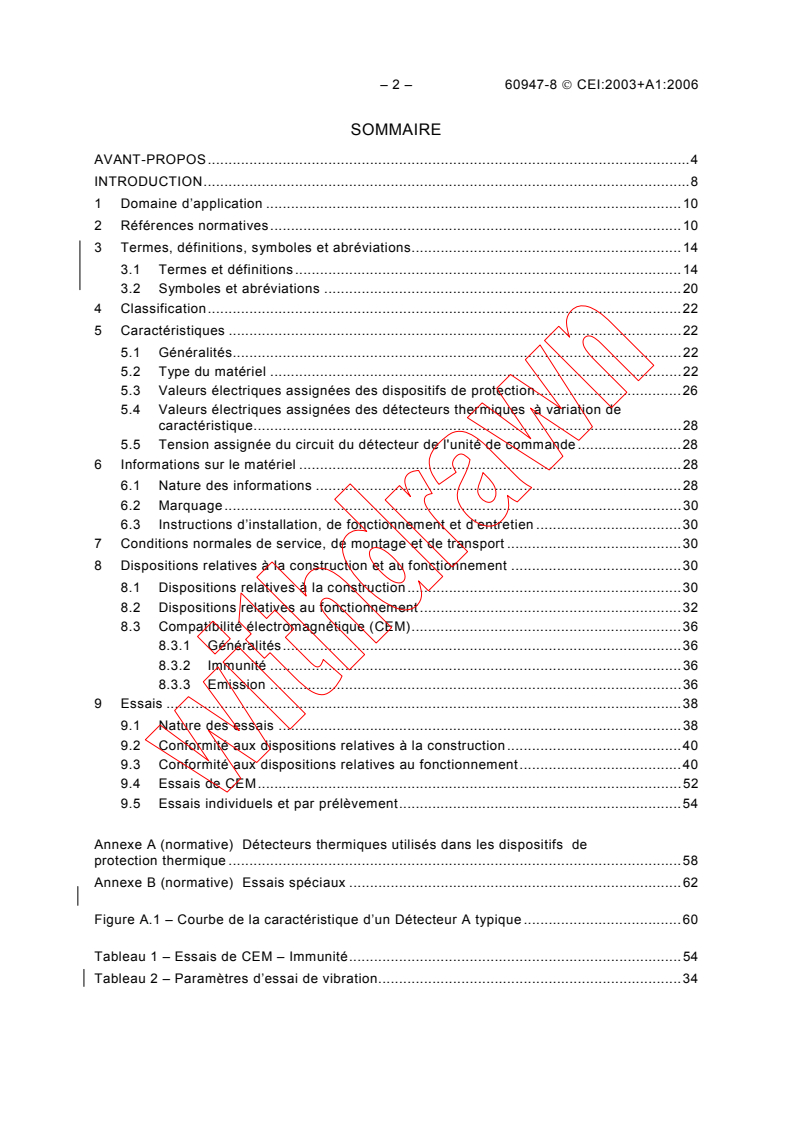
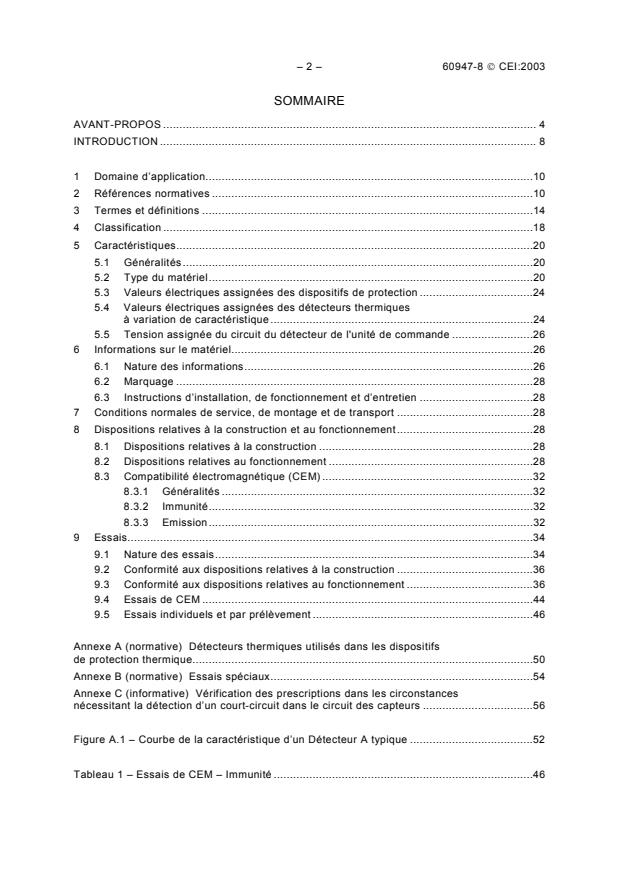
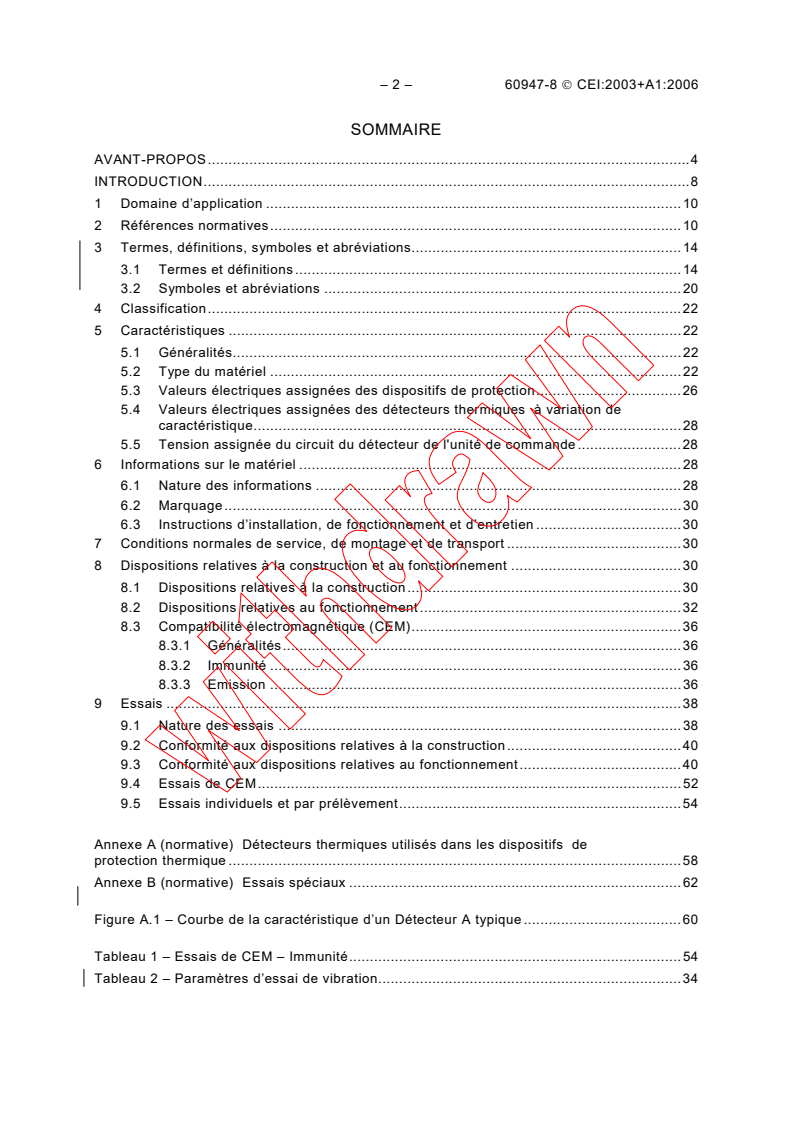
CONTENTS
FOREWORD.5
INTRODUCTION.9
1 Scope.11
2 Normative references .11
3 Terms, definitions, symbols and abbreviations.15
3.1 Terms and definitions .15
3.2 Symbols and abbreviations.21
4 Classification.23
5 Characteristics .23
5.1 General .23
5.2 Type of equipment.23
5.3 Rated electrical values of protection systems .27
5.4 Rated electrical values of characteristic variation thermal detectors .29
5.5 Rated voltage of the detector circuit of the control unit .29
6 Product information .29
6.1 Nature of information.29
6.2 Marking .31
6.3 Instructions for installation, operation and maintenance .31
7 Normal service, mounting and transport conditions.31
8 Constructional and performance requirements.31
8.1 Constructional requirements.31
8.2 Performance requirements .33
8.3 Electromagnetic compatibility (EMC) .37
8.3.1 General .37
8.3.2 Immunity .37
8.3.3 Emission .37
9 Tests .39
9.1 Kinds of tests .39
9.2 Compliance with constructional requirements .41
9.3 Compliance with performance requirements .41
9.4 EMC tests .53
9.5 Routine and sampling tests .55
Annex A (normative) Thermal detectors used in thermal protection systems .59
Annex B (normative) Special tests .63
Figure A.1 – Characteristic curve of a typical Mark A detector .61
Table 1 – Tests for EMC – Immunity .55
Table 2 – Vibration test parameters .35
60947-8 © IEC:2003+A1:2006 – 5 –
INTERNATIONAL ELECTROTECHNICAL COMMISSION
____________
LOW-VOLTAGE SWITCHGEAR AND CONTROLGEAR –
Part 8: Control units for built-in thermal protection (PTC)
for rotating electrical machines
FOREWORD
1) The International Electrotechnical Commission (IEC) is a worldwide organization for standardization comprising
all national electrotechnical committees (IEC National Committees). The object of IEC is to promote
international co-operation on all questions concerning standardization in the electrical and electronic fields. To
this end and in addition to other activities, IEC publishes International Standards, Technical Specifications,
Technical Reports, Publicly Available Specifications (PAS) and Guides (hereafter referred to as “IEC
Publication(s)”). Their preparation is entrusted to technical committees; any IEC National Committee interested
in the subject dealt with may participate in this preparatory work. International, governmental and non-
governmental organizations liaising with the IEC also participate in this preparation. IEC collaborates closely
with the International Organization for Standardization (ISO) in accordance with conditions determined by
agreement between the two organizations.
2) The formal decisions or agreements of IEC on technical matters express, as nearly as possible, an international
consensus of opinion on the relevant subjects since each technical committee has representation from all
interested IEC National Committees.
3) IEC Publications have the form of recommendations for international use and are accepted by IEC National
Committees in that sense. While all reasonable efforts are made to ensure that the technical content of IEC
Publications is accurate, IEC cannot be held responsible for the way in which they are used or for any
misinterpretation by any end user.
4) In order to promote international uniformity, IEC National Committees undertake to apply IEC Publications
transparently to the maximum extent possible in their national and regional publications. Any divergence
between any IEC Publication and the corresponding national or regional publication shall be clearly indicated in
the latter.
5) IEC provides no marking procedure to indicate its approval and cannot be rendered responsible for any
equipment declared to be in conformity with an IEC Publication.
6) All users should ensure that they have the latest edition of this publication.
7) No liability shall attach to IEC or its directors, employees, servants or agents including individual experts and
members of its technical committees and IEC National Committees for any personal injury, property damage or
other damage of any nature whatsoever, whether direct or indirect, or for costs (including legal fees) and
expenses arising out of the publication, use of, or reliance upon, this IEC Publication or any other IEC
Publications.
8) Attention is drawn to the Normative references cited in this publication. Use of the referenced publications is
indispensable for the correct application of this publication.
9) Attention is drawn to the possibility that some of the elements of this IEC Publication may be the subject of
patent rights. IEC shall not be held responsible for identifying any or all such patent rights.
International Standard IEC 60947-8 has been prepared by subcommittee 17B: Low-voltage
switchgear and controlgear, of IEC technical committee 17: Switchgear and controlgear.
This consolidated version of IEC 60947-8 consists of the first edition (2003) [documents
17B/1276/FDIS and 17B/1282/RVD] and its amendment 1 (2006) [documents 17B/1477/FDIS
and 17B/1504/RVD].
The technical content is therefore identical to the base edition and its amendment and has
been prepared for user convenience.
It bears the edition number 1.1.
A vertical line in the margin shows where the base publication has been modified by
amendment 1.
This standard shall be used in conjunction with IEC 60947-1: General rules.
60947-8 © IEC:2003+A1:2006 – 7 –
The provisions of the general rules dealt with in IEC 60947-1 are applicable to this standard,
where specifically called for. Clauses and subclauses, tables, figures and annexes of the
general rules thus applicable are identified by reference to IEC 60947-1 (e.g. 1.2.3 of
IEC 60947-1, Table 4 of IEC 60947-1 or Annex A of IEC 60947-1, etc.).
The committee has decided that the contents of the base publication and its amendments will
remain unchanged until the maintenance result date indicated on the IEC web site under
"http://webstore.iec.ch" in the data related to the specific publication. At this date,
the publication will be
• reconfirmed,
• withdrawn,
• replaced by a revised edition, or
• amended.
60947-8 © IEC:2003+A1:2006 – 9 –
INTRODUCTION
Thermal protection systems which are based on the principle of monitoring the temperature of
the protected parts constitute a simple and effective means of protecting rotating electrical
machines against excessive temperature rises, including those caused by faults in the cooling
system, or excessively high ambient temperature, whereas systems of protection based only
on monitoring the current absorbed may not ensure this type of protection.
Since the operating temperature and response times of thermal protection systems are fixed
in advance, they may not be adjusted in relation to the conditions of use of the machine and
they may not be completely effective for all fault conditions or improper use of the machine.
A thermal protection system in accordance with this standard may consist of a characteristic
change thermal detector which has an associated control unit to convert a point on the
characteristic of the detector to a switching function. A very large number of thermal
protection systems are in use and, in all cases, the machine manufacturer will fit the detectors
in the machine. The machine manufacturer will either supply the control unit with the machine
or specify particulars of the control unit to be used.
It is also customary for the control units to be considered as part of the control system and not
necessarily supplied with the machine. For this reason it is considered necessary to have an
interchangeable system, where the characteristics of association between the detector and
the control unit are specified. This particular system is not considered superior in any way to
other systems complying with the requirements of this standard, but in some fields the
practice is likely to be that this interchangeable system will be used, as indicated by
the designation “Mark A”.
60947-8 © IEC:2003+A1:2006 – 11 –
LOW-VOLTAGE SWITCHGEAR AND CONTROLGEAR –
Part 8: Control units for built-in thermal protection (PTC)
for rotating electrical machines
1 Scope
This part of IEC 60947 specifies rules for control units, which perform the switching functions
in response to the thermal detectors incorporated in rotating electrical machines according to
IEC 60034-11, and the industrial application.
It specifies rules for that type of system comprising a positive temperature coefficient (PTC)
thermistor detector having particular characteristics, and its associated control unit.
The PT100 detectors are covered by IEC 60751, where the resistor values are given
according to the temperatures of the detector.
The present rules lay down the characteristics of association of this particular positive
temperature coefficient thermistor detector and its associated control unit (designated “Mark A
detector” and “Mark A control unit”), when they are used in thermal protection systems.
NOTE It is not possible to specify all the requirements for the operating characteristics of a control unit, as they
are dependent on some aspects of the thermal detectors. Some aspects of the requirements of the thermal
protector system can only be specified when account is taken of the characteristics of the rotating machine to be
protected and the method of installation of the detector within the machine.
For these reasons, for each characteristic it is necessary to specify who is responsible for stating the required
values and who is responsible for compliance with the requirement and for carrying out any confirmatory test.
2 Normative references
The following referenced documents are indispensable for the application of this document.
For dated references, only the edition cited applies. For undated references, the latest edition
of the referenced document (including any amendments) applies.
IEC 60034-11:2004, Rotating electrical machines – Part 11: Thermal protection
IEC 60068-2-6:1995, Environmental testing – Part 2: Tests – Test Fc: Vibration (sinusoidal)
IEC 60068-2-27:1987, Environmental testing – Part 2: Tests – Test Ea and guidance: Shock
IEC 60410:1973, Sampling plans and procedures for inspection by attributes
IEC 60417:2002, Graphical symbols for use on equipment
IEC 60738-1:1998, Thermistors – Directly heated positive step-function temperature
coefficient – Part 1: Generic specification
60947-8 © IEC:2003+A1:2006 – 13 –
IEC 60751:1983, Industrial platinum resistance thermometer sensors
Amendment 1 (1986)
Amendment 2 (1995)
IEC 60947-1:2004, Low-voltage switchgear and controlgear – Part 1: General rules
IEC 60947-5-1:2003, Low-voltage switchgear and controlgear – Part 5-1: Control circuit
devices and switching elements – Electromechanical control circuit devices
IEC 61000-4-2:1995, Electromagnetic compatibility (EMC) – Part 4: Testing and measurement
techniques – Section 2: Electrostatic discharge immunity test – Basic EMC Publication
Amendment 1 (1998)
Amendment 2 (2000)
IEC 61000-4-3:2006, Electromagnetic compatibility (EMC) - Part 4-3 : Testing and
measurement techniques - Radiated, radio-frequency, electromagnetic field immunity test
IEC 61000-4-4:1995, Electromagnetic compatibility (EMC) – Part 4: Testing and measurement
techniques – Section 4: Electrical fast transient/burst immunity test – Basic EMC Publication
Amendment 1 (2000)
Amendment 2 (2001)
IEC 61000-4-5:1995, Electromagnetic compatibility (EMC) – Part 4-5: Testing and
measurement techniques – Surge immunity test
Amendment 1 (2000)
IEC 61000-4-6:2003, Electromagnetic compatibility (EMC) – Part 4-6: Testing and
measurement techniques – Immunity to conducted disturbances, induced by radio-frequency
fields
Amendment 1 (2004)
Amendment 2 (2006)
IEC 61000-4-8:1993, Electromagnetic compatibility (EMC) – Part 4-8: Testing and
measurement techniques – Power frequency magnetic field immunity test – Basic EMC
Publication
Amendment 1 (2000)
IEC 61000-4-11:1994, Electromagnetic compatibility (EMC) – Part 4-11: Testing and measure-
ment techniques – Voltage dips, short interruptions and voltage variations immunity tests
Amendment 1 (2000)
IEC 61000-4-13:2002, Electromagnetic compatibility (EMC) – Part 4-13: Testing and measure-
ment techniques – Harmonics and interharmonics including mains signalling at a.c. power
port, low-frequency immunity tests – Basic EMC Publication
CISPR 11:2003, Industrial, scientific and medical (ISM) radio-frequency equipment –
Electromagnetic disturbance characteristics – Limits and methods of measurement
Amendment 1 (2004)
CISPR 22:2005, Information technology equipment – Radio disturbance characteristics –
Limits and methods of measurement
Amendment 1 (2005)
Amendment 2 (2006)
60947-8 © IEC:2003+A1:2006 – 15 –
3 Terms, definitions, symbols and abbreviations
For the purposes of this document, relevant definitions of IEC 60947-1, together with the
following definitions, apply.
3.1 Terms and definitions
Reference
A
Abrupt characteristic change thermal detector . 3.1.14
B
Built-in thermal protection . 3.1.1
C
Category of thermal protection. 3.1.12
Characteristic variation thermal detector. 3.1.13
Control circuit . 3.1.16
Control system. 3.1.5
Control unit. 3.1.15
Control unit with dynamic wire break detection. 3.1.25
Control unit with short-circuit detection within the thermal detector circuit. 3.1.24
D
Detector operating temperature (TNF) . 3.1.17
E
Electrically separated contact elements . 3.1.20
M
Mark A control unit. 3.1.23
Mark A detector . 3.1.22
Maximum temperature after tripping. 3.1.11
P
Protected part. 3.1.6
PTC thermistor detector. 3.1.21
R
Reset temperature . 3.1.19
S
Switching type thermal detector . 3.1.4
System operating temperature (TFS) . 3.1.18
T
Thermal detector. 3.1.3
Thermal overload with rapid variation . 3.1.8
Thermal overload with slow variation . 3.1.7
Thermal protection system. 3.1.2
Thermal protection with detector . 3.1.10
Thermally critical part of a machine . 3.1.9
3.1.1
built-in thermal protection
protection of certain parts (called protected parts) of a rotating electrical machine against
excessive temperatures resulting from certain conditions of thermal overload, achieved by
means of a thermal protection system, the whole or part of which is a thermally sensitive
device incorporated within the machine
60947-8 © IEC:2003+A1:2006 – 17 –
3.1.2
thermal protection system
system intended to ensure the thermal protection of a rotating electrical machine by means of
a built-in thermal detector together with a control unit
3.1.3
thermal detector
electrical insulated device (component), sensitive to temperature only, which will initiate a
switching function in the control system when its temperature reaches a predetermined level
3.1.4
switching type thermal detector
thermal detector which causes a direct operation of a switching element
NOTE The combination of the thermal detector and the switching element is rated as a unit and mounted in the
rotating electrical machine.
3.1.5
control system
system to translate a particular point on the characteristic of a thermal detector to a switching
function on the supply to the rotating electrical machine
NOTE The system is capable of being reset (either manually or automatically) when the temperature falls to the
reset value.
3.1.6
protected part
part of a rotating electrical machine, the temperature of which is limited to a predetermined
value by the action of the thermal protection system
3.1.7
thermal overload with slow variation
slow temperature rise above the normal operating temperature
NOTE 1 The variation of the temperature of the protected part is sufficiently slow for the temperature of the
thermal detector to follow without appreciable delay.
NOTE 2 A thermal overload with slow variation may be caused, for instance, by:
− defects in ventilation or in the ventilation system, for example partial blocking of the ventilation ducts,
excessive dust, dirt on the windings or on the cooling ribs of the frame;
− an excessive rise in the ambient temperature or in the temperature of the cooling medium;
− gradually increasing mechanical overload;
− prolonged voltage drop or over-voltage in the machine supply;
− excessive duty in a machine.
3.1.8
thermal overload with rapid variation
rapid rise of temperature above the normal operating temperature
NOTE 1 The variation of the temperature of the protected part may be too rapid for the temperature of the thermal
detector to follow without delay. This may result in a significant temperature difference between the thermal
detector and the protected part.
NOTE 2 A thermal overload with rapid variation may be caused, for instance, by stalling the machine or in certain
circumstances, by phase failure or by starting under abnormal conditions (inertia too high, voltage too low, load
torque abnormally high).
3.1.9
thermally critical part of a machine
part of a machine in which the temperature most rapidly reaches its dangerous value
NOTE A part of a machine which is thermally critical in the case of thermal overload with slow variation may not
be so for a thermal overload with rapid variation.
60947-8 © IEC:2003+A1:2006 – 19 –
3.1.10
thermal protection with detector
form of protection where the part of the machine in which the thermal detector(s) is (are)
incorporated is the thermally critical part
3.1.11
maximum temperature after tripping
maximum value of the temperature which is reached by the protected part of the machine
during the period which follows tripping by the thermal protection system, for thermal overload
with rapid variation
3.1.12
category of thermal protection
indication of the permissible temperature levels on the windings of a machine when subjected
to the thermal overload
3.1.13
characteristic variation thermal detector
thermal detector which has a characteristic the variation of which, related to the temperature,
is able to initiate a switching function in the control system for one temperature fixed in
advance during manufacture or by initial adjustment of the control unit
NOTE For example, a resistor detector, thermocouple detector, negative temperature coefficient thermistor
detector, positive temperature coefficient thermistor detector.
3.1.14
abrupt characteristic change thermal detector
thermal detector which has a characteristic, the abrupt change of which for one temperature
fixed in advance during manufacture is able to initiate a switching operation in the control
system
3.1.15
control unit
device which converts into a switching function the variation of the characteristic of a thermal
detector
NOTE The control unit may be part of other devices or systems.
3.1.16
control circuit
circuit controlling the switching device which makes and breaks the power supply
3.1.17
detector operating temperature (TNF)
detector temperature at which detector switching occurs during an increase of temperature, or
at which the variation of the characteristic related to the temperature is such as to cause
operation of the associated control unit
3.1.18
system operating temperature (TFS)
detector temperature at which, during an increase of temperature, the detector and control
unit together cause the operation of the control unit
60947-8 © IEC:2003+A1:2006 – 21 –
3.1.19
reset temperature
detector temperature at which, during a decrease of temperature, detector switching occurs
or at which the variation of the characteristic related to the temperature is such that in
conjunction with the control unit it permits the resetting of the control unit
3.1.20
electrically separated contact elements
contact elements belonging to the same control unit, but adequately insulated from each other
so that they can be connected into electrically separated circuits
3.1.21
PTC thermistor detector
abrupt characteristic change thermal detector made by a PTC thermistor, having on part of its
resistance-temperature characteristic, known as the PTC part, a considerable increase in
its electrical resistance with negligible power dissipation as soon as its temperature exceeds
a given value
3.1.22
mark A detector
PTC thermistor detector having the particular characteristics described in Annex A
3.1.23
mark A control unit
control unit having the particular characteristics specified in this standard and intended for
operation in conjunction with a mark A detector
3.1.24
control unit with short-circuit detection within the thermal detector circuit
control unit capable of detecting short-circuited thermal detector circuits
3.1.25
control unit with dynamic wire break detection
control unit capable of indicating wire breaks within the thermal detector circuits
3.2 Symbols and abbreviations
EMC Electromagnetic compatibility
I Rated operational current (5.3.3)
e
I Conventional free air thermal current (5.3.3)
th
PTC Positive temperature coefficient
Q Amplification factor (9.3.3.13.3)
TFS System operating temperature (3.1.18)
TNF Detector operating temperature (3.1.17)
U Rated operational voltage (5.3.2)
e
U Rated insulation voltage (5.3.2)
i
U Rated impulse withstand voltage (6.1)
imp
U Rated voltage of the detector circuit (6.1)
r
U Rated control supply voltage (6.1)
s
60947-8 © IEC:2003+A1:2006 – 23 –
4 Classification
Under consideration.
5 Characteristics
5.1 General
The characteristics of a control unit shall be stated in the following terms, where such terms
are applicable:
− type of equipment (see 5.2);
− rated electrical values of protection systems (see 5.3);
− rated electrical values of characteristic variation thermal detectors (see 5.4);
− rated voltage of the detector circuit of the control unit (see 5.5).
5.2 Type of equipment
5.2.1 Operating temperatures of protection systems
Each detector, or detector with control unit, shall have either a declared rated operating
temperature in accordance with 5.2.2 (TNF), or a declared rated system operating
temperature in accordance with 5.2.3 (TFS), or both. For example:
a) Switching type thermal detector: TNF shall be declared.
b) Abrupt characteristic change thermal detector: TNF shall be declared; TFS is not
applicable.
c) Abrupt characteristic change thermal detector with its control unit: TFS shall be declared.
In this case, the value of TFS may coincide with the value of TNF for the detector itself.
d) Characteristic variation thermal detector with its control unit: TFS shall be declared. In this
case, the detector may not have a definable value of TNF.
5.2.2 Rated detector operating temperature
In the case of an abrupt characteristic change thermal detector, the value of the TNF shall be
declared by the detector manufacturer.
It is recommended that the normal value of TNF, expressed in degrees Celsius, be selected
from the series of numbers which are multiples of five.
It shall be the responsibility of the detector manufacturer to verify the detector operating
temperature.
5.2.3 Rated system operating temperature
If the protection system of detector and the control unit are supplied through a single supplier
then that supplier shall declare the value of the TFS.
In all other cases, the control unit manufacturer shall declare the value of the TFS.
60947-8 © IEC:2003+A1:2006 – 25 –
The tolerance on the declared value of the TFS shall be ±6 K unless otherwise agreed
between the manufacturers.
NOTE The tolerance is the sum of the tolerances of the detector and the control unit.
It shall be the responsibility of the manufacturer, or supplier who declares the value of the
TFS, to ensure that this value is verified, but the test may be carried out by the detector
manufacturer or the control unit manufacturer by agreement.
Routine tests shall be carried out by the control unit manufacturer to verify correct operation
under normal operating conditions in accordance with 8.2.1.
5.2.4 Maximum permissible rated operating temperature for the system
The maximum permissible value of the TFS for a particular detector or a particular control unit
shall be declared by the detector manufacturer or by the control unit manufacturer
respectively.
NOTE For any particular device, the maximum value of the TFS will be dependent on the characteristics and the
materials used in the manufacture of the detector, or by the limits on the characteristics of the detector which can
be modified by the range of settings available with the control unit design.
5.2.5 Reset temperature
The reset temperature value and tolerances may be declared by the manufacturer of the
detector or, in cases where this depends upon the combination of the detector and its control
unit, by the control unit manufacturer.
It shall be the responsibility of the detector manufacturer or the control unit manufacturer,
depending on which of them has declared the reset temperature, to ensure that this is verified
in accordance with 9.3.3.8, but the test may be carried out by either manufacturer by
agreement.
NOTE To restart the machine after the tripping of the control system, it is important for the machine winding and
the thermal detector to cool sufficiently to permit normal machine acceleration without nuisance tripping, especially
with a high inertia load. The temperature value for restarting depends on installation and service conditions. The
control system may be designed in order to permit a selection of different temperature values.
For a manual restarting system, the maximum temperature shall be considered. For automatic
restarting systems, the machine manufacturer should consider the minimum and maximum
differential temperatures which result from choices of TNF or TFS and rest temperature with
the declared tolerance values. Differential values which are too narrow may not permit
sufficient cool-down for restarting without nuisance tripping. Differential temperatures that are
too wide may result in an excessively long machine cooling down time or resetting may be
prevented in high ambient temperatures.
5.2.6 Characteristics of Mark A control units
When the control unit operates under the normal conditions of service and the detector circuit
is connected to the terminals of the control unit, the following conditions shall be met.
Compliance shall be verified by the tests specified in 9.3.3.10.
a) The control unit shall switch on, or be able to be reset, when the resistance of the detector
circuit is 750 Ω or less.
b) The control unit shall switch off when the resistance of the thermistor detector circuit is
increased from 1 650 Ω to 4 000 Ω.
60947-8 © IEC:2003+A1:2006 – 27 –
c) The control unit shall switch on, or be able to be reset, when the resistance of the
thermistor detector circuit falls from 1 650 Ω to 750 Ω.
d) When a resistance of 4 000 Ω is connected between each pair of terminals intended for
the connection of a thermistor detector circuit, and when the control unit operates at its
rated voltage, the voltage per pair of terminals shall not exceed 7,5 V (direct or alternating
peak voltage).
e) There shall be no significant modification in the operation of the control unit when the
capacitance of the detector circuit is not greater than 0,2 μF.
5.2.7 Short-circuit detection within the sensor circuit
Thermal detectors have a low resistance and therefore a special measure is necessary to
recognize a reduction of the resistance to nearly zero by a short-circuit. For safety
applications, or to increase the lifetime of a rotating electrical machine, it is useful to establish
a short-circuit detection system within the sensor circuit. The safety of the thermal protection,
in particular, is increased by such a short-circuit detection.
Such a short-circuit detection only identifies a short-circuit but it does not automatically cover
a defined action. All following actions depend on the configuration of the control unit and the
manufacturers application.
5.3 Rated electrical values of protection systems
5.3.1 Rated electrical values of switching devices (i.e. control units and switching
type thermal detectors)
The rated electrical values of the switching devices of control units and switching type thermal
detectors shall be declared by the control unit manufacturer in accordance with 5.3.2 to 5.3.4,
as appropriate.
5.3.2 Rated voltages of a control unit
The rated voltages of a control unit are the rated insulation voltage (U) and the rated
i
operational voltage (U ) as defined in 4.3.1.2 and 4.3.1.1 of IEC 60947-1.
e
5.3.3 Rated currents of a control unit
The rated currents of a control unit are the conventional free air thermal current (I ) and the
th
rated operational current (I ) as defined in 4.3.2.1 and 4.3.2.3 of IEC 60947-1.
e
NOTE A control unit may be assigned a number of combinations of rated operational voltage and rated
operational current.
5.3.4 Rated making and breaking capacities of a control unit
For a control unit or a switching type thermal detector to which an utilization category is
assigned, the utilization category shall be declared according to 4.4 of IEC 60947-5-1 and it is
unnecessary to specify rated making and breaking capacities, since these values depend
directly on the utilization category and on the rated operational voltages and currents.
60947-8 © IEC:2003+A1:2006 – 29 –
5.4 Rated electrical values of characteristic variation thermal detectors
5.4.1 General
The rated electrical values of characteristic variation thermal detectors shall be declared by
the manufacturer.
5.4.2 Rated insulation voltage
The rated insulation voltage (U) is the value of voltage to which the dielectric tests are
i
referred.
5.4.3 Rated operational voltage of the detector
For a detector for which the operation is dependent on the applied voltage, the rated
operational voltage (U ) is the value of voltage by which the detector is designated and which
e
may be applied to the detector.
NOTE For detectors used with alternating current, the rated operational voltage is the peak value of the voltage,
indicated by Û .
e
5.5 Rated voltage of the detector circuit of the control unit
The rated voltage of the detector circuit (U ) intended to be used with characteristic variation
r
thermal detectors having a defined rated operational voltage shall be declared by the
manufacturer of the control unit.
The voltage U is the maximum value of voltage which appears between each pair of terminals
r
intended for the connection of a detector circuit when a resistance, determined as below, is
connected between these terminals and when the control unit is supplied at its rated voltage.
The resistance to be used corresponds to the value of the characteristic curve when the
control unit is switched off and takes into account the number of detectors in the circuit. This
may be a maximum or minimum value depending upon the shape of the characteristic curve.
NOTE If the circuit is an a.c. circuit, the rated voltage is the peak value of voltage, indicated by Û .
r
6 Product information
6.1 Nature of information
The following information shall be given by the manufacturer:
Identification
a) manufacturer’s name or trade mark;
b) type designation or serial number;
c) number of this standard.
Additional marking of Mark A control units:
The control unit shall be marked with the letter “A” additional to the number of this
standard.
60947-8 © IEC:2003+A1:2006 – 31 –
Characteristics, basic rated values and utilization
d) rated control supply voltage (U );
s
e) rated frequency of control supply voltage;
f) rated operational voltage (U ) of the control unit;
e
g) rated operational current (I ) of the control unit;
e
h) utilization category, or making and breaking capacities;
i) a circuit diagram which specifies the terminal marking and the connections of the
detectors, the control unit and the supply;
j) rated insulation voltage (U ) of the control circuit;
i
k) type of thermal detectors with which the control unit is to be used and, if applicable, the
rated voltage (U ) of the detector circuit;
r
l) IP code in case of an enclosed equipment;
m) the equipment class according to the EMC emission levels and the specific requirements
necessary to maintain compliance;
n) the immunity levels attained and the specific requirements necessary to maintain
compliance;
o) rated impulse withstand voltage U ;
imp
p) rated operating temperature.
6.2 Marking
Subclause 5.2 of IEC 60947-1 applies with the following additions.
Data under d) to p) above shall, preferably, be marked on the equipment or in the
manufacturer's published literature.
Data under c) and l) above shall, preferably, be marked on the equipment.
6.3 Instructions for installation, operation and maintenance
Subclause 5.3 of IEC 60947-1 applies with the following addition.
Information shall be provided by the manufacturer to advise the user on the measures to be
taken with regard to the equipment in connection with the requirements for EMC.
7 Normal service, mounting and transport conditions
Clause 6 of IEC 60947-1 applies.
8 Constructional and performance requirements
8.1 Constructional requirements
Subclause 7.1 of IEC 60947-1 applies with the following additions.
Connection devices (e.g. terminals), when fitted, shall be able to accept single strand
2 2
conductors from 0,5 mm to 1,5 mm , and shall be sufficient in number to permit the
connection of the thermal detector circuit(s).
60947-8 © IEC:2003+A1:2006 – 33 –
Terminals for connection to a single thermal detector circuit shall be marked T1 and T2.
Terminals for connection to several thermal detector circuits shall be marked 1T1 and 1T2,
2T1 and 2T2, etc.
Terminals intended to be at frame or earth potential shall be marked with the appropriate
symbol as specified in IEC 60417.
The installation shall be made in accordance with the manufacturer’s instructions, including
permissible shock and vibration levels and limitations on mounting positions.
8.2 Performance requirements
8.2.1 Normal conditions of service
Control units shall operate satisfactorily under all the conditions of Clause 7 and the following
conditions when used with the appropriate detectors:
− supply voltage between 85 % and 110 % of the rated control supply voltage (U );
s
− frequency of the supply voltage (for a.c. units) 50 Hz or 60 Hz;
− clean air and a relative humidity not exceeding 50 % at a maximum of 40 °C.
NOTE 1 For d.c. units, ripple and form factor should be agreed between the manufacturer and the user.
NOTE 2 Devices intended to be used under conditions of service which are outside the above limits should be the
subject of an agreement between the manufact
...
NORME CEI
INTERNATIONALE 60947-8
Edition 1.1
2006-11
Edition 1:2003 consolidée par l’amendement 1:2006
Appareillage à basse tension –
Partie 8:
Unités de commande pour la protection thermique
incorporée (CTP) aux machines électriques
tournantes
Cette version française découle de la publication d’origine
bilingue dont les pages anglaises ont été supprimées.
Les numéros de page manquants sont ceux des pages
supprimées.
Numéro de référence
CEI 60947-8:2003+A1:2006(F)
Numérotation des publications
Depuis le 1er janvier 1997, les publications de la CEI sont numérotées à partir de
60000. Ainsi, la CEI 34-1 devient la CEI 60034-1.
Editions consolidées
Les versions consolidées de certaines publications de la CEI incorporant les
amendements sont disponibles. Par exemple, les numéros d’édition 1.0, 1.1 et 1.2
indiquent respectivement la publication de base, la publication de base incorporant
l’amendement 1, et la publication de base incorporant les amendements 1 et 2
Informations supplémentaires sur les publications de la CEI
Le contenu technique des publications de la CEI est constamment revu par la CEI
afin qu'il reflète l'état actuel de la technique. Des renseignements relatifs à cette
publication, y compris sa validité, sont disponibles dans le Catalogue des
publications de la CEI (voir ci-dessous) en plus des nouvelles éditions, amende-
ments et corrigenda. Des informations sur les sujets à l’étude et l’avancement des
travaux entrepris par le comité d’études qui a élaboré cette publication, ainsi que la
liste des publications parues, sont également disponibles par l’intermédiaire de:
• Site web de la CEI (www.iec.ch)
• Catalogue des publications de la CEI
Le catalogue en ligne sur le site web de la CEI (www.iec.ch/searchpub) vous permet
de faire des recherches en utilisant de nombreux critères, comprenant des
recherches textuelles, par comité d’études ou date de publication. Des informations
en ligne sont également disponibles sur les nouvelles publications, les publications
remplacées ou retirées, ainsi que sur les corrigenda.
• IEC Just Published
Ce résumé des dernières publications parues (www.iec.ch/online_news/justpub)
est aussi disponible par courrier électronique. Veuillez prendre contact avec le
Service client (voir ci-dessous) pour plus d’informations.
• Service clients
Si vous avez des questions au sujet de cette publication ou avez besoin de
renseignements supplémentaires, prenez contact avec le Service clients:
Email: custserv@iec.ch
Tél: +41 22 919 02 11
Fax: +41 22 919 03 00
NORME CEI
INTERNATIONALE 60947-8
Edition 1.1
2006-11
Edition 1:2003 consolidée par l’amendement 1:2006
Appareillage à basse tension –
Partie 8:
Unités de commande pour la protection thermique
incorporée (CTP) aux machines électriques
tournantes
© IEC 2006 Droits de reproduction réservés
Aucune partie de cette publication ne peut être reproduite ni utilisée sous quelque forme que ce soit et par aucun
procédé, électronique ou mécanique, y compris la photocopie et les microfilms, sans l'accord écrit de l'éditeur.
International Electrotechnical Commission, 3, rue de Varembé, PO Box 131, CH-1211 Geneva 20, Switzerland
Telephone: +41 22 919 02 11 Telefax: +41 22 919 03 00 E-mail: inmail@iec.ch Web: www.iec.ch
CODE PRIX
Commission Electrotechnique Internationale CM
International Electrotechnical Commission
Международная Электротехническая Комиссия
Pour prix, voir catalogue en vigueur
– 2 – 60947-8 © CEI:2003+A1:2006
SOMMAIRE
AVANT-PROPOS.4
INTRODUCTION.8
1 Domaine d’application .10
2 Références normatives.10
3 Termes, définitions, symboles et abréviations.14
3.1 Termes et définitions .14
3.2 Symboles et abréviations .20
4 Classification.22
5 Caractéristiques .22
5.1 Généralités.22
5.2 Type du matériel .22
5.3 Valeurs électriques assignées des dispositifs de protection.26
5.4 Valeurs électriques assignées des détecteurs thermiques à variation de
caractéristique.28
5.5 Tension assignée du circuit du détecteur de l'unité de commande.28
6 Informations sur le matériel .28
6.1 Nature des informations .28
6.2 Marquage.30
6.3 Instructions d’installation, de fonctionnement et d’entretien .30
7 Conditions normales de service, de montage et de transport .30
8 Dispositions relatives à la construction et au fonctionnement .30
8.1 Dispositions relatives à la construction.30
8.2 Dispositions relatives au fonctionnement.32
8.3 Compatibilité électromagnétique (CEM).36
8.3.1 Généralités.36
8.3.2 Immunité .36
8.3.3 Emission .36
9 Essais .38
9.1 Nature des essais .38
9.2 Conformité aux dispositions relatives à la construction.40
9.3 Conformité aux dispositions relatives au fonctionnement.40
9.4 Essais de CEM.52
9.5 Essais individuels et par prélèvement.54
Annexe A (normative) Détecteurs thermiques utilisés dans les dispositifs de
protection thermique .58
Annexe B (normative) Essais spéciaux .62
Figure A.1 – Courbe de la caractéristique d’un Détecteur A typique .60
Tableau 1 – Essais de CEM – Immunité.54
Tableau 2 – Paramètres d’essai de vibration.34
– 4 – 60947-8 © CEI:2003+A1:2006
COMMISSION ÉLECTROTECHNIQUE INTERNATIONALE
____________
APPAREILLAGE À BASSE TENSION –
Partie 8: Unités de commande pour la protection thermique
incorporée (CTP) aux machines électriques tournantes
AVANT-PROPOS
1) La Commission Electrotechnique Internationale (CEI) est une organisation mondiale de normalisation
composée de l'ensemble des comités électrotechniques nationaux (Comités nationaux de la CEI). La CEI a
pour objet de favoriser la coopération internationale pour toutes les questions de normalisation dans les
domaines de l'électricité et de l'électronique. A cet effet, la CEI – entre autres activités – publie des Normes
internationales, des Spécifications techniques, des Rapports techniques, des Spécifications accessibles au
public (PAS) et des Guides (ci-après dénommés "Publication(s) de la CEI"). Leur élaboration est confiée à des
comités d'études, aux travaux desquels tout Comité national intéressé par le sujet traité peut participer. Les
organisations internationales, gouvernementales et non gouvernementales, en liaison avec la CEI, participent
également aux travaux. La CEI collabore étroitement avec l'Organisation Internationale de Normalisation (ISO),
selon des conditions fixées par accord entre les deux organisations.
2) Les décisions ou accords officiels de la CEI concernant les questions techniques représentent, dans la mesure
du possible, un accord international sur les sujets étudiés, étant donné que les Comités nationaux de la CEI
intéressés sont représentés dans chaque comité d’études.
3) Les Publications de la CEI se présentent sous la forme de recommandations internationales et sont agréées
comme telles par les Comités nationaux de la CEI. Tous les efforts raisonnables sont entrepris afin que la CEI
s'assure de l'exactitude du contenu technique de ses publications; la CEI ne peut pas être tenue responsable
de l'éventuelle mauvaise utilisation ou interprétation qui en est faite par un quelconque utilisateur final.
4) Dans le but d'encourager l'uniformité internationale, les Comités nationaux de la CEI s'engagent, dans toute la
mesure possible, à appliquer de façon transparente les Publications de la CEI dans leurs publications
nationales et régionales. Toutes divergences entre toutes Publications de la CEI et toutes publications
nationales ou régionales correspondantes doivent être indiquées en termes clairs dans ces dernières.
5) La CEI n’a prévu aucune procédure de marquage valant indication d’approbation et n'engage pas sa
responsabilité pour les équipements déclarés conformes à une de ses Publications.
6) Tous les utilisateurs doivent s'assurer qu'ils sont en possession de la dernière édition de cette publication.
7) Aucune responsabilité ne doit être imputée à la CEI, à ses administrateurs, employés, auxiliaires ou
mandataires, y compris ses experts particuliers et les membres de ses comités d'études et des Comités
nationaux de la CEI, pour tout préjudice causé en cas de dommages corporels et matériels, ou de tout autre
dommage de quelque nature que ce soit, directe ou indirecte, ou pour supporter les coûts (y compris les frais
de justice) et les dépenses découlant de la publication ou de l'utilisation de cette Publication de la CEI ou de
toute autre Publication de la CEI, ou au crédit qui lui est accordé.
8) L'attention est attirée sur les références normatives citées dans cette publication. L'utilisation de publications
référencées est obligatoire pour une application correcte de la présente publication.
9) L’attention est attirée sur le fait que certains des éléments de la présente Publication de la CEI peuvent faire
l’objet de droits de propriété intellectuelle ou de droits analogues. La CEI ne saurait être tenue pour
responsable de ne pas avoir identifié de tels droits de propriété et de ne pas avoir signalé leur existence.
La Norme internationale CEI 60947-8 a été établie par le sous-comité 17B: Appareillage
à basse tension, du comité d'études 17 de la CEI: Appareillage.
La présente version consolidée de la CEI 60947-8 comprend la première édition (2003)
[documents 17B/1276/FDIS et 17B/1282/RVD] et son amendement 1 (2006) [documents
17B/1477/FDIS et 17B/1504/RVD].
Le contenu technique de cette version consolidée est donc identique à celui de l'édition de
base et à son amendement; cette version a été préparée par commodité pour l'utilisateur.
Elle porte le numéro d'édition 1.1.
Une ligne verticale dans la marge indique où la publication de base a été modifiée par
l'amendement 1.
La présente norme doit être utilisée conjointement avec la CEI 60947-1: Règles générales.
– 6 – 60947-8 © CEI:2003+A1:2006
Les dispositions des règles générales qui font l’objet de la CEI 60947-1 sont applicables
à la présente norme lorsque celle-ci le précise. Les articles, paragraphes, tableaux, figures
et annexes des règles générales qui sont ainsi applicables sont identifiés par référence à
la CEI 60947-1 (par exemple: 1.2.3 de la CEI 60947-1, Tableau 4 de la CEI 60947-1 ou
Annexe A de la CEI 60947-1, etc.).
Cette publication a été rédigée selon les Directives ISO/CEI, Partie 2.
Le comité a décidé que le contenu de la publication de base et de ses amendements ne sera
pas modifié avant la date de maintenance indiquée sur le site web de la CEI sous
"http://webstore.iec.ch" dans les données relatives à la publication recherchée. A cette date,
la publication sera
• reconduite,
• supprimée,
• remplacée par une édition révisée, ou
• amendée.
– 8 – 60947-8 © CEI:2003+A1:2006
INTRODUCTION
Les dispositifs de protection thermique faisant appel au principe de la surveillance de la
température des parties protégées constituent un moyen simple et efficace de protection des
machines électriques tournantes contre les échauffements excessifs, y compris ceux causés
par des défaillances du système de refroidissement ou par une température ambiante trop
élevée, tandis que les dispositifs de protection faisant appel seulement à la surveillance du
courant absorbé ne peuvent pas assurer une protection de ce type.
Puisque la température de fonctionnement et les temps de réponse des dispositifs de
protection thermique sont fixés à l’avance, ils ne peuvent pas être réglés en fonction des
conditions d’utilisation de la machine et donc ne peuvent pas être complètement efficaces
pour toutes les conditions de défaut ou pour une mauvaise utilisation de la machine.
Un dispositif de protection thermique selon la présente norme peut consister en un détecteur
thermique à variation de caractéristique associé à une unité de commande afin de convertir
un point de la caractéristique du détecteur en une fonction de commutation. Un très grand
nombre de dispositifs de protection thermique sont utilisés et, dans tous les cas, le
constructeur de la machine incorpore les détecteurs dans la machine. Le constructeur de la
machine fournit l’unité de commande avec la machine ou spécifie les particularités de l’unité
de commande à utiliser.
Il est également d’usage de considérer les unités de commande comme faisant partie du
dispositif de commande et pas nécessairement fournies avec la machine. Pour cette raison, il
est estimé nécessaire d’avoir un dispositif interchangeable, dans lequel les caractéristiques
de l’association entre le détecteur et l’unité de commande sont spécifiées. Ce dispositif
particulier n’est en aucun cas considéré comme supérieur à d’autres dispositifs satisfaisant
aux prescriptions de la présente norme, mais dans certains domaines la pratique est
susceptible de retenir l’utilisation de ce dispositif interchangeable, indiqué par la désignation
«Détecteur A».
– 10 – 60947-8 © CEI:2003+A1:2006
APPAREILLAGE À BASSE TENSION –
Partie 8: Unités de commande pour la protection thermique
incorporée (CTP) aux machines électriques tournantes
1 Domaine d’application
La présente partie de la CEI 60947 spécifie les règles pour les unités de commande, qui
réalisent les fonctions de commutation en réponse aux détecteurs thermiques incorporés aux
machines électriques tournantes selon la CEI 60034-11, et l’application industrielle.
Elle spécifie les règles pour ce type de dispositif comprenant un détecteur à thermistance à
coefficient de température positif (CTP) ayant des caractéristiques particulières, et son unité
de commande associée.
Les détecteurs PT100 sont couverts par la CEI 60751, où les valeurs de résistance sont
données selon les températures du détecteur.
Les présentes règles fixent les caractéristiques de l’association de ce détecteur à
thermistance à coefficient de température positif particulier et de son unité de commande
associée (désignés par «Détecteur A» et «Unité de commande A»), lorsqu’ils sont utilisés
dans des dispositifs de protection thermique.
NOTE Il n’est pas possible de spécifier toutes les prescriptions pour les caractéristiques de fonctionnement d’une
unité de commande, puisqu’elles sont dépendantes de certains aspects des détecteurs thermiques. Certains
aspects des prescriptions du dispositif de protection thermique peuvent seulement être spécifiés lorsque sont pris
en compte les caractéristiques de la machine tournante à protéger et le mode d’installation du détecteur dans la
machine.
Pour ces raisons, il est nécessaire de spécifier, pour chaque caractéristique, qui est responsable de la déclaration
des valeurs requises et qui est responsable de la conformité aux prescriptions et de l’exécution de tout essai de
vérification de la conformité.
2 Références normatives
Les documents de référence suivants sont indispensables pour l'application du présent
document. Pour les références datées, seule l'édition citée s'applique. Pour les références
non datées, la dernière édition du document de référence s'applique (y compris les éventuels
amendements).
CEI 60034-11:2004, Machines électriques tournantes – Partie 11: Protection thermique
CEI 60068-2-6:1995, Essais d’environnement – Partie 2: Essais – Essai Fc: Vibrations
(sinusoïdales)
CEI 60068-2-27:1987, Essais d’environnement – Deuxième partie: Essais – Essai Ea et
guide: Chocs
CEI 60410:1973, Plans et règles d’échantillonnage pour les contrôles par attributs
CEI 60417:2002, Symboles graphiques utilisables sur le matériel
CEI 60738-1:1998, Thermistances à basculement à coefficient de température positif à
chauffage direct – Partie 1: Spécification générique
Disponible uniquement en anglais.
– 12 – 60947-8 © CEI:2003+A1:2006
CEI 60751:1983, Capteurs industriels à résistance thermométrique de platine
Amendement 1 (1986)
Amendement 2 (1995)
CEI 60947-1:2004, Appareillage à basse tension – Partie 1: Règles générales
CEI 60947-5-1:2003, Appareillage à basse tension – Partie 5-1: Appareils et éléments de
commutation pour circuits de commande – Appareils électromécaniques pour circuits de
commande
CEI 61000-4-2:1995, Compatibilité électromagnétique (CEM) – Partie 4-2: Techniques d’essai
et de mesure – Essai d’immunité aux décharges électrostatiques – Publication fondamentale
en CEM
Amendement 1 (1998)
Amendement 2 (2000)
CEI 61000-4-3 :2006, Compatibilité électromagnétique (CEM) - Partie 4-3 : Techniques
d'essai et de mesure - Essai d'immunité aux champs électromagnétiques rayonnés aux
fréquences radioélectriques
CEI 61000-4-4:1995, Compatibilité électromagnétique (CEM) – Partie 4-4: Techniques d’essai
et de mesure – Essais d’immunité aux transitoires électriques rapides en salves – Publication
fondamentale en CEM
Amendement 1 (2000)
Amendement 2 (2001)
CEI 61000-4-5:1995, Compatibilité électromagnétique (CEM) – Partie 4-5: Techniques d’essai
et de mesure – Essai d’immunité aux ondes de choc
Amendement 1 (2000)
CEI 61000-4-6:2003, Compatibilité électromagnétique (CEM) – Partie 4-6: Techniques d’essai
et de mesure – Immunité aux perturbations conduites, induites par les champs radio-
électriques
Amendement 1 (2004)
Amendement 2 (2006)
CEI 61000-4-8:1993, Compatibilité électromagnétique (CEM) – Partie 4-8: Techniques d’essai
et de mesure – Essai d’immunité au champ magnétique à la fréquence du réseau –
Publication fondamentale en CEM
Amendement 1 (2000)
CEI 61000-4-11:1994, Compatibilité électromagnétique (CEM) – Partie 4-11: Techniques
d’essai et de mesure – Essais d’immunité aux creux de tension, coupures brèves et variations
de tension
Amendement 1 (2000)
CEI 61000-4-13:2002, Compatibilité électromagnétique (CEM) – Partie 4-13: Techniques
d’essai et de mesure – Essais d’immunité basse fréquence aux harmoniques et inter-
harmoniques incluant les signaux transmis sur le réseau électrique alternatif – Publication
fondamentale en CEM
CISPR 11:2003, Appareils industriels, scientifiques et médicaux (ISM) à fréquence
radioélectrique – Caractéristiques de perturbations électromagnétiques – Limites et méthodes
de mesure
Amendement 1 (2004)
CISPR 22:2005, Appareils de traitement de l'information – Caractéristiques des perturbations
radioélectriques – Limites et méthodes de mesure
Amendement 1 (2005)
Amendement 2 (2006)
– 14 – 60947-8 © CEI:2003+A1:2006
3 Termes, définitions, symboles et abréviations
Pour les besoins du présent document, les définitions appropriées de la CEI 60947-1, ainsi
que les définitions suivantes sont applicables.
3.1 Termes et définitions
Référence
C
Catégorie de protection thermique . 3.1.12
Circuit de commande . 3.1.16
D
Détecteur A . 3.1.22
Détecteur à thermistance CTP . 3.1.21
Détecteur thermique . 3.1.3
Détecteur thermique à caractéristique à évolution brutale . 3.1.14
Détecteur thermique à commutation. 3.1.4
Détecteur thermique à variation de caractéristique . 3.1.13
Dispositif de commande. 3.1.5
Dispositif de protection thermique. 3.1.2
E
Eléments de contact électriquement séparés . 3.1.20
P
Partie de la machine thermiquement critique. 3.1.9
Partie protégée . 3.1.6
Protection thermique avec un détecteur . 3.1.10
Protection thermique incorporée . 3.1.1
S
Surcharge thermique à variation lente. 3.1.7
Surcharge thermique à variation rapide. 3.1.8
T
Température de fonctionnement du détecteur (TNF) . 3.1.17
Température de fonctionnement du dispositif (TFS) . 3.1.18
Température de réarmement. 3.1.19
Température maximale après déclenchement . 3.1.11
U
Unité de commande . 3.1.15
Unité de commande A. 3.1.23
Unité de commande avec détection de court-circuit dans le circuit du détecteur
thermique. 3.1.24
Unité de commande avec détection dynamique de rupture de conducteur. 3.1.25
3.1.1
protection thermique incorporée
protection de certaines parties (appelées parties protégées) d’une machine électrique
tournante contre les températures excessives résultant de certaines conditions de surcharge
thermique, au moyen d’un dispositif de protection thermique dont tout ou partie consiste en un
appareil sensible à la température incorporé à la machine
– 16 – 60947-8 © CEI:2003+A1:2006
3.1.2
dispositif de protection thermique
dispositif destiné à assurer la protection thermique d’une machine électrique tournante au
moyen d’un détecteur thermique incorporé, associé à une unité de commande
3.1.3
détecteur thermique
appareil isolé électriquement (composant), sensible uniquement à la température, provoquant
une fonction de commutation dans le dispositif de commande lorsque sa température atteint
un niveau prédéterminé
3.1.4
détecteur thermique à commutation
détecteur thermique qui permet une manœuvre directe d’un élément de commutation
NOTE La combinaison du détecteur thermique et de l’élément de commutation est considérée comme une unité
et montée dans la machine électrique tournante.
3.1.5
dispositif de commande
dispositif qui transforme un point particulier sur la caractéristique d’un détecteur thermique en
une fonction de commutation sur l’alimentation de la machine électrique tournante
NOTE Le dispositif est capable d’être réarmé (manuellement ou automatiquement) lorsque la température
descend à la valeur de réarmement.
3.1.6
partie protégée
partie de la machine électrique tournante dont la température est limitée à une valeur
prédéterminée par l’action du dispositif de protection thermique
3.1.7
surcharge thermique à variation lente
lente élévation de température au-dessus de la température normale de service
NOTE 1 La variation de la température de la partie protégée est suffisamment lente pour que la température du
détecteur thermique suive sans retard appréciable.
NOTE 2 Une surcharge thermique à variation lente peut avoir pour origine, par exemple:
– des défauts de ventilation ou du système de ventilation, tels qu’une obturation partielle des conduits de
ventilation, de la poussière excessive, boue déposée sur les enroulements ou sur les nervures de
refroidissement de la carcasse;
– une élévation excessive de la température ambiante ou de la température du fluide de refroidissement;
– une surcharge d’origine mécanique augmentant lentement;
– une chute de tension ou une surtension prolongée dans l’alimentation de la machine;
– un service trop intensif imposé à la machine.
3.1.8
surcharge thermique à variation rapide
rapide élévation de température au-dessus de la température normale de service
NOTE 1 La variation de la température de la partie protégée peut être trop rapide pour que la température du
détecteur thermique suive sans retard. Il peut en résulter un écart de température important entre le détecteur
thermique et la partie protégée.
NOTE 2 Une surcharge thermique à variation rapide peut avoir pour origine, par exemple, le calage de la
machine ou, dans certaines circonstances, la rupture d’une phase ou le démarrage dans des conditions anormales
(inertie trop importante, tension trop faible, couple résistant anormalement élevé).
3.1.9
partie de la machine thermiquement critique
partie de la machine dont la température atteint le plus rapidement sa valeur dangereuse
NOTE Une partie de la machine qui est thermiquement critique dans le cas d’une surcharge thermique à variation
lente peut ne plus l’être pour une surcharge thermique à variation rapide.
– 18 – 60947-8 © CEI:2003+A1:2006
3.1.10
protection thermique avec un détecteur
forme de protection où la partie de la machine dans laquelle le ou les détecteurs thermiques
sont incorporés est la partie thermiquement critique
3.1.11
température maximale après déclenchement
valeur maximale de la température atteinte par la partie protégée de la machine, dans la
période suivant le déclenchement provoqué par le dispositif de protection thermique, lors
d’une surcharge thermique à variation rapide
3.1.12
catégorie de protection thermique
indication des niveaux de température admissible que peuvent atteindre les enroulements
d’une machine lorsqu’elle est soumise à une surcharge thermique
3.1.13
détecteur thermique à variation de caractéristique
détecteur thermique qui possède une caractéristique dont la variation, liée à la température,
est capable de provoquer une fonction de commutation dans le dispositif de commande pour
une température fixée à l’avance au cours de la fabrication ou par réglage initial de l’unité de
commande
NOTE Par exemple, détecteur à résistance, détecteur à couple thermoélectrique, détecteur à thermistance à
coefficient de température négatif, détecteur à thermistance à coefficient de température positif.
3.1.14
détecteur thermique à caractéristique à évolution brutale
détecteur thermique qui possède une caractéristique dont l’évolution brutale, pour une
température fixée à l’avance au cours de la fabrication, est capable de provoquer une
manœuvre de commutation dans le dispositif de commande
3.1.15
unité de commande
dispositif qui convertit en une fonction de commutation la variation de la caractéristique d’un
détecteur thermique
NOTE L’unité de commande peut être une partie d’autres appareils ou de systèmes.
3.1.16
circuit de commande
circuit commandant l’appareil de connexion qui établit et interrompt l’alimentation
3.1.17
température de fonctionnement du détecteur (TNF)
température du détecteur pour laquelle se produit la commutation du détecteur lors d’une
élévation de température, ou pour laquelle la variation de la caractéristique liée à la
température est telle qu’elle provoque le fonctionnement de l’unité de commande associée
3.1.18
température de fonctionnement du dispositif (TFS)
température du détecteur pour laquelle, lors d’une élévation de température, le détecteur et
l’unité de commande provoquent ensemble le fonctionnement de l’unité de commande
– 20 – 60947-8 © CEI:2003+A1:2006
3.1.19
température de réarmement
température du détecteur pour laquelle, lors d’une diminution de température, se produit la
commutation du détecteur, ou pour laquelle la variation de la caractéristique liée à la tempé-
rature est telle qu’en liaison avec l’unité de commande, elle permette le réarmement de l’unité
de commande
3.1.20
éléments de contact électriquement séparés
éléments de contact appartenant à la même unité de commande, mais suffisamment isolés
les uns des autres pour qu’ils puissent être reliés dans des circuits électriquement séparés
3.1.21
détecteur à thermistance CTP
détecteur thermique à caractéristique à évolution brutale constitué d’une thermistance CTP,
dont une partie de sa caractéristique résistance-température, dite «partie CTP», a un
accroissement considérable de sa résistance électrique avec une dissipation de puissance
négligeable dès que sa température excède une valeur donnée
3.1.22
détecteur A
détecteur à thermistance CTP dont les caractéristiques particulières sont spécifiées à
l’Annexe A
3.1.23
unité de commande A
unité de commande dont les caractéristiques particulières sont spécifiées dans la présente
norme et prévue pour fonctionner conjointement avec un détecteur A
3.1.24
unité de commande avec détection de court-circuit dans le circuit du détecteur thermique
unité de commande capable de détecter les courts-circuits dans les circuits des détecteurs
thermiques
3.1.25
unité de commande avec détection dynamique de rupture de conducteur
unité de commande capable d’indiquer les ruptures de conducteur dans les circuits des
détecteurs thermiques
3.2 Symboles et abréviations
CEM Compatibilité électromagnétique
CTP Coefficient de température positif
I Courant assigné d’emploi (5.3.3)
e
I Courant thermique conventionnel à l’air libre (5.3.3)
th
Q Facteur d’amplification (9.3.3.13.3)
TFS Température de fonctionnement du dispositif (3.1.18)
TNF Température de fonctionnement du détecteur (3.1.17)
U Tension assignée d’emploi (5.3.2)
e
U Tension assignée d’isolement (5.3.2)
i
U Tension assignée de tenue aux chocs (6.1)
imp
U Tension assignée du circuit du détecteur (6.1)
r
U Tension assignée d’alimentation de commande (6.1)
s
– 22 – 60947-8 © CEI:2003+A1:2006
4 Classification
A l’étude.
5 Caractéristiques
5.1 Généralités
Les caractéristiques d’une unité de commande doivent, chaque fois que cela est possible,
être indiquées de la façon suivante:
− type du matériel (voir 5.2);
− valeurs électriques assignées des dispositifs de protection (voir 5.3);
− valeurs électriques assignées des détecteurs thermiques à variation de caractéristique
(voir 5.4);
− tension assignée du circuit du détecteur de l'unité de commande (voir 5.5).
5.2 Type du matériel
5.2.1 Températures de fonctionnement des dispositifs de protection
Chaque détecteur, ou détecteur avec une unité de commande, doit avoir soit une température
assignée de fonctionnement déclarée conformément à 5.2.2 (TNF), soit une température
assignée de fonctionnement du dispositif déclarée conformément à 5.2.3 (TFS), ou les deux.
Par exemple:
a) Détecteur thermique à commutation: la TNF doit être déclarée.
b) Détecteur thermique à caractéristique à évolution brutale: la TNF doit être déclarée; la
TFS n’est pas applicable.
c) Détecteur thermique à caractéristique à évolution brutale avec son unité de commande:
la TFS doit être déclarée. Dans ce cas, la valeur de la TFS peut coïncider avec la valeur
de la TNF pour le détecteur lui-même.
d) Détecteur thermique à variation de caractéristique avec son unité de commande: la TFS
doit être déclarée. Dans ce cas, le détecteur peut ne pas avoir une valeur de TNF
définissable.
5.2.2 Température assignée de fonctionnement du détecteur
Dans le cas d’un détecteur thermique à caractéristique à évolution brutale, la valeur de la
TNF doit être déclarée par le constructeur du détecteur.
Il est recommandé que la valeur normale de la TNF, exprimée en degrés Celsius, soit choisie
dans la série de nombres multiples de cinq.
Il doit être de la responsabilité du constructeur du détecteur de vérifier la température de
fonctionnement du détecteur.
5.2.3 Température assignée de fonctionnement du dispositif
Si le dispositif de protection du détecteur et l’unité de commande sont fournis par un seul
fournisseur, celui-ci doit déclarer la valeur de la TFS.
Dans tous les autres cas, le constructeur de l’unité de commande doit déclarer la valeur
de la TFS.
– 24 – 60947-8 © CEI:2003+A1:2006
La tolérance sur la valeur déclarée de la TFS doit être doit être ±6 K sauf accord contraire
entre les constructeurs.
NOTE La tolérance est la somme des tolérances du détecteur et de l’unité de commande.
Il doit être de la responsabilité du constructeur, ou du fournisseur qui déclare la valeur de la
TFS, de s’assurer que cette valeur est vérifiée, mais l’essai peut être effectué par le construc-
teur du détecteur ou par le constructeur de l’unité de commande, par accord.
Les essais de série doivent être effectués par le constructeur de l’unité de commande afin de
vérifier le fonctionnement correct dans des conditions normales de fonctionnement conformé-
ment à 8.2.1.
5.2.4 Valeur maximale admissible de la température assignée
de fonctionnement pour le dispositif
La valeur maximale admissible de la TFS, pour un détecteur particulier ou une unité de
commande particulière, doit être déclarée respectivement par le constructeur du détecteur ou
par le constructeur de l’unité de commande.
NOTE Pour tout dispositif particulier, la valeur maximale de la TFS dépend des caractéristiques et des matériaux
utilisés dans la fabrication du détecteur, ou des limites sur les caractéristiques du détecteur qui peuvent être
modifiées par la plage de réglage disponible selon la conception de l’unité de commande.
5.2.5 Température de réarmement
La valeur de la température de réarmement et les tolérances peuvent être déclarées par le
constructeur du détecteur ou, dans les cas où cela dépend de la combinaison du détecteur
avec son unité de commande, par le constructeur de l’unité de commande.
Il doit être de la responsabilité du constructeur du détecteur ou du constructeur de l’unité de
commande, selon celui qui a déclaré la température de réarmement, de s’assurer que celle-ci
a été vérifiée conformément à 9.3.3.8, mais l’essai peut être effectué par l’un ou l’autre
constructeur, par accord.
NOTE Pour redémarrer la machine après le déclenchement du dispositif de commande, il est important que
l’enroulement de la machine et le détecteur thermique refroidissent suffisamment afin de permettre l’accélération
normale de la machine sans déclenchement intempestif, spécialement avec une charge à inertie élevée. La valeur
de température pour le redémarrage dépend de l’installation et des conditions de service. Le dispositif de
commande peut être conçu de manière à permettre une sélection de différentes valeurs de température.
Pour les dispositifs à redémarrage manuel, la température maximale doit être considérée. Pour les
dispositifs à redémarrage automatique, il convient que le constructeur de la machine considère les
températures différentielles minimales et maximales qui résultent des choix de la TNF ou de la TFS
et de la température de réarmement avec les valeurs de tolérances déclarées. Des valeurs
différentielles qui sont trop proches ne peuvent pas permettre un refroidissement suffisant pour un
redémarrage sans déclenchement intempestif. Des températures différentielles qui sont trop larges
peuvent conduire à une durée de refroidissement de la machine excessivement longue ou des
températures ambiantes élevées peuvent empêcher un réarmement.
5.2.6 Caractéristiques des Unités de commande A
Lorsque l’unité de commande fonctionne dans les conditions normales de service et que le
circuit du détecteur est raccordé aux bornes de l’unité de commande, les conditions suivantes
doivent être satisfaites. La conformité doit être vérifiée par les essais spécifiés en 9.3.3.10.
a) L’unité de commande doit enclencher, ou pouvoir être réarmée, lorsque la résistance du
circuit du détecteur est égale ou inférieure à 750 Ω.
b) L’unité de commande doit déclencher lorsque la résistance du circuit du détecteur à
thermistance est augmentée de 1 650 Ω à 4 000 Ω.
– 26 – 60947-8 © CEI:2003+A1:2006
c) L’unité de commande doit enclencher, ou pouvoir être réarmée, lorsque la résistance du
circuit du détecteur à thermistance tombe de 1 650 Ω à 750 Ω.
d) Lorsqu’une résistance de 4 000 Ω est connectée entre chaque paire de bornes prévues
pour le raccordement d’un circuit du détecteur à thermistance, et lorsque l’unité de
commande fonctionne à sa tension assignée, la tension par paire de bornes ne doit pas
dépasser 7,5 V (tension continue ou tension alternative de crête).
e) Il ne doit y avoir aucune modification significative dans le fonctionnement de l’unité de
commande lorsque la capacité du circuit du détecteur est inférieure ou égale à 0,2 μF.
5.2.7 Détection d’un court-circuit dans le circuit des capteurs
Les détecteurs thermiques ont une résistance faible, c’est pourquoi une mesure spéciale est
nécessaire pour déceler une diminution de la résistance à une valeur voisine de zéro suite à
un court-circuit. Pour des applications de sécurité, ou pour augmenter la durée de vie d’une
machine électrique tournante, il est utile d’avoir un système de détection de court-circuit dans
le circuit des capteurs. En particulier, la sécurité de la protection thermique est augmentée
par une telle détection de court-circuit.
La détection de court-circuit décrite fournit uniquement la détection d’un court-circuit, mais
elle ne résulte pas automatiquement en une action définie. Toute action résultante dépend de
la configuration de l’unité de commande et de l’application des constructeurs.
5.3 Valeurs électriques assignées des dispositifs de protection
5.3.1 Valeurs électriques assignées des appareils de connexion (c’est-à-dire unités
de commande et détecteurs thermiques à commutation)
Les valeurs électriques assignées des appareils de connexion des unités de commande et
des détecteurs thermiques à commutation doivent être déclarées par le constructeur de l’unité
de commande conformément aux Paragraphes 5.3.2 à 5.3.4, selon le cas.
5.3.2 Tensions assignées d’une unité de commande
) et
Les tensions assignées d’une unité de commande sont la tension assignée d’isolement (U
i
la tension assignée d’emploi (U ) telles qu’elles sont définies en 4.3.1.2 et 4.3.1.1 de la
e
CEI 60947-1.
5.3.3 Courants assignés d’une unité de commande
Les courants assignés d’une unité de commande sont le courant thermique conventionnel à
l’air libre (I ) et le courant assigné d’emploi (I ) tels qu’ils sont définis en 4.3.2.1 et 4.3.2.3 de
th e
la CEI 60947-1.
NOTE Plusieurs valeurs combinées de tension assignée d’emploi et de courant assigné d’emploi peuvent être
attribuées à une unité de commande
5.3.4 Pouvoirs assignés de fermeture et de coupure d’une unité de commande
Pour une unité de commande ou un détecteur thermique à commutation auquel une catégorie
d’emploi a été attribuée, celle-ci doit être déclarée conformément à 4.4 de la CEI 60947-5-1
et il n’est pas nécessaire de spécifier les pouvoirs assignés de fermeture et de coupure,
puisque ces valeurs dépendent directement de la catégorie d’emploi et des tensions et
courants assignés d’emploi.
– 28 – 60947-8 © CEI:2003+A1:2006
5.4 Valeurs électriques assignées des détecteurs thermiques
à variation de caractéristique
5.4.1 Généralités
Les valeurs électriques assignées des détecteurs thermiques à variation de caractéristique
doivent être déclarées par le constructeur.
5.4.2 Tension assignée d’isolement
La tension assignée d’isolement (U ) est la valeur de tension à laquelle se réfèrent les essais
i
diélectriques.
5.4.3 Tension assignée d’emploi du détecteur
Pour un détecteur dont le fonctionnement dépend de la tension appliquée, la tension assignée
d’emploi (U ) est la valeur de tension pour laquelle le détecteur est conçu et qui peut être
e
appliquée au détecteur.
NOTE Pour les détecteurs utilisés en courant alternatif, la tension assignée d’emploi est la valeur de crête
de la tension, désignée par Û .
e
5.5 Tension assignée du circuit du détecteur de l'unité de commande
La tension assignée du circuit du détecteur (U ) destiné à être utilisé avec des détecteurs
r
thermiques à variation de caractéristique ayant une tension assignée d’emploi définie doit
être déclarée par le constructeur de l’unité de commande.
La tension U est la valeur maximale de tension qui apparaît entre chaque paire de bornes
r
destinées au raccordement d’un circuit de détecteur lorsqu’une résistance, déterminée
comme ci-après, est raccordée entre ces bornes et lorsque l’unité de commande est
alimentée à sa tension assignée.
La résistance à utiliser
...
NORME CEI
INTERNATIONALE IEC
60947-8
INTERNATIONAL
Première édition
STANDARD
First edition
2003-05
Appareillage à basse tension –
Partie 8:
Unités de commande pour la protection thermique
incorporée (CTP) aux machines électriques
tournantes
Low-voltage switchgear and controlgear –
Part 8:
Control units for built-in thermal protection (PTC)
for rotating electrical machines
Numéro de référence
Reference number
CEI/IEC 60947-8:2003
Numérotation des publications Publication numbering
Depuis le 1er janvier 1997, les publications de la CEI As from 1 January 1997 all IEC publications are
sont numérotées à partir de 60000. Ainsi, la CEI 34-1 issued with a designation in the 60000 series. For
devient la CEI 60034-1. example, IEC 34-1 is now referred to as IEC 60034-1.
Editions consolidées Consolidated editions
Les versions consolidées de certaines publications de la The IEC is now publishing consolidated versions of its
CEI incorporant les amendements sont disponibles. Par publications. For example, edition numbers 1.0, 1.1
exemple, les numéros d’édition 1.0, 1.1 et 1.2 indiquent and 1.2 refer, respectively, to the base publication,
respectivement la publication de base, la publication de the base publication incorporating amendment 1 and
base incorporant l’amendement 1, et la publication de the base publication incorporating amendments 1
base incorporant les amendements 1 et 2. and 2.
Informations supplémentaires Further information on IEC publications
sur les publications de la CEI
Le contenu technique des publications de la CEI est The technical content of IEC publications is kept
constamment revu par la CEI afin qu'il reflète l'état under constant review by the IEC, thus ensuring that
actuel de la technique. Des renseignements relatifs à the content reflects current technology. Information
cette publication, y compris sa validité, sont dispo- relating to this publication, including its validity, is
nibles dans le Catalogue des publications de la CEI available in the IEC Catalogue of publications
(voir ci-dessous) en plus des nouvelles éditions, (see below) in addition to new editions, amendments
amendements et corrigenda. Des informations sur les and corrigenda. Information on the subjects under
sujets à l’étude et l’avancement des travaux entrepris consideration and work in progress undertaken by the
par le comité d’études qui a élaboré cette publication, technical committee which has prepared this
ainsi que la liste des publications parues, sont publication, as well as the list of publications issued,
également disponibles par l’intermédiaire de: is also available from the following:
• Site web de la CEI (www.iec.ch) • IEC Web Site (www.iec.ch)
• Catalogue des publications de la CEI • Catalogue of IEC publications
Le catalogue en ligne sur le site web de la CEI The on-line catalogue on the IEC web site
(http://www.iec.ch/searchpub/cur_fut.htm) vous permet (http://www.iec.ch/searchpub/cur_fut.htm) enables
de faire des recherches en utilisant de nombreux you to search by a variety of criteria including text
critères, comprenant des recherches textuelles, par searches, technical committees and date of
comité d’études ou date de publication. Des publication. On-line information is also available
informations en ligne sont également disponibles sur on recently issued publications, withdrawn and
les nouvelles publications, les publications rempla- replaced publications, as well as corrigenda.
cées ou retirées, ainsi que sur les corrigenda.
• IEC Just Published • IEC Just Published
Ce résumé des dernières publications parues This summary of recently issued publications
(http://www.iec.ch/online_news/justpub/jp_entry.htm) (http://www.iec.ch/online_news/justpub/jp_entry.htm)
est aussi disponible par courrier électronique. is also available by email. Please contact the
Veuillez prendre contact avec le Service client Customer Service Centre (see below) for further
(voir ci-dessous) pour plus d’informations. information.
• Service clients • Customer Service Centre
Si vous avez des questions au sujet de cette If you have any questions regarding this
publication ou avez besoin de renseignements publication or need further assistance, please
supplémentaires, prenez contact avec le Service contact the Customer Service Centre:
clients:
Email: custserv@iec.ch Email: custserv@iec.ch
Tél: +41 22 919 02 11 Tel: +41 22 919 02 11
Fax: +41 22 919 03 00 Fax: +41 22 919 03 00
.
NORME CEI
INTERNATIONALE IEC
60947-8
INTERNATIONAL
Première édition
STANDARD
First edition
2003-05
Appareillage à basse tension –
Partie 8:
Unités de commande pour la protection thermique
incorporée (CTP) aux machines électriques
tournantes
Low-voltage switchgear and controlgear –
Part 8:
Control units for built-in thermal protection (PTC)
for rotating electrical machines
IEC 2003 Droits de reproduction réservés Copyright - all rights reserved
Aucune partie de cette publication ne peut être reproduite ni No part of this publication may be reproduced or utilized in any
utilisée sous quelque forme que ce soit et par aucun procédé, form or by any means, electronic or mechanical, including
électronique ou mécanique, y compris la photocopie et les photocopying and microfilm, without permission in writing from
microfilms, sans l'accord écrit de l'éditeur. the publisher.
International Electrotechnical Commission, 3, rue de Varembé, PO Box 131, CH-1211 Geneva 20, Switzerland
Telephone: +41 22 919 02 11 Telefax: +41 22 919 03 00 E-mail: inmail@iec.ch Web: www.iec.ch
CODE PRIX
U
Commission Electrotechnique Internationale PRICE CODE
International Electrotechnical Commission
Международная Электротехническая Комиссия
Pour prix, voir catalogue en vigueur
For price, see current catalogue
– 2 – 60947-8 CEI:2003
SOMMAIRE
AVANT-PROPOS . 4
INTRODUCTION .8
1 Domaine d’application.10
2 Références normatives .10
3 Termes et définitions .14
4 Classification .18
5 Caractéristiques.20
5.1 Généralités.20
5.2 Type du matériel.20
5.3 Valeurs électriques assignées des dispositifs de protection .24
5.4 Valeurs électriques assignées des détecteurs thermiques
à variation de caractéristique.24
5.5 Tension assignée du circuit du détecteur de l'unité de commande .26
6 Informations sur le matériel.26
6.1 Nature des informations.26
6.2 Marquage .28
6.3 Instructions d’installation, de fonctionnement et d’entretien .28
7 Conditions normales de service, de montage et de transport .28
8 Dispositions relatives à la construction et au fonctionnement.28
8.1 Dispositions relatives à la construction .28
8.2 Dispositions relatives au fonctionnement .28
8.3 Compatibilité électromagnétique (CEM) .32
8.3.1 Généralités .32
8.3.2 Immunité.32
8.3.3 Emission.32
9 Essais.34
9.1 Nature des essais.34
9.2 Conformité aux dispositions relatives à la construction .36
9.3 Conformité aux dispositions relatives au fonctionnement .36
9.4 Essais de CEM .44
9.5 Essais individuels et par prélèvement .46
Annexe A (normative) Détecteurs thermiques utilisés dans les dispositifs
de protection thermique.50
Annexe B (normative) Essais spéciaux.54
Annexe C (informative) Vérification des prescriptions dans les circonstances
nécessitant la détection d’un court-circuit dans le circuit des capteurs .56
Figure A.1 – Courbe de la caractéristique d’un Détecteur A typique .52
Tableau 1 – Essais de CEM – Immunité .46
60947-8 IEC:2003 – 3 –
CONTENTS
FOREWORD . 5
INTRODUCTION .9
1 Scope .11
2 Normative references.11
3 Terms and definitions .15
4 Classification .19
5 Characteristics.21
5.1 General .21
5.2 Type of equipment .21
5.3 Rated electrical values of protection systems .25
5.4 Rated electrical values of characteristic variation thermal detectors.25
5.5 Rated voltage of the detector circuit of the control unit .27
6 Product information.27
6.1 Nature of information .27
6.2 Marking .29
6.3 Instructions for installation, operation and maintenance.29
7 Normal service, mounting and transport conditions .29
8 Constructional and performance requirements .29
8.1 Constructional requirements .29
8.2 Performance requirements.29
8.3 Electromagnetic compatibility (EMC).33
8.3.1 General.33
8.3.2 Immunity.33
8.3.3 Emission.33
9 Tests .35
9.1 Kinds of tests.35
9.2 Compliance with constructional requirements .37
9.3 Compliance with performance requirements.37
9.4 EMC tests.45
9.5 Routine and sampling tests.47
Annex A (normative) Thermal detectors used in thermal protection systems.51
Annex B (normative) Special tests.55
Annex C (informative) Verification requirements in circumstances requiring short-
circuit detection in the sensor circuit .57
Figure A.1 – Characteristic curve of a typical Mark A detector.53
Table 1 – Tests for EMC – Immunity.47
– 4 – 60947-8 CEI:2003
COMMISSION ÉLECTROTECHNIQUE INTERNATIONALE
____________
APPAREILLAGE À BASSE TENSION –
Partie 8: Unités de commande pour la protection thermique
incorporée (CTP) aux machines électriques tournantes
AVANT-PROPOS
1) La CEI (Commission Electrotechnique Internationale) est une organisation mondiale de normalisation
composée de l'ensemble des comités électrotechniques nationaux (Comités nationaux de la CEI). La CEI a
pour objet de favoriser la coopération internationale pour toutes les questions de normalisation dans les
domaines de l'électricité et de l'électronique. A cet effet, la CEI, entre autres activités, publie des Normes
internationales. Leur élaboration est confiée à des comités d'études, aux travaux desquels tout Comité national
intéressé par le sujet traité peut participer. Les organisations internationales, gouvernementales et non
gouvernementales, en liaison avec la CEI, participent également aux travaux. La CEI collabore étroitement
avec l'Organisation Internationale de Normalisation (ISO), selon des conditions fixées par accord entre les
deux organisations.
2) Les décisions ou accords officiels de la CEI concernant les questions techniques représentent, dans la mesure
du possible, un accord international sur les sujets étudiés, étant donné que les Comités nationaux intéressés
sont représentés dans chaque comité d’études.
3) Les documents produits se présentent sous la forme de recommandations internationales. Ils sont publiés
comme normes, spécifications techniques, rapports techniques ou guides et agréés comme tels par les
Comités nationaux.
4) Dans le but d'encourager l'unification internationale, les Comités nationaux de la CEI s'engagent à appliquer de
façon transparente, dans toute la mesure possible, les Normes internationales de la CEI dans leurs normes
nationales et régionales. Toute divergence entre la norme de la CEI et la norme nationale ou régionale
correspondante doit être indiquée en termes clairs dans cette dernière.
5) La CEI n’a fixé aucune procédure concernant le marquage comme indication d’approbation et sa responsabilité
n’est pas engagée quand un matériel est déclaré conforme à l’une de ses normes.
6) L’attention est attirée sur le fait que certains des éléments de la présente Norme internationale peuvent faire
l’objet de droits de propriété intellectuelle ou de droits analogues. La CEI ne saurait être tenue pour
responsable de ne pas avoir identifié de tels droits de propriété et de ne pas avoir signalé leur existence.
La Norme internationale CEI 60947-8 a été établie par le sous-comité 17B: Appareillage
à basse tension, du comité d'études 17 de la CEI: Appareillage.
Le texte de cette norme est issu des documents suivants:
FDIS Rapport de vote
17B/1276/FDIS 17B/1282/RVD
Le rapport de vote indiqué dans le tableau ci-dessus donne toute information sur le vote ayant
abouti à l'approbation de cette norme.
La présente norme doit être utilisée conjointement avec la CEI 60947-1: Règles générales.
Les dispositions des règles générales qui font l’objet de la CEI 60947-1 sont applicables
à la présente norme lorsque celle-ci le précise. Les articles, paragraphes, tableaux, figures
et annexes des règles générales qui sont ainsi applicables sont identifiés par référence à
la CEI 60947-1 (par exemple: 1.2.3 de la CEI 60947-1, Tableau 4 de la CEI 60947-1 ou
Annexe A de la CEI 60947-1, etc.).
60947-8 IEC:2003 – 5 –
INTERNATIONAL ELECTROTECHNICAL COMMISSION
____________
LOW-VOLTAGE SWITCHGEAR AND CONTROLGEAR –
Part 8: Control units for built-in thermal protection (PTC)
for rotating electrical machines
FOREWORD
1) The IEC (International Electrotechnical Commission) is a worldwide organization for standardization comprising
all national electrotechnical committees (IEC National Committees). The object of the IEC is to promote
international co-operation on all questions concerning standardization in the electrical and electronic fields. To
this end and in addition to other activities, the IEC publishes International Standards. Their preparation is
entrusted to technical committees; any IEC National Committee interested in the subject dealt with may
participate in this preparatory work. International, governmental and non-governmental organizations liaising
with the IEC also participate in this preparation. The IEC collaborates closely with the International
Organization for Standardization (ISO) in accordance with conditions determined by agreement between the
two organizations.
2) The formal decisions or agreements of the IEC on technical matters express, as nearly as possible, an
international consensus of opinion on the relevant subjects since each technical committee has representation
from all interested National Committees.
3) The documents produced have the form of recommendations for international use and are published in the form
of standards, technical specifications, technical reports or guides and they are accepted by the National
Committees in that sense.
4) In order to promote international unification, IEC National Committees undertake to apply IEC International
Standards transparently to the maximum extent possible in their national and regional standards. Any
divergence between the IEC Standard and the corresponding national or regional standard shall be clearly
indicated in the latter.
5) The IEC provides no marking procedure to indicate its approval and cannot be rendered responsible for any
equipment declared to be in conformity with one of its standards.
6) Attention is drawn to the possibility that some of the elements of this International Standard may be the subject
of patent rights. The IEC shall not be held responsible for identifying any or all such patent rights.
International Standard IEC 60947-8 has been prepared by subcommittee 17B: Low-voltage
switchgear and controlgear, of IEC technical committee 17: Switchgear and controlgear.
The text of this standard is based on the following documents:
FDIS Report on voting
17B/1276/FDIS 17B/1282/RVD
Full information on the voting for the approval of this standard can be found in the report on
voting indicated in the above table.
This standard shall be used in conjunction with IEC 60947-1: General rules.
The provisions of the general rules dealt with in IEC 60947-1 are applicable to this standard,
where specifically called for. Clauses and subclauses, tables, figures and annexes of the
general rules thus applicable are identified by reference to IEC 60947-1 (e.g. 1.2.3 of
IEC 60947-1, Table 4 of IEC 60947-1 or Annex A of IEC 60947-1, etc.).
– 6 – 60947-8 CEI:2003
Cette publication a été rédigée selon les Directives ISO/CEI, Partie 2.
Le comité a décidé que le contenu de cette publication ne sera pas modifié avant 2006.
A cette date, la publication sera
• reconduite;
• supprimée;
• remplacée par une édition révisée, ou
• amendée.
60947-8 IEC:2003 – 7 –
This publication has been drafted in accordance with the ISO/IEC Directives, Part 2.
The committee has decided that the contents of this publication will remain unchanged until 2006.
At this date, the publication will be
• reconfirmed;
• withdrawn;
• replaced by a revised edition, or
• amended.
– 8 – 60947-8 CEI:2003
INTRODUCTION
Les dispositifs de protection thermique faisant appel au principe de la surveillance de la
température des parties protégées constituent un moyen simple et efficace de protection des
machines électriques tournantes contre les échauffements excessifs, y compris ceux causés
par des défaillances du système de refroidissement ou par une température ambiante trop
élevée, tandis que les dispositifs de protection faisant appel seulement à la surveillance du
courant absorbé ne peuvent pas assurer une protection de ce type.
Puisque la température de fonctionnement et les temps de réponse des dispositifs de
protection thermique sont fixés à l’avance, ils ne peuvent pas être réglés en fonction des
conditions d’utilisation de la machine et donc ne peuvent pas être complètement efficaces
pour toutes les conditions de défaut ou pour une mauvaise utilisation de la machine.
Un dispositif de protection thermique selon la présente norme peut consister en un détecteur
thermique à variation de caractéristique associé à une unité de commande afin de convertir
un point de la caractéristique du détecteur en une fonction de commutation. Un très grand
nombre de dispositifs de protection thermique sont utilisés et, dans tous les cas, le
constructeur de la machine incorpore les détecteurs dans la machine. Le constructeur de la
machine fournit l’unité de commande avec la machine ou spécifie les particularités de l’unité
de commande à utiliser.
Il est également d’usage de considérer les unités de commande comme faisant partie du
dispositif de commande et pas nécessairement fournies avec la machine. Pour cette raison, il
est estimé nécessaire d’avoir un dispositif interchangeable, dans lequel les caractéristiques
de l’association entre le détecteur et l’unité de commande sont spécifiées. Ce dispositif
particulier n’est en aucun cas considéré comme supérieur à d’autres dispositifs satisfaisant
aux prescriptions de la présente norme, mais dans certains domaines la pratique est
susceptible de retenir l’utilisation de ce dispositif interchangeable, indiqué par la désignation
«Détecteur A».
60947-8 IEC:2003 – 9 –
INTRODUCTION
Thermal protection systems which are based on the principle of monitoring the temperature of
the protected parts constitute a simple and effective means of protecting rotating electrical
machines against excessive temperature rises, including those caused by faults in the cooling
system, or excessively high ambient temperature, whereas systems of protection based only
on monitoring the current absorbed may not ensure this type of protection.
Since the operating temperature and response times of thermal protection systems are fixed
in advance, they may not be adjusted in relation to the conditions of use of the machine and
they may not be completely effective for all fault conditions or improper use of the machine.
A thermal protection system in accordance with this standard may consist of a characteristic
change thermal detector which has an associated control unit to convert a point on the
characteristic of the detector to a switching function. A very large number of thermal
protection systems are in use and, in all cases, the machine manufacturer will fit the detectors
in the machine. The machine manufacturer will either supply the control unit with the machine
or specify particulars of the control unit to be used.
It is also customary for the control units to be considered as part of the control system and not
necessarily supplied with the machine. For this reason it is considered necessary to have an
interchangeable system, where the characteristics of association between the detector and
the control unit are specified. This particular system is not considered superior in any way to
other systems complying with the requirements of this standard, but in some fields the
practice is likely to be that this interchangeable system will be used, as indicated by
the designation “Mark A”.
– 10 – 60947-8 CEI:2003
APPAREILLAGE À BASSE TENSION –
Partie 8: Unités de commande pour la protection thermique
incorporée (CTP) aux machines électriques tournantes
1 Domaine d’application
La présente partie de la CEI 60947 spécifie les règles pour les unités de commande, qui
réalisent les fonctions de commutation en réponse aux détecteurs thermiques incorporés aux
machines électriques tournantes selon la CEI 60034-11, et l’application industrielle.
Elle spécifie les règles pour ce type de dispositif comprenant un détecteur à thermistance à
coefficient de température positif (CTP) ayant des caractéristiques particulières, et son unité
de commande associée.
Les détecteurs PT100 sont couverts par la CEI 60751, où les valeurs de résistance sont
données selon les températures du détecteur.
Les présentes règles fixent les caractéristiques de l’association de ce détecteur à
thermistance à coefficient de température positif particulier et de son unité de commande
associée (désignés par «Détecteur A» et «Unité de commande A»), lorsqu’ils sont utilisés
dans des dispositifs de protection thermique.
NOTE Il n’est pas possible de spécifier toutes les prescriptions pour les caractéristiques de fonctionnement d’une
unité de commande, puisqu’elles sont dépendantes de certains aspects des détecteurs thermiques. Certains
aspects des prescriptions du dispositif de protection thermique peuvent seulement être spécifiés lorsque sont pris
en compte les caractéristiques de la machine tournante à protéger et le mode d’installation du détecteur dans la
machine.
Pour ces raisons, il est nécessaire de spécifier, pour chaque caractéristique, qui est responsable de la déclaration
des valeurs requises et qui est responsable de la conformité aux prescriptions et de l’exécution de tout essai de
vérification de la conformité.
2 Références normatives
Les documents de référence suivants sont indispensables pour l'application du présent
document. Pour les références datées, seule l'édition citée s'applique. Pour les références
non datées, la dernière édition du document de référence s'applique (y compris les éventuels
amendements).
CEI 60034-11:1978, Machines électriques tournantes – Partie 11: Protection thermique
incorporée – Chapitre 1: Règles concernant la protection des machines électriques tournantes
CEI 60410:1973, Plans et règles d’échantillonnage pour les contrôles par attributs
CEI 60417-DB:2000 , Symboles graphiques utilisables sur le matériel
CEI 60738-1:1998, Thermistances à basculement à coefficient de température positif à
chauffage direct – Partie 1: Spécification générique
Disponible uniquement en anglais.
CEI 60751:1983, Capteurs industriels à résistance thermométrique de platine
Amendement 1 (1986)
Amendement 2 (1995)
———————
« DB » se réfère à la base de données en ligne de la CEI.
60947-8 IEC:2003 – 11 –
LOW-VOLTAGE SWITCHGEAR AND CONTROLGEAR –
Part 8: Control units for built-in thermal protection (PTC)
for rotating electrical machines
1 Scope
This part of IEC 60947 specifies rules for control units, which perform the switching functions
in response to the thermal detectors incorporated in rotating electrical machines according to
IEC 60034-11, and the industrial application.
It specifies rules for that type of system comprising a positive temperature coefficient (PTC)
thermistor detector having particular characteristics, and its associated control unit.
The PT100 detectors are covered by IEC 60751, where the resistor values are given
according to the temperatures of the detector.
The present rules lay down the characteristics of association of this particular positive
temperature coefficient thermistor detector and its associated control unit (designated “Mark A
detector” and “Mark A control unit”), when they are used in thermal protection systems.
NOTE It is not possible to specify all the requirements for the operating characteristics of a control unit, as they
are dependent on some aspects of the thermal detectors. Some aspects of the requirements of the thermal
protector system can only be specified when account is taken of the characteristics of the rotating machine to be
protected and the method of installation of the detector within the machine.
For these reasons, for each characteristic it is necessary to specify who is responsible for stating the required
values and who is responsible for compliance with the requirement and for carrying out any confirmatory test.
2 Normative references
The following referenced documents are indispensable for the application of this document.
For dated references, only the edition cited applies. For undated references, the latest edition
of the referenced document (including any amendments) applies.
IEC 60034-11:1978, Rotating electrical machines – Part 11: Built-in thermal protection –
Chapter 1: Rules for protection of rotating electrical machines
IEC 60410:1973, Sampling plans and procedures for inspection by attributes
IEC 60417-DB:2000 , Graphical symbols for use on equipment
IEC 60738-1:1998, Thermistors – Directly heated positive step-function temperature
coefficient – Part 1: Generic specification
IEC 60751:1983, Industrial platinum resistance thermometer sensors
Amendment 1 (1986)
Amendment 2 (1995)
———————
DB refers to the IEC on-line database.
– 12 – 60947-8 CEI:2003
CEI 60947-1:1999, Appareillage à basse tension – Partie 1: Règles générales
Amendement 1 (2000)
Amendement 2 (2001)
CEI 60947-5-1:1997, Appareillage à basse tension – Partie 5-1: Appareils et éléments de
commutation pour circuits de commande – Appareils électromécaniques pour circuits de
commande
Amendement 1 (1999)
Amendement 2 (1999)
CEI 61000-4-2:1995, Compatibilité électromagnétique (CEM) – Partie 4-2: Techniques d’essai
et de mesure – Essai d’immunité aux décharges électrostatiques – Publication fondamentale
en CEM
Amendement 1 (1998)
Amendement 2 (2000)
CEI 61000-4-3:2002, Compatibilité électromagnétique (CEM) – Partie 4-3: Techniques d’essai
et de mesure – Essai d’immunité aux champs électromagnétiques rayonnés aux fréquences
radioélectriques
CEI 61000-4-4:1995, Compatibilité électromagnétique (CEM) – Partie 4-4: Techniques d’essai
et de mesure – Essais d’immunité aux transitoires électriques rapides en salves – Publication
fondamentale en CEM
Amendement 1 (2000)
Amendement 2 (2001)
CEI 61000-4-5:1995, Compatibilité électromagnétique (CEM) – Partie 4-5: Techniques d’essai
et de mesure – Essai d’immunité aux ondes de choc
Amendement 1 (2000)
CEI 61000-4-6:1996, Compatibilité électromagnétique (CEM) – Partie 4-6: Techniques d’essai
et de mesure – Immunité aux perturbations conduites, induites par les champs
radioélectriques
Amendement 1 (2000)
CEI 61000-4-8:1993, Compatibilité électromagnétique (CEM) – Partie 4-8: Techniques d’essai
et de mesure – Essai d’immunité au champ magnétique à la fréquence du réseau –
Publication fondamentale en CEM
Amendement 1 (2000)
CEI 61000-4-11:1994, Compatibilité électromagnétique (CEM) – Partie 4-11: Techniques
d’essai et de mesure – Essais d’immunité aux creux de tension, coupures brèves et variations
de tension
Amendement 1 (2000)
CEI 61000-4-13:2002, Compatibilité électromagnétique (CEM) – Partie 4-13: Techniques
d’essai et de mesure – Essais d’immunité basse fréquence aux harmoniques et inter-
harmoniques incluant les signaux transmis sur le réseau électrique alternatif – Publication
fondamentale en CEM
CISPR 11:1997, Appareils industriels, scientifiques et médicaux (ISM) à fréquence radio-
électrique – Caractéristiques de perturbations électromagnétiques – Limites et méthodes
de mesure
Amendement 1 (1999)
CISPR 22:1997, Appareils de traitement de l’information – Caractéristiques des perturbations
radioélectriques – Limites et méthodes de mesure
Amendement 1 (2000)
60947-8 IEC:2003 – 13 –
IEC 60947-1:1999, Low-voltage switchgear and controlgear – Part 1: General rules
Amendment 1 (2000)
Amendment 2 (2001)
IEC 60947-5-1:1997, Low-voltage switchgear and controlgear – Part 5-1: Control circuit
devices and switching elements – Electromechanical control circuit devices
Amendment 1 (1999)
Amendment 2 (1999)
IEC 61000-4-2:1995, Electromagnetic compatibility (EMC) – Part 4: Testing and measurement
techniques – Section 2: Electrostatic discharge immunity test – Basic EMC Publication
Amendment 1 (1998)
Amendment 2 (2000)
IEC 61000-4-3:2002, Electromagnetic compatibility (EMC) – Part 4-3: Testing and
measurement techniques – Radiated, radio-frequency, electromagnetic field immunity test
IEC 61000-4-4:1995, Electromagnetic compatibility (EMC) – Part 4: Testing and measurement
techniques – Section 4: Electrical fast transient/burst immunity test – Basic EMC Publication
Amendment 1 (2000)
Amendment 2 (2001)
IEC 61000-4-5:1995, Electromagnetic compatibility (EMC) – Part 4-5: Testing and
measurement techniques – Surge immunity test
Amendment 1 (2000)
IEC 61000-4-6:1996, Electromagnetic compatibility (EMC) – Part 4-6: Testing and
measurement techniques – Immunity to conducted disturbances, induced by radio-frequency
fields
Amendment 1 (2000)
IEC 61000-4-8:1993, Electromagnetic compatibility (EMC) – Part 4-8: Testing and
measurement techniques – Power frequency magnetic field immunity test – Basic EMC
Publication
Amendment 1 (2000)
IEC 61000-4-11:1994, Electromagnetic compatibility (EMC) – Part 4-11: Testing and measure-
ment techniques – Voltage dips, short interruptions and voltage variations immunity tests
Amendment 1 (2000)
IEC 61000-4-13:2002, Electromagnetic compatibility (EMC) – Part 4-13: Testing and measure-
ment techniques – Harmonics and interharmonics including mains signalling at a.c. power
port, low-frequency immunity tests – Basic EMC Publication
CISPR 11:1997, Industrial, scientific and medical (ISM) radio-frequency equipment – Electro-
magnetic disturbance characteristics – Limits and methods of measurement
Amendment 1 (1999)
CISPR 22:1997, Information technology equipment – Radio disturbance characteristics –
Limits and methods of measurement
Amendment 1 (2000)
– 14 – 60947-8 CEI:2003
3 Termes et définitions
Pour les besoins du présent document, les définitions appropriées de la CEI 60947-1, ainsi
que les définitions suivantes sont applicables.
3.1
protection thermique incorporée
protection de certaines parties (appelées parties protégées) d’une machine électrique
tournante contre les températures excessives résultant de certaines conditions de surcharge
thermique, au moyen d’un dispositif de protection thermique dont tout ou partie consiste en un
appareil sensible à la température incorporé à la machine
3.2
dispositif de protection thermique
dispositif destiné à assurer la protection thermique d’une machine électrique tournante au
moyen d’un détecteur thermique incorporé, associé à une unité de commande
3.3
détecteur thermique
appareil isolé électriquement (composant), sensible uniquement à la température, provoquant
une fonction de commutation dans le dispositif de commande lorsque sa température atteint
un niveau prédéterminé
3.4
détecteur thermique à commutation
détecteur thermique qui permet une manœuvre directe d’un élément de commutation
NOTE La combinaison du détecteur thermique et de l’élément de commutation est considérée comme une unité
et montée dans la machine électrique tournante.
3.5
dispositif de commande
dispositif qui transforme un point particulier sur la caractéristique d’un détecteur thermique en
une fonction de commutation sur l’alimentation de la machine électrique tournante
NOTE Le dispositif est capable d’être réarmé (manuellement ou automatiquement) lorsque la température
descend à la valeur de réarmement.
3.6
partie protégée
partie de la machine électrique tournante dont la température est limitée à une valeur
prédéterminée par l’action du dispositif de protection thermique
3.7
surcharge thermique à variation lente
lente élévation de température au-dessus de la température normale de service
NOTE 1 La variation de la température de la partie protégée est suffisamment lente pour que la température du
détecteur thermique suive sans retard appréciable.
NOTE 2 Une surcharge thermique à variation lente peut avoir pour origine, par exemple:
– des défauts de ventilation ou du système de ventilation, tels qu’une obturation partielle des conduits de
ventilation, de la poussière excessive, boue déposée sur les enroulements ou sur les nervures de
refroidissement de la carcasse;
– une élévation excessive de la température ambiante ou de la température du fluide de refroidissement;
– une surcharge d’origine mécanique augmentant lentement;
– une chute de tension ou une surtension prolongée dans l’alimentation de la machine;
– un service trop intensif imposé à la machine.
60947-8 IEC:2003 – 15 –
3 Terms and definitions
For the purposes of this document, relevant definitions of IEC 60947-1, together with the
following definitions, apply.
3.1
built-in thermal protection
protection of certain parts (called protected parts) of a rotating electrical machine against
excessive temperatures resulting from certain conditions of thermal overload, achieved by
means of a thermal protection system, the whole or part of which is a thermally sensitive
device incorporated within the machine
3.2
thermal protection system
system intended to ensure the thermal protection of a rotating electrical machine by means of
a built-in thermal detector together with a control unit
3.3
thermal detector
electrical insulated device (component), sensitive to temperature only, which will initiate a
switching function in the control system when its temperature reaches a predetermined level
3.4
switching type thermal detector
thermal detector which causes a direct operation of a switching element
NOTE The combination of the thermal detector and the switching element is rated as a unit and mounted in the
rotating electrical machine.
3.5
control system
system to translate a particular point on the characteristic of a thermal detector to a switching
function on the supply to the rotating electrical machine
NOTE The system is capable of being reset (either manually or automatically) when the temperature falls to the
reset value.
3.6
protected part
part of a rotating electrical machine, the temperature of which is limited to a predetermined
value by the action of the thermal protection system
3.7
thermal overload with slow variation
slow temperature rise above the normal operating temperature
NOTE 1 The variation of the temperature of the protected part is sufficiently slow for the temperature of the
thermal detector to follow without appreciable delay.
NOTE 2 A thermal overload with slow variation may be caused, for instance, by:
− defects in ventilation or in the ventilation system, for example partial blocking of the ventilation ducts,
excessive dust, dirt on the windings or on the cooling ribs of the frame;
− an excessive rise in the ambient temperature or in the temperature of the cooling medium;
− gradually increasing mechanical overload;
− prolonged voltage drop or over-voltage in the machine supply;
− excessive duty in a machine.
– 16 – 60947-8 CEI:2003
3.8
surcharge thermique à variation rapide
rapide élévation de température au-dessus de la température normale de service
NOTE 1 La variation de la température de la partie protégée peut être trop rapide pour que la température du
détecteur thermique suive sans retard. Il peut en résulter un écart de température important entre le détecteur
thermique et la partie protégée.
NOTE 2 Une surcharge thermique à variation rapide peut avoir pour origine, par exemple, le calage de la
machine ou, dans certaines circonstances, la rupture d’une phase ou le démarrage dans des conditions anormales
(inertie trop importante, tension trop faible, couple résistant anormalement élevé).
3.9
partie de la machine thermiquement critique
partie de la machine dont la température atteint le plus rapidement sa valeur dangereuse
NOTE Une partie de la machine qui est thermiquement critique dans le cas d’une surcharge thermique à variation
lente peut ne plus l’être pour une surcharge thermique à variation rapide.
3.10
protection thermique avec un détecteur
forme de protection où la partie de la machine dans laquelle le ou les détecteurs thermiques
sont incorporés est la partie thermiquement critique
3.11
température maximale après déclenchement
valeur maximale de la température atteinte par la partie protégée de la machine, dans la
période suivant le déclenchement provoqué par le dispositif de protection thermique, lors
d’une surcharge thermique à variation rapide
3.12
catégorie de protection thermique
indication des niveaux de température admissible que peuvent atteindre les enroulements
d’une machine lorsqu’elle est soumise à une surcharge thermique
3.13
détecteur thermique à variation de caractéristique
détecteur thermique qui possède une caractéristique dont la variation, liée à la température,
est capable de provoquer une fonction de commutation dans le dispositif de commande pour
une température fixée à l’avance au cours de la fabrication ou par réglage initial de l’unité de
commande
NOTE Par exemple, détecteur à résistance, détecteur à couple thermoélectrique, détecteur à thermistance à
coefficient de température négatif, détecteur à thermistance à coefficient de température positif.
3.14
détecteur thermique à caractéristique à évolution brutale
détecteur thermique qui possède une caractéristique dont l’évolution brutale, pour une
température fixée à l’avance au cours de la fabrication, est capable de provoquer une
manœuvre de commutation dans le dispositif de commande
3.15
unité de commande
dispositif qui convertit en une fonction de commutation la variation de la caractéristique d’un
détecteur thermique
3.16
circuit de commande
circuit commandant l’appareil de connexion qui établit et interrompt l’alimentation
60947-8 IEC:2003 – 17 –
3.8
thermal overload with rapid variation
rapid rise of temperature above the normal operating temperature
NOTE 1 The variation of the temperature of the protected part may be too rapid for the temperature of the thermal
detector to follow without delay. This may result in a significant temperature difference between the thermal
detector and the protected part.
NOTE 2 A thermal overload with rapid variation may be caused, for instance, by stalling the mach
...
NORME CEI
INTERNATIONALE
IEC
60947-8
INTERNATIONAL
Edition 1.1
STANDARD
2006-11
Edition 1:2003 consolidée par l'amendement 1:2006
Edition 1:2003 consolidated with amendment 1:2006
Appareillage à basse tension –
Partie 8:
Unités de commande pour la protection thermique
incorporée (CTP) aux machines électriques
tournantes
Low-voltage switchgear and controlgear –
Part 8:
Control units for built-in thermal protection (PTC)
for rotating electrical machines
Numéro de référence
Reference number
CEI/IEC 60947-8:2003+A1:2006
Numérotation des publications Publication numbering
Depuis le 1er janvier 1997, les publications de la CEI As from 1 January 1997 all IEC publications are
sont numérotées à partir de 60000. Ainsi, la CEI 34-1 issued with a designation in the 60000 series. For
devient la CEI 60034-1. example, IEC 34-1 is now referred to as IEC 60034-1.
Editions consolidées Consolidated editions
Les versions consolidées de certaines publications de la The IEC is now publishing consolidated versions of its
CEI incorporant les amendements sont disponibles. Par publications. For example, edition numbers 1.0, 1.1
exemple, les numéros d’édition 1.0, 1.1 et 1.2 indiquent and 1.2 refer, respectively, to the base publication,
respectivement la publication de base, la publication de the base publication incorporating amendment 1 and
base incorporant l’amendement 1, et la publication de the base publication incorporating amendments 1
base incorporant les amendements 1 et 2. and 2.
Informations supplémentaires Further information on IEC publications
sur les publications de la CEI
Le contenu technique des publications de la CEI est The technical content of IEC publications is kept
constamment revu par la CEI afin qu'il reflète l'état under constant review by the IEC, thus ensuring that
actuel de la technique. Des renseignements relatifs à the content reflects current technology. Information
cette publication, y compris sa validité, sont dispo- relating to this publication, including its validity, is
nibles dans le Catalogue des publications de la CEI available in the IEC Catalogue of publications
(voir ci-dessous) en plus des nouvelles éditions, (see below) in addition to new editions, amendments
amendements et corrigenda. Des informations sur les and corrigenda. Information on the subjects under
sujets à l’étude et l’avancement des travaux entrepris consideration and work in progress undertaken by the
par le comité d’études qui a élaboré cette publication, technical committee which has prepared this
ainsi que la liste des publications parues, sont publication, as well as the list of publications issued,
également disponibles par l’intermédiaire de: is also available from the following:
• Site web de la CEI (www.iec.ch) • IEC Web Site (www.iec.ch)
• Catalogue des publications de la CEI • Catalogue of IEC publications
Le catalogue en ligne sur le site web de la CEI The on-line catalogue on the IEC web site
(www.iec.ch/searchpub) vous permet de faire des (www.iec.ch/searchpub) enables you to search by a
recherches en utilisant de nombreux critères, variety of criteria including text searches,
comprenant des recherches textuelles, par comité technical committees and date of publication. On-
d’études ou date de publication. Des informations en line information is also available on recently
ligne sont également disponibles sur les nouvelles issued publications, withdrawn and replaced
publications, les publications remplacées ou retirées, publications, as well as corrigenda.
ainsi que sur les corrigenda.
• IEC Just Published • IEC Just Published
Ce résumé des dernières publications parues This summary of recently issued publications
(www.iec.ch/online_news/justpub) est aussi dispo- (www.iec.ch/online_news/justpub) is also available
nible par courrier électronique. Veuillez prendre by email. Please contact the Customer Service
contact avec le Service client (voir ci-dessous) Centre (see below) for further information.
pour plus d’informations.
• Service clients • Customer Service Centre
Si vous avez des questions au sujet de cette If you have any questions regarding this
publication ou avez besoin de renseignements publication or need further assistance, please
supplémentaires, prenez contact avec le Service contact the Customer Service Centre:
clients:
Email: custserv@iec.ch Email: custserv@iec.ch
Tél: +41 22 919 02 11 Tel: +41 22 919 02 11
Fax: +41 22 919 03 00 Fax: +41 22 919 03 00
.
NORME CEI
INTERNATIONALE
IEC
60947-8
INTERNATIONAL
Edition 1.1
STANDARD
2006-11
Edition 1:2003 consolidée par l'amendement 1:2006
Edition 1:2003 consolidated with amendment 1:2006
Appareillage à basse tension –
Partie 8:
Unités de commande pour la protection thermique
incorporée (CTP) aux machines électriques
tournantes
Low-voltage switchgear and controlgear –
Part 8:
Control units for built-in thermal protection (PTC)
for rotating electrical machines
© IEC 2006 Droits de reproduction réservés ⎯ Copyright - all rights reserved
Aucune partie de cette publication ne peut être reproduite ni No part of this publication may be reproduced or utilized in any
utilisée sous quelque forme que ce soit et par aucun procédé, form or by any means, electronic or mechanical, including
électronique ou mécanique, y compris la photocopie et les photocopying and microfilm, without permission in writing from
microfilms, sans l'accord écrit de l'éditeur. the publisher.
International Electrotechnical Commission, 3, rue de Varembé, PO Box 131, CH-1211 Geneva 20, Switzerland
Telephone: +41 22 919 02 11 Telefax: +41 22 919 03 00 E-mail: inmail@iec.ch Web: www.iec.ch
CODE PRIX
CM
Commission Electrotechnique Internationale
PRICE CODE
International Electrotechnical Commission
МеждународнаяЭлектротехническаяКомиссия
Pour prix, voir catalogue en vigueur
For price, see current catalogue
– 2 – 60947-8 © CEI:2003+A1:2006
SOMMAIRE
AVANT-PROPOS.4
INTRODUCTION.8
1 Domaine d’application .10
2 Références normatives.10
3 Termes, définitions, symboles et abréviations.14
3.1 Termes et définitions .14
3.2 Symboles et abréviations .20
4 Classification.22
5 Caractéristiques .22
5.1 Généralités.22
5.2 Type du matériel .22
5.3 Valeurs électriques assignées des dispositifs de protection.26
5.4 Valeurs électriques assignées des détecteurs thermiques à variation de
caractéristique.28
5.5 Tension assignée du circuit du détecteur de l'unité de commande.28
6 Informations sur le matériel .28
6.1 Nature des informations .28
6.2 Marquage.30
6.3 Instructions d’installation, de fonctionnement et d’entretien .30
7 Conditions normales de service, de montage et de transport .30
8 Dispositions relatives à la construction et au fonctionnement .30
8.1 Dispositions relatives à la construction.30
8.2 Dispositions relatives au fonctionnement.32
8.3 Compatibilité électromagnétique (CEM).36
8.3.1 Généralités.36
8.3.2 Immunité .36
8.3.3 Emission .36
9 Essais .38
9.1 Nature des essais .38
9.2 Conformité aux dispositions relatives à la construction.40
9.3 Conformité aux dispositions relatives au fonctionnement.40
9.4 Essais de CEM.52
9.5 Essais individuels et par prélèvement.54
Annexe A (normative) Détecteurs thermiques utilisés dans les dispositifs de
protection thermique .58
Annexe B (normative) Essais spéciaux .62
Figure A.1 – Courbe de la caractéristique d’un Détecteur A typique .60
Tableau 1 – Essais de CEM – Immunité.54
Tableau 2 – Paramètres d’essai de vibration.34
60947-8 © IEC:2003+A1:2006 – 3 –
CONTENTS
FOREWORD.5
INTRODUCTION.9
1 Scope.11
2 Normative references .11
3 Terms, definitions, symbols and abbreviations.15
3.1 Terms and definitions .15
3.2 Symbols and abbreviations.21
4 Classification.23
5 Characteristics .23
5.1 General .23
5.2 Type of equipment.23
5.3 Rated electrical values of protection systems .27
5.4 Rated electrical values of characteristic variation thermal detectors .29
5.5 Rated voltage of the detector circuit of the control unit .29
6 Product information .29
6.1 Nature of information.29
6.2 Marking .31
6.3 Instructions for installation, operation and maintenance .31
7 Normal service, mounting and transport conditions.31
8 Constructional and performance requirements.31
8.1 Constructional requirements.31
8.2 Performance requirements .33
8.3 Electromagnetic compatibility (EMC) .37
8.3.1 General .37
8.3.2 Immunity .37
8.3.3 Emission .37
9 Tests .39
9.1 Kinds of tests .39
9.2 Compliance with constructional requirements .41
9.3 Compliance with performance requirements .41
9.4 EMC tests .53
9.5 Routine and sampling tests .55
Annex A (normative) Thermal detectors used in thermal protection systems .59
Annex B (normative) Special tests .63
Figure A.1 – Characteristic curve of a typical Mark A detector .61
Table 1 – Tests for EMC – Immunity .55
Table 2 – Vibration test parameters .35
– 4 – 60947-8 © CEI:2003+A1:2006
COMMISSION ÉLECTROTECHNIQUE INTERNATIONALE
____________
APPAREILLAGE À BASSE TENSION –
Partie 8: Unités de commande pour la protection thermique
incorporée (CTP) aux machines électriques tournantes
AVANT-PROPOS
1) La Commission Electrotechnique Internationale (CEI) est une organisation mondiale de normalisation
composée de l'ensemble des comités électrotechniques nationaux (Comités nationaux de la CEI). La CEI a
pour objet de favoriser la coopération internationale pour toutes les questions de normalisation dans les
domaines de l'électricité et de l'électronique. A cet effet, la CEI – entre autres activités – publie des Normes
internationales, des Spécifications techniques, des Rapports techniques, des Spécifications accessibles au
public (PAS) et des Guides (ci-après dénommés "Publication(s) de la CEI"). Leur élaboration est confiée à des
comités d'études, aux travaux desquels tout Comité national intéressé par le sujet traité peut participer. Les
organisations internationales, gouvernementales et non gouvernementales, en liaison avec la CEI, participent
également aux travaux. La CEI collabore étroitement avec l'Organisation Internationale de Normalisation (ISO),
selon des conditions fixées par accord entre les deux organisations.
2) Les décisions ou accords officiels de la CEI concernant les questions techniques représentent, dans la mesure
du possible, un accord international sur les sujets étudiés, étant donné que les Comités nationaux de la CEI
intéressés sont représentés dans chaque comité d’études.
3) Les Publications de la CEI se présentent sous la forme de recommandations internationales et sont agréées
comme telles par les Comités nationaux de la CEI. Tous les efforts raisonnables sont entrepris afin que la CEI
s'assure de l'exactitude du contenu technique de ses publications; la CEI ne peut pas être tenue responsable
de l'éventuelle mauvaise utilisation ou interprétation qui en est faite par un quelconque utilisateur final.
4) Dans le but d'encourager l'uniformité internationale, les Comités nationaux de la CEI s'engagent, dans toute la
mesure possible, à appliquer de façon transparente les Publications de la CEI dans leurs publications
nationales et régionales. Toutes divergences entre toutes Publications de la CEI et toutes publications
nationales ou régionales correspondantes doivent être indiquées en termes clairs dans ces dernières.
5) La CEI n’a prévu aucune procédure de marquage valant indication d’approbation et n'engage pas sa
responsabilité pour les équipements déclarés conformes à une de ses Publications.
6) Tous les utilisateurs doivent s'assurer qu'ils sont en possession de la dernière édition de cette publication.
7) Aucune responsabilité ne doit être imputée à la CEI, à ses administrateurs, employés, auxiliaires ou
mandataires, y compris ses experts particuliers et les membres de ses comités d'études et des Comités
nationaux de la CEI, pour tout préjudice causé en cas de dommages corporels et matériels, ou de tout autre
dommage de quelque nature que ce soit, directe ou indirecte, ou pour supporter les coûts (y compris les frais
de justice) et les dépenses découlant de la publication ou de l'utilisation de cette Publication de la CEI ou de
toute autre Publication de la CEI, ou au crédit qui lui est accordé.
8) L'attention est attirée sur les références normatives citées dans cette publication. L'utilisation de publications
référencées est obligatoire pour une application correcte de la présente publication.
9) L’attention est attirée sur le fait que certains des éléments de la présente Publication de la CEI peuvent faire
l’objet de droits de propriété intellectuelle ou de droits analogues. La CEI ne saurait être tenue pour
responsable de ne pas avoir identifié de tels droits de propriété et de ne pas avoir signalé leur existence.
La Norme internationale CEI 60947-8 a été établie par le sous-comité 17B: Appareillage
à basse tension, du comité d'études 17 de la CEI: Appareillage.
La présente version consolidée de la CEI 60947-8 comprend la première édition (2003)
[documents 17B/1276/FDIS et 17B/1282/RVD] et son amendement 1 (2006) [documents
17B/1477/FDIS et 17B/1504/RVD].
Le contenu technique de cette version consolidée est donc identique à celui de l'édition de
base et à son amendement; cette version a été préparée par commodité pour l'utilisateur.
Elle porte le numéro d'édition 1.1.
Une ligne verticale dans la marge indique où la publication de base a été modifiée par
l'amendement 1.
La présente norme doit être utilisée conjointement avec la CEI 60947-1: Règles générales.
60947-8 © IEC:2003+A1:2006 – 5 –
INTERNATIONAL ELECTROTECHNICAL COMMISSION
____________
LOW-VOLTAGE SWITCHGEAR AND CONTROLGEAR –
Part 8: Control units for built-in thermal protection (PTC)
for rotating electrical machines
FOREWORD
1) The International Electrotechnical Commission (IEC) is a worldwide organization for standardization comprising
all national electrotechnical committees (IEC National Committees). The object of IEC is to promote
international co-operation on all questions concerning standardization in the electrical and electronic fields. To
this end and in addition to other activities, IEC publishes International Standards, Technical Specifications,
Technical Reports, Publicly Available Specifications (PAS) and Guides (hereafter referred to as “IEC
Publication(s)”). Their preparation is entrusted to technical committees; any IEC National Committee interested
in the subject dealt with may participate in this preparatory work. International, governmental and non-
governmental organizations liaising with the IEC also participate in this preparation. IEC collaborates closely
with the International Organization for Standardization (ISO) in accordance with conditions determined by
agreement between the two organizations.
2) The formal decisions or agreements of IEC on technical matters express, as nearly as possible, an international
consensus of opinion on the relevant subjects since each technical committee has representation from all
interested IEC National Committees.
3) IEC Publications have the form of recommendations for international use and are accepted by IEC National
Committees in that sense. While all reasonable efforts are made to ensure that the technical content of IEC
Publications is accurate, IEC cannot be held responsible for the way in which they are used or for any
misinterpretation by any end user.
4) In order to promote international uniformity, IEC National Committees undertake to apply IEC Publications
transparently to the maximum extent possible in their national and regional publications. Any divergence
between any IEC Publication and the corresponding national or regional publication shall be clearly indicated in
the latter.
5) IEC provides no marking procedure to indicate its approval and cannot be rendered responsible for any
equipment declared to be in conformity with an IEC Publication.
6) All users should ensure that they have the latest edition of this publication.
7) No liability shall attach to IEC or its directors, employees, servants or agents including individual experts and
members of its technical committees and IEC National Committees for any personal injury, property damage or
other damage of any nature whatsoever, whether direct or indirect, or for costs (including legal fees) and
expenses arising out of the publication, use of, or reliance upon, this IEC Publication or any other IEC
Publications.
8) Attention is drawn to the Normative references cited in this publication. Use of the referenced publications is
indispensable for the correct application of this publication.
9) Attention is drawn to the possibility that some of the elements of this IEC Publication may be the subject of
patent rights. IEC shall not be held responsible for identifying any or all such patent rights.
International Standard IEC 60947-8 has been prepared by subcommittee 17B: Low-voltage
switchgear and controlgear, of IEC technical committee 17: Switchgear and controlgear.
This consolidated version of IEC 60947-8 consists of the first edition (2003) [documents
17B/1276/FDIS and 17B/1282/RVD] and its amendment 1 (2006) [documents 17B/1477/FDIS
and 17B/1504/RVD].
The technical content is therefore identical to the base edition and its amendment and has
been prepared for user convenience.
It bears the edition number 1.1.
A vertical line in the margin shows where the base publication has been modified by
amendment 1.
This standard shall be used in conjunction with IEC 60947-1: General rules.
– 6 – 60947-8 © CEI:2003+A1:2006
Les dispositions des règles générales qui font l’objet de la CEI 60947-1 sont applicables
à la présente norme lorsque celle-ci le précise. Les articles, paragraphes, tableaux, figures
et annexes des règles générales qui sont ainsi applicables sont identifiés par référence à
la CEI 60947-1 (par exemple: 1.2.3 de la CEI 60947-1, Tableau 4 de la CEI 60947-1 ou
Annexe A de la CEI 60947-1, etc.).
Cette publication a été rédigée selon les Directives ISO/CEI, Partie 2.
Le comité a décidé que le contenu de la publication de base et de ses amendements ne sera
pas modifié avant la date de maintenance indiquée sur le site web de la CEI sous
"http://webstore.iec.ch" dans les données relatives à la publication recherchée. A cette date,
la publication sera
• reconduite,
• supprimée,
• remplacée par une édition révisée, ou
• amendée.
60947-8 © IEC:2003+A1:2006 – 7 –
The provisions of the general rules dealt with in IEC 60947-1 are applicable to this standard,
where specifically called for. Clauses and subclauses, tables, figures and annexes of the
general rules thus applicable are identified by reference to IEC 60947-1 (e.g. 1.2.3 of
IEC 60947-1, Table 4 of IEC 60947-1 or Annex A of IEC 60947-1, etc.).
The committee has decided that the contents of the base publication and its amendments will
remain unchanged until the maintenance result date indicated on the IEC web site under
"http://webstore.iec.ch" in the data related to the specific publication. At this date,
the publication will be
• reconfirmed,
• withdrawn,
• replaced by a revised edition, or
• amended.
– 8 – 60947-8 © CEI:2003+A1:2006
INTRODUCTION
Les dispositifs de protection thermique faisant appel au principe de la surveillance de la
température des parties protégées constituent un moyen simple et efficace de protection des
machines électriques tournantes contre les échauffements excessifs, y compris ceux causés
par des défaillances du système de refroidissement ou par une température ambiante trop
élevée, tandis que les dispositifs de protection faisant appel seulement à la surveillance du
courant absorbé ne peuvent pas assurer une protection de ce type.
Puisque la température de fonctionnement et les temps de réponse des dispositifs de
protection thermique sont fixés à l’avance, ils ne peuvent pas être réglés en fonction des
conditions d’utilisation de la machine et donc ne peuvent pas être complètement efficaces
pour toutes les conditions de défaut ou pour une mauvaise utilisation de la machine.
Un dispositif de protection thermique selon la présente norme peut consister en un détecteur
thermique à variation de caractéristique associé à une unité de commande afin de convertir
un point de la caractéristique du détecteur en une fonction de commutation. Un très grand
nombre de dispositifs de protection thermique sont utilisés et, dans tous les cas, le
constructeur de la machine incorpore les détecteurs dans la machine. Le constructeur de la
machine fournit l’unité de commande avec la machine ou spécifie les particularités de l’unité
de commande à utiliser.
Il est également d’usage de considérer les unités de commande comme faisant partie du
dispositif de commande et pas nécessairement fournies avec la machine. Pour cette raison, il
est estimé nécessaire d’avoir un dispositif interchangeable, dans lequel les caractéristiques
de l’association entre le détecteur et l’unité de commande sont spécifiées. Ce dispositif
particulier n’est en aucun cas considéré comme supérieur à d’autres dispositifs satisfaisant
aux prescriptions de la présente norme, mais dans certains domaines la pratique est
susceptible de retenir l’utilisation de ce dispositif interchangeable, indiqué par la désignation
«Détecteur A».
60947-8 © IEC:2003+A1:2006 – 9 –
INTRODUCTION
Thermal protection systems which are based on the principle of monitoring the temperature of
the protected parts constitute a simple and effective means of protecting rotating electrical
machines against excessive temperature rises, including those caused by faults in the cooling
system, or excessively high ambient temperature, whereas systems of protection based only
on monitoring the current absorbed may not ensure this type of protection.
Since the operating temperature and response times of thermal protection systems are fixed
in advance, they may not be adjusted in relation to the conditions of use of the machine and
they may not be completely effective for all fault conditions or improper use of the machine.
A thermal protection system in accordance with this standard may consist of a characteristic
change thermal detector which has an associated control unit to convert a point on the
characteristic of the detector to a switching function. A very large number of thermal
protection systems are in use and, in all cases, the machine manufacturer will fit the detectors
in the machine. The machine manufacturer will either supply the control unit with the machine
or specify particulars of the control unit to be used.
It is also customary for the control units to be considered as part of the control system and not
necessarily supplied with the machine. For this reason it is considered necessary to have an
interchangeable system, where the characteristics of association between the detector and
the control unit are specified. This particular system is not considered superior in any way to
other systems complying with the requirements of this standard, but in some fields the
practice is likely to be that this interchangeable system will be used, as indicated by
the designation “Mark A”.
– 10 – 60947-8 © CEI:2003+A1:2006
APPAREILLAGE À BASSE TENSION –
Partie 8: Unités de commande pour la protection thermique
incorporée (CTP) aux machines électriques tournantes
1 Domaine d’application
La présente partie de la CEI 60947 spécifie les règles pour les unités de commande, qui
réalisent les fonctions de commutation en réponse aux détecteurs thermiques incorporés aux
machines électriques tournantes selon la CEI 60034-11, et l’application industrielle.
Elle spécifie les règles pour ce type de dispositif comprenant un détecteur à thermistance à
coefficient de température positif (CTP) ayant des caractéristiques particulières, et son unité
de commande associée.
Les détecteurs PT100 sont couverts par la CEI 60751, où les valeurs de résistance sont
données selon les températures du détecteur.
Les présentes règles fixent les caractéristiques de l’association de ce détecteur à
thermistance à coefficient de température positif particulier et de son unité de commande
associée (désignés par «Détecteur A» et «Unité de commande A»), lorsqu’ils sont utilisés
dans des dispositifs de protection thermique.
NOTE Il n’est pas possible de spécifier toutes les prescriptions pour les caractéristiques de fonctionnement d’une
unité de commande, puisqu’elles sont dépendantes de certains aspects des détecteurs thermiques. Certains
aspects des prescriptions du dispositif de protection thermique peuvent seulement être spécifiés lorsque sont pris
en compte les caractéristiques de la machine tournante à protéger et le mode d’installation du détecteur dans la
machine.
Pour ces raisons, il est nécessaire de spécifier, pour chaque caractéristique, qui est responsable de la déclaration
des valeurs requises et qui est responsable de la conformité aux prescriptions et de l’exécution de tout essai de
vérification de la conformité.
2 Références normatives
Les documents de référence suivants sont indispensables pour l'application du présent
document. Pour les références datées, seule l'édition citée s'applique. Pour les références
non datées, la dernière édition du document de référence s'applique (y compris les éventuels
amendements).
CEI 60034-11:2004, Machines électriques tournantes – Partie 11: Protection thermique
CEI 60068-2-6:1995, Essais d’environnement – Partie 2: Essais – Essai Fc: Vibrations
(sinusoïdales)
CEI 60068-2-27:1987, Essais d’environnement – Deuxième partie: Essais – Essai Ea et
guide: Chocs
CEI 60410:1973, Plans et règles d’échantillonnage pour les contrôles par attributs
CEI 60417:2002, Symboles graphiques utilisables sur le matériel
CEI 60738-1:1998, Thermistances à basculement à coefficient de température positif à
chauffage direct – Partie 1: Spécification générique
Disponible uniquement en anglais.
60947-8 © IEC:2003+A1:2006 – 11 –
LOW-VOLTAGE SWITCHGEAR AND CONTROLGEAR –
Part 8: Control units for built-in thermal protection (PTC)
for rotating electrical machines
1 Scope
This part of IEC 60947 specifies rules for control units, which perform the switching functions
in response to the thermal detectors incorporated in rotating electrical machines according to
IEC 60034-11, and the industrial application.
It specifies rules for that type of system comprising a positive temperature coefficient (PTC)
thermistor detector having particular characteristics, and its associated control unit.
The PT100 detectors are covered by IEC 60751, where the resistor values are given
according to the temperatures of the detector.
The present rules lay down the characteristics of association of this particular positive
temperature coefficient thermistor detector and its associated control unit (designated “Mark A
detector” and “Mark A control unit”), when they are used in thermal protection systems.
NOTE It is not possible to specify all the requirements for the operating characteristics of a control unit, as they
are dependent on some aspects of the thermal detectors. Some aspects of the requirements of the thermal
protector system can only be specified when account is taken of the characteristics of the rotating machine to be
protected and the method of installation of the detector within the machine.
For these reasons, for each characteristic it is necessary to specify who is responsible for stating the required
values and who is responsible for compliance with the requirement and for carrying out any confirmatory test.
2 Normative references
The following referenced documents are indispensable for the application of this document.
For dated references, only the edition cited applies. For undated references, the latest edition
of the referenced document (including any amendments) applies.
IEC 60034-11:2004, Rotating electrical machines – Part 11: Thermal protection
IEC 60068-2-6:1995, Environmental testing – Part 2: Tests – Test Fc: Vibration (sinusoidal)
IEC 60068-2-27:1987, Environmental testing – Part 2: Tests – Test Ea and guidance: Shock
IEC 60410:1973, Sampling plans and procedures for inspection by attributes
IEC 60417:2002, Graphical symbols for use on equipment
IEC 60738-1:1998, Thermistors – Directly heated positive step-function temperature
coefficient – Part 1: Generic specification
– 12 – 60947-8 © CEI:2003+A1:2006
CEI 60751:1983, Capteurs industriels à résistance thermométrique de platine
Amendement 1 (1986)
Amendement 2 (1995)
CEI 60947-1:2004, Appareillage à basse tension – Partie 1: Règles générales
CEI 60947-5-1:2003, Appareillage à basse tension – Partie 5-1: Appareils et éléments de
commutation pour circuits de commande – Appareils électromécaniques pour circuits de
commande
CEI 61000-4-2:1995, Compatibilité électromagnétique (CEM) – Partie 4-2: Techniques d’essai
et de mesure – Essai d’immunité aux décharges électrostatiques – Publication fondamentale
en CEM
Amendement 1 (1998)
Amendement 2 (2000)
CEI 61000-4-3 :2006, Compatibilité électromagnétique (CEM) - Partie 4-3 : Techniques
d'essai et de mesure - Essai d'immunité aux champs électromagnétiques rayonnés aux
fréquences radioélectriques
CEI 61000-4-4:1995, Compatibilité électromagnétique (CEM) – Partie 4-4: Techniques d’essai
et de mesure – Essais d’immunité aux transitoires électriques rapides en salves – Publication
fondamentale en CEM
Amendement 1 (2000)
Amendement 2 (2001)
CEI 61000-4-5:1995, Compatibilité électromagnétique (CEM) – Partie 4-5: Techniques d’essai
et de mesure – Essai d’immunité aux ondes de choc
Amendement 1 (2000)
CEI 61000-4-6:2003, Compatibilité électromagnétique (CEM) – Partie 4-6: Techniques d’essai
et de mesure – Immunité aux perturbations conduites, induites par les champs radio-
électriques
Amendement 1 (2004)
Amendement 2 (2006)
CEI 61000-4-8:1993, Compatibilité électromagnétique (CEM) – Partie 4-8: Techniques d’essai
et de mesure – Essai d’immunité au champ magnétique à la fréquence du réseau –
Publication fondamentale en CEM
Amendement 1 (2000)
CEI 61000-4-11:1994, Compatibilité électromagnétique (CEM) – Partie 4-11: Techniques
d’essai et de mesure – Essais d’immunité aux creux de tension, coupures brèves et variations
de tension
Amendement 1 (2000)
CEI 61000-4-13:2002, Compatibilité électromagnétique (CEM) – Partie 4-13: Techniques
d’essai et de mesure – Essais d’immunité basse fréquence aux harmoniques et inter-
harmoniques incluant les signaux transmis sur le réseau électrique alternatif – Publication
fondamentale en CEM
CISPR 11:2003, Appareils industriels, scientifiques et médicaux (ISM) à fréquence
radioélectrique – Caractéristiques de perturbations électromagnétiques – Limites et méthodes
de mesure
Amendement 1 (2004)
CISPR 22:2005, Appareils de traitement de l'information – Caractéristiques des perturbations
radioélectriques – Limites et méthodes de mesure
Amendement 1 (2005)
Amendement 2 (2006)
60947-8 © IEC:2003+A1:2006 – 13 –
IEC 60751:1983, Industrial platinum resistance thermometer sensors
Amendment 1 (1986)
Amendment 2 (1995)
IEC 60947-1:2004, Low-voltage switchgear and controlgear – Part 1: General rules
IEC 60947-5-1:2003, Low-voltage switchgear and controlgear – Part 5-1: Control circuit
devices and switching elements – Electromechanical control circuit devices
IEC 61000-4-2:1995, Electromagnetic compatibility (EMC) – Part 4: Testing and measurement
techniques – Section 2: Electrostatic discharge immunity test – Basic EMC Publication
Amendment 1 (1998)
Amendment 2 (2000)
IEC 61000-4-3:2006, Electromagnetic compatibility (EMC) - Part 4-3 : Testing and
measurement techniques - Radiated, radio-frequency, electromagnetic field immunity test
IEC 61000-4-4:1995, Electromagnetic compatibility (EMC) – Part 4: Testing and measurement
techniques – Section 4: Electrical fast transient/burst immunity test – Basic EMC Publication
Amendment 1 (2000)
Amendment 2 (2001)
IEC 61000-4-5:1995, Electromagnetic compatibility (EMC) – Part 4-5: Testing and
measurement techniques – Surge immunity test
Amendment 1 (2000)
IEC 61000-4-6:2003, Electromagnetic compatibility (EMC) – Part 4-6: Testing and
measurement techniques – Immunity to conducted disturbances, induced by radio-frequency
fields
Amendment 1 (2004)
Amendment 2 (2006)
IEC 61000-4-8:1993, Electromagnetic compatibility (EMC) – Part 4-8: Testing and
measurement techniques – Power frequency magnetic field immunity test – Basic EMC
Publication
Amendment 1 (2000)
IEC 61000-4-11:1994, Electromagnetic compatibility (EMC) – Part 4-11: Testing and measure-
ment techniques – Voltage dips, short interruptions and voltage variations immunity tests
Amendment 1 (2000)
IEC 61000-4-13:2002, Electromagnetic compatibility (EMC) – Part 4-13: Testing and measure-
ment techniques – Harmonics and interharmonics including mains signalling at a.c. power
port, low-frequency immunity tests – Basic EMC Publication
CISPR 11:2003, Industrial, scientific and medical (ISM) radio-frequency equipment –
Electromagnetic disturbance characteristics – Limits and methods of measurement
Amendment 1 (2004)
CISPR 22:2005, Information technology equipment – Radio disturbance characteristics –
Limits and methods of measurement
Amendment 1 (2005)
Amendment 2 (2006)
– 14 – 60947-8 © CEI:2003+A1:2006
3 Termes, définitions, symboles et abréviations
Pour les besoins du présent document, les définitions appropriées de la CEI 60947-1, ainsi
que les définitions suivantes sont applicables.
3.1 Termes et définitions
Référence
C
Catégorie de protection thermique . 3.1.12
Circuit de commande . 3.1.16
D
Détecteur A . 3.1.22
Détecteur à thermistance CTP . 3.1.21
Détecteur thermique . 3.1.3
Détecteur thermique à caractéristique à évolution brutale . 3.1.14
Détecteur thermique à commutation. 3.1.4
Détecteur thermique à variation de caractéristique . 3.1.13
Dispositif de commande. 3.1.5
Dispositif de protection thermique. 3.1.2
E
Eléments de contact électriquement séparés . 3.1.20
P
Partie de la machine thermiquement critique. 3.1.9
Partie protégée . 3.1.6
Protection thermique avec un détecteur . 3.1.10
Protection thermique incorporée . 3.1.1
S
Surcharge thermique à variation lente. 3.1.7
Surcharge thermique à variation rapide. 3.1.8
T
Température de fonctionnement du détecteur (TNF) . 3.1.17
Température de fonctionnement du dispositif (TFS) . 3.1.18
Température de réarmement. 3.1.19
Température maximale après déclenchement . 3.1.11
U
Unité de commande . 3.1.15
Unité de commande A. 3.1.23
Unité de commande avec détection de court-circuit dans le circuit du détecteur
thermique. 3.1.24
Unité de commande avec détection dynamique de rupture de conducteur. 3.1.25
3.1.1
protection thermique incorporée
protection de certaines parties (appelées parties protégées) d’une machine électrique
tournante contre les températures excessives résultant de certaines conditions de surcharge
thermique, au moyen d’un dispositif de protection thermique dont tout ou partie consiste en un
appareil sensible à la température incorporé à la machine
60947-8 © IEC:2003+A1:2006 – 15 –
3 Terms, definitions, symbols and abbreviations
For the purposes of this document, relevant definitions of IEC 60947-1, together with the
following definitions, apply.
...
IEC 60947-8 ®
Edition 1.2 2011-10
INTERNATIONAL
STANDARD
NORME
INTERNATIONALE
colour
inside
Low-voltage switchgear and controlgear –
Part 8: Control units for built-in thermal protection (PTC) for rotating electrical
machines
Appareillage à basse tension –
Partie 8: Unités de commande pour la protection thermique incorporée (CTP)
aux machines électriques tournantes
All rights reserved. Unless otherwise specified, no part of this publication may be reproduced or utilized in any form or by
any means, electronic or mechanical, including photocopying and microfilm, without permission in writing from either IEC or
IEC's member National Committee in the country of the requester.
If you have any questions about IEC copyright or have an enquiry about obtaining additional rights to this publication,
please contact the address below or your local IEC member National Committee for further information.
Droits de reproduction réservés. Sauf indication contraire, aucune partie de cette publication ne peut être reproduite
ni utilisée sous quelque forme que ce soit et par aucun procédé, électronique ou mécanique, y compris la photocopie
et les microfilms, sans l'accord écrit de la CEI ou du Comité national de la CEI du pays du demandeur.
Si vous avez des questions sur le copyright de la CEI ou si vous désirez obtenir des droits supplémentaires sur cette
publication, utilisez les coordonnées ci-après ou contactez le Comité national de la CEI de votre pays de résidence.
IEC Central Office
3, rue de Varembé
CH-1211 Geneva 20
Switzerland
Email: inmail@iec.ch
Web: www.iec.ch
About the IEC
The International Electrotechnical Commission (IEC) is the leading global organization that prepares and publishes
International Standards for all electrical, electronic and related technologies.
About IEC publications
The technical content of IEC publications is kept under constant review by the IEC. Please make sure that you have the
latest edition, a corrigenda or an amendment might have been published.
Catalogue of IEC publications: www.iec.ch/searchpub
The IEC on-line Catalogue enables you to search by a variety of criteria (reference number, text, technical committee,…).
It also gives information on projects, withdrawn and replaced publications.
IEC Just Published: www.iec.ch/online_news/justpub
Stay up to date on all new IEC publications. Just Published details twice a month all new publications released. Available
on-line and also by email.
Electropedia: www.electropedia.org
The world's leading online dictionary of electronic and electrical terms containing more than 20 000 terms and definitions
in English and French, with equivalent terms in additional languages. Also known as the International Electrotechnical
Vocabulary online.
Customer Service Centre: www.iec.ch/webstore/custserv
If you wish to give us your feedback on this publication or need further assistance, please visit the Customer Service
Centre FAQ or contact us:
Email: csc@iec.ch
Tel.: +41 22 919 02 11
Fax: +41 22 919 03 00
A propos de la CEI
La Commission Electrotechnique Internationale (CEI) est la première organisation mondiale qui élabore et publie des
normes internationales pour tout ce qui a trait à l'électricité, à l'électronique et aux technologies apparentées.
A propos des publications CEI
Le contenu technique des publications de la CEI est constamment revu. Veuillez vous assurer que vous possédez
l’édition la plus récente, un corrigendum ou amendement peut avoir été publié.
Catalogue des publications de la CEI: www.iec.ch/searchpub/cur_fut-f.htm
Le Catalogue en-ligne de la CEI vous permet d’effectuer des recherches en utilisant différents critères (numéro de référence,
texte, comité d’études,…). Il donne aussi des informations sur les projets et les publications retirées ou remplacées.
Just Published CEI: www.iec.ch/online_news/justpub
Restez informé sur les nouvelles publications de la CEI. Just Published détaille deux fois par mois les nouvelles
publications parues. Disponible en-ligne et aussi par email.
Electropedia: www.electropedia.org
Le premier dictionnaire en ligne au monde de termes électroniques et électriques. Il contient plus de 20 000 termes et
définitions en anglais et en français, ainsi que les termes équivalents dans les langues additionnelles. Egalement appelé
Vocabulaire Electrotechnique International en ligne.
Service Clients: www.iec.ch/webstore/custserv/custserv_entry-f.htm
Si vous désirez nous donner des commentaires sur cette publication ou si vous avez des questions, visitez le FAQ du
Service clients ou contactez-nous:
Email: csc@iec.ch
Tél.: +41 22 919 02 11
Fax: +41 22 919 03 00
IEC 60947-8 ®
Edition 1.2 2011-10
INTERNATIONAL
STANDARD
NORME
INTERNATIONALE
colour
inside
Low-voltage switchgear and controlgear –
Part 8: Control units for built-in thermal protection (PTC) for rotating electrical
machines
Appareillage à basse tension –
Partie 8: Unités de commande pour la protection thermique incorporée (CTP)
aux machines électriques tournantes
INTERNATIONAL
ELECTROTECHNICAL
COMMISSION
COMMISSION
ELECTROTECHNIQUE
PRICE CODE
INTERNATIONALE
CODE PRIX CP
ICS 29.130.20 ISBN 978-2-88912-722-1
– 2 – 60947-8 IEC:2003+A1:2006+A2:2011
CONTENTS
FOREWORD . 3
INTRODUCTION . 5
1 Scope . 6
2 Normative references . 6
3 Terms, definitions, symbols and abbreviations . 8
3.1 Terms and definitions . 8
3.2 Symbols and abbreviations . 11
4 Classification . 12
5 Characteristics . 12
5.1 General . 12
5.2 Type of equipment . 12
5.3 Rated electrical values of protection systems . 14
5.4 Rated electrical values of characteristic variation thermal detectors . 15
5.5 Rated voltage of the detector circuit of the control unit . 15
6 Product information . 15
6.1 Nature of information . 15
6.2 Marking . 16
6.3 Instructions for installation, operation and maintenance . 16
7 Normal service, mounting and transport conditions . 16
8 Constructional and performance requirements . 16
8.1 Constructional requirements . 16
8.2 Performance requirements . 17
8.3 Electromagnetic compatibility (EMC) . 19
8.3.1 General . 19
8.3.2 Immunity . 19
8.3.3 Emission . 20
9 Tests . 21
9.1 Kinds of tests . 21
9.2 Compliance with constructional requirements . 22
9.3 Compliance with performance requirements . 22
9.4 EMC tests . 28
9.5 Routine and sampling tests . 30
Annex A (normative) Thermal detectors used in thermal protection systems . 31
Annex B (normative) Special tests . 33
Figure A.1 – Characteristic curve of a typical Mark A detector . 32
Table 1 – Tests for EMC – Immunity . 29
Table 2 – Vibration test parameters . 19
60947-8 IEC:2003+A1:2006+A2:2011 – 3 –
INTERNATIONAL ELECTROTECHNICAL COMMISSION
____________
LOW-VOLTAGE SWITCHGEAR AND CONTROLGEAR –
Part 8: Control units for built-in thermal protection (PTC)
for rotating electrical machines
FOREWORD
1) The International Electrotechnical Commission (IEC) is a worldwide organization for standardization comprising
all national electrotechnical committees (IEC National Committees). The object of IEC is to promote
international co-operation on all questions concerning standardization in the electrical and electronic fields. To
this end and in addition to other activities, IEC publishes International Standards, Technical Specifications,
Technical Reports, Publicly Available Specifications (PAS) and Guides (hereafter referred to as “IEC
Publication(s)”). Their preparation is entrusted to technical committees; any IEC National Committee interested
in the subject dealt with may participate in this preparatory work. International, governmental and non-
governmental organizations liaising with the IEC also participate in this preparation. IEC collaborates closely
with the International Organization for Standardization (ISO) in accordance with conditions determined by
agreement between the two organizations.
2) The formal decisions or agreements of IEC on technical matters express, as nearly as possible, an international
consensus of opinion on the relevant subjects since each technical committee has representation from all
interested IEC National Committees.
3) IEC Publications have the form of recommendations for international use and are accepted by IEC National
Committees in that sense. While all reasonable efforts are made to ensure that the technical content of IEC
Publications is accurate, IEC cannot be held responsible for the way in which they are used or for any
misinterpretation by any end user.
4) In order to promote international uniformity, IEC National Committees undertake to apply IEC Publications
transparently to the maximum extent possible in their national and regional publications. Any divergence
between any IEC Publication and the corresponding national or regional publication shall be clearly indicated in
the latter.
5) IEC itself does not provide any attestation of conformity. Independent certification bodies provide conformity
assessment services and, in some areas, access to IEC marks of conformity. IEC is not responsible for any
services carried out by independent certification bodies.
6) All users should ensure that they have the latest edition of this publication.
7) No liability shall attach to IEC or its directors, employees, servants or agents including individual experts and
members of its technical committees and IEC National Committees for any personal injury, property damage or
other damage of any nature whatsoever, whether direct or indirect, or for costs (including legal fees) and
expenses arising out of the publication, use of, or reliance upon, this IEC Publication or any other IEC
Publications.
8) Attention is drawn to the Normative references cited in this publication. Use of the referenced publications is
indispensable for the correct application of this publication.
9) Attention is drawn to the possibility that some of the elements of this IEC Publication may be the subject of
patent rights. IEC shall not be held responsible for identifying any or all such patent rights.
International Standard IEC 60947-8 has been prepared by subcommittee 17B: Low-voltage
switchgear and controlgear, of IEC technical committee 17: Switchgear and controlgear.
This consolidated version of IEC 60947-8 consists of the first edition (2003) [documents
17B/1276/FDIS and 17B/1282/RVD], its amendment 1 (2006) [documents 17B/1477/FDIS and
17B/1504/RVD] and its amendment 2 (2011) [documents 17B/1732/FDIS and 17B/1739/RVD].
The technical content is therefore identical to the base edition and its amendments and has
been prepared for user convenience.
It bears the edition number 1.2.
A vertical line in the margin shows where the base publication has been modified by
amendments 1 and 2.
This standard shall be used in conjunction with IEC 60947-1: General rules.
– 4 – 60947-8 IEC:2003+A1:2006+A2:2011
The provisions of the general rules dealt with in IEC 60947-1 are applicable to this standard,
where specifically called for. Clauses and subclauses, tables, figures and annexes of the
general rules thus applicable are identified by reference to IEC 60947-1 (e.g. 1.2.3 of
IEC 60947-1, Table 4 of IEC 60947-1 or Annex A of IEC 60947-1, etc.).
This publication has been drafted in accordance with the ISO/IEC Directives, Part 2.
The committee has decided that the contents of the base publication and its amendments will
remain unchanged until the stability date indicated on the IEC web site under
"http://webstore.iec.ch" in the data related to the specific publication. At this date, the
publication will be
• reconfirmed,
• withdrawn,
• replaced by a revised edition, or
• amended.
IMPORTANT – The “colour inside” logo on the cover page of this publication indicates
that it contains colours which are considered to be useful for the correct understanding
of its contents. Users should therefore print this publication using a colour printer.
60947-8 IEC:2003+A1:2006+A2:2011 – 5 –
INTRODUCTION
Thermal protection systems which are based on the principle of monitoring the temperature of
the protected parts constitute a simple and effective means of protecting rotating electrical
machines against excessive temperature rises, including those caused by faults in the cooling
system, or excessively high ambient temperature, whereas systems of protection based only
on monitoring the current absorbed may not ensure this type of protection.
Since the operating temperature and response times of thermal protection systems are fixed
in advance, they may not be adjusted in relation to the conditions of use of the machine and
they may not be completely effective for all fault conditions or improper use of the machine.
A thermal protection system in accordance with this standard may consist of a characteristic
change thermal detector which has an associated control unit to convert a point on the
characteristic of the detector to a switching function. A very large number of thermal
protection systems are in use and, in all cases, the machine manufacturer will fit the detectors
in the machine. The machine manufacturer will either supply the control unit with the machine
or specify particulars of the control unit to be used.
It is also customary for the control units to be considered as part of the control system and not
necessarily supplied with the machine. For this reason it is considered necessary to have an
interchangeable system, where the characteristics of association between the detector and
the control unit are specified. This particular system is not considered superior in any way to
other systems complying with the requirements of this standard, but in some fields the
practice is likely to be that this interchangeable system will be used, as indicated by
the designation “Mark A”.
– 6 – 60947-8 IEC:2003+A1:2006+A2:2011
LOW-VOLTAGE SWITCHGEAR AND CONTROLGEAR –
Part 8: Control units for built-in thermal protection (PTC)
for rotating electrical machines
1 Scope
This part of IEC 60947 specifies rules for control units, which perform the switching functions
in response to the thermal detectors incorporated in rotating electrical machines according to
IEC 60034-11, and the industrial application.
It specifies rules for that type of system comprising a positive temperature coefficient (PTC)
thermistor detector having particular characteristics, and its associated control unit.
The PT100 detectors are covered by IEC 60751, where the resistor values are given
according to the temperatures of the detector.
The present rules lay down the characteristics of association of this particular positive
temperature coefficient thermistor detector and its associated control unit (designated “Mark A
detector” and “Mark A control unit”), when they are used in thermal protection systems.
NOTE It is not possible to specify all the requirements for the operating characteristics of a control unit, as they
are dependent on some aspects of the thermal detectors. Some aspects of the requirements of the thermal
protector system can only be specified when account is taken of the characteristics of the rotating machine to be
protected and the method of installation of the detector within the machine.
For these reasons, for each characteristic it is necessary to specify who is responsible for stating the required
values and who is responsible for compliance with the requirement and for carrying out any confirmatory test.
2 Normative references
The following referenced documents are indispensable for the application of this document.
For dated references, only the edition cited applies. For undated references, the latest edition
of the referenced document (including any amendments) applies.
IEC 60034-11:2004, Rotating electrical machines – Part 11: Thermal protection
IEC 60068-2-1, Environmental testing – Part 2-1: Tests – Test A: Cold
IEC 60068-2-6:1995, Environmental testing – Part 2: Tests – Test Fc: Vibration (sinusoidal)
IEC 60068-2-27:1987, Environmental testing – Part 2: Tests – Test Ea and guidance: Shock
IEC 60410:1973, Sampling plans and procedures for inspection by attributes
IEC 60417:2002, Graphical symbols for use on equipment
IEC 60738-1:1998, Thermistors – Directly heated positive step-function temperature
coefficient – Part 1: Generic specification
60947-8 IEC:2003+A1:2006+A2:2011 – 7 –
IEC 60751:1983, Industrial platinum resistance thermometer sensors
Amendment 1 (1986)
Amendment 2 (1995)
IEC 60947-1:2007, Low-voltage switchgear and controlgear – Part 1: General rules
IEC 60947-5-1:2003, Low-voltage switchgear and controlgear – Part 5-1: Control circuit
devices and switching elements – Electromechanical control circuit devices
IEC 61000-4-2:2008, Electromagnetic compatibility (EMC) – Part 4-2: Testing and
measurement techniques – Electrostatic discharge immunity test
IEC 61000-4-3:2006, Electromagnetic compatibility (EMC) - Part 4-3: Testing and
measurement techniques - Radiated, radio-frequency, electromagnetic field immunity test
Amendment 1 (2007)
Amendment 2 (2010)
IEC 61000-4-4:2004, Electromagnetic compatibility (EMC) – Part 4-4: Testing and
measurement techniques – Electrical fast transient/burst immunity test
Amendment 1 (2010)
IEC 61000-4-5:2005, Electromagnetic compatibility (EMC) – Part 4-5: Testing and
measurement techniques – Surge immunity test
Corrigendum 1 (2009)
IEC 61000-4-6:2008, Electromagnetic compatibility (EMC) – Part 4-6: Testing and
measurement techniques – Immunity to conducted disturbances, induced by radio-frequency
fields
IEC 61000-4-8:2009, Electromagnetic compatibility (EMC) – Part 4-8: Testing and
measurement techniques – Power frequency magnetic field immunity test
IEC 61000-4-11:2004, Electromagnetic compatibility (EMC) – Part 4-11: Testing and
measurement techniques – Voltage dips, short interruptions and voltage variations immunity
tests
IEC 61000-4-13:2002, Electromagnetic compatibility (EMC) – Part 4-13: Testing and
measurement techniques – Harmonics and interharmonics including mains signalling at a.c.
power port, low-frequency immunity tests
Amendment 1 (2009)
CISPR 11:2009, Industrial, scientific and medical equipment – Radio-frequency disturbance
characteristics – Limits and methods of measurement
Amendment 1 (2010)
CISPR 22:2008, Information technology equipment – Radio disturbance characteristics –
Limits and methods of measurement
– 8 – 60947-8 IEC:2003+A1:2006+A2:2011
3 Terms, definitions, symbols and abbreviations
For the purposes of this document, relevant definitions of IEC 60947-1, together with the
following definitions, apply.
3.1 Terms and definitions
Reference
A
Abrupt characteristic change thermal detector . 3.1.14
B
Built-in thermal protection . 3.1.1
C
Category of thermal protection . 3.1.12
Characteristic variation thermal detector . 3.1.13
Control circuit . 3.1.16
Control system . 3.1.5
Control unit . 3.1.15
Control unit with dynamic wire break detection. 3.1.25
Control unit with short-circuit detection within the thermal detector circuit . 3.1.24
D
Detector operating temperature (TNF) . 3.1.17
E
Electrically separated contact elements . 3.1.20
M
Mark A control unit . 3.1.23
Mark A detector . 3.1.22
Maximum temperature after tripping . 3.1.11
P
Protected part . 3.1.6
PTC thermistor detector . 3.1.21
R
Reset temperature . 3.1.19
S
Switching type thermal detector . 3.1.4
System operating temperature (TFS) . 3.1.18
T
Thermal detector. 3.1.3
Thermal overload with rapid variation . 3.1.8
Thermal overload with slow variation . 3.1.7
Thermal protection system . 3.1.2
Thermal protection with detector . 3.1.10
Thermally critical part of a machine . 3.1.9
3.1.1
built-in thermal protection
protection of certain parts (called protected parts) of a rotating electrical machine against
excessive temperatures resulting from certain conditions of thermal overload, achieved by
means of a thermal protection system, the whole or part of which is a thermally sensitive
device incorporated within the machine
60947-8 IEC:2003+A1:2006+A2:2011 – 9 –
3.1.2
thermal protection system
system intended to ensure the thermal protection of a rotating electrical machine by means of
a built-in thermal detector together with a control unit
3.1.3
thermal detector
electrical insulated device (component), sensitive to temperature only, which will initiate a
switching function in the control system when its temperature reaches a predetermined level
3.1.4
switching type thermal detector
thermal detector which causes a direct operation of a switching element
NOTE The combination of the thermal detector and the switching element is rated as a unit and mounted in the
rotating electrical machine.
3.1.5
control system
system to translate a particular point on the characteristic of a thermal detector to a switching
function on the supply to the rotating electrical machine
NOTE The system is capable of being reset (either manually or automatically) when the temperature falls to the
reset value.
3.1.6
protected part
part of a rotating electrical machine, the temperature of which is limited to a predetermined
value by the action of the thermal protection system
3.1.7
thermal overload with slow variation
slow temperature rise above the normal operating temperature
NOTE 1 The variation of the temperature of the protected part is sufficiently slow for the temperature of the
thermal detector to follow without appreciable delay.
NOTE 2 A thermal overload with slow variation may be caused, for instance, by:
− defects in ventilation or in the ventilation system, for example partial blocking of the ventilation ducts,
excessive dust, dirt on the windings or on the cooling ribs of the frame;
− an excessive rise in the ambient temperature or in the temperature of the cooling medium;
− gradually increasing mechanical overload;
− prolonged voltage drop or over-voltage in the machine supply;
− excessive duty in a machine.
3.1.8
thermal overload with rapid variation
rapid rise of temperature above the normal operating temperature
NOTE 1 The variation of the temperature of the protected part may be too rapid for the temperature of the thermal
detector to follow without delay. This may result in a significant temperature difference between the thermal
detector and the protected part.
NOTE 2 A thermal overload with rapid variation may be caused, for instance, by stalling the machine or in certain
circumstances, by phase failure or by starting under abnormal conditions (inertia too high, voltage too low, load
torque abnormally high).
3.1.9
thermally critical part of a machine
part of a machine in which the temperature most rapidly reaches its dangerous value
NOTE A part of a machine which is thermally critical in the case of thermal overload with slow variation may not
be so for a thermal overload with rapid variation.
– 10 – 60947-8 IEC:2003+A1:2006+A2:2011
3.1.10
thermal protection with detector
form of protection where the part of the machine in which the thermal detector(s) is (are)
incorporated is the thermally critical part
3.1.11
maximum temperature after tripping
maximum value of the temperature which is reached by the protected part of the machine
during the period which follows tripping by the thermal protection system, for thermal overload
with rapid variation
3.1.12
category of thermal protection
indication of the permissible temperature levels on the windings of a machine when subjected
to the thermal overload
3.1.13
characteristic variation thermal detector
thermal detector which has a characteristic the variation of which, related to the temperature,
is able to initiate a switching function in the control system for one temperature fixed in
advance during manufacture or by initial adjustment of the control unit
NOTE For example, a resistor detector, thermocouple detector, negative temperature coefficient thermistor
detector, positive temperature coefficient thermistor detector.
3.1.14
abrupt characteristic change thermal detector
thermal detector which has a characteristic, the abrupt change of which for one temperature
fixed in advance during manufacture is able to initiate a switching operation in the control
system
3.1.15
control unit
device which converts into a switching function the variation of the characteristic of a thermal
detector
NOTE The control unit may be part of other devices or systems.
3.1.16
control circuit
circuit controlling the switching device which makes and breaks the power supply
3.1.17
detector operating temperature (TNF)
detector temperature at which detector switching occurs during an increase of temperature, or
at which the variation of the characteristic related to the temperature is such as to cause
operation of the associated control unit
3.1.18
system operating temperature (TFS)
detector temperature at which, during an increase of temperature, the detector and control
unit together cause the operation of the control unit
60947-8 IEC:2003+A1:2006+A2:2011 – 11 –
3.1.19
reset temperature
detector temperature at which, during a decrease of temperature, detector switching occurs
or at which the variation of the characteristic related to the temperature is such that in
conjunction with the control unit it permits the resetting of the control unit
3.1.20
electrically separated contact elements
contact elements belonging to the same control unit, but adequately insulated from each other
so that they can be connected into electrically separated circuits
3.1.21
PTC thermistor detector
abrupt characteristic change thermal detector made by a PTC thermistor, having on part of its
resistance-temperature characteristic, known as the PTC part, a considerable increase in
its electrical resistance with negligible power dissipation as soon as its temperature exceeds
a given value
3.1.22
mark A detector
PTC thermistor detector having the particular characteristics described in Annex A
3.1.23
mark A control unit
control unit having the particular characteristics specified in this standard and intended for
operation in conjunction with a mark A detector
3.1.24
control unit with short-circuit detection within the thermal detector circuit
control unit capable of detecting short-circuited thermal detector circuits
3.1.25
control unit with dynamic wire break detection
control unit capable of indicating wire breaks within the thermal detector circuits
3.2 Symbols and abbreviations
EMC Electromagnetic compatibility
I Rated operational current (5.3.3)
e
I Conventional free air thermal current (5.3.3)
th
PTC Positive temperature coefficient
Q Amplification factor (9.3.3.13.3)
TFS System operating temperature (3.1.18)
TNF Detector operating temperature (3.1.17)
U Rated operational voltage (5.3.2)
e
U Rated insulation voltage (5.3.2)
i
U Rated impulse withstand voltage (6.1)
imp
U Rated voltage of the detector circuit (6.1)
r
U Rated control supply voltage (6.1)
s
– 12 – 60947-8 IEC:2003+A1:2006+A2:2011
4 Classification
Under consideration.
5 Characteristics
5.1 General
The characteristics of a control unit shall be stated in the following terms, where such terms
are applicable:
− type of equipment (see 5.2);
− rated electrical values of protection systems (see 5.3);
− rated electrical values of characteristic variation thermal detectors (see 5.4);
− rated voltage of the detector circuit of the control unit (see 5.5).
5.2 Type of equipment
5.2.1 Operating temperatures of protection systems
Each detector, or detector with control unit, shall have either a declared rated operating
temperature in accordance with 5.2.2 (TNF), or a declared rated system operating
temperature in accordance with 5.2.3 (TFS), or both. For example:
a) Switching type thermal detector: TNF shall be declared.
b) Abrupt characteristic change thermal detector: TNF shall be declared; TFS is not
applicable.
c) Abrupt characteristic change thermal detector with its control unit: TFS shall be declared.
In this case, the value of TFS may coincide with the value of TNF for the detector itself.
d) Characteristic variation thermal detector with its control unit: TFS shall be declared. In this
case, the detector may not have a definable value of TNF.
5.2.2 Rated detector operating temperature
In the case of an abrupt characteristic change thermal detector, the value of the TNF shall be
declared by the detector manufacturer.
It is recommended that the normal value of TNF, expressed in degrees Celsius, be selected
from the series of numbers which are multiples of five.
It shall be the responsibility of the detector manufacturer to verify the detector operating
temperature.
5.2.3 Rated system operating temperature
If the protection system of detector and the control unit are supplied through a single supplier
then that supplier shall declare the value of the TFS.
In all other cases, the control unit manufacturer shall declare the value of the TFS.
60947-8 IEC:2003+A1:2006+A2:2011 – 13 –
The tolerance on the declared value of the TFS shall be ±6 K unless otherwise agreed
between the manufacturers.
NOTE The tolerance is the sum of the tolerances of the detector and the control unit.
It shall be the responsibility of the manufacturer, or supplier who declares the value of the
TFS, to ensure that this value is verified, but the test may be carried out by the detector
manufacturer or the control unit manufacturer by agreement.
Routine tests shall be carried out by the control unit manufacturer to verify correct operation
under normal operating conditions in accordance with 8.2.1.
5.2.4 Maximum permissible rated operating temperature for the system
The maximum permissible value of the TFS for a particular detector or a particular control unit
shall be declared by the detector manufacturer or by the control unit manufacturer
respectively.
NOTE For any particular device, the maximum value of the TFS will be dependent on the characteristics and the
materials used in the manufacture of the detector, or by the limits on the characteristics of the detector which can
be modified by the range of settings available with the control unit design.
5.2.5 Reset temperature
The reset temperature value and tolerances may be declared by the manufacturer of the
detector or, in cases where this depends upon the combination of the detector and its control
unit, by the control unit manufacturer.
It shall be the responsibility of the detector manufacturer or the control unit manufacturer,
depending on which of them has declared the reset temperature, to ensure that this is verified
in accordance with 9.3.3.8, but the test may be carried out by either manufacturer by
agreement.
NOTE To restart the machine after the tripping of the control system, it is important for the machine winding and
the thermal detector to cool sufficiently to permit normal machine acceleration without nuisance tripping, especially
with a high inertia load. The temperature value for restarting depends on installation and service conditions. The
control system may be designed in order to permit a selection of different temperature values.
For a manual restarting system, the maximum temperature shall be considered. For automatic
restarting systems, the machine manufacturer should consider the minimum and maximum
differential temperatures which result from choices of TNF or TFS and rest temperature with
the declared tolerance values. Differential values which are too narrow may not permit
sufficient cool-down for restarting without nuisance tripping. Differential temperatures that are
too wide may result in an excessively long machine cooling down time or resetting may be
prevented in high ambient temperatures.
5.2.6 Characteristics of Mark A control units
When the control unit operates under the normal conditions of service and the detector circuit
is connected to the terminals of the control unit, the following conditions shall be met.
Compliance shall be verified by the tests specified in 9.3.3.10.
a) The control unit shall switch on, or be able to be reset, when the resistance of the detector
circuit is 750 Ω or less.
b) The control unit shall switch off when the resistance of the thermistor detector circuit is
increased from 1 650 Ω to 4 000 Ω.
– 14 – 60947-8 IEC:2003+A1:2006+A2:2011
c) The control unit shall switch on, or be able to be reset, when the resistance of the
thermistor detector circuit falls from 1 650 Ω to 750 Ω.
d) When a resistance of 4 000 Ω is connected between each pair of terminals intended for
the connection of a thermistor detector circuit, and when the control unit operates at its
rated voltage, the voltage per pair of terminals shall not exceed 7,5 V (direct or alternating
peak voltage).
e) There shall be no significant modification in the operation of the control unit when the
capacitance of the detector circuit is not greater than 0,2 µF.
5.2.7 Short-circuit detection within the sensor circuit
Thermal detectors have a low resistance and therefore a special measure is necessary to
recognize a reduction of the resistance to nearly zero by a short-circuit. For safety
applications, or to increase the lifetime of a rotating electrical machine, it is useful to establish
a short-circuit detection system within the sensor circuit. The safety of the thermal protection,
in particular, is increased by such a short-circuit detection.
Such a short-circuit detection only identifies a short-circuit but it does not automatically cover
a defined action. All following actions depend on the configuration of the control unit and the
manufacturers application.
5.3 Rated electrical values of protection systems
5.3.1 Rated electrical values of switching devices (i.e. control units and switching
type thermal detectors)
The rated electrical values of the switching devices of control units and switching type thermal
detectors shall be declared by the control unit manufacturer in accordance with 5.3.2 to 5.3.4,
as appropriate.
5.3.2 Rated voltages of a control unit
The rated voltages of a control unit are the rated insulation voltage (U) and the rated
i
operational voltage (U ) as defined in 4.3.1.2 and 4.3.1.1 of IEC 60947-1.
e
5.3.3 Rated currents of a control unit
The rated currents of a control unit are the conventional free air thermal current (I ) and the
th
rated operational current (I ) as defined in 4.3.2.1 and 4.3.2.3 of IEC 60947-1.
e
NOTE A control unit may be assigned a number of combinations of rated operational voltage and rated
operational current.
5.3.4 Rated making and breaking capacities of a control unit
For a control unit or a switching type thermal detector to which an utilization category is
assigned, the utilization category shall be declared according to 4.4 of IEC 60947-5-1 and it is
unnecessary to specify rated making and breaking capacities, since these values depend
directly on the utilization category and on the rated operational voltages and currents.
60947-8 IEC:2003+A1:2006+A2:2011 – 15 –
5.4 Rated electrical values of characteristic variation thermal detectors
5.4.1 General
The rated electrical values of characteristic variation thermal detectors shall be declared by
the manufacturer.
5.4.2 Rated insulation voltage
The rated insulation voltage (U) is the value of voltage to which the dielectric tests are
i
referred.
5.4.3 Rated operational voltage of the detector
For a detector for which the operation is dependent on the applied voltage, the rated
operational voltage (U ) is the value of voltage by which the detector is designated and which
e
may be applied to the detector.
NOTE For detectors used with alternating current, the rated operational voltage is the peak value of the voltage,
indicated by Û .
e
5.5 Rated voltage of the detector circuit of the control unit
The rated voltage of the detector circuit (U ) intended to be used with characteristic variation
r
thermal detectors having a defined rated operational voltage shall be declared by the
manufacturer of the control unit.
The voltage U is the maximum value of voltage which appears between each pair of terminals
r
intended for the connection of a detector circuit when a resistance, determined as below, is
connected between these terminals and when the control unit is supplied at its rated voltage.
The resistance to be used corresponds to the value of the characteristic curve when the
control unit is switched off and takes into account the number of detectors in the circuit. This
may be a maximum or minimum value depending upon the shape of the characteristic curve.
NOTE If the circuit is an a.c. circuit, the rated voltage is the peak value of voltage, indicated by Û .
r
6 Product information
6.1 Nature of information
The following information shall be given by the manufacturer:
Identification
a) manufacturer’s name or trade mark;
b) type designation or serial number;
c) 60947-8.
The Mark A control units shall be additionally marked “Mark A control unit”.
Additional marking of Mark A control units:
The control unit shall be marked with the letter “A” additional to the number of this
standard.
– 16 – 60947-8 IEC:2003+A1:2006+A2:2011
Characteristics, basic rated values and utilization
d) rated control supply voltage (U );
s
e) rated frequency of control supply voltage;
f) rated operational voltage (U ) of the control unit;
e
g) rated operational current (I ) of the control unit;
e
h) utilization category, or making and breaking capacities;
i) a circuit diagram which specifies the terminal marking and the connections of the
detectors, the control unit and the supply;
) of the control circuit;
...