

IEC 60204-11:2018
(Main)Safety of machinery - Electrical equipment of machines - Part 11: Requirements for equipment for voltages above 1 000 V AC or 1 500 V DC and not exceeding 36 kV
General Information
- Abstract
IEC 60204-11:2018 applies to electrical and electronic equipment and systems to machines, including a group of machines working together in a co-ordinated manner, which operate at nominal voltages above 1 000 V AC or 1 500 V DC and not exceeding 36 kV AC or DC with nominal frequencies not exceeding 60 Hz. IEC 60204-11:2018 cancels and replaces the first edition, published in 2000. This edition constitutes a technical revision. This edition contains significant technical changes with respect to the previous edition regarding the following:
– aspects of risk assessment, which are mirrored from ISO 12100;
– equipotential bonding and earthing;
– EMC and power quality;
– HV switchgear and controlgear;
– creepage distances for conductors and slip-ring assemblies;
– a list of machinery using HV equipment, in Annex A.
IEC 60204-11:2018 has been updated and improved to reflect the experience gained with the first edition and the evolution of high-voltage equipment reflected in the relevant standards. Regarding formal requirements, IEC 60204-11 has been aligned with
– IEC 60204-1:2016,
– IEC 61936-1:2010 and IEC 61936-1:2010/AMD1:2014,
– IEC 62271 (all parts). This document is intended to be used in conjunction with IEC 60204-1.
- Status
- Published
- Publication Date
- 30-Jul-2018
- Technical Committee
- TC 44 - Safety of machinery - Electrotechnical aspects
- Drafting Committee
- MT 60204-11 - TC 44/MT 60204-11
- Current Stage
- PPUB - Publication issued
- Start Date
- 31-Jul-2018
- Completion Date
- 03-Aug-2018
Buy Documents
IEC 60204-11:2018 RLV - Safety of machinery - Electrical equipment of machines - Part 11: Requirements for equipment for voltages above 1 000 V AC or 1 500 V DC and not exceeding 36 kV Released:7/31/2018
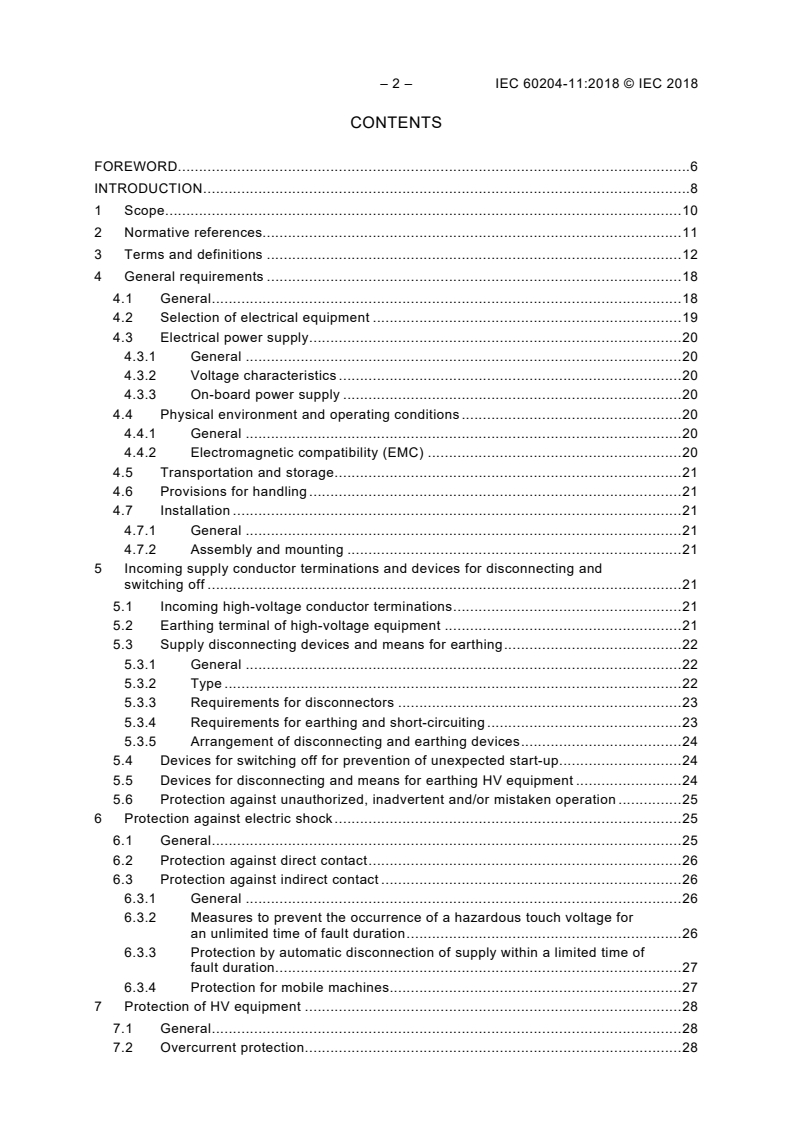
IEC 60204-11:2018 - Safety of machinery - Electrical equipment of machines - Part 11: Requirements for equipment for voltages above 1 000 V AC or 1 500 V DC and not exceeding 36 kV Released:7/31/2018
Overview
IEC 60204-11:2018 is an international standard developed by the International Electrotechnical Commission (IEC). This standard specifies the safety requirements for the electrical and electronic equipment of machines that operate at nominal voltages above 1 000 V AC or 1 500 V DC and not exceeding 36 kV. It is designed to ensure the protection of personnel and property while maintaining the performance and reliability of high-voltage (HV) equipment integrated into machinery.
This second edition of IEC 60204-11 replaces the 2000 version, introducing significant technical updates, including alignment with related standards such as IEC 60204-1:2016, IEC 61936-1, and IEC 62271 series. Its scope covers machines operated individually or as coordinated groups, providing clear guidelines for HV electrical systems with nominal frequencies up to 60 Hz.
IEC 60204-11 is intended to be used in conjunction with IEC 60204-1, especially where both high and low voltage equipment are present in a machine system.
Key Topics
Risk Assessment
Integrates principles from ISO 12100 to address hazards, enhance safety, and guide risk reduction measures for HV equipment.Equipotential Bonding & Earthing
Specifies requirements for grounding and equipotential bonding to protect against electric shock and ensure fault current paths.Electromagnetic Compatibility (EMC) & Power Quality
Establishes practices to minimize electromagnetic interference and maintain stable power supply within HV systems.Switchgear and Controlgear
Provides specifications for HV switchgear and controlgear to ensure safe operation, maintenance, and disconnection procedures.Protection Against Electrical Hazards
Outlines protective measures against overcurrent, overheating, overvoltages, arc faults, and fire risks associated with HV equipment.Creepage Distances
Sets minimum requirements for creepage distances on conductor lines and slip-ring assemblies for reliable insulation and reduced risk of failure.Documentation and Testing
Requires technical documentation, marking, and warning signage, alongside rigorous testing and verification procedures.Integration of Low Voltage (LV) Systems
Details how LV control and auxiliary equipment should be safely incorporated into HV environments.
Applications
IEC 60204-11:2018 applies to a wide range of industrial settings where machinery operates at HV levels, including:
- Manufacturing and Process Industries: Ensures safe electrical integration in production lines, automated equipment, and process machinery utilizing high-voltage power.
- Material Handling Systems: Applies to cranes, hoists, and conveyor systems where HV equipment is present.
- Electrical Drive Systems: Relevant for HV motors, transformers, and control gear used in heavy-duty industrial applications.
- Coordinated Group Machines: Suitable for installations where machines work together, requiring harmonized HV electrical systems.
- Applications with Special Risks: Addresses specific requirements for machines used outdoors, in explosive atmospheres, or in mining operations.
By following IEC 60204-11, manufacturers, designers, and operators benefit from improved occupational safety, enhanced equipment reliability, and compliance with international safety regulations.
Related Standards
IEC 60204-11:2018 is closely linked to several key IEC standards, ensuring comprehensive coverage and compatibility:
- IEC 60204-1:2016 – General requirements for the electrical equipment of machines
- IEC 61936-1 – Power installations exceeding 1 kV AC
- IEC 62271 Series – High-voltage switchgear and controlgear
- ISO 12100 – Safety of machinery - General principles for design - Risk assessment and risk reduction
Additional relevant standards include IEC 60364 for electrical installations, IEC 60034 for rotating electrical machines, and IEC 60529 for degrees of protection (IP code).
Keywords:
IEC 60204-11, electrical equipment of machines, high-voltage safety, industrial machinery, HV equipment, equipotential bonding, earthing, switchgear, controlgear, electromagnetic compatibility, risk assessment, industrial standards, machinery safety.
Relations
- Effective Date
- 25-Aug-2026
- Effective Date
- 25-Aug-2026
- Effective Date
- 22-Apr-2026
- Effective Date
- 05-Sep-2023
Buy Documents
IEC 60204-11:2018 RLV - Safety of machinery - Electrical equipment of machines - Part 11: Requirements for equipment for voltages above 1 000 V AC or 1 500 V DC and not exceeding 36 kV Released:7/31/2018
IEC 60204-11:2018 - Safety of machinery - Electrical equipment of machines - Part 11: Requirements for equipment for voltages above 1 000 V AC or 1 500 V DC and not exceeding 36 kV Released:7/31/2018
Get Certified
Connect with accredited certification bodies for this standard

IMQ S.p.A. (Certification)
Italian electrical product certification.

SLG Prüf- und Zertifizierungs GmbH
German testing and certification body.

UL Solutions
Global safety science company with testing, inspection and certification.
Sponsored listings
Frequently Asked Questions
IEC 60204-11:2018 is a standard published by the International Electrotechnical Commission (IEC). Its full title is "Safety of machinery - Electrical equipment of machines - Part 11: Requirements for equipment for voltages above 1 000 V AC or 1 500 V DC and not exceeding 36 kV". This standard covers: IEC 60204-11:2018 applies to electrical and electronic equipment and systems to machines, including a group of machines working together in a co-ordinated manner, which operate at nominal voltages above 1 000 V AC or 1 500 V DC and not exceeding 36 kV AC or DC with nominal frequencies not exceeding 60 Hz. IEC 60204-11:2018 cancels and replaces the first edition, published in 2000. This edition constitutes a technical revision. This edition contains significant technical changes with respect to the previous edition regarding the following: – aspects of risk assessment, which are mirrored from ISO 12100; – equipotential bonding and earthing; – EMC and power quality; – HV switchgear and controlgear; – creepage distances for conductors and slip-ring assemblies; – a list of machinery using HV equipment, in Annex A. IEC 60204-11:2018 has been updated and improved to reflect the experience gained with the first edition and the evolution of high-voltage equipment reflected in the relevant standards. Regarding formal requirements, IEC 60204-11 has been aligned with – IEC 60204-1:2016, – IEC 61936-1:2010 and IEC 61936-1:2010/AMD1:2014, – IEC 62271 (all parts). This document is intended to be used in conjunction with IEC 60204-1.
IEC 60204-11:2018 applies to electrical and electronic equipment and systems to machines, including a group of machines working together in a co-ordinated manner, which operate at nominal voltages above 1 000 V AC or 1 500 V DC and not exceeding 36 kV AC or DC with nominal frequencies not exceeding 60 Hz. IEC 60204-11:2018 cancels and replaces the first edition, published in 2000. This edition constitutes a technical revision. This edition contains significant technical changes with respect to the previous edition regarding the following: – aspects of risk assessment, which are mirrored from ISO 12100; – equipotential bonding and earthing; – EMC and power quality; – HV switchgear and controlgear; – creepage distances for conductors and slip-ring assemblies; – a list of machinery using HV equipment, in Annex A. IEC 60204-11:2018 has been updated and improved to reflect the experience gained with the first edition and the evolution of high-voltage equipment reflected in the relevant standards. Regarding formal requirements, IEC 60204-11 has been aligned with – IEC 60204-1:2016, – IEC 61936-1:2010 and IEC 61936-1:2010/AMD1:2014, – IEC 62271 (all parts). This document is intended to be used in conjunction with IEC 60204-1.
IEC 60204-11:2018 is classified under the following ICS (International Classification for Standards) categories: 13.110 - Safety of machinery; 29.020 - Electrical engineering in general. The ICS classification helps identify the subject area and facilitates finding related standards.
IEC 60204-11:2018 has the following relationships with other standards: It is inter standard links to EN ISO 21789:2022, EN ISO 22291:2022, EN ISO 8528-13:2026, IEC 60204-11:2000. Understanding these relationships helps ensure you are using the most current and applicable version of the standard.
IEC 60204-11:2018 is available in PDF format for immediate download after purchase. The document can be added to your cart and obtained through the secure checkout process. Digital delivery ensures instant access to the complete standard document.
Standards Content (Sample)
IEC 60204-11 ®
Edition 2.0 2018-07
REDLINE VERSION
INTERNATIONAL
STANDARD
colour
inside
Safety of machinery – Electrical equipment of machines –
Part 11: Requirements for HV equipment for voltages above 1 000 V AC or
1 500 V DC and not exceeding 36 kV
All rights reserved. Unless otherwise specified, no part of this publication may be reproduced or utilized in any form
or by any means, electronic or mechanical, including photocopying and microfilm, without permission in writing from
either IEC or IEC's member National Committee in the country of the requester. If you have any questions about IEC
copyright or have an enquiry about obtaining additional rights to this publication, please contact the address below or
your local IEC member National Committee for further information.
IEC Central Office Tel.: +41 22 919 02 11
3, rue de Varembé info@iec.ch
CH-1211 Geneva 20 www.iec.ch
Switzerland
About the IEC
The International Electrotechnical Commission (IEC) is the leading global organization that prepares and publishes
International Standards for all electrical, electronic and related technologies.
About IEC publications
The technical content of IEC publications is kept under constant review by the IEC. Please make sure that you have the
latest edition, a corrigenda or an amendment might have been published.
IEC Catalogue - webstore.iec.ch/catalogue Electropedia - www.electropedia.org
The stand-alone application for consulting the entire The world's leading online dictionary of electronic and
bibliographical information on IEC International Standards, electrical terms containing 21 000 terms and definitions in
Technical Specifications, Technical Reports and other English and French, with equivalent terms in 16 additional
documents. Available for PC, Mac OS, Android Tablets and languages. Also known as the International Electrotechnical
iPad. Vocabulary (IEV) online.
IEC publications search - webstore.iec.ch/advsearchform IEC Glossary - std.iec.ch/glossary
The advanced search enables to find IEC publications by a 67 000 electrotechnical terminology entries in English and
variety of criteria (reference number, text, technical French extracted from the Terms and Definitions clause of
committee,…). It also gives information on projects, replaced IEC publications issued since 2002. Some entries have been
and withdrawn publications. collected from earlier publications of IEC TC 37, 77, 86 and
CISPR.
IEC Just Published - webstore.iec.ch/justpublished
Stay up to date on all new IEC publications. Just Published IEC Customer Service Centre - webstore.iec.ch/csc
details all new publications released. Available online and If you wish to give us your feedback on this publication or
also once a month by email. need further assistance, please contact the Customer Service
Centre: sales@iec.ch.
IEC 60204-11 ®
Edition 2.0 2018-07
REDLINE VERSION
INTERNATIONAL
STANDARD
colour
inside
Safety of machinery – Electrical equipment of machines –
Part 11: Requirements for HV equipment for voltages above 1 000 V AC or
1 500 V DC and not exceeding 36 kV
INTERNATIONAL
ELECTROTECHNICAL
COMMISSION
ICS 13.110; 29.020 ISBN 978-2-8322-5929-0
– 2 – IEC 60204-11:2018 RLV © IEC 2018
CONTENTS
FOREWORD . 6
INTRODUCTION . 8
1 Scope . 10
2 Normative references. 11
3 Terms and definitions . 13
4 General requirements . 21
4.1 General considerations . 21
4.2 Selection of electrical equipment . 22
4.3 Electrical power supply . 22
4.3.1 General . 22
4.3.2 Supplies Voltage characteristics . 22
4.3.3 On-board power supply . 23
4.4 Physical environment and operating conditions . 23
4.4.1 General . 23
4.4.2 Electromagnetic compatibility (EMC) . 23
4.5 Transportation and storage . 24
4.6 Provisions for handling . 24
4.7 Installation . 24
4.7.1 General . 24
4.7.2 Assembly and mounting . 24
5 Incoming supply conductor terminations and devices for disconnecting and
switching off, and means for earthing . 24
5.1 Incoming supply high-voltage conductor terminations . 24
5.2 Earthing terminal of high-voltage equipment . 24
5.3 Supply disconnecting (isolating) devices and means for earthing . 25
5.3.1 General . 25
5.3.2 Type . 25
5.3.3 Requirements for disconnectors . 26
5.3.4 Means Requirements for earthing and short-circuiting . 27
Operating handle .
5.3.5 Arrangement of disconnecting and earthing devices . 27
5.4 Devices for switching off for prevention of unexpected start-up . 28
5.5 Devices for disconnecting and means for earthing HV equipment . 28
5.6 Protection against unauthorized, inadvertent and/or mistaken operation . 29
6 Protection against electric shock . 29
6.1 General . 29
6.2 Protection against direct contact . 30
6.3 Protection against indirect contact . 30
6.3.1 General . 30
6.3.2 Measures to prevent the occurrence of a hazardous touch voltage for
an unlimited time of fault duration . 31
6.3.3 Protection by automatic disconnection of supply within a limited time of
fault duration . 31
6.3.4 Protection for mobile machines . 31
7 Protection of HV equipment . 32
7.1 General . 32
7.2 Overcurrent protection . 32
7.2.1 General . 32
7.2.2 Supply conductors . 32
7.2.3 Power circuits . 32
7.2.4 Transformers . 33
7.2.5 Overcurrent protective devices . 33
7.2.6 Rating and setting of overcurrent protective devices . 33
7.3 Protection of motors against overheating . 33
7.4 Protection against abnormal temperature . 33
7.5 Protection against the effects of supply interruption or voltage reduction and
subsequent restoration . 33
7.6 Motor overspeed protection . 34
7.7 Earth fault protection . 34
7.8 Protection against overvoltages due to lightning and to switching surges . 34
Protection against abnormal conditions .
7.9 Protection against hazards due to arc faults . 35
7.10 Protection against overpressure and leakage . 35
7.11 Protection against fire . 35
8 Equipotential bonding . 35
8.1 General . 35
8.2 Protective bonding circuit . 37
8.2.1 General . 37
8.2.2 Protective conductors . 38
8.2.3 Continuity of the protective bonding circuit . 39
Exclusion of switching devices from the protective bonding circuit .
Interruption of the protective bonding circuit .
8.2.4 Mobile machines . 40
8.2.5 Protective bonding circuit connecting points . 40
8.2.6 Supplementary equipotential protective bonding conductors . 40
9 Control systems, control circuits and control functions . 40
10 Operator interface and machine-mounted control devices . 41
11 Electronic equipment . 41
12 Controlgear: location, mounting, and enclosures . 41
12.1 General requirements . 41
12.2 Location and mounting . 41
12.2.1 Accessibility and maintenance . 41
12.2.2 Physical separation . 42
12.3 Degrees of protection . 42
12.4 Enclosures, doors and openings . 43
12.5 Access to HV equipment . 44
13 Conductors and cables . 44
13.1 General requirements . 44
13.2 Conductors . 44
13.3 Insulation and sheath materials . 45
13.4 Current-carrying capacity in normal service . 45
13.5 Conductor and cable voltage drop . 46
13.6 Minimum cross-sectional area . 46
13.7 Flexible cables . 46
– 4 – IEC 60204-11:2018 RLV © IEC 2018
13.7.1 General . 46
13.7.2 Mechanical rating . 46
13.7.3 Current-carrying capacity of cables wound on drums . 46
13.8 Conductor wires, conductor bars and slip-ring assemblies . 47
13.8.1 Protection against direct contact . 47
13.8.2 Protective bonding circuit . 47
13.8.3 Protective conductor current collectors . 48
13.8.4 Clearances in air . 48
13.8.5 Creepage distances . 48
13.8.6 Conductor system sectioning . 49
13.8.7 Construction and installation of conductor wire, conductor bar systems
and slip-ring assemblies . 49
14 Wiring practices . 50
14.1 Connections and routing . 50
14.1.1 General requirements . 50
14.1.2 Cable runs . 50
14.2 Identification of conductors . 51
14.3 Flexible cables . 51
14.4 Plug-socket combinations . 52
14.5 Dismantling for shipment . 52
14.6 Cable trays . 52
15 Electric motors and associated equipment . 52
15.1 General . 52
15.2 Motor connection boxes . 52
Accessories .
Accessories for earthing and short-circuiting live parts .
Voltage detectors .
Accessories for safe working .
16 Means to protect persons working on electrical installations . 53
16.1 General . 53
16.2 Equipment for isolating installations or apparatus . 53
16.3 Devices to prevent reclosing of isolating devices. 53
16.4 Devices for determining the de-energized state . 53
16.5 Devices for earthing and short-circuiting . 53
16.6 Equipment acting as protective barriers against adjacent live parts . 53
16.7 Storage of personal protection equipment . 53
17 Marking, warning signs and reference designations . 54
17.1 General . 54
17.2 Warning signs . 54
18 Technical documentation . 55
18.1 General . 55
18.2 Instructions for use . 55
18.2.1 General . 55
18.2.2 Provisions for handling . 55
18.2.3 Assembly and mounting . 55
18.2.4 Connections . 55
18.2.5 Final installation inspection . 55
18.2.6 Warning sign . 56
19 Testing and verification . 56
19.1 General . 56
19.2 Earthing system tests . 56
19.3 Insulation resistance tests . 56
19.4 Voltage tests . 57
19.5 Functional tests . 57
19.6 IP tests for HV equipment outside electrical operating areas . 57
19.7 Retesting . 57
Annex A (informative) Examples of machines covered by IEC 60204-11 . 58
Annex B (informative) Inquiry form for the HV equipment of machines . 59
Annex (informative) Method of calculation for the cross-sectional area of
bare protective conductors in supply systems with direct earthing or low impedance
earthing of the neutral .
Annex C (informative) Relationship between cable rated voltages and highest voltage
for HV equipment . 65
Annex (informative) Rationalization of the use of terms relating to earthing and
protective bonding .
Index .
Bibliography . 71
Figure – Explanation of the terms relating to earthing and protective bonding .
Figure 1 – Block diagram of a machine containing HV equipment . 9
Figure 2 – Example of equipotential bonding for electrical equipment of a machine . 37
Figure 3 – Symbol for protective earth (protective ground) . 40
Figure 4 – Warning sign “high voltage” . 54
Figure 5 – DANGER hazard severity panel . 55
Table – Cross-sectional area of bare protective conductors .
Table 1 – Maximum allowable conductor temperatures under normal and short-circuit
conditions . 45
Table 2 – De-rating factors for cables wound on drums . 47
Table 3 – Selection of the pollution level depending on the degree of protection
and insulator material . 49
Table 4 – Minimum creepage distance of conductor lines and slip ring assemblies . 49
Table B.1 – Overvoltage protection for HV equipment of machinery . 62
Table C.1 – Rated voltages of cable and highest voltage for HV equipment . 65
– 6 – IEC 60204-11:2018 RLV © IEC 2018
INTERNATIONAL ELECTROTECHNICAL COMMISSION
____________
SAFETY OF MACHINERY –
ELECTRICAL EQUIPMENT OF MACHINES –
Part 11: Requirements for HV equipment for voltages
above 1 000 V AC or 1 500 V DC and not exceeding 36 kV
FOREWORD
1) The International Electrotechnical Commission (IEC) is a worldwide organization for standardization comprising
all national electrotechnical committees (IEC National Committees). The object of IEC is to promote
international co-operation on all questions concerning standardization in the electrical and electronic fields. To
this end and in addition to other activities, IEC publishes International Standards, Technical Specifications,
Technical Reports, Publicly Available Specifications (PAS) and Guides (hereafter referred to as “IEC
Publication(s)”). Their preparation is entrusted to technical committees; any IEC National Committee interested
in the subject dealt with may participate in this preparatory work. International, governmental and non-
governmental organizations liaising with the IEC also participate in this preparation. IEC collaborates closely
with the International Organization for Standardization (ISO) in accordance with conditions determined by
agreement between the two organizations.
2) The formal decisions or agreements of IEC on technical matters express, as nearly as possible, an international
consensus of opinion on the relevant subjects since each technical committee has representation from all
interested IEC National Committees.
3) IEC Publications have the form of recommendations for international use and are accepted by IEC National
Committees in that sense. While all reasonable efforts are made to ensure that the technical content of IEC
Publications is accurate, IEC cannot be held responsible for the way in which they are used or for any
misinterpretation by any end user.
4) In order to promote international uniformity, IEC National Committees undertake to apply IEC Publications
transparently to the maximum extent possible in their national and regional publications. Any divergence
between any IEC Publication and the corresponding national or regional publication shall be clearly indicated in
the latter.
5) IEC itself does not provide any attestation of conformity. Independent certification bodies provide conformity
assessment services and, in some areas, access to IEC marks of conformity. IEC is not responsible for any
services carried out by independent certification bodies.
6) All users should ensure that they have the latest edition of this publication.
7) No liability shall attach to IEC or its directors, employees, servants or agents including individual experts and
members of its technical committees and IEC National Committees for any personal injury, property damage or
other damage of any nature whatsoever, whether direct or indirect, or for costs (including legal fees) and
expenses arising out of the publication, use of, or reliance upon, this IEC Publication or any other IEC
Publications.
8) Attention is drawn to the Normative references cited in this publication. Use of the referenced publications is
indispensable for the correct application of this publication.
9) Attention is drawn to the possibility that some of the elements of this IEC Publication may be the subject of
patent rights. IEC shall not be held responsible for identifying any or all such patent rights.
This redline version of the official IEC Standard allows the user to identify the changes
made to the previous edition. A vertical bar appears in the margin wherever a change
has been made. Additions are in green text, deletions are in strikethrough red text.
International Standard IEC 60204-11 has been prepared by IEC technical committee 44:
Safety of machinery – Electrotechnical aspects.
This second edition cancels and replaces the first edition, published in 2000. This edition
constitutes a technical revision.
This edition contains significant technical changes with respect to the previous edition
regarding the following:
– aspects of risk assessment, which are mirrored from ISO 12100;
– equipotential bonding and earthing;
– EMC and power quality;
– HV switchgear and controlgear;
– creepage distances for conductors and slip-ring assemblies;
– a list of machinery using HV equipment, in Annex A.
This second edition of IEC 60204-11 has been updated and improved to reflect the
experience gained with the first edition and the evolution of high-voltage equipment reflected
in the relevant standards.
Regarding formal requirements, IEC 60204-11 has been aligned with
– IEC 60204-1:2016,
– IEC 61936-1:2010 and IEC 61936-1:2010/AMD1:2014,
– IEC 62271 (all parts).
This document is intended to be used in conjunction with IEC 60204-1.
The text of this International Standard is based on the following documents:
FDIS Report on voting
44/819/FDIS 44/828/RVD
Full information on the voting for the approval of this International Standard can be found in
the report on voting indicated in the above table.
This document has been drafted in accordance with the ISO/IEC Directives, Part 2.
A list of all parts in the IEC 60204 series, published under the general title Safety of
machinery – Electrical equipment of machines, can be found on the IEC website.
The committee has decided that the contents of this document will remain unchanged until the
stability date indicated on the IEC website under "http://webstore.iec.ch" in the data related to
the specific document. At this date, the document will be
reconfirmed,
withdrawn,
replaced by a revised edition, or
amended.
IMPORTANT – The 'colour inside' logo on the cover page of this publication indicates
that it contains colours which are considered to be useful for the correct
understanding of its contents. Users should therefore print this document using a
colour printer.
– 8 – IEC 60204-11:2018 RLV © IEC 2018
INTRODUCTION
This part of IEC 60204 provides requirements and recommendations relating to the high-
voltage electrical equipment (HV equipment) of machines together with its associated low-
voltage electrical equipment (LV equipment) so as to promote
– safety of persons and property,
– consistency of control response,
– ease of maintenance maintainability.
High performance is not to be obtained at the expense of the essential factors mentioned
above.
An example of a possible application of these requirements is a machine or group of
machines used for the processing of a material where a failure in such machinery can have
serious economic consequences.
Figure 1 is a block diagram of a machine and associated equipment showing the various
elements of the electrical equipment addressed in this document. Numbers in parentheses
(…) refer to clauses and subclauses in this document. It is understood that all of the elements
taken together including the safeguards, software and the documentation constitute the
machine or group of machines working together with usually at least one level of supervisory
control.
More guidance on the use of this standard is given in annex F of IEC 60204-1.
This document should be used in conjunction with IEC 60204-1. HV equipment can include LV
control parts in the same general enclosure or in separate compartments.
Figure 1 – Block diagram of a machine containing HV equipment
– 10 – IEC 60204-11:2018 RLV © IEC 2018
SAFETY OF MACHINERY –
ELECTRICAL EQUIPMENT OF MACHINES –
Part 11: Requirements for HV equipment for voltages
above 1 000 V AC or 1 500 V DC and not exceeding 36 kV
1 Scope
This part of IEC 60204 applies to electrical and electronic equipment and systems to
machines, including a group of machines working together in a co-ordinated manner, but
excluding higher level system aspects (i.e. communications between systems) which operate
at nominal voltages above 1 000 V AC or 1 500 V DC and not exceeding 36 kV AC or DC with
nominal frequencies not exceeding 60 Hz.
This part of IEC 60204 is applicable to equipment, or parts of equipment, which operate with
nominal supply voltages above 1 000 V a.c. or 1 500 V d.c. and not exceeding 36 kV a.c. or
d.c. with nominal frequencies not exceeding 200 Hz. For higher voltages or frequencies,
special requirements may be needed.
In this document, the term HV equipment also covers the LV equipment forming an integral
part of the equipment operating at high voltage. The requirements in this document primarily
cover the parts operating at high-voltage except where explicitly stated otherwise. Reference
is made to IEC 60204-1 for those requirements which also apply to HV equipment.
NOTE 1 Other LV equipment not forming part of the HV equipment and defined as operating at voltages not
exceeding 1 000 V a.c. or 1 500 V d.c. are is covered by IEC 60204-1:2016.
NOTE 2 In this document, the term "electrical" includes both electrical and electronic matters (i.e. electrical
equipment means both the electrical and the electronic equipment).
NOTE 3 This document does not apply to independent high-voltage power supply installations for which separate
IEC standards exist.
The electrical equipment covered by this document commences at the point of connection of
the supply to the electrical equipment of the machine (see 5.1).
NOTE For the requirements for power supply installations, see HD 637.
NOTE 4 For the requirements for high-voltage power supply installations, see IEC 61936-1.
This document is an application a generic safety standard and is not intended to limit or inhibit
technological advancement. It does not cover all the requirements (e.g. guarding, interlocking
or control) which are needed or required by other standards or regulations in order to
safeguard personnel from hazards other than electrical hazards. Each type of machine has
unique requirements to be accommodated to provide adequate safety.
NOTE 5 In some machines the high-voltage power supply can be produced by a step-up transformer
(autotransformer), supplied by a low-voltage system (e.g. by a LV generator).
NOTE 6 In the context of this document, the term "person" refers to any individual; "personnel" are those persons
who are assigned and instructed by the user or his agent(s) in the use and care of the machine in question.
This part of IEC 60204 specifically includes, but is not limited to, machines as defined in 3.29
(Annex A lists examples of machines whose electrical equipment may can be covered by this
document).
For protection against electric shock from high-voltage equipment, this document refers to
IEC 61936-1. When it comes to low-voltage equipment, this document refers to
IEC 60204-1:2016.
NOTE 7 High- and low-voltage standards use different terms regarding protection against electric shock. Whereas
high-voltage standards use the terms “direct contact” and “indirect contact”, low-voltage standards correspondingly
use “basic protection” and “fault protection”.
Additional and special requirements can apply to the electrical equipment of machines that
– are used in the open air (i.e. outside buildings or other protective structures);
– use, process or produce potentially explosive material (e.g. paint or sawdust);
– are used in potentially explosive and/or flammable atmospheres;
– have special risks when producing or using certain materials;
– are used in mines.
Power circuits where electrical energy is directly used as a working tool are excluded from
this part of IEC 60204.
Hazards as a result of noise and vibration are excluded from the scope of this document.
2 Normative references
The following documents are referred to in the text in such a way that some or all of their
content constitutes requirements of this document. For dated references, only the edition
cited applies. For undated references, the latest edition of the referenced document (including
any amendments) applies.
IEC 60034-1:1996, Rotating electrical machines – Part 1: Rating and performance
IEC 60050(191):1990, International Electrotechnical Vocabulary (IEV) – Chapter 191:
Dependability and quality of service
IEC 60050-195:1998, International Electrotechnical Vocabulary (IEV) – Part 195: Earthing
and protection against electric shock
IEC 60050(441):1984, International Electrotechnical Vocabulary (IEV) – Chapter 441: Switch-
gear, controlgear and fuses
IEC 60050(826):1982, International Electrotechnical Vocabulary (IEV) – Chapter 826:
Electrical installations of buildings
IEC 60050(826):1995, amendment No. 2
IEC 60071-1:1993, Insulation co-ordination – Part 1: Definitions, principles and rules
IEC 60071-2:1996, Insulation co-ordination – Part 2: Application guide
IEC 60076-5:1976, Power transformers – Part 5: Ability to withstand short-circuit
IEC 60129:1984, Alternating current disconnectors and earthing switches
IEC 60298:1990, A.C. metal-enclosed switchgear and controlgear for rated voltages above
1 kV and up to and including 52 kV
– 12 – IEC 60204-11:2018 RLV © IEC 2018
IEC 60364-4-41:1992, Electrical installations of buildings – Part 4: Protection for safety –
Chapter 41: Protection against electric shock
IEC 60364-4-42:1980, Electrical installations of buildings – Part 4: Protection for safety –
Chapter 42: Protection against thermal effects
IEC 60204-1:1997 2016, Safety of machinery – Electrical equipment of machines – Part 1:
General requirements
IEC 60364-5-54:1980 2011, Low-voltage electrical installations of buildings – Part 5-54:
Selection and erection of electrical equipment – Earthing arrangements and protective
conductors
IEC 60417, Graphical symbols for use on equipment (available at http://www.graphical-
symbols.info/equipment)
IEC 60420:1990, High-voltage alternating current switch-fuse combinations
IEC 60445:1999, Basic and safety principles for man-machine interface, marking and
identification – Identification of equipment terminals and of terminations of certain designated,
conductor terminations and conductors, including general rules for an alphanumeric system
IEC 60466:1987, A.C. insulation-enclosed switchgear and controlgear for rated voltages
above 1 kV and up to and including 38 kV
IEC 60529:1989, Degrees of protection provided by enclosures (IP Code)
IEC 60621-3:1979, Electrical installations for outdoor sites under heavy conditions (including
open-cast mines and quarries) – Part 3: General requirements for equipment and ancillaries
IEC 60694:1996, Common specifications for high-voltage switchgear and controlgear
standards
IEC 60865-1:1993, Short-circuit currents – Calculation of effects – Part 1: Definitions and
calculation methods
IEC 61230:1993, Live working – Portable equipment for earthing or earthing and short-
circuiting
IEC 61243-1:1993, Live working – Voltage detectors – Part 1: Capacitive type to be used for
voltages exceeding 1 kV a.c.
IEC 61310-1:1995, Safety of machinery – Indication, marking and actuation – Part 1:
Requirements for visual, auditory and tactile signals
IEC 61310-3:1999, Safety of machinery – Indication, marking and actuation – Part 3:
Requirements for the location and operation of actuators
IEC 61800 (all parts), Adjustable speed electrical power drive systems
IEC 61936-1:2010, Power installations exceeding 1 kV a.c. – Part 1: Common rules
IEC 61936-1:2010/AMD1:2014
IEC 62061, Safety of machinery – Functional safety of safety-related electrical, electronic and
programmable electronic control systems
IEC 62271-102, High-voltage switchgear and controlgear – Part 102: Alternating current
disconnectors and earthing switches
IEC 62271-103, High-voltage switchgear and controlgear – Part 103: Switches for rated
voltages above 1 kV up to and including 52 kV
IEC 62271-105, High-voltage switchgear and controlgear – Part 105: Alternating current
switch-fuse combinations for rated voltages above 1 kV up to and including 52 kV
IEC 62271-107, High-voltage switchgear and controlgear – Part 107: Alternating current fused
circuit-switchers for rated voltages above 1 kV up to and including 52 kV
IEC 62271-200:2011, High-voltage switchgear and controlgear – Part 200: AC metal-enclosed
switchgear and controlgear for rated voltages above 1 kV and up to and including 52 kV
IEC 62271-201, High-voltage switchgear and controlgear – Part 201: AC solid-insulation
enclosed switchgear and controlgear for rated voltages above 1 kV and up to and including
52 kV
IEC 62745, Safety of machinery – Requirements for cableless control systems of machinery
ISO 13849-1, Safety of machinery – Safety-related parts of control systems – Part 1: General
principles for design
ISO 3864-1:1984 2011, Graphical symbols – Safety colours and safety signs – Part 1: Design
principles for safety signs and safety markings
ISO 3864-2:2016, Graphical symbols –Safety colours and safety signs – Part 2: Design
principles for product safety labels
ISO 7010:2011, Graphical symbols – Safety colours and safety signs – Registered safety
signs
ISO 12100, Safety of machinery –General principles for design – Risk assessment and risk
reduction
ISO/TR 12100-1:1992, Safety of machinery – Basic concepts, general principles for design –
Part 1: Basic terminology, methodology
EN 50178:1997, Electronic equipment for use in power stations
HD 637:1999, Power installations exceeding 1 kV a.c.
3 Terms and definitions
NOTE The index lists, in alphabetical order, the terms defined in this clause and indicates where they are used in
the text of this part of IEC 60204.
For the purposes of this document, the following terms and definitions apply.
ISO and IEC maintain terminological databases for use in standardization at the following
addresses:
• IEC Electropedia: available at http://www.electropedia.org/
• ISO Online browsing platform: available at http://www.iso.org/obp
– 14 – IEC 60204-11:2018 RLV © IEC 2018
3.1
ambient temperature
temperature of the air or other medium where the equipment is to be used
[IEV 826-01-04]
3.2
barrier
part providing protection against direct contact with live parts from any usual direction of
access
[IEV 826-03-13]
3.3
basic protection
protection against electric shock under fault-free conditions
Note 1 to entry: Previously referred to as “protection against direct contact”.
[SOURCE: IEC 60050-195:1998, 195-06-01, modified – The note has been added.]
3.4
cable tray
cable support consisting of a continuous base and with raised edges and but no covering
Note 1 to entry: A cable tray may be perforated or non-perforated mesh.
[SOURCE: IEV 826-06-07, amendment 2 IEC 60050-826:2004, 826-15-08]
3.5
conductor wire
conductor bar
conductor rail
conductive wire, bar or rail of a feeder system with a sliding current collector
3.6
control circuit
circuit used for the operational control of the machine and for protection of
the power circuits the control, including monitoring, of a machine and the electrical equipment
3.7
control device
device connected into the control circuit and used for controlling the operation of the machine
EXAMPLE Position sensor, manual control switch, relay, magnetically operated valve.
3.8
controlgear
general term covering switching devices and their combination with associated control,
measuring, protective, and regulating equipment, also assemblies of such devices and
equipment with associated interconnections, accessories, enclosures, and supporting
structures, intended in principle for the control of electrical energy consuming equipment
[SOURCE: IEC 60050-441:2000, 441-11-03]
3.7
direct contact
electric contact of persons or animals with live parts
[IEV 195-06-03
...
IEC 60204-11 ®
Edition 2.0 2018-07
INTERNATIONAL
STANDARD
NORME
INTERNATIONALE
colour
inside
Safety of machinery – Electrical equipment of machines –
Part 11: Requirements for equipment for voltages above 1 000 V AC or 1 500 V
DC and not exceeding 36 kV
Sécurité des machines – Équipement électrique des machines –
Partie 11: Exigences pour les équipements fonctionnant à des tensions
supérieures à 1 000 V en courant alternatif ou 1 500 V en courant continu et ne
dépassant pas 36 kV
All rights reserved. Unless otherwise specified, no part of this publication may be reproduced or utilized in any form
or by any means, electronic or mechanical, including photocopying and microfilm, without permission in writing from
either IEC or IEC's member National Committee in the country of the requester. If you have any questions about IEC
copyright or have an enquiry about obtaining additional rights to this publication, please contact the address below or
your local IEC member National Committee for further information.
Droits de reproduction réservés. Sauf indication contraire, aucune partie de cette publication ne peut être reproduite
ni utilisée sous quelque forme que ce soit et par aucun procédé, électronique ou mécanique, y compris la photocopie
et les microfilms, sans l'accord écrit de l'IEC ou du Comité national de l'IEC du pays du demandeur. Si vous avez des
questions sur le copyright de l'IEC ou si vous désirez obtenir des droits supplémentaires sur cette publication, utilisez
les coordonnées ci-après ou contactez le Comité national de l'IEC de votre pays de résidence.
IEC Central Office Tel.: +41 22 919 02 11
3, rue de Varembé info@iec.ch
CH-1211 Geneva 20 www.iec.ch
Switzerland
About the IEC
The International Electrotechnical Commission (IEC) is the leading global organization that prepares and publishes
International Standards for all electrical, electronic and related technologies.
About IEC publications
The technical content of IEC publications is kept under constant review by the IEC. Please make sure that you have the
latest edition, a corrigenda or an amendment might have been published.
IEC Catalogue - webstore.iec.ch/catalogue Electropedia - www.electropedia.org
The stand-alone application for consulting the entire The world's leading online dictionary of electronic and
bibliographical information on IEC International Standards, electrical terms containing 21 000 terms and definitions in
Technical Specifications, Technical Reports and other English and French, with equivalent terms in 16 additional
documents. Available for PC, Mac OS, Android Tablets and languages. Also known as the International Electrotechnical
iPad. Vocabulary (IEV) online.
IEC publications search - webstore.iec.ch/advsearchform IEC Glossary - std.iec.ch/glossary
The advanced search enables to find IEC publications by a 67 000 electrotechnical terminology entries in English and
variety of criteria (reference number, text, technical French extracted from the Terms and Definitions clause of
committee,…). It also gives information on projects, replaced IEC publications issued since 2002. Some entries have been
and withdrawn publications. collected from earlier publications of IEC TC 37, 77, 86 and
CISPR.
IEC Just Published - webstore.iec.ch/justpublished
Stay up to date on all new IEC publications. Just Published IEC Customer Service Centre - webstore.iec.ch/csc
details all new publications released. Available online and If you wish to give us your feedback on this publication or
also once a month by email. need further assistance, please contact the Customer Service
Centre: sales@iec.ch.
A propos de l'IEC
La Commission Electrotechnique Internationale (IEC) est la première organisation mondiale qui élabore et publie des
Normes internationales pour tout ce qui a trait à l'électricité, à l'électronique et aux technologies apparentées.
A propos des publications IEC
Le contenu technique des publications IEC est constamment revu. Veuillez vous assurer que vous possédez l’édition la
plus récente, un corrigendum ou amendement peut avoir été publié.
Catalogue IEC - webstore.iec.ch/catalogue Electropedia - www.electropedia.org
Application autonome pour consulter tous les renseignements
Le premier dictionnaire en ligne de termes électroniques et
bibliographiques sur les Normes internationales,
électriques. Il contient 21 000 termes et définitions en anglais
Spécifications techniques, Rapports techniques et autres
et en français, ainsi que les termes équivalents dans 16
documents de l'IEC. Disponible pour PC, Mac OS, tablettes
langues additionnelles. Egalement appelé Vocabulaire
Android et iPad.
Electrotechnique International (IEV) en ligne.
Recherche de publications IEC -
Glossaire IEC - std.iec.ch/glossary
webstore.iec.ch/advsearchform
67 000 entrées terminologiques électrotechniques, en anglais
La recherche avancée permet de trouver des publications IEC et en français, extraites des articles Termes et Définitions des
en utilisant différents critères (numéro de référence, texte, publications IEC parues depuis 2002. Plus certaines entrées
comité d’études,…). Elle donne aussi des informations sur les antérieures extraites des publications des CE 37, 77, 86 et
projets et les publications remplacées ou retirées. CISPR de l'IEC.
IEC Just Published - webstore.iec.ch/justpublished Service Clients - webstore.iec.ch/csc
Restez informé sur les nouvelles publications IEC. Just Si vous désirez nous donner des commentaires sur cette
Published détaille les nouvelles publications parues. publication ou si vous avez des questions contactez-nous:
Disponible en ligne et aussi une fois par mois par email. sales@iec.ch.
IEC 60204-11 ®
Edition 2.0 2018-07
INTERNATIONAL
STANDARD
NORME
INTERNATIONALE
colour
inside
Safety of machinery – Electrical equipment of machines –
Part 11: Requirements for equipment for voltages above 1 000 V AC or 1 500 V
DC and not exceeding 36 kV
Sécurité des machines – Équipement électrique des machines –
Partie 11: Exigences pour les équipements fonctionnant à des tensions
supérieures à 1 000 V en courant alternatif ou 1 500 V en courant continu et ne
dépassant pas 36 kV
INTERNATIONAL
ELECTROTECHNICAL
COMMISSION
COMMISSION
ELECTROTECHNIQUE
INTERNATIONALE
ICS 13.110; 29.020 ISBN 978-2-8322-5904-7
– 2 – IEC 60204-11:2018 © IEC 2018
CONTENTS
FOREWORD . 6
INTRODUCTION . 8
1 Scope . 10
2 Normative references. 11
3 Terms and definitions . 12
4 General requirements . 18
4.1 General . 18
4.2 Selection of electrical equipment . 19
4.3 Electrical power supply . 20
4.3.1 General . 20
4.3.2 Voltage characteristics . 20
4.3.3 On-board power supply . 20
4.4 Physical environment and operating conditions . 20
4.4.1 General . 20
4.4.2 Electromagnetic compatibility (EMC) . 20
4.5 Transportation and storage . 21
4.6 Provisions for handling . 21
4.7 Installation . 21
4.7.1 General . 21
4.7.2 Assembly and mounting . 21
5 Incoming supply conductor terminations and devices for disconnecting and
switching off . 21
5.1 Incoming high-voltage conductor terminations . 21
5.2 Earthing terminal of high-voltage equipment . 21
5.3 Supply disconnecting devices and means for earthing . 22
5.3.1 General . 22
5.3.2 Type . 22
5.3.3 Requirements for disconnectors . 23
5.3.4 Requirements for earthing and short-circuiting . 23
5.3.5 Arrangement of disconnecting and earthing devices . 24
5.4 Devices for switching off for prevention of unexpected start-up . 24
5.5 Devices for disconnecting and means for earthing HV equipment . 24
5.6 Protection against unauthorized, inadvertent and/or mistaken operation . 25
6 Protection against electric shock . 25
6.1 General . 25
6.2 Protection against direct contact . 26
6.3 Protection against indirect contact . 26
6.3.1 General . 26
6.3.2 Measures to prevent the occurrence of a hazardous touch voltage for
an unlimited time of fault duration . 26
6.3.3 Protection by automatic disconnection of supply within a limited time of
fault duration . 27
6.3.4 Protection for mobile machines . 27
7 Protection of HV equipment . 28
7.1 General . 28
7.2 Overcurrent protection . 28
7.2.1 General . 28
7.2.2 Supply conductors . 28
7.2.3 Power circuits . 28
7.2.4 Transformers . 28
7.2.5 Overcurrent protective devices . 29
7.2.6 Rating and setting of overcurrent protective devices . 29
7.3 Protection of motors against overheating . 29
7.4 Protection against abnormal temperature . 29
7.5 Protection against the effects of supply interruption or voltage reduction and
subsequent restoration . 29
7.6 Motor overspeed protection . 29
7.7 Earth fault protection . 30
7.8 Protection against overvoltage due to lightning and switching surges . 30
7.9 Protection against hazards due to arc faults . 30
7.10 Protection against overpressure and leakage . 30
7.11 Protection against fire . 30
8 Equipotential bonding . 30
8.1 General . 30
8.2 Protective bonding circuit . 33
8.2.1 General . 33
8.2.2 Protective conductors . 34
8.2.3 Continuity of the protective bonding circuit . 34
8.2.4 Mobile machines . 35
8.2.5 Protective bonding circuit connecting points . 35
8.2.6 Supplementary protective bonding conductors . 36
9 Control systems, control circuits and control functions . 36
10 Operator interface and machine-mounted control devices . 36
11 Electronic equipment . 36
12 Controlgear: location, mounting, and enclosures . 36
12.1 General requirements . 36
12.2 Location and mounting . 37
12.2.1 Accessibility and maintenance . 37
12.2.2 Physical separation . 37
12.3 Degrees of protection . 37
12.4 Enclosures, doors and openings . 38
12.5 Access to HV equipment . 39
13 Conductors and cables . 39
13.1 General requirements . 39
13.2 Conductors . 39
13.3 Insulation and sheath materials . 40
13.4 Current-carrying capacity in normal service . 40
13.5 Conductor and cable voltage drop . 40
13.6 Minimum cross-sectional area . 40
13.7 Flexible cables . 40
13.7.1 General . 40
13.7.2 Mechanical rating . 41
13.7.3 Current-carrying capacity of cables wound on drums . 41
13.8 Conductor wires, conductor bars and slip-ring assemblies . 41
– 4 – IEC 60204-11:2018 © IEC 2018
13.8.1 Protection against direct contact . 41
13.8.2 Protective bonding circuit . 42
13.8.3 Protective conductor current collectors . 42
13.8.4 Clearances in air . 42
13.8.5 Creepage distances . 42
13.8.6 Conductor system sectioning . 43
13.8.7 Construction and installation of conductor wire, conductor bar systems
and slip-ring assemblies . 43
14 Wiring practices . 44
14.1 Connections and routing . 44
14.1.1 General requirements . 44
14.1.2 Cable runs . 44
14.2 Identification of conductors . 45
14.3 Flexible cables . 45
14.4 Plug-socket combinations . 46
14.5 Dismantling for shipment . 46
14.6 Cable trays . 46
15 Electric motors and associated equipment . 46
15.1 General . 46
15.2 Motor connection boxes . 46
16 Means to protect persons working on electrical installations . 47
16.1 General . 47
16.2 Equipment for isolating installations or apparatus . 47
16.3 Devices to prevent reclosing of isolating devices. 47
16.4 Devices for determining the de-energized state . 47
16.5 Devices for earthing and short-circuiting . 47
16.6 Equipment acting as protective barriers against adjacent live parts . 47
16.7 Storage of personal protection equipment . 47
17 Marking, warning signs and reference designations . 47
17.1 General . 47
17.2 Warning signs . 47
18 Technical documentation . 48
18.1 General . 48
18.2 Instructions for use . 48
18.2.1 General . 48
18.2.2 Provisions for handling . 48
18.2.3 Assembly and mounting . 48
18.2.4 Connections . 49
18.2.5 Final installation inspection . 49
18.2.6 Warning sign . 49
19 Testing and verification . 49
19.1 General . 49
19.2 Earthing system tests . 49
19.3 Insulation resistance tests . 50
19.4 Voltage tests . 50
19.5 Functional tests . 50
19.6 IP tests for HV equipment outside electrical operating areas . 50
19.7 Retesting . 50
Annex A (informative) Examples of machines covered by IEC 60204-11 . 51
Annex B (informative) Inquiry form for the HV equipment of machines . 52
Annex C (informative) Relationship between cable rated voltages and highest voltage
for HV equipment . 56
Bibliography . 57
Figure 1 – Block diagram of a machine containing HV equipment . 9
Figure 2 – Example of equipotential bonding for electrical equipment of a machine . 33
Figure 3 – Symbol for protective earth (protective ground) . 35
Figure 4 – Warning sign “high voltage” . 48
Figure 5 – DANGER hazard severity panel . 48
Table 1 – Maximum allowable conductor temperatures under normal and short-circuit
conditions . 39
Table 2 – De-rating factors for cables wound on drums . 41
Table 3 – Selection of the pollution level depending on the degree of protection and
insulator material . 43
Table 4 – Minimum creepage distance of conductor lines and slip ring assemblies . 43
Table B.1 – Overvoltage protection for HV equipment of machinery . 54
Table C.1 – Rated voltages of cable and highest voltage for HV equipment . 56
– 6 – IEC 60204-11:2018 © IEC 2018
INTERNATIONAL ELECTROTECHNICAL COMMISSION
____________
SAFETY OF MACHINERY –
ELECTRICAL EQUIPMENT OF MACHINES –
Part 11: Requirements for equipment for voltages
above 1 000 V AC or 1 500 V DC and not exceeding 36 kV
FOREWORD
1) The International Electrotechnical Commission (IEC) is a worldwide organization for standardization comprising
all national electrotechnical committees (IEC National Committees). The object of IEC is to promote
international co-operation on all questions concerning standardization in the electrical and electronic fields. To
this end and in addition to other activities, IEC publishes International Standards, Technical Specifications,
Technical Reports, Publicly Available Specifications (PAS) and Guides (hereafter referred to as “IEC
Publication(s)”). Their preparation is entrusted to technical committees; any IEC National Committee interested
in the subject dealt with may participate in this preparatory work. International, governmental and non-
governmental organizations liaising with the IEC also participate in this preparation. IEC collaborates closely
with the International Organization for Standardization (ISO) in accordance with conditions determined by
agreement between the two organizations.
2) The formal decisions or agreements of IEC on technical matters express, as nearly as possible, an international
consensus of opinion on the relevant subjects since each technical committee has representation from all
interested IEC National Committees.
3) IEC Publications have the form of recommendations for international use and are accepted by IEC National
Committees in that sense. While all reasonable efforts are made to ensure that the technical content of IEC
Publications is accurate, IEC cannot be held responsible for the way in which they are used or for any
misinterpretation by any end user.
4) In order to promote international uniformity, IEC National Committees undertake to apply IEC Publications
transparently to the maximum extent possible in their national and regional publications. Any divergence
between any IEC Publication and the corresponding national or regional publication shall be clearly indicated in
the latter.
5) IEC itself does not provide any attestation of conformity. Independent certification bodies provide conformity
assessment services and, in some areas, access to IEC marks of conformity. IEC is not responsible for any
services carried out by independent certification bodies.
6) All users should ensure that they have the latest edition of this publication.
7) No liability shall attach to IEC or its directors, employees, servants or agents including individual experts and
members of its technical committees and IEC National Committees for any personal injury, property damage or
other damage of any nature whatsoever, whether direct or indirect, or for costs (including legal fees) and
expenses arising out of the publication, use of, or reliance upon, this IEC Publication or any other IEC
Publications.
8) Attention is drawn to the Normative references cited in this publication. Use of the referenced publications is
indispensable for the correct application of this publication.
9) Attention is drawn to the possibility that some of the elements of this IEC Publication may be the subject of
patent rights. IEC shall not be held responsible for identifying any or all such patent rights.
International Standard IEC 60204-11 has been prepared by IEC technical committee 44:
Safety of machinery – Electrotechnical aspects.
This second edition cancels and replaces the first edition, published in 2000. This edition
constitutes a technical revision.
This edition contains significant technical changes with respect to the previous edition
regarding the following:
– aspects of risk assessment, which are mirrored from ISO 12100;
– equipotential bonding and earthing;
– EMC and power quality;
– HV switchgear and controlgear;
– creepage distances for conductors and slip-ring assemblies;
– a list of machinery using HV equipment, in Annex A.
This second edition of IEC 60204-11 has been updated and improved to reflect the
experience gained with the first edition and the evolution of high-voltage equipment reflected
in the relevant standards.
Regarding formal requirements, IEC 60204-11 has been aligned with
– IEC 60204-1:2016,
– IEC 61936-1:2010 and IEC 61936-1:2010/AMD1:2014,
– IEC 62271 (all parts).
This document is intended to be used in conjunction with IEC 60204-1.
The text of this International Standard is based on the following documents:
FDIS Report on voting
44/819/FDIS 44/828/RVD
Full information on the voting for the approval of this International Standard can be found in
the report on voting indicated in the above table.
This document has been drafted in accordance with the ISO/IEC Directives, Part 2.
A list of all parts in the IEC 60204 series, published under the general title Safety of
machinery – Electrical equipment of machines, can be found on the IEC website.
The committee has decided that the contents of this document will remain unchanged until the
stability date indicated on the IEC website under "http://webstore.iec.ch" in the data related to
the specific document. At this date, the document will be
• reconfirmed,
• withdrawn,
• replaced by a revised edition, or
• amended.
IMPORTANT – The 'colour inside' logo on the cover page of this publication indicates
that it contains colours which are considered to be useful for the correct
understanding of its contents. Users should therefore print this document using a
colour printer.
– 8 – IEC 60204-11:2018 © IEC 2018
INTRODUCTION
This part of IEC 60204 provides requirements and recommendations relating to the high-
voltage electrical equipment (HV equipment) of machines together with its associated low-
voltage electrical equipment (LV equipment) so as to promote
– safety of persons and property,
– consistency of control response,
– maintainability.
Figure 1 is a block diagram of a machine and associated equipment showing the various
elements of the electrical equipment addressed in this document. Numbers in parentheses
(…) refer to clauses and subclauses in this document. It is understood that all of the elements
taken together including the safeguards, software and the documentation constitute the
machine or group of machines working together with usually at least one level of supervisory
control.
This document should be used in conjunction with IEC 60204-1. HV equipment can include LV
control parts in the same general enclosure or in separate compartments.
Figure 1 – Block diagram of a machine containing HV equipment
– 10 – IEC 60204-11:2018 © IEC 2018
SAFETY OF MACHINERY –
ELECTRICAL EQUIPMENT OF MACHINES –
Part 11: Requirements for equipment for voltages
above 1 000 V AC or 1 500 V DC and not exceeding 36 kV
1 Scope
This part of IEC 60204 applies to electrical and electronic equipment and systems to
machines, including a group of machines working together in a co-ordinated manner, which
operate at nominal voltages above 1 000 V AC or 1 500 V DC and not exceeding 36 kV AC or
DC with nominal frequencies not exceeding 60 Hz.
In this document, the term HV equipment also covers the LV equipment forming an integral
part of the equipment operating at high voltage. The requirements in this document primarily
cover the parts operating at high-voltage except where explicitly stated otherwise.
NOTE 1 LV equipment not forming part of the HV equipment is covered by IEC 60204-1:2016.
NOTE 2 In this document, the term "electrical" includes both electrical and electronic matters (i.e. electrical
equipment means both the electrical and the electronic equipment).
NOTE 3 This document does not apply to independent high-voltage power supply installations for which separate
IEC standards exist.
The electrical equipment covered by this document commences at the point of connection of
the supply to the electrical equipment of the machine (see 5.1).
NOTE 4 For the requirements for high-voltage power supply installations, see IEC 61936-1.
This document is a generic safety standard. It does not cover all the requirements (e.g.
guarding, interlocking or control) which are needed or required by other standards or
regulations in order to safeguard personnel from hazards other than electrical hazards. Each
type of machine has unique requirements to be accommodated to provide adequate safety.
NOTE 5 In some machines the high-voltage power supply can be produced by a step-up transformer
(autotransformer), supplied by a low-voltage system (e.g. by a LV generator).
NOTE 6 In the context of this document, the term "person" refers to any individual; "personnel" are those persons
who are assigned and instructed by the user or his agent(s) in the use and care of the machine in question.
This part of IEC 60204 specifically includes, but is not limited to, machines as defined in 3.29
(Annex A lists examples of machines whose electrical equipment can be covered by this
document).
For protection against electric shock from high-voltage equipment, this document refers to
IEC 61936-1. When it comes to low-voltage equipment, this document refers to
IEC 60204-1:2016.
NOTE 7 High- and low-voltage standards use different terms regarding protection against electric shock. Whereas
high-voltage standards use the terms “direct contact” and “indirect contact”, low-voltage standards correspondingly
use “basic protection” and “fault protection”.
Additional and special requirements can apply to the electrical equipment of machines that
– are used in the open air (i.e. outside buildings or other protective structures);
– use, process or produce potentially explosive material (e.g. paint or sawdust);
– are used in potentially explosive and/or flammable atmospheres;
– have special risks when producing or using certain materials;
– are used in mines.
Hazards as a result of noise and vibration are excluded from the scope of this document.
2 Normative references
The following documents are referred to in the text in such a way that some or all of their
content constitutes requirements of this document. For dated references, only the edition
cited applies. For undated references, the latest edition of the referenced document (including
any amendments) applies.
IEC 60071-2:1996, Insulation co-ordination – Part 2: Application guide
IEC 60076-5, Power transformers – Part 5: Ability to withstand short-circuit
IEC 60204-1:2016, Safety of machinery – Electrical equipment of machines – Part 1: General
requirements
IEC 60364-5-54:2011, Low-voltage electrical installations – Part 5-54: Selection and erection
of electrical equipment – Earthing arrangements and protective conductors
IEC 60417, Graphical symbols for use on equipment (available at http://www.graphical-
symbols.info/equipment)
IEC 60445, Basic and safety principles for man-machine interface, marking and identification
– Identification of equipment terminals, conductor terminations and conductors.
IEC 60529, Degrees of protection provided by enclosures (IP Code)
IEC 60865-1, Short-circuit currents – Calculation of effects – Part 1: Definitions and
calculation methods
IEC 61800 (all parts), Adjustable speed electrical power drive systems
IEC 61936-1:2010, Power installations exceeding 1 kV a.c. – Part 1: Common rules
IEC 61936-1:2010/AMD1:2014
IEC 62061, Safety of machinery – Functional safety of safety-related electrical, electronic and
programmable electronic control systems
IEC 62271-102, High-voltage switchgear and controlgear – Part 102: Alternating current
disconnectors and earthing switches
IEC 62271-103, High-voltage switchgear and controlgear – Part 103: Switches for rated
voltages above 1 kV up to and including 52 kV
IEC 62271-105, High-voltage switchgear and controlgear – Part 105: Alternating current
switch-fuse combinations for rated voltages above 1 kV up to and including 52 kV
IEC 62271-107, High-voltage switchgear and controlgear – Part 107: Alternating current fused
circuit-switchers for rated voltages above 1 kV up to and including 52 kV
IEC 62271-200:2011, High-voltage switchgear and controlgear – Part 200: AC metal-enclosed
switchgear and controlgear for rated voltages above 1 kV and up to and including 52 kV
– 12 – IEC 60204-11:2018 © IEC 2018
IEC 62271-201, High-voltage switchgear and controlgear – Part 201: AC solid-insulation
enclosed switchgear and controlgear for rated voltages above 1 kV and up to and including
52 kV
IEC 62745, Safety of machinery – Requirements for cableless control systems of machinery
ISO 13849-1, Safety of machinery – Safety-related parts of control systems – Part 1: General
principles for design
ISO 3864-1:2011, Graphical symbols – Safety colours and safety signs – Part 1: Design
principles for safety signs and safety markings
ISO 3864-2:2016, Graphical symbols –Safety colours and safety signs – Part 2: Design
principles for product safety labels
ISO 7010:2011, Graphical symbols – Safety colours and safety signs – Registered safety
signs
ISO 12100, Safety of machinery –General principles for design – Risk assessment and risk
reduction
3 Terms and definitions
For the purposes of this document, the following terms and definitions apply.
ISO and IEC maintain terminological databases for use in standardization at the following
addresses:
• IEC Electropedia: available at http://www.electropedia.org/
• ISO Online browsing platform: available at http://www.iso.org/obp
3.1
ambient temperature
temperature of the air or other medium where the equipment is to be used
3.2
barrier
part providing protection against contact with live parts from any usual direction of access
3.3
basic protection
protection against electric shock under fault-free conditions
Note 1 to entry: Previously referred to as “protection against direct contact”.
[SOURCE: IEC 60050-195:1998, 195-06-01, modified – The note has been added.]
3.4
cable tray
cable support consisting of a continuous base with raised edges but no covering
Note 1 to entry: A cable tray may be perforated or mesh.
[SOURCE: IEC 60050-826:2004, 826-15-08]
3.5
conductor wire
conductor bar
conductor rail
conductive wire, bar or rail of a feeder system with a sliding current collector
3.6
control circuit
circuit used for the control, including monitoring, of a machine and the
electrical equipment
3.7
control device
device connected into the control circuit and used for controlling the operation of the machine
EXAMPLE Position sensor, manual control switch, relay, magnetically operated valve.
3.8
controlgear
general term covering switching devices and their combination with associated control,
measuring, protective, and regulating equipment, also assemblies of such devices and
equipment with associated interconnections, accessories, enclosures, and supporting
structures, intended in principle for the control of electrical energy consuming equipment
[SOURCE: IEC 60050-441:2000, 441-11-03]
3.9
duct
enclosed channel designed expressly for holding and protecting electrical conductors, cables,
and busbars
Note 1 to entry: Conduits, cable trunking systems and underfloor channels are types of duct.
3.10
earthing system
all the electric connections and devices involved in the earthing of a system, an installation
and equipment
[SOURCE: IEC 60050-826:2004, 826-13-04, modified – The preferred terms have been
deleted and the deprecated term is used as a preferred term.]
3.11
electrical operating area
room or location for electrical equipment to which access is intended to be restricted to skilled
or instructed persons, by the opening of a door or the removal of a barrier without the use of a
key or tool, and which is clearly marked by appropriate warning signs
Note 1 to entry: An (electrically) instructed person is a person adequately advised or supervised by an electrically
skilled person to enable him or her to perceive risks and to avoid hazards which electricity can create (see
IEC 60050-826:2004, 826-18-02.
Note 2 to entry: An (electrically) skilled person is a person with relevant education and experience to enable him
or her to perceive risks and to avoid hazards which electricity can create (see IEC 60050-826:2004, 826-18-01)
3.12
electronic equipment
part of the electrical equipment containing circuitry mainly based on electronic devices and
components
– 14 – IEC 60204-11:2018 © IEC 2018
3.13
closed electrical operating area
room or location for operation of electrical installations and equipment to which access is
intended to be restricted to skilled or instructed persons or to lay personnel under the
supervision of skilled or instructed persons, e.g. by opening of a door or removal of a
protective barrier only by the use of a key or tool, and which is clearly marked by appropriate
warning signs
Note 1 to entry: See also Notes to entry 1 and 2 of definition 3.11.
3.14
enclosure
part providing a specified degree of protection of equipment against external influences and,
in any direction, a specified degree of protection against approach to or contact with live parts
and against contact with moving parts
Note 1 to entry: The definition needs the following explanations within the scope of this document:
Enclosures provide protection of persons or livestock against access to hazardous parts.
Barriers, shaped openings, or any other means suitable to prevent or limit the penetration of the specified test
probes, whether attached to the enclosure or formed by the enclosed equipment, are considered as part of the
enclosure, except where they can be removed without the use of a key or tool.
An enclosure may be
– a cabinet or box, either mounted on the machine or separate from the machine;
– a compartment consisting of an enclosed space within the machine structure.
[SOURCE: IEC 60050-441:2000, 441-13-01, modified – "of an assembly" has been deleted
and "in any direction" and the note have been added.]
3.15
equipment
items used in connection with the util
...