

IEC 61650:1997
(Main)Reliability data analysis techniques - Procedures for comparison of two constant failure rates and two constant failure (event) intensities
General Information
- Abstract
Specifies procedures to compare two observed - failure rates; - failure intensities; - rates/intensities of relevant events. The procedures are used to determine whether an apparent difference between the two sets of observations can be considered statistically significant. Numerical methods and a graphical procedure are prescribed. Simple practical examples are provided to illustrate how the procedures can be applied.
- Status
- Published
- Publication Date
- 05-Aug-1997
- Technical Committee
- TC 56 - Dependability
- Drafting Committee
- WG 4 - TC 56/WG 4
- Current Stage
- PPUB - Publication issued
- Start Date
- 06-Aug-1997
- Completion Date
- 31-Jul-1997
Overview
IEC 61650:1997 establishes internationally recognized procedures for the statistical comparison of two constant failure rates or two constant failure (event) intensities. Developed by the International Electrotechnical Commission (IEC), this standard is part of the IEC 60000 series and caters primarily to reliability analysis within the fields of electrical, electronic, and related systems engineering. The main objective is to determine whether the observed differences in failure rates or intensities between two sets of data are statistically significant.
The standard prescribes both numerical methods and a graphical procedure, supporting practical reliability data analysis scenarios. Comprehensive guidance ensures effective analysis regardless of whether the observation periods are equal or differ.
Key Topics
- Comparison Procedures: Methods for comparing two observed failure rates, failure intensities, or rates/intensities of relevant events.
- Statistical Significance: Steps for hypothesis testing to assess if differences in observed reliability measures are statistically justified.
- Assumptions:
- Time intervals to or between events are independent and identically exponentially distributed.
- Failure rates or intensities remain constant over the observation period.
- Applicable Data:
- Applies to repaired items (failure intensity) and non-repaired items (failure rate).
- Requires counts of observed failures and corresponding test times for each dataset.
- Methods Provided:
- Binomial Distribution: Suitable for general cases with unequal test times.
- F Distribution: Offers an alternative for significance testing.
- Graphical Methods: Simplifies analysis when observing equal accumulated test times.
- Significance Level: User-defined risk level (commonly 5% or 10%) to guide statistical decisions.
Applications
IEC 61650:1997 is highly relevant to reliability engineers, quality control specialists, system designers, and analysts concerned with reliability data analysis and product comparison. Typical use cases include:
- Product Comparisons: Assessing if reliability differs between products from different manufacturers, or production batches from the same manufacturer over time.
- Operational Assessment: Comparing components or systems operated in varying environments, under different loads, or before and after maintenance actions.
- System Upgrades: Measuring improvements (or deteriorations) in reliability after implementing upgrades or changes in process.
- Quality Control: Demonstrating statistical differences in failure performance to support supplier qualification, warranty claims, or regulatory compliance.
Examples include analyzing failure rates in circuit boards, failure intensities in equipment restarts, or comparing the occurrence of specific events such as process incidents or field failures.
Related Standards
- IEC 60050(191): International Electrotechnical Vocabulary - Dependability and quality of service. Serves as the reference for terminology used in IEC 61650.
- IEC 60027: Letter symbols for use in electrical technology. Provides standard symbols relevant to the documentation of test results.
- IEC 60417: Graphical symbols for use on equipment, aiding clarity in reporting and visualization.
- IEC 60617: Graphical symbols for diagrams, supporting the creation of clear and standardized reliability analysis diagrams.
Practical Value
Implementing IEC 61650:1997 ensures a systematic, statistically sound approach to reliability comparison within and across product lines and operational conditions. By following its prescribed methods, organizations can:
- Increase confidence in maintenance and design decisions.
- Improve product quality by identifying statistically meaningful differences in failure characteristics.
- Satisfy customer and regulatory expectations for reliability reporting and product validation.
Overall, IEC 61650 is a vital tool for any organization prioritizing data-driven reliability analysis and evidence-based product or process improvement.
Get Certified
Connect with accredited certification bodies for this standard

BSI Group
BSI (British Standards Institution) is the business standards company that helps organizations make excellence a habit.

Bureau Veritas
Bureau Veritas is a world leader in laboratory testing, inspection and certification services.

DNV
DNV is an independent assurance and risk management provider.
Sponsored listings
Frequently Asked Questions
IEC 61650:1997 is a standard published by the International Electrotechnical Commission (IEC). Its full title is "Reliability data analysis techniques - Procedures for comparison of two constant failure rates and two constant failure (event) intensities". This standard covers: Specifies procedures to compare two observed - failure rates; - failure intensities; - rates/intensities of relevant events. The procedures are used to determine whether an apparent difference between the two sets of observations can be considered statistically significant. Numerical methods and a graphical procedure are prescribed. Simple practical examples are provided to illustrate how the procedures can be applied.
Specifies procedures to compare two observed - failure rates; - failure intensities; - rates/intensities of relevant events. The procedures are used to determine whether an apparent difference between the two sets of observations can be considered statistically significant. Numerical methods and a graphical procedure are prescribed. Simple practical examples are provided to illustrate how the procedures can be applied.
IEC 61650:1997 is classified under the following ICS (International Classification for Standards) categories: 03.120.01 - Quality in general; 03.120.30 - Application of statistical methods. The ICS classification helps identify the subject area and facilitates finding related standards.
IEC 61650:1997 is available in PDF format for immediate download after purchase. The document can be added to your cart and obtained through the secure checkout process. Digital delivery ensures instant access to the complete standard document.
Standards Content (Sample)
NORME
CEI
INTERNATIONALE
IEC
INTERNATIONAL
Première édition
STANDARD
First edition
1997-08
Techniques d'analyse des données de fiabilité –
Procédures pour la comparaison de deux taux
de défaillance constants et de deux intensités
de défaillance (événements) constantes
Reliability data analysis techniques –
Procedures for comparison of two constant failure
rates and two constant failure (event) intensities
Numéro de référence
Reference number
CEI/IEC 61650: 1997
Numéros des publications Numbering
Les publications de la CEI sont numérotées à partir de As from the 1st January 1997 all IEC publications are
60000 dès le 1er janvier 1997. issued with a designation in the 60000 series.
Publications consolidées Consolidated publications
Les versions consolidées de certaines publications de Consolidated versions of some IEC publications
la CEI incorporant amendements sont disponibles. Par including amendments are available. For example,
exemple, les numéros d’édition 1.0, 1.1 et 1.2 edition numbers 1.0, 1.1 and 1.2 refer, respectively, to
indiquent respectivement la publication de base, la the base publication, the base publication
publication de base incorporant l’amendement 1, et la incorporating amendment 1 and the base publication
publication de base incorporant les amendements 1 incorporating amendments 1 and 2.
et 2.
Validité de la présente publication Validity of this publication
Le contenu technique des publications de la CEI est The technical content of IEC publications is kept under
constamment revu par la CEI afin qu'il reflète l'état constant review by the IEC, thus ensuring that the
actuel de la technique. content reflects current technology.
Des renseignements relatifs à la date de Information relating to the date of the reconfirmation of
reconfirmation de la publication sont disponibles dans the publication is available in the IEC catalogue.
le Catalogue de la CEI.
Les renseignements relatifs à ces révisions, à l'établis- Information on the revision work, the issue of revised
sement des éditions révisées et aux amendements editions and amendments may be obtained from IEC
peuvent être obtenus auprès des Comités nationaux de National Committees and from the following IEC
la CEI et dans les documents ci-dessous: sources:
• Bulletin de la CEI • IEC Bulletin
• Annuaire de la CEI • IEC Yearbook
Accès en ligne* On-line access*
• Catalogue des publications de la CEI • Catalogue of IEC publications
Publié annuellement et mis à jour régulièrement Published yearly with regular updates
(Accès en ligne)* (On-line access)*
Terminologie, symboles graphiques Terminology, graphical and letter
et littéraux symbols
En ce qui concerne la terminologie générale, le lecteur For general terminology, readers are referred to IEC
se reportera à la CEI 60050: Vocabulaire Electro- 60050: International Electrotechnical Vocabulary
technique International (VEI). (IEV).
Pour les symboles graphiques, les symboles littéraux For graphical symbols, and letter symbols and signs
et les signes d'usage général approuvés par la CEI, le approved by the IEC for general use, readers are
lecteur consultera la CEI 60027: Symboles littéraux à referred to publications IEC 60027: Letter symbols to
utiliser en électrotechnique, la CEI 60417: Symboles be used in electrical technology, IEC 60417: Graphical
symbols for use on equipment. Index, survey and
graphiques utilisables sur le matériel. Index, relevé et
compilation des feuilles individuelles, et la CEI 60617: compilation of the single sheets and IEC 60617:
Symboles graphiques pour schémas. Graphical symbols for diagrams.
Publications de la CEI établies par IEC publications prepared by the same
le même comité d'études technical committee
L'attention du lecteur est attirée sur les listes figurant The attention of readers is drawn to the end pages of
à la fin de cette publication, qui énumèrent les this publication which list the IEC publications issued
publications de la CEI préparées par le comité by the technical committee which has prepared the
d'études qui a établi la présente publication. present publication.
* Voir adresse «site web» sur la page de titre. * See web site address on title page.
NORME
CEI
INTERNATIONALE
IEC
INTERNATIONAL
Première édition
STANDARD
First edition
1997-08
Techniques d'analyse des données de fiabilité –
Procédures pour la comparaison de deux taux
de défaillance constants et de deux intensités
de défaillance (événements) constantes
Reliability data analysis techniques –
Procedures for comparison of two constant failure
rates and two constant failure (event) intensities
IEC 1997 Droits de reproduction réservés Copyright - all rights reserved
Aucune partie de cette publication ne peut être reproduite ni No part of this publication may be reproduced or utilized in
utilisée sous quelque forme que ce soit et par aucun any form or by any means, electronic or mechanical,
procédé, électronique ou mécanique, y compris la photo- including photocopying and microfilm, without permission in
copie et les microfilms, sans l'accord écrit de l'éditeur. writing from the publisher.
International Electrotechnical Commission 3, rue de Varembé Geneva, Switzerland
Telefax: +41 22 919 0300 e-mail: inmail@iec.ch IEC web site http: //www.iec.ch
CODE PRIX
Commission Electrotechnique Internationale
R
PRICE CODE
International Electrotechnical Commission
Pour prix, voir catalogue en vigueur
For price, see current catalogue
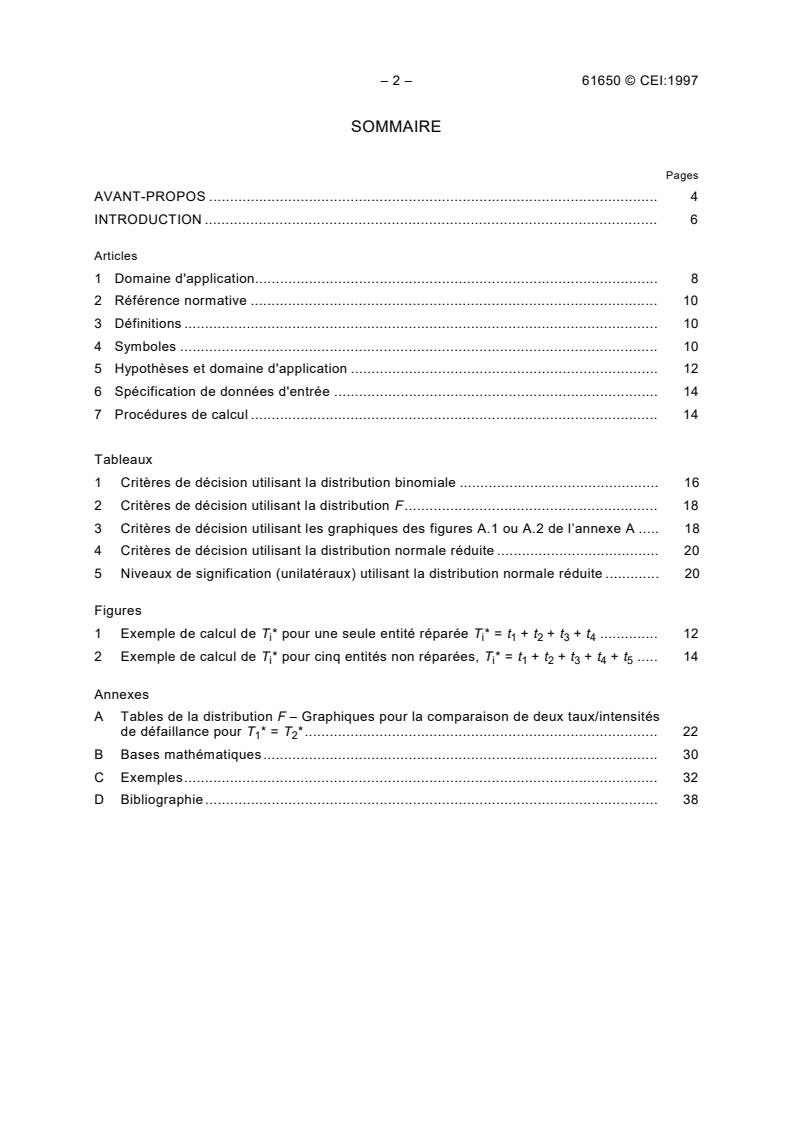
– 2 – 61650 © CEI:1997
SOMMAIRE
Pages
AVANT-PROPOS . 4
INTRODUCTION . 6
Articles
1 Domaine d'application. 8
2 Référence normative . 10
3 Définitions . 10
4 Symboles . 10
5 Hypothèses et domaine d'application . 12
6 Spécification de données d'entrée . 14
7 Procédures de calcul . 14
Tableaux
1 Critères de décision utilisant la distribution binomiale . 16
2 Critères de décision utilisant la distribution F . 18
3 Critères de décision utilisant les graphiques des figures A.1 ou A.2 de l’annexe A . 18
4 Critères de décision utilisant la distribution normale réduite . 20
5 Niveaux de signification (unilatéraux) utilisant la distribution normale réduite . 20
Figures
1 Exemple de calcul de T * pour une seule entité réparée T * = t + t + t + t . 12
i i 1 2 3 4
2 Exemple de calcul de T * pour cinq entités non réparées, T * = t + t + t + t + t . 14
i i 1 2 3 4 5
Annexes
A Tables de la distribution F – Graphiques pour la comparaison de deux taux/intensités
de défaillance pour T * = T *. 22
1 2
B Bases mathématiques. 30
C Exemples. 32
D Bibliographie. 38
61650 © IEC:1997 – 3 –
CONTENTS
Page
FOREWORD . 5
INTRODUCTION . 7
Clause
1 Scope. 9
2 Normative reference . 11
3 Definitions . 11
4 Symbols .11
5 Assumptions and area of application. 13
6 Specification of input data. 15
7 Calculation procedures . 15
Tables
1 Decision criteria using the binomial distribution. 17
2 Decision criteria using the F distribution . 19
3 Decision criteria using the graphs, figures A.1 or A.2 in annex A. 19
4 Decision criteria using the standard normal distribution. 21
5 Significance levels (one-sided) using the standard normal distribution . 21
Figures
1 Example of calculation of T * for one repaired item, T * = t + t + t + t . 13
i i 1 2 3 4
2 Example of calculation of T * for five non-repaired items, T * = t + t + t + t + t . 15
i i 1 2 3 4 5
Annexes
A Tables of the F distribution – Graphs for comparison of two failure
rates/intensities for
T * = T * . 23
1 2
B Mathematical background . 31
C Examples. 33
D Bibliography. 39
– 4 – 61650 © CEI:1997
COMMISSION ÉLECTROTECHNIQUE INTERNATIONALE
___________
TECHNIQUES D'ANALYSE DES DONNÉES DE FIABILITÉ –
Procédures pour la comparaison de deux taux de défaillance constants
et de deux intensités de défaillance (événements) constantes
AVANT-PROPOS
1) La CEI (Commission Electrotechnique Internationale) est une organisation mondiale de normalisation composée
de l'ensemble des comités électrotechniques nationaux (Comités nationaux de la CEI). La CEI a pour objet de
favoriser la coopération internationale pour toutes les questions de normalisation dans les domaines de
l'électricité et de l'électronique. A cet effet, la CEI, entre autres activités, publie des Normes Internationales.
Leur élaboration est confiée à des comités d'études, aux travaux desquels tout Comité national intéressé par le
sujet traité peut participer. Les organisations internationales, gouvernementales et non gouvernementales, en
liaison avec la CEI, participent également aux travaux. La CEI collabore étroitement avec l'Organisation
Internationale de Normalisation (ISO), selon des conditions fixées par accord entre les deux organisations.
2) Les décisions ou accords officiels de la CEI concernant les questions techniques, représentent, dans la mesure
du possible un accord international sur les sujets étudiés, étant donné que les Comités nationaux intéressés
sont représentés dans chaque comité d’études.
3) Les documents produits se présentent sous la forme de recommandations internationales. Ils sont publiés
comme normes, rapports techniques ou guides et agréés comme tels par les Comités nationaux.
4) Dans le but d'encourager l'unification internationale, les Comités nationaux de la CEI s'engagent à appliquer de
façon transparente, dans toute la mesure possible, les Normes internationales de la CEI dans leurs normes
nationales et régionales. Toute divergence entre la norme CEI et la norme nationale ou régionale
correspondante doit être indiquée en termes clairs dans cette dernière.
5) La CEI n’a fixé aucune procédure concernant le marquage comme indication d’approbation et sa responsabilité
n’est pas engagée quand un matériel est déclaré conforme à l’une de ses normes.
6) L’attention est attirée sur le fait que certains des éléments de la présente Norme internationale peuvent faire
l’objet de droits de propriété intellectuelle ou de droits analogues. La CEI ne saurait être tenue pour
responsable de ne pas avoir identifié de tels droits de propriété et de ne pas avoir signalé leur existence.
La Norme internationale CEI 61650 a été établie par le comité d'études 56 de la CEI: Sûreté de
fonctionnement.
Le texte de cette norme est issu des documents suivants:
FDIS Rapport de vote
56/533/FDIS 56/580/RVD
Le rapport de vote indiqué dans le tableau ci-dessus donne toute information sur le vote ayant
abouti à l'approbation de cette norme.
L'annexe A fait partie intégrante de cette norme.
Les annexes B, C et D sont données uniquement à titre d'information.
61650 © IEC:1997 – 5 –
INTERNATIONAL ELECTROTECHNICAL COMMISSION
___________
RELIABILITY DATA ANALYSIS TECHNIQUES –
Procedures for comparison of two constant failure rates
and two constant failure (event) intensities
FOREWORD
1) The IEC (International Electrotechnical Commission) is a worldwide organization for standardization comprising
all national electrotechnical committees (IEC National Committees). The object of the IEC is to promote
international co-operation on all questions concerning standardization in the electrical and electronic fields. To
this end and in addition to other activities, the IEC publishes International Standards. Their preparation is
entrusted to technical committees; any IEC National Committee interested in the subject dealt with may
participate in this preparatory work. International, governmental and non-governmental organizations liaising
with the IEC also participate in this preparation. The IEC collaborates closely with the International Organization
for Standardization (ISO) in accordance with conditions determined by agreement between the two
organizations.
2) The formal decisions or agreements of the IEC on technical matters express, as nearly as possible, an
international consensus of opinion on the relevant subjects since each technical committee has representation
from all interested National Committees.
3) The documents produced have the form of recommendations for international use and are published in the form
of standards, technical reports or guides and they are accepted by the National Committees in that sense.
4) In order to promote international unification, IEC National Committees undertake to apply IEC International
Standards transparently to the maximum extent possible in their national and regional standards. Any
divergence between the IEC Standard and the corresponding national or regional standard shall be clearly
indicated in the latter.
5) The IEC provides no marking procedure to indicate its approval and cannot be rendered responsible for any
equipment declared to be in conformity with one of its standards.
6) Attention is drawn to the possibility that some of the elements of this International Standard may be the subject
of patent rights. The IEC shall not be held responsible for identifying any or all such patent rights.
International Standard IEC 61650 has been prepared by technical committee 56: Dependability.
The text of this standard is based on the following documents:
FDIS Report on voting
56/533/FDIS 56/580/RVD
Full information on the voting for the approval of this standard can be found in the report on
voting indicated in the above table.
Annex A forms an integral part of this standard.
Annexes B, C and D are for information only.
– 6 – 61650 © CEI:1997
INTRODUCTION
Il est souvent nécessaire de comparer les caractéristiques de fiabilité des systèmes et des
composants lorsqu'il existe des raisons techniques ou autres de croire qu'elles puissent être
différentes. Par exemple, il pourrait être nécessaire de comparer la fiabilité des entités
produites par le même fabricant au cours de différentes périodes de temps, ou d'entités
produites par différents fabricants.
Le taux de défaillance et l'intensité de défaillance sont souvent utilisés comme mesures de la
fiabilité. La présente norme décrit les procédures destinées à la comparaison de deux séries
d'observations du taux de défaillance constant/de l'intensité constante de défaillance. Des
exemples pratiques simples sont fournis pour illustrer la façon suivant laquelle ces procédures
peuvent être appliquées.
61650 © IEC:1997 – 7 –
INTRODUCTION
It is often necessary to compare the reliability characteristics of systems and components when
there are technical or other reasons to believe that they might be different. For example, it
might be necessary to compare the reliability of items produced by the same manufacturer over
different periods of time, or of items produced by different manufacturers.
Failure rate and failure intensity are often used as reliability measures. This standard describes
procedures for comparing two sets of observations of constant failure rate/constant failure
intensity. Simple practical examples are provided to illustrate how the procedures can be
applied.
– 8 – 61650 © CEI:1997
TECHNIQUES D'ANALYSE DES DONNÉES DE FIABILITÉ –
Procédures pour la comparaison de deux taux de défaillance constants
et de deux intensités de défaillance (événements) constantes
1 Domaine d'application
La présente Norme internationale spécifie les procédures destinées à comparer deux obser-
vations différentes faites sur
– des taux de défaillance;
– des intensités de défaillance;
– des taux/intensités d'événements particuliers.
Les procédures sont utilisées pour déterminer si une différence apparente entre les deux
ensembles d'observations peut être considérée comme statistiquement significative.
On suppose que les intervalles de temps avant/entre défaillances (événements) sont indé-
pendants et distribués exponentiellement et identiquement pendant la période d'observation
(c'est-à-dire la durée cumulée d'essai correspondante).
NOTE – Cette supposition implique que le taux/l'intensité de défaillance est constant(e).
On suppose en outre qu'il existe des raisons techniques ou autres de croire qu'une différence
(soit une amélioration, soit une détérioration) pourrait exister entre la caractéristique de fiabilité
observée des deux séries d'entités comparées. Quelques exemples d'application types sont
décrits en 5.4.
Les méthodes sont conçues comme des tests d'hypothèse qui affirment, avec un risque
spécifié (le niveau de signification), si les deux séries d'observations appartiennent à la même
population ou au même processus, c'est-à-dire s'ils ont la même valeur moyenne vraie.
NOTE – Le taux de défaillance qui est applicable aux entités non réparées est associé à une distribution des
durées de fonctionnement avant défaillance. L'intensité de défaillance, qui est applicable aux entités réparées
uniquement, est associée à un procédé qui permet la description d'une séquence d'événements, par exemple
les temps entre défaillances sur un axe des temps.
Les procédures ne sont pas limitées à la comparaison de l'intensité/du taux de défaillance,
mais peuvent être appliquées aux observations de deux séries quelconques d'événements
particuliers à condition que les hypothèses ci-dessus soient valables.
NOTE – Les deux séries d'observations peuvent concerner les entités provenant de la même population ou de
la même entité dans des conditions différentes (par exemple environnement et charge) ou des séries
d'événements simplement comparables (par exemples accidents de voiture sur une route).
Des méthodes numériques et une procédure graphique sont prescrites. Il n'est pas nécessaire
que les périodes d'observation applicables aux deux séries soient égales, mais si elles le sont,
les méthodes sont très simples.
61650 © IEC:1997 – 9 –
RELIABILITY DATA ANALYSIS TECHNIQUES –
Procedures for comparison of two constant failure rates
and two constant failure (event) intensities
1 Scope
This International Standard specifies procedures to compare two observed
– failure rates;
– failure intensities;
– rates/intensities of relevant events.
The procedures are used to determine whether an apparent difference between the two sets of
observations can be considered statistically significant.
It is assumed that the time intervals to/between the failures (events) are independent and
identically exponentially distributed during the observation period (that is, the accumulated
relevant test time).
NOTE – This assumption implies that the failure rate/intensity is constant.
It is furthermore assumed that there are technical or other reasons to believe that a difference
(either an improvement or deterioration) might exist between the observed reliability
characteristic of the two sets of items under comparison. Some examples of typical
applications are described in 5.4.
The methods are designed as hypothesis tests which state, with a specified risk (the
significance level), whether the two series of observations belong to the same population or the
same process, that is they have the same true mean value.
NOTE – Failure rate, which is relevant to non-repaired items, is associated with a distribution of times to failure.
Failure intensity, which is relevant to repaired items only, is associated with a point process describing a se-
quence of events, for example times between failures on a time axis.
The procedures are not restricted to comparison of failure rate/intensity, but can be applied to
observations of two series of any relevant events, provided the above assumptions are valid.
NOTE – The two series of observations may be of items from the same population, or the same item under
different conditions (for example environment and load), or just comparable series of events (for example car
accidents on a road).
Numerical methods and a graphical procedure are prescribed. The observation periods
relevant to the two series do not need to be equal, but if they are, the methods are very simple.
– 10 – 61650 © CEI:1997
2 Référence normative
Le document normatif suivant contient des dispositions qui, par suite de la référence qui y est
faite, constituent des dispositions valables pour la présente Norme internationale. Au moment
de la publication, l’édition indiquée était en vigueur. Tout document normatif est sujet à révision
et les parties prenantes aux accords fondés sur la présente Norme internationale sont invitées
à rechercher la possibilité d'appliquer l’édition la plus récente du document normatif indiqué ci-
après. Les membres de la CEI et de l'ISO possèdent le registre des Normes internationales en
vigueur.
CEI 60050(191): 1990, Vocabulaire Electrotechnique International (VEI) – Chapitre 191: Sûreté
de fonctionnement et qualité de service
3 Définitions
Pour les besoins de la présente Norme internationale, les termes et définitions de la
CEI 60050(191) sont applicables.
4 Symboles
4.1 Liste des symboles
α niveau de signification calculé
α niveau de signification donné
λ taux de défaillance pour la série i
i
Φ(u) fonction de répartition de la loi normale Φ(u ) = α
α
i
1 ou 2, désignation pour les séries d'observations
f statistique lorsqu'on utilise la distribution F
f valeur critique pour un niveau de signification donné utilisant la distribution F
c
ν α ν ν ν ν
F (ν , ) fractile (1- ) de la distribution F( , ) avec degrés de liberté et
1-α 1 2 1 2 1 2
*
* *
p rapport, p = T / TT+
()
1 1 2
r nombre total de défaillances, r = r + r
1 2
r nombre de défaillances à prendre en compte pour la série i
i
T * durée d'essai cumulée à prendre en compte pour la série i
i
u statistique lorsqu'on utilise la distribution normale
u fractile α de la fonction de répartition de la loi normale
α
u valeur critique pour un niveau de signification donné utilisant la distribution normale
c
w taux/intensité de défaillance vrai (voir 4.2)
NOTE – w est généralement inconnu.
$w estimation ponctuelle pour le taux/l'intensité de défaillance pour la série i, $w = r /T
i i
i i
z intensité de défaillance vraie pour la série i
i
61650 © IEC:1997 – 11 –
2 Normative reference
The following normative document contains provisions which, through reference in this text,
constitute provisions of this International Standard. At the time of publication, the edition
indicated was valid. All normative documents are subject to revision, and parties to agreements
based on this International Standard are encouraged to investigate the possibility of applying
the most recent edition of the normative document indicated below. Members of IEC and ISO
maintain registers of currently valid International Standards.
IEC 60050(191): 1990, International Electrotechnical Vocabulary (IEV) – Chapter 191:
Dependability and quality of service
3 Definitions
For the purposes of this International Standard, the terms and definitions of IEC 60050(191)
apply.
4 Symbols
4.1 List of symbols
α calculated significance level
α given significance level
λ true failure rate for series i
i
Φ(u) the cumulative standard normal distribution, Φ(u ) = α
α
i 1 or 2, designation for the observation series
f statistic when using the F distribution
f critical value for a given significance level using the F distribution
c
F (ν ,ν ) the (1-α) fractile of the F(ν ,ν ) distribution with ν and ν degrees of freedom
1-α 1 2
1 2 1 2
* * *
TT+
p ratio, p = T / ()
1 1 2
r total number of failures, r = r + r
1 2
r number of failures relevant to series i
i
T * accumulated relevant test time for series i
i
u statistic when using the standard normal distribution
u the α fractile of the cumulative standard normal distribution
α
u critical value for a given significance level using the standard normal distribution
c
w true failure rate/intensity (see 4.2)
NOTE – w is generally unknown.
$w point estimate for failure rate/intensity for series i, $w = r /T
i i i i
z true failure intensity for series i
i
– 12 – 61650 © CEI:1997
4.2 Transformation des symboles
Etant donné que les procédures dans la présente Norme internationale sont applicables à des
mesures différentes de la fiabilité, le symbole générique w est utilisé pour le taux/l'intensité de
défaillance.
D'où, pour:
– le taux de défaillance w = λ;
– l'intensité de défaillance w = z.
5 Hypothèses et domaine d'application
5.1 Hypothèses
Les essais sont basés sur l'hypothèse que les intervalles de temps avant/entre défaillances
sont distribués exponentiellement, indépendamment et identiquement pendant la période
d'observation (durée d'essai cumulée). Cette hypothèse implique un taux constant de
défaillance et une intensité constante de défaillance, respectivement.
Etant donné que l'on suppose qu'il existe des raisons techniques ou autres pour croire qu'une
différence (soit une amélioration, soit une détérioration) pourrait exister entre les caracté-
ristiques de fiabilité observées des deux ensembles d'entités ou d'observations comparées, les
procédures d'essai unilatérales indiquées sont valables.
5.2 Entités réparées
Les procédures sont applicables pour comparer les observations d'intensité de défaillance
(déduites des entitées réparées), à condition qu'à l'intérieur de chaque période, les hypothèses
suivantes soient vraies:
– la durée d'essai cumulée applicable est calculée comme temps de fonctionnement
écoulé (à l'exclusion des temps de réparation et autres temps d'indisponibilité) (voir figure
1);
– les entités réparées peuvent être considérées "comme neuves".
IEC 954/97
Figure 1 – Exemple de calcul de T * pour une seule entité réparée T * = t + t + t + t
i i 1 2 3 4
5.3 Entités non réparées
Les procédures sont applicables pour comparer les observations du taux de défaillance
déduites des entités non réparées, à condition qu'à l'intérieur de chaque période les
hypothèses suivantes soient vraies:
– la durée d'essai cumulée applicable est calculée comme étant la somme des durées de
fonctionnement av
...