


IEC TS 62672-1:2013
(Main)Reliability and availability evaluation of HVDC systems - Part 1: HVDC systems with line commutated converters
General Information
- Abstract
IEC/TS 62672-1:2013(E) applies to all line-commutated high-voltage direct current (HVDC) transmission systems used for power exchange in utility systems. HVDC stations with voltage sourced converters (VSC) are not covered. The purpose of this part of IEC 62672 is to define a standardized reporting protocol so that data collected from different HVDC transmission systems can be compared on an equitable basis. It covers point-to-point transmission systems, back-to-back interconnections and multi-terminal transmission systems. For point-to-point systems and back-to-back interconnections, i.e. two-terminal systems, statistics are to be reported based on the total transmission capability from the sending end to the receiving end measured at a given point. If, however, the two terminals are operated by different users/owners, or are composed of equipment of different vintage or of equipment from different suppliers, statistics can be reported on an individual station basis if so desired by those responsible for reporting. In such a case, the outage should only be reported under the originating converter station taking care not to report the same event twice. For distributed multi-terminal systems, i.e. systems with more than two terminals, statistics are to be reported separately for each converter station based on its own individual capability.
- Status
- Replaced
- Publication Date
- 03-Nov-2013
- Technical Committee
- TC 115 - High Voltage Direct Current (HVDC) transmission for DC voltages above 100 kV
- Drafting Committee
- WG 2 - TC 115/WG 2
- Current Stage
- DELPUB - Deleted Publication
- Start Date
- 26-Sep-2018
- Completion Date
- 30-Jun-2017
Relations
- Effective Date
- 05-Sep-2023
Get Certified
Connect with accredited certification bodies for this standard

IMQ S.p.A. (Certification)
Italian electrical product certification.

SLG Prüf- und Zertifizierungs GmbH
German testing and certification body.

UL Solutions
Global safety science company with testing, inspection and certification.
Sponsored listings
Frequently Asked Questions
IEC TS 62672-1:2013 is a technical specification published by the International Electrotechnical Commission (IEC). Its full title is "Reliability and availability evaluation of HVDC systems - Part 1: HVDC systems with line commutated converters". This standard covers: IEC/TS 62672-1:2013(E) applies to all line-commutated high-voltage direct current (HVDC) transmission systems used for power exchange in utility systems. HVDC stations with voltage sourced converters (VSC) are not covered. The purpose of this part of IEC 62672 is to define a standardized reporting protocol so that data collected from different HVDC transmission systems can be compared on an equitable basis. It covers point-to-point transmission systems, back-to-back interconnections and multi-terminal transmission systems. For point-to-point systems and back-to-back interconnections, i.e. two-terminal systems, statistics are to be reported based on the total transmission capability from the sending end to the receiving end measured at a given point. If, however, the two terminals are operated by different users/owners, or are composed of equipment of different vintage or of equipment from different suppliers, statistics can be reported on an individual station basis if so desired by those responsible for reporting. In such a case, the outage should only be reported under the originating converter station taking care not to report the same event twice. For distributed multi-terminal systems, i.e. systems with more than two terminals, statistics are to be reported separately for each converter station based on its own individual capability.
IEC/TS 62672-1:2013(E) applies to all line-commutated high-voltage direct current (HVDC) transmission systems used for power exchange in utility systems. HVDC stations with voltage sourced converters (VSC) are not covered. The purpose of this part of IEC 62672 is to define a standardized reporting protocol so that data collected from different HVDC transmission systems can be compared on an equitable basis. It covers point-to-point transmission systems, back-to-back interconnections and multi-terminal transmission systems. For point-to-point systems and back-to-back interconnections, i.e. two-terminal systems, statistics are to be reported based on the total transmission capability from the sending end to the receiving end measured at a given point. If, however, the two terminals are operated by different users/owners, or are composed of equipment of different vintage or of equipment from different suppliers, statistics can be reported on an individual station basis if so desired by those responsible for reporting. In such a case, the outage should only be reported under the originating converter station taking care not to report the same event twice. For distributed multi-terminal systems, i.e. systems with more than two terminals, statistics are to be reported separately for each converter station based on its own individual capability.
IEC TS 62672-1:2013 is classified under the following ICS (International Classification for Standards) categories: 29.240.01 - Power transmission and distribution networks in general. The ICS classification helps identify the subject area and facilitates finding related standards.
IEC TS 62672-1:2013 has the following relationships with other standards: It is inter standard links to IEC TR 62672:2018. Understanding these relationships helps ensure you are using the most current and applicable version of the standard.
IEC TS 62672-1:2013 is available in PDF format for immediate download after purchase. The document can be added to your cart and obtained through the secure checkout process. Digital delivery ensures instant access to the complete standard document.
Standards Content (Sample)
IEC/TS 62672-1 ®
Edition 1.0 2013-11
TECHNICAL
SPECIFICATION
Reliability and availability evaluation of HVDC systems –
Part 1: HVDC systems with line commutated converters
IEC/TS 62672-1:2013(E)
All rights reserved. Unless otherwise specified, no part of this publication may be reproduced or utilized in any form
or by any means, electronic or mechanical, including photocopying and microfilm, without permission in writing from
either IEC or IEC's member National Committee in the country of the requester.
If you have any questions about IEC copyright or have an enquiry about obtaining additional rights to this publication,
please contact the address below or your local IEC member National Committee for further information.
IEC Central Office Tel.: +41 22 919 02 11
3, rue de Varembé Fax: +41 22 919 03 00
CH-1211 Geneva 20 info@iec.ch
Switzerland www.iec.ch
About the IEC
The International Electrotechnical Commission (IEC) is the leading global organization that prepares and publishes
International Standards for all electrical, electronic and related technologies.
About IEC publications
The technical content of IEC publications is kept under constant review by the IEC. Please make sure that you have the
latest edition, a corrigenda or an amendment might have been published.
Useful links:
IEC publications search - www.iec.ch/searchpub Electropedia - www.electropedia.org
The advanced search enables you to find IEC publications The world's leading online dictionary of electronic and
by a variety of criteria (reference number, text, technical electrical terms containing more than 30 000 terms and
committee,…). definitions in English and French, with equivalent terms in
It also gives information on projects, replaced and additional languages. Also known as the International
withdrawn publications. Electrotechnical Vocabulary (IEV) on-line.
IEC Just Published - webstore.iec.ch/justpublished Customer Service Centre - webstore.iec.ch/csc
Stay up to date on all new IEC publications. Just Published If you wish to give us your feedback on this publication
details all new publications released. Available on-line and or need further assistance, please contact the
also once a month by email. Customer Service Centre: csc@iec.ch.
IEC/TS 62672-1 ®
Edition 1.0 2013-11
TECHNICAL
SPECIFICATION
Reliability and availability evaluation of HVDC systems –
Part 1: HVDC systems with line commutated converters
INTERNATIONAL
ELECTROTECHNICAL
COMMISSION
PRICE CODE
X
ICS 29.240.01 ISBN 978-2-8322-1182-3
– 2 – TS 62672-1 IEC:2013(E)
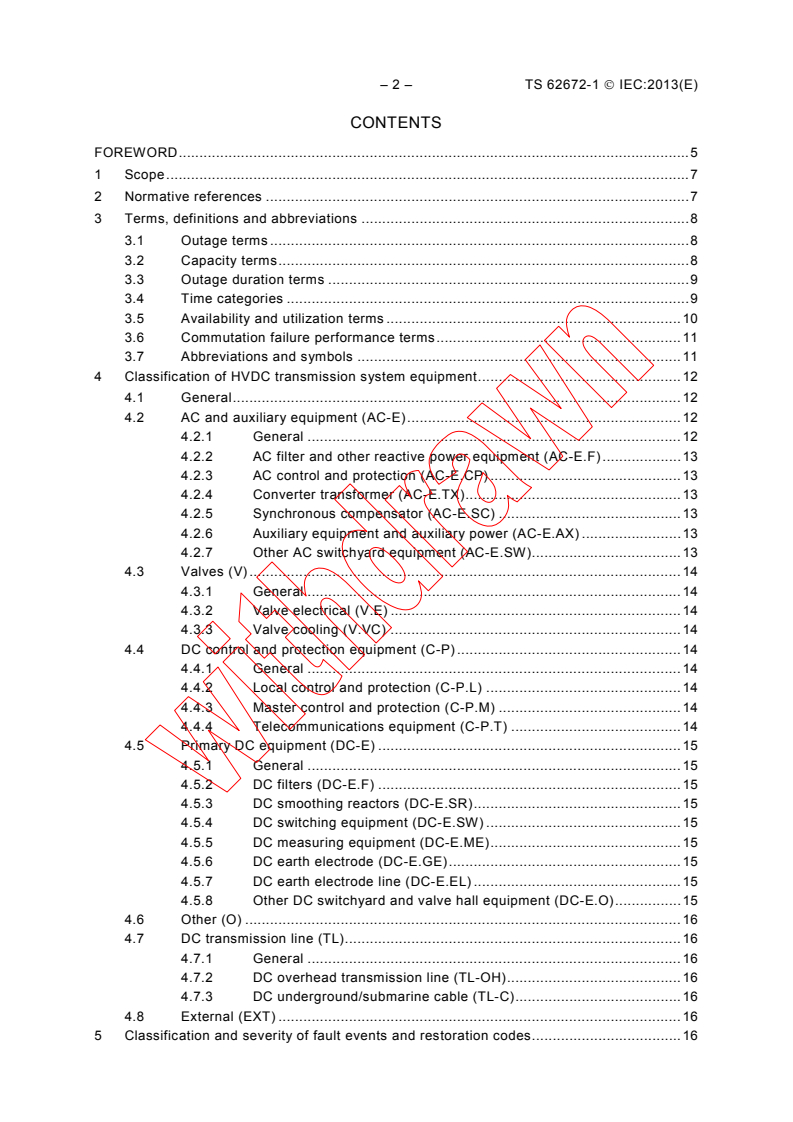
CONTENTS
FOREWORD . 5
1 Scope . 7
2 Normative references . 7
3 Terms, definitions and abbreviations . 8
3.1 Outage terms . 8
3.2 Capacity terms . 8
3.3 Outage duration terms . 9
3.4 Time categories . 9
3.5 Availability and utilization terms . 10
3.6 Commutation failure performance terms . 11
3.7 Abbreviations and symbols . 11
4 Classification of HVDC transmission system equipment . 12
4.1 General . 12
4.2 AC and auxiliary equipment (AC-E) . 12
4.2.1 General . 12
4.2.2 AC filter and other reactive power equipment (AC-E.F) . 13
4.2.3 AC control and protection (AC-E.CP) . 13
4.2.4 Converter transformer (AC-E.TX) . 13
4.2.5 Synchronous compensator (AC-E.SC) . 13
4.2.6 Auxiliary equipment and auxiliary power (AC-E.AX) . 13
4.2.7 Other AC switchyard equipment (AC-E.SW) . 13
4.3 Valves (V) . 14
4.3.1 General . 14
4.3.2 Valve electrical (V.E) . 14
4.3.3 Valve cooling (V.VC) . 14
4.4 DC control and protection equipment (C-P) . 14
4.4.1 General . 14
4.4.2 Local control and protection (C-P.L) . 14
4.4.3 Master control and protection (C-P.M) . 14
4.4.4 Telecommunications equipment (C-P.T) . 14
4.5 Primary DC equipment (DC-E) . 15
4.5.1 General . 15
4.5.2 DC filters (DC-E.F) . 15
4.5.3 DC smoothing reactors (DC-E.SR) . 15
4.5.4 DC switching equipment (DC-E.SW) . 15
4.5.5 DC measuring equipment (DC-E.ME) . 15
4.5.6 DC earth electrode (DC-E.GE) . 15
4.5.7 DC earth electrode line (DC-E.EL) . 15
4.5.8 Other DC switchyard and valve hall equipment (DC-E.O) . 15
4.6 Other (O) . 16
4.7 DC transmission line (TL) . 16
4.7.1 General . 16
4.7.2 DC overhead transmission line (TL-OH) . 16
4.7.3 DC underground/submarine cable (TL-C) . 16
4.8 External (EXT) . 16
5 Classification and severity of fault events and restoration codes . 16
TS 62672-1 IEC:2013(E) – 3 –
5.1 Classification of fault events . 16
5.2 Severity codes . 17
5.3 Restoration codes . 18
6 Instructions for compilation of report . 18
6.1 General . 18
6.2 General instructions . 18
6.3 Instructions for Table 2 and Table 3 . 19
6.3.1 Section 1 . 19
6.3.2 Section 2 . 19
6.3.3 Sections 3, 4 and 5 . 19
6.3.4 Section 6 . 20
6.3.5 Section 7 . 20
6.4 Instructions for Table 4 and Table 5 . 23
6.4.1 Forced outages – Table 4 . 23
6.4.2 Scheduled outages – Table 5 . 23
6.5 Instructions for Table 6 . 25
6.6 Instructions for Table 7 . 26
6.7 Instructions for Table 8 . 26
6.8 Instructions for Table 9 . 27
7 Interpretation and evaluation of reports . 28
7.1 Calculation of outage duration . 28
7.2 External events . 28
7.3 Protective operation . 28
7.4 Performance of special controls . 28
Annex A (informative) Outage log form and examples . 30
A.1 Example of an outage log . 30
A.2 Examples of application of rule f) of 6.3 scheduled outage during a forced
outage . 32
A.2.1 Case 1: Scheduled outage does not increase ODF or extends
outage duration . 32
A.2.2 Case 2: Scheduled outage increases ODF . 33
A.3 Examples of application of rule g) of 6.3 second outage during an outage . 34
A.3.1 Case 1: Second outage does not increase ODF or extends
outage duration . 34
A.3.2 Case 2: Second outage extends duration . 35
A.3.3 Case 3: Second outage with variable ODF . 36
Annex B (informative) Sample annual report . 37
Bibliography . 43
Figure A.1 – Scheduled outage does not increase ODF or extends outage duration . 32
Figure A.2 – Scheduled outage increases ODF . 33
Figure A.3 – Second outage does not increase ODF or extends outage duration . 34
Figure A.4 – Second outage extends duration . 35
Figure A.5 – Second outage with variable ODF . 36
Table 1 – Classification of fault events . 17
Table 2 – DC system performance for back-to-back systems and for two terminal
systems reporting jointly (corresponding to Table 1 of Cigré TB 346:2008) . 21
– 4 – TS 62672-1 IEC:2013(E)
Table 3 – DC system performance for multi-terminal systems and for stations reporting
separately as part of two-terminal systems (corresponding to Table 1 M/S of Cigré TB
346:2008) . 22
Table 4 – Forced outages HVDC substation (corresponding to Table 2FS of Cigré TB
346:2008) . 24
Table 5 – Scheduled outages HVDC substation (corresponding to Table 2 SS of Cigré
TB 346:2008) . 24
Table 6 – HVDC overhead line protection operations (corresponding to Table 3 of
Cigré TB 346:2008). 25
Table 7 – AC system faults and commutation failure starts (back-to-back, two terminal
or multi-terminal systems) (corresponding to Table 4 of Cigré TB 346:2008) . 26
Table 8 – Converter unit hours and semiconductor devices failed (corresponding to
Table 5 of Cigré TB 346:2008) . 27
Table 9 – Forced outage summary (corresponding to Table 6 of Cigré TB 346:2008) . 29
Table A.1 – Example of an outage log. 30
Table B.1 – DC system performance for two terminal systems reporting jointly . 37
Table B.2 – Forced outages HVDC substation . 38
Table B.3 – Scheduled outages HVDC substation . 39
Table B.4 – HVDC overhead line protection operations . 40
Table B.5 – AC system faults and commutation failure starts . 40
Table B.6 – Converter unit hours and semiconductor devices failed . 41
Table B.7 – Forced outage summary . 42
TS 62672-1 IEC:2013(E) – 5 –
INTERNATIONAL ELECTROTECHNICAL COMMISSION
____________
RELIABILITY AND AVAILABILITY EVALUATION OF HVDC SYSTEMS –
Part 1: HVDC systems with line commutated converters
FOREWORD
1) The International Electrotechnical Commission (IEC) is a worldwide organization for standardization comprising
all national electrotechnical committees (IEC National Committees). The object of IEC is to promote
international co-operation on all questions concerning standardization in the electrical and electronic fields. To
this end and in addition to other activities, IEC publishes International Standards, Technical Specifications,
Technical Reports, Publicly Available Specifications (PAS) and Guides (hereafter referred to as “IEC
Publication(s)”). Their preparation is entrusted to technical committees; any IEC National Committee interested
in the subject dealt with may participate in this preparatory work. International, governmental and non-
governmental organizations liaising with the IEC also participate in this preparation. IEC collaborates closely
with the International Organization for Standardization (ISO) in accordance with conditions determined by
agreement between the two organizations.
2) The formal decisions or agreements of IEC on technical matters express, as nearly as possible, an international
consensus of opinion on the relevant subjects since each technical committee has representation from all
interested IEC National Committees.
3) IEC Publications have the form of recommendations for international use and are accepted by IEC National
Committees in that sense. While all reasonable efforts are made to ensure that the technical content of IEC
Publications is accurate, IEC cannot be held responsible for the way in which they are used or for any
misinterpretation by any end user.
4) In order to promote international uniformity, IEC National Committees undertake to apply IEC Publications
transparently to the maximum extent possible in their national and regional publications. Any divergence
between any IEC Publication and the corresponding national or regional publication shall be clearly indicated in
the latter.
5) IEC itself does not provide any attestation of conformity. Independent certification bodies provide conformity
assessment services and, in some areas, access to IEC marks of conformity. IEC is not responsible for any
services carried out by independent certification bodies.
6) All users should ensure that they have the latest edition of this publication.
7) No liability shall attach to IEC or its directors, employees, servants or agents including individual experts and
members of its technical committees and IEC National Committees for any personal injury, property damage or
other damage of any nature whatsoever, whether direct or indirect, or for costs (including legal fees) and
expenses arising out of the publication, use of, or reliance upon, this IEC Publication or any other IEC
Publications.
8) Attention is drawn to the Normative references cited in this publication. Use of the referenced publications is
indispensable for the correct application of this publication.
9) Attention is drawn to the possibility that some of the elements of this IEC Publication may be the subject of
patent rights. IEC shall not be held responsible for identifying any or all such patent rights.
The main task of IEC technical committees is to prepare International Standards. In
exceptional circumstances, a technical committee may propose the publication of a technical
specification when
• the required support cannot be obtained for the publication of an International Standard,
despite repeated efforts, or
• the subject is still under technical development or where, for any other reason, there is the
future but no immediate possibility of an agreement on an International Standard.
Technical specifications are subject to review within three years of publication to decide
whether they can be transformed into International Standards.
IEC/TS 62672-1, which is a technical specification, has been prepared by IEC technical
committee 115: High voltage direct current (HVDC) transmission for DC voltages above
100 kV.
– 6 – TS 62672-1 IEC:2013(E)
The text of this technical specification is based on the following documents:
Enquiry draft Report on voting
115/68/DTS 115/75/RVC
Full information on the voting for the approval of this technical specification can be found in
the report on voting indicated in the above table.
This publication has been drafted in accordance with the ISO/IEC Directives, Part 2.
Annexes A and B are for information only.
A list of all parts in the IEC 62672 series, published under the general title Reliability and
availability evaluation of HVDC systems, can be found on the IEC website.
The committee has decided that the contents of this publication will remain unchanged until
the stability date indicated on the IEC web site under "http://webstore.iec.ch" in the data
related to the specific publication. At this date, the publication will be
• transformed into an International standard,
• reconfirmed,
• withdrawn,
• replaced by a revised edition, or
• amended.
A bilingual version of this publication may be issued at a later date.
TS 62672-1 IEC:2013(E) – 7 –
RELIABILITY AND AVAILABILITY EVALUATION OF HVDC SYSTEMS –
Part 1: HVDC systems with line commutated converters
1 Scope
This part of IEC 62672 applies to all line-commutated high-voltage direct current (HVDC)
transmission systems used for power exchange in utility systems. HVDC stations with voltage
sourced converters (VSC) are not covered.
In order to assess the operational performance of HVDC transmission systems, reliability and
availability need to be evaluated. For this purpose the HVDC users/owners are encouraged to
compile reports on an annual basis based on the recommendations given in this Technical
Specification. The purpose of this part of IEC 62672 is to define a standardized reporting
protocol so that data collected from different HVDC transmission systems can be compared
on an equitable basis. It is recommended that such reports are sent to Cigré SC B4, “HVDC
and Power Electronics” (http://b4.cigre.org) who collects such data and publishes a survey of
HVDC systems throughout the world on a bi-annual basis.
This part of IEC 62672 covers point-to-point transmission systems, back-to-back
interconnections and multi-terminal transmission systems. For point-to-point systems and
back-to-back interconnections, i.e. two-terminal systems, statistics are to be reported based
on the total transmission capability from the sending end to the receiving end measured at a
given point. If, however, the two terminals are operated by different users/owners, or are
composed of equipment of different vintage or of equipment from different suppliers, statistics
can be reported on an individual station basis if so desired by those responsible for reporting.
In such a case, the outage should only be reported under the originating converter station
taking care not to report the same event twice. For distributed multi-terminal systems, i.e.
systems with more than two terminals, statistics are to be reported separately for each
converter station based on its own individual capability.
Multi-terminal systems, incorporating parallel converters but having only two converter
stations on the d.c. line, can be considered as either point-to-point systems or as multi-
terminal systems for purpose of reporting. Therefore, statistics for this special type of multi-
terminal system can be reported based on either total transmission capability or on individual
station capability. If the converters at one station use different technology, converter station
statistics can be reported separately for each different type of capacity if desired. Multiple
bipoles are also to be reported individually. Special mention should be given in the text and in
the tabulations to any common events resulting in bipolar outages.
NOTE Usually the agreement between the purchaser and the turnkey suppliers of the HVDC converter station
includes specific requirements regarding contractual evaluation. Such specific requirements will govern over this
Technical Specification.
2 Normative references
The following documents, in whole or in part, are normatively referenced in this document and
are indispensable for its application. For dated references, only the edition cited applies. For
undated references, the latest edition of the referenced document (including any
amendments) applies.
IEC 60633:1998, Terminology for high-voltage direct current (HVDC) transmission
Amendment 1:2009
– 8 – TS 62672-1 IEC:2013(E)
3 Terms, definitions and abbreviations
For the purpose of this document, the following terms and definitions apply.
3.1 Outage terms
3.1.1
outage
state in which the HVDC system is unavailable for operation at its rated continuous capacity
due to an event directly related to the converter station equipment or d.c. transmission line
Note 1 to entry: Failure of equipment not needed for power transmission shall not be considered as an outage for
purposes of this evaluation. AC system related outages will be recorded but not included in HVDC system reliability
calculations.
Note 2 to entry: For purposes of this evaluation, outages taken for major reconfiguration or upgrading, such as
addition of converters, shall not be reported.
3.1.2
scheduled outage
outage, which is either planned or which can be deferred until a suitable time
Note 1 to entry: Scheduled outages can be planned well in advance, primarily for preventive maintenance
purposes such as annual maintenance program. During such planned maintenance outage, it is usual to work on
several different equipment or systems concurrently. It is not necessary to allocate such outage time to individual
equipment categories. Only the elapsed time should be reported in Table 5 as “PM”.
Note 2 to entry: Classified under the scheduled outage category are also outages for work which could be
postponed until a suitable time (usually night or weekend) but cannot be postponed until the next planned outage.
Equipment category code in Table 5 should be used to identify the affected equipment. This includes discretionary
outages based on operating policies, user/owner’s preference and maintenance of redundant equipment.
Note 3 to entry: If the scheduled outage is extended due to additional work which would otherwise have
necessitated a forced outage, the excess period is to be counted as a forced outage.
3.1.3
forced outage
state in which equipment is unavailable for normal operation but is not in the scheduled
outage state
3.1.3.1
trips
sudden interruption in transmission by automatic protective action or manual emergency
shutdown
3.1.3.2
other forced outages
other unexpected HVDC equipment problems that force immediate reduction in capacity of
HVDC converter stations or system but do not cause or require a trip
Note 1 to entry: Also in this category are outages caused by start-up or de-block delays caused by HVDC
equipment.
Note 2 to entry: In some cases the opportunity exists during forced outages to perform some of the repairs or
maintenance that would otherwise be performed during the next scheduled outage. See 6.3, rule (f).
3.2 Capacity terms
3.2.1
rated capacity
P
m
maximum capacity (MW), excluding the added capacity available through means of redundant
equipment, for which continuous operation under designed conditions is possible
TS 62672-1 IEC:2013(E) – 9 –
Note 1 to entry: For two-terminal systems reporting jointly, the rated capacity is referred to a particular point in
the system, usually at one or the other converter station. For multi-terminal systems or two-terminal systems
reporting separately, the rated capacity refers to the rating of the individual converter station.
Note 2 to entry: When the maximum continuous capacity varies according to seasonal conditions, the highest
value can be used as the capacity for the purpose of reports prepared according to this Specification for reason of
simplicity. However this excludes over-load capability such as available during low – ambient temperature.
3.2.2
outage capacity
P
o
capacity reduction (MW) which the outage would have caused if the system were operating at
its rated capacity (P ) at the time of the outage
m
Note 1 to entry: The outage capacity is referred to the same point in the system used for defining P .
m
3.2.3
outage derating factor
ODF
ratio of outage capacity to rated capacity
ODF = P / P
o m
3.3 Outage duration terms
3.3.1
actual outage duration
AOD
time elapsed in decimal hours between the start and the end of an outage
Note 1 to entry: The start of an outage is typically the first switching action related to the outage. The end of an
outage is typically the last switching action related to return of the equipment to operational readiness.
Note 2 to entry: In some contractual evaluations between Purchaser and Supplier, AOD can be subjected to
correction to adjust for long waiting times, administrative delays, non-availability of tools and tackles, non-
availability of spare parts or other needed resources including trained man power, delay in permits etc.
3.3.2
equivalent outage duration
EOD
actual outage duration (AOD) in decimal hours, multiplied by the outage derating factor
(ODF), so as to take account of partial loss of capacity
EOD = AOD × ODF
Note 1 to entry: Each equivalent outage duration (EOD) may be classified according to the type of outage
involved: equivalent forced outage duration (EFOD) and equivalent scheduled outage duration (ESOD).
3.4 Time categories
3.4.1
period hours
PH
number of calendar hours in the reporting period
Note 1 to entry: In a full calendar year the period hours are 8760, or 8784 in leap years.
Note 2 to entry: If the equipment is commissioned part way through a year, the period hours will be
proportionately less.
3.4.2
actual outage hours
AOH
sum of actual outage durations within the reporting period
– 10 – TS 62672-1 IEC:2013(E)
AOH = Σ AOD
Note 1 to entry: The actual outage hour (AOH) may be classified according to the type of outage involved: actual
forced outage hours (AFOH) and, actual scheduled outage hours (ASOH).
AFOH = Σ AFOD
ASOH = Σ ASOD
3.4.3
equivalent outage hours
EOH
sum of equivalent outage durations within the reporting period
EOH = Σ EOD
Note 1 to entry: The equivalent outage hours (EOH) may be classified according to the type of outage involved:
equivalent forced outage hours (EFOH) and equivalent scheduled outage hours (ESOH).
EFOH = Σ EFOD
ESOH = Σ ESOD
3.5 Availability and utilization terms
3.5.1
energy unavailability
EU
measure of the energy which could not have been transmitted due to outages
Note 1 to entry: The energy unavailability is calculated based on the same point in the system used for defining
Pm.
Note 2 to entry: The energy unavailability (EU) may be classified according to the type of outage involved: forced
energy unavailability (FEU) and scheduled energy unavailability (SEU).
EU (%)
= (EOH / PH) × 100
FEU (%)
= (EFOH / PH) × 100
SEU (%)
= (ESOH / PH) × 100
Note 3 to entry: SEU covers both scheduled energy unavailability due to planned outage (SEUP) as well
scheduled energy unavailability due to deferred outage (SEUD).
3.5.2
energy availability
EA
measure of the energy which could have been transmitted except for limitations of capacity
due to outages
Note 1 to entry: The energy availability is calculated based on the same point in the system used for defining P .
m
EA = 100 – EU (%)
3.5.3
energy utilization
U
factor giving a measure of the energy actually transmitted over the system.
Note 1 to entry: The energy utilization is calculated based on the same point in the system used for defining P .
m
E
total
U= × 100 %
P ⋅ P
m h
TS 62672-1 IEC:2013(E) – 11 –
Where
E is the total energy transmitted (MWh);
total
P is the rated capacity (MW);
m
P is the period hours (h).
h
Note 2 to entry: The total energy transmitted is the sum of energy exported and energy imported (expressed in
MWh), both referred to the point at which P is defined.
m
3.6 Commutation failure performance terms
3.6.1
recordable a.c. system fault
a.c. system fault which causes one or more of the inverter a.c. bus phase voltages, referred to
the terminals of the harmonic filter, to drop immediately following the fault initiation below
90 % of the voltage prior to the fault
Note 1 to entry: AC system faults at, or near, the rectifier are not relevant in this context and are not required to
be included in this reporting. An exception to this rule is a special case where the network topology dictates that an
a.c. fault near the rectifier also produces a simultaneous recordable fault at the inverter or where specific converter
configuration (e.g. no smoothing reactor) is susceptible to a commutation failure in rectifier operation.
3.6.2
commutation failure start
CFS(A)
initiation or onset of commutation failure(s) in any valve group immediately following the
occurrence of an a.c. system fault, regardless of whether or not the a.c. fault is “recordable”
as defined in 3.6.1
Note 1 to entry: Commutation failures as a result of control problems or switching events are not to be included.
3.6.3
commutation failure start
CFS(B)
initiation or onset of commutation failure(s) in any valve group as a result of control problems,
switching events or other causes, but excluding those initiated by a.c. system faults under
3.6.2 above.
3.7 Abbreviations and symbols
For the purpose of this document, the following abbreviations apply.
AC (a.c.) alternating current
AFOH actual forced outage hours
AOD actual outage duration
AOH actual outage hours
ASOH actual scheduled outage hours
CFS commutation failure start
CT current transformer
DC (d.c.) direct current
DMR dedicated metallic return (conductor)
EA energy availability
EFOD equivalent forced outage duration
EFOH equivalent forced outage hours
EOD equivalent outage duration
EOH equivalent outage hours
– 12 – TS 62672-1 IEC:2013(E)
ESOD equivalent scheduled outage duration
ESOH equivalent schedules outage hours
EU energy unavailability
FEU forced energy unavailability
HVDC high voltage direct current
PH period hours
PLC power line carrier
P rated capacity
m
P outage capacity
o
ODF outage derating factor
RAM reliability, availability, maintainability
RI radio interference
SEU scheduled energy unavailability
SEUD scheduled energy unavailability deferred
SEUP scheduled energy unavailability planned
STATCOM static compensator
SVC static var compensator
U (energy) utilisation
4 Classification of HVDC transmission system equipment
4.1 General
For the purpose of reporting the cause of capacity reduction or converter outages, converter
station equipment is classified into major categories. Failure of equipment resulting in an
outage or loss of converter capacity shall be charged to the category to which the failed
equipment belongs. The outage may be forced as a direct consequence of the failure or miss-
operation, or the outage may be scheduled due to maintenance requirements. Only scheduled
outages classified as deferred are categorized according to the equipment type.
The major categories are listed in the following subclauses and are as follows:
a) AC and auxiliary equipment (AC-E): 4.2
b) Valves (V): 4.3
c) DC control and protection equipment (C-P): 4.4
d) Primary DC equipment (DC-E): 4.5
e) Other (O): 4.6
f) DC transmission line (TL): 4.7
g) External (EXT): 4.8.
The above major categories are further divided into subcategories.
4.2 AC and auxiliary equipment (AC-E)
4.2.1 General
This major category covers all a.c. main circuit equipment at the converter station. This
includes everything from the incoming a.c. connection to the external connecting clamp on the
valve winding bushing of the converter transformer. This category also covers low voltage
auxiliary power, valve cooling equipment (including pumps, fans, electrical auxiliaries etc. but
TS 62672-1 IEC:2013(E) – 13 –
excluding parts at high potential integral within valve, see 4.3.3) and a.c. control and
protection.
NOTE This category does not apply to capacity outages resulting from events in the a.c. network external to the
converter station.
The "AC and auxiliary equipment" category is divided into six subcategories described in 4.2.2
to 4.2.7.
4.2.2 AC filter and other reactive power equipment (AC-E.F)
Loss of converter station capacity due to failure of a.c. filters (passive and/or active) or other
reactive power compensation equipment shall be assigned to this subcategory. The types of
components included in this subcategory are capacitors, reactors, resistors, CTs and
arresters comprised within the a.c. filtering or reactive power compensation equipment of the
converter station.
NOTE Associated disconnectors/breakers, etc. with filters/reactive compensated equipment are excluded from
this subcategory, as those are included in 4.2.7.
AC PLC/RI filters, SVCs, series capacitors (including those between converter transformers
and valves), STATCOM, etc. when included in a converter station shall also be reported under
this subcategory.
4.2.3 AC control and protection (AC-E.CP)
Loss of converter station capacity due to failure of a.c. protections, a.c. controls, or a.c.
current and voltage measuring devices shall be assigned to this subcategory. AC protections
or control could be for the main circuit equipment, for the auxiliary power equipment or for the
valve cooling equipment.
NOTE CTs with a.c. filters, CTs on transformer bushings are not reported in this subcategory.
4.2.4 Converter transformer (AC-E.TX)
Loss of converter station capacity due to failure of a converter transformer shall be assigned
to this subcategory. Any equipment integral with the converter transformer such as tap
changers, bushings, bushing CTs or transformer cooling equipment is included in this
subcategory.
4.2.5 Synchronous compensator (AC-E.SC)
Loss of converter station capacity due to failure of a synchronous compensator shall be
charged to this subcategory. Anything integral or directly related to the synchronous machine
such as its cooling system or exciter is included in this subcategory.
4.2.6 Auxiliary equipment and auxiliary power (AC-E.AX)
Loss of converter station capacity due to failure or miss-operation of any auxiliary equipment
shall be assigned to this subcategory. Such equipment includes auxiliary transformers,
pumps, battery chargers, heat exchangers, cooling system process instrumentation, low
voltage switchgear, motor control centres, fire protection and civil works.
4.2.7 Other AC switchyard equipment (AC-E.SW)
Loss of converter station capacity due to failure of circuit breakers, disconnected switches or
earthing switches in the a.c. switchyard (including for a.c. filtering and reactive power
compensation) shall be assigned to this subcategory. Also included are other a.c. switchyard
equipment such as a.c. surge arresters, bus-work or insulators.
– 14 – TS 62672-1 IEC:2013(E)
4.3 Valves (V)
4.3.1 General
This major category covers all parts of the thyristor valve itself. The valve is the complete
operative array forming an arm, or part of an arm of the converter bridge. It includes all
auxiliaries and components integral with the valve and forming part of the operative array.
The "valves" category is divided into two subcategories described in 4.3.2 and 4.3.3.
4.3.2 Valve electrical (V.E)
Loss of converter station capacity due to any failure of the valve except for those related to
the part of the valve cooling system integral with the valve shall be assigned to this
subcategory.
4.3.3 Valve cooling (V.VC)
Loss of converter station capacity due to any failure of the valve, related to the valve cooling
system at high potential integral with the valve, shall be assigned to this subcategory.
4.4 DC control and protection equipment (C-P)
4.4.1 General
This major category covers the equipment used for control of the overall HVDC system and
for the control, monitoring and protection of each HVDC substation excluding control and
protection of a conventional type which is included in 4.2.3. This also excludes the a.c.
measuring transducers which are included in 4.2.3 as well as d.c. measuring transducers
which are included in 4.5.5.
NOTE The equipment provided for the coding of control and indication information to be sent over a
telecommunication circuit and the circuit itself is included. Devices such as disconnectors, circuit-breakers and
transformer tap changers which can actually perform the control or protection action are excluded from this
subcategory.
The "DC control and protection equipment" category is divided into three subcategories
described in 4.4.2 to 4.4.4.
4.4.2 Local control and protection (C-P.L)
Loss of converter station capacity due to any failure of the control, protection or monitoring
equipment of the local HVDC station shall be assigned to this subcategory. Examples would
include failures of the converter firing control, current and voltage regulators, converter and
d.c. yard protections, valve control and protection, and local station control sequences.
4.4.3 Master control and protection (C-P.M)
Loss of converter station capacity due to any failure of the master control equipment shall be
assigned to this subcategory. The master control equipment usually includes bipolar control,
inter-station coordination of current and voltage orders, inter-station sequences, auxiliary
controls such as damping controls or higher level controls such as run-back/run-up, power
control or frequency control.
4.4.4 Telecommunications equipment (C-P.T)
Loss of converter station capacity due to any failure of the equipment provided for the coding
of control and indication information to be sent over a telecommunication circuit as well as the
telecommunication circuit itself, for example, optical communication or microwave or PLC ,
shall be assigned to this subcategory.
TS 62672-1 IEC:2013(E) – 15 –
NOTE The earth wire itself, when optical fibre is integrated with such wire, is included in 4.7.
4.5 Primary DC equipment (DC-E)
4.5.1 General
This major category covers all equipment at the HVDC substations except for that in the three
categories "a.c. and auxiliary equipment" which includes converter transformers, "valves" and
"d.c. control and protection equipment".
The "Primary DC equipment" category is divided into seven subcategories presented in 4.5.2
to 4.5.8.
4.5.2 DC filters (DC-E.F)
Loss of converter station capacity due to failure of shunt/series d.c. filters (active and/or
passive) or d.c.-side PLC/RI filters shall be assigned to this subcategory. Types of
components included in this subcategory are capacitors, reactors, resistors, CTs and
arresters, etc. which comprise the d.c. filtering of the converter station.
4.5.3 DC smoothing reactors (DC-E.SR)
Loss of converter station capacity due to failure of the d.c. smoothing reactors shall be
assigned to this subcategory.
4.5.4 DC switching equipment (DC-E.SW)
Loss of converter station capacity due to failure of any d.c. circuit breakers, d.c. commutating
switches, d.c. disconnect switches, isolating switches, by-pass switches or earthing switches
shall be assigned to this subcategory.
Components forming active/passive circuits for any commutating switch/breaker shall also be
included under this subcategory.
4.5.5 DC measuring equipment (DC-E.ME)
Loss of converter station capacity due to failure of the direct current and voltage measuring
devices shall be assigned to this subcategory.
4.5.6 DC earth electrode (DC-E.GE)
Loss of converter station capacity due to problems with or f
...