

IEC 62973-4:2021
(Main)Railway applications - Rolling stock - Batteries for auxiliary power supply systems - Part 4: Secondary sealed nickel-metal hydride batteries
General Information
- Abstract
IEC 62973-4:2021 applies to secondary sealed nickel-metal hydride battery technologies for auxiliary power supply systems used on rolling stock.
This document specifies the requirements of the characteristics and tests for the sealed nickel-metal hydride cells and supplements IEC 62973-1 which applies to any rolling stock types (e.g. light rail vehicles, tramways, streetcars, metros, commuter trains, regional trains, high speed trains, locomotives, etc.). Unless otherwise specified, the requirements of IEC 62973-1 apply. This document also specifies the requirements of the interface between the batteries and the battery chargers. This document is to be used in conjunction with IEC 62675, IEC 63115-1 and IEC 63115-2.
- Status
- Published
- Publication Date
- 20-Jan-2021
- Technical Committee
- TC 9 - Electrical equipment and systems for railways
- Drafting Committee
- PT 62973-4 - TC 9/PT 62973-4
- Current Stage
- PPUB - Publication issued
- Start Date
- 21-Jan-2021
- Completion Date
- 20-Jan-2021
Overview
IEC 62973-4:2021 is an international standard developed by the International Electrotechnical Commission (IEC) that specifies requirements for secondary sealed nickel-metal hydride (Ni-MH) batteries used as auxiliary power supply systems in railway rolling stock. This standard complements IEC 62973-1, which addresses battery requirements for all types of rolling stock, including trams, metros, commuter trains, and high-speed rail. Focusing on sealed Ni-MH battery technologies, IEC 62973-4 covers characteristics, environmental considerations, safety, mechanical design, electrical interfaces, and testing procedures essential for ensuring reliable and safe battery performance in railway applications.
Key Topics
Battery Technology Scope
IEC 62973-4 applies specifically to secondary sealed nickel-metal hydride batteries, which provide robust and efficient auxiliary power solutions for rolling stock systems.System Requirements
The standard defines system voltage, charging and discharging characteristics, charge retention (self-discharge), capacity sizing, and temperature compensation during charging to optimize battery reliability and lifespan.Safety and Protection
It highlights critical safety measures including protection against deep discharge, thermal management, and fire protection to guarantee operational safety and compliance with rolling stock requirements.Mechanical and Electrical Interfaces
The document specifies mechanical design parameters and standardized electrical interface requirements for battery modules and their integration with battery chargers, helping ensure compatibility and maintainability.Environmental and Storage Conditions
Specifications on environmental conditions for operation, storage, and transportation are included to maintain battery integrity across diverse railway service environments.Testing and Quality Assurance
IEC 62973-4 outlines comprehensive type and routine testing procedures such as electrical characteristic tests, dielectric tests, shock and vibration tests, and reliability assessments to ensure batteries meet performance and safety criteria.
Applications
Railway Rolling Stock Auxiliary Power
These Ni-MH batteries serve as reliable auxiliary power supplies for wide-ranging rolling stock types, including light rail vehicles, trams, commuter trains, locomotives, and high-speed trains.Backup Power Systems
The batteries ensure continuous auxiliary power for critical control, signaling, and communication systems, enhancing overall railway safety and operational stability.Energy Storage for Subsystems
Designed for seamless integration with onboard chargers and energy management systems, these batteries support power needs during train start-up, stationary periods, or unexpected power interruptions.
Related Standards
IEC 62973-1
Provides overarching requirements for batteries used in all rolling stock types, serving as the foundational standard aligned with IEC 62973-4 specifics.IEC 62675
Addresses the standardization of battery charger interfaces and functionality necessary for auxiliary power supply systems.IEC 63115-1 and IEC 63115-2
Cover additional aspects of battery system requirements and testing relevant to railway applications, supporting IEC 62973-4 implementation.
Keywords: IEC 62973-4, nickel-metal hydride batteries, railway auxiliary power, rolling stock batteries, sealed Ni-MH batteries, railway battery standards, battery charging systems, battery testing railway, IEC railway standards, battery safety in trains.
Get Certified
Connect with accredited certification bodies for this standard

IRIS Certification (UNIFE)
International Railway Industry Standard certification.

TÜV SÜD Rail GmbH
TÜV SÜD railway certification services.

Bureau Veritas Railway Certification
Railway and transportation certification.
Sponsored listings
Frequently Asked Questions
IEC 62973-4:2021 is a standard published by the International Electrotechnical Commission (IEC). Its full title is "Railway applications - Rolling stock - Batteries for auxiliary power supply systems - Part 4: Secondary sealed nickel-metal hydride batteries". This standard covers: IEC 62973-4:2021 applies to secondary sealed nickel-metal hydride battery technologies for auxiliary power supply systems used on rolling stock. This document specifies the requirements of the characteristics and tests for the sealed nickel-metal hydride cells and supplements IEC 62973-1 which applies to any rolling stock types (e.g. light rail vehicles, tramways, streetcars, metros, commuter trains, regional trains, high speed trains, locomotives, etc.). Unless otherwise specified, the requirements of IEC 62973-1 apply. This document also specifies the requirements of the interface between the batteries and the battery chargers. This document is to be used in conjunction with IEC 62675, IEC 63115-1 and IEC 63115-2.
IEC 62973-4:2021 applies to secondary sealed nickel-metal hydride battery technologies for auxiliary power supply systems used on rolling stock. This document specifies the requirements of the characteristics and tests for the sealed nickel-metal hydride cells and supplements IEC 62973-1 which applies to any rolling stock types (e.g. light rail vehicles, tramways, streetcars, metros, commuter trains, regional trains, high speed trains, locomotives, etc.). Unless otherwise specified, the requirements of IEC 62973-1 apply. This document also specifies the requirements of the interface between the batteries and the battery chargers. This document is to be used in conjunction with IEC 62675, IEC 63115-1 and IEC 63115-2.
IEC 62973-4:2021 is classified under the following ICS (International Classification for Standards) categories: 45.060.01 - Railway rolling stock in general. The ICS classification helps identify the subject area and facilitates finding related standards.
IEC 62973-4:2021 is available in PDF format for immediate download after purchase. The document can be added to your cart and obtained through the secure checkout process. Digital delivery ensures instant access to the complete standard document.
Standards Content (Sample)
IEC 62973-4 ®
Edition 1.0 2021-01
INTERNATIONAL
STANDARD
NORME
INTERNATIONALE
Railway applications – Rolling stock – Batteries for auxiliary power supply
systems –
Part 4: Secondary sealed nickel-metal hydride batteries
Applications ferroviaires – Materiel roulant –Batteries pour systemes
d'alimentation auxiliaire –
Partie 4: Batterie d'accumulateurs nickel-hydrure métallique étanche
All rights reserved. Unless otherwise specified, no part of this publication may be reproduced or utilized in any form
or by any means, electronic or mechanical, including photocopying and microfilm, without permission in writing from
either IEC or IEC's member National Committee in the country of the requester. If you have any questions about IEC
copyright or have an enquiry about obtaining additional rights to this publication, please contact the address below or
your local IEC member National Committee for further information.
Droits de reproduction réservés. Sauf indication contraire, aucune partie de cette publication ne peut être reproduite
ni utilisée sous quelque forme que ce soit et par aucun procédé, électronique ou mécanique, y compris la photocopie
et les microfilms, sans l'accord écrit de l'IEC ou du Comité national de l'IEC du pays du demandeur. Si vous avez des
questions sur le copyright de l'IEC ou si vous désirez obtenir des droits supplémentaires sur cette publication, utilisez
les coordonnées ci-après ou contactez le Comité national de l'IEC de votre pays de résidence.
IEC Central Office Tel.: +41 22 919 02 11
3, rue de Varembé info@iec.ch
CH-1211 Geneva 20 www.iec.ch
Switzerland
About the IEC
The International Electrotechnical Commission (IEC) is the leading global organization that prepares and publishes
International Standards for all electrical, electronic and related technologies.
About IEC publications
The technical content of IEC publications is kept under constant review by the IEC. Please make sure that you have the
latest edition, a corrigendum or an amendment might have been published.
IEC publications search - webstore.iec.ch/advsearchform IEC online collection - oc.iec.ch
The advanced search enables to find IEC publications by a Discover our powerful search engine and read freely all the
variety of criteria (reference number, text, technical publications previews. With a subscription you will always
committee, …). It also gives information on projects, replaced have access to up to date content tailored to your needs.
and withdrawn publications.
Electropedia - www.electropedia.org
IEC Just Published - webstore.iec.ch/justpublished
The world's leading online dictionary on electrotechnology,
Stay up to date on all new IEC publications. Just Published
containing more than 22 000 terminological entries in English
details all new publications released. Available online and
and French, with equivalent terms in 18 additional languages.
once a month by email.
Also known as the International Electrotechnical Vocabulary
(IEV) online.
IEC Customer Service Centre - webstore.iec.ch/csc
If you wish to give us your feedback on this publication or
need further assistance, please contact the Customer Service
Centre: sales@iec.ch.
A propos de l'IEC
La Commission Electrotechnique Internationale (IEC) est la première organisation mondiale qui élabore et publie des
Normes internationales pour tout ce qui a trait à l'électricité, à l'électronique et aux technologies apparentées.
A propos des publications IEC
Le contenu technique des publications IEC est constamment revu. Veuillez vous assurer que vous possédez l’édition la
plus récente, un corrigendum ou amendement peut avoir été publié.
Recherche de publications IEC - IEC online collection - oc.iec.ch
webstore.iec.ch/advsearchform Découvrez notre puissant moteur de recherche et consultez
La recherche avancée permet de trouver des publications IEC gratuitement tous les aperçus des publications. Avec un
en utilisant différents critères (numéro de référence, texte, abonnement, vous aurez toujours accès à un contenu à jour
comité d’études, …). Elle donne aussi des informations sur adapté à vos besoins.
les projets et les publications remplacées ou retirées.
Electropedia - www.electropedia.org
IEC Just Published - webstore.iec.ch/justpublished
Le premier dictionnaire d'électrotechnologie en ligne au
Restez informé sur les nouvelles publications IEC. Just
monde, avec plus de 22 000 articles terminologiques en
Published détaille les nouvelles publications parues.
anglais et en français, ainsi que les termes équivalents dans
Disponible en ligne et une fois par mois par email.
16 langues additionnelles. Egalement appelé Vocabulaire
Electrotechnique International (IEV) en ligne.
Service Clients - webstore.iec.ch/csc
Si vous désirez nous donner des commentaires sur cette
publication ou si vous avez des questions contactez-nous:
sales@iec.ch.
IEC 62973-4 ®
Edition 1.0 2021-01
INTERNATIONAL
STANDARD
NORME
INTERNATIONALE
Railway applications – Rolling stock – Batteries for auxiliary power supply
systems –
Part 4: Secondary sealed nickel-metal hydride batteries
Applications ferroviaires – Materiel roulant –Batteries pour systemes
d'alimentation auxiliaire –
Partie 4: Batterie d'accumulateurs nickel-hydrure métallique étanche
INTERNATIONAL
ELECTROTECHNICAL
COMMISSION
COMMISSION
ELECTROTECHNIQUE
INTERNATIONALE
ICS 45.060.01 ISBN 978-2-8322-9279-2
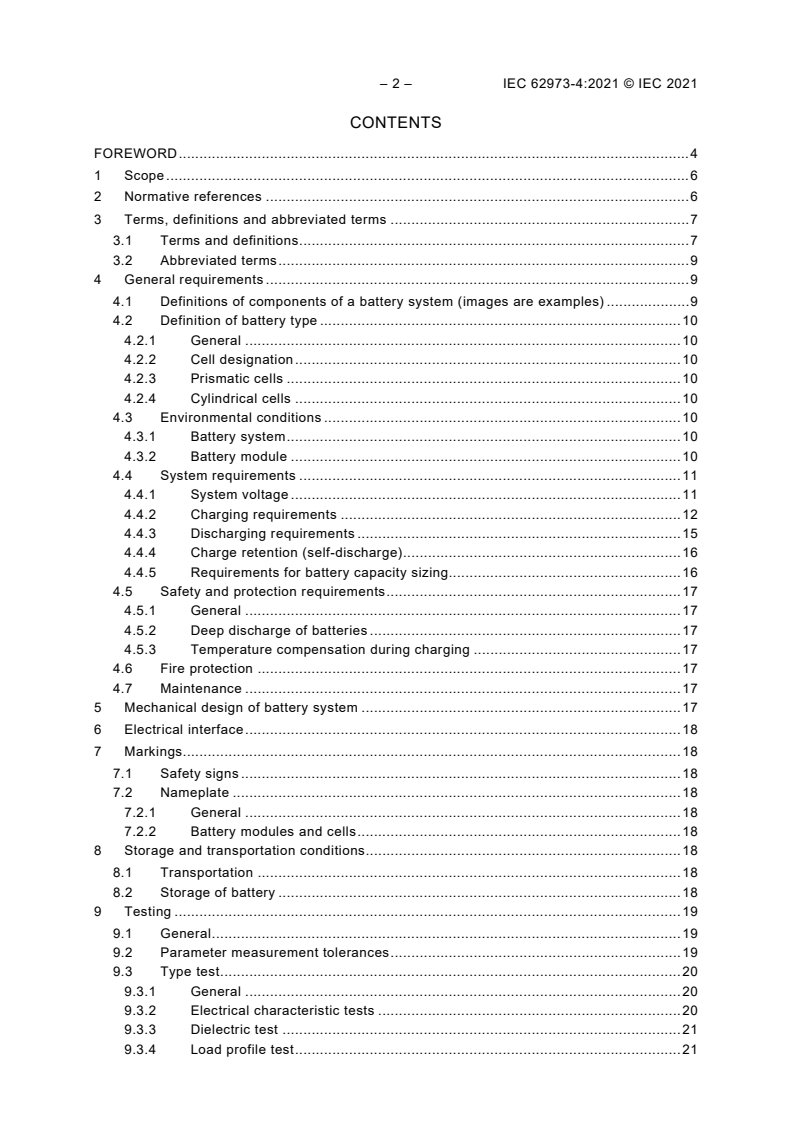
– 2 – IEC 62973-4:2021 © IEC 2021
CONTENTS
FOREWORD . 4
1 Scope . 6
2 Normative references . 6
3 Terms, definitions and abbreviated terms . 7
3.1 Terms and definitions . 7
3.2 Abbreviated terms . 9
4 General requirements . 9
4.1 Definitions of components of a battery system (images are examples) . 9
4.2 Definition of battery type . 10
4.2.1 General . 10
4.2.2 Cell designation . 10
4.2.3 Prismatic cells . 10
4.2.4 Cylindrical cells . 10
4.3 Environmental conditions . 10
4.3.1 Battery system . 10
4.3.2 Battery module . 10
4.4 System requirements . 11
4.4.1 System voltage . 11
4.4.2 Charging requirements . 12
4.4.3 Discharging requirements . 15
4.4.4 Charge retention (self-discharge) . 16
4.4.5 Requirements for battery capacity sizing. 16
4.5 Safety and protection requirements . 17
4.5.1 General . 17
4.5.2 Deep discharge of batteries . 17
4.5.3 Temperature compensation during charging . 17
4.6 Fire protection . 17
4.7 Maintenance . 17
5 Mechanical design of battery system . 17
6 Electrical interface . 18
7 Markings. 18
7.1 Safety signs . 18
7.2 Nameplate . 18
7.2.1 General . 18
7.2.2 Battery modules and cells . 18
8 Storage and transportation conditions . 18
8.1 Transportation . 18
8.2 Storage of battery . 18
9 Testing . 19
9.1 General . 19
9.2 Parameter measurement tolerances . 19
9.3 Type test . 20
9.3.1 General . 20
9.3.2 Electrical characteristic tests . 20
9.3.3 Dielectric test . 21
9.3.4 Load profile test . 21
9.3.5 Shock and vibration test . 21
9.3.6 Reliability test . 21
9.4 Routine test . 21
9.4.1 General . 21
9.4.2 Visual checks . 21
9.4.3 Dielectric test . 21
9.4.4 Measurement of open circuit voltage . 22
9.4.5 Measurement of Internal resistance . 22
Annex A (informative) Other configuration of the battery charging system . 23
A.1 General . 23
A.2 Charging requirements for the main charger . 23
A.3 Charging requirements for the additional charger . 24
A.3.1 General . 24
A.3.2 Temperature compensation during charging . 25
Annex B (informative) Declaration of cell model range representative of the testing . 26
B.1 Electrical performance declaration . 26
B.2 Shock and vibration declaration . 26
Bibliography . 27
Figure 1 –Definition of cell(s), battery module, crate, tray and battery box . 9
Figure 2 – Example of discharge curves at various constant discharge currents based
on percentage of capacity . 11
Figure 3 – Examples of Ni-MH charge curves. 12
Figure 4 – Example of interfaces between battery box and battery charging system. 13
Figure 5 – Typical charging characteristic of secondary sealed nickel-metal hydride
battery . 15
Figure A.1 – Example of interface with the additional charger in the battery box . 24
Figure A.2 – Examples of Ni-MH charge curves . 25
Table 1 – Requirements of the charging characteristics . 12
Table 2 – Typical Ni-MH battery charging characteristics . 14
Table 3 – Parameters and responsibility for battery capacity sizing . 16
Table 4 – Type test and routine test . 19
Table A.1 – Requirements of the charging characteristics for the main charger outside
the battery box with the additional charger in the battery box . 23
– 4 – IEC 62973-4:2021 © IEC 2021
INTERNATIONAL ELECTROTECHNICAL COMMISSION
____________
RAILWAY APPLICATIONS – ROLLING STOCK –
BATTERIES FOR AUXILIARY POWER SUPPLY SYSTEMS –
Part 4: Secondary sealed nickel-metal hydride batteries
FOREWORD
1) The International Electrotechnical Commission (IEC) is a worldwide organization for standardization comprising
all national electrotechnical committees (IEC National Committees). The object of IEC is to promote
international co-operation on all questions concerning standardization in the electrical and electronic fields. To
this end and in addition to other activities, IEC publishes International Standards, Technical Specifications,
Technical Reports, Publicly Available Specifications (PAS) and Guides (hereafter referred to as “IEC
Publication(s)”). Their preparation is entrusted to technical committees; any IEC National Committee interested
in the subject dealt with may participate in this preparatory work. International, governmental and non-
governmental organizations liaising with the IEC also participate in this preparation. IEC collaborates closely
with the International Organization for Standardization (ISO) in accordance with conditions determined by
agreement between the two organizations.
2) The formal decisions or agreements of IEC on technical matters express, as nearly as possible, an international
consensus of opinion on the relevant subjects since each technical committee has representation from all
interested IEC National Committees.
3) IEC Publications have the form of recommendations for international use and are accepted by IEC National
Committees in that sense. While all reasonable efforts are made to ensure that the technical content of IEC
Publications is accurate, IEC cannot be held responsible for the way in which they are used or for any
misinterpretation by any end user.
4) In order to promote international uniformity, IEC National Committees undertake to apply IEC Publications
transparently to the maximum extent possible in their national and regional publications. Any divergence
between any IEC Publication and the corresponding national or regional publication shall be clearly indicated in
the latter.
5) IEC itself does not provide any attestation of conformity. Independent certification bodies provide conformity
assessment services and, in some areas, access to IEC marks of conformity. IEC is not responsible for any
services carried out by independent certification bodies.
6) All users should ensure that they have the latest edition of this publication.
7) No liability shall attach to IEC or its directors, employees, servants or agents including individual experts and
members of its technical committees and IEC National Committees for any personal injury, property damage or
other damage of any nature whatsoever, whether direct or indirect, or for costs (including legal fees) and
expenses arising out of the publication, use of, or reliance upon, this IEC Publication or any other IEC
Publications.
8) Attention is drawn to the Normative references cited in this publication. Use of the referenced publications is
indispensable for the correct application of this publication.
9) Attention is drawn to the possibility that some of the elements of this IEC Publication may be the subject of
patent rights. IEC shall not be held responsible for identifying any or all such patent rights.
International Standard IEC 62973-4 has been prepared by IEC technical committee 9:
Electrical equipment and systems for railways.
The text of this International Standard is based on the following documents:
FDIS Report on voting
9/2638/FDIS 9/2665/RVD
Full information on the voting for the approval of this International Standard can be found in
the report on voting indicated in the above table.
This document has been drafted in accordance with the ISO/IEC Directives, Part 2.
This document is to be used in conjunction with IEC 62675, IEC 63115-1 and IEC 63115-2.
A list of all parts in the IEC 62973 series, published under the general title Railway
applications – Rolling stock – Batteries for auxiliary power supply systems, can be found on
the IEC website.
The committee has decided that the contents of this document will remain unchanged until the
stability date indicated on the IEC website under "http://webstore.iec.ch" in the data related to
the specific document. At this date, the document will be
• reconfirmed,
• withdrawn,
• replaced by a revised edition, or
• amended.
– 6 – IEC 62973-4:2021 © IEC 2021
RAILWAY APPLICATIONS – ROLLING STOCK –
BATTERIES FOR AUXILIARY POWER SUPPLY SYSTEMS –
Part 4: Secondary sealed nickel-metal hydride batteries
1 Scope
This part of IEC 62973 applies to secondary sealed nickel-metal hydride battery technologies
for auxiliary power supply systems used on rolling stock.
This document specifies the requirements of the characteristics and tests for the sealed
nickel-metal hydride cells and supplements IEC 62973-1 which applies to any rolling stock
types (e.g. light rail vehicles, tramways, streetcars, metros, commuter trains, regional trains,
high speed trains, locomotives, etc.). Unless otherwise specified, the requirements of
IEC 62973-1 apply.
This document also specifies the requirements of the interface between the batteries and the
battery chargers.
2 Normative references
The following documents are referred to in the text in such a way that some or all of their
content constitutes requirements of this document. For dated references, only the edition
cited applies. For undated references, the latest edition of the referenced document (including
any amendments) applies.
IEC 60051 (all parts), Direct acting indicating analogue electrical measuring instruments and
their accessories
IEC 60077-1, Railway applications – Electric equipment for rolling stock – Part 1: General
service conditions and general rules
IEC 62485-2, Safety requirements for secondary batteries and battery installations – Part 2:
Stationary batteries
IEC 62675, Secondary cells and batteries containing alkaline or other non-acid electrolytes –
Sealed nickel-metal hydride prismatic rechargeable single cells
IEC 62902:2019, Secondary cells and batteries – Marking symbols for identification of their
chemistry
IEC 62973-1:2018, Railway applications – Rolling stock – Batteries for auxiliary power supply
systems – Part 1: General requirements
IEC 63115-1:2020, Secondary cells and batteries containing alkaline or other non-acid
electrolytes – Sealed nickel-metal hydride cells and batteries for use in industrial applications
– Part 1: Performance
IEC 63115-2:2021, Secondary cells and batteries containing alkaline or other non-acid
electrolytes – Sealed nickel-metal hydride cells and batteries for use in industrial applications
– Part 2: Safety
3 Terms, definitions and abbreviated terms
3.1 Terms and definitions
ISO and IEC maintain terminological databases for use in standardization at the following
addresses:
• IEC Electropedia: available at http://www.electropedia.org/;
• ISO Online browsing platform: available at http://www.iso.org/obp.
NOTE All typical battery related descriptions are defined in IEC 60050-482.
3.1.1
nickel-metal hydride battery
Ni-MH battery
secondary battery with an electrolyte of aqueous potassium hydroxide, a positive electrode
containing nickel as nickel hydroxide and a negative electrode of hydrogen in the form of a
metal hydride
Note 1 to entry: Nickel-metal hydride battery contains assembly of sealed cells.
[SOURCE: IEC 60050-482:2004, 482-05-08, modified – Abbreviation and Note 1 to entry have
been added.]
3.1.2
cell
basic functional unit, consisting of an assembly of electrodes, electrolyte, container, terminals
and usually separators, that is a source of electric energy obtained by direct conversion of
chemical energy
Note 1 to entry: In this document cell means secondary sealed nickel-metal hydride cell,
[SOURCE: IEC 60050-482:2004, 482-01-01, modified – Note 1 to entry has been replaced.]
3.1.3
sealed cell
cell which remains closed and does not release either gas or liquid when operated within the
limits specified by the manufacturer
Note 1 to entry: A sealed cell may be equipped with a safety device to prevent a dangerously high internal
pressure and is designed to operate during its life in its original sealed state.
[SOURCE: IEC 60050-482:2004, 482-05-17]
3.1.4
secondary cell
cell which is designed to be electrically recharged
Note 1 to entry: The recharge is accomplished by way of a reversible chemical reaction.
[SOURCE: IEC 60050-482:2004, 482-01-03]
3.1.5
battery module
group of cells connected together either in series and/or parallel configuration with or without
protective devices (e.g. fuse or PTC) and monitoring circuitry
[SOURCE: IEC 62973-1:2018, 3.1.9, modified – “temperature sensor” has been replaced with
“PTC”.]
– 8 – IEC 62973-4:2021 © IEC 2021
3.1.6
rated capacity
C < at the 5 h rate >
capacity value of a battery determined under specified conditions and declared by the battery
manufacturer
Note 1 to entry: In this document, rated capacity is at the 5 h rate; C .
[SOURCE: IEC 60050-482:2004, 482-03-15, modified – Abbreviation and Note 1 to entry have
been added.]
3.1.7
state of charge
SOC
remaining capacity to be discharged, normally expressed as a percentage of the full battery
rated capacity as expressed in relevant standards
Note 1 to entry: Practical definitions of SOC are dependent upon chosen technologies.
[SOURCE: IEC 62973-1:2018, 3.1.6]
3.1.8
depth of discharge
DOD
capacity removed from a battery during discharge in relation to its full rated capacity
expressed as a percentage
Note 1 to entry: It is the complement of SOC.
Note 2 to entry: As one increases, the other decreases by the same amount.
Note 3 to entry: Practical definitions of DOD are dependent upon chosen technologies.
[SOURCE: IEC 62973-1:2018, 3.1.7]
3.1.9
end user
organization which operates the battery system
Note 1 to entry: The end user is normally an organization which operates the vehicle equipped with the battery
system, unless the responsibility is delegated to a main contractor or consultant.
[SOURCE: IEC 62973-1:2018, 3.1.11]
3.1.10
system integrator
organization which has the technical responsibility of the complete battery system and
charging system
Note 1 to entry: The system integrator can be the end user or the train manufacturer, or none of them.
[SOURCE: IEC 62973-1:2018, 3.1.12]
3.1.11
manufacturer,
organization which has the technical responsibility for its scope of supply
Note 1 to entry: The manufacturer can be the train builder or the system integrator of a battery system, a cell
manufacturer, etc. If necessary to explicitly distinguish, “train manufacturer”, “battery system manufacturer” or “cell
manufacturer” is expressed.
[SOURCE: IEC 62973-1:2018, 3.1.13]
3.2 Abbreviated terms
AC Alternating Current
C Capacity at the 5-h rate
DC Direct Current
DOD Depth of Discharge
LRU Line Replaceable Unit
Ni-MH battery Nickel-Metal Hydride battery
OCV Open Circuit Voltage
SOC State of Charge
4 General requirements
4.1 Definitions of components of a battery system (images are examples)
Figure 1 shows the definition of cell(s), battery module, crate, tray and battery box.
Figure 1 –Definition of cell(s), battery module, crate, tray and battery box
Some batteries may not include all of the above components, e.g. single cells may be
installed in a tray without crates.
– 10 – IEC 62973-4:2021 © IEC 2021
4.2 Definition of battery type
4.2.1 General
A battery consists of a number of cells or battery modules and/or assembled in trays, crates,
and then assembled in a battery box.
A cell consists of positive and negative plates, electrolyte, metal container and sealing cap.
Positive and negative terminals, which are apart by a separator, are housed and sealed in the
metal container with a sealing cap.
The sealing cap consists of a positive terminal, a pressure release valve and an insulator
which are insulated to a negative part that forms a container. The container wears an
insulating envelope.
The positive active material is nickel hydroxide, and the negative active material is hydrogen
absorbed nickel-alloy.
The electrodes are surrounded by electrolyte, an aqueous solution mainly of potassium
hydroxide (KOH), and distilled or deionized water. The electrolyte does not chemically change
or degrade due to charge/discharge cycles.
4.2.2 Cell designation
Sealed nickel-metal hydride cells shall be designated by a letter L, M, H or X which signifies:
– low rate of discharge (L);
– medium rate of discharge (M);
– high rate of discharge (H);
– very high rate of discharge (X).
NOTE These cells are typically but not exclusively used for the following discharge rates (see IEC 63115-1:2020):
L: up to and including 0,5 I A;
t
M: up to and including 3,5 I A;
t
H: up to and including 7,0 I A;
t
X: up to and above 7,0 I A.
t
These currents are expressed as multiples of I A, where I A = C Ah/1 h.
t t 5
4.2.3 Prismatic cells
Prismatic cell is the cell in the form of a rectangular parallelepiped.
4.2.4 Cylindrical cells
Cylindrical cell is the cell in the form of a cylinder. The overall height is equal to, or greater
than the overall diameter.
4.3 Environmental conditions
4.3.1 Battery system
Refer to IEC 62973-1:2018, 4.3.
4.3.2 Battery module
Ni-MH battery modules can operate at temperatures in the range of −20 °C to +45 °C.
Deviations may be agreed between the end user and/or system integrator and cell/battery
manufacturer.
4.4 System requirements
4.4.1 System voltage
The battery nominal voltages of Ni-MH is 1,2 V per cell.
The charging voltage for the Ni-MH battery is dependent on the number of cells and
temperature.
The optimized number of cells in a Ni-MH battery calculated by the battery manufacturer shall
allow operating between the minimum and maximum equipment operating voltage range
considering the operating conditions and battery load profile. Then the operational battery
charging voltage at 20 °C shall be set considering the calculated number of cells and
individual cell charging characteristics. Refer to IEC 62973-1:2018, 4.4.1.
The battery nominal voltages and the discharge voltages are different. As an example, the
following Figure 2 shows typical discharges of a Ni-MH cell at various constant discharging
currents that vary by battery discharge rate designation (e.g. L, M, and H as set out in 4.2.2
A, where I A = C Ah/1 h,
and IEC 63115-1). These currents are expressed as multiples of I
t t 5
(see IEC 63115-1 and IEC 61960-3).
Figure 2 – Example of discharge curves at various constant
discharge currents based on percentage of capacity
The following example, Figure 3 a) shows a typical charge of a Ni-MH cell at constant
charging current at 0,2 I A for initial phase followed by Figure 3 b) constant charging voltage
t
for the last phase depending on the Ni-MH battery technology.
Charging curves shall be available from battery manufacturers.
– 12 – IEC 62973-4:2021 © IEC 2021
a) Example of charging current rate curve b) Example of charging voltage curve
Figure 3 – Examples of Ni-MH charge curves
4.4.2 Charging requirements
The required battery charging voltage and the optimum charging method are specified
according to Table 1.
Table 1 – Requirements of the charging characteristics
Requirements Characteristics
Normal condition Float charge by battery charger with temperature compensation and
charging condition required by the battery manufacturer.
Charging method See 4.5.3
Steady state control tolerance of the ±1,5 % or lower tolerance
battery charge voltage output at the
charging system
Charging voltage ripple ≤ 5 % (according to IEC 60077-1 with disconnected battery)
Charging current ripple The battery charging current shall be DC, as any superimposed AC
component in the charging current can lead to a temperature increase of
the battery. The AC content in the charging current should not exceed
values as set out in IEC 62485-2.
Temperature compensation Required. In some case, in agreement between the end user and
manufacturer, the temperature compensation voltage control charging
may not be required.
Detection of temperature Signal from sensor on battery or battery compartment, detection inside
battery charging system.
NOTE DC ripple factor is calculated from the following formula:
U −U
max min
DC ripple factor = × 100
U +U
max min
where U and U are the maximum and minimum values, respectively, of the pulsating voltage.
max min
See IEC 60077-1.
Figure 4 shows a typical electrical schematic for an interface between the battery box and the
battery charging system.
Other configurations of the battery charging system may be available and the battery charging
system may be included in the battery box by agreement between the end user and/or the
integrator and the battery manufacturer. See Annex A.
Figure 4 – Example of interfaces between battery box and battery charging system
The interface system between the battery charging system and the battery box as shown in
Figure 4 consists of:
a) Battery voltage sensing and regulation; maximum ±1 % tolerance (see (1) in Figure 4);
b) Temperature data acquisition, (2a), including wiring (2b) to the sensor (3); typically, better
than ±2,5 K tolerance;
c) Temperature sensor (3): maximum tolerance ±2 K for the specified temperature range
preferably attached to the battery, minimum one sensor per battery system (see (3)); The
choice of the temperature sensor shall be agreed between the system integrator and the
suppliers of the battery and battery charging system;
d) Position of the temperature sensor (3) within the battery box (4);
e) Cabling between battery and battery charger; part of system integration in the rolling stock
(5).
The system integrator will check if and how the effect of the wiring needs to be compensated,
considering voltage drop in the power cables and resistance in the temperature sensor wires.
The impact of the sensor wiring depends on the type of temperature sensor, data acquisition
system and/or location of the voltage sensor. If there are significant influences, it is possible
to compensate these influences in the battery charger control system upon agreement
between the system integrator and the manufacturer of the battery charging system.
With the recommended temperature sensors, the influence of the wiring resistance on the
temperature acquisition can be neglected.
The charging voltage of the battery shall be limited to the maximum voltage at the equipment
in Table 1 of IEC 62973-1:2018. The temperature compensation voltage control should be
limited to these values considering the charging cell voltage values in Table 2 multiplied by
the number of cells in series for the battery.
The typical charging voltages per cell for most applications are shown in Table 2 with
temperature compensation voltage control. Higher or lower values, within the above limits,
can be selected depending on sizing and application parameters (e.g. a single level float
charge voltage of 1,40 V/cell without temperature compensation voltage control charging is
typical).
– 14 – IEC 62973-4:2021 © IEC 2021
In some cases, in agreement between the end user and manufacturer, the temperature
compensation voltage control charging may not be required. This information shall be agreed
upon prior to calculating the battery capacity required for a specific load profile. In such a
case, the battery temperature sensor may be omitted. It is the responsibility of the battery
manufacturer to calculate the additional battery capacity needed to consider the non-
temperature compensated charging regime. In case of extreme low temperature, a heater can
be added to limit the additional capacity needed. Then the activation temperature of heater
shall be agreed prior to battery capacity calculation.
Table 2 – Typical Ni-MH battery charging characteristics
Ni-MH batteries charging Float charging Boost charge at Remarks
characteristics voltage at 20 °C 20 °C
b b
Basic data for Charging voltage 1,40 V/cell 1,60 V/cell See points ① and
a
charging at 20 °C ② on Figure 5
Mandatory, NA 45 °C See point ③ on
change from Figure 5
boost to float
The switch point
charging
from boost to float
charge is based on
parameters such as
temperature, current
and/or time
−1 −1 c −1 −1 c
Temperature Typical case with −2 mVK cell −2 mVK cell See Figure 5
correction a single value
Switching set Mandatory stop Up to 70 °C maximum See point ④ on
points charging of
Figure 5
(all charge modes) battery
Standard, from NA The switch point from Current
boost to float boost to float charge measurement
charging is based on necessary as well as
parameters such as temperature and/or
temperature, current time
d
and/or time
Standard, from The switch point from NA Current
float to boost float to boost charge measurement
charging is based on necessary as well as
parameters such as temperature and/or
temperature, current time
d
and/or time
NOTE Point ⑤ in Figure 5 corresponds to the maximum charging voltage at the equipment as expressed in
Table 1 of IEC 62973-1:2018.
a
When single level charging is used, the boost charge voltage = the float charge voltage.
b
The values of the charging voltages for the different charge modes are indicative values. The manufacturer
may choose different values for reaching a certain state of charge depending on the Ni-MH technology.
Those values shall be clearly indicated in the cell documentation and available upon request from the cell
manufacturer. The voltage tolerance should be taken at maximum +/−1 %.
c −1 −1
A temperature compensation is necessary, a typical value is of −0,002 VK cell . In case the numerical
value shall be adjusted for some type of cells specified as CCCV, it shall be clearly indicated in the cell
manufacturer‘s documentation and in the approval documents. It is possible to have 3 values;
• one for temperatures lower than or equal to T , (T < 45 °C, e.g. T = 20 °C)
1 1 1
• one for temperature higher than T , and lower than or equal to 45 °C, and
• one for temperature higher than 45 °C.
d
The charging current can vary depending on the designed charging current value as indicated on the
documentation provided by the manufacturer for the cell.
Figure 5 – Typical charging characteristic of secondary
sealed nickel-metal hydride battery
4.4.3 Discharging requirements
4.4.3.1 General
Refer to IEC 62973-1:2018, 4.4.3.1.
The discharge conditions (current, temperature, final voltage) shall be declared by the battery
manufacturer.
4.4.3.2 Load profile
Refer to IEC 62973-1.
There is no special remark concerning the load profile for Ni-MH.
There are several types for Ni-MH depending on charging/discharging rate. Sizing of the
battery shall be designed considering cell characteristics of charging/ discharging based on
the load profile (see IEC 63115-1:2020).
4.4.3.3 Extended discharge time
The battery shall be able to withstand the extended discharge without permanent damage.
The extended discharge time should be defined by the end user and/or system integrator.
Battery shall be properly sized in order that extended discharge time does not lead to deep
discharge as in 4.5.2.
4.4.3.4 Low or high temperature performance
Discharge performance is characterized on minimum requirement at a low temperature as set
out in IEC 63115-1:2020, 7.3.3.
– 16 – IEC 62973-4:2021 © IEC 2021
This document specifies charging/discharging characteristics at extremely low and high
temperatures for auxiliary power supply systems used on rolling stock.
Details are defined in 9.3.2.2.
In case results of tests performed in the past are available at, or worse than, the requested
condition, these can be used without retesting by similarity between the battery system in
question and the one having been tested already.
4.4.4 Charge retention (self-discharge)
For the requirements of charge retention, refer to IEC 62973-1.
Self-discharge can lead to a fully discharged Ni-MH battery over an extended time. However,
this does not permanently damage the Ni-MH battery.
4.4.5 Requirements for battery capacity sizing
The Ni-MH battery manufacturer shall define the following parameters:
– SOC determined by the charging parameters (voltage, temperature compensation, number
of cells) and environmental conditions;
– ageing factor depending upon but not limited to the operating ambient temperature,
cycling at the corresponding DOD, maintenance, and required lifetime.
The requirements for battery capacity sizing are specified using the values set out in Table 3.
Table 3 – Parameters and responsibility for battery capacity sizing
Parameters needed for battery Responsibilities of parameters to Values
sizing be provided
Load profile cases each in W, Ω, A
Load profile (W, Ω, A) Provided by the system integrator
over a specified duration period
Low or high temperature for sizing As specified by the train High and low temperature in °C as
to the load profile (°C) manufacturer or in conjunction with set out in 4.4.3.4 of IEC 62973-
the end user 1:2018
Charging voltage for battery system Battery or cell manufacturer Number of cells x requested
at 20 °C charging voltage per cell
State of Charge (SOC) at 20 °C Provided by the battery or cell Percentage of rated capacity as set
under float charging conditions (%) manufacturer out in IEC 63115-1:2020
Ageing factor (%) Provided by the battery or cell Percentage of rated capacity as set
manufacturer out in IEC 63115-1:2020
Requested cycle capability (number Specified by the end user Number of cycles and duration
of load profile cycles and time (partial or full) of load profile per
duration) week, month or year
Useful battery life at an average Provided by the battery or cell Years of life duration under typical
annual operating temperature of manufacturer railway conditions
approximately 20 °C under railway
conditions (Years)
4.5 Safety and protection requirements
4.5.1 General
Refer to IEC 62973-1.
Requirements for the safety and its protection shall be considered for:
– leakage of the electrolyte from battery modules at the end of life;
– failure modes, e.g. over discharging, over charging, occurring due to imbalance of cell
performances in the battery module by internal short-circuiting at the end of life.
4.5.2 Deep discharge of batteries
Refer to IEC 62973-1.
There is a possibility that deep discharge leads to performance degradation due to pressure
rise in the sealed Ni-MH cells, leakage of the electrolyte and degradation of active materials.
4.5.3 Temperature compensation during charging
Charging voltage of the sealed nickel-metal hydride batteries changes depending on
temperature (see Figure 5).
For auxiliary power supply systems used on rolling stock, batteries are kept fully charged. By
controlling setting of charging voltage based on a temperature sensor in the battery box, it is
possible to utilize the capacity fully.
The battery charging voltage should be temperature controlled. Refer to 4.4.2.
4.6 Fire protection
Refer to IEC 62973-1.
There is a possibility that sudden temperature rise of battery modules by internal short-
circuiting causes rupturing of the battery modules and spark. However, parts in battery
modules, e.g. electrolyte, are non-flammable and battery modules do not continue burning.
On the other hand, attention should be paid to propagation of fire to adjacent parts by the
spark.
Fire-retardant materials for parts in the battery box shall be used.
4.7 Maintenance
Refer to IEC 62973-1.
In order to maintain the battery performance, t
...