


IEC 61260-1:2014
(Main)Electroacoustics - Octave-band and fractional-octave-band filters - Part 1: Specifications
Electroacoustics - Octave-band and fractional-octave-band filters - Part 1: Specifications
IEC 61260-1:2014 specifies performance requirements for analogue, sampled-data, and digital implementations of band-pass filters. The extent of the pass-band region of a filter's relative attenuation characteristic is a constant percentage of the exact mid-band frequency for all filters of a given bandwidth. An instrument conforming to the requirements of this standard may contain any number of contiguous band-pass filters covering any desired frequency range. Performance requirements are provided for two filter classes: class 1 and class 2. In general, specifications for class 1 and class 2 filters have the same design goals and differ mainly in the acceptance limits and the range of operational temperature. Acceptance limits for class 2 are greater than, or equal to, those for class 1. Maximum-permitted expanded uncertainties of measurement are also specified. Band-pass filters conforming to the performance requirements of this standard may be part of various measurement systems or may be an integral component of a specific instrument such as a spectrum analyser. This standard specifies the ranges of environmental conditions for operation of the filters. The required range depends on whether the instrument containing the filters is designed to be operated in a controlled environment or more generally in the field. Band-pass filters conforming to the requirements of this standard are capable of providing frequency-band-filtered spectral information for a wide variety of signals, for example, time-varying, intermittent or steady; broadband or discrete frequency; and long or short durations. This first edition of IEC 61260-1, future IEC 61260-2 and future IEC 61260-3, cancel and replace the first edition of IEC 61260 (1995) and its amendment 1 (2001). This edition constitutes a technical revision which includes the following significant technical changes with respect to the IEC 61260 (1995) and its amendment 1 (2001):
- the single document in the first edition of IEC 61260 (1995) and its amendment 1 (2001) is in IEC 61260 series separated into the three parts covering: specifications, pattern evaluation tests and periodic tests;
- the performance category class 0 is removed;
- the design goals for the specification can be based only base-10;
- the reference environmental conditions have been changed from 20 °C / 65 % RH to 23 °C / 50 % RH; and
- IEC 61260 (1995) specified tolerance limits without considering the uncertainty of measurement for verification of the specifications. IEC 61260 series specifies acceptance limits for the observed values and maximum-permitted uncertainty of measurements for laboratories testing conformance to specifications in the standard.
Electroacoustique Filtres de bande d'octave et de bande d'une fraction d'octave - Partie 1: Spécifications
L'IEC 61260-1:2014 spécifie les exigences de performances des filtres passe-bande analogiques, à données échantillonnées et numériques. L'étendue de la bande passante de la caractéristique d'affaiblissement relatif d'un filtre est un pourcentage constant de la fréquence médiane exacte pour tous les filtres d'une bande passante donnée. Un instrument conforme aux exigences de la présente norme peut contenir n'importe quel nombre de filtres passe-bande adjacents couvrant n'importe quelle gamme de fréquences désirée. Les exigences de performances sont fournies pour deux classes de filtres: classe 1 et classe 2. En général, les spécifications pour les filtres de classe 1 et de classe 2 disposent des mêmes objectifs de conception et diffèrent principalement dans les limites d'acceptation et dans la plage de températures d'exploitation. Les limites d'acceptation de la classe 2 sont supérieures ou égales à celles de la classe 1. Les incertitudes de mesure élargies maximales autorisées sont également spécifiées. Les filtres passe-bande conformes aux exigences de la présente norme peuvent faire partie de différents systèmes de mesure ou peuvent être un composant intégré dans un instrument spécifique tel qu'un analyseur de spectre. La présente norme spécifie les gammes de conditions d'environnement pour le fonctionnement des filtres. La gamme exigée dépend du fait que l'instrument contenant les filtres est conçu pour fonctionner dans un environnement contrôlé ou plus généralement sur le terrain. Les filtres passe-bande conformes aux exigences de la présente norme sont capables de fournir une information spectrale filtrée en bandes de fréquences pour une large variété de signaux, comme des signaux variables dans le temps, intermittents ou permanents, à large bande ou composés de fréquences discrètes, de courtes ou de longues durées. Cette première édition de l'IEC 61260-1 (2014), la future IEC 61260-2 et la future IEC 61260-3, annulent et remplacent la première édition de l'IEC 61260 (1995) et son amendement 1 (2001). Cette édition constitue une révision technique qui inclut les modifications techniques majeures suivantes par rapport à l'IEC 61260 (1995) et son amendement 1 (2001):
- le document unique dans la première édition de l'IEC 61260 (1995) et son amendement 1 (2001) est, dans la série IEC 61260 divisé selon les trois parties suivantes: spécifications, essais d'évaluation d'un modèle et essais périodiques;
- l'IEC 61260-1 (2014) ne contient plus de catégorie de performances de classe 0;
- dans l'IEC 61260-1 (2014), les objectifs de conception de la spécification sont basés sur une conception en base 10 uniquement;
- les conditions d'environnement de référence sont passées de 20 °C / 65 % d'humidité relative à 23 °C / 50 % d'humidité relative;
- l'IEC 61260 (1995) et son amendement 1 (2001) spécifiait des limites de tolérance sans considérer l'incertitude de la mesure pour la vérification des spécifications. La nouvelle série IEC 61260 spécifie des limites d'acceptation pour les valeurs observées et l'incertitude maximale autorisée des mesures pour la conformité des essais de laboratoire aux spécifications de la norme.
General Information
- Status
- Published
- Publication Date
- 13-Feb-2014
- Technical Committee
- TC 29 - Electroacoustics
- Drafting Committee
- MT 19 - TC 29/MT 19
- Current Stage
- PPUB - Publication issued
- Start Date
- 14-Feb-2014
- Completion Date
- 15-Mar-2014
Relations
- Effective Date
- 05-Sep-2023
Overview
IEC 61260-1:2014 is an international standard developed by the International Electrotechnical Commission (IEC) that specifies the performance requirements for octave-band and fractional-octave-band filters used in electroacoustics. This standard covers analogue, sampled-data, and digital band-pass filter implementations, defining precise criteria to ensure consistent and reliable frequency filtering across various applications. The standard is essential for manufacturers and users of acoustic measurement equipment, particularly those involving band-pass filtering of signals over specified frequency ranges.
The key aspect of IEC 61260-1:2014 is the standardization of pass-band regions with a constant percentage of the mid-band frequency for each filter bandwidth, ensuring uniformity in filter design and performance. It applies to instruments that can contain any number of contiguous band-pass filters, which may be used individually or as components within more complex measurement systems such as spectrum analyzers.
Key Topics
Filter Performance Requirements
IEC 61260-1 defines strict performance criteria for two filter classes, Class 1 and Class 2. Both classes share design goals, but differ mainly in acceptance limits and operational temperature ranges, with Class 2 accommodating wider tolerances typically required for field operations.Frequency Band Specifications
The standard specifies exact and nominal mid-band frequencies, band-edge frequencies, and attenuation characteristics. This ensures that filters provide accurate and repeatable frequency band separation, regardless of the filter technology used.Measurement Uncertainty and Acceptance Limits
Unlike previous versions, IEC 61260-1 defines maximum-permitted expanded uncertainties and clearly delineates acceptance limits for conformance testing. This provides a reliable framework to verify filter performance objectively.Environmental Conditions and Stability
Reference environmental conditions are specified (23 °C and 50% relative humidity), and the standard covers requirements for operation in both controlled and field environments with specific attention to temperature sensitivity and robustness under electrostatic discharge and electromagnetic interference.Filter Characteristics and Operation
The document defines important filter characteristics such as linear operating range, filter decay time, time-invariant operation, anti-alias filtering, and overload indication to ensure accurate and stable behavior during measurements.Instrument Marking and Documentation
IEC 61260-1 also stipulates requirements for clear instrument marking and user manuals, emphasizing the importance of detailed operational guidance and test procedures to support proper use and maintenance.
Applications
IEC 61260-1:2014 is primarily used in:
Acoustic Measurement Systems
For sound level meters, octave analyzers, and acoustic spectrum analyzers requiring precise band-pass filtering to analyze audio signals by frequency components.Electroacoustic Device Testing
Ensuring compliance and performance verification in manufacturing and quality control of microphones, loudspeakers, hearing aids, and related audio equipment.Noise and Vibration Analysis
Implemented in environmental noise assessment, industrial noise control, and vibration analysis systems where frequency-specific filtering is crucial.Research and Development
Supporting the design of band-pass filter technologies and advancement of signal processing algorithms in acoustic and audio engineering.Field and Laboratory Environments
Providing guide rails to ensure measurement accuracy in both controlled laboratory settings and more challenging field environments with varying temperatures and humidity.
Related Standards
IEC 61260-2: Pattern Evaluation Tests
Complements IEC 61260-1 by detailing the tests required to verify filter performance patterns and conformity to specifications.IEC 61260-3: Periodic Tests
Provides guidelines for periodic retesting of filters to maintain compliance throughout their operational lifecycle.ISO 266: Acoustics – Preferred Frequencies
Defines standard preferred frequencies to harmonize with IEC 61260-1 mid-band frequency selections.IEC 61672 Series: Electroacoustics – Sound Level Meters
Addresses related specifications for sound level meters that often utilize octave-band filtering as per IEC 61260-1 requirements.
Summary
IEC 61260-1:2014 ensures that octave-band and fractional-octave-band filters meet stringent international specifications for performance, measurement uncertainty, and environmental operation. By setting uniform standards for filter design and testing, IEC 61260-1 facilitates accurate frequency analysis in electroacoustic applications, improving consistency and reliability across industry and research. Manufacturers, testing laboratories, and users benefit from this standard by ensuring that their instruments deliver precise spectral filtering essential for sound and vibration analysis.
Keywords: IEC 61260-1, octave-band filters, fractional-octave filters, electroacoustics standard, band-pass filter specifications, acoustic measurement, filter performance, measurement uncertainty, spectral analysis filters, environmental conditions, electroacoustic instrumentation.
Frequently Asked Questions
IEC 61260-1:2014 is a standard published by the International Electrotechnical Commission (IEC). Its full title is "Electroacoustics - Octave-band and fractional-octave-band filters - Part 1: Specifications". This standard covers: IEC 61260-1:2014 specifies performance requirements for analogue, sampled-data, and digital implementations of band-pass filters. The extent of the pass-band region of a filter's relative attenuation characteristic is a constant percentage of the exact mid-band frequency for all filters of a given bandwidth. An instrument conforming to the requirements of this standard may contain any number of contiguous band-pass filters covering any desired frequency range. Performance requirements are provided for two filter classes: class 1 and class 2. In general, specifications for class 1 and class 2 filters have the same design goals and differ mainly in the acceptance limits and the range of operational temperature. Acceptance limits for class 2 are greater than, or equal to, those for class 1. Maximum-permitted expanded uncertainties of measurement are also specified. Band-pass filters conforming to the performance requirements of this standard may be part of various measurement systems or may be an integral component of a specific instrument such as a spectrum analyser. This standard specifies the ranges of environmental conditions for operation of the filters. The required range depends on whether the instrument containing the filters is designed to be operated in a controlled environment or more generally in the field. Band-pass filters conforming to the requirements of this standard are capable of providing frequency-band-filtered spectral information for a wide variety of signals, for example, time-varying, intermittent or steady; broadband or discrete frequency; and long or short durations. This first edition of IEC 61260-1, future IEC 61260-2 and future IEC 61260-3, cancel and replace the first edition of IEC 61260 (1995) and its amendment 1 (2001). This edition constitutes a technical revision which includes the following significant technical changes with respect to the IEC 61260 (1995) and its amendment 1 (2001): - the single document in the first edition of IEC 61260 (1995) and its amendment 1 (2001) is in IEC 61260 series separated into the three parts covering: specifications, pattern evaluation tests and periodic tests; - the performance category class 0 is removed; - the design goals for the specification can be based only base-10; - the reference environmental conditions have been changed from 20 °C / 65 % RH to 23 °C / 50 % RH; and - IEC 61260 (1995) specified tolerance limits without considering the uncertainty of measurement for verification of the specifications. IEC 61260 series specifies acceptance limits for the observed values and maximum-permitted uncertainty of measurements for laboratories testing conformance to specifications in the standard.
IEC 61260-1:2014 specifies performance requirements for analogue, sampled-data, and digital implementations of band-pass filters. The extent of the pass-band region of a filter's relative attenuation characteristic is a constant percentage of the exact mid-band frequency for all filters of a given bandwidth. An instrument conforming to the requirements of this standard may contain any number of contiguous band-pass filters covering any desired frequency range. Performance requirements are provided for two filter classes: class 1 and class 2. In general, specifications for class 1 and class 2 filters have the same design goals and differ mainly in the acceptance limits and the range of operational temperature. Acceptance limits for class 2 are greater than, or equal to, those for class 1. Maximum-permitted expanded uncertainties of measurement are also specified. Band-pass filters conforming to the performance requirements of this standard may be part of various measurement systems or may be an integral component of a specific instrument such as a spectrum analyser. This standard specifies the ranges of environmental conditions for operation of the filters. The required range depends on whether the instrument containing the filters is designed to be operated in a controlled environment or more generally in the field. Band-pass filters conforming to the requirements of this standard are capable of providing frequency-band-filtered spectral information for a wide variety of signals, for example, time-varying, intermittent or steady; broadband or discrete frequency; and long or short durations. This first edition of IEC 61260-1, future IEC 61260-2 and future IEC 61260-3, cancel and replace the first edition of IEC 61260 (1995) and its amendment 1 (2001). This edition constitutes a technical revision which includes the following significant technical changes with respect to the IEC 61260 (1995) and its amendment 1 (2001): - the single document in the first edition of IEC 61260 (1995) and its amendment 1 (2001) is in IEC 61260 series separated into the three parts covering: specifications, pattern evaluation tests and periodic tests; - the performance category class 0 is removed; - the design goals for the specification can be based only base-10; - the reference environmental conditions have been changed from 20 °C / 65 % RH to 23 °C / 50 % RH; and - IEC 61260 (1995) specified tolerance limits without considering the uncertainty of measurement for verification of the specifications. IEC 61260 series specifies acceptance limits for the observed values and maximum-permitted uncertainty of measurements for laboratories testing conformance to specifications in the standard.
IEC 61260-1:2014 is classified under the following ICS (International Classification for Standards) categories: 17.140.50 - Electroacoustics. The ICS classification helps identify the subject area and facilitates finding related standards.
IEC 61260-1:2014 has the following relationships with other standards: It is inter standard links to IEC 61260:1995/AMD1:2001. Understanding these relationships helps ensure you are using the most current and applicable version of the standard.
You can purchase IEC 61260-1:2014 directly from iTeh Standards. The document is available in PDF format and is delivered instantly after payment. Add the standard to your cart and complete the secure checkout process. iTeh Standards is an authorized distributor of IEC standards.
Standards Content (Sample)
IEC 61260-1 ®
Edition 1.0 2014-02
INTERNATIONAL
STANDARD
NORME
INTERNATIONALE
Electroacoustics – Octave-band and fractional-octave-band filters –
Part 1: Specifications
Électroacoustique – Filtres de bande d'octave et de bande d'une fraction
d'octave –
Partie 1: Spécifications
All rights reserved. Unless otherwise specified, no part of this publication may be reproduced or utilized in any form
or by any means, electronic or mechanical, including photocopying and microfilm, without permission in writing from
either IEC or IEC's member National Committee in the country of the requester. If you have any questions about IEC
copyright or have an enquiry about obtaining additional rights to this publication, please contact the address below or
your local IEC member National Committee for further information.
Droits de reproduction réservés. Sauf indication contraire, aucune partie de cette publication ne peut être reproduite
ni utilisée sous quelque forme que ce soit et par aucun procédé, électronique ou mécanique, y compris la photocopie
et les microfilms, sans l'accord écrit de l'IEC ou du Comité national de l'IEC du pays du demandeur. Si vous avez des
questions sur le copyright de l'IEC ou si vous désirez obtenir des droits supplémentaires sur cette publication, utilisez
les coordonnées ci-après ou contactez le Comité national de l'IEC de votre pays de résidence.
IEC Central Office Tel.: +41 22 919 02 11
3, rue de Varembé Fax: +41 22 919 03 00
CH-1211 Geneva 20 info@iec.ch
Switzerland www.iec.ch
About the IEC
The International Electrotechnical Commission (IEC) is the leading global organization that prepares and publishes
International Standards for all electrical, electronic and related technologies.
About IEC publications
The technical content of IEC publications is kept under constant review by the IEC. Please make sure that you have the
latest edition, a corrigenda or an amendment might have been published.
IEC Catalogue - webstore.iec.ch/catalogue Electropedia - www.electropedia.org
The stand-alone application for consulting the entire The world's leading online dictionary of electronic and
bibliographical information on IEC International Standards, electrical terms containing more than 30 000 terms and
Technical Specifications, Technical Reports and other definitions in English and French, with equivalent terms in 14
documents. Available for PC, Mac OS, Android Tablets and additional languages. Also known as the International
iPad. Electrotechnical Vocabulary (IEV) online.
IEC publications search - www.iec.ch/searchpub IEC Glossary - std.iec.ch/glossary
The advanced search enables to find IEC publications by a More than 55 000 electrotechnical terminology entries in
variety of criteria (reference number, text, technical English and French extracted from the Terms and Definitions
committee,…). It also gives information on projects, replaced clause of IEC publications issued since 2002. Some entries
and withdrawn publications. have been collected from earlier publications of IEC TC 37,
77, 86 and CISPR.
IEC Just Published - webstore.iec.ch/justpublished
Stay up to date on all new IEC publications. Just Published IEC Customer Service Centre - webstore.iec.ch/csc
details all new publications released. Available online and If you wish to give us your feedback on this publication or
also once a month by email. need further assistance, please contact the Customer Service
Centre: csc@iec.ch.
A propos de l'IEC
La Commission Electrotechnique Internationale (IEC) est la première organisation mondiale qui élabore et publie des
Normes internationales pour tout ce qui a trait à l'électricité, à l'électronique et aux technologies apparentées.
A propos des publications IEC
Le contenu technique des publications IEC est constamment revu. Veuillez vous assurer que vous possédez l’édition la
plus récente, un corrigendum ou amendement peut avoir été publié.
Catalogue IEC - webstore.iec.ch/catalogue Electropedia - www.electropedia.org
Application autonome pour consulter tous les renseignements
Le premier dictionnaire en ligne de termes électroniques et
bibliographiques sur les Normes internationales,
électriques. Il contient plus de 30 000 termes et définitions en
Spécifications techniques, Rapports techniques et autres
anglais et en français, ainsi que les termes équivalents dans
documents de l'IEC. Disponible pour PC, Mac OS, tablettes
14 langues additionnelles. Egalement appelé Vocabulaire
Android et iPad.
Electrotechnique International (IEV) en ligne.
Recherche de publications IEC - www.iec.ch/searchpub
Glossaire IEC - std.iec.ch/glossary
Plus de 55 000 entrées terminologiques électrotechniques, en
La recherche avancée permet de trouver des publications IEC
en utilisant différents critères (numéro de référence, texte, anglais et en français, extraites des articles Termes et
comité d’études,…). Elle donne aussi des informations sur les Définitions des publications IEC parues depuis 2002. Plus
projets et les publications remplacées ou retirées. certaines entrées antérieures extraites des publications des
CE 37, 77, 86 et CISPR de l'IEC.
IEC Just Published - webstore.iec.ch/justpublished
Service Clients - webstore.iec.ch/csc
Restez informé sur les nouvelles publications IEC. Just
Published détaille les nouvelles publications parues. Si vous désirez nous donner des commentaires sur cette
Disponible en ligne et aussi une fois par mois par email. publication ou si vous avez des questions contactez-nous:
csc@iec.ch.
IEC 61260-1 ®
Edition 1.0 2014-02
INTERNATIONAL
STANDARD
NORME
INTERNATIONALE
Electroacoustics – Octave-band and fractional-octave-band filters –
Part 1: Specifications
Électroacoustique – Filtres de bande d'octave et de bande d'une fraction
d'octave –
Partie 1: Spécifications
INTERNATIONAL
ELECTROTECHNICAL
COMMISSION
COMMISSION
ELECTROTECHNIQUE
PRICE CODE
INTERNATIONALE
CODE PRIX X
ICS 17.140.50 ISBN 978-2-8322-1417-6
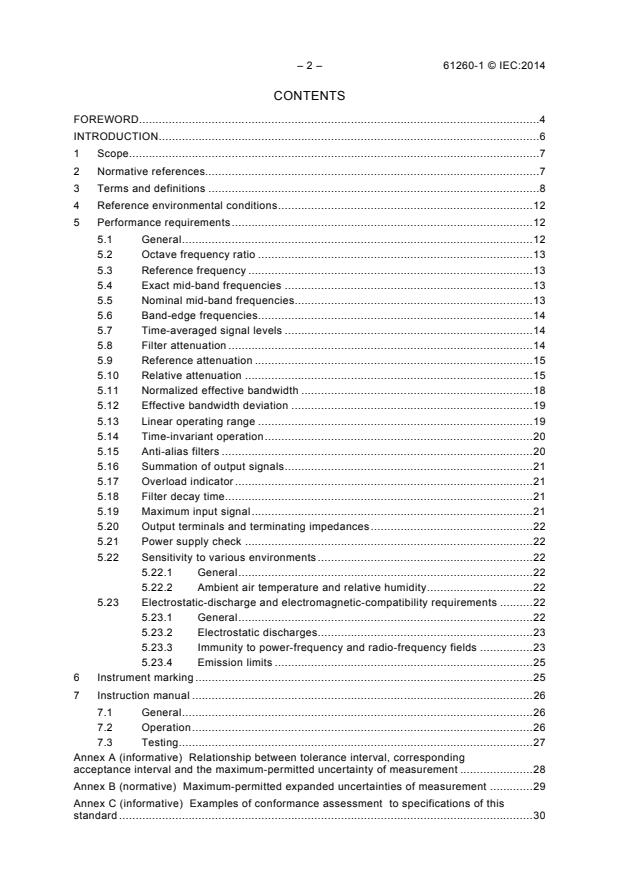
– 2 – 61260-1 © IEC:2014
CONTENTS
FOREWORD . 4
INTRODUCTION . 6
1 Scope . 7
2 Normative references. 7
3 Terms and definitions . 8
4 Reference environmental conditions . 12
5 Performance requirements . 12
5.1 General . 12
5.2 Octave frequency ratio . 13
5.3 Reference frequency . 13
5.4 Exact mid-band frequencies . 13
5.5 Nominal mid-band frequencies . 13
5.6 Band-edge frequencies . 14
5.7 Time-averaged signal levels . 14
5.8 Filter attenuation . 14
5.9 Reference attenuation . 15
5.10 Relative attenuation . 15
5.11 Normalized effective bandwidth . 18
5.12 Effective bandwidth deviation . 19
5.13 Linear operating range . 19
5.14 Time-invariant operation . 20
5.15 Anti-alias filters . 20
5.16 Summation of output signals . 21
5.17 Overload indicator . 21
5.18 Filter decay time. 21
5.19 Maximum input signal . 21
5.20 Output terminals and terminating impedances . 22
5.21 Power supply check . 22
5.22 Sensitivity to various environments . 22
5.22.1 General . 22
5.22.2 Ambient air temperature and relative humidity . 22
5.23 Electrostatic-discharge and electromagnetic-compatibility requirements . 22
5.23.1 General . 22
5.23.2 Electrostatic discharges . 23
5.23.3 Immunity to power-frequency and radio-frequency fields . 23
5.23.4 Emission limits . 25
6 Instrument marking . 25
7 Instruction manual . 26
7.1 General . 26
7.2 Operation . 26
7.3 Testing . 27
Annex A (informative) Relationship between tolerance interval, corresponding
acceptance interval and the maximum-permitted uncertainty of measurement . 28
Annex B (normative) Maximum-permitted expanded uncertainties of measurement . 29
Annex C (informative) Examples of conformance assessment to specifications of this
standard . 30
61260-1 © IEC:2014 – 3 –
C.1 General . 30
C.2 Conformance criteria . 30
C.3 Example test results . 31
Annex D (informative) Base 2 filters . 33
Annex E (normative) Nominal mid-band frequencies . 34
E.1 Mid-band frequencies for octave-band and one-third-octave-band filters . 34
E.2 Mid-band frequencies for one-half-octave-band filters . 34
E.3 Mid-band frequencies for other bandwidths . 34
Annex F (informative) Normalized frequencies at breakpoints of acceptance limits on
minimum and maximum relative attenuation for one-third-octave-band filters . 36
Annex G (informative) Filter response to exponentially swept sinusoidal signals . 38
G.1 Exponential frequency sweep . 38
G.2 Response of set of band-pass filters to a sweep . 38
Annex H (informative) Measurement of filter decay time . 41
H.1 General . 41
H.2 Measurement of filter decay time . 41
H.2.1 Instruments with the capability to measure reverberation time . 41
H.2.2 Instruments without the capability to measure reverberation
time . 41
Bibliography . 43
Figure 1 – Minimum and maximum limits on relative attenuation as a function of f/f
m
for class 1 and class 2 octave-band filters . 17
Figure A.1 – Relationship between tolerance interval, corresponding acceptance
interval and the maximum-permitted uncertainty of measurement . 28
Figure C.1 – Examples of conformance assessment . 32
Figure G.1 – Relation between the logarithmic frequency scale and the linear time
scale due to the exponential sweep . 40
Table 1 – Acceptance limits on relative attenuation for octave-band filters . 15
Table 2 – Limits for radiated disturbance of class B Information Technology Equipment
(ITE) at a distance of 10 m . 25
Table 3 – Limits for conducted disturbance to the voltage of a public supply of electric
power . 25
Table B.1 – Maximum-permitted expanded uncertainties of measurement . 29
Table C.1 – Examples of conformance assessment . 31
Table E.1 – Mid-band frequencies for octave-band and one-third-octave-band filters in
the audio range . 35
Table F.1 – Acceptance limits on relative attenuation for one-third-octave-band filters . 37
– 4 – 61260-1 © IEC:2014
INTERNATIONAL ELECTROTECHNICAL COMMISSION
____________
ELECTROACOUSTICS –
OCTAVE-BAND AND FRACTIONAL-OCTAVE-BAND FILTERS –
Part 1: Specifications
FOREWORD
1) The International Electrotechnical Commission (IEC) is a worldwide organization for standardization comprising
all national electrotechnical committees (IEC National Committees). The object of IEC is to promote
international co-operation on all questions concerning standardization in the electrical and electronic fields. To
this end and in addition to other activities, IEC publishes International Standards, Technical Specifications,
Technical Reports, Publicly Available Specifications (PAS) and Guides (hereafter referred to as “IEC
Publication(s)”). Their preparation is entrusted to technical committees; any IEC National Committee interested
in the subject dealt with may participate in this preparatory work. International, governmental and non-
governmental organizations liaising with the IEC also participate in this preparation. IEC collaborates closely
with the International Organization for Standardization (ISO) in accordance with conditions determined by
agreement between the two organizations.
2) The formal decisions or agreements of IEC on technical matters express, as nearly as possible, an international
consensus of opinion on the relevant subjects since each technical committee has representation from all
interested IEC National Committees.
3) IEC Publications have the form of recommendations for international use and are accepted by IEC National
Committees in that sense. While all reasonable efforts are made to ensure that the technical content of IEC
Publications is accurate, IEC cannot be held responsible for the way in which they are used or for any
misinterpretation by any end user.
4) In order to promote international uniformity, IEC National Committees undertake to apply IEC Publications
transparently to the maximum extent possible in their national and regional publications. Any divergence
between any IEC Publication and the corresponding national or regional publication shall be clearly indicated in
the latter.
5) IEC itself does not provide any attestation of conformity. Independent certification bodies provide conformity
assessment services and, in some areas, access to IEC marks of conformity. IEC is not responsible for any
services carried out by independent certification bodies.
6) All users should ensure that they have the latest edition of this publication.
7) No liability shall attach to IEC or its directors, employees, servants or agents including individual experts and
members of its technical committees and IEC National Committees for any personal injury, property damage or
other damage of any nature whatsoever, whether direct or indirect, or for costs (including legal fees) and
expenses arising out of the publication, use of, or reliance upon, this IEC Publication or any other IEC
Publications.
8) Attention is drawn to the Normative references cited in this publication. Use of the referenced publications is
indispensable for the correct application of this publication.
9) Attention is drawn to the possibility that some of the elements of this IEC Publication may be the subject of
patent rights. IEC shall not be held responsible for identifying any or all such patent rights.
International Standard IEC 61260-1 has been prepared by IEC technical committee 29:
Electroacoustics.
This first edition of IEC 61260-1, future IEC 61260-2 and future IEC 61260-3, cancel and
replace the first edition of IEC 61260 published in 1995, and Amendment 1:2001. This edition
constitutes a technical revision.
This edition includes the following significant technical changes with respect to the
IEC 61260:
a) the single document in the first edition of IEC 61260:1995 is in IEC 61260 series
separated into the three parts covering: specifications, pattern evaluation tests and
periodic tests;
b) the IEC 61260:1995 specified three performance categories: classes 0, 1 and 2. The
IEC 61260 series specifies requirements for class 1 and 2;
c) in the IEC 61260:1995, the design goals for the specification can be based on base-2 or
base 10 design. In IEC 61260 series only base-10 is specified;
61260-1 © IEC:2014 – 5 –
d) the reference environmental conditions have been changed from 20 °C / 65 % RH to
23 °C / 50 % RH;
e) IEC 61260:1995 specified tolerance limits without considering the uncertainty of
measurement for verification of the specifications. IEC 61260 series specifies acceptance
limits for the observed values and maximum-permitted uncertainty of measurements for
laboratories testing conformance to specifications in the standard.
The text of this standard is based on the following documents:
FDIS Report on voting
29/835/FDIS 29/839/RVD
Full information on the voting for the approval of this standard can be found in the report on
voting indicated in the above table.
This publication has been drafted in accordance with the ISO/IEC Directives, Part 2.
A list of all the parts in the IEC 61260 series, published under the general title
Electroacoustics – Octave-band and fractional-octave-band filters can be found on the IEC
website.
The committee has decided that the contents of this publication will remain unchanged until
the stability date indicated on the IEC web site under "http://webstore.iec.ch" in the data
related to the specific publication. At this date, the publication will be
• reconfirmed,
• withdrawn,
• replaced by a revised edition, or
• amended.
– 6 – 61260-1 © IEC:2014
INTRODUCTION
IEC 61260:1995 and its Amendment 1:2001 are now separated into the following three parts
of IEC 61260 series:
• Part 1: Specifications
• Part 2: Pattern evaluation tests (under consideration)
• Part 3: Periodic tests (under consideration)
For assessments of conformance to performance specifications, IEC 61260-1 uses different
criteria than were used for the IEC 61260:1995 edition.
IEC 61260:1995 did not provide any requirements or recommendations to account for the
uncertainty of measurement in assessments of conformance to specifications. This absence
of requirements or recommendations to account for uncertainty of measurement created
ambiguity in determinations of conformance to specifications for situations where a measured
deviation from a design goal was close to a limit of the allowed deviation. If conformance was
determined based on whether a measured deviation did or did not exceed the limits, the end-
user of the octave-band and fractional-octave-band filters incurred the risk that the true
deviation from a design goal exceeded the limits.
To remove this ambiguity, IEC Technical Committee 29, at its meeting in 1996, adopted a
policy to account for measurement uncertainty in assessments of conformance in International
Standards that it prepares.
This first edition of IEC 61260-1 uses an amended criterion for assessing conformance to a
specification. Conformance is demonstrated when (a) measured deviations from design goals
do not exceed the applicable acceptance limits and (b) the uncertainty of measurement does
not exceed the corresponding maximum-permitted uncertainty. Acceptance limits are
analogous to the tolerance limits allowances for design and manufacturing implied in the
IEC 61260:1995.
Actual and maximum-permitted uncertainties of measurement are determined for a coverage
probability of 95 %. Unless more-specific information is available, the evaluation of the
contribution of a specific filter or filter set to a total measurement uncertainty can be based on
the acceptance limits and maximum-permitted uncertainties specified in this standard.
61260-1 © IEC:2014 – 7 –
ELECTROACOUSTICS –
OCTAVE-BAND AND FRACTIONAL-OCTAVE-BAND FILTERS –
Part 1: Specifications
1 Scope
1.1 This part of the IEC 61260 series specifies performance requirements for analogue,
sampled-data, and digital implementations of band-pass filters. The extent of the pass-band
region of a filter's relative attenuation characteristic is a constant percentage of the exact mid-
band frequency for all filters of a given bandwidth. An instrument conforming to the
requirements of this standard may contain any number of contiguous band-pass filters
covering any desired frequency range.
1.2 Performance requirements are provided for two filter classes: class 1 and class 2. In
general, specifications for class 1 and class 2 filters have the same design goals and differ
mainly in the acceptance limits and the range of operational temperature. Acceptance limits
for class 2 are greater than, or equal to, those for class 1. Maximum-permitted expanded
uncertainties of measurement are also specified.
1.3 Performance requirements are given for designs where the octave frequency ratio and
the mid-band frequencies are powers of ten.
1.4 Band-pass filters conforming to the performance requirements of this standard may be
part of various measurement systems or may be an integral component of a specific
instrument such as a spectrum analyser.
1.5 This standard specifies the ranges of environmental conditions for operation of the
filters. The required range depends on whether the instrument containing the filters is
designed to be operated in a controlled environment or more generally in the field.
1.6 Band-pass filters conforming to the requirements of this standard are capable of
providing frequency-band-filtered spectral information for a wide variety of signals, for
example, time-varying, intermittent or steady; broadband or discrete frequency; and long or
short durations.
2 Normative references
The following documents, in whole or in part, are normatively referenced in this document and
are indispensable for its application. For dated references, only the edition cited applies. For
undated references, the latest edition of the referenced document (including any
amendments) applies.
IEC 61000-4-2, Electromagnetic compatibility (EMC) – Part 4-2: Testing and measurement
techniques – Electrostatic discharge immunity test
IEC 61000-4-3:2006, Electromagnetic compatibility (EMC) – Part 4-3: Testing and
measurement techniques – Radiated, radio-frequency, electromagnetic field immunity test
IEC 61000-6-1:2005, Electromagnetic compatibility (EMC) – Part 6-1: Generic standards –
Immunity for residential, commercial and light-industrial environments
– 8 – 61260-1 © IEC:2014
IEC 61000-6-2:2005, Electromagnetic compatibility (EMC) – Part 6-2: Generic standards –
Immunity for industrial environments
IEC 61000-6-3:2006, Electromagnetic compatibility (EMC) – Part 6-3: Generic standards –
Emission standard for residential, commercial and light-industrial environments
Amendment 1:2010
IEC 61672-1, Electroacoustics – Sound level meters – Part 1: Specifications
CISPR 22:2008, Information technology equipment – Radio disturbance characteristics –
Limits and methods of measurement
ISO/IEC Guide 98-3, Uncertainty of measurement – Part 3: Guide to the expression of
uncertainty in measurement (GUM: 1995)
ISO/IEC Guide 98-4:2012, Uncertainty of measurement – Part 4: Role of measurement
uncertainty in conformity assessment
3 Terms and definitions
For the purposes of this document, the terms and definitions given in IEC 61000-4-2,
IEC 61000-4-3, IEC 61000-6-1, IEC 61000-6-2, and IEC 61000-6-3, as well as the following
apply.
3.1
band-pass filter
filter with a single transmission band (or pass-band with small relative attenuation) extending
from a lower band-edge frequency greater than zero to a finite upper band-edge frequency
3.2
octave frequency ratio
frequency ratio nominally equal to an octave or a frequency ratio of 2:1
Note 1 to entry: 5.2.1 gives the expression of the octave frequency ratio for this standard.
3.3
bandwidth designator
reciprocal of a positive integer, including 1, to designate the fraction of an octave band
Note 1 to entry: The bandwidth designator is used to designate the nominal bandwidth of the filters in a set of
filters, for example, for 1/b = 1/12, the filters are designated as one-twelfth-octave-band filters.
3.4
reference frequency
single frequency selected to normalize the attenuation response for all band-pass filters in a
filter set
Note 1 to entry: The reference frequency is expressed in hertz (Hz).
3.5
exact mid-band frequency
frequency that has a specified relationship to the reference frequency such that the ratio of
the exact mid-band frequencies of any two contiguous band-pass filters is the same for all
filters in a filter set of a specified bandwidth
Note 1 to entry: Exact mid-band frequency is expressed in hertz (Hz).
61260-1 © IEC:2014 – 9 –
3.6
nominal mid-band frequency
rounded mid-band frequency for the designation of band-pass filters
Note 1 to entry: Nominal mid-band frequency is expressed in hertz (Hz).
3.7
normalized frequency
for a band-pass filter, ratio of a frequency to the corresponding exact mid-band frequency
3.8
band-edge frequencies
frequencies at the lower and upper edges of the pass-band of a band-pass filter such that the
exact mid-band frequency is the geometric mean of the lower and upper band-edge
frequencies
Note 1 to entry: Band-edge frequencies are expressed in hertz (Hz).
3.9
normalized bandwidth of a filter
relative bandwidth for a given filter, the ratio of the upper band-edge frequency minus the
corresponding lower band-edge frequency to the exact mid-band frequency
3.10
octave-band filter
band-pass filter for which the ratio of upper band-edge frequency to lower band-edge
frequency is the octave frequency ratio
3.11
fractional-octave-band filter
band-pass filter for which the ratio of upper band-edge frequency to lower band-edge
frequency is the octave frequency ratio raised to an exponent equal to the applicable
bandwidth designator
Note 1 to entry: An octave-band filter is also a fractional-octave-band filter (1/b = 1/1).
3.12
signal level
time-average signal level
at any frequency, ten times the logarithm to the base ten of the ratio of a specified time-mean-
square signal to the square of a specified reference value
Note 1 to entry Time-averaged signal level is expressed in decibels (dB).
3.13
filter attenuation
at any frequency, for a band-pass filter, the input signal level minus the corresponding output
signal level
Note 1 to entry: Filter attenuation is expressed in decibels (dB).
3.14
reference attenuation
for all band-pass filters in an instrument, nominal filter attenuation in the pass-band for
determining relative attenuation
Note 1 to entry: Reference attenuation is expressed in decibels (dB).
3.15
relative attenuation
filter attenuation minus the reference attenuation
– 10 – 61260-1 © IEC:2014
Note 1 to entry: Relative attenuation is expressed in decibels (dB).
3.16
normalized response
at any normalized frequency, the anti-logarithm to the base ten of minus one-tenth of the
corresponding relative attenuation
3.17
normalized effective bandwidth
integral over normalized frequency of the normalized response of a band-pass filter to
constant-amplitude sinusoidal input signals, the normalized response being weighted with the
inverse of the normalized frequency
3.18
normalized reference effective bandwidth
normalized effective bandwidth for a band-pass filter having zero relative attenuation in the
passband and infinite relative attenuation at other frequencies
3.19
effective bandwidth deviation
ten times the logarithm to the base ten of the ratio of the normalized effective bandwidth of a
filter to the normalized reference effective bandwidth
Note 1 to entry: Effective bandwidth deviation is expressed in decibels (dB).
3.20
reference level range
one of the available level ranges specified for testing the electrical performance
characteristics of the band-pass filters in a filter set
3.21
reference input signal level
specified reference level of the input signal on the reference level range
Note 1 to entry: The reference input signal level is expressed in decibels (dB).
3.22
level linearity deviation
on any level range at the exact mid-band frequency, if not otherwise specified, an indicated
output signal level minus the anticipated output signal level
Note 1 to entry: Level linearity deviation is expressed in decibels (dB).
3.23
linear operating range
for a stated filter and a stated level range, the extent of steady sinusoidal input signal levels
over which level linearity deviations do not exceed the applicable limits of this standard
Note 1 to entry: Linear operating range is expressed in decibels (dB).
3.24
level range control
device for adjusting the sensitivity of a band-pass filter in response to changes in the level
of the input signal in order to maintain the overall operation of the filter within the linear
operating range
3.25
measurement range
for any exact mid-band frequency, the range from the lower boundary of the input signal
level for the linear operating range on the most-sensitive level range to the upper boundary
of the input signal level for the linear operating range on the least-sensitive level range
61260-1 © IEC:2014 – 11 –
Note 1 to entry: A measurement range is expressed in decibels (dB).
3.26
analogue filter
filter that operates continuously on an input signal to produce a filtered output
3.27
sampled-data filter
computational process that operates on samples of an input signal to produce a filtered
output
3.28
digital filter
subset of sampled-data filters that operates on digitized samples of input data
3.29
time-invariant operation
operational mode or capability of a system of band-pass filters such that the response to a
signal is independent of the time when the signal was applied
3.30
filter decay time
at a stated frequency, elapsed time required for the output signal level to decrease by 60 dB
after sudden cessation of the signal from the input to the filter
Note 1 to entry: Filter decay time is expressed in seconds (s).
3.31
reference orientation
orientation of a band-pass filter with respect to the principal direction of an emitter or receiver
of radio-frequency fields
3.32
group X band-pass filter
self-contained instrument that includes band-pass filtering facilities conforming to the
requirements of this standard and which specifies internal battery power for the normal mode
of operation and requiring no external connection to other apparatus to operate the instrument
3.33
group Y band-pass filter
self-contained instrument that includes band-pass filtering facilities conforming to the
requirements of this standard and which specifies connection to a public supply of electrical
power for the normal mode of operation and also requiring no external connection to other
apparatus to operate the instrument
3.34
group Z band-pass filter
instrument that includes band-pass filtering facilities conforming to the requirements of this
standard and requiring two or more items of equipment to be connected together by some
means for the normal mode of operation, with operation either from batteries or from a public
supply of electrical power
Note 1 to entry: If the items communicate by means of radio or optical methods, but are not connected by any
conductive device, the items are not connected in this context.
3.35
coverage probability
probability that the set of true quantity values of a measurand is contained within a specified
coverage interval
– 12 – 61260-1 © IEC:2014
[SOURCE: ISO/IEC Guide 98-4:2012, 3.2.8]
3.36
acceptance limit
specified upper or lower bound of permissible measured quantity values
[SOURCE: ISO/IEC Guide 98-4:2012, 3.3.8]
4 Reference environmental conditions
Reference environmental conditions are as follows:
• temperature 23 °C
• static pressure 101,325 kPa
• relative humidity 50 %
5 Performance requirements
5.1 General
5.1.1 Electrical response characteristics specified in this standard for fractional-octave-
band filters apply under the reference environmental conditions of Clause 4, if not otherwise
stated.
5.1.2 Any filter design realization may be utilized provided the resulting filters conform to
all applicable requirements of this standard.
5.1.3 Band-pass filters may be powered by batteries or from external power supply
systems.
5.1.4 The configuration of the filter shall be as specified in the Instruction Manual for one
of the normal modes of operation, including required accessories.
5.1.5 For filters enclosed in a sound level meter with detachable preamplifier, the signal
input to the filter may be, as specified by the supplier, the input of the preamplifier through a
suitable input device replacing the microphone, or the terminal where the signal from the
preamplifier normally is connected.
5.1.6 Acceptance limits in this standard include allowances for design, manufacturing and
aging.
5.1.7 In subsequent subclauses, acceptance limits are provided for allowable values of
measured deviations from design goals. Annex A describes the relationship between
tolerance interval, corresponding acceptance interval and the maximum-permitted uncertainty
of measurement.
5.1.8 For pattern-evaluation tests and periodic tests, the laboratory shall determine that
their actual expanded uncertainties, as the 95 % coverage intervals in accordance with
ISO/IEC Guide 98-3 and ISO/IEC Guide 98-4, do not exceed the maximum-permitted
expanded uncertainties specified in Annex B.
5.1.9 Conformance to the specifications is demonstrated when (a) the measured deviations
from the design goals do not exceed the applicable acceptance limits and (b) the
corresponding actual expanded uncertainties of measurements does not exceed the
corresponding maximum-permitted uncertainty of measurement given in Annex B.
61260-1 © IEC:2014 – 13 –
5.1.10 Annex C gives examples of evaluation of conformance to specifications of this
standard.
5.2 Octave frequency ratio
5.2.1 For this standard, the octave frequency ratio, G, shall be given by the following
expression
3/10
G = 10
(1)
5.2.2 The octave frequency ratio calculated from Formula (1) to six significant digits is
1,995 26. Filters designed according to this ratio are designated base-10 filters.
NOTE 1 Filters specified in this standard are by convention called octave-band and fractional-octave band filters.
NOTE 2 For technical reasons, some filters have been designed based on G = 2, exactly. Such filter designs are
called base-2 filters. The probability that a base-2 filter conforms to the requirements of this standard decreases as
the difference between the mid-band frequency and the reference frequency increases; see Annex D.
5.3 Reference frequency
For the purposes of this standard, the reference frequency, f , is 1 000 Hz, exactly.
r
5.4 Exact mid-band frequencies
5.4.1 When the denominator of the bandwidth designator is an odd number, the exact mid-
band frequencies, f , of any filter in a set of filters shall be determined from the following
m
expression
x/b
f = f G (2)
m r
where f is the reference frequency and 1/b is the bandwidth designator, for example 1/1 or
r
1/3 for octave-band or one-third-octave-band filters, respectively.
5.4.2 When the denominator of the bandwidth designator is an even number, exact mid-
band frequencies of any filter in a set of filters shall be determined from the following
expression
(2x+1)/(2b)
f = f G (3)
m r
where x in Formulas (2) and (3) is any integer, positive, negative or zero.
NOTE 1 The outputs of narrow-bandwidth fractional-octave-band filters that have exact mid-band frequencies
determined from Formula (2) or Formula (3) can be combined to approximate the band level indicated by a filter of
wider bandwidth with a corresponding exact mid-band frequency and corresponding band-edge frequencies.
NOTE 2 When the denominator of the bandwidth designator is an odd number, one of the filters in a complete
filter set can have a mid-band frequency of 1 000 Hz. When the denominator of the bandwidth designator is an
even number, the band-edge frequencies of an adjacent pair of filters in a complete filter set can be at 1 000 Hz
and none of the filters will have a mid-band frequency of 1 000 Hz.
5.5 Nominal mid-band frequencies
Octave-band and fractional-octave-band filters shall be identified, or labelled, by their nominal
mid-band frequencies. Annex E provides exact and nominal mid-band frequencies for octave-
band and one-third-octave-band filters for the usual range of audio frequencies. Annex E also
specifies a procedure for determining the nominal mid-band frequencies for fractional-octave-
band filters with other bandwidth designators.
– 14 – 61260-1 © IEC:2014
5.6 Band-edge frequencies
5.6.1 Lower and upper band-edge frequencies for a pass-band filter shall be determined
from the following expressions:
-1/(2b)
f = f G (4)
1 m
and
+1/(2b)
f = f G (5)
2 m
where
f is the lower band-edge frequency;
f is the upper band-edge frequency;
G is the octave frequency ratio given by Formula (1), and
f is an exact mid-band frequency determined from Formula (2) or Formula (3).
m
NOTE An exact mid-band frequency is the geometric mean of the corresponding band-edge frequencies as given
by f = f f .
m 1 2
1/b 3/10
5.6.2 A band-edge frequency ratio is given by f /f = G , for example 10 for octave-
2 1
1/10
for one-third-octave-band filters.
band filters and 10
+1/(2b) -1/(2b)
5.6.3 The normalized bandwidth of a filter is given by (f – f )/f = G – G .
2 1 m
5.7 Time-averaged signal levels
5.7.1 A time-averaged signal level, L, shall be determined according to the following
expression:
T
(1/ T ) V (t )dt
∫
L = 10lg dB (6)
V
where
V(t)is the instantaneous signal as a function of time t,
T is the elapsed time for integration and averaging, and
V is an appropriate reference value such as 1 µV if the signal is a voltage.
5.7.2 The reference value shall be the same for the level of input signals and output
signals.
5.8 Filter attenuation
5.8.1 For any normalized frequency, Ω = f/f , filter attenuation, A(Ω), shall be determined
m
from the following expression:
A(Ω) = L (Ω) – L (Ω) (7)
in out
where
L (Ω) is the time-averaged level of the input signal and
in
61260-1 © IEC:2014 – 15 –
L (Ω)is the corresponding time-averaged level of the output signal.
out
5.8.2 For measurement of filter attenuation, the resolution of the indications of the levels of
the input and output signals shall be 0,1 dB or smaller.
5.9 Reference attenuation
5.9.1 The instruction manual shall specify the reference attenuation in the pass-band. The
reference attenuation shall be nominally the same for all filters of all available filter
bandwidths in a set of filters.
5.9.2 Verification of the specified reference attenuation may require that the filters be
adjusted according to a procedure described in the instruction manual.
5.10 Relative attenuation
5.10.1 Relative attenuation, ΔA(Ω)at normalized frequency Ω = f/f , shall be determined
m
from the following expression:
ΔA(Ω) = A(Ω) – A (8)
ref
where
A is the reference attenuation.
ref
5.10.2 For class 1 or class 2 octave-band filters, in the pass-band from Ω to Ω , the
1 2
relative attenuation of any filter shall be within the acceptance limits in Table 1 for the
minimum and maximum relative attenuations at the specified octave-band normalized
frequencies. In the stop-bands for Ω < Ω and Ω > Ω , the relative attenuation shall be not
1 2
less than the minimum acceptance limits in Table 1.
Table 1 – Acceptance limits on relative attenuation for octave-band filters
Minimum and maximum acceptance limits on relative attenuation
Normalized frequency
in dB
Ω = f/f
m
Class 1 Class 2
-4
Ω ≤ G +70; +∞ +60; +∞
l
-3
G +60; +∞ +54; +∞
Ω
l
-2
Ω G +40,5; +
...
Questions, Comments and Discussion
Ask us and Technical Secretary will try to provide an answer. You can facilitate discussion about the standard in here.
Loading comments...