

IEC 60645-6:2022
(Main)Electroacoustics - Audiometric equipment - Part 6: Instruments for the measurement of otoacoustic emissions
General Information
- Abstract
IEC 606045-6:2022 applies to instruments designed primarily for the measurement of otoacoustic emissions in the human external auditory meatus evoked by acoustic probe stimuli. This document defines the characteristics to be specified by the manufacturer, specifies minimum mandatory functions for two types of instruments and provides performance specifications applicable to both instrument types. This document describes methods to be used to demonstrate conformance with the specifications in this document and guidance on methods for periodic calibration. The purpose of this document is to ensure that measurements made under comparable test conditions with different instruments complying with this document will be consistent. Instruments can provide a measurement function not specifically within the scope of this document and still comply with the relevant requirements of this document for the functions that are within the scope. This document is not intended to restrict development or incorporation of new features, nor to discourage innovative approaches. IEC 606045-6:2022 cancels and replaces the first edition published in 2009. This edition constitutes a technical revision.
This edition includes the following significant technical changes with respect to the previous edition:
a) the nominal test frequency used in DPOAE is now defined as the higher of the two frequencies, f2;
b) the permitted deviation of the stimulus signal for TEOAE has been specified;
c) the frequency range for DPOAE stimulus signals has been redefined,
d) the stimulus level requirements for TEOAE have been redefined;
e) the stimulus level requirements for DPOAE have been redefined;
f) the harmonic distortion requirements for DPOAE have been redefined;
g) a minimum measurement range for DPOAE has been added.
- Status
- Published
- Publication Date
- 06-Aug-2026
- Technical Committee
- TC 29 - Electroacoustics
- Drafting Committee
- WG 10 - TC 29/WG 10
- Current Stage
- PPUB - Publication issued
- Start Date
- 10-Mar-2022
- Completion Date
- 11-Apr-2022
Buy Documents
IEC 60645-6:2022 RLV - Electroacoustics - Audiometric equipment - Part 6: Instruments for the measurement of otoacoustic emissions Released:3/10/2022
IEC 60645-6:2022+AMD1:2026 CSV - Electroacoustics - Audiometric equipment - Part 6: Instruments for the measurement of otoacoustic emissions
IEC 60645-6:2022 - Electroacoustics - Audiometric equipment - Part 6: Instruments for the measurement of otoacoustic emissions Released:3/10/2022
Overview
IEC 60645-6:2022 - "Electroacoustics - Audiometric equipment - Part 6: Instruments for the measurement of otoacoustic emissions" - specifies requirements for instruments that measure otoacoustic emissions (OAEs) in the human external auditory meatus evoked by acoustic probe stimuli. The standard defines manufacturer-declared characteristics, mandatory functions for two instrument types, performance specifications, methods to demonstrate conformity, and guidance for routine/periodic calibration. Its aim is to ensure measurements from different compliant instruments are consistent under comparable test conditions.
Key Topics and Technical Requirements
- Instrument scope and mandatory functions: Defines two instrument types and the minimum set of functions manufacturers must provide.
- Acoustic stimulus system: Requirements for probe stimuli used to evoke OAEs, including stimulus types, frequency range, stimulus levels and permitted deviations.
- DPOAE and TEOAE specifics: Addresses both distortion-product OAEs (DPOAE) and transient-evoked OAEs (TEOAE); this 2022 edition updates nominal test frequency conventions, stimulus level and frequency-range definitions, harmonic distortion limits, and minimum measurement range for DPOAE.
- Measuring system performance: Specifications for measurement range, accuracy, frequency range, noise reduction and response detection/quality metrics.
- Test quality assurance: Stability of acoustic response in the ear canal, individual stimulus recording handling, and quality indicators to ensure reliable clinical data.
- Conformance and calibration: Prescribed methods to demonstrate instrument conformity and guidance on routine periodic calibration; maximum permitted measurement uncertainty requirements are defined.
- General device requirements: Marking, instruction manuals, safety, electromagnetic immunity, warm-up time and environmental operation constraints.
Applications and Who Uses This Standard
- Manufacturers of audiometric and OAE instruments use IEC 60645-6:2022 to design, document and declare device capabilities and to meet international performance benchmarks.
- Clinical audiologists and otologists rely on OAE instruments that conform to the standard for consistent diagnostic screening (newborn hearing screening, ototoxicity monitoring, cochlear function evaluation).
- Calibration and test laboratories use the conformity and calibration methods to verify device performance and maintain traceability.
- Regulatory bodies and procurement teams reference the standard when evaluating device safety, interoperability and measurement consistency.
Related Standards
- IEC 60318-4, IEC 60318-5 (ear/occluded-ear simulators and couplers) - used for acoustic coupling and probe verification.
- IEC 60601 series - medical electrical safety and EMC requirements relevant for clinical OAE instruments.
For implementation or procurement, obtain the full IEC 60645-6:2022 publication from IEC or your national standards body to access detailed test methods, normative values and calibration procedures.
Relations
- Effective Date
- 26-Oct-2025
- Effective Date
- 05-Sep-2023
Buy Documents
IEC 60645-6:2022 RLV - Electroacoustics - Audiometric equipment - Part 6: Instruments for the measurement of otoacoustic emissions Released:3/10/2022
IEC 60645-6:2022+AMD1:2026 CSV - Electroacoustics - Audiometric equipment - Part 6: Instruments for the measurement of otoacoustic emissions
IEC 60645-6:2022 - Electroacoustics - Audiometric equipment - Part 6: Instruments for the measurement of otoacoustic emissions Released:3/10/2022
Get Certified
Connect with accredited certification bodies for this standard

BSMI (Bureau of Standards, Metrology and Inspection)
Taiwan's standards and inspection authority.
Sponsored listings
Frequently Asked Questions
IEC 60645-6:2022 is a standard published by the International Electrotechnical Commission (IEC). Its full title is "Electroacoustics - Audiometric equipment - Part 6: Instruments for the measurement of otoacoustic emissions". This standard covers: IEC 606045-6:2022 applies to instruments designed primarily for the measurement of otoacoustic emissions in the human external auditory meatus evoked by acoustic probe stimuli. This document defines the characteristics to be specified by the manufacturer, specifies minimum mandatory functions for two types of instruments and provides performance specifications applicable to both instrument types. This document describes methods to be used to demonstrate conformance with the specifications in this document and guidance on methods for periodic calibration. The purpose of this document is to ensure that measurements made under comparable test conditions with different instruments complying with this document will be consistent. Instruments can provide a measurement function not specifically within the scope of this document and still comply with the relevant requirements of this document for the functions that are within the scope. This document is not intended to restrict development or incorporation of new features, nor to discourage innovative approaches. IEC 606045-6:2022 cancels and replaces the first edition published in 2009. This edition constitutes a technical revision. This edition includes the following significant technical changes with respect to the previous edition: a) the nominal test frequency used in DPOAE is now defined as the higher of the two frequencies, f2; b) the permitted deviation of the stimulus signal for TEOAE has been specified; c) the frequency range for DPOAE stimulus signals has been redefined, d) the stimulus level requirements for TEOAE have been redefined; e) the stimulus level requirements for DPOAE have been redefined; f) the harmonic distortion requirements for DPOAE have been redefined; g) a minimum measurement range for DPOAE has been added.
IEC 606045-6:2022 applies to instruments designed primarily for the measurement of otoacoustic emissions in the human external auditory meatus evoked by acoustic probe stimuli. This document defines the characteristics to be specified by the manufacturer, specifies minimum mandatory functions for two types of instruments and provides performance specifications applicable to both instrument types. This document describes methods to be used to demonstrate conformance with the specifications in this document and guidance on methods for periodic calibration. The purpose of this document is to ensure that measurements made under comparable test conditions with different instruments complying with this document will be consistent. Instruments can provide a measurement function not specifically within the scope of this document and still comply with the relevant requirements of this document for the functions that are within the scope. This document is not intended to restrict development or incorporation of new features, nor to discourage innovative approaches. IEC 606045-6:2022 cancels and replaces the first edition published in 2009. This edition constitutes a technical revision. This edition includes the following significant technical changes with respect to the previous edition: a) the nominal test frequency used in DPOAE is now defined as the higher of the two frequencies, f2; b) the permitted deviation of the stimulus signal for TEOAE has been specified; c) the frequency range for DPOAE stimulus signals has been redefined, d) the stimulus level requirements for TEOAE have been redefined; e) the stimulus level requirements for DPOAE have been redefined; f) the harmonic distortion requirements for DPOAE have been redefined; g) a minimum measurement range for DPOAE has been added.
IEC 60645-6:2022 is classified under the following ICS (International Classification for Standards) categories: 17.140.50 - Electroacoustics. The ICS classification helps identify the subject area and facilitates finding related standards.
IEC 60645-6:2022 has the following relationships with other standards: It is inter standard links to IEC 60645-6:2022/AMD1:2026, IEC 60645-6:2009. Understanding these relationships helps ensure you are using the most current and applicable version of the standard.
IEC 60645-6:2022 is available in PDF format for immediate download after purchase. The document can be added to your cart and obtained through the secure checkout process. Digital delivery ensures instant access to the complete standard document.
Standards Content (Sample)
IEC 60645-6 ®
Edition 2.0 2022-03
REDLINE VERSION
INTERNATIONAL
STANDARD
colour
inside
Electroacoustics – Audiometric equipment –
Part 6: Instruments for the measurement of otoacoustic emissions
All rights reserved. Unless otherwise specified, no part of this publication may be reproduced or utilized in any form
or by any means, electronic or mechanical, including photocopying and microfilm, without permission in writing from
either IEC or IEC's member National Committee in the country of the requester. If you have any questions about IEC
copyright or have an enquiry about obtaining additional rights to this publication, please contact the address below or
your local IEC member National Committee for further information.
IEC Secretariat Tel.: +41 22 919 02 11
3, rue de Varembé info@iec.ch
CH-1211 Geneva 20 www.iec.ch
Switzerland
About the IEC
The International Electrotechnical Commission (IEC) is the leading global organization that prepares and publishes
International Standards for all electrical, electronic and related technologies.
About IEC publications
The technical content of IEC publications is kept under constant review by the IEC. Please make sure that you have the
latest edition, a corrigendum or an amendment might have been published.
IEC publications search - webstore.iec.ch/advsearchform IEC Products & Services Portal - products.iec.ch
The advanced search enables to find IEC publications by a Discover our powerful search engine and read freely all the
variety of criteria (reference number, text, technical publications previews. With a subscription you will always
committee, …). It also gives information on projects, replaced have access to up to date content tailored to your needs.
and withdrawn publications.
Electropedia - www.electropedia.org
IEC Just Published - webstore.iec.ch/justpublished
The world's leading online dictionary on electrotechnology,
Stay up to date on all new IEC publications. Just Published
containing more than 22 300 terminological entries in English
details all new publications released. Available online and
and French, with equivalent terms in 19 additional languages.
once a month by email.
Also known as the International Electrotechnical Vocabulary
(IEV) online.
IEC Customer Service Centre - webstore.iec.ch/csc
If you wish to give us your feedback on this publication or
need further assistance, please contact the Customer Service
Centre: sales@iec.ch.
IEC 60645-6 ®
Edition 2.0 2022-03
REDLINE VERSION
INTERNATIONAL
STANDARD
colour
inside
Electroacoustics – Audiometric equipment –
Part 6: Instruments for the measurement of otoacoustic emissions
INTERNATIONAL
ELECTROTECHNICAL
COMMISSION
ICS 17.140.50 ISBN 978-2-8322-4334-3
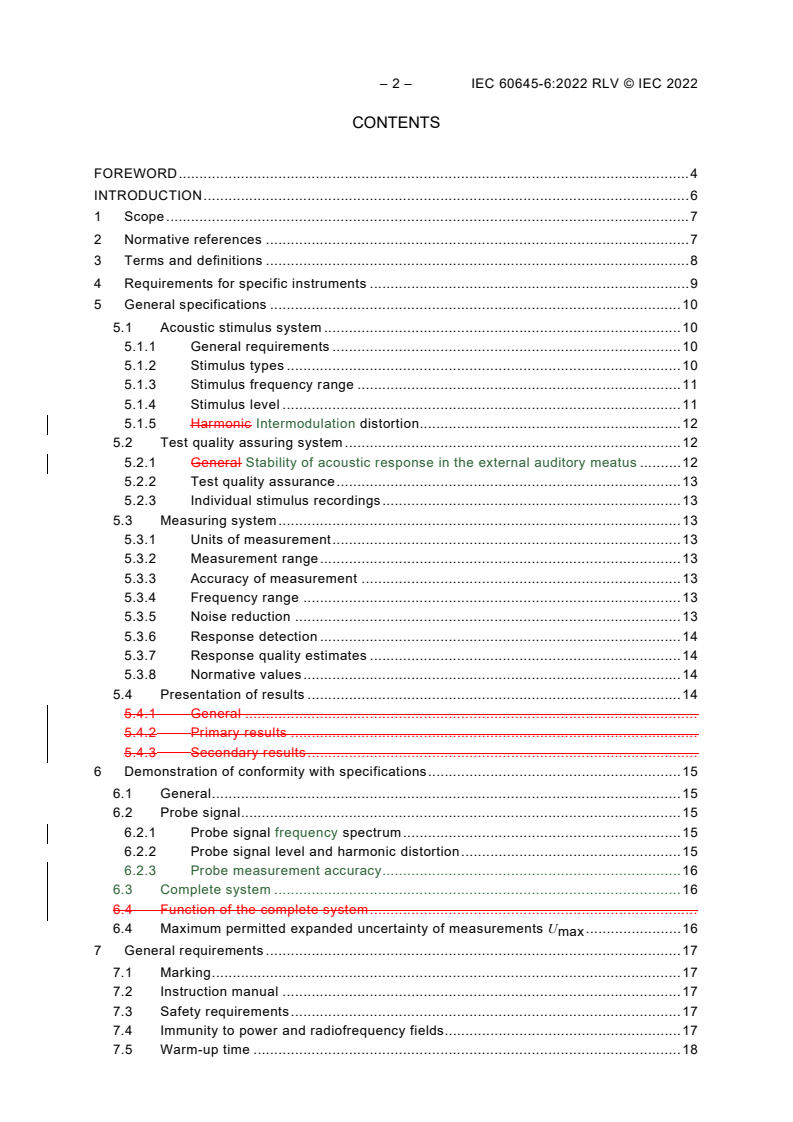
– 2 – IEC 60645-6:2022 RLV © IEC 2022
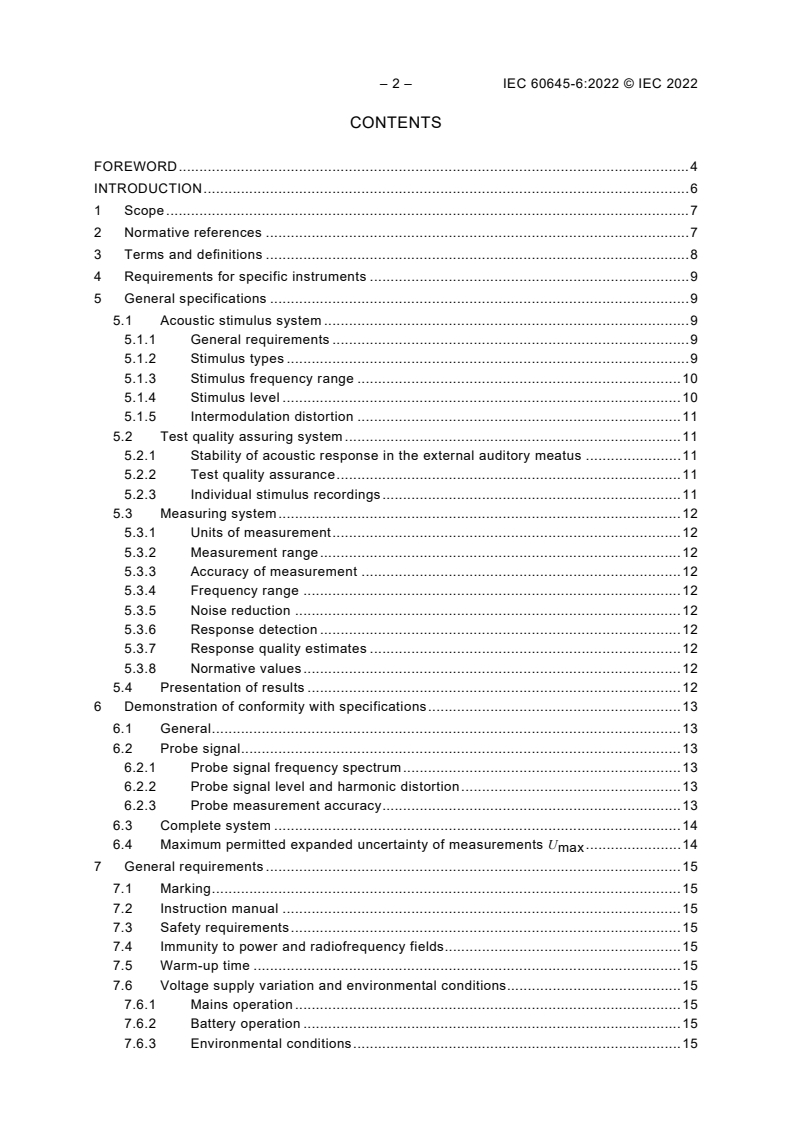
CONTENTS
FOREWORD . 4
INTRODUCTION . 6
1 Scope . 7
2 Normative references . 7
3 Terms and definitions . 8
4 Requirements for specific instruments . 9
5 General specifications . 10
5.1 Acoustic stimulus system . 10
5.1.1 General requirements . 10
5.1.2 Stimulus types . 10
5.1.3 Stimulus frequency range . 11
5.1.4 Stimulus level . 11
5.1.5 Harmonic Intermodulation distortion. 12
5.2 Test quality assuring system . 12
5.2.1 General Stability of acoustic response in the external auditory meatus . 12
5.2.2 Test quality assurance . 13
5.2.3 Individual stimulus recordings . 13
5.3 Measuring system . 13
5.3.1 Units of measurement . 13
5.3.2 Measurement range . 13
5.3.3 Accuracy of measurement . 13
5.3.4 Frequency range . 13
5.3.5 Noise reduction . 13
5.3.6 Response detection . 14
5.3.7 Response quality estimates . 14
5.3.8 Normative values . 14
5.4 Presentation of results . 14
5.4.1 General .
5.4.2 Primary results .
5.4.3 Secondary results .
6 Demonstration of conformity with specifications . 15
6.1 General . 15
6.2 Probe signal . 15
6.2.1 Probe signal frequency spectrum . 15
6.2.2 Probe signal level and harmonic distortion . 15
6.2.3 Probe measurement accuracy . 16
6.3 Complete system . 16
6.4 Function of the complete system .
6.4 Maximum permitted expanded uncertainty of measurements U . 16
max
7 General requirements . 17
7.1 Marking . 17
7.2 Instruction manual . 17
7.3 Safety requirements . 17
7.4 Immunity to power and radiofrequency fields. 17
7.5 Warm-up time . 18
7.6 Voltage supply variation and environmental conditions. 18
7.6.1 Mains operation . 18
7.6.2 Battery operation . 18
7.6.3 Environmental conditions . 18
8 Additional characteristics to be specified by the manufacturer . 18
9 Routine Periodic calibration . 18
Bibliography . 20
Table 1 – Mandatory functions for otoacoustic emission instruments. 9
Table 2 – Documentation of test conditions, parameters and results . 14
Table 3 – Values of U for basic conformance and periodic calibration
max
measurements . 17
– 4 – IEC 60645-6:2022 RLV © IEC 2022
INTERNATIONAL ELECTROTECHNICAL COMMISSION
____________
ELECTROACOUSTICS –
AUDIOMETRIC EQUIPMENT –
Part 6: Instruments for the measurement of otoacoustic emissions
FOREWORD
1) The International Electrotechnical Commission (IEC) is a worldwide organization for standardization comprising
all national electrotechnical committees (IEC National Committees). The object of IEC is to promote international
co-operation on all questions concerning standardization in the electrical and electronic fields. To this end and
in addition to other activities, IEC publishes International Standards, Technical Specifications, Technical Reports,
Publicly Available Specifications (PAS) and Guides (hereafter referred to as “IEC Publication(s)”). Their
preparation is entrusted to technical committees; any IEC National Committee interested in the subject dealt with
may participate in this preparatory work. International, governmental and non-governmental organizations liaising
with the IEC also participate in this preparation. IEC collaborates closely with the International Organization for
Standardization (ISO) in accordance with conditions determined by agreement between the two organizations.
2) The formal decisions or agreements of IEC on technical matters express, as nearly as possible, an international
consensus of opinion on the relevant subjects since each technical committee has representation from all
interested IEC National Committees.
3) IEC Publications have the form of recommendations for international use and are accepted by IEC National
Committees in that sense. While all reasonable efforts are made to ensure that the technical content of IEC
Publications is accurate, IEC cannot be held responsible for the way in which they are used or for any
misinterpretation by any end user.
4) In order to promote international uniformity, IEC National Committees undertake to apply IEC Publications
transparently to the maximum extent possible in their national and regional publications. Any divergence between
any IEC Publication and the corresponding national or regional publication shall be clearly indicated in the latter.
5) IEC itself does not provide any attestation of conformity. Independent certification bodies provide conformity
assessment services and, in some areas, access to IEC marks of conformity. IEC is not responsible for any
services carried out by independent certification bodies.
6) All users should ensure that they have the latest edition of this publication.
7) No liability shall attach to IEC or its directors, employees, servants or agents including individual experts and
members of its technical committees and IEC National Committees for any personal injury, property damage or
other damage of any nature whatsoever, whether direct or indirect, or for costs (including legal fees) and
expenses arising out of the publication, use of, or reliance upon, this IEC Publication or any other IEC
Publications.
8) Attention is drawn to the Normative references cited in this publication. Use of the referenced publications is
indispensable for the correct application of this publication.
9) Attention is drawn to the possibility that some of the elements of this IEC Publication may be the subject of patent
rights. IEC shall not be held responsible for identifying any or all such patent rights.
This redline version of the official IEC Standard allows the user to identify the changes made to
the previous edition IEC 60645-6:2009. A vertical bar appears in the margin wherever a change
has been made. Additions are in green text, deletions are in strikethrough red text.
IEC 60645-6 has been prepared by IEC technical committee 29: Electroacoustics. It is an
International Standard.
This second edition cancels and replaces the first edition published in 2009. This edition
constitutes a technical revision.
This edition includes the following significant technical changes with respect to the previous
edition:
a) the nominal test frequency used in DPOAE is now defined as the higher of the two
;
frequencies, f
b) the permitted deviation of the stimulus signal for TEOAE has been specified;
c) the frequency range for DPOAE stimulus signals has been redefined,
d) the stimulus level requirements for TEOAE have been redefined;
e) the stimulus level requirements for DPOAE have been redefined;
f) the harmonic distortion requirements for DPOAE have been redefined;
g) a minimum measurement range for DPOAE has been added.
The text of this International Standard is based on the following documents:
Draft Report on voting
29/1109/FDIS 29/1114/RVD
Full information on the voting for its approval can be found in the report on voting indicated in
the above table.
The language used for the development of this International Standard is English.
This document was drafted in accordance with ISO/IEC Directives, Part 2, and developed in
accordance with ISO/IEC Directives, Part 1 and ISO/IEC Directives, IEC Supplement, available
at www.iec.ch/members_experts/refdocs. The main document types developed by IEC are
described in greater detail at http://www.iec.ch/standardsdev/publications.
A list of all parts in the IEC 60645 series, published under the general title Electroacoustics –
Audiometric equipment, can be found on the IEC website.
The committee has decided that the contents of this document will remain unchanged until the
stability date indicated on the IEC website under webstore.iec.ch in the data related to the
specific document. At this date, the document will be
• reconfirmed,
• withdrawn,
• replaced by a revised edition, or
• amended.
IMPORTANT – The 'colour inside' logo on the cover page of this publication indicates that it
contains colours which are considered to be useful for the correct understanding of its
contents. Users should therefore print this document using a colour printer.
– 6 – IEC 60645-6:2022 RLV © IEC 2022
INTRODUCTION
Developments in the field of diagnostic hearing measurement have resulted in a number of
instruments designed to evaluate the otoacoustic emissions of the human ear. Such emissions
may be evoked by acoustic test signals having different spectral and temporal characteristics.
The practical use of such instruments concerns the measurement of sound energy emitted by
the inner ear and its separation from sounds emerging from other physiological or artificial other
sources.
The spontaneous otoacoustic emissions (SOAE) and stimulus frequency otoacoustic emissions
(SFOAE), which comprise part of the otoacoustic emissions, are not covered by this document.
Conformance to the performance specification in this document is demonstrated when a
measured deviation from a design goal equals or does not exceed the corresponding
acceptance limit(s), and the laboratory has demonstrated that the associated uncertainty of
measurement equals or does not exceed the maximum permitted uncertainty specified in this
document.
ELECTROACOUSTICS –
AUDIOMETRIC EQUIPMENT –
Part 6: Instruments for the measurement of otoacoustic emissions
1 Scope
This part of IEC 60645 applies to instruments designed primarily for the measurement of
otoacoustic emissions in the human external acoustic auditory meatus evoked by acoustic
probe pulses or tones stimuli. This document defines the characteristics to be specified by the
manufacturer, lays down performance specifications for two types of instruments and specifies
the functions to be provided on these types. This part of IEC 60645 describes methods of test
to be used for approval testing and guidance on methods for undertaking routine calibration
specifies minimum mandatory functions for two types of instruments and provides performance
specifications applicable to both instrument types. This document describes methods to be used
to demonstrate conformance with the specifications in this document and guidance on methods
for periodic calibration.
The purpose of this document is to ensure that measurements made under comparable test
conditions with different instruments complying with this document will be consistent.
Instruments which can provide a measurement function not specifically within the scope of this
document shall and still comply with any the relevant requirements of this document for the
functions that are within the scope. This document is not intended to restrict development or
incorporation of new features, nor to discourage innovative approaches.
2 Normative references
The following documents are referred to in the text in such a way that some or all of their content
constitutes requirements of this document. For dated references, only the edition cited applies.
For undated references, the latest edition of the referenced document (including any
amendments) applies.
IEC 60318-4, Electroacoustics – Simulators of human head and ear – Part 4: Occluded-ear
simulator for the measurement of earphones coupled to the ear by means of ear inserts
IEC 60318-5, Electroacoustics – Simulators of human head and ear – Part 5: 2 cm coupler for
the measurement of hearing aids and earphones coupled to the ear by means of ear inserts
IEC 60601-1, Medical electrical equipment – Part 1: General requirements for basic safety and
essential performance
IEC 60601-1-2, Medical electrical equipment – Part 1-2: General requirements for basic safety
and essential performance – Collateral standard: Electromagnetic compatibility disturbances –
Requirements and tests
IEC 60601-1-4, Medical electrical equipment – Part 1-4: General requirements for safety –
Collateral standard: Programmable electrical medical systems
___________
Screening and full diagnostics.
To be published.
– 8 – IEC 60645-6:2022 RLV © IEC 2022
IEC 60645-1:20012017, Electroacoustics – Audiological Audiometric equipment – Part 1: Pure-
tone audiometers Equipment for pure-tone and speech audiometry
IEC 60645-3:20072020, Electroacoustics – Audiometric equipment – Part 3: Test signals of
short duration
ISO/IEC Guide 98-3, Uncertainty of measurement – Part 3: Guide to the expression of
uncertainty in measurement (GUM:1995)
3 Terms and definitions
For the purposes of this document, the following terms and definitions apply.
ISO and IEC maintain terminological databases for use in standardization at the following
addresses:
• IEC Electropedia: available at http://www.electropedia.org/
• ISO Online browsing platform: available at http://www.iso.org/obp
3.1
otoacoustic emissions
OAE
general term covering all types of acoustic signals generated in the inner ear which can be
recorded in the external acoustic auditory meatus
NOTE The spontaneous otoacoustic emissions (SOAE) and stimulus frequency otoacoustic emissions (SFOAE)
which are also a part of the otoacoustic emissions are not be covered by this standard.
3.2
transient-evoked otoacoustic emissions
TEOAE
acoustic signals emitted by the inner ear after stimulation with a stimulus of short duration
3.3
distortion product otoacoustic emissions
DPOAE
acoustic signals generated in the inner ear during stimulation with two pure tones
Note 1 to entry: The pure tones are frequencies f and f , f being the lower frequency.
1 2 1
Note 2 to entry: The frequencies of the DPOAE are given by the formulas for distortions 3f , 2f -f , 2f -f , 3f
1 1 2 2 1 2
intermodulation distortions (IMD), i.e. 2f – f , 2f – f , etc.
1 2 2 1
3.4
nominal test frequency
frequency for which a DPOAE measurement is reported
3.5
primary tones
pure-tone stimuli used to evoke DPOAE
3.6
probe
part of the instrument, usually containing acoustic transducers, interfacing the instrument to the
ear
3.7
ear tip
device used to provide a seal between the probe and the external acoustic meatus
device used to assist acoustic coupling, to reduce acoustic leakage, to reduce the influence of
environmental noise on measurements and to aid retention of the probe in the external auditory
meatus
3.8
probe signal
acoustic stimulus signal that is emitted into the external auditory meatus by means of a probe
3.9
peak-to-peak equivalent sound pressure level
peSPL
root mean squared (RMS) value of a long-duration sinusoidal sound signal which, when
compared under the same test conditions with a short-duration output signal from the transducer
under test, has the same peak-to-peak value (i.e., difference between the extreme positive and
the extreme negative values) as the short-duration signal
Note 1 to entry: See IEC 60645-3:20072020, Figure 2.
4 Requirements for specific instruments
Two different types of otoacoustic emission instruments are specified by the requirements for
minimum mandatory functions (see Table 1). Additional functions are not precluded. The two
types relate to their presumed primary application (diagnostic/clinical or screening); however,
a device of one type is not required to comply with the additional specifications of the other
type.
Instrument types
1 Diagnostic/clinical: Adjustable stimulus and recording parameters, result shown in a
graphical format
2 Screening: Automatic testing, automatic evaluation, results as pass/refer
Table 1 – Mandatory functions for otoacoustic emission instruments
Type
1 2
Diagnostic/clinical Screening
Automatic test x x
Manual test x
Presentation of results
Display of full result x
Display of PASS/REFER x
Display of a quality measure estimate x
Display of response significance x
Digital storage of full result x
Printout x
– 10 – IEC 60645-6:2022 RLV © IEC 2022
Type
1 2
Diagnostic/clinical Screening
Automatic test x x
Manual test x
Display of PASS/REFER x
Display of detailed result in graphical and/or tabular x
format
Display of stability of acoustic response in the x
external auditory meatus (see 5.2.1)
Display of response quality estimate (see 5.3.7) x
Digital storage of detailed result x
Export of full test report x
Type 1. This type of devices shall include the ability to manually start the test and to adjust the parameters of the
test.
Type 2. This type of device shall include the ability to automatically start the test.
5 General specifications
5.1 Acoustic stimulus system
5.1.1 General requirements
Specifications for the acoustic stimulus system are as given in the relevant parts of Clause 6,
Clause 8 and Clause 10 of IEC 60645-1:20012017 and Clause 5 of IEC 60645-3:20072020 with
the exceptions specified below.
NOTE If the instrument is designed to also allow the measurement of hearing thresholds, the full text of the relevant
clauses of IEC 60645-1:20012017 should apply applies.
5.1.2 Stimulus types
5.1.2.1 General
The general properties and temporal characteristics of the acoustic stimulus signals are
specified within 5.1.2.2 and 5.1.2.3 depending on the type of OAE being measured.
5.1.2.2 TEOAE
The full characteristics of the short-duration signal used for the measurements of TEOAE shall
be specified by the manufacturer (i.e., as specified in IEC 60645-3:20072020).
NOTE A series of clicks with different polarity and levels is often used and this is usually referred to as a "non-
linear click series". The specifications found in IEC 60645-3 are applicable to each single click in the series.
5.1.2.3 DPOAE
The stimulus signal used for the measurement of DPOAE shall be composed of two primary
tones with frequencies f and f . Although the DPOAE of principal interest is at a frequency of
1 2
– f , the nominal test frequency of the measurement normally refers to f f . If f f is used
2f
1 2 1 2 2 1
as the nominal test frequency, this shall be stated by the manufacturer. If additional test signals
are used (such as those used for masking), their full characteristics shall be specified by the
manufacturer.
5.1.3 Stimulus frequency range
5.1.3.1 General
The frequency content of the stimulus signal shall, as a minimum, meet the requirements
specified in 5.1.3.2 and 5.1.3.3 depending on the type of OAEs being measured.
5.1.3.2 TEOAE
The frequency spectrum of the transient stimulus signal shall at least cover the range from
0,5 kHz to 4 kHz for Type 1 instruments and the range from 1,5 kHz to 3 kHz for Type 2
instruments. The stimulus level frequency spectrum shall be flat within a limit of ±5 dB as
measured in an occluded-ear simulator according to IEC 60318-4 or a 2 cm coupler according
to IEC 60318-5, using the ear simulator or 2 cm coupler microphone, over the frequency range.
5.1.3.3 DPOAE
For the measurement of DPOAE, nominal stimulus frequencies between 0,5 0,75 kHz and 8 kHz
in at least three steps per octave shall be provided in instruments of Type 1 and at least two
frequencies between 1 kHz and 4 kHz for Type 2. The frequency ratio of the two primary tones
shall be stated by the manufacturer and shall normally be from 1:1,15 to 1:1,25. The actual
frequencies shall not differ from their nominal values by more than ±1 %.
The acceptance limit of the actual frequencies is ±1 %.
5.1.4 Stimulus level
5.1.4.1 General
The sound pressure level of the stimulus signals shall be variable within the ranges specified
in 5.1.4.2 and 5.1.4.3 depending on the type of OAEs. Its actual value within the residual
ear-canal volume shall be measured prior to each recording with the probe microphone.
5.1.4.2 TEOAE
The stimulus level shall provide the range from 30 dB peSPL to 90 dB peSPL for instruments
of Type 1 and from 60 dB peSPL to 80 dB peSPL for instruments of Type 2 as measured
according to IEC 60318-4 or IEC 60318-5.
For Type 1 instruments, the stimulus level shall be adjustable with a step size no greater than
5 dB and include a range of at least 60 dB peSPL to 85 dB peSPL. For Type 2 instruments, a
single fixed level of stimulus is acceptable, and this level shall be stated clearly in the
documentation since it impacts on the specificity of screening for a certain level of hearing loss.
The stimulus levels stated shall be measured in an occluded-ear simulator according to
IEC 60318-4 or a 2 cm coupler according to IEC 60318-5, using the occluded-ear simulator or
2 cm coupler microphone.
To combat possible probe placement movement during the test, it is recommended that the
stimulus level be confirmed regularly during data acquisition for both Type 1 and Type 2
instruments.
The acceptance limit of the stimulus signal given above is ±1,5 dB.
NOTE Type 2 instruments are expected to provide a stimulus level between 80 dB peSPL and 86 dB peSPL to
maintain compatibility with established neonatal hearing screening programs.
– 12 – IEC 60645-6:2022 RLV © IEC 2022
5.1.4.3 DPOAE
The levels of the primary tones under test conditions shall not deviate from the nominal levels
by more than 1,5 dB.
The stimulus levels of the primary tones shall, as a minimum, be adjustable over the range from
0 dB SPL to 70 dB SPL for instruments of Type 1 and from 50 dB SPL to 65 dB SPL for
instruments of Type 2 at all signal frequencies as measured in an occluded-ear simulator
according to IEC 60318-4 or in a reference coupler according to IEC 60318-5. The level L of
the primary tone with the lower frequency must be equal to or higher than L but shall not
exceed 90 dB SPL.
NOTE The levels should be optionally tested at regular intervals during data acquisition in instruments of Type 1.
For Type 1 instruments, the stimulus levels of the primary tones shall be adjustable with a step
size no greater than 5 dB and include a range from 30 dB SPL to 70 dB SPL. For Type 2
instruments, a single fixed level for each of the two stimuli is acceptable but shall be stated
clearly in the documentation since it impacts on the specificity of screening for a certain level
of hearing loss. This measurement shall be performed in an occluded-ear simulator according
to IEC 60318-4 or in a 2 cm coupler according to IEC 60318-5 using the occluded-ear simulator
or 2 cm coupler microphone. The level L of the primary tone with the lower frequency shall be
equal to or higher than L but shall not exceed 90 dB SPL.
To combat possible probe placement movement during the test, it is recommended that the
stimuli level be confirmed regularly during data acquisition for both Type 1 and Type 2
instruments.
The acceptance limit of the primary tones given above under test conditions is 1,5 dB.
NOTE Type 2 instruments are expected to provide stimuli levels that fall between 55 dB SPL and 70 dB SPL at all
signal frequencies to maintain compatibility with established neonatal hearing screening programs.
5.1.5 Harmonic Intermodulation distortion
For DPOAE stimuli, the total harmonic distortion of the acoustic test signal shall be less than
0,1 %. The total cubic distortion due to non-linear interactions between the two primary tones
shall be less than 0,01 %.
The intermodulation distortion due to non-linear interactions between the two primary tones
shall be less than 0,01 % at the clinically important distortion product frequency of 2f – f . This
1 2
measurement shall be performed in an occluded-ear simulator according to IEC 60318-4 or in
a 2 cm coupler according to IEC 60318-5 using the microphone and measurement system of
the OAE instrument. The maximum distortion limit of 0,01 % shall be achieved over the entire
frequency range and stimuli levels offered by the instrument.
NOTE No requirements are specified for TEOAE.
5.2 Test quality assuring system
5.2.1 General Stability of acoustic response in the external auditory meatus
The acoustic conditions in the ear canal shall be checked by the ear probe and optionally
adapted automatically to a predefined waveform and level before starting data acquisition and
after its completion. From the comparison of the initial and the final state, stability shall be
derived.
The acoustic conditions in the external auditory meatus shall be checked by measuring the
acoustic response and optionally adapting this to a pre-defined level and waveform. The
acoustic conditions shall be checked again after the data acquisition is completed before the
probe is removed from the ear and the stability of the measurement shall be derived from these
checks. Optionally, intermediate checks can be performed.
5.2.2 Test quality assurance
The following functions shall be available: ambient noise detection, leak detection, blocked
probe detection.
5.2.3 Individual stimulus recordings
An oscillogram and a frequency spectrum of the stimulus recorded in the ear canal shall be
generated and stored for TEOAE results in Type 1 instruments.
NOTE Additional intermediate oscillograms and spectra should be provided during the recording process in
instruments of Type 1.
For Type 1 TEOAE instruments, the waveform and/or frequency spectrum of the stimulus
recorded in the external auditory meatus shall be stored. An option may be provided to display
the stored results.
It is recommended that intermediate recordings of this stimulus are used to provide an indication
of the probe stability during the measurement.
5.3 Measuring system
5.3.1 Units of measurement
SI units or derived SI units shall be used. The units of measurement shall be indicated.
5.3.2 Measurement range
The minimum measurement range for OAE shall be from -20 dB SPL to +30 dB SPL.
Instruments shall be able to measure TEOAE over a range of at least –20 dB SPL to +30 dB
SPL and DPOAE over a range of at least –10 dB SPL to +30 dB SPL.
5.3.3 Accuracy of measurement
The difference between indicated and actual sound pressure levels shall not exceed ±3 dB for
frequencies up to 4 kHz and ±5 dB for higher frequencies.
The probe microphone shall measure the actual sound pressure level over the OAE frequency
range. The acceptance limit for this measurement is ±3 dB for frequencies up to 4 kHz and
±5 dB at higher frequencies. If measurement points other than the probe microphone position
are used, then the actual measurement points shall be stated by the manufacturer.
NOTE This performance limit of the standard relates to the probe microphone and input channel calibration accuracy
(see 6.2.3 for details).
5.3.4 Frequency range
The frequency range of the measuring system shall be according to the applicable stimulus
frequency range in 5.1.3 with accuracy defined in 5.3.3.
5.3.5 Noise reduction
The ambient noise shall be reduced by at least 30 dB in the relevant frequency range when
measured in an occluded-ear simulator according to IEC 60318-4 or in a reference coupler
according to IEC 60318-5.
– 14 – IEC 60645-6:2022 RLV © IEC 2022
Instruments shall be able to reduce the influence of ambient noise by at least 30 dB in the
relevant frequency range when measured in an occluded-ear simulator according to
IEC 60318-4 or in a 2 cm coupler according to IEC 60318-5.
NOTE Methods employed to reduce the influence of ambient noise include sound isolation provided by the probe
tip and signal averaging and/or other signal processing techniques.
5.3.6 Response detection
If an algorithm is used for automatic detection, the statistical significance of the algorithm shall
be validated by the manufacturer. Instruments that provide an automated PASS/REFER
decision algorithm shall document and make available the statistical sensitivity of the algorithm
under realistic test conditions of no OAE present (see 6.3). During the measurement, a stimulus
artefact rejection system shall be used, and its characteristics shall be specified by the
manufacturer.
5.3.7 Response quality estimates
The method used for determination of the residual noise shall be described.
The instrument shall provide indication(s) as to the degree that the result is contaminated by
the presence of noise (and/or other measurement quality metrics). The method used to
determine the degree of contamination shall be described in the documentation.
5.3.8 Normative values
If normative values are used (e.g. for calibration, PASS/REFER criteria), the source of these
values shall be stated in the instruction manual.
5.4 Presentation of results
5.4.1 General
All relevant information shall be stored and be available on demand. The information shall be
presented on the display of the instrument, in electronic form and/or as a paper printout. The
explanation of the relevant information required is given in Table 2.
Table 2 – Documentation of test conditions, parameters and results
Type
1 2
Diagnostic/clinical Screening
Stimulus level x
Recorded OAEs Number of epochs or time of recorded
x
data
Number of artefacts epochs or time of rejected data x
Artefact rejection limit x
a
x
Graphic display of full detailed result
Display of PASS/REFER x
Residual noise estimate x
OAE to noise ratio x
a
Oscillogram Waveform (TEOAE) and/or frequency spectrum (TEOAE and DPOAE), respectively.
5.4.2 Primary results
5.4.2.1 Presentation
Averaged signal, estimated residual noise and total signal (OAE and noise) separately.
5.4.2.2 TEOAE
Time domain (oscillogram).
5.4.2.3 DPOAE
Frequency domain (spectrum).
5.4.3 Secondary results
5.4.3.1 TEOAE
Time slices and frequency ranges, estimated true level (noise correction), cross correlation
(reproducibility).
5.4.3.2 DPOAE
Estimated true level (corrected for noise), signal-to-noise ratio.
6 Demonstration of conformity with specifications
6.1 General
The following procedures shall be used for ensuring that an instrument meets the specifications
given in this document. Guidelines for routine periodic calibration are described in Clause 9.
6.2 Probe signal
6.2.1 Probe signal frequency spectrum
The probe signal frequency spectrum shall be measured by coupling the probe to an occluded-
ear simulator or reference 2 cm coupler according to IEC 60318-4 and IEC 60318-5,
respectively, and according to the instructions provided by the manufacturer. The occluded-ear
simulator or 2 cm coupler to be used and the method of coupling shall be stated by the
manufacturer.
Since both the occluded-ear simulator and 2 cm couplers have ¼ wave resonances within the
frequency range of typical OAE measurements, the manufacturer shall state clearly whether
the probe signal spectrum is measured using the test-cavity measurement microphone or the
probe microphone.
6.2.2 Probe signal level and harmonic distortion
The signal level and the harmonic distortion of the probe signal shall be measured by means of
an occluded-ear simulator according to IEC 60318-4 or a reference 2 cm coupler according to
IEC 60318‑5, to which the probe is coupled with the ear tip placed according to instructions
provided by the manufacturer.
Since both the simulator and 2 cm couplers have ¼ wave resonances within the frequency
range of typical OAE measurements, the manufacturer shall state clearly whether the probe
signal spectrum is measured using the cavity measurement microphone or the probe
microphone.
– 16 – IEC 60645-6:2022 RLV © IEC 2022
6.2.3 Probe measurement accuracy
The probe microphone accuracy is determined by measuring the output of the probe microphone
in the presence of a known sound field presented over the range of frequencies stipulated in
5.1.3.
Suggested verification methods are:
– free-field with a calibrated measurement microphone in the same sound field as the probe
microphone;
– the use of a measurement microphone and a test cavity with dimensions such that the first
¼ wave resonance is above the highest OAE measurement frequency of the instrument.
If other measurement methods are used, these shall be specified by the manufacturer.
6.3 Complete system
The performance of the complete test system shall be tested by coupling the probe to an
occluded-ear simulator according to IEC 60318-4 or a 2 cm coupler according to IEC 60318-5,
with the ear tip placed according to the instructions provided by the manufacturer. On
completion of the test, no response shall be detected.
If the instrument provides automatic PASS/REFER decision algorithms, these tests shall be
performed in the presence of acoustic noise with a typical frequency spectrum and at a level
which triggers the noise rejection at least 10 % of the time. The procedures employed during
this testing and the corresponding results shall be documented by the manufacturer.
Some test equipment specifically designed for neonatal hearing screening cannot perform these
tests in the occluded-ear simulator or 2 cm coupler specified above due to the cavity size. In
this instance, the manufacturer shall provide the necessary information on how to perform the
function test of the complete system using an alternative neonatal test cavity or ear simulator.
NOTE One example of an alternative neonatal test cavity is given in IEC 60318-8.
6.4 Maximum permitted expanded uncertainty of measurements U
max
Table 3 specifies the maximum permitted expanded uncertainty U calculated with a
max
coverage factor of k = 2 to give a level of confidence of approximately 95 %, associated with
the measurements undertaken in this part of IEC 60645, according to ISO/IEC Guide 98-3. One
set of values for U is given for basic type approval measurements.
max
Table 3 specifies the maximum permitted expanded uncertainty for a coverage factor of k = 2
according to ISO/IEC Guide 98-3, associated with the measurements undertaken in this
document. One set of values for U is given for conformance testing and periodic calibration.
max
The expanded uncertainties of measurement given in Table 3 are the maximum permitted for
demonstration of conformance to the requirements of this document. If the actual expanded
uncertainty of a measurement performed by the test laboratory or maintenance service exceeds
the maximum permitted value in Table 3, the measurement shall not be used to demonstrate
conformance to the requirements of this document.
Table 3 – Values of U for basic conformance and periodic calibration measurements
max
Measured Relevant Basic
quantity subclause number U (k = 2)
max
Stimulus levels 5.1.4.2, 5.1.4.3 1,0 dB
Stimulus level deviation 5.1.4.3 0,4 dB
Frequency 5.1.3.2, 5.1.3.3 0,5 %
Total harmonic distortion 5.1.5 0,05 %
Cubic Intermodulation distortion 5.1.5 0,005 %
Measurement range 5.3.2 1,0 dB
Accuracy of measurement up to 4 kHz 5.3.3 0,7 dB
Accuracy of measurement higher than 4 kHz 5.3.3 1,2 dB
Noise reduction 5.3.5 1,0 dB
Temperature 7.6.3
0,5 °C
Relative humidity 7.6.3 5 %
Ambient pressure 7.6.3 0,1 kPa
6.4 Function of the complete system
The function of the complete test system shall be proven by coupling the probe to an occluded-
ear simulator according to IEC 60318-4 or a reference coupler according to IEC 60318-5, with
the ear tip placed according to the instructions provided by the manufacturer and performing
the test. No response shall be detected.
NOTE If the test cannot be performed with the occluded-ear simulator or reference coupler specified above, the
manufacturer should provide the necessary information on how to perform the function test of the complete system.
7 General requirements
7.1 Marking
The instrument shall be marked with the name of the manufacturer, the type as defined in
Clause 4, the model and its serial number as well as the identification of the transducer(s)
employed.
If a transducer can be detached by the user, the transducer and/or the instrument shall be
marked or identified, for example with a serial number, to prevent unintended interchange of
transducers.
7.2 Instruction manual
An instruction manual shall be supplied with each instrument. In this manual,
...
IEC 60645-6 ®
Edition 2.1 2026-08
INTERNATIONAL
STANDARD
CONSOLIDATED VERSION
Electroacoustics - Audiometric equipment -
Part 6: Instruments for the measurement of otoacoustic emissions
ICS 17.140.50 ISBN 978-2-8327-1443-0
All rights reserved. Unless otherwise specified, no part of this publication may be reproduced or utilized in any form or
by any means, electronic or mechanical, including photocopying and microfilm, without permission in writing from either
IEC or IEC's member National Committee in the country of the requester. If you have any questions about IEC copyright
or have an enquiry about obtaining additional rights to this publication, please contact the address below or your local
IEC member National Committee for further information.
IEC Secretariat Tel.: +41 22 919 02 11
3, rue de Varembé info@iec.ch
CH-1211 Geneva 20 www.iec.ch
Switzerland
About the IEC
The International Electrotechnical Commission (IEC) is the leading global organization that prepares and publishes
International Standards for all electrical, electronic and related technologies.
About IEC publications
The technical content of IEC publications is kept under constant review by the IEC. Please make sure that you have the
latest edition, a corrigendum or an amendment might have been published.
IEC publications search - IEC Products & Services Portal - products.iec.ch
webstore.iec.ch/advsearchform Discover our powerful search engine and read freely all the
The advanced search enables to find IEC publications by a publications previews, graphical symbols and the glossary.
variety of criteria (reference number, text, technical With a subscription you will always have access to up to date
committee, …). It also gives information on projects, content tailored to your needs.
replaced and withdrawn publications.
Electropedia - www.electropedia.org
The world's leading online dictionary on electrotechnology,
IEC Just Published - webstore.iec.ch/justpublished
Stay up to date on all new IEC publications. Just Published containing more than 22 500 terminological entries in English
details all new publications released. Available online and and French, with equivalent terms in 25 additional languages.
once a month by email. Also known as the International Electrotechnical Vocabulary
(IEV) online.
IEC Customer Service Centre - webstore.iec.ch/csc
If you wish to give us your feedback on this publication or
need further assistance, please contact the Customer
Service Centre: sales@iec.ch.
CONTENTS
FOREWORD . 3
INTRODUCTION . 5
INTRODUCTION to Amendment 1 . 5
1 Scope . 6
2 Normative references . 6
3 Terms and definitions . 7
4 Requirements for specific instruments . 8
5 General specifications . 8
5.1 Acoustic stimulus system . 8
5.1.1 General requirements . 8
5.1.2 Stimulus types . 9
5.1.3 Stimulus frequency range . 9
5.1.4 Stimulus level . 9
5.1.5 Intermodulation distortion . 10
5.2 Test quality assuring system . 10
5.2.1 Stability of acoustic response in the external auditory meatus . 10
5.2.2 Test quality assurance . 11
5.2.3 Individual stimulus recordings . 11
5.3 Measuring system . 11
5.3.1 Units of measurement . 11
5.3.2 Measurement range . 11
5.3.3 Accuracy of measurement . 11
5.3.4 Frequency range . 11
5.3.5 Noise reduction . 11
5.3.6 Response detection . 11
5.3.7 Response quality estimates . 11
5.3.8 Normative values . 12
5.4 Presentation of results . 12
6 Demonstration of conformity with specifications . 12
6.1 General . 12
6.2 Probe signal. 12
6.2.1 Probe signal frequency spectrum . 12
6.2.2 Probe signal level and harmonic distortion . 12
6.2.3 Probe measurement accuracy. 13
6.3 Complete system . 13
6.4 Maximum permitted expanded uncertainty of measurements U . 13
max
7 General requirements . 14
7.1 Marking . 14
7.2 Instruction manual . 14
7.3 Safety requirements . 14
7.4 Immunity to power and radiofrequency fields . 14
7.5 Warm-up time . 14
7.6 Voltage supply variation and environmental conditions . 15
7.6.1 Mains operation . 15
7.6.2 Battery operation . 15
7.6.3 Environmental conditions . 15
8 Additional characteristics to be specified by the manufacturer . 15
9 Periodic calibration . 15
Bibliography . 16
Table 1 – Mandatory functions for otoacoustic emission instruments . 8
Table 2 – Documentation of test conditions, parameters and results . 12
Table 3 – Values of U for conformance and periodic calibration measurements . 14
max
INTERNATIONAL ELECTROTECHNICAL COMMISSION
____________
Electroacoustics -
Audiometric equipment -
Part 6: Instruments for the measurement of otoacoustic emissions
FOREWORD
1) The International Electrotechnical Commission (IEC) is a worldwide organization for standardization comprising
all national electrotechnical committees (IEC National Committees). The object of IEC is to promote international
co-operation on all questions concerning standardization in the electrical and electronic fields. To this end and
in addition to other activities, IEC publishes International Standards, Technical Specifications, Technical Reports,
Publicly Available Specifications (PAS) and Guides (hereafter referred to as “IEC Publication(s)”). Their
preparation is entrusted to technical committees; any IEC National Committee interested in the subject dealt with
may participate in this preparatory work. International, governmental and non-governmental organizations liaising
with the IEC also participate in this preparation. IEC collaborates closely with the International Organization for
Standardization (ISO) in accordance with conditions determined by agreement between the two organizations.
2) The formal decisions or agreements of IEC on technical matters express, as nearly as possible, an international
consensus of opinion on the relevant subjects since each technical committee has representation from all
interested IEC National Committees.
3) IEC Publications have the form of recommendations for international use and are accepted by IEC National
Committees in that sense. While all reasonable efforts are made to ensure that the technical content of IEC
Publications is accurate, IEC cannot be held responsible for the way in which they are used or for any
misinterpretation by any end user.
4) In order to promote international uniformity, IEC National Committees undertake to apply IEC Publications
transparently to the maximum extent possible in their national and regional publications. Any divergence between
any IEC Publication and the corresponding national or regional publication shall be clearly indicated in the latter.
5) IEC itself does not provide any attestation of conformity. Independent certification bodies provide conformity
assessment services and, in some areas, access to IEC marks of conformity. IEC is not responsible for any
services carried out by independent certification bodies.
6) All users should ensure that they have the latest edition of this publication.
7) No liability shall attach to IEC or its directors, employees, servants or agents including individual experts and
members of its technical committees and IEC National Committees for any personal injury, property damage or
other damage of any nature whatsoever, whether direct or indirect, or for costs (including legal fees) and
expenses arising out of the publication, use of, or reliance upon, this IEC Publication or any other IEC
Publications.
8) Attention is drawn to the Normative references cited in this publication. Use of the referenced publications is
indispensable for the correct application of this publication.
9) IEC draws attention to the possibility that the implementation of this document may involve the use of (a)
patent(s). IEC takes no position concerning the evidence, validity or applicability of any claimed patent rights in
respect thereof. As of the date of publication of this document, IEC had not received notice of (a) patent(s), which
may be required to implement this document. However, implementers are cautioned that this may not represent
the latest information, which may be obtained from the patent database available at https://patents.iec.ch. IEC
shall not be held responsible for identifying any or all such patent rights.
This consolidated version of the official IEC Standard and its amendment has been prepared
for user convenience.
IEC 60645-6 edition 2.1 contains the second edition (2022-03) [documents 29/1109/FDIS and
29/1114/RVD] and its amendment 1 (2026-08) [documents 29/1240/FDIS and 29/1242/RVD].
In this Redline version, a vertical line in the margin shows where the technical content is
modified by amendment 1. Additions are in green text, deletions are in strikethrough red text.
A separate Final version with all changes accepted is available in this publication.
IEC 60645-6 has been prepared by IEC technical committee 29: Electroacoustics. It is an
International Standard.
This second edition cancels and replaces the first edition published in 2009. This edition
constitutes a technical revision.
This edition includes the following significant technical changes with respect to the previous
edition:
a) the nominal test frequency used in DPOAE is now defined as the higher of the two
frequencies, f ;
b) the permitted deviation of the stimulus signal for TEOAE has been specified;
c) the frequency range for DPOAE stimulus signals has been redefined,
d) the stimulus level requirements for TEOAE have been redefined;
e) the stimulus level requirements for DPOAE have been redefined;
f) the harmonic distortion requirements for DPOAE have been redefined;
g) a minimum measurement range for DPOAE has been added.
The text of this International Standard is based on the following documents:
Draft Report on voting
29/1109/FDIS 29/1114/RVD
Full information on the voting for its approval can be found in the report on voting indicated in
the above table.
The language used for the development of this International Standard is English.
This document was drafted in accordance with ISO/IEC Directives, Part 2, and developed in
accordance with ISO/IEC Directives, Part 1 and ISO/IEC Directives, IEC Supplement, available
at www.iec.ch/members_experts/refdocs. The main document types developed by IEC are
described in greater detail at http://www.iec.ch/standardsdev/publications.
A list of all parts in the IEC 60645 series, published under the general title Electroacoustics –
Audiometric equipment, can be found on the IEC website.
The committee has decided that the contents of this document and its amendment will remain
unchanged until the stability date indicated on the IEC website under webstore.iec.ch in the
data related to the specific document. At this date, the document will be
– reconfirmed,
– withdrawn, or
– revised.
INTRODUCTION
Developments in the field of diagnostic hearing measurement have resulted in a number of
instruments designed to evaluate the otoacoustic emissions of the human ear. Such emissions
may be evoked by acoustic test signals having different spectral and temporal characteristics.
The practical use of such instruments concerns the measurement of sound energy emitted by
the inner ear and its separation from sounds emerging from physiological or other sources.
The spontaneous otoacoustic emissions (SOAE) and stimulus frequency otoacoustic emissions
(SFOAE), which comprise part of the otoacoustic emissions, are not covered by this document.
Conformance to the performance specification in this document is demonstrated when a
measured deviation from a design goal equals or does not exceed the corresponding
acceptance limit(s), and the laboratory has demonstrated that the associated uncertainty of
measurement equals or does not exceed the maximum permitted uncertainty specified in this
document.
INTRODUCTION to Amendment 1
The second edition of IEC 60645-6 was published in 2022 and included normative references
to test signals of short duration specified in IEC 60645-3:2020. In 2025, IEC 60645-3:2020 was
withdrawn, and its normative content was incorporated into IEC 60645-7:2025.
Consequently, IEC/TC 29 approved a project to develop Amendment 1 to IEC 60645-6:2022.
This amendment includes
– replacing the references to the withdrawn IEC 60645-3:2020 with the relevant parts of
IEC 60645-7:2025 concerning the requirements for short-duration signals, and
– editorial clarification of the two-sided (±) acceptance limits for the stimulus levels of DPOAE
primary tones.
This amendment does not introduce any technical changes to the document.
1 Scope
This part of IEC 60645 applies to instruments designed primarily for the measurement of
otoacoustic emissions in the human external auditory meatus evoked by acoustic probe stimuli.
This document defines the characteristics to be specified by the manufacturer, specifies
minimum mandatory functions for two types of instruments and provides performance
specifications applicable to both instrument types. This document describes methods to be used
to demonstrate conformance with the specifications in this document and guidance on methods
for periodic calibration.
The purpose of this document is to ensure that measurements made under comparable test
conditions with different instruments complying with this document will be consistent.
Instruments can provide a measurement function not specifically within the scope of this
document and still comply with the relevant requirements of this document for the functions that
are within the scope. This document is not intended to restrict development or incorporation of
new features, nor to discourage innovative approaches.
2 Normative references
The following documents are referred to in the text in such a way that some or all of their content
constitutes requirements of this document. For dated references, only the edition cited applies.
For undated references, the latest edition of the referenced document (including any
amendments) applies.
IEC 60318-4, Electroacoustics – Simulators of human head and ear – Part 4: Occluded-ear
simulator for the measurement of earphones coupled to the ear by means of ear inserts
IEC 60318-5, Electroacoustics – Simulators of human head and ear – Part 5: 2 cm coupler for
the measurement of hearing aids and earphones coupled to the ear by means of ear inserts
IEC 60601-1, Medical electrical equipment – Part 1: General requirements for basic safety and
essential performance
IEC 60601-1-2, Medical electrical equipment – Part 1-2: General requirements for basic safety
and essential performance – Collateral standard: Electromagnetic disturbances – Requirements
and tests
IEC 60645-1:2017, Electroacoustics – Audiometric equipment – Part 1: Equipment for pure-
tone and speech audiometry
IEC 60645-3:2020, Electroacoustics – Audiometric equipment – Part 3: Test signals of short
duration
IEC 60645-7:2025, Electroacoustics - Audiometric equipment - Part 7: Instruments for the
measurement of auditory evoked potentials
ISO/IEC Guide 98-3, Uncertainty of measurement – Part 3: Guide to the expression of
uncertainty in measurement (GUM:1995)
3 Terms and definitions
For the purposes of this document, the following terms and definitions apply.
ISO and IEC maintain terminological databases for use in standardization at the following
addresses:
• IEC Electropedia: available at http://www.electropedia.org/
• ISO Online browsing platform: available at http://www.iso.org/obp
3.1
otoacoustic emissions
OAE
acoustic signals generated in the inner ear which can be recorded in the external auditory
meatus
3.2
transient-evoked otoacoustic emissions
TEOAE
acoustic signals emitted by the inner ear after stimulation with a stimulus of short duration
3.3
distortion product otoacoustic emissions
DPOAE
acoustic signals generated in the inner ear during stimulation with two pure tones
Note 1 to entry: The pure tones are frequencies f and f , f being the lower frequency.
1 2 1
Note 2 to entry: The frequencies of the DPOAE are given by the formulas for intermodulation distortions (IMD), i.e.
2f – f , 2f – f , etc.
1 2 2 1
3.4
nominal test frequency
frequency for which a DPOAE measurement is reported
3.5
primary tones
pure-tone stimuli used to evoke DPOAE
3.6
probe
part of the instrument, usually containing acoustic transducers, interfacing the instrument to the
ear
3.7
ear tip
device used to assist acoustic coupling, to reduce acoustic leakage, to reduce the influence of
environmental noise on measurements and to aid retention of the probe in the external auditory
meatus
3.8
probe signal
acoustic stimulus signal that is emitted into the external auditory meatus by means of a probe
3.9
peak-to-peak equivalent sound pressure level
peSPL
root mean squared (RMS) value of a long-duration sinusoidal sound signal which, when
compared under the same test conditions with a short-duration output signal from the transducer
under test, has the same peak-to-peak value (i.e., difference between the extreme positive and
the extreme negative values) as the short-duration signal
Note 1 to entry: See IEC 60645-3:2020 IEC 60645-7:2025, Figure 2.
4 Requirements for specific instruments
Two different types of otoacoustic emission instruments are specified by the requirements for
minimum mandatory functions (see Table 1). Additional functions are not precluded. The two
types relate to their presumed primary application (diagnostic/clinical or screening); however,
a device of one type is not required to comply with the additional specifications of the other
type.
Table 1 – Mandatory functions for otoacoustic emission instruments
Type
1 2
Diagnostic/clinical Screening
Automatic test x x
Manual test x
Display of PASS/REFER x
Display of detailed result in graphical and/or tabular x
format
Display of stability of acoustic response in the
x
external auditory meatus (see 5.2.1)
Display of response quality estimate (see 5.3.7) x
Digital storage of detailed result x
Export of full test report x
Type 1. This type of devices shall include the ability to manually start the test and to adjust the parameters of the
test.
Type 2. This type of device shall include the ability to automatically start the test.
5 General specifications
5.1 Acoustic stimulus system
5.1.1 General requirements
Specifications for the acoustic stimulus system are as given in the relevant parts of Clause 6,
Clause 8 and Clause 10 of IEC 60645-1:2017 and Clause 5 of IEC 60645-3:2020, and in the
relevant parts of Clause 6 and Clause 7 of IEC 60645-7:2025, with the exceptions specified
below.
NOTE If the instrument is designed to also allow the measurement of hearing thresholds, the full text of the relevant
clauses of IEC 60645-1:2017 applies.
5.1.2 Stimulus types
5.1.2.1 General
The general properties and temporal characteristics of the acoustic stimulus signals are
specified within 5.1.2.2 and 5.1.2.3 depending on the type of OAE being measured.
5.1.2.2 TEOAE
The full characteristics of the short-duration signal used for the measurements of TEOAE shall
be specified by the manufacturer (i.e., as specified in IEC 60645-3:2020 IEC 60645-7:2025).
NOTE A series of clicks with different polarity and levels is often used and this is usually referred to as a "non-
linear click series". The specifications found in IEC 60645-3 IEC 60645-7:2025 are applicable to each single click in
the series.
5.1.2.3 DPOAE
The stimulus signal used for the measurement of DPOAE shall be composed of two primary
tones with frequencies f and f . Although the DPOAE of principal interest is at a frequency of
1 2
2f – f , the nominal test frequency of the measurement normally refers to f . If f is used as
1 2 2 1
the nominal test frequency, this shall be stated by the manufacturer. If additional test signals
are used (such as those used for masking), their full characteristics shall be specified by the
manufacturer.
5.1.3 Stimulus frequency range
5.1.3.1 General
The frequency content of the stimulus signal shall, as a minimum, meet the requirements
specified in 5.1.3.2 and 5.1.3.3 depending on the type of OAEs being measured.
5.1.3.2 TEOAE
The frequency spectrum of the transient stimulus signal shall at least cover the range from
0,5 kHz to 4 kHz for Type 1 instruments and the range from 1,5 kHz to 3 kHz for Type 2
instruments. The stimulus level frequency spectrum shall be flat within a limit of ±5 dB as
measured in an occluded-ear simulator according to IEC 60318-4 or a 2 cm coupler according
to IEC 60318-5, using the ear simulator or 2 cm coupler microphone, over the frequency range.
5.1.3.3 DPOAE
For the measurement of DPOAE, nominal stimulus frequencies between 0,75 kHz and 8 kHz in
at least three steps per octave shall be provided in instruments of Type 1 and at least two
frequencies between 1 kHz and 4 kHz for Type 2. The frequency ratio of the two primary tones
shall be stated by the manufacturer and shall normally be from 1:1,15 to 1:1,25.
The acceptance limit of the actual frequencies is ±1 %.
5.1.4 Stimulus level
5.1.4.1 General
The sound pressure level of the stimulus signals shall be variable within the ranges specified
in 5.1.4.2 and 5.1.4.3 depending on the type of OAEs. Its actual value within the residual
ear-canal volume shall be measured prior to each recording with the probe microphone.
5.1.4.2 TEOAE
For Type 1 instruments, the stimulus level shall be adjustable with a step size no greater than
5 dB and include a range of at least 60 dB peSPL to 85 dB peSPL. For Type 2 instruments, a
single fixed level of stimulus is acceptable, and this level shall be stated clearly in the
documentation since it impacts on the specificity of screening for a certain level of hearing loss.
The stimulus levels stated shall be measured in an occluded-ear simulator according to
IEC 60318-4 or a 2 cm coupler according to IEC 60318-5, using the occluded-ear simulator or
2 cm coupler microphone.
To combat possible probe placement movement during the test, it is recommended that the
stimulus level be confirmed regularly during data acquisition for both Type 1 and Type 2
instruments.
The acceptance limit of the stimulus signal given above is ±1,5 dB.
NOTE Type 2 instruments are expected to provide a stimulus level between 80 dB peSPL and 86 dB peSPL to
maintain compatibility with established neonatal hearing screening programs.
5.1.4.3 DPOAE
For Type 1 instruments, the stimulus levels of the primary tones shall be adjustable with a step
size no greater than 5 dB and include a range from 30 dB SPL to 70 dB SPL. For Type 2
instruments, a single fixed level for each of the two stimuli is acceptable but shall be stated
clearly in the documentation since it impacts on the specificity of screening for a certain level
of hearing loss. This measurement shall be performed in an occluded-ear simulator according
to IEC 60318-4 or in a 2 cm coupler according to IEC 60318-5 using the occluded-ear simulator
or 2 cm coupler microphone. The level L of the primary tone with the lower frequency shall be
equal to or higher than L but shall not exceed 90 dB SPL.
To combat possible probe placement movement during the test, it is recommended that the
stimuli level be confirmed regularly during data acquisition for both Type 1 and Type 2
instruments.
The acceptance limit of the primary tones given above under test conditions is ±1,5 dB.
NOTE Type 2 instruments are expected to provide stimuli levels that fall between 55 dB SPL and 70 dB SPL at all
signal frequencies to maintain compatibility with established neonatal hearing screening programs.
5.1.5 Intermodulation distortion
The intermodulation distortion due to non-linear interactions between the two primary tones
shall be less than 0,01 % at the clinically important distortion product frequency of 2f – f . This
1 2
measurement shall be performed in an occluded-ear simulator according to IEC 60318-4 or in
a 2 cm coupler according to IEC 60318-5 using the microphone and measurement system of
the OAE instrument. The maximum distortion limit of 0,01 % shall be achieved over the entire
frequency range and stimuli levels offered by the instrument.
NOTE No requirements are specified for TEOAE.
5.2 Test quality assuring system
5.2.1 Stability of acoustic response in the external auditory meatus
The acoustic conditions in the external auditory meatus shall be checked by measuring the
acoustic response and optionally adapting this to a pre-defined level and waveform. The
acoustic conditions shall be checked again after the data acquisition is completed before the
probe is removed from the ear and the stability of the measurement shall be derived from these
checks. Optionally, intermediate checks can be performed.
5.2.2 Test quality assurance
The following functions shall be available: ambient noise detection, leak detection, blocked
probe detection.
5.2.3 Individual stimulus recordings
For Type 1 TEOAE instruments, the waveform and/or frequency spectrum of the stimulus
recorded in the external auditory meatus shall be stored. An option may be provided to display
the stored results.
It is recommended that intermediate recordings of this stimulus are used to provide an indication
of the probe stability during the measurement.
5.3 Measuring system
5.3.1 Units of measurement
SI units or derived SI units shall be used. The units of measurement shall be indicated.
5.3.2 Measurement range
Instruments shall be able to measure TEOAE over a range of at least –20 dB SPL to +30 dB
SPL and DPOAE over a range of at least –10 dB SPL to +30 dB SPL.
5.3.3 Accuracy of measurement
The probe microphone shall measure the actual sound pressure level over the OAE frequency
range. The acceptance limit for this measurement is ±3 dB for frequencies up to 4 kHz and
±5 dB at higher frequencies. If measurement points other than the probe microphone position
are used, then the actual measurement points shall be stated by the manufacturer.
NOTE This performance limit of the standard relates to the probe microphone and input channel calibration accuracy
(see 6.2.3 for details).
5.3.4 Frequency range
The frequency range of the measuring system shall be according to the applicable stimulus
frequency range in 5.1.3 with accuracy defined in 5.3.3.
5.3.5 Noise reduction
Instruments shall be able to reduce the influence of ambient noise by at least 30 dB in the
relevant frequency range when measured in an occluded-ear simulator according to
IEC 60318-4 or in a 2 cm coupler according to IEC 60318-5.
NOTE Methods employed to reduce the influence of ambient noise include sound isolation provided by the probe
tip and signal averaging and/or other signal processing techniques.
5.3.6 Response detection
Instruments that provide an automated PASS/REFER decision algorithm shall document and
make available the statistical sensitivity of the algorithm under realistic test conditions of no
OAE present (see 6.3). During the measurement, a stimulus artefact rejection system shall be
used, and its characteristics shall be specified by the manufacturer.
5.3.7 Response quality estimates
The instrument shall provide indication(s) as to the degree that the result is contaminated by
the presence of noise (and/or other measurement quality metrics). The method used to
determine the degree of contamination shall be described in the documentation.
5.3.8 Normative values
If normative values are used (e.g. for calibration, PASS/REFER criteria), the source of these
values shall be stated in the instruction manual.
5.4 Presentation of results
All relevant information shall be stored and be available on demand. The information shall be
presented on the display of the instrument, in electronic form and/or as a paper printout. The
relevant information required is given in Table 2.
Table 2 – Documentation of test conditions, parameters and results
Type
1 2
Diagnostic/clinical Screening
Stimulus level x
Number of epochs or time of recorded data x
Number of epochs or time of rejected data x
Artefact rejection limit x
a
x
Graphic display of detailed result
Display of PASS/REFER x
Residual noise estimate x
OAE to noise ratio x
a
Waveform (TEOAE) and/or frequency spectrum (TEOAE and DPOAE), respectively.
6 Demonstration of conformity with specifications
6.1 General
The following procedures shall be used for ensuring that an instrument meets the specifications
given in this document. Guidelines for periodic calibration are described in Clause 9.
6.2 Probe signal
6.2.1 Probe signal frequency spectrum
The probe signal frequency spectrum shall be measured by coupling the probe to an occluded-
ear simulator or 2 cm coupler according to IEC 60318-4 and IEC 60318-5, respectively, and
according to the instructions provided by the manufacturer. The occluded-ear simulator or 2 cm
coupler to be used and the method of coupling shall be stated by the manufacturer.
Since both the occluded-ear simulator and 2 cm couplers have ¼ wave resonances within the
frequency range of typical OAE measurements, the manufacturer shall state clearly whether
the probe signal spectrum is measured using the test-cavity measurement microphone or the
probe microphone.
6.2.2 Probe signal level and harmonic distortion
The signal level and the harmonic distortion of the probe signal shall be measured by means of
an occluded-ear simulator according to IEC 60318-4 or a 2 cm coupler according to
IEC 60318‑5, to which the probe is coupled with the ear tip placed according to instructions
provided by the manufacturer.
Since both the simulator and 2 cm couplers have ¼ wave resonances within the frequency
range of typical OAE measurements, the manufacturer shall state clearly whether the probe
signal spectrum is measured using the cavity measurement microphone or the probe
microphone.
6.2.3 Probe measurement accuracy
The probe microphone accuracy is determined by measuring the output of the probe
microphone in the presence of a known sound field presented over the range of frequencies
stipulated in 5.1.3.
Suggested verification methods are:
– free-field with a calibrated measurement microphone in the same sound field as the probe
microphone;
– the use of a measurement microphone and a test cavity with dimensions such that the first
¼ wave resonance is above the highest OAE measurement frequency of the instrument.
If other measurement methods are used, these shall be specified by the manufacturer.
6.3 Complete system
The performance of the complete test system shall be tested by coupling the probe to an
occluded-ear simulator according to IEC 60318-4 or a 2 cm coupler according to IEC 60318-5,
with the ear tip placed according to the instructions provided by the manufacturer. On
completion of the test, no response shall be detected.
If the instrument provides automatic PASS/REFER decision algorithms, these tests shall be
performed in the presence of acoustic noise with a typical frequency spectrum and at a level
which triggers the noise rejection at least 10 % of the time. The procedures employed during
this testing and the corresponding results shall be documented by the manufacturer.
Some test equipment specifically designed for neonatal hearing screening cannot perform these
tests in the occluded-ear simulator or 2 cm coupler specified above due to the cavity size. In
this instance, the manufacturer shall provide the necessary information on how to perform the
function test of the complete system using an alternative neonatal test cavity or ear simulator.
NOTE One example of an alternative neonatal test cavity is given in IEC 60318-8.
6.4 Maximum permitted expanded uncertainty of measurements U
max
Table 3 specifies the maximum permitted expanded uncertainty for a coverage factor of k = 2
according to ISO/IEC Guide 98-3, associated with the measurements undertaken in this
document. One set of values for U is given for conformance testing and periodic calibration.
max
The expanded uncertainties of measurement given in Table 3 are the maximum permitted for
demonstration of conformance to the requirements of this document. If the actual expanded
uncertainty of a measurement performed by the test laboratory or maintenance service exceeds
the maximum permitted value in Table 3, the measurement shall not be used to demonstrate
conformance to the requirements of this document.
Table 3 – Values of U for conformance and periodic calibration measurements
max
Measured Relevant Basic
quantity subclause number U (k = 2)
max
Stimulus levels 5.1.4.2, 5.1.4.3 1,0 dB
Stimulus level deviation 5.1.4.3 0,4 dB
Frequency 5.1.3.2, 5.1.3.3 0,5 %
Intermodulation distortion 5.1.5 0,005 %
Measurement range 5.3.2 1,0 dB
Accuracy of measurement up to 4 kHz 5.3.3 0,7 dB
Accuracy of measurement higher than 4 kHz 5.3.3 1,2 dB
Temperature 7.6.3 0,5 °C
Relative humidity 7.6.3 5 %
Ambient pressure 7.6.3 0,1 kPa
7 General requirements
7.1 Marking
The instrument shall be marked with the name of the manufacturer, the type as defined in
Clause 4, the model and its serial number.
If a transducer can be detached by the user, the transducer and/or the instrument shall be
marked or identified, for example with a serial number, to prevent unintended interchange of
transducers.
7.2 Instruction manual
An instruction manual shall be supplied with each instrument. In this manual, the manufacturer
shall specify all characteristics as required by this document.
7.3 Safety requirements
Limitations of the applications shall be specified. Instruments shall conform to IEC safety
requirements specified in IEC 60601-1.
7.4 Immunity to power and radiofrequency fields
Instruments shall meet the requirements of IEC 60601-1-2 for electromagnetic compatibility
(EMC).
During, and as a result of any EMC immunity testing, under the EMC test conditions, the
unwanted sound from any air conduction transducer shall not exceed a hearing level
corresponding to 80 dB peSPL when the transducer is coupled to an occluded-ear simulator
according to IEC 60318-4 or a 2 cm coupler according to IEC 60318-5. The manufacturer shall
state the settings of the instruments. IEC 60645-1:2017, 13.3, gives methods for showing
conformity.
7.5 Warm-up time
The maximum warm-up time shall be specified by the manufacturer and shall not exceed 10 min
when the unit has been stored at room temperature. The performance requirements of this
document shall be met after the stated warm-up time has elapsed and after any setting-up
adjustments have been carried out in the manner prescribed by the manufacturer.
7.6 Voltage supply variation and environmental conditions
7.6.1 Mains operation
The specifications shall be met over the full combined ranges of any long-term deviation in
supply voltage of ±10 % and mains frequency ±5 %. When any short-term line variation has
occurred that affects the performance of the instrument, the instrument shall revert to a mode
that will not endanger the subject under test, nor yield invalid results.
7.6.2 Battery operation
The manufacturer shall state the limits of battery voltages within which the specification shall
be met, and a suitable indicator shall be provided to inform the operator whether the battery
voltage is within the limits for correct performance.
7.6.3 Environmental conditions
The specifications shall be met for all combinations of temperature within the range +15 °C to
+35 °C, relative humidity within the range 30 % to 90 %, and static pressure within the range
98 kPa to 104 kPa.
8 Additional characteristics to be specified by the manufacturer
Procedures to measure the test quality according to 5.2 shall be specified by the manufacturer.
9 Periodic calibration
For both Type 1 and Type 2 instruments, the following parameters shall be calibrated regularly:
– stimulus characteristics according to manufacturer’s guidelines;
– microphone signal level response to test stimuli delivered by probe transducers.
NOTE A typical time interval for periodic calibration is 12 months.
These parameters shall be measured by coupling the probe to an occluded-ear simulator,
according to IEC 60318-4 or a 2 cm coupler according to IEC 60318-5, with the ear tip placed
according to the instructions provided by the manufacturer and using reference levels provided
by the manufacturer.
A system test, as detailed in 6.3, shall also be performed to verify the complete system
performance.
Bibliography
IEC 60318-8, Electroacoustics – Simulators of human head and ear – Part 8: Acoustic coupler
for high-frequency measurements of hearing aids and earphones coupled to the ear by means
of ear inserts
ISO 389-6, Acoustics – Reference zero for the calibration of audiometric equipment – Part 6:
Reference threshold of hearing for test signals of short duration
___________
CONTENTS
FOREWORD . 3
INTRODUCTION . 5
INTRODUCTION to Amendment 1 . 5
1 Scope . 6
2 Normative references . 6
3 Terms and definitions . 7
4 Requirements for specific instruments . 8
5 General specifications . 8
5.1 Acoustic stimulus system .
...
IEC 60645-6 ®
Edition 2.0 2022-03
INTERNATIONAL
STANDARD
NORME
INTERNATIONALE
Electroacoustics – Audiometric equipment –
Part 6: Instruments for the measurement of otoacoustic emissions
Électroacoustique – Appareils audiométriques –
Partie 6: Instruments pour la mesure des émissions otoacoustiques
All rights reserved. Unless otherwise specified, no part of this publication may be reproduced or utilized in any form
or by any means, electronic or mechanical, including photocopying and microfilm, without permission in writing from
either IEC or IEC's member National Committee in the country of the requester. If you have any questions about IEC
copyright or have an enquiry about obtaining additional rights to this publication, please contact the address below or
your local IEC member National Committee for further information.
Droits de reproduction réservés. Sauf indication contraire, aucune partie de cette publication ne peut être reproduite
ni utilisée sous quelque forme que ce soit et par aucun procédé, électronique ou mécanique, y compris la photocopie
et les microfilms, sans l'accord écrit de l'IEC ou du Comité national de l'IEC du pays du demandeur. Si vous avez des
questions sur le copyright de l'IEC ou si vous désirez obtenir des droits supplémentaires sur cette publication, utilisez
les coordonnées ci-après ou contactez le Comité national de l'IEC de votre pays de résidence.
IEC Secretariat Tel.: +41 22 919 02 11
3, rue de Varembé info@iec.ch
CH-1211 Geneva 20 www.iec.ch
Switzerland
About the IEC
The International Electrotechnical Commission (IEC) is the leading global organization that prepares and publishes
International Standards for all electrical, electronic and related technologies.
About IEC publications
The technical content of IEC publications is kept under constant review by the IEC. Please make sure that you have the
latest edition, a corrigendum or an amendment might have been published.
IEC publications search - webstore.iec.ch/advsearchform IEC Products & Services Portal - products.iec.ch
The advanced search enables to find IEC publications by a Discover our powerful search engine and read freely all the
variety of criteria (reference number, text, technical publications previews. With a subscription you will always
committee, …). It also gives information on projects, replaced have access to up to date content tailored to your needs.
and withdrawn publications.
Electropedia - www.electropedia.org
IEC Just Published - webstore.iec.ch/justpublished
The world's leading online dictionary on electrotechnology,
Stay up to date on all new IEC publications. Just Published
containing more than 22 300 terminological entries in English
details all new publications released. Available online and
and French, with equivalent terms in 19 additional languages.
once a month by email.
Also known as the International Electrotechnical Vocabulary
(IEV) online.
IEC Customer Service Centre - webstore.iec.ch/csc
If you wish to give us your feedback on this publication or
need further assistance, please contact the Customer Service
Centre: sales@iec.ch.
A propos de l'IEC
La Commission Electrotechnique Internationale (IEC) est la première organisation mondiale qui élabore et publie des
Normes internationales pour tout ce qui a trait à l'électricité, à l'électronique et aux technologies apparentées.
A propos des publications IEC
Le contenu technique des publications IEC est constamment revu. Veuillez vous assurer que vous possédez l’édition la
plus récente, un corrigendum ou amendement peut avoir été publié.
Recherche de publications IEC - IEC Products & Services Portal - products.iec.ch
webstore.iec.ch/advsearchform Découvrez notre puissant moteur de recherche et consultez
La recherche avancée permet de trouver des publications IEC gratuitement tous les aperçus des publications. Avec un
en utilisant différents critères (numéro de référence, texte, abonnement, vous aurez toujours accès à un contenu à jour
comité d’études, …). Elle donne aussi des informations sur adapté à vos besoins.
les projets et les publications remplacées ou retirées.
Electropedia - www.electropedia.org
IEC Just Published - webstore.iec.ch/justpublished
Le premier dictionnaire d'électrotechnologie en ligne au
Restez informé sur les nouvelles publications IEC. Just
monde, avec plus de 22 300 articles terminologiques en
Published détaille les nouvelles publications parues.
anglais et en français, ainsi que les termes équivalents dans
Disponible en ligne et une fois par mois par email.
19 langues additionnelles. Egalement appelé Vocabulaire
Electrotechnique International (IEV) en ligne.
Service Clients - webstore.iec.ch/csc
Si vous désirez nous donner des commentaires sur cette
publication ou si vous avez des questions contactez-nous:
sales@iec.ch.
IEC 60645-6 ®
Edition 2.0 2022-03
INTERNATIONAL
STANDARD
NORME
INTERNATIONALE
Electroacoustics – Audiometric equipment –
Part 6: Instruments for the measurement of otoacoustic emissions
Électroacoustique – Appareils audiométriques –
Partie 6: Instruments pour la mesure des émissions otoacoustiques
INTERNATIONAL
ELECTROTECHNICAL
COMMISSION
COMMISSION
ELECTROTECHNIQUE
INTERNATIONALE
ICS 17.140.50 ISBN 978-2-8322-1086-6
– 2 – IEC 60645-6:2022 © IEC 2022
CONTENTS
FOREWORD . 4
INTRODUCTION . 6
1 Scope . 7
2 Normative references . 7
3 Terms and definitions . 8
4 Requirements for specific instruments . 9
5 General specifications . 9
5.1 Acoustic stimulus system . 9
5.1.1 General requirements . 9
5.1.2 Stimulus types . 9
5.1.3 Stimulus frequency range . 10
5.1.4 Stimulus level . 10
5.1.5 Intermodulation distortion . 11
5.2 Test quality assuring system . 11
5.2.1 Stability of acoustic response in the external auditory meatus . 11
5.2.2 Test quality assurance . 11
5.2.3 Individual stimulus recordings . 11
5.3 Measuring system . 12
5.3.1 Units of measurement . 12
5.3.2 Measurement range . 12
5.3.3 Accuracy of measurement . 12
5.3.4 Frequency range . 12
5.3.5 Noise reduction . 12
5.3.6 Response detection . 12
5.3.7 Response quality estimates . 12
5.3.8 Normative values . 12
5.4 Presentation of results . 12
6 Demonstration of conformity with specifications . 13
6.1 General . 13
6.2 Probe signal . 13
6.2.1 Probe signal frequency spectrum . 13
6.2.2 Probe signal level and harmonic distortion . 13
6.2.3 Probe measurement accuracy . 13
6.3 Complete system . 14
6.4 Maximum permitted expanded uncertainty of measurements U . 14
max
7 General requirements . 15
7.1 Marking . 15
7.2 Instruction manual . 15
7.3 Safety requirements . 15
7.4 Immunity to power and radiofrequency fields. 15
7.5 Warm-up time . 15
7.6 Voltage supply variation and environmental conditions. 15
7.6.1 Mains operation . 15
7.6.2 Battery operation . 15
7.6.3 Environmental conditions . 15
8 Additional characteristics to be specified by the manufacturer . 16
9 Periodic calibration . 16
Bibliography . 17
Table 1 – Mandatory functions for otoacoustic emission instruments. 9
Table 2 – Documentation of test conditions, parameters and results . 13
Table 3 – Values of U for conformance and periodic calibration measurements . 14
max
– 4 – IEC 60645-6:2022 © IEC 2022
INTERNATIONAL ELECTROTECHNICAL COMMISSION
____________
ELECTROACOUSTICS –
AUDIOMETRIC EQUIPMENT –
Part 6: Instruments for the measurement of otoacoustic emissions
FOREWORD
1) The International Electrotechnical Commission (IEC) is a worldwide organization for standardization comprising
all national electrotechnical committees (IEC National Committees). The object of IEC is to promote international
co-operation on all questions concerning standardization in the electrical and electronic fields. To this end and
in addition to other activities, IEC publishes International Standards, Technical Specifications, Technical Reports,
Publicly Available Specifications (PAS) and Guides (hereafter referred to as “IEC Publication(s)”). Their
preparation is entrusted to technical committees; any IEC National Committee interested in the subject dealt with
may participate in this preparatory work. International, governmental and non-governmental organizations liaising
with the IEC also participate in this preparation. IEC collaborates closely with the International Organization for
Standardization (ISO) in accordance with conditions determined by agreement between the two organizations.
2) The formal decisions or agreements of IEC on technical matters express, as nearly as possible, an international
consensus of opinion on the relevant subjects since each technical committee has representation from all
interested IEC National Committees.
3) IEC Publications have the form of recommendations for international use and are accepted by IEC National
Committees in that sense. While all reasonable efforts are made to ensure that the technical content of IEC
Publications is accurate, IEC cannot be held responsible for the way in which they are used or for any
misinterpretation by any end user.
4) In order to promote international uniformity, IEC National Committees undertake to apply IEC Publications
transparently to the maximum extent possible in their national and regional publications. Any divergence between
any IEC Publication and the corresponding national or regional publication shall be clearly indicated in the latter.
5) IEC itself does not provide any attestation of conformity. Independent certification bodies provide conformity
assessment services and, in some areas, access to IEC marks of conformity. IEC is not responsible for any
services carried out by independent certification bodies.
6) All users should ensure that they have the latest edition of this publication.
7) No liability shall attach to IEC or its directors, employees, servants or agents including individual experts and
members of its technical committees and IEC National Committees for any personal injury, property damage or
other damage of any nature whatsoever, whether direct or indirect, or for costs (including legal fees) and
expenses arising out of the publication, use of, or reliance upon, this IEC Publication or any other IEC
Publications.
8) Attention is drawn to the Normative references cited in this publication. Use of the referenced publications is
indispensable for the correct application of this publication.
9) Attention is drawn to the possibility that some of the elements of this IEC Publication may be the subject of patent
rights. IEC shall not be held responsible for identifying any or all such patent rights.
IEC 60645-6 has been prepared by IEC technical committee 29: Electroacoustics. It is an
International Standard.
This second edition cancels and replaces the first edition published in 2009. This edition
constitutes a technical revision.
This edition includes the following significant technical changes with respect to the previous
edition:
a) the nominal test frequency used in DPOAE is now defined as the higher of the two
frequencies, f ;
b) the permitted deviation of the stimulus signal for TEOAE has been specified;
c) the frequency range for DPOAE stimulus signals has been redefined,
d) the stimulus level requirements for TEOAE have been redefined;
e) the stimulus level requirements for DPOAE have been redefined;
f) the harmonic distortion requirements for DPOAE have been redefined;
g) a minimum measurement range for DPOAE has been added.
The text of this International Standard is based on the following documents:
Draft Report on voting
29/1109/FDIS 29/1114/RVD
Full information on the voting for its approval can be found in the report on voting indicated in
the above table.
The language used for the development of this International Standard is English.
This document was drafted in accordance with ISO/IEC Directives, Part 2, and developed in
accordance with ISO/IEC Directives, Part 1 and ISO/IEC Directives, IEC Supplement, available
at www.iec.ch/members_experts/refdocs. The main document types developed by IEC are
described in greater detail at http://www.iec.ch/standardsdev/publications.
A list of all parts in the IEC 60645 series, published under the general title Electroacoustics –
Audiometric equipment, can be found on the IEC website.
The committee has decided that the contents of this document will remain unchanged until the
stability date indicated on the IEC website under webstore.iec.ch in the data related to the
specific document. At this date, the document will be
• reconfirmed,
• withdrawn,
• replaced by a revised edition, or
• amended.
– 6 – IEC 60645-6:2022 © IEC 2022
INTRODUCTION
Developments in the field of diagnostic hearing measurement have resulted in a number of
instruments designed to evaluate the otoacoustic emissions of the human ear. Such emissions
may be evoked by acoustic test signals having different spectral and temporal characteristics.
The practical use of such instruments concerns the measurement of sound energy emitted by
the inner ear and its separation from sounds emerging from physiological or other sources.
The spontaneous otoacoustic emissions (SOAE) and stimulus frequency otoacoustic emissions
(SFOAE), which comprise part of the otoacoustic emissions, are not covered by this document.
Conformance to the performance specification in this document is demonstrated when a
measured deviation from a design goal equals or does not exceed the corresponding
acceptance limit(s), and the laboratory has demonstrated that the associated uncertainty of
measurement equals or does not exceed the maximum permitted uncertainty specified in this
document.
ELECTROACOUSTICS –
AUDIOMETRIC EQUIPMENT –
Part 6: Instruments for the measurement of otoacoustic emissions
1 Scope
This part of IEC 60645 applies to instruments designed primarily for the measurement of
otoacoustic emissions in the human external auditory meatus evoked by acoustic probe stimuli.
This document defines the characteristics to be specified by the manufacturer, specifies
minimum mandatory functions for two types of instruments and provides performance
specifications applicable to both instrument types. This document describes methods to be used
to demonstrate conformance with the specifications in this document and guidance on methods
for periodic calibration.
The purpose of this document is to ensure that measurements made under comparable test
conditions with different instruments complying with this document will be consistent.
Instruments can provide a measurement function not specifically within the scope of this
document and still comply with the relevant requirements of this document for the functions that
are within the scope. This document is not intended to restrict development or incorporation of
new features, nor to discourage innovative approaches.
2 Normative references
The following documents are referred to in the text in such a way that some or all of their content
constitutes requirements of this document. For dated references, only the edition cited applies.
For undated references, the latest edition of the referenced document (including any
amendments) applies.
IEC 60318-4, Electroacoustics – Simulators of human head and ear – Part 4: Occluded-ear
simulator for the measurement of earphones coupled to the ear by means of ear inserts
IEC 60318-5, Electroacoustics – Simulators of human head and ear – Part 5: 2 cm coupler for
the measurement of hearing aids and earphones coupled to the ear by means of ear inserts
IEC 60601-1, Medical electrical equipment – Part 1: General requirements for basic safety and
essential performance
IEC 60601-1-2, Medical electrical equipment – Part 1-2: General requirements for basic safety
and essential performance – Collateral standard: Electromagnetic disturbances – Requirements
and tests
IEC 60645-1:2017, Electroacoustics – Audiometric equipment – Part 1: Equipment for pure-
tone and speech audiometry
IEC 60645-3:2020, Electroacoustics – Audiometric equipment – Part 3: Test signals of short
duration
ISO/IEC Guide 98-3, Uncertainty of measurement – Part 3: Guide to the expression of
uncertainty in measurement (GUM:1995)
– 8 – IEC 60645-6:2022 © IEC 2022
3 Terms and definitions
For the purposes of this document, the following terms and definitions apply.
ISO and IEC maintain terminological databases for use in standardization at the following
addresses:
• IEC Electropedia: available at http://www.electropedia.org/
• ISO Online browsing platform: available at http://www.iso.org/obp
3.1
otoacoustic emissions
OAE
acoustic signals generated in the inner ear which can be recorded in the external auditory
meatus
3.2
transient-evoked otoacoustic emissions
TEOAE
acoustic signals emitted by the inner ear after stimulation with a stimulus of short duration
3.3
distortion product otoacoustic emissions
DPOAE
acoustic signals generated in the inner ear during stimulation with two pure tones
Note 1 to entry: The pure tones are frequencies f and f , f being the lower frequency.
1 2 1
Note 2 to entry: The frequencies of the DPOAE are given by the formulas for intermodulation distortions (IMD), i.e.
2f – f , 2f – f , etc.
1 2 2 1
3.4
nominal test frequency
frequency for which a DPOAE measurement is reported
3.5
primary tones
pure-tone stimuli used to evoke DPOAE
3.6
probe
part of the instrument, usually containing acoustic transducers, interfacing the instrument to the
ear
3.7
ear tip
device used to assist acoustic coupling, to reduce acoustic leakage, to reduce the influence of
environmental noise on measurements and to aid retention of the probe in the external auditory
meatus
3.8
probe signal
acoustic stimulus signal that is emitted into the external auditory meatus by means of a probe
3.9
peak-to-peak equivalent sound pressure level
peSPL
root mean squared (RMS) value of a long-duration sinusoidal sound signal which, when
compared under the same test conditions with a short-duration output signal from the transducer
under test, has the same peak-to-peak value (i.e., difference between the extreme positive and
the extreme negative values) as the short-duration signal
Note 1 to entry: See IEC 60645-3:2020, Figure 2.
4 Requirements for specific instruments
Two different types of otoacoustic emission instruments are specified by the requirements for
minimum mandatory functions (see Table 1). Additional functions are not precluded. The two
types relate to their presumed primary application (diagnostic/clinical or screening); however,
a device of one type is not required to comply with the additional specifications of the other
type.
Table 1 – Mandatory functions for otoacoustic emission instruments
Type
1 2
Diagnostic/clinical Screening
Automatic test x x
Manual test x
Display of PASS/REFER x
Display of detailed result in graphical and/or tabular x
format
Display of stability of acoustic response in the x
external auditory meatus (see 5.2.1)
Display of response quality estimate (see 5.3.7) x
Digital storage of detailed result x
Export of full test report x
Type 1. This type of devices shall include the ability to manually start the test and to adjust the parameters of the
test.
Type 2. This type of device shall include the ability to automatically start the test.
5 General specifications
5.1 Acoustic stimulus system
5.1.1 General requirements
Specifications for the acoustic stimulus system are as given in the relevant parts of Clause 6,
Clause 8 and Clause 10 of IEC 60645-1:2017 and Clause 5 of IEC 60645-3:2020 with the
exceptions specified below.
NOTE If the instrument is designed to also allow the measurement of hearing thresholds, the full text of the relevant
clauses of IEC 60645-1:2017 applies.
5.1.2 Stimulus types
5.1.2.1 General
The general properties and temporal characteristics of the acoustic stimulus signals are
specified within 5.1.2.2 and 5.1.2.3 depending on the type of OAE being measured.
– 10 – IEC 60645-6:2022 © IEC 2022
5.1.2.2 TEOAE
The full characteristics of the short-duration signal used for the measurements of TEOAE shall
be specified by the manufacturer (i.e., as specified in IEC 60645-3:2020).
NOTE A series of clicks with different polarity and levels is often used and this is usually referred to as a "non-
linear click series". The specifications found in IEC 60645-3 are applicable to each single click in the series.
5.1.2.3 DPOAE
The stimulus signal used for the measurement of DPOAE shall be composed of two primary
tones with frequencies f and f . Although the DPOAE of principal interest is at a frequency of
1 2
2f – f , the nominal test frequency of the measurement normally refers to f . If f is used as
1 2 2 1
the nominal test frequency, this shall be stated by the manufacturer. If additional test signals
are used (such as those used for masking), their full characteristics shall be specified by the
manufacturer.
5.1.3 Stimulus frequency range
5.1.3.1 General
The frequency content of the stimulus signal shall, as a minimum, meet the requirements
specified in 5.1.3.2 and 5.1.3.3 depending on the type of OAEs being measured.
5.1.3.2 TEOAE
The frequency spectrum of the transient stimulus signal shall at least cover the range from
0,5 kHz to 4 kHz for Type 1 instruments and the range from 1,5 kHz to 3 kHz for Type 2
instruments. The stimulus level frequency spectrum shall be flat within a limit of ±5 dB as
measured in an occluded-ear simulator according to IEC 60318-4 or a 2 cm coupler according
to IEC 60318-5, using the ear simulator or 2 cm coupler microphone, over the frequency range.
5.1.3.3 DPOAE
For the measurement of DPOAE, nominal stimulus frequencies between 0,75 kHz and 8 kHz in
at least three steps per octave shall be provided in instruments of Type 1 and at least two
frequencies between 1 kHz and 4 kHz for Type 2. The frequency ratio of the two primary tones
shall be stated by the manufacturer and shall normally be from 1:1,15 to 1:1,25.
The acceptance limit of the actual frequencies is ±1 %.
5.1.4 Stimulus level
5.1.4.1 General
The sound pressure level of the stimulus signals shall be variable within the ranges specified
in 5.1.4.2 and 5.1.4.3 depending on the type of OAEs. Its actual value within the residual
ear-canal volume shall be measured prior to each recording with the probe microphone.
5.1.4.2 TEOAE
For Type 1 instruments, the stimulus level shall be adjustable with a step size no greater than
5 dB and include a range of at least 60 dB peSPL to 85 dB peSPL. For Type 2 instruments, a
single fixed level of stimulus is acceptable, and this level shall be stated clearly in the
documentation since it impacts on the specificity of screening for a certain level of hearing loss.
The stimulus levels stated shall be measured in an occluded-ear simulator according to
IEC 60318-4 or a 2 cm coupler according to IEC 60318-5, using the occluded-ear simulator or
2 cm coupler microphone.
To combat possible probe placement movement during the test, it is recommended that the
stimulus level be confirmed regularly during data acquisition for both Type 1 and Type 2
instruments.
The acceptance limit of the stimulus signal given above is ±1,5 dB.
NOTE Type 2 instruments are expected to provide a stimulus level between 80 dB peSPL and 86 dB peSPL to
maintain compatibility with established neonatal hearing screening programs.
5.1.4.3 DPOAE
For Type 1 instruments, the stimulus levels of the primary tones shall be adjustable with a step
size no greater than 5 dB and include a range from 30 dB SPL to 70 dB SPL. For Type 2
instruments, a single fixed level for each of the two stimuli is acceptable but shall be stated
clearly in the documentation since it impacts on the specificity of screening for a certain level
of hearing loss. This measurement shall be performed in an occluded-ear simulator according
to IEC 60318-4 or in a 2 cm coupler according to IEC 60318-5 using the occluded-ear simulator
or 2 cm coupler microphone. The level L of the primary tone with the lower frequency shall be
equal to or higher than L but shall not exceed 90 dB SPL.
To combat possible probe placement movement during the test, it is recommended that the
stimuli level be confirmed regularly during data acquisition for both Type 1 and Type 2
instruments.
The acceptance limit of the primary tones given above under test conditions is 1,5 dB.
NOTE Type 2 instruments are expected to provide stimuli levels that fall between 55 dB SPL and 70 dB SPL at all
signal frequencies to maintain compatibility with established neonatal hearing screening programs.
5.1.5 Intermodulation distortion
The intermodulation distortion due to non-linear interactions between the two primary tones
shall be less than 0,01 % at the clinically important distortion product frequency of 2f – f . This
1 2
measurement shall be performed in an occluded-ear simulator according to IEC 60318-4 or in
a 2 cm coupler according to IEC 60318-5 using the microphone and measurement system of
the OAE instrument. The maximum distortion limit of 0,01 % shall be achieved over the entire
frequency range and stimuli levels offered by the instrument.
NOTE No requirements are specified for TEOAE.
5.2 Test quality assuring system
5.2.1 Stability of acoustic response in the external auditory meatus
The acoustic conditions in the external auditory meatus shall be checked by measuring the
acoustic response and optionally adapting this to a pre-defined level and waveform. The
acoustic conditions shall be checked again after the data acquisition is completed before the
probe is removed from the ear and the stability of the measurement shall be derived from these
checks. Optionally, intermediate checks can be performed.
5.2.2 Test quality assurance
The following functions shall be available: ambient noise detection, leak detection, blocked
probe detection.
5.2.3 Individual stimulus recordings
For Type 1 TEOAE instruments, the waveform and/or frequency spectrum of the stimulus
recorded in the external auditory meatus shall be stored. An option may be provided to display
the stored results.
– 12 – IEC 60645-6:2022 © IEC 2022
It is recommended that intermediate recordings of this stimulus are used to provide an indication
of the probe stability during the measurement.
5.3 Measuring system
5.3.1 Units of measurement
SI units or derived SI units shall be used. The units of measurement shall be indicated.
5.3.2 Measurement range
Instruments shall be able to measure TEOAE over a range of at least –20 dB SPL to +30 dB
SPL and DPOAE over a range of at least –10 dB SPL to +30 dB SPL.
5.3.3 Accuracy of measurement
The probe microphone shall measure the actual sound pressure level over the OAE frequency
range. The acceptance limit for this measurement is ±3 dB for frequencies up to 4 kHz and
±5 dB at higher frequencies. If measurement points other than the probe microphone position
are used, then the actual measurement points shall be stated by the manufacturer.
NOTE This performance limit of the standard relates to the probe microphone and input channel calibration accuracy
(see 6.2.3 for details).
5.3.4 Frequency range
The frequency range of the measuring system shall be according to the applicable stimulus
frequency range in 5.1.3 with accuracy defined in 5.3.3.
5.3.5 Noise reduction
Instruments shall be able to reduce the influence of ambient noise by at least 30 dB in the
relevant frequency range when measured in an occluded-ear simulator according to
IEC 60318-4 or in a 2 cm coupler according to IEC 60318-5.
NOTE Methods employed to reduce the influence of ambient noise include sound isolation provided by the probe
tip and signal averaging and/or other signal processing techniques.
5.3.6 Response detection
Instruments that provide an automated PASS/REFER decision algorithm shall document and
make available the statistical sensitivity of the algorithm under realistic test conditions of no
OAE present (see 6.3). During the measurement, a stimulus artefact rejection system shall be
used, and its characteristics shall be specified by the manufacturer.
5.3.7 Response quality estimates
The instrument shall provide indication(s) as to the degree that the result is contaminated by
the presence of noise (and/or other measurement quality metrics). The method used to
determine the degree of contamination shall be described in the documentation.
5.3.8 Normative values
If normative values are used (e.g. for calibration, PASS/REFER criteria), the source of these
values shall be stated in the instruction manual.
5.4 Presentation of results
All relevant information shall be stored and be available on demand. The information shall be
presented on the display of the instrument, in electronic form and/or as a paper printout. The
relevant information required is given in Table 2.
Table 2 – Documentation of test conditions, parameters and results
Type
1 2
Diagnostic/clinical Screening
Stimulus level x
Number of epochs or time of recorded data x
Number of epochs or time of rejected data x
Artefact rejection limit x
a
x
Graphic display of detailed result
Display of PASS/REFER x
Residual noise estimate x
OAE to noise ratio x
a
Waveform (TEOAE) and/or frequency spectrum (TEOAE and DPOAE), respectively.
6 Demonstration of conformity with specifications
6.1 General
The following procedures shall be used for ensuring that an instrument meets the specifications
given in this document. Guidelines for periodic calibration are described in Clause 9.
6.2 Probe signal
6.2.1 Probe signal frequency spectrum
The probe signal frequency spectrum shall be measured by coupling the probe to an occluded-
ear simulator or 2 cm coupler according to IEC 60318-4 and IEC 60318-5, respectively, and
according to the instructions provided by the manufacturer. The occluded-ear simulator or 2 cm
coupler to be used and the method of coupling shall be stated by the manufacturer.
Since both the occluded-ear simulator and 2 cm couplers have ¼ wave resonances within the
frequency range of typical OAE measurements, the manufacturer shall state clearly whether
the probe signal spectrum is measured using the test-cavity measurement microphone or the
probe microphone.
6.2.2 Probe signal level and harmonic distortion
The signal level and the harmonic distortion of the probe signal shall be measured by means of
an occluded-ear simulator according to IEC 60318-4 or a 2 cm coupler according to
IEC 60318‑5, to which the probe is coupled with the ear tip placed according to instructions
provided by the manufacturer.
Since both the simulator and 2 cm couplers have ¼ wave resonances within the frequency
range of typical OAE measurements, the manufacturer shall state clearly whether the probe
signal spectrum is measured using the cavity measurement microphone or the probe
microphone.
6.2.3 Probe measurement accuracy
The probe microphone accuracy is determined by measuring the output of the probe microphone
in the presence of a known sound field presented over the range of frequencies stipulated in
5.1.3.
– 14 – IEC 60645-6:2022 © IEC 2022
Suggested verification methods are:
– free-field with a calibrated measurement microphone in the same sound field as the probe
microphone;
– the use of a measurement microphone and a test cavity with dimensions such that the first
¼ wave resonance is above the highest OAE measurement frequency of the instrument.
If other measurement methods are used, these shall be specified by the manufacturer.
6.3 Complete system
The performance of the complete test system shall be tested by coupling the probe to an
occluded-ear simulator according to IEC 60318-4 or a 2 cm coupler according to IEC 60318-5,
with the ear tip placed according to the instructions provided by the manufacturer. On
completion of the test, no response shall be detected.
If the instrument provides automatic PASS/REFER decision algorithms, these tests shall be
performed in the presence of acoustic noise with a typical frequency spectrum and at a level
which triggers the noise rejection at least 10 % of the time. The procedures employed during
this testing and the corresponding results shall be documented by the manufacturer.
Some test equipment specifically designed for neonatal hearing screening cannot perform these
tests in the occluded-ear simulator or 2 cm coupler specified above due to the cavity size. In
this instance, the manufacturer shall provide the necessary information on how to perform the
function test of the complete system using an alternative neonatal test cavity or ear simulator.
NOTE One example of an alternative neonatal test cavity is given in IEC 60318-8.
6.4 Maximum permitted expanded uncertainty of measurements U
max
Table 3 specifies the maximum permitted expanded uncertainty for a coverage factor of k = 2
according to ISO/IEC Guide 98-3, associated with the measurements undertaken in this
document. One set of values for U is given for conformance testing and periodic calibration.
max
The expanded uncertainties of measurement given in Table 3 are the maximum permitted for
demonstration of conformance to the requirements of this document. If the actual expanded
uncertainty of a measurement performed by the test laboratory or maintenance service exceeds
the maximum permitted value in Table 3, the measurement shall not be used to demonstrate
conformance to the requirements of this document.
Table 3 – Values of U for conformance and periodic calibration measurements
max
Measured Relevant Basic
quantity subclause number U (k = 2)
max
Stimulus levels 5.1.4.2, 5.1.4.3 1,0 dB
Stimulus level deviation 5.1.4.3 0,4 dB
Frequency 5.1.3.2, 5.1.3.3 0,5 %
Intermodulation distortion 5.1.5 0,005 %
Measurement range 5.3.2 1,0 dB
Accuracy of measurement up to 4 kHz 5.3.3 0,7 dB
Accuracy of measurement higher than 4 kHz 5.3.3 1,2 dB
Temperature 7.6.3 0,5 °C
Relative humidity 7.6.3 5 %
Ambient pressure 7.6.3 0,1 kPa
7 General requirements
7.1 Marking
The instrument shall be marked with the name of the manufacturer, the type as defined in
Clause 4, the model and its serial number.
If a transducer can be detached by the user, the transducer and/or the instrument shall be
marked or identified, for example with a serial number, to prevent unintended interchange of
transducers.
7.2 Instruction manual
An instruction manual shall be supplied with each instrument. In this manual, the manufacturer
shall specify all characteristics as required by this document.
7.3 Safety requirements
Limitations of the applications shall be specified. Instruments shall conform to IEC safety
requirements specified in IEC 60601-1.
7.4 Immunity to power and radiofrequency fields
Instruments shall meet the requirements of IEC 60601-1-2 for electromagnetic compatibility
(EMC).
During, and as a result of any EMC immunity testing, under the EMC test conditions, the
unwanted sound from any air conduction transducer shall not exceed a hearing level
corresponding to 80 dB peSPL when the transducer is coupled to an occluded-ear simulator
according to IEC 60318-4 or a 2 cm coupler according to IEC 60318-5. The manufacturer shall
state the settings of the instruments. IEC 60645-1:2017, 13.3, gives methods for showing
conformity.
7.5 Warm-up time
The maximum warm-up time shall be specified by the manufacturer and shall not exceed 10 min
when the unit has been stored at room temperature. The performance requirements of this
document shall be met after the stated warm-up time has elapsed and after any setting-up
adjustments have been carried out in the manner prescribed by the manufacturer.
7.6 Voltage supply variation and environmental conditions
7.6.1 Mains operation
The specifications shall be met over the full combined ranges of any long-term deviation in
supply voltage of ±10 % and mains frequency ±5 %. When any short-term line variation has
occurred that affects the performance of the instrument, the instrument shall revert to a mode
that will not endanger the subject under test, nor yield invalid results.
7.6.2 Battery operation
The manufacturer shall state the limits of battery voltages within which the specification shall
be met, and a suitable indicator shall be provided to inform the operator whether the battery
voltage is within the limits for correct performance.
7.6.3 Environmental conditions
The specifications shall be met for all combinations of temperature within the range +15 °C to
+35 °C, relative humidity within the range 30 % to 90 %, and static pressure within the range
98 kPa to 104 kPa.
– 16 – IEC 60645-6:2022 © IEC 2022
8 Additional characteristics to be specified by the manufacturer
Procedures to measure the test quality according to 5.2 shall be specified by the manufacturer.
9 Periodic calibration
For both Type 1 and Type 2 instruments, the following parameters shall be calibrated regularly:
– stimulus characteristics according to manufacturer’s guidelines;
– microphone signal level response to test stimuli delivered by probe transducers.
NOTE A typical time interval for periodic calibration is 12 months.
These parameters shall be measured by coupling the probe to an occluded-ear simulator,
according to IEC 60318-4 or a 2 cm coupler according to IEC 60318-5, with the ear tip placed
according to the instructions provided by the manufacturer and using reference levels provided
by the manufacturer.
A system test, as detailed in 6.3, shall also be performed to verify the complete system
performance.
Bibliography
IEC 60318-8, Electroacoustics – Simulators of human head and ear – Part 8: Acoustic coupler
for high-frequency measurements of hearing aids and earphones coupled to the ear by means
of ear inserts
ISO 389-6, Acoustics – Reference zero for the calibration of audiometric equipment – Part 6:
Reference threshold of hearing for test signals of short duration
___________
– 18 – IEC 60645-6:2022 © IEC 2022
SOMMAIRE
AVANT-PROPOS . 20
INTRODUCTION . 22
1 Domaine d’application .
...