

IEC 60645-6:2009
(Main)Electroacoustics - Audiometric equipment - Part 6: Instruments for the measurement of otoacoustic emissions
General Information
- Abstract
IEC 60645-6:2009 applies to instruments designed primarily for the measurement of otoacoustic emissions in the human external acoustic meatus evoked by acoustic probe pulses or tones. This standard defines the characteristics to be specified by the manufacturer, lays down performance specifications for two types of instruments and specifies the functions to be provided on these types. IEC 60645-6:2009 describes methods of test to be used for approval testing and guidance on methods for undertaking routine calibration. The purpose of IEC 60645-6:2009 is to ensure that measurements made under comparable test conditions with different instruments complying with the standard will be consistent. Instruments which provide a measurement function not specifically within the scope of the standard shall still comply with any relevant requirements. This standard is not intended to restrict development or incorporation of new features, nor to discourage innovative approaches.
- Status
- Published
- Publication Date
- 28-Apr-2009
- Technical Committee
- TC 29 - Electroacoustics
- Drafting Committee
- WG 10 - TC 29/WG 10
- Current Stage
- DELPUB - Deleted Publication
- Start Date
- 10-Mar-2022
- Completion Date
- 31-Jul-2021
Overview
IEC 60645-6:2009 is an international standard published by the International Electrotechnical Commission (IEC) that focuses on electroacoustics specifically for audiometric equipment. This part addresses instruments designed for the measurement of otoacoustic emissions (OAE) in the human external acoustic meatus. Otoacoustic emissions are sounds generated by the inner ear, which can be evoked by acoustic probe pulses or tones and measured using specialized equipment. The standard sets out the minimum performance specifications, essential functions, and testing methods to ensure accuracy, consistency, and reliability of OAE measuring instruments.
The primary goal of IEC 60645-6:2009 is to promote comparable measurement results across different instruments under similar test conditions - an important factor for clinical diagnostics, hearing research, and auditory health assessments.
Key Topics
Scope of Application:
IEC 60645-6 applies to instruments designed mainly for measuring otoacoustic emissions using acoustic stimuli such as probe pulses or tones. It includes definitions, performance criteria, testing methods, and calibration guidance for two types of OAE measurement devices.Performance and Functional Specifications:
The standard defines characteristics that manufacturers must specify for their instruments, including stimulus types, stimulus frequency and levels, harmonic distortion limits, and measurement accuracy. It covers:- Acoustic stimulus systems and their performance requirements
- Test quality assurance systems to validate data integrity
- Measurement ranges, noise reduction techniques, and frequency response
- Presentation of primary and secondary measurement results
Testing and Calibration Methods:
IEC 60645-6 guides both approval testing and routine calibration methods to verify conformity with the specifications, supporting standardized quality control and maintenance.Safety and Electromagnetic Compatibility:
Instrument safety, immunity to power variations and radiofrequency fields, warm-up time, and power supply conditions (mains and battery operation) are addressed to ensure reliable operation in clinical settings.Documentation and Marking:
The standard requires clear marking of equipment and comprehensive user manuals, ensuring ease of use and traceability of measurement conditions and parameters.
Applications
Hearing Diagnostics:
OAE measurements are widely used in audiology clinics for screening newborns, diagnosing cochlear function, and evaluating hearing impairments. IEC 60645-6 compliant instruments provide trusted data that support accurate hearing assessments.Research and Clinical Studies:
Researchers rely on consistent measurement methods to study inner ear function and otoacoustic emissions in both healthy and impaired populations, advancing knowledge of auditory physiology.Hearing Device Evaluation:
The standard supports testing hearing aids and other audiometric devices where otoacoustic emissions are part of device diagnostics or monitoring protocols.Product Development and Compliance:
Manufacturers of audiometric equipment use IEC 60645-6 to guide product design, performance verification, and regulatory compliance, ensuring their instruments meet international quality benchmarks.
Related Standards
- IEC 60645-1: Pure-tone audiometers – Specifies requirements for audiometric devices generating pure-tone signals for hearing tests.
- IEC 60645-3: Test signals of short duration – Details specifications for test signals used in audiometric equipment.
- IEC 60601 series: Medical electrical equipment – Covers basic safety, essential performance, and electromagnetic compatibility requirements crucial for audiometric instruments.
- IEC 60318-4 and IEC 60318-5: Simulators of human head and ear – Define test couplers and occluded-ear simulators used to standardize measurements related to earphones and hearing devices.
- ISO/IEC Guide 98-3: Guide to the expression of uncertainty in measurement – Provides foundational principles for quantifying measurement uncertainty necessary in calibration and testing of audiometric equipment.
By adhering to IEC 60645-6:2009, manufacturers and users of otoacoustic emission measuring instruments can ensure high-accuracy, reliable diagnostic outcomes, and international conformity essential for advancing hearing healthcare technologies and practices. This globally recognized standard fosters innovation while maintaining robust quality assurance in electroacoustic audiometric testing.
Relations
- Effective Date
- 05-Sep-2023
Get Certified
Connect with accredited certification bodies for this standard

BSMI (Bureau of Standards, Metrology and Inspection)
Taiwan's standards and inspection authority.
Sponsored listings
Frequently Asked Questions
IEC 60645-6:2009 is a standard published by the International Electrotechnical Commission (IEC). Its full title is "Electroacoustics - Audiometric equipment - Part 6: Instruments for the measurement of otoacoustic emissions". This standard covers: IEC 60645-6:2009 applies to instruments designed primarily for the measurement of otoacoustic emissions in the human external acoustic meatus evoked by acoustic probe pulses or tones. This standard defines the characteristics to be specified by the manufacturer, lays down performance specifications for two types of instruments and specifies the functions to be provided on these types. IEC 60645-6:2009 describes methods of test to be used for approval testing and guidance on methods for undertaking routine calibration. The purpose of IEC 60645-6:2009 is to ensure that measurements made under comparable test conditions with different instruments complying with the standard will be consistent. Instruments which provide a measurement function not specifically within the scope of the standard shall still comply with any relevant requirements. This standard is not intended to restrict development or incorporation of new features, nor to discourage innovative approaches.
IEC 60645-6:2009 applies to instruments designed primarily for the measurement of otoacoustic emissions in the human external acoustic meatus evoked by acoustic probe pulses or tones. This standard defines the characteristics to be specified by the manufacturer, lays down performance specifications for two types of instruments and specifies the functions to be provided on these types. IEC 60645-6:2009 describes methods of test to be used for approval testing and guidance on methods for undertaking routine calibration. The purpose of IEC 60645-6:2009 is to ensure that measurements made under comparable test conditions with different instruments complying with the standard will be consistent. Instruments which provide a measurement function not specifically within the scope of the standard shall still comply with any relevant requirements. This standard is not intended to restrict development or incorporation of new features, nor to discourage innovative approaches.
IEC 60645-6:2009 is classified under the following ICS (International Classification for Standards) categories: 17.140.50 - Electroacoustics. The ICS classification helps identify the subject area and facilitates finding related standards.
IEC 60645-6:2009 has the following relationships with other standards: It is inter standard links to IEC 60645-6:2022. Understanding these relationships helps ensure you are using the most current and applicable version of the standard.
IEC 60645-6:2009 is available in PDF format for immediate download after purchase. The document can be added to your cart and obtained through the secure checkout process. Digital delivery ensures instant access to the complete standard document.
Standards Content (Sample)
IEC 60645-6 ®
Edition 1.0 2009-04
INTERNATIONAL
STANDARD
NORME
INTERNATIONALE
Electroacoustics – Audiometric equipment –
Part 6: Instruments for the measurement of otoacoustic emissions
Electroacoustique – Equipements audiométriques –
Partie 6: Instruments pour la mesure des émissions otoacoustiques
All rights reserved. Unless otherwise specified, no part of this publication may be reproduced or utilized in any form or by
any means, electronic or mechanical, including photocopying and microfilm, without permission in writing from either IEC or
IEC's member National Committee in the country of the requester.
If you have any questions about IEC copyright or have an enquiry about obtaining additional rights to this publication,
please contact the address below or your local IEC member National Committee for further information.
Droits de reproduction réservés. Sauf indication contraire, aucune partie de cette publication ne peut être reproduite
ni utilisée sous quelque forme que ce soit et par aucun procédé, électronique ou mécanique, y compris la photocopie
et les microfilms, sans l'accord écrit de la CEI ou du Comité national de la CEI du pays du demandeur.
Si vous avez des questions sur le copyright de la CEI ou si vous désirez obtenir des droits supplémentaires sur cette
publication, utilisez les coordonnées ci-après ou contactez le Comité national de la CEI de votre pays de résidence.
IEC Central Office
3, rue de Varembé
CH-1211 Geneva 20
Switzerland
Email: inmail@iec.ch
Web: www.iec.ch
About the IEC
The International Electrotechnical Commission (IEC) is the leading global organization that prepares and publishes
International Standards for all electrical, electronic and related technologies.
About IEC publications
The technical content of IEC publications is kept under constant review by the IEC. Please make sure that you have the
latest edition, a corrigenda or an amendment might have been published.
ƒ Catalogue of IEC publications: www.iec.ch/searchpub
The IEC on-line Catalogue enables you to search by a variety of criteria (reference number, text, technical committee,…).
It also gives information on projects, withdrawn and replaced publications.
ƒ IEC Just Published: www.iec.ch/online_news/justpub
Stay up to date on all new IEC publications. Just Published details twice a month all new publications released. Available
on-line and also by email.
ƒ Electropedia: www.electropedia.org
The world's leading online dictionary of electronic and electrical terms containing more than 20 000 terms and definitions
in English and French, with equivalent terms in additional languages. Also known as the International Electrotechnical
Vocabulary online.
ƒ Customer Service Centre: www.iec.ch/webstore/custserv
If you wish to give us your feedback on this publication or need further assistance, please visit the Customer Service
Centre FAQ or contact us:
Email: csc@iec.ch
Tel.: +41 22 919 02 11
Fax: +41 22 919 03 00
A propos de la CEI
La Commission Electrotechnique Internationale (CEI) est la première organisation mondiale qui élabore et publie des
normes internationales pour tout ce qui a trait à l'électricité, à l'électronique et aux technologies apparentées.
A propos des publications CEI
Le contenu technique des publications de la CEI est constamment revu. Veuillez vous assurer que vous possédez
l’édition la plus récente, un corrigendum ou amendement peut avoir été publié.
ƒ Catalogue des publications de la CEI: www.iec.ch/searchpub/cur_fut-f.htm
Le Catalogue en-ligne de la CEI vous permet d’effectuer des recherches en utilisant différents critères (numéro de référence,
texte, comité d’études,…). Il donne aussi des informations sur les projets et les publications retirées ou remplacées.
ƒ Just Published CEI: www.iec.ch/online_news/justpub
Restez informé sur les nouvelles publications de la CEI. Just Published détaille deux fois par mois les nouvelles
publications parues. Disponible en-ligne et aussi par email.
ƒ Electropedia: www.electropedia.org
Le premier dictionnaire en ligne au monde de termes électroniques et électriques. Il contient plus de 20 000 termes et
définitions en anglais et en français, ainsi que les termes équivalents dans les langues additionnelles. Egalement appelé
Vocabulaire Electrotechnique International en ligne.
ƒ Service Clients: www.iec.ch/webstore/custserv/custserv_entry-f.htm
Si vous désirez nous donner des commentaires sur cette publication ou si vous avez des questions, visitez le FAQ du
Service clients ou contactez-nous:
Email: csc@iec.ch
Tél.: +41 22 919 02 11
Fax: +41 22 919 03 00
IEC 60645-6 ®
Edition 1.0 2009-04
INTERNATIONAL
STANDARD
NORME
INTERNATIONALE
Electroacoustics – Audiometric equipment –
Part 6: Instruments for the measurement of otoacoustic emissions
Electroacoustique – Equipements audiométriques –
Partie 6: Instruments pour la mesure des émissions otoacoustiques
INTERNATIONAL
ELECTROTECHNICAL
COMMISSION
COMMISSION
ELECTROTECHNIQUE
PRICE CODE
INTERNATIONALE
P
CODE PRIX
ICS 17.140.50 ISBN 978-2-88910-242-6
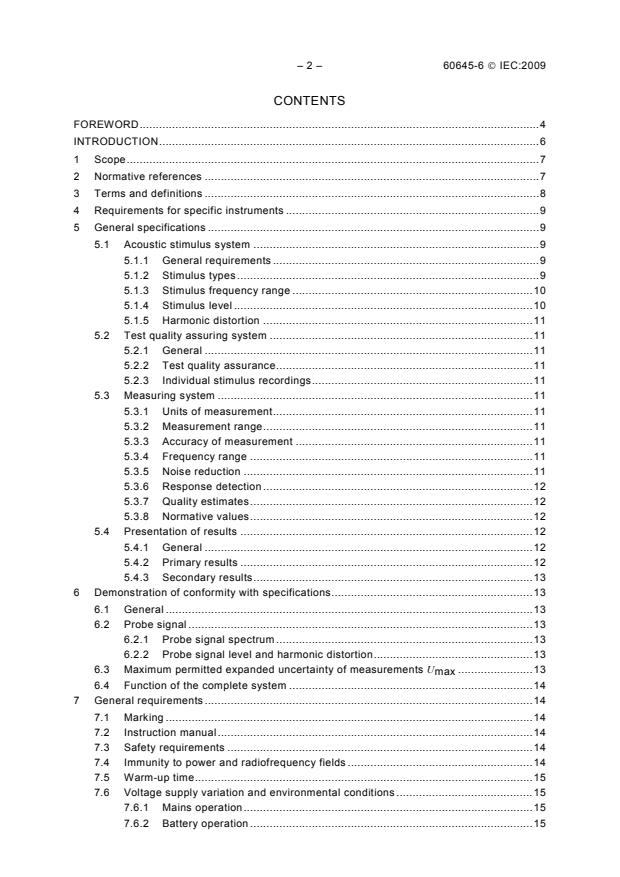
– 2 – 60645-6 © IEC:2009
CONTENTS
FOREWORD.4
INTRODUCTION.6
1 Scope.7
2 Normative references .7
3 Terms and definitions .8
4 Requirements for specific instruments .9
5 General specifications .9
5.1 Acoustic stimulus system .9
5.1.1 General requirements .9
5.1.2 Stimulus types .9
5.1.3 Stimulus frequency range .10
5.1.4 Stimulus level .10
5.1.5 Harmonic distortion .11
5.2 Test quality assuring system .11
5.2.1 General .11
5.2.2 Test quality assurance.11
5.2.3 Individual stimulus recordings.11
5.3 Measuring system .11
5.3.1 Units of measurement.11
5.3.2 Measurement range.11
5.3.3 Accuracy of measurement .11
5.3.4 Frequency range .11
5.3.5 Noise reduction .11
5.3.6 Response detection.12
5.3.7 Quality estimates.12
5.3.8 Normative values.12
5.4 Presentation of results .12
5.4.1 General .12
5.4.2 Primary results .12
5.4.3 Secondary results.13
6 Demonstration of conformity with specifications.13
6.1 General .13
6.2 Probe signal .13
6.2.1 Probe signal spectrum .13
6.2.2 Probe signal level and harmonic distortion.13
6.3 Maximum permitted expanded uncertainty of measurements U .13
max
6.4 Function of the complete system .14
7 General requirements .14
7.1 Marking .14
7.2 Instruction manual.14
7.3 Safety requirements .14
7.4 Immunity to power and radiofrequency fields .14
7.5 Warm-up time.15
7.6 Voltage supply variation and environmental conditions .15
7.6.1 Mains operation.15
7.6.2 Battery operation .15
60645-6 © IEC:2009 – 3 –
7.6.3 Environmental conditions.15
8 Additional characteristics to be specified by the manufacturer .15
9 Routine calibration .15
Bibliography.16
Table 1 – Mandatory functions for otoacoustic emission instruments .9
Table 2 – Documentation of test conditions, parameters and results .12
Table 3 – Values of U for basic measurements .14
max
– 4 – 60645-6 © IEC:2009
INTERNATIONAL ELECTROTECHNICAL COMMISSION
_____________
ELECTROACOUSTICS –
AUDIOMETRIC EQUIPMENT –
Part 6: Instruments for the measurement
of otoacoustic emissions
FOREWORD
1) The International Electrotechnical Commission (IEC) is a worldwide organization for standardization comprising
all national electrotechnical committees (IEC National Committees). The object of IEC is to promote
international co-operation on all questions concerning standardization in the electrical and electronic fields. To
this end and in addition to other activities, IEC publishes International Standards, Technical Specifications,
Technical Reports, Publicly Available Specifications (PAS) and Guides (hereafter referred to as “IEC
Publication(s)”). Their preparation is entrusted to technical committees; any IEC National Committee interested
in the subject dealt with may participate in this preparatory work. International, governmental and non-
governmental organizations liaising with the IEC also participate in this preparation. IEC collaborates closely
with the International Organization for Standardization (ISO) in accordance with conditions determined by
agreement between the two organizations.
2) The formal decisions or agreements of IEC on technical matters express, as nearly as possible, an international
consensus of opinion on the relevant subjects since each technical committee has representation from all
interested IEC National Committees.
3) IEC Publications have the form of recommendations for international use and are accepted by IEC National
Committees in that sense. While all reasonable efforts are made to ensure that the technical content of IEC
Publications is accurate, IEC cannot be held responsible for the way in which they are used or for any
misinterpretation by any end user.
4) In order to promote international uniformity, IEC National Committees undertake to apply IEC Publications
transparently to the maximum extent possible in their national and regional publications. Any divergence
between any IEC Publication and the corresponding national or regional publication shall be clearly indicated in
the latter.
5) IEC provides no marking procedure to indicate its approval and cannot be rendered responsible for any
equipment declared to be in conformity with an IEC Publication.
6) All users should ensure that they have the latest edition of this publication.
7) No liability shall attach to IEC or its directors, employees, servants or agents including individual experts and
members of its technical committees and IEC National Committees for any personal injury, property damage or
other damage of any nature whatsoever, whether direct or indirect, or for costs (including legal fees) and
expenses arising out of the publication, use of, or reliance upon, this IEC Publication or any other IEC
Publications.
8) Attention is drawn to the Normative references cited in this publication. Use of the referenced publications is
indispensable for the correct application of this publication.
9) Attention is drawn to the possibility that some of the elements of this IEC Publication may be the subject of
patent rights. IEC shall not be held responsible for identifying any or all such patent rights.
International Standard IEC 60645-6 has been prepared by IEC technical committee 29:
Electroacoustics.
The text of this standard is based on the following documents:
FDIS Report on voting
29/673/FDIS 29/681/RVD
Full information on the voting for the approval of this standard can be found in the report on
voting indicated in the above table.
This publication has been drafted in accordance with the ISO/IEC Directives, Part 2.
60645-6 © IEC:2009 – 5 –
The list of all the parts of the IEC 60645 series, under the general title Electroacoustics –
Audiometric equipment, can be found on the IEC website.
The committee has decided that the contents of this publication will remain unchanged until
the maintenance result date indicated on the IEC web site under "http://webstore.iec.ch" in
the data related to the specific publication. At this date, the publication will be
• reconfirmed;
• withdrawn;
• replaced by a revised edition, or
• amended.
– 6 – 60645-6 © IEC:2009
INTRODUCTION
Developments in the field of diagnostic hearing measurement have resulted in a number of
instruments designed to evaluate the otoacoustic emissions of the human ear evoked by
acoustic test signals having different spectral and temporal characteristics.
The practical use of such instruments concerns the measurement of sound energy emitted by
the inner ear and its separation from sounds emerging from other physiological or artificial
sources.
60645-6 © IEC:2009 – 7 –
ELECTROACOUSTICS –
AUDIOMETRIC EQUIPMENT –
Part 6: Instruments for the measurement
of otoacoustic emissions
1 Scope
This part of IEC 60645 applies to instruments designed primarily for the measurement of
otoacoustic emissions in the human external acoustic meatus evoked by acoustic probe
pulses or tones. This standard defines the characteristics to be specified by the manufacturer,
lays down performance specifications for two types of instruments and specifies the
functions to be provided on these types. This part of IEC 60645 describes methods of test to
be used for approval testing and guidance on methods for undertaking routine calibration.
The purpose of this part of IEC 60645 is to ensure that measurements made under
comparable test conditions with different instruments complying with the standard will be
consistent. Instruments which provide a measurement function not specifically within the
scope of the standard shall still comply with any relevant requirements. This standard is not
intended to restrict development or incorporation of new features, nor to discourage
innovative approaches.
2 Normative references
The following referenced documents are indispensable for the application of this document.
For dated references, only the edition cited applies. For undated references, the latest edition
of the referenced document (including any amendments) applies.
IEC 60318-4, Electroacoustics – Simulators of human head and ear – Part 4: Occluded-ear
simulator for the measurement of earphones coupled to the ear by means of ear inserts
IEC 60318-5, Electroacoustics – Simulators of human head and ear – Part 5: 2 cm coupler
for the measurement of hearing aids and earphones coupled to the ear by means of ear
inserts
IEC 60601-1, Medical electrical equipment – Part 1: General requirements for basic safety
and essential performance
IEC 60601-1-2, Medical electrical equipment – Part 1-2: General requirements for basic safety
and essential performance – Collateral standard: Electromagnetic compatibility –
Requirements and tests
IEC 60601-1-4, Medical electrical equipment – Part 1-4: General requirements for safety –
Collateral standard: Programmable electrical medical systems
IEC 60645-1:2001, Electroacoustics – Audiological equipment – Part 1: Pure-tone
audiometers
———————
Screening and full diagnostics.
To be published.
– 8 – 60645-6 © IEC:2009
IEC 60645-3:2007, Electroacoustics – Audiometric equipment – Part 3: Test signals of short
duration
ISO/IEC Guide 98-3, Uncertainty of measurement – Part 3: Guide to the expression of
uncertainty in measurement (GUM:1995)
3 Terms and definitions
For the purposes of this document, the following terms and definitions apply.
3.1
otoacoustic emissions
OAE
general term covering all types of acoustic signals generated in the inner ear which can be
recorded in the external acoustic meatus
NOTE The spontaneous otoacoustic emissions (SOAE) and stimulus frequency otoacoustic emissions (SFOAE)
which are also a part of the otoacoustic emissions are not be covered by this standard.
3.2
transient-evoked otoacoustic emissions
TEOAE
acoustic signals emitted by the inner ear after stimulation with a stimulus of short duration
3.3
distortion product otoacoustic emissions
DPOAE
acoustic signals generated in the inner ear during stimulation with two pure tones
(frequencies f and f , f being the lower frequency)
1 2 1
NOTE The frequencies of the DPOAE are given by the formulas for distortions 3f , 2f -f , 2f -f , 3f , etc.
1 1 2 2 1 2
3.4
nominal test frequency
the frequency for which a DPOAE measurement is reported
3.5
primary tones
pure tone stimuli used to evoke DPOAEs
3.6
probe
part of the instrument, usually containing transducers, interfacing the instrument to the ear
3.7
ear tip
device used to provide a seal between the probe and the external acoustic meatus
3.8
probe signal
acoustic signal that is emitted into the external auditory meatus by means of a probe
3.9
peak-to-peak equivalent sound pressure level
peSPL
r.m.s. value of a long-duration sinusoidal sound signal which, when compared under the same
test conditions with a short-duration output signal from the transducer under test, has the
60645-6 © IEC:2009 – 9 –
same peak-to-peak value (i.e., difference between the extreme positive and the extreme
negative values) as the short-duration signal
NOTE See IEC 60645-3:2007, Figure 2.
4 Requirements for specific instruments
Two different types of otoacoustic emission instrument are specified by the requirements for
minimum mandatory functions (see Table 1). Additional functions are not precluded. The two
types relate to their presumed primary application (screening and diagnostic/clinical).
Instrument types
1 Diagnostic/clinical: Adjustable stimulus and recording parameters, result shown in a
graphical format
2 Screening: Automatic testing, automatic evaluation, results as pass/refer
Table 1 – Mandatory functions for otoacoustic emission instruments
Type
1 2
Diagnostic/clinical Screening
Automatic test x x
Manual test x
Presentation of results
Display of full result x
Display of PASS/REFER x
Display of a quality measure estimate x
Display of response significance x
Digital storage of full result x
Printout x
5 General specifications
5.1 Acoustic stimulus system
5.1.1 General requirements
Specifications for the acoustic stimulus system are as given in the relevant parts of Clauses
6, 8 and 10 of IEC 60645-1:2001 and Clause 5 of IEC 60645-3:2007 with the exceptions
specified below.
NOTE If the instrument is designed to allow also the measurement of hearing thresholds, the full text of
IEC 60645-1:2001 should apply.
5.1.2 Stimulus types
5.1.2.1 General
The general properties and temporal characteristics of the acoustic stimulus signals are
specified within the following sections depending on the type of OAEs.
– 10 – 60645-6 © IEC:2009
5.1.2.2 TEOAE
The full characteristics of the short-duration signal used for the measurements of TEOAEs
shall be specified by the manufacturer (i.e., as specified in IEC 60645-3:2007).
NOTE Series of clicks with different polarity and levels are often used, usually referred to as non-linear click
series. The specifications found in IEC 60645-3 are applicable to each single click in the series.
5.1.2.3 DPOAE
The stimulus signal used for the measurement of DPOAEs shall be composed of two primary
tones, f and f . The nominal test frequency normally refers to f . If f is used as the nominal
1 2 1 2
test frequency, this shall be stated by the manufacturer. If additional test signals are used,
their full characteristics shall be specified by the manufacturer.
5.1.3 Stimulus frequency range
5.1.3.1 General
The frequency of the stimulus signals shall meet at least the requirements specified in the
following subclauses depending on the type of OAEs.
5.1.3.2 TEOAE
The stimulus shall cover the range from 0,5 kHz to 4 kHz for Type 1 instruments and the
range from 1,5 kHz to 3 kHz for Type 2 instruments.
5.1.3.3 DPOAE
For the measurement of DPOAEs, stimulus frequencies between 0,5 kHz and 8 kHz in at least
three steps per octave shall be provided in instruments of Type 1 and at least two frequencies
between 1 kHz and 4 kHz for Type 2. The frequency ratio of the two primary tones shall be
from 1:1,15 to 1:1,25. The actual frequencies shall not differ from their nominal values by
more than ±1 %.
5.1.4 Stimulus level
5.1.4.1 General
The sound pressure level of the stimulus signals shall be variable within the ranges specified
in the following clauses depending on the type of OAEs. Its actual value within the residual
ear-canal volume shall be measured prior to each recording with the probe microphone.
5.1.4.2 TEOAE
The stimulus level shall provide the range from 30 dB peSPL to 90 dB peSPL for instruments
of Type 1 and from 60 dB peSPL to 80 dB peSPL for instruments of Type 2 as measured
according to IEC 60318-4 or IEC 60318-5.
5.1.4.3 DPOAE
The levels of the primary tones under test conditions shall not deviate from the nominal levels
by more than 1,5 dB.
The stimulus levels of the primary tones shall, as a minimum, be adjustable over the range
from 0 dB SPL to 70 dB SPL for instruments of Type 1 and from 50 dB SPL to 65 dB SPL for
instruments of Type 2 at all signal frequencies as measured in an occluded-ear simulator
according to IEC 60318-4 or in a reference coupler according to IEC 60318-5. The level L
of the primary tone with the lower frequency must be equal to or higher than L but shall not
exceed 90 dB SPL.
60645-6 © IEC:2009 – 11 –
NOTE The levels should be optionally tested at regular intervals during data acquisition in instruments of Type 1.
5.1.5 Harmonic distortion
For DPOAE stimuli, the total harmonic distortion of the acoustic test signal shall be less than
0,1 %. The total cubic distortion due to non-linear interactions between the two primary tones
shall be less than 0,01 %.
NOTE No requirements are specified for TEOAE.
5.2 Test quality assuring system
5.2.1 General
The acoustic conditions in the ear canal shall be checked by the ear probe and optionally
adapted automatically to a predefined waveform and level before starting data acquisition and
after its completion. From the comparison of the initial and the final state, stability shall be
derived.
5.2.2 Test quality assurance
The following functions shall be available: ambient noise detection, leak detection, blocked
probe detection.
5.2.3 Individual stimulus recordings
An oscillogram and a frequency spectrum of the stimulus recorded in the ear canal shall be
generated and stored for TEOAE results in Type 1 instruments.
NOTE Additional intermediate oscillograms and spectra should be provided during the recording process in
instruments of Type 1.
5.3 Measuring system
5.3.1 Units of measurement
SI units or derived SI units shall be used. The units of measurement shall be indicated.
5.3.2 Measurement range
The minimum measurement range for OAE shall be from -20 dB SPL to +30 dB SPL.
5.3.3 Accuracy of measurement
The difference between indicated and actual sound pressure levels shall not exceed ±3 dB for
frequencies up to 4 kHz and ±5 dB for higher frequencies.
5.3.4 Frequency range
The frequency range shall be according to the applicable stimulus frequency range in 5.1.3.
5.3.5 Noise reduction
The ambient noise shall be reduced by at least 30 dB in the relevant frequency range when
measured in an occluded-ear simulator according to IEC 60318-4 or in a reference coupler
according to IEC 60318-5.
– 12 – 60645-6 © IEC:2009
5.3.6 Response detection
If an algorithm is used for automatic detection, the statistical significance of the algorithm
shall be validated by the manufacturer. During the measurement, a stimulus artefact rejection
system shall be used, and its characteristics shall be specified by the manufacturer.
5.3.7 Quality estimates
The method used for determination of the residual noise shall be described.
5.3.8 Normative values
If normative values are used (e.g. for calibration, PASS/REFER criteria), the source of these
values shall be stated in the instruction manual.
5.4 Presentation of results
5.4.1 General
All relevant information shall be stored and be available on demand. The information shall be
presented on display of the instrument and/or as paper printout. The explanation of the
relevant information is shown in Table 2.
Table 2 – Documentation of test conditions, parameters and results
Type
1 2
Diagnostic/clinical Screening
Stimulus level x
Recorded OAEs x
Number of artefacts x
Artefact rejection limit x
a
x
Graphic display of full result
Display of PASS/REFER x
Residual noise estimate x
OAE to noise ratio x
a
Oscillogram (TEOAE) and/or frequency spectrum (TEOAE and DPOAE), respectively.
5.4.2 Primary results
5.4.2.1 Presentation
Averaged signal, estimated residual noise and total signal (OAE and noise) separately.
5.4.2.2 TEOAE
Time domain (oscillogram).
5.4.2.3 DPOAE
Frequency domain (spectrum).
60645-6 © IEC:2009 – 13 –
5.4.3 Secondary results
5.4.3.1 TEOAE
Time slices and frequency ranges, estimated true level (noise correction), cross correlation
(reproducibility).
5.4.3.2 DPOAE
Estimated true level (corrected for noise), signal-to-noise ratio.
6 Demonstration of conformity with specifications
6.1 General
The following procedures shall be used for ensuring that an instrument meets the
specifications given in this part of IEC 60645. Guidelines for routine calibration are described
in Clause 9.
6.2 Probe signal
6.2.1 Probe signal spectrum
The probe signal spectrum shall be measured by coupling the probe to an occluded-ear
simulator or reference coupler according to IEC 60318-4 and IEC 60318-5, respectively,
according to the instructions provided by the manufacturer. The ear simulator or coupler to be
used and the method of coupling shall be stated by the manufacturer.
6.2.2 Probe signal level and harmonic distortion
The signal level and the harmonic distortion of the probe signal shall be measured by means
of an occluded-ear simulator according to IEC 60318-4 or a reference coupler according to
IEC 60318-5, to which the probe is coupled with the ear tip placed according to instructions
provided by the manufacturer.
6.3 Maximum permitted expanded uncertainty of measurements U
max
Table 3 specifies the maximum permitted expanded uncertainty U calculated with a
max
coverage factor of k = 2 to give a level of confidence of approximately 95 %, associated with
the measurements undertaken in this part of IEC 60645, according to ISO/IEC Guide 98-3.
One set of values for U is given for basic type approval measurements.
max
The expanded uncertainties of measurements given in Table 3 are the maximum permitted for
demonstration of conformance to the requirements of this part of IEC 60645. If the actual
expanded uncertainty of a measurement performed by the test laboratory exceeds the
maximum permitted value in Table 3, the measurement shall not be used to demonstrate
conformance to the requirements of this part of IEC 60645.
– 14 – 60645-6 © IEC:2009
Table 3 – Values of U for basic measurements
max
Measured Relevant Basic
quantity subclause number U (k = 2)
max
Stimulus levels 5.1.4.2, 5.1.4.3 1,0 dB
Stimulus level deviation 5.1.4.3 0,4 dB
Frequency 5.1.3.2, 5.1.3.3 0,5 %
Total harmonic distortion 5.1.5 0,05 %
Cubic distortion 5.1.5 0,005 %
Measurement range 5.3.2 1,0 dB
Accuracy of measurement up to 4 kHz 5.3.3 0,7 dB
Accuracy of measurement higher than 4 kHz 5.3.3 1,2 dB
Noise reduction 5.3.5 1,0 dB
Temperature 7.6.3
0,5 °C
Relative humidity 7.6.3 5 %
Ambient pressure 7.6.3 0,1 kPa
6.4 Function of the complete system
The function of the complete test system shall be proven by coupling the probe to an
occluded-ear simulator according to IEC 60318-4 or a reference coupler according to
IEC 60318-5, with the ear tip placed according to the instructions provided by the
manufacturer and performing the test. No response shall be detected.
NOTE If the test cannot be performed with the occluded-ear simulator or reference coupler specified above, the
manufacturer should provide the necessary information on how to perform the function test of the complete system.
7 General requirements
7.1 Marking
The instrument shall be marked with the name of the manufacturer, the type as in Clause 4,
the model and its serial number as well as the identification of the transducer(s) employed.
7.2 Instruction manual
An instruction manual shall be supplied with each instrument. In this manual the manufacturer
shall specify all characteristics as required by this part of IEC 60645.
7.3 Safety requirements
Limitations of the applications shall be specified. Instruments shall conform to IEC safety
requirements specified in IEC 60601-1 and IEC 60601-1-4.
7.4 Immunity to power and radiofrequency fields
7.4.1 Instruments shall meet the requirements of IEC 60601-1-2 for electromagnetic
compatibility (EMC).
7.4.2 During, and as a result of any EMC immunity testing, under the EMC test conditions,
the unwanted sound from any air conduction transducer shall not exceed a hearing level
corresponding to 80 dB peSPL. The manufacturer shall state the settings of the instruments.
13.3 of IEC 60645-1:2001 gives methods for showing conformity.
60645-6 © IEC:2009 – 15 –
7.5 Warm-up time
The maximum warm-up time shall be specified by the manufacturer and shall not exceed
10 min when the unit has been stored at room temperature. The performance requirements of
this part of IEC 60645 shall be met after the stated warm-up time has elapsed and after any
setting-up adjustments have been carried out in the manner prescribed by the manufacturer.
7.6 Voltage supply variation and environmental conditions
7.6.1 Mains operation
The specifications shall be met when any long-term deviation in any supply voltage or mains
frequency in combination is least favourable within the limits of ±10 % supply voltage or ±5 %
mains frequency. When any short-term line variation has occurred that affects the
performance of the instrument, the instrument shall revert to a mode that will not endanger
the subject under test, nor yield invalid results.
7.6.2 Battery operation
The manufacturer shall state the limits of battery voltages within which the specification shall
be met, and a suitable indicator shall be provided to inform the operator whether the battery
voltage is within the limits for correct performance.
7.6.3 Environmental conditions
The specifications shall be met for all combinations of temperature within the range +15 °C to
+35 °C, relative humidity within the range 30 % to 90 %, and static pressure within the range
98 kPa to 104 kPa.
8 Additional characteristics to be specified by the manufacturer
Procedures to measure the test quality according to 5.2.
9 Routine calibration
For Type 1 instruments, the following parameters shall be verified at regular intervals:
• stimulus characteristics;
• microphone response to test stimuli delivered by probe receivers.
NOTE A typical regular time interval for routine calibration is 12 months.
These parameters shall be verified by coupling the probe to an occluded-ear simulator,
according to IEC 60318-4 or a reference coupler according to IEC 60318-5, with the ear tip
placed according to the instructions and reference values provided by the manufacturer.
For Type 2 instruments the parameters listed above should be verified as described for
Type 1 instruments.
– 16 – 60645-6 © IEC:2009
Bibliography
[1] ISO 389-6, Acoustics – Reference zero for the calibration of audiometric equipment –
Part 6: Reference threshold of hearing for test signals of short duration
___________
– 18 – 60645-6 © CEI:2009
SOMMAIRE
AVANT-PROPOS.20
INTRODUCTION.22
1 Domaine d’application .23
2 Références normatives.23
3 Termes et définitions .24
4 Exigences relatives aux instruments spécifiques .25
5 Spécifications générales.25
5.1 Système de stimulus acoustique.25
5.1.1 Exigences générales .25
5.1.2 Types de stimulus.26
5.1.3 Bande de fréquence des stimuli.26
5.1.4 Niveau de stimulus .26
5.1.5 Distorsion harmonique.27
5.2 Système pour assurer la qualité des essais.27
5.2.1 Généralités.27
5.2.2 Assurance de la qualité des essais.27
5.2.3 Enregistrements des stimuli individuels .27
5.3 Système de mesure.27
5.3.1 Unités de mesure .27
5.3.2 Etendue de mesure .27
5.3.3 Exactitude de mesure .27
5.3.4 Bande de fréquences.28
5.3.5 Réduction du bruit .28
5.3.6 Détection de la réponse.28
5.3.7 Estimations de la qualité.28
5.3.8 Valeurs normatives.28
5.4 Présentation des résultats .28
5.4.1 Généralités.28
5.4.2 Résultats primaires.29
5.4.3 Résultats secondaires .29
6 Démonstration de conformité aux spécifications .29
6.1 Généralités.29
6.2 Signal de sonde .29
6.2.1 Spectre du signal de sonde .29
6.2.2 Niveau du signal de sonde et distorsion harmonique .29
6.3 Incertitude de mesures élargie maximale autorisée U .29
max
6.4 Fonctionnement du système complet.30
7 Exigences générales .30
7.1 Marquage.30
7.2 Manuel d’instructions.30
7.3 Exigences de sécurité .30
7.4 Immunité aux champs de puissance et aux champs radioélectriques .30
7.5 Temps de pré-chauffage.31
7.6 Variation de la tension d’alimentation et conditions environnementales .31
7.6.1 Fonctionnement réseau .31
7.6.2 Fonctionnement sur batterie .31
60645-6 © CEI:2009 – 19 –
7.6.3 Conditions environnementales.31
8 Caractéristiques supplémentaires à spécifier par le fabricant .31
9 Etalonnage de routine .31
Bibliographie.32
Tableau 1 – Fonctions obligatoires pour les instruments d’émission otoacoustique .25
Tableau 2 – Documentation concernant les conditions, les paramètres et les résultats
d’essai .28
Tableau 3 – Valeurs de U pour les mesures fondamentales.30
max
– 20 – 60645-6 © CEI:2009
COMMISSION ÉLECTROTECHNIQUE INTERNATIONALE
_____________
ÉLECTROACOUSTIQUE –
ÉQUIPEMENTS AUDIOMÉTRIQUES –
Partie 6: Instruments pour la mesure
des émissions otoacoustiques
AVANT-PROPOS
1) La Commission Électrotechnique Internationale (CEI) est une organisation mondiale de normalisation
composée de l'ensemble des comités électrotechniques nationaux (Comités nationaux de la CEI). La CEI a
pour objet de favoriser la coopération internationale pour toutes les questions de normalisation dans les
domaines de l'électricité et de l'électronique. A cet effet, la CEI – entre autres activités – publie des Normes
internationales, des Spécifications techniques, des Rapports techniques, des Spécifications accessibles au
public (PAS) et des Guides (ci-après dénommés "Publication(s) de la CEI"). Tout comité national de la CEI
intéressé par le sujet traité peut prendre part à ces travaux préliminaires. Des organismes internationaux,
gouvernementaux ou non gouvernementaux, opérant en relation avec la CEI participent également à cette
élaboration. La CEI collabore étroitement avec l'Organisation Internationale de Normalisation (ISO), selon des
conditions fixées par accord entre les deux organisations.
2) Les décisions ou accords officiels de la CEI concernant les questions techniques représentent, dans la mesure
du possible, un accord international sur les sujets étudiés, étant donné que les Comités nationaux de la CEI
intéressés sont représentés dans chaque comité d’études.
3) Les Publications de la CEI se présentent sous la forme de recommandations internationales et sont agréées
comme telles par les Comités nationaux de la CEI. Tous les efforts raisonnables sont entrepris afin que la CEI
s'assure de l'exactitude du contenu technique de ses publications; la CEI ne peut pas être tenue responsable
de l'éventuelle mauvaise utilisation ou interprétation qui en est faite par un quelconque utilisateur final.
4) Dans le but d'encourager l'uniformité internationale, les Comités nationaux de la CEI s'engagent, dan
...