


IEC 61360-2:2012
(Main)Standard data element types with associated classification scheme for electric components - Part 2: EXPRESS dictionary schema
General Information
- Abstract
CORRECTED VERSION 2025-03
IEC 61360-2:2012 provides a formal model for data according to the scope as given in IEC 61360-1 and ISO 13584-42. It provides a means for the computer-sensible representation and exchange of such data, allowing for the implementation of dictionary systems dealing with data delivered according to either of the standards. This third edition cancels and replaces the second edition published in 2002, and its Amendment 1 (2003). It is a technical revision. It includes the following significant technical changes:
- separation of concepts between characterization class and categorization class;
- introduction of value constraints on classes and properties;
- addition of various new subtypes for data types, including rational_type;
- improvement on the representation of unit of measurement.
IEC 61360-4, IEC reference collection of standard data element types and component classes, can be accessed from IEC CDD (Common Data Dictionary) Free access to Database. The database contains the IEC reference collection of classes and associated characteristic properties (data element types or DETs) of electric;electronic components including materials, geometry and features used in electrotechnical equipment and systems. The dictionary and database follow the methodology of Part 1 of IEC 61360 and the information model of Part 2.
IEC 61360-2:2012 has the status of a horizontal standard in accordance with IEC Guide 108.
- Status
- Published
- Publication Date
- 01-Oct-2012
- Technical Committee
- SC 3D - Classes, Properties and Identification of products - Common Data Dictionary (CDD)
- Drafting Committee
- MT 61360-2 - TC 3/SC 3D/MT 61360-2
- Current Stage
- PPUB - Publication issued
- Start Date
- 02-Oct-2012
- Completion Date
- 15-Mar-2012
Overview
IEC 61360-2:2012 is a globally recognized international standard published by the International Electrotechnical Commission (IEC). This standard specifies a formal EXPRESS dictionary schema for standardized data element types with an associated classification scheme specifically tailored for electrical components. It serves as a technical revision of previous editions, refining and extending the data model to support computer-readable representation and exchange of electrical component data.
The standard aligns with the scope defined in IEC 61360-1 and ISO 13584-42, providing a structured framework for dictionary systems. This enables efficient and consistent sharing and management of data regarding electric and electronic components across different platforms, enhancing interoperability and data integration capabilities in electrotechnical industries.
Key enhancements in the 2012 edition include clear separation between characterization and categorization classes, value constraints for classes and properties, introduction of new data type subtypes like rational_type, and improved representation of units of measurement.
Key Topics
Express Dictionary Schema: A formal data modeling language standardized by ISO, used here to define the structural schema for electrical component data.
Data Element Types (DET): Definitions of standardized attributes (properties) associated with components including characteristics, measurements, and classifications.
Classification Scheme: Organizes electrical components into categorization classes and characterization classes, aiding consistent component identification.
Value Constraints: Rules and restrictions applied to classes and properties to ensure data integrity and semantic accuracy.
Unit of Measurement Representation: Enhanced methods for defining and exchanging precise unit data to support quantitative descriptions.
Compatibility & Interoperability: The schema maintains compatibility with ISO 13584-42 for seamless integration with related standards and data dictionaries.
Language Resource Schema: Supports multilingual labels and descriptions, facilitating international use and localization of data dictionaries.
Constraint Schema: Defines domain, range, cardinality, and integrity constraints to strictly govern data validity.
Applications
IEC 61360-2:2012 and its EXPRESS dictionary schema are critical for industries and organizations that require:
Standardized Component Data Exchange: Facilitates sharing of detailed electrical component information between manufacturers, suppliers, and engineering systems.
Electrotechnical Product Cataloging: Supports the creation and management of comprehensive product databases, including the IEC Common Data Dictionary (IEC CDD).
Component Lifecycle Management: Enhances the accuracy and reliability of data used in maintenance, procurement, and replacement processes.
Design Automation and CAD Integration: Enables automated tools to interpret standardized component attributes and classifications, improving engineering productivity.
Semantic Interoperability: Helps integrate data from diverse sources into unified systems by using common data element standards.
Compliance and Regulatory Reporting: Provides structured data formats needed for certification, conformity assessment, and regulatory documentation related to electrical components.
Related Standards
IEC 61360-1: Defines the general principles and requirements for standard data element types and classification schemes for electrical components.
ISO 13584-42: Part of the ISO 13584 standard series for industrial automation systems and product data, closely related to the EXPRESS dictionary schema outlined in IEC 61360-2.
IEC 61360-4: Offers the IEC reference collection of standardized data element types and component classes accessible via the IEC Common Data Dictionary (IEC CDD).
ISO 10303-41: Provides unit definitions applied within the IEC 61360-2 schema for representing measurement units coherently.
By adhering to IEC 61360-2:2012, organizations ensure consistent, reliable, and internationally harmonized data representation for electric and electronic components, enabling effective digital communication and innovation in electrotechnical fields.
Relations
- Effective Date
- 05-Sep-2023
- Effective Date
- 05-Sep-2023
- Effective Date
- 05-Sep-2023
Frequently Asked Questions
IEC 61360-2:2012 is a standard published by the International Electrotechnical Commission (IEC). Its full title is "Standard data element types with associated classification scheme for electric components - Part 2: EXPRESS dictionary schema". This standard covers: CORRECTED VERSION 2025-03 IEC 61360-2:2012 provides a formal model for data according to the scope as given in IEC 61360-1 and ISO 13584-42. It provides a means for the computer-sensible representation and exchange of such data, allowing for the implementation of dictionary systems dealing with data delivered according to either of the standards. This third edition cancels and replaces the second edition published in 2002, and its Amendment 1 (2003). It is a technical revision. It includes the following significant technical changes: - separation of concepts between characterization class and categorization class; - introduction of value constraints on classes and properties; - addition of various new subtypes for data types, including rational_type; - improvement on the representation of unit of measurement. IEC 61360-4, IEC reference collection of standard data element types and component classes, can be accessed from IEC CDD (Common Data Dictionary) Free access to Database. The database contains the IEC reference collection of classes and associated characteristic properties (data element types or DETs) of electric;electronic components including materials, geometry and features used in electrotechnical equipment and systems. The dictionary and database follow the methodology of Part 1 of IEC 61360 and the information model of Part 2. IEC 61360-2:2012 has the status of a horizontal standard in accordance with IEC Guide 108.
CORRECTED VERSION 2025-03 IEC 61360-2:2012 provides a formal model for data according to the scope as given in IEC 61360-1 and ISO 13584-42. It provides a means for the computer-sensible representation and exchange of such data, allowing for the implementation of dictionary systems dealing with data delivered according to either of the standards. This third edition cancels and replaces the second edition published in 2002, and its Amendment 1 (2003). It is a technical revision. It includes the following significant technical changes: - separation of concepts between characterization class and categorization class; - introduction of value constraints on classes and properties; - addition of various new subtypes for data types, including rational_type; - improvement on the representation of unit of measurement. IEC 61360-4, IEC reference collection of standard data element types and component classes, can be accessed from IEC CDD (Common Data Dictionary) Free access to Database. The database contains the IEC reference collection of classes and associated characteristic properties (data element types or DETs) of electric;electronic components including materials, geometry and features used in electrotechnical equipment and systems. The dictionary and database follow the methodology of Part 1 of IEC 61360 and the information model of Part 2. IEC 61360-2:2012 has the status of a horizontal standard in accordance with IEC Guide 108.
IEC 61360-2:2012 is classified under the following ICS (International Classification for Standards) categories: 31.020 - Electronic components in general. The ICS classification helps identify the subject area and facilitates finding related standards.
IEC 61360-2:2012 has the following relationships with other standards: It is inter standard links to IEC 61360-5:2004, IEC 61360-2:2002/AMD1:2003, IEC 61360-2:2002. Understanding these relationships helps ensure you are using the most current and applicable version of the standard.
IEC 61360-2:2012 is available in PDF format for immediate download after purchase. The document can be added to your cart and obtained through the secure checkout process. Digital delivery ensures instant access to the complete standard document.
Standards Content (Sample)
IEC 61360-2 ®
Edition 3.0 2012-10
INTERNATIONAL
STANDARD
NORME
INTERNATIONALE
HORIZONTAL STANDARD
NORME HORIZONTALE
Standard data element types with associated classification scheme for electric
components –
Part 2: EXPRESS dictionary schema
Types normalisés d'éléments de données avec plan de classification pour
composants électriques –
Partie 2: Schéma d'un dictionnaire EXPRESS
All rights reserved. Unless otherwise specified, no part of this publication may be reproduced or utilized in any form
or by any means, electronic or mechanical, including photocopying and microfilm, without permission in writing from
either IEC or IEC's member National Committee in the country of the requester.
If you have any questions about IEC copyright or have an enquiry about obtaining additional rights to this publication,
please contact the address below or your local IEC member National Committee for further information.
Droits de reproduction réservés. Sauf indication contraire, aucune partie de cette publication ne peut être reproduite ni
utilisée sous quelque forme que ce soit et par aucun procédé, électronique ou mécanique, y compris la photocopie et les
microfilms, sans l'accord écrit de la CEI ou du Comité national de la CEI du pays du demandeur.
Si vous avez des questions sur le copyright de la CEI ou si vous désirez obtenir des droits supplémentaires sur cette
publication, utilisez les coordonnées ci-après ou contactez le Comité national de la CEI de votre pays de résidence.
IEC Central Office Tel.: +41 22 919 02 11
3, rue de Varembé Fax: +41 22 919 03 00
CH-1211 Geneva 20 info@iec.ch
Switzerland www.iec.ch
About the IEC
The International Electrotechnical Commission (IEC) is the leading global organization that prepares and publishes
International Standards for all electrical, electronic and related technologies.
About IEC publications
The technical content of IEC publications is kept under constant review by the IEC. Please make sure that you have the
latest edition, a corrigenda or an amendment might have been published.
Useful links:
IEC publications search - www.iec.ch/searchpub Electropedia - www.electropedia.org
The advanced search enables you to find IEC publications The world's leading online dictionary of electronic and
by a variety of criteria (reference number, text, technical electrical terms containing more than 30 000 terms and
committee,…). definitions in English and French, with equivalent terms in
It also gives information on projects, replaced and additional languages. Also known as the International
withdrawn publications. Electrotechnical Vocabulary (IEV) on-line.
IEC Just Published - webstore.iec.ch/justpublished Customer Service Centre - webstore.iec.ch/csc
Stay up to date on all new IEC publications. Just Published If you wish to give us your feedback on this publication
details all new publications released. Available on-line and or need further assistance, please contact the
also once a month by email. Customer Service Centre: csc@iec.ch.
A propos de la CEI
La Commission Electrotechnique Internationale (CEI) est la première organisation mondiale qui élabore et publie des
Normes internationales pour tout ce qui a trait à l'électricité, à l'électronique et aux technologies apparentées.
A propos des publications CEI
Le contenu technique des publications de la CEI est constamment revu. Veuillez vous assurer que vous possédez
l’édition la plus récente, un corrigendum ou amendement peut avoir été publié.
Liens utiles:
Recherche de publications CEI - www.iec.ch/searchpub Electropedia - www.electropedia.org
La recherche avancée vous permet de trouver des Le premier dictionnaire en ligne au monde de termes
publications CEI en utilisant différents critères (numéro de électroniques et électriques. Il contient plus de 30 000
référence, texte, comité d’études,…). termes et définitions en anglais et en français, ainsi que
Elle donne aussi des informations sur les projets et les les termes équivalents dans les langues additionnelles.
publications remplacées ou retirées. Egalement appelé Vocabulaire Electrotechnique
International (VEI) en ligne.
Just Published CEI - webstore.iec.ch/justpublished
Service Clients - webstore.iec.ch/csc
Restez informé sur les nouvelles publications de la CEI.
Just Published détaille les nouvelles publications parues. Si vous désirez nous donner des commentaires sur
Disponible en ligne et aussi une fois par mois par email. cette publication ou si vous avez des questions
contactez-nous: csc@iec.ch.
IEC 61360-2 ®
Edition 3.0 2012-10
INTERNATIONAL
STANDARD
NORME
INTERNATIONALE
HORIZONTAL STANDARD
NORME HORIZONTALE
Standard data element types with associated classification scheme for electric
components –
Part 2: EXPRESS dictionary schema
Types normalisés d'éléments de données avec plan de classification pour
composants électriques –
Partie 2: Schéma d'un dictionnaire EXPRESS
INTERNATIONAL
ELECTROTECHNICAL
COMMISSION
COMMISSION
ELECTROTECHNIQUE
INTERNATIONALE
ICS 31.020 ISBN 978-2-83220-321-7
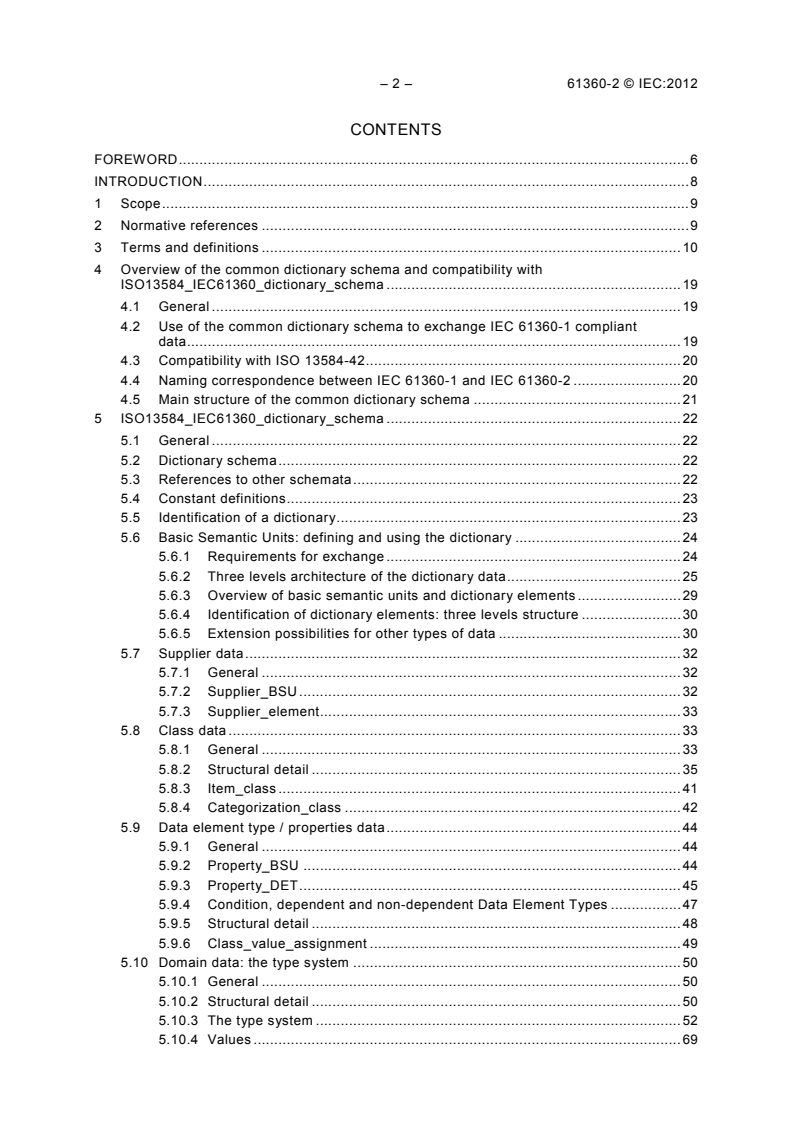
– 2 – 61360-2 © IEC:2012
CONTENTS
FOREWORD . 6
INTRODUCTION . 8
1 Scope . 9
2 Normative references . 9
3 Terms and definitions . 10
4 Overview of the common dictionary schema and compatibility with
ISO13584_IEC61360_dictionary_schema . 19
4.1 General . 19
4.2 Use of the common dictionary schema to exchange IEC 61360-1 compliant
data . 19
4.3 Compatibility with ISO 13584-42 . 20
4.4 Naming correspondence between IEC 61360-1 and IEC 61360-2 . 20
4.5 Main structure of the common dictionary schema . 21
5 ISO13584_IEC61360_dictionary_schema . 22
5.1 General . 22
5.2 Dictionary schema . 22
5.3 References to other schemata . 22
5.4 Constant definitions . 23
5.5 Identification of a dictionary . 23
5.6 Basic Semantic Units: defining and using the dictionary . 24
5.6.1 Requirements for exchange . 24
5.6.2 Three levels architecture of the dictionary data . 25
5.6.3 Overview of basic semantic units and dictionary elements . 29
5.6.4 Identification of dictionary elements: three levels structure . 30
5.6.5 Extension possibilities for other types of data . 30
5.7 Supplier data . 32
5.7.1 General . 32
5.7.2 Supplier_BSU . 32
5.7.3 Supplier_element. 33
5.8 Class data . 33
5.8.1 General . 33
5.8.2 Structural detail . 35
5.8.3 Item_class . 41
5.8.4 Categorization_class . 42
5.9 Data element type / properties data . 44
5.9.1 General . 44
5.9.2 Property_BSU . 44
5.9.3 Property_DET . 45
5.9.4 Condition, dependent and non-dependent Data Element Types . 47
5.9.5 Structural detail . 48
5.9.6 Class_value_assignment . 49
5.10 Domain data: the type system . 50
5.10.1 General . 50
5.10.2 Structural detail . 50
5.10.3 The type system . 52
5.10.4 Values . 69
61360-2 © IEC:2012 – 3 –
5.10.5 Structural detail . 69
5.10.6 Extension to ISO 10303-41 unit definitions . 74
5.11 Basic type and entity definitions . 75
5.11.1 Basic type definitions . 75
5.11.2 Structural detail . 75
5.11.3 Basic entity definitions . 85
5.12 Function definitions . 89
5.12.1 General . 89
5.12.2 Acyclic_superclass_relationship function . 89
5.12.3 Check_syn_length function . 90
5.12.4 Codes_are_unique function . 90
5.12.5 Definition_available_implies function . 91
5.12.6 Is_subclass function . 91
5.12.7 String_for_derived_unit function . 92
5.12.8 String_for_named_unit function . 94
5.12.9 String_for_SI_unit function . 94
5.12.10 String_for_unit function . 96
5.12.11 All_class_descriptions_reachable function . 96
5.12.12 Compute_known_visible_properties function . 97
5.12.13 Compute_known_visible_data_types function . 97
5.12.14 Compute_known_applicable_properties function . 98
5.12.15 Compute_known_applicable_data_types function . 99
5.12.16 List_to_set function . 100
5.12.17 Check_properties_applicability function . 100
5.12.18 Check_datatypes_applicability function . 101
5.12.19 One_language_per_translation function . 102
5.12.20 Allowed_values_integer_types function . 102
5.12.21 Is_class_valued_property function . 103
5.12.22 Class_value_assigned function . 103
6 ISO13584_IEC61360_language_resource_schema . 104
6.1 Overview . 104
6.2 ISO13584_IEC61360_language_resource_schema type and entity definitions . 105
6.2.1 general . 105
6.2.2 Language_code . 105
6.2.3 Global_language_assignment . 106
6.2.4 Present_translations . 106
6.2.5 Translatable_label . 107
6.2.6 Translated_label . 107
6.2.7 Translatable_text . 107
6.2.8 Translated_text. 108
6.3 ISO13584_IEC61360_language_resource_schema function definitions . 108
6.3.1 General . 108
6.3.2 Check_label_length function . 108
6.4 ISO13584_IEC61360_language_resource_schema rule definition . 109
7 ISO13584_IEC61360_class_constraint_schema . 109
7.1 General . 109
7.2 Introduction to the ISO13584_IEC61360_class_constraint_schema . 110
7.3 ISO13584_IEC61360_class_constraint_schema entity definitions. 111
7.3.1 General . 111
– 4 – 61360-2 © IEC:2012
7.3.2 Constraint . 111
7.3.3 Property_constraint . 112
7.3.4 Class_constraint . 112
7.3.5 Configuration_control_constraint . 112
7.3.6 Filter . 113
7.3.7 Integrity_constraint . 114
7.3.8 Context_restriction_constraint . 115
7.3.9 Domain_constraint . 115
7.3.10 Subclass_constraint . 116
7.3.11 Entity_subtype_constraint . 116
7.3.12 Enumeration_constraint . 116
7.3.13 Range_constraint . 118
7.3.14 String_size_constraint . 119
7.3.15 String_pattern_constraint . 119
7.3.16 Cardinality_constraint . 120
7.4 ISO13584_IEC61360_class_constraint_schema type definitions . 121
7.4.1 General . 121
7.4.2 Constraint_or_constraint_id . 121
7.5 ISO13584_IEC61360_class_constraint_schema function definition . 121
7.5.1 General . 121
7.5.2 Integer_values_in_range function . 121
7.5.3 Correct_precondition function . 122
7.5.4 Correct_constraint_type function . 122
7.5.5 Compatible_data_type_and_value function . 125
7.6 ISO13584_IEC61360_class_constraint_schema rule definition . 129
7.6.1 General . 129
7.6.2 Unique_constraint_id . 129
8 ISO13584_IEC61360_item_class_case_of_schema . 129
8.1 Overview . 129
8.2 Introduction to the ISO13584_IEC61360_item_class_case_of_schema . 130
8.3 ISO13584_IEC61360_item_class_case_of_schema entity definitions . 130
8.3.1 A priori semantic relationship. 130
8.3.2 Item_class_case_of . 133
8.4 ISO13584_IEC61360_item_class_case_of_schema function definitions . 135
8.4.1 General . 135
8.4.2 Compute_known_property_constraints function . 135
8.4.3 Compute_known_referenced_property_constraints function . 136
8.4.4 Superclass_of_item_is_item function . 137
8.4.5 Check_is_case_of_referenced_classes_definition function . 138
8.5 ISO13584_IEC61360_item_class_case_of_schema rule definitions . 138
8.5.1 General . 138
8.5.2 Imported_properties_are_visible_or_applicable_rule rule . 138
8.5.3 Imported_data_types_are_visible_or_applicable_rule rule . 139
8.5.4 Allowed_named_type_usage_rule rule . 139
Annex A (informative) Example physical file . 141
Annex B (informative) EXPRESS-G Diagram . 146
Annex C (informative) Partial dictionaries . 157
Annex D (normative) Value format specification . 158
61360-2 © IEC:2012 – 5 –
Bibliography . 173
Figure 1 – Overview of the dictionary schema . 21
Figure 2 – Pieces of data with relationships . 25
Figure 3 – Implementation of "inter-piece" relationships using basic semantic units . 26
Figure 4 – Relationship between basic semantic unit and dictionary element . 29
Figure 5 – Current BSUs and dictionary elements . 30
Figure 6 – Overview of supplier data and relationships . 32
Figure 7 – Overview of class data and relationships . 34
Figure 8 – Example of a supplier ontology . 43
Figure 9 – Overview of property data element type data and relationships . 47
Figure 10 – Kinds of data element types . 47
Figure 11 – Entity hierarchy for the type system . 50
Figure 12 – Overview of non-quantitative data element types. 69
Figure 13 – ISO13584_IEC61360_language_resource_schema and
support_resource_schema . 105
Figure B.1 – ISO13584_IEC61360_dictionary_schema – EXPRESS-G diagram 1 of 7 . 147
Figure B.2 – ISO13584_IEC61360_dictionary_schema – EXPRESS-G diagram 2 of 7 . 148
Figure B.3 – ISO13584_IEC61360_dictionary_schema – EXPRESS-G diagram 3 of 7 . 149
Figure B.4 – ISO13584_IEC61360_dictionary_schema EXPRESS-G diagram 4 of 7 . 150
Figure B.5 – ISO13584_IEC61360_dictionary_schema – EXPRESS-G diagram 5 of 7 . 151
Figure B.6 – ISO13584_IEC61360_dictionary_schema – EXPRESS-G diagram 6 of 7 . 152
Figure B.7 – ISO13584_IEC61360_dictionary_schema – EXPRESS-G diagram 7 of 7 . 153
Figure B.8 – ISO13584_IEC61360_language_resource_schema – EXPRESS-G
diagram 1 of 1. 154
Figure B.9 – ISO13584_IEC61360_constraint_schema – EXPRESS-G diagram 1 of 1 . 155
Figure B.10 – ISO13584_IEC61360_item_class_case_of_schema – EXPRESS-G
diagram 1 of 1. 156
Table 1 – Cross refernce table . 20
Table D.1 – ISO/IEC 14977 EBNF syntactic metalanguage . 159
Table D.2 – Transposing European style digits into Arabic digits . 166
Table D.3 – Number value examples. 167
Table D.4 – Characters from other rows of the Basic Multilingual Plane of
ISO/IEC 10646-1 . 168
– 6 – 61360-2 © IEC:2012
INTERNATIONAL ELECTROTECHNICAL COMMISSION
____________
STANDARD DATA ELEMENT TYPES WITH ASSOCIATED
CLASSIFICATION SCHEME FOR ELECTRIC COMPONENTS –
Part 2: EXPRESS dictionary schema
FOREWORD
1) The International Electrotechnical Commission (IEC) is a worldwide organization for standardization comprising
all national electrotechnical committees (IEC National Committees). The object of IEC is to promote
international co-operation on all questions concerning standardization in the electrical and electronic fields. To
this end and in addition to other activities, IEC publishes International Standards, Technical Specifications,
Technical Reports, Publicly Available Specifications (PAS) and Guides (hereafter referred to as “IEC
Publication(s)”). Their preparation is entrusted to technical committees; any IEC National Committee interested
in the subject dealt with may participate in this preparatory work. International, governmental and non-
governmental organizations liaising with the IEC also participate in this preparation. IEC collaborates closely
with the International Organization for Standardization (ISO) in accordance with conditions determined by
agreement between the two organizations.
2) The formal decisions or agreements of IEC on technical matters express, as nearly as possible, an international
consensus of opinion on the relevant subjects since each technical committee has representation from all
interested IEC National Committees.
3) IEC Publications have the form of recommendations for international use and are accepted by IEC National
Committees in that sense. While all reasonable efforts are made to ensure that the technical content of IEC
Publications is accurate, IEC cannot be held responsible for the way in which they are used or for any
misinterpretation by any end user.
4) In order to promote international uniformity, IEC National Committees undertake to apply IEC Publications
transparently to the maximum extent possible in their national and regional publications. Any divergence
between any IEC Publication and the corresponding national or regional publication shall be clearly indicated in
the latter.
5) IEC itself does not provide any attestation of conformity. Independent certification bodies provide conformity
assessment services and, in some areas, access to IEC marks of conformity. IEC is not responsible for any
services carried out by independent certification bodies.
6) All users should ensure that they have the latest edition of this publication.
7) No liability shall attach to IEC or its directors, employees, servants or agents including individual experts and
members of its technical committees and IEC National Committees for any personal injury, property damage or
other damage of any nature whatsoever, whether direct or indirect, or for costs (including legal fees) and
expenses arising out of the publication, use of, or reliance upon, this IEC Publication or any other IEC
Publications.
8) Attention is drawn to the Normative references cited in this publication. Use of the referenced publications is
indispensable for the correct application of this publication.
9) Attention is drawn to the possibility that some of the elements of this IEC Publication may be the subject of
patent rights. IEC shall not be held responsible for identifying any or all such patent rights.
International Standard IEC 61360-2 has been prepared by subcommittee 3D: Product
properties and classes and their identification, of IEC technical committee 3: Information
structures, documentation and graphical symbols.
It has the status of a horizontal standard in accordance with IEC Guide 108.
This third edition cancels and replaces the second edition published in 2002, and its
Amendment 1 (2003). It is a technical revision.
This edition includes the following significant technical changes with respect to the previous
edition:
– separation of concepts between characterization class and categorization class;
– introduction of value constraints on classes and properties;
– addition of various new subtypes for data types, including rational_type;
– improvement on the representation of unit of measurement.
61360-2 © IEC:2012 – 7 –
The text of this standard is based on the following documents:
FDIS Report on voting
3D/196/FDIS 3D/204/RVD
Full information on the voting for the approval of this standard can be found in the report on
voting indicated in the above table.
This publication has been drafted in accordance with the ISO/IEC Directives, Part 2.
A list of all parts of the IEC 61360 series can be found, under the general title Standard data
elements types with associated classification scheme for electric components, on the IEC
website.
The committee has decided that the contents of this publication will remain unchanged until
the stability date indicated on the IEC web site under "http://webstore.iec.ch" in the data
related to the specific publication. At this date, the publication will be
• reconfirmed,
• withdrawn,
• replaced by a revised edition, or
• amended.
– 8 – 61360-2 © IEC:2012
INTRODUCTION
The common ISO/IEC dictionary schema presented here is based on the intersection of the
scopes of the following standards:
– IEC 61360-1;
– ISO 13584-42.
Relevant parts of the scope clauses of these standards include the following:
IEC 61360-1:2009
“This part of IEC 61360 provides a firm basis for the clear and unambiguous definition of
characteristic properties (data element types) of all elements of electrotechnical systems from
basic components to subassemblies and full systems. Although originally conceived in the
context of providing a basis for the exchange of information on electric/electronic components,
the principles and methods of this standard may be used in areas outside the
originalconception such as assemblies of components and electrotechnical systems and
subsystems.”
ISO 13584-42:2010
“This part of ISO 13584 specifies the principles to be used for defining characterization
classes of parts and properties of parts which provide for characterizing a part independently
of any particular supplier-defined identification.
The rules and guidelines provided in this part of ISO 13584 are mandatory for the
standardization committees responsible for creating standardized characterization hierarchies.
The use of these rules by suppliers and users is recommended as a methodology for building
their own hierarchies.”
IEC SC3D and ISO TC184/SC4 agreed NOT to change and/or modify the presented
EXPRESS model independent of each other in order to guarantee the harmonization and the
reusability of the work from both committees. Requests for amendments should therefore be
sent to both committees. These requests should be adopted by both committees before
modifying the EXPRESS information model
61360-2 © IEC:2012 – 9 –
STANDARD DATA ELEMENT TYPES WITH ASSOCIATED
CLASSIFICATION SCHEME FOR ELECTRIC COMPONENTS –
Part 2: EXPRESS dictionary schema
1 Scope
This part of IEC 61360 series provides a formal model for data according to the scope as
given in IEC 61360-1 and ISO 13584-42, and thus provides a means for the computer-
sensible representation and exchange of such data.
The intention is to provide a common information model for the work of IEC SC3D and
ISO TC184/SC4, thus allowing for the implementation of dictionary systems dealing with data
delivered according to either of the standards elaborated by both committees.
The scope of this part of IEC 61360 is the common ISO/IEC dictionary schema based on the
intersection of the scopes of the two base standards IEC 61360-1 and ISO 13584-42.
The presented EXPRESS model represents a common formal model for the two standards
and facilitates a harmonization of both.
The IEC 61360-2 forms the master document. ISO 13584-42 contains a copy of the
IEC 61360-2 EXPRESS model in an informative annex
In a number of clauses, where the common EXPRESS model allows more freedom, IEC has
defined more restrictions which are found in the methodology part of IEC 61360-1.
Two schemas are provided in this part of IEC 61360 defining the two options that may be
selected for an implementation. Each of these options is referred to as a conformance class.
– The ISO13584_IEC61360_dictionary_schema2 provides for modelling and
exchanging technical data element types with associated classification scheme used in the
data element type definitions. It constitutes conformance class 1 of this part of IEC 61360.
– The ISO13584_IEC61360_language_resource_schema provides resources for permitting
strings in various languages. It has been extracted from the dictionary schema, since it
could be used in other schemata. It is largely based on the support_resource_schema from
ISO 10303-41:2000, and can be seen as an extension to that. It allows for the usage of one
specific language throughout an exchange context (physical file) without the overhead introduced
when multiple languages are used.
When used together with ISO 10303-21, each schema defines one single exchange format.
The exchange format defined by conformance class 1 is fully compatible with the ISO 13584
series.
2 Normative references
The following referenced documents are indispensable for the application of this document.
For dated references, only the edition cited applies. For undated references, the latest edition
of the referenced document (including any amendments) applies.
IEC 61360-1:2009, Standard data elements types with associated classification scheme for
electric items – Part 1: Definitions – Principles and methods
– 10 – 61360-2 © IEC:2012
IEC 61360-DB, Standard data element types with associated classification scheme for electric
components – Part 4: IEC reference collection of standard data element types and component
classes
ISO/IEC 8859-1:1998, Information techonology – 8-bit single-byte coded graphic character
sets – Part 1: Latin alphabet No. 1
ISO/IEC 10646-1, Information technology – Universal Multiple-Octet Coded Character Set
(UCS) – Part 1: Architecture and Basic Multilingual Plane
ISO/IEC 14977, Information technology – Syntactic metalanguage – Extended BNF
ISO 639 (all parts), Codes for the representation of names of languages
ISO 843:1997, Information and documentation – Conversion of Greek characters into Latin
characters
ISO 3166-1, Codes for the representation of names of countries and their subdivisions –
Part 1: Country codes
ISO 4217:2008, Codes for the representation of currencies and funds
ISO 8601:2004, Data elements and interchange formats – Information interchange –
Representation of dates and times
ISO 10303-11:2004, Industrial automation systems and integration – Product data
representation and exchange – Part 11: Description methods: The EXPRESS language
reference manual
ISO 10303-21:2002, Industrial automation systems and integration – Product data
representation and exchange – Part 21: Implementation methods: Clear text encoding of the
exchange structure
ISO 10303-41:2000, Industrial automation systems and integration – Product data
representation and exchange – Part 41: Integrated generic resources: Fundamentals of
product description and support
ISO 13584-26:2000, Industrial automation systems and integration – Parts library – Part 26:
Logical resource: Information supplier identification
ISO 13584-42:2010, Industrial automation systems and integration – Parts library – Part 42:
Description methodology: Methodology for structuring parts families
3 Terms and definitions
For the purposes of this document, the following terms and definitions apply.
3.1
abstract class
class of which all members are also members of one of its subclasses
___________
A new edition of ISO 10303-41 was published in 2005.
61360-2 © IEC:2012 – 11 –
Note 1 to entry: Abstract classes are used when it is needed to group different kinds of objects in a class of a
class inclusion hierarchy.
Note 2 to entry: In the common ISO13584/IEC61360 dictionary model, both abstract categorization classes and
abstract characterization classes can be defined. The fact of being abstract is only a conceptual characteristic of a
class. This characteristic is not explicitly represented in the model.
Note 3 to entry: Through inheritance, abstract characterization class allows to share, for example, some visible
properties between different subclasses that correspond to different kinds of items.
3.2
applicable property of a class
applicable property necessarily possessed by each part that is member of a characterization
class
Note 1 to entry: Each part that is member of a characterization class possesses an aspect corresponding to each
applicable property of this characterization class.
Note 2 to entry: The above definition is conceptual, there is no requirement that all the applicable properties of a
class should be used for describing each part of this class at the data model level.
Note 3 to entry: All the applicable properties of a superclass are also applicable properties for the subclasses of
this superclass.
Note 4 to entry: Only properties defined or inherited as visible and imported properties of a class may be
applicable properties.
Note 5 to entry: To facilitate integration of component libraries and electronic catalogues based on
ISO 13584-24:2003 and ISO 13584-25, these parts of ISO 13584 request that only properties that are applicable to
a class be used to characterize their instances in component libraries and electronic catalogues.
3.3
attribute
data element for the computer-sensible description of a property, a relation or a class
Note 1 to entry: An attribute describes only one single detail of a property, of a class or of a relation.
EXAMPLE The name of a property, the code of a class, the measure unit in which values of a property are
provided.
3.4
basic semantic unit
entity that provides an absolute and universally unique identification of a certain object of the
application domain that is represented as a dictionary element
EXAMPLE 1 A dictionary compliant with this part of IEC 61360 provides for the identification of classes,
properties, information sources and datatypes.
EXAMPLE 2 A dictionary compliant with ISO 13584-24:2003 provides for the identification of classes, properties,
information sources, datatypes, tables, documents and program libraries.
EXAMPLE 3 In ISO 13584-511, the class of the hexagon head bolts is identified by a BSU, the property thread
tolerance grade is also identified by a BSU.
Note 1 to entry: The content of a basic semantic unit may also be represented as an IRDI.
3.5
characteristic of a product
product characteristic
invariable property, characteristic of a product, whose value is fixed once the product is
defined
Note 1 to entry: Changing the value of a characteristic of a product would mean changing the product.
EXAMPLE For a ball bearing, the inner diameter and the outer diameter are product characteristics.
Note 2 to entry: Adapted from ISO 13584-24:2003, definition 3.12.
– 12 – 61360-2 © IEC:2012
3.6
class
abstraction of a set of similar products
Note 1 to entry: A product that complies with the abstraction defined by a class is called a class member.
Note 2 to entry: A class is an intentional concept that can take different extensional meanings in different
contexts.
EXAMPLE The set of products used by a particular enterprise and the set of all ISO-standardized products are
two examples of contexts. In these two contexts (the particular enterprise and ISO), the set of products that are
considered as members of the single ball bearing class can be different, in particular because employees of each
enterprise ignore a number of existing single ball bearing products.
Note 3 to entry: Classes are structured by class inclusion relationships.
Note 4 to entry: A class of products is a general concept as defined in ISO 1087-1. Thus, it is advisable that the
rules defined in ISO 704 be used for defining the designation and definition attributes of classes of products.
Note 5 to entry: In the context of the ISO 13584 series, a class is either a characterization class, associated with
properties and usable for characterizing products, or a categorization class, not associated with properties and not
usable for characterizing products.
3.7
class inclusion relationship
relationship between classes that means inclusion of class members: if A is a superclass of
A1 this means that, in any context, any member of A1 is also member of A
EXAMPLE 1 The set of products used by a particular enterprise and the set of all ISO-standardized products are
two examples of contexts.
EXAMPLE 2 In any context, the class capacitor includes the class electrolytic capacitor.
Note 1 to entry: Class inclusion defines a hierarchical structure between classes.
Note 2 to entry: Class inclusion is a conceptual relationship that does not prescribe anything at the data
representation level. Consequently, it does not prescribe any particular database schema or data model.
Note 3 to entry: In the model defined in this part of IEC 61360, the “is-a” relationship ensures class inclusion.
This part of IEC 61360 recommends that the “case-of” relationship also ensure class inclusion.
Note 4 to entry: The class inclusion relationship is also called subsumption.
3.8
class member
product that complies with the abstraction defined by a class
3.9
class valued property
property that has one single value for a whole characterization class of products
Note 1 to entry: The value of a class valued property is not defined individually for every single product of a
characterization class, but globally for the class itself.
Note 2 to entry: When all products from a characterization class of products have the same value for a particular
property, defining this property as a class valued property permits to avoid duplication of the value for each
instance.
Note 3 to entry: Class valued properties can also be used to capture some commonality between different
characterization classes when such a commonality is not captured by the hierarchy structure.
3.10
common ISO13584/IEC61360 dictionary model
data model for product ontology, using the information modeling language EXPRESS,
resulting from a joint effort between ISO/TC 184/SC 4/WG 2 and IEC SC3D
Note 1 to entry: Several levels of allowed implementations, known as conformance classes, are defined for the
common ISO13584/IEC61360 dictionary model. Conformance class 1 consists of the various schemes documented
61360-2 © IEC:2012 – 13 –
in this part of IEC 61360 (that duplicate information contained in this standard), more the
ISO13584_IEC61360_dictionary_aggregate_extension_schema documented in ISO 13584-25 (duplicated in
I
...