

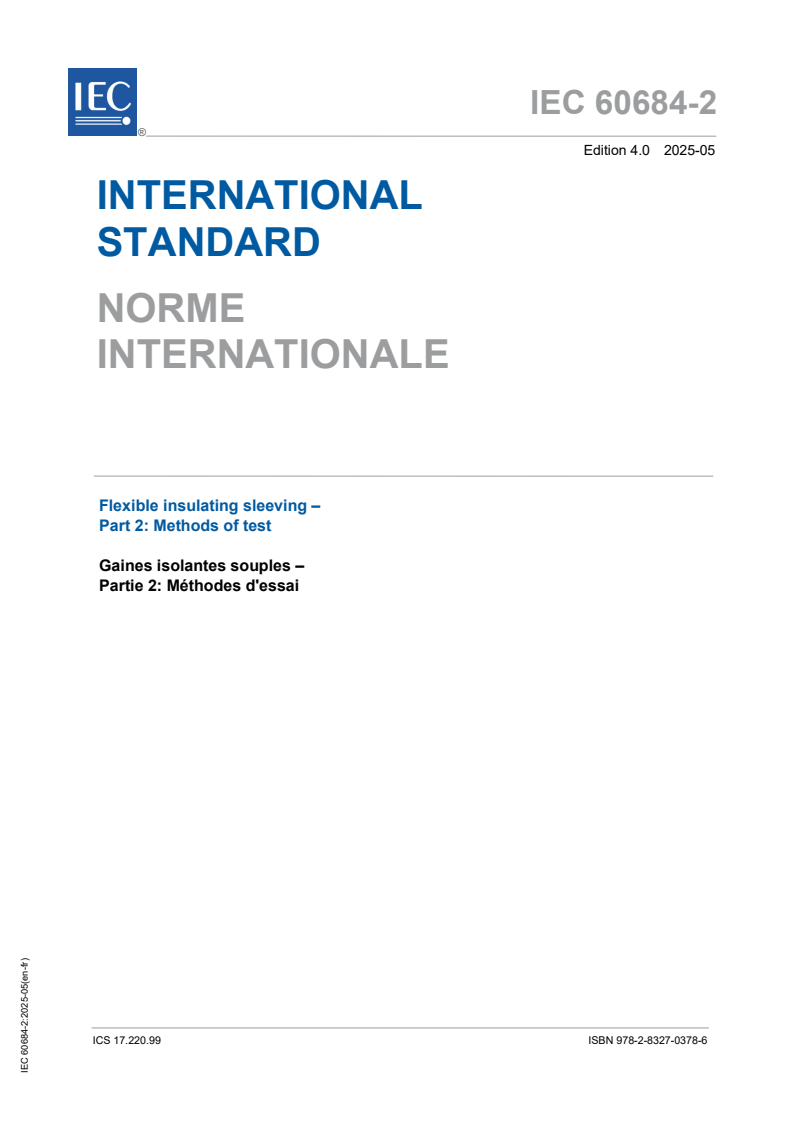
IEC 60684-2:2025
(Main)Flexible insulating sleeving - Part 2: Methods of test
General Information
- Abstract
IEC 60684-2:2025 gives methods of test for flexible insulating sleeving, including heat-shrinkable sleeving, intended primarily for insulating electrical conductors and connections of electrical apparatus, although they can be used for other purposes. The tests specified are designed to control the quality of the sleeving but it is recognized that they do not completely establish the suitability of sleeving for impregnation or encapsulation processes or for other specialized applications. Where necessary, the test methods in this document will be supplemented by appropriate impregnation or compatibility tests to suit the individual circumstances. This fourth edition cancels and replaces the third edition published in 2011.This edition constitutes a technical revision.
This edition includes the following significant technical changes with respect to the previous edition:
a) major update of normative references;
b) revision of Clause 5, with amendment of methods for measurements of bore and wall thickness;
c) revision of Clause 11, to clarify that the longitudinal change test is done on expanded sleeving;
d) revision of Clause 28, additional method D for flame propagation testing;
e) revision of Clause 56, additional method for preparation of samples for adhesive peel test;
f) addition of Clause 63, abrasion test method;
g) addition of Clause 64, volume resistivity for semi-conducting materials;
h) addition of Clause 65, outgassing;
i) addition of Clause 66, resistance to weathering.
- Status
- Published
- Publication Date
- 08-May-2025
- Technical Committee
- TC 15 - Solid electrical insulating materials
- Drafting Committee
- WG 5 - TC 15/WG 5
- Current Stage
- PPUB - Publication issued
- Start Date
- 09-May-2025
- Completion Date
- 23-May-2025
Buy Documents
REDLINE IEC 60684-2:2025 RLV - Flexible insulating sleeving - Part 2: Methods of test/9/2025
IEC 60684-2:2025 - Flexible insulating sleeving - Part 2: Methods of test Released:5/9/2025
Overview
IEC 60684-2:2025 is the fourth edition of the International Standard specifying test methods for flexible insulating sleeving, including heat-shrinkable varieties. Produced by the International Electrotechnical Commission (IEC), this standard focuses on ensuring the quality of sleeving intended primarily for insulating electrical conductors and connections within electrical apparatus. While it covers a broad range of test methods to assess physical and electrical properties, it acknowledges that specialized applications like impregnation or encapsulation require additional testing beyond this standard.
This edition brings significant technical updates, revising measurement methods and introducing new tests such as abrasion resistance, volume resistivity for semi-conductive materials, outgassing, and weathering resistance. IEC 60684-2:2025 serves as a critical reference for manufacturers and quality control laboratories aiming to comply with international benchmarks in insulated sleeving performance and reliability.
Key Topics
- Scope and Terminology: Defines the types of flexible insulating sleeving covered, establishing terms and definitions critical for standard testing protocols.
- Test Conditions: Outlines standard, elevated, and low-temperature conditions under which tests should be conducted to simulate various operating environments.
- Dimensional Measurements: Updated methods for measuring bore size, wall thickness, and concentricity ensure accurate characterization of sleeving geometry.
- Mechanical Tests: Includes resistance to splitting, bending flexibility at varied temperatures, deformation under load, abrasion resistance, and tensile strength measurements.
- Thermal and Electrical Properties: Evaluates heat shock resistance, tensile stress and elongation, thermal stability, volume resistivity for semi-conducting materials, and loss in mass on heating.
- Additional Evaluations: New tests such as flame propagation, adhesive peel strength, outgassing, resistance to weathering, and hydrolysis of coatings support comprehensive quality assurance.
- Sample Preparation Procedures: Standardizes methods for preparing test specimens to ensure repeatability and reliability of test results.
Applications
IEC 60684-2:2025 is indispensable for:
- Manufacturers of Flexible Insulating Sleeving: To verify compliance with international quality criteria, ensuring products perform safely and effectively under varied electrical and environmental conditions.
- Electrical and Electronics Industry: For reliable insulation of conductors and connections within devices requiring durable and heat-resistant sleeving.
- Quality Assurance and Testing Laboratories: Providing standardized test methods to assess mechanical, thermal, and electrical properties of sleeving materials.
- Design and Engineering Professionals: Assisting in material selection by referencing validated test results and performance characteristics.
- Specialized Applications: While the standard tests control product quality, it also recommends additional compatibility assessments for impregnation, encapsulation, or other niche uses.
Related Standards
- IEC 60684-1: Specification for Flexible Insulating Sleeving - General requirements.
- IEC 60243: Electric strength of insulating materials.
- ISO 182: Methods for thermal stability testing linked with the standard’s thermal evaluation clauses.
- IEC 60332: Flame propagation testing methods relevant to flame resistance evaluations in sleeving materials.
- IEC 60068: Environmental testing for mechanical and climatic stress ensuring product durability.
- IEC 60512: Electrical connectors testing complementing insulation materials testing.
Summary
IEC 60684-2:2025 stands as an authoritative guide for the testing of flexible insulating sleeving. By applying the updated and comprehensive methods it details, stakeholders in electrical insulation technology can ensure product quality, safety, and compliance. The standard’s inclusion of new abrasion, outgassing, and weathering tests reflect modern requirements for durable, high-performance insulating sleeves that meet rigorous international demands. Adopting IEC 60684-2:2025 promotes consistency, reliability, and innovation in the manufacture and application of flexible insulating sleeving across electrical and electronic industries.
Relations
- Effective Date
- 05-Sep-2023
Buy Documents
REDLINE IEC 60684-2:2025 RLV - Flexible insulating sleeving - Part 2: Methods of test/9/2025
IEC 60684-2:2025 - Flexible insulating sleeving - Part 2: Methods of test Released:5/9/2025
Get Certified
Connect with accredited certification bodies for this standard

BSMI (Bureau of Standards, Metrology and Inspection)
Taiwan's standards and inspection authority.
Sponsored listings
Frequently Asked Questions
IEC 60684-2:2025 is a standard published by the International Electrotechnical Commission (IEC). Its full title is "Flexible insulating sleeving - Part 2: Methods of test". This standard covers: IEC 60684-2:2025 gives methods of test for flexible insulating sleeving, including heat-shrinkable sleeving, intended primarily for insulating electrical conductors and connections of electrical apparatus, although they can be used for other purposes. The tests specified are designed to control the quality of the sleeving but it is recognized that they do not completely establish the suitability of sleeving for impregnation or encapsulation processes or for other specialized applications. Where necessary, the test methods in this document will be supplemented by appropriate impregnation or compatibility tests to suit the individual circumstances. This fourth edition cancels and replaces the third edition published in 2011.This edition constitutes a technical revision. This edition includes the following significant technical changes with respect to the previous edition: a) major update of normative references; b) revision of Clause 5, with amendment of methods for measurements of bore and wall thickness; c) revision of Clause 11, to clarify that the longitudinal change test is done on expanded sleeving; d) revision of Clause 28, additional method D for flame propagation testing; e) revision of Clause 56, additional method for preparation of samples for adhesive peel test; f) addition of Clause 63, abrasion test method; g) addition of Clause 64, volume resistivity for semi-conducting materials; h) addition of Clause 65, outgassing; i) addition of Clause 66, resistance to weathering.
IEC 60684-2:2025 gives methods of test for flexible insulating sleeving, including heat-shrinkable sleeving, intended primarily for insulating electrical conductors and connections of electrical apparatus, although they can be used for other purposes. The tests specified are designed to control the quality of the sleeving but it is recognized that they do not completely establish the suitability of sleeving for impregnation or encapsulation processes or for other specialized applications. Where necessary, the test methods in this document will be supplemented by appropriate impregnation or compatibility tests to suit the individual circumstances. This fourth edition cancels and replaces the third edition published in 2011.This edition constitutes a technical revision. This edition includes the following significant technical changes with respect to the previous edition: a) major update of normative references; b) revision of Clause 5, with amendment of methods for measurements of bore and wall thickness; c) revision of Clause 11, to clarify that the longitudinal change test is done on expanded sleeving; d) revision of Clause 28, additional method D for flame propagation testing; e) revision of Clause 56, additional method for preparation of samples for adhesive peel test; f) addition of Clause 63, abrasion test method; g) addition of Clause 64, volume resistivity for semi-conducting materials; h) addition of Clause 65, outgassing; i) addition of Clause 66, resistance to weathering.
IEC 60684-2:2025 is classified under the following ICS (International Classification for Standards) categories: 17.220.99 - Other standards related to electricity and magnetism. The ICS classification helps identify the subject area and facilitates finding related standards.
IEC 60684-2:2025 has the following relationships with other standards: It is inter standard links to IEC 60684-2:2011. Understanding these relationships helps ensure you are using the most current and applicable version of the standard.
IEC 60684-2:2025 is available in PDF format for immediate download after purchase. The document can be added to your cart and obtained through the secure checkout process. Digital delivery ensures instant access to the complete standard document.
Standards Content (Sample)
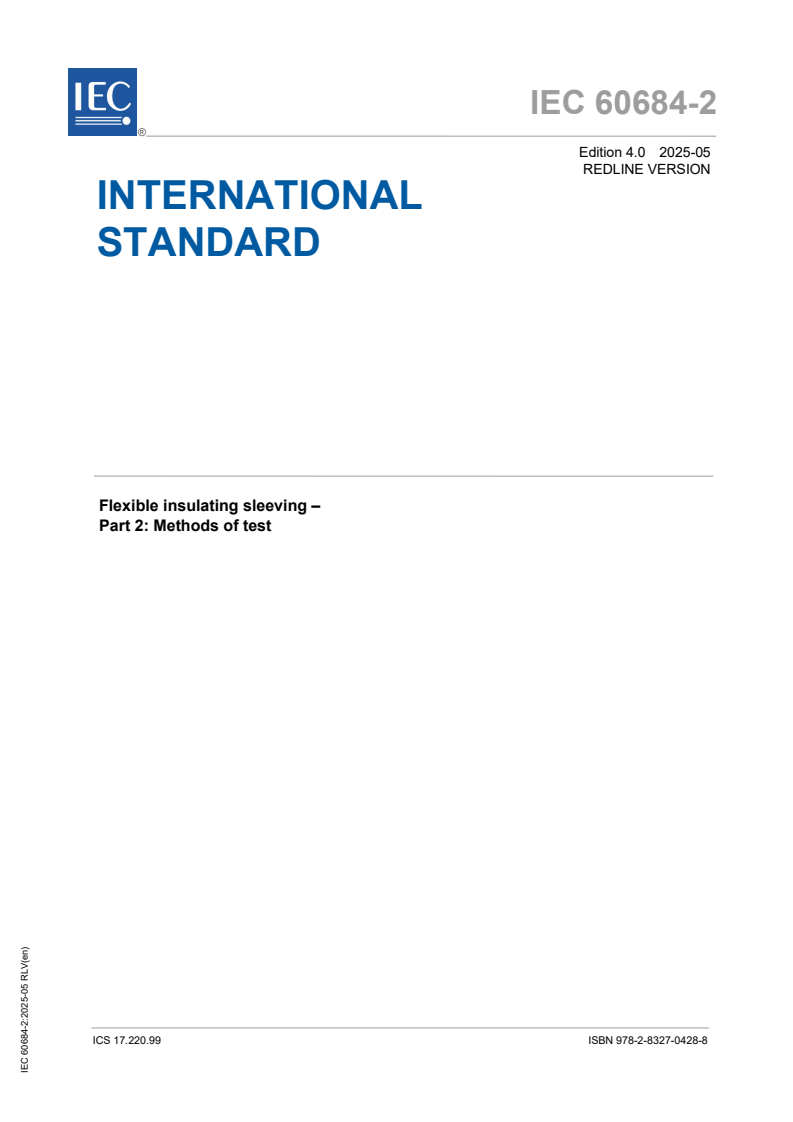
IEC 60684-2 ®
Edition 4.0 2025-05
REDLINE VERSION
INTERNATIONAL
STANDARD
Flexible insulating sleeving –
Part 2: Methods of test
ICS 17.220.99 ISBN 978-2-8327-0428-8
All rights reserved. Unless otherwise specified, no part of this publication may be reproduced or utilized in any form or
by any means, electronic or mechanical, including photocopying and microfilm, without permission in writing from either
IEC or IEC's member National Committee in the country of the requester. If you have any questions about IEC copyright
or have an enquiry about obtaining additional rights to this publication, please contact the address below or your local
IEC member National Committee for further information.
IEC Secretariat Tel.: +41 22 919 02 11
3, rue de Varembé info@iec.ch
CH-1211 Geneva 20 www.iec.ch
Switzerland
About the IEC
The International Electrotechnical Commission (IEC) is the leading global organization that prepares and publishes
International Standards for all electrical, electronic and related technologies.
About IEC publications
The technical content of IEC publications is kept under constant review by the IEC. Please make sure that you have the
latest edition, a corrigendum or an amendment might have been published.
IEC publications search - IEC Products & Services Portal - products.iec.ch
webstore.iec.ch/advsearchform Discover our powerful search engine and read freely all the
The advanced search enables to find IEC publications by a publications previews, graphical symbols and the glossary.
variety of criteria (reference number, text, technical With a subscription you will always have access to up to date
committee, …). It also gives information on projects, content tailored to your needs.
replaced and withdrawn publications.
Electropedia - www.electropedia.org
The world's leading online dictionary on electrotechnology,
IEC Just Published - webstore.iec.ch/justpublished
Stay up to date on all new IEC publications. Just Published containing more than 22 500 terminological entries in English
details all new publications released. Available online and and French, with equivalent terms in 25 additional languages.
once a month by email. Also known as the International Electrotechnical Vocabulary
(IEV) online.
IEC Customer Service Centre - webstore.iec.ch/csc
If you wish to give us your feedback on this publication or
need further assistance, please contact the Customer
Service Centre: sales@iec.ch.
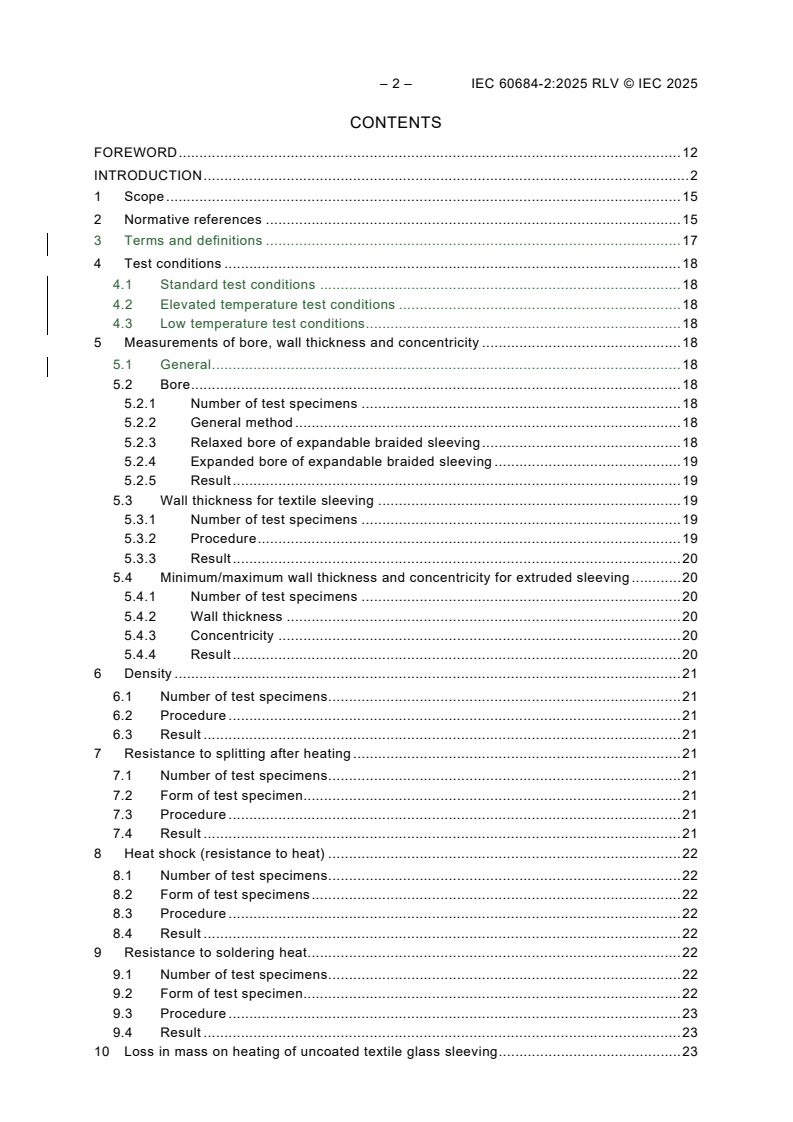
– 2 – IEC 60684-2:2025 RLV © IEC 2025
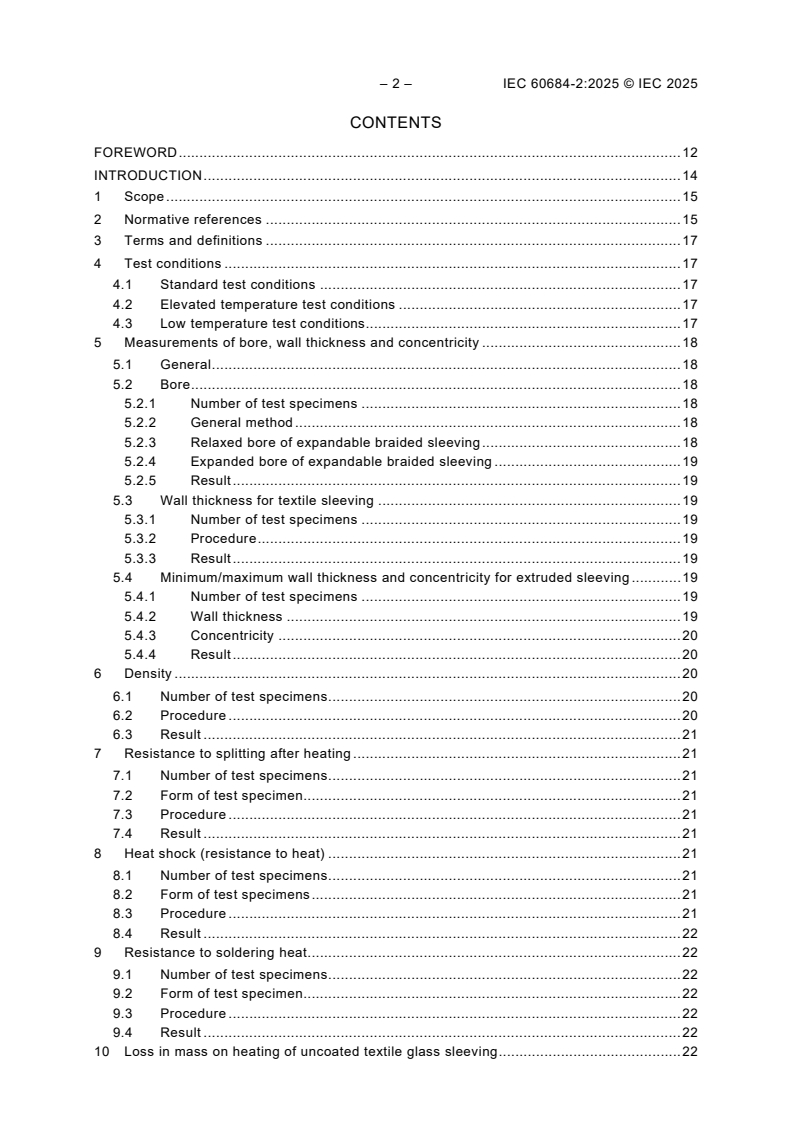
CONTENTS
FOREWORD . 12
INTRODUCTION . 2
1 Scope . 15
2 Normative references . 15
3 Terms and definitions . 17
4 Test conditions . 18
4.1 Standard test conditions . 18
4.2 Elevated temperature test conditions . 18
4.3 Low temperature test conditions. 18
5 Measurements of bore, wall thickness and concentricity . 18
5.1 General . 18
5.2 Bore . 18
5.2.1 Number of test specimens . 18
5.2.2 General method . 18
5.2.3 Relaxed bore of expandable braided sleeving . 18
5.2.4 Expanded bore of expandable braided sleeving . 19
5.2.5 Result . 19
5.3 Wall thickness for textile sleeving . 19
5.3.1 Number of test specimens . 19
5.3.2 Procedure . 19
5.3.3 Result . 20
5.4 Minimum/maximum wall thickness and concentricity for extruded sleeving . 20
5.4.1 Number of test specimens . 20
5.4.2 Wall thickness . 20
5.4.3 Concentricity . 20
5.4.4 Result . 20
6 Density . 21
6.1 Number of test specimens . 21
6.2 Procedure . 21
6.3 Result . 21
7 Resistance to splitting after heating . 21
7.1 Number of test specimens . 21
7.2 Form of test specimen. 21
7.3 Procedure . 21
7.4 Result . 21
8 Heat shock (resistance to heat) . 22
8.1 Number of test specimens . 22
8.2 Form of test specimens . 22
8.3 Procedure . 22
8.4 Result . 22
9 Resistance to soldering heat. 22
9.1 Number of test specimens . 22
9.2 Form of test specimen. 22
9.3 Procedure . 23
9.4 Result . 23
10 Loss in mass on heating of uncoated textile glass sleeving . 23
10.1 Number and mass of test specimens . 23
10.2 Procedure . 23
10.3 Calculation . 23
10.4 Result . 23
11 Longitudinal change . 23
11.1 Number of test specimens . 23
11.2 Form of test specimen. 23
11.3 Procedure . 24
11.4 Calculation . 24
11.5 Result . 24
12 Deformation under load (resistance to pressure at elevated temperature) . 24
12.1 Method A . 24
12.1.1 Number of test specimens . 24
12.1.2 Form of test specimen . 24
12.1.3 Apparatus . 24
12.1.4 Procedure . 25
12.1.5 Result . 25
12.2 Method B . 25
12.2.1 Number of test specimen . 25
12.2.2 Form of test specimen . 25
12.2.3 Apparatus . 25
12.2.4 Procedure . 26
12.2.5 Result . 27
13 Thermal stability of PVC sleeving . 27
13.1 Principle . 27
13.2 Form of test specimen. 27
13.2.1 ISO 182-1 method . 27
13.2.2 ISO 182-2 method . 27
13.3 Procedure . 27
13.4 Result . 27
14 Volatile content of silicone sleeving . 27
14.1 Number and mass of test specimens . 27
14.2 Procedure . 27
14.3 Calculation . 28
14.4 Result . 28
15 Bending after heating . 28
15.1 Number of test specimens . 28
15.2 Form of test specimen. 28
15.3 Procedure . 28
15.4 Result . 29
16 Bending at low temperature . 29
16.1 Number and form of test specimens . 29
16.2 Procedure . 29
16.3 Result . 29
17 Brittleness temperature . 29
17.1 Form of test specimen. 29
17.2 Procedure . 29
17.3 Result . 29
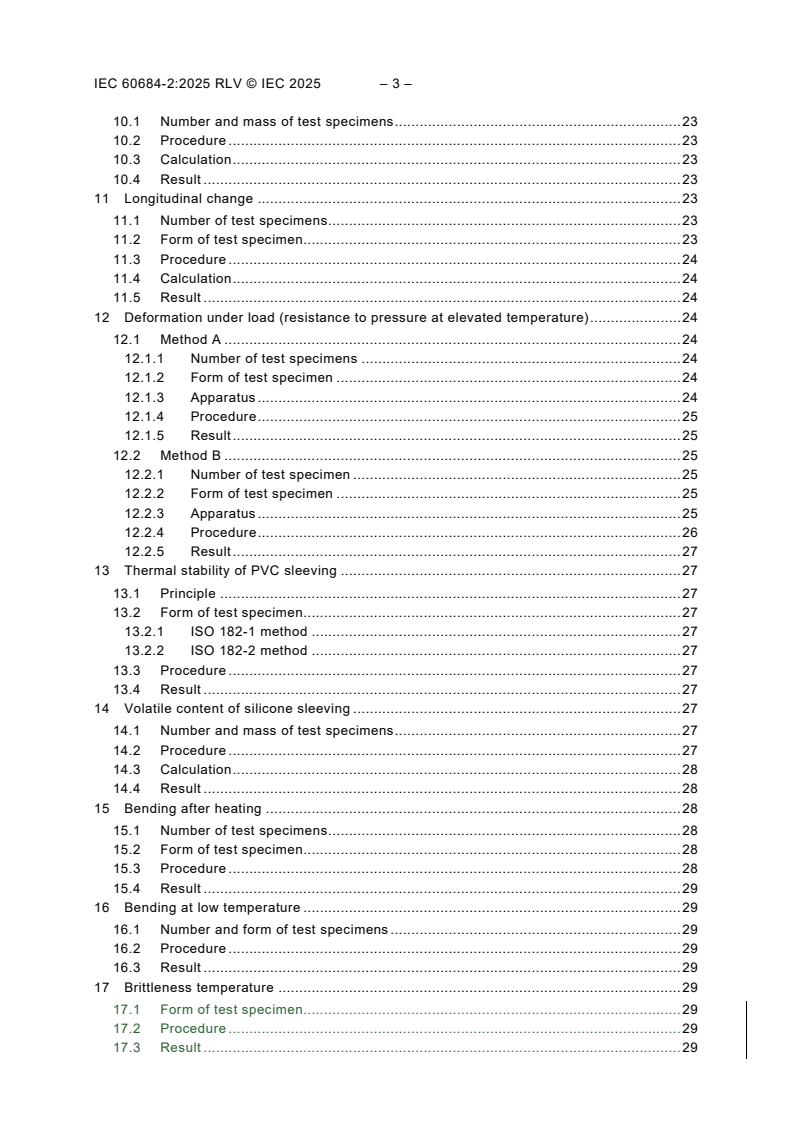
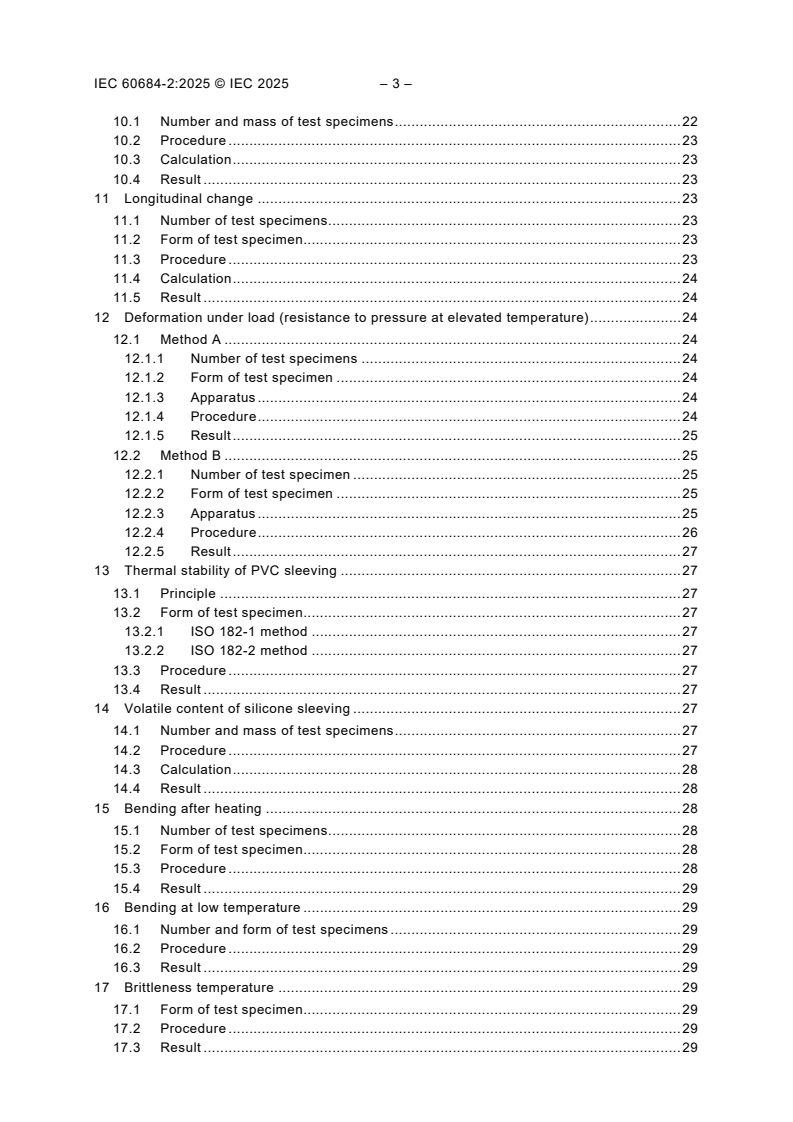
– 4 – IEC 60684-2:2025 RLV © IEC 2025
18 Dimensional stability on storage (applicable to heat-shrinkable sleeving only) . 29
18.1 Number and length of test specimens . 29
18.2 Procedure . 30
18.3 Result . 30
19 Hydrolysis of coating . 30
19.1 Number of test specimens . 30
19.2 Form of test specimen. 30
19.3 Procedure . 30
19.4 Result . 30
20 Flexibility (extruded sleeving only) . 31
20.1 Number and length of test specimens . 31
20.2 Procedure . 31
20.3 Report Result . 31
21 Tensile strength, tensile stress at 100 % elongation, elongation at break and
secant modulus at 2 % elongation . 31
21.1 General . 31
21.2 Tensile strength and elongation at break for full-section sleeving . 31
21.2.1 Number of test specimens . 31
21.2.2 Form of test specimen . 31
21.2.3 Conditioning . 32
21.2.4 Test temperature . 32
21.2.5 Procedure . 32
21.2.6 Calculations . 32
21.2.7 Result . 33
21.3 Tensile strength and elongation at break on dumb-bell specimens . 33
21.3.1 General . 33
21.3.2 Form of test specimen . 33
21.3.3 Procedure . 33
21.3.4 Result . 34
21.4 Tensile strength of uncoated glass textile sleeving . 34
21.4.1 General . 34
21.4.2 Procedure . 34
21.4.3 Results . 34
21.5 Secant modulus at 2 % elongation . 34
21.5.1 Number and form of test specimens . 34
21.5.2 Procedure . 34
21.5.3 Calculation . 35
21.5.4 Result . 35
21.6 Tensile stress at 100 % elongation . 35
21.6.1 General . 35
21.6.2 Calculation . 35
21.6.3 Result . 35
21.7 Tensile stress at 100 % elongation and at elevated temperature . 35
22 Fraying resistance test . 35
22.1 PrincipleGeneral . 35
22.2 Number and length form of test specimens . 36
22.3 Procedure . 36
22.4 Calculation . 36
22.5 Result . 36
23 Breakdown voltage . 36
23.1 Principle . 36
23.1.1 General . 36
23.1.2 Number and form of test specimens . 37
23.1.3 Conditioning . 37
23.1.4 Application of voltage . 37
23.1.5 Test method modification . 37
23.1.6 Result . 37
23.2 Straight mandrel test, 100 mm foil electrode . 37
23.2.1 Test specimen . 37
23.2.2 Electrodes . 37
23.2.3 Procedure . 37
23.2.4 Result . 37
23.3 Test on cut-out specimens for large-size sleeving . 37
23.3.1 Test specimen . 37
23.3.2 Electrodes . 38
23.3.3 Procedure . 38
23.3.4 Result . 38
23.4 Tests at elevated temperature . 38
23.5 Tests after damp heat . 38
23.6 Result . 38
24 Insulation resistance . 38
24.1 Conditioning . 38
24.2 Form of test specimen. 39
24.3 Measurement of insulation resistance . 39
24.4 Test conditions . 39
24.4.1 Number of test specimens . 39
24.4.2 Tests at room temperature . 39
24.4.3 Tests at elevated temperature . 39
24.4.4 Tests after subjection to damp heat conditions . 39
24.5 Result . 39
25 Volume resistivity for insulating material . 39
25.1 General . 39
25.2 Conditioning . 40
25.3 Form of test specimen. 40
25.4 Measurement of volume resistivity . 40
25.5 Test conditions . 41
25.5.1 Number of test specimens . 41
25.5.2 Tests at room temperature . 41
25.5.3 Tests at elevated temperature . 41
25.5.4 Tests after subjection to damp heat conditions . 41
25.6 Result . 41
26 Permittivity and dissipation factor . 41
26.1 Number of test specimens . 41
26.2 Form of test specimen. 41
26.3 Electrodes . 41
26.4 Procedure . 42
– 6 – IEC 60684-2:2025 RLV © IEC 2025
26.5 Calculation . 42
26.6 Result . 42
27 Resistance to tracking . 43
28 Flame propagation tests . 43
28.1 Principle . 43
28.2 Methods A and B . 43
28.2.1 General . 43
28.2.2 Number of test specimens . 43
28.2.3 Method A, applicable to sleeving up to and including 10 mm bore only . 43
28.2.4 Method B . 43
28.2.5 Source of heat . 43
28.2.6 Specimen arrangements . 44
28.2.7 Result . 44
28.3 Method C . 44
28.3.1 Number of test specimens . 44
28.3.2 Source of heat . 44
28.3.3 Cabinet and arrangements within it . 44
28.3.4 Procedure . 45
28.3.5 Result . 45
28.4 Method D . 45
28.4.1 Number of test specimens . 45
28.4.2 Cabinet and specimen arrangements . 45
28.4.3 Source of heat . 45
28.4.4 Procedure . 45
28.4.5 Result . 46
29 Oxygen index . 46
29.1 Oxygen index at ambient temperature . 46
29.2 Oxygen index at elevated temperature . 46
29.3 Results . 46
30 Transparency . 46
30.1 Number of test specimens . 46
30.2 Form of test specimen. 46
30.3 Procedure . 47
30.4 Result . 47
31 Ionic impurities test . 47
31.1 General . 47
31.2 Result . 47
32 Silver staining test . 47
32.1 Principle . 47
32.2 Number and form of test specimens . 47
32.3 Stain tester . 47
32.4 Procedure . 47
32.5 Result . 48
33 Electrolytic corrosion resistance . 48
33.1 General . 48
33.2 Number of test specimens . 48
34 Corrosion resistance (tensile and elongation) . 48
34.1 Principle . 48
34.2 Number and form of test specimens . 48
34.3 Procedure . 48
34.4 Result . 49
35 Copper corrosion (presence of corrosive volatiles) . 49
35.1 Principle . 49
35.2 Apparatus . 49
35.3 Number and form of test specimens . 49
35.4 Procedure . 49
35.5 Result . 50
36 Colour fastness to light . 50
36.1 Principle . 50
36.2 Test specimen . 50
36.3 Procedure . 50
36.4 Result . 50
37 Resistance to ozone . 50
37.1 General . 50
37.2 Number and form of test specimens . 50
37.3 Procedure . 50
37.4 Result . 51
38 Resistance to selected fluids . 51
38.1 Principle . 51
38.2 Choice of fluid . 51
38.3 Methods of assessment . 51
38.4 Number and form of test specimens . 51
38.5 Procedure . 51
38.6 Result . 52
39 Thermal endurance . 52
40 Mass per unit length . 52
40.1 Number of test specimens . 52
40.2 Procedure . 52
40.3 Result . 52
41 Heat ageing . 53
41.1 Number and form of test specimens . 53
41.2 Procedure . 53
41.3 Report (Bend test) . 53
42 Water absorption . 53
42.1 General . 53
42.2 Result . 53
43 Restricted shrinkage (applicable to heat-shrinkable sleeving only) . 53
43.1 Number of test specimens . 53
43.2 Form of test specimen. 53
43.3 Apparatus . 53
43.4 Procedure . 54
43.5 Result . 54
44 Colour stability to heat . 54
44.1 Number of test specimens . 54
44.2 Form of test specimens . 54
44.3 Procedure . 54
– 8 – IEC 60684-2:2025 RLV © IEC 2025
44.4 Result . 54
45 Smoke index . 55
45.1 Definitions. 55
45.2 Principle . 55
45.3 Apparatus . 55
45.4 Number and form of test specimen . 55
45.5 Conditioning . 55
45.6 Mounting of test pieces . 55
45.7 Safety of operations . 56
45.8 Procedure . 56
45.9 Calculation of results . 57
45.9.1 General . 57
45.9.2 Correction of transmittance values . 57
45.9.3 Calculation of the smoke index . 58
45.10 Result . 59
46 Toxicity index . 60
46.1 Definition General . 60
46.2 Principle . 60
46.3 Apparatus . 60
46.3.1 General . 60
46.3.2 Test chamber. 60
46.3.3 Burner . 60
46.3.4 Sample support . 61
46.3.5 Timing device . 61
46.3.6 Gas sampling and analytical equipment . 61
46.4 Test pieces . 61
46.4.1 General . 61
46.4.2 Conditioning . 61
46.5 Safety of operations . 61
46.6 Test procedure . 62
46.6.1 Determination of background correction factor . 62
46.6.2 Determination of evolved gases . 62
46.7 Calculation of toxicity index. 63
46.8 Toxic constituents . 63
46.9 Values for Cf . 64
46.10 Result and report . 64
47 Halogen content . 64
47.1 Method for the determination of low levels of chlorine and/or bromine and/or
iodine . 64
47.1.1 Principle . 64
47.1.2 Procedure . 65
47.2 Determination of low levels of fluorine . 65
47.2.1 Principle . 65
47.2.2 Procedure . 66
47.3 Result . 67
48 Acid gas generation . 67
48.1 Determination of the amount of halogen acid gas . 67
48.2 Determination of degree of acidity of gases . 67
49 Hot elongation and hot set . 67
49.1 Number and form of test specimens .
...
IEC 60684-2 ®
Edition 4.0 2025-05
INTERNATIONAL
STANDARD
NORME
INTERNATIONALE
Flexible insulating sleeving –
Part 2: Methods of test
Gaines isolantes souples –
Partie 2: Méthodes d'essai
ICS 17.220.99 ISBN 978-2-8327-0378-6
All rights reserved. Unless otherwise specified, no part of this publication may be reproduced or utilized in any form or
by any means, electronic or mechanical, including photocopying and microfilm, without permission in writing from either
IEC or IEC's member National Committee in the country of the requester. If you have any questions about IEC copyright
or have an enquiry about obtaining additional rights to this publication, please contact the address below or your local
IEC member National Committee for further information.
Droits de reproduction réservés. Sauf indication contraire, aucune partie de cette publication ne peut être reproduite ni
utilisée sous quelque forme que ce soit et par aucun procédé, électronique ou mécanique, y compris la photocopie et
les microfilms, sans l'accord écrit de l'IEC ou du Comité national de l'IEC du pays du demandeur. Si vous avez des
questions sur le copyright de l'IEC ou si vous désirez obtenir des droits supplémentaires sur cette publication, utilisez
les coordonnées ci-après ou contactez le Comité national de l'IEC de votre pays de résidence.
IEC Secretariat Tel.: +41 22 919 02 11
3, rue de Varembé info@iec.ch
CH-1211 Geneva 20 www.iec.ch
Switzerland
About the IEC
The International Electrotechnical Commission (IEC) is the leading global organization that prepares and publishes
International Standards for all electrical, electronic and related technologies.
About IEC publications
The technical content of IEC publications is kept under constant review by the IEC. Please make sure that you have the
latest edition, a corrigendum or an amendment might have been published.
IEC publications search - IEC Products & Services Portal - products.iec.ch
webstore.iec.ch/advsearchform Discover our powerful search engine and read freely all the
The advanced search enables to find IEC publications by a publications previews, graphical symbols and the glossary.
variety of criteria (reference number, text, technical With a subscription you will always have access to up to date
committee, …). It also gives information on projects, content tailored to your needs.
replaced and withdrawn publications.
Electropedia - www.electropedia.org
IEC Just Published - webstore.iec.ch/justpublished The world's leading online dictionary on electrotechnology,
Stay up to date on all new IEC publications. Just Published containing more than 22 500 terminological entries in English
details all new publications released. Available online and and French, with equivalent terms in 25 additional languages.
once a month by email. Also known as the International Electrotechnical Vocabulary
(IEV) online.
IEC Customer Service Centre - webstore.iec.ch/csc
If you wish to give us your feedback on this publication or
need further assistance, please contact the Customer
Service Centre: sales@iec.ch.
A propos de l'IEC
La Commission Electrotechnique Internationale (IEC) est la première organisation mondiale qui élabore et publie des
Normes internationales pour tout ce qui a trait à l'électricité, à l'électronique et aux technologies apparentées.
A propos des publications IEC
Le contenu technique des publications IEC est constamment revu. Veuillez vous assurer que vous possédez l’édition la
plus récente, un corrigendum ou amendement peut avoir été publié.
Recherche de publications IEC - IEC Products & Services Portal - products.iec.ch
webstore.iec.ch/advsearchform Découvrez notre puissant moteur de recherche et consultez
La recherche avancée permet de trouver des publications gratuitement tous les aperçus des publications, symboles
IEC en utilisant différents critères (numéro de référence, graphiques et le glossaire. Avec un abonnement, vous aurez
texte, comité d’études, …). Elle donne aussi des toujours accès à un contenu à jour adapté à vos besoins.
informations sur les projets et les publications remplacées
ou retirées. Electropedia - www.electropedia.org
Le premier dictionnaire d'électrotechnologie en ligne au
IEC Just Published - webstore.iec.ch/justpublished monde, avec plus de 22 500 articles terminologiques en
Restez informé sur les nouvelles publications IEC. Just anglais et en français, ainsi que les termes équivalents
Published détaille les nouvelles publications parues. dans 25 langues additionnelles. Egalement appelé
Disponible en ligne et une fois par mois par email. Vocabulaire Electrotechnique International (IEV) en ligne.
Service Clients - webstore.iec.ch/csc
Si vous désirez nous donner des commentaires sur cette
publication ou si vous avez des questions contactez-
nous: sales@iec.ch.
– 2 – IEC 60684-2:2025 © IEC 2025
CONTENTS
FOREWORD . 12
INTRODUCTION . 14
1 Scope . 15
2 Normative references . 15
3 Terms and definitions . 17
4 Test conditions . 17
4.1 Standard test conditions . 17
4.2 Elevated temperature test conditions . 17
4.3 Low temperature test conditions. 17
5 Measurements of bore, wall thickness and concentricity . 18
5.1 General . 18
5.2 Bore . 18
5.2.1 Number of test specimens . 18
5.2.2 General method . 18
5.2.3 Relaxed bore of expandable braided sleeving . 18
5.2.4 Expanded bore of expandable braided sleeving . 19
5.2.5 Result . 19
5.3 Wall thickness for textile sleeving . 19
5.3.1 Number of test specimens . 19
5.3.2 Procedure . 19
5.3.3 Result . 19
5.4 Minimum/maximum wall thickness and concentricity for extruded sleeving . 19
5.4.1 Number of test specimens . 19
5.4.2 Wall thickness . 19
5.4.3 Concentricity . 20
5.4.4 Result . 20
6 Density . 20
6.1 Number of test specimens . 20
6.2 Procedure . 20
6.3 Result . 21
7 Resistance to splitting after heating . 21
7.1 Number of test specimens . 21
7.2 Form of test specimen. 21
7.3 Procedure . 21
7.4 Result . 21
8 Heat shock (resistance to heat) . 21
8.1 Number of test specimens . 21
8.2 Form of test specimens . 21
8.3 Procedure . 21
8.4 Result . 22
9 Resistance to soldering heat. 22
9.1 Number of test specimens . 22
9.2 Form of test specimen. 22
9.3 Procedure . 22
9.4 Result . 22
10 Loss in mass on heating of uncoated textile glass sleeving . 22
10.1 Number and mass of test specimens . 22
10.2 Procedure . 23
10.3 Calculation . 23
10.4 Result . 23
11 Longitudinal change . 23
11.1 Number of test specimens . 23
11.2 Form of test specimen. 23
11.3 Procedure . 23
11.4 Calculation . 24
11.5 Result . 24
12 Deformation under load (resistance to pressure at elevated temperature) . 24
12.1 Method A . 24
12.1.1 Number of test specimens . 24
12.1.2 Form of test specimen . 24
12.1.3 Apparatus . 24
12.1.4 Procedure . 24
12.1.5 Result . 25
12.2 Method B . 25
12.2.1 Number of test specimen . 25
12.2.2 Form of test specimen . 25
12.2.3 Apparatus . 25
12.2.4 Procedure . 26
12.2.5 Result . 27
13 Thermal stability of PVC sleeving . 27
13.1 Principle . 27
13.2 Form of test specimen. 27
13.2.1 ISO 182-1 method . 27
13.2.2 ISO 182-2 method . 27
13.3 Procedure . 27
13.4 Result . 27
14 Volatile content of silicone sleeving . 27
14.1 Number and mass of test specimens . 27
14.2 Procedure . 27
14.3 Calculation . 28
14.4 Result . 28
15 Bending after heating . 28
15.1 Number of test specimens . 28
15.2 Form of test specimen. 28
15.3 Procedure . 28
15.4 Result . 29
16 Bending at low temperature . 29
16.1 Number and form of test specimens . 29
16.2 Procedure . 29
16.3 Result . 29
17 Brittleness temperature . 29
17.1 Form of test specimen. 29
17.2 Procedure . 29
17.3 Result . 29
– 4 – IEC 60684-2:2025 © IEC 2025
18 Dimensional stability on storage (applicable to heat-shrinkable sleeving only) . 29
18.1 Number and length of test specimens . 29
18.2 Procedure . 30
18.3 Result . 30
19 Hydrolysis of coating . 30
19.1 Number of test specimens . 30
19.2 Form of test specimen. 30
19.3 Procedure . 30
19.4 Result . 30
20 Flexibility (extruded sleeving only) . 31
20.1 Number and length of test specimens . 31
20.2 Procedure . 31
20.3 Result . 31
21 Tensile strength, tensile stress at 100 % elongation, elongation at break and
secant modulus at 2 % elongation . 31
21.1 General . 31
21.2 Tensile strength and elongation at break for full-section sleeving . 31
21.2.1 Number of test specimens . 31
21.2.2 Form of test specimen . 31
21.2.3 Conditioning . 32
21.2.4 Test temperature . 32
21.2.5 Procedure . 32
21.2.6 Calculations . 32
21.2.7 Result . 33
21.3 Tensile strength and elongation at break on dumb-bell specimens . 33
21.3.1 General . 33
21.3.2 Form of test specimen . 33
21.3.3 Procedure . 33
21.3.4 Result . 33
21.4 Tensile strength of uncoated glass textile sleeving . 34
21.4.1 General . 34
21.4.2 Procedure . 34
21.4.3 Results . 34
21.5 Secant modulus at 2 % elongation . 34
21.5.1 Number and form of test specimens . 34
21.5.2 Procedure . 34
21.5.3 Calculation . 35
21.5.4 Result . 35
21.6 Tensile stress at 100 % elongation . 35
21.6.1 General . 35
21.6.2 Calculation . 35
21.6.3 Result . 35
21.7 Tensile stress at 100 % elongation and at elevated temperature . 35
22 Fraying resistance test . 35
22.1 General . 35
22.2 Number and form of test specimens . 36
22.3 Procedure . 36
22.4 Calculation . 36
22.5 Result . 36
23 Breakdown voltage . 36
23.1 Principle . 36
23.1.1 General . 36
23.1.2 Number and form of test specimens . 37
23.1.3 Conditioning . 37
23.1.4 Application of voltage . 37
23.1.5 Test method modification . 37
23.1.6 Result . 37
23.2 Straight mandrel test, 100 mm foil electrode . 37
23.2.1 Test specimen . 37
23.2.2 Electrodes . 37
23.2.3 Procedure . 37
23.2.4 Result . 37
23.3 Test on cut-out specimens for large-size sleeving . 37
23.3.1 Test specimen . 37
23.3.2 Electrodes . 38
23.3.3 Procedure . 38
23.3.4 Result . 38
23.4 Tests at elevated temperature . 38
23.5 Tests after damp heat . 38
23.6 Result . 38
24 Insulation resistance . 38
24.1 Conditioning . 38
24.2 Form of test specimen. 39
24.3 Measurement of insulation resistance . 39
24.4 Test conditions . 39
24.4.1 Number of test specimens . 39
24.4.2 Tests at room temperature . 39
24.4.3 Tests at elevated temperature . 39
24.4.4 Tests after subjection to damp heat conditions . 39
24.5 Result . 39
25 Volume resistivity for insulating material . 39
25.1 General . 39
25.2 Conditioning . 40
25.3 Form of test specimen. 40
25.4 Measurement of volume resistivity . 40
25.5 Test conditions . 40
25.5.1 Number of test specimens . 40
25.5.2 Tests at room temperature . 40
25.5.3 Tests at elevated temperature . 40
25.5.4 Tests after subjection to damp heat conditions . 41
25.6 Result . 41
26 Permittivity and dissipation factor . 41
26.1 Number of test specimens . 41
26.2 Form of test specimen. 41
26.3 Electrodes . 41
26.4 Procedure . 41
– 6 – IEC 60684-2:2025 © IEC 2025
26.5 Calculation . 42
26.6 Result . 42
27 Resistance to tracking . 42
28 Flame propagation tests . 42
28.1 Principle . 42
28.2 Methods A and B . 42
28.2.1 General . 42
28.2.2 Number of test specimens . 42
28.2.3 Method A, applicable to sleeving up to and including 10 mm bore only . 42
28.2.4 Method B . 43
28.2.5 Source of heat . 43
28.2.6 Specimen arrangements . 43
28.2.7 Result . 43
28.3 Method C . 44
28.3.1 Number of test specimens . 44
28.3.2 Source of heat . 44
28.3.3 Cabinet and arrangements within it . 44
28.3.4 Procedure . 44
28.3.5 Result . 44
28.4 Method D . 45
28.4.1 Number of test specimens . 45
28.4.2 Cabinet and specimen arrangements . 45
28.4.3 Source of heat . 45
28.4.4 Procedure . 45
28.4.5 Result . 45
29 Oxygen index . 46
29.1 Oxygen index at ambient temperature . 46
29.2 Oxygen index at elevated temperature . 46
29.3 Results . 46
30 Transparency . 46
30.1 Number of test specimens . 46
30.2 Form of test specimen. 46
30.3 Procedure . 46
30.4 Result . 46
31 Ionic impurities test . 46
31.1 General . 46
31.2 Result . 47
32 Silver staining test . 47
32.1 Principle . 47
32.2 Number and form of test specimens . 47
32.3 Stain tester . 47
32.4 Procedure . 47
32.5 Result . 47
33 Electrolytic corrosion resistance . 47
33.1 General . 47
33.2 Number of test specimens . 48
34 Corrosion resistance (tensile and elongation) . 48
34.1 Principle . 48
34.2 Number and form of test specimens . 48
34.3 Procedure . 48
34.4 Result . 48
35 Copper corrosion (presence of corrosive volatiles) . 49
35.1 Principle . 49
35.2 Apparatus . 49
35.3 Number and form of test specimens . 49
35.4 Procedure . 49
35.5 Result . 50
36 Colour fastness to light . 50
36.1 Principle . 50
36.2 Test specimen . 50
36.3 Procedure . 50
36.4 Result . 50
37 Resistance to ozone . 50
37.1 General . 50
37.2 Number and form of test specimens . 50
37.3 Procedure . 50
37.4 Result . 50
38 Resistance to selected fluids . 51
38.1 Principle . 51
38.2 Choice of fluid . 51
38.3 Methods of assessment . 51
38.4 Number and form of test specimens . 51
38.5 Procedure . 51
38.6 Result . 52
39 Thermal endurance . 52
40 Mass per unit length . 52
40.1 Number of test specimens . 52
40.2 Procedure . 52
40.3 Result . 52
41 Heat ageing . 53
41.1 Number and form of test specimens . 53
41.2 Procedure . 53
41.3 Report (Bend test) . 53
42 Water absorption . 53
42.1 General . 53
42.2 Result . 53
43 Restricted shrinkage (applicable to heat-shrinkable sleeving only) . 53
43.1 Number of test specimens . 53
43.2 Form of test specimen. 53
43.3 Apparatus . 53
43.4 Procedure . 54
43.5 Result . 54
44 Colour stability to heat . 54
44.1 Number of test specimens . 54
44.2 Form of test specimens . 54
44.3 Procedure . 54
– 8 – IEC 60684-2:2025 © IEC 2025
44.4 Result . 54
45 Smoke index . 55
45.1 Definitions. 55
45.2 Principle . 55
45.3 Apparatus . 55
45.4 Number and form of test specimen . 55
45.5 Conditioning . 55
45.6 Mounting of test pieces . 55
45.7 Safety of operations . 56
45.8 Procedure . 56
45.9 Calculation of results . 57
45.9.1 General . 57
45.9.2 Correction of transmittance values . 57
45.9.3 Calculation of the smoke index . 58
45.10 Result . 59
46 Toxicity index . 59
46.1 General . 59
46.2 Principle . 60
46.3 Apparatus . 60
46.3.1 General . 60
46.3.2 Test chamber. 60
46.3.3 Burner . 60
46.3.4 Sample support . 60
46.3.5 Timing device . 61
46.3.6 Gas sampling and analytical equipment . 61
46.4 Test pieces . 61
46.4.1 General . 61
46.4.2 Conditioning . 61
46.5 Safety of operations . 61
46.6 Test procedure . 61
...