


IEC 61747-4-1:2004
(Main)Liquid crystal display devices - Part 4-1: Matrix colour LCD modules - Essential ratings and characteristics
General Information
- Abstract
Describes the essential ratings and characteristics of matrix colour liquid crystal display modules.
- Status
- Published
- Publication Date
- 22-Nov-2004
- Technical Committee
- TC 110 - Electronic displays
- Drafting Committee
- WG 2 - TC 110/WG 2
- Current Stage
- DELPUB - Deleted Publication
- Start Date
- 15-Oct-2014
- Completion Date
- 28-Aug-2026
Overview
IEC 61747-4-1:2004 is an international standard published by the International Electrotechnical Commission (IEC) that specifies the essential ratings and characteristics of matrix colour liquid crystal display (LCD) modules. This first edition provides a crucial framework for manufacturers, designers, and engineers working with matrix colour LCD modules to ensure consistent performance and interoperability in electronic devices. The standard falls under the broader IEC 61747 series dedicated to liquid crystal display devices, emphasizing flat panel display technology.
This standard establishes clear definitions and limits for electrical, optical, and mechanical properties of matrix colour LCD modules, thus supporting quality assurance, reliability, and international harmonization in display technologies.
Key Topics
Scope and Application
IEC 61747-4-1 focuses exclusively on matrix colour LCD modules, serving as a detailed guideline on how to assess their performance characteristics under defined conditions.Essential Ratings
- Absolute maximum ratings over operating temperature ranges
- Electrical characteristics such as voltage and current limits
- Optical characteristics including contrast ratio, luminance, and response time
Technical Details
The standard describes:- Types of matrix colour LCD modules
- Operating principles and materials used in construction
- Various modes of operation to suit different application needs
- Mechanical outline and dimensional details for consistent integration
Supplementary Information
Additional data relevant for the evaluation of matrix colour LCD modules, including environmental and endurance considerations, are also provided or referenced.
Applications
IEC 61747-4-1 is indispensable for industries involved in the development, testing, and use of colour matrix LCD screens. Typical applications include:
Consumer Electronics
Televisions, monitors, handheld devices, smartphones, and tablets benefit from standardized LCD characteristics to optimize display quality and energy usage.Industrial and Automotive Displays
Dashboard panels, control panels, and instrumentation require reliable display modules compliant with these essential ratings to function effectively under harsh operating conditions.Medical Equipment
Ensuring consistent image quality and performance in diagnostic and monitoring devices where display accuracy is crucial.Commercial Signage and Information Systems
Large-format colour matrix LCD modules used in advertising and public information systems leverage the stability guarantees provided by this standard.
By adhering to IEC 61747-4-1, manufacturers can assure customers that their matrix colour LCD modules meet internationally recognized benchmarks for safety, reliability, and functional performance.
Related Standards
IEC 61747-4-1 is part of a comprehensive series of standards covering LCD devices, which include:
- IEC 61747-1: Generic specification for liquid crystal display devices
- IEC 61747-2: Sectional specification for LCD modules including passive and colour matrix displays
- IEC 61747-3: Sectional specification for LCD cells
- IEC 61747-5: Environmental, endurance, and mechanical test methods for LCD modules and cells
- IEC 61747-6: Measuring methods for transmissive liquid crystal modules
These interconnected standards collectively ensure a systematic approach to LCD module design, testing, and quality control, enhancing global industry compatibility.
By following the essential ratings and characteristics defined in IEC 61747-4-1:2004, stakeholders in the display technology domain can optimize device performance, enhance product durability, and facilitate international trade and regulatory compliance. This standard is a critical resource for those involved in the design and manufacturing of high-quality matrix colour LCD modules used across various electronic applications.
Relations
- Effective Date
- 05-Sep-2023
Frequently Asked Questions
IEC 61747-4-1:2004 is a standard published by the International Electrotechnical Commission (IEC). Its full title is "Liquid crystal display devices - Part 4-1: Matrix colour LCD modules - Essential ratings and characteristics". This standard covers: Describes the essential ratings and characteristics of matrix colour liquid crystal display modules.
Describes the essential ratings and characteristics of matrix colour liquid crystal display modules.
IEC 61747-4-1:2004 is classified under the following ICS (International Classification for Standards) categories: 31.120 - Electronic display devices. The ICS classification helps identify the subject area and facilitates finding related standards.
IEC 61747-4-1:2004 has the following relationships with other standards: It is inter standard links to IEC 61747-4-1:2014. Understanding these relationships helps ensure you are using the most current and applicable version of the standard.
IEC 61747-4-1:2004 is available in PDF format for immediate download after purchase. The document can be added to your cart and obtained through the secure checkout process. Digital delivery ensures instant access to the complete standard document.
Standards Content (Sample)
NORME CEI
INTERNATIONALE
IEC
61747-4-1
INTERNATIONAL
Première édition
STANDARD
First edition
2004-11
Dispositifs d'affichage à cristaux liquides –
Partie 4-1:
Modules LCD matriciels couleur –
Valeurs limites et caractéristiques essentielles
Liquid crystal display devices –
Part 4-1:
Matrix colour LCD modules –
Essential ratings and characteristics
Numéro de référence
Reference number
CEI/IEC 61747-4-1:2004
Numérotation des publications Publication numbering
Depuis le 1er janvier 1997, les publications de la CEI As from 1 January 1997 all IEC publications are
sont numérotées à partir de 60000. Ainsi, la CEI 34-1 issued with a designation in the 60000 series. For
devient la CEI 60034-1. example, IEC 34-1 is now referred to as IEC 60034-1.
Editions consolidées Consolidated editions
Les versions consolidées de certaines publications de la The IEC is now publishing consolidated versions of its
CEI incorporant les amendements sont disponibles. Par publications. For example, edition numbers 1.0, 1.1
exemple, les numéros d’édition 1.0, 1.1 et 1.2 indiquent and 1.2 refer, respectively, to the base publication,
respectivement la publication de base, la publication de the base publication incorporating amendment 1 and
base incorporant l’amendement 1, et la publication de the base publication incorporating amendments 1
base incorporant les amendements 1 et 2. and 2.
Informations supplémentaires Further information on IEC publications
sur les publications de la CEI
Le contenu technique des publications de la CEI est The technical content of IEC publications is kept
constamment revu par la CEI afin qu'il reflète l'état under constant review by the IEC, thus ensuring that
actuel de la technique. Des renseignements relatifs à the content reflects current technology. Information
cette publication, y compris sa validité, sont dispo- relating to this publication, including its validity, is
nibles dans le Catalogue des publications de la CEI available in the IEC Catalogue of publications
(voir ci-dessous) en plus des nouvelles éditions, (see below) in addition to new editions, amendments
amendements et corrigenda. Des informations sur les and corrigenda. Information on the subjects under
sujets à l’étude et l’avancement des travaux entrepris consideration and work in progress undertaken by the
par le comité d’études qui a élaboré cette publication, technical committee which has prepared this
ainsi que la liste des publications parues, sont publication, as well as the list of publications issued,
également disponibles par l’intermédiaire de: is also available from the following:
• Site web de la CEI (www.iec.ch) • IEC Web Site (www.iec.ch)
• Catalogue des publications de la CEI • Catalogue of IEC publications
Le catalogue en ligne sur le site web de la CEI The on-line catalogue on the IEC web site
(www.iec.ch/searchpub) vous permet de faire des (www.iec.ch/searchpub) enables you to search by a
recherches en utilisant de nombreux critères, variety of criteria including text searches,
comprenant des recherches textuelles, par comité technical committees and date of publication. On-
d’études ou date de publication. Des informations en line information is also available on recently
ligne sont également disponibles sur les nouvelles issued publications, withdrawn and replaced
publications, les publications remplacées ou retirées, publications, as well as corrigenda.
ainsi que sur les corrigenda.
• IEC Just Published • IEC Just Published
Ce résumé des dernières publications parues This summary of recently issued publications
(www.iec.ch/online_news/justpub) est aussi dispo- (www.iec.ch/online_news/justpub) is also available
nible par courrier électronique. Veuillez prendre by email. Please contact the Customer Service
contact avec le Service client (voir ci-dessous) Centre (see below) for further information.
pour plus d’informations.
• Service clients • Customer Service Centre
Si vous avez des questions au sujet de cette If you have any questions regarding this
publication ou avez besoin de renseignements publication or need further assistance, please
supplémentaires, prenez contact avec le Service contact the Customer Service Centre:
clients:
Email: custserv@iec.ch Email: custserv@iec.ch
Tél: +41 22 919 02 11 Tel: +41 22 919 02 11
Fax: +41 22 919 03 00 Fax: +41 22 919 03 00
.
NORME CEI
INTERNATIONALE
IEC
61747-4-1
INTERNATIONAL
Première édition
STANDARD
First edition
2004-11
Dispositifs d'affichage à cristaux liquides –
Partie 4-1:
Modules LCD matriciels couleur –
Valeurs limites et caractéristiques essentielles
Liquid crystal display devices –
Part 4-1:
Matrix colour LCD modules –
Essential ratings and characteristics
IEC 2004 Droits de reproduction réservés Copyright - all rights reserved
Aucune partie de cette publication ne peut être reproduite ni No part of this publication may be reproduced or utilized in any
utilisée sous quelque forme que ce soit et par aucun procédé, form or by any means, electronic or mechanical, including
électronique ou mécanique, y compris la photocopie et les photocopying and microfilm, without permission in writing from
microfilms, sans l'accord écrit de l'éditeur. the publisher.
International Electrotechnical Commission, 3, rue de Varembé, PO Box 131, CH-1211 Geneva 20, Switzerland
Telephone: +41 22 919 02 11 Telefax: +41 22 919 03 00 E-mail: inmail@iec.ch Web: www.iec.ch
CODE PRIX
H
PRICE CODE
Commission Electrotechnique Internationale
International Electrotechnical Commission
МеждународнаяЭлектротехническаяКомиссия
Pour prix, voir catalogue en vigueur
For price, see current catalogue
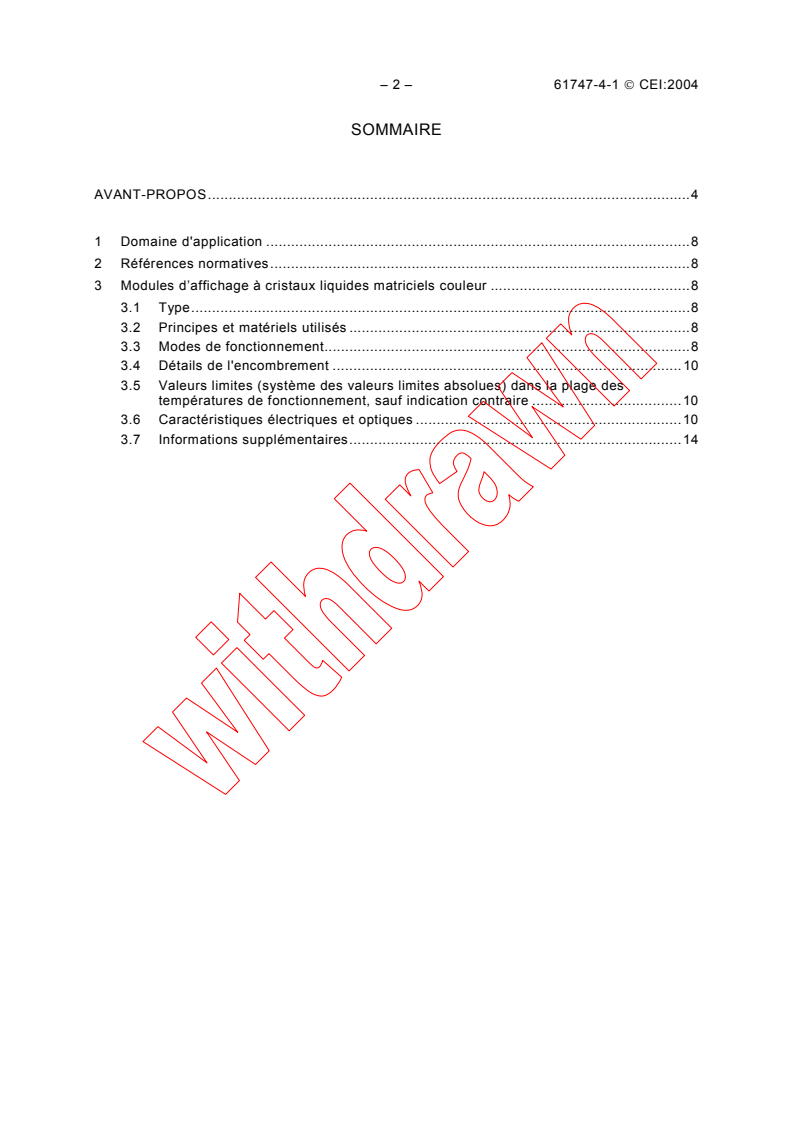
– 2 – 61747-4-1 CEI:2004
SOMMAIRE
AVANT-PROPOS.4
1 Domaine d'application .8
2 Références normatives.8
3 Modules d’affichage à cristaux liquides matriciels couleur .8
3.1 Type.8
3.2 Principes et matériels utilisés .8
3.3 Modes de fonctionnement.8
3.4 Détails de l'encombrement .10
3.5 Valeurs limites (système des valeurs limites absolues) dans la plage des
températures de fonctionnement, sauf indication contraire .10
3.6 Caractéristiques électriques et optiques .10
3.7 Informations supplémentaires.14
61747-4-1 IEC:2004 – 3 –
CONTENTS
FOREWORD.5
1 Scope.9
2 Normative reference .9
3 Matrix colour liquid crystal display modules .9
3.1 Type.9
3.2 Principles and material used .9
3.3 Modes of operation.9
3.4 Details of outline .11
3.5 Limiting values (absolute maximum rating system) over the operating
temperature range, unless otherwise stated .11
3.6 Electrical and optical characteristics.11
3.7 Supplementary information.15
– 4 – 61747-4-1 CEI:2004
COMMISSION ÉLECTROTECHNIQUE INTERNATIONALE
___________
DISPOSITIFS D’AFFICHAGE À CRISTAUX LIQUIDES –
Partie 4-1: Modules LCD matriciels couleur –
Valeurs limites et caractéristiques essentielles
AVANT-PROPOS
1) La Commission Electrotechnique Internationale (CEI) est une organisation mondiale de normalisation
composée de l'ensemble des comités électrotechniques nationaux (Comités nationaux de la CEI). La CEI a
pour objet de favoriser la coopération internationale pour toutes les questions de normalisation dans les
domaines de l'électricité et de l'électronique. A cet effet, la CEI – entre autres activités – publie des Normes
internationales, des Spécifications techniques, des Rapports techniques, des Spécifications accessibles au
public (PAS) et des Guides (ci-après dénommés "Publication(s) de la CEI"). Leur élaboration est confiée à des
comités d'études, aux travaux desquels tout Comité national intéressé par le sujet traité peut participer. Les
organisations internationales, gouvernementales et non gouvernementales, en liaison avec la CEI, participent
également aux travaux. La CEI collabore étroitement avec l'Organisation Internationale de Normalisation (ISO),
selon des conditions fixées par accord entre les deux organisations.
2) Les décisions ou accords officiels de la CEI concernant les questions techniques représentent, dans la mesure
du possible, un accord international sur les sujets étudiés, étant donné que les Comités nationaux de la CEI
intéressés sont représentés dans chaque comité d’études.
3) Les Publications de la CEI se présentent sous la forme de recommandations internationales et sont agréées
comme telles par les Comités nationaux de la CEI. Tous les efforts raisonnables sont entrepris afin que la CEI
s'assure de l'exactitude du contenu technique de ses publications; la CEI ne peut pas être tenue responsable
de l'éventuelle mauvaise utilisation ou interprétation qui en est faite par un quelconque utilisateur final.
4) Dans le but d'encourager l'uniformité internationale, les Comités nationaux de la CEI s'engagent, dans toute la
mesure possible, à appliquer de façon transparente les Publications de la CEI dans leurs publications
nationales et régionales. Toutes divergences entre toutes Publications de la CEI et toutes publications
nationales ou régionales correspondantes doivent être indiquées en termes clairs dans ces dernières.
5) La CEI n’a prévu aucune procédure de marquage valant indication d’approbation et n'engage pas sa
responsabilité pour les équipements déclarés conformes à une de ses Publications.
6) Tous les utilisateurs doivent s'assurer qu'ils sont en possession de la dernière édition de cette publication.
7) Aucune responsabilité ne doit être imputée à la CEI, à ses administrateurs, employés, auxiliaires ou
mandataires, y compris ses experts particuliers et les membres de ses comités d'études et des Comités
nationaux de la CEI, pour tout préjudice causé en cas de dommages corporels et matériels, ou de tout autre
dommage de quelque nature que ce soit, directe ou indirecte, ou pour supporter les coûts (y compris les frais
de justice) et les dépenses découlant de la publication ou de l'utilisation de cette Publication de la CEI ou de
toute autre Publication de la CEI, ou au crédit qui lui est accordé.
8) L'attention est attirée sur les références normatives citées dans cette publication. L'utilisation de publications
référencées est obligatoire pour une application correcte de la présente publication.
9) L’attention est attirée sur le fait que certains des éléments de la présente Publication de la CEI peuvent faire
l’objet de droits de propriété intellectuelle ou de droits analogues. La CEI ne saurait être tenue pour
responsable de ne pas avoir identifié de tels droits de propriété et de ne pas avoir signalé leur existence.
La Norme internationale CEI 61747-4-1 a été établie par le comité d'études 110 de la CEI:
Dispositifs d'affichage à panneaux plats.
Le texte de cette norme est issu des documents suivants:
FDIS Rapport de vote
110/28/FDIS 110/35/RVD
Le rapport de vote indiqué dans le tableau ci-dessus donne toute information sur le vote ayant
abouti à l'approbation de cette norme.
Cette publication a été rédigée selon les Directives ISO/CEI, Partie 2.
Cette norme doit être lue conjointement avec la CEI 61747-1.
61747-4-1 IEC:2004 – 5 –
INTERNATIONAL ELECTROTECHNICAL COMMISSION
___________
LIQUID CRYSTAL DISPLAY DEVICES –
Part 4-1: Matrix colour LCD modules –
Essential ratings and characteristics
FOREWORD
1) The International Electrotechnical Commission (IEC) is a worldwide organization for standardization comprising
all national electrotechnical committees (IEC National Committees). The object of IEC is to promote
international co-operation on all questions concerning standardization in the electrical and electronic fields. To
this end and in addition to other activities, IEC publishes International Standards, Technical Specifications,
Technical Reports, Publicly Available Specifications (PAS) and Guides (hereafter referred to as “IEC
Publication(s)”). Their preparation is entrusted to technical committees; any IEC National Committee interested
in the subject dealt with may participate in this preparatory work. International, governmental and
non-governmental organizations liaising with the IEC also participate in this preparation. IEC collaborates
closely with the International Organization for Standardization (ISO) in accordance with conditions determined
by agreement between the two organizations.
2) The formal decisions or agreements of IEC on technical matters express, as nearly as possible, an international
consensus of opinion on the relevant subjects since each technical committee has representation from all
interested IEC National Committees.
3) IEC Publications have the form of recommendations for international use and are accepted by IEC National
Committees in that sense. While all reasonable efforts are made to ensure that the technical content of IEC
Publications is accurate, IEC cannot be held responsible for the way in which they are used or for any
misinterpretation by any end user.
4) In order to promote international uniformity, IEC National Committees undertake to apply IEC Publications
transparently to the maximum extent possible in their national and regional publications. Any divergence
between any IEC Publication and the corresponding national or regional publication shall be clearly indicated in
the latter.
5) IEC provides no marking procedure to indicate its approval and cannot be rendered responsible for any
equipment declared to be in conformity with an IEC Publication.
6) All users should ensure that they have the latest edition of this publication.
7) No liability shall attach to IEC or its directors, employees, servants or agents including individual experts and
members of its technical committees and IEC National Committees for any personal injury, property damage or
other damage of any nature whatsoever, whether direct or indirect, or for costs (including legal fees) and
expenses arising out of the publication, use of, or reliance upon, this IEC Publication or any other IEC
Publications.
8) Attention is drawn to the Normative references cited in this publication. Use of the referenced publications is
indispensable for the correct application of this publication.
9) Attention is drawn to the possibility that some of the elements of this IEC Publication may be the subject of
patent rights. IEC shall not be held responsible for identifying any or all such patent rights.
International Standard IEC 61747-4-1 has been prepared by IEC technical committee 110:
Flat panel display devices.
The text of this standard is based on the following documents:
FDIS Report on voting
110/28/FDIS 110/35/RVD
Full information on the voting for the approval of this standard can be found
...