


IEC 61817:2000
(Main)Household portable appliances for cooking, grilling and similar use - Methods for measuring performance
Household portable appliances for cooking, grilling and similar use - Methods for measuring performance
Specifies methods for measuring the performance of electric household portable appliances for cooking, grilling and similar use. It defines the main performance characteristics of these appliances which are of interest to the user, and specifies methods of measuring them. For performance of microwave ovens, see IEC 60705; for electric cooking ranges, hobs, ovens and grills for household use, see IEC 60350.
Appareils mobiles à usage domestique pour cuire, griller ou à usage similaire - Méthodes de mesure de l'aptitude à la fonction
Définit des méthodes de mesure de l'aptitude à la fonction des appareils mobiles à usage domestique pour cuire, griller ou à usage similaire. La norme définit les principales caractéristiques d'aptitude à la fonction intéressant le consommateur, et de spécifier les méthodes pour les mesurer. Pour la mesure de l'aptitude à la fonction des fours à micro-ondes, voir CEI 60750; pour des cuisinières, foyers de cuisson, fours électriques et grils à usage domestique, voir CEI 60350.
General Information
- Status
- Withdrawn
- Publication Date
- 17-Oct-2000
- Withdrawal Date
- 31-May-2021
- Technical Committee
- SC 59L - Small household appliances
- Drafting Committee
- MT 2 - TC 59/SC 59L/MT 2
- Current Stage
- WPUB - Publication withdrawn
- Start Date
- 01-Jun-2021
- Completion Date
- 31-May-2021
Relations
- Effective Date
- 05-Sep-2023


iec61817{ed1.0}b-CHAR - IEC 61817:2000+AMD1:2004 CSV - Household portable appliances for cooking, grilling and similar use - Methods for measuring performance Released:11/2/2004 Isbn:2831876427
iec61817{ed1.1}b - IEC 61817:2000+AMD1:2004 CSV - Household portable appliances for cooking, grilling and similar use - Methods for measuring performance Released:11/2/2004 Isbn:2831876427
Frequently Asked Questions
IEC 61817:2000 is a standard published by the International Electrotechnical Commission (IEC). Its full title is "Household portable appliances for cooking, grilling and similar use - Methods for measuring performance". This standard covers: Specifies methods for measuring the performance of electric household portable appliances for cooking, grilling and similar use. It defines the main performance characteristics of these appliances which are of interest to the user, and specifies methods of measuring them. For performance of microwave ovens, see IEC 60705; for electric cooking ranges, hobs, ovens and grills for household use, see IEC 60350.
Specifies methods for measuring the performance of electric household portable appliances for cooking, grilling and similar use. It defines the main performance characteristics of these appliances which are of interest to the user, and specifies methods of measuring them. For performance of microwave ovens, see IEC 60705; for electric cooking ranges, hobs, ovens and grills for household use, see IEC 60350.
IEC 61817:2000 is classified under the following ICS (International Classification for Standards) categories: 97.040.50 - Small kitchen appliances. The ICS classification helps identify the subject area and facilitates finding related standards.
IEC 61817:2000 has the following relationships with other standards: It is inter standard links to IEC 61817:2000/AMD1:2004. Understanding these relationships helps ensure you are using the most current and applicable version of the standard.
IEC 61817:2000 is available in PDF format for immediate download after purchase. The document can be added to your cart and obtained through the secure checkout process. Digital delivery ensures instant access to the complete standard document.
Standards Content (Sample)
NORME CEI
INTERNATIONALE
IEC
INTERNATIONAL
Edition 1.1
STANDARD
2004-11
Edition 1:2000 consolidée par l'amendement 1:2004
Edition 1:2000 consolidated with amendment 1:2004
Appareils mobiles à usage domestique
pour cuire, griller ou à usage similaire –
Méthodes de mesure de l'aptitude à la fonction
Household portable appliances
for cooking, grilling and similar use –
Methods for measuring performance
Numéro de référence
Reference number
CEI/IEC 61817:2000+A1:2004
Numérotation des publications Publication numbering
Depuis le 1er janvier 1997, les publications de la CEI As from 1 January 1997 all IEC publications are
sont numérotées à partir de 60000. Ainsi, la CEI 34-1 issued with a designation in the 60000 series. For
devient la CEI 60034-1. example, IEC 34-1 is now referred to as IEC 60034-1.
Editions consolidées Consolidated editions
Les versions consolidées de certaines publications de la The IEC is now publishing consolidated versions of its
CEI incorporant les amendements sont disponibles. Par publications. For example, edition numbers 1.0, 1.1
exemple, les numéros d’édition 1.0, 1.1 et 1.2 indiquent and 1.2 refer, respectively, to the base publication,
respectivement la publication de base, la publication de the base publication incorporating amendment 1 and
base incorporant l’amendement 1, et la publication de the base publication incorporating amendments 1
base incorporant les amendements 1 et 2. and 2.
Informations supplémentaires Further information on IEC publications
sur les publications de la CEI
Le contenu technique des publications de la CEI est The technical content of IEC publications is kept
constamment revu par la CEI afin qu'il reflète l'état under constant review by the IEC, thus ensuring that
actuel de la technique. Des renseignements relatifs à the content reflects current technology. Information
cette publication, y compris sa validité, sont dispo- relating to this publication, including its validity, is
nibles dans le Catalogue des publications de la CEI available in the IEC Catalogue of publications
(voir ci-dessous) en plus des nouvelles éditions, (see below) in addition to new editions, amendments
amendements et corrigenda. Des informations sur les and corrigenda. Information on the subjects under
sujets à l’étude et l’avancement des travaux entrepris consideration and work in progress undertaken by the
par le comité d’études qui a élaboré cette publication, technical committee which has prepared this
ainsi que la liste des publications parues, sont publication, as well as the list of publications issued,
également disponibles par l’intermédiaire de: is also available from the following:
• Site web de la CEI (www.iec.ch) • IEC Web Site (www.iec.ch)
• Catalogue des publications de la CEI • Catalogue of IEC publications
Le catalogue en ligne sur le site web de la CEI The on-line catalogue on the IEC web site
(www.iec.ch/searchpub) vous permet de faire des (www.iec.ch/searchpub) enables you to search by a
recherches en utilisant de nombreux critères, variety of criteria including text searches,
comprenant des recherches textuelles, par comité technical committees and date of publication. On-
d’études ou date de publication. Des informations en line information is also available on recently
ligne sont également disponibles sur les nouvelles issued publications, withdrawn and replaced
publications, les publications remplacées ou retirées, publications, as well as corrigenda.
ainsi que sur les corrigenda.
• IEC Just Published • IEC Just Published
Ce résumé des dernières publications parues This summary of recently issued publications
(www.iec.ch/online_news/justpub) est aussi dispo- (www.iec.ch/online_news/justpub) is also available
nible par courrier électronique. Veuillez prendre by email. Please contact the Customer Service
contact avec le Service client (voir ci-dessous) Centre (see below) for further information.
pour plus d’informations.
• Service clients • Customer Service Centre
Si vous avez des questions au sujet de cette If you have any questions regarding this
publication ou avez besoin de renseignements publication or need further assistance, please
supplémentaires, prenez contact avec le Service contact the Customer Service Centre:
clients:
Email: custserv@iec.ch Email: custserv@iec.ch
Tél: +41 22 919 02 11 Tel: +41 22 919 02 11
Fax: +41 22 919 03 00 Fax: +41 22 919 03 00
.
NORME CEI
INTERNATIONALE
IEC
INTERNATIONAL
Edition 1.1
STANDARD
2004-11
Edition 1:2000 consolidée par l'amendement 1:2004
Edition 1:2000 consolidated with amendment 1:2004
Appareils mobiles à usage domestique
pour cuire, griller ou à usage similaire –
Méthodes de mesure de l'aptitude à la fonction
Household portable appliances
for cooking, grilling and similar use –
Methods for measuring performance
IEC 2004 Droits de reproduction réservés Copyright - all rights reserved
Aucune partie de cette publication ne peut être reproduite ni No part of this publication may be reproduced or utilized in any
utilisée sous quelque forme que ce soit et par aucun procédé, form or by any means, electronic or mechanical, including
électronique ou mécanique, y compris la photocopie et les photocopying and microfilm, without permission in writing from
microfilms, sans l'accord écrit de l'éditeur. the publisher.
International Electrotechnical Commission, 3, rue de Varembé, PO Box 131, CH-1211 Geneva 20, Switzerland
Telephone: +41 22 919 02 11 Telefax: +41 22 919 03 00 E-mail: inmail@iec.ch Web: www.iec.ch
CODE PRIX
CL
Commission Electrotechnique Internationale
PRICE CODE
International Electrotechnical Commission
МеждународнаяЭлектротехническаяКомиссия
Pour prix, voir catalogue en vigueur
For price, see current catalogue
– 2 – 61817 © CEI:2000+A1:2004
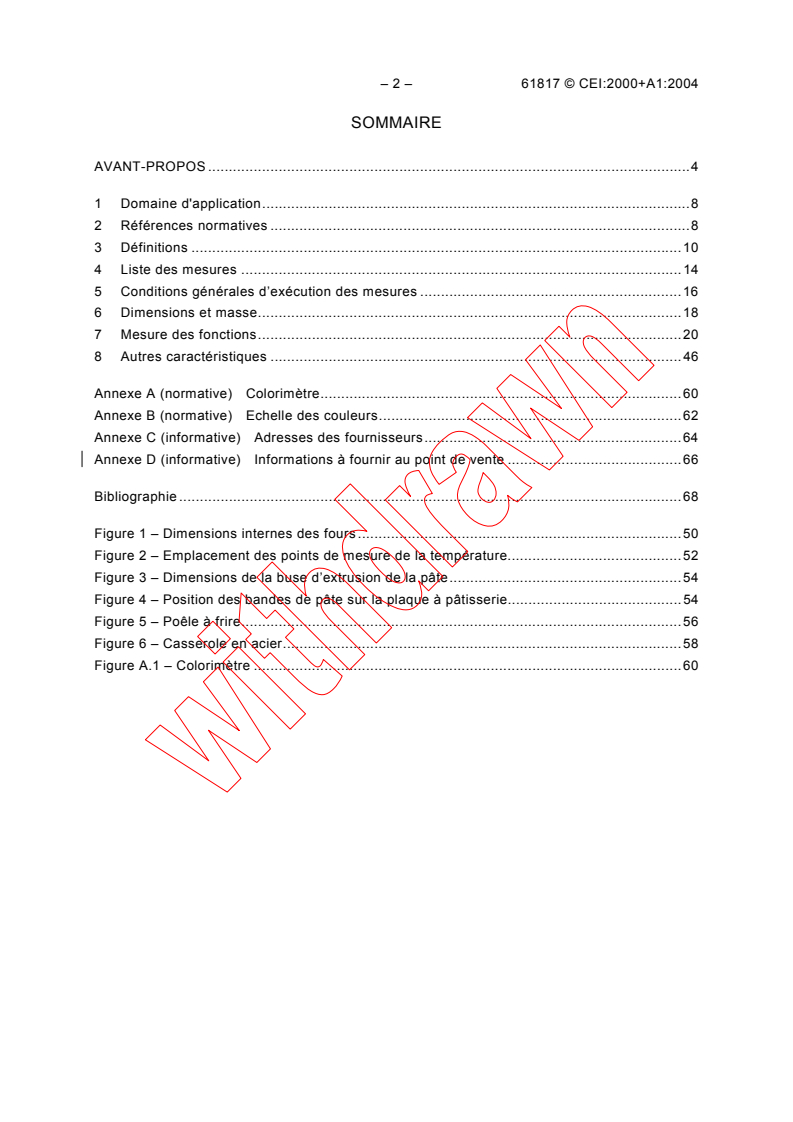
SOMMAIRE
AVANT-PROPOS .4
1 Domaine d'application.8
2 Références normatives.8
3 Définitions.10
4 Liste des mesures .14
5 Conditions générales d’exécution des mesures .16
6 Dimensions et masse.18
7 Mesure des fonctions.20
8 Autres caractéristiques.46
Annexe A (normative) Colorimètre.60
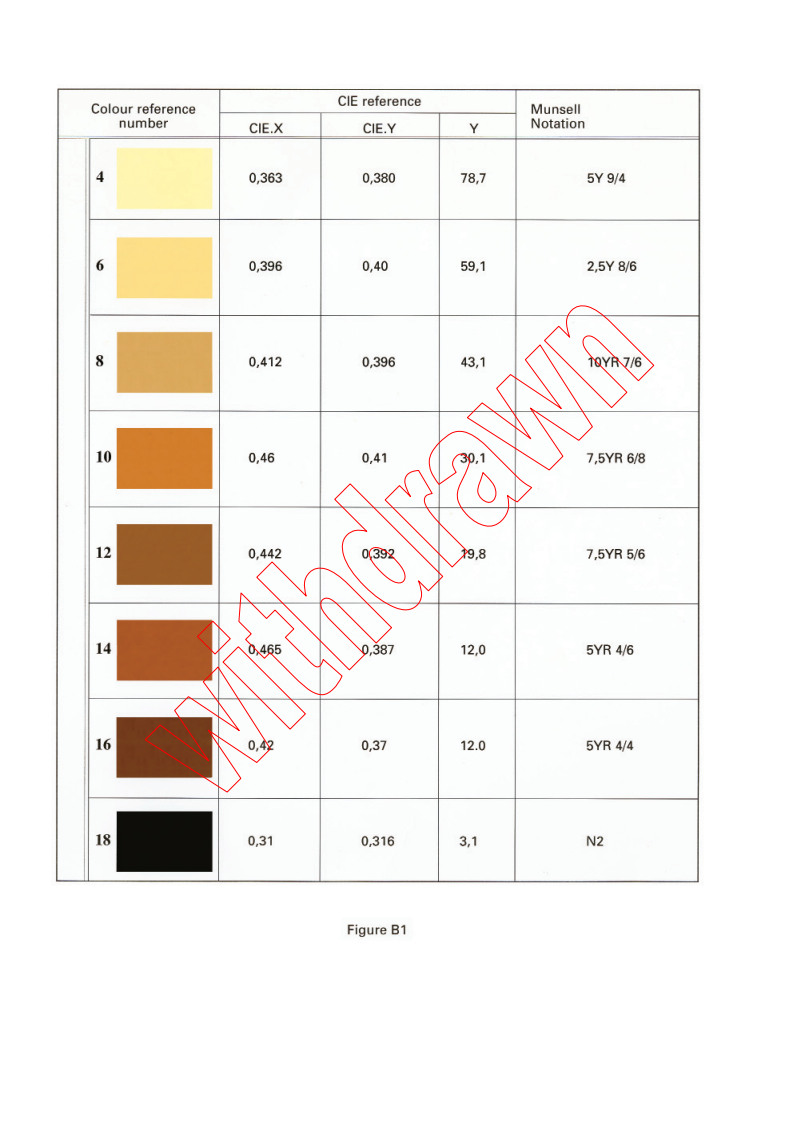
Annexe B (normative) Echelle des couleurs.62
Annexe C (informative) Adresses des fournisseurs.64
Annexe D (informative) Informations à fournir au point de vente .66
Bibliographie .68
Figure 1 – Dimensions internes des fours .50
Figure 2 – Emplacement des points de mesure de la température.52
Figure 3 – Dimensions de la buse d’extrusion de la pâte.54
Figure 4 – Position des bandes de pâte sur la plaque à pâtisserie.54
Figure 5 – Poêle à frire.56
Figure 6 – Casserole en acier.58
Figure A.1 – Colorimètre .60
61817 © IEC:2000+A1:2004 – 3 –
CONTENTS
FOREWORD…………………………………………………………………………………………………5
1 Scope.9
2 Normative references.9
3 Definitions.11
4 List of measurements .15
5 General conditions for the measurements.17
6 Dimensions and mass.19
7 Function measurements.21
8 Other characteristics.47
Annex A (normative) Colour measuring instrument .61
Annex B (normative) Shade chart .63
Annex C (informative) Addresses of suppliers.65
Annex D (informative) Informations to be provided to the point of sale.67
Bibliography…………………… .69
Figure 1 – Internal dimensions of ovens.51
Figure 2 – Positions for temperature-recording device .53
Figure 3 – Shape of the nozzle for extruding pastry .55
Figure 4– Position of pastry strips on the baking sheet .55
Figure 5 – Frying pan.57
Figure 6 – Steel saucepan .59
Figure A.1 – Colour measuring instrument .61
– 4 – 61817 © CEI:2000+A1:2004
COMMISSION ÉLECTROTECHNIQUE INTERNATIONALE
____________
APPAREILS MOBILES À USAGE DOMESTIQUE
POUR CUIRE, GRILLER OU À USAGE SIMILAIRE –
MÉTHODES DE MESURE DE L’APTITUDE À LA FONCTION
AVANT-PROPOS
1) La Commission Electrotechnique Internationale (CEI) est une organisation mondiale de normalisation composée
de l'ensemble des comités électrotechniques nationaux (Comités nationaux de la CEI). La CEI a pour objet de
favoriser la coopération internationale pour toutes les questions de normalisation dans les domaines de
l'électricité et de l'électronique. A cet effet, la CEI – entre autres activités – publie des Normes internationales,
des Spécifications techniques, des Rapports techniques, des Spécifications accessibles au public (PAS) et des
Guides (ci-après dénommés "Publication(s) de la CEI"). Leur élaboration est confiée à des comités d'études,
aux travaux desquels tout Comité national intéressé par le sujet traité peut participer. Les organisations
internationales, gouvernementales et non gouvernementales, en liaison avec la CEI, participent également aux
travaux. La CEI collabore étroitement avec l'Organisation Internationale de Normalisation (ISO), selon des
conditions fixées par accord entre les deux organisations.
2) Les décisions ou accords officiels de la CEI concernant les questions techniques représentent, dans la mesure
du possible, un accord international sur les sujets étudiés, étant donné que les Comités nationaux de la CEI
intéressés sont représentés dans chaque comité d’études.
3) Les Publications de la CEI se présentent sous la forme de recommandations internationales et sont agréées
comme telles par les Comités nationaux de la CEI. Tous les efforts raisonnables sont entrepris afin que la CEI
s'assure de l'exactitude du contenu technique de ses publications; la CEI ne peut pas être tenue responsable de
l'éventuelle mauvaise utilisation ou interprétation qui en est faite par un quelconque utilisateur final.
4) Dans le but d'encourager l'uniformité internationale, les Comités nationaux de la CEI s'engagent, dans toute la
mesure possible, à appliquer de façon transparente les Publications de la CEI dans leurs publications
nationales et régionales. Toutes divergences entre toutes Publications de la CEI et toutes publications
nationales ou régionales correspondantes doivent être indiquées en termes clairs dans ces dernières.
5) La CEI n’a prévu aucune procédure de marquage valant indication d’approbation et n'engage pas sa
responsabilité pour les équipements déclarés conformes à une de ses Publications.
6) Tous les utilisateurs doivent s'assurer qu'ils sont en possession de la dernière édition de cette publication.
7) Aucune responsabilité ne doit être imputée à la CEI, à ses administrateurs, employés, auxiliaires ou
mandataires, y compris ses experts particuliers et les membres de ses comités d'études et des Comités
nationaux de la CEI, pour tout préjudice causé en cas de dommages corporels et matériels, ou de tout autre
dommage de quelque nature que ce soit, directe ou indirecte, ou pour supporter les coûts (y compris les frais
de justice) et les dépenses découlant de la publication ou de l'utilisation de cette Publication de la CEI ou de
toute autre Publication de la CEI, ou au crédit qui lui est accordé.
8) L'attention est attirée sur les références normatives citées dans cette publication. L'utilisation de publications
référencées est obligatoire pour une application correcte de la présente publication.
9) L’attention est attirée sur le fait que certains des éléments de la présente Publication de la CEI peuvent faire
l’objet de droits de propriété intellectuelle ou de droits analogues. La CEI ne saurait être tenue pour
responsable de ne pas avoir identifié de tels droits de propriété et de ne pas avoir signalé leur existence.
La Norme internationale CEI 61817 a été établie par le sous-comité 59G: Petits appareils de
cuisine, du comité d’études 59 de la CEI: Aptitude à la fonction des appareils électrodomestiques.
La présente version consolidée de la CEI 61817 comprend la première édition (2000)
[documents 59G/107/FDIS et 59G/108/RVD] et son amendement 1 (2004) [documents
59L/2/FDIS et 59L/6/RVD].
Le contenu technique de cette version consolidée est donc identique à celui de l'édition de
base et à son amendement; cette version a été préparée par commodité pour l'utilisateur.
Elle porte le numéro d'édition 1.1.
Une ligne verticale dans la marge indique où la publication de base a été modifiée par
l'amendement 1.
Les annexes A et B font partie intégrante de cette norme.
L’annexe C et D sont données uniquement à titre d’information.
61817 © IEC:2000+A1:2004 – 5 –
INTERNATIONAL ELECTROTECHNICAL COMMISSION
____________
HOUSEHOLD PORTABLE APPLIANCES
FOR COOKING, GRILLING AND SIMILAR USE –
METHODS FOR MEASURING PERFORMANCE
FOREWORD
1) The International Electrotechnical Commission (IEC) is a worldwide organization for standardization comprising
all national electrotechnical committees (IEC National Committees). The object of IEC is to promote
international co-operation on all questions concerning standardization in the electrical and electronic fields. To
this end and in addition to other activities, IEC publishes International Standards, Technical Specifications,
Technical Reports, Publicly Available Specifications (PAS) and Guides (hereafter referred to as “IEC
Publication(s)”). Their preparation is entrusted to technical committees; any IEC National Committee interested
in the subject dealt with may participate in this preparatory work. International, governmental and non-
governmental organizations liaising with the IEC also participate in this preparation. IEC collaborates closely
with the International Organization for Standardization (ISO) in accordance with conditions determined by
agreement between the two organizations.
2) The formal decisions or agreements of IEC on technical matters express, as nearly as possible, an international
consensus of opinion on the relevant subjects since each technical committee has representation from all
interested IEC National Committees.
3) IEC Publications have the form of recommendations for international use and are accepted by IEC National
Committees in that sense. While all reasonable efforts are made to ensure that the technical content of IEC
Publications is accurate, IEC cannot be held responsible for the way in which they are used or for any
misinterpretation by any end user.
4) In order to promote international uniformity, IEC National Committees undertake to apply IEC Publications
transparently to the maximum extent possible in their national and regional publications. Any divergence
between any IEC Publication and the corresponding national or regional publication shall be clearly indicated in
the latter.
5) IEC provides no marking procedure to indicate its approval and cannot be rendered responsible for any
equipment declared to be in conformity with an IEC Publication.
6) All users should ensure that they have the latest edition of this publication.
7) No liability shall attach to IEC or its directors, employees, servants or agents including individual experts and
members of its technical committees and IEC National Committees for any personal injury, property damage or
other damage of any nature whatsoever, whether direct or indirect, or for costs (including legal fees) and
expenses arising out of the publication, use of, or reliance upon, this IEC Publication or any other IEC
Publications.
8) Attention is drawn to the Normative references cited in this publication. Use of the referenced publications is
indispensable for the correct application of this publication.
9) Attention is drawn to the possibility that some of the elements of this IEC Publication may be the subject of
patent rights. IEC shall not be held responsible for identifying any or all such patent rights.
International Standard IEC 61817 has been prepared by subcommittee 59G: Small kitchen
appliances, of IEC technical committee 59: Performance of household electrical appliances.
This consolidated version of IEC 61817 consists of the first edition (2000) [documents
59G/107/FDIS and 59G/108/RVD] and its amendment 1 (2004) [documents 59L/2/FDIS and
59L/6/RVD].
The technical content is therefore identical to the base edition and its amendment and has
been prepared for user convenience.
It bears the edition number 1.1.
A vertical line in the margin shows where the base publication has been modified by
amendment 1.
Annexes A and B form an integral part of this standard.
Annex C and D are for information only.
– 6 – 61817 © CEI:2000+A1:2004
Le comité a décidé que le contenu de la publication de base et de ses amendements ne sera
pas modifié avant la date de maintenance indiquée sur le site web de la CEI sous
"http://webstore.iec.ch" dans les données relatives à la publication recherchée. A cette date, la
publication sera
• reconduite,
• supprimée,
• remplacée par une édition révisée, ou
• amendée.
61817 © IEC:2000+A1:2004 – 7 –
The committee has decided that the contents of the base publication and its amendments will
remain unchanged until the maintenance result date indicated on the IEC web site under
"http://webstore.iec.ch" in the data related to the specific publication. At this date, the
publication will be
• reconfirmed,
• withdrawn,
• replaced by a revised edition, or
• amended.
– 8 – 61817 © CEI:2000+A1:2004
APPAREILS MOBILES À USAGE DOMESTIQUE
POUR CUIRE, GRILLER OU À USAGE SIMILAIRE –
MÉTHODES DE MESURE DE L’APTITUDE À LA FONCTION
1 Domaine d'application
La présente Norme Internationale définit des méthodes de mesure de l’aptitude à la fonction
des appareils mobiles à usage domestique pour cuire, griller ou à usage similaire.
Cette norme a pour objet de définir les principales caractéristiques d’aptitude à la fonction
intéressant le consommateur, et de spécifier les méthodes pour les mesurer.
La présente norme ne traite pas des prescriptions de sécurité et ne spécifie pas les prescrip-
tions d’aptitude à la fonction.
Prenant en compte les degrés de précision et de répétibilité assez faibles en raison des
variations dans le temps, de l’origine des matériels d’essais et des ingrédients, et de l’influence
du jugement subjectif des opérateurs effectuant les essais, les méthodes d’essais décrites ci-
après appliquées à des essais comparatifs portant sur un grand nombre d’appareils et
effectués approximativement au même moment, dans un même laboratoire, par le même
opérateur et avec les mêmes ustensiles, donneront un résultat plus fiable que si elles étaient
appliquées à des essais unitaires effectués dans différents laboratoires.
Cette norme ne s’applique pas aux fours à micro-ondes, aux cuisinières, foyers de cuisson,
fours électriques et grils à usage domestique, ni aux appareils prévus exclusivement pour un
usage commercial ou industriel
2 Références normatives
Les documents de référence suivants sont indispensables pour l'application du présent
document. Pour les références datées, seule l'édition citée s'applique. Pour les références non
datées, la dernière édition du document de référence s'applique (y compris les éventuels
amendements).
ISO 7724 (toutes les parties), Peintures et vernis – Colorimétrie
ISO/CIE 10526:1999, Illuminants colorimétriques normalisés CIE
ISO/CIE 10527:1991, Observateurs de référence colorimétriques CIE
CIE 15.2:1986, Colorimétrie
61817 © IEC:2000+A1:2004 – 9 –
HOUSEHOLD PORTABLE APPLIANCES
FOR COOKING, GRILLING AND SIMILAR USE –
METHODS FOR MEASURING PERFORMANCE
1 Scope
This International Standard specifies methods for measuring the performance of electric
household portable appliances for cooking, grilling and similar use.
This standard defines the main performance characteristics of such appliances which are of
interest to the user, and specifies methods of measurement.
This standard is concerned neither with safety nor performance requirements.
Taking into account the lower grade of accuracy and repeatability, due to the variations in
time, origin of test materials and ingredients and to the influence of the subjective judgement
of test operators, the described test methods may be applied more reliably for comparative
testing of a number of appliances at approximately the same time, in the same laboratory, by
the same operator and with the same utensils, rather than for testing of a single appliance in
different laboratories.
This standard does not apply to microwave ovens, electric cooking ranges, hobs, ovens and
grills for household use, nor to appliances designed exclusively for commercial or industrial
use.
2 Normative references
The following referenced documents are indispensable for the application of this document.
For dated references, only the edition cited applies. For undated references, the latest edition
of the referenced document (including any amendments) applies.
ISO 7724 (all parts), Paints and varnishes – Colorimetry
ISO/CIE 10526:1999, CIE standard colorimetric illuminants
ISO/CIE 10527:1991, CIE standard colorimetric observers
CIE 15.2:1986, Colorimetry
– 10 – 61817 © CEI:2000+A1:2004
3 Définitions
Pour les besoins de la présente Norme Internationale, les définitions suivantes s’appliquent.
3.1
grillage/grillage par contact
cuisson et/ou brunissage des aliments au moyen de chaleur rayonnante
NOTE 1 Dans le cas d’un grillage par contact, l’aliment est cuit sur une face ou sur les deux par contact direct
avec la plaque chauffante.
NOTE 2 Le grillage ou le grillage par contact effectué à l’extérieur est appelé barbecue.
NOTE 3 Les fonctions barbecue, grillage sur pierre, raclette sont couvertes par la notion de grillage/grillage par
contact.
3.2
rôtissage
cuisson et brunissage d’aliment (typiquement rôti de viande, gibier ou volaille) au moyen de
chaleur sèche, par convection, rayonnement ou convection forcée d'air chaude
3.3
grillage de toast
brunissage de produits à base de farine au moyen de chaleur rayonnante
3.4
cuisson au four
cuisson et brunissage d’aliment (typiquement produits à base de farine tels que les gâteaux et
le pain) au moyen de chaleur sèche, par convection, rayonnement ou convection forcée
NOTE Dans certains cas, l’aliment peut se dilater et devenir plus solide avec pour conséquence une réduction de
sa masse ou de son poids.
3.5
mijotage
cuisson d’un aliment immergé dans un liquide en l’amenant tout d’abord à ébullition puis en
réduisant la chaleur de manière à le maintenir presque à ébullition, ce qui est confirmé par le
frémissement de l’eau
NOTE Le mijotage est normalement utilisé pour une cuisson lente et longue.
3.6
étuvage
cuisson lente d’aliments au moyen de la vapeur produite par de l’eau en ébullition
3.7
rissolage (Italiano soffritto) (English shallow frying)
cuisson et/ou brunissage des aliments au moyen de chaleur conduite et en utilisant une petite
proportion de matière grasse (par exemple graisse ou huile)
3.8
gratinage
finition par brunissage d’un aliment cuit au préalable et normalement couvert de chapelure ou
de fromage
3.9
déshydratation
préparation d’aliment en vue de sa conservation, par enlèvement de l’eau qu’il contient
NOTE par l’opération de déshydratation, le poids de l’aliment est considérablement réduit
61817 © IEC:2000+A1:2004 – 11 –
3 Definitions
For the purposes of this International Standard, the following definitions apply.
3.1
grilling/contact grilling
cooking and/or browning food by means of radiated heat
NOTE 1 In the case of contact grilling the food is cooked on one side or both by direct contact with the heating
plates.
NOTE 2 Grilling /contact grilling performed outdoors is called barbecuing.
NOTE 3 Barbecues, stone grills and raclette/griddle functions are covered by grilling/contact grilling.
3.2
roasting
cooking and browning food (typically joints of meat, game or poultry) by dry convected heat,
radiant heat or forced hot air
3.3
toasting
browning flour-based products by means of radiated heat
3.4
baking
cooking and browning food (typically flour based items such as cakes and bread) by dry
convected heat, radiant heat or forced hot air
NOTE In some cases the food will expand and become more solidified, causing its mass/weight to be reduced.
3.5
simmering
cooking food immersed in liquid by first bringing to a boil and then reducing the heat to
maintain a point below boiling, indicated by slight movement of the liquid.
NOTE Simmering is normally used for long slow cooking.
3.6
steaming
cooking food gently by means of steam produced from boiling water
3.7
shallow frying (Italian soffritto) (French rissoler)
cooking and/or browning food by means of conducted heat using a small amount of cooking
agent e.g. fat or oil
3.8
gratinée
finish, by browning, a pre-cooked food normally covered in breadcrumbs or cheese
3.9
dehydrating
preparing food for preservation by removal of water
NOTE By dehydration the weight of the food will be considerably reduced.
– 12 – 61817 © CEI:2000+A1:2004
3.10
bouillir
action de cuire les aliments dans un liquide à base d’eau porté à 100 °C en maintenant la
formation de bulles jusqu'à la fin de la cuisson
3.11
fondre
action de convertir un aliment solide, normalement la graisse, le sucre, le chocolat en une
préparation liquide par un chauffage doux
3.12
appareil mobile
appareil qui est prévu pour être déplacé pendant son fonctionnement ou appareil dont la
masse est inférieure à 18 kg
NOTE Les appareils mobiles sont généralement équipés d’un cordon d’alimentation et d’une fiche de prise de
courant leur permettant d’être raccordés au réseau d’alimentation électrique.
3.13
table de cuisson
plaque de cuisson
appareil ou partie d’un appareil qui comporte une ou plusieurs zones de cuisson
3.14
zone de cuisson
partie de la table de cuisson ou zone repérée sur la surface d’une table de cuisson sur
laquelle on place les casseroles à chauffer
3.15
plaque chauffante
partie solidaire de la surface de la table de cuisson qui forme la zone de cuisson
3.16
plaque chauffante pleine
plaque chauffante ayant une surface pleine, généralement en fonte, incorporant un élément
chauffant
3.17
plaque chauffante tubulaire
plaque chauffante dont l’élément chauffant est constitué d’une gaine tubulaire placée dans un
plan pratiquement plat
3.18
table de cuisson en vitrocéramique
table de cuisson dans laquelle les éléments chauffants sont situés sous une surface
vitrocéramique
3.19
zone de cuisson par induction
zone de cuisson sur laquelle la casserole est chauffée au moyen de courants de Foucault
NOTE 1 Les courants de Foucault sont induits dans le fond de la casserole par un champ magnétique généré par
une bobine.
NOTE 2 La surface de la table de cuisson peut être en vitrocéramique.
61817 © IEC:2000+A1:2004 – 13 –
3.10
boiling
cooking food in water-based liquid at 100 °C or bringing food/liquid to 100 °C and maintaining
a bubble formation to complete the cooking
3.11
melting
converting a solid food, normally fat, sugar, or chocolate, into a liquid by gently heating
3.12
portable appliance
appliance intended to be moved while in operation or having a mass of less than 18 kg
NOTE Portable appliances are normally provided with a supply cord and a plug for connection to the supply.
3.13
hob
appliance or part of an appliance which incorporates one or more cooking zones
3.14
cooking zone
part of the hob or area marked on the surface of a hob on which pans are placed for heating
3.15
hotplate
part attached to the surface of a hob which forms a cooking zone
3.16
solid hotplate
hotplate with closed surface usually constructed from cast iron with an integrated heating
element
3.17
tubular hotplate
hotplate, the surface of which is formed by the configuration of a tubular sheathed heating
element in a substantially flat plane
3.18
glass ceramic hob
hob in which the heating elements are located beneath a glass ceramic surface
3.19
induction cooking zone
cooking zone on which the pan is heated by means of eddy currents
NOTE 1 The eddy currents are induced in the bottom of the pan by the electromagnetic field of a coil.
NOTE 2 The hob surface may be of glass ceramic.
– 14 – 61817 © CEI:2000+A1:2004
3.20
gril
appareil ou partie d’appareil dans lequel l’aliment est cuit au moyen de chaleur rayonnante
3.21
four
appareil ou compartiment d'un appareil de cuisson dans lequel l’aliment est cuit par
rayonnement, par convection naturelle, convection forcée d'air chaud ou par combinaison de
ces méthodes de cuisson
3.22
four à chaleur tournante
four dans lequel la transmission de la chaleur à l’aliment est effectuée par circulation forcée de
l’air
NOTE Un four à chaleur tournante peut également fonctionner comme un four à chaleur conventionnelle,
néanmoins, dans ce cas, des éléments chauffants supplémentaires peuvent être nécessaires.
3.23
four à catalyse
four dans lequel les salissures de cuisson sont enlevées par décomposition sur un revêtement
spécial
3.24
grille
grille ouverte permettant le passage libre de l’air et de la chaleur rayonnée, utilisée pour
supporter les aliments/les récipients
3.25
plaque de cuisson
plaque solide de métal, de verre ou constituée d’un autre matériau
4 Liste des mesures
4.1 Dimensions et masse
Les mesures suivantes sont effectuées:
– dimensions hors tout (voir 6.1);
– longueur du câble d’alimentation (voir 6.2);
– masse de l’appareil (voir 6.3);
– dimensions des fours, des étagères et des grilles de grillage (voir 6.4, 6.5, 6.6).
4.2 Fonctions
Les essais suivants sont effectués:
– grillage/grillage par contact (voir 7.1);
– rôtissage (voir 7.2);
– grillage de toast (voir 7.3);
– cuisson (voir 7.4);
– distribution de chaleur (voir 7.5);
– mijotage (voir 7.6);
– étuvage (voir 7.7);
61817 © IEC:2000+A1:2004 – 15 –
3.20
grill
appliance or part of an appliance in which food is cooked by radiant heat
3.21
oven
appliance or compartment of a cooking range in which food is cooked by radiation, by natural
convection, by forced-air circulation or by a combination of these heating methods
3.22
oven with forced air circulation
oven with heat transmission to the food by circulating air
NOTE An oven with forced air circulation may also operate as a conventional oven, however, a supplementary set
of heating elements may be necessary for that purpose.
3.23
oven with catalytic lining
oven in which cleaning is achieved by breaking down certain depositions on a special coating
3.24
shelf
open grid which allows free movement of air and radiated heat, used to support
food/container
3.25
baking sheet
solid sheet of metal, glass or other material
4 List of measurements
4.1 Dimensions and mass
The following measurements are carried out:
– overall dimensions (see 6.1);
– length of the flexible cord (see 6.2);
– mass of the appliance (see 6.3);
– oven, backing sheets and grill grid/shelves dimensions (see 6.4, 6.5, 6.6).
4.2 Functions
The following tests are carried out:
– grilling/contact grilling (see 7.1);
– roasting (see 7.2);
– toasting (see 7.3),
– baking (see 7.4);
– heat distribution (see 7.5);
– simmering (see 7.6);
– steaming (see 7.7).
– 16 – 61817 © CEI:2000+A1:2004
– rissolage (voir 7.8);
– gratinage (voir 7.9);
– déshydratation (voir 7.10);
– bouillir (voir 7.11);
– fondre (voir 7.12).
4.3 Autres caractéristiques
– nettoyage (voir 8.1);
– manuel d’utilisation (voir 8.2).
5 Conditions générales d’exécution des mesures
Sauf spécification contraire, les mesures sont effectuées dans les conditions suivantes.
5.1 Généralités
Les réglages, les accessoires et les quantités d’ingrédients utilisés sont ceux recommandés
par le fabricant. En l’absence de recommandations du fabricant, les quantités indiquées dans
la présente norme sont utilisées. Les ingrédients spécifiés ont été sélectionnés de manière à
assurer l’uniformité et la reproductibilité des résultats.
Sauf spécification contraire, l'appareil est manœuvré selon les instructions du fabricant.
5.2 Salle d’essai
Les essais sont réalisés dans une salle pratiquement exempte de courants d’air dans laquelle
la température ambiante est maintenue à 20 °C ± 5 °C.
5.3 Température ambiante
Sauf indication contraire, la température ambiante et la température de tous les ustensiles et
ingrédients est maintenue à 20 °C ± 5 °C.
5.4 Tension
L’appareil est alimenté à la tension assignée ±1 %.
Si une plage de tension est spécifiée, les essais sont effectués à la tension nominale du pays
pour lequel l'appareil est conçu.
5.5 Instrumentation
La précision de l’appareil de mesure comprenant un couple thermoélectrique doit être de
0,5 °C entre 0 °C et 100 °C et de 2 °C entre 100 °C et 300 °C.
La précision de l’appareil de mesure de consommation d’énergie doit être de 1 %.
5.6 Positionnement de l’appareil
Les appareils sont positionnés à une distance d’au moins 30 cm des parois de tout mur, sur un
support en bois, peint en noir mat.
61817 © IEC:2000+A1:2004 – 17 –
– shallow frying (see 7.8);
– gratinée (see 7.9);
– dehydrating (see 7.10);
– boiling (see 7.11);
– melting (see 7.12).
4.3 Other Characteristics
– cleaning (see 8.1);
– user instructions (see 8.2).
5 General conditions for the measurements
Unless otherwise specified, the measurements are made under the following conditions.
5.1 General
The settings, accessories and quantities of ingredients used are those recommended by the
manufacturer. In the absence of the manufacturer's recommendations, the quantities quoted
are used. The ingredients specified have been selected primarily to ensure uniform and
reproducible results.
Unless otherwise stated, the appliance is operated in accordance with the manufacturer’s
instructions.
5.2 Test room
The tests are carried out in a substantially draught-free room in which the ambient
temperature is maintained at 20 °C ± 5 °C.
5.3 Ambient temperature
The ambient temperature and the temperature of all utensils and ingredients are maintained
at 20 °C ± 5 °C unless otherwise specified.
5.4 Voltage
The appliance is supplied at rated voltage ±1 %.
If the appliance has a rated voltage range, the tests are carried out at the nominal voltage of
the country where the appliance is intended to be used.
5.5 Instrumentation
The temperature measuring instruments including thermocouples shall have an accuracy of
0,5 °C within the temperature range of 0 °C to 100 °C and an accuracy of 2 °C within the
temperature range 100 °C to 300 °C.
The energy measuring meter shall have an accuracy of 1 %.
5.6 Positioning the appliance
Appliances are positioned at a distance of at least 30 cm away from side walls on a dull black
painted wooden support.
– 18 – 61817 © CEI:2000+A1:2004
5.7 Préchauffage
L’appareil est initialement à la température ambiante. Cependant, si un préchauffage est
spécifié pour l’essai, l’appareil est préchauffé selon les instructions d’utilisation. Si aucune
instruction n’est donnée, l’appareil est considéré comme préchauffé après que le thermostat a
pour la première fois commandé la coupure.
5.8 Réglage des commandes
La commande est réglée pour donner la température spécifiée pour l’essai. Cependant, si la
température ne peut être atteinte pour des raisons de construction, le positionnement le plus
proche correspondant à la température spécifiée doit être choisi.
5.9 Equipement
Lorsque cela est approprié, un mélangeur électrique d’aliments peut être utilisé. L’appareil est
alimenté sous une tension correspondant à la tension assignée.
6 Dimensions et masse
6.1 Dimensions hors tout
Les dimensions hors tout de l’appareil, hauteur, largeur et profondeur, sont mesurées, y
compris tous boutons de controle ou autres protubérances, les portes, si elles existent, étant
fermées. Ces dimensions sont exprimées en millimètres.
6.2 Longueur du câble d’alimentation
La distance entre le point d’entrée dans l’appareil et la fiche de prise de courant, incluant tout
système anti-flexion, est mesurée et indiquée en mètres, arrondie aux 0,05 m les plus proches.
6.3 Masse de l’appareil
La masse de l’appareil, y compris le cordon d’alimentation et la fiche de prise de courant, est
déterminée et exprimée en kilogrammes, arrondis au kilogramme le plus proche.
6.4 Dimensions internes des fours
La hauteur, la largeur et la profondeur du four sont mesurées comme indiqué à la figure 1, et
consignées en millimètres.
Le volume utile est calculé à partir de ces trois dimensions et est consigné en litres.
6.5 Dimensions des étagères
La surface utile de l’étagère est mesurée. Si l'étagère n'est pas plate, la surface est
déterminée 5 mm au-dessus de la surface de l’étagère.
La surface est calculée et consignée en centimètres carrés, arrondie aux 10 cm les plus
proches.
6.6 Dimensions des grilles de grillage
La largeur et la profondeur utile de la grille de grillage sont mesurées.
La surface est calculée et consignée en centimètres carrés, arrondie aux 10 cm² les plus
proches.
61817 © IEC:2000+A1:2004 – 19 –
5.7 Preheating
The appliance is initially at room temperature. However, if preheating is specified, the
appliance is preheated in accordance with the instructions for use. If no instructions are given,
the appliance is considered to be preheated after the thermostat has switched off for the first
time.
5.8 Setting of controls
The control is set to give the temperature specified for the test. However, if the temperature
cannot be attained due to the construction of the control, the nearest setting related to the
specified temperature is chosen.
5.9 Equipment
When appropriate, an electric food mixer may be used when mixing ingredients. The
appliance is supplied at rated voltage.
6 Dimensions and mass
6.1 Overall dimensions
The overall dimensions – height, width and depth – of the appliance including knobs, handles
etc., are measured and indicated in millimetres, the doors, if any, being closed.
6.2 Length of the flexible cord
The distance between the entry points into the appliance and the plug, including any cord
guard, are measured and indicated in metres, to the nearest 0,05 m.
6.3 Mass of the appliance
The mass of the appliance, with the flexible cord and the plug attached, is determined and
expressed in kilograms, rounded to the nearest kilogram.
6.4 Internal dimensions of oven
The height, width and depth within the oven are measured as shown in figure 1 and stated in
millimetres.
The usable volume is calculated from these three dimensions and stated in litres.
6.5 Dimensions of baking sheets
The usable area of a baking sheet is measured. If the baking sheet is not flat, this area is
measured 5 mm above the surface of the shelf.
The surface area is calculated and stated in square centimetres, rounded to the nearest
10 cm .
6.6 Dimensions of grill grids/shelves
The usable width and depth of the shelf for the grill grid are measured.
The surface area is calculated and expressed in square centimetres rounded to the nearest
10 cm .
– 20 – 61817 © CEI:2000+A1:2004
7 Mesure des fonctions
7.1 Grillage/grillage par contact
L’objet de cet essai est de déterminer l’uniformité de la cuisson et du brunissage de la viande.
NOTE Cet essai n’est effectué que pour des essais comparatifs.
7.1.1 Ingrédients
2,5 kg de viande de bœuf hachée, pourcentage de matière grasse entre 10 % et 20 %.
Cette quantité est suffisante pour réaliser 20 pâtés.
7.1.2 Procédure
On forme des petits pâtés, d’un poids de 125 g, de 75 mm de diamètre à l’aide d’un moule
rond. Les pâtés sont comprimés de manière que leur hauteur soit approximativement de
35 mm.
Répartir les pâtés régulièrement sur la grille, en laissant environ 15 mm entre les pâtés et
entre les pâtés et
...
Questions, Comments and Discussion
Ask us and Technical Secretary will try to provide an answer. You can facilitate discussion about the standard in here.
Loading comments...