

IEC 62759-1:2015
(Main)Photovoltaic (PV) modules - Transportation testing - Part 1: Transportation and shipping of module package units
General Information
- Abstract
IEC 62759-1:2015 describes methods for the simulation of transportation of complete package units of modules and combined subsequent environmental impacts. This standard is designed so that its test sequence can co-ordinate with those of IEC 61215 or IEC 61646, so that a single set of samples may be used to perform both the transportation simulation and performance evaluation of a photovoltaic module design.
- Status
- Published
- Publication Date
- 25-Jun-2015
- Technical Committee
- TC 82 - Solar photovoltaic energy systems
- Drafting Committee
- WG 2 - TC 82/WG 2
- Current Stage
- DELPUB - Deleted Publication
- Start Date
- 07-Jul-2022
- Completion Date
- 01-Apr-2019
Overview
IEC 62759-1:2015 is an international standard published by the International Electrotechnical Commission (IEC) that addresses the transportation testing of photovoltaic (PV) modules. Specifically, it focuses on the simulation of transportation and shipping conditions for complete package units of PV modules, ensuring mechanical stresses during transit are properly replicated and assessed. This standard is crucial as existing type approval standards primarily focus on operational performance and do not consider the physical impacts modules may face during logistics.
The standard is designed to coordinate with other key IEC PV standards such as IEC 61215 and IEC 61646, enabling manufacturers to use the same test samples for both transportation simulation and performance qualification. While originally intended for flat plate PV modules, IEC 62759-1 can also be adapted for concentrator photovoltaic (CPV) modules and assemblies.
Key Topics
Scope and Purpose: Defines testing methods simulating transportation-induced mechanical stresses on fully packaged PV modules, covering shocks, vibrations, and environmental effects.
Testing Procedures:
- Random vibration testing to simulate the broadband mechanical vibrations occurring in transport.
- Shock testing to assess the module’s resilience to sudden impacts.
- Environmental stress testing, addressing combined environmental loads after transportation simulation.
Sampling and Handling: Guidance on the selection and preparation of test samples to ensure representative and reproducible results.
Coordination with Other Standards: Test sequences are aligned with IEC 61215 and IEC 61646 requirements, allowing comprehensive performance and durability assessments from a single sample set.
Normative References: Integration of complementary international standards such as IEC 60068-2-27 for shock, IEC 60068-2-64 for vibration, and ASTM D4169 for shipping container performance.
Applications
IEC 62759-1:2015 is essential for manufacturers, testing labs, and certification bodies involved in the solar energy industry. Its practical applications include:
Quality Assurance: Assuring PV modules can withstand the mechanical impacts during shipping, reducing damage rates and warranty claims.
Design Validation: Enabling module designers to evaluate packaging robustness and module construction against typical transport stresses.
Certification and Compliance: Supporting product certification by simulation of real-world transportation conditions, complementing performance standards.
Supply Chain Optimization: Helping logistics providers and manufacturers understand and mitigate risks inherent in international transportation of delicate PV products.
Integration into Product Development: Combining transportation stress simulation with performance tests to streamline testing workflows for new PV module models.
Related Standards
IEC 62759-1 refers to and aligns with a suite of standards relevant to photovoltaic modules and transportation testing:
- IEC 61215: Design qualification and type approval for crystalline silicon terrestrial PV modules.
- IEC 61646: Design qualification and type approval for thin-film terrestrial PV modules.
- IEC 61730-2: PV module safety qualification requirements.
- IEC 62108: Design qualification for concentrator photovoltaic (CPV) modules and assemblies.
- IEC 60068-2-27 & IEC 60068-2-64: Environmental testing standards for shock and vibration.
- ASTM D4169: Performance testing practice for shipping containers which is used as reference for vibration and shock profiles.
- ISO 13355: Packaging testing related to vibration.
- MIL STD 810G: Military standard for environmental testing, used for comparison of severity levels.
This comprehensive framework supports manufacturers in delivering durable and reliable photovoltaic modules capable of enduring the stresses of global transportation logistics.
By following IEC 62759-1:2015 methodologies, stakeholders can ensure effective protection of photovoltaic modules during shipping, enhancing the longevity and reliability of solar installations worldwide. This standard is vital for advancing quality and trust in the solar energy supply chain.
Relations
- Effective Date
- 05-Sep-2023
Get Certified
Connect with accredited certification bodies for this standard

DNV
DNV is an independent assurance and risk management provider.

Lloyd's Register
Lloyd's Register is a global professional services organisation specialising in engineering and technology.
DNV Energy Systems
Energy and renewable energy certification.
Sponsored listings
Frequently Asked Questions
IEC 62759-1:2015 is a standard published by the International Electrotechnical Commission (IEC). Its full title is "Photovoltaic (PV) modules - Transportation testing - Part 1: Transportation and shipping of module package units". This standard covers: IEC 62759-1:2015 describes methods for the simulation of transportation of complete package units of modules and combined subsequent environmental impacts. This standard is designed so that its test sequence can co-ordinate with those of IEC 61215 or IEC 61646, so that a single set of samples may be used to perform both the transportation simulation and performance evaluation of a photovoltaic module design.
IEC 62759-1:2015 describes methods for the simulation of transportation of complete package units of modules and combined subsequent environmental impacts. This standard is designed so that its test sequence can co-ordinate with those of IEC 61215 or IEC 61646, so that a single set of samples may be used to perform both the transportation simulation and performance evaluation of a photovoltaic module design.
IEC 62759-1:2015 is classified under the following ICS (International Classification for Standards) categories: 27.160 - Solar energy engineering. The ICS classification helps identify the subject area and facilitates finding related standards.
IEC 62759-1:2015 has the following relationships with other standards: It is inter standard links to IEC 62759-1:2022. Understanding these relationships helps ensure you are using the most current and applicable version of the standard.
IEC 62759-1:2015 is available in PDF format for immediate download after purchase. The document can be added to your cart and obtained through the secure checkout process. Digital delivery ensures instant access to the complete standard document.
Standards Content (Sample)
IEC 62759-1 ®
Edition 1.0 2015-06
INTERNATIONAL
STANDARD
NORME
INTERNATIONALE
Photovoltaic (PV) modules – Transportation testing –
Part 1: Transportation and shipping of module package units
Modules photovoltaïques (PV) – Essais de transport –
Partie 1: Transport et expédition d'unités d'emballage de modules
All rights reserved. Unless otherwise specified, no part of this publication may be reproduced or utilized in any form
or by any means, electronic or mechanical, including photocopying and microfilm, without permission in writing from
either IEC or IEC's member National Committee in the country of the requester. If you have any questions about IEC
copyright or have an enquiry about obtaining additional rights to this publication, please contact the address below or
your local IEC member National Committee for further information.
Droits de reproduction réservés. Sauf indication contraire, aucune partie de cette publication ne peut être reproduite
ni utilisée sous quelque forme que ce soit et par aucun procédé, électronique ou mécanique, y compris la photocopie
et les microfilms, sans l'accord écrit de l'IEC ou du Comité national de l'IEC du pays du demandeur. Si vous avez des
questions sur le copyright de l'IEC ou si vous désirez obtenir des droits supplémentaires sur cette publication, utilisez
les coordonnées ci-après ou contactez le Comité national de l'IEC de votre pays de résidence.
IEC Central Office Tel.: +41 22 919 02 11
3, rue de Varembé Fax: +41 22 919 03 00
CH-1211 Geneva 20 info@iec.ch
Switzerland www.iec.ch
About the IEC
The International Electrotechnical Commission (IEC) is the leading global organization that prepares and publishes
International Standards for all electrical, electronic and related technologies.
About IEC publications
The technical content of IEC publications is kept under constant review by the IEC. Please make sure that you have the
latest edition, a corrigenda or an amendment might have been published.
IEC Catalogue - webstore.iec.ch/catalogue Electropedia - www.electropedia.org
The stand-alone application for consulting the entire The world's leading online dictionary of electronic and
bibliographical information on IEC International Standards, electrical terms containing more than 30 000 terms and
Technical Specifications, Technical Reports and other definitions in English and French, with equivalent terms in 15
documents. Available for PC, Mac OS, Android Tablets and additional languages. Also known as the International
iPad. Electrotechnical Vocabulary (IEV) online.
IEC publications search - www.iec.ch/searchpub IEC Glossary - std.iec.ch/glossary
The advanced search enables to find IEC publications by a More than 60 000 electrotechnical terminology entries in
variety of criteria (reference number, text, technical English and French extracted from the Terms and Definitions
committee,…). It also gives information on projects, replaced clause of IEC publications issued since 2002. Some entries
and withdrawn publications. have been collected from earlier publications of IEC TC 37,
77, 86 and CISPR.
IEC Just Published - webstore.iec.ch/justpublished
Stay up to date on all new IEC publications. Just Published IEC Customer Service Centre - webstore.iec.ch/csc
details all new publications released. Available online and If you wish to give us your feedback on this publication or
also once a month by email. need further assistance, please contact the Customer Service
Centre: csc@iec.ch.
A propos de l'IEC
La Commission Electrotechnique Internationale (IEC) est la première organisation mondiale qui élabore et publie des
Normes internationales pour tout ce qui a trait à l'électricité, à l'électronique et aux technologies apparentées.
A propos des publications IEC
Le contenu technique des publications IEC est constamment revu. Veuillez vous assurer que vous possédez l’édition la
plus récente, un corrigendum ou amendement peut avoir été publié.
Catalogue IEC - webstore.iec.ch/catalogue Electropedia - www.electropedia.org
Application autonome pour consulter tous les renseignements
Le premier dictionnaire en ligne de termes électroniques et
bibliographiques sur les Normes internationales,
électriques. Il contient plus de 30 000 termes et définitions en
Spécifications techniques, Rapports techniques et autres
anglais et en français, ainsi que les termes équivalents dans
documents de l'IEC. Disponible pour PC, Mac OS, tablettes
15 langues additionnelles. Egalement appelé Vocabulaire
Android et iPad.
Electrotechnique International (IEV) en ligne.
Recherche de publications IEC - www.iec.ch/searchpub
Glossaire IEC - std.iec.ch/glossary
La recherche avancée permet de trouver des publications IEC Plus de 60 000 entrées terminologiques électrotechniques, en
en utilisant différents critères (numéro de référence, texte, anglais et en français, extraites des articles Termes et
comité d’études,…). Elle donne aussi des informations sur les Définitions des publications IEC parues depuis 2002. Plus
projets et les publications remplacées ou retirées. certaines entrées antérieures extraites des publications des
CE 37, 77, 86 et CISPR de l'IEC.
IEC Just Published - webstore.iec.ch/justpublished
Service Clients - webstore.iec.ch/csc
Restez informé sur les nouvelles publications IEC. Just
Published détaille les nouvelles publications parues. Si vous désirez nous donner des commentaires sur cette
Disponible en ligne et aussi une fois par mois par email. publication ou si vous avez des questions contactez-nous:
csc@iec.ch.
IEC 62759-1 ®
Edition 1.0 2015-06
INTERNATIONAL
STANDARD
NORME
INTERNATIONALE
Photovoltaic (PV) modules – Transportation testing –
Part 1: Transportation and shipping of module package units
Modules photovoltaïques (PV) – Essais de transport –
Partie 1: Transport et expédition d'unités d'emballage de modules
INTERNATIONAL
ELECTROTECHNICAL
COMMISSION
COMMISSION
ELECTROTECHNIQUE
INTERNATIONALE
ICS 27.160 ISBN 978-2-8322--2757-2
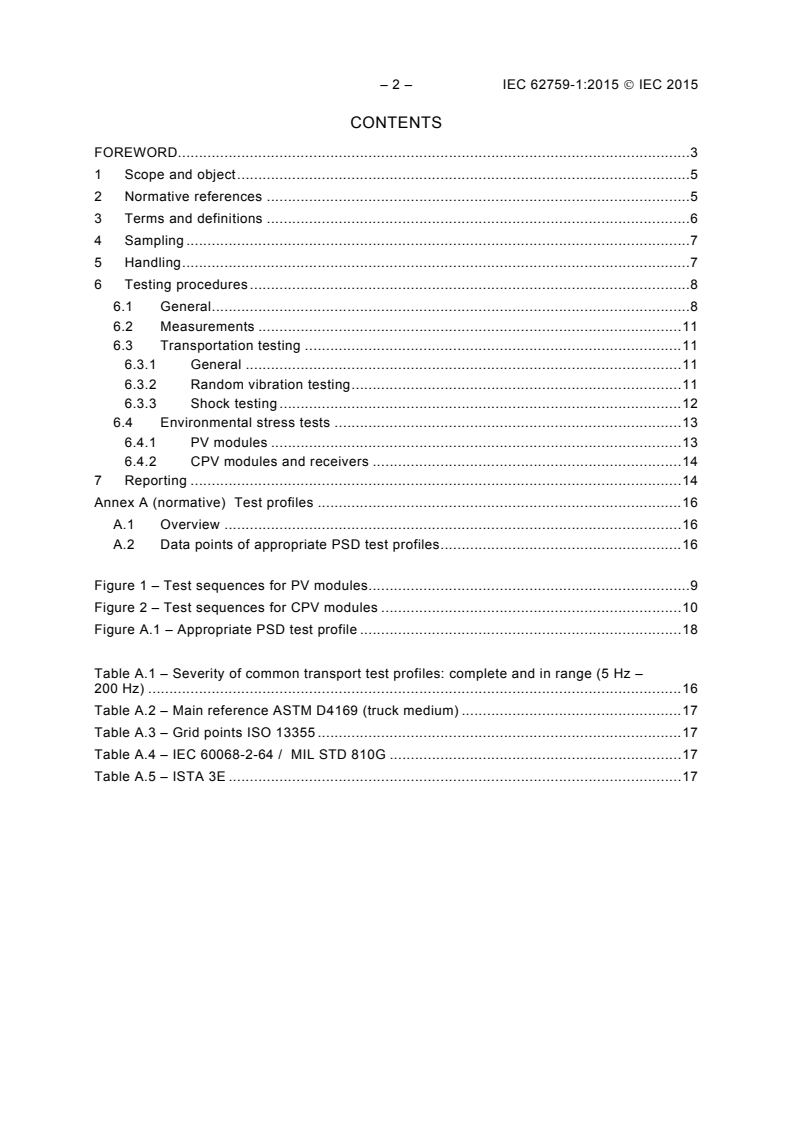
– 2 – IEC 62759-1:2015 IEC 2015
CONTENTS
FOREWORD. 3
1 Scope and object . 5
2 Normative references . 5
3 Terms and definitions . 6
4 Sampling . 7
5 Handling . 7
6 Testing procedures . 8
6.1 General . 8
6.2 Measurements . 11
6.3 Transportation testing . 11
6.3.1 General . 11
6.3.2 Random vibration testing . 11
6.3.3 Shock testing . 12
6.4 Environmental stress tests . 13
6.4.1 PV modules . 13
6.4.2 CPV modules and receivers . 14
7 Reporting . 14
Annex A (normative) Test profiles . 16
A.1 Overview . 16
A.2 Data points of appropriate PSD test profiles . 16
Figure 1 – Test sequences for PV modules . 9
Figure 2 – Test sequences for CPV modules . 10
Figure A.1 – Appropriate PSD test profile . 18
Table A.1 – Severity of common transport test profiles: complete and in range (5 Hz –
200 Hz) . 16
Table A.2 – Main reference ASTM D4169 (truck medium) . 17
Table A.3 – Grid points ISO 13355 . 17
Table A.4 – IEC 60068-2-64 / MIL STD 810G . 17
Table A.5 – ISTA 3E . 17
INTERNATIONAL ELECTROTECHNICAL COMMISSION
____________
PHOTOVOLTAIC (PV) MODULES –
TRANSPORTATION TESTING –
Part 1: Transportation and shipping of module package units
FOREWORD
1) The International Electrotechnical Commission (IEC) is a worldwide organization for standardization comprising
all national electrotechnical committees (IEC National Committees). The object of IEC is to promote
international co-operation on all questions concerning standardization in the electrical and electronic fields. To
this end and in addition to other activities, IEC publishes International Standards, Technical Specifications,
Technical Reports, Publicly Available Specifications (PAS) and Guides (hereafter referred to as “IEC
Publication(s)”). Their preparation is entrusted to technical committees; any IEC National Committee interested
in the subject dealt with may participate in this preparatory work. International, governmental and non-
governmental organizations liaising with the IEC also participate in this preparation. IEC collaborates closely
with the International Organization for Standardization (ISO) in accordance with conditions determined by
agreement between the two organizations.
2) The formal decisions or agreements of IEC on technical matters express, as nearly as possible, an international
consensus of opinion on the relevant subjects since each technical committee has representation from all
interested IEC National Committees.
3) IEC Publications have the form of recommendations for international use and are accepted by IEC National
Committees in that sense. While all reasonable efforts are made to ensure that the technical content of IEC
Publications is accurate, IEC cannot be held responsible for the way in which they are used or for any
misinterpretation by any end user.
4) In order to promote international uniformity, IEC National Committees undertake to apply IEC Publications
transparently to the maximum extent possible in their national and regional publications. Any divergence
between any IEC Publication and the corresponding national or regional publication shall be clearly indicated in
the latter.
5) IEC itself does not provide any attestation of conformity. Independent certification bodies provide conformity
assessment services and, in some areas, access to IEC marks of conformity. IEC is not responsible for any
services carried out by independent certification bodies.
6) All users should ensure that they have the latest edition of this publication.
7) No liability shall attach to IEC or its directors, employees, servants or agents including individual experts and
members of its technical committees and IEC National Committees for any personal injury, property damage or
other damage of any nature whatsoever, whether direct or indirect, or for costs (including legal fees) and
expenses arising out of the publication, use of, or reliance upon, this IEC Publication or any other IEC
Publications.
8) Attention is drawn to the Normative references cited in this publication. Use of the referenced publications is
indispensable for the correct application of this publication.
9) Attention is drawn to the possibility that some of the elements of this IEC Publication may be the subject of
patent rights. IEC shall not be held responsible for identifying any or all such patent rights.
International Standard IEC 62759-1 has been prepared by IEC technical committee 82: Solar
photovoltaic energy systems.
The text of this standard is based on the following documents:
FDIS Report on voting
82/962/FDIS 82/982/RVD
Full information on the voting for the approval of this standard can be found in the report on
voting indicated in the above table.
This publication has been drafted in accordance with the ISO/IEC Directives, Part 2.
– 4 – IEC 62759-1:2015 IEC 2015
A list of all parts of IEC 62759 series, under the general title Photovoltaic (PV) modules –
Transportation testing, can be found on the IEC website.
The committee has decided that the contents of this publication will remain unchanged until
the stability date indicated on the IEC web site under "http://webstore.iec.ch" in the data
related to the specific publication. At this date, the publication will be
• reconfirmed,
• withdrawn,
• replaced by a revised edition, or
• amended.
PHOTOVOLTAIC (PV) MODULES –
TRANSPORTATION TESTING –
Part 1: Transportation and shipping of module package units
1 Scope and object
Photovoltaic (PV) modules are electrical devices intended for continuous outdoor exposure
during their lifetime. Existing type approval standards do not consider mechanical stresses
that may occur during transportation to the PV installation destination.
This part of IEC 62759 describes methods for the simulation of transportation of complete
package units of modules and combined subsequent environmental impacts, it does however
not include pass/fail criteria.
This standard is designed so that its test sequence can co-ordinate with those of IEC 61215
or IEC 61646, so that a single set of samples may be used to perform both the transportation
simulation and performance evaluation of a photovoltaic module design. This standard
applies to flat plate photovoltaic modules, but may also be used as a basis for testing of CPV
modules and assemblies.
2 Normative references
The following documents, in whole or in part, are normatively referenced in this document and
are indispensable for its application. For dated references, only the edition cited applies. For
undated references, the latest edition of the referenced document (including any
amendments) applies.
IEC 60068-2-27:2008, Environmental testing – Part 2-27: Tests – Test Ea and guidance:
Shock
IEC 60068-2-64, Environmental testing – Part 2-64: Tests – Test Fh: Vibration, broadband
random and guidance
IEC 61215:2005, Crystalline silicon terrestrial photovoltaic (PV) modules – Design
qualification and type approval
IEC 61646:2008, Thin-film terrestrial photovoltaic (PV) modules – Design qualification and
type approval
IEC 61730-2:2004, Photovoltaic (PV) module safety qualification – Part 2: Requirements for
testing
IEC TS 61836, Solar photovoltaic energy systems – Terms, definitions and symbols
IEC 62108:2007, Concentrator photovoltaic (CPV) modules and assemblies – Design
qualification and type approval
IEC 62782, Dynamic mechanical load testing for photovoltaic (PV) modules (to be published)
ISO 13355, Packaging – Complete, filled transport packages and unit loads – Vertical random
vibration test
– 6 – IEC 62759-1:2015 IEC 2015
ASTM D880-92:2008, Standard Test Method for Impact Testing for Shipping Containers and
Systems
ASTM D4169:2008, Standard Practice for Performance Testing of Shipping Containers and
Systems
ASTM D4728:2006, Standard Test Method for Random Vibration Testing of Shipping
Containers
ASTM D5277:1992, Test method for performing programmed horizontal impact using an
incline impact tester
ISTA 3E:2009, Unitized Loads of Same Product
MIL STD 810G, Test Method Standard for Environmental Engineering Considerations and
Laboratory Tests
3 Terms and definitions
For the purposes of this document, the terms and definitions given in IEC TS 61836:1999 and
the following apply.
3.1
bandwidth
difference in Hz between the upper and lower limits of a frequency band. For the purposes of
the described test method, the bandwidth may be considered equivalent to the frequency
resolution of a spectrum analysis
3.2
overall g
RMS
square root of the integral of power spectral density over the total frequency range. It
describes the severity or harshness of the testing grade
3.3
root mean square
r.m.s.
square root of the mean square value. In the exclusive case of a sine wave, the r.m.s. value is
0,707 times peak value
3.4
random vibration
oscillation whose instantaneous amplitude is not prescribed for any given instant in time. The
instantaneous amplitudes of a random vibration are prescribed by a probability distribution
function, the integral of which, over a given amplitude range, will give the probable
percentage of time that the amplitude will fall within that range. Random vibration contains no
periodic or quasi-periodic components
3.5
packaging
material and technology used to protect goods from transportation stresses and separate
individual units from each other
3.6
power spectral density
PSD
expression of random vibration in terms of mean-square acceleration per unit of frequency.
2 2
/Hz (g /cycles/s). Power spectral density is the limit of the mean square
The units are g
amplitude in a given rectangular waveband divided by the bandwidth, as the bandwidth
approaches zero
3.7
grade A PV modules
100 % functional modules without any visual or functional defects
3.8
grade B or lower PV modules
grade B or lower modules may have visual or functional defects. The modules should be
equivalent to grade A modules regarding their mass, size and mechanical behavior.
4 Sampling
As test samples for the basic transportation and shock test methods, a shipping unit of PV
modules shall be taken at random from a production batch or batches. The shipping unit shall
contain the usual amount of PV modules. This test procedure is however designed for
shipping units containing at least 10 modules. For further testing (path A and B for PV
modules) at least six grade A modules are needed from the shipping unit.
Further three grade A modules are to be taken from a separate shipping unit not undergoing
any transportation simulation.
Grade B or lower modules can be used to fill up the shipping system (uniform distribution) of
samples, completing it to a regular shipping unit. Each individual substitute shall cover the
same mass, size and bending stiffness as the modules to be tested in the subsequent
environmental impact tests.
The shipping unit shall contain at least 25 % grade A modules. If the shipping unit contains
less than 24 modules at least six grade A modules shall be provided.
In case of horizontal shipping the bottom and the top of the shipping unit shall be made up
with grade A modules and in case of vertical shipping the outer modules of the shipping unit
shall be made up with grade A modules.
Use the regular shipment packaging materials with the modules, as marketed and designed
by the manufacturer.
The modules shall have been manufactured from specified materials and components in
accordance with the relevant drawings and process sheets and shall have been subjected to
the manufacturer's normal inspection, quality control and production acceptance procedures.
The modules shall be complete in every detail, including a type label and shall be
accompanied by the manufacturer's handling, mounting, shipping/packaging and installation
instructions, including the information of the maximum permissible system voltage.
The shipping unit of test specimen shall be in accordance with the standard procedures used
to ship modules to customers.
NOTE For CPV modules the sample numbers may vary, as shipping units may be much larger.
5 Handling
The test samples shall be handled with suitable care prior to the application of the tests
described in this standard. It shall be ensured that the test samples are not exposed to
additional mechanical impacts in form of shocks, rough handling, dropping, etc.
– 8 – IEC 62759-1:2015 IEC 2015
For the transportation from the manufacturer to the test laboratory special care should be
taken to avoid any kind of damage. A special packaging concept may be considered for this
particular shipping route (manufacturer – test site). Testing shall be carried out without
additional packaging.
6 Testing procedures
6.1 General
Performance measurements, insulation and wet leakage current testing shall be performed in
accordance with IEC 61215:2005 respectively IEC 61646:2008, 10.2, 10.3 and 10.15 as
relative initial and control measurements. Electroluminescence or thermal images can be
used to support the evaluation of the samples initial and intermediate status (e. g. micro
cracks, defects, etc.).
The initial and visual inspection in accordance with IEC 61215:2005, 10.1 or IEC 61646:2008,
10.1 for PV modules and IEC 62108:2007, 10.1 for CPV modules shall also be part of the
assessment.
The actual transportation test is shown in Figure 1 for PV modules; Figure 2 shows a possible
test sequence for CPV modules. The sequences of combined transportation stress testing and
the possible effects of these impacts on the PV modules shall detect early failures in regards
to future life-time stresses.
If a manufacturer wishes to combine the testing to this standard with type approval testing,
sequence A of Figure 1 can also be used in conjunction with IEC 61215 respectively
IEC 61646 testing. Combined testing will increase the risk of failure in type approval testing,
as the transportation testing will pose additional stress to the samples.
Sequence B of Figure 1 could be extended with the UV preconditioning test and then also be
coordinated with IEC 61215 respectively IEC 61646.
The proposed test sequence in Figure 2 for CPV modules can also be adjusted to coordinate
with IEC 62108. The sequence shall be adjusted depending on whether receivers or modules
are tested. For receivers, instead of the pre-thermal cycling and humidity freeze test, the
thermal cycling test according to IEC 62108:2007, 10.8 may be performed.
Separate modules, that have not undergone any transportation testing, are also subjected to
the stress tests in sequences A and B. Failures induced by the transportation simulation and
potentially worsen defects due to the environmental stress tests shall be identified in
comparison to the modules tested without any transportation pre-damages.
IEC
* See 6.2 for details on measurements.
Figure 1 – Test sequences for PV modules
– 10 – IEC 62759-1:2015 IEC 2015
IEC
* See 6.2 for details on measurements.
Figure 2 – Test sequences for CPV modules
6.2 Measurements
Each initial, intermediate and final measurement shall characterize the electrical performance
of the PV modules and document the influence of the stress tests. The initial, intermediate
and final measurements are:
• Visual inspection according to IEC 61215:2005, IEC 61646:2008, respectively
IEC 62108:2007, 10.1
• Maximum power determination according to IEC 61215:2005, IEC 61646:2008,
respectively IEC 62108:2007, 10.2
• Insulation test according to IEC 61215:2005, IEC 61646:2008, 10.3 respectively
IEC 62108:2007, 10.4
• Ground continuity test according to IEC 61730-2:2004,10.4 respectively IEC 62108, 10.3
• Wet leakage current test according to IEC 61215:2005, IEC 61646:2008, 10.15
respectively IEC 62108, 10.5
• Optionally electroluminescence (only for PV modules) or infrared imaging can be used for
analysing modules for cracked or broken solar cells, etc.
While the maximum power determination is only a relative measurement, some PV
technologies may require preconditioning according to their respective type approval standard
to arrive at meaningful data.
6.3 Transportation testing
6.3.1 General
Performing tests of random vibration and various shock tests on the complete package
system of modules simulates road transportation and the related mechanical impacts on
shipping units and the (C)PV modules that are contained within.
NOTE Sequence B of Figure 1 can be extended by the UV preconditioning test to be able to coordinate with
IEC 61215 or IEC 61646 if desired.
While the (C)PV modules are carefully unpacked, the modules shall be marked: the original
packaging situation and the module position within the package shall be adequately
documented.
After the initial measurements described in 6.2, the modules shall be restored to their original
packaged condition in order to perform the tests described under 6.3.2 and 6.3.3.
6.3.2 Random vibration testing
6.3.2.1 Purpose
Transportation simulation is achieved through a random vibration test. Truck transportation is
considered to be the most severe method of long distance transportation for shipping goods.
The truck transportation test therefore covers most other means of transportation.
6.3.2.2 Apparatus
Test equipment as described in ASTM D4728:2006, section 5 – Apparatus, shall be used.
6.3.2.3 Procedure
The transportation simulation shall be performed in accordance with ASTM D4169 with one
complete stack of modules:
The applied test profile shall meet the following requirements:
– 12 – IEC 62759-1:2015 IEC 2015
a) A frequency range of within 5 Hz to 200 Hz.
b) A test severity not below 0,49 g as described in Annex A.
RMS
c) The test duration shall last at least 180 min.
d) Excitation axis: vertical.
Following the random vibration test, a series of shock tests shall be carried out on the
shipping unit.
6.3.3 Shock testing
6.3.3.1 Vertical shock test
6.3.3.1.1 Purpose
A shock test according to IEC 60068-2-27 shall be performed. This test procedure simulates
stresses as may be caused by potholes or sidewalk edges which are not covered by the
random vibration test.
6.3.3.1.2 Apparatus
Test equipment as described in IEC 60068-2-27:2008, Clause 4 shall be used.
The following deviations will be tolerated, if the applied variations are explained and clearly
documented in the report:
• Extension of the mounting table in order to fit larger package units in an appropriate way.
6.3.3.1.3 Procedure
100 half sinusoidal shocks with duration of 11 ms shall be applied vertically (z direction).
6.3.3.2 Incline impact test
6.3.3.2.1 Purpose
The incline impact test shall be performed to simulate stress potentially caused by forklift
transportation.
6.3.3.2.2 Apparatus
Test equipment as described in ASTM D880 shall be used.
6.3.3.2.3 Procedure
The procedure as described in ISTA 3E, Test Block, 2 shall be followed.
6.3.3.3 Horizontal impact test
6.3.3.3.1 Purpose
For testing the integrity of the shipping unit regarding internal displacements or displacements
of the shipping goods against the palette, an incline impact test shall be performed in
accordance with ASTM D5277. This test simulates sudden deceleration and sideward
acceleration in curves during truck transportation.
6.3.3.3.2 Apparatus
Test equipment as described in ASTM D5277 shall be used.
6.3.3.3.3 Procedure
A test according to ASTM D5277 – “test method for performing programmed horizontal impact
using an incline impact tester” shall be performed. The difference to the incline impact test is
that the shipping unit is decelerated on the transport sledge / transport vehicle.
The characteristic of this impact shall be half sinusoidal shock like. The half sine shock shall
have a deceleration of 1 g and a length of 350 ms and shall be applied on each horizontal
side.
It is common to start with an initial value of 0,3 g and increase the deceleration stepwise till
the integrity of the shipping unit is damaged or the end value of 1 g is reached.
6.3.3.4 Rotational edge drop test
6.3.3.4.1 Purpose
A rotational edge drop test shall be performed to test the integrity of the shipping supporting
units pallet.
6.3.3.4.2 Apparatus
Test equipment as described in ISTA 3E, Test Block 3, shall be used.
6.3.3.4.3 Procedure
The procedure as described in ISTA 3E, Test Block 3, shall be followed.
6.4 Environmental stress tests
6.4.1 PV modules
6.4.1.1 Path A
The transportation test is followed by a thermal cycling test in accordance with
IEC 61215:2005 respectively IEC 61646:2008, 10.11 for 200 cycles. During this thermal cycle
test no current flow is required unless this test protocol is combined with an IEC 61215
respectively IEC 61646 type approval. Continuity of the circuit through the module shall still
be measured using a current flow of less than 0,5 % of short circuit current of the module
under test.
Sample allocation for path A:
a) 1 × module (highest power loss relative to initial measurement after transport simulation);
b) 1 × module (lowest power loss relative to initial measurement after transport simulation);
c) 1 × module from separate shipping unit.
NOTE The thermal cycling test represents the worst case variability of temperature in temperate climates. In
general, PV modules are multilayer products. Each material (layer) has a different thermal expansion. This causes
stress between the layers while thermal cycling. The cells, the joints and cell/string connectors may be especially
prone to strains.
6.4.1.2 Path B
The transportation test is followed by a dynamic mechanical load test according to IEC 62782,
a thermal cycling test according to IEC 61215 respectively IEC 61646, 10.11 with 50 cycles
and a humidity freeze test according to IEC 61215 respectively IEC 61646, 10.12. The
sequence concludes with a mechanical load test according to IEC 61215 respectively
IEC 61646, 10.16.
– 14 – IEC 62759-1:2015 IEC 2015
The dynamic mechanical load test for photovoltaic modules is described in IEC 62782. The
module shall be installed according to the installation manual of the manufacturer. If different
mounting techniques are possible, the worst case mounting situation shall be applied.
Sample allocation for path B:
a) 1 × module (highest power loss relative to initial measurement after transport simulation);
b) 1 × module (lowest power loss relative to initial measurement after transport simulation);
c) 1 × module from separate shipping unit.
6.4.2 CPV modules and receivers
The transportation test is followed by a dynamic mechanical load test acc. to IEC 62782, a
pre-thermal cycle test and a humidity freeze test according to IEC 62108:2007, 10.8. The
sequence concludes with a mechanical load test according to IEC 62108:2007, 10.13.
The dynamic mechanical load test for photovoltaic modules is described in IEC 62782. The
CPV module shall be installed according to the installation manual of the manufacturer. If
different mounting techniques are possible, the worst case mounting situation shall be
applied.
Sample allocation for CPV modules and receivers
a) 1 × module (highest power loss relative to initial measurement after transport simulation);
b) 1 × module (lowest power loss relative to initial measurement after transport simulation);
c) 1 × modules from separate shipping unit.
7 Reporting
Each test report shall include at least the following information:
a) a title;
b) name and address of the test laboratory and location where the tests were carried out;
c) unique identification of the report and of each page;
d) name and address of client, where appropriate;
e) description and identification of the item tested;
f) characterization and condition of the test item;
g) date of receipt of test item and date(s) of test, where appropriate;
h) identification of test method used;
i) reference to sampling procedure, where relevant;
j) the applied standard for transportation testing and the used test profile. Any deviations
from, additions to or exclusions from the test method, and any other information relevant
to a specific tests, such as environmental conditions;
k) measurements, examinations and derived results supported by tables, graphs, sketches
and photographs respectively electroluminescence or thermal images. Of particular
importance are results indicating power loss or damages caused by the testing;
l) camera properties of electroluminescence and thermal imaging devices as well as the
used current on the PV module and the exposure time;
m) a statement of the estimated uncertainty of the test results (where relevant);
n) a signature and title, or equivalent identification of the person(s) accepting responsibility
for the content of the certificate or report, and the date of issue;
o) where relevant, a statement to the effect that the results relate only to the items tested;
p) a statement that the report shall not be reproduced except in full, without the written
approval of the laboratory.
A copy of this report shall be kept by the manufacturer for reference purposes.
– 16 – IEC 62759-1:2015 IEC 2015
Annex A
(normative)
Test profiles
A.1 Overview
For informative purposes, the following PSD test profiles are shown and analyzed according
to the criteria defined in Clause 6.The main reference for transport testing is the PSD profile
out of the standard ASTM D4169. Other PSD profiles also fulfill the transportation testing
requirements. The relevant frequency range for examination is between 5 Hz and 200 Hz. The
result of the analysis is shown in Table A.1. The listed test profiles fulfill the requirements
which are defined in Clause 6. The listed test profiles pass the requirements which are
defined in Clause 6.
Table A.1 – Severity of common transport test profiles:
complete and in range (5 Hz – 200 Hz)
Name of test profile g (5 Hz – 200 Hz) g complete profile
RMS RMS
Main reference: ASTM D4169 (truck medium) 0,499 0,520
ISTA 3 E 0,504 0,540
MIL STD 810G / IEC 60064-2-64 0,950 1,040
ISO 13355 0,583 0,590
The resonance of PV modules depends on the construction: including mass, size and
stiffness. Tests have shown that the slowest fundamental resonance of a PV module is ~5 Hz.
Most transportation test profiles have the majority of the energy between the frequencies of
5 Hz and 200 Hz. A reasonable benchmark for different transportation test profiles for PV
modules should therefore only include vibrations between 5 Hz and 200 Hz.
A.2 Data points of appropriate PSD test profiles
The following Tables A.2 to A.5 identify the profile boundaries of the PSD excitation profiles
analysed and shown in Table A.1 and Figure A.1.
Table A.2 – Main reference ASTM D4169 Table A.5 – ISTA 3E
(truck medium)
Frequency
g /Hz
Frequency
Hz
g /Hz
Hz
1 0,0072
1 0,00005
3 0,018
4 0,01
4 0,0018
16 0,01
6 0,00072
40 0,001
12 0,00072
80 0,001
16 0,0036
200 0,00001
25 0,0036
0,520 g 30 0,00072
RMS
40 0,0036
Table A.3 – Grid points ISO 13355
80 0,0036
100 0,00036
Frequency
g /Hz
200 0,000018
Hz
3 0,0005 0,540 g
RMS
6 0,012
18 0,012
40 0,001
200 0,0005
0,590 g
RMS
Table A.4 – IEC 60068-2-64 /
MIL STD 810G
Frequency
/Hz
g
Hz
5 0,015
40 0,015
500 0,00015
1,040 g
RMS
– 18 – IEC 62759-1:2015 IEC 2015
IEC
Figure A.1 – Appropriate PSD test profile
______________
– 20 – IEC 62759-1:2015 IEC 2015
SOMMAIRE
AVANT-PROPOS . 21
1 Domaine d’application et objet . 23
2 Références normatives . 23
3 Termes et définitions . 24
4 Echantillonnage . 25
5 Manipulation . 26
6 Procédures d’essai . 26
6.1 Généralités . 26
6.2 Mesures . 30
6.3 Essais de transport . 31
6.3.1 Généralités . 31
6.3.2 Essais de vibration aléatoire . 31
6.3.3 Essais de chocs . 31
6.4 Essais de contrainte environnementale . 33
6.4.1 Modules PV . 33
6.4.2 Modules et récepteurs CPV . 34
7 Rapport . 34
Annexe A (normative) Profils d'essai . 35
A.1 Vue d'ensemble . 35
A.2 Points de données des profils d’essai PSD appropriés . 35
Figure 1 – Séquences d’essai pour modules PV . 28
Figure 2 – Séquences d’essai pour modules CPV . 30
Figure A.1 – Profil d’essai PSD approprié . 37
Tableau A.1 – Sévérité des profils d’essai de transport communs: complets et dans la
plage (5 Hz – 200 Hz) . 35
Tableau A.2 – Référence principale ASTM D4169 (par camion) . 36
Tableau A.3 – Points de grille ISO 13355 . 36
Tableau A.4 – IEC 60068-2-64 / MIL STD 810G . 36
Tableau A.5 – ISTA 3E . 36
COMMISSION ÉLECTROTECHNIQUE INTERNATIONALE
____________
MODULES PHOTOVOLTAÏQUES (PV) –
ESSAIS DE TRANSPORT –
Partie 1: Transport et expédition d'unités d'emballage de modules
AVANT-PROPOS
1) La Commission Electrotechnique Internationale (IEC) est une organisation mondiale de normalisation
composée de l'ensemble des comités électrotechniques nationaux (Comités nationaux de l’IEC). L’IEC a pour
objet de favoriser la coopération internationale pour toutes les questions de normalisation dans les domaines
de l'électricité et de l'électronique. A cet effet, l’IEC – entre autres activités – publie des Normes
internationales, des Spécifications techniques, des Rapports techniques, des Spécifications accessibles au
public (PAS) et des Guides (ci-après dénommés "Publication(s) de l’IEC"). Leur élaboration est confiée à des
comités d'études, aux travaux desquels tout Comité national intéressé par le sujet traité peut participer. Les
organisations internationales, gouvernementales et non gouvernementales, en liaison avec l’IEC, participent
également aux travaux. L’IEC collabore étroitement avec l'Organisation Internationale de Normalisation (ISO),
selon des conditions fixées par accord entre les deux organisations.
2) Les décisions ou accords officiels de l’IEC concernant les questions techniques représentent, dans la mesure
du possible, un accord international sur les sujets étudiés, étant donné que les Comités nationaux de l’IEC
intéressés sont représentés dans chaque comité d’études.
3) Les Publications de l’IEC se présentent sous la forme de recommandations internationales et sont agréées
comme telles par les Comités nationaux de l’IEC. Tous les efforts raisonnables sont entrepris afin que l’IEC
s'assure de l'exactitude du contenu technique de ses publications; l’IEC ne peut pas être tenue responsable de
l'éventuelle mauvaise utilisation ou interprétation qui en est faite par un quelconque utilisateur final.
4) Dans le but d'encourager l'uniformité internationale, les Comités nationaux de l’IEC s'engagent, dans toute la
mesure possible, à appliquer de façon transparente les Publications de l’IEC dans leurs publications nationales
et régionales. Toutes divergences entre toutes Publications de l’IEC et toutes publications nationales ou
régionales correspondantes doivent être indiquées en termes clairs dans ces dernières.
5) L’IEC elle-même ne fournit aucune attestation de conformité. Des organismes de certification indépendants
fournissent des services d'évaluation de conformité et, dans certains secteurs, accèdent aux marques de
conformité de l’IEC. L’IEC n'est responsable d'aucun des services effectués par les organismes de certification
indépendants.
6) Tous les utilisateurs doivent s'assurer qu'ils sont en possession de la dernière édition de cette publication.
7) Aucune responsabilité ne doit être imputée à l’IEC, à ses administrateurs, employés, auxiliaires ou
mandataires, y compris ses experts particuliers et les membres
...