

IEC 60404-8-1:2001
(Main)Magnetic materials - Part 8-1: Specifications for individual materials - Magnetically hard materials
General Information
- Abstract
Specifies minimum values for the principal magnetic properties of, and dimensional tolerances for, technically important magnetically hard materials (permanent magnets). For information purposes only, the standard provides values for the densities of the materials and the ranges of their chemical compositions. Some additional physical and mechanical reference data concerning the magnetic materials is given for information and comparison purposes.
- Status
- Published
- Publication Date
- 13-Jul-2004
- Technical Committee
- TC 68 - Magnetic alloys and steels
- Drafting Committee
- WG 5 - TC 68/WG 5
- Current Stage
- DELPUB - Deleted Publication
- Start Date
- 27-Mar-2015
- Completion Date
- 28-Aug-2026
Buy Documents
IEC 60404-8-1:2001 - Magnetic materials - Part 8-1: Specifications for individual materials - Magnetically hard materials Released:4/11/2001
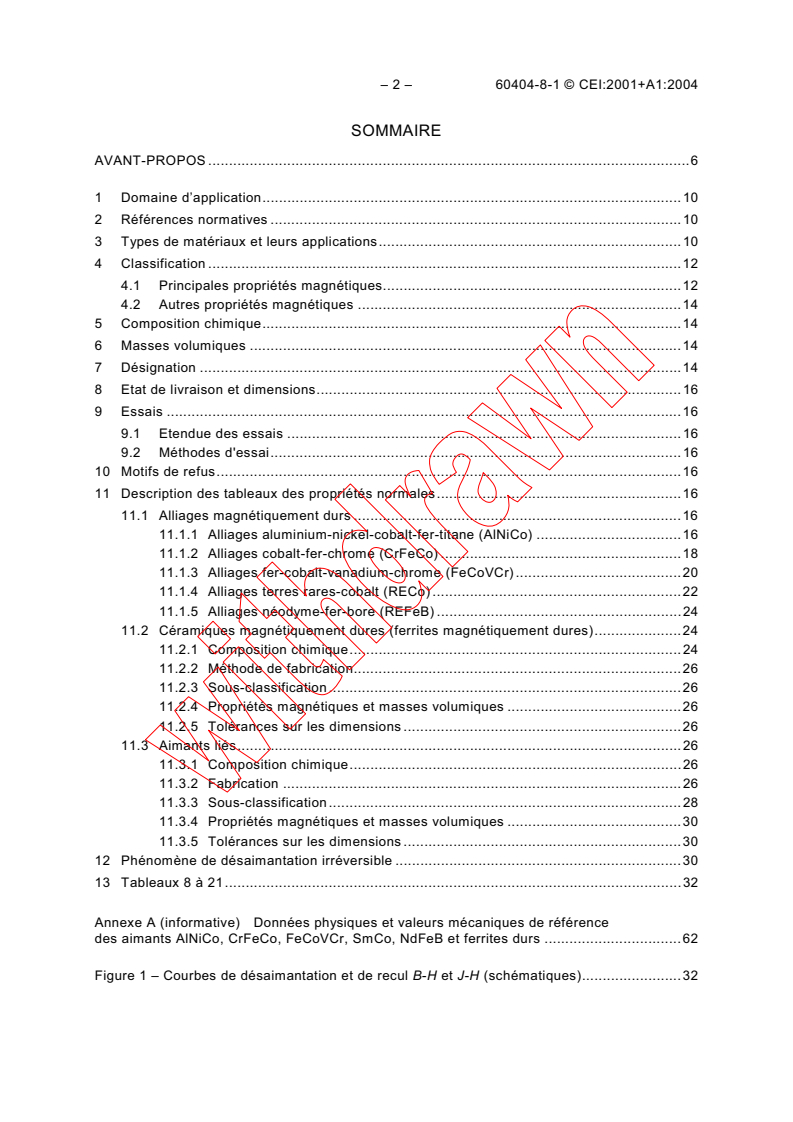
IEC 60404-8-1:2001+AMD1:2004 CSV - Magnetic materials - Part 8-1: Specifications for individual materials - Magnetically hard materials Released:7/14/2004
Overview
IEC 60404-8-1:2001 – Magnetic materials – Part 8-1: Specifications for individual materials – Magnetically hard materials – is a key international standard published by the International Electrotechnical Commission (IEC). This document establishes the minimum values for principal magnetic properties and dimensional tolerances of technically important magnetically hard materials, commonly referred to as permanent magnets. The standard applies to alloys, ceramics, and bonded magnets, and offers informative values for material densities, chemical composition ranges, and additional physical and mechanical reference data.
By specifying clear and harmonized criteria for magnetic properties and dimensions, IEC 60404-8-1 ensures that manufacturers, designers, and end-users of permanent magnets can rely on consistent quality and performance in critical technological applications.
Key Topics
Classification of Magnetically Hard Materials:
The standard provides a new classification system based on metallurgical relationships. It covers:- Magnetically hard alloys (e.g., AlNiCo, CrFeCo, FeCoVCr, rare earth-based alloys)
- Magnetically hard ceramics (ferrites)
- Bonded magnets
Principal Magnetic Properties:
- Remanence (Br)
- Maximum energy product ((BH)max)
- Coercivity relating to flux density (HcB)
- Coercivity relating to polarization (HcJ)
Dimensional Tolerances:
Minimum and permissible variations in the sizes of permanent magnets, ensuring compatibility and interchangeability in assemblies.Material Density and Chemical Composition:
Informative ranges for density and chemical makeup are provided for reference and comparison.Physical and Mechanical Data:
For further context, the standard references typical physical and mechanical property values of various permanent magnet types.
Applications
Permanent magnets specified under IEC 60404-8-1 are essential in a broad range of industries and applications, including:
Electric Motors and Generators:
Permanent magnet motors and dynamo generators for industrial, automotive, and consumer electronics.Measuring Instruments:
Devices such as sensors, galvanometers, and speed indicators benefit from standardized magnet performance.Audio and Communication Equipment:
Speakers, microphones, and related electromagnetic devices rely on consistent magnetic properties.Office and Computer Hardware:
Hard drives, printers, and data storage devices use magnetically hard materials for reliable data handling and mechanical functions.Automotive Systems:
Used in sensors, actuators, alternators, and electric vehicle drive systems.Medical Instruments:
High-precision magnets are crucial in diagnostic equipment and therapeutic devices.Mechanical Engineering:
Lifting magnets, holding devices, clamping plates, and magnetic couplings.Consumer Electronics:
Applications in household appliances, entertainment devices, and telecommunication systems.
Related Standards
IEC 60404-8-1 works in conjunction with several related international standards, including:
IEC 60404-1: Magnetic materials – Part 1: Classification
(Provides basic classification principles for magnetic materials, including permanent magnets.)IEC 60404-5: Magnetic materials – Part 5: Permanent magnet (magnetically hard) materials – Methods of measurement of magnetic properties
(Covers measurement procedures for magnetic properties specified in IEC 60404-8-1.)IEC 60404-7: Method of measurement of the coercivity of magnetic materials in an open magnetic circuit
(Details test methods for determining magnetic coercivity.)IEC 60050-121 & IEC 60050-221: International Electrotechnical Vocabulary (IEV)
(Define terms relating to electromagnetism and magnetic materials.)
Practical Value
Compliance with IEC 60404-8-1 enables:
- Consistency in production and procurement across global markets.
- Ensured interoperability and quality assurance for manufacturers and users.
- Benchmarking and comparison of magnet materials for design optimization.
- Reliable performance of permanent magnets in critical applications.
By following IEC 60404-8-1, organizations benefit from internationally recognized specifications for magnetically hard materials, supporting innovation and safety in electronics, automotive, and industrial sectors.
Keywords: IEC 60404-8-1, magnetically hard materials, permanent magnets, magnetic materials standard, magnetic properties, dimensional tolerances, permanent magnet applications, international standardization, electric motors, magnetic alloys, magnetic ceramics, bonded magnets.
Relations
- Effective Date
- 05-Sep-2023
- Effective Date
- 05-Sep-2023
Buy Documents
IEC 60404-8-1:2001 - Magnetic materials - Part 8-1: Specifications for individual materials - Magnetically hard materials Released:4/11/2001
IEC 60404-8-1:2001+AMD1:2004 CSV - Magnetic materials - Part 8-1: Specifications for individual materials - Magnetically hard materials Released:7/14/2004
Get Certified
Connect with accredited certification bodies for this standard

IMQ S.p.A. (Certification)
Italian electrical product certification.

SLG Prüf- und Zertifizierungs GmbH
German testing and certification body.

UL Solutions
Global safety science company with testing, inspection and certification.
Sponsored listings
Frequently Asked Questions
IEC 60404-8-1:2001 is a standard published by the International Electrotechnical Commission (IEC). Its full title is "Magnetic materials - Part 8-1: Specifications for individual materials - Magnetically hard materials". This standard covers: Specifies minimum values for the principal magnetic properties of, and dimensional tolerances for, technically important magnetically hard materials (permanent magnets). For information purposes only, the standard provides values for the densities of the materials and the ranges of their chemical compositions. Some additional physical and mechanical reference data concerning the magnetic materials is given for information and comparison purposes.
Specifies minimum values for the principal magnetic properties of, and dimensional tolerances for, technically important magnetically hard materials (permanent magnets). For information purposes only, the standard provides values for the densities of the materials and the ranges of their chemical compositions. Some additional physical and mechanical reference data concerning the magnetic materials is given for information and comparison purposes.
IEC 60404-8-1:2001 is classified under the following ICS (International Classification for Standards) categories: 17.220.20 - Measurement of electrical and magnetic quantities; 29.030 - Magnetic materials. The ICS classification helps identify the subject area and facilitates finding related standards.
IEC 60404-8-1:2001 has the following relationships with other standards: It is inter standard links to IEC 60404-8-1:2001/AMD1:2004, IEC 60404-8-1:2015. Understanding these relationships helps ensure you are using the most current and applicable version of the standard.
IEC 60404-8-1:2001 is available in PDF format for immediate download after purchase. The document can be added to your cart and obtained through the secure checkout process. Digital delivery ensures instant access to the complete standard document.
Standards Content (Sample)
NORME CEI
INTERNATIONALE IEC
60404-8-1
INTERNATIONAL
Deuxième édition
STANDARD
Second edition
2001-04
Matériaux magnétiques –
Partie 8-1:
Spécifications pour matériaux particuliers –
Matériaux magnétiquement durs
Magnetic materials –
Part 8-1:
Specifications for individual materials –
Magnetically hard materials
Numéro de référence
Reference number
CEI/IEC 60404-8-1:2001
Numérotation des publications Publication numbering
Depuis le 1er janvier 1997, les publications de la CEI As from 1 January 1997 all IEC publications are
sont numérotées à partir de 60000. Ainsi, la CEI 34-1 issued with a designation in the 60000 series. For
devient la CEI 60034-1. example, IEC 34-1 is now referred to as IEC 60034-1.
Editions consolidées Consolidated editions
Les versions consolidées de certaines publications de la The IEC is now publishing consolidated versions of its
CEI incorporant les amendements sont disponibles. Par publications. For example, edition numbers 1.0, 1.1
exemple, les numéros d’édition 1.0, 1.1 et 1.2 indiquent and 1.2 refer, respectively, to the base publication,
respectivement la publication de base, la publication de the base publication incorporating amendment 1 and
base incorporant l’amendement 1, et la publication de the base publication incorporating amendments 1
base incorporant les amendements 1 et 2. and 2.
Informations supplémentaires Further information on IEC publications
sur les publications de la CEI
Le contenu technique des publications de la CEI est The technical content of IEC publications is kept
constamment revu par la CEI afin qu'il reflète l'état under constant review by the IEC, thus ensuring that
actuel de la technique. Des renseignements relatifs à the content reflects current technology. Information
cette publication, y compris sa validité, sont dispo- relating to this publication, including its validity, is
nibles dans le Catalogue des publications de la CEI available in the IEC Catalogue of publications
(voir ci-dessous) en plus des nouvelles éditions, (see below) in addition to new editions, amendments
amendements et corrigenda. Des informations sur les and corrigenda. Information on the subjects under
sujets à l’étude et l’avancement des travaux entrepris consideration and work in progress undertaken by the
par le comité d’études qui a élaboré cette publication, technical committee which has prepared this
ainsi que la liste des publications parues, sont publication, as well as the list of publications issued,
également disponibles par l’intermédiaire de: is also available from the following:
• Site web de la CEI (www.iec.ch) • IEC Web Site (www.iec.ch)
• Catalogue des publications de la CEI • Catalogue of IEC publications
Le catalogue en ligne sur le site web de la CEI The on-line catalogue on the IEC web site
(www.iec.ch/catlg-f.htm) vous permet de faire des (www.iec.ch/catlg-e.htm) enables you to search
recherches en utilisant de nombreux critères, by a variety of criteria including text searches,
comprenant des recherches textuelles, par comité technical committees and date of publication. On-
d’études ou date de publication. Des informations line information is also available on recently
en ligne sont également disponibles sur les issued publications, withdrawn and replaced
nouvelles publications, les publications rempla- publications, as well as corrigenda.
cées ou retirées, ainsi que sur les corrigenda.
• IEC Just Published
• IEC Just Published
Ce résumé des dernières publications parues
This summary of recently issued publications
(www.iec.ch/JP.htm) est aussi disponible par
(www.iec.ch/JP.htm) is also available by email.
courrier électronique. Veuillez prendre contact
Please contact the Customer Service Centre (see
avec le Service client (voir ci-dessous) pour plus
below) for further information.
d’informations.
• Service clients
• Customer Service Centre
Si vous avez des questions au sujet de cette
If you have any questions regarding this
publication ou avez besoin de renseignements
publication or need further assistance, please
supplémentaires, prenez contact avec le Service
contact the Customer Service Centre:
clients:
Email: custserv@iec.ch
Email: custserv@iec.ch
Tél: +41 22 919 02 11
Tel: +41 22 919 02 11
Fax: +41 22 919 03 00
Fax: +41 22 919 03 00
.
NORME CEI
INTERNATIONALE IEC
60404-8-1
INTERNATIONAL
Deuxième édition
STANDARD
Second edition
2001-04
Matériaux magnétiques –
Partie 8-1:
Spécifications pour matériaux particuliers –
Matériaux magnétiquement durs
Magnetic materials –
Part 8-1:
Specifications for individual materials –
Magnetically hard materials
IEC 2001 Droits de reproduction réservés Copyright - all rights reserved
Aucune partie de cette publication ne peut être reproduite ni No part of this publication may be reproduced or utilized in
utilisée sous quelque forme que ce soit et par aucun procédé, any form or by any means, electronic or mechanical,
électronique ou mécanique, y compris la photocopie et les including photocopying and microfilm, without permission in
microfilms, sans l'accord écrit de l'éditeur. writing from the publisher.
International Electrotechnical Commission 3, rue de Varembé Geneva, Switzerland
Telefax: +41 22 919 0300 e-mail: inmail@iec.ch IEC web site http://www.iec.ch
CODE PRIX
Commission Electrotechnique Internationale
V
PRICE CODE
International Electrotechnical Commission
Pour prix, voir catalogue en vigueur
For price, see current catalogue
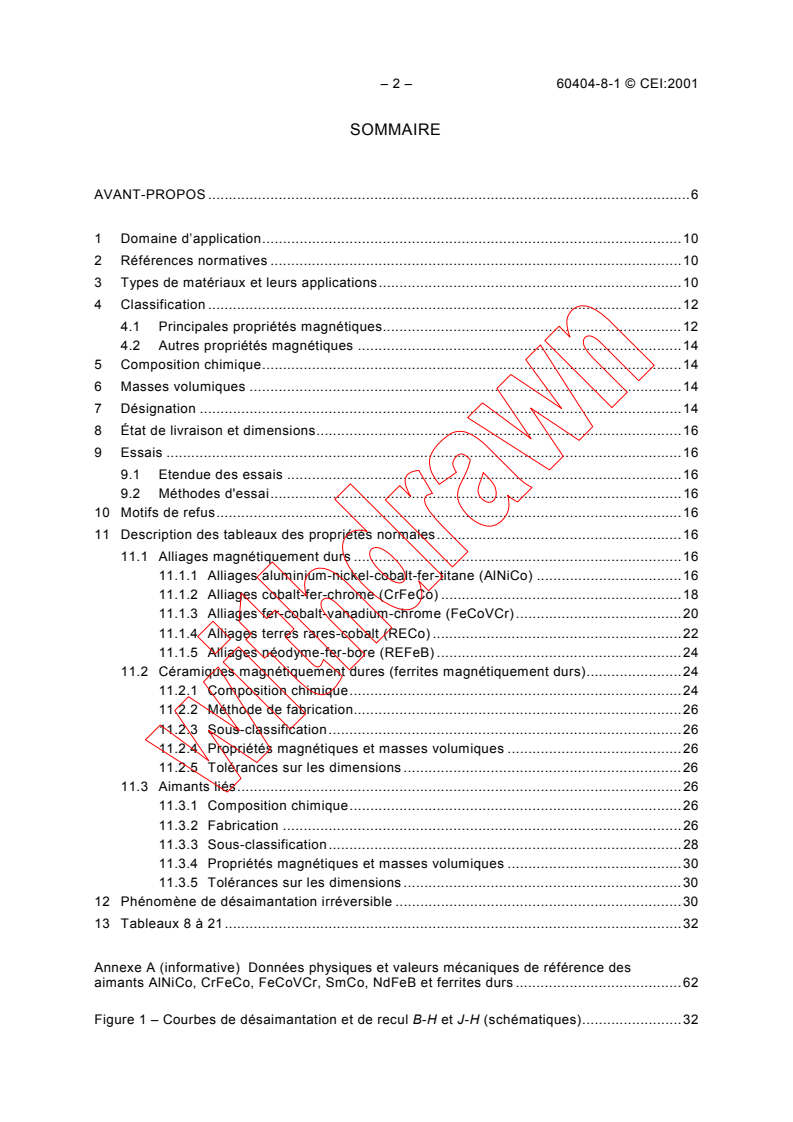
– 2 – 60404-8-1 © CEI:2001
SOMMAIRE
AVANT-PROPOS .6
1 Domaine d’application.10
2 Références normatives .10
3 Types de matériaux et leurs applications.10
4 Classification .12
4.1 Principales propriétés magnétiques.12
4.2 Autres propriétés magnétiques .14
5 Composition chimique.14
6 Masses volumiques .14
7 Désignation .14
8 État de livraison et dimensions.16
9 Essais .16
9.1 Etendue des essais .16
9.2 Méthodes d'essai.16
10 Motifs de refus.16
11 Description des tableaux des propriétés normales.16
11.1 Alliages magnétiquement durs .16
11.1.1 Alliages aluminium-nickel-cobalt-fer-titane (AlNiCo) .16
11.1.2 Alliages cobalt-fer-chrome (CrFeCo) .18
11.1.3 Alliages fer-cobalt-vanadium-chrome (FeCoVCr) .20
11.1.4 Alliages terres rares-cobalt (RECo) .22
11.1.5 Alliages néodyme-fer-bore (REFeB) .24
11.2 Céramiques magnétiquement dures (ferrites magnétiquement durs).24
11.2.1 Composition chimique.24
11.2.2 Méthode de fabrication.26
11.2.3 Sous-classification.26
11.2.4 Propriétés magnétiques et masses volumiques .26
11.2.5 Tolérances sur les dimensions .26
11.3 Aimants liés.26
11.3.1 Composition chimique.26
11.3.2 Fabrication .26
11.3.3 Sous-classification.28
11.3.4 Propriétés magnétiques et masses volumiques .30
11.3.5 Tolérances sur les dimensions .30
12 Phénomène de désaimantation irréversible .30
13 Tableaux 8 à 21.32
Annexe A (informative) Données physiques et valeurs mécaniques de référence des
aimants AlNiCo, CrFeCo, FeCoVCr, SmCo, NdFeB et ferrites durs .62
Figure 1 – Courbes de désaimantation et de recul B-H et J-H (schématiques).32
60404-8-1 © IEC:2001 – 3 –
CONTENTS
FOREWORD.7
1 Scope .11
2 Normative references.11
3 Types of materials and their applications.11
4 Classification .13
4.1 Principal magnetic properties .13
4.2 Additional magnetic properties .15
5 Chemical composition .15
6 Densities .15
7 Designation .15
8 Mode of shipment and dimensions .17
9 Testing .17
9.1 Extent of testing.17
9.2 Testing methods .17
10 Grounds for rejection .17
11 Description of tables of standard properties.17
11.1 Magnetically hard alloys .17
11.1.1 Aluminium-nickel-cobalt-iron-titanium alloys (AlNiCo) .17
11.1.2 Chromium-iron-cobalt alloys (CrFeCo).19
11.1.3 Iron-cobalt-vanadium-chromium alloys (FeCoVCr).21
11.1.4 Rare earth-cobalt alloys (RECo) .23
11.1.5 Neodymium-iron-boron alloys (REFeB).25
11.2 Magnetically hard ceramics (magnetically hard ferrites).25
11.2.1 Chemical composition .25
11.2.2 Manufacturing method.27
11.2.3 Sub-classification.27
11.2.4 Magnetic properties and densities .27
11.2.5 Dimensional tolerances .27
11.3 Bonded magnets.27
11.3.1 Chemical composition .27
11.3.2 Manufacturing.27
11.3.3 Sub-classification.29
11.3.4 Magnetic properties and densities .31
11.3.5 Dimensional tolerances .31
12 Irreversible demagnetization behaviour .31
13 Tables 8 to 21.33
Annex A (informative) Physical data and mechanical reference values of AlNiCo,
CrFeCo, FeCoVCr, SmCo, NdFeB and hard ferrite magnets .63
Figure 1 – B-H and J-H demagnetization and recoil curves (schematic).33
– 4 – 60404-8-1 © CEI:2001
Tableau 1 – Propriétés magnétiques – Symboles et unités.12
Tableau 2 – Propriétés magnétiques additionnelles – Symboles et unités.14
Tableau 3 – Compositions chimiques des alliages AlNiCo (wt %) .18
Tableau 4 – Compositions chimiques des alliages CrFeCo (wt %).18
Tableau 5 – Compositions chimiques des alliages FeCoVCr (wt %) .20
Tableau 6 – Compositions chimiques des alliages RECo (wt %).22
Tableau 7 – Compositions chimiques des alliages REFeB (wt %).24
Tableau 8 – Classification des matériaux magnétiques durs .34
Tableau 9 – Propriétés magnétiques, températures de Curie, température d’utilisation
et masses volumiques des aimants AlNiCo.36
Tableau 10 – Propriétés magnétiques, températures de Curie, température d’utilisation
et masses volumiques des aimants CrFeCo et FeCoVCr .38
Tableau 11 – Propriétés magnétiques, températures de Curie, température d’utilisation
et masses volumiques des aimants RECo .40
Tableau 12 – Propriétés magnétiques, températures de Curie, température d’utilisation
et masses volumiques des aimants REFeB .42
Tableau 13 – Propriétés magnétiques, températures de Curie, température d’utilisation
et masses volumiques des ferrites durs.44
Tableau 14 – Propriétés magnétiques, températures de Curie, température d’utilisation
et masses volumiques des alliages AlNiCo isotropes à liant organique.46
Tableau 15 – Propriétés magnétiques, températures de Curie, température d’utilisation
et masses volumiques des alliages RECo à liant organique .48
Tableau 16 – Propriétés magnétiques, températures de Curie, température d’utilisation
et masses volumiques des aimants isotropes REFeB à liant organique .50
Tableau 17 – Propriétés magnétiques, températures de Curie, température d’utilisation
et masses volumiques des ferrites dures isotropes et anisotropes à liant organique.52
Tableau 18 – Tolérances sur les dimensions des aimants en alliages AlNiCo moulés ou
frittés (valeurs en millimètres) .54
Tableau 19 – Tolérances sur les dimensions de feuillards laminés à froid, pour des
alliages FeCoVCr et CrFeCo avec une épaisseur maximale de 6 mm et une largeur
maximale de 125 mm (valeurs en millimètres) .56
Tableau 20 – Tolérances sur le diamètre des fils et des barres étirés à froid pour des
alliages FeCoVCr et CrFeCo (valeurs en millimètres) .58
Tableau 21 – Tolérances sur les dimensions des aimants en ferrites durs (valeurs en
millimètres) .60
Tableau A.1 – Données physiques et valeurs mécaniques de référence des aimants
AlNiCo, CrFeCo, FeCoVCr, SmCo, NdFeB et ferrites durs .64
60404-8-1 © IEC:2001 – 5 –
Table 1 – Magnetic properties – Symbols and units.13
Table 2 – Additional magnetic properties – Symbols and units .15
Table 3 – Chemical compositions of AINiCo alloys (wt %) .19
Table 4 – Chemical compositions of CrFeCo alloys (wt %) .19
Table 5 – Chemical compositions of FeCoVCr alloys (wt %).21
Table 6 – Chemical compositions of RECo alloys (wt %).23
Table 7 – Chemical compositions of REFeB alloys (wt %) .25
Table 8 – Classification of magnetically hard materials .35
Table 9 – Magnetic properties, Curie temperatures, operational temperature and
densities of AlNiCo magnets.37
Table 10 – Magnetic properties, Curie temperatures, operational temperature and
densities of CrFeCo and FeCoVCr magnets.39
Table 11 – Magnetic properties, Curie temperatures, operational temperature and
densities of RECo magnets .41
Table 12 – Magnetic properties, Curie temperatures, operational temperature and
densities of REFeB magnets .43
Table 13 – Magnetic properties, Curie temperatures, operational temperature and
densities of hard ferrites.45
Table 14 – Magnetic properties, Curie temperatures, operational temperature and
densities of isotropic AlNiCo alloys with organic binder .47
Table 15 – Magnetic properties, Curie temperatures, operational temperature and
densities of RECo alloys with organic binder.49
Table 16 – Magnetic properties, Curie temperatures, operational temperature and
densities of isotropic REFeB alloys with organic binder .51
Table 17 – Magnetic properties, Curie temperatures, operational temperature and
densities of isotropic and anisotropic hard ferrites with organic binder.53
Table 18 – Dimensional tolerances (as cast or as sintered) of magnets made from
AlNiCo alloys (values in millimetres) .55
Table 19 – Dimensional tolerances of cold rolled strips of FeCoVCr and CrFeCo alloys
with a maximum thickness of 6 mm and a maximum width of 125 mm (values in
millimetres) .57
Table 20 – Dimensional tolerances of the diameter of cold drawn wires and bars of
FeCoVCr and CrFeCo alloys (values in millimetres) .59
Table 21 – Dimensional tolerances on magnets made from hard ferrites (values in
millimetres) .61
Table A.1 – Physical data and mechanical reference values of AlNiCo, CrFeCo,
FeCoVCr, SmCo, NdFeB and hard ferrite magnets .65
– 6 – 60404-8-1 © CEI:2001
COMMISSION ÉLECTROTECHNIQUE INTERNATIONALE
___________
MATÉRIAUX MAGNÉTIQUES –
Partie 8-1: Spécifications pour matériaux particuliers –
Matériaux magnétiquement durs
AVANT-PROPOS
1) La CEI (Commission Électrotechnique Internationale) est une organisation mondiale de normalisation
composée de l'ensemble des comités électrotechniques nationaux (Comités nationaux de la CEI). La CEI a
pour objet de favoriser la coopération internationale pour toutes les questions de normalisation dans les
domaines de l'électricité et de l'électronique. A cet effet, la CEI, entre autres activités, publie des Normes
internationales. Leur élaboration est confiée à des comités d'études, aux travaux desquels tout Comité national
intéressé par le sujet traité peut participer. Les organisations internationales, gouvernementales et non
gouvernementales, en liaison avec la CEI, participent également aux travaux. La CEI collabore étroitement
avec l'Organisation Internationale de Normalisation (ISO), selon des conditions fixées par accord entre les deux
organisations.
2) Les décisions ou accords officiels de la CEI concernant les questions techniques représentent, dans la mesure
du possible, un accord international sur les sujets étudiés, étant donné que les Comités nationaux intéressés
sont représentés dans chaque comité d’études.
3) Les documents produits se présentent sous la forme de recommandations internationales. Ils sont publiés
comme normes, spécifications techniques, rapports techniques ou guides et agréés comme tels par les
Comités nationaux.
4) Dans le but d'encourager l'unification internationale, les Comités nationaux de la CEI s'engagent à appliquer de
façon transparente, dans toute la mesure possible, les Normes internationales de la CEI dans leurs normes
nationales et régionales. Toute divergence entre la norme de la CEI et la norme nationale ou régionale
correspondante doit être indiquée en termes clairs dans cette dernière.
5) La CEI n’a fixé aucune procédure concernant le marquage comme indication d’approbation et sa responsabilité
n’est pas engagée quand un matériel est déclaré conforme à l’une de ses normes.
6) L’attention est attirée sur le fait que certains des éléments de la présente Norme internationale peuvent faire
l’objet de droits de propriété intellectuelle ou de droits analogues. La CEI ne saurait être tenue pour
responsable de ne pas avoir identifié de tels droits de propriété et de ne pas avoir signalé leur existence.
La Norme internationale CEI 60404-8-1 a été établie par le comité d’études 68 de la CEI:
Matériaux magnétiques tels qu’alliages et aciers.
Cette deuxième édition annule et remplace la première édition parue en 1986, l’amendement 1
(1991) et l’amendement 2 (1992). Elle constitue une révision technique.
Le texte de cette norme est issu des documents suivants:
FDIS Rapport de vote
68/230/FDIS 68/232/RVD
Le rapport de vote indiqué dans le tableau ci-dessus donne toute information sur le vote ayant
abouti à l'approbation de cette norme.
Cette publication a été rédigée selon les Directives ISO/CEI, Partie 3.
L’annexe A est donnée uniquement à titre d’information.
60404-8-1 © IEC:2001 – 7 –
INTERNATIONAL ELECTROTECHNICAL COMMISSION
___________
MAGNETIC MATERIALS –
Part 8-1: Specifications for individual materials –
Magnetically hard materials
FOREWORD
1) The IEC (International Electrotechnical Commission) is a worldwide organization for standardization comprising
all national electrotechnical committees (IEC National Committees). The object of the IEC is to promote
international co-operation on all questions concerning standardization in the electrical and electronic fields. To
this end and in addition to other activities, the IEC publishes International Standards. Their preparation is
entrusted to technical committees; any IEC National Committee interested in the subject dealt with may
participate in this preparatory work. International, governmental and non-governmental organizations liaising
with the IEC also participate in this preparation. The IEC collaborates closely with the International Organization
for Standardization (ISO) in accordance with conditions determined by agreement between the two
organizations.
2) The formal decisions or agreements of the IEC on technical matters express, as nearly as possible, an
international consensus of opinion on the relevant subjects since each technical committee has representation
from all interested National Committees.
3) The documents produced have the form of recommendations for international use and are published in the form
of standards, technical specifications, technical reports or guides and they are accepted by the National
Committees in that sense.
4) In order to promote international unification, IEC National Committees undertake to apply IEC International
Standards transparently to the maximum extent possible in their national and regional standards. Any
divergence between the IEC Standard and the corresponding national or regional standard shall be clearly
indicated in the latter.
5) The IEC provides no marking procedure to indicate its approval and cannot be rendered responsible for any
equipment declared to be in conformity with one of its standards.
6) Attention is drawn to the possibility that some of the elements of this International Standard may be the subject
of patent rights. The IEC shall not be held responsible for identifying any or all such patent rights.
International Standard IEC 60404-8-1 has been prepared by IEC technical committee 68:
Magnetic alloys and steels.
This second edition cancels and replaces the first edition published in 1986, amendment 1
(1991) and amendment 2 (1992), and constitutes a technical revision.
The text of this standard is based on the following documents:
FDIS Report on voting
68/230/FDIS 68/232/RVD
Full information on the voting for the approval of this standard can be found in the report on
voting indicated in the above table.
This publication has been drafted in accordance with the ISO/IEC Directives, Part 3.
Annex A is for information only.
– 8 – 60404-8-1 © CEI:2001
Le comité a décidé que le contenu de cette publication ne sera pas modifié avant 2005. A
cette date, la publication sera
• reconduite;
• supprimée;
• remplacée par une édition révisée, ou
• amendée.
60404-8-1 © IEC:2001 – 9 –
The committee has decided that the contents of this publication will remain unchanged until
2005. At this date, the publication will be
• reconfirmed;
• withdrawn;
• replaced by a revised edition, or
• amended.
– 10 – 60404-8-1 © CEI:2001
MATÉRIAUX MAGNÉTIQUES –
Partie 8-1: Spécifications pour matériaux particuliers –
Matériaux magnétiquement durs
1 Domaine d’application
La présente partie de la CEI 60404 spécifie les valeurs minimales des propriétés magnétiques
principales et les tolérances dimensionnelles des matériaux magnétiques durs (aimants
permanents).
La présente norme donne uniquement à titre indicatif des valeurs de masse volumique des
matériaux et les domaines de leur composition chimique.
NOTE Dans un but d'information et de comparaison, quelques données physiques et mécaniques typiques des
matériaux magnétiques sont aussi données au tableau A.1.
2 Références normatives
Les documents normatifs suivants contiennent des dispositions qui, par suite de la référence
qui y est faite, constituent des dispositions valables pour la présente partie de la CEI 60404.
Pour les références datées, les amendements ultérieurs ou les révisions de ces publications
ne s’appliquent pas. Toutefois, les parties prenantes aux accords fondés sur la présente partie
de la CEI 60404 sont invitées à rechercher la possibilité d’appliquer les éditions les plus
récentes des documents normatifs indiqués ci-après. Pour les références non datées, la
dernière édition du document normatif en référence s’applique. Les membres de l’ISO et de la
CEI possèdent le registre des Normes internationales en vigueur.
CEI 60050-121:1998, Vocabulaire Electrotechnique International (VEI) – Partie 121:
Electromagnétisme
CEI 60050(221):1990, Vocabulaire Electrotechnique International (VEI) – Chapitre 221:
Matériaux et composants magnétiques
CEI 60404-1:2000, Matériaux magnétiques – Partie 1: Classification
CEI 60404-5:1993, Matériaux magnétiques – Partie 5: Aimants permanents (magnétiques durs) –
Méthodes de mesure des propriétés magnétiques
CEI 60404-7:1982, Matériaux magnétiques – Septième partie: Méthode de mesure du champ
coercitif des matériaux magnétiques en circuit magnétique ouvert
3 Types de matériaux et leurs applications
Les matériaux pour aimants permanents, également appelés «matériaux magnétiquement
durs», sont répertoriés dans la CEI 60404-1 sous forme de classification selon les articles R
(alliages magnétiquement durs), S (céramiques magnétiquement dures) et U (aimants
comportant un liant).
60404-8-1 © IEC:2001 – 11 –
MAGNETIC MATERIALS –
Part 8-1: Specifications for individual materials –
Magnetically hard materials
1 Scope
This part of IEC 60404 specifies minimum values for the principal magnetic properties of, and
dimensional tolerances for, technically important magnetically hard materials (permanent
magnets).
For information purposes only, the standard provides values for the densities of the materials
and the ranges of their chemical compositions.
NOTE Some additional physical and mechanical reference data concerning the magnetic materials is given in
table A.1 for information and comparison purposes.
2 Normative references
The following normative documents contain provisions which, through reference in this text,
constitute provisions of this part of IEC 60404. For dated references, subsequent amendments
to, or revisions of, any of these publications do not apply. However, parties to agreements
based on this part of IEC 60404 are encouraged to investigate the possibility of applying the
most recent editions of the normative documents indicated below. For undated references, the
latest edition of the normative document referred to applies. Members of IEC and ISO maintain
registers of currently valid International Standards.
IEC 60050-121:1998, International Electrotechnical Vocabulary (IEV) – Part 121: Electro-
magnetism
IEC 60050(221):1990, International Electrotechnical Vocabulary (IEV) – Chapter 221: Magnetic
materials and components
IEC 60404-1:2000, Magnetic materials – Part 1: Classification
IEC 60404-5:1993, Magnetic materials – Part 5: Permanent magnet (magnetically hard)
materials – Methods of measurement of magnetic properties
IEC 60404-7:1982, Magnetic materials – Part 7: Method of measurement of the coercivity of
magnetic materials in an open magnetic circuit
3 Types of materials and their applications
Permanent magnetic materials, also designated as magnetically hard materials, are classified
in IEC 60404-1, clauses R (magnetically hard alloys), S (magnetically hard ceramics) and U
(bonded magnets).
– 12 – 60404-8-1 © CEI:2001
Les aimants permanents ont une coercitivité de polarisation magnétique >1 kA/m. Après avoir
été aimantés jusqu'à saturation, ils produisent une énergie magnétique spécifique dépendant
du matériau qui peut être utilisée dans des circuits magnétiques d’applications statiques ou
dynamiques.
Les matériaux magnétiques permanents sont utilisés dans tous les domaines de la vie
quotidienne. Ils réalisent des fonctions de couplage, de modulation ou de régulation dans des
équipements ou dispositifs basés sur les principes de l'électromagnétisme, par exemple dans
les appareils de mesure, les moteurs, les générateurs et les haut-parleurs. Les matériaux
magnétiques sont indispensables dans les équipements de bureau et le matériel informatique,
les automobiles, l'audio-visuel, les télécommunications, l'électroménager et les instruments
médicaux, aussi bien que dans la construction mécanique, comme dispositifs d'attraction,
plaques de fixation, etc.
Des applications typiques et d’autres possibilités pour les matériaux magnétiques permanents
commercialement disponibles sont décrites en détails dans les articles R, S et U de la
CEI 60404-1.
4 Classification
Comparée à l'édition précédente de la CEI 60404-8-1 (1986), cette édition révisée utilise une
nouvelle classification des matériaux magnétiques permanents pour applications techniques.
Cette classification est donnée dans le tableau 8. Les matériaux sont regroupés selon leurs
caractéristiques métallurgiques.
Les matériaux magnétiques permanents sont identifiés par les propriétés magnétiques
principales données ci-dessous:
4.1 Principales propriétés magnétiques
Tableau 1 – Propriétés magnétiques – Symboles et unités
Termes de la Propriétés magnétiques Symbole Unité
CEI 60050(121) et de la
CEI 60050(221)
– 221-04-05 Valeur maximale du produit (BH)(BH) kJ/m
max
121-12-67 221-02-38 Rémanence B mT
r
121-12-69 221-02-36 Coercitivité relative à l’induction magnétique H kA/m
cB
121-12-69 221-02-36 Coercitivité relative à la polarisation magnétique H kA/m
cJ
Les valeurs minimales des propriétés magnétiques à température ambiante, mesurées après
aimantation à saturation, sont données dans les tableaux 9 à 17.
Les valeurs des propriétés magnétiques spécifiées sont valables seulement pour les aimants
ayant une section constante le long de l'axe d'aimantation, un volume compris entre 1 cm et
200 cm , et dont les dimensions relatives aux trois axes de coordonnées sont d'au moins
8 mm.
Pour les matériaux anisotropes, elles sont valables seulement selon la direction axiale
préférée.
NOTE 1 Pour plus de détails sur les tailles limites des pièces mesurées, voir la CEI 60404-5.
NOTE 2 Pour des raisons liées aux méthodes de production, de plus faibles valeurs des propriétés magnétiques
peuvent être obtenues si les conditions dimensionnelles mentionnées ci-dessus ne sont pas satisfaites.
60404-8-1 © IEC:2001 – 13 –
Permanent magnets have a coercivity of magnetic polarization >1 kA/m. After being
magnetized to saturation they produce a material-dependent specific magnetic energy, which
can be used in static or dynamic magnetic circuit applications.
Permanent magnetic materials are used in nearly every area of daily life. They perform
coupling, modulating, or regulating functions in equipment and devices based on
electromagnetic principles, for example in measuring instruments, motors, generators and
loudspeakers. Magnet materials are indispensable in office equipment and computer hardware,
automobiles, entertainment electronics, telecommunications, household appliances and
medical instruments, as well as in mechanical engineering as holding devices, clamping plates
etc.
Further possible and typical applications for the commercially available permanent magnetic
materials are described in more detail in clauses R, S and U of IEC 60404-1.
4 Classification
Compared to the preceding edition of IEC 60404-8-1 (1986), this revised edition uses a new
classification of permanent magnetic materials for technical applications. This classification is
given in table 8. The materials are regrouped according to their metallurgical relationships.
The permanent magnetic materials are identified by the following principal magnetic properties.
4.1 Principal magnetic properties
Table 1 – Magnetic properties – Symbols and units
Term number in IEC 60050(121) Magnetic properties Symbol Unit
and/or IEC 60050(221)
– 221-04-05 Maximum value of (BH) product (BH) kJ/m
max
121-12-67 221-02-38 Remanence B mT
r
121-12-69 221-02-36 Coercivity relating to the magnetic flux density H kA/m
cB
121-12-69 221-02-36 Coercivity relating to the magnetic polarization kA/m
H
cJ
Minimum values at room temperatures of magnetic properties, determined after magnetization
to saturation, are given in tables 9 to 17.
The specified values of magnetic properties are valid only for magnets having a cross section
3 3
invariable along the axis of magnetization, with a volume of from 1 cm to 200 cm and with
dimensions in three directions of the coordinate axes of at least 8 mm.
For anisotropic materials, they are valid only along the one straight preferred direction.
NOTE 1 For more details on size limits for measurements, see IEC 60404-5.
NOTE 2 For reasons connected with the manufacturing methods, smaller values of the magnetic properties may
be obtained if the dimensional conditions mentioned above are not satisfied.
– 14 – 60404-8-1 © CEI:2001
4.2 Autres propriétés magnétiques
Tableau 2 – Propriétés magnétiques additionnelles – Symboles et unités
Termes de la Propriétés magnétiques Symbole Unité
CEI 60050(121) et de la
CEI 60050(221)
221-03-16 Perméabilité de recul –
μ
rec
Coefficient de température de la rémanence %/°C
α(B )
r
(il est lié au coefficient de température
de la saturation magnétique α(J ))
s
Coefficient de température de la coercitivité %/°C
α(H )
cJ
de la polarisation magnétique
121-12-51 Température de Curie T °C
C
Les valeurs données dans les tableaux 9 à 17 sont des valeurs typiques. Ce sont les valeurs
moyennes publiées dans les ouvrages spécialisés; elles sont seulement données à titre
indicatif et ne sont pas garanties. Le domaine de température pour les coefficients de
température figurant dans les tableaux s'étend de 20 °C à 100 °C, mais cela n'exclut pas
l'utilisation de ces matériaux en dehors de ce domaine.
L'intensité du champ magnétique nécessaire pour aimanter les matériaux magnétiquement
durs jusqu'à la saturation est définie dans la CEI 60404-5 ainsi que dans la CEI 60404-7.
5 Composition chimique
Le domaine de composition des divers groupes de matériaux est donné à titre indicatif en
11.1.1.1 et 11.2.1.
6 Masses volumiques
Les valeurs de la masse volumique reportées dans les tableaux 9 à 17 sont indicatives. Elles
permettent d'estimer par le calcul les masses et les volumes utilisés.
7 Désignation
Les matériaux magnétiquement durs peuvent être identifiés par des abréviations et par des
symboles alphanumériques (code chiffré) (voir les tableaux 9 à 17). Les symboles chimiques
qui sont éventuellement utilisés dans les abréviations indiquent les principaux constituants. Le
nombre situé devant la barre oblique, dans l'abréviation, indique la valeur maximale du produit
BH en kilojoules par mètre cube (kJ/m ), et le nombre situé après la barre indique un dixième
de la coercitivité H en kiloampères par mètre (kA/m). Les matériaux magnétiquement durs
cJ
avec liant organique (voir 11.3) sont repérés par un «p» ajouté comme suffixe à l'abréviation.
EXEMPLE Pour la qualité AlNiCo 12/6 du tableau 9, l'entier 12 est obtenu à partir de la valeur
minimale du produit (BH) de 11,6 kJ/m , et l'entier 6 à partir du dixième de la valeur
max
minimale de la coercitivité H , soit 1/10 de 55 kA/m = 5,5 kA/m en arrondissant, au-dessous
cJ
ou au-dessus, à l'entier le plus proche. Si l'arrondi au-dessous conduit à l’entier nul, le nombre
comprenant le premier décimal arrondi non nul est retenu.
60404-8-1 © IEC:2001 – 15 –
4.2 Additional magnetic properties
Table 2 – Additional magnetic properties – Symbols and units
Term number in
IEC 60050(121)) or IEC Magnetic properties Symbol Unit
60050(221)
221-03-16 Recoil permeability –
μ
rec
Temperature coefficient of the remanence (it corresponds %/°C
α(B )
r
to the temperature coefficient of the magnetic saturation
α(J ) )
s
Temperature coefficient of the coercivity of magnetic %/°C
α(H )
cJ
polarization
121-12-51 Curie temperature T °C
C
The values given in tables 9 to 17 are typical values. They are mean values published in the
literature and are given as an indication only and are not guaranteed. The temperature range
for the temperature coefficients in the tables is generally from 20 °C to 100 °C, but this does
not preclude the use of these materials outside this temperature range.
The magnetic field strength necessary for magnetizing magnetically hard materials to magnetic
saturation is defined in IEC 60404-5 and IEC 60404-7.
5 Chemical composition
The composition ranges for the different material groups are given for information purposes
under 11.1.1.1 and 11.2.1.
6 Densities
Density values are given in tables 9 to 17 for information purposes only. The density values
can be used for mass and volume calculations.
7 Designation
Magnetically hard materials can be identified by brief designations and by alpha-numeric
symbols (code numbers) (see tables 9 to 17). In so far as chemical symbols are used in the
brief designation, they indicate main constituents. The number before the oblique stroke in the
brief designation denotes the maximum value of the (BH) product in kilojoules per cubic metre
(kJ/m ) and the number after the oblique stroke denotes one tenth of the coercivity H in
cJ
kiloamperes per metre (kA/m). Magnetically hard materials with a binder (mostly organic, see
11.3) are denoted by a suffixed “p“ to the brief designation.
EXAMPLE For the grade AlNiCo 12/6 of table 9, the integer 12 is obtained from its minimum
value (BH) of 11,6 kJ/m , and the integer 6 from one-tenth of its minimum value of H , i.e.
max cJ
1/10 of 55 kA/m = 5,5 kA/m on rounding up or down to the nearest integer. If rounding down
would give the integer zero, the number containing the first rounded non-zero decimal is
maintained.
– 16 – 60404-8-1 © CEI:2001
Le code chiffré provient du système de classification utilisé dans la CEI 60404-1. La lettre
contenue dans le code chiffré désigne le groupe du matériau magnétiquement dur. Le premier
chiffre désigne le type de matériau dans le groupe respectif (voir tableau 8). Un «0» à la
seconde place signifie que le matériau est magnétiquement isotrope; un «1» signifie que, du
point de vue magnétique, le matériau est anisotrope. Le troisième chiffre distingue les
différentes qualités.
8 Etat de livraison et dimensions
Les matériaux mentionnés dans la présen
...
IEC 60404-8-1
Edition 2.1 2004-07
INTERNATIONAL
STANDARD
NORME
INTERNATIONALE
Magnetic materials –
Part 8-1: Specifications for individual materials – Magnetically hard materials
Matériaux magnétiques –
Partie 8-1: Spécifications pour matériaux particuliers – Matériaux
magnétiquement durs
All rights reserved. Unless otherwise specified, no part of this publication may be reproduced or utilized in any form or by
any means, electronic or mechanical, including photocopying and microfilm, without permission in writing from either IEC or
IEC's member National Committee in the country of the requester.
If you have any questions about IEC copyright or have an enquiry about obtaining additional rights to this publication,
please contact the address below or your local IEC member National Committee for further information.
Droits de reproduction réservés. Sauf indication contraire, aucune partie de cette publication ne peut être reproduite
ni utilisée sous quelque forme que ce soit et par aucun procédé, électronique ou mécanique, y compris la photocopie
et les microfilms, sans l'accord écrit de la CEI ou du Comité national de la CEI du pays du demandeur.
Si vous avez des questions sur le copyright de la CEI ou si vous désirez obtenir des droits supplémentaires sur cette
publication, utilisez les coordonnées ci-après ou contactez le Comité national de la CEI de votre pays de résidence.
IEC Central Office
3, rue de Varembé
CH-1211 Geneva 20
Switzerland
Email: inmail@iec.ch
Web: www.iec.ch
About the IEC
The International Electrotechnical Commission (IEC) is the leading global organization that prepares and publishes
International Standards for all electrical, electronic and related technologies.
About IEC publications
The technical content of IEC publications is kept under constant review by the IEC. Please make sure that you have the
latest edition, a corrigenda or an amendment might have been published.
ƒ Catalogue of IEC publications: www.iec.ch/searchpub
The IEC on-line Catalogue enables you to search by a variety of criteria (reference number, text, technical committee,…).
It also gives information on projects, withdrawn and replaced publications.
ƒ IEC Just Published: www.iec.ch/online_news/justpub
Stay up to date on all new IEC publications. Just Published details twice a month all new publications released. Available
on-line and also by email.
ƒ Electropedia: www.electropedia.org
The world's leading online dictionary of electronic and electrical terms containing more than 20 000 terms and definitions
in English and French, with equivalent terms in additional languages. Also known as the International Electrotechnical
Vocabulary online.
ƒ Customer Service Centre: www.iec.ch/webstore/custserv
If you wish to give us your feedback on this publication or need further assistance, please visit the Customer Service
Centre FAQ or contact us:
Email: csc@iec.ch
Tel.: +41 22 919 02 11
Fax: +41 22 919 03 00
A propos de la CEI
La Commission Electrotechnique Internationale (CEI) est la première organisation mondiale qui élabore et publie des
normes internationales pour tout ce qui a trait à l'électricité, à l'électronique et aux technologies apparentées.
A propos des publications CEI
Le contenu technique des publications de la CEI est constamment revu. Veuillez vous assurer que vous possédez
l’édition la plus récente, un corrigendum ou amendement peut avoir été publié.
ƒ Catalogue des publications de la CEI: www.iec.ch/searchpub/cur_fut-f.htm
Le Catalogue en-ligne de la CEI vous permet d’effectuer des recherches en utilisant différents critères (numéro de référence,
texte, comité d’études,…). Il donne aussi des informations sur les projets et les publications retirées ou remplacées.
ƒ Just Published CEI: www.iec.ch/online_news/justpub
Restez informé sur les nouvelles publications de la CEI. Just Published détaille deux fois par mois les nouvelles
publications parues. Disponible en-ligne et aussi par email.
ƒ Electropedia: www.electropedia.org
Le premier dictionnaire en ligne au monde de termes électroniques et électriques. Il contient plus de 20 000 termes et
définitions en anglais et en français, ainsi que les termes équivalents dans les langues additionnelles. Egalement appelé
Vocabulaire Electrotechnique International en ligne.
ƒ Service Clients: www.iec.ch/webstore/custserv/custserv_entry-f.htm
Si vous désirez nous donner des commentaires sur cette publication ou si vous avez des questions, visitez le FAQ du
Service clients ou contactez-nous:
Email: csc@iec.ch
Tél.: +41 22 919 02 11
Fax: +41 22 919 03 00
IEC 60404-8-1
Edition 2.1 2004-07
INTERNATIONAL
STANDARD
NORME
INTERNATIONALE
Magnetic materials –
Part 8-1: Specifications for individual materials – Magnetically hard materials
Matériaux magnétiques –
Partie 8-1: Spécifications pour matériaux particuliers – Matériaux
magnétiquement durs
INTERNATIONAL
ELECTROTECHNICAL
COMMISSION
COMMISSION
ELECTROTECHNIQUE
PRICE CODE
INTERNATIONALE
CM
CODE PRIX
ICS 17.220.20; 29.030 ISBN 2-8318-7545-5
– 2 – 60404-8-1 © CEI:2001+A1:2004
SOMMAIRE
AVANT-PROPOS .6
1 Domaine d’application.10
2 Références normatives .10
3 Types de matériaux et leurs applications.10
4 Classification .12
4.1 Principales propriétés magnétiques.12
4.2 Autres propriétés magnétiques .14
5 Composition chimique.14
6 Masses volumiques .14
7 Désignation .14
8 Etat de livraison et dimensions.16
9 Essais .16
9.1 Etendue des essais .16
9.2 Méthodes d'essai.16
10 Motifs de refus.16
11 Description des tableaux des propriétés normales.16
11.1 Alliages magnétiquement durs .16
11.1.1 Alliages aluminium-nickel-cobalt-fer-titane (AlNiCo) .16
11.1.2 Alliages cobalt-fer-chrome (CrFeCo) .18
11.1.3 Alliages fer-cobalt-vanadium-chrome (FeCoVCr) .20
11.1.4 Alliages terres rares-cobalt (RECo) .22
11.1.5 Alliages néodyme-fer-bore (REFeB) .24
11.2 Céramiques magnétiquement dures (ferrites magnétiquement dures).24
11.2.1 Composition chimique.24
11.2.2 Méthode de fabrication.26
11.2.3 Sous-classification.26
11.2.4 Propriétés magnétiques et masses volumiques .26
11.2.5 Tolérances sur les dimensions .26
11.3 Aimants liés.26
11.3.1 Composition chimique.26
11.3.2 Fabrication .26
11.3.3 Sous-classification.28
11.3.4 Propriétés magnétiques et masses volumiques .30
11.3.5 Tolérances sur les dimensions .30
12 Phénomène de désaimantation irréversible .30
13 Tableaux 8 à 21.32
Annexe A (informative) Données physiques et valeurs mécaniques de référence
des aimants AlNiCo, CrFeCo, FeCoVCr, SmCo, NdFeB et ferrites durs .62
Figure 1 – Courbes de désaimantation et de recul B-H et J-H (schématiques).32
60404-8-1 © IEC:2001+A1:2004 – 3 –
CONTENTS
FOREWORD.7
1 Scope.11
2 Normative references.11
3 Types of materials and their applications.11
4 Classification .13
4.1 Principal magnetic properties.13
4.2 Additional magnetic properties .15
5 Chemical composition.15
6 Densities .15
7 Designation .15
8 Mode of shipment and dimensions .17
9 Testing .17
9.1 Extent of testing .17
9.2 Testing methods .17
10 Grounds for rejection .17
11 Description of tables of standard properties .17
11.1 Magnetically hard alloys.17
11.1.1 Aluminium-nickel-cobalt-iron-titanium alloys (AlNiCo) .17
11.1.2 Chromium-iron-cobalt alloys (CrFeCo) .19
11.1.3 Iron-cobalt-vanadium-chromium alloys (FeCoVCr).21
11.1.4 Rare earth-cobalt alloys (RECo).23
11.1.5 Neodymium-iron-boron alloys (REFeB).25
11.2 Magnetically hard ceramics (magnetically hard ferrites).25
11.2.1 Chemical composition.25
11.2.2 Manufacturing method .27
11.2.3 Sub-classification.27
11.2.4 Magnetic properties and densities .27
11.2.5 Dimensional tolerances.27
11.3 Bonded magnets.27
11.3.1 Chemical composition.27
11.3.2 Manufacturing.27
11.3.3 Sub-classification.29
11.3.4 Magnetic properties and densities .31
11.3.5 Dimensional tolerances.31
12 Irreversible demagnetization behaviour .31
13 Tables 8 to 21.33
Annex A (informative) Physical data and mechanical reference values of AlNiCo,
CrFeCo, FeCoVCr, SmCo, NdFeB and hard ferrite magnets .63
Figure 1 – B-H and J-H demagnetization and recoil curves (schematic) .33
– 4 – 60404-8-1 © CEI:2001+A1:2004
Tableau 1 – Propriétés magnétiques – Symboles et unités.12
Tableau 2 – Propriétés magnétiques additionnelles – Symboles et unités.14
Tableau 3 – Compositions chimiques des alliages AlNiCo (wt %) .18
Tableau 4 – Compositions chimiques des alliages CrFeCo (wt %).18
Tableau 5 – Compositions chimiques des alliages FeCoVCr (wt %) .20
Tableau 6 – Compositions chimiques des alliages RECo (wt %).22
Tableau 7 – Compositions chimiques des alliages REFeB (wt %).24
Tableau 8 – Classification des matériaux magnétiques durs .34
Tableau 9 – Propriétés magnétiques, températures de Curie, température d’utilisation
et masses volumiques des aimants AlNiCo.36
Tableau 10 – Propriétés magnétiques, températures de Curie, température d’utilisation
et masses volumiques des aimants CrFeCo et FeCoVCr .38
Tableau 11 – Propriétés magnétiques et masses volumiques des aimants RECo .40
Tableau 12 – Propriétés magnétiques et masses volumiques des aimants REFeB .42
Tableau 13 – Propriétés magnétiques et masses volumiques des ferrites durs.44
Tableau 14 – Propriétés magnétiques, températures de Curie, température d’utilisation
et masses volumiques des alliages AlNiCo isotropes à liant organique.46
Tableau 15 – Propriétés magnétiques, températures de Curie, température d’utilisation
et masses volumiques des alliages RECo à liant organique .48
Tableau 16 – Propriétés magnétiques et masses volumiques des alliages isotropes
REFeB avec liant organique .50
Tableau 17 – Propriétés magnétiques, températures de Curie, température d’utilisation
et masses volumiques des ferrites durs isotropes et anisotropes à liant organique.52
Tableau 18 – Tolérances sur les dimensions des aimants en alliages AlNiCo moulés
ou frittés (valeurs en millimètres).54
Tableau 19 – Tolérances d’épaisseur et de largeur de feuillards laminés à froid,
pour des alliages FeCoVCr et CrFeCo avec une épaisseur maximale de 6 mm
et une largeur maximale de 125 mm (valeurs en millimètres).56
Tableau 20 – Tolérances sur le diamètre des fils et des barres étirés à froid
pour des alliages FeCoVCr et CrFeCo (valeurs en millimètres) .58
Tableau 21 – Tolérances sur les dimensions des aimants en ferrites durs
(valeurs en millimètres) .60
Tableau A.1 – Données physiques et valeurs mécaniques de référence
des aimants AlNiCo, CrFeCo, FeCoVCr, SmCo, NdFeB et ferrites dur .64
60404-8-1 © IEC:2001+A1:2004 – 5 –
Table 1 – Magnetic properties – Symbols and units .13
Table 2 – Additional magnetic properties – Symbols and units .15
Table 3 – Chemical compositions of AINiCo alloys (wt %) .19
Table 4 – Chemical compositions of CrFeCo alloys (wt %).19
Table 5 – Chemical compositions of FeCoVCr alloys (wt %).21
Table 6 – Chemical compositions of RECo alloys (wt %).23
Table 7 – Chemical compositions of REFeB alloys (wt %).25
Table 8 – Classification of magnetically hard materials .35
Table 9 – Magnetic properties, Curie temperatures, operational temperature
and densities of AlNiCo magnets .37
Table 10 – Magnetic properties, Curie temperatures, operational temperature
and densities of CrFeCo and FeCoVCr magnets.39
Table 11 – Magnetic properties and densities of RECo magnets .41
Table 12 – Magnetic properties and densities of REFeB magnets .43
Table 13 – Magnetic properties and densities of hard ferrites.45
Table 14 – Magnetic properties, Curie temperatures, operational temperature
and densities of isotropic AlNiCo alloys with organic binder .47
Table 15 – Magnetic properties, Curie temperatures, operational temperature
and densities of RECo alloys with organic binder .49
Table 16 – Magnetic properties and densities of isotropic REFeB alloys
with organic binder .51
Table 17 – Magnetic properties, Curie temperatures, operational temperature
and densities of isotropic and anisotropic hard ferrites with organic binder.53
Table 18 – Dimensional tolerances (as cast or as sintered) of magnets made
from AlNiCo alloys (values in millimetres) .55
Table 19 – Dimensional tolerances of cold rolled strips of FeCoVCr and CrFeCo alloys
with a maximum thickness of 6 mm and a maximum width of 125 mm
(values in millimetres) .57
Table 20 – Dimensional tolerances of the diameter of cold drawn wires
and bars of FeCoVCr and CrFeCo alloys (values in millimetres).59
Table 21 – Dimensional tolerances on magnets made from hard ferrites
(values in millimetres) .61
Table A.1 – Physical data and mechanical reference values of AlNiCo, CrFeCo,
FeCoVCr, SmCo, NdFeB and hard ferrite magnets .65
– 6 – 60404-8-1 © CEI:2001+A1:2004
COMMISSION ÉLECTROTECHNIQUE INTERNATIONALE
___________
MATÉRIAUX MAGNÉTIQUES –
Partie 8-1: Spécifications pour matériaux particuliers –
Matériaux magnétiquement durs
AVANT-PROPOS
1) La Commission Electrotechnique Internationale (CEI) est une organisation mondiale de normalisation composée
de l'ensemble des comités électrotechniques nationaux (Comités nationaux de la CEI). La CEI a pour objet de
favoriser la coopération internationale pour toutes les questions de normalisation dans les domaines de
l'électricité et de l'électronique. A cet effet, la CEI – entre autres activités – publie des Normes internationales,
des Spécifications techniques, des Rapports techniques, des Spécifications accessibles au public (PAS) et des
Guides (ci-après dénommés "Publication(s) de la CEI"). Leur élaboration est confiée à des comités d'études,
aux travaux desquels tout Comité national intéressé par le sujet traité peut participer. Les organisations
internationales, gouvernementales et non gouvernementales, en liaison avec la CEI, participent également aux
travaux. La CEI collabore étroitement avec l'Organisation Internationale de Normalisation (ISO), selon des
conditions fixées par accord entre les deux organisations.
2) Les décisions ou accords officiels de la CEI concernant les questions techniques représentent, dans la mesure
du possible, un accord international sur les sujets étudiés, étant donné que les Comités nationaux de la CEI
intéressés sont représentés dans chaque comité d’études.
3) Les Publications de la CEI se présentent sous la forme de recommandations internationales et sont agréées
comme telles par les Comités nationaux de la CEI. Tous les efforts raisonnables sont entrepris afin que la CEI
s'assure de l'exactitude du contenu technique de ses publications; la CEI ne peut pas être tenue responsable de
l'éventuelle mauvaise utilisation ou interprétation qui en est faite par un quelconque utilisateur final.
4) Dans le but d'encourager l'uniformité internationale, les Comités nationaux de la CEI s'engagent, dans toute la
mesure possible, à appliquer de façon transparente les Publications de la CEI dans leurs publications
nationales et régionales. Toutes divergences entre toutes Publications de la CEI et toutes publications
nationales ou régionales correspondantes doivent être indiquées en termes clairs dans ces dernières.
5) La CEI n’a prévu aucune procédure de marquage valant indication d’approbation et n'engage pas sa
responsabilité pour les équipements déclarés conformes à une de ses Publications.
6) Tous les utilisateurs doivent s'assurer qu'ils sont en possession de la dernière édition de cette publication.
7) Aucune responsabilité ne doit être imputée à la CEI, à ses administrateurs, employés, auxiliaires ou
mandataires, y compris ses experts particuliers et les membres de ses comités d'études et des Comités
nationaux de la CEI, pour tout préjudice causé en cas de dommages corporels et matériels, ou de tout autre
dommage de quelque nature que ce soit, directe ou indirecte, ou pour supporter les coûts (y compris les frais
de justice) et les dépenses découlant de la publication ou de l'utilisation de cette Publication de la CEI ou de
toute autre Publication de la CEI, ou au crédit qui lui est accordé.
8) L'attention est attirée sur les références normatives citées dans cette publication. L'utilisation de publications
référencées est obligatoire pour une application correcte de la présente publication.
9) L’attention est attirée sur le fait que certains des éléments de la présente Publication de la CEI peuvent faire
l’objet de droits de propriété intellectuelle ou de droits analogues. La CEI ne saurait être tenue pour
responsable de ne pas avoir identifié de tels droits de propriété et de ne pas avoir signalé leur existence.
La Norme internationale CEI 60404-8-1 a été établie par le comité d’études 68 de la CEI:
Matériaux magnétiques tels qu’alliages et aciers.
La présente version consolidée de la CEI 60404-8-1 comprend la deuxième édition (2001)
[documents 68/230/FDIS et 68/232/RVD] et son amendement 1 (2004) [documents
68/294/FDIS et 68/298/RVD].
Le contenu technique de cette version consolidée est donc identique à celui de l'édition de
base et à son amendement; cette version a été préparée par commodité pour l'utilisateur.
Elle porte le numéro d'édition 2.1.
Une ligne verticale dans la marge indique où la publication de base a été modifiée par
l'amendement 1.
L’annexe A est donnée uniquement à titre d’information.
60404-8-1 © IEC:2001+A1:2004 – 7 –
INTERNATIONAL ELECTROTECHNICAL COMMISSION
___________
MAGNETIC MATERIALS –
Part 8-1: Specifications for individual materials –
Magnetically hard materials
FOREWORD
1) The International Electrotechnical Commission (IEC) is a worldwide organization for standardization comprising
all national electrotechnical committees (IEC National Committees). The object of IEC is to promote
international co-operation on all questions concerning standardization in the electrical and electronic fields. To
this end and in addition to other activities, IEC publishes International Standards, Technical Specifications,
Technical Reports, Publicly Available Specifications (PAS) and Guides (hereafter referred to as “IEC
Publication(s)”). Their preparation is entrusted to technical committees; any IEC National Committee interested
in the subject dealt with may participate in this preparatory work. International, governmental and non-
governmental organizations liaising with the IEC also participate in this preparation. IEC collaborates closely
with the International Organization for Standardization (ISO) in accordance with conditions determined by
agreement between the two organizations.
2) The formal decisions or agreements of IEC on technical matters express, as nearly as possible, an international
consensus of opinion on the relevant subjects since each technical committee has representation from all
interested IEC National Committees.
3) IEC Publications have the form of recommendations for international use and are accepted by IEC National
Committees in that sense. While all reasonable efforts are made to ensure that the technical content of IEC
Publications is accurate, IEC cannot be held responsible for the way in which they are used or for any
misinterpretation by any end user.
4) In order to promote international uniformity, IEC National Committees undertake to apply IEC Publications
transparently to the maximum extent possible in their national and regional publications. Any divergence
between any IEC Publication and the corresponding national or regional publication shall be clearly indicated in
the latter.
5) IEC provides no marking procedure to indicate its approval and cannot be rendered responsible for any
equipment declared to be in conformity with an IEC Publication.
6) All users should ensure that they have the latest edition of this publication.
7) No liability shall attach to IEC or its directors, employees, servants or agents including individual experts and
members of its technical committees and IEC National Committees for any personal injury, property damage or
other damage of any nature whatsoever, whether direct or indirect, or for costs (including legal fees) and
expenses arising out of the publication, use of, or reliance upon, this IEC Publication or any other IEC
Publications.
8) Attention is drawn to the Normative references cited in this publication. Use of the referenced publications is
indispensable for the correct application of this publication.
9) Attention is drawn to the possibility that some of the elements of this IEC Publication may be the subject of
patent rights. IEC shall not be held responsible for identifying any or all such patent rights.
International Standard IEC 60404-8-1 has been prepared by IEC technical committee 68:
Magnetic alloys and steels.
This condsolidated version of IEC 60404-8-1 consists of the second edition (2001) [documents
68/230/FDIS and 68/232/RVD] and its amendment 1 (2004) [documents 68/294/FDIS and
68/298/RVD].
The technical content is therefore identical to the base edition and its amendment and has
been prepared for user convenience.
It bears the edition number 2.1.
A vertical line in the margin shows where the base publication has been modified by
amendment 1.
Annex A is for information only.
– 8 – 60404-8-1 © CEI:2001+A1:2004
Le comité a décidé que le contenu de la publication de base et de ses amendements ne sera
pas modifié avant la date de maintenance indiquée sur le site web de la CEI sous
"http://webstore.iec.ch" dans les données relatives à la publication recherchée. A cette date, la
publication sera
• reconduite,
• supprimée,
• remplacée par une édition révisée, ou
• amendée.
60404-8-1 © IEC:2001+A1:2004 – 9 –
The committee has decided that the contents of the base publication and its amendments will
remain unchanged until the maintenance result date indicated on the IEC web site under
"http://webstore.iec.ch" in the data related to the specific publication. At this date, the
publication will be
• reconfirmed,
• withdrawn,
• replaced by a revised edition, or
• amended.
– 10 – 60404-8-1 © CEI:2001+A1:2004
MATÉRIAUX MAGNÉTIQUES –
Partie 8-1: Spécifications pour matériaux particuliers –
Matériaux magnétiquement durs
1 Domaine d’application
La présente partie de la CEI 60404 spécifie les valeurs minimales des propriétés magnétiques
principales et les tolérances dimensionnelles des matériaux magnétiques durs (aimants
permanents).
La présente norme donne uniquement à titre indicatif des valeurs de masse volumique des
matériaux et les domaines de leur composition chimique.
NOTE Dans un but d'information et de comparaison, quelques données physiques et mécaniques typiques des
matériaux magnétiques sont aussi données au tableau A.1.
2 Références normatives
Les documents de référence suivants sont indispensables pour l'application du présent
document. Pour les références datées, seule l'édition citée s'applique. Pour les références non
datées, la dernière édition du document de référence s'applique (y compris les éventuels
amendements).
CEI 60050-121:1998, Vocabulaire Electrotechnique International (VEI) – Partie 121:
Electromagnétisme
CEI 60050(221):1990, Vocabulaire Electrotechnique International (VEI) – Chapitre 221:
Matériaux et composants magnétiques
CEI 60404-1:2000, Matériaux magnétiques – Partie 1: Classification
CEI 60404-5:1993, Matériaux magnétiques – Partie 5: Aimants permanents (magnétiques durs) –
Méthodes de mesure des propriétés magnétiques
CEI 60404-7:1982, Matériaux magnétiques – Septième partie: Méthode de mesure du champ
coercitif des matériaux magnétiques en circuit magnétique ouvert
3 Types de matériaux et leurs applications
Les matériaux pour aimants permanents, également appelés «matériaux magnétiquement
durs», sont répertoriés dans la CEI 60404-1 sous forme de classification selon les articles R
(alliages magnétiquement durs), S (céramiques magnétiquement dures) et U (aimants
comportant un liant).
60404-8-1 © IEC:2001+A1:2004 – 11 –
MAGNETIC MATERIALS –
Part 8-1: Specifications for individual materials –
Magnetically hard materials
1 Scope
This part of IEC 60404 specifies minimum values for the principal magnetic properties of, and
dimensional tolerances for, technically important magnetically hard materials (permanent
magnets).
For information purposes only, the standard provides values for the densities of the materials
and the ranges of their chemical compositions.
NOTE Some additional physical and mechanical reference data concerning the magnetic materials is given in
table A.1 for information and comparison purposes.
2 Normative references
The following referenced documents are indispensable for the application of this document. For
dated references, only the edition cited applies. For undated references, the latest edition of
the referenced document (including any amendments) applies.
IEC 60050-121:1998, International Electrotechnical Vocabulary (IEV) – Part 121: Electro-
magnetism
IEC 60050(221):1990, International Electrotechnical Vocabulary (IEV) – Chapter 221: Magnetic
materials and components
IEC 60404-1:2000, Magnetic materials – Part 1: Classification
IEC 60404-5:1993, Magnetic materials – Part 5: Permanent magnet (magnetically hard)
materials – Methods of measurement of magnetic properties
IEC 60404-7:1982, Magnetic materials – Part 7: Method of measurement of the coercivity of
magnetic materials in an open magnetic circuit
3 Types of materials and their applications
Permanent magnetic materials, also designated as magnetically hard materials, are classified
in IEC 60404-1, clauses R (magnetically hard alloys), S (magnetically hard ceramics) and U
(bonded magnets).
– 12 – 60404-8-1 © CEI:2001+A1:2004
Les aimants permanents ont une coercitivité de polarisation magnétique >1 kA/m. Après avoir
été aimantés jusqu'à saturation, ils produisent une énergie magnétique spécifique dépendant
du matériau qui peut être utilisée dans des circuits magnétiques d’applications statiques ou
dynamiques.
Les matériaux magnétiques permanents sont utilisés dans tous les domaines de la vie
quotidienne. Ils réalisent des fonctions de couplage, de modulation ou de régulation dans des
équipements ou dispositifs basés sur les principes de l'électromagnétisme, par exemple dans
les appareils de mesure, les moteurs, les générateurs et les haut-parleurs. Les matériaux
magnétiques sont indispensables dans les équipements de bureau et le matériel informatique,
les automobiles, l'audio-visuel, les télécommunications, l'électroménager et les instruments
médicaux, aussi bien que dans la construction mécanique, comme dispositifs d'attraction,
plaques de fixation, etc.
Des applications typiques et d’autres possibilités pour les matériaux magnétiques permanents
commercialement disponibles sont décrites en détails dans les articles R, S et U de la
CEI 60404-1.
4 Classification
Comparée à l'édition précédente de la CEI 60404-8-1 (1986), cette édition révisée utilise une
nouvelle classification des matériaux magnétiques permanents pour applications techniques.
Cette classification est donnée dans le tableau 8. Les matériaux sont regroupés selon leurs
caractéristiques métallurgiques.
Les matériaux magnétiques permanents sont identifiés par les propriétés magnétiques
principales données ci-dessous:
4.1 Principales propriétés magnétiques
Tableau 1 – Propriétés magnétiques – Symboles et unités
Termes de la Propriétés magnétiques Symbole Unité
CEI 60050(121) et de la
CEI 60050(221)
– 221-04-05 Valeur maximale du produit (BH) (BH) kJ/m
max
121-12-67 221-02-38 Rémanence B mT
r
121-12-69 221-02-36 Coercitivité relative à l’induction magnétique H kA/m
cB
121-12-69 221-02-36 Coercitivité relative à la polarisation magnétique kA/m
H
cJ
Les valeurs minimales des propriétés magnétiques à température ambiante, mesurées après
aimantation à saturation, sont données dans les tableaux 9 à 17.
Les valeurs des propriétés magnétiques spécifiées sont valables seulement pour les aimants
ayant une section constante le long de l'axe d'aimantation, un volume compris entre 1 cm et
200 cm , et dont les dimensions relatives aux trois axes de coordonnées sont d'au moins
8 mm.
Pour les matériaux anisotropes, elles sont valables seulement selon la direction axiale
préférée.
NOTE 1 Pour plus de détails sur les tailles limites des pièces mesurées, voir la CEI 60404-5.
NOTE 2 Pour des raisons liées aux méthodes de production, de plus faibles valeurs des propriétés magnétiques
peuvent être obtenues si les conditions dimensionnelles mentionnées ci-dessus ne sont pas satisfaites.
60404-8-1 © IEC:2001+A1:2004 – 13 –
Permanent magnets have a coercivity of magnetic polarization >1 kA/m. After being
magnetized to saturation they produce a material-dependent specific magnetic energy, which
can be used in static or dynamic magnetic circuit applications.
Permanent magnetic materials are used in nearly every area of daily life. They perform
coupling, modulating, or regulating functions in equipment and devices based on
electromagnetic principles, for example in measuring instruments, motors, generators and
loudspeakers. Magnet materials are indispensable in office equipment and computer hardware,
automobiles, entertainment electronics, telecommunications, household appliances and
medical instruments, as well as in mechanical engineering as holding devices, clamping plates
etc.
Further possible and typical applications for the commercially available permanent magnetic
materials are described in more detail in clauses R, S and U of IEC 60404-1.
4 Classification
Compared to the preceding edition of IEC 60404-8-1 (1986), this revised edition uses a new
classification of permanent magnetic materials for technical applications. This classification is
given in table 8. The materials are regrouped according to their metallurgical relationships.
The permanent magnetic materials are identified by the following principal magnetic properties.
4.1 Principal magnetic properties
Table 1 – Magnetic properties – Symbols and units
Term number in IEC 60050(121) Magnetic properties Symbol Unit
and/or IEC 60050(221)
– 221-04-05 kJ/m
Maximum value of (BH) product (BH)
max
121-12-67 221-02-38 Remanence B mT
r
121-12-69 221-02-36 Coercivity relating to the magnetic flux density H kA/m
cB
121-12-69 221-02-36 Coercivity relating to the magnetic polarization H kA/m
cJ
Minimum values at room temperatures of magnetic properties, determined after magnetization
to saturation, are given in tables 9 to 17.
The specified values of magnetic properties are valid only for magnets having a cross section
3 3
invariable along the axis of magnetization, with a volume of from 1 cm to 200 cm and with
dimensions in three directions of the coordinate axes of at least 8 mm.
For anisotropic materials, they are valid only along the one straight preferred direction.
NOTE 1 For more details on size limits for measurements, see IEC 60404-5.
NOTE 2 For reasons connected with the manufacturing methods, smaller values of the magnetic properties may
be obtained if the dimensional conditions mentioned above are not satisfied.
– 14 – 60404-8-1 © CEI:2001+A1:2004
4.2 Autres propriétés magnétiques
Tableau 2 – Propriétés magnétiques additionnelles – Symboles et unités
Termes de la Propriétés magnétiques Symbole Unité
CEI 60050(121) et de la
CEI 60050(221)
221-03-16 Perméabilité de recul –
µ
rec
Coefficient de température de la rémanence %/°C
α(B )
r
(il est lié au coefficient de température
de la saturation magnétique α(J ))
s
Coefficient de température de la coercitivité %/°C
α(H )
cJ
de la polarisation magnétique
121-12-51 Température de Curie T °C
C
Les valeurs données dans les tableaux 9 à 17 sont des valeurs typiques. Ce sont les valeurs
moyennes publiées dans les ouvrages spécialisés; elles sont seulement données à titre
indicatif et ne sont pas garanties. Le domaine de température pour les coefficients de
température figurant dans les tableaux s'étend de 20 °C à 100 °C, mais cela n'exclut pas
l'utilisation de ces matériaux en dehors de ce domaine.
L'intensité du champ magnétique nécessaire pour aimanter les matériaux magnétiquement
durs jusqu'à la saturation est définie dans la CEI 60404-5 ainsi que dans la CEI 60404-7.
5 Composition chimique
Le domaine de composition des divers groupes de matériaux est donné à titre indicatif en
11.1.1.1 et 11.2.1.
6 Masses volumiques
Les valeurs de la masse volumique reportées dans les tableaux 9 à 17 sont indicatives. Elles
permettent d'estimer par le calcul les masses et les volumes utilisés.
7 Désignation
Les matériaux magnétiquement durs peuvent être identifiés par des abréviations et par des
symboles alphanumériques (code chiffré) (voir les tableaux 9 à 17). Les symboles chimiques
qui sont éventuellement utilisés dans les abréviations indiquent les principaux constituants. Le
nombre situé devant la barre oblique, dans l'abréviation, indique la valeur maximale du produit
BH en kilojoules par mètre cube (kJ/m ), et le nombre situé après la barre indique un dixième
de la coercitivité H en kiloampères par mètre (kA/m). Les matériaux magnétiquement durs
cJ
avec liant organique (voir 11.3) sont repérés par un «p» ajouté comme suffixe à l'abréviation.
EXEMPLE Pour la qualité AlNiCo 12/6 du tableau 9, l'entier 12 est obtenu à partir de la valeur
minimale du produit (BH) de 11,6 kJ/m , et l'entier 6 à partir du dixième de la valeur
max
minimale de la coercitivité H , soit 1/10 de 55 kA/m = 5,5 kA/m en arrondissant, au-dessous
cJ
ou au-dessus, à l'entier le plus proche. Si l'arrondi au-dessous conduit à l’entier nul, le nombre
comprenant le premier décimal arrondi non nul est retenu.
60404-8-1 © IEC:2001+A1:2004 – 15 –
4.2 Additional magnetic properties
Table 2 – Additional magnetic properties – Symbols and units
Term number in
IEC 60050(121)) or IEC Magnetic properties Symbol Unit
60050(221)
221-03-16 Recoil permeability µ –
rec
Temperature coefficient of the remanence (it corresponds %/°C
α(B )
r
to the temperature coefficient of the magnetic saturation
α(J ) )
s
Temperature coefficient of the coercivity of magnetic %/°C
α(H )
cJ
polarization
121-12-51 Curie temperature T °C
C
The values given in tables 9 to 17 are typical values. They are mean values published in the
literature and are given as an indication only and are not guaranteed. The temperature range
for the temperature coefficients in the tables is generally from 20 °C to 100 °C, but this does
not preclude the use of these materials outside this temperature range.
The magnetic field strength necessary for magnetizing magnetically hard materials to magnetic
saturation is defined in IEC 60404-5 and IEC 60404-7.
5 Chemical composition
The composition ranges for the different material groups are given for information purposes
under 11.1.1.1 and 11.2.1.
6 Densities
Density values are given in tables 9 to 17 for information purposes only. The density values can
be used for mass and volume calculations.
7 Designation
Magnetically hard materials can be identified by brief designations and by alpha-numeric
symbols (code numbers) (see tables 9 to 17). In so far as chemical symbols are used in the
brief designation, they indicate main constituents. The number before the oblique stroke in the
brief designation denotes the maximum val
...